




Introduction
Food insecurity – the limited or uncertain access to adequate food – is a social determinant of health that influences health inequities. Over the past decade, college students in the United States have been identified as a population that experiences heightened levels of food insecurity. It is estimated that one in every three college students experiences food insecurity, although the prevalence varies depending on certain demographic and campus-related factors(Reference Nikolaus, An, Ellison and Nickols-Richardson1). The impact on college student wellbeing is well documented and includes physical, mental, academic, and social consequences for food-insecure college students(Reference Hagedorn-Hatfield, Hood and Hege2,Reference Landry, Gundersen and Eicher-Miller3) . Efforts to alleviate college food insecurity are often stalled by outdated programming and policies which are built on the assumption that college students fit the traditional student mould; that is, they are financially dependent on parents, are enrolled full-time, work part-time or less, and have no dependents(Reference Hagedorn-Hatfield, Richards, Qamar, Hood, Landry and Savoie‐Roskos4,Reference Freudenberg, Goldrick-Rab and Poppendieck5) . However, the demographics of college students are becoming more varied and ‘non-traditional’(Reference Goldman, Freiria, Landry, Arikawa and Wright6).
More than one-fifth of college students care for a child or other dependent(Reference Mait7,8) . It is well documented that households with children or other dependents are at greater risk of experiencing food insecurity(Reference Rabbitt, Hales, Burke and Coleman-Jensen9). College students who care for a child or other dependent are likely to be older, live off-campus, face increased financial constraints, and manage additional responsibilities and demands, all of which set them apart from the typical college student demographic(8,Reference Navarro-Cruz, Dávila, Amaya and Orozco-Barajas10) . Their dual role as a student and caregiver can contribute to time poverty and heightened stress, which may in turn negatively impact academic performance, health outcomes, and overall wellbeing. Compared to more traditional students, students with dependents may also be less likely to benefit from conventional campus resources, such as food pantries, due to limitations in availability, accessibility, and the extent to which these resources accommodate their specific needs.
To our knowledge, there is no existing review focused solely on food insecurity among college students caring for children and/or other dependents. Therefore, this review aimed to (1) delineate disparities in food security rates among students with and without dependent children and/or family members; (2) detail the experiences of college students with dependent children and/or family members in terms of food security, dietary quality/intake, academic outcomes, and programme utilisation for addressing food security; and (3) describe the availability of the policies, programmes, and support systems that contribute towards the academic success and wellbeing of a parenting college student and the health of their child or dependent(s).
Understanding the intersectionality of caregiving responsibilities and structural and socioeconomic dimensions of status (e.g., part- versus full-time enrolment, first-generation college attendance, socioeconomic status) is crucial for developing comprehensive strategies to mitigate food insecurity and promote wellbeing for all within higher education. Through this scoping review, we hope to elucidate the unique challenges faced by this subgroup of college students and underscore the need for targeted interventions and policies that address their specific circumstances.
Methods
The review was conducted in accordance with the Joanna Briggs Institute (JBI) methodology for scoping reviews(Reference Peters, Marnie, Tricco, Pollock, Munn and Alexander11). The PRISMA Extension for Scoping Reviews (PRISMA-ScR) is used to guide the reporting of scoping review methods, process, and results(Reference Tricco, Lillie, Zarin, O’Brien, Colquhoun and Levac12). A preliminary search of Medline, the Cochrane Database of Systematic Reviews and JBI Evidence Synthesis was conducted, and no current or underway systematic reviews or scoping reviews on the topic were identified.
Participants
The population of interest for this scoping review was college students who identified as caring for a child and/or other dependent. College students at all levels (undergraduate, graduate, professional programme, etc.) and modalities of learning (online, on-campus, etc.) were included. Student caregivers of any age, gender, race, sexual identity, and marital status were included.
Concept
The concept of interest focused on food insecurity among students who care for a dependent, examining the dietary and academic outcomes of these food-insecure caregiving college students and the resources available to support their wellbeing. For an article to be eligible for inclusion in this review, at least one student included in the study sample must be caring for a dependent. Dependents were defined as persons who cannot meet their own needs, such as children or functionally impaired adults. Studies that do not explicitly state if a portion or full sample were students with dependents were excluded. For this scoping review, studies that combined food insecurity with broader basic needs insecurity without an explicit focus on food insecurity were excluded.
Context
The context for studies included college/university settings in the United States. All college/university settings (i.e., community colleges, tribal colleges, private colleges, etc.) were included. Studies among college students enrolled outside the United States were excluded.
Types of sources
Sources were required to be available in English and published between January 2009 and July 2024. January 2009 was selected as it is commonly referred to as the date of the first college food insecurity publication(Reference Hagedorn-Hatfield, Hood and Hege2,Reference Landry, Gundersen and Eicher-Miller3) . This scoping review included both qualitative and quantitative study designs. Both peer-reviewed and grey literature sources were considered for inclusion in this scoping review. Research question (RQ) 1 required a quantitative measure of food insecurity to be included in the study. RQ 2 and RQ 3 included both qualitative and quantitative studies. Previous reviews and other non-original research (i.e., blog posts) were not included but were utilised to assess for any missed sources. Conference abstracts and research presentations were excluded.
Search strategy
A search strategy was designed and implemented by a research librarian to identify peer-reviewed publications and grey literature relevant to the research question. Search terms were guided by a previous scoping review on college food insecurity but revised to encompass key search terms for parenting students(Reference Goldman, Freiria, Landry, Arikawa and Wright6). Search terms included: ‘dependent’ OR ‘child’ OR ‘pregnan*’ OR ‘guardian’ OR ‘parent’ AND ‘college student’ OR ‘university student’ AND ‘food insecur*’ OR ‘food secur*’ OR ‘food insufficiency’ OR ‘food disparity’ OR ‘food desert’. The comprehensive search occurred using four databases: Cumulative Index to Nursing and Allied Health Literature (CINAHL), Google Scholar, Embase, and Medline. These databases were selected based on their inclusion of nutrition and higher education-focused journals. A secondary search occurred with a review of the cited references in the final articles to ensure all relevant articles were included.
Study/source of evidence selection
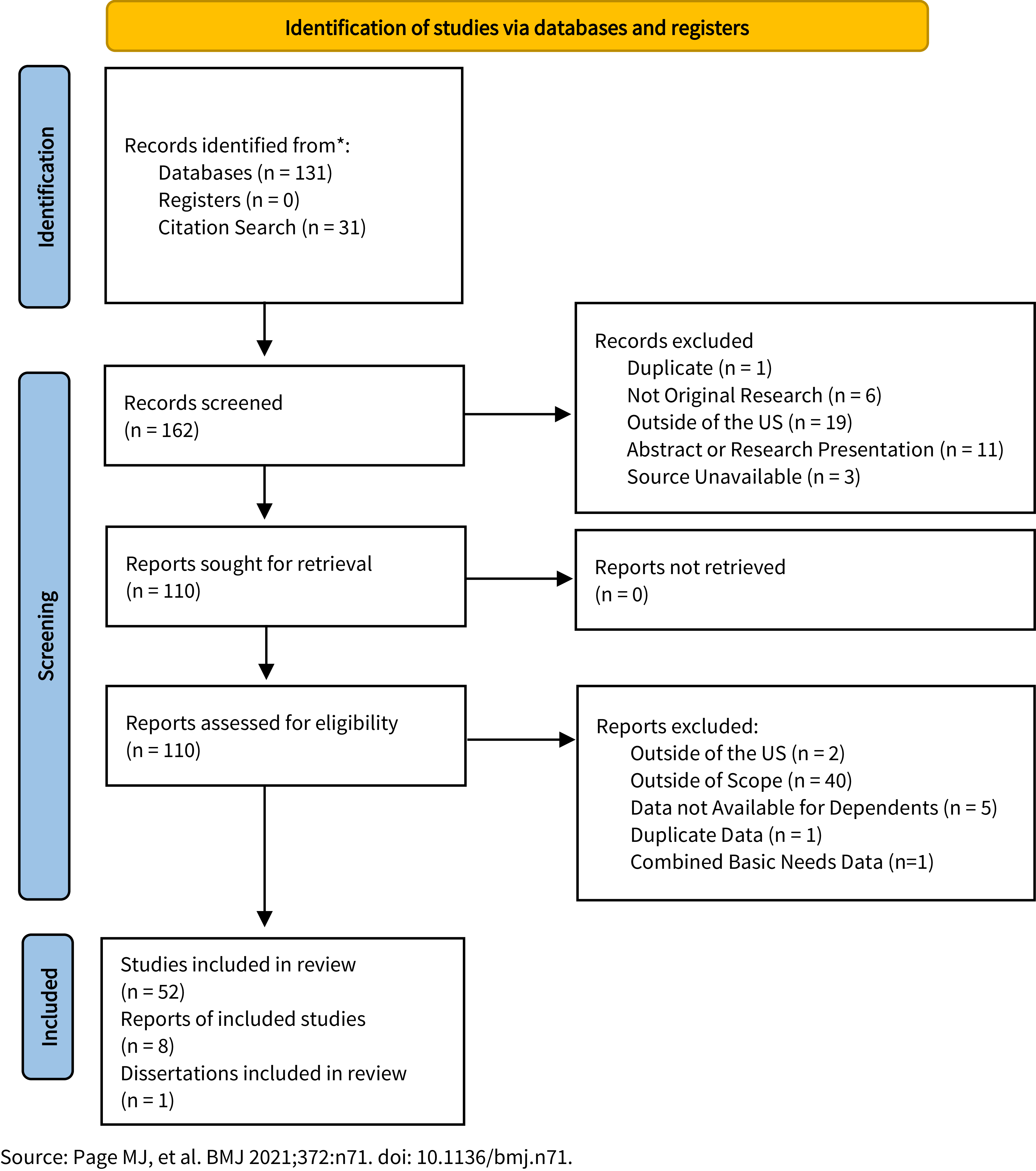
All identified peer-reviewed and grey literature sources found using selected databases were exported to a shared Google Folder and citations were input into Google Sheets for review. Thirty-one additional articles were identified through the cited reference search of a current review on college food insecurity(Reference Goldman, Freiria, Landry, Arikawa and Wright6). Identified dissertations were replaced by the corresponding published peer-reviewed literature, if available. In one case, a dissertation was replaced by two separate articles. A total of 162 sources were identified. The full list was sorted by author last name and citation numbers were assigned for study review. The authors used a three-step process to review the articles: title review, abstract review, and full-text review. The authors noted the reasons for exclusion at each phase. To ensure inter-rater reliability, the authors met and discussed the application of inclusion and exclusion criteria. The extracted articles were divided into three equal sets. Each author independently reviewed the titles and abstracts for two of the three sets, so that each set was reviewed by two authors. Authors met to check consistency between articles that should be kept or removed during the title and abstract review phases. Discrepancy in whether to keep or remove an article was resolved through discussion between reviewers. The third reviewer served as a tiebreaker as needed. Fifty-two articles were removed after the title and abstract review phases. The remaining articles were divided between the authors for full-text review against the study inclusion criteria. Any articles that were deemed questionable during full-text review were evaluated by the full review team. Forty-nine articles were excluded during the full-text review step. The article selection and screening process is shown in Figure 1.
PRISMA 2020 flow diagram.

Data extraction
Data were extracted from articles into a spreadsheet that was developed by the authors. The data extraction template was built and shared amongst authors via Google Sheets. The final articles included in the review (n = 61) were divided between the review team for data extraction. Extracted data from all articles included the study aim, indication if the study occurred during the Coronavirus Disease 2019 (COVID-19) pandemic, sample size, research method (quantitative, qualitative, or mixed-methods), recruitment method, student population, institution description, and dependent description. To address RQ 1, the method to measure food insecurity and the prevalence of food insecurity among students with dependents were extracted. Details regarding specific populations of parenting students who experienced risk factors for food insecurity, as determined by subgroup comparisons in the results, were also noted. To address RQ 2, additional data were extracted for dietary and/or academic consequences as well as programme use/challenges. The review team met multiple times during data extraction to discuss the process and resolve any issues.
Results
Study characteristics
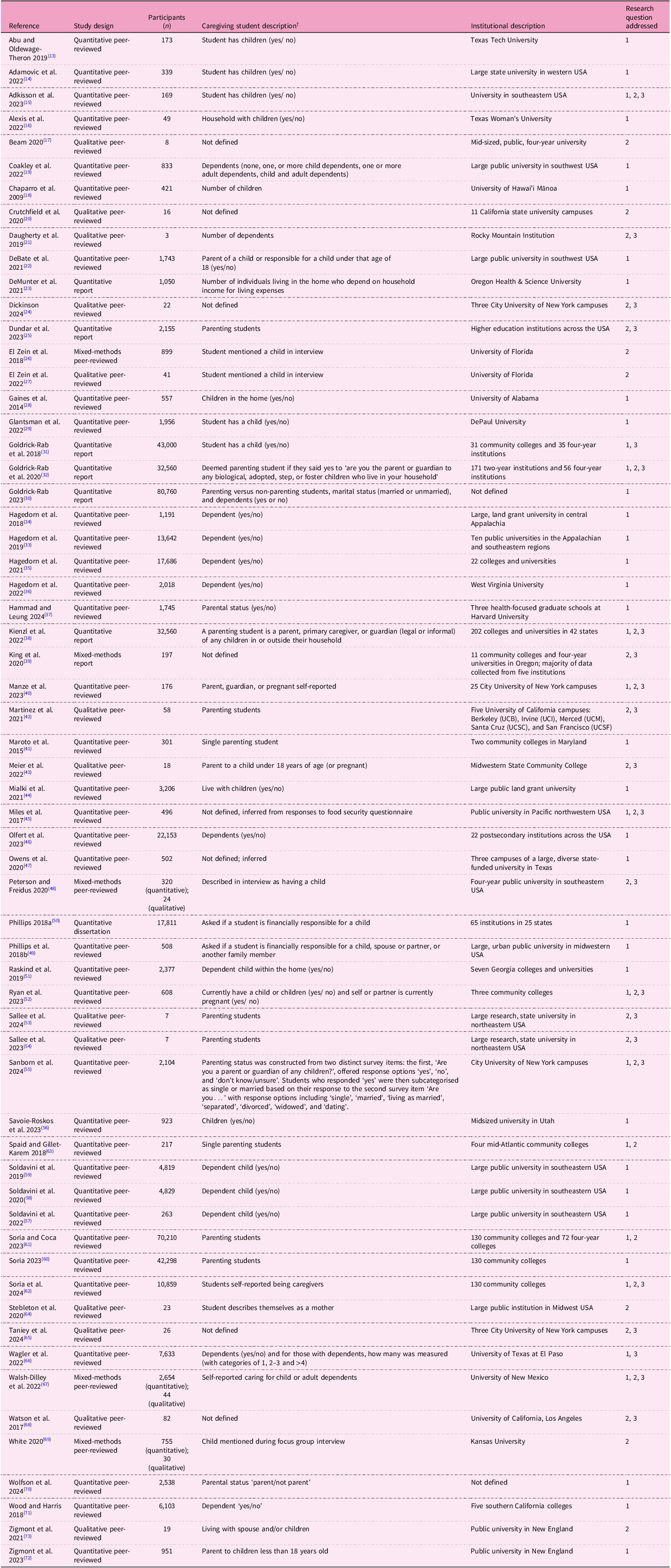
Of the 162 sources screened, 61 were included in the final review(Reference Abu and Oldewage-Theron13–Reference Zigmont, Linsmeier and Gallup73). Characteristics of the included sources are shown in Table 1, including which scoping review RQ each study addressed. Included studies were a mix of peer-reviewed articles (n = 52) and grey literature (n = 8 reports, n = 1 dissertation). Most (74%) of articles were published in 2020 or later. Studies incorporated three research designs: qualitative (n = 13), quantitative (n = 43), and mixed-methods designs (n = 5). The majority of studies recruited students via convenience sampling. Six studies used random sampling, four used stratified random sampling, one used a probability sample, and two used representative sampling. The sample size across all study types ranged from seven to 80,760. The descriptions of caregiving students also ranged significantly across studies. Studies that did provide a description focused heavily on caring for a child dependent (n = 52), whereas only nine studies considered adult dependents. Studies ranged from including a single college or university, across a university system, or institutions across the United States, and included both community colleges and four-year institutions.
Study characteristics*

*Some articles reported on sub-samples from a larger survey, study, or data collection effort. Details provided in the table are reflective of the sub-sample and may not reflect details of the larger survey or study.
†When no explicit operational definition of ‘caregiving student’ was provided, this was coded as ‘not defined’, although the study addressed students with caregiving responsibilities.
RQ 1: food insecurity prevalence among parenting students
Forty-three articles(Reference Abu and Oldewage-Theron13–Reference Alexis, Unruh, Wang, Dave, Miketinas and Chen16,Reference Chaparro, Zaghloul, Holck and Dobbs18,Reference Coakley, Cargas, Walsh-Dilley and Mechler19,Reference DeBate, Himmelgreen, Gupton and Heuer22,Reference DeMunter, Rdesinski, Vintro and Carney23,Reference Gaines, Robb, Knol and Sickler28–Reference Kienzl, Hu, Caccavella and Goldrick-Rab38,Reference Manze, Watnick and Freudenberg40,Reference Maroto, Snelling and Linck41,Reference Mialki, House, Mathews and Shelnutt44–Reference Owens, Brito-Silva, Kirkland, Moore, Davis and Patterson47,Reference Phillips, McDaniel and Croft49–Reference Ryan, Pieper, Adam, Askelson, Greene and Buckert52,Reference Sanborn, Manze and Watnick55–Reference Spaid and Gillett-Karam63,Reference Wagler, Schober, Chavez-Baray, Ayala, Dessauer and Moya66,Reference Walsh-Dilley, Coakley, Mechler and Cargas67,Reference Wolfson, Insolera, Laska and Leung70–Reference Zigmont, Anziano, Schwartz and Gallup72) (70%) reported quantitative estimates about the prevalence of food insecurity among college students with caregiving responsibilities. Two studies(Reference Glantsman, McGarity-Palmer, Swanson, Carroll, Zinter and Lancaster29,Reference Wagler, Schober, Chavez-Baray, Ayala, Dessauer and Moya66) provided food insecurity estimates on their university campus for two years (2019 and 2020). Studies varied in their definitions of having a child dependent. Six studies(Reference Beam17,Reference Hagedorn, McArthur, Hood, Berner, Anderson Steeves and Connell33–Reference Hagedorn, Olfert, MacNell, Houghtaling, Hood and Savoie Roskos35,Reference Miles, McBeath, Brockett and Sorenson45,Reference Wagler, Schober, Chavez-Baray, Ayala, Dessauer and Moya66) measured having dependents, but the measure was not clearly defined. One study asked if the students had children(Reference Goldrick-Rab, Richardson, Schneider, Hernandez and Cady31), while two studies included the number of dependents(Reference Daugherty, Birnbaum and Clark21,Reference Wagler, Schober, Chavez-Baray, Ayala, Dessauer and Moya66) . Two studies(Reference Manze, Watnick and Freudenberg40,Reference Ryan, Pieper, Adam, Askelson, Greene and Buckert52) included current pregnancy for themselves or their partner in the definition. Three studies(Reference Maroto, Snelling and Linck41,Reference Sanborn, Manze and Watnick55,Reference Spaid and Gillett-Karam63) focused on single parents. Two studies specified the household, asking about parenting or guardianship status for children living in the household(Reference Goldrick-Rab, Welton and Coca32), inside or outside the household(Reference Maroto, Snelling and Linck41), and two studies considered married/cohabitating parents(Reference Goldrick-Rab30,Reference Sanborn, Manze and Watnick55) .
The prevalence of food insecurity among parenting students ranged from 9% to 79%. Two studies reported estimates separately for students at two-year and four-year colleges(Reference Goldrick-Rab, Richardson, Schneider, Hernandez and Cady31,Reference Goldrick-Rab, Welton and Coca32) . Five studies focused only on students enrolled at two-year colleges(Reference Goldrick-Rab, Richardson, Schneider, Hernandez and Cady31,Reference Goldrick-Rab, Welton and Coca32,Reference Maroto, Snelling and Linck41,Reference Ryan, Pieper, Adam, Askelson, Greene and Buckert52,Reference Spaid and Gillett-Karam63) . Estimates were similar by university type but may be slightly higher at two-year universities (43–77%)(Reference Goldrick-Rab, Richardson, Schneider, Hernandez and Cady31,Reference Goldrick-Rab, Welton and Coca32,Reference Maroto, Snelling and Linck41,Reference Ryan, Pieper, Adam, Askelson, Greene and Buckert52,Reference Spaid and Gillett-Karam63) than at four-year universities (9–79%)(Reference Abu and Oldewage-Theron13–Reference Adkisson, Dean, Gutschall, Farris, Root and McArthur15,Reference Chaparro, Zaghloul, Holck and Dobbs18,Reference Coakley, Cargas, Walsh-Dilley and Mechler19,Reference DeBate, Himmelgreen, Gupton and Heuer22,Reference DeMunter, Rdesinski, Vintro and Carney23,Reference Gaines, Robb, Knol and Sickler28–Reference Hagedorn, McArthur, Hood, Berner, Anderson Steeves and Connell33,Reference Hagedorn, Olfert, MacNell, Houghtaling, Hood and Savoie Roskos35–Reference Hammad and Leung37,Reference Mialki, House, Mathews and Shelnutt44,Reference Olfert, Hagedorn-Hatfield, Houghtaling, Esquivel, Hood and MacNell46,Reference Phillips, McDaniel and Croft49–Reference Raskind, Haardorfer and Berg51,Reference Savoie-Roskos, Harrison, Coombs, Hendrickson, Hawes and Barney56–Reference Soria, Vakanski, White and Arp62,Reference Wagler, Schober, Chavez-Baray, Ayala, Dessauer and Moya66,Reference Walsh-Dilley, Coakley, Mechler and Cargas67,Reference Wolfson, Insolera, Laska and Leung70–Reference Zigmont, Anziano, Schwartz and Gallup72) . Variability may have been affected by low numbers of parenting students in some studies. Six studies(Reference Goldrick-Rab30,Reference Kienzl, Hu, Caccavella and Goldrick-Rab38,Reference Manze, Watnick and Freudenberg40,Reference Sanborn, Manze and Watnick55,Reference Soria and Coca61,Reference Wolfson, Insolera, Laska and Leung70) had samples that combined prevalence estimates across institution types, and these food insecurity estimates ranged from 21% to 61%. Twenty-seven studies(Reference Abu and Oldewage-Theron13,Reference Adkisson, Dean, Gutschall, Farris, Root and McArthur15,Reference Alexis, Unruh, Wang, Dave, Miketinas and Chen16,Reference Chaparro, Zaghloul, Holck and Dobbs18,Reference DeBate, Himmelgreen, Gupton and Heuer22,Reference Gaines, Robb, Knol and Sickler28,Reference Glantsman, McGarity-Palmer, Swanson, Carroll, Zinter and Lancaster29,Reference Goldrick-Rab, Richardson, Schneider, Hernandez and Cady31,Reference Hagedorn, McArthur, Hood, Berner, Anderson Steeves and Connell33–Reference Hammad and Leung37,Reference Maroto, Snelling and Linck41,Reference Mialki, House, Mathews and Shelnutt44–Reference Owens, Brito-Silva, Kirkland, Moore, Davis and Patterson47,Reference Phillips, McDaniel and Croft49,Reference Phillips50,Reference Sanborn, Manze and Watnick55,Reference Savoie-Roskos, Harrison, Coombs, Hendrickson, Hawes and Barney56,Reference Soldavini and Berner58,Reference Wagler, Schober, Chavez-Baray, Ayala, Dessauer and Moya66,Reference Walsh-Dilley, Coakley, Mechler and Cargas67,Reference Wolfson, Insolera, Laska and Leung70,Reference Zigmont, Anziano, Schwartz and Gallup72) included a reference group of non-parents to identify if parenting students experience a higher burden of food insecurity compared to non-parenting students, and also provided the results of statistical testing to compare the two groups. Eleven of these studies (39.3%) found statistically significant differences between the two groups, with parents having a higher prevalence of food insecurity, while 18 studies did not find associations between food insecurity and dependent status. One study(Reference Wagler, Schober, Chavez-Baray, Ayala, Dessauer and Moya66) provided data that compared parenting students in 2019 and again in 2020, with the 2019 timeframe showing an association, while the 2020 timeframe did not. Two studies(Reference Phillips50,Reference Wagler, Schober, Chavez-Baray, Ayala, Dessauer and Moya66) included non-parent reference groups and compared levels of food insecurity, finding that the prevalence of low and very low food insecurity was higher for parents than non-parents. Similarly, food insecurity prevalences were higher for students with more dependents (81% among those with more than four dependents) compared to 61.8% among those with one dependent(Reference Wagler, Schober, Chavez-Baray, Ayala, Dessauer and Moya66).
Beyond the prevalence of food insecurity, one study simply reported that they found no association between food insecurity and students with caregiving responsibilities(Reference DeMunter, Rdesinski, Vintro and Carney23). Further, 13 studies(Reference Adamovic, Newton and House14,Reference Chaparro, Zaghloul, Holck and Dobbs18,Reference Coakley, Cargas, Walsh-Dilley and Mechler19,Reference DeMunter, Rdesinski, Vintro and Carney23,Reference Glantsman, McGarity-Palmer, Swanson, Carroll, Zinter and Lancaster29,Reference Owens, Brito-Silva, Kirkland, Moore, Davis and Patterson47,Reference Phillips, McDaniel and Croft49,Reference Raskind, Haardorfer and Berg51,Reference Soldavini and Berner58–Reference Soria and Coca61,Reference Wood and Harris71) used regression modelling to estimate the differences in food insecurity between parenting and non-parenting students. Regression models in each of the studies included differing variables, which limits comparability between studies. Five studies(Reference Adamovic, Newton and House14,Reference Chaparro, Zaghloul, Holck and Dobbs18,Reference Coakley, Cargas, Walsh-Dilley and Mechler19,Reference Raskind, Haardorfer and Berg51,Reference Wood and Harris71) found no significant association between food security and parenting status using odds ratios or beta coefficients. Eight articles reported an association between parental status and food insecurity; parents had higher odds of food insecurity than their non-parenting peers(Reference Glantsman, McGarity-Palmer, Swanson, Carroll, Zinter and Lancaster29,Reference Owens, Brito-Silva, Kirkland, Moore, Davis and Patterson47,Reference Phillips50,Reference Sanborn, Manze and Watnick55,Reference Soldavini and Berner58–Reference Soria and Coca61) . Odds ratios ranged from 1.004 to 4.89 for food-insecure students. Estimates varied substantially due to small parenting student sample sizes in some studies.
Students with risk factors for food insecurity
Thirteen articles (21.3%) identified specific parenting student populations with risk factors for food insecurity. Marital status was identified to be a factor in the risk of food insecurity. Single parents were the most identified student population, with an increased experience of food insecurity observed in 69.2% (9 out of 13) of these articles(Reference Alexis, Unruh, Wang, Dave, Miketinas and Chen16,Reference Goldrick-Rab30,Reference Goldrick-Rab, Welton and Coca32,Reference Kienzl, Hu, Caccavella and Goldrick-Rab38,Reference Maroto, Snelling and Linck41,Reference Owens, Brito-Silva, Kirkland, Moore, Davis and Patterson47,Reference Sanborn, Manze and Watnick55,Reference Soria, Vakanski, White and Arp62,Reference Spaid and Gillett-Karam63) . Rates of food insecurity for single-parenting students were present in 8 out of 13 articles and ranged from 37% to 77%(Reference Alexis, Unruh, Wang, Dave, Miketinas and Chen16,Reference Goldrick-Rab30,Reference Goldrick-Rab, Welton and Coca32,Reference Kienzl, Hu, Caccavella and Goldrick-Rab38,Reference Maroto, Snelling and Linck41,Reference Owens, Brito-Silva, Kirkland, Moore, Davis and Patterson47,Reference Sanborn, Manze and Watnick55,Reference Spaid and Gillett-Karam63) . One study(Reference Alexis, Unruh, Wang, Dave, Miketinas and Chen16) only detailed rates among female students and found that female single parents had higher rates of low food security compared to non-parenting students, but overall food insecurity prevalence among single students was not provided. Two articles compared single-parenting students to married-parenting students, and both revealed a greater than 15% difference between the two parenting populations(Reference Goldrick-Rab, Welton and Coca32,Reference Sanborn, Manze and Watnick55) . One study(Reference Sanborn, Manze and Watnick55) additionally considered the home environment and compared single parents to non-parents and married/cohabitating parents. This study found that the food insecurity prevalence was higher for single parents (41.8%) compared to non-parents (31.3%) and married/cohabitating parents (24.4%)(Reference Sanborn, Manze and Watnick55). Single parents were found to have twice the odds of food insecurity compared to married/cohabitating parents. An additional study that was conducted during the COVID-19 pandemic reported students who were single parents had greater odds of being food insecure (OR = 2.48, 95% CI: 2.03, 3.04, p < 0.001) compared to students who lived alone(Reference Owens, Brito-Silva, Kirkland, Moore, Davis and Patterson47). Another study comparing single parents and non-single parents also found a higher burden of food insecurity for single parents (77% versus 54%, respectively).(Reference Maroto, Snelling and Linck41) One study identified caregiving students who were single or divorced to have a higher probability of experiencing food insecurity(Reference Soria, Vakanski, White and Arp62).
Three articles(Reference Goldrick-Rab, Welton and Coca32,Reference Kienzl, Hu, Caccavella and Goldrick-Rab38,Reference Soria, Vakanski, White and Arp62) identified race/ethnicity differences among parenting students experiencing food insecurity. One study(Reference Kienzl, Hu, Caccavella and Goldrick-Rab38) determined that, when combined, students of colour had a 3% increased prevalence of food insecurity compared to White students. In this same study, when exploring experiences with food insecurity, 25% of students of colour reported issues feeding their children balanced meals compared to 19% of White students, and 11% of students of colour cut meal sizes compared to 5% of White parenting students(Reference Kienzl, Hu, Caccavella and Goldrick-Rab38). Another study revealed that White students had a reduced probability of experiencing food insecurity(Reference Soria, Vakanski, White and Arp62). A HOPE Center report noted that, at both two- and four-year institutions, White parenting students had the lowest prevalence of food insecurity(Reference Goldrick-Rab, Welton and Coca32). In the same report, Black parenting students had 13% and 21% higher rates of food insecurity compared to White parenting students at two- and four-year institutions, respectively. Overall, Black female parents were identified in the HOPE Center report as the student population with the highest rates of food insecurity(Reference Goldrick-Rab, Welton and Coca32).
Three studies(Reference Dundar, Tighe and Turner25,Reference Goldrick-Rab, Welton and Coca32,Reference Soria, Vakanski, White and Arp62) reported that the gender of students with child dependents was a risk factor for food insecurity. One study(Reference Goldrick-Rab, Welton and Coca32) reported that female students with child dependents experienced higher rates of food insecurity, while another(Reference Dundar, Tighe and Turner25) identified that mothers with child dependents were more likely to report financial difficulties acquiring food. Identifying as a cisgender man or woman and identifying as heterosexual had a reduced likelihood of experiencing food insecurity in one study examining students with dependents(Reference Soria, Vakanski, White and Arp62). In the same study, students with dependents who identified as transgender had an increased probability of experiencing food insecurity(Reference Soria, Vakanski, White and Arp62). When comparing food insecurity prevalence between cisgender female students to non-binary/third gender students, there was a 21% and 34% increase in food insecurity for non-binary/third gender parenting students with child dependents at two- and four-year institutions, respectively(Reference Goldrick-Rab, Welton and Coca32). These differences were even greater when comparing cisgender male students to non-binary/third gender students, with rates of food insecurity being 30% higher at two-year institutions and 47% higher at four-year institutions for students with child dependents(Reference Goldrick-Rab, Welton and Coca32).
Two sources identified the number of children/other dependents in the care of the college student as a contributing factor towards increased food insecurity prevalence(Reference Goldrick-Rab, Welton and Coca32,Reference Wagler, Schober, Chavez-Baray, Ayala, Dessauer and Moya66) . Specifically, in both sources, having four or more children was identified as the parenting group with the highest rates of food insecurity. In a HOPE Center report, having two dependents was identified as the group with the lowest prevalence of food insecurity(Reference Goldrick-Rab, Welton and Coca32). Similarly, another study found that students who report having two or three dependents had lower rates of food insecurity (57.8% in 2019 and 53.3% in 2020) compared to those with one dependent (61.8% in 2019 and 54.4% in 2020) and those with four or more dependents (81.1% in 2019 and 57.9% in 2020)(Reference Wagler, Schober, Chavez-Baray, Ayala, Dessauer and Moya66).
Other characteristics among parenting students that were reported to be associated with a higher burden of food insecurity in singular studies were being a foreign-born student(Reference Ryan, Pieper, Adam, Askelson, Greene and Buckert52), being a caregiver with a disability(Reference Soria and Coca61), being a first-generation college student(Reference Soria60,Reference Soria, Vakanski, White and Arp62) , being a graduate student(Reference Soldavini, Berner and Da Silva59), and having a history of familial financial strain or being in foster care(Reference Soria, Vakanski, White and Arp62).
RQ 2: caregiving’s impact on dietary intake and academic performance
Thirteen studies(Reference Adkisson, Dean, Gutschall, Farris, Root and McArthur15,Reference Beam17,Reference Crutchfield, Maguire, Campbell, Lohay, Valverde Loscko and Simon20,Reference Daugherty, Birnbaum and Clark21,Reference King, Siever, Ruff and Maskey39,Reference Meier, Ryan, Askelson, Pieper, Greene and Buckert43,Reference Miles, McBeath, Brockett and Sorenson45,Reference Peterson and Freidus48,Reference Sallee, Kohler, Haumesser and Hine54,Reference Stebleton, Lee and Diamond64,Reference Taniey and Leyden65,Reference White69,Reference Zigmont, Linsmeier and Gallup73) examined the impact of caregiving for a dependent on college students’ dietary choices and intake. These studies revealed that students commonly prioritised feeding their child before themselves, often selecting meals centred around their child’s preferences. In more severe cases, students reported eating less to ensure that available food lasted longer. In one study(Reference Miles, McBeath, Brockett and Sorenson45), parents reported having to cut the size of their children’s meal, worrying their child was hungry, and even reporting their child did not eat for a day. Many students indicated a heavy reliance on low-cost, low-nutrient foods due to stringent food budgets, which often led to poor nutritional outcomes and compromised health. Parenting students reported utilising foods that would stretch, such as oats or rice, and indicated that fruits and vegetables were more difficult to acquire on a limited budget(Reference Adkisson, Dean, Gutschall, Farris, Root and McArthur15,Reference Daugherty, Birnbaum and Clark21,Reference Stebleton, Lee and Diamond64) . One study(Reference Stebleton, Lee and Diamond64) indicated this challenge was elevated after children aged out of nutrition assistance programmes, such as the Special Supplemental Nutrition Program for Women, Infants, and Children (WIC), which supports the purchase of healthier products. Two additional studies(Reference Goldrick-Rab, Welton and Coca32,Reference Kienzl, Hu, Caccavella and Goldrick-Rab38) highlighted the challenges faced by student caregivers in utilising foods acquired from food assistance programmes on campus. Limited availability of suitable options on campus forced students to skip meals frequently or make trips to off-campus locations where their benefits could be used. Efforts to keep children unaware were commonly reported but caused stress and negative feelings for parenting students when having to hide food to make it stretch or keep children from attending social events that required additional money for food(Reference Beam17). Coping with limited financial resources also goes beyond stretching meals and utilising food assistance programmes, as parents may volunteer at functions with free food, provide services to friends in exchange for home-cooked meals, and change shopping habits to find free and reduced price items(Reference Daugherty, Birnbaum and Clark21).
The review identified six studies(Reference Adkisson, Dean, Gutschall, Farris, Root and McArthur15,Reference Beam17,Reference Soria60–Reference Soria, Vakanski, White and Arp62,Reference Taniey and Leyden65) that specifically highlighted the academic challenges encountered by college students who undertake caregiving responsibilities. These students expressed concerns about needing to schedule their academic obligations around their caregiving duties, which often led to increased stress and time-management difficulties. Financial limitations even resulted in having to bring children to class in one study(Reference Beam17). Moreover, students indicated that their caregiving responsibilities prolonged their time in college, potentially delaying graduation. These challenges were exacerbated by COVID-19, as mentioned in three studies(Reference Adkisson, Dean, Gutschall, Farris, Root and McArthur15,Reference Soria60,Reference Soria and Coca61) . No studies within this review quantified the direct impact of food insecurity among caregiving students on students’ GPA or performance in individual courses.
RQ 3: food assistance use and availability of programmes
Thirteen studies(Reference Adkisson, Dean, Gutschall, Farris, Root and McArthur15,Reference Daugherty, Birnbaum and Clark21,Reference Dickinson24,Reference Goldrick-Rab, Welton and Coca32,Reference King, Siever, Ruff and Maskey39,Reference Manze, Watnick and Freudenberg40,Reference Meier, Ryan, Askelson, Pieper, Greene and Buckert43,Reference Miles, McBeath, Brockett and Sorenson45,Reference Peterson and Freidus48,Reference Sallee, Hine and Kohler53–Reference Sanborn, Manze and Watnick55,Reference Taniey and Leyden65) identified the use of food assistance programmes among parenting college students. Five studies(Reference Adkisson, Dean, Gutschall, Farris, Root and McArthur15,Reference King, Siever, Ruff and Maskey39,Reference Meier, Ryan, Askelson, Pieper, Greene and Buckert43,Reference Miles, McBeath, Brockett and Sorenson45,Reference Taniey and Leyden65) reported the use of federal nutrition assistance programmes, including the Supplemental Nutrition Assistance Program (SNAP), the National School Lunch Program (NSLP), and WIC; six studies(Reference Daugherty, Birnbaum and Clark21,Reference Dickinson24,Reference Peterson and Freidus48,Reference Sallee, Hine and Kohler53,Reference Sallee, Kohler, Haumesser and Hine54,Reference Taniey and Leyden65) indicated the use of campus food resources including campus food pantries; and three studies more broadly looked at the use of food assistance programmes as a whole(Reference Goldrick-Rab, Welton and Coca32,Reference Manze, Watnick and Freudenberg40,Reference Sanborn, Manze and Watnick55) . Although no study explicitly addressed the availability of programmes for parenting students, a few studies did identify challenges parenting students face when utilising resources. SNAP and WIC benefits were noted to help parenting college students meet their needs, and food-insecure parenting students were more likely to enrol in federal food assistance programmes(Reference Adkisson, Dean, Gutschall, Farris, Root and McArthur15,Reference Meier, Ryan, Askelson, Pieper, Greene and Buckert43,Reference Miles, McBeath, Brockett and Sorenson45) . However, SNAP benefits were reportedly insufficient to cover needs fully, and parenting college students still struggled to cover the cost of food(Reference King, Siever, Ruff and Maskey39,Reference Taniey and Leyden65) . Furthermore, it was shown in one study that parenting students reported the need for assistance in applying for SNAP benefits(Reference Ryan, Pieper, Adam, Askelson, Greene and Buckert52).
One study(Reference Taniey and Leyden65) found that parenting students found the campus-based food pantry to be a beneficial supplement to SNAP benefits. Another study found that the food pantry was highly valued because it offered a variety of food options and helped to shield children from the awareness of their family’s struggles with food access(Reference Daugherty, Birnbaum and Clark21). Another study reported that campus meal vouchers were a ‘big help’ to parenting students(Reference Dickinson24). However, data from a different sample of parenting students reported that campus food resources, including the food pantry, were difficult for this population to use(Reference Sallee, Hine and Kohler53,Reference Sallee, Kohler, Haumesser and Hine54) . Students with caregiving responsibilities reported obstacles when attempting to use campus food assistance, including physical access, pantry hours, and lack of clarity surrounding the support they offer to parenting students. Further, one study highlighted the stigma that parenting students face, and feelings of shame for not waiting to have a child(Reference Peterson and Freidus48). Overall, the food pantry was noted to be a resource that was not designed with parenting students in mind.
When compared with non-parenting students, parents were found to be more likely to use food assistance programmes overall(Reference Sanborn, Manze and Watnick55). Additionally, another study found that students who identified that their pregnancy or that of their partner interfered with college were more likely to utilise food assistance programmes(Reference Manze, Watnick and Freudenberg40). However, the use of food assistance was low among parenting students in two studies, despite high rates of food insecurity(Reference Goldrick-Rab, Welton and Coca32,Reference Sanborn, Manze and Watnick55) .
Intersection with other basic needs insecurities
Basic needs are essential resources required to support wellbeing and academic success. Sixteen sources(Reference Dundar, Tighe and Turner25,Reference Goldrick-Rab, Richardson, Schneider, Hernandez and Cady31,Reference Goldrick-Rab, Welton and Coca32,Reference Kienzl, Hu, Caccavella and Goldrick-Rab38,Reference Manze, Watnick and Freudenberg40,Reference Martinez, Esaryk, Moffat and Ritchie42,Reference Meier, Ryan, Askelson, Pieper, Greene and Buckert43,Reference Ryan, Pieper, Adam, Askelson, Greene and Buckert52–Reference Sanborn, Manze and Watnick55,Reference Soria, Vakanski, White and Arp62,Reference Wagler, Schober, Chavez-Baray, Ayala, Dessauer and Moya66–Reference Watson, Malan, Glik and Martinez68) were found to present findings that parenting students struggled with basic needs insecurities beyond food insecurity. One study(Reference Kienzl, Hu, Caccavella and Goldrick-Rab38) indicated that basic needs insecurities were an estimated 10% higher for parenting students, with students of colour facing a higher burden of basic needs insecurity. However, this same report found that single, Black male parents reported lower overall use of resources to meet their basic needs.(Reference Kienzl, Hu, Caccavella and Goldrick-Rab38) Challenges with housing or house insecurity were the most commonly addressed basic needs insecurity beyond food insecurity, identified in 11 studies(Reference Dundar, Tighe and Turner25,Reference Goldrick-Rab, Richardson, Schneider, Hernandez and Cady31,Reference Goldrick-Rab, Welton and Coca32,Reference Manze, Watnick and Freudenberg40,Reference Martinez, Esaryk, Moffat and Ritchie42,Reference Meier, Ryan, Askelson, Pieper, Greene and Buckert43,Reference Ryan, Pieper, Adam, Askelson, Greene and Buckert52,Reference Sanborn, Manze and Watnick55,Reference Soria, Vakanski, White and Arp62,Reference Wagler, Schober, Chavez-Baray, Ayala, Dessauer and Moya66,Reference Walsh-Dilley, Coakley, Mechler and Cargas67) . Similar to food insecurity, rates of housing insecurity were high among parenting students. This double burden of food and housing insecurity was explicitly studied in one article and found to be of greater occurrence among those with adult dependents(Reference Walsh-Dilley, Coakley, Mechler and Cargas67).
Other basic needs insecurities identified included childcare, and financial and transportation issues(Reference Dundar, Tighe and Turner25,Reference King, Siever, Ruff and Maskey39,Reference Martinez, Esaryk, Moffat and Ritchie42,Reference Sallee, Hine and Kohler53,Reference Sallee, Kohler, Haumesser and Hine54,Reference Watson, Malan, Glik and Martinez68) . The use of the Section 8 housing programme was reported in one study as a vital resource for students with limited financial resources(Reference Meier, Ryan, Askelson, Pieper, Greene and Buckert43). Three studies(Reference Goldrick-Rab, Welton and Coca32,Reference Manze, Watnick and Freudenberg40,Reference Soria, Vakanski, White and Arp62) described limitations associated with childcare. Students in two of the identified studies reported struggling to pay for the cost of childcare. One quantitative study found that students who experience childcare challenges were more likely to worry about food insecurity and have issues associated with hunger. However, similar to issues applying for SNAP benefits, parenting college students reported the need for additional assistance applying to state or federal programmes to help meet their basic needs(Reference Ryan, Pieper, Adam, Askelson, Greene and Buckert52). For campus programming, as aforementioned with food insecurity resources, support for parenting students to meet other basic needs was identified to be lacking. Studies identified that parenting students felt they had less financial support, and programming at their institutions was not designed to fit their specific needs, despite their increased financial and time responsibilities(Reference Martinez, Esaryk, Moffat and Ritchie42,Reference Sallee, Hine and Kohler53,Reference Sallee, Kohler, Haumesser and Hine54,Reference Watson, Malan, Glik and Martinez68) .
Discussion
Overall, studies examining the prevalence of food insecurity among parenting students across two-year, four-year, and graduate institutions varied in quality. Much of this variability stems from inconsistent definitions of parenting students or caregivers. In addition, many studies do not adequately account for factors that may influence the food insecurity experience, such as the home environment (marital status) and/or the number of children in the household. Additionally, very few studies considered caregiver responsibilities for family members or older parents. Research was mixed, but, overall, for studies that had comparison groups, more studies found a higher prevalence of food insecurity for parenting students than non-parenting students. There was not enough research examining this association at the community college to make a statement comparing food security prevalence across two- and four-year institutions. While in some studies subgroups of student caregivers were identified to have a higher burden of food insecurity, this information was not consistently reported across studies and made comparisons difficult.
Lack of data on college students caring for dependents
Data on students who care for a dependent were limited. This included overall prevalence as well as programmes and resource support for these students. While some evidence suggests that the burden of being a dual student and caregiver may negatively impact academic performance, health outcomes, and overall wellbeing, more data are needed.
A key limitation of existing college food insecurity research is that students who care for a dependent are often overlooked. A small number of higher-education institutions currently collect, or have routinely collected, data on students caring for dependents, while others have conducted intermittent or one-time survey efforts. Several states, including California, Michigan, Oregon, Texas, Maryland, and Illinois, have begun responding to the need for data on students’ parenting and/or caregiving status since 2020 by passing bills requiring higher-education institutions to track this data(Reference Sick, Anderson, Green, Adu-Gyamfi and DeMario74). Similar federal legislation, Understanding Student Parent Outcomes Act of 2023, has been introduced in Congress (118th Congress, H.R. 6309).
Even within existing efforts, quantifying the caregiving responsibilities of college students presents several challenges. First, measuring the amount of time a student dedicates to caring for a dependent, for example, is complex. Descriptive questions, such as whether they are the primary caregiver or care for a dependent ‘most’ or ‘more than half’ of the time, need clearer definitions to ensure accurate data collection. Furthermore, the scope of caregiving – whether the student provides support to, is responsible for, or actively cares for a dependent – varies and needs precise categorisation. For instance, caring for a young child demands greater attention and resources compared to caring for an older child, and measuring this variability accurately is crucial. Also, the time required to care for an older adult will depend on their specific health conditions. Additionally, future data collection efforts could also consider asking students caring for a dependent if they have a partner who assists with any caregiving responsibilities. In our review, several studies defined a caregiving student as single students without a partner; however, the study by Sanborn et al.(Reference Sanborn, Manze and Watnick55) asked about parenting status and relationship status. Having a partner to assist with caregiving duties may impact food security status or campus resource use because it can alleviate the overall caregiving burden, provide emotional support, and create more financial flexibility.
Additionally, while already sparse, much of the current existing programmes and support for college students we found in our scoping review are centred around those caring for child dependents. To our knowledge, few resources focus on college students caring for adult dependents. Given the population trend in the United States toward older age demographics and the anticipated rise in demand for older adult care, higher education institutions may see an increase in the number of students who are responsible for an adult family member. Therefore, it is crucial to direct more attention and resources to support this particular student population to ensure their academic success and wellbeing.
Implications and recommendations
Improving resources and services for food-insecure college students who care for child or adult dependents involves addressing their individual challenges and providing comprehensive support. Solutions must acknowledge that reliable access to nutritious and sufficient food is probably not the only problem students face, as they may also experience a lack of resources and financial stability to fulfil basic needs.
A first step for making actionable change towards promoting food security is determining the prevalence and risk factors and evaluating this regularly(Reference Landry, Heying, Qamar, Hagedorn-Hatfield, Savoie-Roskos and Cuite75). Institutions with a greater prevalence of students who care for child or adult dependents will need to plan, restructure, and implement programmes to accommodate the needs of these students(Reference Hagedorn-Hatfield, Qamar, Richards, Patton-López, Savoie-Roskos and Heying76). Campus-specific assessments should be conducted to determine the particular food security needs of each institution and its student body. It is important to note that a one-size-fits-all approach will not be most effective compared to a campus-specific approach, as some campuses may have more students who care for children, while others may have more students caring for adult dependents, or a balance between the two. Additionally, differences in geographic variability of campuses should be considered. We propose and summarise key recommendations for higher education institutions drawn from recommendations stated in the included studies and from consistent themes identified across our scoping review.
First, as we have recommended elsewhere(Reference Landry, Savoie-Roskos, Gray, Mann, Qamar and Hagedorn-Hatfield77), higher education institutions should establish dedicated resource centres or basic needs centres. These centres serve as comprehensive, one-stop resource hubs, offering a range of services aimed at addressing food insecurity, housing instability, healthcare access, and other critical basic needs. Best practices, such as ensuring that existing services, such as food pantries, are accessible to student caregivers through convenient hours and offering easy pick-up options, are essential. We also acknowledge that the type(s) of assistance provided at a basic needs centre for a student caring for dependents may be different from what is provided to a more traditional student. Awareness of available resources is often a challenge on campuses, so implementing targeted awareness campaigns should aim to inform student caregivers about available and relevant support services and resources. Providing student caregivers with support in completing complicated application processes for government food assistance programmes may improve access to these resources. Some institutions have basic needs coordinators that help students to navigate support programmes, application processes, and regulations, and some states such as Texas have gone as far as requiring that state institutions have a designated support liaison for parenting students (Texas Ed. Code § 51.982). These dedicated staff members play an important role, based on their knowledge and familiarity with assistance programmes specific to students with dependents. For example, there is a federal grant programme to help low-income parenting students pay for childcare: Child Care Access Means Parents in School, or CCAMPIS. A Government Accountability Office study found that parenting students who received CCAMPIS subsidies were more likely to stay in college(Reference Emrey-Arras78).
In addition to food security, housing security was noted as a persistent concern for many students caring for dependents. Unlike most traditional college students, those with dependents often require multiple-bedroom accommodations (as opposed to a single bedroom), and as a result often must pay higher costs for housing. Institutions can consider developing or expanding family housing options on or near campus with amenities suitable for children and families. Alternatively, subsidies or financial aid for housing costs can be offered. More broadly, higher education institutions can consider how general financial support tailored to the needs of student caregivers could be provided. For example, institutions could offer targeted scholarships or grants for emergency caregiving expenses. These flexible funds would be used as needed by student caregivers to cover a range of essential costs, such as childcare services, medical bills for dependents, or unexpected financial burdens that arise from caregiving responsibilities.
Reliable childcare and adult care services are equally important to ensure that students have time to attend classes and study. Institutions should establish or expand affordable childcare facilities on campus with flexible hours to accommodate students’ class and study schedules. Ensuring that on-campus childcare services prioritise students, not just faculty and staff, and addressing waiting list issues are important steps. In general, larger institutions are more likely to provide on-campus care. Collaborations with local organisations and businesses can be impactful for universities and colleges that lack the capital to provide additional resources or services or where the resource or service would be underutilised by only the campus population. Collaborations or partnerships could provide subsidies or vouchers for an off-campus service to reduce the financial burden on students (e.g., a community-based childcare centre offering discounted childcare services). Collaborations with local organisations and businesses can also be impactful and easier to access for commuting students who often spend little time on campus outside their classes. To the authors’ knowledge, few, if any, institutions offer on-campus adult-care services. For example, some, such as the University of California, San Francisco, provide paid access to services to navigate the process of finding care(79). However, students are still responsible for paying for the care they find and use. We propose that care facilities that support both child and adult care could be an area for institutions to consider allocating future resources towards.
Developing a welcoming campus environment that holistically supports students who care for dependents includes both academic accommodations and supportive campus policies.(Reference Savoie-Roskos, Hood, Hagedorn-Hatfield, Landry, Patton-López and Richards80) Flexible academic policies can significantly aid student caregivers. Institutions can develop leave policies that allow students to take time off for caregiving without academic penalties and offer flexible scheduling options, including more evening, weekend, or online classes, to accommodate the diverse schedules of student caregivers. Even something as simple as adopting a campus policy where student caregivers get priority registration to ensure classes accommodate their care schedules can be a highly effective and supportive strategy. An example of this in practice can be seen at California institutions of higher education, where state law requires educational institutions to provide priority registration for parenting college students (California Ed. Code § 66025).
A strategy to offer resources for students with dependents could include reworking existing approaches or reimagining current spaces to better accommodate their unique needs and challenges. For example, this could be achieved by offering support groups, dedicated spaces, and tailored events that specifically address the needs of student caregivers. Support groups provide a vital network of peers who understand the unique challenges of balancing academic responsibilities with caregiving duties. Dedicated spaces, such as infant and child-friendly lactation rooms and study rooms, create a campus climate where student caregivers feel included. Additionally, hosting events tailored to student caregivers, such as family-friendly gatherings and workshops on time management and stress relief, helps to build a sense of community and provides valuable resources.
Lastly, campuses should consider adopting a comprehensive approach that supports a holistic culture of food security on their campus with a focus on creating opportunities for all students to maintain health and wellbeing(Reference Savoie-Roskos, Hood, Hagedorn-Hatfield, Landry, Patton-López and Richards80). Higher education institutional administration in particular plays an important role in establishing a culture that promotes student health and in ensuring appropriate support and resources are available for students(Reference Landry, Savoie-Roskos, Gray, Mann, Qamar and Hagedorn-Hatfield77). Beyond the university campus, it is often important for institutions to actively work with local, state, and federal governments to secure additional funding and resources. By implementing these recommendations, higher education institutions can make significant strides in improving food security among college students, especially those that care for dependents, thereby empowering student caregivers to thrive academically and personally.
Conclusion
This scoping review demonstrates that food insecurity disproportionately affects college students with caregiving responsibilities, with prevalence rates consistently higher relative to other college students. Beyond prevalence, the review reveals that food insecurity compromises dietary quality, undermines academic progress, and co-occurs with housing instability, creating a compounding burden. Existing food assistance programmes – while valued – remain underutilised due to logistical barriers such as limited pantry hours, inadequate SNAP benefits, and a lack of caregiver-specific services, underscoring the need for campus resources explicitly designed with this population in mind. Higher education institutions, in partnership with local and federal stakeholders, can adopt comprehensive, caregiver-centred approaches, including flexible academic policies, expanded childcare services, and targeted basic needs support, to promote the food security, wellbeing, and academic success of this growing and underserved student population.
Data availability statement
The data that support the findings of this scoping review are available from the corresponding author, M.J.L., upon reasonable request.
Acknowledgements
Not applicable.
Authorship
Conceptualisation: M.J.L., R.L.H.-H., V.A.Z., and M.D. Data curation: M.J.L., R.L.H.-H., V.A.Z., and M.D. Funding acquisition: M.J.L., R.L.H.-H., and V.A.Z. Investigation: M.J.L., R.L.H.-H., and V.A.Z. Methodology: M.J.L., R.L.H.-H., and V.A.Z. Writing – original draft: M.J.L., R.L.H.-H., and V.A.Z. Writing – review and editing: M.J.L., R.L.H.-H., V.A.Z., and M.D. All authors have reviewed and approve of the final manuscript.
Financial support
This paper was funded by Healthy Eating Research, a national programme of the Robert Wood Johnson Foundation. Funding for publishing this article open access was provided by the University of California Libraries under a transformative open access agreement with the publisher.
Competing interests
The authors report no conflicts of interest.
Ethical standards
Ethics approval was not required for this study as it is a scoping review article based on previously published research.
Consent for publication
Not applicable.

 Open access

