





1. Introduction
Most research used to build theories of lexical processing has been based on monolinguals. Research exploring language and cognitive processes in bilinguals has increased over the past three decades, revealing important insights including shared conceptual-semantic representations, automatic cross-language co-activation of lexical representations, non-selective lexical access, and cross-language lexical competition. Furthermore, the lexical system is highly dynamic, revealing cross-linguistic influence (CLI) in both directions and the ability to adapt to various contextual demands. In some cases CLI facilitates lexical processing, while in other cases it appears to interfere. This discrepancy has largely been ignored, in part because evidence for each phenomenon – facilitation and interference – often comes from disparate bodies of literature. Thus, it is currently unclear under what conditions cross-linguistic facilitation and interference are found and how to reconcile the appearance of these opposing forces across various experimental paradigms. In order to advance theories of bilingual lexical processing, these seemingly contradictory bodies of evidence need to be reconciled and placed within the broader theoretical context of bilingual lexical organisation.
We consider CLI to encompass any instance where lexical representations in one language – either as a result of retrieval (comprehension or production), passive exposure, or simple existence in the bilingual's lexicon – exert some effect on lexical access in another language. This definition may seem rather broad and possibly at odds with traditional conceptualisations of CLI. However, we feel that it enables generalisation of principles that have become ubiquitous in research on bilingualism to behavioural outcomes (facilitation and interference) observed across a wide range of contexts and experimental paradigms.
Although CLI may occur at multiple levels of language processing, in this review, we examine patterns of CLI at the level of lexical processing with the aim of establishing when, and under which conditions, CLI either facilitates or interferes with lexical access in the dominant and non-dominant language(s)Footnote 1. We begin by exploring evidence of facilitation and interference CLI effects, drawing upon findings from both psycholinguistic and memory research. These two fields have developed in isolation from each other, with very little cross-talk between them (Mickan et al., Reference Mickan, McQueen and Lemhöfer2019). Moreover, we attempt to contextualise the findings of our review within a broad theoretical framework, drawing on principles and predictions from formal models of bilingual language organisation.
Based on an extensive review of the literature, we argue that while interference effects have received a lot of attention, facilitation effects are much more widespread and, indeed, may represent the default form of CLI. At the core of this argument is the proposition that facilitation and interference are driven by separate but – importantly – not mutually exclusive mechanisms. We posit that facilitation is driven by automatic cross-language co-activation, a ubiquitous mechanism whereby lexical access in one language activates lexical representations in the other language, improving later accessibility of the co-activated representations. Importantly, the ubiquity of co-activation ought to confer some degree of facilitation during nearly all bilingual lexical processing contexts. Interference, by contrast, arises due to cross-linguistic competition which can occur as a result of co-activation. Unlike automatic co-activation, competition is not ubiquitous and only arises under certain contexts, and may be resolved through inhibition. We therefore argue that both facilitation and interference effects may occur simultaneously, with behavioral measures revealing the prevalence of one or the other depending on their relative contributions during lexical access.
To begin, we briefly outline three principles thought to underlie CLI: shared semantic representations, automatic lexical co-activation, and cognitive control processes in lexical selection. Following this, we separately review the evidence for cross-linguistic facilitative and interference effects and offer theoretical interpretations for each. We then discuss three critical factors which appear to modulate the nature and magnitude of CLI: language context, language direction, and modality. Finally, we conclude by discussing the dynamic nature of CLI.
The scope of this review may seem unusually broad, drawing on findings from a range of paradigms and experimental effects, which often have few commonalities among them. For example, much of the evidence concerning cross-linguistic facilitation comes from translation priming and simultaneous picture-word presentation paradigms, while interference effects are frequently reported in the context of language switching and language learning, as well as second-language immersion settings. Experienced readers may also note that these different paradigms were developed to tap entirely different features of the bilingual lexicon; for example, translation priming paradigms are mainly employed to investigate the architecture of the lexico-semantic system, while language switching paradigms were designed to tap control processes in lexical selection. How does one reconcile such disparate bodies of literature? We encourage readers to view these seemingly incompatible paradigms simply as different contexts which give rise to greater or lesser degrees of co-activation, competition, and inhibition. As we will elaborate below, many contexts give rise to co-activation but not competition – hence, they are naturally held up as robust examples of cross-linguistic facilitation. By contrast, paradigms that elicit high degrees of competition tend to produce interference. To understand how these processes co-occur, however, we compare results from these different paradigms based on the degrees of co-activation and competition that they are assumed to engender, while also recognizing the roles of certain influential factors (e.g., certain task demands that seem to drive variable degrees of competition). The advantage of this approach is that it offers generalizability across different bodies of research that report evidence of facilitation or interference – a primary goal of this review. Our approach is not intended to provide a framework for highly specific predictions about lexical access or the lexico-semantic architecture – that is the domain of more targeted bodies of research. Rather, it is intended to characterise, broadly, how facilitation and interference may co-occur in different contexts, considering overarching principles and mechanisms that are common to many theories of bilingual lexical access.
2. Principles underlying CLI
Numerous models of bilingual language organisation have been proposed over the past few decades. While the purpose of this review is not to evaluate specific models, we feel that many provide a useful lens with which to view the data on CLI. We draw on broad principles shared by models to interpret general effects. Three such principles are overlapping representations, automatic co-activation, and lexical competition and inhibition.
2.1. Overlapping representations
Although they possess two or more different lexicons, bilinguals are thought to have a single conceptual-semantic system with links to lexical representations in both languages. Prominent models of the lexical architecture of bilinguals incorporate (mostly) shared semantic representations (e.g., Dijkstra et al., Reference Dijkstra, Wahl, Buytenhuijs, Halem, Al-Jibouri, Korte and Rekké2019; Kroll & Stewart, Reference Kroll and Stewart1994), an integrated lexicon, and some means of classifying lexical representations by language membership (e.g., Dijkstra & van Heuven, Reference Dijkstra and van Heuven2002; Green, Reference Green1998). Cognate words (such as Bicicleta and Bicycle in Spanish and English) have the most overlap across languages. In addition to largely overlapping meanings, they share orthographic and/or phonological forms, to a greater or lesser extent. Some researchers have suggested that cognates may have unique lexical representations. For example, if the bilingual lexicon is organized not by language but rather by morphological relatedness, cognates would share the same morphological representation in the mental lexicon despite having different language memberships (Lalor & Kirsner, Reference Lalor and Kirsner2001a, 2001b; Sánchez-Casas & García-Albea, Reference Sánchez-Casas and García-Albea2005). By contrast, other researchers posit that in addition to shared semantics, cross-language overlap for cognates exists at the levels of sublexical and lexical phonology (Degani et al., Reference Degani, Prior and Hajajra2018; Miwa et al., Reference Miwa, Dijkstra, Bolger and Baayen2014). Some models of the bilingual lexicon, such as the Bilingual Interactive Activation+ (BIA+; Dijkstra & van Heuven, Reference Dijkstra and van Heuven2002) and Multilink (Dijkstra et al., Reference Dijkstra, Wahl, Buytenhuijs, Halem, Al-Jibouri, Korte and Rekké2019) models assume only shared semantic representations for cognates but separate morphemic and phonological representations.
2.2. Automatic co-activation
The presence of a shared conceptual-semantic system means that activation of a conceptual representation should activate all lexical items associated with that concept, in all languages. For example, upon viewing a picture of a table, a Spanish–English bilingual would experience co-activation of both of the object's associated lexical representations (mesa and table). Co-activation is observed even when a task is solely in one language, as well as when language-unique orthography ensures that the language cues only support the activation of one language (e.g., Degani et al., Reference Degani, Prior and Hajajra2018). In addition to spreading activation from shared conceptual-semantic representations, activation may spread between lexical representations in both languages through direct connections between them (Kroll & Stewart, Reference Kroll and Stewart1994). Lexical representations in each language then spread activation to their associated phonological and orthographic representations (e.g., Cop et al., Reference Cop, Dirix, van Assche, Drieghe and Duyck2017; Costa et al., Reference Costa, Caramazza and Sebastian-Galles2000; Hermans, Reference Hermans2004). A good example of this can be found in cognates: cognate facilitation effects (see 3.1) are generally thought to be due to spreading activation from lexical representations in both languages to shared phonological forms (Costa et al., Reference Costa, Caramazza and Sebastian-Galles2000). Since cognates have overlapping phonological/orthographic segments, these segments receive activation from both lexical representations, leading to quicker access of phonological forms for cognates than non-cognates (Costa et al., Reference Costa, Caramazza and Sebastian-Galles2000; Strijkers et al., Reference Strijkers, Costa and Thierry2010). Interestingly, co-activation may occur exclusively on the basis of phonological and orthographic similarity, independent of shared semantics (e.g., Hameau et al., Reference Hameau, Biedermann and Nickels2021).
An important related concept is the activation threshold. A word's activation threshold is thought to determine its accessibility, whereby words with lower thresholds are easier to access (Green, Reference Green1986, Reference Green1998; Paradis, Reference Paradis1993, Reference Paradis2007)Footnote 2. Activation thresholds are highly dynamic: activating a word once will lower its threshold, making it more accessible on subsequent trials, while the thresholds of words that are not accessed gradually rise over time (Paradis, Reference Paradis1993). Thus, different words have different resting levels of activation, depending on factors such as frequency of use (Dijkstra et al., Reference Dijkstra, Wahl, Buytenhuijs, Halem, Al-Jibouri, Korte and Rekké2019). This principle has important implications for automatic co-activation: if activating a word in one language causes co-activation of its translation equivalent(s) in another, then the threshold of the translation equivalent(s) should also be lowered, making it more readily accessible on subsequent trials.
2.3. Lexical competition and inhibition
A popular view holds that, in many contexts, co-activated words in a non-target language may compete for lexical selection. This competition must therefore be resolved in order to select the desired target word. Consider the following example: if a Spanish–English bilingual engages in a Spanish picture naming task, viewing a picture of a table will cause parallel activation of all associated lexical representations (mesa and table). This creates conflict because mesa and table represent alternative possible responses. Therefore, competition posed by table must be overcome in order to successfully respond with mesa.
The idea of controlling interference from other languages has been widely applied to understanding a number of bilingual phenomena, including language attrition, slower word retrieval, language switching costs, and generalized cognitive advantages. A number of mechanisms have been proposed to mediate lexical selection in the presence of competition (see Finkbeiner et al., Reference Finkbeiner, Gollan and Caramazza2006; or Kroll et al., Reference Kroll, Bobb and Wodniecka2006 for reviews), though all are broadly concerned with cognitive control mechanisms that serve to increase the accessibility of words in the target language and/or reduce competition from words in a non-target language. Many accounts hold that this is achieved by regulating activation thresholds of words in either or both languages (Green, Reference Green1986, Reference Green1998; Paradis, Reference Paradis1993, Reference Paradis2007). A common view, stemming from Green's (Reference Green1998) highly influential Inhibitory Control model, is that lexical competition is resolved through inhibition. Inhibition is a domain-general mechanism which, in this context, reduces the accessibility of non-target words, possibly by raising their activation thresholds, in order to facilitate selection of the desired target word.
According to Green (Reference Green1998), inhibition may operate either proactively or reactively. With respect to proactive inhibition, bilinguals may indiscriminately inhibit all words in a non-target language in order to reduce any potential competition; this phenomenon is commonly referred to as global inhibition. Global inhibition may be regarded as a top-down process driven, at least in large part, by the speaker's intentions and expectations about upcoming demands on the language system (e.g., “I must name this picture in Spanish”), and is likely mediated by language identifiers that differentiate words in the target language from those in the non-target language. By contrast, reactive inhibition may serve to overcome (as opposed to prevent) competition from non-target words during lexical selectionFootnote 3. This so-called local inhibition may be applied selectively, at the level of individual representations. Thus, in order to successfully retrieve a target word such as mesa, the speaker would inhibit only activated competitors (e.g., table), while unrelated words (e.g., university) would not require inhibition. Critically, inhibition at any level should confer a latent cost to the inhibited word(s). If inhibiting a word raises its activation threshold, then that word should become less accessible on subsequent trials.
3. Cross-linguistic facilitation
3.1. Evidence for facilitation
The studies described in this section are presented in Table 1 for the reader's convenience. There is substantial evidence that speaking, knowing, or being exposed to words in one language can facilitate access to words in another language. Perhaps the most intuitive example of such facilitation comes from research on cognate processing. Cognates are easier to learn than non-cognates in both childhood (Bosch & Ramon-Casas, Reference Bosch and Ramon-Casas2014; Gampe et al., Reference Gampe, Quick and Daum2021) and adulthood (Elias & Degani, Reference Elias and Degani2022; Ghazi-Saidi & Ansaldo, Reference Ghazi-Saidi and Ansaldo2017; Lotto & de Groot, Reference Lotto and de Groot1998; Raboyeau et al., Reference Raboyeau, Marcotte, Adrover-Roig and Ansaldo2010). Cognates also tend to facilitate language processing: even when operating in a single language, cognates often show processing benefits, evidenced by faster and/or more accurate picture naming (Acheson et al., Reference Acheson, Ganushchak, Christoffels and Hagoort2012; Costa et al., Reference Costa, Caramazza and Sebastian-Galles2000; Hoshino & Kroll, Reference Hoshino and Kroll2008; Ivanova & Costa, Reference Ivanova and Costa2008; Jacobs et al., Reference Jacobs, Fricke and Kroll2016; Li & Gollan, Reference Li and Gollan2021; Roberts & Deslauriers, Reference Roberts and Deslauriers1999; Rosselli et al., Reference Rosselli, Ardila, Jurado and Salvatierra2014; Stadie et al., Reference Stadie, Springer, De Bleser, Burk and Paradis1995; Strijkers et al., Reference Strijkers, Costa and Thierry2010), fewer tip-of-the-tongue states (TOTs; Gollan & Acenas, Reference Gollan and Acenas2004), and faster responses on word reading (de Groot et al., Reference de Groot, Borgwaldt, Bos and van den Eijnden2002; Lalor & Kirsner, Reference Lalor and Kirsner2001b), word association (Degani et al., Reference Degani, Prior and Hajajra2018; van Hell & de Groot, Reference van Hell and de Groot1998; van Hell & Dijkstra, Reference van Hell and Dijkstra2002), translation (de Groot, Reference de Groot1992), and lexical decision tasks (de Groot et al., Reference de Groot, Borgwaldt, Bos and van den Eijnden2002; Dijkstra et al., Reference Dijkstra, Grainger and van Heuven1999; Lalor & Kirsner, Reference Lalor and Kirsner2001a; Lemhöfer & Dijkstra, Reference Lemhöfer and Dijkstra2004; Lemhöfer et al., Reference Lemhöfer, Dijkstra and Michel2004; Miwa et al., Reference Miwa, Dijkstra, Bolger and Baayen2014). Moreover, sentences and longer texts containing cognate words are read more quickly and efficiently compared to texts with fewer or no cognates (Balling, Reference Balling2013; Cop et al., Reference Cop, Dirix, van Assche, Drieghe and Duyck2017; Duyck et al., Reference Duyck, Assche, Drieghe and Hartsuiker2007; Van Assche et al., Reference Van Assche, Duyck, Hartsuiker and Diependaele2009, Reference Van Assche, Drieghe, Duyck, Welvaert and Hartsuiker2011). Cognates also appear to be resistant to forgetting: for example, immersion studies demonstrating first-language (L1) attrition have shown that while participants may struggle to recall lower frequency words, cognates still show robust retention, even if the cognate words are lower frequency (Ammerlaan, Reference Ammerlaan1996; Hulsen, Reference Hulsen2000). Interlingual homonyms, which are closely related to cognates, also show facilitatory effects. Interlingual homonyms (also known as “false cognates” or, colloquially, “false friends”) are words in two languages that share phonological overlap (“homophones”) or orthographic overlap (“homographs”), but no semantic overlap. Under certain task conditions, participants may respond more quickly to interlingual homographs (de Groot et al., Reference de Groot, Delmaar and Lupker2000; Dijkstra et al., Reference Dijkstra, Van Jaarsveld and Ten Brinke1998; Lemhöfer & Dijkstra, Reference Lemhöfer and Dijkstra2004) and homophones (Haigh & Jared, Reference Haigh and Jared2007) than to control words.
Summary of studies showing behavioral evidence of cross-linguistic facilitation discussed in Section 3.1. Studies are organized alphabetically by Task / Test of lexical access. This table does not include reviews, meta-analyses, or studies reporting exclusively on neuroimaging results.

Non-cognate translation equivalents also show cross-language facilitation. A large source of evidence here comes from research employing cross-language priming paradigms. In these experiments, participants are briefly shown a prime in one language (typically presented so rapidly that participants are not conscious of its presence) followed by a target word in a different language. Participants are usually required to make a lexical or semantic decision judgement. Participants tend to respond more quickly to targets that are primed by a translation equivalent compared to an unrelated word (Basnight-Brown & Altarriba, Reference Basnight-Brown and Altarriba2007; B. Chen et al., Reference Chen, Liang, Cui and Dunlap2014; de Groot & Nas, Reference de Groot and Nas1991; Duñabeitia et al., Reference Duñabeitia, Perea and Carreiras2009; Duyck & Warlop, Reference Duyck and Warlop2009; Goral et al., Reference Goral, Obler, Klein, Gitterman, Bonch-Bruevich, Crawford, Hellermann, Higgins and Nguyen2001; Grainger & Frenck-Mestre, Reference Grainger and Frenck-Mestre1998; Jiang, Reference Jiang1999; Lee et al., Reference Lee, Jang and Choi2018; McPhedran & Lupker, Reference McPhedran and Lupker2021; Nakayama et al., Reference Nakayama, Ida and Lupker2016; Wang, Reference Wang2013; Wang & Forster, Reference Wang and Forster2010; see Wen & van Heuven, Reference Wen and van Heuven2017 for a meta-analysis). Similarly, bilinguals name pictures more rapidly if the same picture was previously named in another language (Branzi et al., Reference Branzi, Martin, Abutalebi and Costa2014; Misra et al., Reference Misra, Guo, Bobb and Kroll2012; Runnqvist & Costa, Reference Runnqvist and Costa2012). Cross-language priming effects tend to be stronger for cognates (overlapping semantics, orthography, and phonology) than non-cognates (Cristoffanini et al., Reference Cristoffanini, Kirsner and Milech1986; Gerard & Scarborough, Reference Gerard and Scarborough1989; Kim & Davis, Reference Kim and Davis2003; Nakayama et al., Reference Nakayama, Sears, Hino and Lupker2013), and may even be observed across languages employing different scripts (overlapping semantics and phonology, but not orthography) (Greek–English: Voga & Grainger, Reference Voga and Grainger2007; Hebrew–English: Gollan et al., Reference Gollan, Forster and Frost1997; Korean–English: Kim & Davis, Reference Kim and Davis2003; Japanese–English: Hoshino & Kroll, Reference Hoshino and Kroll2008; Miwa et al., Reference Miwa, Dijkstra, Bolger and Baayen2014; Nakayama et al., Reference Nakayama, Sears, Hino and Lupker2012, Reference Nakayama, Sears, Hino and Lupker2013). Indeed, cognate primes are just as robust as within-language repetition primes (Davis et al., Reference Davis, Sánchez-Casas, García-Albea, Guasch, Molero and Ferré2010). Interestingly, priming effects are generally more robust when primes are presented in the dominant language and targets in the non-dominant language than in the opposite direction (which we discuss in section 5.2). Facilitative co-activation is thought to underlie cross-language repetition priming effects whereby the prime word automatically co-activates its translation equivalent(s), which is then easier to process when it appears as the target (see section 3.2).
Another paradigm that reveals cross-language facilitation is simultaneous picture-word presentation. In this design, a picture of an object is presented with a word superimposed over it, and participants are typically instructed to name the pictured object and ignore the printed word. Picture naming (i.e, target word retrieval) is faster when the target word's translation is superimposed compared to an unrelated word or a non-word (Costa & Caramazza, Reference Costa and Caramazza1999; Costa et al., Reference Costa, Miozzo and Caramazza1999; Dylman & Barry, Reference Dylman and Barry2018; Giezen & Emmorey, Reference Giezen and Emmorey2016; Hermans, Reference Hermans2004; Roelofs et al., Reference Roelofs, Piai, Garrido Rodriguez and Chwilla2016). It should be noted that these studies used non-cognates, so the facilitation is not due to overlapping orthographic/phonological information, but rather must occur through the shared conceptual-semantics of the target word and its translation.
The evidence presented so far supports the idea that activation of a word in one language co-activates its translation equivalent(s) and facilitates subsequent processing of those translations. One might argue that the nature of these tasks induces automatic co-activation by virtue of participants being exposed to words in both languages (even if the primes are masked and thereby subconscious). However, automatic co-activation of translation equivalents can facilitate lexical processing even when a task is completed in a single language. In a clever “hidden repetition” paradigm, Chinese–English bilinguals made relatedness judgments on pairs of English words. Stimulus pairs that were unrelated in English (the target language), but whose translation equivalents were related orthographically or phonologically, elicited an electrophysiological brain response typical for semantic priming or lexical repetition, indicating facilitation of the target word (Thierry & Wu, Reference Thierry and Wu2007; Wu & Thierry, Reference Wu and Thierry2010; Zhang et al., Reference Zhang, van Heuven and Conklin2011; but see Wen & van Heuven, Reference Wen and van Heuven2018, who failed to replicate this effect). Additional evidence has been reported for morphological priming, which showed cognate facilitation effects even when the primes and targets were in only one language (Comesaña et al., Reference Comesaña, Bertin, Oliveira, Soares, Hernández-Cabrera and Casalis2018). Additional evidence of co-activation from single-language tasks has revealed cross-language effects of lexical frequency (Miwa et al., Reference Miwa, Dijkstra, Bolger and Baayen2014), phonological neighbors (Hameau et al., Reference Hameau, Biedermann and Nickels2021), and morphological family members (Mulder et al., Reference Mulder, Dijkstra and Baayen2015). Crucially, in all of these studies, participants completed the tasks in, and were exposed to, only one language; thereby eliminating any explicit effects of exposure to another language. These studies demonstrate that translation equivalents are automatically co-activated even when only one language is required for the task, and that this co-activation, by default, can facilitate lexical processing.
The facilitation that arises from co-activation is not limited only to experimental settings, but can also result in longer-term changes in lexical accessibility. For example, bilinguals name pictures in their dominant language more rapidly (Gollan et al., Reference Gollan, Montoya, Fennema-Notestine and Morris2005; Higby et al., Reference Higby, Donnelly, Yoon and Obler2020) and experience fewer TOTs on these words (Gollan & Acenas, Reference Gollan and Acenas2004) if they know an equivalent translation in their non-dominant language. Poulin-Dubois et al. (Reference Poulin-Dubois, Kuzyk, Legacy, Zesiger and Friend2018) showed that bilingual toddlers were better able to match words in one language to the correct picture if they knew the same word in another language, compared to words only known in one language. These studies suggest that cross-language connections can improve accessibility.
Cross-linguistic facilitation can also be seen in studies of code-blending, a bilingual language production phenomenon unique to bimodal bilingualsFootnote 4. Unlike switching back and forth between two spoken languages, which tends to incur a processing cost (see section 4.1), research has shown that code-blending does not slow down lexical retrieval (Emmorey et al., Reference Emmorey, Petrich and Gollan2012; Kaufmann & Philipp, Reference Kaufmann and Philipp2017). For example, accuracy for low-frequency American Sign Language (ASL) signs improves when produced together with their English translations (Emmorey et al., Reference Emmorey, Petrich and Gollan2012). Moreover, ASL–English bilinguals occasionally produce ASL signs when communicating with English monolinguals, as well as co-speech gestures that resemble properties of ASL (Casey & Emmorey, Reference Casey and Emmorey2008; Weisberg et al., Reference Weisberg, Casey, Sehyr and Emmorey2020). It is unlikely that the bilinguals intend to convey information with their use of signs (as they tend not to be iconic signs and thus would be uninterpretable by their interlocutors); rather, this example of code-blending suggests that the co-activation of English and ASL supported lexical access or other aspects of language production.
Lastly, unique evidence for cross-language facilitation can be found in neurodivergent bilingual individuals (e.g., those with aphasiaFootnote 5 or Alzheimer's disease). Facilitative effects of cognates have been found in studies of these populations (Costa et al., Reference Costa, Calabria, Marne, Hernández, Juncadella, Gascón-Bayarri, Lleó, Ortiz-Gil, Ugas, Blesa and Reñé2012; Ferrand & Humphreys, Reference Ferrand and Humphreys1996; Roberts & Deslauriers, Reference Roberts and Deslauriers1999). Moreover, treatment for aphasia in one language has been shown to improve later retrieval for untreated translations of the words used for treatment (Edmonds & Kiran, Reference Edmonds and Kiran2006; Goral et al., Reference Goral, Rosas, Conner, Maul and Obler2012; Kiran & Roberts, Reference Kiran and Roberts2010; Kohnert, Reference Kohnert2004; Lopez et al., Reference Lopez, Gravier, Gray, Vasquez, Soto, Tollast and Higby2022). This suggests that cross-language co-activation can also benefit language recovery in bilinguals.
3.2. Interpretation of facilitation effects
Overall, it is clear that cross-linguistic facilitation is a robust and replicable phenomenon that has been demonstrated across a range of contexts. Based on the prevalence of automatic co-activation and the resulting improvements in lexical accessibility, we posit that facilitation takes place in virtually all cases of cross-linguistic influence. Importantly, this co-activation should lower the activation thresholds of both the selected words and their translation(s), resulting in subsequent ease of retrieval for both.
In the cases of translation priming and simultaneous picture-word presentation, exposure to the prime or distractor activates its lexical representation, which causes co-activation of its translation equivalent(s), either via shared conceptual representations or via direct lexical links (Kroll & Stewart, Reference Kroll and Stewart1994). This has the effect of lowering the activation threshold of both the target and its translation equivalent(s), making the latter more readily accessible when a response is required (e.g., a recognition judgement or verbal response). Similarly, naming a word or picture in one language activates its translation equivalent(s), making the translation(s) more readily accessible when participants subsequently name the same item in another language. A similar interpretation may be applied to cross-language treatment effects for bilinguals with aphasia: treated words activate their (untreated) translation equivalents via co-activation, resulting in treatment gains in both the treated and untreated languages.
The “hidden repetition” effect and the observation that knowing words in one language facilitates access to their translation equivalent(s) reveals the long-term effects of co-activation, even in the absence of an experimental manipulation (Degani et al., Reference Degani, Prior and Tokowicz2011). Repeated co-activation of translation equivalents will lower their activation thresholds, resulting in modified resting activation levels.
Cognates tend to enjoy an even greater benefit of cross-linguistic co-activation than non-cognate translation equivalents. The ease with which cognates are retrieved and recognized is likely due to multiple sources: co-activation of shared semantics, shared phonological and/or orthographic representations, and morphological family members (Dijkstra et al., Reference Dijkstra, Wahl, Buytenhuijs, Halem, Al-Jibouri, Korte and Rekké2019; Lalor & Kirsner, Reference Lalor and Kirsner2001a; Mulder et al., Reference Mulder, Dijkstra and Baayen2015). By contrast, non-cognate translation equivalents benefit from shared semantics but not overlap of phonological, orthographic, or morphological representations. As such, the enhanced benefits conferred to cognates might be considered a result of the sum of co-activation across multiple levels of representation (Voga & Grainger, Reference Voga and Grainger2007). Indeed, facilitative cognate effects have been shown to scale with degree of phonological/orthographic/semantic overlap (Dijkstra et al., Reference Dijkstra, Miwa, Brummelhuis, Sappelli and Baayen2010; Mulder et al., Reference Mulder, Dijkstra and Baayen2015; but see Vanlangendonck et al., Reference Vanlangendonck, Peeters, Rueschemeyer and Dijkstra2020), while interlingual homonyms also appear to benefit even in the absence of semantic overlap (Dijkstra et al., Reference Dijkstra, Van Jaarsveld and Ten Brinke1998; Haigh & Jared, Reference Haigh and Jared2007; Lemhöfer & Dijkstra, Reference Lemhöfer and Dijkstra2004).
Interestingly, orthographic overlap is not a requirement for observing cross-language facilitation, evidenced by facilitative effects of phonologically similar words across languages that employ different scripts (Gollan et al., Reference Gollan, Forster and Frost1997; Hoshino & Kroll, Reference Hoshino and Kroll2008; Kim & Davis, Reference Kim and Davis2003; Miwa et al., Reference Miwa, Dijkstra, Bolger and Baayen2014; Nakayama et al., Reference Nakayama, Sears, Hino and Lupker2012, Reference Nakayama, Sears, Hino and Lupker2013; Voga & Grainger, Reference Voga and Grainger2007). Voga and Grainger (Reference Voga and Grainger2007) demonstrated in a lexical decision task that cross-script cognates actually produced the greatest facilitation, same-script cognates and cross-script noncognates showed somewhat lower levels of facilitation, and same-script non-cognates showed the smallest amount of facilitation. The advantage for cross-script translation primes is that they do not elicit lateral inhibition between orthographic representations across languages (as same-script translation primes are assumed to do). Electrophysiological evidence supports this claim by demonstrating earlier translation priming effects across different scripts than across languages that share the same script (Hoshino et al., Reference Hoshino, Midgley, Holcomb and Grainger2010; Midgley et al., Reference Midgley, Holcomb and Grainger2009).
4. Cross-linguistic interference
4.1. Evidence for interference
The studies described in this section are presented in Table 2 for the reader's convenience. Perhaps the most prominent example of cross-linguistic interference is the cost to lexical access incurred when switching from one language to another, commonly known as the bilingual switch cost. Evidence for this phenomenon comes from language switching paradigms in which the language that participants use to name stimuli varies on a trial-to-trial basis, often depending on an accompanying cue or stimulus feature (e.g., “name blue numbers in English; red numbers in Spanish”). The switch cost refers to slower response latencies when participants change response language (switch trials) compared to when they respond to two consecutive trials in the same language (non-switch trials) (Meuter & Allport, Reference Meuter and Allport1999). Switch costs appear to be very robust and have been replicated in both word production (e.g., Broersma et al., Reference Broersma, Carter and Acheson2016; Christoffels et al., Reference Christoffels, Firk and Schiller2007; Costa & Santesteban, Reference Costa and Santesteban2004; Declerck et al., Reference Declerck, Grainger, Koch and Philipp2017; Kleinman & Gollan, Reference Kleinman and Gollan2018; Li & Gollan, Reference Li and Gollan2018a; Macizo et al., Reference Macizo, Bajo and Paolieri2012; Mosca & de Bot, Reference Mosca and de Bot2017) and comprehension paradigms (Declerck & Grainger, Reference Declerck and Grainger2017; Mosca & de Bot, Reference Mosca and de Bot2017; Orfanidou & Sumner, Reference Orfanidou and Sumner2005; Thomas & Allport, Reference Thomas and Allport2000; Von Studnitz & Green, Reference Von Studnitz and Green1997, Reference Von Studnitz and Green2002, but see section 5.3).
Summary of studies showing behavioral evidence of cross-linguistic interference discussed in Section 4.1. Studies are organized alphabetically by Task / Test of lexical access. This table does not include reviews, meta-analyses, or studies reporting exclusively on neuroimaging results.
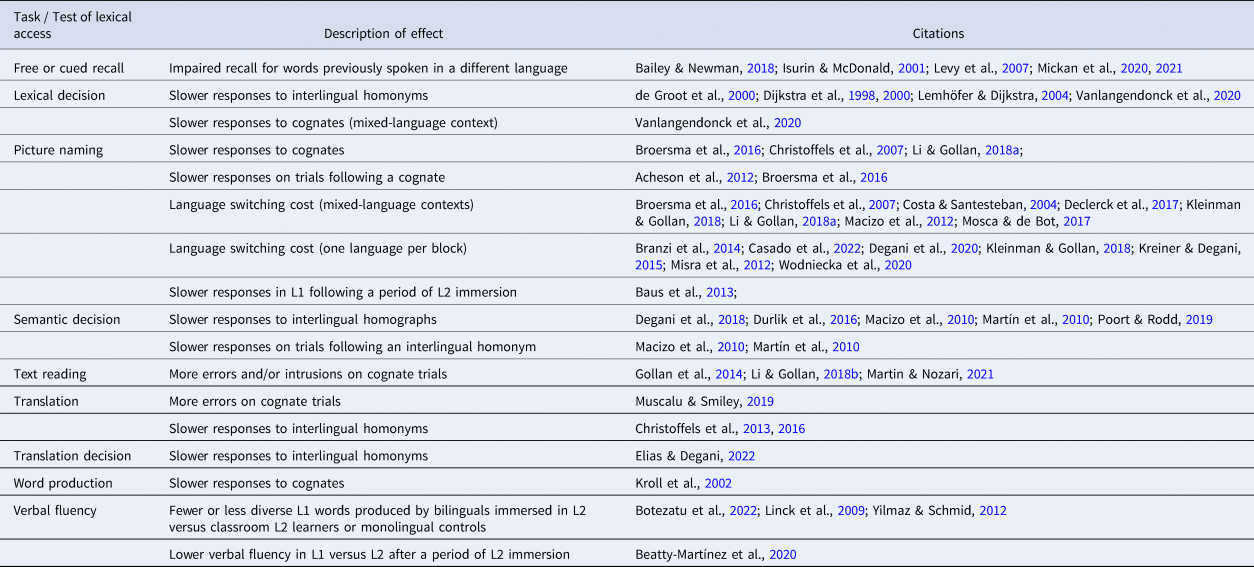
Switch costs have also been demonstrated in blocked language-
Switch costs have also been demonstrated in blocked language-switching paradigms in which the response language changes between blocks of stimuli (Branzi et al., Reference Branzi, Martin, Abutalebi and Costa2014; Casado et al., Reference Casado, Szewczyk, Wolna and Wodniecka2022; Degani et al., Reference Degani, Kreiner, Ataria and Khateeb2020; Kleinman & Gollan, Reference Kleinman and Gollan2018; Misra et al., Reference Misra, Guo, Bobb and Kroll2012; Wodniecka et al., Reference Wodniecka, Szewczyk, Kałamała, Mandera and Durlik2020). It is worth noting that such effects are not confined to translation equivalents: naming any pictures in one language can interfere with lexical access in another, although in some cases naming translation equivalents incurs a greater cost (e.g., Kleinman & Gollan, Reference Kleinman and Gollan2018). Other studies with conceptually similar designs have also yielded similar effects. Levy et al. (Reference Levy, McVeigh, Marful and Anderson2007) reported L1 interference following naming of L2 translation equivalents in a mixed-language block, while Kreiner and Degani (Reference Kreiner and Degani2015) report significantly more TOTs for L1 picture naming after viewing a ten-minute video in the L2, relative to L1 naming before the video.
Interference effects have been observed even at the earliest stages of second language learning. One study demonstrated that two newly learned languages can interfere with one another (Isurin & McDonald, Reference Isurin and McDonald2001). Here, participants learned a list of words in an unfamiliar language and then learned a second list – composed of either translation equivalents of words from the first list or unrelated words – in a second unfamiliar language. At the end of the experiment, participants were less likely to recall words from the first list if they had learned translation equivalents in the second list. More recent studies have demonstrated that retrieving words in the dominant language can interfere with memory for newly learned words in a novel language. Participants were less accurate (Mickan et al., Reference Mickan, McQueen and Lemhöfer2020) and slower (Bailey & Newman, Reference Bailey and Newman2018; Mickan et al., Reference Mickan, McQueen and Lemhöfer2020, Reference Mickan, McQueen, Valentini, Piai and Lemhöfer2021) retrieving or responding to words that had been named in the other language, compared to words that had not. Taken together, these studies indicate that newly learned vocabulary from a novel language is susceptible to cross-linguistic interference, both from a different novel language learned in parallel and from previously known languages.
Interference effects have also been observed in more advanced second language learners. The evidence here has mostly come from language immersion studies. When bilinguals are immersed in an L2-speaking environment, even for a relatively short period of time, they often experience perturbed access to their L1 (Baus et al., Reference Baus, Costa and Carreiras2013; Botezatu et al., Reference Botezatu, Kroll, Trachsel and Guo2022; Linck et al., Reference Linck, Kroll and Sunderman2009). For example, Baus et al. (Reference Baus, Costa and Carreiras2013) report that native German speakers who spent a semester in Spain were slower at naming non-cognate pictures in German at the end of the immersion period compared to the beginning. Similarly, Linck et al. (Reference Linck, Kroll and Sunderman2009) compared a group of native English speakers who had spent a semester in Spain to a separate group taking a non-immersive Spanish class. The immersion group showed reduced word production on a verbal fluency task in their L1, though it is worth noting that their L1 recovered to pre-immersion levels after 6 months.
Looking at the effects of long-term immersion can also be helpful in understanding the role of cross-linguistic interference effects. Research on language attrition has focused on changes to the L1 for individuals living in a predominantly L2 environment for a number of years (Schmid, Reference Schmid2010, Reference Schmid2011). Like short-term immersion studies, long-term L2 immersion studies show that accessing L1 words becomes more challenging (Kasparian & Steinhauer, Reference Kasparian and Steinhauer2016; Olshtain & Barzilay, Reference Olshtain, Barzilay, Seliger and Vago1991; Opitz, Reference Opitz2013). This is particularly true for low-frequency words (Hulsen, Reference Hulsen2000; Yilmaz & Schmid, Reference Yilmaz and Schmid2012). In discourse production tasks like free speech or story retelling, lexical attrition effects can be observed in terms of reduced lexical diversity, in particular manifesting as a reduction in the number of low-frequency words (Olshtain & Barzilay, Reference Olshtain, Barzilay, Seliger and Vago1991; Yilmaz & Schmid, Reference Yilmaz and Schmid2012). More constrained, single-word lexical retrieval tasks like confrontation naming (Beatty-Martínez et al., Reference Beatty-Martínez, Navarro-Torres, Dussias, Bajo, Guzzardo Tamargo and Kroll2020; Yilmaz & Schmid, Reference Yilmaz and Schmid2012) and verbal fluency (Baus et al., Reference Baus, Costa and Carreiras2013; Botezatu et al., Reference Botezatu, Kroll, Trachsel and Guo2022) do not always reveal the subtle effects of lexical attrition, suggesting that it may not be lexical access itself that is impacted in attrition contexts, but rather integration of retrieved lexical items during production. More generally, losses in L1 seem to scale with the amount of L2 input received in immersion settings (e.g., Datta, Reference Datta2012; Miller & Rothman, Reference Miller and Rothman2020; Stoehr et al., Reference Stoehr, Benders, van Hell and Fikkert2017). This mirrors experimental settings, where more exposure to or engagement with one language tends to result in greater interference effects in another (Isurin & McDonald, Reference Isurin and McDonald2001; Kleinman & Gollan, Reference Kleinman and Gollan2018; Levy et al., Reference Levy, McVeigh, Marful and Anderson2007).
In contrast to cognate facilitation effects described in the previous section, cognates may also cause interference, relative to non-cognates, in certain contexts. For example, greater switch costs have been found for cognates compared to non-cognates (Christoffels et al., Reference Christoffels, Firk and Schiller2007; Li & Gollan, Reference Li and Gollan2018a). Cognates are also more likely than non-cognates to elicit errors and cross-language intrusions (Gollan et al., Reference Gollan, Schotter, Gomez, Murillo and Rayner2014; Li & Gollan, Reference Li and Gollan2018b; Martin & Nozari, Reference Martin and Nozari2021; Muscalu & Smiley, Reference Muscalu and Smiley2019). In a typed translation task, participants showed more orthographic errors and longer typing times for cognates than non-cognates (Muscalu & Smiley, Reference Muscalu and Smiley2019). When reading aloud a mixed-language text, cross-language intrusions were five times more likely to involve cognate words than non-cognate words (Gollan et al., Reference Gollan, Schotter, Gomez, Murillo and Rayner2014). Cognates may show interference only in L2 (Broersma et al., Reference Broersma, Carter and Acheson2016) or only in L1 (Kroll et al., Reference Kroll, Michael, Tokowicz and Dufour2002), depending on the task and perhaps proficiency level. Aside from these immediate access difficulties, there is evidence that cognate retrieval may cause latent interference effects on subsequent trials (Acheson et al., Reference Acheson, Ganushchak, Christoffels and Hagoort2012; Broersma et al., Reference Broersma, Carter and Acheson2016). Taken together, these studies indicate that cognates have the potential to cause interference, either during immediate retrieval of the cognate or on subsequent trials, though the precise nature of cognate interference remains unclear.
Interlingual homographs (i.e., false cognates) provide an interesting case of interference. Due to their conflicting semantic representations, co-activation of interlingual homographs leads to slower responses and/or more errors on semantic decision tasks (Degani et al., Reference Degani, Prior and Hajajra2018; Durlik et al., Reference Durlik, Szewczyk, Muszyński and Wodniecka2016; Macizo et al., Reference Macizo, Bajo and Cruz Martín2010; Martín et al., Reference Martín, Macizo and Bajo2010; Poort & Rodd, Reference Poort and Rodd2019) and translation tasks (Christoffels et al., Reference Christoffels, Ganushchak and Koester2013, Reference Christoffels, Timmer, Ganushchak and La Heij2016). In addition, Macizo et al. (Reference Macizo, Bajo and Cruz Martín2010) and Martín et al. (Reference Martín, Macizo and Bajo2010) report latent interference effects induced by homographs: participants made semantic judgements about pairs of words in a single language (English) and were slower to respond if the pair contained the non-target language (Spanish) translation for a previously presented homograph (e.g., responses were slower for the pair Foot-Hand than for Finger-Hand if the prior trial contained Pie in English). These interference effects can occur even when the task is restricted to only one language and the two languages have different scripts, meaning that the co-activation of interlingual homonyms does not arise simply through bottom-up activation from shared orthography (Degani et al., Reference Degani, Prior and Hajajra2018; Elias & Degani, Reference Elias and Degani2022). Indeed, learning novel meanings for familiar words within the same language (which is analogous to interlingual homonyms) may elicit opposing forces of facilitation and interference – initially benefiting from form facilitation (i.e., phonological and/or orthographic overlap) but later exhibiting semantic interference (Fang et al., Reference Fang, Perfetti and Stafura2017).
4.2. Interpretation of interference effects
It is clear that, much like facilitation, interference has been observed in many contexts. The reader will note that many contexts/paradigms that lead to facilitation (e.g., picture naming) can also give rise to interference, and therefore our interpretations provided below may at first glance seem at odds with those described in the preceding section. To be clear, automatic co-activation and competition are not mutually exclusive processes. Indeed, competition should be understood as a result of co-activation, while inhibition in turn is a means of resolving competition to aid lexical access. This view is uncontroversial and is consistent with popular accounts of bilingual lexical access (Green, Reference Green1998; Meuter & Allport, Reference Meuter and Allport1999). Moreover, it is our position that whether facilitation or interference effects are observed at the behavioural level is ultimately determined by the relative weight of contributions from each mechanism, which in turn is determined by complex interactions between a number of factors discussed in the subsequent section. We may assume that, in each case of interference discussed below, the deleterious effects of competition/inhibition were sufficient to outweigh benefits conferred by co-activation.
Bilingual switch costs are typically interpreted as a latent effect of inhibition (Meuter & Allport, Reference Meuter and Allport1999), whereby the inhibited language is less accessible on subsequent trials or blocks. We may take a similar inhibition-based view of interference effects in the context of language learning and L2 immersion. If inhibition is necessary to resolve cross-language competition, subsequent interference in one language following lexical retrieval in another may be attributed to persistent effects of inhibition that took place during the initial instance of lexical access. As such, many of the interference effects discussed in the preceding section – for example, impaired language learning following picture naming in the dominant language (Bailey & Newman, Reference Bailey and Newman2018; Mickan et al., Reference Mickan, McQueen and Lemhöfer2020, Reference Mickan, McQueen, Valentini, Piai and Lemhöfer2021), or diminished dominant language access following immersion or picture naming in a non-dominant language (Baus et al., Reference Baus, Costa and Carreiras2013; Kreiner & Degani, Reference Kreiner and Degani2015; Levy et al., Reference Levy, McVeigh, Marful and Anderson2007; Linck et al., Reference Linck, Kroll and Sunderman2009) – may be explained by this simple principle of lasting inhibition.
A remaining question is the locus of inhibition in these studies. As discussed earlier, the locus of inhibition may be broadly defined as either global, driven by top-down control processes and/or the speaker's expectations about upcoming demands on the language system, or local, driven by cross-linguistic competition of specific lexical representations during lexical access. Studies have reported both global and local effects (Branzi et al., Reference Branzi, Martin, Abutalebi and Costa2014; Degani et al., Reference Degani, Kreiner, Ataria and Khateeb2020; Emmorey et al., Reference Emmorey, Li, Petrich and Gollan2020; Kleinman & Gollan, Reference Kleinman and Gollan2018; Van Assche et al., Reference Van Assche, Duyck and Gollan2013), supporting the view that inhibition may operate at different levels of the lexicon in parallel. Interference effects in the context of language learning, whereby newly learned vocabulary interferes with a previously known language, or vice-versa, have primarily been interpreted in terms of local inhibition. This is because most work in this area has identified interference effects by comparing performance for words that were spoken in another language to those which were not (Bailey & Newman, Reference Bailey and Newman2018; Isurin & McDonald, Reference Isurin and McDonald2001; Levy et al., Reference Levy, McVeigh, Marful and Anderson2007; Mickan et al., Reference Mickan, McQueen and Lemhöfer2020, Reference Mickan, McQueen, Valentini, Piai and Lemhöfer2021); such comparisons naturally lend themselves to detecting local inhibition. However, the possibility of global inhibition cannot be ruled out. We reason that global inhibition may have taken place in these studies but was simply undetectable. In simple terms, it may be that all words were affected by global inhibition, but that item-level differences due to naming in another language arose because local inhibition had an additive effect, resulting in overall greater interference effects on the translations of newly learned words.
Cognate and interlingual homonym interference effects warrant slightly different interpretations from those discussed above. We consider many such cases of interference to reflect response selection problems. It has been suggested that although cognates will initially benefit from co-activation at multiple levels of representation, this co-activation can in some cases lead to excessive amounts of competition, which in turn outweighs the initial facilitation (Broersma et al., Reference Broersma, Carter and Acheson2016; Li & Gollan, Reference Li and Gollan2018a, Reference Li and Gollan2018b). For example, Li and Gollan (Reference Li and Gollan2018a) suggested that co-activation at the phonological level may flow to the lexical level in the non-target language, and that this feedback (from phonological to lexical) may induce incrementally greater levels of competition at the lexical level on each subsequent presentation or production of the cognate word. The increased competition at the lexical level will therefore make lexical selection more difficult. This explanation may account for higher rates of errors and cross-language intrusions (Gollan et al., Reference Gollan, Schotter, Gomez, Murillo and Rayner2014; Li & Gollan, Reference Li and Gollan2018b; Martin & Nozari, Reference Martin and Nozari2021; Muscalu & Smiley, Reference Muscalu and Smiley2019) as well as slower picture naming (Broersma et al., Reference Broersma, Carter and Acheson2016; Kroll et al., Reference Kroll, Michael, Tokowicz and Dufour2002) for cognates compared to non-cognates.
As with cognates, interlingual homonyms will cause co-activation of overlapping phonological or orthographic representations, which flows to the lexical level. However, due to their conflicting semantic representations, co-activation of lexical representations leads to ambiguous lexical-semantic mapping, and hence worse performance on semantic decision (Durlik et al., Reference Durlik, Szewczyk, Muszyński and Wodniecka2016; Macizo et al., Reference Macizo, Bajo and Cruz Martín2010; Martín et al., Reference Martín, Macizo and Bajo2010; Poort & Rodd, Reference Poort and Rodd2019) and translation tasks (Christoffels et al., Reference Christoffels, Ganushchak and Koester2013, Reference Christoffels, Timmer, Ganushchak and La Heij2016). We need not invoke inhibition in order to explain these cases of interference (see also section 6.2). Having said this, the finding that cognates can lead to downstream interference effects (Acheson et al., Reference Acheson, Ganushchak, Christoffels and Hagoort2012; Broersma et al., Reference Broersma, Carter and Acheson2016), while interlingual homonyms can cause latent semantic interference (Macizo et al., Reference Macizo, Bajo and Cruz Martín2010; Martín et al., Reference Martín, Macizo and Bajo2010), indicates that such cases of lexical competition must still be resolved through inhibition, leading to access difficulties beyond the initial lexical selection process.
5. Modulating factors
We have shown that facilitation and interference effects can each emerge in a variety of experimental contexts. In fact, somewhat paradoxically, some contexts that consistently yield facilitation effects can also give rise to interference. These apparent discrepancies may be at least partially explained by three factors that affect CLI: language context (single- versus mixed-language contexts), direction (effects from the dominant to non-dominant language, or vice-versa), and modality (production versus comprehension).
5.1. Language context
It is important to recognise that lexical selection never occurs as a single, isolated process: it is always subject to constraints imposed by available cues (e.g., stimuli) and broader contextual requirements (e.g., speaking in one language versus switching languages), as well as constraints imposed by response goals (e.g., lexical decision versus picture naming). Such factors appear critical in determining the extent to which facilitation and/or interference arise in a given study.
Taking a broad view of the literature discussed so far in this review, there is much evidence to suggest that cross-linguistic facilitation is likely to emerge (or, alternatively, interference is unlikely) when bilinguals complete tasks and/or respond exclusively in a single language. This is primarily evidenced by reports of facilitation in experiments that used masked priming and simultaneous picture-word presentation. In contrast to single-language contexts, contexts that require participants to rapidly switch back-and-forth between languages often elicit interference, as seen in language switch costs. We should of course be cautious when comparing findings from different paradigms; however, our distinction between single-language (facilitating) and mixed-language (interfering) contexts is further supported by studies directly comparing lexical access across such contexts. A number of studies have indicated that lexical access is more difficult in mixed-language contexts (whereby the response language changes on a trial-to-trial basis) compared to single-language contexts (the response language is consistent throughout a block of trials). These mixing costsFootnote 6 have been evidenced by slower and/or more error-prone responses on non-switch trials in mixed-language contexts compared to trials in single-language blocks (Christoffels et al., Reference Christoffels, Firk and Schiller2007; Gollan & Ferreira, Reference Gollan and Ferreira2009; Guo et al., Reference Guo, Liu, Misra and Kroll2011; Hernandez & Kohnert, Reference Hernandez and Kohnert1999; Jevtović et al., Reference Jevtović, Duñabeitia and de Bruin2020; Ma et al., Reference Ma, Li and Guo2016).
One interpretation of these findings is that responding in only one language enables more efficient planning and maintenance of lexical access. In this vein, there is evidence that both mixing costs and switch costs are diminished in mixed-language contexts with longer delays between language cue and word presentation, which provide participants with more time to prepare to respond in the target language (Costa & Santesteban, Reference Costa and Santesteban2004; Fink & Goldrick, Reference Fink and Goldrick2015; Ma et al., Reference Ma, Li and Guo2016; Verhoef et al., Reference Verhoef, Roelofs and Chwilla2010). Switch costs are also diminished in contexts where switch trials are highly predictable (Liu et al., Reference Liu, Chang, Li, Liu, Chen, Zhang and Wang2018; Macnamara et al., Reference Macnamara, Krauthammer and Bolgar1968). Similarly, allowing participants to switch languages at will (as opposed to mandatory switching in response to an external cue) may disrupt or even eliminate switch costs altogether (Gollan & Ferreira, Reference Gollan and Ferreira2009; Jevtović et al., Reference Jevtović, Duñabeitia and de Bruin2020; Zhu et al., Reference Zhu, Blanco-Elorrieta, Sun, Szakay and Sowman2022). For example, Carpenter et al. (Reference Carpenter, Rao, Peñaloza and Kiran2020) found that bilinguals with aphasia produced fewer correct responses than healthy bilinguals on a verbal fluency task when they were limited to only one language or had to switch languages every other response (forced switching), but the two groups performed similarly on the task when switching was optional and voluntary. Green and Abutalebi (Reference Green and Abutalebi2013) suggest that in voluntary switching conditions, the languages are in a cooperative relationship, and cognitive control demands are low; whereas single-language contexts (and presumably cued language switching) place the languages in a competitive relationship, which requires more cognitive control. Thus, in mixed-language contexts where speakers are able to plan ahead – either because switches are predictable, voluntary, or there is more preparation time – costs associated with language switching tend to be reduced or eliminated. These diminished costs may be afforded at least in part by more opportunity for proactive control. By extension, opportunity for proactive control afforded to single-language contexts may explain the absence or reduction of interference effects. For example, when a task requires responses in a single language, bilinguals may proactively boost activation of the target language, making potential target words more readily accessible (Li & Gollan, Reference Li and Gollan2021). Another possibility, which is not mutually exclusive with the boosting account, is that speakers may globally inhibit the non-target language, reducing potential competition (Christoffels et al., Reference Christoffels, Firk and Schiller2007). Broadly speaking, this proactive planning account of single versus mixed contexts echoes elements of the Inhibitory Control (Green, Reference Green1986, Reference Green1998) and BIA+ (Dijkstra & van Heuven, Reference Dijkstra and van Heuven2002) models, both of which emphasise the role of speaker goals (“task schema”) in top-down control of lexical activation.
Another point worthy of discussion here is stimulus composition; in particular, cognate status has been shown to interact with contextual effects described above. Cognate facilitation effects are often present in mixed-language contexts (Christoffels et al., Reference Christoffels, Firk and Schiller2007; Li & Gollan, Reference Li and Gollan2021). Moreover, cognates facilitate language switches on cued-switch picture naming tasks when in a block of cognate trials (Li & Gollan, Reference Li and Gollan2018a, Experiment 1). When mixed with noncognates, however, cognates may actually elicit greater switch costs than non-cognates (Christoffels et al., Reference Christoffels, Firk and Schiller2007; Filippi et al., Reference Filippi, Karaminis and Thomas2014; Li & Gollan, Reference Li and Gollan2018a). Interestingly, Li and Gollan (Reference Li and Gollan2018a, Experiments 2 & 3) report that cognates facilitate switches at the first presentation of a picture but not on subsequent presentations. These authors also report that cognates became increasingly slower with repeated presentation of the same pictures, particularly on switch trials, indicative of increasing cognate interference (Li & Gollan, Reference Li and Gollan2018a, Experiment 3). Non-cognates, by contrast, did not show evidence of increasing competition. This pattern of results suggests that cognates are facilitative at the phonological level but interfering at the lexical level. Thus, whether facilitation or interference is observed depends on task demands and which processing level is targeted (Li & Gollan, Reference Li and Gollan2021).
Work on interlingual homographs has also yielded interesting findings pertaining to language context. Experiments employing lexical decision tasks have reported that homographs either elicited no interference (Dijkstra et al., Reference Dijkstra, Bruijn, Schriefers and Brinke2000) or a reaction time advantage (Dijkstra et al., Reference Dijkstra, Van Jaarsveld and Ten Brinke1998; Lemhöfer & Dijkstra, Reference Lemhöfer and Dijkstra2004) relative to control words when they occurred in a single-language block; however, responses to homographs were either slowed (de Groot et al., Reference de Groot, Delmaar and Lupker2000; Dijkstra et al., Reference Dijkstra, Van Jaarsveld and Ten Brinke1998, Reference Dijkstra, Bruijn, Schriefers and Brinke2000) or did not show the previously observed advantage (Lemhöfer & Dijkstra, Reference Lemhöfer and Dijkstra2004) in mixed-language blocks. These findings were replicated and extended by Vanlangendonck et al. (Reference Vanlangendonck, Peeters, Rueschemeyer and Dijkstra2020), who reported that interference increased for both interlingual homographs and identical cognates in a unilingual lexical decision task when the target word stimuli were mixed in with words from the bilinguals’ other language. In fact, the cognate facilitation effect found in the single-language version of the task not only disappeared but turned into an interference cost in the mixed-language version. Since the task required a “yes” response for words in the target language and a “no” response for words in the non-target language, identical cognates (which can be read in both languages) elicited conflict at the response level. It is worth noting that the response language did not differ between conditions – only the stimulus composition. As Vanlangendonck et al. (Reference Vanlangendonck, Peeters, Rueschemeyer and Dijkstra2020, p. 842) put so well, “What hinders cognate performance in the mixed list is precisely what benefits them in the pure list: their cross-linguistic overlap.”
To summarize, mixed-language contexts tend to generate more interference compared to single-language contexts, possibly because they enable less opportunity for proactive control of the target language through boosting and the non-target language through inhibition. Context effects may interact with stimulus composition effects: mixed-language contexts may reverse both cognate facilitation and interlingual homograph interference effects typically seen in single-language contexts. These effects speak to general cognitive control mechanisms that are essential for bilingual lexical access in any context. This fact is particularly evident in studies of neurodivergent individuals (e.g., those with aphasia or Alzheimer's disease) where cognitive control mechanisms break down. Pathological language mixing (i.e., language switching that is inappropriate for the context) can result from a disruption of the neural systems involved in controlling the choice of language output, which may reflect deficits in cognitive control (Fyndanis & Lehtonen, Reference Fyndanis and Lehtonen2021). Furthermore, for bilinguals with aphasia, therapy in one language may lead to increased cross-language intrusion errors in the untreated language due to an inability to inhibit the over-activated language of treatment (Keane & Kiran, Reference Keane and Kiran2015; Kurland & Falcon, Reference Kurland and Falcon2011).
5.2. Language direction
Much research in bilingualism is characterised by asymmetries – that is, effects that may be present or absent, or that differ in magnitude, depending on the direction of CLI being tested. For example, cognate facilitation effects tend to be greater when the task is completed in the non-dominant compared to the dominant language (Christoffels et al., Reference Christoffels, Firk and Schiller2007; Costa et al., Reference Costa, Caramazza and Sebastian-Galles2000, Reference Costa, Calabria, Marne, Hernández, Juncadella, Gascón-Bayarri, Lleó, Ortiz-Gil, Ugas, Blesa and Reñé2012; Gollan et al., Reference Gollan, Forster and Frost1997; Ivanova & Costa, Reference Ivanova and Costa2008; Lalor & Kirsner, Reference Lalor and Kirsner2001a; Roberts & Deslauriers, Reference Roberts and Deslauriers1999; Stadie et al., Reference Stadie, Springer, De Bleser, Burk and Paradis1995; Starreveld et al., Reference Starreveld, Groot, Rossmark and Hell2014). In fact, cognate effects are inversely related to language dominance (Anthony & Blumenfeld, Reference Anthony and Blumenfeld2019). Within spreading activation models, these asymmetries can be explained in terms of the degree to which co-activated translation equivalents are activated. When completing a task in a weaker language, co-activated words in a stronger language may be strongly co-activated because of their privileged connections to shared semantics or because they have lower activation thresholds. By contrast, when completing a task in a stronger language, the co-activation of words in a weaker language may be less strong and thus may exert a weaker cross-language effect on task performance (Li & Gollan, Reference Li and Gollan2021). Support for this comes from a study of lexical decision speed with trilinguals (van Hell & Dijkstra, Reference van Hell and Dijkstra2002). A processing speed advantage was found for cognates between the participants’ L1 and L2, but not for cognates between the L1 and L3 (their least proficient language). Nevertheless, a cognate benefit in the L1 was observed for participants with higher L3 proficiency. In other words, the degree to which cognate facilitation occurs seems to be dependent on proficiency in the weaker language.
Another experimental paradigm that often yields asymmetries is translation priming. Forward priming (in which a prime in a stronger language is followed by a target in a weaker language) is often reported to be stronger and/or more robust than backward priming (Dimitropoulou et al., Reference Dimitropoulou, Duñabeitia and Carreiras2011b, Reference Dimitropoulou, Duñabeitia and Carreiras2011a; Dubey et al., Reference Dubey, Witzel and Witzel2018; Jiang, Reference Jiang1999; Nakayama et al., Reference Nakayama, Sears, Hino and Lupker2013; Smith et al., Reference Smith, Walters and Prior2019), although significant priming effects have been reported in both directions (Basnight-Brown & Altarriba, Reference Basnight-Brown and Altarriba2007; B. Chen et al., Reference Chen, Liang, Cui and Dunlap2014; Dimitropoulou et al., Reference Dimitropoulou, Duñabeitia and Carreiras2011b; Duñabeitia et al., Reference Duñabeitia, Perea and Carreiras2009, Reference Duñabeitia, Dimitropoulou, Uribe-Etxebarria, Laka and Carreiras2010; Jiang, Reference Jiang1999; Kiran & Lebel, Reference Kiran and Lebel2007; Schoonbaert et al., Reference Schoonbaert, Duyck, Brysbaert and Hartsuiker2009; see also Wen & van Heuven, Reference Wen and van Heuven2017). One interpretation of this asymmetry, offered by Schoonbaert et al. (Reference Schoonbaert, Duyck, Brysbaert and Hartsuiker2009), is that while the dominant and non-dominant lexicons share overlapping semantic representations (and, therefore, automatic co-activation can occur in either direction), lexical representations in the non-dominant language are associated with fewer semantic nodes than lexical representations in the dominant language. As such, a prime in the dominant language will activate a larger proportion of semantic nodes associated with the non-dominant translation equivalent compared to non-dominant language primes (see also Finkbeiner et al., Reference Finkbeiner, Forster, Nicol and Nakamura2004; Wang & Forster, Reference Wang and Forster2010). This asymmetry in translation priming also appears to be modulated by relative proficiency in each language. Unlike unbalanced bilinguals, balanced bilingualsFootnote 7 often exhibit symmetric priming in both directions (e.g., Basnight-Brown & Altarriba, Reference Basnight-Brown and Altarriba2007; Duñabeitia et al., Reference Duñabeitia, Perea and Carreiras2009). Further, highly proficient bilinguals show stronger backward priming effects compared to less proficient bilinguals (Nakayama et al., Reference Nakayama, Sears, Hino and Lupker2012, Reference Nakayama, Sears, Hino and Lupker2013, Reference Nakayama, Ida and Lupker2016), though significant backward translation priming can occur even for low-proficiency bilinguals when the interval between prime and target is longer (Lee et al., Reference Lee, Jang and Choi2018). This asymmetry can be explained by the Sense Model (Finkbeiner et al., Reference Finkbeiner, Forster, Nicol and Nakamura2004), which assumes that lexical representations in the L2 develop more connections with semantic nodes as proficiency increases. The BIA+ model also predicts that because conceptual links for the non-dominant language are weak, and words in that language have low activation levels in general, the masked prime does not provide sufficient stimulation to trigger a priming effect (Nakayama et al., Reference Nakayama, Ida and Lupker2016).
Translation tasks provide another source of evidence for directional asymmetry in bilingual lexical processing. In these tasks, forward translation is typically slower than backward translation (Kroll et al., Reference Kroll, Michael, Tokowicz and Dufour2002, Reference Kroll, van Hell, Tokowicz and Green2010; Kroll & Stewart, Reference Kroll and Stewart1994; Sholl et al., Reference Sholl, Sankaranarayanan and Kroll1995), but note that some studies have revealed translation asymmetries in the opposite direction (Christoffels et al., Reference Christoffels, de Groot and Kroll2006; de Groot et al., Reference de Groot, Dannenburg and Vanhell1994, Experiment 2). The Revised Hierarchical Model (RHM) explains this asymmetry in terms of asymmetric connections between translation equivalents via direct lexical links (Kroll & Stewart, Reference Kroll and Stewart1994), which are stronger in the L2-L1 direction than vice-versa. Moreover, because of stronger links between the L1 lexical representation and its associated semantic representation, forward translation would necessarily entail semantic mediation, whereas backward translation might be achieved via the more direct lexical route. Hence, according to the RHM, backward translation is faster due to the stronger direct lexical connection from the L2 to the L1, while this asymmetry is often reduced in balanced bilinguals (Kroll et al., Reference Kroll, Michael, Tokowicz and Dufour2002). Dylman and Barry (Reference Dylman and Barry2018) report a similar asymmetric pattern in a simultaneous picture-word paradigm; these authors report greater facilitation when participants saw an L2 distractor and named in L1 compared to vice-versa.
The examples above illustrate greater and lesser degrees of facilitation by co-activation, with asymmetries likely driven by differences in activation levels of words or strength of lexical connections between words. Next we discuss examples of asymmetric interference effects, wherein asymmetries are driven by relative levels of lexical competition.
While bilinguals typically retrieve words faster in their dominant language (e.g., Chen & Leung, Reference Chen and Leung1989), some studies report a switched dominance effect in mixed-language naming contexts whereby naming in the non-dominant language is faster than in the dominant language (Christoffels et al., Reference Christoffels, Firk and Schiller2007; Gollan & Ferreira, Reference Gollan and Ferreira2009; Guo et al., Reference Guo, Liu, Misra and Kroll2011; Ma et al., Reference Ma, Li and Guo2016). Intrusion errors are also more common in mixed-language contexts when attempting to name in the dominant language (Gollan et al., Reference Gollan, Schotter, Gomez, Murillo and Rayner2014; but see Poulisse, Reference Poulisse1999 who report more intrusions for non-dominant targets). Asymmetric switch costs are also commonly reported whereby switching into the dominant language is more costly (in terms of increased response time) compared to switching into the non-dominant language (Costa & Santesteban, Reference Costa and Santesteban2004; Costa et al., Reference Costa, Santesteban and Ivanova2006; Kleinman & Gollan, Reference Kleinman and Gollan2018; Meuter & Allport, Reference Meuter and Allport1999). These observations are widely regarded as evidence that in mixed-language or language-switching conditions, participants inhibit their dominant language more strongly, sometimes resulting in easier access to the non-dominant language (Christoffels et al., Reference Christoffels, Firk and Schiller2007; Costa & Santesteban, Reference Costa and Santesteban2004; Declerck et al., Reference Declerck, Philipp and Koch2013, Reference Declerck, Stephan, Koch and Philipp2015; Declerck, Reference Declerck2020; Declerck & Philipp, Reference Declerck and Philipp2015b b; Gollan et al., Reference Gollan, Schotter, Gomez, Murillo and Rayner2014; Gollan & Ferreira, Reference Gollan and Ferreira2009; Guo et al., Reference Guo, Liu, Misra and Kroll2011; Heikoop et al., Reference Heikoop, Declerck, Los and Koch2016; Jylkkä et al., Reference Jylkkä, Lehtonen, Lindholm, Kuusakoski and Laine2018; Kleinman & Gollan, Reference Kleinman and Gollan2018; Li & Gollan, Reference Li and Gollan2018a, Reference Li and Gollan2018b; C. Liu et al., Reference Liu, Timmer, Jiao, Yuan and Wang2019; Philipp et al., Reference Philipp, Gade and Koch2007; Philipp & Koch, Reference Philipp and Koch2009; Verhoef et al., Reference Verhoef, Roelofs and Chwilla2010). The reversed language dominance pattern is thought to be the result of proactive global inhibition of the dominant language in anticipation of interference, while the switch-cost asymmetry might reflect a form of reactive control that is more transient (Declerck, Reference Declerck2020; Declerck & Philipp, Reference Declerck and Philipp2015a). Interestingly, there is also some evidence for asymmetric switch costs between language modalities. Emmorey et al. (Reference Emmorey, Li, Petrich and Gollan2020) reported that switching from producing ASL–English code-blends to producing words in a single language was easier when the single-language naming was participants’ dominant language (English) but harder when switching to ASL only. Their explanation was that switching from a code-blend back to a single-language production requires inhibiting the language that will no longer be produced, which will incur a greater cost if the language to be inhibited is the dominant language.
Similarly to priming asymmetries, asymmetric switch costs are modulated by L2 proficiency. Asymmetric switch costs are typically observed amongst unbalanced bilinguals (Costa & Santesteban, Reference Costa and Santesteban2004; Costa et al., Reference Costa, Santesteban and Ivanova2006; Kleinman & Gollan, Reference Kleinman and Gollan2018; Meuter & Allport, Reference Meuter and Allport1999), while this asymmetry is reportedly smaller (or non-existent) amongst balanced or high- compared to low-proficiency bilinguals (Costa & Santesteban, Reference Costa and Santesteban2004; Costa et al., Reference Costa, Santesteban and Ivanova2006; Filippi et al., Reference Filippi, Karaminis and Thomas2014; Meuter & Allport, Reference Meuter and Allport1999; Mosca & de Bot, Reference Mosca and de Bot2017; Schwieter & Sunderman, Reference Schwieter and Sunderman2008); though we note that symmetric switch costs have been observed even amongst low-proficiency bilinguals (see Declerck & Philipp, Reference Declerck and Philipp2015a for review). These findings reinforce the point that the degree of inhibition that must be applied to resolve competition is likely dependent on relative imbalances between L1 and L2, which in turn is influenced by proficiency in each.
In blocked picture naming tasks, asymmetries have been observed with respect to language order. Naming first in the dominant language facilitates later naming in a non-dominant language (Branzi et al., Reference Branzi, Martin, Abutalebi and Costa2014; Casado et al., Reference Casado, Szewczyk, Wolna and Wodniecka2022; Misra et al., Reference Misra, Guo, Bobb and Kroll2012; Wodniecka et al., Reference Wodniecka, Szewczyk, Kałamała, Mandera and Durlik2020); by contrast, no such facilitation occurs for the dominant language following a prior block of naming in a non-dominant language. Both new and repeated words in the L1 show interference when preceded by naming in the L2. This suggests a more global lexical control process (rather than a local one) in the L1, but word-specific facilitation in the L2, likely due to automatic co-activation. In a related vein, there is also evidence for similar order effects in a verbal fluency task: Van Assche et al. (Reference Van Assche, Duyck and Gollan2013) report that, when asked to generate exemplars from the same semantic category in two languages, participants produce fewer exemplars in L1 following naming in L2, whereas L2 was not negatively impacted by a prior L1 naming block.
What are we to conclude from this collection of asymmetric effects? At the outset, they may appear rather disjointed – indeed, the fact that these effects are often studied in isolation from one another, using different paradigms, does not help. However, we argue that the evidence presented here speaks to a fundamental principle of cross-linguistic influence: co-activation (and consequently, facilitation) is a ubiquitous phenomenon, present in almost all instances of CLI, but which may be masked when experimental conditions give rise to lexical competition. Critically, the degree to which facilitation is masked is linked to the degree of competition present which, in turn, is at least partially determined by the direction of CLI and relative proficiency levels. The degree of competition present during lexical retrieval depends on relative imbalances in resting activation levels between the target and non-target languages. Certain task demands, like switching back-and-forth between languages, give rise to more competition compared to situations in which participants only need to respond in one language. Moreover, producing words might raise their activation level to a greater degree than merely reading them, causing those words to present more competition on subsequent trials (e.g., on switch trials).
5.3. Modality
A major consideration when describing CLI effects is whether the experimental task requires production (e.g., word naming) or comprehension (e.g., lexical decision). Indeed, some models of bilingual lexical access are exclusively concerned with production (Kroll & Stewart, Reference Kroll and Stewart1994) or comprehension (Dijkstra & van Heuven, Reference Dijkstra and van Heuven2002), which speaks to the divergence of these two modalities in the literature. We have already seen in section 5.2 that translation and priming tasks (which entail production and comprehension respectively) reveal asymmetries in opposite directions. Production has been described as a top-down process, whereby activation spreads directly from conceptual-semantic representations to associated lexical forms and their respective phonological representations (Dijkstra et al., Reference Dijkstra, Wahl, Buytenhuijs, Halem, Al-Jibouri, Korte and Rekké2019). By contrast, comprehension of written forms is bottom-up; activation will initially spread from orthographic or phonological forms (depending on whether the input is written or auditory) to morphologically related forms and associated conceptual-semantic representations (Dijkstra & van Heuven, Reference Dijkstra and van Heuven2002). These different paths of information flow will likely affect the degrees of facilitation, competition, and subsequent inhibition that occur. For example, comprehension tasks typically lead to coactivation of interlingual homonyms (phonological or orthographic overlap between languages, but no semantic overlap). This type of spreading activation may result in ambiguous mapping to conceptual-semantic representations, leading to semantic interference effects (Durlik et al., Reference Durlik, Szewczyk, Muszyński and Wodniecka2016; Macizo et al., Reference Macizo, Bajo and Cruz Martín2010; Martín et al., Reference Martín, Macizo and Bajo2010; Poort & Rodd, Reference Poort and Rodd2019). In the case of production tasks, interlingual homonyms are not expected to induce cross-language competition because activation spreads in the opposite direction.
Switch costs are another area in which production and comprehension diverge. While switch costs are robust in production paradigms (e.g., picture naming), these effects appear to be less robust for comprehension (Declerck & Grainger, Reference Declerck and Grainger2017; Mosca & de Bot, Reference Mosca and de Bot2017; Orfanidou & Sumner, Reference Orfanidou and Sumner2005; Thomas & Allport, Reference Thomas and Allport2000; Von Studnitz & Green, Reference Von Studnitz and Green1997, Reference Von Studnitz and Green2002). For example, Declerck et al. (Reference Declerck, Koch, Duñabeitia, Grainger and Stephan2019) failed to replicate comprehension-based switch costs across several experiments, using a variety of different comprehension tasks and including bilinguals of varying levels of proficiency. Moreover, proficiency appears to affect switch costs for production (Jackson et al., Reference Jackson, Swainson, Mullin, Cunnington and Jackson2004; Macizo et al., Reference Macizo, Bajo and Paolieri2012; Mosca & de Bot, Reference Mosca and de Bot2017) but not comprehension (see Declerck & Philipp, Reference Declerck and Philipp2015a for review).
These observations suggest that reactive inhibition is differentially deployed in comprehension versus production. Declerck et al. (Reference Declerck, Koch, Duñabeitia, Grainger and Stephan2019) suggest that in comprehension tasks, in which activation spreads from orthographic/phonological forms to morphological neighbours, parallel activation of lexical representations in the non-target language is less likely (or occurs to a lesser degree). Less parallel activation of potential competitors in the non-target language would require less inhibition, and thus diminished or absent switch costs. In summary, the different paths of information flow in production versus comprehension tasks affect co-activation and competition differently.
6. Discussion and final considerations
6.1. General conclusions
Our review of the existing literature on cross-linguistic facilitation and interference effects in bilinguals has revealed important insights into the nature of these two seemingly contradictory forces. The overwhelming evidence for automatic co-activation suggests that facilitation occurs to some extent in almost all cases of CLI. By contrast, interference – which is not mutually exclusive from facilitation, but which can mask or outweigh facilitative effects – arises only in contexts where cross-linguistic competition from a non-target language might perturb lexical access in the target language. We posit that in the examples of cognate facilitation, translation priming, simultaneous picture-word presentation, and translation, cross-language lexical competition is minimal, revealing robust facilitation effects – particularly in the dominant-to-nondominant language direction. In other situations, such as mixed-language contexts or blocked language switching, cross-language lexical competition is relatively high. This competition necessitates inhibition, which has a latent effect on lexical access on subsequent trials, giving rise to interference effects that mask any underlying facilitation by co-activation. Critically, latent inhibition tends to incur a greater cost for the dominant language, likely because dominant language words are activated to a greater extent and/or are more strongly represented, which, incidentally, is precisely what leads them to cause enhanced facilitation in the absence of competition.
Central to both facilitation and interference are the relative levels in resting activation (i.e., accessibility) and, subsequently, degree of co-activation between representations in the target and non-target languages. Generally speaking, words in the dominant language are regarded as having “stronger” lexical representations than those in a non-dominant language (that is, lower activation thresholds and stronger links to semantics). The privileged status of the dominant language both helps and hinders lexical access in the non-dominant language. On the one hand, L2 access is facilitated by the L1 via strong co-activation. In some contexts, however, because of its relatively greater strength, the dominant language can also present more competition during lexical access in the non-dominant language. This heightened competition may necessitate greater degrees of inhibition (both proactive and reactive) in the case of language switching, and subsequently more difficult lexical access when the speaker returns to using the dominant language.
We argue that our account of facilitation versus interference still holds when considering cognate interference effects and interlingual homonyms; findings in this area are complex and often counterintuitive, and so deserve special attention. As a rule, access to words with overlapping semantic, orthographic, and/or phonological representations across languages will initially benefit from co-activation flowing to different levels of representation. This benefit is evidenced by cognate advantages on various production and comprehension tasks and by interlingual homonym advantages on lexical decision tasks in single-language contexts. However, in many situations, competition arising from co-activation can be detrimental to response selection and can also induce latent inhibitory effects. Whether facilitation or interference is observed at the behavioural level depends upon the context and related task demands. For example, cognates can induce competition when participants complete a unilingual lexical decision task because their language membership can be ambiguous (Vanlangendonck et al., Reference Vanlangendonck, Peeters, Rueschemeyer and Dijkstra2020). Similarly, when responding to interlingual homographs, participants must inhibit semantically inappropriate competitors when making semantic judgements (Durlik et al., Reference Durlik, Szewczyk, Muszyński and Wodniecka2016; Macizo et al., Reference Macizo, Bajo and Cruz Martín2010, Reference Macizo, Bajo and Cruz Martín2010; Poort & Rodd, Reference Poort and Rodd2019) or selecting translation equivalents of a presented word (Christoffels et al., Reference Christoffels, Ganushchak and Koester2013, Reference Christoffels, Timmer, Ganushchak and La Heij2016). In these examples, co-activation that resulted in facilitation at the behavioural level in other contexts ultimately led to interference. It is our position that such examples do not preclude initial facilitation from co-activation. Rather, the observed behaviour likely reflects the sum of relative degrees of co-activation and competition/inhibition. Thus, in the aforementionned examples, any benefits to lexical access from co-activation were masked by subsequent competition and inhibition. We note that we are not the first to make this case – other researchers have posited similar interpretations to explain the co-occurrence of cognate facilitation and interference effects arising within the same paradigm (e.g., Broersma et al., Reference Broersma, Carter and Acheson2016; Li & Gollan, Reference Li and Gollan2018a Reference Li and Gollanb).
CLI is clearly a complex phenomenon that is dependent on many factors. A number of factors, such as language context, direction and modality interact in complex and often counterintuitive ways to affect activation thresholds and degree of co-activation, lexical competition, and inhibition. Additionally, these processes may have both short- and long-term effects and can change on a trial-to-trial basis, giving rise to seemingly contradictory effects. For example, facilitated language switching for cognates on the first presentation of an item, followed by cognate interference on subsequent trials (Li & Gollan, Reference Li and Gollan2018a, Experiments 2 & 3). All of this is to say that one should not view CLI as following a set of rigid determinants, but rather as a highly dynamic process that we are still trying to fully understand.
6.2. Alternatives to inhibition
Throughout this review we have explained latent interference effects mainly in terms of inhibition. We have taken this position because inhibition-based interpretations appear to dominate the literature and moreover provide a convenient and generalisable framework that explains much of the data. However, some have argued that inhibition is not necessary to explain interference. While an evaluation of this position would be beyond the scope of this review, we feel that it is worth outlining a few such accounts here.
Some accounts emphasise the importance of maintaining or modifying activation levels in either language. The persistent activation account (Philipp et al., Reference Philipp, Gade and Koch2007) was proposed to explain asymmetric switch costs, but may also be applicable to other examples of cross-linguistic interference. This account holds that naming in a non-dominant language requires a large amount of activation in order to overcome higher resting activation level of the dominant language. This increase in L2 activation persists into subsequent trials, presenting a high degree of competition from the non-dominant language, making subsequent retrieval in the dominant language more difficult. In a similar vein, the activation threshold hypothesis (Paradis, Reference Paradis2007) argues that language attrition may be explained by a gradual rise in activation threshold over time if a word is not accessed. While these accounts are not mutually exclusive from inhibition, they do offer another mechanism by which latent interference effects may occur.
Another class of theories posits that cross-language competition is limited by a speaker's intentions or task goals by, for example, raising activation levels for the target language (Grosjean, Reference Grosjean and Nicol2001; La Heij, Reference La Heij2005). Similarly, the response selection account (Finkbeiner et al., Reference Finkbeiner, Gollan and Caramazza2006) proposes that, following activation of non-target lexical representations (e.g., the translation equivalent of the target word), selection is achieved via top-down control mechanisms that select or reject potential responses based on their compatibility with the speaker's goals. These accounts generally propose that lexical selection is achieved by “biasing” activation levels in one language, while still allowing for lexical competition between languages.
6.3. The time-course of facilitation and interference
The patterns observed for cross-language facilitation and interference imply that their effects might operate over different time scales, an idea proposed by Higby et al. (Reference Higby, Donnelly, Yoon and Obler2020). Specifically, there is some evidence suggesting that facilitative effects afforded by co-activation are long-lasting, while interference effects are more transient in that they often subside after a relatively short period of time after the initial effect was induced. While little work that we are aware of has explored this issue, we note some additional evidence supporting this idea. Casado et al. (2022; Experiment 2) reported that after an L2 naming block, L1 lexical access speed recovered over the course of a block of L1 naming. Similarly, latent inhibitory effects induced by interlingual homographs, reported by Martín et al. (Reference Martín, Macizo and Bajo2010), dropped off sharply over time: semantic interference was detectable when trials were separated by a 500 ms interval but not a 750 ms interval. In the context of L2 immersion, reduced access to the L1 lexicon shows recovery after returning to the L1 context (Linck et al., Reference Linck, Kroll and Sunderman2009). Lastly, interference when learning a novel language diminished to non-significant levels one week later (Mickan et al., Reference Mickan, McQueen and Lemhöfer2020).
It is likely that both co-activation and inhibition act upon activation thresholds – with co-activation lowering thresholds of activated words and inhibition raising thresholds – though the time courses of these processes are poorly understood. Paradis (Reference Paradis1993, Reference Paradis2007) has argued that activation thresholds can change gradually over time in the absence of stimulation or inhibition. One possibility is that this process occurs at different rates and directions (i.e., raising or lowering), depending on relative amounts of preceding activation and inhibition. In a recent paper, Casado et al. (Reference Casado, Szewczyk, Wolna and Wodniecka2022) outline a model of how relative levels of language activation impact the degree of language control required. Future research could attempt to disentangle the time scales of these two effects, particularly using experimental designs that can reveal both facilitation and interference effects within the same participants and design.
6.4. Overlap and divergence from models of the bilingual lexicon
We have attempted in this review to describe broad trends in the literature concerning behavioural outcomes of facilitation and interference and how they may come about through co-activation, competition, and inhibition in various contexts. In our account, we have attempted to incorporate principles from various existing models of bilingual lexical processing. First, we have made the case that co-activation of representations across languages may facilitate retrieval of co-activated words. This position is expressed in many popular accounts of bilingual lexical access (Multilink: Dijkstra et al., Reference Dijkstra, Wahl, Buytenhuijs, Halem, Al-Jibouri, Korte and Rekké2019; BIA+ Dijkstra & van Heuven, Reference Dijkstra and van Heuven2002; IC: Green, Reference Green1998; RHM: Kroll et al., Reference Kroll, Bobb and Wodniecka2006). Furthermore, modulation of co-activation by relative imbalance of representation strength between languages has become generally accepted in bilingualism research (Dijkstra & van Heuven, Reference Dijkstra and van Heuven2002; Green, Reference Green1998; Kroll & Stewart, Reference Kroll and Stewart1994).
Some of our assumptions are less universal. Many of the models cited above assume (as do we) that co-activation may lead to lexical competition and that this competition is resolved through varying degrees of reactive and/or proactive inhibition. While inhibitory mechanisms are consistent with the widely-cited Inhibitory Control and BIA+ models, alternative theories have also been proposed (see 6.2). Moreover, our account accommodates a division between the lexico-semantic system and a distinct decision-making system; this is in line with the BIA+ (Dijkstra & van Heuven, Reference Dijkstra and van Heuven2002) and Multilink (Dijkstra et al., Reference Dijkstra, Wahl, Buytenhuijs, Halem, Al-Jibouri, Korte and Rekké2019) models. We place a great deal of emphasis on context and task demands, which goes beyond models mainly concerned with specific contexts (e.g., word recognition: Dijkstra & van Heuven, Reference Dijkstra and van Heuven2002) or tasks (e.g., translation: Kroll & Stewart, Reference Kroll and Stewart1994). Our account also attempts to encompass both comprehension and production. To our knowledge, only the Multilink model (Dijkstra et al., Reference Dijkstra, Wahl, Buytenhuijs, Halem, Al-Jibouri, Korte and Rekké2019) encompasses both of these domains. This model operates on many of the same principles as our account (overlapping representations between languages, non-selective co-activation, competition), although we note some disagreement in that the seminal work behind this model assumes no lateral inhibition between competitors (Dijkstra et al., Reference Dijkstra, Wahl, Buytenhuijs, Halem, Al-Jibouri, Korte and Rekké2019).
Our account does make a few novel claims, though we do not feel that these claims are incompatible with the models discussed above. First, we propose that facilitation is a direct result of co-activation and so is the default form of CLI. By extension, interference effects are context-dependent and may mask (but do not preclude) the initial facilitation. This framework is grounded in simple and straightforward principles that form the basis of many popular models of lexical access (e.g., the IC, BIA+, and Multilink models). Finally, we are not aware of any models that address different time scales for latent facilitation and interference effects (see 6.3). Although the time scale of inhibition has been the subject of some investigation (Higby et al., Reference Higby, Donnelly, Yoon and Obler2020; Linck et al., Reference Linck, Kroll and Sunderman2009; Martín et al., Reference Martín, Macizo and Bajo2010), we are not aware of any such work being implemented in formal models of bilingual processing.
6.5. Future directions
Future research might investigate a number of areas pertaining to CLI. As we have seen, there is substantial evidence that facilitation and interference are not mutually exclusive; both seem to contribute to CLI effects, often within the same contexts. While facilitatory and interfering cross-linguistic effects on lexical processing have typically been studied separately, we argue that, from a theoretical perspective, they must be considered together, with each operating in dynamic ways, in order to understand the nature of lexical processing among bilinguals.
One major theme that emerged from our review is that regulation of the dominant language appears central to many CLI effects. As discussed earlier, the dominant language is typically more strongly represented. This means that regulation of L1 words (via boosting and/or inhibition) may have a more profound effect on relative imbalances in representational strength between the dominant and non-dominant languages compared to regulation of a non-dominant language (Bogulski et al., Reference Bogulski, Bice and Kroll2019; Zhang et al., Reference Zhang, Diaz, Guo and Kroll2021). Future work might therefore investigate differential outcomes of L1 versus L2 regulation upon CLI effects.
One area that needs more clarification is the degree to which activation spreads across languages. The empirical evidence suggests that activation spreads to translation equivalents of a target word, and morphological family members of cognate translation equivalents appear to benefit from spreading activation as well (e.g., Lalor & Kirsner, Reference Lalor and Kirsner2001a). However, the extent to which various lexical representations, beyond cognates and translation equivalents, in the language not in use are co-activated is still underspecified, both empirically and in current models of bilingual lexical processing. Furthermore, how does co-activation affect the time course of processing such that facilitation and interference might arise at different stages? Two studies provide interesting clues. In an eye-tracking study, Miwa et al. (Reference Miwa, Dijkstra, Bolger and Baayen2014) found inhibitory effects of phonological overlap at early stages of word recognition but at later stages phonological similarity facilitated recognition. By contrast, in a written production study, Muscalu and Smiley (Reference Muscalu and Smiley2019) reported shorter response onsets for cognates but more errors and longer total production latencies, reflecting initial facilitation followed by interference. Future work should employ methods that reveal more detail about the time-course of processing (such as eye-tracking and EEG) in order to capture the dynamic processes of facilitation and interference.
Finally, this review of factors influencing CLI is by no means exhaustive. It may be beneficial for future reviews to address the roles of those factors which we were unable to address comprehensively, such as proficiency and word frequency. Moreover, future reviews might also move beyond CLI in the context of lexical access – the topic of this paper – and examine CLI in other contexts such as syntactic processing.
Acknowledgments
We are grateful to Jennifer Truong and Dammy Emeto for their assistance with reviewing articles cited in this review. We are also grateful to three anonymous reviewers for their helpful feedback during the preparation of this manuscript. Lyam Bailey was supported by a Killam Predoctoral scholarship; Kate Lockary was supported by the Center for Student Research at California State University, East Bay.
Competing interest
The authors have no competing interests to declare.


 Open access

