


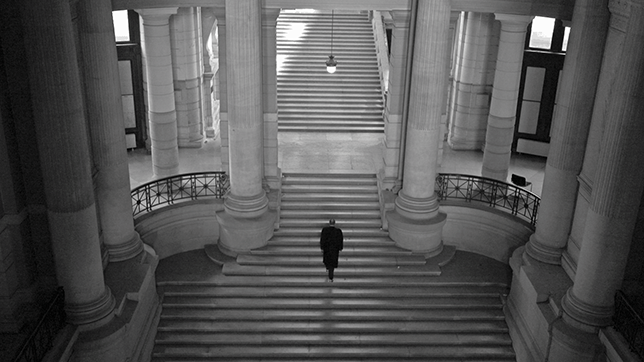
A small, solitary figure of an advocate in robes, surrounded by monumental columns, climbs the lengthy flight of stairs that leads into the Belgium Palais de Justice (see Figure 1.1). The actor, an old Latin term for lawyer, is a diminutive, costumed figure engulfed by the imperial surroundings and majestic spectacle in which they will play their evanescent part. The shadow of a shadow, a fleeting image, the jurist thespian enters an exemplary theatre of legality, the colossus of the courthouse, to take up a costumed role and scripted part in the spectacle that awaits beyond the hardwood doors of the various courtrooms. This still from a video artwork by artist Carey Young arrests the viewer in its symmetry and scale. Emptiness defines the scene: To the right a vacant chair symbolises the absence of any populace. Authority reveals itself as structure, the vicarious delegation of majesty and power as places occupied, as offices and duties rather than individual attributes. The space exudes a sense of the past as other: The architectural imposition, the scale of forensis with its Doric sentinels, and the sheer magnitude of the building all indicate the environment and atmosphere as entry into a social sanctum, a space that is itself spectacular and simultaneously a threshold to the structural stages and stagings of law as performance.
Carey Young, Palais de Justice (still), 2017. Single-channel HD video (from 4K); 16:9 format, colour, quadraphonic sound. 17 minutes, 58 seconds.
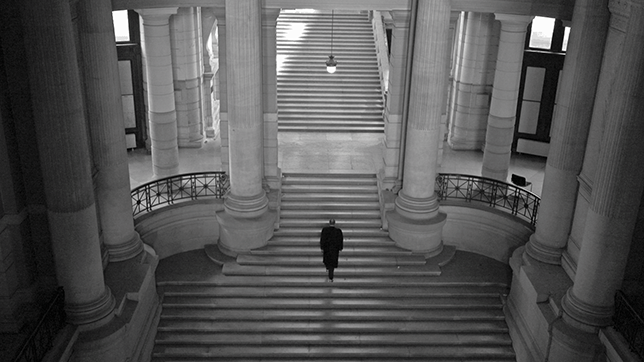
This is the site of open justice where, in the old language of the ecclesiastics, law is published and ‘sped’ to populace and public. The performing of law, its enactment as a spectacle, carries on and indeed augments massively with the presence of cameras, monitors, lenses within what was previously the intimate public sphere of legality. The spectres of trial and figures of litigation now increasingly circulate on social media, on viral and streamed sites, while both publicising and diffracting the doctrines and other scenes relayed. Law, in sum and trajectory, now inexorably joins the more general politics of the imaginal that marks the contemporary epoch and impinges increasingly upon the disciplines. Just as the robed advocate is swallowed up by the sheer scale of the building, so law anxiously awaits the arrival of precisely the technologies and modes of circulation that Carey Young’s secretive video of the Palais both portends and relays in images that transgress the antique divide between licit and illicit. Like it or not, lawyers in their lairs now have to come alive to the fact that they exist in a mediated environment through which they nevertheless have to perform.
It has become commonplace to assert that everything is a performance. From presidential debates streamed with zealous pomp and circumstance to social media accounts carefully curated toward superficial connection to corporate mimicry of interpersonal rhetoric intended to virtue signal, it is all too easy to point to the ambivalent use of the performative in today’s society. The theatrics of our times are undeniable, as media, politics, and the wider attention economy inundate our daily lives. For others yet, performance is everything. The stage has moved beyond established concert venues to pop-up theatres, museum and gallery installations, viral videos, one-on-one performances in the home, and puppet parades involving entire cities and crossing continents. In a post-pandemic society, the ability to attend live art has been received with renewed welcome. Attendance, attention, audition, and audience rule the day online as also in real time and space, one bolstering the other, doubling and redoubling in feedback loops and viral enumerations.
Law has never been entirely immune to the rigmarole of image and spectacle as atmospheric locators and transmitters of legal structures. Early in the Western tradition the drama of legal duels, enacted as symbolic stagings of conflict, replaced the melody of nomos or Pythagorean harmony as a musical model of settling disputes. The legal form was and is a belligerent tradition, historically often a mode of literal combat. The duillum or duel was a legal procedure that survived until the late sixteenth century, but over time the rules of legal procedure and the ceremonies of the process sought to mask the element of antagonism and to secrete and separate the duelling parties, the crown and the accused, or the litigants, in a discrete and secluded theatre of legal actions in curia but not in camera, as one early text formulates it.Footnote 1 The rituals of trial were specifically gauged to give the appearance of a liturgical function and the theatrical dimensions of lawsuits were hidden, as Carey Young so vividly portrays, in vast sepulchres, in arcane argot, windowless courtrooms, ecclesiastical architecture, aesthetics, and costumes. The historical atmosphere of law and the symbolism of its ceremonies were very much in camera in the sense and materiality of separate and somnolent mausoleums, chambers, libraries, but until recently not on camera.Footnote 2 Digitisation, however, broke down the walls of the legal archive, and omnipresent recording, online blogging, streaming, and screen capture have all entered the courtroom and other sites of lawmaking and law enforcement. Law’s performances, its bodies, rites, and stages, as also its agon, polarisations, and the politics of decision, are increasingly visible and evanescent events, spectacles in the public sphere.
And yet despite the overwhelming ubiquity of the theatrical, the performative, spectre and spectacle, performance studies has frequently been siloed in marginal academic spaces, held at arm’s length from the more traditional disciplines of the academy and specifically the lucubrations of jurists and philosophers of law. Theatre and training in the rhetorical arts of gesture and delivery were intrinsic to the Renaissance and early modern fabrication of common law, as well as to its internal pedagogy and mooting. The Inns of Court were next to the playhouses of London, and barristers would learn to perform ‘to the pit’, the audience, both by attending plays and through their own training exercises and revels.Footnote 3 The separation occurs with the broadly Protestant attack on imagery and its theatrical manifestations, and then later in the continuance of that hostile stance in the Enlightenment attack on theatre that led to an ever-increasing reliance upon the textualisation of law and particularly the systematisation of law reporting. The common opinion of the bar, the thespian sense of what was argued and heard in court as oral memory of performance, as dialogue and exchange, gets replaced by written reason and solemnity of judgment. The specialisation of the profession and the emergence of law schools in the United Kingdom and the United States in the second half of the nineteenth century moved the common lawyers to their own faculty, housed most usually in their own building and frequently on the edge of or just off campus. The marriage, or in legal terms, altera coniux, the other love of the lawyers, their revels and dances, plays and ludic inventions, were abandoned in favour of the text. The scission extends most distinctively and formidably to the gulf between legal practitioners and those who practice theatre. Perhaps in US contexts the Establishment Clause designating what is now the increasingly fragile separation of church and state accounts for this anxiety, given the ease with which performance has been frequently elided with ritual, ceremony, the fictive, the occult, and the magical.Footnote 4 Or perhaps performers’ refusal to be recorded resists the authoritative archival logics tethered to Western jurisprudence. Regardless of the reason, intentional or not, it remains true that two of the disciplines most rooted in public engagement of the populace remain the most distinct from one another in the modern university.
This absent disciplinary attention and dysfunctional dialogic lacuna extends in both directions. When originary figures in performance studies such as Jon McKenzie defined the field through the paradigms of cultural, organisational, and technological performance practice, space for the legal and juridical was made peripheral, if not left out altogether.Footnote 5 As performance studies pushed forward in directions of the political and methodological, traces of legal engagement fell from central view in spite of early attentions. Consider Joseph Roach’s oft-cited work, Cities of the Dead. This monograph advances generative themes of surrogation, counter-memory, and circum-Atlantic performance, as taught in many introductory courses to performance studies and cherished by pedagogues and scholars alike. Yet less frequently highlighted is ‘Bodies of Law’, a section in the second chapter that sutures Richard Schechner’s definition of performance’s ‘restored behavior’ to law. Here, Roach writes: ‘Law functions as a repository of social performances, past and present. … Indispensably, performance infuses the artifacts of written law with bodily action, a meaning that obtains when it is said that a party to a contract “performs.”’Footnote 6 In a broader historical sense, a legal action – legis actio – is expressly a mode of political manifestation and public appearance of law in the social sphere. For lawyers, in the old formula, scribere est agere, to write is to act, and the juridical writ or edict are illocutionary modes of what Emanuele Coccia terms ‘efficacious language’, pronouncements that give effectiveness to formulae and rules.Footnote 7 What is actually figured, what materialises, appears in public space or assembly as present and real is precisely the display, the liturgical efficacy of the legal act, and in the traditional language of both laws, actus legitimi materialising on the social stage as performance. The lawyer, as noted, was in classical terms an actor, a player upon the political scene, but one who shrouded that performance in a religious cloak of gravity and truth that had the ironic effect of hiding the essentially thespian character of these stagings behind technical argot and theological robes. The gilded separation of law from other disciplines, the specialism necessary to legal action, the distinct and secreted spaces of juristic apparition, as well as the jurisprudential call to pure reason, all tended to segregate the legal from performance studies and the everyday of social play. Antiquity, meaning the legal tradition, hates novelty, or novum omne cave as the maxim goes, meaning beware of the new, and the mobile and rapidly changing ephemera of performance were ignored by a law determined to stay for the longue durée, symbolically reflected in religious garb and ceremonies, architecture, archives, and the use of dead languages.
Similarly, when legal theory widened its scope toward the humanities, embracing or borrowing from other disciplines, the ambit of these couplings or fetters were constrained by the textualism of legal analysis and equally restrained by the esoteric and at times occult character of its tradition, language, and rules. From the law and literature movement to critical legal studies to critical race studies, the less conventional (which is to say, the less textual) shunned the field of performance studies, which was not invited to the party until most recently and even still quite tentatively. Occasional essays in early critical legal studies took the form of dialogues, and in one case a fictive correspondence on writing and copyright law was performed live at an annual conference, but the presentations were pitched as literary and cogitative, readings gauged to subsequent publication, rather than rooted in the gestural or ephemeral realms of performance and play.Footnote 8 While rhetoric was also highlighted as a central device in the maintenance of the legitimacy of the legal order, it was the figures of speech that were marshalled to provide critical analyses of statutory and precedential texts rather than addressing directly their playbook, the social enactment of law, or the visual semiotics of its transmission.Footnote 9 The discipline of print, so fundamental to the concept of ‘black letter law’, and the Gothic typeface of permanent rule, confined critique of law to the page, to an inveterate textualism that ramiculated into the variants of radical lawyering that superseded critical legal studies, particularly in the United States.
Although central figures in critical race studies, such as Kimberlé Crenshaw, featured the work of performers in their analyses, not least the 2 Live Crew in her famed essay, ‘Mapping the Margins’, such an action never became a trend in spite of the centrality of representation and agency implicit to both fields.Footnote 10 As Subha Mukherji noted some time back of the relation of law to theatre, rhetoric and specifically its third component, delivery, suffered ‘a reduction of the role of the legal rhetorician and the displacement of rhetoric from law to literature’.Footnote 11 In making a return to law, the literary is deemed safely narrative and operates in multimodal forms that have more recently provided lawyers, conservative and critical alike, with a textual outlet that hides the elements of dialogue and performance in the discursive regimentations and monochromacity of the page. The radicals remain lawyers, their critique circumscribed by modernist frames of legal rationality as a disembodied discursive enterprise of rule application. Thus metaphor, and more recently the neo-materialist matterphor, reference transference and materialisation in discourse rather than directly addressing the performative character and corporeal enactment of both text and utterance.Footnote 12 Narrative figures, stories, and calls for rights displace rhetorical attention on delivery or hypokrisis as essentially and extrinsically thespian endeavours.
The historical confinement of legal studies to the linearity of the page and the scripture of reason – ratio scripta – is a complex historical phenomenon of the longue durée of juridical theology. In the common law tradition, the modern roots of what Sir Edward Coke termed the sedentary, and in consequence short, life of lawyers lie in the Protestant reforms that swept England during the early modern period. The reformers’ very creditable juristic maxim sola scriptura fed into the epistemological break of the Enlightenment and captured the heart of early modern lawyers.Footnote 13 It led to an ever more formal separation of legality and theatricality, erasing both the history and the histrionics of the legal tradition as an art of actors and acting. To paraphrase a Renaissance critic of common lawyers, the jurists sought jealously to guard the distinctiveness of their profession: ‘You would love the law, but sine rivali, you would reign, but alone, hinc illae lachrymae.’Footnote 14 The desire for isolation and autonomy, guild pride in law as a distinct discipline and practice serve to veil the dramaturgic dimension of court and trial. Hubris and denial are triggered by the need to make claims to legitimacy and to enforce the interests of governance. These lead to disguising theatricality as religious ritual and treating an at times absurd gravitas as a form of anti-theatricality. It is this point of scission, the fissure between theatre and law, thespian performance and legal practice, that the present collection picks up, examines, and aspires to move beyond.
Julie Stone Peters’ book Law as Performance: Theatricality, Spectatorship, and the Making of Law in Ancient, Medieval and Early Modern Europe first appeared, meticulous, mellifluous, and monumental, in print in 2022. It was clear immediately that its provocations and taunting historical and theatrical detail would challenge scholars in their scholist siloes and secluded specialisms. Her painstaking reignition of the theatrical narratives, trainings, and performances of lawyers across time and jurisdictions has been an efflorescent sign of the times and a moment seized to maximum effect. It has rippled forth toward a fuller deluge of new avenues in law and humanities and specifically has generated a bridging of the chasm separating law and performance.Footnote 15 Arguing in intense historical detail that the force of law lies in its aesthetics, in the style of its performances, Peters signals a seismic shift of focus and attention. The downcast eyes of judges and jurisprudes are raised again to the corporeal and scenic avenues of law’s enactment, the blindfold is removed from the eyes of justice, and in the manner of poor theatre, the audience’s role in the judgment of law is seen and acknowledged.Footnote 16 Law as Performance emerges as the culmination of prior inclinations, and as a mode of building toward a subdiscipline that understands the embodiment of legal action. It is a trajectory expressed in a number of Peters’ shorter, more polemical pieces. Most famously, in a much mooted article that opens with a theatrical scene of a failed conference dialogue between professors of literature and legal academics, she argues that law and literature is ‘an interdisciplinary illusion’: The lawyers seek to work through their fantasies of escape by exiting into literature, while the literary critics seek meaningful substance for their work in law.Footnote 17 Neither group experiences fulfilment. The putative interdisciplinarity was in fact, Peters argues, an anti-interdisciplinarity, and its positive outcome is the realisation that the illusion lies in the attempt to separate the two enterprises, namely that there is no firm boundary between what are essentially two intertwined normative literary programs or, in Bradin Cormack’s version of the argument, conjoint and so competing jurisdictions.Footnote 18
In ‘Theatrocracy Unwired’, Peters examines the impact of the modern mediasphere on the visibility of the legal and the consequent trial by media that now suffuses the polity as both entertainment and political trending. The remediation of law also forms the topos of an historical analysis that traces the shift in law’s performance from the thaumaturgic character of classical legal judgment to the accelerated crowdsourced quality of contemporary relays going viral, ‘the coup de force is here turned into a coup de théâtre’.Footnote 19 Certain other scholars, including Alan Read in his Theatre and Law, and the anthology Law and Performance, give scope to an emergent subdiscipline and line of active critical inquiry.Footnote 20 The key point is not that Peters has a few fellow travellers, but rather that Law as Performance immediately and uniquely spawned future research inquiries and responses. Colloquia in Toronto and New York, London and Los Angeles, Oxford and online, as well as a series of three panels extending themes of law and performance at the 2022 Association for the Study of Law, Culture, and the Humanities conference at Emory University School of Law in Atlanta, Georgia, exemplify this energetic reception and aesthetic force of the author and work, and it is from those varied and dynamic sessions that the present volume originates.
Performing Law responds to the generative scholarship advanced following the publication of Peters’ magnum opus. It seeks both to capture a sampling of the theoretical and conceptual questions opened by her text, while also itself advancing new lines of interdisciplinary research. Intimate frictions between the disciplines of law and the humanities animate its pages, further blurred by a new embrace of the live arts, not least the amorphous category of performance and contested neologism of performativity. These concepts and their theatrical practices, of course, have a lengthy history that law has at times attempted to quash, as with the Roman edict that banned citizens from performing on stage under penalty of infamia, meaning civil death. The prohibition on citizens acting was an attempt to exclude the competitor to legal theatre, Greek tragedy, fearing that its foreign and exotic histrions would displace, seize, or otherwise distract attention from the forensic stage on which the legitimate drama of public life was to be played out.Footnote 21 Lawyers’ uses of theatrical techniques and oratorical arts of delivery, of codes of gesture and instructions on bodily postures, elocution and enunciation borrowed from drama, has tended more often, however, to generate a covert relationship between the performative and the legal, hidden borrowings, sotto voce incorporations, divagating uses. Yet lawyers themselves are not the only bodies whose performances manifest the law. In the classical formula, the function of the juridical is to exemplify the recognisable structure of the social, to identify and circumscribe persons, relations, and actions – the tripartite bases of the public sphere and playbook. Law provides the parameters within which subjects, persons as players, appear on the social stage. The jurist desires enactment, the embodiment of rules as the encoding of a daily life which in its conversational and performative forms in turn provides the animus that mobilises and in time responds and contributes to the customs and uses that signal changes in both mores and laws.
Divided into three parts, Performing Law proposes to move through law to performance and so to shift attention from the constrained analogy of law to theatre, to an expanded focus on an unconstrained, mobile, and transitive sense of enacting law in the everyday embodiments of persons and polities. Part I thus addresses the history of law’s performance, namely the classical staging of the legal, forensis as that which pertains to the forum and to the formality and formulae of lawyers. The theatricality of law, both in text and context, is addressed in genealogical style as a series of dramatic occasions and choreographed events, including its venue. Part II directly addresses the affective play of legality, homo juridicus as homo ludens, and specifically focuses on the theatres of affect and resistance, the agon and agonistics of legal action here being understood as the push and pull of play that emerges in juridical conflict, casuistry, and decision, and effectively attaches subject to norm. As a structural feature of the social, of language and symbolic, law gets under the skin. Part III engages with performance studies to look toward transgressive encounters, good and bad, between legal actors and the comedians, as also the variable inhabitation of these roles by either or both genres. Performing Law opens, finally, to the contemporary, social-media-generated, viral, and unwired performativity manifest both in virtual websites and in real life. The two are inextricably interlaced and appearances online are as likely to generate recognition and resistance, accession or opposition to legal regulation as an extraneous or alien form and formalism of staging the social.
Part I: Forensis
The space and stage of law’s performance, the architecture and atmosphere, provide the manifest visual entrance to any account of law as performance. To aid in that conjunction each section of the work is entered and introduced through an image taken from the work of visual artist Carey Young. Her expansive oeuvre has increasingly challenged perception of law’s more performative life through covert and cunning use of images shot through the windows of closed doors, through partings of curtains, cracks, and distances that allow the observer to be unobserved. Many photographs simulate camera apertures, peeping scopic views, purloined images – Young did not have permission to film – inviting visual and sensorial counterpoint to the historical and methodological rubric of law’s downcast eyes and the abstractions of academicism.Footnote 22 For Part I: Forensis, a colour still, ‘Installation View’, from the series Palais de Justice evinces law becoming strangely real. It captures the silhouette of a museumgoer at Modern Art Oxford, reclined on a bench to look back at the outcast glance of a female judge from her bench. The immediate visual impact is of a camera obscura, a portal of light entering an enclosed space – a blank page – and inverting its content. The judge and robed lawyer are in dialogue, pensive, and for the viewer, the portal into the enclosure. The courtroom produces an image that escapes into the darkened auditorium. There is a doubling effect – the spectator viewing an audience member returns the gaze of the judge looking out – and in doing so, in this further refraction, inculcates and displays an expanded sense of law’s public, at once constituted for and by this optical intrusion upon the in camera of the courtroom spectacle.
Forensis, derived from forum, is the Latin term for the publicity of law, designating the juristic space in which trials were conducted, as well as being used to reference the advocate – forensis – who would play the part of representing the litigants. Forensis thus references the space where trials were publicly conducted and the meaning develops in medieval Latin to include the lay participants and other foreigners to the law. The etymology is taken up and extended in performance studies into a variety of action-related verbs: to witness, to spectate, to appreciate, to respond, active modalities that reverberate through the contributions of these chapters and disrupt an imaginary of law rooted in the discursive. ‘The windows and the camera’s lens are suggested as an interwoven series of oculi’, submits Young, ‘in which we watch justice as performance and are ourselves implicated as witnesses and voyeurs’.Footnote 23 Dim lighting and digital projection otherwise haunt the photograph, shuttling the viewer into temporal tension, a scene of sci-fi effect in the afterglow shattered by the iconographic sartorial folds of black robing in the nineteenth-century halls of justice in Brussels. Here a phenomenon of the camera obscura, elsewhere the cloaked contours of law illuminated through the suggestion of law as performance in which the script is flipped. From law’s enunciation to its mise-en-scène, these opening chapters amplify the fundamental ways in which law has always been framed through performance, ceremonially promulgated in both its historical pageantry and its itinerancy as well as being distinctively enacted for public relay and consumption in its various forums.
Regardless of the historical, political, and epistemological differences that both led to and sustained the artificial separation of law and live performance, this volume expands upon the long-standing entanglements of the two but also the importance of taking that entanglement seriously. Law without theatre is a broken reed, a dead letter, a public vacuum, an irrelevance, in the specific sense that to manifest, to appear and become real require staging, delivery, and visibility. To ignore such facets of the legal process as ornamental and trivial in comparison to substantive textual elaborations misunderstands both a key modality of legal transmission and ignores the theatrical content of legal enunciations, be they legislative, administrative, case reports, trial transcripts or enforcement practices. For actors – and we can recall again that the classical term for lawyers was precisely actores, and later narratores, a structural sign of commonality embedded in the language – to be in the public sphere is to be on stage, to manifest and appear, to be a spectacle engaged in the aisthesis of representation and performance.Footnote 24 As Peters formulates it at the outset of her study, aesthetics is essential to the force of law, to which she adds circumspectly that ‘law and its aesthetic representation are not always radically distinct kinds of things, their differences often more a matter of degree than of kind’.Footnote 25 The commonality lies in costume, staging, and the unities of action, time, and place – a shift from representation to presentation, from the textually bound to the embodied.
Reflecting on the obviousness of law’s theatrical character and the sheer scope of examples of histrionics in the emergence of the modern tradition, tracked most recently and expansively in Law as Performance, the starting point for interdisciplinary repair looks first to the performativity of legal texts. The foundational works of the early modern legal tradition, particularly noticeable in common law, were dialogues, scripted conversations, often in ambulant form, enacting both juristic principles and substantive transmission underscored through rhetorical attentions. There, we find dialogues between Chancellor and Prince, Doctor and Student, a Philosopher and Common Lawyer, or a between Cardinal and a Scholar on the possibility of transitioning from common law to continental Roman formulae.Footnote 26 The text, in dialogic form, evidences both a dialectic of conversation and difference, an awareness of sources and derivations, as well as concordances and refutations. The printed text – as an earlier work by Peters, Theatre of the Book, well expounds – carried elements of performance into the textual archive with which law becomes synonymous.Footnote 27 We see this as well in the peculiar style of early printed law, with emblems and illustrated letters, including the case of Sir Edward Coke’s foundational Institutes where three columns jostle together and interact on the folio page in Latin, French, and English.Footnote 28 These were, in a dual sense, playbooks, texts that both manifested and concealed in scriptural form and linear regimentation the performances that the book had and will propel. Moving across didascalia, the textual directions, in dialogue, oration, and forensic play, the focus in this section extends to the ambulation of the law through the countryside, the pageant that precedes and accompanies entry into the portals of the courthouse, the movement of judges and lawyers both across and in composition of their jurisdiction. The skiagraphic observer, the shadow figure of the viewer in Young’s image of the camera obscura of the courtroom is inherited from the careful pageantry of legal spectacles, the florid progress of the Assize judges, and in the extreme the scaffold on which public executions and hangings were historically performed for lay consumption.
This volume thus begins in refusal: of norms, customs, and literary dominance. Juridical hypokrisis becomes suddenly hypocritical because performance makes the playbook of law both visible and contestable, if not always risible or lachrymose. For Lorna Hutson, in an adroit chapter on the relation of theatre to rhetoric to performance, the anti-theatrical drive of lawyers is delineated as motivated by a desire to restrain performance and prevent it taking on a life or laughter of its own. The prejudice against acting seemingly parallels the historical restraint of rhetoric as administrative and juridical regimes seek to mute the playful character of proceedings. This, as Florence Dupont aptly argues, is because law and theatre are both in significant measure exercises in words and gestures that are distinguished primarily by the context of their enunciation.Footnote 29 Law, in being intrinsically theatrical, becomes paradoxically anti-theatrical as a mode of saving its identity and autonomy as law, rather than being only or merely theatre. Another way of formulating the competition between lawyer and thespian, judge and player, in Hutson’s analysis, is to point to the capacity of the two regimes to inspire a forgetting of the world in favour of the fictive scene conjured by the play or by the law play. The public stage, according to the jurisprudence of the Bar and prior formulations of forensic oratory, should be kept for legal theatrics, for serious social speech, while from Rousseau’s Letter to d’Alembert onwards, the playwright was simply divagating, dissembling and distracting from the real themes, concerns and faiths of the polity. This is the result of the force and impact, Hutson argues, of a novel fictionality that is transmitted to English theatre from the new Italian commedia erudita, which underspecifies the fiction so as to allow the audience to imagine and fill in the world to which the narrative and action belong. At this point of intersection, particularly, the two genres of performance had to be kept strictly distinct and hierarchically juxtaposed for law to retain its gravity and gravitational field. The jurist had to appear to shun the playful, the wiles of the actor, and the efflorescences or exornations of the flowers of rhetoric that could only serve to distract the viewer from the liturgical solemnity, apposite ceremony and gravamen of the secular equivalent of the biblically inscribed Last Judgment.
The concept that the theatre of law is somehow real in the ontological sense of being non-fictive, stated rather than performed, also depends upon a strict separation of the legal from the social. As Subha Mukherji points out both in earlier work and in her contribution here, the law needs credibility, persuasiveness, and effective presence. It depends upon the triumphal spectacle of legality, and this in turn necessitates embodiment and the techniques of theatre and rhetoric to relay both the form and the content of the norm. She starts from the tears that failed to flow in the lawsuit between Johnny Depp and Amber Heard.Footnote 30 In contradistinction, the failed expression and tearless weeping of the actress were received as a paradoxical yet key signifier of inauthenticity, a visibly absent ontology where in theatrical poiesis the lachrymose is properly the figure and punctum of the face, the opening to the affects of the soul. In seeking to make inward truths visible, law codes the expressions of tears and laughter, solemnity and levity as also the gestures and colours, intensities and movements of bodily presence and performance both to authenticate evidence and to relay a spectacle of trial, enactment, and governance. Drawing on an unparalleled archive of renaissance dramatics, Mukherji goes on to show how the schools of law at the Inns of Court not only depended upon a profound familiarity with the techniques of theatre, but also how training as a barrister was an adventure in dramatics, a playbook of laws, and also an exercise in revels, in the wild playfulness of the emotions and the persuasive expressions of the affective body performed for a public.
Reaching beyond the page, it is what appears in law, the substance of the staging, that engrosses Piyel Haldar, whose chapter traces the public appearance of law to that other staging that so impregnates both common and Gallic law, namely the concept of laws of the earth, or leges terrae, the alluvial source or divinely given tellurian basis of a most just earth. Starting from the last trial by combat in the common law tradition, the grand staging in Tothill Fields, recounted in detail in Peters’ opening chapter, Haldar embarks upon a reconstruction of a peculiarly English open-air theatre of law comprised of mythical ‘ley lines’, geographical law vectors of force that transect the English countryside and produce a pattern, interpreted by many as a species of early modern earth jurisprudence or Druidic tellurian harmony that precedes and undergirds the common law as its natural infrastructure. The court is a place, an alluvial architectural space in which ley lines and other forces conjoin as the common substrate and natural norm, a nomos of the earth, upon which law’s legitimacy so proximately depends. For Haldar, the theatre of law is predicated upon its staging in and out of the architectural space of the courtroom as an itinerant symbolic scheme of sovereign communication as much as it was a substantive body of rules. Law travels not only in time, for posterity, but also in space, transfixing its jurisdiction through the act of traversing it.
Derek Miller returns us to a critical review of the four corners of the document in the subtle and literal sense of how the modern legal text still incorporates in concealed or generally overlooked form the markers of performance, reading these scripts for the residual indicators of dramatic texts aligned to the theatrical directions for their enactment, past or future. It is the relay and exchange, the dialectic of record and act, that is quarried in thespian markers, and specifically dialogue, speech prefixes, stage directions, paratexts, and didascalia (markers that encode and direct emotion). Careful scrutiny or proper exegesis of legal texts, of trial transcripts, law reports, affidavits, and of Hansard, the official record of English parliamentary legislative debates, now warily viewed by courts attempting to interpret statutory texts, all bear the imprimatur of the live performances that produced them. That they might perform or not is the driving question that challenges a more flippant view of all law as performative and so poses the question that Young inscribes implicitly through her ‘Installation View’ of the effect of the image that escapes, the literal optics of the exchange between viewer and viewed, which is doubled in the gaze of the spectator opening to the photograph.
Part II: Affectations
An opening onto another opening, a lush red theatrical curtain frames a marbled corridor leading to another door, this one ajar, half open, simultaneously beckoning and concealing. Entry to law is both physical and affective, the archway of a courthouse is not separate from the felt sensations of passing through. In a ‘Theatre of Punishment’, a video still by Young included in the wider Before the Law series, the curtain separates the scene, marking – or inventing – a proscenium boundary between law’s public and its authorised actors. It situates the viewer downstage as recipient of a carefully curated performance meant to be viewed with respect to the fourth wall. Behind peeks a plain bench, radiator, and open door, the mechanics of law’s performance revealed through parted folds. These uncomfortable way stations for the attendant public discourage congregating and exude a barren formality, a hushed bureaucratic injunction to quietude, obeisance, and awe. The photograph thus challenges the affective register of law in a dual form. The geometry of the space suggests hierarchy, waiting, and passage to an unseen arcanum or space before the law. It offers both the opulent and the retracted, the installed artifice of the drapery barely masking the attempt at self-importance required to maintain the authority of law’s performance against the more banal bureaucracy held in the linear folds of the plush velvet curtains and more strikingly in the bare corridor and sparse furniture that discourage any lingering presence. This may be an exotic scene but it is not a welcoming one. When viewed as an exhibition-sized print, Young laments, one can see silver pins on the curtain hem, suggesting the curtain is not only ‘handmade but unfinished’: Law abides by theatre’s own thirty-foot rule.Footnote 31 Young’s work affirms the impetus of this section, that ‘law operates in its affects’ and emotional territories.Footnote 32 Part II of this volume shifts our attention from the rhetoric of law and its formulae of emplacement to its affective spaces of conjunction and disjunction. The curtain rises or here opens as a theatrical potential for animating dialogues, conjuring affects, constraining viewing and presence so as to absorb the potency and the unruly affective resonances which linger in between the formal stages of the legal process. Here, contributors attend to atmospherics, the auratics of the courts, the imaginal presence of law and lawyers that form the less obvious and in some senses less visible structures that stage legal performance. This attention also allows a shift from the presumed gravitas and authority of law to more fleeting emotions and humours, to the play of anger, laughter, sorrow, and anxiety that riddle the form and engender performances both public and private, manifest and suppressed.
Part II begins, historically and theatrically, with the affective spaces of dialogue, the scripted roles and staged performances that Miller earlier discusses in terms of didascalia or stage directions. Jesús Velasco takes this structural feature of legal discourse as dramatic enactment as the starting point for an account of the history of illegalism, the fight for the survival of affective spaces that exist in externality to juristic orthodoxy and resist its regulatory forms. These illegalisms are both inside and outside of the lawscape, the atmosphere of legality and its scripted modes. Dialogue assigns roles and places to the actors in the juridical drama and assigns the spaces that these players will occupy. It is these spaces that become the focus of Velasco’s critical analysis of legal performance as a practice that necessarily occupies and expresses an affective space that challenges the authority and the containment of the dialogue that it relays. The atmosphere of law provides the context, the affective outside that contains the legal dialogue and also mingles in and with it. Affect roams freely, and like the image, it exceeds what can be said; it has to be seen, sensed, and felt. Dialogue, in the expanded sense in which Velasco elaborates its historical and legal role, escapes both literature and law as pure performance, as bodily habiliment and ontographic expression. It generates a space of feeling, an affective atmosphere and exchange whose embodied dimensions and sensory relay take dialogue and role beyond themselves and into the new media, the mobile scopic, auditory and holographic forms of contemporary performance as differing modes of conjoined promulgation of mores or the moral censures that give effect to governmentality.
In the next chapter Simon Stern examines shifting patterns of performance and its affect within the courthouse and trial procedures with a specific focus upon the emergence of the modern form of cross-examination as a key dimension of legal dialogue in courtroom action. When the world comes into the space of law, the atmosphere changes. Focusing on the trend toward a somewhat more explicit advocacy from the judicial bench, Stern is concerned to address the role of the community in the performance of law, paying particular attention to the ways in which the audience, spectators in the courtroom – in critical perspective, in the pit – and in the jury, impress communal views upon the legal advocates and the judges. Performance, in other words, is always for someone, for an audience, and that dynamic between advocates, judges, and spectators is nowhere more evident than in the recent tendency of the judiciary in the US Supreme Court to seek to use humour and to elicit laughter from those below. This is in many respects an exercise of power, an expression of Hobbesian superiority, legal one-upmanship, but it is also a rift and fissure in the solemn appearance of law, a hostage to humour that opens legal dialogue both to alternative performances and to critical revision.
Court TV and streaming services augment and accelerate that interplay of the ludic and the legal, and in consonance with Velasco’s disassembling of dialogue stands Francis Bacon’s dictate that law take nothing from theatre, which leads into the theme of Performing Law, which is that law takes, if not everything, at least multum ex scena, or as Bentham put it, to take much from theatre ‘is to say, lose no occasion of speaking to the eye. In a well-composed committee of penal law, I know not a more essential personage than the manager of a theatre’.Footnote 33 The boundaries or rather the confusion and lack of boundaries are the disturbing focus of Jisha Menon’s analysis of two controversial plays on child sex offenders, The Hunt and The Woodsman. Adopting an intersectional and open perspective upon the moral panic and carceral drive that inform and blur social responses to paedophilia, Menon analyses the possibility of a non-binary approach to both offender and victim. The accused is rapidly, and without process or trial, subject to infamia, to the public response of caput lupinum or outlawry, a vindictive herd reaction or social panic that dehumanises in seeking sudden and swift retribution for the extremity of the allegation rather than inquiring into the context and relationships, contacts, and communications that actually occurred. A restorative understanding of sex offenses greatly complicates the easy and totalising binaries of perpetrator and victim by showing how the roles can be reversed by social frenzy and misinformation. This is particularly evident in the context of the vulnerability, shame, and wounding of a wrongly accused sex offender, but is equally pertinent to recovery and rehabilitation that has to recompose relational dynamics and understand both the source of the paedophile’s desire and the avenues to its redirection. In all of this, Menon’s critical analysis scrutinises and unpacks the troubled relation of law to social anxieties and sexual panics, the rage and the projections that play into the legal process as well as stemming from it. Hate, exclusion, and stereotyping as well as sexual, racial, and class divisions play into the analysis and intersect any simplified distinction or singular boundary between legal process and sociopolitical action – a partiality framed back in a theatre of punishment.
Part III: Transgressions
The intersection of performance and law carries theatre into legal proceedings while equally extending the themes and fictions of trial, regulation, and enforcement into the increasingly virtual spaces of the social. Courtroom drama has been the focus of performance studies’ attention toward the juridical: Catherine Cole writes on the Truth and Reconciliation Commission as a performance of public ritual and national theatre as much as transitional justice; Michelle Castañeda writes on the hidden theatres of US immigration law that criminalise race; and Minou Arjomand writes on post-war show trials, including the Nuremburg trials, the Eichmann trial, and the Auschwitz trials, as staged showcases of both truth and artifice, norm, and performance.Footnote 34 Collectively these works mark a shift in the boundaries of the disciplines and the hierarchy of social stagings of governance as a diverse array of normative practices made visible in their liveness. Legal theatre – that is, theatre that addresses law and legal events, be it Sophocles’ Antigone or Shakespeare’s The Merchant of Venice, Reginald Rose’s Twelve Angry Men or Wole Soyinka’s Death of a King’s Horseman – transitions toward a concept of living law, the perception of legality as necessarily and intrinsically performative, material, and embodied, and thus meriting attention in terms of gesture and movement, colour and costume, spectacle and screening. The divide between law and performance is destabilised and pluralised by the blurring of the boundaries between the two. But performance studies as method further transgresses the line between theatre and law, norm and practice by addressing the corporeal immediacy, the intimate visibility, and the shared quality of social enactments of juridical forms. The performance of law, in its intimate, corporeal and fleshy modalities, mediatised and streamed, seen on screen, in mobile fragments, clips and memes, breaks down the barriers, the walls of the courtroom and the mystique of its argot and rites, its dialogue and formulas, to show the juridical as yet another part of the gestural and symbolic diversity and diversions of transient, transitional, and transgressive modes of social action.
The final Carey Young still included in the volume features the four corners of the document recast through the four limbs of the body, the reach of the self, imprinted on the surface of law. A set of blue handprints and footprints mark where a body has been, already indicating where a yet unnamed body will inevitably be. The radial extension harkens to the induced corporeality of legal authority, ‘Hands Up, Don’t Shoot’, the interpellation of the subject with stop and search, with arrest, and Transportation Security Administration body scans compelled in the silhouette. The silence of the white space, here staged between the cinder blocks of an intake room rather than a blank abyss of paper, reverberates in the absence of the human form, its marks alone left on the impassive, slightly sepia tone of the wall. The footprints mark a presence, a standing before the law, a station that obviously enough goes no further into the doorless barricade or windowless cube of legality. It is a sign of what is sometimes termed la salle des pas perdus, of the legal labyrinth, where causes are lost and litigants ‘lose their feet and their time’ endlessly searching for a resolution that is ever delayed.Footnote 35 The hands are blue as in the Blue Man Group, or more recently the business attire colour chosen by protesting women in the Tasmanian case of Lau v. Moorilla, where in uniform hue thirty-five women danced in and out of the courthouse where their discrimination case was heard. Transgression occurs as poor theatre or incursion of the audience upon the stage.Footnote 36 For Young, the monotone plaster surface repels advances but registers marks of presence. Thus framed, it speaks to a history of obstruction, presenting a visual relationship between law and the bodies that encounter legality in the diversity of its forms, and here in an art gallery.Footnote 37 They can strive to enter, to participate, to engage, but the scene is set, the rules are laid down, and as audience and auditors they enter on law’s terms and in the striking image of ‘Intake Room’ there are only the marks, the prints of their extremities, their presence otherwise a blank. No face, no torso, no front or back; it feels as if the identity is absorbed in the indifference, the adiaphorism of the law. This photograph completes a larger photographic series, ‘Surfaces of Law’, which captures spaces of discipline in which the body is implicated, if absent. In Part III of this book, like Young, scholars turn toward the ways in which law is performed and transgressed, through absence, interruption, non-performance, hilarity, laughter, and the various eruptions that follow.
In the spirit of revision, borrowing a term from early modern lawyer Thomas Blount’s Glossographia, Peter Goodrich centres the transgressive history of comedy more directly through a study of legal texts as comediographic records. His chapter starts from an image preceding a dialogue between Emperor Hadrian and Epictetus, published in the years of the plague in Renaissance France by Italian jurist Andrea Alciato and translated and commented by constitutional theorist Jean de Coras. The comediographer is defined as one who takes an altercation, a conflict, and develops a narrative that elaborates and expands upon the discontent and then ends it in happy, which is to say comic, popular resolution. Law may seem more tragic, more prone to disillusion than contentment, but it follows a similar trajectory to comedy, one drawn inexorably to resolution and to social harmonisation of antithetic views. Casuistry has its own comic relay, its instances of the absurd as well as its everyday occasions of the unforeseen, unexpected, and untoward. Tracking these glimpses of the playbook, of epistolary exchange and dialogue between theatre and law, casuist and comedian, persona and performance, allows for an appreciation of the manner in which law appears, a reasoning that adds to the inductive protocol of law proceeding ad similia, that of proceeding ad apparentiam and in the mode of play. The popular appeal of legal drama lies not only in its agon, the thrill of contestation, but also in the affective projection of the viewing self into the phantasmatic spaces of the tradition, costume, and comedy of conflict resolution.
Extending this historical reflection on comedy, laughter is the driving theme of Başak Ertür’s contribution to the minor jurisprudence of affect and its transgressive interruptions to the solemn space of law. Where Simon Stern, at the end of his chapter, addresses the propensity of judges to elicit laughter as a form of advocacy, seeking to persuade the audience of the veracity of the judicial position or opinion, Ertür examines a uniquely rambunctious courtroom drama in Marleen Gorris’ film A Question of Silence. Here a different, explosive, and more equalising laughter takes hold of a murder trial of three women and spreads to their female psychiatrist and then to the audience. The world erupts in the court in rebellion against the absurdity of the formal procedures, and the laughter becomes contagious. The women on trial have remained silent throughout the process, they ‘can communicate but see no point in it’, the sonic absence, or abstinence, echoed in Young’s trace remainder of the body. The women refuse, and laughter is the modality of their breaking away from the agelastic sexism of the proceedings. Laughter shatters both their silence and the discourse of the lawyers in a gelascopic fashion. Ertür argues that a complex hybrid of emotions, what could be termed risus iratus, mixing anger and absurdity, the ribald and the resistant, the cachinnation opens an alternative space within the dialogue of court proceedings, interrupting and taking over the trial through the intervention of an untameable flow and wild contagion of mirth. The drama performs an exquisite reversal in which what the dictionary defines as psychiatrically inappropriate hilarity takes hold also of the psychiatrist expert witness. The spectacle of laughter, which recent studies indicate that the US Supreme Court uses to validate their decisional proceedings,Footnote 38 here gets upended in a feminist filmic fiction that hints at the critical role of the comic and the transgressive force of laughter. The restrained comedy of the Justices of the Supreme Court is here potentially pitched against an affective hilarity that inverts and undoes the solemn gravitas and occasional, generally mocking humour of the high judiciary whose bids for laughter are always accompanied by the meiosis or mockery of dogmatic superiority. For Ertür the focus is on the women defendants and a laughter that laughs back, that takes over the court and silences the judges. But it is a fiction, an aspiration that in the argot of the legal philosopher is defined as non-entia imaginaria, an imaginal intervention rather than a real trial. As the image ‘Intake Room’ shows, blue prints on a bare and seemingly unreceptive and nonresponsive wall are the only vestiges, the austere marks of sensory presence and performance, laughter and tears, that passed before but not through the law.
The dual potential for legal texts to script action, but also in many instances to fail to do so, undergirds the more contemporary theorisation of the non-performative. Pointing to the shadow side of the Austin–Butler conception of the performative as a constituting utterance or act, Sara Ahmed draws our attention to the non-performative: ‘the failure of the speech act to do what it says is not a failure of intent or even circumstance, but is actually what the speech act is doing … naming can be a way of not bringing something into effect’.Footnote 39 The critical role of the non-performative, the conflict of theatres, and more precisely of genres of the theatrical, take centre stage in Marco Wan’s account of increasingly tense political struggles in Hong Kong that came to a head in the peculiar rite of swearing the oath of office upon being returned to the legislature, after election victories. The performative ceremony of oath taking was seized upon by prodemocracy, oppositional politicians to literally stage a protest, capture the camera, and turn law’s performance of induction against itself. Six elected representatives chose different facets of the oath-taking ceremony to enact the oath differently, by changes in tone and speed of diction, in deportment, in accessories such as a flag with an anti-China message on it, or an enormous yellow umbrella, by sudden interruptions of the recitation, or in one case by pausing six seconds between each word. In the last mentioned instance, the court held the oath invalid for being theatrical, rendering this performative event oddly non-performative. The expanded pauses between words make the performance, the medium of oral delivery, the subject of the swearing, and so deflect successfully both from the seriousness of the legal rite, resisting the imposition of the role of subject who swears an oath by subverting the illocutionary act and turning the form of affirmation against its substance. The decision against the recalcitrant actor, in a reprise of earlier legislation against acting, and in common with the anti-theatrical tradition, makes visible the covert element of play in juristic and governmental culture. Such exposure or stripping bare of the law by its makers threatens the status quo ante comœdium or the state of affairs prior to the histrionics of their performance.Footnote 40 The theatre of law can neither admit poor theatre nor let popular performance into the sanctified interior of the legal assembly. As Wan argues it, the illocutionary force, the power of the juristic performance, its liturgical effect, was undone by the explicit theatricalisation of the legal process. The irony of this profanation of communist legality has a peculiar force or redoubling effect, opening the viewer’s eyes in this context not so much to the emperor’s lack of clothes as to the empire’s lack of closure.
The oath takers’ revelry in alternate modes of acting out the oath of office sought not only sympathy from the auditors but also engagement in politicising the ritual of investiture into a constrained yet contested official role. Indeed, in deed, the secret of successful performance, according to Charles Lamb, was a subtle and tacit understanding whereby the audience is drawn without knowing it into the scene.Footnote 41 They participate unconsciously, and it is precisely that convention, the legal atmosphere, the exegetical literalism of the avowal, which portends an otherworldly judgment, an exodus from quotidian secular time and space that is challenged by the loudly explicit performance of laughter or, in the Hong Kong case, the self-consciously thespian style of swearing the oath.
Gender, race, and performance in contemporary contexts of conflict emerge dramatically upon the social stage of law enforcement in the figure of ‘Naked Athena’, the subject, both literal and matterphoric, of Kimmel’s chapter on the wayward aesthetics of exposed bodies. The figure in question was that of a woman who, wearing only a face mask and stocking cap, confronted police lines during demonstrations in Portland, Oregon. She stood alone and adopted what came to be captioned balletic poses in front of the heavily overdressed and armed police lines: ‘Through her balletic performance of resistance, themes of discipline, elegance, and decorum swirl against the indecent, vulgar, and obscene labels afforded other protesters in the same scene.’ The choreographic apparition of Naked Athena, the performance as a bare and unnamed actress, staged a semiotic alternative or other scene of protest. The exposure of the body was deemed neither pornographic nor a threat to public order, and the mask, which in other protests has been deemed of itself to threaten violence, was seen as the prosopon of a stage player.Footnote 42
Resistance, demonstration, and political manifestation on the streets of the polity often results in conflict with the law in which disorder confronts the militarised forces of the state. The protesters occupy the streets in opposition to the routine and the extant status quo. In the example of Naked Athena, however, a singular naked performance, dance postures, and a silent semiotic resistance were capable of stepping outside and above legal rules of public order and social decorum that most probably were conceived without contemplating such a bare manifestation of public and public expression. The most effective art is sometimes the simplest, and the naked adoption of poses not only confronted the latent violence of the police riot lines but also managed to break the law in the alternative sense of breaking out of law and entering an untamed space of an-archos not dissimilar to, but more real than the laughter in court that ends the trial scene in A Question of Silence. Where laughter interrupts and collapses the binary distinction between speech and silence, the stripping bare and performing stage poses in front of police lines makes the medium of protest, the body, both inordinately visible and vulnerable, collapsing in turn the sumptuary binary between the clothed and the uniform, protest and the forces of order, and in a complex historical sense between gender and norm, love and law.
Returning to our starting point, the antagonism between law and theatre, two different and competing stages for the unravelling of public life, is both challenged and reshaped by the shift of focus to performance. As Peters has argued at length in Law as Performance, the binary opposition or duelling dyad misrepresents the history of law’s intrinsic theatricality while also failing to appreciate the law internal to theatre. The opposition, as the performances of Naked Athena so well illustrate, is really a case of frustrated desire for social place and legal recognition. Law is intrinsic to the social forms and patterns of performance, to social dressage, the codes of gesture (lex gestus), to the rhythms of dance, to the circulations and ambulations that organise the protests and processions, the occasions and the events, the persons and plays that appear and so are recognised in the public, and intimate public spheres. Law carries over the order of religious and social rites, and the judge takes the place of the priest to be the one who dances first – praelatus – in the secular social sphere. On the other side of the collapsed equation, the emergence of performance studies gives new weight to the theatricality, the plurality of actors and acting, that is at the heart of legality. To perform is to manifest, to institute, to produce and transform. In an age of omnivoyance, in the viral videosphere, it is increasingly the ephemera of performance, the unmarked signs of law, that now govern.

 Open access