

Introduction
Ageing is a multi-dimensional process influenced by a range of bio-psycho-social, cultural and political factors. Transgender individuals, particularly trans women, face unique and additional challenges as they age (Holman and Walker Reference Holman and Walker2021; Witten Reference Witten2017). While significant research has been conducted in Western contexts, particularly in the US (Fredriksen-Goldsen et al. Reference Fredriksen-Goldsen, Prasad, Kim and Jung2023; Wesson et al. Reference Wesson, Vittinghoff, Turner, Arayasirikul, McFarland and Wilson2021), little is known about how older trans adults navigate ageing in regions like Latin America. Furthermore, existing literature often generalizes the findings from a broader LGBTIQ+ community without distinguishing the unique experiences of trans individuals (Bauer et al. Reference Bauer, Hammond, Travers, Kaay, Hohenadel and Boyce2009; Fabbre and Gaveras Reference Fabbre and Gaveras2020).
The experiences of older trans women in Colombia remain largely undocumented despite evidence indicating that trans people in Latin America face higher rates of violence, discrimination and marginalization (Diversa et al. Reference Colombia, Afirmativo and Fundación2015; Reyes et al. Reference Reyes, Colonia Vélez, Maldonado Salamanca, Correa, Ordoñez, Leguizamo and Agudelo Avellaneda2025). This demographic invisibility underscores a critical gap in our understanding of how older trans women in this context experience ageing, access resources and confront barriers. Addressing this gap is essential for advancing gerontological knowledge and informing inclusive policies and practices to mitigate discrimination and social exclusion in the region (Valbuena Reference Valbuena2022).
This article begins by discussing what is currently known about ageing in the transgender community. This will be followed by introducing the guiding sensitizing concepts and exploring Colombia’s cultural aspects. The article will then outline our methodology, highlight findings from the study and discuss them in a broader context.
Trans ageing: insights and current understanding
In this article, ‘trans’ serves as an umbrella term for those who identify differently from the sex assigned to them at birth while acknowledging its diversity (Noble et al. Reference Noble, Bradley and Hendricks2021; Profamilia 2021). Ageing is a heterogeneous process, although trans individuals face unique challenges in their ageing process based on their gender identity (Witten and Eyler Reference Witten and Eyler2011). Throughout their lives, many trans individuals endure a psychosocial context marked by violence, frequent discrimination and abuse, as evidenced by international scholars (Benbow et al. Reference Benbow, Eost-Telling and Kingston2022; Finkenauer et al. Reference Finkenauer, Sherratt, Marlow and Brodey2012; Fredriksen-Goldsen et al. Reference Fredriksen-Goldsen, Simoni, Kim, Lehavot, Walters, Yang and Hoy-Ellis2014).
Despite the need to understand how trans older adults experience ageing, there remains scarce knowledge about it. Valbuena (Reference Valbuena2022) emphasized that such information is ‘of significant relevance for the trans population, such as access to health, education and their mechanisms for social inclusion’ (p. 21). Additionally, it serves as a tool for policy makers to ensure social inclusion and ‘reduce the high rates of discrimination and violence towards this minority’ (Valbuena Reference Valbuena2022, p. 21).
Discrimination and violence have their roots in stereotypes and prejudices against a specific group, which often intensify during trans adulthood (Witten Reference Witten2017). Stereotypes represent specific beliefs regarding the traits, attributes or qualities of a social group of people or group members, and they can foster prejudice – marked by negative thoughts and feelings – leading to discrimination, which manifests as targeted actions against the group (Anzani et al. Reference Anzani, Siboni, Lindley, Galupo and Prunas2024). For example, stereotypes attributed towards transwomen, as found by Howansky et al. (Reference Howansky, Wilton, Young, Abrams and Clapham2021, p. 2), suggest that trans identity is associated with ‘pathology, disgust, and deviance’. Such harmful stereotypes can foster prejudice and discrimination, and the intersection of ageism and transphobia is often embedded in culture, societal values, laws, policies and practices. Evidence from a national US quantitative study showed that such discrimination results in ‘economic insecurity, limited access to health care, psychological distress, and violence’ (Wesson et al. Reference Wesson, Vittinghoff, Turner, Arayasirikul, McFarland and Wilson2021, p. 447; see also Beltran et al. Reference Beltran, Allen, Lin, Turner, Ozer and Wilson2019).
Based on the US National Health, Aging, and Sexuality/Gender Study (NHAS), trans adults and older adults experience higher levels of lifetime violence, discrimination and microaggressions compared to their cisgender counterparts. Furthermore, a study from the US found that prolonged exposure to violence throughout the lifecourse is associated with poorer mental and physical health outcomes (Fredriksen-Goldsen et al. Reference Fredriksen-Goldsen, Prasad, Kim and Jung2023). Additionally, older trans individuals in the US have encountered various regulatory and non-regulatory barriers during their transition processes (transition refers to ‘the process of aligning person’s gender expression with their self-identified gender identity’) (Ducheny et al. Reference Ducheny, Hardacker, Claybren, Parker, Hardacker, Ducheny and Houlberg2019, p. 4). Regulatory barriers can include difficulties in accessing gender-affirming health-care services and education, as well as stigmatizing laws, while non-regulatory barriers often involve societal transphobic attitudes and familial dynamics. These challenges were particularly daunting for trans women at a time when diversity was less understood and protection laws were scarce (Van Wagenena et al. Reference Van Wagenena, Driskellb and Bradford2014; Witten Reference Witten2014, Reference Witten2017).
Globally, trans people are among the most marginalized and stigmatized groups in society (Bauer et al. Reference Bauer, Hammond, Travers, Kaay, Hohenadel and Boyce2009; White Hughto et al. Reference White Hughto, Reisner and Pachankis2015; Witten Reference Witten2009). In turn, this marginalization can lead to social exclusion and structural erasure, defined in trans literature as the ‘condition of how transsexuality is managed in culture and institutions, a condition that ultimately inscribes it as impossible’ (Namaste Reference Namaste2000, pp. 4–5; see also Bauer et al. Reference Bauer, Hammond, Travers, Kaay, Hohenadel and Boyce2009; Hoffkling et al. Reference Hoffkling, Obedin-Maliver and Sevelius2017). Another critical issue related to the trans experience is invisibility, or being ‘invisible’, interpreted as being ‘easily overlooked or disregarded’ (Smith et al. Reference Smith, Watkins, Ladge and Carlton2019, p. 1705). To combat this invisibility, in 2009 Rachel Crandall Crocker founded the International Transgender Day of Visibility – on 31 March – to counter the invisibility of people with trans identities. The Colombian news, reported by Payton (Reference Payton2021), mentioned that the activist aimed to raise awareness and recognition ‘to challenge transphobia, racism, misogyny, and heterosexism’. Such activism has played a pivotal role worldwide in securing greater rights for people with trans identities. Nonetheless, many trans older adults have endured a lifetime of invisibility, abuse and violence, as extensively discussed by scholars (Cook-Daniels Reference Cook-Daniels, Harley and Teaster2016; Fredriksen-Goldsen et al. Reference Fredriksen-Goldsen, Simoni, Kim, Lehavot, Walters, Yang and Hoy-Ellis2014; Witten Reference Witten2014, Reference Witten2017). Poteat et al. (Reference Poteat, German and Kerrigan2013, p. 1) noted in a qualitative grounded theory study in the mid-Atlantic region in the US that stigmatization (e.g. shaming, blaming and othering) and discrimination can escalate ‘the risk of depression, suicide and HIV’. Stigma is often characterized as a mechanism of social control through labelling, categorising, stereotyping and rejecting any form of human diversity (White Hughto et al. Reference White Hughto, Reisner and Pachankis2015).
Furthermore, Fabbre and Gaveras (Reference Fabbre and Gaveras2020), in an interpretive content analysis of US transgender and gender non-binary older adults, found that they navigated multi-layered stigma, including self-stigma (individual), stigma within various relationships during their life course (interpersonal) and a heightened awareness of societal norms and laws about LGBTIQ+ individuals (structural). Hence, policy and societal factors significantly influence ageing.
Guiding sensitizing concepts
Key sensitizing concepts were used in the study reported on in this article to help guide data analysis towards a flexible, open-ended approach, contrasting with traditional approaches that use predefined concepts or frameworks. Instead of forcing data into existing structures, the constructivist grounded theory used in this study allows concepts to emerge from the data (Charmaz Reference Charmaz2014). As introduced by Blumer (Reference Blumer1969), sensitizing concepts provide a broad idea of what might be relevant to the data. These concepts open up areas of interest for exploration without imposing existing frameworks. They are not definitive but act as suggestions to deepen understanding of the phenomenon under study. They do not impose a rigid framework onto the data but allow flexibility where the data leads. In this study, ecological systems theory served as one sensitizing concept. Ecological systems theory underscores the importance of examining individuals’ interactions with the multiple layers of their environment. Ecological systems theory highlights how someone is influenced by a variety of factors in their environment, including more proximal factors in their immediate environment as well as more distal factors in the broader sociocultural environment around them. In relation to this idea, Bronfenbrenner and Ceci (Reference Bronfenbrenner and Ceci1994, p. 572) identified the idea of the proximal process, which refers to the ‘reciprocal interaction between an active, evolving biopsychological human organism and the persons, objects, and symbols in their immediate environment’. Thus, proximal processes are key to guiding one’s development and are influenced by factors such as the qualities of the developing person and the environment around them.
White Hughto et al. (Reference White Hughto, Reisner and Pachankis2015) identified another important sensitizing concept related to trans individuals that has also guided the study reported on here. White Hughto et al. (Reference White Hughto, Reisner and Pachankis2015), in a critical literature review of stigma towards trans people in the US, proposed a socio-ecological model designed to identify the determinants of stigma, suggesting that it operates at individual, interpersonal and structural levels. They detail how stigma, manifesting across these layers, profoundly influences the physical and mental health of trans individuals. Although the authors were aware of these ecological frameworks, they provided a general sense of what was relevant in the data. As suggested by Charmaz (Reference Charmaz2014), sensitizing concepts, such as the ecological frameworks, can be used as starting points for analysis and rest (or lie fallow) until striking aspects emerge from the data relevant to the researchers’ prior knowledge. Thus, they are not imposed onto the data.
These sensitizing concepts are used to address the lack of knowledge, which is evident in Western culture but more so in Latin America. Since very little is known about trans older adults, in this region they are perceived as a demographically invisible group. Most of the knowledge derives from a limited number of studies focusing on the general LGBTIQ+ population rather than trans or non-binary individuals specifically. According to these studies, trans people in Latin America encounter a broad spectrum of violence, discrimination and hate crimes, with their rights often being infringed upon (Diversa et al. Reference Colombia, Afirmativo and Fundación2015; Organización Panamericana de la Salud (OPS) 2012).
The Colombian context
Colombia’s population is ageing. The demographic segment aged 60 and older is growing; currently, 13.9 per cent of the population is aged 59 and over, projected to reach 21 per cent by 2050 (Saldarriaga Reference Saldarriaga2021). Colombian older adults face considerable vulnerabilities: for instance, only 23 per cent have a pension (MinSalud 2021); about 24 per cent live in monetary poverty; and 18 per cent live in multi-dimensional poverty, facing challenges related to economic insecurity, education, health and living standards (Departamento Administrativo Nacional de Estadística (DANE) and Fundación Saldarriaga Concha 2021).
Trans older adults in Colombia remain largely unseen. There is evidence that the current generation of trans older adults spent several decades under the Colombian Constitution of 1886, which marginalized individuals with diverse gender identities, stigmatizing them and criminalizing them by law enforcement. In 1991, the new Colombian Constitution marked a shift, securing fundamental rights and leading to the development of specific policies to protect the rights of trans individuals in Colombia (ex. T-594 of 1993, C-371 of 2000, T-1025 of 2002, T-099 of 2015 cited by the Ministry of Interior 2018 ).
Reliable demographic data on the trans population in Colombia is limited and often imprecise (Departamento Nacional de Planeación (DNP) 2020). Reports indicate that, despite considerable progress in preventing prejudice, stigma and discrimination based on gender identity, trans individuals continue to face discrimination (Departamento Nacional de Planeación (DNP) 2021; Osella and Rubio-Marin Reference Osella and Rubio-Marin2021; Valbuena Reference Valbuena2022). In Colombia trans women face significant barriers to education, employment (Buitrago Quintero Reference Buitrago Quintero2021) and health care services (Ritterbusch et al. Reference Ritterbusch, Correa Salazar and Correa2018 Zapata Mayor et al. Reference Zapata Mayor and Hoyos Hernández2024). In Colombia, most trans women recount traumatic experiences of physical and psychological abuse by family members, public authorities and society at large (Colombia Diversa et al. Reference Diversa, Afirmativo and Fundación2015; Departamento Nacional de Planeación (DNP) 2020). Moreover, a significant number of trans people live in extreme poverty, encounter criminalization and face social exclusion (Ministry of Interior and PAIIS 2018; Osella and Rubio-Marin Reference Osella and Rubio-Marin2021). They are more likely to have lower educational levels, struggle to access health care and have limited job opportunities (Departamento Nacional de Planeación (DNP) 2020; Lozano Reference Lozano2021). It is also documented that trans individuals have significantly shorter lives compared to their cisgender peers (Colombia Diversa et al. Reference Colombia, Afirmativo and Fundación2015; Valbuena Reference Valbuena2022). To our knowledge, there is little published information on trans older adults in Colombia. Therefore, it is crucial to study the ageing experiences of trans people to provide evidence to advance gerontological knowledge, as well as for policy and practice.
Ageing experiences have been examined under social-ecological approaches (Hwang and Kim Reference Hwang and Kim2017; Chang et al. Reference Chang, Xu, Xie and Wang2023), including trans and non-binary individuals (Katz-Wise et al. Reference Katz-Wise, Godwin, Parsa, Brown, Pullen Sansfaçon, Goldman, MacNish, Rosal and Austin2022). This approach is particularly pertinent as it acknowledges the dynamic interplay between individuals and their environment. In the context of ageing within the trans community, it provides valuable insights into how the various layers of the social-ecological model intricately shape and influence the ageing process.
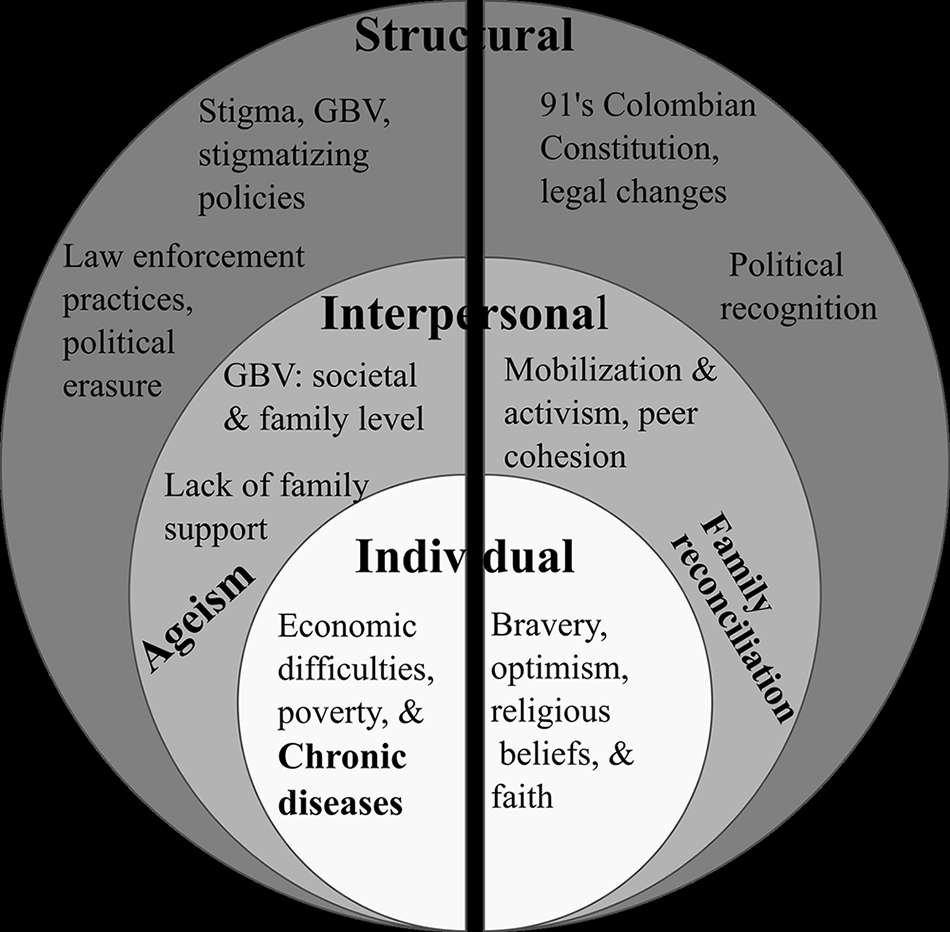
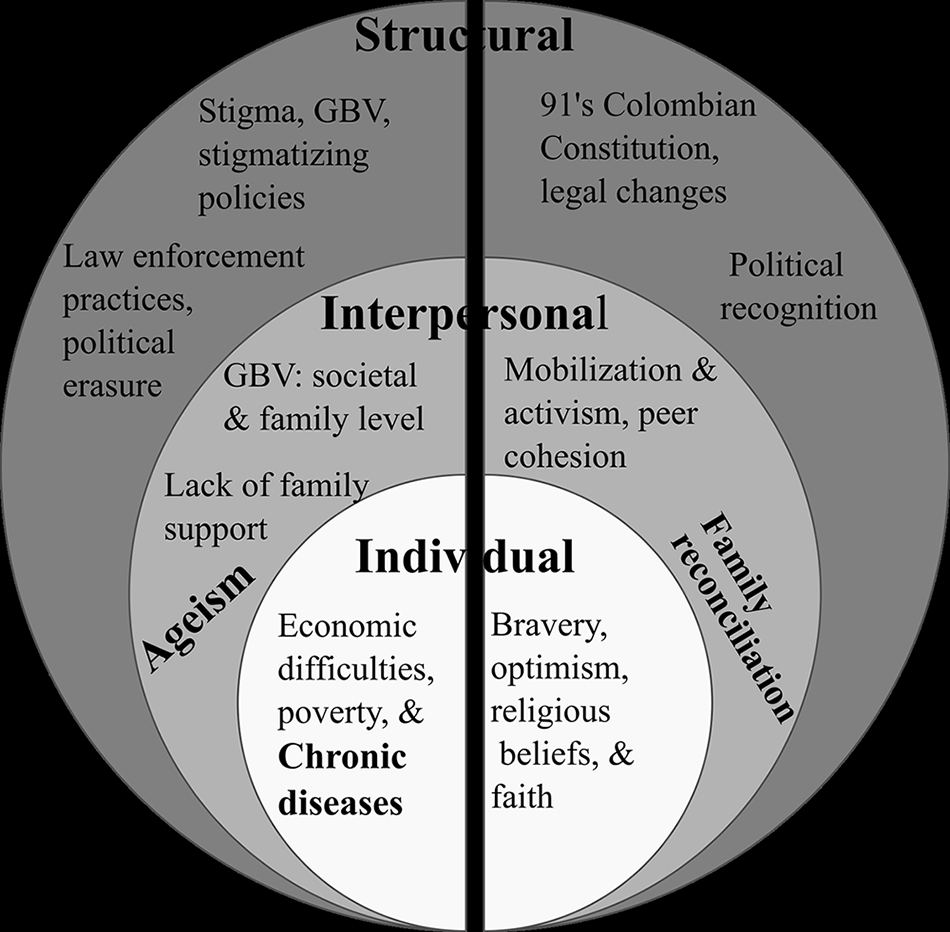
This study explores the multiple factors that shape the ageing experiences, focusing on the challenges faced by a group of Colombian trans women. By employing an ecological model, it examines the barriers and resources that impact their ageing process (Figure 1).
Ecological midel barriers and resources trans women ageing process. Note: The highlighted themes are referred to the barriers or resources in late life.
Methods
A qualitative research project was conducted using the constructivist grounded theory (CGT) methodology proposed by Charmaz (Reference Charmaz2006, Reference Charmaz2014). The theory employs a systematic inductive, iterative and comparative approach to explore the meaning of people’s experiences. We chose CGT as a method to explore an under-researched area in Colombia, aligning with Charmaz and Thornberg (Reference Charmaz and Thornberg2021, p. 306), who noted that ‘many researchers use this method for a variety of worthy purposes instead of or in conjunction with theory construction, as the exploration of a new area of study’. This approach was considered appropriate for examining the barriers and resources experienced by a group of Colombian trans women navigating their ageing process and later life.
Participants
Twenty-three trans women aged 50–67 years old residing in Bogotá, Colombia, participated in this study (see Appendix 1). Participants were contacted through the Red Comunitaria Trans (RCT) [Trans Community Network] of Bogotá. The RCT is a communitarian-based organization of trans women who are street sex workers in an underprivileged neighbourhood. A purposeful snowball sampling facilitated by community leaders was employed. Individuals who self-identified as older trans women were invited to participate. The participants were inhabitants from two low-income neighbourhoods in Bogotá, Colombia. Some of the participants were street sex workers (see Appendix 1).
Locations
These neighbourhoods in Bogotá face significant financial hardship and social vulnerability. They include a red-light district and have a high influx of migrants from rural regions (many of whom have been displaced by violence). The neighbourhoods have a diverse population, including street dwellers, sex workers, ethnic minorities and individuals struggling with extreme poverty (to preserve anonymity we do not specify the areas) (Alcaldía Mayor de Bogotá 2002; Amézquita et al. Reference Amézquita, Rodriguez and Murillo2015; Pérez Plazas Reference Pérez Plazas2013, see Appendix 1).
Data collection
Semi-structured interviews
The interviews focused on understanding the challenges participants experienced during the ageing process and later in life. Semi-structured interviews allowed the researchers to deeply explore personal and often sensitive experiences (DeJonckheere and Vaughn Reference DeJonckheere and Vaughn2019). Interviews began with discussions on general life perceptions and proceeded with a flexible topic guide exploring the experience of the transition process; expectations of old age; coping with old age; planning; lifestyle; the social/family area; health; finance; and end-of-life and death. The interview schedule was adaptable, with prompts such as ‘Can you tell me more about that?’ or ‘What does that mean to you?’ Appendix 2 outlines the questions that guided the interviews.
Research procedure
The research commenced with an initial consultation between the first author and the RCT to align research interests and procedural strategies. The RCT started recruitment, inviting older trans women to participate in the project via word-of-mouth referrals. During these initial discussions, the age criterion for inclusion was revised based on the RCT’s recommendation to extend the invitation to those aged 50 years and over, rather than limiting it to those aged 60 and above. This adjustment acknowledges the social construction of ageing within the community, where trans individuals in these territories often consider themselves older adults after the age of 50. As participant P07 expressed, ‘After reaching 50 years of age, we tend to view ourselves as older individuals.’
First, a verbal agreement was established with the RCT to facilitate recruitment. Older trans women were recruited via snowball sampling. Participants who agreed to participate were provided with written information about the study and a written consent form. The information sheet contained the objective of the research project, as well as the ethical considerations, such as confidentiality, anonymity, participation being voluntary and participants having the option to withdraw at any time without giving any explanation. It was also communicated that interviews would be audio-recorded and transcribed verbatim, and that data would be securely protected. The first author’s contact details were provided for further enquiries. Participants were asked to sign the consent form prior to the commencement of the interviews.
All women who agreed to participate were informed about the consent, signed the consent form and were interviewed. Each interview lasted around 60 minutes and was conducted at RCT facilities and participants’ homes. Interviews were carried out in Spanish by the first author and assistant researchers were trained, all of whom were psychology undergraduate students and trained by the first author. The interviews took place between 2017 and 2019 at RCT facilities, Fundación Lxs Locxs and participants’ residences. All the interviews were audio-recorded and transcribed verbatim externally. Descriptive and interpretive memos were composed throughout the data collection and analysis.
Data analysis
All interviews were conducted, transcribed and coded in Spanish. The analysis occurred concurrently with the data collection, known as theoretical sampling, until data saturation was reached, indicating the point at which no new properties were found in the data (Charmaz Reference Charmaz2006, Reference Charmaz2014; Charmaz and Thornberg Reference Charmaz and Thornberg2021). We used line-by-line and focused coding while simultaneously writing memos, which fostered reflexivity and the creation of higher abstraction themes. The principle of constant comparison was applied by comparing codes, assigning codes to categories and co-creating categories of higher abstraction. At this stage of the coding process, tentative analytic categories emerged throughout the analysis (Appendix 3). This approach ensured that initial and focus codes were firmly grounded in the data and captured participants’ meanings. Colombian researchers subsequently discussed the coded interviews; this process of reflexivity fostered the quality criterion of trustworthiness (Charmaz Reference Charmaz2014). A second interview with the same participants was not feasible owing to the challenges of accessing the population, which is a common issue that has been reported in previous studies (e.g. Timonen et al. Reference Timonen, Foley and Conlon2018).
Additionally, memos were integrated into the theoretical categories. As part of the ongoing analytical process, the research team developed several diagrams and maps to refine the categories further, culminating in the final diagram (see Figure 1). The method of constant comparison, augmented by writing and drawing memos as recommended by Charmaz (Reference Charmaz2014), supported the co-construction of theoretical categories and ultimately guided the development of a theory.
Researchers in Colombia employed the gold standard of back translation into English. To the English-speaking ear, some directly translated Spanish quotations might seem unconventional. Nonetheless, verbatim translation was favoured over grammatical rectification to preserve the authenticity and emotional resonance of the interviews (Spanish quotes in Table S1). Both teams (UK and Colombian) engaged in a collaborative dialogue throughout each phase of the analytical process, and the UK researchers supported the final analysis.
The analysis leveraged Charmaz’s (Reference Charmaz2014) CGT approach to explore lived experiences and identify participant meanings. The philosophical underpinnings of CGT require that analysis be grounded in the data, not confined by pre-existing frameworks or theoretical concepts. Thus, the concepts as described earlier (Bronfenbrenner Reference Bronfenbrenner1979; White Hughto et al. Reference White Hughto, Reisner and Pachankis2015) served only as sensitizing concepts, and the data was examined from various angles. The ecological model in this study was returned to only because it emerged from the data.
Ethical considerations
At the time of conducting the interviews, the University of El Bosque did not require an ethics approval procedure. Therefore, this study could not be approved by the university. However, the research team considered ethical issues and followed the advice from the Declaration of Helsinki (World Medical Association 2001). We ensured confidentiality and anonymity by removing all identifiable information from the transcripts and labelling all participants with an alphanumeric code. Audio recordings were deleted once transcribed. This meticulous approach to participants’ confidentiality ensured adhering to the ethical code of conduct. Additionally, the transcripts were stored on the university’s server, accessible only to researchers using a password. The information sheet guaranteed that all provided information would be kept anonymous and confidential. The project did not raise ethical challenges for special consideration since it was not invasive, did not cause harm to the participants and did not pose risks higher than those found in daily life. However, as the interviews were likely to tackle some very sensitive topics in significant depth, we established a distress protocol with the RCT. This included stopping the interview recording and guaranteeing safety and emotional regulation. Additionally, the interviewer team offered to call loved ones and, if desired, provide a referral to Bogotá’s mental health support line. Participants were assured that they could get support from the RCT at any time. During the research, it was not necessary to activate this protocol.
Findings
The findings highlight that older trans women’s experiences were embedded in a complex, intertwined socio-ecological model, as suggested by White Hughto et al. (Reference White Hughto, Reisner and Pachankis2015). Ageing as a trans woman in this context involves confronting multiple barriers while also leveraging available resources. We identified an ecological interplay between the barriers and resources participants experienced during the lifecourse of ageing in Colombia. This interplay is evident at multiple levels: structural (stigma, discrimination and violence), societal intersections (overcoming barriers and mobilizing resources) and individual level (navigating life through personal strengths and economic barriers). Each level encompasses distinct barriers and resources. The model visually delineates these elements at each level during the ageing process. These themes, which emerged from the analysis, are shown in Figure 1 and discussed next.
Structural level: stigma, discrimination and violence
The structural level refers to the cultural, historical, political and legal context in which an individual is born and develops. At the structural level, it was found that participants encountered various barriers during the ageing process that persisted throughout their lives, such as stigma, gender-based violence (GBV), stigmatizing policies and enforcement practices and political erasure. Resources were identified at this level, marked by the Colombian Constitution of 1991 and beyond. These will be detailed in the following section.
Stigma
This refers to the labels imposed by society that marginalize and infringe upon trans women’s rights. For instance, P04 articulated her struggle against stigma that labelled and disadvantaged her. She perceived this barrier as not only perpetuating her marginalized position but also obstructing her ability to envision any opportunities for resistance or change: ‘so many obstacles, social, moral, everything … just being labelled as abnormal … how do you fight against that?’. The findings underscore that structural stigma, which permeates policies and laws, is entrenched in society and promotes GBV.
Gender-based violence (GBV): lifelong battles
Gender-based violence was present across all participants in this study, with each experiencing various forms of GBV throughout their lives. The data revealed how stigma enabled the normalization of GBV within policies and laws that participants encountered. For example, P18 spoke about the burden she has experienced during her life because of her gender identity. Her narrative is one example in which the participants identify that these acts of violence are systematic at a structural level and are experienced throughout life in the form of discrimination, exclusion and marginalization owing to their gender identity: ‘I have carried a lot of the bulk in life for being trans … ever since I started identifying as a trans girl, I have been consistently bullied. People have treated me terribly; no matter wherever I went, I faced discrimination’.
Stigmatizing policies and law enforcement practice
Prior to the 1991 constitution, individuals identifying themselves as trans women were victims of violence and discrimination. They were labelled as criminals and faced stigmatizing policies and law enforcement practices. Illustrating the consequences of these practices, P04 said: ‘I have been shot and stabbed. I have been in prison because they [police] took me to jail for wearing female clothes … for being a transvestite’.
Two other participants shared similar experiences of being discriminated against and treated like a criminal because of to their gender identity. As P06 said: ‘I was like a criminal …, they would expel me out and refuse to serve me in restaurants’. This was seconded by P09: ‘we had to hide a lot because sometimes people don’t even rent us a place’.
Further, P16 remarked on how law enforcement practices legitimized violence and discrimination, leaving her without protection in a dangerous environment where violence was not only tolerated but even encouraged by authorities: ‘Back in 1991, anyone who wanted could assault [hit] me, and those who wanted to stab me would do so. The police remained silent, and in those times, the police would even encourage violence, telling others to hit even harder’.
Despite the advancements of Colombia’s 1991 Constitution, participants reported ongoing discrimination and violence, particularly among those involved in street sex work. These experiences were tied to political erasure, a form of social exclusion.
Political erasure
Participants generally distrusted the government and its institutions, feeling consistently overlooked in political agendas that only reinforce their exclusion from social and political systems. As P01 told us: ‘Many of us said that the state has given us nothing; it gives us problems but never solutions’.
Similarly, P08 relates how political erasure is manifested in the limited support or social policies aimed at safeguarding trans rights: ‘They [government] don’t provide us support because we don’t have a family … so who is going to fall for it …, that the government and the people realise that we are human beings like any other person, that they should give us the contributions we need such as housing, health, work, education, but then you need support, resources’.
The findings indicate that participants in the study experienced pervasive and systemic GBV throughout their lives, reflecting a normalization of stigma within society, policies and law enforcement practices that perpetuated discrimination and violence against trans women, as well as their social exclusion and political erasure. However, new laws and regulations are now fostering positive changes.
Structural resources: the Colombian Constitution of 1991 and beyond
The 1991 Colombian Constitution, in Article 16, declares the right to the free development of personality. This legal change has become a structural resource for older trans, and, despite persistent structural stigmatization, this period has initiated transformative legal changes and political advancements (and recognition) for their protection. Noteworthy changes in legal protection and access to rights were underscored by the participants. For instance, P05 recognized in her narrative how this legal change has been evident in protecting her rights and preventing violent law enforcement practices and police abuse: ‘Today, we have many laws supporting transgender groups … Now, we find that we can make our transits and they [the police] are no longer going to take us [to jail], criticize, or beaten’. P04 added: ‘Today transvestites are winning … today it is no longer a crime’.
Furthermore, the constitutional changes in the 1991 Constitution have paved a crucial path for political recognition. This pivotal transformation has facilitated political engagement, yielding benefits such as enhanced representation, greater influence in decision-making and platforms for community advocacy. It has enabled trans individuals’ representation in spaces for public policy participation, promoted discussion forums on specialized LGBTIQ+ social policies and ensured activism and mobilization efforts. These modifications are evident in what P08 reported: ‘in every municipality, we have an LGBTQI+ community board. From there, we’re involved in everything … Well, in reality, many doors are opening’.
These experiences of changes at the structural level highlight the positive impact of legal changes in individuals’ lives, particularly for younger people. However, the experiences of older trans people being stigmatized, as found in this study, were still evident. As P22 illustrated: ‘nowadays, … things are better; for example, some police officers are very kind and respectful, but aggression and discrimination still persist’.
The 1991 Colombian Constitution has provided structural resources that support older trans individuals by legally affirming their rights to free personality development, and fostering significant legal protections and political recognition, which has led to increased representation and advocacy opportunities. However, challenges such as stigmatization and GBV still persist, particularly for those in older generations, affecting their lives, development and wellbeing. The intersectionality of these aspects is reflected in the societal level.
Societal level intersections: overcoming barriers and mobilizing resources
This level captures the intersection of various societal domains – including family, work, education and health services – with the environment where individuals develop and engage, thus enabling a range of interpersonal interactions. Both barriers and resources were identified at this level.
Societal level barriers: GBV and ageism
At this level, GBV was evident from participants’ experiences with this type of violence in both institutional and societal settings, and it impacted their interpersonal interactions throughout their lifecourse. Additionally, as individuals progress into mid-adulthood and later life, ageism emerges as a new barrier. These barriers have led to marginalization and stigmatization within society. For instance, P02 highlighted how the failure to recognize her pronouns throughout her life reinforced the power to categorize, mistreat and denigrate her. This lack of acknowledgement and calling her names associated with her former gender identity, thereby denying the current one, were experienced as both painful and as a form of criticism of her gender identity: ‘Society is the most difficult thing, there is always criticism under the table …, I’ve always been treated as a male, people called me “sir” …. Others have said “the fag”, “the transvestite”’.
Not only did the participants discuss society’s stigma, social perception and lack of acceptance of diverse gender identities but they also talked about how GBV was present at an institutional level. This contributed to marginalization and limited their opportunities for personal development.
Institutionalised GBV
Nearly all participants had experienced institutionalized GBV, which refers to any violence perpetrated by various public institutions, society and educational services. For example, P21 recalled how police abuse, particularly prior to the 1991 Constitution, impacted lives significantly as it limited her ability to access services and use public, leisure and recreational spaces:
For example, you could be in a restaurant, and a policeman passed by the door and when they finished serving lunch, they told you, pay for it now and walk, and you said wait! He grabbed you by the hair and dragged you out, but nobody said anything. They [police] took you to a cell for 72 hours, that was the worst thing in life. I thought all the time that [violence] affected us, both in health and morally. At that time it was a very, very terrible persecution and it is still obviously very noticeable.
Some participants reported experiences of discrimination in health-care services, consisting of stigmatizing practices such as unnecessary HIV testing, health-care negligence and delays, and misrecognition of their identities. These discriminatory practices required participants to continually demand respect for their rights and educate health-care workers about inclusive practices. Evidence of this can be seen in the accounts of two participants.
If I go [to the health-care service] because I have a toothache, the first thing they do to me is an HIV test (argh), because of a toothache! and you have to take an HIV test? how many people go [to health care] and they don’t even ask for it? and misgendering: make my gender identity very clear and they start calling me ‘Mr’, ‘he’, so-and-so. (P01)
This was supported by P05: ‘Personally, not with me, but with those who passed away. The care was terrible. They weren’t attended to on time, there was always a delay in getting their medicine quickly. There was always some obstacle preventing them from receiving their medication promptly, and you see, there they are’.
Nevertheless, notable distinctions have emerged in the experiences related to health-care services owing to the 1991 Constitution. Some participants perceived a progression towards inclusivity within the health service and expressed gratitude for this trend. One participant, P15, described this positive change in relation to both her courage to speak up and society’s respect, showing a fundamental change in her experience: ‘Let me tell you about myself. At the age of 20, I wanted to be treated as a woman, but I was always treated as a man, which was a violation of my rights. Nowadays, things have changed. If you address me using masculine pronouns, I will politely ask you to use feminine pronouns, and doctors will understand’.
Furthermore, P18 mentioned no negative experiences when asked about her current health care. Instead, she spoke about her gratitude for the health care she has received: ‘Regarding my medical situation, thankfully, I receive good care. I attend clinics where they treat me well. Although there are occasional delays, they always provide me with my medications. I manage to keep my oxygen supply up to date, thanks to the Lord’.
Another institutional aspect is related to education. Many participants spoke about how their experiences led to bullying and discrimination from an early age. For example, P04 said: ‘The teacher bullied me, he always mimicked me and imitated how I walked, they bullied me because of my effeminacy’.
For many, the education system did not allow participants to develop their potential careers, resulting in limited job opportunities. This lack of education is seen as a barrier that has a long-lasting impact on people’s lives, interfering with their economic stability later in life.
For instance, P23 emphasized the challenge and desire of economic stability in later life: ‘I wish I had a job, something …, like a pension …, sometimes you can’t find a job, so you start to think about how I am going to pay for the room (for a living)’.
As a result of being marginalized and discriminated against, many participants spoke about their struggles and how they were often limited to specific occupations, such as sex work. Two participants indicated that opportunities are scarce and no other options were possible. According to P01: ‘Prostitution ends up being a life option because I don’t have the opportunity to get another job’; and P08 stated: I had jobs when I was a teenager, but precisely because of my identity, I was rejected a lot’.
This finding highlights how GBV was evident in both institutional and societal settings, affecting participants’ lives through discrimination, marginalization and systemic abuse in areas like health care, law enforcement and education, which limited career opportunities and led to stigmatization and most likely to reduced wellbeing. However, the post-1991 constitutional changes have brought some positive shifts towards inclusivity, particularly in health care, though disparities do still persist. Acknowledging that participants are impacted not only by institutional and social settings in their lives but also by family and friends requires detailed consideration.
Societal-based GBV: GBV within the family and lack of family support
At this level, participants faced violence and discrimination not only in institutional and societal settings but also within the family sphere. The following two participants spoke about the painful experiences during their childhood when they faced physical abuse from their family, leading them to leave home at early ages in search of companionship and work. As P9 said: ‘after my family beat me a lot, that’s when I left my home and looked for friends. Since I was a minor, I couldn’t prostitute myself’. And P06 recounts how her grandfather told her to leave home as a teenager: ‘I was 14, I was a girl, and my grandfather kicked me out of the house; he did not accept my gender identity’.
Other experiences were related to the consequences of domestic violence and lack of family support that some of the participants experienced, which put them at risk at a very early age. Participants were compelled to leave their homes during childhood to fend for themselves, often resorting to child labour for survival. As P09 said: ‘I had to work as a child, since I was ten years old, at 11 years old, I fled my house’. With a different experience, P15 told us: ‘As a child, I had to throw myself onto the streets and survive’.
Yet another participant, P09, shared how difficult children’s experiences were: facing domestic violence, death threats and painful separation from their mother. She related her experience primarily to her time of transition: ‘Since I was a child, I have been very feminine, so my sisters and my father insulted me a lot when I was little’. Similarly, P07 said: ‘My mom did accept me, but when we were going to see each other, we had to see each other far away because my brother wanted to kill me’.
The experiences were harrowing, and, as a result, some individuals who were victims of domestic violence left their families at a young age. They were motivated to begin their transition processes in less restrictive environments without medical supervision. As P09 described it:
Look, since I was a child, I injected myself with whatever I found. I began by injecting a hormone that was very good – the hormone transformed me. At that time, when they [people] told you to inject a mixture of water and oil, people would do it without consulting a doctor. So, I administered my own treatment independently. I was aware of what I was putting into my body and knew that it would change my appearance.
The GBV, the domestic violence and the lack of family support during the lifecourse made participants vulnerable to engaging in risky behaviours, experiencing mental health issues and having fewer opportunities to develop their human potential. The already experienced discrimination was exaggerated while ageing, and a new manifestation of discrimination was mentioned.
Ageism
The findings identified emerging manifestations of discrimination in later life. Some participants articulated the contemporary challenge of confronting age-based discrimination. This signifies that, over the lifecourse of transitioning to older adulthood, participants encountered ageism, a newly and additional recognized barrier affecting their wellbeing, pointing towards intersectionality. To exemplify how they now have to contend with discrimination from fellow trans individuals in street sex work owing to their age, P06 said: ‘Our young comrades criticize us and despise an adult trans who is standing in a corner, they say ugly, old, and you should be collected’.
Some have experienced increased discrimination owing to their age and gender identity. As P21 expressed: ‘and now, being an old transvestite, they say to you, ‘Out, out, old fag, ugly fag!’ … Oh, quite a lot, quite a lot. They discriminate against you much more, as I just said, ‘old fag, ugly fag’, get dressed as a man, you’re not even ashamed, already so old and standing there, that’s very common now’.
The quotes above illustrate that discrimination exists not only within institutions, societal policies and families but also among peers. This discrimination contributes to ageism within the trans community and leads to fewer opportunities for individuals and double discrimination based on both their age and their gender. For example, it is more challenging for them to secure employment, leading to a cycle of poverty and economic hardship that puts them at a continued disadvantage, resulting in poorer health outcomes. Additionally, P07 and P08 suggest that older trans women face a lack of government support and economic insecurity, often resulting in a struggle to secure employment owing to their age. Moreover, being ‘looked down on’, as mentioned by P08, reflects the desire for acceptance and support: ‘We are alone; you may have your family, but we are alone and really have to fend for ourselves, and they don’t give us work anymore because we are old, and yes, maybe there are some of us that are sick’. Then P08 added: ‘Because we, as older trans, have to think about where to lay our heads since everyone looks down on us’.
This finding highlights that ageism and discrimination are experienced by older trans individuals, particularly in street sex work. It reveals that, in addition to facing institutional and societal discrimination, these individuals also endure prejudice and discrimination from younger members of the trans community owing to their age. This intersection of age and gender identity exacerbates their marginalization, leading often to economic hardship, unemployment, lack of support and poorer health outcomes. Participants’ quotes reflect the harsh treatment they received, including derogatory remarks and exclusion, which further isolate them and limit their opportunities for support and employment. However, the 1991 Constitution introduced significant changes that ensure rights and provide opportunities, such as mobilization to combat various forms of discrimination and marginalization, serving as an important societal resource.
Societal resources: mobilization, activism and community cohesion
Despite the severity of the barriers faced by the participants at the structural and societal levels, resources such as mobilization and activism, peer cohesion and family reconciliation help them overcome adversity.
Mobilization and activism
Some participants have been involved in activism with LGBTIQ+ communities and have become recognized leaders over the years. This communitarian mobilization and activism have aimed to increase awareness and political recognition. Such activism has provided them with empowerment and a sense of purpose. As P01 said: ‘I am a leader, and that experience changed my lifestyle’. The success of the participants’ mobilization and activism has fostered new career opportunities and improved political recognition. One participant, P18, spoke proudly about what she had achieved as a leading figure: ‘Now, I have become a complete leader because of the process that I initiated with the mayor’s office … What have we achieved? Well, we’ve open[ed] many spaces, processes, workshops, training, and education that previously did not exist for us’.
Additionally, many participants have experienced a positive change in public policies as a result of their activism and mobilization. As P05 illustrated: ‘Today we have many laws in favour of transgender groups’; and P04 said: ‘Today, transvestites are in a good position …, today is not a crime’.
Describing how activism and mobilization have impacted policies and how younger transgender individuals currently enjoy more rights, P14 said:
The thing is, right now, transgender youth and the community, in general, have many opportunities, for example, currently, some trans folks are working, some studying, and have completed a degree. That’s the purpose of this march (mobilization) – regardless of our circumstances, we want to study or have a job, something that you, who are heterosexual, have but might not fully appreciate.
The mobilization and activism of LGBTIQ+ communities, particularly trans individuals, have led to essential social and political changes. Through their leadership, participants have gained empowerment, opened up new opportunities and influenced public policies, improving rights and recognition for their communities. Additionally, several participants involved in these efforts now witness positive changes in laws and societal attitudes, with younger trans individuals enjoying greater access to education, employment and overall equality. Despite the barriers faced, as described earlier, many participants found support within their trans community.
Community cohesion
This study found that participants have built strong relationships with the trans community and peers, which became one of the major sources of social support. As P09 stated: ‘I have many trans friends because they have met me in this neighbourhood … Well, I have a close friendship with X because she has always taken care of me’.
The cohesion within trans peers has become a new family. It was evident that this cohesion has been maintained and is considered a significant form of support, as P15 described: ‘For me, they have always been my family … since childhood I have shared with them, I have always shared with them, on my birthday, New Year. With them, I have laughed, I have cried, with them I have fought. Then, my family has always been my friends, my community’.
The mixed experiences of community cohesion described above point towards the importance of meaningful relationships, which were essential resources for maintaining wellbeing and potential survival. As participants achieved middle and older adulthood, some tried to reconnect with their families, and some achieved family reconciliation. Describing the positive change in the relationship with her father she achieved by speaking openly, P11 told us:
Currently, my relationship with my family is good, despite the fear I had that my father would find out …. My mom died, then my dad found out that I was like that [trans], … When he found out, he called for me. I respect him, even though I was scared of him. In any case, I had to respect him … He said ‘Why didn’t you tell me before? I imagine how much you must have suffered.’ … I told him that I was afraid.
The empathy from the participant’s father was probably not experienced by all, but it fosters hope for future generations. However, the societal level reflects the mixed experiences and how various societal aspects interrelate and impact individuals’ lives and wellbeing. The societal level underscores that early childhood experiences of discrimination have a long-lasting impact on people’s education, work opportunities, participation as members of society and overall wellbeing. Using the ecological model as a sensitizing concept, it can be seen that participants also demonstrated important individual resources to overcome the barriers.
Individual level: navigating life through personal strengths and economic barriers
This level refers to the immediate environment, including activities, roles and personal characteristics. At this level, the resources outweighed the barriers, illustrating how personal and adaptive resources helped participants move forward and recover from adversity.
Individual resources
Individual resources were identified as psychological strengths, including bravery, optimism, religious beliefs and faith. Participants exhibited bravery as a defence mechanism that empowers them to fight against adverse situations and uphold their wellbeing. Some participants expressed how strong they are and that this made them survive. For instance, P08 said: ‘we were so discriminated at that time [before the Colombian 1991 constitution], those of us who are alive it is because we are badass’. Similarly, P19 stated: ‘fighting against society, the family and everything … we know how to overcome obstacles, is the everyday story of my life’.
Optimism as a resource was evident in participants’ positive attitudes. They use it as a cognitive process to adapt to life’s circumstances and the future, and this contributes to their sense of gratitude. As P12 stated: ‘I am cheerful; I always try, I am aware of myself. Grey hair and health issues are normal … I am 66 years old, I can say that I had to try to mould my attitude, anyone who reaches this age my advice is to take care of your attitude’.
Not only were personal strength and positive cognitive appraisal identified as resources; religious beliefs and faith also brought hope to the participants and helped them cope with adversity, as mentioned by P1: ‘I think God was the one who opened a door to change my mind’. This was supported by P8, who stated: ‘I came to have my little house because we have to think about where are we going to put our heads, because everyone makes it ugly for us, and thank God despite my age I feel good because God has given me my grain of salt’.
Religion and its practices are known for their self-calming and stress-relieving functions. Religion therefore needs to be acknowledged as a supportive resource for older adults. This strategy can be seen as a self-care strategy.
One of the most interesting findings was that participants changed their self-care behaviours and started to conceive of older adulthood as a second life opportunity, realizing the importance of self-care in maintaining their wellbeing. As P7 stated: ‘Old age is a metamorphosis … now I eat healthy food, I don’t stay up late anymore, I don’t drink too much, only on special occasions’.
Similarly, P23, who is still doing street sex work, said: ‘I no longer go out to work late, I go and work some days and I do my life, I go to my room and rest, because before I was three to four days partying’.
As mentioned already, the resources outweigh the barriers at this level. However, this is not without difficulty, as many have described the economic situation as challenging.
Barriers: economic difficulties
Although fewer barriers were identified at this level compared to others, most participants had economic difficulties. Only two participants received a pension, and some were living in poverty. For example, two participants spoke about their financial struggle owing to lack of income and suffering from health issues. Reflecting on these challenges, P21 said: ‘I am looking for someone to help me, now that I am out of work, that I am without money, without anything, right? … then as one gets older, of course, it is very different, to be poor and old than to be old as a millionaire, of course, because a poor one has to seek help from others’. Then another participant, P14, who has a chronic disease, brought up additional economic barriers:
I am a stylist, and as I’ve told you, in the last three years, I no longer have that skill in my work because of my state of health. So, what’s happening is the years are passing and I do not know where I’ll end up. Do I have to look for a charity to shelter me? Between now and tomorrow, I get to be in poor health, What am I going to do?
This finding about individual resources and barriers highlighted individual psychological strengths, such as bravery, optimism, religious beliefs and faith, which helped many participants cope with adversity, maintain wellbeing and find meaning in life. While participants relied on these personal resources to overcome obstacles, many also faced significant economic challenges, such as poverty and lack of financial security, especially in later life, owing to health issues and limited work opportunities.
Discussion
Since little is known about the lived experience of ageing among Colombian trans women, this qualitative study aimed to address this knowledge gap. Further, the study aimed to explore the barriers faced by them. Participants were 23 Colombian trans women. Their ageing process was influenced by barriers and resources at the structural, societal and individual levels. These three levels impact people’s lives and ageing processes, as identified earlier in the ecological frameworks of Bronfenbrenner and Morris (Reference Bronfenbrenner, Morris, Damon and Lerner2006) and White Hughto et al. (Reference White Hughto, Reisner and Pachankis2015). Although the frameworks were not used explicitly, the ecological perspective guided the analysis as a sensitizing concept (Charmaz Reference Charmaz2014). Despite Bronfenbrenner and Morris (Reference Bronfenbrenner, Morris, Damon and Lerner2006) emphasizing that close relationships are more influential than distant aspects, such as policies, this was not evident in the findings reported on in this article; instead, they support the findings of White Hughto et al. (Reference White Hughto, Reisner and Pachankis2015) by addressing multi-layered and interrelated aspects that influence ageing experiences. The study found that while some barriers persist during the lifecourse, others emerge in later life. Participants in this study experienced marginalization, violence and discrimination throughout their lives at structural, societal and individual levels (see Figure 1).
These findings are important for several reasons. They demonstrate that ageing is not experienced in the same way by everyone and that it influences a variety of intrapersonal experiences. At an interpersonal level, the study shows that cultural (e.g. cisnormative), societal (e.g. poverty) and political (e.g. laws and regulations) factors shape the experiences of ageing trans women (Fredriksen-Goldsen et al. Reference Fredriksen-Goldsen, Emlet, Fabbre, Kim, Lerner, Jung, Harner and Goldsen2024). Further, this study extends understandings of ageing beyond the Global North. The economic and social disparities between Colombia and the Global North are substantial, influencing the experiences of trans women in later life differently. For example, somewhere between 28 per cent and 40 per cent of Colombians aged over 66 years live below the UN poverty line, and health-care policies differ owing to economic, cultural and social factors, impacting health-care access (Bennett et al. Reference Bennett, Reyes-Rodriguez, Altamar and Soulsby2016; Derrer-Merk et al. Reference Derrer-Merk, Reyes-Rodriguez, Salazar, Guevara, Rodríguez, Fonseca, Camacho, Ferson, Mannis, Bentall and Bennett2022). For these reasons the study makes an important contribution to the gerontological literature, and for stakeholders and policy makers. The results underscore the importance of policies with differential and intersectional approaches since ageing is not homogenous. Historically, marginalized individuals face compounded challenges in their later years, carrying the burden of violence experienced throughout their lives. Additionally, the model in Figure 1 illustrates the interconnection between different levels and emphasizes the need for policies that adopt an intersectional approach to address the varied experiences of ageing in Colombia distinctively.
The interplay of discrimination and violence at a structural level, along with societal stigma and prejudice, and the available resources and challenging barriers of individuals can be seen in Figure 1. The interplay of policies, societal challenges and individual resources and barriers impacts participants’ wellbeing, and they expressed deep concerns about their future as ageing adults. These findings resonate with reports from the Global North, which emphasize how stigma and discrimination marginalize trans individuals (Bauer et al. Reference Bauer, Hammond, Travers, Kaay, Hohenadel and Boyce2009; Poteat et al. Reference Poteat, German and Kerrigan2013), demonstrate how stigma operates at multiple levels (Fabbre and Gaveras Reference Fabbre and Gaveras2020) and indicate that it can have profound consequences across social, physical and mental health domains (Bauer et al. Reference Bauer, Hammond, Travers, Kaay, Hohenadel and Boyce2009; Fredriksen-Goldsen et al. Reference Fredriksen-Goldsen, Prasad, Kim and Jung2023; Hoffkling et al. Reference Hoffkling, Obedin-Maliver and Sevelius2017).
Many barriers at the structural (i.e. stigma, stigmatizing policies and enforcement practices, and political erasure) and societal levels (i.e. GBV in institutional and societal environments) have persisted during the lifecourse of older trans individuals, despite political and constitutional changes. Findings in this study support previous evidence found in the literature about prejudicial policies (Finkenauer et al. Reference Finkenauer, Sherratt, Marlow and Brodey2012; Lozano Reference Lozano2021), family rejection and GBV (Colombia Diversa 2010; Departamento Nacional de Planeación (DNP) 2020; Witten Reference Witten2014). Furthermore, in relation to similarities with previous studies, our findings provide evidence that shows how lifelong exposure to structural violence ultimately impacts life trajectories and increases vulnerability in older trans adults (Anzani et al. Reference Anzani, Siboni, Lindley, Galupo and Prunas2024; White Hughto et al. Reference White Hughto, Reisner and Pachankis2015).
Additionally, some new barriers appeared in later life, such as ageism. Trans older adults face additional challenges and discrimination in late life, primarily because of their gender identity, age and work status (street sex work and/or poverty). Evidence of how trans individuals faced combined stereotypes (age and gender) concerning health and wellness has been reported earlier (i.e. Witten Reference Witten2017). This study expands upon the findings of Witten (Reference Witten2017) by offering new insights from trans individuals in Latin America and shedding light on the context of street-based sex work in old age. The findings of this study indicate that older trans women living in poverty and/or engaging in street sex work experienced additional stigma related to their economic circumstances and occupation, resulting in decreased job opportunities and wellbeing and legitimizing stereotypes. These results demonstrate the lack of differentiated policies and services for older transgender individuals. This prompts reflection on current social policies in Colombia, which are theoretically based on a differential and gender perspective. However, it seems that this has not yet translated into the services received by older transgender individuals. There is still a population group that either does not receive these services or requires specialized care.
However, some existing resources have changed during their lifecourse, such as new laws aimed to protect trans individuals’ rights, family reconciliation in later life, and awareness and development of self-care behaviours. Through mobilization and activism, many trans women have been able to achieve political recognition. This result is evidence of how guaranteeing participation and mobilization has allowed this sector of the population to impact policies and regulations. It also acknowledges older trans women who have survived stigmatizing policies and enforcement practices, helping them to achieve political participation and creating a space to seek rights protection. However, it highlights how trans individuals have not been part of Colombia’s political agendas and how the trans community has had to advocate for inclusion through social mobilization.
The effects of violence on mental health at various levels have been widely reported, such as internal conflicts, unpredictable relationships or exclusion, as well as limiting transphobic policies, among others (i.e. Fabbre and Gaveras Reference Fabbre and Gaveras2020; Fredriksen-Goldsen et al. Reference Fredriksen-Goldsen, Prasad, Kim and Jung2023). Our findings take a unique approach by also identifying the factors that facilitated coping and adaptation in the face of adversity. They demonstrate how elements such as social cohesion, mobilization and personal strengths through cognitive appraisal influenced policies through activism. This is especially relevant when there is a political guarantee, such as the 1991 Constitution, allowing typically marginalized groups from grassroots social movements to demand their rights.
Most resources and the fewest barriers were found at the individual level. At this level, participants used individual resources (optimism, resilience, religious beliefs and faith) to overcome the barriers and survive trauma. These resources helped participants, for example, with health problems, stigma and poverty. Faith and religious practices provided hope and meaning in their lives and functioned as stress relief, as Sisti et al. (Reference Sisti, Buonsenso, Moscato, Costanzo and Malorni2023) suggested in other contexts. This finding may be linked to common religious practices in Colombian culture, particularly those still firmly engaged among older adults.
The resources at the individual level facilitated participants in cognitive flexibility by allowing them to analyse situations from different perspectives, focusing on opportunities. Optimism contributed to cultivating gratitude and a sense of purpose in life. Baltes and Baltes (Reference Baltes, Baltes, Baltes and Baltes1990) found these cognitive appraisals earlier, highlighted in their concept of selective optimization and compensation. While the gerontological literature has extensively explored personal resources such as faith, gratitude and resilience (e.g. Malone and Dadswell Reference Malone and Dadswell2018; Salces-Cubero et al. Reference Salces-Cubero, Ramírez-Fernández and Ortega-Martínez2019), there is a notable scarcity of literature concerning the unique personal strengths and coping mechanisms of ageing within the transgender community (Finkenauer et al. Reference Finkenauer, Sherratt, Marlow and Brodey2012). Thus, our results contribute to addressing this gap and may provide valuable insights into the field of gerontology.
One of the most important findings was that reaching middle adulthood was a turning point for many participants. This stage of life was described as a moment when they started changing self-care behaviours and experienced self-acceptance; this was also found earlier by Miguel (2015). Interestingly, many participants began to see late life as a second chance at life. This is interesting because it suggests that reaching late life is an achievement for this group of trans women. It indicates that some may not have initially envisioned reaching older adulthood, and others may not have been able to fulfil this milestone. Melo et al. (Reference Melo, Oliveira and Magalhães2025, p. 18) (in a scoping review) also identified similar experiences. They identified older trans women sex workers as ‘true survivors’.
Nonetheless, barriers persisted throughout life, such as the cycle of poverty and risk behaviours (although these decreased in later life). Despite participants’ personal strengths, the results showed how participants’ lives have been crossed by violence, abuse, discrimination, marginalization and exclusion. This, in turn, affected participants’ wellbeing and generated economic uncertainty for their later life.
The co-creation of new knowledge within a model (Figure 1) enables researchers, practitioners and community members to collaboratively address the needs of older trans women, recognizing the interrelation among different levels and its impact on the lives of older trans women. This approach fosters a more inclusive and comprehensive theory development in gerontology, ensuring that the needs and experiences of ageing are marked by the intersection of social categories and affected by the interrelationship of different levels. Making decisions that have an impact on the various levels that eliminate barriers and endorse resources can promote a differentiated, dignified and achievable ageing process for older trans women.
Limitations
The study did not seek to explore solely trans women, but recruitment was difficult; it was not possible to reach out to contact older trans men. Another limitation is that the results reflect only participants’ experiences in two deprived areas in Bogotá. This study potentially does not reflect the experiences of older trans people in better social and economic situations, or in rural or other regions in the country. Another limitation relates to the fact that the recruitment of participants was led by the RCT. Although not all individuals were part of this organization, it was the community leaders of the RCT who facilitated access to the population. This is a limitation in the sense that the participants of the study belong only to a socio-economic context where the RCT is present. For this reason, it is important to emphasize that the results do not represent the diversity of experiences of being an older trans person.
Conclusion
In conclusion, the lived experiences of trans women ageing in Colombia revealed a multi-layered interplay of individual, societal and structural factors that shaped their lifecourse. This study highlights how deeply ingrained discrimination, violence and marginalization have not only persisted throughout their lives but also evolved, introducing new barriers such as ageism in later life. While some participants found resilience through individual resources like optimism and faith, the overarching narrative underscores a stark reality: the existing policies and societal structures often fail to address the unique challenges faced by older trans women, including health care, education and career opportunities. The findings call for a more nuanced understanding of ageing that accounts for the intersectionality of gender identity, socioeconomic status and age.
Furthermore, the results highlight the critical role of structural and political contexts that can either amplify vulnerability or, when inclusive, create avenues for collective action and ageing with dignity. The study emphasizes the urgent need for differentiated and inclusive policies that guarantee trans individuals’ rights and tailored policies, interventions and services to meet the needs and particularities of trans ageing identities. As trans women navigate the ageing process, the lack of tailored services and resources can exacerbate their vulnerabilities, leading to compounded challenges in education, health, wellbeing and economic stability, affecting their wellbeing later in life. However, the emergence of political recognition and activism among trans communities offers hope, indicating that systemic change is possible. By fostering a collaborative, ecological approach, stakeholders can better advocate for the rights and needs of older transwomen, ultimately promoting an inclusive, equitable and dignified ageing experience in Colombia. This model might also be useful in other contexts where marginalized communities face systemic barriers, highlighting the importance of intersectional, community and policy-driven strategies in advancing social justice and wellbeing in later life.
Supplementary material
The supplementary material for this article can be found at https://doi.org/10.1017/S0144686X25100196.
Acknowledgements
The authors would like to thank all participants for sharing their experiences with the researchers. Without their support, this study would not have been possible and would not have gained such deep insight. A huge thank-you to Andrea Correa, Daniela Maldonado and all the members of the Red Comunitaria Trans who supported the study and provided support for the participants. Additionally, we would like to thank the students who were involved in data collection and analyses, namely, Ana María Suárez, Carlos Méndez, Maria Fernanda Ariza, Vannesa Arias, Isabella Pachón, Mónica Pérez, Tatiana Plata, Marcela Salinas, María Fernanda Camargo, Camila Aguilar and Catherine Guerrero.
Author contributions
MFR designed the study, conducted the interviews, analysed the data and co-wrote the manuscript. EDM analysed the data and co-wrote the manuscript. SB, JDJ, MC, LL and JPP (research assistants) supported the conducting of the interviews, the transcription process and analysis of the data. KMB commented on the manuscript.
Financial support
This study had no financial support.
Competing interests
The authors declare that they don’t have any competing interests.
Ethical standards
Owing to the sensitivity of the data and to assure its protection, the data (in Spanish) will only be available upon reasonable request to the first author. An example of the data and coding process is available as supplementary material. All quotes reflect the English translation.


 Open access

