


Introduction
Symbiotic relationships among marine organisms are widespread and diverse (Gittenberger and Gittenberger Reference Gittenberger and Gittenberger2011; Rouzé et al., Reference Rouzé, Leray, Magalon, Penin, Gélin, Knowlton and Fauvelot2017), and a wide array of associations has been described in the literature, from shallow to deep waters, involving two or multiple organisms (Brown et al., Reference Brown, Terraneo, Moore, Paulay, White, Berumen and Benzoni2025; Hoeksema Reference Hoeksema2017; Maggiorni et al., Reference Maggioni, Arrigoni, Seveso, Galli, Berumen, Denis, Hoeksema, Huang, Manca, Pica, Puce, Reimer and Montano2022a; Mercier and Hamel Reference Mercier and Hamel2008). For instance, in shallow-water tropical reefs, coral-associated fauna represents most of the invertebrate diversity (Montano Reference Montano2022), with the highest levels found for crustaceans and molluscs (Stella et al., Reference Stella, Pratchett, Hutchings and Jones2011). Such interactions are fundamental for the survival of benthic communities, promoting productivity (Rodríguez-Troncoso et al., Reference Rodríguez-Troncoso, Rodríguez-Zaragoza, Mayfield and Cupul-Magaña2019), structural complexity (Bergsma and Martinez Reference Bergsma and Martinez2011), and survival of the partners (Appril Reference Appril2020), while potentially influencing each other’s evolution (deVienne et al., Reference deVienne DM, Refrégier, López-Villavicencio, Tellier, Hood and Giraud2013). However, despite the abundance and importance of symbiotic associations, many of the interactions occurring in the marine environment remain poorly known (Stella et al., Reference Stella, Pratchett, Hutchings and Jones2011). This is especially remarkable considering those occurring at mesophotic and aphotic depths (Turner et al., Reference Turner, Babcock, Hovey and Kendrick2017), where often obligate symbioses are necessary for the survival of both partners (Osman and Weinnig Reference Osman and Weinnig2022). In fact, although coral associations with other invertebrates are fairly well explored in shallow-water hard corals (e.g., Bähr et al., Reference Bähr, Dunn, van der Meij, Chowdhury and Benzoni2025, Reference Bähr, van der Meij, Terraneo, Xu and Benzoni2023; Macrina et al., Reference Macrina, Terraneo, Arrigoni, Maggioni, Tietbohl, Anker, Lasley, Pappas, Berumen and Benzoni2024a; Maggioni et al., Reference Maggioni, Arrigoni, Seveso, Galli, Berumen, Denis, Hoeksema, Huang, Manca, Pica, Puce, Reimer and Montano2022a; Stella et al., Reference Stella, Jones and Pratchett2010; van der Schoot and Hoeksema Reference van der Schoot and Hoeksema2024; Xu et al., Reference Xu, Bravo, Scholten, Borgstein and van der Meij2025), many symbiotic relationships involve octocoral hosts (Anker et al., Reference Anker, Vimercati, Barreca, Marchese, Chimienti, Terraneo, Rodrigue, Eweida, Qurban, Duarte, Pieribone and Benzoni2023; Lau et al., Reference Lau, Poliseno, Kushida, Quere and Reimer2020) at greater depths. Octocorals are major components of benthic environments, providing habitat and shelter to a variety of organisms across the water column (Schubert et al., Reference Schubert, Brown, Rossi, Rossi, Bramanti, Gori and Orejas2017), and forming dense communities known as marine animal forests (MAFs; Orejas et al., Reference Orejas, Carreiro-Silva, Mohn, Reimer, Samaai, Allcock and Rossi2022; Rossi et al., Reference Rossi, Bramanti, Gori, Orejas, Rossi, Bramanti, Gori and Orejas2017). Accordingly, various taxa have been reported in association with octocorals, establishing symbiotic relationships that can be very intricate (Fourreau et al., Reference Fourreau, Macrina, Lalas, Takahata, Koido and Reimer2024; Lourie and Randall Reference Lourie and Randall2003).
Mesophotic coral ecosystems (MCEs), particularly those dominated by MAFs, are increasingly recognised as biodiversity hotspots due to their structural complexity and the specialised taxa they support (Radice et al., Reference Radice, Hernández-Agreda, Pérez-Rosales, Booker, Bellworthy, Broadribb, Carpenter, Diaz, Eckert, Foster, Gijsbers, Gress, Laverick, Micaroni, Pierotti, Rouzé, Stevenson, Sturm and Bongaerts2024; Rossi et al., Reference Rossi, Bramanti, Gori, Orejas, Rossi, Bramanti, Gori and Orejas2017). These ecosystems host organisms with unique adaptations to low light, high pressure, and nutrient-poor conditions (Denis et al., Reference Denis, Ferrier-Pagès, Schubert, Coppari, Baker, Camp, Gori, Grottoli, Houlbrèque, Maier, Mancinelli, Martinez, Özdilek, Radice, Ribes, Richter, Viladrich and Rossi2024) and are listed as vulnerable marine ecosystems by the Food and Agriculture Organization of the United Nations (FAO), given their ecological value and susceptibility to impacts from fishing activities (FAO 2009). Nevertheless, our current understanding of the biodiversity and symbiotic relationships occurring in these ecosystems remains scarce (Radice et al., Reference Radice, Hernández-Agreda, Pérez-Rosales, Booker, Bellworthy, Broadribb, Carpenter, Diaz, Eckert, Foster, Gijsbers, Gress, Laverick, Micaroni, Pierotti, Rouzé, Stevenson, Sturm and Bongaerts2024), although their characterisation would be critical for both biodiversity assessments and effective conservation planning (Diaz et al., Reference Diaz, Howell, Robinson, Hosegood, Bolton, Ganderton, Arber, Attrill and Foster2023; Nolan et al., Reference Nolan, Falkenberg, Marchese, Ezeta Watts, Dunn, Macrina, Nunes-Peinemann, Chimienti, Vimercati, Terraneo, Qurban, Pieribone, Duarte and Benzoni2025, Reference Nolan, Marchese, Purkis, Ouhssain, Kheireddine, Terraneo, Chimienti, Rodrigue, Eweida, Jones and Benzoni2024; Rossi et al., Reference Rossi, Bramanti, Gori, Orejas, Rossi, Bramanti, Gori and Orejas2017).
Sea anemones can engage in symbioses with a variety of marine taxa, including the well-known association with anemonefish (Roux et al., Reference Roux, Salis, Lee, Besseau and Laudet2020), but also, with hermit crabs (Ross and Zamponi Reference Ross and Zamponi1982), gastropods (Mercier and Hamel Reference Mercier and Hamel2008), black corals (Gress and Kaimuddin Reference Gress and Kaimuddin2021), and octocorals (Ocaña et al., Reference Ocaña, den Hartog and van Ofwegen2004). However, their associations with the latter are still understudied (e.g., Ocaña et al., Reference Ocaña, den Hartog and van Ofwegen2004; Riemann-Zürneck and Griffiths Reference Riemann-Zürneck and Griffiths1999). Actiniarian species such as Amphianthus dohrnii (Koch, 1878), Calliactis palliata (Müller, 1776), or Stephanauge impedita (Gravier 1918), attach to octocoral branches by maintaining their standard pedal disc structure and surrounding the colony with it (Carlgren Reference Carlgren1934; Gravier Reference Gravier1918). In contrast, other species, such as those commonly known as ring sea anemones (RSA), appear to have modified their morphology into a pedal ring constituted of totally fused tissue surrounding the branches of octocoral colonies in a ring-like structure (Ocaña et al., Reference Ocaña, den Hartog and van Ofwegen2004).
The first description of RSA belongs to Hiles (Reference Hiles1899), who, while analysing octocoral colonies from the family Ellisellidae Gray, 1859, collected from Papua New Guinea by A. Willey, found and described the new sea anemone species Peronanthus verrucellae Hiles, 1899. Subsequently, Carlgren (Reference Carlgren1936) described Stephanauge annularis Carlgren, 1936, which was then recognised as another species of RSA (see Rodríguez et al., Reference Rodríguez, Fautin and Daly2025) associated with sea pens of the genus Balticina Gray, 1870 (formerly Halipteris Kölliker, 1870). Thereafter, Ocaña et al. (Reference Ocaña, den Hartog and van Ofwegen2004) provided an overview of the known RSA and, based on morphology, assigned them to two groups: the first encompassing small RSA with a remarkable dimorphism between the upper part and the pedal ring (i.e., P. verrucellae, Peronanthus sp. 1 – sp. 3, and S. annularis), and the second including bigger RSA with a thick mesoglea (i.e., Peronanthus sp. 4). Finally, a potential fifth species of Peronanthus (sp. 5) was documented by Ocaña et al. (Reference Ocaña, Henriques and Porteiro2007) and assigned to the first of the two morphological groups.
To date, RSA are known to occur in associations with octocoral hosts of the genera Keratoisis Wright, 1869, Ellisella Gray, 1858, Verrucella Milne Edwards & Haime, 1857, Anthothela Verrill, 1879, and Balticina, from 30 m to aphotic depths in the Atlantic, Indian, and Pacific Oceans (Ocaña et al., Reference Ocaña, den Hartog and van Ofwegen2004, Reference Ocaña, Henriques and Porteiro2007; WoRMS 2024; Figure 1). However, there are no records of RSA from the Red Sea, a basin where geological factors and environmental extremes are tightly linked to the diversity, evolution, and endemism of marine fauna as well as their symbiotic relationships (Berumen et al., Reference Berumen, Voolstra, Daffonchio, Agusti, Aranda, Irigoien, Jones, Morán, Duarte, Voolstra and Berumen2019; DiBattista et al., Reference DiBattista, Roberts, Bouwmeester, Bowen, Coker, Lozano-Cortes, Choat, Gaither, Hobbs, Khalil, Kochzius, Myres, Paulay, Robitzch, Saenz-Agudelo, Salas, Sinclair-Taylor, Toonen, Westneat, Williams and Berumen2016; McFadden et al., Reference McFadden, Erickson, Lane, Nassongole, Aguilar, Dunakey, Durkin, Lalas, Kushida, Macrina, Minor, Morales-Paredes, Nelson, Peddada, Poole, Porto, Purow-Ruderman, Snyder, Wismar, Samimi-Namin, Baria-Rodriguez, Benzoni, Huang, Reimer, Paulay, Quattrini, Ekins and Benayahu2025).
Map showing the sampling locality of the octocoral colony and symbiotic RSA in the central Saudi Arabian Red Sea (red dot). Blue dots indicate other locations where RSA are known from previous studies. A summary with coordinates of the previously known records is reported in Supplementary Table S1. The map was created with QGIS v3.32.2 (QGIS Development Team 2025).

In this study, we report the first record of RSA living on an octocoral colony from the Saudi Arabian Red Sea mesophotic zone. By combining morphological and molecular analyses, we provide an identification at the genus level and establish its phylogenetic position through DNA barcoding.
Materials and methods
Sampling
During the Red Sea Decade (RSDE) expedition onboard the M/V OceanXplorer, Remotely Operated Vehicle (ROV) and submersible dives occurred along the Saudi Arabian Exclusive Economic Zone of the Red Sea in mesophotic and aphotic waters from February to May 2022. Sampling for this study was carried out using a Triton 3300/3 submersible (Neptune), equipped with a Schilling T4 hydraulic manipulator. During a submarine survey on 2 March 2022, an octocoral colony was observed and collected at 97 m depth in the central Saudi Arabian Red Sea (20.73865 °N, 39.265010 °E) (Figure 1). Once at the surface, RSA were observed on the collected colony (octocoral colony voucher KAUST NTN0127BIO20). The octocoral specimen and associated anemones were processed aboard the research vessel and the apical part of one colony branch, including RSA, was subsampled and fixed in 99% ethanol immediately after collection for subsequent molecular analyses. The rest of the octocoral colony was air-dried out of direct sunlight for 24 hours and stored for subsequent morphological examination.
Morphological analyses and identification
At the King Abdullah University of Science and Technology (KAUST, Thuwal, Saudi Arabia), the octocoral dry colony and ethanol-preserved branches, as well as the anemones, were photographed using a Nikon D7500 camera with a Nikkor 18–55 mm lens. Detailed microscopical images of the anemones, of the octocoral polyps, and of the disposition and morphology of the octocoral’s skeletal elements were taken using a Leica M205A stereomicroscope equipped with a Leica DMC 5004 camera (Leica Microsystems, Wetzlar, Germany). Octocoral sclerites were characterised using a Quattro S Environmental Scanning Electron Microscope (Thermo Fisher Scientific, Wilmington, USA) at KAUST Imaging Core Laboratories (Thuwal, Saudi Arabia), following the workflow for sclerite preparation outlined in Macrina et al. (Reference Macrina, Nolan, Terraneo, Oury, Augustin, van der Zwan and Benzoni2024b).
Both the actinians and the octocoral colony were identified based on morphological characters used in traditional taxonomy and reported in original descriptions and subsequent revisions (e.g., Milne-Edwards and Haime Reference Milne-Edwards and Haime1857; Hiles Reference Hiles1899; Bayer and Grasshoff Reference Bayer and Grasshoff1994; Ocaña et al., Reference Ocaña, den Hartog and van Ofwegen2004). The octocoral dry colony and the ethanol-preserved samples, including the symbiotic anemones, are stored at KAUST.
DNA extraction, amplification, and sequencing
Total DNA was extracted from one of the symbiotic anemones (sea anemone voucher KAUST NTN0127BIO20A) using a DNeasy® Blood and Tissue Kit (Qiagen Inc., Hilden, Germany), following the manufacturer’s protocol. Polymerase chain reaction (PCR) was used to amplify a portion of the small subunit of ribosomal RNA (rRNA) 12S using the primer couple ANTMT12SF (5′ – AGCCACACTTTCACTGAAACAAGG – 3′) and ANTMT12SR (5′ – GTTCCCYYWCYCTYACYATGTTACGAC – 3′) (Chen and Yu Reference Chen and Yu2000). The amplification was performed in a 15 μL volume obtained with 7.5 µL 2X Multiplex PCR Master Mix (Qiagen Inc., Hilden, Germany), 1.5 µL of each primer (2 μM), 3.3 µL of H2O, and 1.2 µL of raw DNA. The thermal profile used for the amplification of the 12S rRNA region consisted of 95 °C for 15 min, followed by 4 cycles of 95 °C for 30 sec, 50 °C for 1 min, and 72 °C for 2 min, followed by 30 cycles of 95 °C for 30 sec, 55 °C for 1 min, and 72 °C for 2 min (Chen et al., Reference Chen, Wallace and Wolstenholme2002). Success of the amplification was tested using a QIAxcel Advanced System (Qiagen Inc., Hilden, Germany). The amplified product was then purified using lllustra™ ExoProStar™ (Global Life Sciences Solutions Operations UK Ltd, Buckinghamshire, UK), following the manufacturer’s protocol, and directly sequenced in both forward and reverse directions using an ABI 3730xl DNA analyser (Applied Biosystems, Massachusetts, USA) at KAUST BioSciences Core Laboratories (Thuwal, Saudi Arabia). Raw DNA is stored at KAUST. A barcode sequence for the octocoral host is available in Macrina et al. (Reference Macrina, Terraneo, McFadden, Chimienti, Marchese, Vimercati, Vicario, Reimer, Purkis, Eweida, Pieribone, Qurban, Duarte, Rodrigue, van der Zwan, Augustin, Westphal and Benzoni2025) (GenBank Accession Number: PV707296).
Phylogenetic analyses
Chromatograms of the forward and reverse sequences were manually checked, edited and assembled using Geneious® v10.1.3 (Biomatters Ltd, Auckland, New Zealand). To infer the phylogenetic position of the newly produced sequence, it was aligned with 69 previously deposited sequences available on GenBank database (https://www.ncbi.nml.nih.gov/genbank/) and representing specimens belonging to the order Actiniaria (Supplementary Table S2) using MAFFT v7.490 (Katoh and Standley Reference Katoh and Standley2013) through the E-INS-i settings. The alignment was manually inspected and edited using the software AliView v1.28 (Larsson Reference Larsson2014). The newly produced sequence was deposited in GenBank database (Accession number: PQ481953). The alignments’ statistics were checked using MEGA v11 (Tamura et al., Reference Tamura, Stecher and Kumar2021). Prior to running phylogenetic analyses, evolutionary models were checked through jModelTest2 (Darriba et al., Reference Darriba, Taboada, Doallo and Posada2012) on CIPRES (Miller et al., Reference Miller, Pfeiffer and Schwarts2010), under the Akaike Information Criterion (AIC), which selected the model GTR+G. Phylogenetic trees were then inferred using both Maximum Likelihood (ML) with RAxML-HPC2 on XSEDE v8 (Stamatakis Reference Stamatakis2014) and Bayesian Inference (BI) through MrBayes on XSEDE v3.2.7a (Ronquist et al., Reference Ronquist, Teslenko, van der Mark, Ayres, Darling, Höhna, Larget, Liu, Suchard and Huelsenbeck2012) on the CIPRES portal. ML analyses were run using the default parameters and 1,000 bootstrap replicates. For Bayesian analyses, two independent runs for four Monte Carlo Markov Chains (MCMC) were conducted for 10 million generations, with trees sampled every 1000th generation, and burn-in set to 25%. Phylogenetic trees were visualized using FigTree v1.4.4 (http://tree.bio.ed.ac.uk/software/figtree/) and rooted to Relicanthus daphneae (Daly, 2006) based on a previously published Actiniaria phylogeny (Rodríguez et al., Reference Rodríguez, Barbeitos, Brugler, Crowley, Grajales, Gusmão, Häussermann, Reft and Daly2014; Supplementary Table S2).
Results
Morphological results
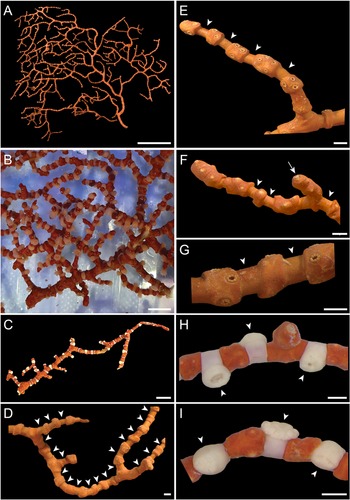
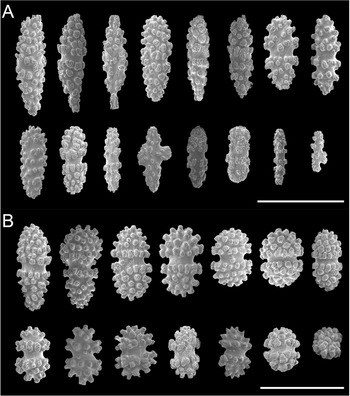
The octocoral host (KAUST NTN0127BIO20) consisted of a densely branched colony, with short and thick branches presenting anastomoses (Figure 2A). Polyps were monomorphic, contractile, but not retractile, and arranged around the branches (Figure 2A–2I). Surface sclerites were orange, while subsurface sclerites were colourless. Sclerites consisted of symmetrical spindles and double-headed clubs (Figure 3). Based on these morphological characters, the octocoral colony was assigned to the family Ellisellidae and to an unidentified species in the genus Verrucella.
Details of the analysed octocoral colony (voucher KAUST NTN0127BIO20) and associated RSA: (A) Full dry colony; (B) Portion of the freshly collected octocoral colony with associated RSA; (C) Branch of the ethanol-preserved colony; (D–E) Microscopic pictures of the octocoral skeleton showing the polyps and the marks from the RSA on its branches (indicated by arrowheads); (F) Microscopic picture of a branch of the colony showing the marks left by the RSA on the host (indicated by arrowheads) and the axis of the octocoral left exposed by the epibiont (indicated by the arrow); (G) Microscopic picture of a portion of a colony branch showing the marks left by the RSA on the host coenenchyme (indicated by arrowheads); (H–I) Ethanol-preserved octocoral polyps and associated RSA (indicated by arrowheads). Scale bars: A, 5 cm; B, C, 1 cm; D-I, 1 mm.

Sclerites of the Verrucella sp. colony characterised through scanning electron microscopy (SEM): (A) Symmetrical spindles; (B) Double-headed sclerites. Scale bars: 100 µm.

Upon examination, the Verrucella sp. branches appeared to be covered in white RSA (Figure 2B) which surrounded the host branches through a pedal ring (Ocaña et al., Reference Ocaña, den Hartog and van Ofwegen2004) constituted by the pedal disk tissue and part of the column (Figure 2A, 2B, 2H, 2I), which had to be broken to be detached from the octocoral colony. Most of the anemones’ tissue was arranged in their upper part, grouping the oral disc, tentacles, pharynx, and mesenteries, while their pedal rings surrounded the branches of the octocoral colony and appeared as a thin tissue junction with sparse external scars (Figure 2H, 2I). Based on these morphological characters, the RSA were assigned to the genus Peronanthus given their correspondence with the features of the first of the two morphological groups reported by Ocaña et al. (Reference Ocaña, den Hartog and van Ofwegen2004), and shared characters with Peronanthus sp. 3 (Ocaña et al., Reference Ocaña, den Hartog and van Ofwegen2004).
Molecular results
The newly generated 12S rRNA sequence (RSA voucher KAUST NTN0127BIO20A) was analysed along with 69 previously published Actiniaria sequences (Supplementary Table S2), in a final alignment of 974 bp. The alignment included 373 conserved sites, 539 variable sites, 391 parsimony-informative sites, and 142 singletons. The tree topologies resulting from the BI and ML analyses were concordant and confirmed that the sequenced specimen belongs to the superorder Enthemonae, superfamily Metridioidea Carlgren, 1893, family Amphianthidae Hertwig, 1882, and genus Peronanthus (Figure 4).
Bayesian Inference phylogenetic reconstruction of Actiniaria inferred from the sequencing of the small subunit 12S rRNA region, showing the phylogenetic position of one of the newly sampled Red Sea RSA (voucher KAUST NTN0127BIO20A in red). Node circles correspond to Bayesian posterior probability (≥0.8) and node values correspond to ML bootstrap values (≥80). The tree was rooted to Relicanthus daphneae.

Discussion
Morphological and molecular analyses confirmed that the actiniarian specimens associated with the octocoral colony sampled at 97 m in the central Saudi Arabian Red Sea belonged to the genus Peronanthus. Identification at the genus level was confirmed by our integrative analyses, and the RSA reported here correspond to the first morphological group established by Ocaña et al. (Reference Ocaña, den Hartog and van Ofwegen2004). However, species level assignment could not be confirmed at this stage due to the specimens being fixed in ethanol, which made their study difficult for histological and taxonomic purposes, and the geographical distance from the original collection locations of previously reported Peronanthus specimens (Supplementary Table S1; Hiles Reference Hiles1899; Ocaña et al., Reference Ocaña, den Hartog and van Ofwegen2004, Reference Ocaña, Henriques and Porteiro2007). Further and more detailed taxonomic studies aiming at clarifying the actual diversity of these organisms may overcome these limitations by preserving specimens for histological examination and internal anatomy (Fautin Reference Fautin2009), and by comparing freshly collected RSA with the type material of P. verrucellae and related taxa (Carlgren Reference Carlgren1936; Hiles Reference Hiles1899; Ocaña et al., Reference Ocaña, den Hartog and van Ofwegen2004, Reference Ocaña, Henriques and Porteiro2007). Moreover, sequencing additional loci (e.g., Yap et al., Reference Yap, Quek, Tan, Nugroho, Lee, Berumen, Tan and Huang2020) or employing next-generation sequencing techniques may offer insights into the evolutionary relationships of these organisms in the context of the order Actiniaria’s systematics (Fautin Reference Fautin2016; Fautin et al., Reference Fautin, Zelenchuk and Raveendran2007; Rodríguez et al., Reference Rodríguez, Barbeitos, Brugler, Crowley, Grajales, Gusmão, Häussermann, Reft and Daly2014) and help refine the phylogenetic placement of the specimen reported here beyond what was possible to achieve by sequencing the 12S rRNA marker alone. Such an integrated approach would be critical for resolving species-level relationships within the genus Peronanthus as well as to clarify whether any of the organisms reported to date represent undescribed species. Nevertheless, the RSA record reported here represents the first one known from the Red Sea, marking a significant expansion of the known distribution of the genus Peronanthus, beyond its previously observed range in the North Atlantic, Western Indian, and Pacific Oceans (Hiles Reference Hiles1899; Ocaña et al., Reference Ocaña, den Hartog and van Ofwegen2004; Rodríguez et al., Reference Rodríguez, Fautin and Daly2025).
The finding of RSA associated with a Verrucella sp. colony at mesophotic depths is particularly relevant as octocorals of the family Ellisellidae can provide habitat and three-dimensional structure in MAF ecosystems (Chimienti et al., Reference Chimienti, Aguilar, Maiorca and Mastrototaro2021; Moccia et al., Reference Moccia, Cau, Bramanti, Carugati, Canese, Follesa and Cannas2020). Hence, it underscores the importance of characterising the biodiversity of these communities at both the host and symbiont levels, particularly in MCEs, where obligate associations may be key to species survival (Kahng et al., Reference Kahng, Copus and Wagner2014). Symbiotic interactions involving actiniarians and octocorals are rare but biologically intriguing, especially those comprising Peronanthus, whose morphological adaptation suggests a high degree of host specificity and functional integration, potentially reflecting a long coevolutionary history. Unlike many shallow-water anemones that retain a free-living capacity or use loosely attached pedal discs (e.g., Calliactis spp. with hermit crabs), RSA are obligately epibiotic and appear to be structurally dependent on their hosts (Ocaña et al., Reference Ocaña, den Hartog and van Ofwegen2004). The evolution of the ring-like pedal morphology may have arisen as a species-specific adaptation to the host colonies (see, e.g., van der Schoot and Hoeksema Reference van der Schoot and Hoeksema2024 for other examples) or as a strategy to exploit specific ecological niches (such as the gorgonian branches) and avoid habitat competition (Ocaña et al., Reference Ocaña, den Hartog and van Ofwegen2004). In fact, this modification mirrors similar adaptations seen in other symbionts of octocorals and black corals at depth, such as ovulid gastropods and zoantharians, which often exhibit host-specific tissue modifications to maintain long-term attachment and access to host resources (Ocaña and Brito Reference Ocaña and Brito2004; Reijnen et al., Reference Reijnen, Hoeksema and Gittenberger2010). Accordingly, the ring morphology could represent a parallel evolutionary strategy to ensure stability in exposed habitats, by maximising the contact with the host tissues and ensuring epibiotic attachment. Furthermore, the structural integration seen in Peronanthus may drive selective pressures on both partners’ morphology and physiology (Appril Reference Appril2020; Dimijian Reference Dimijian2000). Comparative research on other mesophotic coral symbioses, such as the sponge-octocoral associations in the Caribbean, revealed that such interactions are often shaped by a combination of environmental constraints and evolutionary patterns (Lourie and Randall Reference Lourie and Randall2003). As such, the highly specialised Peronanthus-octocoral association may serve as a valuable model for exploring host-symbiont coevolution in MAFs.
Although the nature of the symbiosis between octocorals and RSA has not been fully clarified to date, the latter are known to engage in complex interactions with their hosts, including mutualistic and commensal relationships (Ocaña et al., Reference Ocaña, den Hartog and van Ofwegen2004). Nevertheless, Morton (Reference Morton1989) advanced the hypothesis that the genus Peronanthus may be an octocoral parasite, harming the host colonies, and this may be the case of the association reported in this study. In fact, RSA were clearly causing damage to the collected octocoral host, by reducing the thickness of its coenenchyme (Figure 2D–2G) and removing polyps to reach the colony’s axis (Figure 2H–2I), in a relationship that could be linked to a metabolic dependence of the parasite on the host (Ocaña et al., Reference Ocaña, Henriques and Porteiro2007). However, such interactions may also vary depending on environmental conditions and the health of the corals, with potential for mutualistic or commensal associations under different circumstances (Goulet and Goulet Reference Goulet and Goulet2021).
In the Red Sea, a basin known for its extreme environmental conditions (Berumen et al., Reference Berumen, Voolstra, Daffonchio, Agusti, Aranda, Irigoien, Jones, Morán, Duarte, Voolstra and Berumen2019), clarifying the mechanisms behind the symbioses of Peronanthus sea anemones and Ellisellidae octocorals could offer insights into their relationship and roles in MCEs and MAFs (Cuecuecha-Pérez and Ávila-García Reference Cuecuecha-Pérez and Ávila-García2025). At these depths in the warm waters of the Red Sea, organisms like Peronanthus may have evolved specialized adaptations to secure a stable substrate for survival, as shown for instance in hydrothermal environments (Zhou et al., Reference Zhou, Liu, Feng, Lu, Liu, Huang, Tang, Xu, Pu and Zhang2023). With ongoing explorations at depth, this finding contributes to the growing body of evidence highlighting the mesophotic zone of the Red Sea (Loya et al., Reference Loya, Puglise, Bridge, Loya, Puglise and Bridge2019) as a reservoir of undocumented biodiversity (e.g., Anker et al., Reference Anker, Vimercati, Barreca, Marchese, Chimienti, Terraneo, Rodrigue, Eweida, Qurban, Duarte, Pieribone and Benzoni2023; Benayahu et al., Reference Benayahu, McFadden and Shoham2018a, Reference Benayahu, McFadden, Shoham and van Ofwegen2018b; Chimienti et al., Reference Chimienti, Terraneo, Vicario, Marchese, Purkis, Eweida, Rodrigue and Benzoni2022; Macrina et al., Reference Macrina, Terraneo, McFadden, Chimienti, Marchese, Vimercati, Vicario, Reimer, Purkis, Eweida, Pieribone, Qurban, Duarte, Rodrigue, van der Zwan, Augustin, Westphal and Benzoni2025; Maggioni et al., Reference Maggioni, Terraneo, Chimienti, Marchese, Pica, Cairns, Eweida, Rodrigue, Purkis and Benzoni2022b; Nolan et al., Reference Nolan, Falkenberg, Marchese, Ezeta Watts, Dunn, Macrina, Nunes-Peinemann, Chimienti, Vimercati, Terraneo, Qurban, Pieribone, Duarte and Benzoni2025; Terraneo et al., Reference Terraneo, Ouhssain, Bocanegra Castano, Aranda, Hume, Marchese, Vimercati, Chimienti, Eweida, Voolstra, Jones, Purkis, Rodrigue and Benzoni2023; Vicario et al., Reference Vicario, Terraneo, Chimienti, Maggioni, Marchese, Purkis, Eweida, Rodrigue and Benzoni2024; Vimercati et al., Reference Vimercati, van der Meij, Terraneo, Chimienti, Marchese, Eweida, Purkis, Rodrigue and Benzoni2023), underscoring the ecological complexity and biogeographic uniqueness of these underexplored ecosystems. Given the higher diversity found in the mesophotic zone of the Red Sea compared to the euphotic and aphotic counterparts for organisms such as octocorals (Macrina et al., Reference Macrina, Terraneo, McFadden, Chimienti, Marchese, Vimercati, Vicario, Reimer, Purkis, Eweida, Pieribone, Qurban, Duarte, Rodrigue, van der Zwan, Augustin, Westphal and Benzoni2025) and black corals (Vicario et al., Reference Vicario, Terraneo, Chimienti, Maggioni, Marchese, Purkis, Eweida, Rodrigue and Benzoni2024), this record warrants further examination of the patterns of evolution and coevolution among octocorals and symbiotic taxa in the basin, especially considering the Ellisellidae and associated symbionts at depth.
Conclusions
Records of invertebrate associations such as the one reported in this study can be useful to elucidate the occurrence and establishment of symbioses among benthic taxa in MAFs, providing insights into the nature of these interactions and mechanisms of host selection. This new record of Peronanthus sp. in the Saudi Arabian Red Sea mesophotic zone not only extends the known range of this genus but also emphasizes the significance of mesophotic habitats in supporting complex ecological relationships. It is therefore crucial to continue the investigation of the diverse and often intricate symbioses existing in these environments, as they may provide valuable clues to the evolutionary dynamics and ecological processes shaping the biodiversity, resilience, and long-term dynamics of mesophotic ecosystems.
Supplementary material
The supplementary material for this article can be found at 10.1017/S0025315425100787.
Acknowledgements
This research was undertaken in accordance with the policies and procedures of the King Abdullah University of Science and Technology (KAUST, Thuwal, Saudi Arabia). We would like to thank Dr Andrea M. Quattrini (Smithsonian Institution, National Museum of Natural History, Washington DC, USA) for her guidance during the early stages of specimen identification, which contributed to the development of this manuscript. Permission relevant for KAUST to undertake this research was obtained from the applicable governmental agencies in the Kingdom of Saudi Arabia. The authors acknowledge the Saudi Arabian authorities and the National Center for Wildlife (NCW) in particular for supporting the Red Sea Decade OceanX expedition onboard which we could sample for the present study. In addition to M.Q., C.M.D., and NCW, we thank J.E. Thompson, and N.C. Pluma Guerrero for organising, coordinating and facilitating the expedition. The OceanX team, both in headquarters and onboard, is acknowledged for their operational and logistical support during the expedition, especially the captain and crew of the M/V OceanXplorer, and the Sub and ROV teams, to which we are deeply grateful for their patience, support and manipulator mastery. Finally, we thank the KAUST Bioscience Core Laboratories for helping with sequencing. This project was supported by KAUST baseline funds to F. Benzoni.
Author contributions
L.M. and F.B. conceptualised the study. L.M. performed molecular work and formal analyses, designed the figures, and wrote the manuscript with suggestions from F.B. and T.I.T. T.I.T. collected the sample. L.M. and C.S.M. identified specimens. F.B., T.I.T., C.S.M., and G.C. provided supervision. F.B. acquired funds for sample processing and analyses at KAUST. F.B., V.P., M.Q., and C.M.D. administered the expedition and led data collection. All authors have read and agreed to the final version of the manuscript.
Data availability statement
The data that support the findings of this study are openly available in the NCBI GenBank database (https://www.ncbi.nlm.nih.gov/genbank/) under accession number PQ481953.
Financial support
The research expedition onboard the M/V OceanXplorer was funded by National Center for Wildlife (NCW). The authors are grateful to NCW for the invitation to participate in the RSDE and to OceanX ground and onboard staff and technical teams for their support. The material processing and KAUST team logistics and molecular analyses were supported by KAUST (award FCC/1/1973-50-01 and baseline research funds to F. Benzoni BAS/1/1090-01-01).
Competing of interest
The authors declare no conflicts of interest.



 Open access

