

Introduction
The progress of technology and the advent of digitalisation have profoundly transformed various aspects of our lives, including work, lifestyle, business strategies, and government policies. While digitalisation has brought about considerable advantages to the economy and society by enhancing efficiency, productivity, and convenience, it also presents several challenges – such as disparities in access to technology, unequal effects on employment, and benefits distribution – leaving those lacking appropriate capacity, knowledge, and skills at risk of falling further behind.
The ongoing changes called ‘Industry 4.0’ and the ‘Fourth Industrial Revolution’, are used in diverse ways across various fields and contexts; even though they still lack precise definitions (Kowalikova et al Reference Kowalikova, Polak and Rakowski2020), there is a widely accepted understanding that Industry 4.0Footnote 1 denotes the ongoing technological transformation of manufacturing and industry. This transformation involves the integration of digital technologies, automation, and data exchange. It encompasses a broad array of cutting-edge technologies, including artificial intelligence (AI), the Internet of Things (IoT), robotics, big data analytics, cloud computing, autonomous vehicles, 3-D printing, nanotechnology, biotechnology, materials science, energy storage, quantum computing, and more. These advancements are projected to revolutionise manufacturing operations (Schwab Reference Schwab2015), exerting influence on multiple aspects ranging from process enhancements (via the incorporation of new digital tools to streamline manual steps) to organisational adaptations (introducing innovative services and methodologies while discarding what are seen as outdated practices), and even at the level of business domains (reshaping value chains and roles within ecosystems) (Belli et al Reference Belli, Davoli, Medioli, Marchini and Ferrari2019; Parviainen et al Reference Parviainen, Tihinen, Kääriäinen and Teppola2017; Zimmermann et al Reference Zimmermann, Schmidt, Jugel, Möhring, Celesti and Leitner2016). As these changes continue to unfold, there is a parallel evolution in the fundamental essence of work that involves transformations in work organisation, implementation, and assessment.
The progress of technology generates an economic surplus that requires distribution between labour and capital. The allocation of economic surplus, which entails dividing profits or investment gains resulting from technologically advanced production within an economy, holds significant consequences for the distribution of income, wealth, and general economic welfare (Carbonero et al Reference Carbonero, Offermanns and Weber2023). As a result, this lays the foundation for the political endeavours of social partners striving to attain the greatest benefits from technological changes (An Reference An2022). The choices of principles and arguments, as well as the manner in which they are presented in negotiation processes and collective bargaining, hold the potential to determine the outcome of economic surplus division.
This paper examines the dissemination of information concerning Industry 4.0 technologies and strategies by interest groups in France and Germany, two countries with distinct and often opposing social partnership traditions (Thomas Reference Thomas2013). Specifically, our explanatory study explores the topics related to Industry 4.0 strategies, as well as the discussions and postulates surrounding them, with the aim of determining which of the key subjects were pivotal in shaping social dialogue in the analysed countries. To achieve this goal, we utilise cutting-edge big-data-type tools and machine-based automatic text processing to extract the most prominent narratives from public messages issued by social partners, encompassing discussions on Industry 4.0 challenges and the sentiment of these messages.
‘Social partners’ refers here to organisations or entities significantly influencing the labour and employment relations domain. These partners typically consist of trade unions or labour unions representing workers and employers’ organisations representing employers. The term ‘social partners’ underscores their integral role in shaping labour policies, negotiating collective agreements, and actively participating in social dialoguesFootnote 2 to address workplace concerns, employment conditions, and broader societal issues related to labour and the economy.
The study focuses on the period from 2011Footnote 3 to 2019, prior to the COVID-19 pandemic and the accelerated digitalisation changes that followed. The pandemic brought unforeseen challenges for workers, including infection risks, job insecurity, and the adaptation to remote work. During this period, the social dialogue primarily revolved around safeguarding job security and income for workers, with discussions on paid sick leave and unemployment benefits taking centre stage. Therefore, the analysis zeroes in on the digitalisation trends that occurred before the pandemic.
Our dataset comprises a newly collected set of 1,114 documents in PDF format from the websites of the 12 largest organisations representing employers and employees in France and Germany. To the best of our knowledge, this approach is unique, as existing literature primarily focuses on bibliometric analyses of Industry 4.0-related papers (Cobo et al Reference Cobo, Jürgens, Herrero-Solano, Martínez and Herrera-Viedma2018; Muhuri et al Reference Muhuri, Shukla and Abraham2019). These analyses explore different performance metrics like major Industry 4.0 topics, sources or types of journals publishing related studies, the total citations of those papers, etc. Research concerning the role of social partners in Industry 4.0 implementation tends to concentrate on new social dialogue and challenges or opportunities in industrial relations (e.g. Haipeter Reference Haipeter2020; Muňoz de Bustillo Reference Muňoz de Bustillo2020; Schroeder et al Reference Schroeder, Greef and Schreiter2017).
The study reveals that despite significant differences in employment regulations and labour market characteristics between France and Germany (referred to as ‘employment regimes’, see Gallie Reference Gallie2007), as well as variations in technological penetration in both countries, social partners were engaged in similar national initiatives aimed at transforming the economy technologically. Furthermore, sentiment analysis suggests that social partners expressed predominantly positive opinions about the future of work, recognising more opportunities than threats. We also assert that preserving the rights of workers, guaranteeing fair labour environments and conditions, and making investments in training and retraining are essential actions to assist workers in adjusting to new technologies and methods of work.
The structure of this paper is as follows: we begin by providing the backdrop to this research. Subsequently, we delve into the study’s design, elucidating the methodological selections made. Following this, we present the findings. Initially, we extract information from our database and pinpoint the primary themes surrounding the concept of ‘Industry 4.0’. Secondly, we evaluate the polarity and subjectivity of the documents under investigation. The final section encompasses conclusions drawn from the study and outlines potential avenues for future research.
Setting the context
The challenges of Industry 4.0
When enterprises embark on the implementation of Industry 4.0 technologies and strategies, they encounter an array of challenges spanning various dimensions (Nimawat and Das Gidwani Reference Nimawat and Das Gidwani2022). The most significant is a shortage of skilled workers proficient in critical technologies, such as data science, AI, and advanced robotics, which may hinder progress (Future of Jobs Report 2023; Hamada Reference Hamada2019). Additionally, integrating new Industry 4.0 technologies with existing systems and processes can give rise to complexities (Issaoui et al Reference Issaoui, Khiat, Bahnasse and Ouajji2019). Organisations may need to undertake substantial infrastructure and operational changes to fully capitalise on Industry 4.0 advancements. These may require substantial investments in infrastructure, training, and equipment. Introducing new technologies can also lead to resistance and uncertainty in the workforce (Burgess and Connell Reference Burgess and Connell2020). This undertaking, being both costly and time-consuming, can act as a barrier for small- and medium-sized enterprises aiming for further development (Wankhede and Vinodh Reference Wankhede and Vinodh2021).
Industry 4.0 systems also generate and process significant amounts of data, making them susceptible to cyber-attacks (Corallo et al Reference Corallo, Lazoi, Lezzi and Pontrandolfo2021; Furstenau et al Reference Furstenau, Sott, Homrich, Kipper, Al Abri, Cardoso, López-Robles and Cobo2020). Hence, there is a requirement for regulatory challenges, encompassing laws related to data privacy and data protection (Habrat Reference Habrat2020). Finally, a recent discussion about the future of work emphasises that employers’ organisations must carefully balance the implementation of automation and AI with the need for a human workforce, particularly in roles that require complex decision-making, creativity, and empathy (Baiocco et al Reference Baiocco, Fernandez-Macías, Rani and Pesole2022; Bird et al Reference Bird, Fox-Skelly, Jenner, Larbey, Weitkamp and Winfiel2020).
From an employee perspective, Industry 4.0’s impact extends to the social and cultural domains, leading to concerns like job displacement and shifts in the nature of work. These matters have been extensively studied in the literature (e.g. Arntz et al Reference Arntz, Zierahn and Gregory2016; Acemoglu and Restrepo Reference Acemoglu and Restrepo2018, Reference Acemoglu and Restrepo2020; Bowles Reference Bowles2014; Dengler and Matthes Reference Dengler and Matthes2018; Frey and Osborne Reference Frey and Osborne2017; Nedelkoska and Quintini Reference Nedelkoska and Quintini2018; OECD 2019; Schroeder et al Reference Schroeder, Greef and Schreiter2017). There is a broad discourse on the transition from traditional employment to new forms of non-standard employment, notably exploring shifts in work content (Kornelakis et al Reference Kornelakis, Kirov and Thill2022). These new employment configurations diverge from established norms, incorporating formal employer–employee or client–self-employed relationships, work patterns, and organisational aspects, which include working time, workplace, and the utilisation of information communication technology (ICT) (Belli et al Reference Belli, Davoli, Medioli, Marchini and Ferrari2019; Canetta et al Reference Canetta, Barni and Montini2018; Findeisen et al Reference Findeisen, Constantinescu, Pokorni, Ahram, Taiar, Langlois and Choplin2020; Moniz et al Reference Moniz, Candeias and Boavida2022). Hence, these discussions cover not only workers’ rights, equitable wages, and secure working conditions but also the assurance that all employees, even those with limited digital skills or from marginalised backgrounds, will benefit from technological change.
Social partners’ responses
The rate of digital transformation differs across industries and geographic areas. Organisations effectively adopting such changes often concentrate on aligning technological endeavours with their broader business strategies, cultivating an innovative culture and ensuring that their workforce has the necessary skills to thrive in a digital environment. Enterprises with less advanced digitalisation efforts could encounter obstacles in procuring sufficient funds for investing in new technologies. They might also grapple with a shortage of in-house expertise necessary for appraising, implementing, and overseeing these technologies. Moreover, there exists a potential for hesitancy towards technological transitions due to concerns regarding the unfamiliar, job (in)security, or aversion to acquiring new skills. As a result, collaborating with industry associations, technology providers, and local institutions can provide valuable support in navigating these challenges. Additionally, disseminating messages that underscore the advantages of technological transformation can cultivate an environment conducive to learning and innovation.
Consequently, the involvement of social partners is pivotal in the adoption of Industry 4.0, although their demands can differ based on technological maturity, the requirements of workers and employers, and their priorities. As key stakeholders in the world of work and employment relations, they collaborate in shaping labour policies, negotiating employment conditions, and adapting to changes. Unlike certain other developed regions, the European social model has consistently integrated social dialogue. Nevertheless, the dimensions of this dialogue have evolved within the diverse employment and industrial relations frameworks of European countries (Lapeyre Reference Lapeyre2018).
Amidst the Fourth Industrial Revolution, employers’ organisations generally expect to embrace new technologies and processes that enhance productivity and competitiveness, ensuring that the workforce is equipped with the necessary skills to operate in a technologically advanced environment. Simultaneously, these organisations contribute by advocating for policies that encourage technological adoption and address potential disruptions, such as job displacement. Conversely, trade unions strive to ensure that workers’ jobs are not threatened by automation or AI, advocate for policies that promote job retention and fair transition mechanisms, and collaborate to ensure that workers have access to reskilling and upskilling opportunities, enabling them to adapt to changing job requirements. Additionally, trade unions advocate for the ethical application of technology, safeguarding workers’ rights, and privacy in the digital workspace. The literature suggests that collaboration between these groups will help to find mutually beneficial solutions for Industry 4.0’s challenges and opportunities. Nonetheless, recent research underscores that the institutions and actors involved in employment relations have forged distinct pathways of adjustment to digitalisation, underscoring that technology is influencing work in a non-predetermined way (Kornelakis et al Reference Kornelakis, Kirov and Thill2022).
Therefore, the trajectories of technological development can be shaped by the capacity of employers’ associations and trade unions to mobilise power resources. In a competitive market, the distribution of economic surplus between labour and capital depends on their respective contributions to the production process. In regulated economies, the ability to determine this division is through creating and enforcing social regulations (Mueller Reference Mueller2003, 360; Scruton Reference Scruton2007, 544). According to Mueller (Reference Mueller2003, 360–361), two primary sources of agents’ political power can be identified: social regulations established in the past, entitling some agents to possess that power, and information held by certain agents that others lack access to. The first source entails procedural power exercised through coercion or distributing goods, while the second is employed through education and propaganda in an uncertain world (Mueller Reference Mueller2003, 360).
This latter channel holds particular significance for leaders of interest groups like employers’ associations or trade unions. These leaders face a unique challenge: members can easily leave the group if they are dissatisfied, making it hard for leaders to gain significant power through traditional coercive methods. Instead, they need to focus on persuasion and consensus-building among their members. Decision-making within interest groups requires leaders to convince a large portion of members to agree on a particular course of action. This highlights the importance of leaders persuading members to support their goals. In this world, distributing information becomes a cost-effective strategy for leaders to influence members and align them with their own objectives. By sharing information, leaders can shape members’ perceptions and opinions about certain issues. Moreover, sharing information not only helps in gaining support from existing members but can also attract new members to the group. Additionally, leaders might influence policymakers who lack complete information on certain matters. This influence can lead to the formulation of policies that align with the goals of the interest group (Lohmann Reference Lohmann1995). In situations where there is limited information available, leaders who possess relevant information can wield significant political power.
For leaders of interest groups, especially those within entities such as employers’ associations or trade unions, the strategic sharing of information holds significant importance. This practice serves as a means to gain influence, build consensus, attract members, and shape policies, particularly in situations marked by uncertainty (Pilc et al Reference Pilc, Woźniak-Jęchorek, Woźniak, Piątek, Ratajczak-Mrozek and Marszałek2021). In light of the uncertainty enveloping the repercussions of Industry 4.0 for labour market participants, a valuable avenue for investigation could revolve around the examination of how social partners disseminate information, especially in the current context where their experiences and approaches have not been the same around Europe. The German and French cases reveal some differences. According to Haipeter (Reference Haipeter2020), ‘trade unions in Germany have opted to go on the offensive and adopt a strategy aimed at securing active participation in shaping change, as opposed to rejecting it and then fighting over the consequences’, also engaging works councils at the workplace level. In the French case, according to Erhel (Reference Erhel, Vaughan-Whitehead, Ghellab and de Bustillo Llorente2021), as digitalisation creates new opportunities but still raises concerns, both social partners and the government have engaged in negotiations and established new principles, e.g., the 2016 right to disconnect (droit à la déconnexion) to protect the work-life balance.
Research design
Hypotheses
To analyse the dissemination of information regarding Industry 4.0 by trade unions and employers’ organisations in France and Germany, we have utilised emerging big-data-type tools and machine-based automatic text processing. This approach allowed us to identify the most prominent themes in public messages from social partners, as well as the sentiment conveyed in these messages. One of the key advantages of employing machine learning for document analysis is its efficiency – these algorithms can swiftly and accurately process large volumes of documents, leading to significant time and resource savings. Additionally, this method enhances the precision of tasks like data extraction and classification. Consequently, we can employ this technique to categorise the information shared by social partners with a specific focus on primary topics, arguments, and postulates.
Building on the extensive body of research concerning the outcomes and challenges associated with the implementation of Industry 4.0, we put forward three hypotheses:
H1: Employers’ organisations and trade unions aim to play a role in the decision-making process related to the implementation of Industry 4.0 technologies and strategies across various significant employment models.
H2: Social partners particularly emphasise the role of new training and retraining initiatives to enhance the workforce’s adjustment to emerging technologies and work methods within the Industry 4.0 context.
H3: Social partners endeavour to create regulatory frameworks and standards to collaboratively address the challenges and opportunities arising from Industry 4.0.
Consequently, by utilising the insights derived from the research findings, we can evaluate the path of social dialogue pertaining to Industry 4.0 within the examined countries.
Study design
The documents released by employers’ associations and trade unions were sourced from their official websites. We specifically selected official press statements, position papers directed at policymakers, and opinion reports signed by the respective organisations, which were accessible on their websites. Acknowledging the potential diverse interpretations of the term Industry 4.0 among various parties, we compiled an extensive list of nearly 30 keywords associated with Industry 4.0. Whenever a located document published by employer associations or trade unions contained at least one word from this list, it underwent a detailed analysis. The list of these keywords in EnglishFootnote 4 includes Industry 4.0, the fourth industrial revolution, new economy, robotics, robotisation, automation, AI, smart, 3D printing, big data, IoT, nanotechnology, biotechnology, blockchain, driverless car, quantum computing, platform work, telecommuting, telework, digitalisation, digital market, digital competences, digital exclusion, new technology, new technological solution, technological change, innovation, and innovative business model.
The outcome of this procedure is a collection of 1,114 documents in PDF formatFootnote 5 released during the period 2011–2019 by the 12 most prominent organisations representing employers and employees in France and Germany. We selected these two countries for specific reasons. First, according to two sub-indexes of the Digital Economy and Society Index by the European Commission (DESI-EC 2020) – The Business Digitalisation Index and E-commerce Index – Germany and France exhibit similar levels of digital technology integration among national firms (France scores 28.2 in business digitalisation and 13.9 in e-commerce, while Germany scores 23.4 and 16.2, respectively).Footnote 6 However, data from the World Robotics Report 2020 by the International Federation of Robotics (IFR 2020) highlight that Germany maintains a significant lead in the use of industrial robots, with an operational stock of approximately 221,500 units, nearly five times the stock of France (42,000 units).Footnote 7 This discrepancy suggests that the penetration of technological changes varies considerably between Germany and France, necessitating more proactive participation from German social partners in industry-specific social dialogues.
Table 1 displays the list of studied employers’ organisations and trade unions along with the number of documents included in the analysis. Unfortunately, in certain cases, we could not retrieve documents published during the earliest years of the analysed period. Therefore, Table 1 also provides information regarding the period for which messages were available for each organisation, with a notation in italics if the availability span was less than 9 years within the 2011–2019 timeframe.
The number of analysed messages published by employers’ associations and trade unions included in the study together with a period of message availability

Source: Authors’ own elaboration.
We opted to include in the analysis only those organisations operating at the national level and representing more than a single industry. For France and Germany, we selected the three largest employers’ associations and trade unions, which collectively represent nearly 77% of trade union members in France (Ministry of Labour, Employment and Economic Inclusion 2018) and almost 95% of all members in Germany (Dribbusch and Birke Reference Dribbusch and Birke2019, 6–7).
To extract and evaluate textual data gathered from the collected publications, we utilised natural language processing (NLP) libraries. NLP represents a division of AI focused on enabling computers to interpret, process, and generate human language. These libraries provide advanced analytical capabilities that can unveil insights which traditional methods struggle to achieve. They give computers the ability to understand text (as well as spoken words) in very similar way as humans. The benefits of NLP libraries include the capacity to extract semantic information, such as keywords and key phrases, as well as perform sentiment analysis, thereby leading to a deeper understanding of the content and context of the publications. Hence, the utilisation of NLP libraries in our context facilitated the efficient analysis of a substantial volume of textual data (specifically, the set of 1,114 documents). Moreover, this approach minimises the potential for subjective interpretation, given that NLP techniques enable an impartial analysis through automated processes. Consequently, these applied techniques ensure coherence in both data processing and analysis.
Research results
Term frequency (TF)
Term (word) frequency is a fundamental concept in the field of text analysis and information retrieval. To assess this metric and others (polarity and subjectivity) in the selected documents, we developed our own algorithms in Python, leveraging various publicly available libraries. This approach involved a series of steps:
-
1. Initially, we extracted the text from the PDF documents using the PDFMiner library.Footnote 8
-
2. Then we performed tokenisation using the NLTK library,Footnote 9 which involves breaking down the larger text into individual words. In this process, we also filtered out stop words that lack significant meaning (e.g., conjunctions like ‘and’ or ‘or’) and common words that would not contribute to the document’s identification. It is crucial to note that each language has its unique set of stop words.
-
3. To group together different inflected forms of the same word as a single token, we used the spaCy libraryFootnote 10 for lemmatisation.
The outcomes of these steps can be seen in Figs. 1 and 2,Footnote 11 which display the most frequently occurring words in the French and German documents after tokenisation, stop word filtering, and lemmatisation.
French documents.
Note: Word size shows the word frequency (the more frequently a given word appears in a given document, the greater its size in the figure).
Source: Authors’ own elaboration.

German documents.
Note: Word size shows the word frequency (the more frequently a given word appears in a given document, the greater its size in the figure). Nouns are presented in black, verbs are in brown, adverbs are in blue, and adjectives are in green.
Source: Authors’ own elaboration.

TF by document count
Using the TF as a metric has also some drawbacks. One of the most important, it is sensitive to the length of a document. Longer documents naturally tend to have higher TFs simply because they contain more words. So, if you compare the TF of a selected word in a short document to the TF in a long document, it might not provide a true sense of its relative importance in each document. To mitigate this limitation, we took the following steps in our analysis:
-
1. We counted how many documents contained each word, ensuring a more balanced representation of word importance across documents.
-
2. Utilising specific NLP libraries, we conducted part-of-speech tagging to identify significant nouns, adjectives, adverbs, and verbs.
-
3. We categorised the documents into two distinct groups: employers’ associations and trade unions. Subsequently, we identified essential words associated with each group.
Figures 3–6 depict the most frequent words related to a particular part of speech (indicated by different colours) within each group of documents and languages. These visualisations consider tokenisation, stop word filtering, and lemmatisation as pre-processing steps.
French employer associations.
Note: Word size shows the word frequency (the more frequently a given word appears in a given document, the greater its size in the figure). Nouns are presented in black, verbs are in brown, adverbs are in blue, and adjectives are in green.
Source: Authors’ own elaboration.

French trade unions.
Note: Word size shows the word frequency (the more frequently a given word appears in a given document, the greater its size in the figure). Nouns are presented in black, verbs are in brown, adverbs are in blue, and adjectives are in green.
Source: Authors’ own elaboration.

German employer associations.
Note: Word size shows the word frequency (the more frequently a given word appears in a given document, the greater its size in the figure). Nouns are presented in black, verbs are in brown, adverbs are in blue, and adjectives are in green.
Source: Authors’ own elaboration.

German trade unions.
Note: Employer associations’ nouns in French: accord, apprentissage, compétence, compétitivité, coût, cybersécurité, écosystème, financement, formation, gouvernent, industrie, jeune, reforme, représentativité, transformation, mean in English: agreement, learning, skill, competitiveness, cost, cybersecurity, ecosystem, funding, training, government, industry, young, reform, representativeness, transformation. Employer associations’ adjectives in French: collectif, durable, fiscal, grand, humain, législative, national, productif, professionnel, public, salarial, social, solidaire, territorial, économique mean in English: collective, sustainable, fiscal, large, human, legislative, national, productive, professional, public, wage, social, solidarity, territorial, economic. Interactive version of the France heat maps: https://data.lewoniewski.info/labourmarket/fr.htm.
Source: Authors’ own elaboration.

Results of the TF–IDF Method
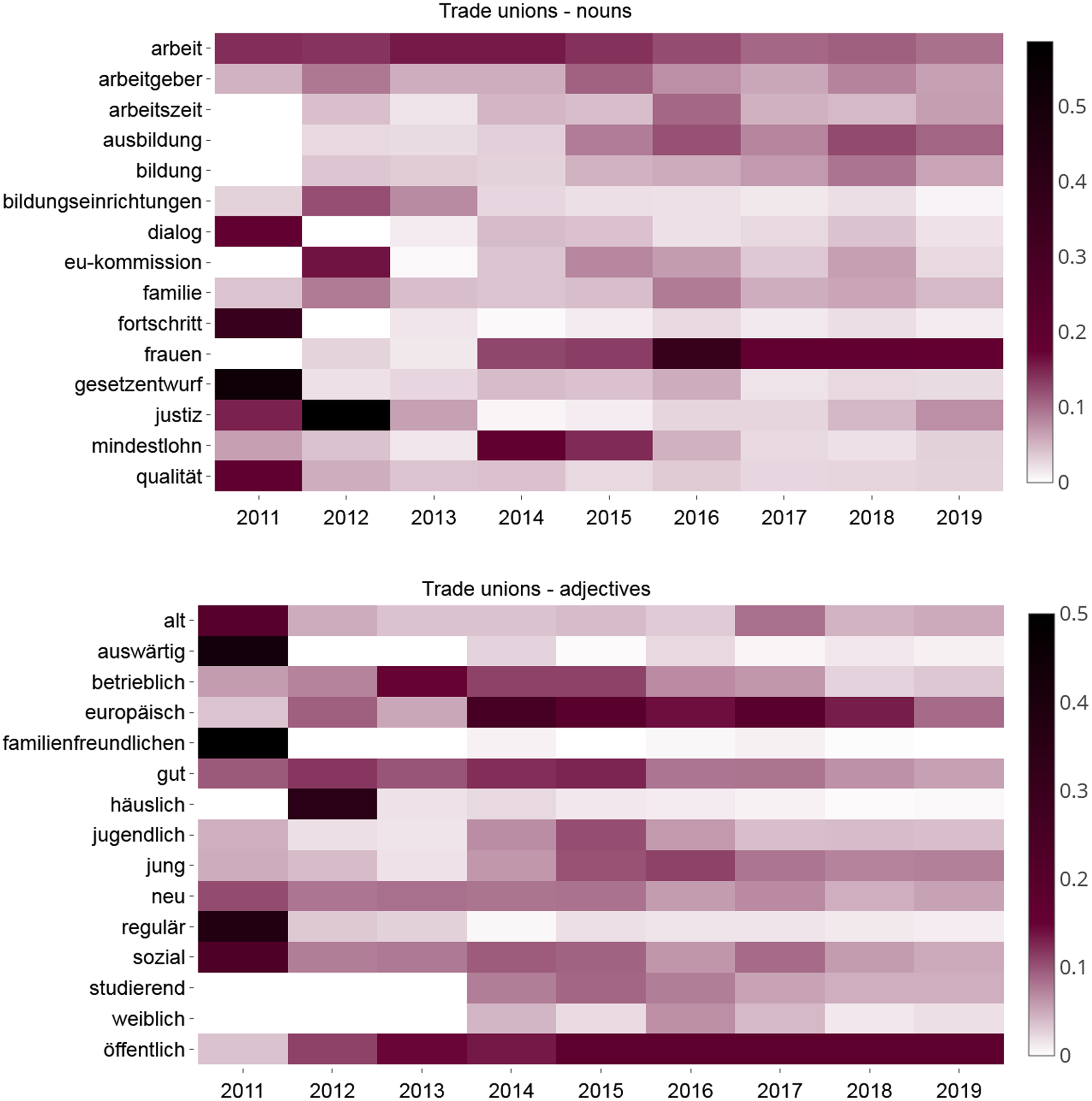
We noticed that the frequency of terms based on the number of documents offers improvements compared to the initial approach, but it still has room for enhancement. One notable drawback of this second method is its inclination towards selecting generic words that appear across a majority of documents. Consequently, some of the identified words lack uniqueness, making them unsuitable for distinguishing between documents. Considering this, we made the decision to employ a more sophisticated algorithm for this purpose: TF–inverse document frequency (IDF). This method is commonly utilised in information retrieval tasks, particularly in search engines (Ntoulaset et al Reference Ntoulas, Cho and Olston2004, 1–12). This metric weighs the TF by its IDF, helping to highlight terms that are distinctive to particular documents. Thus, TF–IDF allows us to gain a better understanding of underappreciated content. Additionally, we categorised the documents into two groups – employers and trade unions – while considering the year of document publication. Due to space constraints, we focused exclusively on nouns and adjectives. We also excluded words that were significant only in a few years or had similar meanings. The heat maps depicted in Figs. 7 and 8 showcase important nouns and adjectives for each year, focusing on French and German employer organisations. Likewise, Figs. 9 and 10 provide insights into French and German trade unions.
French documents published by employer organisations. (Interactive version of the France heat maps: https://data.lewoniewski.info/labourmarket/fr.htm.)
Note: Employer associations’ nouns in German: ausbildung, bildung, bundesregierung, e-commerce, e-government, entwicklung, eu-kommission, forschungsförderung, standards, hochschulen, produkte, wirtschaft, it-sicherheit, regelungen, weiterbildung mean in English: training, education, federal government, e-commerce, e-government, development, EU commission, research funding, standards, universities, products, economy, IT security, regulations, further education. Employer associations’ adjectives in German: akademisch, beruflich, erneuerbare, europäisch, global, grenzüberschreitend, industriell, mittelständisch, national, intelligent, wirtschaftspolitisch, vertraglich, technisch, steuerlich, dual mean in English: academic, professional, renewable, European, global, cross-border, industrial, medium-sized, national, intelligent, economic, contractual, technical, tax, dual. Interactive version of the German heat maps: https://data.lewoniewski.info/labourmarket/de.htm.
Source: Authors’ own elaboration.

German documents published by employer organisations. (Interactive version of the German heat maps: https://data.lewoniewski.info/labourmarket/de.htm.)
Note: Trade unions’ nouns in French: apprentissage, compétence, contrôle, cotisation, emploi, formation, impact, loi, mobilité, négociation, pauvreté, retraite, revenu, reforme, temps mean in English: learning, skill, control, contribution, employment, training, impact, law, mobility, negotiation, poverty, retirement, income, reform, time. Trade unions’ adjectives in French: durable, environmental, fiscal, important, interprofessional, minimum, Mondial, national, précaire, rural, régional, social, urban, écologique, économique mean in English: durable, environmental, tax, important, interprofessional, minimum, global, national, precarious, rural, regional, social, urban, ecological, economic. Interactive version of the German heat maps: https://data.lewoniewski.info/labourmarket/de.htm.
Source: Authors’ own elaboration.

French documents published by trade unions. (Interactive version of the German heat maps: https://data.lewoniewski.info/labourmarket/de.htm.)
Note: Trade unions’ nouns in German: arbeit, arbeitgeber, arbeitszeit, ausbildung, bildung, bildungseinrichtungen, dialog, eu-kommission, familie, fortschritt, frauen, gesetzentwurf, justiz, mindestlohn, qualität mean in English: work, employer, working hours, training, education, educational institutions, dialogue, EU commission, family, progress, women, draft law, justice, minimum wages, quality. Trade unions’ adjectives in German: alt, auswärtig, betrieblich, europäisch, familienfreundlichen, gut, häuslich, jugendlich, jung, neu, regulär, sozial, studierend, weiblich, öffentlich mean in English: old, foreign, company, European, family-friendly, good, domestic, youthful, young, new, regular, social, studying, female, public. Interactive version of the German heat maps: https://data.lewoniewski.info/labourmarket/de.htm.
Source: Authors’ own elaboration.

German documents published by trade unions. (Interactive version of the German heat maps: https://data.lewoniewski.info/labourmarket/de.htm.)
Note: Interactive version of the boxplots: https://data.lewoniewski.info/labourmarket/de-polarity-subjectivity.htm.
Source: Authors’ own elaboration.
The examination of TF in the documents from French and German employers’ organisations revealed comparable media attention to the challenges of Industry 4.0 in both nations (see Figs. 7 and 8). Further in-depth text-mining analysis of the gathered documents provides supporting evidence for our initial hypothesis (H1). Specifically, it demonstrates that French organisations employ terms such as ‘transformation’, ‘agreement’, ‘government’, and ‘representativeness’, while German organisations use the term ‘regulations’ to seek representation of their interests in the decision-making process.
Examining the timeline of social dialogue in France and Germany, it is noteworthy to recall that the French government initiated a dialogue on digitalisation challenges in 2015, marked by the establishment of the National Digital Council and the publication of the Mettling Report (Reference Mettling2015). This report, developed with the participation of trade unions, employers, and the public, laid out numerous recommendations aimed at enhancing firms’ competitiveness in the global digital landscape. In contrast, Germany had already taken earlier steps, implementing the High-Tech Strategy 2020 action plan and establishing an Industry 4.0 platform in 2013. This dialogue involved multiple stakeholders, including the government, the business sector, academia, trade unions, and employers’ associations (Schroeder et al Reference Schroeder, Greef and Schreiter2017). Subsequently, in 2015, the German government released a green paper titled Working 4.0: Thinking Further about Work, which sparked a significant debate among various employers’ associations in the country (Eurofound 2017). The culmination of this extensive dialogue in Germany was the publication of the white paper, Work 4.0 — Rethinking Work in 2017, outlining recommendations for companies, institutions, employees, employers’ associations, and the broader public regarding the implementation of Industry 4.0 technologies and strategies (Federal Ministry of Labour and Social Affairs 2017). This strategy encompassed discussions on data protection challenges and the regulation of non-standard forms of employment, in addition to initiatives like the Working Time Choice Law, which offered greater flexibility for workers in terms of working time and location (Muňoz de Bustillo Reference Muňoz de Bustillo2020, 22–23).
The text-mining analysis of the collected documents also confirmed the prominence of terms such as ‘learning’, ‘teaching’, ‘training’, and ‘competence’. Employers emphasised that training and retraining programmes represent the most crucial form of support for labour adaptation to the new Industry 4.0 environment (H2). Notable examples of employer initiatives in France include the digital skills and job coalition or digital universities. In Germany, employers’ associations have recommended bolstering education, training, and lifelong learning efforts by reducing the number of early school leavers in mathematics, IT, and engineering.
The topic of ‘working time’ standards is also a significant point of discussion in the social dialogue of both countries. In France, the government, trade unions, and employers have been actively involved in addressing changing priorities related to working time. This engagement was prompted by a notable increase in court cases highlighting the necessity for legal clarification in this specific domain. In Germany, trade unions presented the argument that the rise in stress-related absences could pose challenges for both employers and the overall economy (Vargas-Llave et al Reference Vargas-Llave, Weber and Avogaro2020). Similarly, in the French discourse, social partners emphasised that the existing working time regulations were outdated, failing to consider the growing digitalisation in workplaces and the consequences of constant connectivity. In response to these concerns, the El Khomri Act was introduced in France in August 2016, named after the then Minister of Labour. This Act granted the right to switch off (disconnect, R2D) from work-related calls and emails during non-working hours, ensuring that workers using ICT could avoid being perpetually connected. However, the detailed regulation of this right was delegated to social partners, with the provision that if no agreement was reached, a firm could unilaterally establish its rules. It is noteworthy that other aspects of this law, particularly those relating to redundancies and overtime, faced substantial criticism from trade unions at that time.
France also implemented a second new right, known as the Personal Activity Account (La Loi n° 2018-771 du 5 Septembre 2018/ Law No 2018-771, 5th September 2018). This right is applicable to all workers, encompassing employees, self-employed individuals, ‘bogus’ self-employed workers, and platform workers, allowing them to accumulate rights for training, social welfare, unemployment benefits, and retirement within a single, transferable account. This initiative addresses challenges such as career transitions, lifelong learning (especially in the domain of vocational training and adaptive skills), and social protection, as well as the sustainability of its funding. The adaptation to new technologies may introduce not only health and safety risks for workers but also result in precarious employment conditions. Protecting workers’ rights can prove beneficial for employers, particularly in the long term. When employees perceive that their rights are respected and they are treated equitably, they are more likely to be motivated and engaged in their work. This aspect is especially crucial for organisations adopting Industry 4.0 technologies, aiming to attract and retain highly skilled workers and talent. Interestingly, although the origin of the discussion about these new workers’ rights remains uncertain, they were indeed featured in the information messages distributed by employers’ organisations, aligning with our third hypothesis (H3).
Subsequently, as we delved into the documents of French and German trade unions concerning Industry 4.0 (see Figs. 9 and 10), the text-mining analysis provided confirmation that their concerns were centred around several key themes: the emergence of a new paradigm for social dialogue, the evolution of the trade union model, and the establishment of a fresh framework for safeguarding workers’ rights. In this digitally driven, fragmented, and individualised landscape, the collective approach and the traditional role of trade unions have faced challenges due to weakening connections between workers and their respective trade unions. Nevertheless, a wide range of risks stemming from the decline in the number of full-time employees, the increased prevalence of teleworking and self-employment, the penetration of novel technologies and business models, and the ongoing trend of work uberisationFootnote 12 (including new forms of Digital Taylorism and progressively precarious work) persist.
Trade unions in both countries, recognising the ongoing transformations, strive to engage in social dialogue, whether on a national or company level. This aligns with our first hypothesis (H1) and is reflected in their language through terms such as ‘dialogue’, ‘control’, ‘law’, and ‘reform’ (see Figs. 9 and 10). Notably, according to the 2018 survey by European Trade Union Institute on Fair Digitalisation and Workers’ Participation, inquiring about the trade unions’ involvement in initiatives related to technological changes, over half of the respondents perceived the role of trade unions as significant only in Germany (and Sweden). This is contrary to France (and Italy), where the perception was that trade unions were not involved at all (ETUC 2018). However, such an intriguing finding appears to be inconsistent with the number of French documents we uncovered in our study.
The text-mining analysis of trade union documents further underscores the significance of the new policy emphasising digital and STEM skills, as well as the concept of lifelong ‘learning’ for workers. The recognition of ‘training’ as a pivotal element in effectively addressing the forthcoming challenges was prominent in the scrutinised documents from both countries, aligning with our second hypothesis (H2).
Trade unions also delved into the issue of working-time extension, particularly concerning the pervasive nature of connectivity to the Internet anytime and anywhere. The trade unions perspective is, this issue is not solely about techno-dependence; it also encompasses work intensification, social pressure, and an emerging social ailment affecting hyper-connected employees. This phenomenon is manifested through symptoms such as lack of sleep, mental exhaustion, excessive screen time (‘droop’), mental overexcitement, chronic stress, and even depression, potentially leading to burnout and severe health issues.
In Germany, the discourse on this topic was sparked by a trade union proposal for broader workplace stress regulation presented in 2012, driven by the noticeable rise in stress-related absences. This proposal significantly contributed to the amendment of German Occupational Safety and Health legislation, which placed increased emphasis on psycho-social risk factors in the workplace in 2013. Subsequently, the ‘right to disconnect’ (R2D) was revisited in 2014 within a broader conversation about the future of work (‘Work 4.0’), examining the influence of digitalisation on the workplace. Nevertheless, due to opposition from employers’ organisations regarding the enshrinement of an R2D in legislation, combined with other pressing policy matters (e.g., migration) dominating the agenda, this topic gradually diminished in the policy discourse. It has been argued that such matters are best regulated at the company level through collective bargaining (Vargas-Llave et al Reference Vargas-Llave, Weber and Avogaro2020, 30).
Conversely, in France, a comparable debate concluded with the introduction of the ‘right to disconnect’ in 2016, subsequently sparking a new conversation about reducing weekly hours from 36 to 32 hours (CGT 2018). Additionally, trade unions directed employers’ attention to the diverse needs of employees based on their age. For instance, younger employees require high-quality vocational training to acquire further qualifications, while older cohorts may need more flexible individual working time arrangements.
Another prominent challenge arising from Industry 4.0 pertains to the safeguarding of platform workers, a novel phenomenon within the labour market. The gig economy is characterised by imbalanced remuneration, uncertain working conditions, and a lack of social rights. Trade unions have engaged in discussions concerning the implementation of regulations specifically focused on enhancing the social protection of platform workers. This demand is intricately linked to broader concerns, such as the taxation of GAFA corporations (Google, Apple, Facebook, Amazon), the battle against tax havens, the pursuit of equitable taxation on labour within Europe, the establishment of progressive tax structures, reduced reliance on value-added tax in favour of income-related taxes, and a general commitment to combatting inequalities. These issues are also intertwined with initiatives surrounding minimum wage legislation, poverty reduction, enhancing social justice in the labour domain, and promoting a more equitable distribution of resources.
Sentiment analysis
In the next step, we utilised the TextBlob libraryFootnote 13 to evaluate the polarity and subjectivity of the examined documents. Each document was assigned a polarity score, falling on a continuous scale ranging from ‘−1’ to ‘1’. A score closer to ‘1’ indicated a more positive sentiment, while a score nearer to ‘−1’ indicated a more negative sentiment. A polarity score of ‘0’ indicated neutral sentiment. Additionally, each document received a subjectivity score within the range of ‘0’ to ‘1’, with a score closer to ‘1’ suggesting higher subjectivity, meaning the document was more opinion-based. Conversely, a score of ‘0’ in subjectivity indicated high objectivity.
To visualise the distribution of polarity and subjectivity scores across different sources and each year, we employed boxplots. Figures 11 and 12 present these score distributions, shedding light on any outliers and providing essential statistical metrics (minimum, first quartile, median, third quartile, maximum).
Distributions of polarity and subjectivity scores in German documents by year and source. (Interactive version of the boxplots: https://data.lewoniewski.info/labourmarket/de-polarity-subjectivity.htm.)
Note: Interactive version of the boxplots: https://data.lewoniewski.info/labourmarket/fr-polarity-subjectivity.htm.
Source: Authors’ own elaboration.

Distributions of polarity and subjectivity scores in French documents by year and source. (Interactive version of the boxplots: https://data.lewoniewski.info/labourmarket/fr-polarity-subjectivity.htm.)
Note: Interactive version of the histogram: https://data.lewoniewski.info/labourmarket/polarity-subjectivity.htm.
Source: Authors’ own elaboration.

Our findings did not indicate any negative polarity values, which suggests that interest groups in both France and Germany generally expressed a positive perspective on Industry 4.0 technologies and strategies, emphasising more opportunities than threats. However, the recorded polarity values were somewhat higher in Germany compared to France. This observation might imply that German interest groups, to a greater extent than their French counterparts, perceive Industry 4.0 as an avenue for enhancing working conditions.
Regarding the research on subjectivity, the documents released by interest groups in both France and Germany exhibit a relatively modest degree of subjectivity. This indicates that these documents not only present the viewpoints of the social partners but also incorporate a substantial amount of factual information, data, and research outcomes.
Subsequently, we mapped the polarity and subjectivity scores for each document onto a two-dimensional field. Figure 13 illustrates a histogram reminiscent of a contour plot, generated by grouping a set of these points, separately for German and French documents.
2D histogram contour plot with distributions of polarity and subjectivity scores in documents for each language. (Interactive version of the histogram: https://data.lewoniewski.info/labourmarket/polarity-subjectivity.htm.)

Upon overlaying the distribution of polarity values along the x-axis and the distribution of subjectivity values along the y-axis, a notable observation emerges in that the subjectivity of all documents tends to converge around a common value of 0.15. This serves as the median of the subjectivity values and implies that these distributions among German and French documents are similar.
In contrast, when examining polarity, a distinct horizontal position is evident in the plot centre, corresponding to the median of the polarity values. This is attributed to the difference between the median polarity values for German and French documents, with the discrepancy being 0.18. Furthermore, German documents not only exhibit a higher median for polarity scores but also display a broader dispersion of values in comparison to their French counterparts. This difference in dispersion is the primary factor contributing to the greater elongation of the figure along the x-axis for German documents.
Summing up these findings, it is worth stressing that trade unions published a greater quantity of documents addressing the possible impact of Industry 4.0 on the labour market compared to employers’ organisations during the examined timeframe (130 documents from employers’ associations and 437 documents from trade unions in France; 152 documents from employers’ associations and 395 documents from trade unions in Germany). The differing number of documents published by trade unions and employers’ organisations in France and Germany can be attributed to their distinct priorities, stakeholder representation, and communication strategies. It also confirms different paths and priorities in mobilising power resources. Trade unions have probably tried to achieve political power by sharing information, and employers’ organisations primary focus might have been the implementation of Industry 4.0 technologies to augment productivity and competitiveness, rather than conducting an in-depth analysis of its effects on the labour market. Moreover, in order to effectively engage in negotiations within the context of Industry 4.0, trade unions would have required a comprehensive understanding of its effects. Recognising the potential socioeconomic consequences associated with Industry 4.0, trade unions might influence policymakers who possess an incomplete understanding of these specific concerns. Such influence has the potential to result in the formulation of policies that align with their goals and interests.
Conclusion
Industry 4.0 technologies present a dual nature, capable of either enhancing or diminishing competitiveness, contingent on the existing skills gap and implemented social policies. This research focused on the dissemination of information concerning Industry 4.0 technologies and strategies by interest groups such as employers’ organisations and trade unions in France and Germany. Our findings confirm the expectation that social partners in well-developed countries like France and Germany strive to actively engage in Industry 4.0 implementation and the regulation of social concerns.
Specifically, our preliminary investigation delves into the themes, arguments, and positions linked with strategies related to Industry 4.0, with the intention of identifying the primary catalysts of social discourse in the examined societies. The central findings of this study highlight the subsequent aspects: (i) both countries’ social partners participate in comparable national initiatives aimed at advancing digitalisation within their economies; (ii) interest groups within both societies generally express positive viewpoints regarding Industry 4.0 implementation; and (iii) predominant topics in the social dialogue of France and Germany revolve around the importance of co-determination in workers’ rights, working conditions, and the development of new skills. The recognition of future needs is widely evident in national strategies, digital agendas, and implemented documents in both countries.Footnote 14 The subsequent phase involves the large-scale introduction of new legislation and the consensus-building process regarding the responsibility for addressing these expanding needs (e.g., training, upskilling, and lifelong reskilling) – a critical question involving firms, the public sector, or the employees themselves.
The introduction of Industry 4.0 technologies has the potential to reshape the landscape of work and employment, generating uncertainty among workers. While automation and AI may displace certain jobs, they may also create new roles demanding distinct skills and systems. It is crucial for policymakers, employers, and trade unions to assess the influence of Industry 4.0 on various aspects of society and take measures to address any potential adverse consequences. Social partners wield the ability to influence governmental decisions and meld public policies through democratic processes, activism, and lobbying. The initial step involves recognising the prevailing directions of public discourse and then unravelling the mechanics of negotiation and political power. In this study, we solely identified the ongoing discussion trends.
An inherent limitation of the above pre-pandemic analyses is that social partners may have assumed a predictable and linear trajectory for technological change, neglecting the possibility of disruptive events or unforeseen hurdles. The COVID-19 pandemic has underscored the necessity for more adaptable and flexible approaches to technological shifts. Furthermore, social partners largely focused on gradual technological changes, often overlooking the broader social and economic impacts of rapid transformations on workers and communities. Their postulates might have been founded on a narrow spectrum of perspectives, limiting the depth and breadth of insights. The pandemic has highlighted the need for more diverse and inclusive approaches to technological change.
As a result, several avenues for further research emerge. The findings presented in this paper pertain to a specific timeframe and two countries. Further analysis should explore how the distribution of information by social partners evolves over the long term and across other countries, including both well-developed and developing ones. Additionally, it would be valuable to compare countries with varying institutional arrangements (e.g., labour policies, social security, development strategies) within the European Union, different employment, and industrial relations models – or even outside the EU, considering changing sectoral compositions due to the pandemic.
Social partners possess the potential to occupy a crucial position in guaranteeing the just allocation of the advantages stemming from digitalisation and the alleviation of any unfavourable consequences. Nonetheless, it is essential to recognise that their contributions and viewpoints on policy choices linked to digitalisation – such as legislation and regulations pertaining to emerging technologies – should not serve as a means to foster disproportionate political influence or secure particular advantages. Rather, their objective should revolve around creating an atmosphere of collaboration, respect, and mutual understanding, which leads to policies, practices, and working conditions that benefit all stakeholders in a balanced manner.
Funding statement
This research was funded within the Regional Initiative for Excellence programme of the Minister of Science and Higher Education of Poland, 2019–2023 (grant no. 004/RID/2018/19), financing 3,000,000 PLN.
Competing interests
The authors declare that there is no conflict of interest with respect to the research, authorship, and/or publication of this article.
Beata Woźniak-Jęchorek is an associate professor in the Department of Macroeconomics and Development Research at the Institute of Economics at the Poznan University of Economics and Business (PUEB) in Poland. Her theoretical and empirical works cover institutional problems of labour markets, technological change, and the future of work. In 2021, she was granted a scholarship by the Polish National Agency for Academic Exchange for a 1-year stay at Northwestern University in the USA. Her current project aims to identify the future of remote working.
Katarzyna Woźniak-Jasińska is an associate professor in the Department of Macroeconomics and Development Research at the Institute of Economics at the Poznan University of Economics and Business (PUEB) in Poland. Her research interests are in the labour economics, human capital, and digitalisation. She has published papers in macroeconomics and labour economics journals. She has also co-authored the book published by Palgrave Macmillan. She currently is a member of project ‘Economics in the face of the New Economy’ financed within the Regional Initiative for Excellence programme of the Minister of Science and Higher Education of Poland.
Włodzimierz Lewoniewski is an assistant professor in the Department of Information Systems at the Institute of Informatics and Quantitative Economics at the Poznan University of Economics and Business (PUEB) in Poland. The main topic of his research is the automatic quality assessment of information in multilingual Wikipedia and its sources. Research is also conducted in the field of open data analysis, including semantic knowledge bases (such as DBpedia and Wikidata).
Vassil Kirov is an associate professor at the Institute of Philosophy and Sociology in Bulgaria and visiting professor at Sciences Po in France. His research interests are in the sociology of work and organisations, employment relations, and digitalisation. He has been a researcher in large EU-funded research projects and has worked as an external expert for the European Commission, the ILO, and EUROFOUND. He was a European Commission High-Level Expert Group member on the Impact of the Digital Transformation on EU Labour Markets (2018–2019).


 Open access

