





Introduction
Women in sub-Saharan Africa (SSA) face complex health challenges due to a combination of environmental and socio-economic factors (Habib et al., Reference Habib, Adegnika, Honkpehedji, Klug, Lobmaier, Vogg, Bustinduy, Ullrich, Reinhard-Rupp, Esen and C2021). Social determinants of health for women may differ between countries that have unique cultures and dominant religions, but women’s health tends to remain universally neglected (Pons-Duran et al., Reference Pons-Duran, Lucas, Narayan, Dabalen and Menéndez2019). An ongoing challenge in women’s health in SSA is the presence of co-infections in the genital tract. Co-infections can be drawn from any aetiology – viral, bacterial, fungal, and parasitic.
High-risk human papillomavirus (HR-HPV) infection and female genital schistosomiasis (FGS) due to Schistosoma haematobium egg-deposition in the genital tract can exist as co-morbidities among women in SSA and can share clinical manifestations. Both increase the risk of cervical lesions and adverse sexual and reproductive health outcomes by causing chronic inflammation and damage to the genital mucosa (Fernandes et al., Reference Fernandes, Demf, JC, Cobucci, Mg, Andrade and JM2015; Rossi et al., Reference Rossi, Previtali, Salvi, Gerami, Tomasoni and Quiros-Roldan2024).
Nucleic acid amplification tests (NAATs) can detect pathogen DNA even in asymptomatic patients (Krishna and Cunnion, Reference Krishna and Cunnion2012). Polymerase chain reaction (PCR) is the most common NAAT that utilizes thermocycling (cycling through set temperatures) to enable DNA amplification and has been used for both diagnosing active FGS and HPV infections. It is highly sensitive and specific, but the high energy needs, infrastructure, and cost can be prohibitive for its use in low-resource settings.
An additional consideration when developing diagnostics for use in low-resource settings is the possibility of multiplexing or detecting multiple pathogens within one assay. This reduces the sample number required from each patient, requires less reagents and consumable plastics, and can reduce the number of visits a patient has to make to the clinic, which may be remote or difficult to access. In part due to its simple primer design, the PCR platform has been used successfully to develop multiplex assays.
Isothermal assays (one constant temperature) enable DNA amplification at a single set temperature, requiring less equipment and infrastructure, making them more acceptable in low resource settings. The most used isothermal platforms are loop-mediated isothermal amplification (LAMP) and recombinase polymerase/recombinase aided amplification (RPA/RAA). LAMP has been used extensively but has complex assay design. Due to its simple assay design, RPA/RAA has high potential to address some of the accessibility issues for NAATs in low-resource settings.
This review explores the available RPA/RAA diagnostic assays for FGS and HPV, and considers their potential for a multiplex diagnostic, with an emphasis on their suitability for use in low-resource settings.
Electronic searches were conducted on MEDLINE, PubMed and EMBASE databases, using combined ‘Schistosoma haematobium’ ‘human papillomavirus’ and ‘recombinase polymerase amplification’ search terms from the year 2000 to present day.
Female genital schistosomiasis
Female genital schistosomiasis epidemiology and clinical manifestations
Schistosomiasis is a neglected tropical disease (NTD) caused by infection with parasitic trematodes of the Schistosoma (S) genus, with 700 million people at risk globally (Buonfrate et al., Reference Buonfrate, Ferrari, Adegnika, Russell Stothard and Gobbi2025). Schistosomiasis can be broadly divided into two clinical syndromes depending on the location of the adult worms; intestinal schistosomiasis mainly caused by S. japonicum and S. mansoni, and urogenital schistosomiasis caused by S. haematobium. FGS is a morbidity associated with urogenital schistosomiasis caused when eggs of S. haematobium become trapped in the female reproductive organs. Chronic disease can result in infertility, ectopic pregnancy, and chronic inflammation (Lamberti et al., Reference Lamberti, Bozzani, Kiyoshi and Bustinduy2024).
FGS is mainly associated with urogenital schistosomiasis, which is endemic to SSA, parts of the Middle East, and the southern European island of Corsica (Boissier et al., Reference Boissier, Grech-Angelini, Webster, Allienne, Huyse, Mas-Coma, Toulza, Barré-Cardi, Rollinson, Kincaid-Smith, Oleaga, Galinier, Foata, Rognon, Berry, Mouahid, Henneron, Moné, Noel and Mitta2016). It is estimated that between 20 and 56 million women globally are affected by FGS, although challenges in the availability and accuracy of diagnostics make it difficult to make a robust estimate of the global burden (World Health Organisation, 2022).
S. haematobium eggs are highly antigenic, triggering granuloma formation which may later turn into fibrotic scar tissue which does not resolve even after the egg has been destroyed (Kjetland et al., Reference Kjetland, Leutscher and Ndhlovu2012; see Figure 1). Early symptoms of FGS include unusual vaginal discharge, genital itching, coital pain. and contact bleeding (Bustinduy et al., Reference Bustinduy, Randriansolo, Sturt, Kayuni, Leutscher, Webster, Van Lieshout, Stothard, Feldmeier, Gyapong, Rollinson and Stothard2022). The severity of symptoms is linked to the intensity of the S. haematobium infections leading to increased egg deposition, which may be exacerbated by reinfection. When left untreated, chronic FGS can lead to sub-fertility, infertility, and an increased risk of ectopic pregnancy even after the S. haematobium infection has been cured (Kjetland et al., Reference Kjetland, Leutscher and Ndhlovu2012). Additionally, there is some evidence of association between FGS and cervical pre-cancer (Rafferty et al., Reference Rafferty, Sturt, Phiri, Webb, Mudenda, Mapani, Corstjens, van Dam, Schaap, Ayles, Hayes, van Lieshout, Hansingo and Bustinduy2021; Sturt et al., Reference Sturt, Omar, Hansingo, Kamfwa, Bustinduy and Kelly2025). The diagnosis of FGS is complex and not readily accessible in most endemic settings (Bustinduy et al., Reference Bustinduy, Randriansolo, Sturt, Kayuni, Leutscher, Webster, Van Lieshout, Stothard, Feldmeier, Gyapong, Rollinson and Stothard2022).
Colposcopy images of characteristic FGS pathology, including (A) Grainy sandy patches; (B) Homogenous yellow patches; (C) Rubbery papules; (D) Abnormal blood vessels; and (E) Severe contact bleeding (Figure adapted from UNAIDS, 2019).

One of the major challenges in FGS diagnosis is that symptoms overlap with those associated with sexually transmitted infections (STIs) and other gynaecological conditions (Bustinduy et al., Reference Bustinduy, Randriansolo, Sturt, Kayuni, Leutscher, Webster, Van Lieshout, Stothard, Feldmeier, Gyapong, Rollinson and Stothard2022). This can result in women not seeking medical interventions and can impart stigma on the sufferer if misdiagnosed (Engels et al., Reference Engels, Hotez, Ducker, Gyapong, Bustinduy, Secor, Harrison, Theobald, Thomson, Gamba, Masong, Lammie, Govender, Mbabazi and Malecela2020).
Female genital schistosomiasis diagnosis
FGS diagnostics vary widely depending on the setting and resources available. The simplest form of FGS diagnosis is based on associated symptoms in combination with the routine diagnosis of S. haematobium infections, typically by urinary egg microscopy (Lamberti et al., Reference Lamberti, Bozzani, Kiyoshi and Bustinduy2024). However, symptoms are non-specific and urinary egg microscopy has low correlation with genital lesions.
Other diagnostic methods including urine-based NAATs (Cnops et al., Reference Cnops, Soentjens, Clerinx and Van Esbroeck2013) and antigen tests for circulating anodic antigen (CAA; Hoekstra et al., Reference Hoekstra, van Dam and van Lieshout2021) have been used to confirm infection with S. haematobium as a proxy method of FGS risk with unclear link to genital track involvement. More specific methods are needed to accurately diagnose FGS and monitor levels of pathology and associated morbidity (Bustinduy et al., Reference Bustinduy, Randriansolo, Sturt, Kayuni, Leutscher, Webster, Van Lieshout, Stothard, Feldmeier, Gyapong, Rollinson and Stothard2022).
The specific diagnosis for FGS currently necessitates either visualizing the cervix directly or taking cervicovaginal samples such as swabs or cervicovaginal lavage (CVL) for Schistosoma egg or DNA retrieval (Sturt et al., Reference Sturt, Webb, Francis, Hayes and Bustinduy2020). In low-resource settings, visualizing the cervix through colposcopy to detect FGS-associated lesions is the most common diagnostic method (Lamberti et al., Reference Lamberti, Bozzani, Kiyoshi and Bustinduy2024). However, colposcopy is limited as it requires highly trained personnel to conduct the procedures and identify FGS-associated lesions. Furthermore, visual identification lacks specificity, expert agreement between diagnoses remains poor, and not all cases present with lesions (Bustinduy et al., Reference Bustinduy, Randriansolo, Sturt, Kayuni, Leutscher, Webster, Van Lieshout, Stothard, Feldmeier, Gyapong, Rollinson and Stothard2022; Sturt et al., Reference Sturt, Bristowe, Webb, Hansingo, Phiri, Mudenda, Mapani, Mweene, Levecke, Cools, van Dam, Corstjens, Ayles, Hayes, Francis, van Lieshout, Vwalika, Kjetland and Bustinduy2023). Current developments in equipment, such as hand-held colposcopes and artificial intelligence-aided diagnostic technology, aim to make colposcopy more accurate and more accessible to women in low-resource areas (Lamberti et al., Reference Lamberti, Bozzani, Kiyoshi and Bustinduy2024).
NAATs that specifically detect S. haematobium eggs or DNA, typically based on PCR, have been performed using different genital samples including CVL (Kjetland et al., Reference Kjetland, Hove, Gomo, Midzi, Gwanzura, Mason, Friis, Verweij, Gundersen, Ndhlovu, Mduluza and Van Lieshout2009), operator-collected cervical swabs (Ursini et al., Reference Ursini, Scarso, Mugassa, Othman, Yussuph, Ndaboine, Mbwanji, Mazzi, Leonardi, Prato, Pomari, Mazigo and Tamarozzi2023), and cervico-vaginal self-swabs (Sturt et al., Reference Sturt, Webb, Francis, Hayes and Bustinduy2020; Shanaube et al., Reference Shanaube, Ndubani, Kelly, Webb, Mayaud, Lamberti, Fitzpatrick, Kasese, Sturt, Van Lieshout, Van Dam, Corstjens, Kosloff, Bond, Hayes, Terris-Prestholt, Webster, Vwalika, Hansingo, Ayles and Bustinduy2024). Isothermal assays utilizing LAMP and RPA have been developed more recently (Gandasegui et al., Reference Gandasegui, Fernández-Soto, Carranza-Rodríguez, Pérez-Arellano, Vicente, López-Abán and Muro2015; Archer et al., Reference Archer, Patwary, Sturt, Webb, Phiri, Mweene, Hayes, Ayles, Brienen, van Lieshout, Webster and Bustinduy2022) demonstrating that molecular diagnostic assays can maintain high levels of sensitivity and specificity while being suitable for low-resource settings. While NAATs are likely more specific and sensitive than colposcopy, older lesions where the causative eggs has already degraded will not be DNA-positive, so may be missed if DNA amplification methods are used in isolation. This is especially relevant for FGS as lesions persist even when there is no active S. haematobium infection.
Female genital schistosomiasis treatment and management
Schistosomiasis can be treated with praziquantel, a drug that kills the adult worms in the blood vessels. Distribution of praziquantel by mass drug administration (MDA) is the primary form of control of schistosomiasis in endemic areas. Although people in endemic regions often become re-infected, regular treatment is essential in limiting symptoms and preventing morbidity (Faust et al., Reference Faust, Osakunor, Downs, Kayuni, Stothard, Lamberton, Reinhard-Rupp and Rollinson2020).
There is limited evidence from small studies, and only one randomized controlled trial, that indicates that praziquantel has limited action against FGS lesions (Arenholt et al., Reference Arenholt, Randrianasolo, Rabozakandraina, Ramarokoto, Jøker, Kæstel Aarøe, Brønnum, Bundgaard Nielsen, Sørensen, Lumholdt, Jensen, Lundbye-Christensen, Jensen, Corstjens, Hoekstra, van Dam, Kobayashi, N and Leutscher2024). Therefore, diagnosis should be coupled with other approaches to case management to improve patient outcomes. With the increasing awareness of FGS, it is now recognized that it is essential that schoolgirls, female adolescents, and women of all ages in S. haematobium endemic areas, receive praziquantel treatment regularly to prevent FGS or help reduce the risk of high levels of associated morbidity (Engels et al., Reference Engels, Hotez, Ducker, Gyapong, Bustinduy, Secor, Harrison, Theobald, Thomson, Gamba, Masong, Lammie, Govender, Mbabazi and Malecela2020; Lamberti et al., Reference Lamberti, Bozzani, Kiyoshi and Bustinduy2024).
Human papillomavirus
Human papillomavirus epidemiology and clinical manifestations
HPV is one of the most common STIs worldwide; over 80% of sexually active individuals will acquire HPV at least once in their lifetime (Chesson et al., Reference Chesson, Dunne, Hariri and Markowitz2014). Up to half of infections clear within 6 months and approximately 90% clear within two years after acquisition (Plummer et al., Reference Plummer, Schiffman, Castle, Maucort-Boulch and Wheeler2007). Over 200 genotypes have been identified, 40 of which affect the genital tract. HPV genotypes are classified into low-risk (non-oncogenic) and high-risk (oncogenic) types based on their potential to cause cancer. Persistent infection with any of the known 14 HR-HPV types can result in the development of cervical cancer (International Agency for Research on Cancer, 2022; Wei et al., Reference Wei, Georges, Man, Baussano and Clifford2024; see Table 1).
Over 200 types of HPV have been characterized, 40 of which are associated with genital tract infections. Fourteen are classified as high-risk as persistent infections can lead to cervical cancer, while other low-risk types are associated with genital warts

a These are the most common.
Carcinogenicity varies by genotype with HR-HPV types 16 and 18 contributing to 70% of all cervical cancers, and a further 6 HR types (31, 33, 35, 45, 52 and 58) contributing to an additional 10% of all cervical cancers (International Agency for Research on Cancer, 2022; Wei et al., Reference Wei, Georges, Man, Baussano and Clifford2024). There is some geographic variation in the prevalence of different HR-HPV types. For example, HPV 45, 35 and 52 were found to be more common in African women diagnosed with cervical cancer than European, North American, or Chinese women (Wang et al., Reference Wang, Liang, Yan, Bian, Huang, Zhang and Nie2024), although HPV 16 and 18 remained responsible for the majority of cervical cancer.
SSA has the highest HR-HPV prevalence globally at 24% (Bruni et al., Reference Bruni, Serrano, Roura, Alemany, Cowan, Herrero, Poljak, Murillo, Broutet, Riley and de Sanjose2022) and the highest global burden of cervical cancer (Singh et al., Reference Singh, Vignat, Lorenzoni, Eslahi, Ginsburg, Lauby-Secretan, Arbyn, Basu, Bray and Vaccarella2023). Moreover, cervical cancer is the leading cause of cancer death in sub-Saharan African women (Sung et al., Reference Sung, Ferlay, Siegel, Laversanne, Soerjomataram, Jemal and Bray2021).
HR-HPV prevalence has been linked to sociological factors including stigma regarding women’s health (Kutz et al., Reference Kutz, Rausche, Gheit, Puradiredja and Fusco2023a) and high human immunodeficiency virus (HIV) prevalence (Clifford et al., Reference Clifford, de Vuyst, Tenet, Plummer, Tully and Franceschi2016). Difficulties accessing the HPV vaccine, difficulties accessing condoms, and a lack of sexual health education also contribute to high HR-HPV prevalences (Tchouaket et al., Reference Tchouaket, Ka’e, Semengue, Sosso, Simo, Yagai, Nka, Chenwi, Abba, Fainguem, Perno, Colizzi and Fokam2023).
HR-HPV infection often first presents as cervical intraepithelial neoplasia (CIN), abnormal changes in the cervical cells (see Figure 2). CIN is currently graded on a scale of 1–3, measured by the area of the cervix that the abnormal cells cover. Other than the visual cell disruption, CIN can be completely asymptomatic, leading to delays in treatment. This is especially problematic as CIN can develop into cervical cancer.
Cervixes with progressively advanced stages of cervical intraepithelial neoplasia (CIN), associated with HR-HPV and the precursor to cervical cancer. The blue ring highlights where pathology is concentrated. (A) CIN 1; (B) CIN 2; and (C) CIN 3. (Figure adapted from Sellor. JW and Sankaranarayanan. R, Colposcopy and Treatment of Cervical Intraepithelial Neoplasia: A Beginner’s Manual, Sellors, Reference Sellors and Sankaranarayanan2003).

Human papillomavirus diagnosis
HPV NAATs allow detection of HR-HPV infections before cervical precancer develops. Routine cervical cancer screening using HR-HPV NAATs, visual inspection or cervical cytology followed by treatment of precancerous lesions where necessary is highly effective at preventing cervical cancer (World Health Organisation, Reference Organisation2021). It is recommended for women aged 30 years and over for the general population, and 25 years and over for those with HIV (World Health Organisation, Reference Organisation2021). Visual inspection using acetic acid (VIA), is the most common diagnostic method in low resource settings, but the method lacks sensitivity and specificity to detect cervical precancer (Arbyn et al., Reference Arbyn, Gultekin, Morice, Nieminen, Cruickshank, Poortmans, Kelly, Poljak, Bergeron, Ritchie, Schmidt, Kyrgiou, Van den Bruel, Bruni, Basu, Bray and Weiderpass2021).
HR-HPV NAATs are recommended in primary screening over VIA or cytology because it has higher sensitivity and specificity to detect cervical precancer risk. Both clinician-collected and self-collected cervico-vaginal swabs can be used for HPV detection (Arbyn et al., Reference Arbyn, Gultekin, Morice, Nieminen, Cruickshank, Poortmans, Kelly, Poljak, Bergeron, Ritchie, Schmidt, Kyrgiou, Van den Bruel, Bruni, Basu, Bray and Weiderpass2021).
Human papillomavirus and cervical cancer prevention
An important facet of HPV control is vaccination, aimed at reducing HR-HPV infections and so reducing the risk of HPV-related cervical cancer. Globally, the uptake of the HPV vaccine remains lower than the WHO target of 90% of 15-year-old girls (Han et al., Reference Han, Zhang, Chen, Zhang, Wang, Cai, Li, Dai, Dang, Chen and Zhu2025). Vaccine uptake is lowest regionally in SSA, with a pooled uptake of only 28.53% (Bruni et al., Reference Bruni, Serrano, Roura, Alemany, Cowan, Herrero, Poljak, Murillo, Broutet, Riley and de Sanjose2022).
Disparities remain in screening coverage (screened at least once in a lifetime) between high-income countries, with average screening coverage of 88%, and low-income countries at only 15% (Bruni et al., Reference Bruni, Serrano, Roura, Alemany, Cowan, Herrero, Poljak, Murillo, Broutet, Riley and de Sanjose2022). This low coverage is exacerbated in SSA countries due to a lack of organized cervical cancer screening programmes (Anaman-Torgbor et al., Reference Anaman-Torgbor, Angmorterh, Dordunoo and Ofori2020).
Molecular diagnostics
NAATs for FGS and HPV enable sensitive detection of S. haematobium and HPV DNA in clinical samples, with greater accuracy over traditional methods and supporting early diagnosis, surveillance, and targeted interventions. PCR, LAMP and RPA/RAA are the main technologies used for NAATs, with PCR requiring thermal cycling, while LAMP and RPA/RAA operate at constant temperatures (isothermal). The main advantage of isothermal methods is their speed, simplicity, and minimal equipment needs, making them well suited for field diagnostics and low-resource settings. The following sections review the molecular targets for FGS and HPV, developed RPA/RAA assays and opportunities for and integrated diagnostic approach.
S. haematobium molecular diagnostic DNA regions
The genome of S. haematobium is large and complex (385 Mb) and has not been readily explored in terms of novel diagnostic markers. Current NAATs have focused on a handful of molecular markers, namely the second internal transcribed spacer (ITS-2) of the ribosomal DNA (rDNA) subunit, the Dra1 repeat region, mt COX-1 gene regions, and the rDNA intergenic spacer (IGS). The ITS-2 and the Dra1 repeat regions are the most used regions due to their high sensitivity. Both targets are commonly used in PCR-based assays for detecting S. haematobium eggs and DNA in urine and in genital samples (Kjetland et al., Reference Kjetland, Hove, Gomo, Midzi, Gwanzura, Mason, Friis, Verweij, Gundersen, Ndhlovu, Mduluza and Van Lieshout2009; Keller et al., Reference Keller, Rothen, Dangy, Saner, Daubenberger, Allan, Ame, Ali, Kabole, Hattendorf, Rollinson, Seyfarth and Knopp2020). Hence, the ITS-2 PCR is commonly used as the reference test for comparative diagnostic studies including FGS investigations (Archer et al., Reference Archer, Patwary, Sturt, Webb, Phiri, Mweene, Hayes, Ayles, Brienen, van Lieshout, Webster and Bustinduy2022; van Bergen et al., Reference van Bergen, Brienen, Randrianasolo, Ramarokoto, Leutscher, Kjetland, van Diepen, Dekker, Saggiomo, Velders and van Lieshout2024).
The commonly used ITS-2 qPCR is a highly sensitive and specific assay targeting a 77-bp fragment but has the limitation that it cannot differentiate between S. haematobium and S. mansoni DNA. The Dra1 is a 121-bp non-coding repeat sequence that makes up approximately 15% of the S. haematobium genome (Hamburger et al., Reference Hamburger, Abbasi, Ramzy, Jourdane and Ruppel2001). It has been used frequently in S. haematobium RPA development (Rosser et al., Reference Rosser, Rollinson, Forrest and Webster2015). The COX-1 gene, which encodes the cytochrome c oxidase subunit 1 protein, is located within the mitochondrial genome. It was first used in a Schistosoma species NAAT in 2008 (ten Hove et al., Reference ten Hove, Verweij, Vereecken, Polman, Dieye and van Lieshout2008). It has also been utilized in RAA assays (Zhao et al., Reference Zhao, Zhang, Wang, Li, Juma, Berquist, Zhang and Yang2023a). Finally, the ribosomal IGS is a region between the 28S and 18S ribosomal genes that has been extensively used in the development of S. haematobium loop-mediated isothermal amplification (LAMP) assays (Gandasegui et al., Reference Gandasegui, Fernández-Soto, Carranza-Rodríguez, Pérez-Arellano, Vicente, López-Abán and Muro2015; Bayoumi et al., Reference Bayoumi, Al-Refai, Badr, AA, El Akkad, Saad, Elesaily and Abdel Aziz2016). The IGS region contains unique sequence motifs that can be used for differentiation between Schistosoma species, which can be useful for epidemiological investigations.
Human papillomavirus molecular diagnostic DNA regions
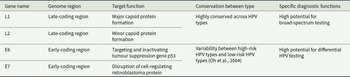
NAATs for HPV have been in development since the 1980s (Saraiya et al., Reference Saraiya, Steben, Watson and Markowitz2013). At least 264 distinctive commercial molecular tests were available as of December 2023 (Poljak et al., Reference Poljak, A, Cuschieri, Bohinc and Arbyn2024). Despite the high number of available tests, the same target regions of the HPV genome are employed (see Table 2). This is partially due to the HPV genome being relatively small at 7900–8000 kb and having a limited number of genes suitable for molecular diagnostic targets. The HPV genome is divided into 3 major regions – the early gene-coding region (E), the late gene-coding region (L) and the long control region (LCR; see Figure 3).
Structure of the HPV genome (figure taken from D’Abramo and Archambault, Reference D’Abramo and Archambault2011). The L1 and L2 genes encode for the major and minor capsid proteins respectively. The E6 and E7 genes are oncoproteins.

Widely used molecular targets in HPV diagnostic assays

L1 and L2 are not expressed at a consistent level throughout the virus lifecycle, with expression being highest in the final stage, during virion formation (Kirk and Graham, Reference Kirk and Graham2024). E6 and E7 are known as oncoproteins as their activity is responsible for cells becoming oncogenic as a by-product of the virus hijacking the cell molecular machinery. When E6 and E7 are rendered inactive, oncogenic cells senesce or undergo apoptosis (Yamato et al., Reference Yamato, Yamada, Kizaki, Ui-Tei, Natori, Fujino, Nishihara, Ikeda, Nasu, Saigo and Yoshinouchi2008; Jabbar et al., Reference Jabbar, Abrams, Glick and Lambert2009).
Due to the strong connection of E6 and E7 gene expression with oncogenicity, with expression increasing as infection develops into cervical precancer and then cervical cancer (Pal and Kundu, Reference Pal and Kundu2020), these genome regions are often used for HR-HPV detection. Additionally, as the E6/E7 regions are linked with disease progression, these regions can be used to identify patients at risk of cervical precancer or cancer in quantitative assays (Zhang et al., Reference Zhang, Du, Du, Duan, Yao, Jing, Feng and Song2024).
Recombinase polymerase amplification/recombinase aided amplification diagnostic assays
Isothermal assays, the most common being either LAMP or RPA, have high potential in low-resource settings due to their reduced energy needs and faster run times. LAMP utilizes 4–6 primers per target and so has a more complex primer design in comparison to PCR and RPA/RAA. Although LAMP assays for both S. haematobium (van Bergen et al., Reference van Bergen, Brienen, Randrianasolo, Ramarokoto, Leutscher, Kjetland, van Diepen, Dekker, Saggiomo, Velders and van Lieshout2024) and HR-HPV (Fan et al., Reference Fan, Feng, Zhang, Li, Zhang and Lin2020) have been successfully developed, the complex primer design and relatively high rate of false positives due to primer dimerization (Gruenberg et al., Reference Gruenberg, Moniz, Hofmann, Wampfler, Koepfli, Mueller, Monteiro, Lacerda, de Melo, Kuehn, Siqueira and Felger2018) make it challenging to utilize as a multiplex diagnostic platform. Like PCR, RPA assays have 2 primers per target, making the development and usage of diagnostic assays in low-resource settings, and as a multiplex assay, more feasible.
S. haematobium recombinase polymerase amplification/recombinase aided amplification assays
The first S. haematobium RPA assay (Sh-RPA) was based on the Dra1 repeat target due to its potential for high sensitivity (Rosser et al., Reference Rosser, Rollinson, Forrest and Webster2015; see Table 3 for S. haematobium RPA assays). Analytical testing using spiked samples reached a limit of detection (LoD) of 100fg of S. haematobium gDNA with reactions taking 10 min (Rosser et al., Reference Rosser, Rollinson, Forrest and Webster2015) and amplicon detection via lateral flow strips.
Published Recombinase Polymerase Amplification/Recombinase Aided Amplification assays for the detection of S. Haematobium (S.H) for the diagnosis of urinary and female genital schistosomiasis

1a. Speed Extract Kit (Qiagen)/SpeedXtract Nucleid Acid Kit (Qiagen); 1b. SwiftX DNA (Xpedite); 2. Extracta DNA Tissue Prep Kit (Quantabio); 3. QIAamp Mini kit (Qiagen); 4. Dneasy Blood and Tissue Kit (Qiagen); 5. Axyprep™ Body Fluid Viral DNA/RNA Miniprep Kit (Axygen Scientific); 6. Viral genomic DNA Extraction Kit (Bioteke); 7. Maxwell RSCVR ccfDNA plasma kit (Promega); 8. Automated extraction machine; and 9. Reverse blot hybridisation-based assay
a Included the use of Betaine to reduce primer dimer formation.
b Included the use of CRISPR-Cas12 for enhanced sensitivity and specificity.
No, number; Prep., preparation; Se., sensitivity; LoD, limit of detection; Sp., specificity; Ref., reference;
LF, lateral flow; Sch. Spp, Schistosoma species; NI, not included; Syn., synthetic;
UEM, urine egg microscopy.
The Sh-RPA continued to be developed into a fluorescence-based assay (Rostron et al., Reference Rostron, Pennance, Bakar, Rollinson, Knopp, Allan, Kabole, Ali, Ame and Webster2019) with amplification detected using a small portable fluorometer. Analytical testing showed a sensitivity of 1fg of DNA. Additionally, 20 frozen urine samples from S. haematobium positive individuals from Zanzibar were also tested with 100% sensitivity obtained.
Archer et al. further tested Sh-RPA on 168 frozen urine samples with an overall sensitivity and specificity of 93.7% and 100%, respectively, compared to urinary eggs microscopy (Archer et al., Reference Archer, Barksby, Pennance, Rostron, Bakar, Knopp, Allan, Kabole, Ali, Ame, Rollinson and Webster2020). As expected, sensitivity depended on the intensity of infection (eggs/10 mL of urine). Of 168 samples, 73% were classed as having a low or ultra-low egg count (10–49 eggs/10 mL urine and 1–9 eggs/10 mL urine respectively). Of the 70 samples with ultra-low egg counts, 6 were false-negative by RPA, giving a sensitivity of 91.4%. While this was still a high sensitivity, difficulties in detecting ultralow infections may be problematic in elimination settings or areas that have recently received praziquantel MDA. Importantly, the Sh-RPA reactions could be run using a portable fluorometer with a reaction time of 42 °C for 20 min.
Following the development of Sh-RPA for urinary schistosomiasis, the assay was then adapted for detection of S. haematobium DNA and/or eggs in FGS samples, namely CVL and cervicovaginal swabs (Archer et al., Reference Archer, Patwary, Sturt, Webb, Phiri, Mweene, Hayes, Ayles, Brienen, van Lieshout, Webster and Bustinduy2022). Sensitivity ranged between sample types – 93.3% for vaginal self-swab samples (VSS) and 71.4–85.6% for CVL when qPCR was used as the reference test. This was expected as CVL samples have a high volume, resulting in a diluted sample compared to a swab.
In addition to the assay itself, testing was done to identify low-resource extraction methods that maximize clinical sensitivity and specificity (Archer et al., Reference Archer, Patwary, Sturt, Webb, Phiri, Mweene, Hayes, Ayles, Brienen, van Lieshout, Webster and Bustinduy2022; Donnelly et al., Reference Donnelly, Mesquita, Archer, Ali, Bartonicek, Lugli and Webster2024). Archer et al.’s reported the highest sensitivity when VSS and CVL were processed with the now discontinued SpeedXtract Nucleic Acid Kit (Qiagen, Germany), although it has been superseded by the SwiftX DNA kit (Xpedite Diagnostics, Germany). While Donnelly et al. used urine samples, further research showed no significant difference between the SpeedXtract Nucleic Acid Kit and the SwiftX DNA kit in terms of reproducibility between replicates (Donnelly et al., Reference Donnelly, Mesquita, Archer, Ali, Bartonicek, Lugli and Webster2024). These are important findings as ensuring a diagnostic assay is resilient to changes in sample preparation methods is important to maintain accessibility and reproducibility of results between laboratories. Clinical sample preparation methodologies are also directly linked to the clinical sensitivity of an assay and should be considered as a vital component of the diagnostic platform.
The Sh-RPA was further refined by Mesquita et al. where the standard DraI RPA oligonucleotides were modified with an aim of improving assay sensitivity and specificity (Mesquita et al., Reference Mesquita, Donnelly, Archer, Lugli and Webster2025). This included inverting the probe fluorophore and quencher and adding a phosphorothioate backbone to prevent formations of secondary structures, which result in false positives. A comparable sensitivity of 10fg of gDNA was achieved together with improved analytical specificity. Additionally, the storage resilience of the RPA reagents was tested, and they were found to remain stable when stored in the absence of light at ±27 °C for up to 30 days. This supports their portability to, and use in, low-resource settings where cold chains are not readily accessible.
The Dra1 region is the most tested and used target in Sh-RPA assays for both urinary schistosomiasis and FGS, but a mt COX-1 target has also been explored (Zhao et al., Reference Zhao, Zhang, Wang, Li, Juma, Berquist, Zhang and Yang2023a). Although early in development, the assay reached a low LoD of 10 copies in a run time of 20 min at 42 °C and showed a clinical sensitivity of 100% for urine samples, with urine egg microscopy used as the reference test.
Human papillomavirus polymerase amplification/ assays
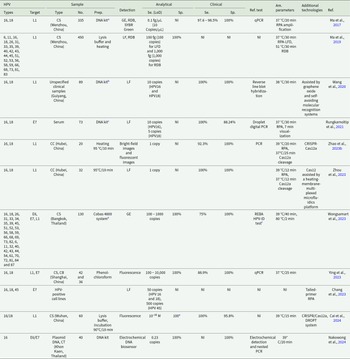
Similarly to FGS, RPA/RAA is being explored as suitable low-resource HPV diagnostic platform (see Table 4 for HR HPV RPA assays). However, as HPV is a global pathogen prevalent in high-resource areas, there is less research focus into the development of low-resource NAATs in comparison to a disease such as schistosomiasis.
Published Recombinase Polymerase Amplification/Recombinase Aided Amplification assays for high-risk human papillomavirus with the purpose of risk assessment for cervical cancer. Adapted from (Ying et al., Reference Ying, Mao, Tang, Fassatoui, Song, Xu, Tang, Li, Liu, Jian, Du, Wong, Feng and Berthet2023)

a Viral genomic DNA Extraction Kit (Bioteke).
bQIAamp DNAminikits (Qiagen).
cMaxwell RSCVR ccfDNA plasma kit (Promega).
dQIAamp Viral DNA.
e Automated extraction machine.
f Reverse blot hybridization-based assay.
No, number; Prep., preparation; Se., sensitivity; LoD, limit of detection; Sp., specificity; Ref., reference; CS, cervical swab; CB, cervical biopsy; CT, cervical tissue; NI, not included; Syn., synthetic; LF, lateral flow device; RDB, reverse dot blot; GE, gel electrophoresis.
Due to high number of HPV types, there has been significant development in multiplex RPA assays for HR-HPV. NAATs testing for 34 types, defined in the paper as 20 HR and 14 LR, simultaneously have been developed (Wongsamart et al., Reference Wongsamart, Bhattarakasol, Chaiwongkot, Wongsawaeng, Okada, Palaga, Leelahavanichkul, Khovidhunkit, Dean and Somboonna2023). This level of multiplexing was achieved through the innovative detection of both E6/E7 and L1. Both targets had one forward primer, but the L1 target had 2 reverse primers and the E6/E7 target 4 reverse primers, allowing for the selection of different types. The assay proved specific and did not cross react with common bacteria, viruses, and mammalian cells. However, a sensitivity of only 75% for DNA detection all 34 HPV types was achieved, which may have been a result of the primer design which allowed for high levels of multiplexing. The target product profile (TPP) of HPV DNA molecular diagnostics required by the WHO requires a sensitivity of 90–98% for CIN2+ or greater (World Health Organisation, 2024).
Most HR-HPV RPA NAATs target fewer types with a focus on the most oncogenic, typically HPV 16, 18 and occasionally 45. They also focus on achieving higher sensitivity and applicability to low-resource settings. An RPA assay targeting HPV 16 and 18 individually achieved a clinical sensitivity of 97.6–98.5% and specificity of 100% when tested on 335 liquid-based cytology samples extracted using a commercial extraction kit (Viral genomic DNA Extraction Kit) (Bioteke, China) (Ma et al., Reference Ma, Fang, Wang, He, Dai, Lin, Su and Zhang2017). Ma et al. continued development, multiplexing the assay to detect 25 total HPV types – 12 HR and 13 LR. The assay was tested using plasmids containing the cloned HPV target sequences prepared using a simplified DNA extraction method that involved the addition of a lysis buffer and heating (Ma et al., Reference Ma, Fang, Lin, Yu, Sun and Zhang2019). The analytical sensitivity was lower in the 2019 assay, at a limit of 102/μL−1 of gDNA, than in the 2017 assay at 0.1 fg/μL (Ma et al., Reference Ma, Fang, Wang, He, Dai, Lin, Su and Zhang2017, Reference Ma, Fang, Lin, Yu, Sun and Zhang2019). This reduction in analytical sensitivity is often seen in NAATs with high levels of multiplexing. This should be kept in consideration as higher sensitivity for HR-HPV types only may be more beneficial clinically than lower sensitivity for a broader range of HPV types.
CRISPR technology has been extensively used alongside RPA assays in HPV diagnostic assays (Tsou et al., Reference Tsou, Leng and Jiang2019; Gong et al., Reference Gong, Zhang, Wang, Liang, Li, Liu, Xue and Tang2021; Ying et al., Reference Ying, Mao, Tang, Fassatoui, Song, Xu, Tang, Li, Liu, Jian, Du, Wong, Feng and Berthet2023) with an aim of increasing sensitivity and specificity. Cai et al.’s use of a CRISPR/Cas12a dual-chamber ‘one-pot’ (DROPT) system, targeting HPV 16/18 had both high sensitivity at 100% and specificity of 95.8% when compared against PCR (Cai et al., Reference Cai, Zhuang, Yu, He, Wang, Hu, Li, Li, Zhou and Huang2024). This shows concordance between the DROPT system and PCR. The DROPT system is a one-pot test, and so does not require other large laboratory equipment, which would make it more suitable for field diagnostics. However, issues regarding reliable cold-chain transportation and the extensive extraction process needed for CRISPR Cas technologies means assays utilizing them remain generally unsuitable for low-resource diagnostics.
Alternative assay designs, such as the use of tailed primers (Chang et al., Reference Chang, Ma, Novak, Barra, Kundrod, Montealegre, Scheurer, Castle, Schmeler and Richards-Kortum2023), may increase suitability as they allow for lateral flow devices (LFD), a low-resource assay output method, to be used. An analytical sensitivity of 50 copies/reaction for HPV 16 and 18, and 500 copies/reaction for HPV 45 was achieved. However, as clinical sensitivity and specificity was not investigated, further testing is needed before its suitability as a low-resource diagnostic can be assessed.
The high sensitivity and specificity of HR-HPV RPA/RAA assays in addition to the multiplexing demonstrated shows that the platform has potential to be used as a multiplex diagnostic in clinical settings.
Utility of potential multiplex diagnostics for female genital schistosomiasis and human papillomavirus
FGS and HR-HPV are common in low-resource areas of SSA, and HR HPV presents a high risk of developing cervical cancer. Additionally, as both FGS and HR-HPV cause physical disruption in the cervix and vaginal canal, making invasion by other pathogens easier, it is hypothesized that having FGS or HR-HPV will increase the risk of acquiring STIs. Relationships have been observed between urogenital schistosomiasis and HIV (Patel et al., Reference Patel, Rose, Kjetland, Downs, Mbabazi, Sabin, Chege, Watts and Secor2021) and between HR-HPV and HIV (Okoye et al., Reference Okoye, Ofodile, Adeleke and Obioma2021). In relation to associations between FGS and HR-HPV, data showed no relationship between FGS and HR-HPV infections in Madagascar (Kutz et al., Reference Kutz, Rausche, Rasamoelina, Ratefiarisoa, Razafindrakoto, Klein, Jaeger, Rakotomalala, Rakotomalala, Randrianasolo, McKay-Chopin, May, Rakotozandrindrainy, Puradiredja, Sicuri, Hampl, Lorenz, Gheit, Rakotoarivelo and Fusco2023b), although an association was found between FGS and non-specified LR and HR-HPV types in a South African study (Shukla et al., Reference Shukla, Kleppa, Holmen, Ndhlovu, Mtshali, Sebitloane, Vennervald, Gundersen, Taylor and Kjetland2023). Additionally, an association between FGS and HPV 16, 18, and 45 was reported in a recent study conducted in Zambia (Lamberti, Reference Lamberti2025). A recent literature review found that data was too limited to confirm or deny a causative connection between FGS and HR-HPV infection (Sturt et al., Reference Sturt, Omar, Hansingo, Kamfwa, Bustinduy and Kelly2025), in part due to sample size and data quality challenges within individual studies. However, even without a direct association, this does not limit the burden FGS and HR-HPV has on women’s health in SSA.
Multiplex NAATs which detect either Schistosoma spp. or HR-HPV with other sample-related pathogens have been developed. For example, a multiplex PCR assay that detects S. haematobium and S. mansoni in stool samples reported a detection rate of 84.1% in comparison to stool microscopy at 79.5% (ten Hove et al., Reference ten Hove, Verweij, Vereecken, Polman, Dieye and van Lieshout2008) and a probe-based LAMP assay for S. mansoni and Strongyloides spp., a soil-transmitted helminth, has been optimized to work at room temperature for field settings (Crego-Vicente et al., Reference Crego-Vicente, Fernández-Soto, García-Bernalt Diego, Febrer-Sendra and Muro2023).
As described, extensive multiplex NAATs for different combinations of HPV types have been developed across different molecular platforms. Additionally, multiplex assays that combine different HPV types with other pathogens that can be found in the same sample types, such as Chlamydia trachomatis, Mycoplasma hominis, Mycoplasma genitalium, Ureaplasma urealyticum and Neisseria gonorrhoeae simultaneously have been developed (Lima et al., Reference Lima, Hoelzle, Simões, Lima, Fradico, Mateo, Zauli and Melo2018).
These studies suggest that the development of a multiplexed NAAT that can detect S. haematobium and HR-HPV simultaneously is feasible using different molecular diagnostic platforms and moreover, this has the potential to address a current gap in women’s health screening in SSA.
Currently, no studies have evaluated a combined diagnostic for FGS and HR-HPV. A multiplex molecular diagnostic for FGS and HR-HPV would be beneficial in terms of delivering diagnostic information, but there may be logistical challenges in its implementation in resource-limited settings. Logistical challenges such as supply chain management can result in delays in test-delivery, which is especially pertinent to NAATs which often require cold storage (Kuupiel et al., Reference Kuupiel, Tlou, Bawontuo, Drain and Mashamba-Thompson2019). Additionally, the initial training needed to familiarize medical personnel, who may not have received molecular biology training before, with new technologies will require significant time and funding (Mfuh et al., Reference Mfuh, Abanda and Titanji2023).
Conclusion
FGS and HR-HPV remain significant challenges to women’s health in SSA. Bringing together both HR-HPV and FGS within scalable molecular diagnostic platforms is a step forward towards the integrated screening for FGS and HR-HPV in sub-Saharan Africa. The commonalities of clinical samples used for FGS and HR-HPV screening provide a platform for an integrated screening approach, reducing costs and improving efficiency both for the test provider and the women accessing the service. Continued research and development have led to a range of isothermal diagnostic assays, which are more suited to low-resource settings, being developed for each individually. Sensitive and specific RPA assays exist for both FGS and HR-HPV and so provide an opportunity for the development of a multiplex RPA diagnostic.
There is a need for further research to explore existing molecular targets and technologies that could be combined and used for the development of a low-resource multiplex diagnostic, while keeping economic feasibility in consideration through interdisciplinary research. This includes cost-benefit analysis, field-evaluation, and synergy with existing diagnostic programmes in target countries. Research focus needs to remain on affordability and efficiently providing diagnoses to women in low-resource areas, especially regarding gynaecological health which can be highly stigmatizing. A combined FGS-HR-HPV diagnostic would benefit women living in SSA, allowing women improved FGS-HPV detection and management.
Author’s contribution
LIS contributed to conceptualization, draft writing, review and editing. AB, BW and SK contributed to supervision, reviewing and editing. HK contributed to reviewing and editing.
Financial support
LIS was supported by the Medical Research Council [MR/W006677/1]. ALB is supported by the UKRI Future Leaders Fellowship [MR/Z000033/1].
Competing interests
None.
Ethical standards
None
Table of Abbreviations
- CAA
Circulating anodic antigen
- CIN
Cervical intraepithelial neoplasia
- CVL
Cervicovaginal lavage
- FGS
Female genital Schistosomiasis
- HIV
Human immunodeficiency virus
- HPV
Human papillomavirus
- HR-HPV
High-Risk human papillomavirus
- IGS
Intergenic spacer
- ITS−2
Second internal transcribed spacer
- LAMP
Loop-mediated Isothermal Amplification
- LCR
Long control region
- LoD
Limit of detection
- LFD
Lateral flow device
- MDA
Mass drug administration
- NAAT
Nucleic acid amplification test
- NTD
Neglected tropical disease
- PCR
Polymerase chain reaction
- RAA
Recombinase aided amplification
- RPA
Recombinase polymerase amplification
- SSA
Sub-Saharan Africa
- STI
Sexually transmitted infection
- TPP
Target product profile
- VIA
Visual inspection with acetic acid
- VSS
Vaginal self-swabs




 Open access

