




1 Introduction
There has recently been a ‘social turn’ in Cognitive Linguistics (CL). Prominent members of the field have emphasised the importance of accepting what is known as the ‘Sociosemiotic Commitment’ (Geeraerts Reference Geeraerts2016)Footnote 1 to address the lack of engagement in CL with social aspects of language knowledge and use (see also Dąbrowska Reference Dąbrowska2016). A number of related approaches in CL, such as Cognitive Sociolinguistics (Claes Reference Claes2018; Kristiansen et al. Reference Kristiansen, Montes, Weiwei, Kristiansen, Franco, Pascale, Rossel and Zhang2021), the Entrenchment-and-Conventionalization model (Schmid Reference Schmid2020) and Word Grammar (Hudson Reference Hudson, Taylor and Wen2021), are grounded in the understanding that a theory of language and grammar must integrate accounts of both individual cognitive entrenchment and community variation and convention, keeping with the assumptions of inherent variability in language (Labov Reference Labov1969), embodied cognition (Croft & Cruse Reference Croft and Cruse2004) and the sociocognitive roots of language in the human species – the ‘ultra-social animal’ (Croft Reference Croft, Evans and Pourcel2009; Tomasello Reference Tomasello2014).
A subset of research questions in this area focuses on modelling socially conditioned grammatical variation. For example, Word Grammar analyses dialect syntax as a point of intersection between linguistic and social conceptual structure (Hudson Reference Hudson2007). Alternatively, the Entrenchment-and-Conventionalization model views sociolinguistic variation as the product of variable conventions whose source is the rich mutual understanding of multidimensional usage events in ‘co-semiosis’,Footnote 2 including elements of situational and sociocultural setting associated with utterance types (Schmid Reference Schmid2022). In addition, over the past decade, the Cognitive Sociolinguistics literature has offered a wide range of case studies analysing socially salient constructions in a number of languages, most especially in Dutch (Kristiansen et al. Reference Kristiansen, Montes, Weiwei, Kristiansen, Franco, Pascale, Rossel and Zhang2021).
In the prominent CL framework of Construction Grammar (CxG), however, interest in sociolinguistic variation has been more limited (Morin et al. Reference Morin, Desagulier and Grieve2020). In earlier work, a few researchers expressed awareness of something akin to the Sociosemiotic Commitment, including Goldberg (Reference Goldberg2013: 16), who wrote that in CxG ‘the role of social cognition [is] viewed as essential to accounts of learning and meaning’. Similarly, Hollmann (Reference Hollmann, Hoffmann and Trousdale2013) argued that a cognitive sociolinguistic approach could bring many benefits to the study of grammatical constructions in CxG, while Östman & Trousdale (Reference Östman, Trousdale, Hoffmann and Trousdale2013) introduced the modelling of regional variation in CxG, focusing on its potential to explain dialect-specific cognition and social meaning as part of the knowledge of different ‘subnetworks’ of speakers whose usage-based conventions differ. More recently, Hoffmann (Reference Hoffmann2022) cites two main notions of social meaning relevant for CxG: static meaning and dynamic indexicality. Both are inspired by the three waves of variationist sociolinguistics (Eckert Reference Eckert2012). Static meaning constraints on the knowledge and use of grammatical constructions – for instance, in terms of local and supralocal social categories including age, sex and region (Östman & Trousdale Reference Östman, Trousdale, Hoffmann and Trousdale2013) – are associated with the first and second waves of variationist theory. Dynamic indexicality, i.e. the inference and association of social contextual features with constructions based on acts of identity in interaction (Hall-Lew et al. Reference Hall-Lew, Moore, Podesva, Hall-Lew, Moore and Podesva2021), is associated with the third wave (see also Hoffmann Reference Hoffmann2015).
Although there has been some interest in incorporating ideas from the study of sociolinguistic variation into CxG, linguists in this tradition have only begun to engage with these ideas. One likely factor limiting development is the methodological difficulties associated with the study of dialect constructions. Two of the main empirical sources of data in CxG are corpora and experiments (Gries Reference Gries2013) and both present challenges for the study of grammatical variation. Dialect-specific and informal language use has been notoriously difficult to capture through observational corpus-based methods, especially involving rare and localised syntactic forms, while experiments are often inappropriate for the study of variation, because the social variables of interest cannot be manipulated directly (Grieve Reference Grieve2021).
However, recent developments in observational linguistic methodology, especially corpus-based computational sociolinguistics (Dunn Reference Dunn2018; Schmid et al. Reference Schmid, Würschinger, Fischer and Küchenhoff2021; Grieve et al. Reference Grieve, Hovy, Jurgens, Kendall, Nguyen, Stanford and Sumner2023), have begun to lessen these empirical obstacles, allowing us to study a range of dialect constructions, including the rarest and most localised ones, through a corpus-based approach that samples informal written data at scale from online sources, especially social media. By drawing on a computational sociolinguistic methodology, in this article, we aim to encourage the development of CxG into a cognitive sociolinguistic theory. Specifically, we analyse a particularly rare, unusual and socially salient grammatical variant in dialects of British English: the Double Modal (DM) construction.
DMs have been attested in limited regions of the British Isles, most commonly in the Scottish Borders (Brown Reference Brown, Trudgill and Chambers1991; Bour Reference Bour2014; Morin Reference Morin2021a, Reference Morin, Baranzini and de Saussure2021b), and to a lesser extent in the Central Belt of Scotland including Glasgow and in areas of Dumfries and Galloway in the southwest (Smith et al. Reference Smith, Adger, Aitken, Heycock, Jamieson and Thoms2019). They are attested even less frequently in the northeastern English counties of Tyneside and Northumberland (Beal Reference Beal, Kortmann and Schneider2004; Beal & Corrigan Reference Beal and Corrigan2000), as well as in Ulster Scots-speaking counties of northeastern Ireland (Montgomery & Nagle Reference Montgomery and Nagle1993). Because they are so infrequent, restricted to specific dialect regions, and potentially archaic in these same regions, studies of these features have relied on limited amounts of data collected through elicitation by a small number of sociolinguistic fieldwork studies. DMs have long been considered impossible to analyse using observational empirical approaches (Butters Reference Butters, Charles James and Shuy1973), although a recent study by Coats (Reference Coats2023) reports the first corpus-based description of DMs in British and Irish speech, based on automated speech transcripts from YouTube. Despite their scarcity, there is evidence that DMs are strongly associated with a social identity linked to the regions they are used in, especially the Scottish Borders (Brown Reference Brown, Trudgill and Chambers1991), and that they are generally perceived as ‘non-standard’ grammatical features, thus conveying salient social meaning when they are used (Bour Reference Bour2014).
At first sight, DMs appear to have a very simple grammatical structure that should be amenable to CxG analysis, combining two distinct word forms of the same class. Nevertheless, DMs are very rare and unusual grammatical features in the English language, with a limited regional distribution, generally being perceived as unacceptable by most speakers. Consequently, DMs are likely to convey fine-grained and distinctive social meaning (Irvine Reference Irvine, Penelope and Rickford2001), making them especially well suited for the analysis of social meaning in CxG for two reasons. First, the social indexicality of these constructions demands that we are clear about the integration of social meaning and sociolinguistic variation into CxG. Second, the empirical analysis of DMs can extend the descriptive scope of CxG, enabling us to study a range of socially meaningful constructions in future research. The analysis of DMs from a CxG perspective thus has the potential to increase both the explanatory adequacy and predictive power of CxG as a theory of language.
In this article, we therefore analyse the social meaning of DMs in a large corpus of social media, showing that British DMs as used on social media are dialect constructions. We present an observational account of British DMs on the social media platform Twitter, comparing the results with past research on these features, and we then present a discussion of social meaning in CxG in light of these results. Specifically, we pursue the following research objectives:
1. Describing the use of DMs in contemporary British English based on an unprecedentedly large corpus of social media, including their inventory, frequency, regional distribution and modal meaning;
2. Proposing a CxG model of DMs in British English on Twitter;
3. Considering, based on this model and the observed quantitative and qualitative regional and social patterns of DMs in our corpus, why and how social meaning should be incorporated into CxG.
Our article is structured as follows: in section 2, we review past research on the inventories and regional distribution of British DMs. In sections 3 and 4, we describe our methods and results in terms of the inventory, frequency and regional distribution of DMs in a large corpus of geolocated social media posts collected from Twitter across the UK in 2014. In section 5, we analyse DMs as a network of constructions through a close examination of their combination patterns and a distributional study of their modal meaning. In section 6, we argue that examining their social meaning is required to fully account for them as socially specific constructions based on non-standardness, informality and regional variation, which may entrench and conventionalise them in dialect-specific grammar networks. We conclude that future research should directly engage with social meaning in CxG and use new empirical approaches to studying language variation so as to transform CxG into a Cognitive Sociolinguistic theory of language, broadening the range of phenomena it can explain.
2 Double modal inventories and regional distribution
In previous research, the most commonly attested DMs in Scots include will can, might can and used to could (1) (Bour Reference Bour2014; Smith et al. Reference Smith, Adger, Aitken, Heycock, Jamieson and Thoms2019; Morin Reference Morin2023). Other attested forms include must can, would might, should can, may should and must could.
(1)
(a) He’ll can help us the morn. (Scotland, Miller Reference Miller, Kortmann and Schneider2004: 34)
(b) She might can get away early (Scotland, Miller Reference Miller, Kortmann and Schneider2004: 34)
(c) He used to could do it when he was younger (Scottish Borders, Brown Reference Brown, Trudgill and Chambers1991: 109)
In Northumberland and Tyneside, might could and might can are less frequently attested, whereas would could seems specific to these counties and rarer in Scots (Beal Reference Beal, Kortmann and Schneider2004). In Ulster Scots, typical forms include will can, might could, used to could, used to would and should could (Robinson Reference Robinson2018).
(2)
(a) He wouldn't could’ve worked, even if you had asked him (Tyneside, Beal Reference Beal, Kortmann and Schneider2004: 128)
(b) We don't have that, but you might could find that across the street (Antrim, Montgomery & Nagle Reference Montgomery and Nagle1993: 103)
Comparatively, DMs are more widespread and diverse in dialects of American English, especially in the southeast (Huang Reference Huang2011), including the combinations might can, might could and used to could, but not typically will can and would could. They are also attested in several English-based creoles such as Gullah, Jamaican and Guyanese (Kortmann et al. Reference Kortmann, Lukenheimer and Ehret2020). Otherwise, they are unattested in most varieties of English, including Standard English (Huddleston & Pullum et al. Reference Huddleston and Pullum2002), and unacceptable to a majority of British speakers, as suggested in the quote below.
what they do if you go up north there are certain places in Scotland that I've read about that use double modal auxiliary verbs […] so for example they'll say a sentence I would could do that which to us sounds ridiculous […] I should might be able to which just sounds really really wrong to us (Spoken BNC 2014, dialect: Received Pronunciation)
There is much uncertainty concerning the status of DMs as dialect features: are they still used in rural northern dialects? Are they disappearing? Have they disappeared? Two decades ago, Beal (Reference Beal, Kortmann and Schneider2004) proposed that DMs are recessive in northern English dialects, based on their near absence in the Newcastle Electronic Corpus of Tyneside English, while Trousdale (Reference Trousdale2000) adopted an agnostic position – acknowledging their attestation, but calling for caution due to a lack of naturalistic data. Corrigan (Reference Corrigan2011) suggested that DMs had acquired ‘relic status’ in the British Isles overall, and that they are passive in Ulster Scots. As for (Borders) Scots, where DMs are reportedly most common, claims about these features vary. While Smith et al. (Reference Smith, Adger, Aitken, Heycock, Jamieson and Thoms2019) suggest that typical DMs such as might can may be disappearing based on lower acceptability rates among younger generations outside the Borders, Bour's fieldwork studies (Bour Reference Bour2014) suggest that they are still used among younger speakers, although this was a decade ago.
Most accounts of the combinatorial constraints on British DMs are based on limited and dated data. Brown (Reference Brown, Trudgill and Chambers1991: 106) proposes a grid of possible modal combinations (table 1). Notably, first modals in DMs have been found to most commonly be might, should, will, would, must, used to and have to, while second modals have been found to most commonly be can, could, must, be to and have to Footnote 3 for a total of 26 possible combinations. The modals shall and may and the semi-modal ought to are not included in this inventory because they are considered rare in Scots and Scottish English. Brown (Reference Brown, Trudgill and Chambers1991) captures the general consensus that might, will and used to are always first and can and could are always second in the typical combinations might can, might could, will can, would could and used to could across the relevant British dialects featuring DMs (Beal Reference Beal, Kortmann and Schneider2004; Corrigan Reference Corrigan2011; Bour Reference Bour2014).
The range of modal combinations in Borders Scots (Hawick) according to Brown (Reference Brown, Trudgill and Chambers1991): X = attested, ? = uncertain

More recently, extensive fieldwork coverage of DMs in Scots is presented by the Scots Syntax Atlas (SCOSYA, Smith et al. Reference Smith, Adger, Aitken, Heycock, Jamieson and Thoms2019), which collected data on the geographical distribution and mean acceptability judgment rates of seven typical DMs: used to could, will can, might can, might would, must can and must could. Maps for each DM are shown in figure 1. Based on these maps, DMs seem most acceptable in the Scottish Borders, as expected from previous research, but also in the Central Belt and the Urban Scots-speaking areas of Glasgow and Edinburgh, as well as Dumfries and Galloway.
Mean acceptability ≥3 of 7 DMs in Scotland from the Scots Syntax Atlas (Smith et al. Reference Smith, Adger, Aitken, Heycock, Jamieson and Thoms2019)

Finally, Coats (Reference Coats2023) recently used a 112-million-word corpus of YouTube transcripts tagged at the county level in the UK and Ireland, finding 187 DM tokens spanning 44 types, which is a larger inventory than considered in past research. Coats proposes that they are both distributed in the northern dialect region identified in past research, but also to a large extent throughout the UK and Ireland, with no clear regional pattern.
3 Data
The data collected for this study come from a 2-billion-word corpus of posts from British Twitter, containing around 180 million geolocated tweets from 1.9 million users produced between January and December 2014 (see Grieve et al. Reference Grieve, Montgomery, Nini, Murakami and Guo2019). The metadata include the longitude and latitude of the user's GPS-enabled smartphone. The corpus was also stratified into 124 subcorpora based on UK postcodes in order to map and analyse the regional distribution of each form. Rather than taking geolocation as an indicator of geographic origin, we take it as an indicator of the geographic location of language use, which is crucial as a measure of regional variation, both for a dialectological study and for a usage-based, CxG approach to DMs. This corpus has previously been used in studies on lexical (Grieve et al. Reference Grieve, Montgomery, Nini, Murakami and Guo2019) and phonological (Nini et al. Reference Nini, Bailey, Guo, Grieve, Patrick and Maguire2020) variation in dialects of British English; these studies have shown that phonological maps based on this corpus align well with traditional dialect surveys.
DM token candidates were collected by automatically extracting all combinations involving the nine primary modals of English (can, could, may, might, shall, should, will, would, must) and three ‘semi-modals’ (used to, ought to, have to in first position). Duplicates such as might might were discarded because they were mostly used emphatically. To focus on the central phenomena of interest, other semi-modals (have to in second position, going to/gonna) and adverb or pronoun-split combinations (might as well could, will you can) were also ignored during data collection. This method resulted in 7,766 collected tokens of potential DMs in the corpus. However, a substantial number were removed by thoroughly hand-cleaning the data to only keep ‘true’ DMs, or at least unequivocally valid combinations of modals in a single tensed clause. Obvious types of problematic combinations or ‘false DMs’ included words that are isomorphic to modals but which are not modals or even verbs, clear cases of autocorrects and typing errors given the context of the tweet, and adjacent modals across clause boundaries that aren't marked by punctuation in spontaneous online communication. The final cleaned dataset that is used in this study consists of 962 examples of DMs, which were produced by a total of 935 unique Twitter accounts, indicating that this dataset is by no means dominated by the style of a small number of Twitter users.
4 Results
4.1 Forms and frequencies of double modals
Our dataset includes 60 distinct DM types, which represents exactly half of all possible combinations (120). The tweets in (4)–(7) feature four of the most common DMs found in our corpus. Table 2 displays the raw frequencies of all tokens per type listed in decreasing order.
(4) doable though; italy weren't great; i think we will can get 6 points and get out the group
(5) nice! i’ll shall look forward to all of the above

(6) we would could be back if the gateshead public supported us !!!
(7) ok will do! just so frustrated with this woman!sorry to of contacted you just thought you would might of been able to help

All DMs in the Twitter dataset
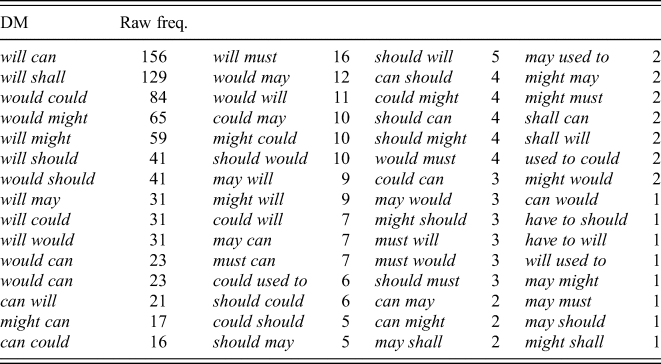
The forms will can and would could are two typical British DMs that appear in the literature, respectively first and third in the overall frequencies. More strikingly, will shall, a previously unattested combination in Scots, is the second most frequent DM in the distribution. Overall, the top ten DMs in the corpus have will or would as the first modal. The first DM to have another modal is can will, which is only the twelfth most frequent combination.
It is especially notable that only a few of these common DMs, namely will can, would could and would might, correspond to the typical, dialect-specific forms identified in section 2. In contrast, other typical DMs are much lower in frequency. The DM might can, for instance, has a relatively higher frequency than most DM types, but is still remarkably uncommon compared to the top twelve DMs. This infrequency is clearer in the case of might could and must can. The typical DMs used to could, may should and should can are very infrequent with a couple of tokens at most. Finally, must could is totally absent from the dataset. Another important finding is the unexpected diversity of DM types, which would likely be even bigger if a larger corpus were analysed. We have 60 unique modal combinations, over twice as many as proposed by Brown (Reference Brown, Trudgill and Chambers1991) and 26 more than found in Coats (Reference Coats2023). A large number of these types – over half of the distribution – have extremely low frequencies, as seen in table 2, including various forms with a frequency of 1.
The status of these forms, of course, needs to be questioned before being invariably accepted. In particular, it is reasonable to question their basic validity: for example, these combinations may have been caused by typing errors or the autofill function of smartphone keyboards predicting the wrong word. However, there are several reasons why the number of such instances appears to be small. Most importantly, as discussed in section 3, we manually checked each token with care to make sure their usage appeared purposefully and meaningfully in context in order to analyse their modal meaning, as discussed below. During this process, we removed clear errors and made sure that the examples retained were directly interpretable in context.
The long tail of low frequency DMs appreciable in table 2, of the type that is familiar in frequency distributions across linguistics, is also evidence of the validity of these results. For example, there is no clear break or inflection point before which valid forms occur regularly, and after which invalid forms occur sporadically. More generally, the diversity of DMs observed in this study is broadly supported by Coats (Reference Coats2023), who also identifies a long tail of very infrequent, yet authentic DMs, based on a manual check of YouTube video excerpts with detailed recordings of oral speech. It is also important to note that even those forms produced in error can still be perceived as genuine combinations by other readers of the tweet: within CxG, Hoffmann (Reference Hoffmann2020) has even argued that errors are a prime source of linguistic innovation, which means that even accidental DMs can turn out to be innovative grammatical constructs due to co-semiotic pressures. Therefore, despite their considerable variability and their low frequency in language use, the infrequent DMs in our dataset, many of which were previously unattested, do appear to be used in a functionally valid way to communicate specific meanings, as can be seen in (8), which presents three sample tweets with very infrequent DMs rarely (a) or never (b, c) attested in past research.
(8)
(a) we may can do somethin aboutt it hahah ;p
(b) if tell yur granda ye luv him then you’d must be together or something; idk??x
(c) maybe we can should lend hull some of our buses hahaha come on hull
4.2 Regional patterns of double modals in the UK
Overall, the inventory identified above suggests that DMs make up an intricate system, with a distribution featuring a relatively short head and an especially long tail. Furthermore, many traditional DMs from past research in dialectology appear to be especially uncommon or even absent. As a way of completing our overview of this system, we can map tweets containing DMs to see if they show regional patterns in use on Twitter, thanks to the geolocation information included in the metadata of our dataset. To do this, we normalised the frequencies of each DM in each of the postcode region subcorpora, dividing them by the total number of words in each subcorpus and multiplying them by 1 billion, as the relative frequencies are generally low and often smaller than 1 when normalised by 1 million. Normalisation allows us to counterbalance the substantial differences in the amount of data available per region, usually following county population and social media usage: for instance, urban regions including large cities such as London provide a large quantity of tweets compared to rural regions such as the Scottish Highlands. In addition, we mapped the precise location of each DM based on the longitude and latitude in the metadata. In figure 2, we show an overall map with the combined relative frequencies of all 60 DMs, along with the individual maps for the first five most common DMs, will can, will shall, would could, will might and would might. The occasional misalignment between the shades and dots is explained by the substantial variation in the number of tweets as well as the general rarity of the feature, which is why it is useful to visualise both types of information.
Frequency maps for common DMs on British Twitter (2014)

In the overall map, we find a prominent northern regional distribution, especially the Scottish Borders, as predicted by the literature, and to a much lesser extent in Northumberland, Tyneside and Northern Ireland. We also see smaller regional patterns in the Scottish Highlands and the urban area of the Scottish Central Belt, and some unexpected regions such as London (3,759 tokens per billion words), Manchester and the southwest of England more generally, but not Birmingham or Leeds. There is also a notable use of DMs in Wales, especially on the border.
In the individual DM maps, the establishment of regional patterns becomes more difficult, at least in part due to low frequency. The most common DM, will can, shows a clear distribution in the Scottish Lowlands and the Borders, although it is used to a lesser extent in regions of England and Wales, including in cities, as can be seen from the clusters of data points. The second most common DM, will shall, appears to be most common in England and Wales, especially the south of England, although it also appears to some extent in the Scottish Lowlands and Northern Ireland. For the three remaining maps of would could, will might and would might, patterns are less clear in part due to the much smaller number of tokens, but the forms seem to be distributed across the UK, without regional specificities, except for would might, which appears to be slightly more common in the Scottish Borders. Importantly, then, based on these maps it appears that DMs in our dataset exhibit both regional patterns and a sporadic use of forms across the UK, corroborating the tendencies put forward by Coats (Reference Coats2023).
Figure 3 features maps only showing the tokens for nine traditional DMs in the Scottish Lowlands, northeast England and northeast Ireland (Beal Reference Beal, Kortmann and Schneider2004; Robinson Reference Robinson2018; Smith et al. Reference Smith, Adger, Aitken, Heycock, Jamieson and Thoms2019). Most of these DMs have very low frequencies and thus no clear regional distributions. The DMs will can and would might are common in the Scottish Lowlands and the Borders. The DMs might can, used to could, must can and should can occur at least once in either the Borders or Northumberland. Otherwise, these combinations do not show any clear regional specificity. Importantly, they appear to be almost completely absent from Northern Ireland. Alongside these DMs, the numerous other low-frequency combinations that were attested for the first time in our dataset, including those in (8), also do not show clear regional patterns. Broadly speaking, they seem consistent with the overall distribution in the Scottish Lowlands, as well as the North, the southwest of England and Wales, with sporadic uses across the UK.
Frequency maps for DMs identified as dialect-specific in the literature on British Twitter (2014)

In sum, DMs occur on British Twitter in a wider range of types, frequencies and regional distributions than assumed previously. However, several of the Scottish DMs appear where expected, and it seems rather unlikely that they are disappearing forms in these regions, since modern speakers appear to be using them in new registers, i.e. social media. The low frequencies of traditional DMs and their occasional occurrence outside the North can be interpreted in several ways. Although some of these forms may be especially rural, and restricted to older speakers, it is also likely that our corpus, despite being very large, is just too small and to some extent underrepresents their use. However, despite a distinct northern pattern, DMs do appear to be much less used in Northumberland, Tyneside and Ulster than in Scotland, with sparser relative frequencies and data points. This supports the claim of their relic, recessive, or even passive status in these varieties (Beal Reference Beal, Kortmann and Schneider2004; Corrigan Reference Corrigan2011). In addition, and importantly, our results join those of Coats (Reference Coats2023) in questioning the assumption that British DMs are restricted to northern varieties, since we find various forms in smaller patterns across southwest England, Wales and even large urban areas in the southeast. We now turn to a step-by-step analysis of DMs as grammatical constructions.
5 The construction network of double modals
5.1 The network structure of double modal forms
Following our inventory overview where DMs were taken as units, we also find important patterns when taking into account the internal structure of DMs. The network graph in figure 4 shows the co-occurrence patterns of modals, where the least frequent pairs (<15) have been excluded, resulting in the modals ought to, used to and have to being dropped.
Eigenvector network graph of DMs modal position

The thickness of the edges represents the co-occurrence frequencies of the nine modals in first and second position. The nodes denote combinatorial schemas, coloured according to eigenvector centrality following a yellow to red gradient scheme. Shades of red indicate a higher eigenvector score, meaning that the node is connected to many nodes with high scores. We thus see that will_X, would_X, X_can, X_shall, X_might and X_could are the most productive DM schemas, including will can, will shall and would could, while also being productive for lower-level combinations such as will must, would may or can could. We see both clear positional preferences for individual modals (such as will and would as first modals, and can, shall and might as second modals) and some positional flexibility. The distribution of DMs thus appears to display a network structure.
This network structure is further evinced in figure 5, where correspondence analysis (CA) is used to summarise and explore attraction patterns between modals in combination as well as their relative flexibility in more detail. The basic idea behind CA is to plot variables across dimensions and see if some variables share similar profiles and appear to cluster together. First, it tests whether the association between the modal in first position (mod_1) and the modal in second position (mod_2) is statistically significant.Footnote 4 Second, CA plots the observations of mod_1 and mod_2 and we can then see if they share similar distributional profiles. In figure 5, each type of mod_1 is in blue, and each type of mod_2 is in magenta.
DM correspondence analysis graph across the first two dimensions

The plot shows the first two dimensions, which account for 51% and 27% of the variance, 78% overall. This plot therefore visualises the most important trends in the joint distribution of mod_1 and mod_2 types. Judging from their extreme coordinates in the plot, three patterns of attraction stand out. Will_X is the only mod_1 type in the left part of the plot. It displays a strong association with X_shall/can/must/would. Another distinctive association is observed between may/can_X and X_will in the upper right corner of the plot. Last, would_X displays a preference for X_might/should/could/used to, as indicated by the cluster in the lower-right quadrant. The mod_1 types should/might/could_X and the mod_2 type X_may appear between these patterns, a sign of their greater combinatorial flexibility.
The CxG paradigm posits the existence of a constructicon (Goldberg Reference Goldberg2013; Hoffmann & Trousdale Reference Hoffmann and Trousdale2013), a taxonomic network of knowledge containing more templatic (schematic) and more specified (substantive) form–meaning pairings known as constructions that are governed by hierarchical links. Such links include vertical default inheritance of formal and functional properties. Our data show evidence that DMs are grouped in such a structured inventory, with notable distributional skews. Based on this information, the representation principles of CxG as a theoretical model appear to provide a good fit for the network structure of our data, giving us further evidence that DMs may be grammatical constructions. The emergence of this network, however, is a surprising finding in light of what we know of the conventional constructicon of English (Kim & Michaelis Reference Kim and Michaelis2020; Hoffmann Reference Hoffmann2022), which tends to pre-empt modal stacking constructions, as will be discussed in section 6.2. Judging from their morphosyntax alone, the DMs subschemas display idiosyncratic connections within a consistent network structure, as revealed in both the eigenvector network graph and the CA plot. These graphs show that certain modals in certain positions are far more frequent than others and are connected to sets of modals of varying sizes. For instance, will_X and X_can are particularly productive templates, and will can is a very common instantiation of these templates.
In figure 6, we propose a sketch of the grammatical network of DM forms, based on a cline from the most substantive instantiations, i.e. the constructs themselves in tweets viewed as co-semiotic usage events (Schmid Reference Schmid2022), up to semi-schematic and fully schematic levels, licensing not only these two typical DMs, but other combinations with will and would first and can and could second, as well as other modal combinations.
Network sketch of the DM construction based on the network graph and correspondence analysis of the Twitter dataset

There is one important caveat with this analysis: the inclusion of two levels of fully schematic macro-constructions is not obvious if we adopt a wholly bottom-up approach, given the constraint-like formal tendencies of the DM network as found on Twitter. We included these levels mainly to account for the long tail of low-frequency DMs that do not appear to follow specific combinatorics. We discuss these low-frequency DMs in more detail below, but for now we argue that their production, which is probabilistically dispreferred by the core subschemas of the network though not categorically pre-empted by them, justifies the postulation of DM macro-constructions and their conventional plausibility.
Although a CxG model seems explanatorily adequate so far, in its current state our network features only the formal side of DM constructions. An overview of their basic modal meanings is also necessary for a more complete account of grammatical constructions as form–meaning pairings (Hoffmann Reference Hoffmann2022).
5.2 The modal meaning of DMs
To provide a provisional meaning-based classification of DMs, we use the traditional categories defined by Palmer (Reference Palmer1990) and Coates (Reference Coates1983) for English, especially Epistemic and Root, with Root further subdivided into Deontic (participant-external) and Dynamic (participant-internal). We also use a tweaked distinction between modal Possibility and Necessity based on Biber et al. (Reference Biber, Johansson, Leech, Conrad and Finegan1999), subsuming Prediction under Epistemic Necessity and Volition under Root/dynamic Necessity.
First, we established a quantitative estimate of the meaning of the ten most frequent DMs in our corpus, by counting proportions of manually annotated modal meaning orderings of DMs in random samples of fifty tokens when possible for these top ten DM types. This estimate is shown in figure 7, and qualitative individual samples for three of the five first DM types are shown in (9). We carefully coded each token by considering the immediate context of the tweet containing a DM, relying on features that generally enable annotators with English as a native language to recognise the type of modality at play and identify the most likely intended meaning. These include the subject and main verb type of the sentence in which the DM is used in order to establish the scope of the modal over the subject participant inside the proposition or the entire proposition itself, interjections, punctuation marks and emojis or emoticons as forms of gesture that help speakers convey attitudes and judgments about events and propositions online (McCulloch Reference McCulloch2019).
(9)
(a) few things i need to sort. bills
then i’ll can make a decision xxxxx (Epistemic Root/dynamic, Necessity–Possibility)(b) oh my god yes and they can bow down to me and i will shall be named the king of all the penguins (Epistemic–Root/deontic, Necessity–Possibility)
(c) thought you’d might like to see it seems as though he was named after you! (Epistemic–Epistemic, Necessity–Possibility)
 then i’ll can make a decision xxxxx (Epistemic Root/dynamic, Necessity–Possibility)
Proportions of modal meaning ordering (Epistemic–Epistemic or Epistemic–Root) of DMs in random samples for the top ten DMs (ranked on the Y axis) in the corpus (n = 50, all tokens for DMs with a frequency < 50)

Overall, a general ordering pattern of Epistemic > Root/deontic > Root/dynamic appears to account for modal meaning, reflecting previous accounts of the cross-linguistic ordering of modal combinations (Zullo et al. 2020; Werkmann Horvat Reference Werkmann Horvat2021): two typical cases are Epistemic > Root(deontic/dynamic) and double epistemics (Epistemic–Epistemic). The first configuration (E–E) is predominant, accounting for six DMs: will can, will shall, would could, would should, will should and will could. The second configuration (E–R) is also very common, accounting for the majority of tokens of the DMs would might, will might, will would and will may. Notably, none of the tokens in these high frequency DMs are double roots (R–R) and none follow the inverse order of Root > Epistemic. Importantly, few of the individual DM types feature a balance between E–E and E–R, and they are often skewed towards one or the other ordering.
The general skew of each of these common forms suggests that DMs are generally specialised in the expression of one of two sequences of modal meaning, which can be described in cognitive semantic terms (Talmy Reference Talmy1988):
(10)
(a) Epistemic – Root: the propositional reasoning-based (lack of) exertion of force on the physical/psychosocial (lack of) exertion of force on the agonist:Footnote 5 will can, will shall, would could, would should, will should, will could.
(b) Epistemic – Epistemic: the propositional reasoning-based (lack of) exertion of force on another propositional (lack of) exertion of force on the Agonist: would might, will might, will would, will may.
We find another important meaning tendency in the co-occurrence patterns of modals based on what we know of the meaning patterns of these individual modals in English. Firstly, will and would, the only two modals in first position, are typically understood as expressing modal necessity as opposed to possibility. Alternatively, can, could, may and might, which account for a majority of modals in second position, are possibility modals (Palmer Reference Palmer1990). We thus see that necessity is the primary modality across positions, and possibility is only second, despite its involvement in a number of combinations. Most notably, DMs appear to primarily involve the sequential addition of necessity modality and possibility modality, especially the addition of the necessity modals will/would and a possibility modal.
Reflecting the formal distribution of DMs, however, the sequences of Necessity + Possibility and Epistemic > Root appear to best describe the core nodes of the network, breaking down as we move down the long tail of the distribution. This is illustrated in table 3 and in (11), which shows surprising proportions of double roots and especially the inverse order of Root > Epistemic, and overall similar rates for all possible orderings. These unusual meanings seem to correlate with unusual forms; these unusual constructs in the periphery of the network are interpreted below.
(11)
(a) sexy af. she could might get it ..
(Root/dynamic–Epistemic, Possibility–Possibility)
(b) hmm that's true!
hopefully we can may be able to get some tomorrow (Root/dynamic–Epistemic, Possibility–Possibility)
(c) shit how something shall can ruin your whole night
(Root/deontic – Epistemic, Necessity–Possibility)
 hopefully we can may be able to get some tomorrow

Proportions of semantic ordering of DMs with less than five tokens, from can should to might shall (n = 66)

So far in our demonstration, DMs appear to make up a network of grammatical constructions that combine two modals. Their primary function is to express a propositional, reasoning-based exertion on the physical or psychosocial absence of force on the agonist. The propositional basis of force is associated with epistemic modality, while the physical and social basis of force is associated with root modality. The presence of exertion is associated with necessity modality, while the absence of exertion is associated with possibility modality. Although this general ordering is the most common, other meanings are possible, especially the double epistemic sequence, associated with specific DMs in the network.
However, in the next section we argue that our description in its current state is insufficient, and that another type of meaning other than basic modal meaning is needed to achieve a more explanatorily adequate analysis of DM constructions: social meaning. To do this, we first discuss DMs in terms of necessary and sufficient criteria to assess their constructionhood.
6 The social meaning of double modals
6.1 Issues of constructionhood
The traditional approach in CxG to justify the existence a construction is to check whether a number of ‘criteria of constructionhood’ apply (Ungerer Reference Ungerer2023): in earlier frameworks, high frequency and non-compositionality of form or meaning were the two main diagnostics (Goldberg Reference Goldberg1995). Both types of criteria appear to be problematic when we apply them to the case of DMs: crucially, however, we believe that the explanatory gaps between these criteria and the data we found of DM constructions can be filled by including the factor of social meaning.
Firstly, DMs do not appear to fully meet the high frequency criterion. That is not to say that we do not consider frequency pressures to play a role in the description of DMs in our corpus: indeed, we found a substantial and complex dataset of DMs distributed in a network structure, which suggests that frequency must constitute an influential process in the DM system to some extent, for instance at the meso-level where the combinatorial schemas have acquired a higher degree of prototypicality with respect to the set of lower-order instantiations. Furthermore, in keeping with the usage-based commitment of CxG (Bybee Reference Bybee, Hoffmann and Trousdale2013), it is also likely that a few of the most frequent DMs, such as will can and would could, are typical exemplars which, through repetition and entrenchment alongside other combinations with will and would as first modal and can and could as second modal, have become influential nodes of the DM construction. Despite these patterns, however, the overall frequencies in our large corpus of natural language are noticeably low, reflecting the fact that DMs are rare syntactic constructions with low frequencies across dialects and registers of English, including Twitter. This challenges the sufficiency of frequency as the sole basis for their constructionhood.
Secondly, to justify the status of construction, one criterion that is often proposed is non-compositionality: a construction C is ‘a form–meaning pair <Fi, Si> such that some aspect of Fi or some aspect of Si is not strictly predictable from C's component parts or from other previously established constructions’ (Goldberg Reference Goldberg1995: 4). Based solely on the analysis of the modal meaning of DMs above, it would appear that these constructions do not meet this criterion: they consist of two combined modals, which appear to add meaning in a compositional manner. The only alternative explanation of DM constructions likely to satisfy the non-compositionality criterion would be that it is in fact their social meaning, discussed in more detail in section 6.2, which acts as a non-compositional constraint on their knowledge and use: such social meaning would complement (low) frequency pressures, and perhaps in fact arise as a result of this low frequency characterising a stigmatized, indexical and highly socially salient, yet maintained, dialect feature. If this hypothesis were to be confirmed in future research, this would have important consequences for CxG theorising, giving us a case of a construction that relies on a previously underappreciated combination of usage-based and social pressures, namely social non-compositionality correlated with low frequency.
Keeping this hypothesis for the time being, however, it is also the case that the non-compositional criterion is not considered a necessary and sufficient condition anymore since Goldberg (Reference Goldberg2006), and patterns that are both general and predictable deserve a place in the constructicon as long as some distributional and functional constraints apply. This may more adequately explain the case of DMs, as evidenced above. Through repetition, even patterns that are originally general and decomposable into constituents end up being treated as units. This is known as chunking, a domain-general cognitive process allowing fully compositional constructions to be stored and accessed directly (Bybee Reference Bybee, Hoffmann and Trousdale2013). Given the statistical evidence presented above, the most frequent DMs are likely to be treated as chunks. We thus believe that the process of chunking, alongside low frequency and non-compositional social meaning, is an important explanatory factor of the formation of DM constructions deriving some of its main probabilistic constraints, including the modal sequences of Necessity > Possibility, Epistemic > Root, and Epistemic > Epistemic. These sequences and social meaning should thus be included in the meaning component of the constructions in the provisional network above, accounting for the central DM system.
What remains to be explained in our dataset is the substantial number of low-frequency DMs that do not appear to conform to these formal and modal meaning ordering tendencies, occurring unconstrainedly across the UK. We propose the following hypothesis: first, in regions of the UK where the DM system is prominent, these infrequent DMs may be spontaneous innovations by speakers experimenting with the DM construction. Their atypical form and meaning result in relative pre-emption by the central system, although this does not discourage speakers from engaging in this process consistently as part of their linguistic creativity. Second, in regions of the UK where the DM system is not prominent, they may also be spontaneous innovations that are even less likely to thrive because of statistical pre-emption factors, most importantly the unacceptability of any kind of modal stacking, as suggested in the quote of an RP speaker in section 1 and further discussed below. In both cases, innovated DMs are likely to attract non-standard social meaning as a result of their formal markedness with respect to standard conventions, which we discuss in more detail below.
6.2 The distinctive force of social meaning
To sum up our discussion so far, although we postulated the DM construction based on formal patterns, modal meaning patterns, and the usage-based pressures of frequency and chunking in the previous sections, we believe these are insufficient to adequately describe DMs, and that social meaning is an essential explanatory factor, especially in light of the low frequency of these constructions. In addition, the integration of this factor enables us to explain the maintenance of DM use against the strong pre-emptive force of standard modal constructions, which involves a finite-verb constraint on their use.
Indeed, a crucial generalisation characterising the conventional network of standard English grammatical constructions is that modal constructions inherit a strong constraint from auxiliary constructions (Kim & Michaelis Reference Kim and Michaelis2020: 186–212), itself inherited from verbal constructions (Hoffmann Reference Hoffmann2022: 206–11), which restricts the category of finiteness (i.e. tense) to one verb maximum per clausal construction. This highly general constraint of English grammar interacts with the lack of non-finite (i.e. untensed) forms in the lexical construction paradigm of the English modals. As a result, modal stacking inside a clause is strongly probabilistically disfavoured, compared to an alternate construction which would convey a very similar complex modal meaning and otherwise satisfy the one-tensed-verb constraint: Brown (Reference Brown, Trudgill and Chambers1991) cites two prominent alternatives, which are semi-modal constructions (e.g. will be able to) or adverbial constructions (maybe instead of might in might could).
If DMs are constructions, there must be an equally strong distinctive aspect of their meaning explaining their entrenchment and conventionalisation against this constraint. By limiting our view of the meaning component of DM constructions to their modal meaning, we are unable to explain why they are not blocked by standard modal alternatives expressing overlapping modal meanings (Brown Reference Brown, Trudgill and Chambers1991), in the same way that a double negative (I don't have no homework) is prescriptively dispreferred, though not blocked, by a standard negative (I don't have any homework). This type of meaning distinction, expected from the co-existence of DMs and standard modal constructions in a general grammar network, would be captured by modern versions of the CxG principle of No Synonymy (Goldberg Reference Goldberg2006; Leclercq & Morin Reference Leclercq and Morin2023), where social meaning is featured as one of the drivers of non-synonymous constructions.
A defining factor likely to explain the constructionhood of DMs is thus the following: the specific association of modal periphrastic or adverbial constructions with a standard network of grammatical constructions on the one hand, and the specific association of formally marked DMs with a non-standard network of grammatical constructions on the other, creates a relationship between the two likely to be conveyed in terms of social meaning, based on the usage-based pressure of social salience (Schmid Reference Schmid, Geeraerts and Cuyckens2012). This social meaning is a function of positions of varieties and grammatical networks of English in a hierarchy based on prescriptive systems of values and norms, and the results of dynamic acts of identity (Eckert Reference Eckert2012). The non-standard network is stigmatized towards informal language registers, hence the occurrence of DMs in the most informal registers of British Twitter shown in the sample tweets above, which include many other features of non-standard online language, such as lack of final punctuation, acronyms, swearing and emojis (McCulloch Reference McCulloch2019).
If the most distinctive aspect of DMs is their social meaning, this has important consequences for CxG as a theory of language, which generally seems to underestimate the role of social meaning in networks of grammatical constructions. Social meaning deserves its own subcomponent in the pragmatic meaning of constructions (Hoffmann Reference Hoffmann2022), which crucially includes elements of situational and sociocultural setting, two important sources of variable sociolinguistic conventions (Schmid Reference Schmid2022). In the following paragraphs, we further discuss the potential richness of social meaning, based on the regional variation in DM use, as observed in this study.
British DMs on Twitter are rare grammatical constructions that appear to be distinguished by the social meaning of non-standard and informal register, enabling them to resist pre-emption by standard modal constructions. In addition, we propose that their social meaning includes a regional dialect meaning, inferred from regional variation in their use. Here we focus on the northern dialect region and the Scottish Lowlands in particular, zooming in on the general map of all DMs of figure 2 in figure 8 below.
Relative frequencies by postcode region and individual tokens of all DMs in the Scottish Lowlands

By analysing a single, streamlined corpus of geolocated natural language, we see how it is now possible to substantiate these claims in finer-grained detail than before. Firstly, we are able to establish the correlation of DM usage with regional variation: the most prominent regional pattern is the northern dialect pattern previously assumed in the literature, especially in the Borders and the Scottish Central Belt. This correlation is taken to have given rise to a specific social meaning of these forms compared to other regions, in addition to the concepts ‘non-standard’ and ‘informal’. Thus it is very likely that DMs are also most typically associated with the concept of ‘Scots’ and especially ‘Borders Scots’, to a lesser extent ‘Urban Scots’, and that this concept contributes to distinguishing them from alternatives associated with the concepts of ‘Standard Scottish English’ or more generally ‘Standard British English’ (see also Östman & Trousdale Reference Östman, Trousdale, Hoffmann and Trousdale2013).
Secondly, we can also take individual natural, geolocated tokens of DMs in tweets viewed as co-semiotic usage events (Schmid Reference Schmid2020) and look at their regional and linguistic context to see whether DM constructions are found alongside other constructs known to be prominent in grammar networks of Scots. Below are a few qualitative examples of tweets including the specific town and postcode region in which they were produced, based on their latitude and longitude.
(12)
(a) aye will can just use ginger bottles; what a beaut?? (Arbroath, Dundee)
(b) dan wallace still a total twat then; might can get his teeth fixed with the £20k he's totalled in price money. sorry jak if you read this. (Hawick, Galashiels/Selkirk)
(c) might can no dae it get in there (Hawick, Galashiels/Selkirk)
(d) will say anything they think will worry voters. if they said “indy means more tory govts” we’d might vote no! (Bearsden, Glasgow)
(e) young keegans an mclaughlin? nice young men them.. we’ll can get a wee sesh sorted soon dear (Grangemouth, Falkirk)
(f) will there be anywhere in hawick that will can repair a laptop screen? (Hawick, Galashiels/Selkirk)
(g) aww naw a don't think i’ll can deal with your paranoia the day (Cumnock, East Ayrshire)
(h) wit the fuck has pregnancy done to me?! greeting because i’ll can feed the ducks when i go on holiday! (Cumnock, East Ayrshire)
(j) they're shite at soccer so they’ll may as well look shite playing it. glitter on a jobby springs to mind. (Dumfries, Dumfries and Galloway)
Upon close examination of these individual tweets, DMs seem natural in pragmatic/discursive contexts favouring the use of constructions from a dialect grammar, co-occuring with a number of well-known dialect features of Scots (Miller Reference Miller, Kortmann and Schneider2004; Smith et al. Reference Smith, Adger, Aitken, Heycock, Jamieson and Thoms2019): for example, the phonological variants of the morphological constructions dae for do, no for not, a for I, wit for what, naw for no; dialect-specific lexical items such as wee (small), aye (yes), the day (today), greeting (crying), jobby (turd); swear words (twat, fuck, shite), and socially specific cultural references and topics (Daniel Wallace is a Scottish Olympic swimmer; 2014 saw the debates over the Scottish Independence Referendum; Hawick is a typical location for DM use; football is the most popular sport in working-class Scotland as in the rest of the UK). This is important qualitative evidence that DMs are syntactic constructions with particularly salient dialect indices used in sociolinguistic acts of identity, occupying a specific place in the modal expressions of a dialect grammar distinguished from the standard grammar, and including the social concepts ‘non-standard’, ‘informal’ and ‘region’ in the form of constraints on their knowledge and use.
7 Conclusion
In this article, we unpacked some of the consequences of the social turn of Cognitive Linguistics for Construction Grammar. To do this, we analysed a particularly rare, unusual and socially salient grammatical construction in English, which we argued could not be well defined without taking the Sociosemiotic Commitment: the double modal construction in British English used on social media. We took advantage of the computational sociolinguistic approach, analysing language variation in a large corpus of informal natural language produced online, as is increasingly used in cognitive sociolinguistics. This study demonstrates the necessity of modelling social meaning and dialect variation in CxG for more general issues in this theoretical framework, for instance a more refined view of what defines a grammatical construction. It has also highlighted the importance of building a finer-grained model of semantic and pragmatic meaning in CxG, notably through the concept of language register and regional variation, which can become indexical dimensions of constructional meaning, and act as constraints on their knowledge and use. The consequences of this case study of DMs for the framework of Construction Grammar are the following, from the most general to the most specific:
• The study of sociolinguistic variation in this CL theory of language is not just opportunistic or a luxury, but a necessity for its capacity to explain all of language, including its social aspects (Dąbrowska Reference Dąbrowska2016), and following the Sociosemiotic Commitment (Geeraerts Reference Geeraerts2016).
• This necessity is illustrated by the case of dialect constructions (e.g. DMs), which are difficult to adequately explain without a working concept of social meaning.
• The integration of social meaning in a CxG model raises new questions on how to define constructions, and what criteria to use for establishing them, especially in terms of frequency, compositionality of meaning and chunking. Specifically, we have a case where a network of low-frequency construction appears to emerge and be maintained thanks to social meaning constraints.
• New methodological paradigms such as computational sociolinguistics enable the study of dialect constructions, including the rarest and most unusual ones (e.g. DMs).
• The social meaning of constructions is primarily represented as static constraints on knowledge and use, but is also the result of dynamic acts of identity in interaction (Eckert Reference Eckert2012) and rich mutual understanding of situational and sociocultural setting in co-semiosis (Schmid Reference Schmid2022).
• For dialect constructions, social meaning needs to be represented as a subcomponent of the extended PRAGMATICS component of the meaning of constructions (Hoffmann Reference Hoffmann2022).
We hope this study will prompt further research on construction-based sociolinguistics and dialectology by asking more precise questions on the respective roles of these meaning features in constructions and grammar networks, and testing hypotheses observationally on a wider range of constructions using online natural language data. The pursuit of these questions can only contribute to the growth of CxG as a theory of language.


 Open access

