





Non-technical Summary
During the Ordovician Period, marine life underwent a dramatic global increase in diversity and ecological change. During the Middle Ordovician, global diversification rates peaked in the main pulse of the Great Ordovician Biodiversification Event (GOBE). Because global patterns are the summation of regional events, we explore the relative impacts of regional versus global environmental changes on body size of brachiopods in the Arbuckle region of Oklahoma. Body size increased at the same time diversification peaked in the basin, mirroring the global trend. The increase in body size is most strongly correlated with global environmental changes (position in time, ocean temperature, tectonics, and diversity), but was not strongly influenced by local changes in sedimentology or carbon cycle. These results support the argument that the Ordovician diversification included a substantial biotic shift during the Middle Ordovician and support the hypothesis that global factors were the dominant factors influencing diversification patterns during the main phase of the GOBE.
Introduction
The Great Ordovician Biodiversification Event (GOBE) comprises a dramatic global increase in marine biodiversity associated with a major ecosystem reorganization (Sepkoski Reference Sepkoski1981; Droser and Finnegan Reference Droser and Finnegan2003; Webby et al. Reference Webby, Paris, Droser and Percival2004; Harper Reference Harper2006; Servais et al. Reference Servais, Owen, Harper, Kröger and Munnecke2010). Contemporaneous with these biotic changes were shifts in environmental and geochemical conditions, including ocean oxygenation, sea levels, silicate weathering, cooling ocean temperatures, and circulation patterns (Trotter et al. Reference Trotter, Williams, Barnes, Lecuyer and Nicoll2008; Saltzman et al. Reference Saltzman, Edwards, Leslie, Dwyer, Bauer, Repetski, Harris and Bergstrom2014; Rasmussen et al. Reference Rasmussen, Ullmann, Jakobsen, Lindskog, Hansen, Hansen and Eriksson2016; Edwards et al. Reference Edwards, Saltzman, Royer and Fike2017; Stigall et al. Reference Stigall, Edwards, Freeman and Rasmussen2019). This combination of diversification, ecological reorganization, and abiotic changes comprises one of the most dramatic intervals of coordinated biotic and abiotic change in Earth’s history (Stigall et al. Reference Stigall, Edwards, Freeman and Rasmussen2019).
Patterns of abiotic and biotic change have mainly been established at a global level (Servais et al. Reference Servais, Harper, Munnecke, Owen and Sheehan2009; Kröger et al. Reference Kröger, Franeck and Rasmussen2019; Stigall et al. Reference Stigall, Edwards, Freeman and Rasmussen2019). The precise relationships between these trends are not as well constrained at the regional scale. Regional- or local-scale studies are essential for more fully understanding diversification patterns, as this is the geographic scale at which evolutionary change (e.g., adaptation and speciation) occurs (Stigall Reference Stigall2018). This study focuses on rhynchonelliform brachiopods as model organisms to investigate regional biotic change during the main phase of the GOBE. Brachiopods have been used as exemplars for prior GOBE and Ordovician studies because their dense fossil record provides a data-rich framework through which to study diversity patterns (Rasmussen et al. Reference Rasmussen, Nielsen and Harper2009; Harper et al. Reference Harper, Rasmussen, Liljeroth, Blodgett, Candela, Jin, Percival, Rong, Villas and Zhan2013, Reference Harper, Zhan and Jin2015; Rasmussen Reference Rasmussen2014; Trubovitz and Stigall Reference Trubovitz and Stigall2016, Reference Trubovitz and Stigall2018; Franeck and Liow Reference Franeck and Liow2019; Cocks and Popov Reference Cocks and Popov2021; Congreve et al. Reference Congreve, Patzkowsky and Wagner2021). Furthermore, brachiopods are a useful focal taxon, as diversity patterns within this clade tend to reflect taxonomic diversity and increased morphological and ecological complexity trends seen in other clades, particularly other benthos (Webby et al. Reference Webby, Paris, Droser and Percival2004; Harper et al. Reference Harper, Rasmussen, Liljeroth, Blodgett, Candela, Jin, Percival, Rong, Villas and Zhan2013).
Regional patterns of taxonomic diversification in brachiopods during the GOBE have been examined for some areas (Zhan and Harper Reference Zhan and Harper2006; Rasmussen et al. Reference Rasmussen, Hansen and Harper2007; Harper et al. Reference Harper, Rasmussen, Liljeroth, Blodgett, Candela, Jin, Percival, Rong, Villas and Zhan2013; Trubovitz and Stigall Reference Trubovitz and Stigall2016; Colmenar and Rasmussen Reference Colmenar and Rasmussen2018); however, few studies have analyzed ecological change at the community level within a coordinated morphological and environmental framework. Furthermore, the relationship between taxonomic diversity and morphological disparity is not entirely clear (Harper Reference Harper2006). For some groups, such as orthid brachiopods, peak taxonomic and morphological diversity are coupled; however, this is not consistent among all taxonomic groups (Miller Reference Miller1997).
Morphologic trends in brachiopod volume are controlled by ecological and environmental factors (Novack-Gottshall Reference Novack-Gottshall2008b); thus, understanding size trends and their relationship to taxonomic diversity provides insight into potential factors controlling GOBE diversification (Heim et al. Reference Heim, Knope, Schaal, Wang and Payne2015; Zhang et al. Reference Zhang, Augustin and Payne2015). This project explores this relationship through detailed analysis of rhynchonelliform brachiopod size trends collected from in situ with associated environmental data from Simpson Group strata of Oklahoma.
Because this study was completed at a local scale, it contains high-resolution data that can more directly link to ecological and environmental relationships than data from global-scale analyses. Using this high-resolution data, the primary goals of this research were to (1) establish brachiopod volume trends within Simpson Group strata across the GOBE interval and (2) clarify the primary factors influencing brachiopod volume trends within this basin. To address these goals, we test three main hypotheses: (1) average brachiopod size and volume increased across the GOBE interval in Simpson Group strata; (2) this size increase was coupled with an increase in brachiopod size disparity; and (3) trends in brachiopod morphology were more tightly correlated with local rather than global controls.
Biotic Patterns of the GOBE
Unlike the Cambrian Explosion, which represented a rise in the number of higher taxa, the GOBE was primarily a rapid diversification at the family, genus, and species levels in groups that dominated the Paleozoic fauna, such as brachiopods, bryozoans, conodonts, corals, cephalopods, and echinoderms (Sepkoski Reference Sepkoski1981; Miller and Foote Reference Miller and Foote1996; Miller Reference Miller1997; Harper Reference Harper2006). Diversification at these lower taxonomic levels set the stage for the benthic community structure that has characterized subsequent marine ecosystems (Harper Reference Harper2006). Global biodiversity increased generally from the Early to Late Ordovician Period, a pattern referred to as the Ordovician Radiation; however, the rate of diversification during this interval was not constant. Diversity data compiled and analyzed by Rasmussen et al. (Reference Rasmussen, Kröger, Nielsen and Colmenar2019) and Kröger et al. (Reference Kröger, Franeck and Rasmussen2019) indicate that there were both a significant biodiversity rise and statistical increase in rate of diversification during the Darriwilian Stage of the Ordovician. These analyses suggest that the main pulse of the GOBE occurred in the Darriwilian Age, whereas a more general diversity increase spans the late Cambrian through Ordovician (Rasmussen et al. Reference Rasmussen, Kröger, Nielsen and Colmenar2019; Stigall et al. Reference Stigall, Edwards, Freeman and Rasmussen2019).
Taxonomic diversification during the GOBE occurred across all clades (Sepkoski Reference Sepkoski, Cooper, Droser and Finney1995; Webby et al. Reference Webby, Paris, Droser and Percival2004). The precise details of diversification varied in magnitude among clades and in relationship to geographic distribution (Miller Reference Miller1997; Stigall et al. Reference Stigall, Edwards, Freeman and Rasmussen2019; Servais et al. Reference Servais, Cascales-Minana and Harper2021), For example, South China experienced additional pulses of diversification in the Early Ordovician (Miller Reference Miller1997; Zhan and Harper Reference Zhan and Harper2006). However, the overall pattern of rapid diversification during the main pulse of the GOBE in the Middle Ordovician has been shown to be globally contemporaneous (Trubovitz and Stigall Reference Trubovitz and Stigall2016; Stigall et al. Reference Stigall, Edwards, Freeman and Rasmussen2019; Deng et al. Reference Deng, Fan, Zhang, Fang, Chen, Shi and Wang2021).
Alongside taxonomic diversification, marine ecosystems also underwent major structural changes (Muscente et al. Reference Muscente, Prabhu, Zhong, Eleish, Meyer, Fox, Hazen and Knoll2018). This restructuring produced increased ecological and tiering complexity as organisms adapted to fill new ecospaces and develop new lifestyles (Ausich and Bottjer Reference Ausich and Bottjer1982; Droser and Finnegan Reference Droser and Finnegan2003; Bambach et al. Reference Bambach, Bush and Erwin2007). With the expansion of ecospace utilization, many clades such as echinoderms, bryozoans, and rhynchonelliform brachiopods began to diversify morphologically, and the volume of preserved skeletal grains significantly increased (Pruss et al. Reference Pruss, Finnegan, Fischer and Knoll2010; Stigall et al. Reference Stigall, Edwards, Freeman and Rasmussen2019). Skeletal accumulation increased through both an increase in total grains and increase in size per grain. One documented aspect of skeletal increase was increased body volume within lineages (Harper et al. Reference Harper, Cocks, Popov, Sheehan, Bassett, Copper, Holmer, Jin, Rong, Webby, Paris, Droser and Percival2004; Finnegan and Droser Reference Finnegan and Droser2008; Heim et al. Reference Heim, Knope, Schaal, Wang and Payne2015; Zhang et al. Reference Zhang, Augustin and Payne2015; Trubovitz and Stigall Reference Stigall2018), which is further investigated in this study.
Earth System Change during the GOBE
In addition to shifting biotic conditions, abiotic factors such as ocean oxygenation, changing sea levels, increased silicate weathering, cooling oceans, shifting circulation patterns, tectonic movements, and asteroid swarms have all been proposed as drivers or facilitators of GOBE diversification (Saltzman et al. Reference Saltzman, Edwards, Leslie, Dwyer, Bauer, Repetski, Harris and Bergstrom2014; Edwards and Saltzman Reference Edwards and Saltzman2015; Rasmussen et al. Reference Rasmussen, Ullmann, Jakobsen, Lindskog, Hansen, Hansen and Eriksson2016; Edwards et al. Reference Edwards, Saltzman, Royer and Fike2017; Liu et al. Reference Liu, Chen, Zhou, Yuan, Jiang and Liu2019; Stigall et al. Reference Stigall, Edwards, Freeman and Rasmussen2019; Kozik et al. Reference Kozik, Young, Ahlberg, Lindskog and Owens2023a; Ontiveros et al. Reference Ontiveros, Beaugrand, Lefebvre, Marcilly, Servais and Pohl2023).
Ocean cooling has been well documented during the Ordovician. The δ18O records indicate that extremely warm global seawater temperatures characteristic of the Early Ordovician seas cooled to temperatures closer to equatorial seawater temperatures during the Middle Ordovician (Trotter et al. Reference Trotter, Williams, Barnes, Lecuyer and Nicoll2008; Zhang et al. Reference Zhang, Shen and Algeo2010; Albanesi et al. Reference Albanesi, Barnes, Trotter, Williams and Bergström2020; Edwards et al. Reference Edwards, Jones, Quinton and Fike2022; Kozik et al. Reference Kozik, Young, Ahlberg, Lindskog and Owens2023a). Cooler conditions would have created a more favorable equilibrium between pCO2 partial pressure, biologic productivity, and skeletal production for metazoan taxa. Ocean cooling promoted seawater oxygenation through enhanced oceanic circulation during the Ordovician, which would have promoted nutrient availability, reduced ecophysiological limitations for metazoan life, and fostered new ecospace development (Rasmussen et al. Reference Rasmussen, Ullmann, Jakobsen, Lindskog, Hansen, Hansen and Eriksson2016; Ontiveros et al. Reference Ontiveros, Beaugrand, Lefebvre, Marcilly, Servais and Pohl2023; Song et al. Reference Song, Wu, Dai, Corso, Wang, Feng, Chu, Tian, Song and Foster2024).
Oxygen levels have been documented to increase in both seawater and the atmosphere from the Early to Middle Ordovician (Saltzman et al. Reference Saltzman, Edwards, Adrain and Westrop2015; Marenco et al. Reference Marenco, Martin, Marenco and Barber2016; Edwards et al. Reference Edwards, Saltzman, Royer and Fike2017; Kozik et al. Reference Kozik, Young, Ahlberg, Lindskog and Owens2023a,Reference Kozik, Young, Lindskog, Ahlberg and Owensb). Adiatma et al. (Reference Adiatma, Saltzman, Young, Griffith, Kozik, Edwards, Leslie and Bancroft2019) indicated that increasing atmospheric oxygen related to land plant diversification and increased organic matter burial may also be linked to Ordovician ocean oxygenation, as atmospheric oxygen trends correlate with δ13C excursions. Indirect evidence for oxygenation patterns during GOBE can be found in δ13C excursion trends, which suggest that ocean oxygenation increased during the GOBE (Edwards and Saltzman Reference Edwards and Saltzman2015; Edwards et al. Reference Edwards, Saltzman, Royer and Fike2017). Trends in Δ13C, calculated using δ13Corg and δ13Ccarb, serve as a proxy for biological fractionation. A potential link between these trends and biological diversity indicate that O2 levels and changing primary producers may have impacted GOBE diversification (Edwards and Saltzman Reference Edwards and Saltzman2015).
Increased silicate weathering during the GOBE may have increased nutrient availability, thus allowing for larger sizes and increased diversity in marine organisms, including brachiopods (Miller and Mao Reference Miller and Mao1995; Saltzman et al. Reference Saltzman, Edwards, Leslie, Dwyer, Bauer, Repetski, Harris and Bergstrom2014). During the Middle Ordovician, decreasing 87Sr/86Sr trends reflect weathering tied to tectonic activity and sea-level changes (Saltzman et al. Reference Saltzman, Edwards, Leslie, Dwyer, Bauer, Repetski, Harris and Bergstrom2014). This tectonic activity has been linked to weathering of volcanic rocks generated during the Taconic orogeny (Young et al. Reference Young, Saltzman, Foland, Linder and Kump2009).
Although ecosystem restructuring, cooling oceans, changing sea levels, silicate weathering, and ocean oxygenation each would have influenced diversity trends during the GOBE (Saltzman et al. Reference Saltzman, Edwards, Leslie, Dwyer, Bauer, Repetski, Harris and Bergstrom2014; Rasmussen et al. Reference Rasmussen, Ullmann, Jakobsen, Lindskog, Hansen, Hansen and Eriksson2016; Edwards et al. Reference Edwards, Saltzman, Royer and Fike2017; Stigall et al. Reference Stigall, Edwards, Freeman and Rasmussen2019), the degree to which each factor influenced diversity patterns globally versus locally is still unclear. Significantly, the influence of each factor may vary by basin (Miller and Mao Reference Miller and Mao1995), and basin-level studies are necessary to unravel the precise mechanisms of each control locally. Thus, our analyses evaluate δ18O, Δ13C, and 87Sr/86Sr isotope trends in order to better establish the influence of each factor within the Oklahoma Basin.
Geologic Setting
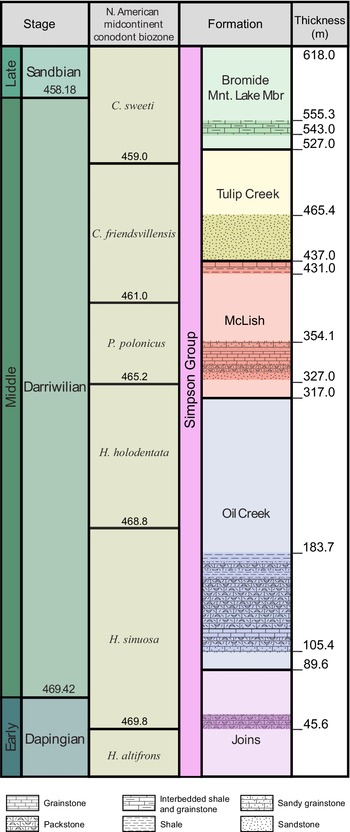
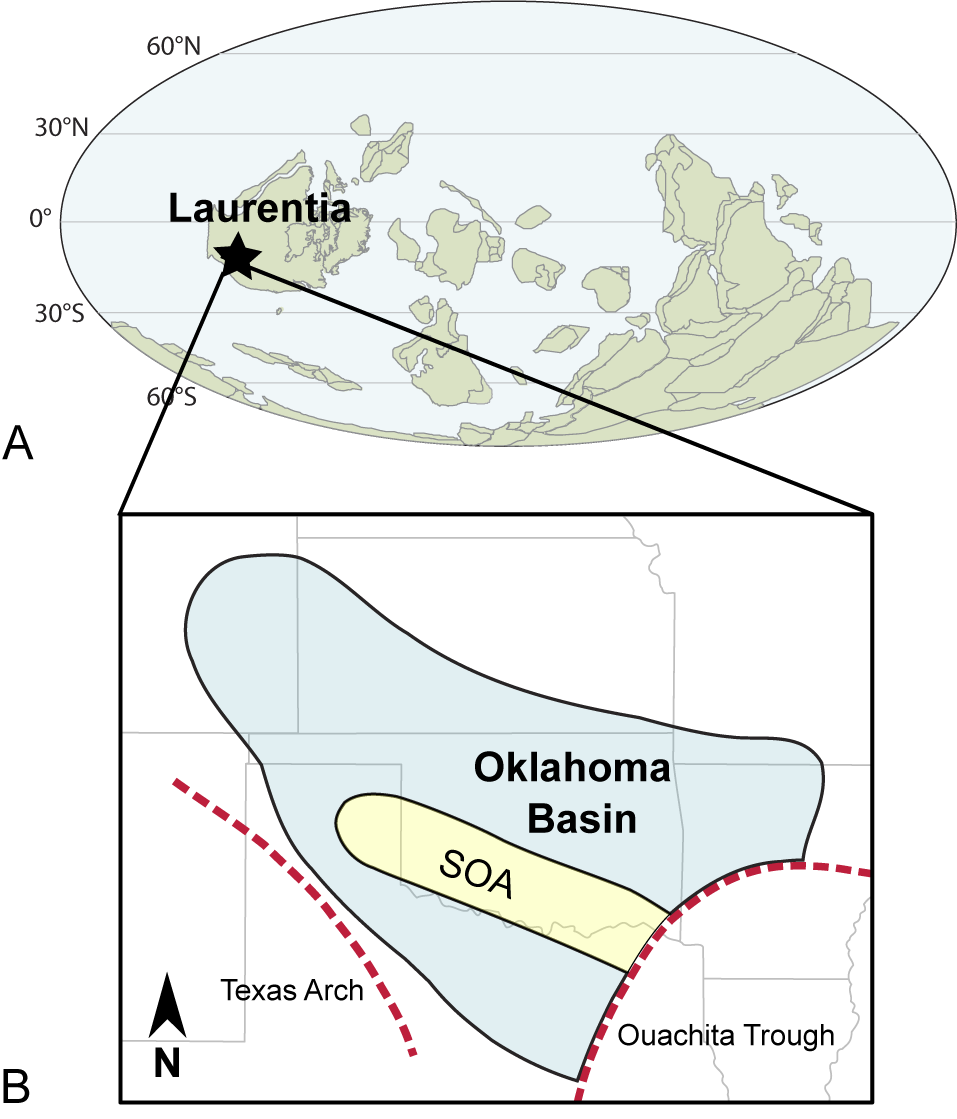
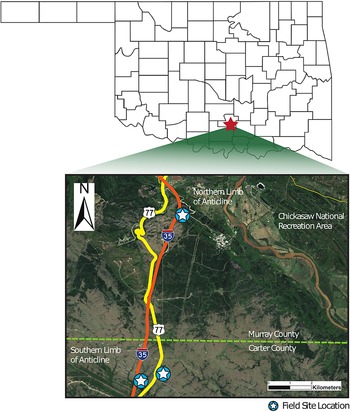
This analysis examines the relationship between body size, diversity, and environmental change in Simpson Group strata in Oklahoma, USA (Fig. 1). During the Middle Ordovician, the Oklahoma Basin was a depocenter within a broad epicontinental sea produced by subsidence of the Southern Oklahoma Aulacogen in what was then southwestern Laurentia (Johnson Reference Johnson1991; Carlucci et al. Reference Carlucci, Westrop, Brett and Burkhalter2014; Fig. 2). Slow, steady subsidence and fluctuating sea levels produced periods of deposition that resulted in remarkably complete transgressive–regressive cycles of sandstone, shale, and limestone (Decker and Merritt Reference Decker and Merritt1931; Fay Reference Fay1989; Johnson Reference Johnson1991). Because of this steady deposition, Simpson Group formations are notably chronostratigraphically continuous, unlike many other midcontinent Ordovician facies of Laurentia (Bauer Reference Bauer2010; McLaughlin and Stigall Reference McLaughlin and Stigall2023). Simpson Group units crop out along the north and south limbs of the Arbuckle Anticline, a feature produced by Alleghenian tectonism, in south-central Oklahoma along I-35 and Highway 77 (Ham Reference Ham1973; Fay Reference Fay1989; Fig. 3).
Generalized stratigraphic column of Simpson Group strata. Portions with lithologic symbols indicate sections measured and studied during fieldwork. Total thicknesses based on Fay (Reference Fay1989). H = Histiodella, P = Phragmodus, C = Cahabagnathus.

Middle Ordovician (~470 Ma) paleogeographic map and location of Oklahoma Basin. A, Global paleogeographic map with star indicating location of Oklahoma Basin (after Torsvik and Cocks Reference Torsvik and Cocks2013). B, Map of southwestern United States indicating the location of the Oklahoma Basin, Southern Oklahoma Aulacogen (SOA), and other major structural features (after Carlucci et al. Reference Carlucci, Westrop, Brett and Burkhalter2014).

Map of field locations. Red star indicates location of field area within Oklahoma, and blue stars marked on Google Earth satellite imagery indicate Simpson Group outcrop locations sampled along I-35 and Hwy 77.

The Simpson Group includes, in ascending order, the Joins and Oil Creek formations (upper Dapingian–lower Darriwilian), McLish Formation (middle Darriwilian), Tulip Creek Formation (upper Darriwilian), and Bromide Formation (Sandbian) (Fig. 1). Aside from the Joins Formation, Simpson Group formations feature a basal sandstone that is overlain by shale and limestone (Fay Reference Fay1989). Other than the sandstone facies, Simpson Group strata are highly fossiliferous and contain an abundance of fossil brachiopods, echinoderms, trilobites, bryozoans, corals, and mollusks (Ham Reference Ham1973; Fay Reference Fay1989; Trubovitz and Stigall Reference Stigall2018). Prior work developed robust biostratigraphic and chemostratigraphic correlations (Bauer Reference Bauer1987, Reference Bauer2010; Saltzman et al. Reference Saltzman, Edwards, Leslie, Dwyer, Bauer, Repetski, Harris and Bergstrom2014; Edwards and Saltzman Reference Edwards and Saltzman2015; Kozik et al. Reference Kozik, Young, Bowman, Saltzman and Them2019; Avila et al. Reference Avila, Saltzman, Adiatma, Joachimski, Griffith and Olesik2022) and identified the main pulse of the GOBE in this outcrop belt as occurring in the upper Oil Creek Formation to lower McLish Formation in the Histiodella holodentata conodont biozone (Trubovitz and Stigall Reference Trubovitz and Stigall2016). Taken together, these correlations provide a high-resolution temporal framework for this work.
The δ18O values obtained from conodont elements within Simpson Group strata suggest that an initial warming period during the deposition of these strata was followed by a period of cooling beginning in the lower Darriwilian. These isotopic trends of δ18O enrichment beginning in the Oil Creek Formation have been interpreted as a global cooling signature and are consistent with global δ18O trends (Edwards et al. Reference Edwards, Jones, Quinton and Fike2022). Simpson Group 87Sr/86Sr data show decreasing values between the upper McLish and Tulip Creek formations (Avila et al. Reference Avila, Saltzman, Adiatma, Joachimski, Griffith and Olesik2022), which correlates with sea-level rise in the basin that may be tied to increased seafloor-spreading rates (Avila et al. Reference Avila, Saltzman, Adiatma, Joachimski, Griffith and Olesik2022). Carbon isotope (δ13Corg, δ13Ccarb, Δ13C) trends suggest that significant carbon cycle changes occurred during the Early–Middle Ordovician in Simpson Group strata (Edwards and Saltzman Reference Edwards and Saltzman2015). Taken together, these various isotopic trends indicate that within Simpson Group strata, cooling temperatures, seafloor spreading causing sea level changes, and carbon cycle changes may have influenced biodiversity and morphologic trends in this basin during the main pulse of the GOBE (Edwards and Saltzman Reference Edwards and Saltzman2015; Avila et al. Reference Avila, Saltzman, Adiatma, Joachimski, Griffith and Olesik2022; Edwards et al. Reference Edwards, Jones, Quinton and Fike2022).
Material and Methods
Field Methods
To quantify how brachiopod body size changed across the GOBE, shell size and sedimentological data were collected from outcrops of the Simpson Group before, during, and after the main pulse of the GOBE as identified in Trubovitz and Stigall (Reference Trubovitz and Stigall2016). Pre-GOBE data were collected from the Joins and lower Oil Creek formations. Data related to the main pulse of the GOBE were collected from the upper Oil Creek and lower McLish formations. Data from rocks aged after this main pulse were collected from the upper McLish Formation. Tulip Creek fossil density was found to be very low, and this unit was excluded from subsequent analyses. The Bromide Formation was also excluded, as it is younger than our target window. All data were collected from outcrops of the Arbuckle Anticline along I-35 and Highway 77 between Murray and Carter Counties, Oklahoma (Fig. 3) during a 2-week interval in May 2022.
Detailed stratigraphic sections were constructed for each of the target strata at decimeter-scale resolution (Supplementary Appendix S1). For each unit, the dominant lithology (i.e., sandstone, grainstone, sandy grainstone, mudstone, wackestone, or packstone), general fossil assemblage present, and sedimentary structures were recorded (Supplementary Appendix S2). Because this study relies on the coupling of brachiopod morphological data and stratigraphic data, the two datasets were collected simultaneously. Morphological measurements, specifically length and width, of rhynchonelliform brachiopod valves were made for suitable brachiopod specimens exposed on each bedding plane using digital calipers (Supplementary Appendix S3). Measurements were based on anteroposterior–transverse (AT) volume measurement estimations, an approach that has been demonstrated to be effective for brachiopod volume estimation (Novack-Gottshall Reference Novack-Gottshall2008b). Brachiopod shells were identified to the genus level based on Cooper (Reference Cooper1956). Species descriptions for most taxa have not been revised since 1956. Therefore, although some genera were monospecific in these units and could be reported as identified to species, we prefer to consider data at the more robust genus level.
Within each decimeter unit, 30 brachiopod valves were measured to obtain a robust dataset. For less fossiliferous intervals, as many brachiopods as available were measured from each fossiliferous unit to generate the most robust dataset possible. Suitable specimens consisted of in situ, mostly complete, well-exposed, and easily identifiable brachiopods. The quality of each measurement (length and width) was recorded as A, B, or C quality according to the following criteria: (A) clear and complete length or width measurement, easily identifiable brachiopod; (B) clear measurement, ~80% complete length or width exposed; (C) measurement incomplete, but brachiopod identifiable (Supplementary Appendix S3). It was later determined that brachiopods including a C measurement do not provide accurate volume estimations, so these brachiopods were removed from the dataset. The final dataset includes a total of 762 measured brachiopods.
Data Analyses
Volume estimations were calculated as log10 values using formulas outlined by Novack-Gottshall (Reference Novack-Gottshall2008b; Supplementary Appendix S3). Variance and mean brachiopod volume were calculated for each unit. Values for length, width, and volume all passed statistical tests for normality. Stratigraphic position for each unit was determined based on position within the formation and then correlated with conodont zones based on correlations for the Simpson Group published by Bauer (Reference Bauer1987, Reference Bauer2010). Zonal boundaries were converted to absolute ages based on the Geologic Time Scale 2020 (Goldman et al. Reference Goldman, Sadler, Leslie, Melchin, Agterberg, Gradstein and Gradstein2020; Supplementary Appendix S4). Zonal boundary ages were used in combination with the thickness of each formation to calculate average depositional rate of each unit and develop an absolute timescale (age model) for analyses (Supplementary Appendix S5).
Time-series analysis was used to investigate the relationship between body size and time and was executed using R package paleoTS (v. 0.5.2; Hunt Reference Hunt2007, Reference Hunt2019) in RStudio. This package includes a series of functions for analyzing time-series analyses of trait-based data within a maximum-likelihood framework (Hunt et al. Reference Hunt, Bell and Travis2008). Notably, paleoTS allows differentiation of the type of evolutionary model (stasis, random walk, punctuated, etc.) that best fits variations in trait data. The calculated absolute ages, variances, mean log10 brachiopod volumes, and number of samples per unit were used as inputs for the time-series analysis. Variance and sample size for each data point were used generate an error envelope and to estimate any sampling noise contribution to observed sample differences in order to fit the model (Supplementary Appendix S6). Disparity was calculated using the variance of volume estimates from all species measured for each stratigraphic unit. Time-series results provide a framework to assess whether brachiopod volume changed through time (Hypothesis 1) and whether brachiopod volume increased in size or disparity through time (Hypothesis 2).
Model fit of the time-series analysis was tested using the paleoTS function fit3models, which fits the time series to general random walk, unbiased random walk, and stasis models. The Akaike weight of each model was then used to determine which model(s) best fit the entire data series. The function fitGpunc was also used to incorporate a punctuational model wherein the timing of the punctuations is automatically identified by the model, testing all possible shift points and selecting the best-supported one based on the data. To further verify whether there was a statistically significant size change during the GOBE, a Welch two-sample t-test was performed using values before (early Oil Creek time) and after (middle Oil Creek time) the volume increase identified by the fitGpunc output at the most likely location (= interval 10) for a punctuational change in model dynamics. This test allows for determination of whether there was a significant size change regardless of whether this size change occurred as a rapid event or long-term trend. In addition, fit3models was applied to data points 1–10 and 11–31 as separate analyses to identify whether the time series in each interval was best fit to general random walk, unbiased random walk, or a stasis model.
After establishing brachiopod size trends during the GOBE, their relationship (or lack thereof) was assessed with respect to (A) lithology, (B) taxonomic diversity, and (C) geochemical trends using a boosted regression model (BRM). This method was used to compare the impact of each environmental factor on brachiopod size trends and was used to evaluate whether changes in brachiopod morphological diversity are more closely related to environmental changes or increasing taxonomic diversity (Hypothesis 3). BRMs allow evaluation of multiple factors within a single analysis. Incorporation of the boosting method improves accuracy by producing many regression trees through an adaptive process that produces greater predictive performance than traditional regression analyses (Elith et al. Reference Elith, Leathwick and Hastie2008). Boosted regression also provides superior model performance relative to standard regression models with multiple types of predictor variables, missing data, and interaction effects between variables (Elith et al. Reference Elith, Leathwick and Hastie2008), which is useful for this dataset. Notably, regression can identify correlations among variables, but cannot explicitly test causality (Hannisdal and Liow Reference Hannisdal and Liow2018). In this study, relative influence on the pattern is interpreted based on strength of association of modeled factors that have been proposed as factors driving or controlling diversification in the literature.
The first environmental factor incorporated in the BRM was lithology. Data for lithology were collected in the field, as detailed earlier. Each different lithology recorded during field work (sandstone, grainstone, sandy grainstone, mudstone, wackestone, or packstone) was coded with a numerical value for analysis (e.g., all grainstone was input as “2”) (Supplementary Appendix S6). Taxonomic diversity values for the focal units were obtained from the diversity data published in Trubovitz and Stigall (Reference Trubovitz and Stigall2016), which include rhynchonelliform diversity captured on a bed-by-bed basis for the same outcrops of Simpson Group strata examined for the volume data.
Geochemical data for δ18O, Δ13C, and 87Sr/86Sr isotopes were obtained from previously published work on the Simpson Group. The δ18O data from Avila et al. (Reference Avila, Saltzman, Adiatma, Joachimski, Griffith and Olesik2022) were used as proxy for paleotemperature conditions. The Δ13C data from Edwards and Saltzman (Reference Edwards and Saltzman2015) were used a proxy for carbon cycle and nutrient conditions. The 87Sr/86Sr data from Avila et al. (Reference Avila, Saltzman, Adiatma, Joachimski, Griffith and Olesik2022) were used as a proxy for weathering and tectonic conditions. Data from each of these studies included isotopic values collected from strata of the Simpson Group. For Δ13C and 87Sr/86Sr datasets, published LOWESS curves (Fig. 4) were aligned with the temporal bins developed for time-series analysis and data values recorded by comparison with each bin (Supplementary Appendix S7). For the δ18O data, a LOWESS curve was first calculated (Fig. 4). The same procedure was then followed to produce an aligned dataset for analysis (Supplementary Appendix S8).
Geochemical data used as proxies for paleoenvironmental conditions. The Δ13C LOWESS curve is from Edwards and Saltzman (Reference Edwards and Saltzman2015). The 87Sr/86Sr data LOWESS curve is from Avila et al. (Reference Avila, Saltzman, Adiatma, Joachimski, Griffith and Olesik2022). The δ18O LOWESS curve was calculated from δ18O values compiled by Avila et al. (Reference Avila, Saltzman, Adiatma, Joachimski, Griffith and Olesik2022), including the following studies: Edwards et al. (Reference Edwards, Jones, Quinton and Fike2022), Grossman and Joachimski (Reference Grossman, Joachimski and Gradstein2020), and Männik et al. (Reference Männik, Lehnert, Nõlvak and Joachimski2021). Study interval indicated in yellow.

All data were then analyzed in a BRM using R package gbm, which implements boosted regression analysis alongside a series of model fit and improvement procedures to optimize model selection to the input dataset (v. 2.1.8; Ridgeway Reference Ridgeway1999; Ridgeway et al. Reference Ridgeway, Greenwell, Boehmke and Cunningham2020). Age, δ18O, Δ13C, and 87Sr/86Sr isotope, taxonomic diversity, and lithologic data were input as independent variables using a BRM. Brachiopod volume was input as a dependent variable. Because lithologic data are categorical, these values were recorded as factors. All other variables were recorded as continuous. A hyperparameter grid was used to evaluate best-fit parameters for the model. After multiple different parameters were evaluated, the root-mean-square-error (RMSE) of each parameter set was calculated. Results of the hyperparameter grid used to evaluate best-fit parameters for the BRM indicate that best-fit parameters include a shrinkage of 0.006, interaction depth of 6, bag fraction of 0.65, and 15 nodes, and the optimal number of trees is 1999. Parameters selected for the final model were those that produced the lowest RMSE. Model-predicted values were then tested against actual values to ensure accurate model predictions using cross validation of training versus test data. RMSE of these predictions was then used to verify model accuracy. The relative influence of each independent variable determined by the BRM model was then used to identify the strongest predictor(s) of brachiopod volume.
Results
Shell Volume and Disparity through Time
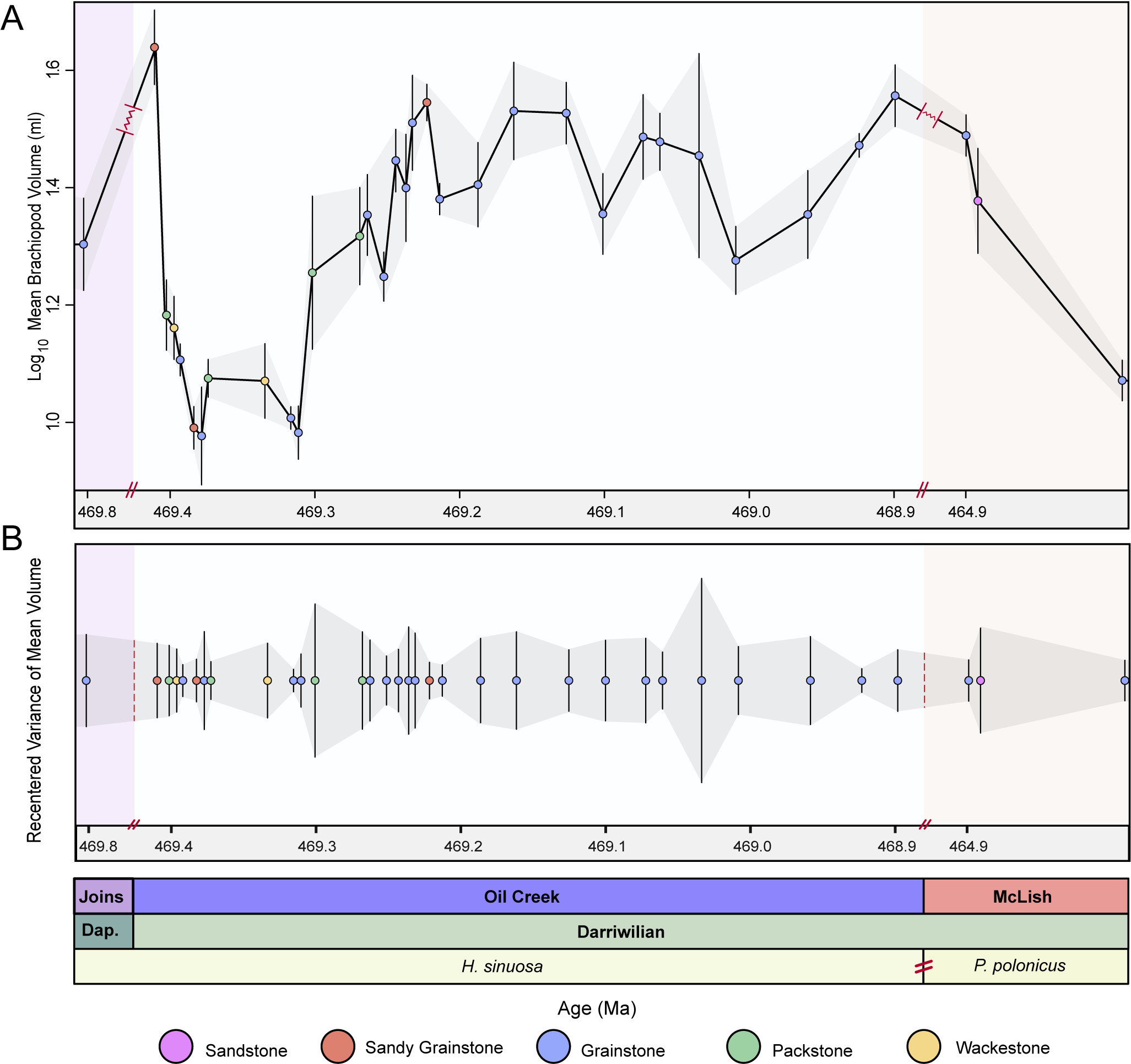
Shell volume varied through time (Fig. 5A). Initially, there is an increase in log10 mean brachiopod size between the Joins and Oil Creek formations that occurs across the Dapingian and Darriwilian stage boundary (Fig. 5A). This increase, however, represents the anomalous effect of a single bed. Overall, the lower portion of the Oil Creek Formation is characterized by the smallest average volumes observed across this study. These smaller average volumes remain relatively consistent across the beginning of the Oil Creek Formation and early Darriwilian Stage. Beginning at ~469.3 Ma, these volumetrically smaller assemblages are followed by a set of volumetrically larger assemblages that remain volumetrically larger across the remainder of the studied Oil Creek section (middle Darriwilian). Non-overlapping error envelopes indicate that, in general, the smaller and larger average volumes form two statistically distinct populations (Fig. 5A). These larger values remain consistent across McLish Formation, except for a decrease in the final measured layer of the McLish Formation. Mean shell volume within the final measured bed is volumetrically similar to the smaller beds observed at the beginning of the Oil Creek Formation. There is no direct statistical correlation between mean shell volume and lithology (Fig. 5A).
Time-series data for average brachiopod shell volume through time. A, Shell volume through time. B, Variance in shell volume through time. Time and stratigraphic units are indicated on the x-axis. The y-axis includes the log10 of mean brachiopod volume. Error bars and gray envelope indicate sample variance. Data points are color coded to indicate lithology of each stratigraphic layer. Red breaks between formations represent significant gaps in time between data points.

Variance, which is measured by the width of the mean standard error envelope, remains relatively consistent through time and shows no significant temporal trend (Fig. 5B), indicating no significant change in brachiopod size disparity (a proxy for morphologic diversity) through time. As with volume, lithology is not statistically correlated with shell volume variance.
Time-Series Analysis
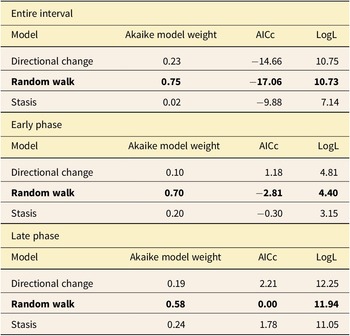
Mean shell volume through time is best fit by a random walk model when considered a single time series across the study interval, during the early part of the study interval, and during just the later part of the study interval (Table 1). These results suggest that while there is change in volume through time, this is either not well explained by directional change through time or that change through time occurs too rapidly to be reflected in the model. Welch’s two-sample t-test results indicate a statistically significant increase in mean volume between early Oil Creek time (strata older than 469.3 Ma) versus later Oil Creek time (strata younger than 469.3 Ma) (t = −10.87, df = 18.09, p << 0.001). The primary result of these analyses is that there is an unbiased random walk across the entire study interval that is punctuated by a statistical increase in volume within the Oil Creek Formation. Because this volume change occurs rapidly, it is recorded as an event rather than a directional trend within the time-series analysis.
Model fit statistics for time-series analysis of brachiopod shell volume through time. AICc, Akaike information criterion; LogL, log likelihood

BRM
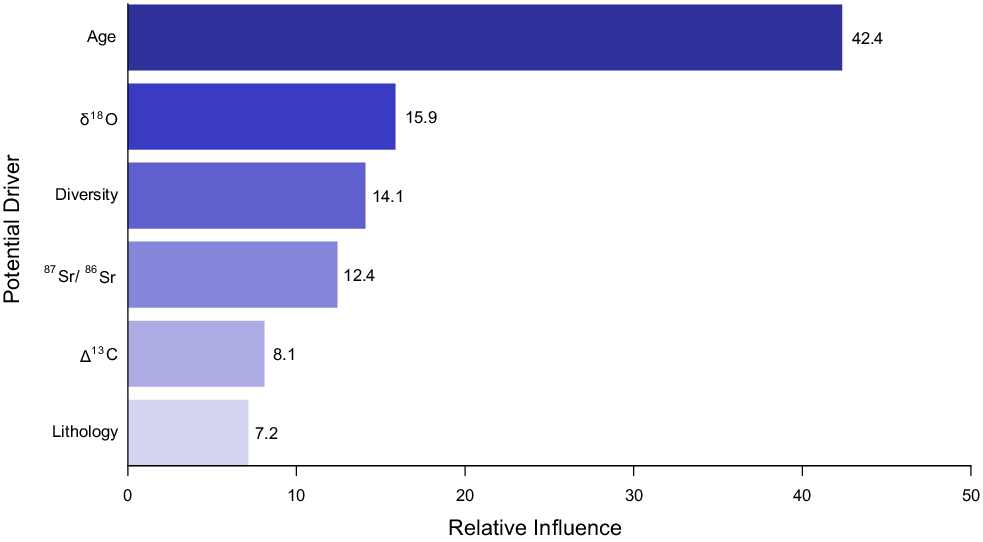
Results of the BRM are represented by the relative influence of each factor (age, δ18O, 87Sr/86Sr, Δ13C, and lithology; Fig. 6). A higher relative influence corresponds to a greater impact on brachiopod volume. Trends in mean brachiopod volume within the Simpson Group strata are most strongly correlated to age, meaning position in geologic time, with a relative influence of 42.4. Then, δ18O has the next highest influence (15.9), followed closely by taxonomic diversity (14.1) and 87Sr/86Sr trends (12.4), while Δ13C is shown to have a relatively low overall influence (8.1). Lithology has the lowest relative influence of the analyzed factors (7.2), indicating that there is little correlation between lithology and mean shell volume. Notably, although Δ13C and lithology have a low relative influence, each factor has a nonzero influence on brachiopod volume trends in Simpson Group strata.
Results of boosted regression model (BRM). The width of each bar represents the relative influence of each factor on brachiopod shell volume (listed on the left). Higher relative influence values correspond to greater impact on brachiopod shell volume.

Discussion
Body Volume through Time
Brachiopod size increased through the Simpson Group (Fig. 5). This size change, however, was not characterized by a gradual long-term directional trend stretching continuously from the Joins through McLish formations (Table 1). The overall pattern is of a non-directional random walk that is punctuated by a rapid increase in shell volume recorded in the lower Oil Creek Formation (Fig. 5A). Notably, the increase in shell volume was not accompanied by an increase in morphological disparity (Fig. 5B), indicating that increases in morphological disparity were not closely linked to increasing average shell volume within these units. These results present the most robust analysis of brachiopod size for the Middle Ordovician Simpson Group to date.
Volume trends follow a similar pattern as the taxonomic diversity pattern established by Trubovitz and Stigall (Reference Trubovitz and Stigall2016). Taxonomic diversity in Simpson Group units was initially low, increased rapidly within the Oil Creek Formation, and subsequently stabilized at relatively higher diversity after this main diversification pulse (Trubovitz and Stigall Reference Trubovitz and Stigall2016). Volume trends in Simpson Group strata mirror this trajectory of initially low volume that increases rapidly in the Oil Creek Formation and stabilizes at larger mean volumes after this main, rapid increase.
Within the Oklahoma Basin, no statistical change in variance occurs through these strata (Fig. 5B). Thus, although both volume and taxonomic diversity increase, they are not coupled with an increase in size disparity. When taxa diversify taxonomically and adapt to new ecospaces, adaptations may promote increasing disparity if both smaller and larger size ranges are utilized by newly developed species (Bambach et al. Reference Bambach, Bush and Erwin2007). In this case, shifting environmental conditions may have ultimately facilitated an overall size increase without a matching increase in small-bodied organisms. Both lower and upper size ranges increased a similar amount, which did not produce an increase in size disparity. Overall, the results of this analysis indicate that the primary difference in brachiopod morphology through time was an increase in overall size, not an increase in range of body sizes utilized.
Globally, a directional trend toward larger body size has been documented in many marine taxa, including brachiopods (Harper et al. Reference Harper, Cocks, Popov, Sheehan, Bassett, Copper, Holmer, Jin, Rong, Webby, Paris, Droser and Percival2004; Novack-Gottshall and Lanier Reference Novack-Gottshall and Lanier2008; Heim et al. Reference Heim, Knope, Schaal, Wang and Payne2015; Zhang et al. Reference Zhang, Augustin and Payne2015; Sigurdsen and Hammer Reference Sigurdsen and Hammer2016). This documented volume increase spans the Paleozoic (Zhang et al. Reference Zhang, Augustin and Payne2015) and includes a substantial volume increase across the GOBE interval (Droser and Finnegan Reference Droser and Finnegan2005; Finnegan and Droser Reference Finnegan and Droser2008; Novack-Gottshall and Lanier Reference Novack-Gottshall and Lanier2008; Trubovitz and Stigall Reference Stigall2018). Globally, the volume increase is partly due to the origination of new families with larger average body sizes rather than increasing size within existing families (Novack-Gottshall and Lanier Reference Novack-Gottshall and Lanier2008; Heim et al. Reference Heim, Knope, Schaal, Wang and Payne2015), thus suggesting a likely link between taxonomic diversity trends and volume trends. However, using literature data, Trubovitz and Stigall (Reference Stigall2018) noted that the apparent body-size increase in the Simpson Group could not be attributed to change in superfamily composition before and after diversity increase and reflected environmental change instead. The data in this study also show limited change in superfamily composition or frequency across the study interval (Supplementary Appendix S3), suggesting that changes at the species or genus level were more important in driving the observed change in shell volume.
Local-scale data from this study indicate a rapid state change within the Oklahoma Basin in which volume increase occurs as a pulse. Because of this rapid pulse, size trends are recorded as an unbiased random walk, indicating that locally, size change is not described by Cope’s rule (which requires a directional trend). A similar trend is recorded in contemporaneous regional data from Baltoscandia, where volume trends reflect a pulse of increasing volume and not gradual directional change (Sigurdsen and Hammer Reference Sigurdsen and Hammer2016). The rapid pulse of increasing volume during the Darriwilian Stage recorded locally within this adds supports to the emerging trend of a main biodiversity pulse that comprises the GOBE, set against a backdrop of a more general, gradual diversification spanning the Ordovician (Stigall et al. Reference Stigall, Edwards, Freeman and Rasmussen2019).
Size patterns documented in other marine taxa, such as trilobites, echinoderms, and mollusks (Finnegan and Droser Reference Finnegan and Droser2008; Novack-Gottshall Reference Novack-Gottshall2008b; Sigurdsen and Hammer Reference Sigurdsen and Hammer2016) represent varying degrees of similarity to brachiopod volume trends observed in this study. Like brachiopods, average body size in trilobites significantly increased during the Ordovician (Finnegan and Droser Reference Finnegan and Droser2008). Regional data from Sigurdsen and Hammer (Reference Sigurdsen and Hammer2016) recovered an unbiased random walk signal and indicated that trilobite size increase may have occurred as a pulse. Data analyzed by Novack-Gottshall (Reference Novack-Gottshall2008a) indicate that early Paleozoic echinoderms show a general, albeit somewhat variable, temporal trend toward increasing volume that is most significant across the Late Ordovician to Devonian. Although mollusks do not exhibit a long-term temporal trend of increasing size through the Cambrian–Devonian, short-term patterns may support a size increase within the Ordovician (Novack-Gottshall Reference Novack-Gottshall2008a). Thus, the trend of increasing volume across the GOBE recovered in this study occurs broadly, though not identically, in other clades.
Factors Influencing Body Volume through Time
Within Simpson Group strata, age (location in time) has the strongest influence over brachiopod volume trends (Fig. 6). This influence reflects trends established in the time series analysis, which indicate a shift from smaller average volumes to larger average volumes through time (Fig. 5A). Volumes from before the main pulse of size increase are statistically distinct from volumes aged after this main pulse; thus, average brachiopod volume is closely linked to geologic age. Average volume is highly dependent on whether the specimen or population was collected before or after this time.
Although age has the most significant influence over brachiopod volume trends, all other analyzed factors exert some influence. The most significant of these factors include δ18O, taxonomic diversity, and 87Sr/86Sr trends. The strong influence of these factors, in addition to age, indicate that global, rather than local, factors were dominant in controlling local volume trends during the GOBE.
Of the geochemical factors, δ18O has the strongest influence over brachiopod volume trends within the Oklahoma Basin, suggesting that locally, brachiopod volume trends are closely linked to seawater temperature. Globally, Ordovician ocean cooling has been identified as having intensified during the Middle Ordovician around the Dapingian/Darriwilian transition (Trotter et al. Reference Trotter, Williams, Barnes, Lecuyer and Nicoll2008; Rasmussen et al. Reference Rasmussen, Ullmann, Jakobsen, Lindskog, Hansen, Hansen and Eriksson2016; Albanesi et al. Reference Albanesi, Barnes, Trotter, Williams and Bergström2020; Edwards et al. Reference Edwards, Jones, Quinton and Fike2022). This Middle Ordovician cooling trend is expressed locally within the isotopic record of the Oklahoma Basin (Edwards et al. Reference Edwards, Jones, Quinton and Fike2022) and is coeval with the volume increase identified in this study. Ocean cooling during this time may have reached modern equatorial temperatures, which would have facilitated biological productivity through enhanced ocean oxygenation and reduced limitations to metazoan metabolism (Trotter et al. Reference Trotter, Williams, Barnes, Lecuyer and Nicoll2008; Rasmussen et al. Reference Rasmussen, Ullmann, Jakobsen, Lindskog, Hansen, Hansen and Eriksson2016; Ontiveros et al. Reference Ontiveros, Beaugrand, Lefebvre, Marcilly, Servais and Pohl2023). In addition, brachiopods use the protein hemerythrin for oxygen transfer, which is less efficient and more sensitive to oxygen redox than hemoglobin or hemocyanin (Song et al. Reference Song, Wu, Dai, Corso, Wang, Feng, Chu, Tian, Song and Foster2024). Song et al. (Reference Song, Wu, Dai, Corso, Wang, Feng, Chu, Tian, Song and Foster2024) demonstrated that brachiopod size reduction during the Permo-Triassic mass extinction was related to reduced oxygen at that time. Conversely, the increased oxidation of the Middle Ordovician would have facilitated greater metabolic activity and larger shell size for brachiopods (Song et al. Reference Song, Wu, Dai, Corso, Wang, Feng, Chu, Tian, Song and Foster2024). Furthermore, decreasing pCO2 values associated with ocean cooling may have also increased ocean carbonate saturation (Trotter et al. Reference Trotter, Williams, Barnes, Lecuyer and Nicoll2008; Shen et al. Reference Shen, Neuweiler and Immenhauser2023), which would have facilitated biomineralization pathways and allowed for increased shell size in brachiopods (Pruss et al. Reference Pruss, Finnegan, Fischer and Knoll2010). Taken together, these factors may have supported the precipitation of volumetrically larger brachiopod shells.
Cooling-associated δ18O trends may also indicate enhanced ocean circulation, which would have enhanced nutrient availability and oxygenation, thus promoting biological activity (Miller and Mao Reference Miller and Mao1995; Rasmussen et al. Reference Rasmussen, Ullmann, Jakobsen, Lindskog, Hansen, Hansen and Eriksson2016). Ultimately, these conditions may have facilitated the development of larger shell volumes observed in this study. Additional support for oxygenation can be found in trace metal analysis of Cambrian–Ordovician units in Baltoscandia, which suggests a transition from anoxic and euxinic conditions in the Cambrian through Early Ordovician, to increased bottom-water oxygenation later in the Ordovician (Kozik et al. Reference Kozik, Young, Ahlberg, Lindskog and Owens2023a). This transition may have helped to initiate GOBE biodiversification. The high relative influence of δ18O on brachiopod volume trends within Simpson Group strata supports the hypothesis of ocean cooling and oxygenation being primary factors driving biodiversity trends during the GOBE.
Although the relative influence of taxonomic diversity ranks as the third most impactful control over local volume trends, its influence is only marginally smaller than that of δ18O; thus, size is tightly correlated with taxonomic diversity. This correlation confirms that the diversification pulse reported by Trubovitz and Stigall (Reference Trubovitz and Stigall2016) is closely linked to the rapid increase in brachiopod volume reported in this study. The close correlation between these two trends indicates that they are likely part of the same primary GOBE pulse within this basin, rather than two independent patterns. Furthermore, this correlation supports conclusions that increasing body size is primarily due to the origination of taxa, as it indicates that volume trends are tied to increasing taxonomic diversity at lower taxonomic levels rather than superfamily distributions. Notably, Trubovitz and Stigall (Reference Trubovitz and Stigall2016) demonstrated that the timing of taxonomic diversification within the Oklahoma Basin is correlative with diversification pulses in Baltica and Gondwana and thus represents a regional expression of a global pattern of rapid middle Darriwilian diversification. Thus, the link between taxonomic diversity and body size in this study reflects a global pattern rather than an exclusively regional expression of the GOBE.
The 87Sr/86Sr trend also influenced brachiopod volume, indicating that tectonic activity and seafloor-spreading rates had a moderate overall influence over shell size within Simpson Group strata. The onset of the Taconic orogeny during the middle Darriwilian Stage has been commonly cited as a potential cause of the 87Sr/86Sr flux reported during this interval (Young et al. Reference Young, Saltzman, Foland, Linder and Kump2009; Saltzman et al. Reference Saltzman, Edwards, Leslie, Dwyer, Bauer, Repetski, Harris and Bergstrom2014; Avila et al. Reference Avila, Saltzman, Adiatma, Joachimski, Griffith and Olesik2022). The 87Sr/86Sr data from the Simpson Group, however, identify this event as having occurred locally across the McLish–Tulip Creek transition (Saltzman et al. Reference Saltzman, Edwards, Leslie, Dwyer, Bauer, Repetski, Harris and Bergstrom2014; Avila et al. Reference Avila, Saltzman, Adiatma, Joachimski, Griffith and Olesik2022); therefore, the onset of this orogeny takes place later in time than the volume increase identified in this analysis, which takes place within Oil Creek time. Thus, 87Sr/86Sr influence directly related to the Taconic Orogeny likely had limited, if any, influence over volume trends in this study.
The 87Sr/86Sr patterns have also been used as proxies for seafloor spreading and associated sea-level change and nutrient availability. Although the onset of the Tippecanoe transgressive sequence in the Oklahoma Basin is typically assigned to the McLish–Tulip Creek transition, Derby et al. (Reference Derby, Bauer, Creath, Dresback, Etherington, Lock and Stitt1991) suggested that it may have occurred closer to the Oil Creek–McLish transition. If so, the timing of this transgression would correspond more closely to the primary volume increase observed in this study.
Compared with global or regional factors, local environmental conditions such as carbon cycle changes (Δ13C) and lithology had more limited influence on brachiopod volume trends (Fig. 6). Data analyzed by Lindskog et al. (Reference Lindskog, Young, Nielsen and Eriksson2023) indicated significant regional variation between carbon trends through the Dapingian–Darriwilian, thus indicating that carbon cycle trends are primarily local. Edwards and Saltzman (Reference Edwards and Saltzman2015) identified a Δ13C increase that corresponds to biodiversification in the Early to Middle Ordovician and proposed a possible link between biological fractionation and diversification. The low influence of Δ13C on volume trends, however, suggests that locally, carbon cycle changes related to biological fractionation were not primary controls of brachiopod volume size during the main GOBE pulse within the Oklahoma Basin.
Lithology also had little impact on brachiopod volume in the boosted regression analysis and was uncorrelated with volume in the time series analysis. These results are similar to those reported by Trubovitz and Stigall (Reference Trubovitz and Stigall2016), whose data indicate that lithology did not have a statistically significant impact on brachiopod diversification in the Oklahoma Basin. Likewise, these lithologic trends have a comparatively low impact on morphologic trends. Given these patterns, facies changes had little impact on diversification patterns in rhynchonelliform brachiopods in the Oklahoma Basin.
Results of this analysis indicate that local factors such as lithologic trends and carbon cycle changes had a limited influence on increasing body size across GOBE pulse in Simpson Group strata, whereas global-scale factors, notably age and ocean temperature trends, had the most significant impact on mean shell volume. Taken together, these results support conclusions from prior studies that global factors were dominant in controlling primary patterns of diversification and ecosystem evolution during the GOBE (Franeck and Liow Reference Franeck and Liow2019; Stigall et al. Reference Stigall, Edwards, Freeman and Rasmussen2019). All factors analyzed herein had a nonzero influence over brachiopod volume trends. This influence of multiple factors supports the argument that driving forces of the GOBE were multifaceted, and ecological and evolutionary trends were produced by a combination of multiple biotic and abiotic factors.
Synthesis and Comparisons
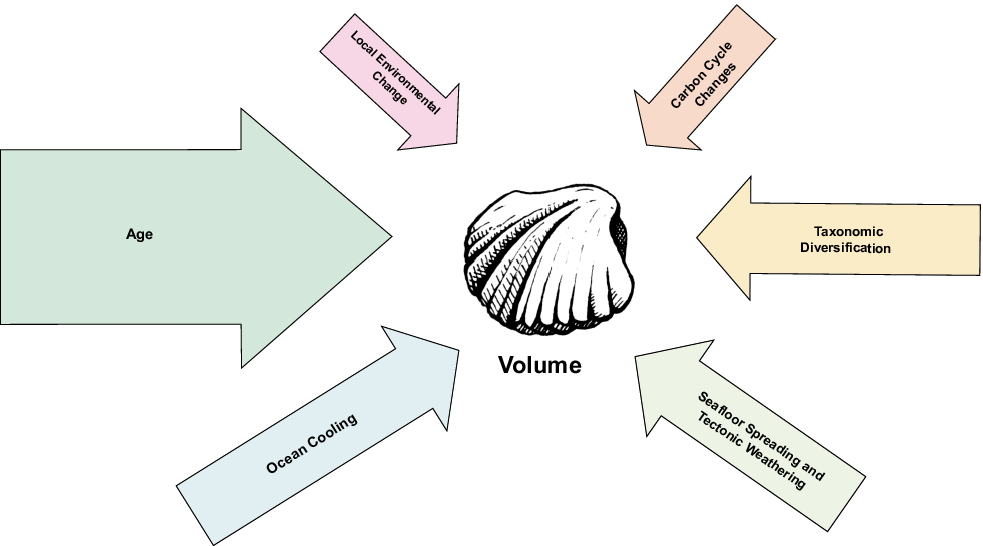
A rapid pulse of brachiopod volume increase occurred across the main GOBE pulse in the Oklahoma Basin, primarily influenced by global-scale factors (Fig. 7). There is ongoing debate regarding the degree to which biodiversity changes during the GOBE represent an aggregation of independent local changes or shared, coordinated global patterns (e.g., Servais and Harper Reference Servais and Harper2018; Stigall et al. Reference Stigall, Edwards, Freeman and Rasmussen2019). The dominant influences on local shell volume change within the Oklahoma Basin are primarily global, which supports the argument that the main pulse of the GOBE was a global-scale event. Additionally, although the faunal composition of brachiopod diversification varies between Baltica and Laurentia, the timing of these events is coeval (Rasmussen et al. Reference Rasmussen, Hansen and Harper2007; Trubovitz and Stigall Reference Trubovitz and Stigall2016; Penny et al. Reference Penny, Hints and Kröger2022), and the overall pattern of a rapid size increase is similar (Sigurdsen and Hammer Reference Sigurdsen and Hammer2016).
Relative influences of global and regional controls over brachiopod volume trends. Arrows are scaled to the relative influence of each factor on brachiopod volume trends established in this study. Factors are based on geochemical proxies used in boosted regression analysis. Global controls include seafloor spreading and tectonic weathering, age, ocean cooling, and taxonomic diversification. Local controls include local environmental change and carbon cycle changes.

However, there are also clear regional differences that have been recorded in biodiversification patterns across the GOBE and broader Ordovician Radiation. For example, diversification patterns in South China indicate an interval of diversification that occurred earlier in South China than in other regions, with peak diversification starting in the Tremadocian and persisting into the Darriwilian (Deng et al. Reference Deng, Fan, Zhang, Fang, Chen, Shi and Wang2021). Regional differences in diversification patterns are influenced by regional variations in diversification controls and conditions, such as paleocontinental location and oceanographic setting. Brachiopod size change in this study, while primarily influenced by global factors, is also influenced in part by regional influences (Fig. 7). Similarly, regional diversification patterns from Baltica suggest that while diversification patterns are in part controlled by global-scale changes, regional controls on siliciclastic versus carbonate sedimentation or platform versus basinal position were also likely influential (Penny et al. Reference Penny, Hints and Kröger2022). Although regional variations impacted which taxonomic units (families, genera, etc.) underwent radiation and the specific character of ecological change within each region during the GOBE, the coordination of timing and strong impact of Earth system changes on regional patterns, such as observed in Oklahoma, suggest that global factors exerted the primary control. These primarily global factors support the argument that change during the main pulse of the GOBE represents a global event, rather than simply the summation of independent local events (Stigall et al. Reference Stigall, Edwards, Freeman and Rasmussen2019).
The factors inferred to control brachiopod size trends in this study are more similar to hypothesized causes of the Cambrian Explosion than hypothesized causes of the Mesozoic radiation. Like the GOBE, proposed drivers of the Cambrian Explosion include a combination of interactions between geochemical, environmental, and biotic controls (Zhang et al. Reference Zhang, Shu, Han, Zhang, Liu and Fu2014). Change during the Cambrian Explosion, however, was primarily due to abiotic factors, whereas change during the GOBE was initiated by abiotic controls that were then further facilitated by biotic controls. The expansion of taxonomic and ecological diversity during the GOBE may have helped establish the foundation for the primarily biotic factors promoting the later Mesozoic radiation. In contrast, the proposed causes of the marine Mesozoic radiation are primarily biotic, with predator–prey interactions being hypothesized as the primary driving force behind this diversification event (e.g., Mesozoic marine revolution sensu Vermeij Reference Vermeij1977). Thus, the combination of abiotic and biotic controls during the GOBE suggests that this event may be conceptualized as an intermediary event between the Cambrian Explosion (primarily abiotic controls) and marine Mesozoic radiation (primarily biotic controls).
Conclusion
A rapid increase in brachiopod shell volume occurred coincident with the main pulse of diversification during the Great Ordovician Biodiversification Event in Simpson Group strata of the Oklahoma Basin. Shell size increase is recorded as an event rather than a gradual directional change. This observed volume increase was not paired with an increase in brachiopod size disparity; thus, local size trends indicate a temporal trend toward overall size increase rather than in increase in the range of body sizes. This volume trend mirrors local taxonomic diversification trends established by Trubovitz and Stigall (Reference Trubovitz and Stigall2016), in which low overall diversity is followed by a rapid diversification pulse and subsequent stabilization at these overall higher diversity levels. The correlation between volume trends and taxonomic diversification supports a possible link between species-level diversity and volume trends and may indicate that volume increase is driven by the origination of new, larger species rather than a size increase within already existing species. Specifically, these trends suggest that local environmental conditions ultimately favored an overall size increase rather than an increase in both large- and small-bodied brachiopods.
Boosted regression analysis of the relative impacts of δ18O, Δ13C, 87Sr/86Sr, taxonomic diversity, age, and lithologic trends on brachiopod shell size indicate that global, rather than local, factors were the primary determinant of this biotic trend. The correlation with global factors suggests that diversification trends within the Oklahoma Basin were not a product of independent local change; instead, local diversification trends were tied to broader, global trends during the GOBE.
Age (position in time) had the strongest influence over brachiopod volume trends and reflected patterns established in the time series analysis. Following age, δ18O, taxonomic diversity, and 87Sr/86Sr have the next most significant relative influences over local brachiopod volume trends. Of these additional factors, δ18O has the strongest influence over volume trends, indicating that these trends are likely linked to seawater cooling during the GOBE (Trotter et al. Reference Trotter, Williams, Barnes, Lecuyer and Nicoll2008) and enhanced ocean oxygenation (Miller and Mao Reference Miller and Mao1995; Rasmussen et al. Reference Rasmussen, Ullmann, Jakobsen, Lindskog, Hansen, Hansen and Eriksson2016). Taxonomic diversity has a similarly significant relative influence as δ18O, confirming that taxonomic diversity and volume trends are closely linked. The close correlation between these trends indicates that they are likely part of the same event. The local factors of lithology and Δ13C have a marginal influence over local brachiopod volume trends, indicating that local carbon cycle changes and local facies changes had a limited influence over volume trends. Nevertheless, all environmental factors examined had a nonzero influence over volume trends, suggesting that driving forces of GOBE diversification are composed of complex interactions between multiple abiotic and biotic influences.
Ultimately, these data indicate that within the Oklahoma Basin, brachiopod volume increased as a rapid pulse that was primarily controlled by global-scale processes, thus supporting the argument for a globally controlled main pulse of diversification during the GOBE. The primary influence of global-scale trends supports the argument that the GOBE was a global-scale event, rather than a series of independent local pulses. Additionally, the rapid pulse of volume increase supports the argument that the GOBE is characterized by a specific interval of increased diversification within background of the broader Ordovician Radiation (Stigall et al. Reference Stigall, Edwards, Freeman and Rasmussen2019).
Acknowledgments
We acknowledge that the land where this research was completed has been home to the Chickasha, Quapaw, Wichita, Osage, and Kickapoo peoples, and is part of the modern Chickasaw Nation. We thank D. Harper, L. H. Liow, and two additional reviewers for constructive comments that helped us improve this article. Additionally, we thank R. Burkhalter for access to the Sam Noble Museum collections, S. Al Salmi and L. Jevnikar for field assistance, and G. S. Springer for analytical assistance. This study was supported by a Dry Dredgers Paleontological Research Award and an Ohio University Geological Sciences Alumni Research Grant to S.A.H. This is a contribution to IGCP 735: Rocks and the Rise of Ordovician Life.
Competing Interest
The authors declare no conflict of interest.
Author Contribution
S.A.H.: Conceptualization, data curation, formal analysis, funding acquisition, methodology, investigation, writing—original draft. A.L.S.: Conceptualization, formal analysis, funding acquisition, methodology, investigation, supervision, writing—review and editing.
Data Availability Statement
Data, Supplementary Appendices 1–8, and stratigraphic columns are available from the Dryad Digital Repository: https://doi.org/10.5061/dryad.fj6q5746d.


 Open access

