


Introduction
As a major Global South country with great power status, China itself adds complexity to its relationships in South–South security cooperation. China’s rise has sparked intensive debates on its role in the (re)making of global security governance. These discussions engage key empirical, theoretical, and normative aspects of China’s approach to security and development in the Global South.Footnote 1 One of central questions in current discussions is what role China will play in the Global North–South binary.Footnote 2
To garner support from the Global South, China has strategically mobilised a discourse centred around ‘fairness and justice’,Footnote 3 positioning itself as a key advocate for the Global South. In this discourse system, the security–development nexus has been used to legitimise China’s role in providing a vision of mutual benefit and solidarity for South–South cooperation.Footnote 4 China has leveraged its large-scale infrastructure development experiences for the Global South. China also shows its interest in maintaining the status of being a Global South country and uses non-interference foreign policyFootnote 5 to enhance its leadership in South–South security cooperation.
Under President Xi Jinping, China has increasingly sought to reform the global security governance system, challenging the US-dominated security architecture and promoting an alternative vision for global stability. Motivated by its ambitions to achieve the ‘Chinese Dream’ of national rejuvenation (wei da fu xing de zhong guo meng) and the policy of ‘strive for achievement’ (fen fa you wei), China has actively linked the development and security of Global South countries to its own goals of national advancement. Therefore, China further provides the concept of a ‘China solution’ and ‘China wisdom’Footnote 6 to build a ‘security community of humankind’ through its Global Security Initiative (GSI)Footnote 7 and Global Development Initiative (GDI).
The Chinese state views development as central to resolving conflicts and emphasises that infrastructure and connectivity-driven development are crucial for maintaining stability. In this context, China has strategically used the narratives of South–South cooperation to promote security–development cooperation. China’s security–development cooperation is thus seen as a contrast to the Global North’s approach, which typically prioritises security as a prerequisite for development.Footnote 8 Through promoting economic growth and social development and the achievement of stability, a growing security commitment appears legitimate and reasonable to both China and other Global South countries.Footnote 9
While current research sheds light on China’s motivations within the security–development nexus, a more thorough analysis of the varying security priorities and regional dynamics is essential to fully understand the complexities of China’s strategies and its promotion of South–South security cooperation. It is evident that China has been adapting the security–development nexus in its South–South security cooperation: some initiatives are more security-driven, while others are more development-focused, with China skilfully shifting between the two, using one to reinforce the other. The key question, then, is under what circumstances will China adjust the balance between security and development in its cooperation with the Global South?
This article uses two case studies in the Mekong region, where China has applied contrasting approaches to address different security-related issues, to explore how China justifies its security choices through the security–development nexus in its relations with Global South countries. The varying security priorities and complex regional dynamics have led to variations in the nature and scope of its security cooperation with the Global South.
This article argues that while China seeks to present a coherent security–development nexus in its relations with Global South countries, its approach is flexible and responsive to changing circumstances. China adapts its strategy by shifting between ‘developmentalising’ security issues and ‘securitising’ development issues, depending on evolving priorities. The article identifies three key factors that influence China’s approach: (a) its perception of security risks in a given issue area, (b) its ability to unilaterally dominate the issue, and (c) the urgency of its interests.
When securitising an issue is perceived as harmful to China’s security, it prefers to ‘developmentalise’ the issue, removing security concerns from the agenda. If China holds a dominant position on a particular issue, it can flexibly switch between securitising and developmentalising, depending on the context. For less urgent matters, China emphasises developmentalisation to shape discourse and exert influence. However, when development issues pose significant security risks that China cannot manage unilaterally, it tends to securitise those issues, seeking state-to-state cooperation to address its security concerns and strengthen its influence in the Global South.
Drawing on data from Chinese official websites, leadership statements and speeches, media reports, and first-hand interviews with scholars and policy advisors, this article finds that China prefers using South–South cooperation more to ‘developmentalise’ water security tensions, while it is more inclined to apply multilateralism narratives in its efforts to securitise cross-border economic crimes. By examining these contrasting cases, the article provides a deeper understanding of how China’s evolving approach to security–development cooperation in the Global South is shaped by its strategic goals and the specific challenges it faces in different regions. It also offers insights into the broader implications of China’s security–development nexus, particularly in the context of its rise as a global power and its aspirations to establish itself as a leader of the Global South.
Studying China’s role in South–South security cooperation in the Mekong region is particularly significant in the ongoing debate about the North–South security binary. The China-led regional institution the Lancang–Mekong Cooperation (LMC) is framed by the Chinese government as a Biaogan (benchmark) for South–South cooperation,Footnote 10 a ‘pioneer’ area for the GDI, and a ‘pilot’ area for the GSI.Footnote 11 China claims to be promoting through these initiatives a just and fair international orderFootnote 12 that emphasises the role of Global South countries.Footnote 13 However, romanticising the Global South identity as a framework for articulating China’s security–development nexus is insufficient to fully address the complexities of China’s security cooperation with Global South countries.
The article highlights the challenges China faces in using the security–development nexus to build a security community in the region. As Berger and Müller suggest,Footnote 14 South–South security cooperation is a relational and collaborative effort, grounded in the sharing of experiences and resources to address common security challenges. For the Mekong countries, China is both a key contributor to addressing regional security concerns and a source of concern in itself. China’s role as both a development partner and a security supporter has enhanced its influence in Global South countries such as Cambodia, Laos, and Myanmar. However, China’s adjustments to its non-intervention policy and changes in its security strategies in certain areas have raised concerns among these countries, causing them to approach security cooperation with China more cautiously.Footnote 15
The next section offers a theoretical analysis of China’s security cooperation choices, followed by an examination of its security–development approach in the Mekong countries. It then explores China’s two contrasting security–development nexus approaches in the areas of water security and trans-border security. Finally, the article concludes with an analysis of the implications for South–South security cooperation.
China’s security cooperation choices in the security–development nexus
To garner support from the Global South, China has strategically mobilised a discourse centred around fairness and justice for the interests of Global South countries. By emphasising themes of fairness, equality, and mutual development, China seeks to align itself with the Global South’s historical struggles against colonialism and inequality. In this context, China has framed its security–development nexus as a tool for fostering solidarity and cooperation. The security–development nexus, in particular, has been employed by China to legitimise its role as a provider of both security and developmental assistance, offering a vision of mutual benefit that promises to address the economic and security challenges faced by Global South countries.Footnote 16
As pointed out by Benabdallah and Large, the security–development nexus is a complex and often-ambiguous concept that connects development and security in Global North–South interactions.Footnote 17 The aftermath of 9/11 has further complicated the nexus, as development assistance provided by the Global North became increasingly tied to security concerns.Footnote 18 This shifted focus has led to a securitisation of development, with development aid often conditioned on a heavy focus on military security by the Global North. Therefore, security is often viewed as a prerequisite to development in the Global North security–development nexus.
This approach contrasts with China’s interpretation of the security–development nexus, where development is viewed as central to addressing the root causes of conflicts. China’s recent economic foreign policy achievements through initiatives such as the Belt and Road Initiative (BRI) have fuelled debates about China’s model as an alternative to the hegemonic Global North.Footnote 19 Chinese leaders believe infrastructure and connectivity are essential prerequisites for stability and security. Therefore, for China, the concept of security is intricately tied to economic development, and development itself becomes a form of security.Footnote 20 Rooted in its own domestic development model, China has applied this approach in its cooperation with the Global South. This is why China’s multilateral peacekeeping and post-conflict efforts in African countries like Mali and Sudan are often accompanied by investments, infrastructure projects, capacity building, and vocational training programmes. By offering substantial financial support and infrastructure projects, China differs itself from the Global North, portraying itself as a more reliable partner. In the process, China also uses non-intervention diplomacy to encourage Global South countries to pursue their own development agendas, free from the political conditionality attached to assistance from the Global North.
While prioritising economic development cooperation with the Global South, China has become increasingly focused on securitising development to protect its overseas security interests (hai wai li yi an quan), a concept introduced by Chinese president Xi Jinping as part of China’s broader vision for ‘comprehensive national security’ in 2014.Footnote 21 The notion of overseas security interests integrates China’s development and security concerns, with China seeking to ensure the safety of its development projects overseas. As China’s global presence expands, the securitisation of development has become a key strategy for managing risks associated with its growing overseas investments. These risks include instability in host countries, threats to Chinese nationals and assets, and damages to China’s image and reputation.Footnote 22 Therefore, while existing research provides valuable insights into China’s approach and motivations within the security–development nexus, a more comprehensive analysis is needed to fully understand the varying nature of China’s security strategies. This includes examining China’s varying security priorities and the complex regional dynamics.
This article posits that while China seeks to portray a cohesive security–development nexus in its partnerships with Global South countries, its approach is dynamic and adaptable. China has strategically reframed the priorities within this nexus to better align with its evolving interests, shifting between the concepts of ‘developmentalising’ security issues and ‘securitising’ developmental matters. It argues that three primary factors that determine when and how China modifies its security–development nexus. First, when China identifies an issue as a potential threat to its security or national interests, it tends to adopt a securitisation approach to mobilise security resources and seek international security cooperation.
Second, China’s dominant position in a particular issue area can significantly influence its strategic choices. If China can set the agenda unilaterally or has a dominant role in the issue area – through economic leverage, political influence, or military assistance – it gains the ability to reshape discussions and actions surrounding those issues. In such circumstances, China can alternate between approaches, employing securitisation when it deems it necessary and reverting to developmentalisation when this serves its strategic interests better.
Third, the urgency of China’s national interests plays a crucial role in determining its approach. For matters that are not immediately pressing, China typically relies on developmentalisation, which emphasises economic cooperation, capacity building, and sustainable development. This strategy not only helps China to promote its vision of development but also facilitates China’s ability to shape governance agendas, establish normative frameworks, and even build identity construction within a region with which China engages. However, the dynamics shift when developmental issues escalate into significant social and security concerns. In such cases, if China perceives that it cannot control the agenda unilaterally, it is likely to shift towards securitising those issues to seek state-to-state cooperation.
Overall, this nuanced understanding of the security–development nexus reveals China’s strategy as it engages with Global South countries. Rather than adhering to a rigid framework, China demonstrates a capability to adapt its policies in response to the shifting landscape of international relations. By balancing developmental goals with security imperatives, China is not only promoting its interests but also reshaping the narrative around South–South cooperation. The next section introduces the context, motivation, and historical approaches of China in its security–development nexus in Mekong.
The security–development nexus in Mekong
After the Cold War, China’s growing interests in strengthening security and development ties with Mekong countries became critical to its national security and foreign policy. With shared water resources and borders, a stable and prosperous neighbourhood is crucial to China’s political, economic, and security objectives.Footnote 23 As a result, China, along with the international community, has promoted development-oriented programmes to foster regional stability and cooperation.
To promote a stable neighbourhood and enhance its domestic security, the Chinese government launched the ‘Opium Substitution Policy’ in Myanmar and Laos. By sharing agricultural development experience and assisting less-developed neighbours in integrating into the regional market, China aims to lessen security concerns such as trans-border criminal activities and conflicts along its border through development cooperation.Footnote 24 Additionally, China has actively participated in regional organisations, such as the Asian Development Bank, to support the economic development of the Mekong region through the Greater Mekong Subregional Economic Cooperation (GMS). In trade, China has extended special treatment to less-developed Mekong countries through the Early Harvest Programmes within the ASEAN (Association of Southeast Asian Nations)–China Free Trade Agreement.Footnote 25
This security and development nexus remains a cornerstone of China’s regional security strategy as well. In addition to actively participating in various ASEAN-centred security initiatives, China has been advocating for a ‘common security’ concept in the region through ‘dialogue’ and ‘cooperation’ through its New Security Policy, which was introduced during the ministerial-level meeting of the ASEAN Regional Forum in 2002.Footnote 26 One key approach in China’s security cooperation with the region involves forging ‘economic interest integration’ to strengthen political and security relations in the region.Footnote 27 While continuing to uphold ASEAN centrality in the regional security architecture, China is also exploring ways to extend its leadership in security cooperation in Southeast Asia and in the Mekong region.
One example is China’s increased security presence in the Mekong region, which began in response to the 2011 Mekong Massacre, in which several Chinese citizens were murdered.Footnote 28 In the aftermath, China established a quadrilateral security cooperation framework with Laos, Myanmar, and Thailand.Footnote 29 However, joint law-enforcement operations and security presence remain sensitive topics in many Mekong countries.Footnote 30 As a result, China’s security apparatus and patrols face limitations, such as their inability to conduct patrols along the Thai border, highlighting ongoing constraints in its security operations in the region. Therefore, China continues to leverage the security–development nexus to foster security cooperation through the Lancang Mekong Cooperation (LMC). This institutionalisation reflects China’s security–development nexus approach as articulated in its 2017 Asia-Pacific Security proposal that ‘security and development are closely linked and mutually reinforcing … through regional economic integration, a solid economic and social foundation is provided for security’.Footnote 31
As China’s power continues to grow, differences between China and the Mekong countries regarding regional security approaches are also increasing. On the one hand, China remains concerned about the security threats posed by the dominant US military presence in the region. For example, Thailand continues to be part of the US-led hub-and-spoke alliance system. Meanwhile, all Mekong countries are focused on maintaining regional security by promoting a balance of power and diversifying their security options.Footnote 32 As a result of growing security concerns in areas like the disputed South China Sea, countries such as Vietnam have shifted their defence posture to engage more proactively with the United States.
On the other hand, China’s upstream behaviour and its extensive investments in Mekong hydropower projects have fuelled tensions in the region.Footnote 33 China’s development of water resources has emerged as a critical water security issue for lower Mekong countries. Various stakeholders, including environmental activists, local governments, and civil society organisations, seek to regulate China’s hydropower investments.Footnote 34 The global community, along with countries like Vietnam, has increasingly called for greater transparency in China’s water-related activities, particularly regarding the disclosure of hydrological data.Footnote 35 However, China views such information as a matter of national security, making these demands a significant challenge for the region.Footnote 36 As a result, China’s development approach is increasingly confronted by the growing securitisation of water disputes. This issue has become a major point of contention between China and the Mekong countries, second only to the ongoing South China Sea disputes.Footnote 37
Therefore, China seeks to leverage the security–development nexus in the South–South cooperation framework to strengthen its rule-making and normative influence in the region. China has employed development-focused rhetoric to downplay the security risks associated with water disputes in the Mekong region, while simultaneously emphasising security-driven concerns when addressing issues such as transnational crime and border security. The two case studies on Mekong water conflicts and transboundary criminal networks in the region outlined below provide clear insights into China’s security cooperation choices with Global South countries.
Developmentalising Mekong water security
One of the key challenges between China and downstream countries in the Mekong stems from tensions and security concerns over water disputes. Driven by its own development, China’s rapid industrialisation has led to a domestic water shortage, driving the country to develop water resources along its transboundary rivers. As the largest upstream nation sharing 42 major transboundary watercourses,Footnote 38 China has consistently advocated for self-determination in managing the shared water resources. For national security reasons, Beijing opposes any binding mechanisms for multilaterally resolving water disputes and has resisted supporting the United Nations Water Convention.Footnote 39 Therefore, China has been defending its unilateral control over hydraulic infrastructure projects and data in the upper reaches of rivers.Footnote 40
While China has constructed water diversion projects in its upper streams, its hydropower companies have expanded internationally, particularly in the Mekong region.Footnote 41 China’s upstream behaviour, coupled with its expansive investments in Mekong hydropower projects, has sparked tensions in the region (see Table 1).Footnote 42 These tensions involve a wide range of actors, including environmental activists, local governors, and civil society groups,Footnote 43 posing great challenges to the traditional state-centric water governance frameworks.Footnote 44 For instance, China’s proposal for the Commercial Navigation Agreement to expand the Mekong River for river trade through dredging and bombing has encountered large-scale protests by Thai communities.Footnote 45 These tensions over water resources have posed challenges for food, the environment, water, and economic security. Any mismanagement and lack of cooperation risks existential threat to the regime stability of the Mekong countries and state-to-state relations. Take the Mekong Delta, for instance. It is a critical area for Vietnam’s rice exports (95 per cent of Vietnam’s exports) and agricultural GDP.Footnote 46 Nonetheless, the construction of upstream hydropower infrastructure and intense economic activities along the river have degraded water quality, changed water flows, and compromised soil for cropping, posing great security challenges to Vietnam’s source of food and nutrition.Footnote 47
Local protests against China’s activities regarding water resources (selective).

Source: compiled by author.
The scale of ecological and social impacts caused by upstream activities has made the Mekong water disputes another significant point of tension between China and Southeast Asia. Consequently, downstream states like Thailand and Vietnam have strong motivations to frame water conflicts as existential threats. In particular, Vietnam has been securitising water disputes to garner international support while also urging China to engage in multilateral governance to resolve the water governance issues.Footnote 48
After Xi came into power, the Chinese leadership recognised the urgency of addressing water management issues, understanding that failure to do so could further escalate tensions and alienate China from the region.Footnote 49 Thus, to build a more benign and responsible image, the Chinese government has implemented a flexible diplomatic approach to addressing concerns over its upstream hydropower activities. This positive gesture from China is to showcase to the regional audience that it is willing to and capable of managing differences and conflicts.
Accordingly, China has shifted from a passive stance to a more active approach by developmentalising the water security issues. This shift involves removing tensions around water disputes and conflicts from the ‘security’ agenda and reframing them within the realm of resource governance and management. To achieve this, China uses development incentives, narratives, and identity construction to de-escalate tensions and foster cooperation.
First, by promoting knowledge sharing and capacity building in the name of water resource development, China has expended its cooperation with Mekong countries through infrastructure, production capacity, and water trade networks to shift the attention of water security to development. Through branding its hydropower projects as part of global transition to green energy,Footnote 50 China justifies its hydropower projects as contributions to global climate goals. To showcase that China is working to improve the governance of water resources, it has also provided financial support to the Global Mekong Study Centers in each LMC member country.
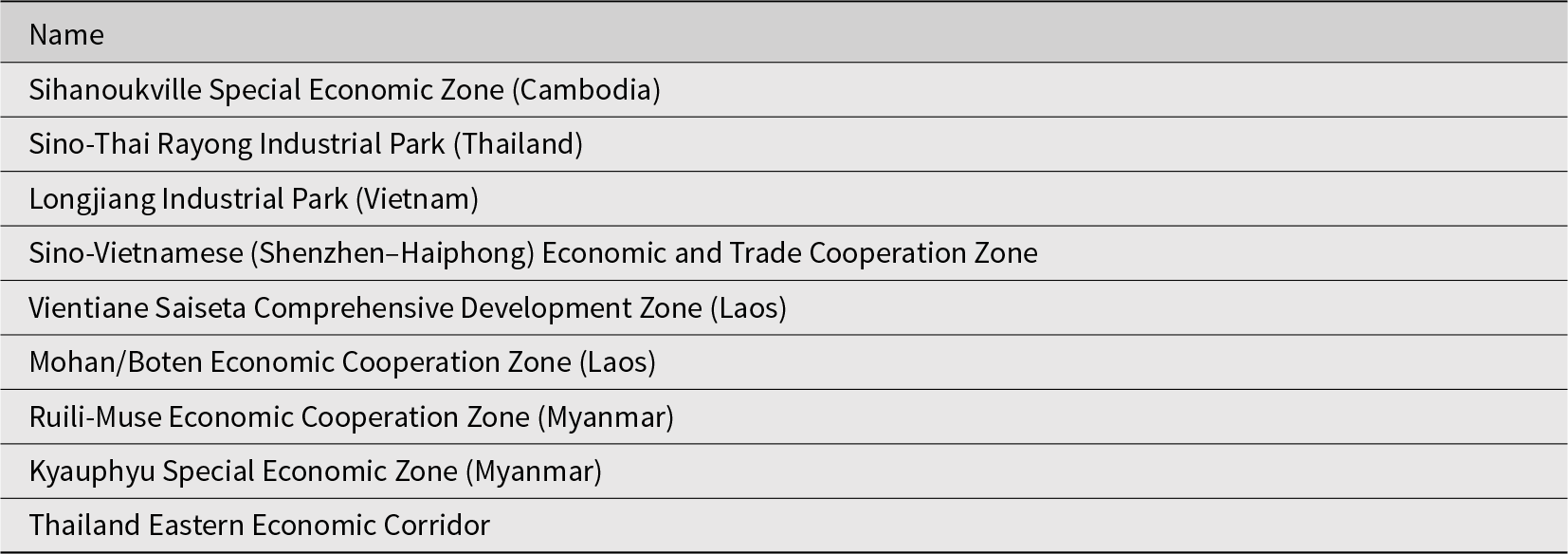
China is also broadening its water-resource-related development projects into broader infrastructure and investment opportunities. Alongside the two existing economic corridors – the China-Indochina Peninsula Economic Corridor and the Sino-Myanmar Economic Corridor – China proposed the Mekong Economic Development Belt as part of its International Land and Maritime Trade New Corridor.Footnote 51 Additionally, China is supporting investments in regional industrial parks and economic zones to bolster the export-oriented economies of the Mekong countries (see Table 2).
China’s involvement in cooperation zones in the Mekong.

Source: compiled by author.
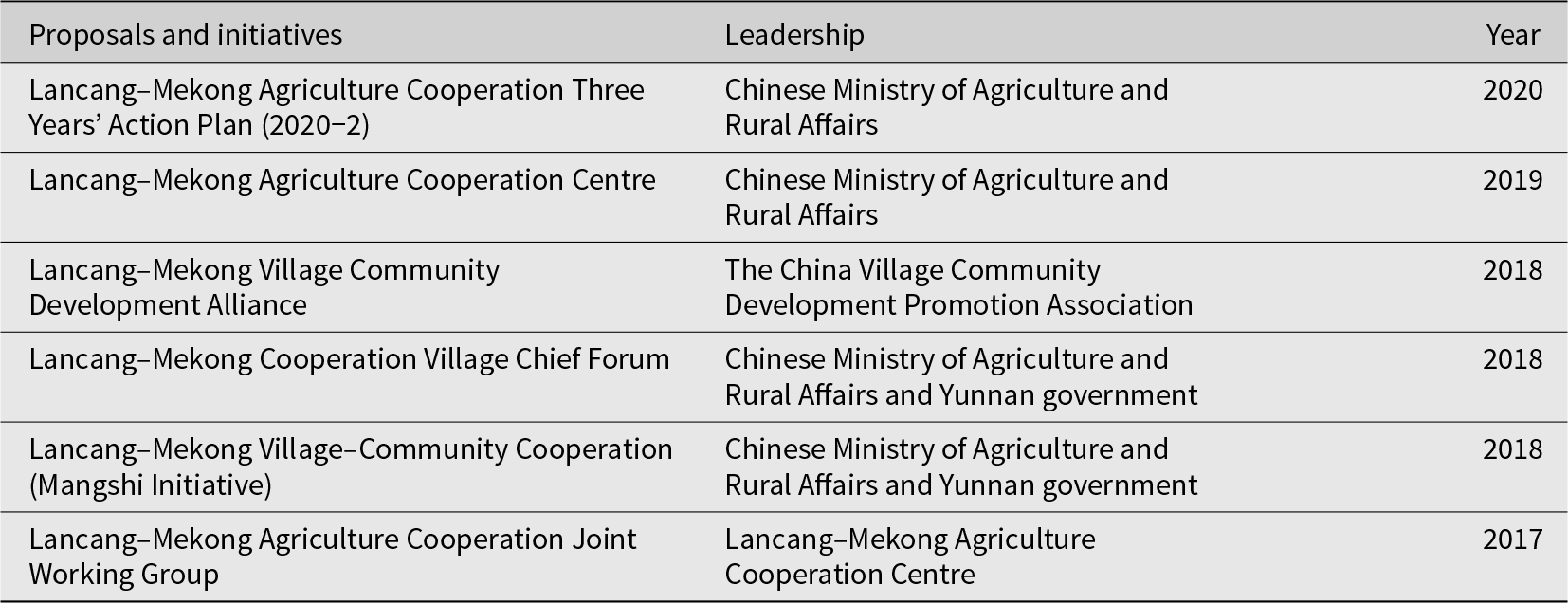
China positions rural development and poverty alleviation as central components of the LMC,Footnote 52 through the Five-Year Plan of Lancang–Mekong Poverty Reduction Cooperation (2018–22). To implement it, China has leveraged its domestic actors to take on the projects.Footnote 53 For example, Chinese non-governmental organisations, including the China International Poverty Reduction Center, have been instrumental in supporting poverty-reduction capacity programmes (see Table 3). Moreover, China has implemented projects in areas like navigation, irrigation, and flood and drought management through the application of its technology. One notable example is the use of China’s Beidou satellite system to monitor flood patterns and track ecological changes, such as fish-stock health, around hydropower projects in Cambodia. These efforts are consistent with China’s broader developmentalising security in its Global South cooperation.
China’s poverty reduction and rural development initiatives in the Lancang–Mekong cooperation.

Source: compiled by author.
Second, China has strategically leveraged its identity as a Global South country to position the LMC as a unique, multilateral platform for South–South cooperation that is more attentive to the needs of regional states. According to the Chinese narrative, the LMC is a manifestation of a ‘new type of international relations’ featuring multilateralism and South–South cooperation.Footnote 54 As a ‘reliable partner and neighbour’, China values equality and righteousness, in contrast to North–South cooperation.Footnote 55 In Minister Wang Yi’s words, ‘compared to other regional mechanisms, the LMC better serves regional countries’ specific needs, and it better embodies regional countries’ wishes of equality, reciprocity and win–win’.Footnote 56 To make Chinese development plans more attractive, former premier Li Keqiang assured Mekong countries that China’s development role complements ASEAN’s connectivity plan. He highlighted LMC as ‘conducive to narrowing ASEAN’s development gaps of its members and promoting regional integration … enriching South–South cooperation’.Footnote 57
Third, China also works to construct an identity in the region by framing its relationship with Mekong countries as deeply connected geographically, historically, and culturally. To highlight China’s efficiency in delivering development cooperation, Chinese officials have touted the speedy achievements and pragmatism, labelling it a ‘golden platform’ for Global South cooperation.Footnote 58 In doing so, China hopes to exclude external powers like the United States from regional governance.
China’s strategies in framing water security issues as development issues appear to be effective in several respects. For Mekong countries, development and poverty reduction are primary concerns, and they share a common experience of utilising water resources to fuel industrialisation. Despite tensions surrounding water governance, most Mekong riparian countries (except for Thailand) remain heavily dependent on hydropower for electricity generation (see Figure 1), much of which is financed, equipped, and built by Chinese companies.Footnote 59 For instance, the Laos government is positioning itself as the ‘Battery of Asia’ through Chinese-supported infrastructure investments including hydropower projects. Cambodia and Myanmar are also leveraging hydropower backed by China to improve their energy access. Even Thailand, while remaining cautious, has publicly acknowledged the efficiency of the LMC, citing over 70 projects supported by China.Footnote 60 Notably, Vietnam, a downstream country most vulnerable to water security concerns, also joined the LMC for economic opportunities.Footnote 61
Electricity generation by source (2021). Units: GWH.

More importantly for China, it has managed to maintain its non-binding stance on water governance. Despite its active engagement in regional institutions such as the Mekong River Commission and Global Water Partnership (an international network for water resources management), China’s institutionalisation of LMC imposes minimal restrictions on future hydropower projects. This allows member states to initiate developments without the need for prior consultation with others. In response to regional demands on data disclosure transparency, a source of tension between China and the lower Mekong countries, China has selectively engaged by signing agreements with loose commitment. For example, the Agreement on the Provision of Hydrological Information on the Lancang–Mekong River with the Mekong River Commission (MRC) lacks a stringent enforcement mechanism, allowing China to maintain flexibility while addressing regional concerns.
Securitising cross-border criminal networks issues
Despite development progress made in the Mekong region, criminal activities such as human, drug, and weapons trafficking still prevail. In particular, the growth of Chinese criminal syndicates has increasingly posed challenges to China’s development approach in the region.
While China’s state-backed investments have boosted industrialisation in the Mekong countries, Chinese criminal syndicates have exploited China’s foreign economic policy, hijacked the state’s BRI, and attempted to link their illegal activities with China’s development cooperation.Footnote 62 For instance, in Cambodia, some Chinese investors have falsely associated ‘internet investment parks’ that involve cyberscams in Sihanoukville with the Chinese state-backed Sihanoukville Special Economic Zone.Footnote 63 In Myanmar, some Chinese criminals have colluded with Karen border guard forces (BGF)Footnote 64 to build the Yatai New City Special Economic Zone, claiming it is connected with China’s BRI.Footnote 65 Moreover, these activities are reportedly tied to serious crimes such as kidnapping, murder, fraud, slavery, and human trafficking.Footnote 66 Taking advantage of the power vacuum caused by Myanmar’s military coup in 2021, criminal networks have been able to expand, particularly in eastern and northern Myanmar, near China’s borders.Footnote 67 This growing criminal presence undermines the legitimacy and security of China’s development projects along its border.
The rise of these illegal activities has sparked criticism from civil society organisations and fuelled anti-Chinese sentiments.Footnote 68 China is increasingly perceived as complicit in transnational crimes because these criminals serve China’s strategic interests.Footnote 69 These scam operation zones have significant involvement in human, weapons, and drug trafficking and have posed serious threats to Chinese citizens’ assets and safety and China’s border security.Footnote 70 As a result, these criminal activities are tarnishing China’s reputation and foreign economic policy. More importantly, domestic concerns over the role of the Chinese government in these issues have created a sense of urgency for the Chinese government to address the cross-border criminal challenges.Footnote 71
Thus, protecting China’s interests has become a central priority in China’s Mekong policy. Consequently, while reinforcing its domestic public security and legal frameworks, the Chinese government is also securitising the criminal threats for both regional and global cooperation.Footnote 72 By framing criminal activities along and near its borders as a global security threat, China seeks to shape public perception, generate a sense of urgency, and convince countries in the region to engage in security cooperation. To achieve these goals, China has taken several actions, including institutionalising its security presence, providing security and technology assistance, and amplifying the perceived security challenges through discourses and media pressure.
Compared to its advantages as an upstream country, China does not have a unilateral control over addressing the cross-border criminal issues. To effectively tackle these challenges, China requires cooperation from the host country, particularly in areas like data sharing, law enforcement, and crackdowns on these criminals. But in some Mekong countries, opaque Chinese business networks colluded with corrupt local officials and criminals in the region.Footnote 73 For instance, media reports suggest Chinese criminals’ ties with the Cambodian Oknha class, a group of people with a prestigious designation from the Cambodian government.Footnote 74 Similarly, Chinese criminal enclaves have expanded under the protection of Karen State’s BGF,Footnote 75 which is allied with the junta in Myanmar. Therefore, local agencies lack the motivation to engage with China’s securitisation proposal, including in-depth joint law enforcement operations.
To receive support, China has taken several steps to securitise illicit economic activities. First, the Chinese state frames the criminal activities not only as the new frontline in China’s security challenges but also as a global security issue.Footnote 76 Leveraging its geographical proximity, China highlighted that ‘our (China and Mekong countries’) security and development interests are inextricably intertwined’.Footnote 77 The underlying message underscores that China and Mekong countries need to address security issues in order to sustain development cooperation.Footnote 78 Furthermore, China highlights that regional norms such as autonomy, equal footing, non-interference, and consensus guide China’s security cooperation with Mekong countries.Footnote 79 Simultaneously, China emphasises the multilateral nature of the LMC, positioning the regional institution as ‘complementary and coordinative’ with ASEAN–China cooperation. In framing these criminal activities as security threats, China not only continues its existing law enforcement operations along the river but also institutionalises security cooperation in establishing the Integrated Law Enforcement and Security Cooperation Center (LMLESC Center).
Moreover, China has leveraged its surveillance capabilities, including big data, satellites, and drones, in supporting its law enforcement and security cooperation with Mekong countries. For instance, China’s Beidou satellite system was used to support operations in tracking down the drug lord following the Mekong Massacre.Footnote 80 By utilising big data and artificial intelligence, China’s posture as a security partner is enhanced. In another example, China assisted the Ministry of National Defence of Laos with building the Integrated Defence and Rescue Service Points in Luang Namtha and Bokeo Provinces by offering equipment and technology to support the Laotian government’s law enforcement capabilities.Footnote 81 Additionally, China established the Law Enforcement Cooperation and Coordination Office in Phnom Penh in 2019, its first overseas police cooperation centre,Footnote 82 further strengthening its security presence in the region.
More interestingly, China has been using an evolving approach to tackling security issues through leveraging media to raise awareness about the proliferation of criminal activities and security threats in Southeast Asia. One prominent example of this is the Chinese movie No More Bets, part of a broader strategy to educate the Chinese public about the dangers posed by criminals such as those based in Mekong.Footnote 83 The release of the film also reflects China’s broader media strategy to highlight security concerns tied to Southeast Asia. In addition to the film, the Chinese government has also employed social media platforms such as WeChat and Weibo and media outlets, including films, documentaries, and news reports, to amplify these criminal activities. Moreover, the Chinese government has used these media platforms to pressurise Mekong countries to take stronger action against criminal syndicates operating within their borders. Clearly, the Chinese government has been increasingly vocal about its concerns over the rise of transnational crimes in the region that affect China’s citizens, border security, and overseas interests.
To Mekong countries, Chinese criminal syndicates increasingly pose challenges to both development and security. Media reports about organised Chinese crime in the region have fuelled negative perceptions about Southeast Asian countries, adversely impacting their service industries and local public security.Footnote 84 As noted by the deputy prime minister and minister of foreign affairs of Thailand, ‘cross-border criminal activities are common challenges for all Mekong–Lancang countries and require immediate and robust concerted efforts to address transnational crimes, online gambling, telecom fraud, and online scams for the security and safety of our countries and peoples’.Footnote 85 In response to security threats posed by these criminals, Mekong countries have generally cooperated with China. For instance, Myanmar’s then-civilian government investigated the Yatai project in 2020 with China’s active involvement and support.Footnote 86
However, Myanmar’s military coup in February 2021 posed further challenges to China’s security–development nexus. As scamming operations in enclaves in northern Myanmar became growing hubs for criminal activities, China struggled to promote its development projects along its border. What is worse, the intertwining networks of criminals and their connections with Burmese BGF and ethnic armed forces further exacerbated China’s border security issues. In response, China adopted a mixed approach to security cooperation with Mekong countries. While continuing multilateral cooperation, such as taking part in the joint law enforcement operation with Laos and Thailand targeting Chinese criminals in Myanmar in August 2023,Footnote 87 China has also increasingly implemented measures in Myanmar that are deemed interventionist.
As scamming operations in enclaves in northern Myanmar grew into significant hubs for criminal activities, the Chinese government initially sought to pressure the junta to take action, but this pressure was unsuccessful, as the junta either lacked the capability or the interest to curb these criminal networks. In fact, the criminal networks expanded rather than reducing from 2022–3.Footnote 88 In response, China turned to more interventionist means. Despite publicly maintaining neutrality in Myanmar’s civil war,Footnote 89 China began leveraging its security and economic influence over ethnic armed groups that depend on China for infrastructure, capital, and resources to address the urgent security situations along and near the border. In 2023, China undertook unilateral actions against scam operations in the autonomous Wa State and Mong La areas of northern Shan State along its borders, arresting Wa officials and tens of thousands of Chinese nationals operating scams.Footnote 90 Such leverage took on a more ‘interventionist’ form during the attacks by the Three Brotherhood Alliance (Alliance hereafter), composed of various ethnic armed groups,Footnote 91 against the Myanmar military and the Kokang Border Guards Force on 27 October 2023. To garner China’s support, the Alliance framed their operations as part of a broader effort to combat the widespread online gambling fraud that has plagued Myanmar.Footnote 92 China also capitalised on the Alliance’s actions by strengthening its law enforcement and security presence. Since November 2023, Chinese authorities have been able to arrest key criminal figures – some of whom were junta-affiliated high-profile Kokang officials.Footnote 93
Case summary
Through case studies on transboundary water issues and cross-border crimes in the Mekong region, this article demonstrates that China’s security–development nexus aims to foster a strong sense of regional integration and establish a security architecture that is different from that of the Global North. It argues that while China is focused on establishing a coherent security–development nexus in its relations with Global South countries, its approach is dynamic.
In the case of water conflicts, the rapid growth of China’s supported upstream hydropower infrastructure projects has led regional stakeholders to promote discourse around water and ecological security, thereby securitising these issues. However, China’s self-determination in managing water resources and its opposition to multilateral solutions led to significant tensions between it and lower Mekong countries. To improve its image, China has sought to developmentalise water security concerns, which entails moving tensions related to water disputes and conflicts away from the ‘security’ agenda and redirecting them into the broader discourse of resource governance and management.
To accomplish this, China employs development incentives, strategic narratives, and identity construction to help de-escalate these tensions. China has used South–South cooperation as a tool for ‘developmentalising’ water security tensions to avoid the internationalisation of these conflicts and to maintain its unilateral control over water governance. It has strictly defended non-intervention and autonomy in its own political agenda in water governance. China’s strategy of framing water security as a development issue has been effective at least in two areas: no restrictions in developing hydropower and a non-binding stance in regional water governance.
In the case of trans-border criminals, Chinese criminal syndicates have posed significant challenges to China’s development efforts in the region, damaging China’s reputation and threatening its citizens’ safety and border security. However, China faces challenges in addressing cross-border crime due to regional concerns about China’s security influence and the lack of full cooperation from local governments, some of which are intertwined with corrupt networks. To gain support, China frames these criminal activities as both a security threat to the region and a global issue. It emphasises multilateral cooperation, stressing the intertwined security and development interests of China and Mekong countries. China also leverages its advanced surveillance technologies to support regional law enforcement efforts. Furthermore, China uses media platforms to raise awareness and pressure Mekong countries into stronger action against criminal syndicates, portraying these activities as a transnational security threat that demands greater collaboration and law enforcement coordination.
China’s strategy in securitising development issues has been effective especially in institutionalising law enforcement and security cooperation in the framework of LMC and in expanding its security influence to select Mekong countries like Cambodia, Laos, and Myanmar. The case also illustrates China’s ability to intervene when necessary, as demonstrated by its law enforcement and security operations in Myanmar. Nonetheless, China has been unable to provide an alternative model, such as the GSI, for all Mekong countries to adopt. For instance, Thailand has adopted a much more cautious approach in supporting GSI.Footnote 94 As a result, China is still unable to conduct patrol within Thailand’s borders in the quadrilateral security cooperation along the Mekong River.
Implications for South–South security cooperation
The analysis of China’s dynamic security–development nexus is crucial for understanding South–South security cooperation, as it poses potential challenges to the traditional Global North-centric security governance, as this special issue argues.Footnote 95 While China’s emphasis on South–South interactions may offer an alternative modelFootnote 96 for global governance, its growing power and ambitions raise important questions about whether China can provide a viable, universally accepted paradigm for global security cooperation.
First, China’s commitment to non-intervention and economic cooperation remains central to its approach in the Global South, yet its ambitions to assume a larger global security role have sometimes resulted in actions that appear interventionist. A key example is China’s response to trans-border crimes in the case of criminal activities in Myanmar’s conflict zones, where China’s national security concerns could drive more direct involvement. This evolving security posture complicates China’s portrayal of itself as an advocate for development and peace in the Global South through development initiatives like the BRI, whose projects are often plagued by political conflicts and controversies.Footnote 97 In this context, the pressure to protect its own interests could push China towards interventions that challenge its non-intervention principle. As China’s economic and security footprint expands, many countries in the Global South are increasingly dependent on Chinese development and security assistance. This growing reliance on China raises questions about the extent to which Global South countries can maintain their autonomy.
Second, while China’s security–development nexus has garnered praise for its infrastructure assistance, its approach has been criticised for being too aligned with authoritarian models.Footnote 98 Those regimes that are more likely to accept China’s development and security assistance are frequently criticised for undermining democratic principles and suppressing civil society. In this context, Chinese investments in hydropower projects and other resource extractive projects in the Mekong region can be seen as tools for legitimising the power of authoritarian regimes.Footnote 99 Moreover, China’s security–development nexus can create governance problems where transparency and inclusivity are set aside for development. The case of developmentalising water security in the article demonstrates governments in the region continue to carry out hydropower projects without prominent improvement in inclusivity, transparency, and public accountability.
Third, China’s security–development nexus has profound implications for South–South security cooperation. While Global South security cooperation is often framed as a collaborative effort between countries with shared historical experiences, as the Introduction to this special issue suggests, the reality in Southeast Asia paints a different picture. China is increasingly viewed as a security challenge, with its growing assertiveness in the disputed South China Sea and its unilateral, self-determined water governance approach. Therefore, China’s narratives about shared experiences and South–South cooperation such as through the GDI and the GSI are received with more scepticism in the region compared to other parts of the Global South. While China seeks to extend its influence in Southeast Asia through infrastructure development and law enforcement cooperation, its actions often prompt calls for greater engagement with other powers to counterbalance China’s presence.Footnote 100 Studies show that these countries, while engaging in bilateral cooperation with China, are also participating in Global North-led institutions to hedge against over-reliance on China.Footnote 101
More broadly, the ongoing US–China rivalry further complicates South–South security cooperation. On the one hand, the rising demand for South–South cooperation, fuelled by concerns over China’s growing ambitions in global security governance, highlights the challenges within South–South security cooperation. On the other hand, as China and the Global North vie for influence in the Global South, many countries have to navigate a complex geopolitical landscape where the pursuit of development may be inextricably linked to security considerations, and where the choice of development partner can have profound political consequences.
Acknowledgements
This article gives special thanks to Professor Dr Tobias Berger and Professor Dr Markus-Michael Müller for their leadership in organising the workshop ‘South–South Cooperation and the (Re)making of Global Security Governance’ at the Freie Universität Berlin, 27–28 April 2023.
Funding statement
This work is supported by the AcRF Tier 1 grant RG 43/22 from the Ministry of Education, Republic of Singapore.
Dr Xue Gong is an assistant professor and coordinator of the China Programme of S. Rajaratnam School of International Studies, Nanyang Technological University, Singapore. Her research interests include China’s economic statecraft, Asian regionalism and governance, China, and Southeast Asia relations.



 Open access

