

Introduction
Securitisation theory has undergone significant revision and expansion in recent years.Footnote 1 One such revision concerns the ‘Collective Securitisation’ framework, developed to explain how actors undertake securitisation collectively in multilateral fora. This framework sheds light on international organisations acting as securitising agents, ranging from the African Union (AU)Footnote 2 and the United Nations (UN)Footnote 3 to the European Union (EU)Footnote 4 and NATOFootnote 5 It has been applied to issues spanning cyber-security,Footnote 6 migration,Footnote 7 and public health,Footnote 8 demonstrating how supranational actors construct security issues, marshal authority, and generate new policy outcomes.Footnote 9 Despite its contributions, Collective Securitisation has predominantly been used to understand single cases, focusing on dynamics within individual organisations. This narrow application overlooks a critical dimension of global governance: the mutually constitutive interactions among international organisations.
This study addresses that oversight by theorising how Collective Securitisation processes in separate international organisations might intersect to shape respective outcomes. It theorises when and at which stages of the Collective Securitisation process – such as the securitising move, audience acceptance, or new policy outputs – these intersections are likely to occur. To explain how such interactions unfold, the study incorporates insights from transnational policy learning and norm diffusion. The adapted framework is then applied to better understand climate change adaptation policy in the UN and the EU. Climate adaptation, defined as adjusting to current or expected climate change and its effects,Footnote 10 provides a compelling case for exploring these dynamics. While the securitisation of climate change has been extensively studied,Footnote 11 less attention has been paid to whether and how this securitisation within institutional contexts such as the UN and EU has shaped adaptation policies.
The Collective Securitisation framework helps to disaggregate these processes, enabling a closer examination of how securitisation dynamics unfold across different stages, making it well suited for analysing policy responses. However, it has not yet been applied to understanding how these dynamics might interact with Collective Securitisation processes in other international organisations.
Thus, the primary aim of this study is to deepen understanding of how ostensibly separate Collective Securitisation processes may relate to one another. By focusing on climate change adaptation, it also engages with research on the link between the securitisation of an issue, such as climate change, and the securitised character of the policies such as adaptation that follow.Footnote 12 In this way, the study contributes to both the development of Collective Securitisation as a framework and our knowledge of how securitisation shapes not only narratives but also the substantive design of policy responses.
Building on the most comprehensive database of its kind, we analysed major climate change and adaptation texts from both the UN and EU over a 40-year period. Supplementing this with triangulated insights from semi-structured interviews with UN and EU officials, we conducted both quantitative and qualitative analyses to uncover evidence of Collective Securitisation processes.
Our analysis confirms existing findings that the UN securitised climate change as an issue earlier than the EU, while offering the novel insight that its subsequent climate adaptation policies reflected this framing. This process influenced the EU through the adoption of similar discourses, the engagement of an active stakeholder network, and the sharing of analytical models that shaped the EU’s adaptation approach. We demonstrate that the Collective Securitisation processes of the UN and EU intersected at key points in the Collective Securitisation model, producing mutually constitutive effects that shaped their respective policy outputs. Notably, the UN’s initial framing of climate change as a challenge requiring a risk-oriented approach to adaptation later influenced the EU. Over time, however, the EU reintroduced threat-oriented perspectives into the UN. Our findings thus illustrate the bidirectional nature of Collective Securitisation processes and the varied ways in which securitisation may manifest.
The article is organised as follows: the next section reviews the literature on Collective Securitisation, highlighting its strengths and identifying two key weaknesses. We then supplement this framework with insights from international policy learning and norm diffusion to address its empirical blind spots. The following section outlines the research design, detailing the methodological approach as well as the tools and processes used for data collection, coding, and analysis. The empirical analysis, presented in the fourth section, examines first the UN’s and then the EU’s Collective Securitisation processes, organised in line with the Collective Securitisation framework to illustrate their interconnections. Finally, we conclude with a summary of findings, analytical reflections, and recommendations for future research.
Theoretical perspectives
Collective securitisation
The theoretical starting point for this study is the literature on Collective Securitisation. Collective Securitisation offers a phase-model that revises the traditional understanding of securitisation as the process by which an actor identifies a ‘threat’, attributes a special status to that threat, and, by so doing, is able to justify ‘urgent and exceptional measures’ in response.Footnote 13 The Collective Securitisation model widens how and where securitisation takes place and helps to capture its effects on outcomes – especially policy outcomes. It theorises how multiple actors, themselves with individual securitising imperatives, may empower a third entity to act on their behalf in securitised ways. Collective Securitisation is thus the process of aggregating these multiple securitisations and giving them authoritative status through public articulationFootnote 14 – and so is most obviously undertaken by formal international organisations.Footnote 15
Collective Securitisation highlights the dynamic of states acting collectively within organisations to bring attention to certain concerns as security questions – and to leverage collective attention and resources accordingly. Haacke and Williams first drew attention to this dynamic, showing how securitisation can take place in regional organisations such as the African Union and the Association of Southeast Asian States.Footnote 16 Since then, studies on Collective Securitisation have identified ‘thin’ and ‘thick’ versions. The thin version refers to a state or small group of states promoting their security concerns within an international organisation, eliciting supportive responses and empowering the organisation to address the issue without granting it autonomy or agency.Footnote 17 Conversely, the thick version views the organisation as possessing distinct influence and agency, acting as a securitising actor in its own right.Footnote 18 Research on the EUFootnote 19 and UNFootnote 20 often applies the thick version due to the substantial political agency and coercive authority both organisations wield in implementing security measures.Footnote 21 This study adopts the thick version of Collective Securitisation.
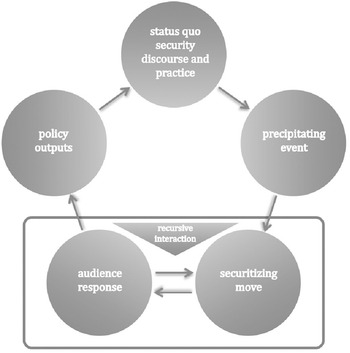
Sperling and Webber added theoretical depth and analytical precision to the Collective Securitisation approach by developing a stage-based analytical framework that theorises the various steps in the thick version of Collective Securitisation (see Figure 1).Footnote 22 They show how international organisations may act as securitising agents, with member states serving as the audience that either accepts or rejects securitising moves from actors in and around the organisation. Emphasising intersubjectivity over unilateral speech act acceptance, Sperling and Webber introduce the notion of ‘recursive interaction’, whereby the securitising actor and the audience influence and shape one another, effectively blurring the actor–audience distinction.Footnote 23 This recursive process not only facilitates audience acceptance but also leads to the production of new policy outputs that concretise securitisation and establish a new status quo. Moreover, including and emphasising the effect of securitising moves on new policy outputs, Sperling and Webber explicitly linked securitisation processes to the nature of resulting policies, asserting that the latter should reflect and embody the characteristics of the former. Figure 1 represents these process phases, which our study builds upon.
The process of Collective Securitisation.

For this study, the Collective Securitisation framework provides a critical lens for analysing whether and how UN and EU adaptation policies mirrored the broader securitisation of climate change. Framing an issue as a security matter at the supranational level not only shapes the tools utilised, the resources allocated, and the strategies implemented but also significantly impacts how the issue is addressed at nationalFootnote 24 and local levels.Footnote 25 Understanding these international processes is vital for assessing how urgent global challenges are managed in the public interest.
Limitations of Collective Securitisation
We see the need to address two limitations in the Collective Securitisation literature, however. One is a tendency to view international organisations as closed systems. Analysis often focuses on discrete contexts, such as the World Health Organization,Footnote 26 NATO,Footnote 27 or the UN,Footnote 28 and how Collective Securitisation unfolds within each. Singular focus offers empirical richness, but it is difficult to square with common understandings of the international institutional environment as dense and overlapping. Multiple international organisations govern across policy areas, even if memberships, remits, and levels of authority differ.Footnote 29 The international policy environment is notably open, with overlapping regimes,Footnote 30 epistemic communities traversing jurisdictions to influence international policy,Footnote 31 and intersecting policy instruments challenging governance.Footnote 32 Indeed, an entire research field explores international organisations’ interaction with and influence on one another.Footnote 33
Collective Securitisation research insufficiently addresses how international organisations interact within securitisation processes. Insights from norm diffusion and policy learning literature can help clarify when, where, and why these interactions occur. Norm diffusion research, although focused mainly on diffusion across countries, highlights several dynamics that may prompt a process of diffusion. One is the onset of an internal policy failure or an external shock that triggers a search for solutions.Footnote 34 Another reflects altered pay-offs and a concern for reputation. The adoption of a policy by a growing number of governments changes the pay-off for those left behind. What once seemed like a costly endeavour – the adoption of new policies and attendant norms – is less so once it appears that like-minded authorities are doing the same.Footnote 35 Finally, learning from the experience of others may trigger diffusion as new information of successful adoption becomes available.Footnote 36
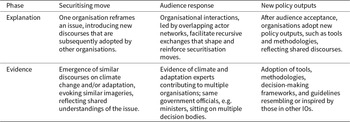
The literature discussed above offers valuable insights into when interaction between the Collective Securitisation process in one IO may initiate or interact with a similar process in another. Such interactions, we argue, can be mapped onto key stages of Sperling and Webber’s model, highlighting potential points of overlap or influence. Specifically, three possible points of interaction emerge. First, these interactions can occur at the ‘securitising move’ stage (see Figure 1), where an IO reframes an issue, introducing new discourses that may inspire or prompt another IO to adopt similar securitising language. The emulation of discourses and framing from one IO to another often reflects dynamics of diffusion or institutional learning, with securitising moves in one venue setting the stage for comparable actions in another.
Second, interactions may rise in the ‘audience response’ stage. Securitisation theory identifies audience acceptance as a necessary condition for successful securitisation. In the context of Collective Securitisation, the audience comprises member states of an IO, whose representatives, including diplomats and national policymakers, often participate in multiple IOs.Footnote 37 Approval or disapproval of a securitising move in one IO may travel with these representatives, influencing the audience response in another IO and thereby facilitating (or hindering) a parallel securitisation process.
Third, interaction may take place at the ‘new policy outputs’ stage. Following successful securitisation, IOs often produce new policies or instruments that reflect the securitised framing. Insights from the transnational policy learning literature show that IOs frequently reference one another’s positions to enhance legitimacy or adapt proven solutions.Footnote 38 Policy tools and arguments developed in one IO are often ‘borrowed’ by another IO via emulation and attention from networks of like-minded actors, thus reinforcing connections between their respective securitisation processes.Footnote 39 In this way, at this stage, the discourses and policy outputs of one IO may inspire or directly shape the policies of another.Footnote 40
In sum, the literature enables us to pinpoint when interaction between Collective Securitisation processes might occur: at the stages of securitising moves, audience response, and/or new policy outputs. These stages reflect potential pathways for emulation, diffusion, and cross-organisational influence within the framework of Collective Securitisation (see Table 1 for a summary).
IGO interactions during Collective Securitisation processes.

Source: Created by the authors.
The second limitation of Collective Securitisation is a lack of specification in what constitutes securitisation. To be fair, Sperling and Webber’s version of Collective Securitisation relaxes the Copenhagen School’s conventional argument that an ‘existential construction’ of a new threat is required. Sperling and Webber follow recent theorising in Critical Security Studies showing that a range of referent objects may be securitised and that securitised outcomes need not be ‘urgent and exceptional’ nor dramatic in character.Footnote 41 Outcomes evolve incrementally over time and reflect a kind of routine politics focused on reducing harm through a wide range of measures. Such security concerns include a wide array of control strategies and ‘risk management’ approaches attached to governments’ efforts to address a span of current public policy problems.Footnote 42 This open approach to measuring and defining securitisation offers advantages in capturing a wide range of acts, practices, and outcomes. However, it also runs the risk of categorising any new practices as securitisation without providing clear criteria for distinguishing these acts, practices, and policy outcomes as genuinely ‘securitised’.Footnote 43
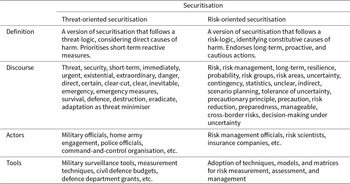
To address the second limitation in Collective Securitisation research, we advocate for the inclusion of measures that capture both traditional threat-based approaches and risk-based approaches to securitisation, the latter associated with the concept of ‘riskification’. Drawing on the securitisation continuum proposed by Diez et al., we propose distinct empirical indicators for both threatification (threat-oriented securitisation) and riskification (risk-oriented securitisation) to more comprehensively measure securitised outcomes.Footnote 44 The riskification literature systematically updates the traditional threat-based model of securitisation – characterised by urgency and existential threat – by recognising how public policy problems are increasingly framed and managed through the lens of risk and precautionFootnote 45 This approach is defined by policy frameworks rooted in calculative rationality, where decisions are guided by probabilities, risk assessments, and cost–benefit analyses.Footnote 46 Policymakers often deploy tools designed to identify, measure, address, and predict risks.Footnote 47 The riskification literature is crucial as it provides a nuanced understanding of how contemporary public policy challenges are increasingly approached through proactive and precautionary measures, offering a complementary framework to traditional threat-based models of securitisation. To operationalise the distinction between threat and risk logics in climate change and adaptation policy discussions, we identify three key analytical indicators that help differentiate between risk-oriented and threat-oriented securitisation.
The first analytical indicator is a discursive shift from framing issues as existential threats with dramatic imagery, and calls for immediate action, towards emphasising inherent vulnerabilities that require ongoing management, monitoring, and assessment. The second analytical indicator is signs of a reliance on and belief in expertise and technical knowledge in addressing vulnerabilities, rather than the higher-level authorities and resources (often military, in cases of traditional threat-based securitisation). A riskification of an issue frequently elevates actors with scientific expertise or close connections to such experts, highlighting a shift in focus from immediate responses to calculated, ongoing management.
The third analytical indicator emphasises the importance of examining not only the actors and their discourses but also the tools and instruments deployed to address perceived security problems.Footnote 48 In contrast to the military tools commonly associated with threat-based approaches, risk management instruments often include analytical models, prescriptive guidelines, and assessment matrices – each reflecting assumptions about the nature of the problem and how it should be managed.Footnote 49 Indicators of riskification, alongside traditional threatification, can thus be identified and analysed, providing a more nuanced understanding of the specific effects generated by a securitisation process.Footnote 50 See Table 2.
Examples of threat-oriented versus risk-oriented securitisation.

Source: Created by the authors, building on Diez et al., Securitisation of Climate Change.
Our analysis below applies this supplemented version of Collective Securitisation that can account for interaction across organisations and measure securitisation in a more precise fashion. We study carefully where securitisation moves, audience acceptance, and new outcomes may be shaped by Collective Securitisation processes unfolding in other international organisations.
Methods
Our study relies on a novel database of climate adaptation documents systematically collected from UN and EU sources, for the period 1972–2023 – the most extensive of its kind. Our document collection strategy captured high-level speech acts, mid-level bureaucratic texts, and lower-level administrative documents to reflect the broad brush of securitisation dynamics, including both securitisation of the issue and the securitisation of resulting policy outcomes. We were careful to select only documents where the effects of a changing climate and the need for responses (such as adaptation) were captured in the discussion. For the UN, we drew data from publicly available databases associated with UN bodies including the UN Environment Programme (UNEP), the UN Development Programme (UNDP), the Intergovernmental Panel on Climate Change (IPCC), the UN Security Council (UNSC), and the UN Framework Convention on Climate Change (UNFCCC) . Data collection was facilitated by official efforts to compile relevant documents on purpose-built websites (such as the UN’s Climate Adaptation webpage).Footnote 51 Obtaining older documents required in-depth searches of UN databases and the use of third-party websites. For the EU, the process was similar, with the Commission’s climate adaptation website the first port of entry, supplemented by a new EU Climate-ADAPT site with collected documents. During the process of manually coding each document, additional documents were identified through citations, such as legislative acts, minutes of network events (e.g. international, and regional conferences), project initiatives, and partnerships between organisations. Document collection resulted in 219 UN-related documents, including over 70 UNFCCC documents of decisions from the Conference of the Parties (CoP) sessions, and 169 EU-related documents.
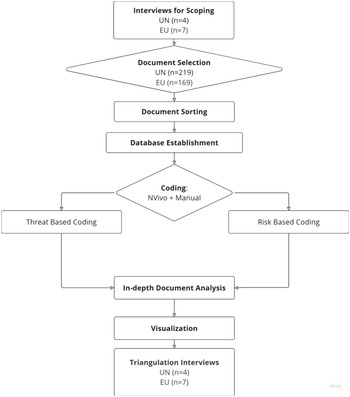
Coding and analysis of 388 documents was done using NVivo14, executed initially using two keyword searches. The first searched the stem word ‘adapt’ to confirm relevance and to identify paragraph units that were associated with adaptation. The second searched the risk-based and threat-based securitisation keywords (see Annex 1) to identify relevant paragraph units. Thereafter, each of the identified paragraph units were manually coded as exhibiting threatification or riskification language, or the paragraph units were ignored if neither was present. Next, each document was again manually coded to indicate whether the document featured mainly riskification or mainly threatification language overall. The coding scheme used to decipher threat-oriented versus risk-oriented indicators is similar to that used in previous studies with a similar objective.Footnote 52 The scheme relies not only on words directly related to ‘risk’ or ‘threat’ but also concepts, images, metaphors, and certain material emphases (see Annex 1). Finally, the analysis traced the securitisation moves by studying network interactions, and technologies and tools (e.g. methodological frameworks, formulas, and programmes), that were identified through the manual coding of the text analysis. Discourse visualisations were created using Python software. Some examples of texts analysed are provided in Annex 2.
In the course of document analysis, we compiled recurring names and affiliations, in order to build an image of how networks emerged and spread, along with geographical locations where certain individuals reappeared and networks periodically ‘landed’.Footnote 53 Most of these names were scholars serving as expert witnesses and as report authors. We also uncovered public officials, representing either supranational organisations or certain member states, whose names repeatedly appear in conference proceedings, for instance. Some networks are formalised and documented (through, for instance, the website Climate Diplomacy).Footnote 54
Finally, to initially scope the viability of the study and later to triangulate and verify our sources, semi-structured interviews were conducted with UN (four) and EU (seven) civil servants working with climate change adaptation (see Annex 3) between March 2021 and September 2022 to verify the findings of the text analysis, tool assessment, and network formation studies. Interviews were conducted in line with EU GDPR and ethical guidelines associated with our respective universities.Footnote 55 A figure depicting our methodological steps can be found in Figure 2.
Methodological steps.

Analysis of Collective Securitisation in the UN and the EU
The UN and climate change adaptation
Research shows the UN has pursued a securitised approach to climate change generally,Footnote 56 but this approach conforms mainly to a risk-oriented perspective rather than a threat-based one.Footnote 57 To what extent do such findings carry over to the question of climate adaptation policy per se? Our analysis shows that the UN’s attention to climate adaptation, which preceded the EU’s in terms of depth and scope, was subject to a process of Collective Securitisation that played out over decades rather than years. Furthermore, we find that UN processes resulted in a specific kind of securitisation – namely, riskification – which reflected a specific set of discourses carried by certain actors and prioritising risk management tools rather than security management practices.
The starting point for applying the Collective Securitisation framework to the UN’s approach to climate change adaptation requires an understanding of the status quo prior to evidence of securitised outcomes. Before the 1980s, the UN’s engagement with climate change was growing, but its interest in adaptation as a response was marked by neglect, as climate change had yet to achieve public salience and other pressing global issues dominated its agenda.Footnote 58 Political attention grew slowly through the 1980s, as climate change mitigation, associated with greenhouse gas emissions, climbed the international policy agenda.Footnote 59 Even though attention to mitigation grew, adaptation was addressed only sporadically and within a small group of technical experts associated with the UN.Footnote 60
For instance, the UNEP, together with the WMO and International Council of Scientific Unions (ICSU), organised an ‘International Conference on the Assessment of the Role of Carbon Dioxide and of Other Greenhouse Gases in Climate Variations and Associated Impacts’ in 1985 with scientists from 29 countries, including European states, participating. Uniquely for that time, the conference called for improved analysis of the impacts of climate change, including immediate assessments of the ‘widest possible range of social responses aimed at preventing or adapting to climate change’.Footnote 61 The 1987 Brundtland Report on sustainable development also served as a pivotal moment in the UN’s development of its adaptation policy. The report’s conclusions stated that several strategies must accompany climate stabilisation, including plans for adaptation to climate change ‘in the event that mitigation policies cannot be implemented rapidly’.Footnote 62 The report features language related to the security effects of climate change, arguing that the reduction of global warming was, then, an ‘essential task to reduce the risks of conflict’.Footnote 63 Yet such language in documents from that period was rare. These years resemble a moment in time when no clear securitisation had yet taken place.
The situation changed in the late 1980s as scientific evidence accumulated, confirming that mitigation targets would be missed, and as belief spread among actor networks that effective mitigation was impossible.Footnote 64 This rapidly growing realisation, reflected in our observation of a widening network of actors and a steep increase in press coverage,Footnote 65 can be interpreted as a precipitating event that directed newfound attention to climate change adaptation, specifically. We find that discourses shifted from adaptation as a secondary concern towards an ‘urgent issue’ that must be addressed by ‘unprepared populations’ as the failure of climate mitigation grew apparent. This was the central theme emerging from a text analysis of events and reports held in the late 1980s, for instance, including widely attended events in 1987 such as the UNEP, WMO, and ICSU workshops on ‘Developing Policies for Responding to Climate Change’ (in Bellagio, Italy, and Villach, Austria) and, in 1988, at the UNEP and WMO Toronto conference on ‘The Changing Atmosphere: Implications for Global Security’.Footnote 66
Not only was attention and analysis growing, but a clear securitising move can be detected. This followed on from a framing of climate change as an ‘existential risk’, yet one that, with anticipation and preparation, could be managed with proper analysis and attention. Along with growing networks of experts, policymakers, and a (initially slow but emerging) group of civil society representatives, focus was placed on ‘decision-making under uncertainties’Footnote 67 identifying ‘possible’ and the ‘most probable impacts’,Footnote 68 assessing risks, managing ‘anticipatory adaptation’,Footnote 69 ‘minimizing adverse effects’, and avoiding ‘forced adaptation’.Footnote 70 The risk framing of anticipation is particularly strong in official adaptation documents during this period (see Figure 3), corresponding with a belief that the world faced a plethora of problems linked to climate change, across societies, but that risk management tools could help avoid the worst.Footnote 71 In short, this marked the beginning of a risk-oriented discourse that would position adaptation as a central response to the escalating challenges associated with climate change.
10–year rolling average number of securitisation references in texts by the United Nations (1972–2023), coded in line with coding scheme in Annex 1.

Through the 1990s, the UN’s securitising move quickened as risk-related discourses grew and experts focused on developing technical tools as an apparent solution to the adaptation challenge. The first IPCC report, published in 1990, kicks off the decade, while the second report in 1992 codifies the risk-oriented discourses emerging from previous reports and conferences. This seminal report treats climate adaptation not as a normal public policy problem, nor as an existential issue requiring extraordinary action, but rather as an issue best managed through risk thinking. It encourages ‘immediate responses’ to the ‘inevitable danger’ of climate change and asks member states to focus on adaptation, including likely impacts, based on ongoing risk assessment and risk analysis, and by continuing research on risk impact.Footnote 72 The second World Climate Conference in 1990 was timed to coincide with that inaugural IPCC report and brought together the key actors grouping around the adaptation question. Actors arrived from UN bodies, including the UNEP, the FAO, WMO, and notably the EU, and reappeared in both conference proceedings and subsequent years’ texts in the form of recurring names and titles (see below).
The UN’s framing of climate change as a risk-laden issue requiring adaptation-focused strategies evolved significantly in the early 1990s, characterised by a shift towards tool-based methodologies and the institutionalisation of risk-oriented frameworks through the efforts of the IPCC and the UNFCCC. The IPCC advanced its work by establishing an expert group and issuing its ‘Preliminary Guidelines for Assessing Impacts of Climate Change’,Footnote 73 the first significant step towards a tool-focused approach to adaptation rather than policy strategies. Two years later, the IPCC released its ‘Technical Guidelines for Assessing Climate Change Impacts and Adaptation’ (1994), which refined the earlier guidelines and provided detailed recommendations for conducting vulnerability analyses. These guidelines laid the foundation for what scholars later termed the ‘first generation’ of adaptation risk frameworks adopted by the UN.Footnote 74 By 1997, the second meeting of the UNFCCC’s Conference of the Parties (CoP) requested the UN secretariat to ‘accelerat[e] the development of methodologies of adaptation technologies, in particular decision tools to evaluate alternative adaptation strategies’.Footnote 75 A surge of guidelines and reports, many issued by the UNFCCC’s newly established secretariat, further cemented the use of risk-based language and analytical tools in adaptation efforts. Simultaneously, the network of actors addressing the issue expanded significantly, bringing in several increasingly active international organisations.
Alongside the growing use of risk-oriented language, UN bodies increasingly pushed for the adoption of specific models to identify and address adaptation challengesFootnote 76 – a further indicator of a risk-oriented approach to securitisation (see Table 2). The UNEP, drawing on many of the same experts participating in the IPCC, and cooperating with the UNFCCC secretariat, developed in 1998 a ‘handbook’ containing guidance on the practical methods of impact and adaptation assessment.Footnote 77 That effort would merge with work done by the IPCC in 1998, effectively consolidating the position of adaptation experts, requisite language, and a technological approach to solving the problem. These trends accelerated through the 2000s. By 2001, the IPCC meetings released their third assessment report focused primarily on adaptation. The risk language is remarkably consistent, with little to no threat-oriented language that a more classical securitisation approach would identify.
The evolution of methodological tools for addressing climate adaptation took a major step in the early 2000s when several UN bodies published what is considered the ‘second generation’ of adaptation risk frameworks, which focused less on top-down predictions of climate change impacts (including narrow cost–benefit analyses) and more on general risk management of physical and social impacts, using a bottom-up perspective.Footnote 78 These reports move fully towards the principle of risk-based modelling for climate adaptation, urging members to apply those models as part of ‘National Adaptation Programmes of Action’ (NAPAs).
By 2007, and following vigorous debate over the various risk frameworks available,Footnote 79 an integrated ‘risk management’ approach that incorporates local capacities, likely vulnerabilities, and potential impacts was adopted in the IPCC’s Adaptation Report 4, which constituted the third generation of adaptation risk frameworks adopted – and a major methodological milestone in the UN’s approach to adaption.Footnote 80 The 1990s and 2000s thus showcased a prolonged but clearly discernible set of securitising moves, including continued use of risk-based terminology and the promotion of risk management tools and practices by actors coalescing around key UN platforms.
The Collective Securitisation approach posits that securitising moves are significant only when accepted by the intended audience, typically the formal decision-making body in an organisation.Footnote 81 However, audience acceptance of a security move is usually preceded by recursive interactions between securitising actors (usually taken to be bureaucratic actors and entrepreneurial experts) and the audience. By the mid- to late 2000s, evidence shows national leaders were adopting the language and tools associated with a risk-oriented version of securitisation.Footnote 82 A pivotal moment occurred during the first Security Council debate on climate change, highlighting a confirmation in the discourse shift and high-level approval of the risk approach to adaptation. The UN Secretary General’s High-Level Event in September 2007 brought the Security Council and General Assembly together to debate the exigencies of climate change a ‘growing and existential risk’ requiring urgent ‘risk management’ and adaptation – in contrast to threat preparation.Footnote 83
Subsequent events in 2008, including discussions at the UNFCCC, led to the creation of the ‘Compendium on Methods and Tools to Evaluate Impacts of, and Vulnerability and Adaptation to, Climate Change’, endorsing ‘risk management’ as the ‘best’ decision-making framework.Footnote 84 By the late 2000s, a risk-oriented approach to climate adaptation was the firmly established UN norm,Footnote 85 exemplifying risk-oriented securitisation as it advanced to the new policy outputs stage in the Collective Securitisation phase-model. The central outputs are well documented in the UNFCCC’s own history of climate change adaptation policyFootnote 86 and are reflected in the risk-oriented language present in the Paris Agreement on Climate Change, in which adaptation was included as a fully independent objective for the first time.Footnote 87
The EU and climate change adaptation
We now turn to the EU’s own Collective Securitisation process, again employing our revised Collective Securitisation framework to explore how the UN and EU processes influenced one another as climate change adaptation entered the agenda. Until the mid-2000s, the EU paid little attention to climate change adaptation and exhibited no clear preference for either risk- or threat-oriented approaches. However, this began to change in 2005, following the UN’s audience acceptance moment, when a risk-oriented approach to climate change adaptation was adopted at the highest level. As we show, this development appears to have prompted the start of a securitising move in the EU in 2007. In doing so, the EU initially mirrored the UN’s risk-oriented approach, reflecting how Collective Securitisation processes can shape and intersect with one another. This section traces that evolution, unpacking the EU’s securitising move and subsequent steps to shed light on the interconnected dynamics of these processes.
Applying the Collective Securitisation framework, we begin by examining the EU’s initial status quo on climate change adaptation, which was characterised by non-securitisation and the absence of risk or threat language in EU texts on the topic during the 2000s (see Figure 4). This is explained mainly by the overall neglect of climate adaptation science and policy development. An exception is the work by officials in the Commission’s Directorate-General for Research (DG Research), which has an expert-led approach to investigating policy problems.Footnote 88 Scientists from DG Research attended the early UN symposia on the matter (and even organised some of their own) in the 1990s. Several were involved in providing input into the early UN reports on the need to shift focus towards climate adaptation.Footnote 89 For the most part, however, there is only scattered mention of adaptation in EU policies and no clear signs of securitisation. Striking evidence of this stems from the EU’s first major position on climate change, in early 2005, when it published ‘Winning the Battle against Global Climate Change’.Footnote 90 This text focuses mainly on mitigation, with only a passing reference to adaptation.
10–year rolling average number of securitisation references in texts by the European Union (1972–2023), coded in line with coding scheme in Annex 1.

Between 2007 and 2008, however, the EU’s approach to climate change adaptation underwent a notable transformation, with key policy texts reflecting a sharp increase in security-focused language that balanced threat-oriented and risk-oriented discourses. A series of texts, including a 2007 staff working document prepared by the Commission, titled ‘Adaptation to Climate Change in Europe’, Footnote 91 and a 2008 publication by the Commission and Council together, titled ‘Climate Change and International Security’, signalled a sharp uptick in security-laden language, including references that suggest both ‘the inescapable threat of climate change’ requiring ‘extraordinary action’ alongside the need to ‘implement long term strategies’ to understand and act upon ‘the multiplying implications’ of climate risks.Footnote 92
What happened in this two-year interval? Our evidence suggests that the UN’s high-level acceptance of securitising moves in 2007 (see previous section) served as a precipitating event for the EU’s own Collective Securitisation process. This interaction demonstrates the influence of cross-institution change mechanisms outlined in the theory section. The UN’s framing of adaptation as a risk management response to a securitised climate problem signalled a shift to the EU, altering the EU’s perceived pay-off calculations and encouraging policy mimeticism. This was further encouraged by growing stakeholder networks working across organisations.
Indeed it is no coincidence that shared stakeholder networks converged on a major EU climate conference in late 2006.Footnote 93 Both UN and EU officials joined with climate scientists and activists to address ‘Future Climate, Impacts and Responses’, which emphasised the need ‘to improve Europe-wide risk, impact and cost/benefit assessment for adaptation responses, as compared with no action’.Footnote 94 In a clear sign of the mechanism of emulation, UN risk management language and concepts such as ‘the goal of building societal resilience’, ‘calculating growing climate risks’, and ‘anticipatory governance’ were subsequently incorporated into the Commission’s 2007 staff working document,Footnote 95 among other texts, likely facilitated by academic experts drawn upon by both organisations in an example of entrepreneurial networks crossing institutional boundaries (see discussion above, circa footnote 89).
From there, the EU engaged in its own set of securitising moves. Many of these actions correspond with the promotion of risk-oriented discourses and the same kind of risk management matrices established by the UN. However, in the early years of the EU’s securitising moves, we see not only risk concepts featured, but also those associated with threat-oriented versions of securitisation. The 2008 publication mentioned above, ‘Climate Change and International Security’, discusses climate change as a ‘threat multiplier’, i.e. a ‘threat to security’ in a plethora of ways, and emphasises the need for adaptation assistance.Footnote 96 This threat-based approach to climate change generally, and adaptation specifically, is unique to the EU; it can be explained partly by the position of a High Representative for the EU’s Common Foreign and Security Policy and, later, the role of the EU’s security-oriented External Action Service in EU policy outcomes. The EU’s contribution to a UN Secretary-General Report on ‘Climate Change and International Security’, in 2009, showcases some of the same perspectives, including the treatment of climate adaptation as a way to downgrade ‘the security threats created by climate change’.Footnote 97
For the most part, however, the securitising moves initiated by EU actors reflected risk thinking (see Figure 4). The preparation for the 2009 climate change negotiations in Copenhagen (CoP15) resulted in a flurry of texts, balancing the EU’s extant focus on mitigation with equal treatment to adaptation. The EU’s own negotiation position, written by the Commission with member state input, called for an ‘Adaptation Framework’ to be agreed.Footnote 98 Soon thereafter, the first adaptation-specific policy statement emerged from the Commission in the form of a 2009 White Paper on ‘Adapting to Climate Change’.Footnote 99 A text analysis of this document shows significant overlap with the UN’s UNFCCC documents of that time, including risk-based language, proposals for specific kinds of impact and vulnerability analysis, and other risk management tools. An internal working paper in the Commission in 2009 provided the basis for the more formal ‘Impact Assessment on Adapting to Climate Change’ requirement, which demands adaptation to be measured and categorised according to risk management matrices.Footnote 100
These moves mirrored the ‘third generation’ of adaptation tools propagated by the UN, drawing on the UNDP’s 2008–9 guidelines on ‘Designing Climate Change Adaptation Initiatives: A UNDP toolkit for practitioners’ and successive IPCC reports on climate change (combined and republished in 2010).Footnote 101 The IPCC’s 2012 special report advises all member states to reduce uncertainty about adaptation by applying risk management measurement tools. Titled ‘Managing the Risks of Extreme Events and Disasters to Advance Climate Change Adaptation’, it suggests integrating climate risks into decision-making processes with tools like decision support maps, predictive instruments, scenario planning, and scenario exercises.Footnote 102 This approach was adopted almost entirely by the European Commission’s first formal proposal for an EU-wide climate change adaptation strategy in 2013. The document parrots the verbiage used by the UNFCCC and IPCC, with references to ‘managing uncertainty’, ‘preparing for the inevitable’, and the criticality of ‘investing in … risk assessments and tools to build up capacities for adaption’.Footnote 103 One interviewee confirmed that the EU ‘used’ many of the UN texts, especially IPCC reports, since ‘the process behind the IPCC reports is solid and sound and there is a political agreement by all the parties in the reports’.Footnote 104
When a Commission proposal for legislation is formulated, generally speaking, supranational officials engage closely with national officials to (informally) test the boundaries of political acceptance. In this case, the Commission gathered key figures from the EU’s national governments (partly via its expert group on climate change) along with officials from the IPCC and the European Environmental Agency, in 2012 and 2013, in a series of meetings and workshops to help ‘sell’ the contents of a climate adaptation strategy.Footnote 105 Analytically, this process resembles one of recursive interaction, when, according to the Collective Securitisation framework, securitising moves are accepted or rejected by the relevant audience. Such interaction was on full display as the Commission and member state officials worked almost side by side to devise the EU’s strategy for climate change adaptation.
There are two notable features of this process. The first is the direct emulation of much of the UN’s risk-related discourses (as shown by text analysis, see Figure 5) along with risk management tools, described earlier. A common finding in our text analyses is the importance of applying an ‘asset-based’ needs assessment. In other words, the technological tools propagated in this process were very much part of the securitising move and the object of discussion in the process of recursive interaction. The second feature is the broadly consensual nature of this interaction, since’the usual suspects’Footnote 106 engaged in this interaction, including EU member state officials, EU supranational policymakers, and experts – many of whom also engaged in the earlier UN securitisation processes and represent the kinds of networked actors theorised earlier. As the Collective Securitisation framework suggests, within international organisations it is often supranational officials as ‘securitisers’ and national representatives as ‘audience’ working intimately in a process of recursive interaction.
10–year rolling average number of risk-based securitisation references in texts by organisation (1972–2023), coded in line with coding scheme in Annex 1.

Unsurprisingly, perhaps, the acceptance of the securitising act can be documented soon thereafter. Two formal acts connote high-level acceptance. One was the Council’s approval of the Commission’s proposal in the form of an ‘EU Strategy on Adaptation to Climate Change’ (2013),Footnote 107 thereby signalling member state approval both formally and informally.Footnote 108 That document contains very similar texts that take a risk-based perspective on adaptation challenges and promotes the same kinds of technical approaches for managing those challenges. Another act was the Council’s adoption of a policy on ‘Climate Diplomacy’ (2013), which argues that tackling climate adaptation challenges is ‘a necessary condition for peace and security, development, and prosperity’.Footnote 109 Such language reintroduces the threat-based language that appeared years earlier (an effect of this document being produced mainly by the European External Action Service, which was temporarily involved in the debate) and of which we find some evidence in subsequent UN documents at the time – a seeming case of ‘recursive interaction’ as proposed by our framework.Footnote 110 The preponderance of evidence, however, points to the acceptance of a risk-oriented version of securitisation taking place in the EU regarding climate adaptation policy.
With this acceptance came a new normal in the EU’s Collective Securitisation process, one characterised by a close alignment of UN and EU efforts. In 2013 and 2014, the UN and EU collaborated to distil existing adaptation research into actionable guidelines under various dissemination programmes, including the ‘Provia’ initiatives,Footnote 111 addressing vulnerability and impacts in a widely adopted ‘User’s Companion’. Simultaneously, the EU’s ‘Mediation’ project devised methodologies for effective climate decision-making. These guidelines were consolidated in Provia’s 2014 ‘Support for NAP Development with the Provia Guidance’, offering risk management models for national and local officials. The EU and UN jointly supported Adaptation Futures conferences from 2010 to 2021, indicating an expansion of risk management models globally. In the latter years of the 2010s, more collaborative efforts, such as the 2017 EU/UN Partnership on Climate Change and Security,Footnote 112 emerged to combat climate change and promote adaptation projects abroad, with funding contingent on adopting the EU and UN’s risk management analysis frameworks.Footnote 113
However, in 2018, threat language found its way back into EU documents as the EU’s previous adaptation strategy was reviewed and updated. The EEA’s evaluation of the old strategy, for example, states that the security angle of adaptation needs more focus, considering how ‘international climate adaptation issues’ are closely linked to ‘migration risks, risk to global value chains, and security risks’.Footnote 114 This type of language, reflected in several EU documents of that period, is more explicit and more directly linked to security per se than the more subtle risk discourse identified previously. The Commission’s own review of the strategy comes to a similar conclusion, arguing that ‘Europe is vulnerable to climate change impacts beyond its borders through, for example, trade, international financial flows, migration, and security’.Footnote 115 A tension between climate change adaptation at home, and adaptation abroad, is more pronounced for the EU and can be attributed to growing geopolitical conflict on the EU’s borders.Footnote 116 See Figure 6 for a depiction of the EU leading the UN in threat language, although at a much lower overall rate compared to risk language in general.Footnote 117
10–year rolling average number of threat-based securitisation references in texts by each organisation (1972–2023), coded in line with coding scheme in Annex 1.

Indeed, subsequent climate adaptation policies in the EU and UN return to a focus on earlier risk management methodologies. The EU refined its methods using guidelines from UNFCCC, IPCC, and UNDP, consolidating tools under the Climate Change and Vulnerability Assessment (CCIV) label. These CCIV tools involve assessing current and future climate conditions and potential impacts on vulnerable sectors, and analysing underlying factors influencing climate risks.Footnote 118 In the mid-2010s, there was a debate on international modelling tools, but by 2018, focus converged on a specific set of tools for measuring, prioritising, and addressing adaptation needs. Notably, collaboration on adaptation modelling intensified through joint efforts of the UNFCCC, EU (especially the European Environmental Agency), and the International Standards Organization (ISO) in workshops and conferences from 2018 to 2020. An interviewee described this intersection as a ‘feedback loop’ between the two IOs within which individual EU member states can raise adaptation issues at the UN and then issues ‘come back’ to the EU and vice versa.Footnote 119 France, Germany, and Sweden tend to be the most engaged members states, although our research shows that groups of individual bureaucratic and academic actors tend to be the conduits for these securitising dynamics.Footnote 120
In a clear instance of cross-organisational influence, the CCIV research and emerging EU approaches for measuring adaptationFootnote 121 shaped the ISO’s 2021 ‘norm’ for climate change assessment protocols.Footnote 122 This ISO norm specified risk modelling parameters, emphasising a shift towards ‘asset-level modeling’ for states addressing prominent climate-related issues. Such modelling approaches were then reflected in EU and UN policy cooperation by the early 2020s. The EU’s second ‘Strategy on Adaptation to Climate Change’ (2021) exemplifies this, focusing on improving the policy cycle through enhanced knowledge and data, support for policy development, and accelerated adaptation action.Footnote 123 The strategy underscores the importance of using ‘state-of-the-art adaptation modeling and risk assessment tools’, aligning with the 2013 strategy’s emphasis on asset-level modelling. This risk-oriented approach became the foundation for subsequent ‘action plans’ and work programmes. In contrast to earlier threat-focused language, the 2021 EU strategy adopted more risk-oriented discourses, viewing adaptation efforts as a series of proactive measures rather than a one-time emergency response.Footnote 124
In short, our data reveals clear intersections of UN and EU Collective Securitisation processes, with the EU’s process staggered temporally, kicking off roughly halfway through the UN’s process in 2007. That intersection seems to be led through several of our hypothesised dynamics, including the UN’s audience acceptance serving as the EU’s precipitating event and the diffusion and use of certain tools and the cross-institutional interaction of key actors. See Figure 7 for a representation of how the respective Collective Securitisation processes overlap.
Collective Securitisation of climate change adaptation in the UN and EU.

Discussion and conclusion
This article set out to examine an important and illustrative case of inter-institutional influence between two ostensibly separate processes of Collective Securitisation. Too often, instances of Collective Securitisation are treated in isolation, despite the dense institutional environment of the international system and the overlapping responsibilities of global governance actors. We hypothesised when and how such interactions might occur, using the Collective Securitisation analytical framework as a foundation while also developing it to demonstrate how three of its stages – precipitating event, securitising moves, and audience acceptance – can create windows of mutual influence. By constructing a database of UN and EU climate adaptation documents published over a 40-year period and analysing them in conjunction with interviews, we gained a robust view of how discourse trends evolve between the two organisations and whether these discourses reflect threat- or risk-oriented logics in response to the pressing issue of climate adaptation.
Our empirical findings confirm that the UN and EU’s Collective Securitisation processes intersected at key moments and in ways that broadly confirm our expectations. Certain stages of the securitisation process, particularly recursive interaction, opened opportunities for cross-organisational influence, as suggested by institutional learning and norm diffusion theories. This was evident in how the UN’s audience acceptance phase set the stage for the EU’s precipitating moment, and in how the EU’s securitising moves directly built upon the UN’s discourses and practices. Constituent members of both organisations acted as conduits of influence, transferring new framings and policy tools across institutions.
Beyond shared discourse, inter-institutional influence extended to the promotion of technological tools shaping adaptation policies. The UN’s risk-oriented approach to climate adaptation pre-dated the EU’s, creating a discursive foundation that the EU later adopted. Over time, both organisations prioritised risk-based frameworks, though threat-oriented language briefly resurfaced in the EU’s adaptation policy during the 2010s before risk images regained prominence. This shift underscores how risk-oriented securitisation, and its emphasis on ongoing management rather than existential threat, became the dominant framing in both organisations.
This article makes three key contributions to advancing the study of Collective Securitisation. First, we theorise how securitisation processes within international organisations interact, extending the literature and strengthening the analytical foundations of this research agenda. Second, we identify specific points of interaction between these securitisation processes and demonstrate how policy learning and norm diffusion mechanisms drive those interactions. Finally, we contribute to a broader understanding of the downstream effects of the securitisation of climate change, showing how securitisation shapes policy responses on adaptation. In doing so, we engage directly with the growing debate on the implications of different approaches to climate governance.Footnote 125
Future research could further explore the mechanisms and conditions under which inter-institutional influence occurs in securitisation processes. While this study focused on the UN and EU – two relatively institutionalised actors – future work could examine whether similar dynamics apply in less formalised or weaker international organisations. Additionally, greater attention should be given to the role of document types in shaping policy spillovers. High-level decision documents may exert greater influence on diffusion processes than technical reports, but this remains an open question. More broadly, the long-term trajectory of risk-based securitisation in climate adaptation policy warrants further investigation, particularly in the face of increasing political contestation over climate governance. Examining whether securitisation remains primarily risk-based or shifts back towards threat-oriented framings could provide valuable insights into the evolving nature of climate adaptation strategies in international governance.
Finally, our findings at the international level invite closer engagement with recent studies examining securitisation processes at the national level.Footnote 126 Future research could productively explore how the collective securitisation observed within the UN and EU aligns or contrasts with national securitisation practices, especially given insights from recent studies on climate securitisation at member-state levels. Such comparative analyses would provide further insights into whether and how international securitisation discourses resonate with national policy implementation.
Acknowledgements
The authors express their sincere gratitude to Evelina Jonsson, PhD candidate at the Department of Economic History and International Relations, Stockholm University, for her expert research assistance, including invaluable support with data gathering, database building, visualisations, and thoughtful suggestions that significantly enhanced this article. The authors also gratefully acknowledge the incisive feedback provided by three anonymous reviewers of this journal, as well as helpful comments from participants at seminars hosted by the University of Stavanger (Norway), Stockholm University (Sweden), the RiskSec2.0 consortium, and a related panel at the 2024 International Studies Association (ISA) annual conference in San Francisco.
Annexes
Annex 1. Operationalisation/Coding Sheet of Climate Security Discourse (summary)

Source: Adapted from Corry 2012, ‘Securitisation and “riskification”’; Diez at al. 2016, The Securitisation of Climate Change; von Lucke, Franziskus., Wellmann, Zehra., & Diez, Thomas (2014). What’s at Stake in Securitising Climate Change? Towards a Differentiated Approach. Geopolitics, 19(4), 857–884. https://doi.org/10.1080/14650045.2014.913028> , and Stiglund 2022, ‘Threats versus risks in Swedish security policy’.
Annex 2. Examples of Documents (N = 388)
Due to space constrains we cannot report all the 388 documents.

Source: Created by the authors.
Annex 3. Interviewees (exact administrative unit withheld for confidentiality reasons)

Source: Created by the authors.
Annex 4. Supplemental data visualisations
10-year rolling average number of Securitisation references by type, both organisations (1972–2023)

Source: Created by authors.


 Open access

