


The systematic review by Pilton et al Reference Pilton, Varese, Berry and Bucci1 in 2015 regarding the relationship between dissociation and voice hearing, found an effect size that suggested a significant correlation (r = 0.52),Reference Pilton, Varese, Berry and Bucci1 between these clinical phenomena. This research aims to further understanding of this relationship by examining subtypes of the dissociative experience involved in trauma-intrusive hallucinations. It aims to improve clinical utility by focusing on the dissociative states in post-traumatic stress disorder (PTSD), rather than the less common diagnosis of dissociative disorders. This research examines two models linking the experience of trauma-intrusive hallucinations with dissociation. The first emphasises trauma-specific symptoms of dissociation where a lack of integration of the trauma memory with the self, creates a sense of ‘other’ and results in hearing voices.Reference Longden, Madill and Waterman2, Reference Hart, Nijenhuis, Steele and Brown3 The second model focuses on the primary role of the general experience of dissociation, where the individual lacks grounding and disintegration of reality testing results in voice hearing.Reference Allen, Coyne and Console4 These different models can be used to inform clinical management.
Method
This research involved four hospitals (private and public), out-patient departments, 11 psychiatrists and 69 participants assessed using the Psychotic Symptoms Rating Scale (PSYRAT),Reference Haddock, Mc Carron, Tarrier and Faragher5 PTSD Symptoms Scale Interview (PSSI-5)Reference Foa, McLean, Zang, Zhong, Rauch and Porter6 and Dissociative Subtype of PTSD Score (DSPS).Reference Wolf, Mitchell, Sadeh, Hein, Fuhrman and Pietrzak7
This study obtained approval from the following: St John of God Hospital Research and Ethics Committee (1139), Hollywood Hospital Research and Ethics Committee (HPH487), Joondalup Health Campus Human Research and Ethics Committee (1730) and Eastern Metropolitan Health Service Human Research and Ethics Committee (RGS334). Signed consent forms were obtained from participants.
Participant selection was not random. Inclusion criteria required a diagnosis of PTSD with dissociation as assessed by their treating psychiatrist (DSM-5)8 and age >18. Exclusion criteria included comorbid diagnosis of a primary psychotic disorder or substance misuse. The participants were asked to focus on their worst traumatic experience when completing the PSSI-5.Reference Foa, McLean, Zang, Zhong, Rauch and Porter6 The DSM-58 diagnosis of PTSD with dissociation is a relatively new construct.Reference Wolf, Mitchell, Sadeh, Hein, Fuhrman and Pietrzak7 The DSPS was developed to explore the severity as well as frequency of a broad range of dissociation symptoms that most strongly link to PTSD,Reference Wolf, Mitchell, Sadeh, Hein, Fuhrman and Pietrzak7 and was selected on this basis. The participants were not required to experience hearing voices. They were divided into subgroups in the research process when asked whether they heard voices either inside or outside of their head, before completing the PSYRAT.Reference Haddock, Mc Carron, Tarrier and Faragher5
Results
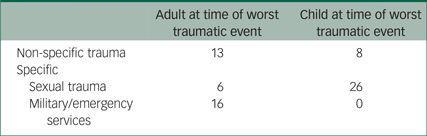
As a result of involvement of multiple centres, a broad selection of participants meant the research was able to explore a wide range of traumatic experiences. Participants were asked for details of their worst traumatic experience, which was then categorised into broad ranges. (Table 1) There were 26 individuals who experienced severe, persistent childhood sexual abuse under the age of 12 by a family member or friend and six participants who were raped as adults, meaning that sexual trauma occurred in 46%. Of the participants, 23% were military, describing significant combat trauma, or police/firefighters describing significant acute on chronic trauma. In the non-specific trauma group (30%), the majority experienced serious physical assaults, vehicle accidents, domestic violence or were exposed to suicide.
Description of trauma category
Although the characteristics of the voices was not specifically targeted in the study, there were a number of features in the group that heard voices that were of clinical interest. The voices were more likely to be solely externally located (16/41) than solely internally located (2/41) and more likely to be negative in content (23/41 completely negative, 2/41 not negative). Participants reported the voices as distressing (23/41 extremely distressing all the time, 2/41 not at all distressing) with a lack of control over the voices (18/41 no control over voices, 1/41 complete control).
The study participants were divided into a group of participants who experienced hearing voices either inside or outside their head, and they were compared with those who did not have this experience. This process resulted in two groups, 59% (n = 41) of the participant who heard voices to compare with the 41% (n = 28) who did not.
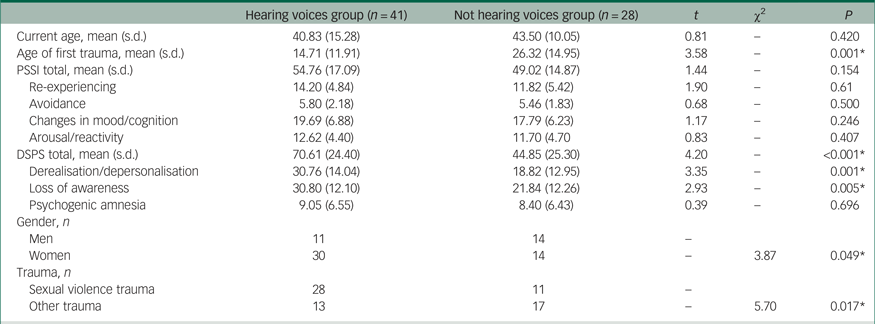
The demographics showed a similar age range between the group of participants who experienced hearing voices and those who did not, but there were proportionately more women in the group that heard voices. The group that heard voices was significantly younger at the time of their worst traumatic experience and it was significantly more likely to involve sexual violence (Table 2).
Comparing variables between the hearing voices group versus not hearing voices group

PSSI, PTSD Symptoms Scale Interview; DSPS, Dissociative Subtype of PTSD Score.
* P<0.05.
The diagnosis of PTSD with dissociation tends to be associated with more severe symptoms of PTSD and this was consistent in this study with both groups’ mean score in the severe range for PTSD symptomatology (46–80). The first important finding was that the severity of PTSD symptoms did not predict experience of hearing voices. Subscale analysis confirmed there was no significant correlation with avoidance symptoms, changes in mood or cognition, changes in arousal or reactivity or re-experiencing phenomena (Table 2).
The second important finding was that the DSPS significantly correlated with the experience of hearing voices. Subscale analysis showed this correlation was with derealisation/depersonalisation and loss of awareness but did not include psychogenic amnesia (Table 2).
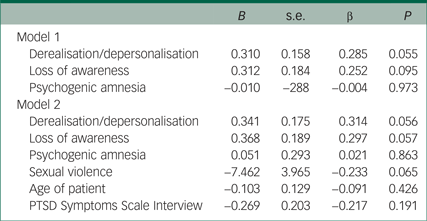
Regression analysis indicated that two scales of dissociation (derealisation/depersonalisation and loss of awareness) were equally good predictors of the extent of hearing voices (PSYRAT), whereas psychogenic amnesia was not relevant. Together, the DSPS scales predicted 23% of the variance in PSYRAT scores (F(3,59) = 5.89, P = 0.001). Adding other possible predictors (age of trauma <18, sexual violence, PSSI score) did not enhance the prediction (R 2Δ = 0.067, F(3,56) = 1.80, P = 0.160) (Table 3).
Regression statistics for prediction of Psychotic Symptoms Rating Scale
Discussion
Main findings
This research shows that in these individuals with PTSD, the experience of trauma-intrusive hallucinations is best predicted by the experience of dissociation, specifically derealisation/depersonalisation and loss of awareness, rather than the severity of the PTSD symptoms. It supports the proposal that trauma-intrusive voices are mediated by symptoms of dissociation and describes general, rather than trauma-specific, symptoms of dissociation as most relevant.
Interpretation of our findings
The measures of severity of PTSD symptoms were consistent between the groups hearing voices and those not hearing them, which suggests that the experience of trauma-intrusive hallucinations is not directly associated with trauma-specific symptoms. The PTSD subscale of re-experiencing phenomena,8 includes dissociative symptoms such as flashbacks, but these are trauma specific, rather than the more general symptoms of dissociation.
In contrast trauma-intrusive hallucinations were strongly associated with general, non-specific symptoms of dissociation including loss of awareness, derealisation and depersonalisation. In the DSPSReference Wolf, Mitchell, Sadeh, Hein, Fuhrman and Pietrzak7 loss of awareness described symptoms such as feeling dazed, foggy, disoriented or confused, the familiar perceived as unfamiliar, or loss of time sense. Derealisation was characterised by a loss of boundary between the self and the external world, where clinically the world was experienced as not real, ‘like a movie’. Depersonalisation was a sense of disconnection within the self where the body was seen as not real, and the individual might have ‘out of body’ experiences.
Psychogenic amnesia was not associated with trauma-intrusive hallucinations. This DSPS subscaleReference Wolf, Mitchell, Sadeh, Hein, Fuhrman and Pietrzak7 relates to two questions regarding memory loss of the specific traumatic event. There have been some questions in the literature as to whether this subscale is helpful in identifying the subgroup of people with PTSD with dissociation.Reference Wolf, Mitchell, Sadeh, Hein, Fuhrman and Pietrzak7 The lack of association with this data in this study again supports the proposal that trauma-intrusive hallucinations link with general dissociation not trauma-specific dissociation.
Characteristics of the trauma were predictive of the experience of hearing voices. In particular age <18 at time of worst trauma and sexual violence predicted hearing voices. This outcome is consistent with the knowledge that the incidence of dissociation is significantly higher in traumatised children and in situations of sexual violence.Reference Scafer, Fisher, Aderhold, Huber, Hoffman-Langer and Golks9
As described there appears to be two types of models in understanding the relationship between trauma, hearing voices and dissociation. One model of trauma-intrusive hallucinations emphasises lack of integration of the specific trauma within the self-identity, leading to fragmentation of the self.Reference Longden, Madill and Waterman2 This model is not supported by this research as the lack of trauma integration would be likely to associate with higher PTSD symptoms in the voice hearing group.
This is important because it makes clinical sense to treat the dissociation actively through psychological strategies. There is good evidence for the effectiveness of desensitisation treatment strategies aimed at managing PTSD symptoms, via the restructuring of traumatic memories. However, although these treatment strategies may be useful for trauma-specific dissociation such as flashbacks, they may not be appropriate for dealing with general dissociative symptoms or trauma-intrusive hallucinations.
This research supports the alternate model that trauma-intrusive voices are mediated by general symptoms of dissociation.Reference Hart, Nijenhuis, Steele and Brown3 This research broadens this concept by suggesting an association with the subscales of derealisation and loss of awareness, as well as depersonalisation, which has been previously described in the literature.
Allen et al Reference Allen, Coyne and Console4 uses the term dissociative detachment, where the individual is deprived of grounding in the world and within the self, via internal and external anchors. This resulting disconnection from the world, others and self, could produce the experience of hearing voices, via impaired reality testing. Allen et al's original focus on trauma-intrusive hallucinations described the experience as stemming from a lack of anchoring both within the self and the outside world.Reference Allen, Coyne and Console4 This proposal described a lack of boundaries regarding sense of self and the outside world as well as poor reality testing, as causing trauma-intrusive hallucinations. The concept of anchoring is useful because it suggests a potential treatment strategy, where anchoring in terms of the self and the external world could be used to manage the experience of trauma-intrusive hallucinations.
Limitations
This research has clear limitations and methodological problems. By its nature this research is retrospective and relies on current descriptions of past trauma, which leaves memories open to retrospective contamination.Reference Longden, Madill and Waterman2 It also requires retrospective description of experiences like dissociation and hallucinations, which by their nature are unreliable. The internal cognitive experience of dissociation is difficult to describe both subjectively and objectively, which makes dissociative experiences difficult to operationalise.
It was a non-random sample that was dependent on clinical accuracy regarding diagnosis. Multiple diagnoses and comorbidity can also present significant difficulties in these complex cases, when examining hearing voices. The experience of hearing voices can also occur in normal individuals outside of the diagnosis of PTSD. This study does, however, have the clear benefit of being able to target individuals with ‘real-world’ clinically challenging cases.
Clinical implications
This research supports the proposal that trauma-intrusive voices are mediated by symptoms of dissociation. It builds on other studies to encourage exploration of symptoms of loss of awareness, derealisation and depersonalisation in patients when trauma-intrusive hallucinations are considered.Reference Kilcommons and Morrison10
Clinicians report being able to differentiate between ‘true’ and ‘pseudo’ hallucinations, possibly because they identify the state of dissociation and assess hearing voices in that context. Consideration needs to be given to psychological strategies targeting trauma and dissociative symptoms, rather than predominantly focusing on medication strategies, in managing trauma-induced hallucinations.
Desensitisation treatment strategies may be useful for trauma-specific dissociation such as flashbacks, but may not be appropriate for dealing with general dissociative symptoms including trauma-intrusive hallucinations. The concept of anchoring in terms of the self and the external world may be more useful in managing the experience of trauma-intrusive hallucinations.



 Open access


eLetters
No eLetters have been published for this article.