

Key Points
Addressing global urban challenges through the implementation of SDG 11 depends on how cities prioritise resources and strategies over the next decade. This prioritisation is context-specific, relating to socio-economic development trajectories and spatio-temporal urbanisation patterns.
Implementing SDG 11 will affect forests and forest livelihoods near and far from urban centres. The strategic inclusion of urban and peri-urban forests in city agendas and planning may help manage adverse effects, emphasising the role forests play in fostering productive rural–urban relationships.
SDG 11 implementation needs to foster people–nature connections in cities to avoid the possible negative consequences for forests and forest-based livelihoods caused by the urbanisation of minds and attitudes.
Many cities currently prioritise SDG 11 targets focused on basic services such as housing and transport, giving less attention to inclusive access to urban forests, protecting cultural and natural heritage or improving urban–rural linkages.
SDG 11 shows synergies with all other SDGs, creating opportunities in and around cities. Synergies delivered through sound urban forestry approaches could benefit not only urban dwellers but also forest communities.
The potential role of urban forests in achieving SDG 11 may be enhanced through the New Urban Agenda and global networks for collective stewardship. Benefits for forests and forest-dependent livelihoods largely depend on multi-scale governance and integrated territorial planning.
11.1 Introduction
As the world continues to rapidly urbanise, the greatest sustainability challenges of the twenty-first century will likely be urban. With three-quarters of the global population projected to be living in cities by 2050 (UN 2014), we can expect an unprecedented pressure on the living environment, including freshwater resources, soils and vegetation cover, with direct and indirect consequences for social relations, security, energy and public health.
Cities’ ecological footprints reach far beyond their physical boundaries. Globally, cities cover circa 3 per cent of the land surface, but account for 60–80 per cent of energy consumption, 70 per cent of carbon emissions and 75 per cent of resource consumption (UNDP 2018). Locally, climates are changed in cities through the urban heat island effect or by altered precipitation patterns (Arnfield Reference Arnfield2003). As cities expand across land surfaces, they also impact biodiversity. Many cities are growing in areas adjacent to biodiversity hotspots, including biodiversity-rich coastal zones or forests, constraining conservation efforts (Seto et al. Reference Seto, Parnell, Emlqvist, Elmqvist, Fragkias and Goodness2013).
Furthermore, the contemporary city often deals with several problems: poverty, social segregation and inequality, vulnerability to extreme weather events, energy inefficiency, poor performance of services and infrastructure, non-optimal waste management, misuse of land and non-renewable resources, air and water pollution and low safety (Moraci et al. Reference Moraci, Errigo, Fazia, Burgio and Foresta2018). Ambient air pollution is a major environmental hazard for urban residents, accounting for more than four million premature deaths annually (Cohen et al. Reference Cohen, Brauer and Burnett2017). According to modelled estimates based on measurements for about 3000 cities and towns worldwide, in 2014 only about 1 in 10 people were breathing clean air, as defined by the World Health Organization safety standards (WHO 2016).
Furthermore, urban expansion in areas of limited economic development and institutional capacity can expose local populations and economies to expanded natural and human-made hazards. In many instances these hazards are exacerbated by climate change, resulting in extreme events such as wildfires, flooding and heat waves affecting cities (Dickson et al. Reference Dickson, Baker, Hoornweg and Tiwari2012, UN 2015). Key drivers of urban vulnerability to these hazards include: competition for land; environmental degradation; unplanned expansion of urban infrastructure and services; and unequal distribution of wealth, as well as access to urban space, services and security (UNISDR 2015). Communities constrained by lower access to these services and resources show inevitably higher levels of vulnerability.
While cities may be drivers of environmental degradation, they can also offer solutions to humanity’s problems (Bettencourt and West Reference Bettencourt and West2010). Addressing this century’s urban challenges and many of humanity’s problems greatly depends on how cities prioritise resources and urban planning strategies over the next decade. A recent global effort to foster more sustainable and resilient cities was endorsed by 193 countries in 2015 as part of the United Nations 2030 Agenda for Sustainable Development and its Sustainable Development Goal 11 (SDG 11) to ‘make cities and human settlements inclusive, safe, resilient and sustainable’. By endorsing a stand-alone goal on cities (‘the urban SDG’), the international community recognised urbanisation as a transformative force for development (UN 2017). The targets under SDG 11 (see Table 11.1) provide an opportunity to harness cities’ transformational force for innovation and sustainable development, making them protagonists of the ‘Future We Want’.Footnote 1 This chapter provides an analysis of SDG 11 implementation and explores potential effects on forests and forest-based livelihoods around the world, considering different contexts, synergies and trade-offs from local to global levels.
| 11.1: By 2030, ensure access for all to adequate, safe and affordable housing and basic services and upgrade slums |
| 11.2: By 2030, provide access to safe, affordable, accessible and sustainable transport systems for all |
| 11.3: By 2030, enhance inclusive and sustainable urbanisation and capacity for participatory, integrated and sustainable human settlement planning and management |
| 11.4: Strengthen efforts to protect and safeguard the world’s cultural and natural heritage |
| 11.5: By 2030, significantly reduce the number of deaths and the number of people affected and substantially decrease the direct economic losses relative to global gross domestic product caused by disasters |
| 11.6: By 2030, reduce the adverse per capita environmental impact of cities, including by paying special attention to air quality and municipal and other waste management |
| 11.7: By 2030, provide universal access to safe, inclusive and accessible, green and public spaces, in particular for women and children, older persons and persons with disabilities |
| 11.A: Support positive economic, social and environmental links between urban, peri-urban and rural areas by strengthening national and regional development planning |
| 11.B: By 2020, substantially increase the number of cities and human settlements adopting and implementing integrated policies and plans towards inclusion, resource efficiency, mitigation and adaptation to climate change, resilience to disasters |
| 11.C: Support least developed countries, including through financial and technical assistance, in building sustainable and resilient buildings utilising local materials |
11.2 SDG 11 Synergies and Trade-offs for Forests and Forest Livelihoods
11.2.1 Critical Assessment of Target Prioritisation: Bias within the Goal
Despite global efforts to monitor SDG 11 implementation, the lack of consistent data collection and common methodological procedures generate inconsistencies, gaps and biases towards certain targets. The bias is linked to the UN’s tracking capacity, but also reflects country needs when prioritising SDG 11 targets (Table 11.1). World data collected by the SDG trackerFootnote 2 only shows performance for SDG 11 targets on housing and basic services (11.1), disaster-related loss (11.5), air quality and waste (11.6) and regulation to manage disaster risk (11.B). For progress on SDG 11, the UN Statistics Division tracks only the proportion of urban population living in slums, the ratio of urban sprawl, air pollution levels and the proportion of countries implementing national urban policies. If priority continues to be given to SDG 11 targets linked to housing, waste management and transport, SDG 11 may represent a challenge for forests as cities keep expanding and densifying.
Prioritising grey infrastructure and basic services may miss opportunities to benefit from services provided by nature (i.e. natural or modified ecosystems), including urban forests. Urban forests are understood here as networks or systems comprising all woodlands, groups of trees and individual trees located in urban and peri-urban areas (Salbitano et al. Reference Salbitano, Borelli, Conigliaro and Chen2016). Urban forests are part of green spaces. Green space, public or private, consists of predominantly unsealed, permeable, ‘soft’ surfaces such as soil, grass, shrubs and trees (Swanwick et al. Reference Swanwick, Dunnett and Woolley2003). Ignoring or postponing consideration of green space, urban forests and nature-based solutions (NBS)Footnote 3 in urban planning could result in further environmental degradation, with cascading negative effects on human health and well-being.
Bias towards grey infrastructure and basic services and lack of consistency was also observed among Voluntary National Reviews (VNRs) prepared by countries to report on their SDG implementation efforts. Of the 112 VNRs submitted by 2018, there was no uniform reporting method. Some countries included all SDGs, others prioritised specific SDGs based on national interests. The High-Level Political Forum (HLPF) reviews the VNRs to assess progress on Agenda 2030. The HLPF assessed SDG 11 for the first time in July 2018 under the theme ‘Transformation towards Sustainable and Resilient Societies’.Footnote 4
In general, countries that included SDG 11 in their VNRs recognised cities as a socio-economic force, but highlighted challenges associated with rapid and/or unplanned urbanisation, segregation of urban dwellers and increasing air pollution. As part of SDG 11 implementation, countries prioritised access to adequate housing with interlinkages to health, education and employment (VNR 2017). Sustainable transport and mobility were frequently mentioned, including access to low-carbon public transport. Few countries highlighted policies to ensure safe, inclusive and accessible, green and public spaces (Target 11.7) or the protection of cultural and natural heritage in and around cities (Target 11.4), despite the manifold benefits urban forests and heritage can bring in terms of ecosystem services, enhancing sense of place, fostering recreational and physical activities, increasing aesthetic appreciation, inspiring artistic and spiritual expression, and generating additional income (FAO 2018). Worldwide, only 13 per cent of the 384 UNESCO World Heritage Sites mention trees, forests, gardens, parks or man–nature relationships in their description or management plans (FAO 2018).
Probably the only SDG 11 targets that promote clear synergies between forests and the social and economic considerations many countries prioritise are those aimed at reducing deaths and economic losses caused by disasters (Target 11.5) and increasing urban resilience to climate-change impacts and disasters (Target 11.B). Countries have achieved most progress in the formulation of policies for climate adaptation and mitigation, disaster-risk reduction and national-level urban policies. For example, 142 countries confirmed policy development and/or implementation in one or more of these areas (UN 2016). Synergies between these targets/policies and forests are particularly evident when NBS are considered to manage risk and build resilience of cities to disasters and climate change in a more integrated manner.
Recent global developments may help balance potential trade-offs among SDG 11 targets. In 2012, UN-Habitat created a monitoring tool to measure sustainability at the urban level: the City Prosperity Index (CPI). Tested in more than 400 cities, this index has the potential to become a global framework to monitor SDG 11 indicators and targets beyond national reporting. The CPI includes environmental sustainability as one of the six dimensions it tracks, thus providing the architecture needed to increase the weight of environment and NBS in urban planning.
Another promising initiative for fostering environmental sustainability in and around cities is the New Urban Agenda (NUA) adopted by 167 countries in 2016. The NUA’s key principles provide a normative direction for the transformation of cities and their achievement of Agenda 2030. These principles recognise the need to integrate green growth considerations, decouple urban growth from resource use and its environmental impacts, and include environmental strategies in long-term urban planning. Several commitments in the NUA relate to promoting green spaces as drivers of social and economic development: leveraging natural and cultural heritage; emphasising multifunctional areas for social interaction and inclusion to positively affect human health, well-being and cultural expression; and supporting territorial systems that integrate urban and rural functions in more efficient ways.
11.2.2 Building on Synergies to Enhance Forest Opportunities
The CPI and NUA provide new tools and principles to catalyse synergies, not only among SDG 11 targets but also between SDG 11 and other SDGs. The SDG framework is explicit that the goals depend on each other.Footnote 5 Nonetheless, many complex interactions are not yet well-understood. Trade-offs exist that need to be minimised, while synergies should be fostered for the 2030 Agenda to deliver on its full potential (Nilsson et al. Reference Nilsson, Griggs and Visbeck2016). Some identified problems include: policymakers and planners often operate in silos with limited budgets; different public and private entities with competing priorities manage the sectors; and evidence is lacking on interventions that may help or hinder SDG integration (Nilsson et al. Reference Nilsson, Griggs and Visbeck2016, Weitz et al. Reference Weitz, Carlsen, Nilsson and Skånberg2017). This section briefly presents how some strategic interactions between SDG 11 and other SDGs could be fostered, focusing on SDG 11 targets with potential impacts on forests (Figure 11.1).
Synergies and trade-offs between SDG 11 targets and the other SDGs in relation to potential effects on forests and forest-based livelihoods. Some interactions may present more synergies (high in the ‘synergies’ y-axis). Others have more trade-offs (high in the ‘trade-offs’ x-axis). SDGs 4 (Quality Education), 16 (Peace, Justice and Strong Institutions) and 17 (Partnerships for the Goals) are cornerstones of potential synergies presented in the graph.
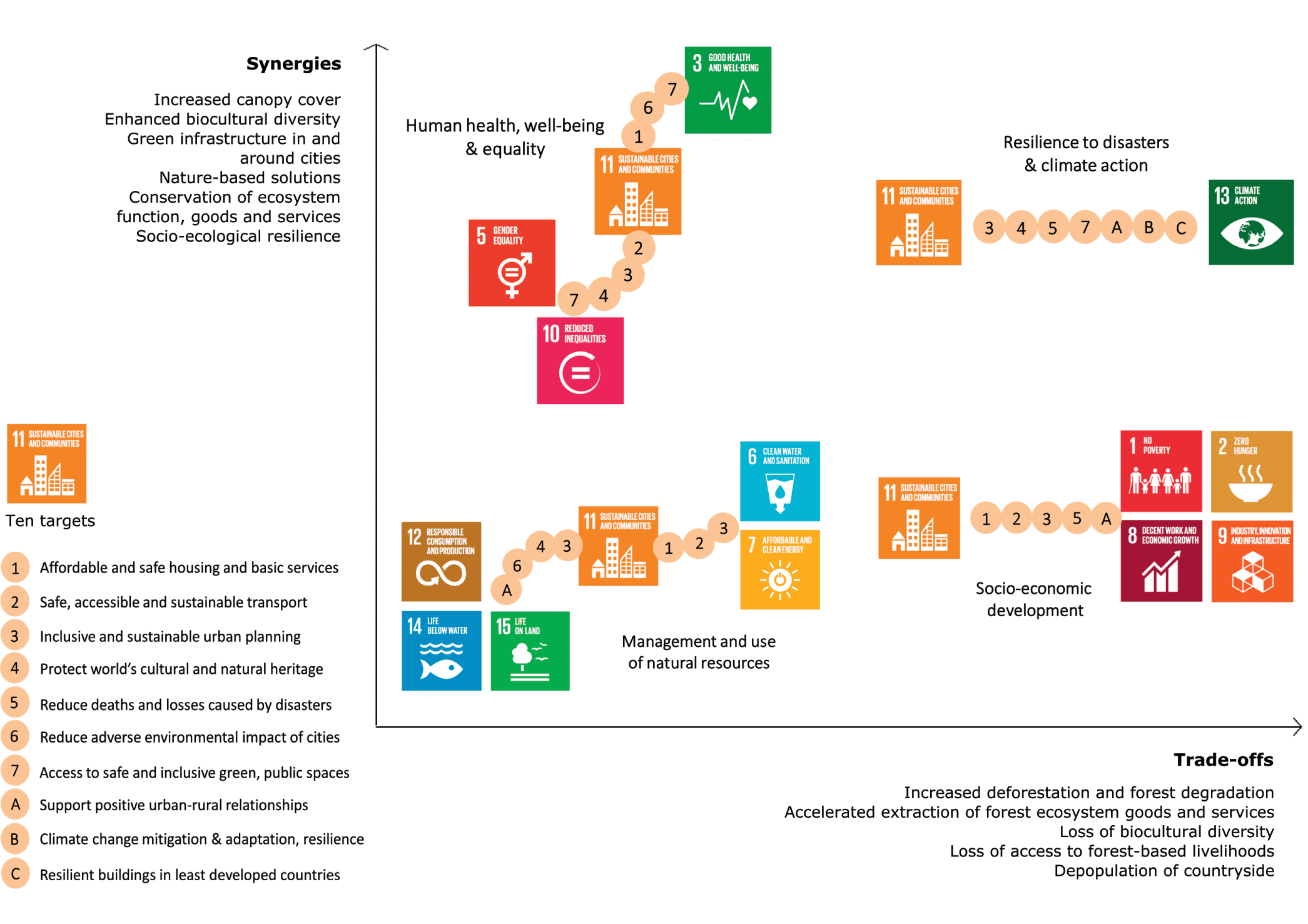
A clear area of synergy relates to human health and well-being. SDG 3 (Health and Well-Being) envisions better health for all human beings. This inclusive approach is closely linked to SDG 10 (Reduced Inequalities) and SDG 5 (Gender Equality). Achieving SDG 3 targets is still hampered by lack of safe water, sanitation and hygiene in urban areas. While most countries reporting VNRs have made progress on access to safe drinking water, challenges in urban areas remain linked to inadequate basic services in slums, as well as water shortfalls and management issues in the context of disasters (UN DESA 2015). Addressing Target 11.1 (access for all to adequate, safe and affordable housing and basic services and upgrading slums) in vulnerable slum areas would constitute an intervention with clear co-benefits for SDG 3, given that populations living in these conditions are the most vulnerable to urban health risks, such as respiratory problems, waterborne diseases and premature deaths.
Focusing on human health synergies can benefit forests in and around cities (Figure 11.1). This is possible through the equitable deployment of Target 11.7 (access to safe, inclusive and accessible, green and public spaces) and Target 11.4 (efforts to protect and safeguard the world’s cultural and natural heritage). According to an increasing number of studies, access to green spaces and other aspects of the urban forest may play a pivotal role in maintaining and positively influencing human health through various ecosystem services,Footnote 6 including regulating (e.g. heat reduction), cultural (e.g. physical activity/recreation, stress relief and social cohesion) and provisioning (e.g. food for survival) (van den Bosch and Sang Reference van den Bosch and Sang2017).
Unfortunately, there is evidence of widespread inequitable access to urban green spaces around the world (Schwarz et al. Reference Schwarz, Fragkias and Boone2015). This inequity is a missed opportunity to address the health and well-being of the most marginalised urban dwellers. For example, in Vancouver, Canada, urban tree canopy cover is lowest in lower-income neighbourhoods, depriving those communities of the ecosystems services provided by urban forests. This bias calls for implementing Target 11.7 in conjunction with SDG 10. Empowering communities to steward their local urban green spaces (including gardens and farms) with interventions supporting social, economic and political inclusion (SDG 10) holds potential synergies with increasing participatory urban planning, increasing equitable access to urban green space and improving overall community health.
Other potential synergies pertain to building resilience and adaptive capacity to climate-related hazards (SDG 13 Climate Action). This can have positive impacts on urban and peri-urban forests if NBS are taken into consideration as a strategy to manage disaster risk (Raymond et al. Reference Raymond, Frantzeskaki and Kabisch2017). NBS include strategies for city greening, from green roofs or green walls to wetland conservation, park establishments and street tree planting. As temperatures continue to rise due to climate change, the cooling effects of urban green spaces are likely to become increasingly important. By mitigating the urban heat island effect, urban forests can also improve energy efficiency at neighbourhood and city levels by reducing energy consumption for cooling. In the USA, the establishment of 100 million mature trees around residences is estimated to save about USD 2 billion annually in reduced energy costs (Akbari et al. Reference Akbari, Huang, Martien, Diamond and Goldman1988, Donovan and Butry Reference Donovan and Butry2009).
In addition to city greening, NBS and low-impact development create other synergies among SDGs that depend on rural–urban connections, such as SDG 6 (Clean Water and Sanitation), SDG 7 (Affordable and Clean Energy), SDG 12 (Responsible Consumption and Production) and SDG 15 (Life on Land). Low-impact development includes connecting water bodies and green spaces in and around cities to provide additional functions. These functions may involve water storage and recycling for irrigation and industrial use, as well as flood risk control, water purification and protection of wildlife habitat (Ghofrani et al. Reference Ghofrani, Sposito and Faggian2017). Focusing on water management (SDG 6) as an entry point can have positive impacts on forest conservation, where many urban water sources are located. A report by the World Bank and World Wildlife Federation’s (WWF) Alliance for Forest Conservation and Sustainable Use (2003) found that about one-third of the world’s largest cities obtain a significant proportion of their drinking water directly from protected forests. Interestingly, in many countries there has been a significant increase over the last 15 years in using urban protected areas as water sources (FAO 2018).
Finally, another area for synergies that can benefit forests is related to clean (i.e. low pollution) cooking fuels. This topic connects SDG 11 with SDG 7 and SDG 13. Cities are primary sources of greenhouse gas (GHG) emissions, requiring mitigation efforts via policies, communication and investment in technology and infrastructure (Hoornweg et al. Reference Hoornweg, Sugar and Trejos Gomez2011, Laukkonen et al. Reference Laukkonen, Blanco and Lenhart2009, Lenhart 2015). While access to clean fuels and technologies for cooking climbed to 57.4 per cent in 2014, more than 3 billion people (particularly in Asia and sub-Saharan Africa) still cook without clean fuels and efficient technologies. In Bangui (Central African Republic) and the slums of Nairobi (Kenya), about 95 per cent of residents still use wood for cooking and lighting (Drigo and Salbitano Reference Drigo and Salbitano2008, FAO 2009). Traditional fuelwood has clear impacts on urban and peri-urban forests, and it exposes users to high levels of indoor air pollution. Transitions to clean fuels in cities can thus have positive impacts on urban forest systems and public health. For instance, raising awareness of cleaner cooking technologies in N’djamena (Chad) was paired with improved capacity for sustainable urban forest management (FAO 2012).
These clear synergies provide guidance for policymakers and urban planners as they try to integrate multiple SDGs in urban areas. Many cities are aiming to develop local policies and plans that work with and enhance one another and are explicitly considering synergies among SDG targets. Finding interventions that build on SDG interactions and can have positive impacts on forest and forest-based livelihoods calls for education to promote sustainable development (SDG 4), as well as strong institutions (SDG 16) and partnerships (SDG 17), as discussed in Section 11.4. Strengthening access to education in urban areas may increase pressures on urban resources if rural-to-urban migration increases. Appropriate attention needs to be placed on enhancing education and work opportunities in rural areas where there can be growth opportunities. A more integrated approach that strengthens rural–urban development planning (Target 11.A) is therefore key and is increasingly being recognised by national agendas (see Section 11.4).
11.3. Contextual Factors Guiding SDG 11 Target Prioritisation
11.3.1 Recognising Different Urbanisation Patterns
Urban areas are expanding across the globe, but urbanisation patterns vary and each situation comes with its own challenges, as shown in Box 11.1. Urban sprawl is a common phenomenon, with the expansion of urban land outpacing the growth of urban populations (Seto et al. Reference Seto, Parnell, Emlqvist, Elmqvist, Fragkias and Goodness2013). This has placed increasing pressure on agricultural, forested and other land use. While some cities densify, others show trends of suburbanisation and peri-urbanisation.
Urban sprawl: the expansion of urban land outpacing the growth of urban populations, placing increasing pressure on the countryside and natural landscapes.
Densification and compact city: the opposite of urban sprawl. The compact (densified) city presents an urban form having a high density of settlements, a clear boundary from surrounding areas, mixed land use and a relative independence of government.
Conurbation and agglomeration: a region comprising cities, large towns and other urban fragments that, through population growth and physical expansion, have merged to form one continuous urban or industrially developed area. In most cases, a conurbation is a polycentric urbanised zone in which transportation has developed to link areas to create a single urban context.
Suburbanisation: the population shift from central urban areas into suburbs, resulting in the formation of (sub)urban sprawl. Suburbanisation is inversely related to urbanisation, which denotes a population shift from rural areas into urban centres.
Ex-urbanisation: a mostly permanent transfer of activities (e.g. malls and shopping centres) from the city centre to the periphery and agglomeration of a city. This phenomenon is particularly widespread in major cities of industrialised countries, but also accompanies the growth of cities in emerging countries.
Peri-urbanisation: the shift of urban populations from denser to less dense areas. It is spatially explicit as an extension process of urban agglomerations, in their periphery, resulting in a permanent transformation of rural areas.
Multi-nucleation: the clustering of populations around several centres, rather than just one, in the same region.
Counter-urbanisation (or de-urbanisation): a demographic and social process by which people migrate from urban to rural communities. Observed in developing and hyper-urbanising countries linked to unbearable stress of urban life or need of changing lifestyle.
Rurbanisation: a process of rural transformation. Predominantly rural agriculture economies, forms of settlements, lifestyles and social attitudes are changing towards urban behaviours and a new rurban form is emerging. Clustering rural settlements brings benefits similar to those of urban areas, empowers rural people with urban facilities (e.g. electrification, Wi-Fi). Rurbanisation is catching the attention of urban planners as a prominent development process commonly witnessed in developing countries.
Gentrification and urban rot: the social process of renewal of degraded urban areas by wealthier residents. It can improve the physical and material quality of a neighbourhood, while becoming a discriminatory process when it forces the move of current and established residents and businesses from a gentrified area, looking for low-cost housing and shops. Conversely, urban rot is the social process where part of a city or town becomes old or dirty or ruined because businesses and wealthy families have moved away from it.
As of 2018, the most urbanised regions of the world include North America (82 per cent urban population), Latin America and the Caribbean (80 per cent) and Europe (74 per cent).Footnote 7 Asia (50 per cent) and Africa (42 per cent) are still mostly rural, although urban settlements are expanding rapidly. By 2050, 64 per cent of Asia’s and 56 per cent of Africa’s population are projected to be urban. This means that 95 per cent of urban expansion in the coming decades will take place in the developing world (UNDP 2018). Intra-regional differences apply: some areas grow with many small to medium settlements (i.e. less than 500 000 inhabitants); others grow megacities of more than 10 million inhabitants, such as China’s Beijing (17 million), Japan’s Tokyo (32 million) and Indonesia’s Jakarta (23 million) (Fensom Reference Fensom2015, UN 2014). Some urban areas are shrinking or transforming in population and economic activity (e.g. gentrification and urban rot), which raises new challenges and opportunities associated with vacant land, displacement and infrastructure (Seto et al. Reference Seto, Parnell, Emlqvist, Elmqvist, Fragkias and Goodness2013).
Urbanisation also needs to be addressed from the perspective of urban–rural linkages (Box 11.1). Most development theory and practice are implicitly based on the dichotomy between rural and urban areas, populations and activities. This results in a division of policies along spatial and sector lines, with urban planners usually focusing on urban issues and paying little attention to rural-led development, while rural planners tend to ignore urban centres and define rural areas as consisting only of farms, villages and their agricultural land (Tacoli Reference Tacoli1998). This dichotomy becomes blurry as urbanisation trajectories change rapidly and different patterns emerge, such as ex-urbanisation, multi-nucleation and rurbanisation, with various implications for urban–rural relationships (Box 11.1).
As early as 1970, Johnson (Reference Johnson1970: 28) noted that ‘It is incorrect to assume that urban entrepreneurial decisions are wholly discrete and separable from rural decisions and choices.’ This statement is even more relevant in modern times when urban–rural interactions have become more complex, diverse and multidimensional. The rural context can range from isolated housing or small settlements on the fringe of cities to remote villages or green-belt agriculture, to family farms or large extensive farming, forestry and grazing lands. In recent decades, ‘ruralities’ have closer economic and social relationships with urban cultures (Hiner Reference Hiner2016, Scott et al. Reference Scott, Gilbert and Gelan2007). Rural villages, small towns, exurbs, peri-urban areas within urban commuter sheds and the rural–urban fringe (Hiner Reference Hiner2016) are places where rural and urban identities are more entangled than in large urban centres (Taylor and Hurley Reference Taylor and Hurley2016).
Recognising that cities’ socio-economic development conditions and urbanisation patterns are of contextual importance to assess SDG 11 impacts on forests and people, we apply a three-dimensional framework to classify cities (Figure 11.2). First, we classify cities according to their pace of growth in the past two decades, with some cities showing rapid growth (several per cent per year) and others showing much slower growth (less than 1 per cent per year), or even experiencing population decline (‘shrinking cities’). Second, we distinguish between cities that are affluent, with sufficient resources to manage and plan their growth and deal with urbanisation’s negative consequences, and those that are less affluent. We base this dimension partly on the World Bank’s country income groups, with countries that are at least in the upper-middle-income group being described as affluent. Third, we consider the spatial pattern of urban growth, identifying cities whose growth is primarily concentrated in the urban core (densifying) versus cities expanding outward (sprawling).
Framework used to categorise cities according to interrelated city growth dimensions and development characteristics.
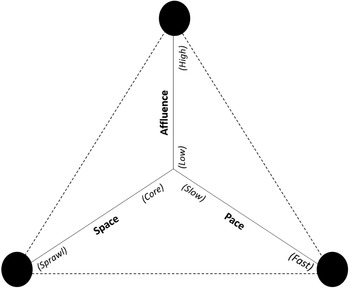
We recognise that classifications are simplifications and acknowledge, for example, that rapidly growing cities will often grow both in their core and in their perimeters, and that levels of affluence can be debated because of large discrepancies within the country and the city. Urban densification can be a planning strategy, but in other cases it can be the result of geographical and other limitations (e.g. a city being confined by neighbouring water bodies or steep slopes). We also acknowledge that this classification can change over time. For example, a city that used to grow at a very rapid pace can slow its growth over time. Nevertheless, the proposed framework to categorise the world’s cities can be used to analyse similarities and differences in how SDG 11 targets are prioritised according to contextual factors and the associated impacts on forests and forest-based livelihoods within and outside city boundaries.
11.3.2 Anticipated Impacts of SDG 11 on Forests and Forest-Based Livelihoods
Applying the framework presented in Figure 11.2, and recognising the vast diversity in the conditions and development patterns of the world’s cities, we analyse how different city types (in terms of growth and affluence) have a different way of prioritising SDG 11, thus affecting forests and forest-based livelihoods. First, we look within urban areas themselves and review the (potential) role of forests and forestry, for example in promoting more sustainable cities. Next, we shift the focus to the implications of urban development on rural forests and forest-based economies.
To conduct the analysis, we use case-study cities as proxies of city types characterised by distinct urbanisation patterns and urban–rural connections (see Table 11.2). These case studies were selected based on information from literature, and socio-economic data obtained from online databases such as the World Population Review.Footnote 8 For affluence level, we made adjustments based on the specific city’s stand in relation to its national mean. For example, Medellín (Colombia) ranks in the lower affluence group and Curitiba (Brazil) in the higher affluence group, even though Colombia and Brazil are both ranked in the upper-middle-income group by the World Bank.
| City type | Region where type is common | City case study | Urban growth and development | Recognition of forests and trees | Urbanisation pattern (Box 11.1) | Effects on urban–rural relationship | Social and landscape changes |
|---|---|---|---|---|---|---|---|
| Asia | Hangzhou, China |
| Recognition of importance of forests and trees; Forest City and urban forestry programmes with large-scale afforestation |
|
|
|
|
| Vancouver, Canada |
| Greenest City Vision and urban forestry programme; urban afforestation and efforts to prevent canopy loss; important role of forests in watersheds for freshwater provision |
|
|
|
| Europe | Milan, Italy |
| Protection and enhancement of green areas; focus on afforestation in former industrial land; introduction of a system of parks, forests and wetlands |
|
|
|
| Latin America | Medellín, Colombia | Slowing growth after rapid growth due to urban renaissance | Greening efforts as part of new urban planning; development of a Green Belt |
|
|
|
|
| Kinshasa, Democratic Republic of Congo | Major, unplanned urban growth and sprawl | Loss and fragmentation of forests both inside and outside of the city; forests provide important products and services, including regulatory and provisioning (e.g. fuelwood, food) ecosystem services |
|
|
|
| Middle East | Tehran, Iran |
| Urban forests and green spaces are recognised for their important ecosystem services, but a more comprehensive approach to urban forestry and green infrastructure planning is still needed |
|
|
|
|
| Curitiba, Brazil |
| Urban forest is seen as central to sustainable urban planning, for example for stormwater management |
|
|
|
| Asia | Ho Chi Minh City, Vietnam |
| New climate-change adaptation policies recognise the importance of blue–green networks; major tree loss due to densification |
|
|
|


We also focus on cities’ pace of growth over the past two decades, acknowledging it may differ from previous decades. Some cities, such as Milan (Italy), experienced heavy urbanisation early on (150 000 people in the fourteenth century, 200 000 in the seventeenth century, more than half a million in 1901), resulting in forest fragmentation over time and suburbanisation patterns combined with multi-nucleation in more recent decades. Other cities expanded differently: for example, Vancouver (Canada) had nearly 20 000 inhabitants in 1901 and then grew rapidly to 630 000 inhabitants in 2016, while its metro area had 40 000 residents in 1901 versus 2.5 million residents in 2016. In recent decades, cities around Vancouver merged to form one continuous urban developed area, a conurbation process that also took place in the San Francisco Bay Area (USA).
Although the overall aim of SDG 11 is valid for all cities, different city types have different approaches towards implementation. For example, cities experiencing fast growth and sprawl in areas of low (or medium) affluence are putting major pressure on surrounding areas, while emphasising the development of urban infrastructure such as housing and transport networks. Sprawl can enhance vulnerability to climate-change impacts as people are pushed into areas of greater risk, such as coastal areas, floodplains or mountainsides. Sprawl and densification can also occur at the same time. Densification is a complex phenomenon (Haaland and Konijnendijk van den Bosch Reference Haaland and Konijnendijk van den Bosch2015) where existing urban green spaces can fall victim, affecting local resilience and quality of life. Densification can drive up property prices and reduce the wider urban footprint on adjacent nature. However, this process can also make cities increasingly unaffordable for the less affluent.
Urbanisation of Minds and Attitudes
The conceptualisations of urban or rural are determined by space, representation and culture. Recent conceptualisations see rurality and urbanity as cultural constructs rather than geographically bound places (Dymitrow et al. Reference Dymitrow, Biegańska and Grzelak-Kostulska2016). From this perspective, the urbanisation of minds is linked to a cultural hegemony, i.e. the control of culture through the domination of social groups via social institutions. In the urban world, the urban culture became rapidly hegemonic, heavily influencing minds and behaviours, also of people (or at least a part of them) living in rural settings.
One of the fundamental questions reflecting the changes in the relationship between urban and rural is the attitude concerning the temporality and transformability of the landscape. Urban thinking tends to perceive fixity in landscape, a sort of freezing of the built-up status quo. In urban community perceptions, the concept of landscape very often represents an immutable, static referential component (Bonnes et al. Reference Bonnes, Passafaro and Carrus2010). In contrast, rural perception of landscape is often very dynamic, related to detailed ecological and vegetation knowledge (Campos et al. Reference Campos, Velázquez and Bocco Verdinelli2012).
The urbanisation of minds might often influence attitudes towards forests. Urban dwellers may feel more disconnected from nature. In other instances, urbanites may see forests as an icon of nature that needs protection. This may hinder decision-making that aims at changing (even slightly) the structure of forests, thereby also affecting sustainable forest management and impacting the livelihoods of people who depend on access to and commercialisation of forest products and services. Allowing a more dynamic and legitimate change in forests in and around cities calls for inclusiveness in urban forest planning, accounting for the multiple social perceptions of and interactions with forests.
Urban Development, Loss of Urban Forest and Traditional Cultural Landscapes
Cities of all types (Table 11.2) face different challenges in relation to urban planning that can successfully and sustainably steer growth. In all cities, maintaining (or creating) green space, including urban forests, is facing pressure from grey infrastructure development.
While urbanisation can reduce direct pressure on forests via rural migration, the expansion of urban and residential areas can cause significant forest loss due to construction and land conversion. Sprawl is commonplace in many Global South cities, such as Kinshasa (Democratic Republic of Congo). Decades ago, Kinshasa was a small town; now it has boomed to 17 million residents, with extensive urban sprawl. Uncontrolled sprawl leads to the decrease of surrounding forests and other ecosystems and a concurrent decrease in the important ecosystem services these provide.
Many cities in Southeast Asia and China are also fast-growing and sprawling, leading to forest fragmentation, habitat loss and degradation, and land-use change. Even in more affluent cities, governments struggle to control growth. In Hangzhou, now the tenth largest city in China, rapid population and surface area growth have led to large-scale land cover changes, loss of suburban forests and green space, and forest fragmentation. This has resulted in a series of environmental and social issues, such as habitat loss, air-pollution and urban health concerns (Byrne et al. Reference Byrne, Lo and Yang2015, Yue et al. Reference Yue, Liu and Fan2013). Urban expansion also frequently takes prime agricultural land out of production, making it increasingly necessary to use marginal lands for cropland and pastures.
Urban sprawl is commonplace in many Latin American cities, although this trend may be decelerating in some cities that are proactively planning for green spaces. Medellín (Colombia) has reinvented itself from a troubled past (related to drug crime) as one of today’s most innovative cities in Latin America (Mendieta Reference Mendieta2011). With enhanced stability and liveability has come the need to house a growing population (Mendieta Reference Mendieta2011). Despite this, the city has been more successful than many other cities in the region in controlling sprawl, and is currently developing an extensive network of urban parks. Curitiba (Brazil) is also globally known as an example of sustainable and green city development, but it has yet to address sprawl or the fact that an increasing part of its population lives in slums (Atlas of Human Development in Brazil 2013).
The growth of some cities occurs through urban densification rather than sprawl, posing its own challenges in relation to green space planning. In Ho Chi Minh City (Vietnam), urban densification was largely unplanned, due to speculation and other factors (Zhu Reference Zhu2012), resulting in a major loss of tree canopy and green spaces (Thanhnien New 2016). Following settlement pressures – residential and production space allocation – intensified landscapes occurred on the urban fringe. This resulted in the unplanned intensification of functions and dramatic landscape change within confined boundaries. This kind of densification, as in the case of Ho Chi Minh, can lead to major land modification near the urbanised zones, often oriented towards industrialised agriculture with mechanised monoculture systems.
Even in affluent Vancouver (Canada), with strong environmental policies in place, fast growth through densification of the urban core has impacted tree canopy cover. At the city level, canopy cover has decreased from 22.5 per cent to less than 18 per cent since 1995 (City of Vancouver 2018). Vancouver’s densification of the urban core is considered necessary, as the Coast Mountain Range and Pacific Ocean restrict development. Less affluent Tehran (Iran) is already very dense, with an average of 11 800 residents per square kilometre (World Population Review 2018). The limits to urban expansion, mobility and the city’s location on two major earthquake fault lines led the Iranian government to explore plans to relocate the capital, which never materialised (Madanipour Reference Madanipour2006). Currently, Tehran’s residents have only an average of 3 m2 of green space per capita at their disposal (van den Bosch and Sang Reference van den Bosch and Sang2017, Kabisch et al. Reference Kabisch, van den Bosch and Lafortezza2017). In comparison, Vienna has 120 m2 of green space per capita, Singapore 66 m2 and London 27 m2 (Baharash Architecture 2018).
Proximity to cities also causes changes in rural lifestyles and employment. In post-industrial societies, urbanisation has gradually induced desertion of rural areas, particularly among younger generations. Rural abandonment has led to intensification of the most productive lands and abandonment of marginal lands (Barbero-Sierra et al. Reference Barbero-Sierra, Marques and Ruíz-Pérez2013), as well as loss of traditional cultural landscapes in many cases (Van Eetvelde and Antrop Reference Van Eetvelde and Antrop2004). Rural abandonment can also spur outright conversion of forest by industrial farmers and ranchers, especially in areas suitable for large-scale agriculture. For example, at the end of the nineteenth century, Milan’s agro-industry transformed the rural area around the city, followed by the heavy industrial boom of the twentieth century. Currently, Milan’s efforts have reoriented to renew the character of the rural landscape even in the metropolitan area. An associated phenomenon is the daily commuting from the rural suburbs to industrial/commercial occupations in cities.
The Importance of Ecosystem Services Provided by Urban Forests
The important contributions of forests and trees to healthy and resilient cities are increasingly recognised. Vancouver’s Urban Forestry Strategy highlights the many ecosystem services provided by the city’s urban forests, including for culture, recreation and social cohesion, all with potential positive influence on human health (City of Vancouver 2014, 2018). Many fast-growing, affluent cities in Asia, including Hangzhou, also stress these ecosystem services. In Medellín, where growth has slowed but sprawl needs to be controlled, the role of urban forests in improving air quality, stormwater runoff and carbon sequestration is highlighted (Mendieta Reference Mendieta2011). Urban forests and trees in the city are considered important for combatting pollution and reducing erosion, as well as for improving public health (van den Bosch and Sang Reference van den Bosch and Sang2017, Kabisch et al. Reference Kabisch, van den Bosch and Lafortezza2017). In Ho Chi Minh City, expanding the urban green–blue network is considered an important way to combat both flooding and the urban heat island effect (C40 Cities 2016).
All of the world’s cities still have some form of dependency on forests and the ecosystem services they provide; however, the focus on specific services differs (Ferrini et al. Reference Ferrini, Konijnendijk van den Bosch and Fini2017). While cities in affluent areas of the Global North may stress the importance of forests for recreation, tourism, water protection and biodiversity conservation, many cities in the developing world are still focusing on provisioning ecosystem services of forests. For example, dependency on fuelwood may be greatest in sub-Saharan Africa. In Kinshasa, annual household fuelwood consumption increased from 12.9 million to 14.5 million m3, while industrial consumption increased from 66 080 to 71 066 m3 between 2001 and 2005 (Samndong and Nhantumbo Reference Samndong and Nhantumbo2015). Initially, fuelwood was obtained from nearby forests, but with the complete disappearance of forestland around Kinshasa, fuelwood and charcoal are now imported from 400 to 500 km away. In other cities, forests are considered a source of food and fodder, and agroforestry and foraging systems in urban areas help supplement urban diets. Nonetheless, cities are not only dependent on surrounding rural areas for their food; they often derive food from areas much further away, impacting remote landscapes (Seto et al. Reference Seto, Parnell, Emlqvist, Elmqvist, Fragkias and Goodness2013).
Increased Access to Green Space and Integration of Urban Forests in Urban Planning
An integrative approach to planning and managing green space calls for even distribution of vegetation and equitable access to urban forests, particularly for low-income communities. The recognition of multiple perspectives on and relationships with urban forests demands inclusiveness and equity in urban forest governance. This is critical when planning for Target 11.7 (universal access to safe, inclusive and accessible, green and public spaces) and overcoming the prevalent uneven distribution of green space, whereby more affluent residents have better access (Nesbitt and Meitner Reference Nesbitt and Meitner2016, Salbitano et al. Reference Salbitano, Borelli, Conigliaro and Chen2016). The long-term sustainability of green spaces is largely dependent on local community action, inclusivity with respect to multiple perspectives and cultural connections to forests, and more integrated governance models.
Creating green, healthy, sustainable cities requires balancing urbanisation pressures with institutional capacity in models that reflect and are relevant to local realities. More affluent cities such as Vancouver, Hangzhou and Curitiba have adopted an urban forestry and green urban planning approach. As part of its Urban Forestry Strategy, Vancouver aims to plant 150 000 new public trees by 2020, while strengthening the legal protection of all urban trees (City of Vancouver 2014, 2018). The regional Metro Vancouver government has developed a series of interconnected regional management plans around its Sustainability Framework to help achieve various SDGs (Kanuri et al. Reference Kanuri, Revi, Espey and Kuhle2016).
Hangzhou is recognised as one of the national Forest Cities, based on a set of criteria for sound urban forest planning and management in China. Accordingly, the Hangzhou government is protecting and rebuilding its urban forest, for example through large-scale afforestation. The city aims to regain its reputation as ‘heaven on earth’, partly based on green and blue spaces such as the West Lake and the Xixi Wetland (Wolch et al. Reference Wolch, Byrne and Newell2014). In Curitiba, the role of the city’s interconnected network of parks and woodlands in providing ecosystem services, such as stormwater management, is well recognised (Adler Reference Adler2016). Curitiba is often highlighted as a global leader in urban sustainability. After facing rapid urban growth, a period of drastic urban-planning reform started under the leadership of Mayor Jaime Lerner during the 1970s. The city created an extensive and affordable public transport system and enhanced the infrastructure for soft traffic (i.e. biking and walking). Urban growth was restricted along a few major transport corridors. Protecting urban forests became an integral part of urban growth, and green space per capita increased from 2 m2 to 50 m2 since the 1970s. To protect its main river (the Iguazu) and regulate flooding, a large river park was created. Green–blue infrastructure replaced otherwise ‘hard engineering’ solutions such as channelling the river with concrete walls. Curitiba also recognises the importance of public places for pedestrians, as well as place-making, in terms of creating meaningful environments for socialisation, social cohesion and community building (Adler Reference Adler2016, Atlas of Human Development in Brazil 2013).
Less affluent cities have also started to consider urban forestry and greening more proactively, seeing green space as an integral part of urban planning and resilience. Medellín is developing an extensive network of large and small urban parks, under a philosophy of social urbanism, with smaller urban parks and forests facilitating natural flows and assisting with biodiversity and water management (Mendieta Reference Mendieta2011). A large-scale afforestation effort is underway to design the Metropolitan Green Belt on the slopes of the Aburrá Valley. When completed, this Green Belt will extend 75 km into the city’s peri-urban hillsides. Various urban forest services are in focus, including recreation, community building, employment opportunities for residents and local food production in terraced gardens. Crucially, the Green Belt will contain urban sprawl and landslides on the steep hillsides, as well as help protect important watersheds, create more inclusive spaces and aim for increased green equity.
11.4. The Governance of a Green Urban SDG
11.4.1 The International Outlook: Building on Decentralised Partnerships
The roles of urban forests and green spaces are increasingly recognised within wider sustainable city discourses. The debate is not just about sustainable energy or transport systems in cities, but also about how these should be balanced with improved access to urban green spaces of varying sizes in proximity to where urban citizens live and interact. International and national organisations, including UN agencies, city networks and research programmes, are supporting the integration of green spaces in cities. A description of a few of these initiatives follows.
City networks and support programmes – such as C40 Cities, Local Governments for Sustainability (ICLEI), 100 Resilient Cities, Smart Cities Connect and WWF’s One Planet Cities – support cities and local governments to address climate change, technological transformation and sustainability challenges. They do so by gathering data on cities and their inhabitants, facilitating exchange among cities, enhancing city capacity via training and tools, and representing cities in national or international forums, including how cities can better address urban green spaces. Although these networks do not focus directly on urban forests, they help enhance cities’ engagement on urban biodiversity. For example, ICLEI set up its BiodiverCity and Cities With Nature programmes. Together with the UN Convention on Biological Diversity, ICLEI and partners coordinate the City Biodiversity Index. The World Urban Parks is an umbrella organisation connecting cities, NGOs and research organisations dedicated to expansive parks in cities and improved tree cover. Cities4ForestsFootnote 9 and the Mantova Challenge ‘Tree Cities of the World’Footnote 10 launched in September and December 2018, respectively, are initiatives that directly address the connection between cities and forests in and around urban areas. The purpose of these two initiatives is manifold, including human well-being, improved management of forests, protection of biodiversity and watersheds, and combatting climate change.
Research programmes are also investigating the role and status of urban green spaces within cities. For example, the Naturvation projectFootnote 11 links nature, innovation and cities, focusing on how NBS can address climate change, including an Urban Nature Atlas with some 100 city cases in Europe (Naturvation 2018). The Green Surge projectFootnote 12 tested and implemented ways to connect green spaces, biodiversity, people and the green economy in cities to address land-use conflicts, climate change adaptation and human health and well-being. In March 2018, global researchers investigating the role of NBS in cities to combat climate change gathered at the Cities IPCC ConferenceFootnote 13 in Edmonton, Canada, proposing to set up a more global urban NBS research network. While an important network, it will most likely examine the contribution of NBS to urban climate strategies, without an explicit examination of urban forestry (Cities IPCC Conference 2018).
Communication tools and mapping are also important to consider. The i-Tree tools and Treepedia initiatives to map a city’s street trees, ecosystem services and Green View Index help increase awareness of the importance of a city’s tree canopy in lowering urban temperatures, creating more comfortable microclimates and mitigating air pollution or intensive rains during flooding events. Treepedia currently collects data in some 30 global cities – however, few case-study cities are in the Global South.
International policy processes are also crucial to put urban forestry considerations on the policy agenda. Cognisant of rapid global urbanisation and the unsustainability of most cities’ growth, FAO formed the Urban and Peri-Urban Forestry (UPF) programme, in growing collaboration with UN agencies (e.g. UNEP, UNDP, UN-Habitat), city networks (e.g. Cities Alliance, United Cities and Local Governments), the Green Belt Movement, the International Society of City and Regional Planners, the World Resources Institute and the WWF, as well as with regional and national stakeholder groups. The UPF programme aims to raise awareness and build knowledge about urban forestry by producing normative tools, sharing policy expertise and building a knowledge network. It recognises the role of urban forestry to support food and nutrition security, provide livelihoods, alleviate poverty, reduce disaster risk, support climate-change adaptation and mitigation strategies, and facilitate recreational, cultural and social opportunities.
Accordingly, in global policy processes and among stakeholder groups, there is growing interest in and attention to examining the importance of urban green spaces, including urban forests. This is also reflected in the NUA (Section 11.2.1), with signatories committed to promote safe, inclusive, accessible, green and quality public spaces, including access to gardens and parks to support civil engagement. Global interest comes from UN agencies, city networks, research institutes, civil society organisations and NGOs operating at local and regional levels. Nonetheless, coordination across stakeholder groups is lacking, and important lessons are often not diffused quickly or effectively enough across diverse stakeholder groups or geographic regions. Overall, an emphasis on capacity building is needed to ensure that research and practice also reach small and medium-sized cities, especially those in the Global South, where urban green spaces and urban forestry are under threat. Ultimately, municipal and regional budgetary allocations will be critical to successful implementation of urban forestry initiatives, and research and practice research communication and public-awareness raising can help make the case for such allocations.
11.4.2 Creating Multi-Scale Bridges for Collective Stewardship
The case studies of different city types discussed in Section 11.3 illustrate that governance of forests and the provision of essential forest ecosystem services is challenging. Urban areas often face a so-called scale mismatch: sustaining and enhancing ecosystem services requires the resolution of mismatches between ecological processes, on the one hand, and social processes of governance, on the other (Ernstson et al. Reference Ernstson, Barthel, Andersson and Borgström2010). All cities face issues of forest and tree loss and increasing pressure on surrounding forest landscapes. Few cities have managed to set up more effective, multi-scale governance structures.
Adaptation to the impacts of climate change provides potential for collective stewardship of forests. Many cities across the world, including in the Global South, have started to develop more comprehensive climate strategies (e.g. C40 Cities 2016). The implementation of these strategies is often obstructed, however, by a lack of cohesive governance and the involvement of a large range of government and other actors. Similar challenges are faced when focusing on the role of forests and forestry in providing other ecosystem services, such as food, fuelwood, construction material and settings for recreation. However, successful examples of integrated climate adaptation and collective stewardship in the Global South exist. For example, the Marikina Watershed Integrated Resources Development Alliance includes seven cities in the Manila metropolitan region (Philippines) that are working with NGOs, the private sector and civil society to rehabilitate and restore the Marikina Watershed to reduce disaster risk and improve urban resilience.
Ernstson et al. (Reference Ernstson, Barthel, Andersson and Borgström2010) use the case of ecosystem governance in Stockholm (Sweden) to highlight the importance of social networks and network governance. They argue that substantial governance gaps exist, which need to be filled by mid-scale managers and ‘scale brokers’ who can operate across and link between different levels of governance. These scale brokers can help link the many bottom-up community initiatives related to forests and trees. In the USA, urban challenges such as budget limitations, ageing urban infrastructure and the impacts of natural and human-made disasters often linked to climate change have helped spur the creation of community-based environmental stewardship groups across cities and urban areas (USDA Northern Research Station 2017). Similar trends can be noted in developing-country cities such as Cochabamba (Bolivia), Guayaquil (Ecuador) and Bangkok (Thailand), where community groups have taken responsibility for urban forestry in the absence of strong government commitment (BIGTrees n.d., Fundación Pro-Bosque 2018, Konijnendijk et al. Reference Konijnendijk, Rodbell and Salbitano2018). Mapping environmental governance is also an important step to develop a baseline for better stewardship. The US Forest Service embarked on an information-gathering process called STEW-MAP to identify and quantify stewardship in several US cities and internationally, including information such as organisational characteristics, geographic areas of influence and connections with other civic, private and governmental organisations (USDA Northern Research Station 2017).
In recent decades, recognition of the importance of public and civil society actors in decision-making process has increased. In Vancouver, for example, one of the city’s most famous urban parks, Stanley Park, is co-managed by the Vancouver Parks and Recreation Board (VPRB) and the Stanley Park Ecology Society (SPES). SPES is primarily responsible for conservation and education in the park, with support from VPRB, while conducting research to inform VPRB’s decision-making (Stanley Park Ecology Society n.d.). Other cases demonstrate governance without, or even in opposition to, formal governments. The Big Tree Project, an environmental and advocacy group in Bangkok, unites local communities to protest the government’s decisions to remove large trees for commercial development (BIGTree n.d.). In other cases, businesses provide leadership in urban forest creation and stewardship, sometimes accelerating environmental action because of economic capacity. In Tokyo, several large businesses initiated and funded urban greening efforts – for example, an entire secondary woodland was established near Otemachi Tower. The woodland was established and grown outside of Tokyo, after which it was transported, piece by piece, to the downtown area (Konijnendijk et al. Reference Konijnendijk, Rodbell and Salbitano2018).
11.4.3 Integrated Governance and Territorial Planning
As this chapter has shown, cities remain highly dependent on forests and trees, both within their boundaries and in their periphery. However, urban and peri-urban forests, and the many ecosystem services they provide to cities, face multiple challenges due to gaps in governance, planning and management. In the twentieth century, urban planning moved towards metropolitanism, encompassing everything from the central city to its periphery, while rural planning faded in importance, potentially marginalising rural voices in urban and peri-urban planning considerations (Dandekar et al. 2016). Today, urban–rural landscapes are highly heterogeneous, tensions exist around land use, social and economic changes happen rapidly and capacity for ecological renewal is limited (Ernstson et al. Reference Ernstson, Barthel, Andersson and Borgström2010).
Nonetheless, the need to bridge the urban–rural divide is unquestionable. The NUA (UN-Habitat 2016) brings out this responsibility, encouraging governance styles that integrate both urban and rural priorities. A decisive challenge is committing to integrated and inclusive policies for territorial planning. The International Guidelines on Urban and Territorial Planning (UN-Habitat 2015) promote, among other issues, integrated urban and territorial planning to improve urban–rural complementarities and food security. Moreover, Target 11.A calls for an integrated approach to planning by ‘supporting positive economic, social and environmental links between urban, peri-urban and rural areas by strengthening national and regional development planning’.
Adopting integrated, comprehensive governance and stewardship approaches at the regional, landscape level requires overcoming asymmetric power dynamics between cities and surrounding communities. Efforts of this kind are illustrated by cities such as Hangzhou, which have advanced urban–rural ecological development through a strategy known as ‘one theme, two goals’. The theme is ‘bringing forests into cities and letting cities embrace forests’. The two goals are planting trees and growing green minds among citizens. Another example of a landscape approach to interconnect cities and forests is that of the community forests in the UK. Since the 1990s, large-scale forest establishment and enhanced woodland stewardship in some of the UK’s major agglomerations has resulted in important improvements to local quality of life and environment. In most cases, local community forest teams have acted as ‘scale brokers’, bringing together different local government actors, businesses, and community groups (Konijnendijk Reference Konijnendijk2018). Especially in Europe, but also in Canada and the USA, the green infrastructure planning concept has been instrumental in promoting regional landscape governance and stewardship (Davies et al. Reference Davies, Hansen and Rall2015). Similar integrative approaches could be adopted in many other parts of the world to enhance the positive implications of SDG 11 on forests and associated socio-economic systems.


 Open access