




Scandentians, commonly known as treeshrews (tree shrews), are the sister group of primates and colugos within the Euarchonta, a clade with an evolutionary history rooted in the Cretaceous (Roberts et al., Reference Roberts, Lanier, Sargis and Olson2011; Melin et al., Reference Melin, Wells, Moritz, Kistler and Orkin2016). Scandentians are, however, extremely rare in the fossil record (Ni and Qiu, Reference Ni and Qiu2012; Li and Ni, Reference Li and Ni2016) and, other than the Oligocene species Ptilocercus kylin Li and Ni, Reference Li and Ni2016, their earliest undoubted representatives are not older than 18 Ma (Li and Ni, Reference Li and Ni2016, and references therein).
Recently Sehgal et al. described Sivatupaia ramnagarensis Sehgal et al., Reference Sehgal, Singh, Gilbert, Patel, Campisano, Selig, Patnaik and Singh2022a, a new genus and species of a purported treeshrew from the Miocene hominoid locality of Dehari (ca. 13.8–12.5 Ma), in the Indian Siwaliks. This occurrence extended the fossil range of the tupaiids in the region by around 2.5–4.0 Myr more than previously reported by Chopra and Vasishat, who described the species Palaeotupaia sivalicus Chopra and Vasishat, Reference Chopra and Vasishat1979, from sediments approximately 10.8–8.5 Ma in age. Even though the description of Sivatupaia could in principle be considered an advancement on knowledge of the group, there are several features of the holotype of this new species that cast some doubts on its published taxonomic ascription. In fact, we realized that right after the original publication as the same authors published a ‘Corrigendum’ (Sehgal et al., Reference Sehgal, Singh, Gilbert, Patel, Campisano, Selig, Patnaik and Singh2022b) to their own work, which we expected to address the same hesitations we have about the taxonomic ascription of Sivatupaia. Because we found no mention of that issue, we considered it worthy to formally express our reservations about the taxonomic allocation of this new taxon.
After a thorough inspection of all the data provided, we found several indications to conclude that Sivatupaia ramnagarensis does not belong to the family Tupaiidae (Scandentia) and that this holotype can be unequivocally identified as a lower left m1. The identification of the tooth as a first lower molar is because the trigonid and the talonid in the lower molars of scandentians are nearly equal in length and in width in m2 (Butler, Reference Butler and Luckett1980). However, such is not the condition displayed by the fossil element described. The talonid of the holotype of Sivatupaia is wider than the trigonid. This feature can be found in the m1s of tupaiids (Butler, Reference Butler and Luckett1980) as well as in those of many other mammals with tribosphenic molars (see Repenning, Reference Repenning1967, and Reumer, Reference Reumer1984, for Soricidae; Hutchison, Reference Hutchison1968, for Talpidae; Butler, Reference Butler1948, for Erinaceidae; Crochet, Reference Crochet1978, for Tertiary Marsupialia from Europe).
Stronger concerns involve the identification of this taxon. Instead of its original taxonomic placement, there is sound evidence to consider that Sivatupaia would be better allocated within the Soricidae (Eulipotyphla). Soricids and scandentians share some peculiar traits in their lower molars, thus easily leading to confusion between both. Mostly, they both retain a clear tribosphenic pattern with the presence of a small cuspid (hypoconulid) in m1 and m2 close to the entoconid but separated from it by a notch.
There are, however, some characters indicating that this tooth belongs to a shrew rather than to a treeshrew. The statement of Sehgal et al. (Reference Sehgal, Singh, Gilbert, Patel, Campisano, Selig, Patnaik and Singh2022a, p. 1323) that “Shrews and most microchiropteran bats generally have a buccal cingulum as well as a paraconid and metaconid that are more deeply separated than the present specimen” does not seem sufficiently supported, because both criteria demonstrate a wide range of variation when the entire families are considered. The cingula and cingulids of the mammalian teeth have strong effects on their mechanical properties (Anderson et al., Reference Anderson, Gill and Rayfield2011), so they are frequently modified by evolutionary constraints. For instance, the genera Solisorex and Soriculus do not display labial cingulids (Repenning, Reference Repenning1967), and the shrews of the extinct genus Nesiotites have shown odd morphologies in their cingulids within a single species (Furió and Pons-Monjo, Reference Furió and Pons-Monjo2013). In fact, a diverse collection of different conditions in labial and lingual cingulids can be found in the descriptions provided by Repenning (Reference Repenning1967) and Reumer (Reference Reumer1984) for many extant and extinct soricids.
Following the general descriptions of Butler (Reference Butler and Luckett1980) for the lower molars, most genera of tupaiids have the three trigonid cuspids arranged in an approximately equilateral triangle, with the only exceptions of the genera Anathana and Urogale, in which the trigonids are shortened mesiodistally. The specimen WIMF/A 4699 does not fit the above description (Fig. 1, occlusal view).
Occlusal, labial, lingual, distal, and mesial views of lower left m1s compared. (1) Crocidura kornfeldi from Quibas-Sima (IPHES-QC4/5-I/A1; Catalan Institute of Human Paleoecology and Social Evolution, Spain); (2) Sivatupaia ramnagarensis (WIMF/A 4699; Dehari 2, India); (3) Tupaia tana Raffles, Reference Raffles1822 (FMNH-14565; Field Museum of Natural History, Morphosource). The characteristic features of the lower molars that make Sivatupaia look more similar to a soricid than to a scandentian are: (A) three trigonid cuspids not arranged in equilateral triangle due to the angled morphology of the paracristid in occlusal view (Crocidura, Sivatupaia); three trigonid cuspids arranged in an approximately equilateral triangle, with a rather smooth curving morphology of the paracristid (Tupaia); (B) hypoconulid not protruding the occlusal outline (Crocidura, Sivatupaia); hypoconulid as a low cusp that overhangs the posterior margin of the tooth (Tupaia); (C) lingual opening of the talonid above the lingual opening of the trigonid (Crocidura, Sivatupaia); lingual opening of the trigonid above the lingual opening of the talonid (Tupaia); (D) protoconid clearly higher than metaconid (Crocidura, Sivatupaia); protoconid slightly lower than (or subequal to) metaconid (Tupaia); (E) protolophid showing a soft tilted right angle valley (Crocidura, Sivatupaia); protolophid showing a deep and rounded intermediate valley (Tupaia); and (F) oblique cristid ending almost below the protoconid, leaving little space to develop the reentrant valley (Crocidura, Sivatupaia); oblique cristid ending less buccally and generating a more pronounced reentrant valley (Tupaia).
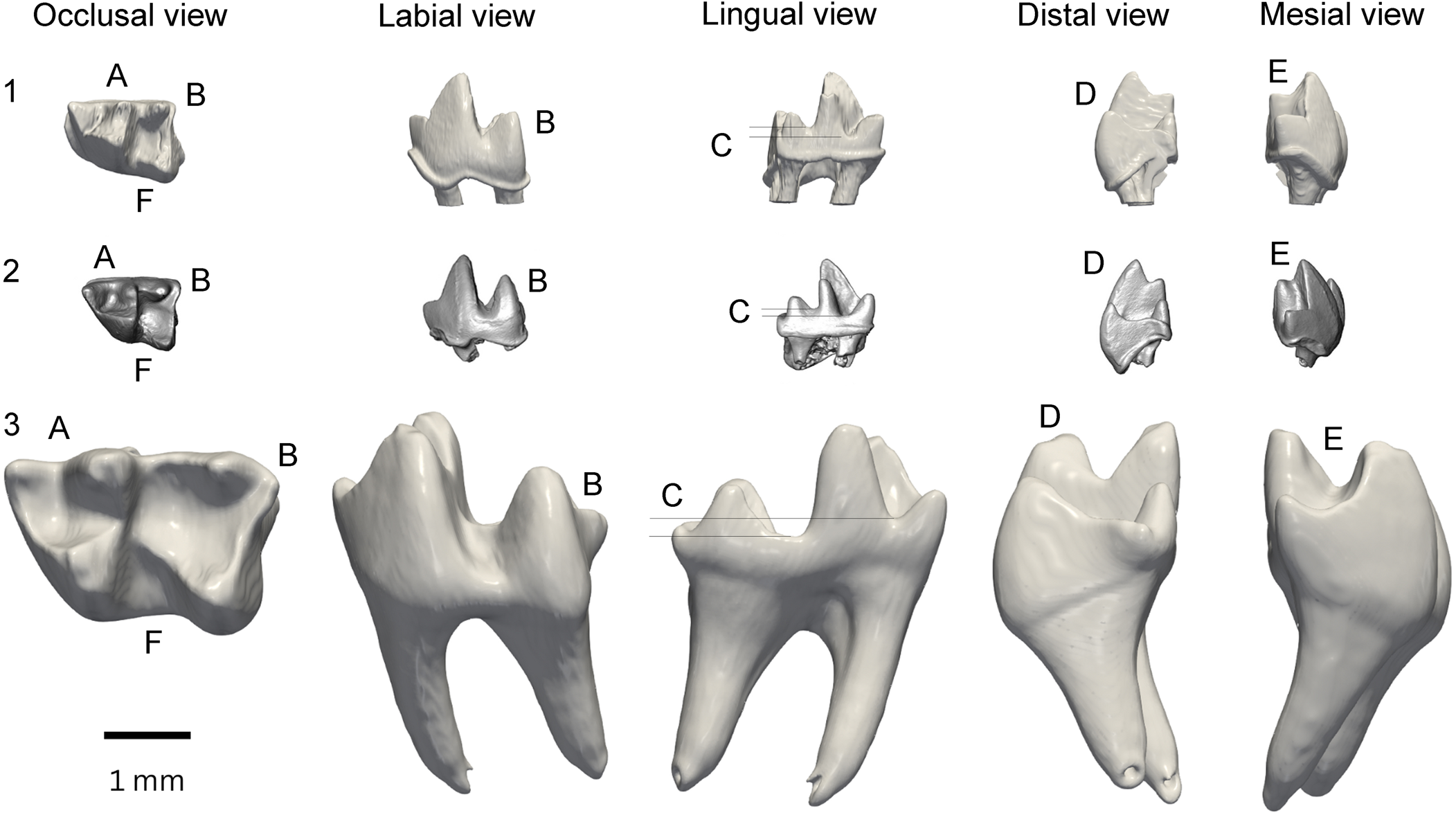
However, this is not the only character weakening the argument about the ascription of this fossil to a scandentian species. The most evident one is perhaps the absence of a true hypoconulid, a low cusp that overhangs the posterior margin of the lower molars of the tupaiids (Butler, Reference Butler and Luckett1980; Qiu, Reference Qiu1986). This element is connected to the hypoconid by a crest but separated by a groove from the entoconid in all Scandentia. The condition displayed in the fossil from Ramnagar better reproduces the shape of soricids, and more precisely as found in crocidurines (Fig. 1, occlusal and labial views), in which the entoconid cristid of the m1 is usually reduced or absent, the talonid is clearly shorter than the trigonid, the buccal reentrant valley opens high above the cingulum, and there is no trace of pigmentation (Repenning, Reference Repenning1967; Reumer, Reference Reumer1984; Dannelid, Reference Dannelid, Wojik and Wolsan1998).
Other than that, the lingual opening of the trigonid is positioned above the lingual opening of the talonid in Tupaia, but the opposite is true in Crocidura and Sivatupaia (Fig. 1, lingual view), which highlights a distinguishing feature between Soricidae and Tupaiidae (Qiu, Reference Qiu1986).
Another interesting difference observed is the relative sizes of protoconid and metaconid. Whereas in tupaiids the metaconid is higher than the protoconid or they are both similarly high, in soricids the protoconid is higher than the metaconid (Fig. 1, distal view). Furthermore, the crest linking both cuspids, the protolophid, has a wide valley in tupaiids in distal view. This differs from what is observed in specimen WIMF/A 4699, where the protolophid forms a kind of tilted right angle in frontal view, frequently found in crocidurines. This condition is exemplified by the species Crocidura kornfeldi Kormos, Reference Kormos1934 (Fig. 1, mesial view) from the southern Spanish site of Quibas-Sima (Piñero et al., Reference Piñero, Agustí, Oms, Blain, Furió, Laplana, Sevilla, Rosas and Vallverdú2020, Reference Piñero, Agustí, Laborda, Duval, Zhao, Blain, Furió, Laplana, Rosas and Sevilla2022). Moreover, the position of the contact between the oblique cristid and the protolophid is different, with the contact being closer to the midline of the tooth in Tupaia, and nearer the buccal border in Crocidura and Sivatupaia (Fig. 1, occlusal view).
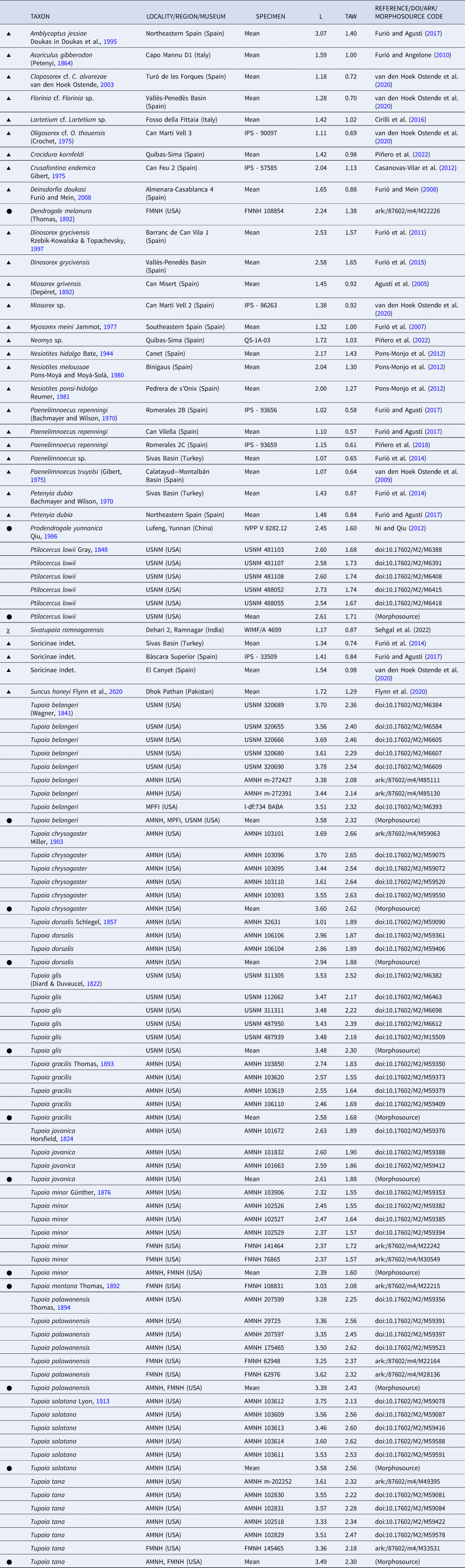
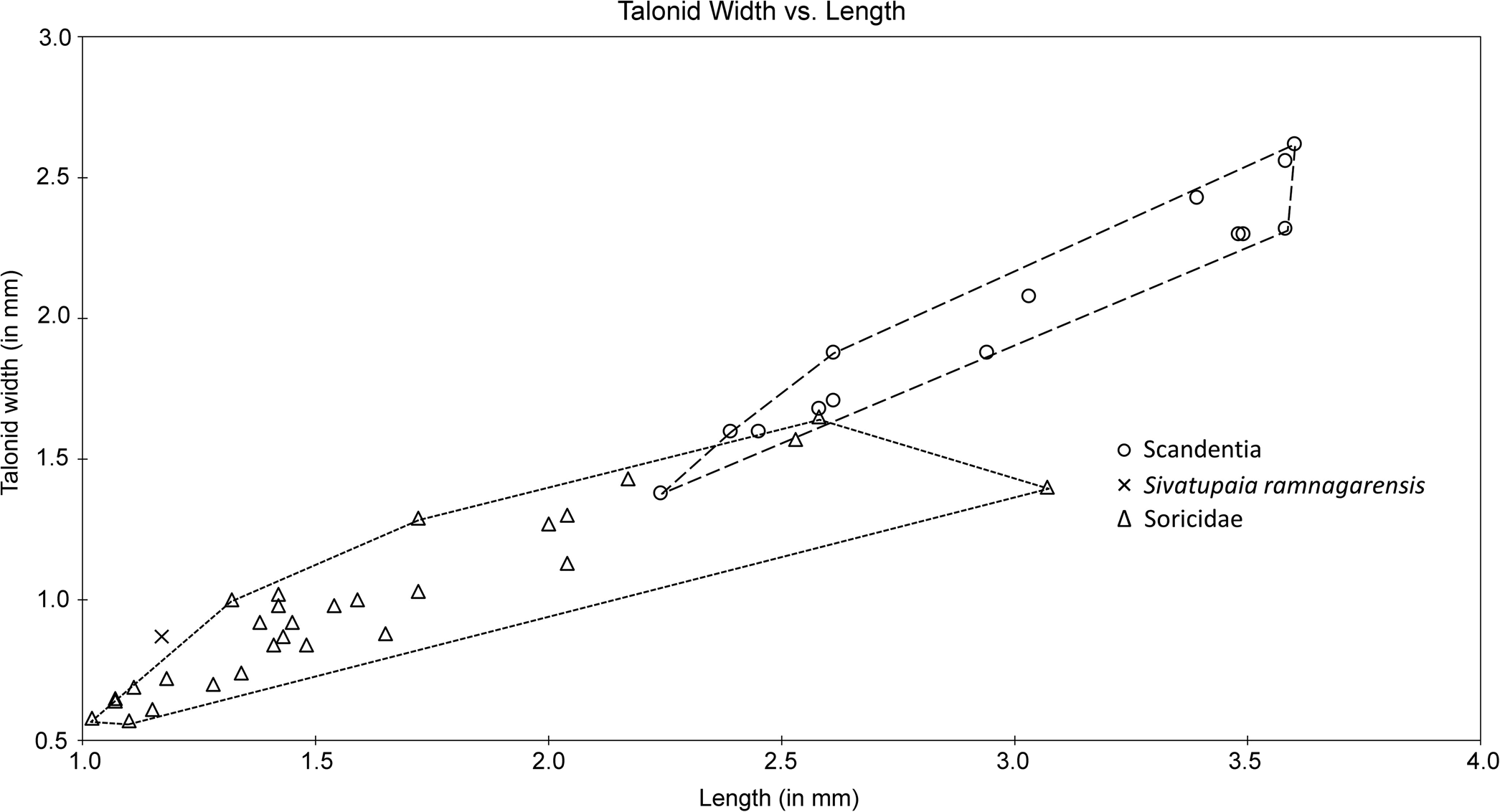
Finally, size provides an additional clue to this specimen's identification. Better than relative proportions, which are of little value in tribosphenic models, the absolute size of the element found marks a difference between the lower molar of Sivatupaia and those of all the species of Scandentia ever known. We have compiled a list of measurements of m1s of shrews and treeshrews (Table 1) based on published data and MorphoSource (Boyer et al., Reference Boyer, Gunnell, Kaufman and McGeary2016). Figure 2 plots absolute lengths (L) versus talonid widths (TAW) according to the methods in Reumer (Reference Reumer1984), placing Sivatupaia in the cloud of shrews, far away from the values for treeshrews. Although the larger species of soricids can occasionally fall within the range of tupaiids, Sivatupaia is too isolated within the cloud of shrews to be considered a dwarf scandentian according to the available data. Treeshrews (Scandentia) are almost always larger than ‘regular’ shrews (Soricidae), which is likely due to morpho-functional reasons related to their way of living. Many species and subspecies of tupaiids do not differ significantly in size between their mainland and island counterparts (Juman et al., Reference Juman, Woodman, Olson and Sargis2021), even if some patterns of variation combining insularity and latitude are discernible (Juman et al., Reference Juman, Millien, Olson and Sargis2022). Although modern treeshrews occupy a much more restricted geographical distribution than they did in the past (according to their known fossil record), the mean body mass of all present-day species of treeshrews ranges from 45 to 224 grams (Sargis, Reference Sargis2002) and their lengths of head and body range from 100 to 225 mm (Stone, Reference Stone1995), which are out of the expected range for a species with a molar scarcely longer than 1 mm.
Measurements of m1 in some fossil and recent species of Soricidae and Scandentia. The sample of soricid fossils is restricted to references in which the measurements have been taken directly by one of the authors to avoid any possible bias in the way of measuring, but Flynn et al. (Reference Flynn, Jacobs, Kimura, Taylor and Tomida2020) is also included due to the similar location and aging of the sites sampled. Except for Ni and Qiu (Reference Ni and Qiu2012), all the measurements in scandentian species have been taken using the data from Morphosource. AMNH = American Museum of Natural History – Mammal Collections, New York City (USA); FMNH = Field Museum of Natural History – Mammal Collection (Zoology), Chicago (USA); IPS = Institut Català de Paleontologia Miquel Crusafont, Barcelona (Spain); IVPP = Institute of Vertebrate Paleontology and Paleoanthropology, Chinese Academy of Sciences, Beijing (China); MPFI = Max Planck Florida Institute for Neuroscience – Fitzpatrick Lab, Jupiter (USA); QS = Quibas Sima Collection of Museo Arqueológico de Murcia, Murcia (Spain); USNM, National Museum of Natural History – Division of Mammals, Washington D.C. (USA); WIMF/A – Wadia Institute of Himalayan Geology Micro Fossil Collection Series A, Dehradun (India); L = length; TAW = talonid width; ▴ = Soricidae; ● = Scandentia; ꭓ = Sivatupaia.
Scatter diagram plotting length (L) versus talonid width (TAW) of m1 in several extinct and extant species of Scandentia and Soricidae. Detailed data and original references for the measurements are provided in Table 1.
For all these reasons, we consider that the specimen WIMF/A 4699 does not belong to a treeshrew. Nevertheless, this likely misidentification of the fossil tooth does not depreciate its real importance. Judging by the ratio between length and width of trigonid and talonid, this lower m1 most likely belongs to a white-toothed shrew. The morphological traits of the m1 of Sivatupaia ramnagarensis are typically found in crocidurine species, where the talonid is usually shorter but wider than its corresponding trigonid. Oddly, Crocidurinae and Tupaiidae share their mysterious evolutionary histories, with a gap in the fossil record between their purported origins and their corresponding oldest fossil records.
Some controversy exists on the origin of the white-toothed shrews. Due to its current diversity, Africa has been considered as a likely cradle for the origin of the Crocidurinae (Butler, Reference Butler, Wojik and Wolsan1998, Reference Butler, Werdelin and Sanders2010). However, the oldest unequivocal records of the subfamily in Africa do not extend in time beyond the Pliocene (Butler, Reference Butler, Wojik and Wolsan1998; Stoetzel, Reference Stoetzel2013). In fact, some molecular studies have suggested more complex evolutionary histories within crocidurines than expected, deducing Eurasian or Afrotropical origins for different genera (Dubey et al., Reference Dubey, Salamin, Ohdachi, Barrière and Vogel2007, Reference Dubey, Salamin, Ruedi, Barrière, Colyn and Vogel2008).
Reumer (Reference Reumer1984) considered that there were representatives of the Crocidurinae in Europe from the Early Miocene onwards, but in that work, he included some members with plesiomorphic characters that were finally reallocated into the subfamily Crocidosoricinae (Reumer, Reference Reumer1987). Thus, the fossil record of the subfamily in Europe is strictly limited to the Pliocene and Pleistocene (Rzebik-Kowalska, Reference Rzebik-Kowalska, Wojik and Wolsan1998), apparently restricting its latitudinal distribution for a long time due to climatic oscillations (Rzebik-Kowalska, Reference Rzebik-Kowalska1995; Furió et al., Reference Furió, Santos-Cubedo, Minwer-Barakat and Agustí2007; Rofes and Cuenca-Bescós, Reference Rofes and Cuenca-Bescós2011).
The fossil record of white-toothed shrews is longer in Asia. According to Storch et al. (Reference Storch, Qiu, Zazhigin, Wojik and Wolsan1998), the oldest unequivocal fossil occurrences of crocidurines in the world come from the Middle Miocene localities of Koçgazi and Sofça (Engesser, Reference Engesser1980), even though they could not be identified at the genus level. However, these occurrences are predated by recent discoveries from the Siwaliks of Pakistan, where crocidurine fossil elements with ages as old as 14 Ma have been reported by Flynn et al. (Reference Flynn, Jacobs, Kimura, Taylor and Tomida2020).
All these fossil finds reinforce the idea that the origin of the subfamily must be found in Asia rather than in Africa. In this sense, the holotype of Sivatupaia ramnagarensis is important because it aligns with the m1s attributed to the genera Crocidura and Suncus in Flynn et al. (Reference Flynn, Jacobs, Kimura, Taylor and Tomida2020). Indeed, the overall shape of the specimen WIMF/A 4699 exhibits numerous characters in common with the genera Crocidura and Suncus, such as the rather short talonid compared to the trigonid, the small and low entoconid cristid, the absence of pigmentation, and the small size.
Unfortunately, Sivatupaia ramnagarensis is smaller than all the species described by Flynn et al. (Reference Flynn, Jacobs, Kimura, Taylor and Tomida2020), so any possible synonymy with the species already identified from the Siwaliks is precluded. In fact, crocidurines display a high rate of phenotypic homoplasy and a low phylogenetic signal of some morphological features (Voyta et al., Reference Voyta, Abramov, Lavrenchenko, Nicolas, Petrova and Kryuchkova2022). Therefore, according to the latter work, the generic identification by Flynn et al. (Reference Flynn, Jacobs, Kimura, Taylor and Tomida2020) should be regarded as tentative due to the constraints imposed by the limited available material. Unlike molecular studies, which clearly track the phylogenetic relationships between many extant species, the morphology and the diagnostic characters of the transitional fossil forms between the Crocidosoricinae and the Crocidurinae are still unknown (Voyta et al., Reference Voyta, Abramov, Lavrenchenko, Nicolas, Petrova and Kryuchkova2022). With the only possible exception of Turiasorex, which also displays short talonids in its lower molars and no pigmentation in its teeth (van Dam et al., Reference van Dam, van den Hoek Ostende and Reumer2011), there are no clear candidates to fill the evolutionary gap from one group to another group. More surprisingly, no African site has ever provided unequivocal fossils of crocidurines of Miocene age (Butler, Reference Butler, Wojik and Wolsan1998, Reference Butler, Werdelin and Sanders2010; Stoetzel, Reference Stoetzel2013).
Therefore, whatever the generic identification of Sivatupaia ramnagarensis will eventually be, such a new find of a fossil element of a Crocidurinae (or a closely related Crocidosoricinae ancestor) at ages around 13 Ma reinforces the idea of Western Asia as the source area for the origin of the subfamily. This raises new questions, such as why crocidurines constrained their distribution in this area for so long, whereas in the African continent they radiated rapidly and expanded to all the existing habitats, or what was (or were) the factor (or factors) during the Miocene precluding the expansion of crocidurines into European lands. On the other hand, the question about why it is so hard to find fossil elements of Scandentia remains unsolved. All these questions require new fossil finds and their subsequent studies to be answered.
Acknowledgments
The authors would here like to express their gratitude to the referees L.L. Voyta, L.L. Jacobs, M.T. Silcox, and an anonymous reviewer, and to the editors J. Kastigar, J. Calede and C. Scott for kindly providing constructive comments and suggestions on the manuscript. This work was supported by Generalitat de Catalunya (1- ICP and IPHES belong to the CERCA Program; 2- M.F. is a Serra Húnter Fellow; 3- M.F. belongs to “PALEOSTRAT: paleontological and stratigraphic record from Cretaceous and Cenozoic”, Grup de Recerca 2021 SGR 00127) and the Spanish Ministry of Science and Innovation (1- IPHES belongs to the “María de Maeztu” program for Units of Excellence (CEX2019-000945-M); 2- P.P. is supported by a “Juan de la Cierva-Incorporación” contract (grant IJC2020-044108-I); 3- this paper is part of R + D+I project PID2020-117289GB-I00 funded by MCIN/AEI/10.13039/501100011033 (Agencia Estatal de Investigación) and “European Union Next Generation EU/PRTR”. SP thanks the following for providing access to MorphoSource micro-CT models of Scandentia included in this study: C. Wall provided access to I-df:734 BABA, USNM 112662, 311305, 311311, 320655, 320666, 320680, 320689, 320690, 4881103, 481107, 481108, 487939, 487950, 488052, and 488055, the collection of which was funded by NSF BCS 1304045 and a research grant from Trinity College of Arts and Sciences. Doug Boyer provided access to AMNH 202252, 272391, 272427, FMNH 62948, 62976, 76865, 108831, 108854, 141464, and 145465, the collection of which was funded by NSF BCS 1317525 (to DM Boyer and ER Seiffert), NSF BCS 1552848 (to DM Boyer) and Duke University Trinity College of Arts and Sciences. MT Silcox provided access to AMNH 29725, 32631, 101663, 101672, 101832, 102518, 102526, 102527, 102529, 102829, 102830, 102831, 103093, 103095, 103096, 103101, 103110, 103609, 103611, 103612, 103613, 103614, 103619, 103620, 103850, 103906, 106105, 106106, 106110, 175465, 207597, and 207599, originally appearing in Selig et al. (2019), the collection of which was funded by a grant from the University of Toronto Scarborough International Research Collaboration Fund and an Natural Sciences and Engineering Research Council of Canada Discovery Grant (to MT Silcox), as well as a Pilot Research Grant from the Department of Anthropology at the University of Toronto (to KR Selig). All micro-CT scans of Scandentia included in this analysis are available on MorphoSource.org, Duke University.
Competing interests
The authors declare none.


 Open access

