





Introduction
What is special about L3 processing and does it need to be treated separately from L2 processing? Trilingualism is often assumed to be an extension of bilingualism (de Bot & Jaensch, Reference de Bot and Jaensch2015; Hoffman, Reference Hoffman2001) but they need to be teased out and it cannot be assumed that both involve the same processes as different social, cultural, psychological and personality factors may influence trilingual acquisition and use (Hoffman, Reference Hoffman, Cenoz and Jessner2008). Bilingualism is a widely investigated area which has passed through several stages: deficit-oriented view from 19th century to the 1960s, emergence of bilingual advantage hypothesis from 1970s to 2000 and a backlash against bilingual advantage theory in the recent times (Jansen et al., Reference Jansen, del Moral, Barzen, Reimann and Opolka2021). After the backlash stage, there has been a resurgence of research with revived emphasis on high quality methodology and measurements. There exists a substantial body of theories and models of bilingualism. Among the prominent ones are: Inhibitory Control Model (Green, Reference Green1998); Adaptive Control Hypothesis (Green & Abutalebi, Reference Green and Abutalebi2013); Connectionist Models (Dijkstra, Reference Dijkstra, Cruse, Hundsnurscher, Job and Lutzeier2005; Dijkstra & Rekké, Reference Dijkstra and Rekké2010; Dijkstra et al., Reference Dijkstra, Haga, Bijsterveld, Sprinkhuizen-Kuyper, Altarriba and Isurin2011; Li & Farkas, Reference Li, Farkas, Heredia and Altarriba2002; McClelland & Rumelhart, Reference McClelland and Rumelhart1981, Reference McClelland and Rumelhart1988); Bilingual Interactive Activation Model (Dijkstra & Van Heuven, Reference Dijkstra, Van Heuven, Grainger and Jacobs1998, Reference Dijkstra and Van Heuven2002) which, actually, is a connectionist model developed specifically for predicting bilingual activation; Hierarchical Model (Kroll & Stewart, Reference Kroll and Stewart1994; Kroll et al., Reference Kroll, van Hell, Tokowicz and Green2010); The Bilingual Language Interaction Network for Comprehension of Speech Model (Shook & Marian, Reference Shook and Marian2012); Multilink Model (Costa & Pickering, Reference Costa and Pickering2018; Dijkstra et al., Reference Dijkstra, Wahl, Buytenhuijs, van Halem, Al-jibouri, de Korte and Rekké2018; Mishra, Reference Mishra2018). Schroeder and Marian (Reference Schroeder and Marian2017) proposed a cognitive plasticity framework to account for the differences and similarities between the bilinguals and trilinguals in what they claim to be the first comprehensive analysis of how learning of a third language affects the cognitive abilities which are modified by bilingual experience and claim that the framework they propose can explain and predict bilingual–trilingual differences. They tested and analyzed three aspects of cognition: cognitive reserve in older adults measured by age of onset of Alzheimer's disease and mild cognitive impairment; inhibitory control in children and younger adults measured by behavioral response times on Simon and flanker tasks; and memory generalization in toddlers and infants measured by accuracy on behavioral deferred imitation tasks. They observed a mixed pattern of results. Older adult trilinguals showed larger cognitive reserve advantages than did bilinguals; children and young adult trilinguals exhibited the same advantage as bilinguals in inhibitory control; toddler and infant trilinguals did not demonstrate the advantages seen in bilinguals in memory generalization. The authors concluded that the cognitive consequences of trilingualism are distinct and not mere extension of effects of bilingualism with theoretical implications for understanding of linguistic and cognitive processes that can be applied in educational and rehabilitative contexts for fostering successful cognitive development and ageing. This was mainly a cognitive study rather than linguistic and does not reveal exactly how the simultaneous activation of three languages is processed. We were interested in testing this phenomenon in adult third language acquirers.
Several studies investigating trilingualism have appeared in the first two decades of the 21st century which have mostly used experimental paradigms used in bilingual studies. Tytus (Reference Tytus2017) and Francis and Gallard (Reference Francis and Gallard2005) used the priming paradigm for testing lexico-semantic memory and concept mediation in translation respectively. Cenoz (Reference Cenoz, Cenoz, Hufeisen and Jessner2001) investigated cross-linguistic influence in third language acquisition using translation task. Lemhofer et al. (Reference Lemhofer, Dijkstra and Michel2004) studied cognate effects in trilingual word recognition. Schwieter and Sunderman (Reference Schwieter and Sunderman2011) used verbal fluency task to investigate inhibitory control processes and lexical access in trilingual speech production. Charkova (Reference Charkova2003) compared monolingual, bilingual and trilingual children on grammaticality judgement task to study their early foreign language education and metalinguistic development. Lexical decision task was used by Alonso et al. (Reference Alonso, Villegas and Mayo2016) to study the effects of dominance and sequential multilingualism on English compound and non-compound processing in bilingual and multilingual speakers and by Ibrahim and Eviatar (Reference Ibrahim and Eviatar2012) to investigate the contribution of the two hemispheres to lexical decision in different languages. Likewise, picture naming has been used by Costa et al. (Reference Costa, Santesteban and Ivanova2006) to investigate inhibitory and language-specific selection mechanisms, Festman (Reference Festman, Gibson, Hufeisen and Personne2008) investigated cross-language interference in trilingual picture naming in single and mixed conditions, Poarch and Van Hell (Reference Poarch and Van Hell2012) used picture naming to investigate cross-language activation in speech production in bilingual and trilingual children, Guo et al. (Reference Guo, Ma and Liu2013) used this paradigm to investigate inhibition of non-target languages in trilingual word production in an ERP study. Language switching paradigm has been used quite a lot in bilingual studies which also has been tested in trilingualism. Linck et al. (Reference Linck, Schwieter and Sundarman2012) used this paradigm to study inhibitory control and speech production in trilinguals. Marian et al. (Reference Marian, Blumenfeld, Mizrahi, Kania and Cordes2013) used language switching in multilingual Stroop task to investigate the effects of trilingualism and proficiency on inhibitory control. Festman and Mosca (Reference Festman, Mosca and Schwieter2016) used language switching paradigm in a trilingual digit-naming study to investigate the influence of preparation time on language control. Hut et al. (Reference Hut, Helenius, Leminen, Makela and Lehtonen2017) used neuromagnetic trilingual language switching task to study how language control mechanisms differ for native languages. Mosca (Reference Mosca2018) studied trilinguals’ language switching from strategic and flexible account. Researchers have been investigating third language acquisition and learning from various perspectives like linguistic transfer (Rothman, Reference Rothman2010; Rothman et al., Reference Rothman, Alonso and Puig-Mayenco2019), bilingual education (Rutgers & Evans, Reference Rutgers and Evans2017) or bilingual literacy (Sanz, Reference Sanz, Pérez-Vidal, Juan-Garau and Bel2007) and have found evidence for additive advantage of trilingualism (Cenoz & Valencia, Reference Cenoz and Valencia1994) and enhancing effect of bilingual education on third language acquisition (Sanz, Reference Sanz2000). Learning of multiple languages is believed to confer direct (transfer effects from early language learning experience to novel experience) and indirect (socially and cognitively mediating abilities changed due to prior experience and influencing novel learning) effects linguistically and cognitively (Hirosh & Degani, Reference Hirosh and Degani2017). Most of these studies deal with language production and interference or inhibition. These studies have not investigated online language comprehension when three languages are activated simultaneously in parallel to each other.
What is apparent from this brief overview of trilingual studies is that trilingualism has been taken mostly as an extension of bilingualism and it is possible to study trilingualism from bilingual cannons. However, it is equally pertinent to treat trilingualism as a separate phenomenon from bilingualism and seek to investigate mechanism(s) which may contribute in theorization and further understanding of this cognitive landscape that constitutes a majority of the world population, especially in the regions like South Asia where multilingualism is more prominent than bilingualism and monolingualism is in the minority. This is also important where South Asian population is becoming more and more global by way of migration to western countries. They are becoming an influential diaspora, contributing in the country of their settlement and also to their country of origin.
Heritage language perspective: Nepali as a mainstream language in Nepal and a heritage language in Norway
A language is regarded as a heritage language if it is spoken at home and is readily available to young children, and is crucially not a dominant language of the larger or national society where the individual lives and will be called a heritage speaker only if s/he has command over heritage language acquired naturalistically but may differ from native monolinguals of comparable age (Rothman, Reference Rothman2009). In their keynote article, Polinsky and Scontras (Reference Polinsky and Scontras2019) synthesize theoretical claims and empirical observations about robust and vulnerable areas of heritage language competence and propose a predictive model of heritage language competence. They highlight two key triggers of deviation from baseline: quality and quantity of the input from which the heritage grammar is acquired; and the economy of online resources when operating in a less dominant language. They also identify three outcomes of deviation in the heritage language in response to these triggers: an avoidance of ambiguity, a resistance to irregularity; and a shrinking of structure. Study of heritage languages is emerging as an independent academic field in its own right (Lynch, Reference Lynch2014) and several mainstream languages of the world have been studied from heritage language perspective: for example, heritage English (Polinsky, Reference Polinsky2018b), heritage Spanish (Montrul, Reference Montrul2016; Silva-Corvalán, Reference Silva-Corvalán1994), heritage Russian (Laleko, Reference Laleko2010), heritage Inuttitut (Sherkina-Lieber, Reference Sherkina-Lieber2011, Reference Sherkina-Lieber2015), heritage Arabic (Albirini et al., Reference Albirini, Benmamoun and Saadah2011), heritage Mandarin (Jia & Bayley, Reference Jia, Bayley, He and Xiao2008), heritage German (Putnam & Salmons, Reference Putnam and Salmons2013), heritage Korean (O'Grady et al., Reference O'Grady, Lee and Choo2001) to name some of them. Many countries are already implementing school instruction in heritage language. For example, Canada has introduced heritage language programs to heritage language speakers in around 60 ethnic languages (Baker & Prys Jones, Reference Baker and Prys Jones1998) with several provinces using heritage language as medium of instruction in heritage language bilingual education programs as declared policy to maintain valuable economic resource and promote intercultural and cross-cultural understanding (Manitoba Education and Training, 1993). Poarch and Bialystok (Reference Poarch and Bialystok2017) assess that with the increased influx of migrants into European Union, the challenge is to integrate the migrant children who are already fluent in one or more languages into the mainstream majority language – for example, German – and assist them in becoming successful multilinguals that would develop their executive control and boost their long-term academic success. So much so, Marian et al. (Reference Marian, Blumenfeld, Mizrahi, Kania and Cordes2013) found that Spanish speaking low SES children and English speaking monolingual middle class children enrolled in Spanish–English bilingual programs performed better on reading and mathematics test compared to the children in monolingual programs. We believe that our study will provide additional insight into heritage language research where heritage speakers maintain their multilingual character by processing two to three languages simultaneously in general, and Nepalis as heritage speakers as they start to acquire the language of the country of their settlement in particular. This study also may serve as a baseline study for future reference in this linguistic situation.
Norway has attracted a large number of students from Nepal in graduate programs in different universities – but predominantly in Norwegian University of Science and Technology (NTNU), Trondheim in medical, engineering and humanities programs – who have contributed back in Nepal; but many stay in Norway and take up different professions. Their children grow up as heritage Nepali speakers. Norway is also one of the eight countries (others being Australia, Canada, Denmark, New Zealand, the Netherland, the US and the UK) that resettled the Nepali speaking Bhutanese refugees from Nepal in their countries (Shrestha, Reference Shrestha2015). These refugees are settled in different parts of Norway and are trying to integrate themselves with the new linguistic and socio-cultural landscape (Bhattarai, Reference Bhattarai2014; Sharma, Reference Sharma2012). This scenario indicates Norway will soon have substantial number of heritage Nepali speaking population for whom educational arrangements in their first language alongside the majority language Norwegian and English will have to be made. Our Norwegian language stimuli represent the mainstream Bokmal (Haukås et al., Reference Haukås, Storto and Tiurikova2021a, Reference Haukås, Storto and Tiurikova2021b). This study was conducted on the sample of population born in Nepal and living in Trondheim, Norway at the time of data collection. Hence, we anticipated our design would be indicative of the trilingual language processing that our sample represented.
Theoretical framework in trilingual processing
In the absence of clear theories and models that predict trilingual processing, we have relied on bilingual theories and models. Among these theories, Inhibitory Control Model (ICM) and Adaptive Control Hypothesis (ACH) come closer in predicting and explaining our study design. Although both ICM and ACH are language production theories, we have applied them to language comprehension in lexical access mediated through parallel language activation paradigm. ICM predicts language non-selective activation and inhibition of unselected lexicon by exertion of inhibitory control on the language currently in use and allowing activation of currently active language. ACH predicts the way different cognitive controls interact with different language contexts in a cascading manner. Thus, we would expect ACH to predict the way the three languages in our design interacted with each other in the bimodal parallel language activation paradigm.
If not exactly trilingual processing model, the Cumulative Enhancement Model for Language Acquisition (Flynn et al., Reference Flynn, Foley and Vinnitskaya2004) was proposed to make predictions about subsequent trilingual acquisition. The underlying assumptions and arguments of this model are that language learning is a cumulative process and all known languages potentially influence the subsequent language leaning, with no privileged role of L1 in subsequent language acquisition. Flynn et al. (Reference Flynn, Foley and Vinnitskaya2004) compared children and adults learning L1 Kazakh, L2 Russian and L3 English in the study investigating the role played by L1 or all the known languages in subsequent language acquisition. They found that L1 does not play a privileged role in subsequent language acquisition; rather, the last learned language determines the next language learned and subsequent language learning is accumulative and prior language enhances the subsequent acquisition. Results of a recent neurolinguistics study (Umejima et al., Reference Umejima, Flynn and Sakai2021) support Cumulative Enhancement Model. Umejima et al. conducted an fMRI experiment on bilinguals and multilinguals (with L1 Japanese, L2 English, L3 Spanish, L4 Kazakh) to evaluate the acquisition of syntactic features in a new language (Kazakh) and found that multilinguals with higher proficiency in their second and third languages required fewer task trials to acquire Kazakh phonology with greater reduction in response times in multilinguals than bilinguals during initial exposure to Kazakh. Significantly enhanced activations in the left ventral inferior frontal gyrus was seen for multilinguals compared to bilinguals indicating more enhanced syntax-related and domain-general brain networks for multilinguals. They also observed significant activations for multilinguals in the visual areas which implied multilinguals were able to use visual representation even while listening to speech sounds alone, showing that multilinguals were able to utilize acquired knowledge in an accumulated manner. We predicted our participants to exhibit accumulative and facilitative effect in processing the parallel activations of the three languages that we tested on them. Theoretically, we expected our study to support the interdependence hypothesis (Cummins, Reference Cummins1979a, Reference Cummins1979b, Reference Cummins and Bialystok1991) that predicts additive effect as children add a second language as their linguistic and academic tool kit (Cummins, Reference Cummins2000, Reference Cummins2007) that enhances their linguistic and academic performance (see Pathak et al., Reference Pathak, Rijal and Pathak2021 for the study that found instruction in second language enhances linguistic and cognitive abilities in first language as well). We would expect that if adding a second language to the first language repertoire had additive benefit, addition of a third language would also show up additional advantage when processing three languages simultaneously.
Mouse tracking as a tool for investigating trilingual processing
MouseTracker (Freeman & Ambady, Reference Freeman and Ambady2010) has proven to be an effective tool in the study of bilingualism in recent times (for example, Incera & McLennan, Reference Incera and McLennan2015, Reference Incera and McLennan2016, Reference Incera and McLennan2017; Incera et al., Reference Incera, Tuft, Fernandes and McLennan2020, Reference Incera, Shah, McLennan and Wetzel2017; Lin & Lin, Reference Lin and Lin2016; Pathak et al., Reference Pathak, Rijal and Pathak2021; Pathak & Pathak, Reference Pathak and Pathak2022). Mouse tracking has also been used to tease out the temporal details of the bilingual processing. For example, Incera and McLennan (Reference Incera and McLennan2016) reinvestigated and challenged the claims of Roelofs (Reference Roelofs2010) that within and between language effects follow the same time course in bilinguals. The authors also exhibited that mouse tracking can even outscore eye tacking when it comes to the capturing of temporal processing details by revisiting the seminal eye tracking work on bilingual parallel language activation study of Marian and Spivey (Reference Marian and Spivey2003b; see Pathak et al., Reference Pathak, Rijal and Pathak2021 for comparison of mouse tracking with eye tracking and button press paradigms). We wanted to further test its efficacy in trilingual processing (Pathak, Reference Pathak2020; Pathak, Reference Pathak2022b) because of its unique features and architecture in recording temporal and spatial cognitive processing of participants’ response patterns modulated by the experimental manipulation.
MouseTracker provides rich temporal and spatial data of continuous online cognitive processing with a sampling rate of 60–70 Hz. It records and generates both raw and normalized time data of cognitive processes by tracking their manual responses as the participants move their hand to make responses using the computer mouse (Freeman & Ambady, Reference Freeman and Ambady2010; Incera & McLennan, Reference Incera and McLennan2015; Pathak et al., Reference Pathak, Rijal and Pathak2021; Spivey et al., Reference Spivey, Grosjean and Knoblich2005). It acquires continuous data points in x and y coordinates across the computer screen by tracking the hand movement trajectories which capture temporal and spatial cognitive processing. Each trajectory is normalized to 101 timesteps, with each timestep having a corresponding x - and y - coordinate (Freeman & Ambady, Reference Freeman and Ambady2010). Temporally, initiation and response times can be analyzed. Initiation time captures the initial stage of cognitive processing: the time when the mouse movement is initiated to make the response. The cut-off time in our study was 1000 ms to initiate the mouse movement after clicking the START button: upon exceeding this limit, the participant would get a message to start moving the mouse early on, even if they are not sure of the response yet; and the trial would be aborted. The participants were asked to click the response button as soon and as accurately as possible once the mouse movement had been initiated. The trials remained onscreen until the response was made. Response time captures the later cognitive processing, completing the decision-making process, when the participants have decided to select one response over the other. In our design, the trials remain on the screen until the participants makes the response. Area Under the Curve (AUC) and Maximum Deviation (MD) are spatial measurements. AUC indexes overall attraction toward unselected response, incorporating all time steps whereas MD indexes maximum attraction toward the unselected alternative which is limited to few timesteps (higher the MD, the more the trajectory deviation toward the unselected response). In our study, these measures would indicate the degree and magnitude of competition or facilitation experienced by the participants in the presence of competing lexicon in another language when the input is in one language.
The present study
In this study, we have investigated parallel language activation in Nepali–English–Norwegian trilinguals. Our participants were all born in Nepal and spoke Nepali as their L1 whose L2 was English as they had received their secondary and tertiary education in English and had learned Norwegian as their L3 with different degree of proficiency who were living in Trondheim, Norway where the study was conducted, mostly pursuing or completed graduate programs in Norwegian University of Science and Technology. They were all fluent in their L1 and L2 but were different in fluency in their spoken L3 but largely they could comprehend it. We were interested in testing how such population who had migrated to a foreign country in their adult life processed their three languages, whether one language influenced other language. Our main research question was how did the language acquired in late life affect the other two languages in terms of processing and whether the first two languages affected the third language in terms of activation and what was the nature of activation in all the three languages?
We designed our experiments in MouseTracker (Freeman & Ambady, Reference Freeman and Ambady2010), which has proven to capture the fine-grained cognitive and linguistic processing as the participants move their mouse to initiate and make responses. The pattern of mouse movements would give us the clue to the nature of activation and processing of all the three languages.
Ethical consideration
All the participants gave written informed consent to participate in the study who were also told that they could withdraw from the study at any stage. Before the data collection, approval was also obtained from the Norwegian Center for Research Data (NSD) through Norwegian University of Science and Technology (NTNU) where this research study was hosted.
Methods
Participants
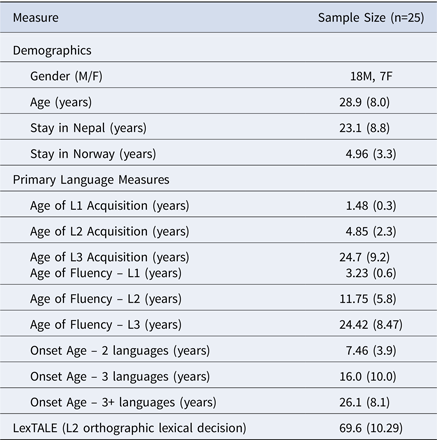
Twenty-five participants (male = 18) with mean age 28.9 years (SD = 8.02 years), age range 12–44 years, participated in online L2 proficiency test LexTALE, mouse tracking trilingual parallel activation task, and trilingual verbal fluency tasks. Two of the youngest participants were age 12 and 13 who had lived in Trondheim for 5 and 11 years respectively and had acquired a high level of proficiency. They were comparable to the adult participants as per their trilingual proficiency. Their parents gave consent for their participation. The eldest participant was 44 years old. All the participants were born and lived in Nepal and were living in Trondheim, Norway during the time of data collection where this study was conducted. Their mean year of stay in Trondheim was 4.96 (3.3) years. All of them gave written informed consent and filled up a language history questionnaire that required them to provide information regarding their duration of stay in Nepal and Norway, age of acquisition of L1, L2 and L3; proficiency in listening, speaking, reading and writing in all the three languages, literacy acquisition in all three languages. Because of a substantial span of age range (12-44 years), some discrepancy has been noticed in the mean values of L3 (for example, age of L3 acquisition as around 25 years, age of L3 fluency in about 24 years but onset age of L3 is 16 years and onset age of more than three language is 26 years. Among 25 participants, only 12 reported to have attained some fluency in L3 and the remaining 13 reported not having attained fluency in L3 yet. They were fluent in their L1 (Nepali) and L2 (English) and had learned L3 (Norwegian) in Trondheim during their stay for study or employmentFootnote 1. Their LexTALE score of 70% indicated high degree of proficiency in L2 (Table 1).
Demographic profile and language history of participants
Design, materials and stimuli
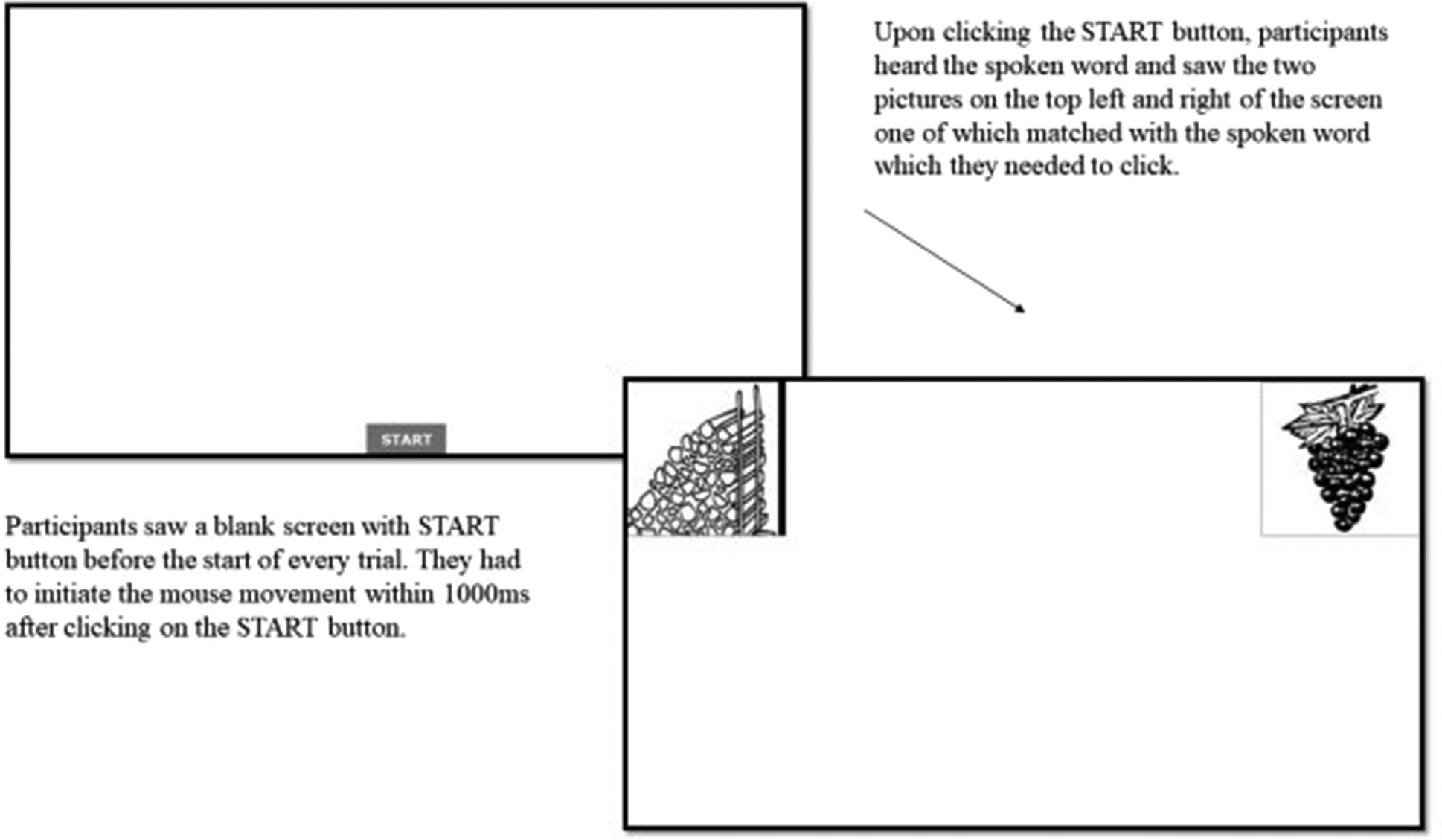
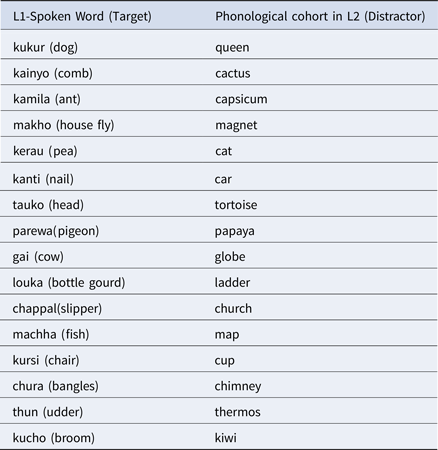
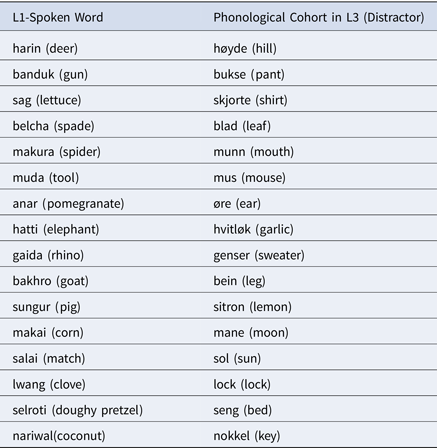
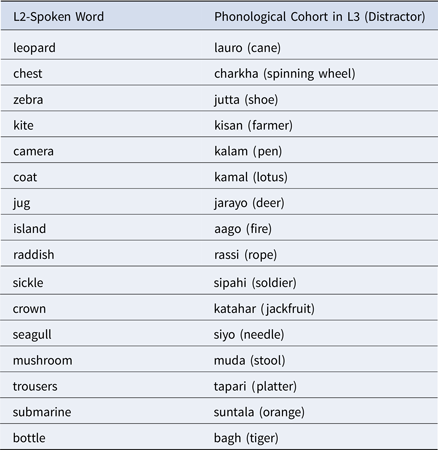
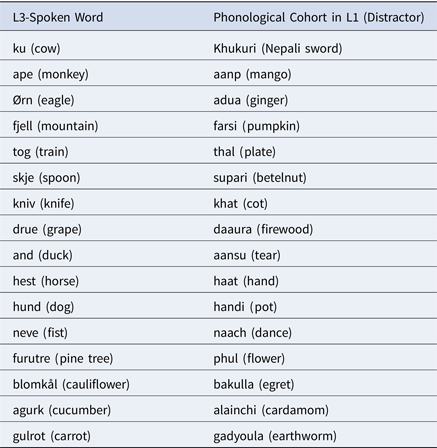
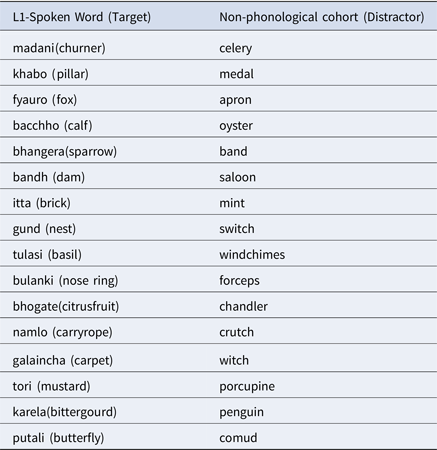
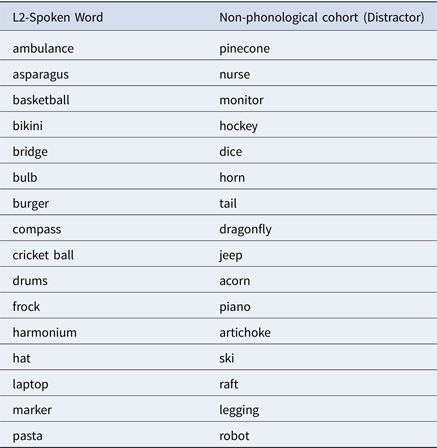
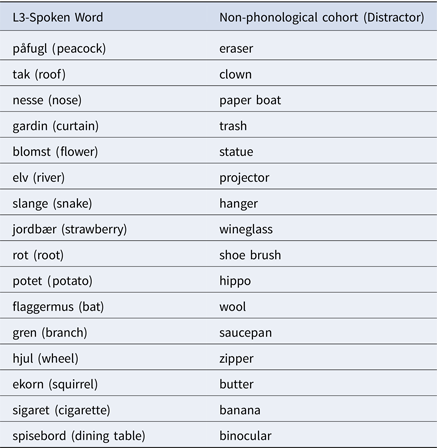
Stimuli were created to test language comprehension and production, and executive control in L1 (Nepali), L2 (English) and L3 (Norwegian). For trilingual processing, spoken word stimuli were recorded in the Fonlab (building 4, room 4509) at NTNU Dragvoll Campus in the voice of female native speakers of Nepali (Standard), English (British) and Norwegian (Bokmal) with the following recording specification: Microphone: Shure KSM44; Preamp: Focusrite ISA 428; Soundcard/Interface: Focusrite Saffire Pro 40; Computer: Dell Optiplex 980 (Windows 7); Software: Adobe Audition 3.0; Fileformat: wav, mono, 16 bit, 44khz. Black and white line drawings were selected from the internet to match the spoken word (target) and distractor. The pictures were mostly standardized images which have been used previously in such researches as well (Rossion & Pourtois, Reference Rossion and Pourtois2004; Snodgrass & Vanderwart, Reference Snodgrass and Vanderwart1980). In every trial, there were two pictures of which one matched with the spoken word and the other didn't. We created 16 lexical stimuli in each condition which resulted into 48 (16 x 3) in three phonological cohort condition in three language directions, likewise 48 (16 x 3) non-phonological cohort distractor condition. All together, there were 96 spoken word trials whose matching pictures were used as targets and there were equal number of distractor pictures which made it 192 picture stimuli. The distractors were either phonological or non-phonological in type with between-language conditions. The phonological distractors are referred to as competitor, as we hypothesize that they compete for selection, as a function of their onset similarity. The non-phonological distractors are merely referred to as distractors as they would not compete for selection as much as the phonological cohorts would. The type of distractor would allow us to measure the degree of parallel activation across all the three languages. The targets and distractors were counter balanced across all the trial condition so that there would be equal number of stimuli on both sides of the screen. We did not block the stimuli language-wise; rather we presented the stimuli in all the three languages randomly so that we could test the simultaneous activation of all the three languages at once. The picture stimuli appeared on the top left and right corners of the computer screen. The inter trial interval was 1000 ms. Mouse tracking experiment was designed to test the effect of L1 on L2 and L3 and that of L2 and L3 on L1 in phonological cohort and non-phonological cohort conditions. As we had almost exhausted the list of concrete nouns sharing the onset phonological similarity, we could not create conditions for effect of L2 on L3 and the effect of L3 on L2, so this would leave out the L2-L3 and L3-L2 comparison in the analysis. This put a limitation on the complete and equal number of lexicon across different cross-conditions (L2-L3 competitor vs distractor and L3-L2 competitor vs distractor). See Figure 1 for trial sample (see Appendix for full list of lexical stimuli).
Trial sample showing the visual display of response stimuli. In this trial participants heard drue (grapes) as L3 Norwegian auditory input and saw the pictures of grapes and firewood (daura in L1 Nepali) – both the words activated by visual display sharing phonological similarity.
In verbal fluency task, three phonemes – /p/, /t/ and /k/ – for phonemic fluency and three categories – animal, fruit and flower – for semantic fluency test were used across all the three languages. In English (L2) F, A, S are the most commonly used phonemes and the same category for VFT task (Gollan & Montoya, Reference Gollan and Montoya2002; Patra et al., Reference Patra, Bose and Marinis2020). In Nepali (L1) and Norwegian (L3), we did not come across any normed or standardized test items for VFT (see Pathak et al., Reference Pathak, Rijal and Pathak2021; Pathak & Rijal, Reference Pathak and Rijal2022 for VFT in Nepali), so we used the most common stop phonemes (that occur in most of the languages of the world) for phonetic fluency in L1 and L3 and likewise for the semantic category as these categories are quite common across languages.
Online lexical decision task, LexTALE (Lemhofer & Broersma, Reference Lemhöfer and Broersma2012) was used to test the L2 proficiency of participants.
Procedure
Participants were recruited through the Nepalese Society in Trondheim (NEST), a body of current and past Nepalese students at Norwegian University of Science and Technology (NTNU) who had come from Nepal to pursue higher education in various academic disciplines. All the participants gave written informed consent to take part in the study. Informed consent for the two participants below the age of 18 was obtained from their parents. During the experiment, each participant was seated in a quiet room and administered the tasks. In parallel language activation task, participants were asked to listen to the spoken word in either L1, L2 or L3 randomized across the participants and asked to click on the picture that matched with the auditory input. When the participants clicked on the START button, the audio and visual stimuli would appear at the same time and upon making a click on the response trial, the screen would disappear and a blank screen would appear showing only the START button for the next trial to get activated. The blank screen stayed on the screen until the participants clicked the START button. After this they had to move the mouse immediately within 1000 ms, else the trial would get aborted after asking the participants to move the mouse early on. The response trial screen remained until the participants made the response with the click of a mouse on either of the two response buttons. After which next blank screen would appear for the next trial. For example, in phonological cohort condition, In L1–L2 language direction when the participants clicked on the START button they would hear kerau (pea) and would simultaneously see the display of the picture of pea and cat, activating the same onset phoneme /k/, of which they would be required to click on the picture of pea; in L1–L3 direction, they would hear harin (deer) which shares phonological similarity with L3 høyde (hill), activating the same onset phoneme /h/ and on the visual display would be the pictures of deer and hill of which they were to click on deer. Since all the three languages belong to Indo-European family, we would expect some phonological overlap or cognates. Though English and Norwegian share enough cognates, Nepali didn't have as many cognates with either, except in case like borrowed word from English cigarette which had similar phonological form in both Norwegian and Nepali. Our design of selecting phonological matches for the stimuli in phonologically similar condition allowed us to try all the available possibilities across all the three languages. We didn't find such cognate overlaps that would affect or confound our results. However, in parallel activation of the three languages, it might be expected that a particular pair might also activate a word from the other language. For example, kukur “dog” in Nepali and “queen” in English pair might also activate ku “cow” in Norwegian (see Figure 1 for Trial Sample).
In verbal fluency task, participants were asked to create as many words as they could from the given phoneme or category in 60 seconds. They were asked not to use proper nouns and inflectional forms or derivations – for example, they couldn't use people or place names, or plural or tense forms or derivations of the same word like book, books, bookish (all these three would be counted as one category).
In LexTALE, the participants would see a string of letters on the screen and they had to decide whether the string was a legitimate word or not. Some pronunciable nonwords would be confused as real word and some unfamiliar but legitimate word might be confused as nonword. Their ability to correctly judge was indexed as mark of proficiency.
Data processing and analysis
MouseTracker data were extracted from its built-in Analyzer. We extracted normalized time data for Initiation Time, Response Time, Area Under the Curve (AUC) and Maximum Deviation (MD). Time normalization allows for the averaging and comparison of x -, y - coordinates of each trajectory across multiple trials with different number of coordinate pairs into 100 time-normalized equal spaces between coordinate samples using linear interpolation for 101 default time steps (Freeman & Ambady, Reference Freeman and Ambady2010). Initiation Time (for mouse movement) was set between 50–1000 ms and Response Time (click the response button) was set for 4000 ms, which means the data outside this range was not considered for analysis. 101 x- and y- coordinates were included for spatial measurement to assess overall activation (AUC) and peak of activation (MD). All the response trajectories heading to response no. 1 (top left-hand side) were overlayed by remapping and directing them to response no. 2 (top right-hand side) for the direct comparison, without affecting the data as both the response locations were symmetrical to each other in the standard coordinate space (Freeman & Ambady, Reference Freeman and Ambady2010; Incera & McLennan, Reference Incera and McLennan2017; Pathak, Reference Pathak2022a; Pathak & Pathak, Reference Pathak and Pathak2022; Pathak et al., Reference Pathak, Rijal and Pathak2021). Only the correct trials were included for the final analysis to eliminate potential biases due to different data cleaning ways (Incera & McLennan, Reference Incera and McLennan2017; Zhou & Krott, Reference Zhou and Krott2016).
For VFT, mean and standard deviation of the words produced for each phoneme and categories; likewise, for LexTALE, mean and standard deviation of the correct responses for the strings of letters correctly identified have been reported.
Preliminary data processing and analysis like mean and standard deviation was done in Excel, ANOVA was run in SPSS and plots were made using R.
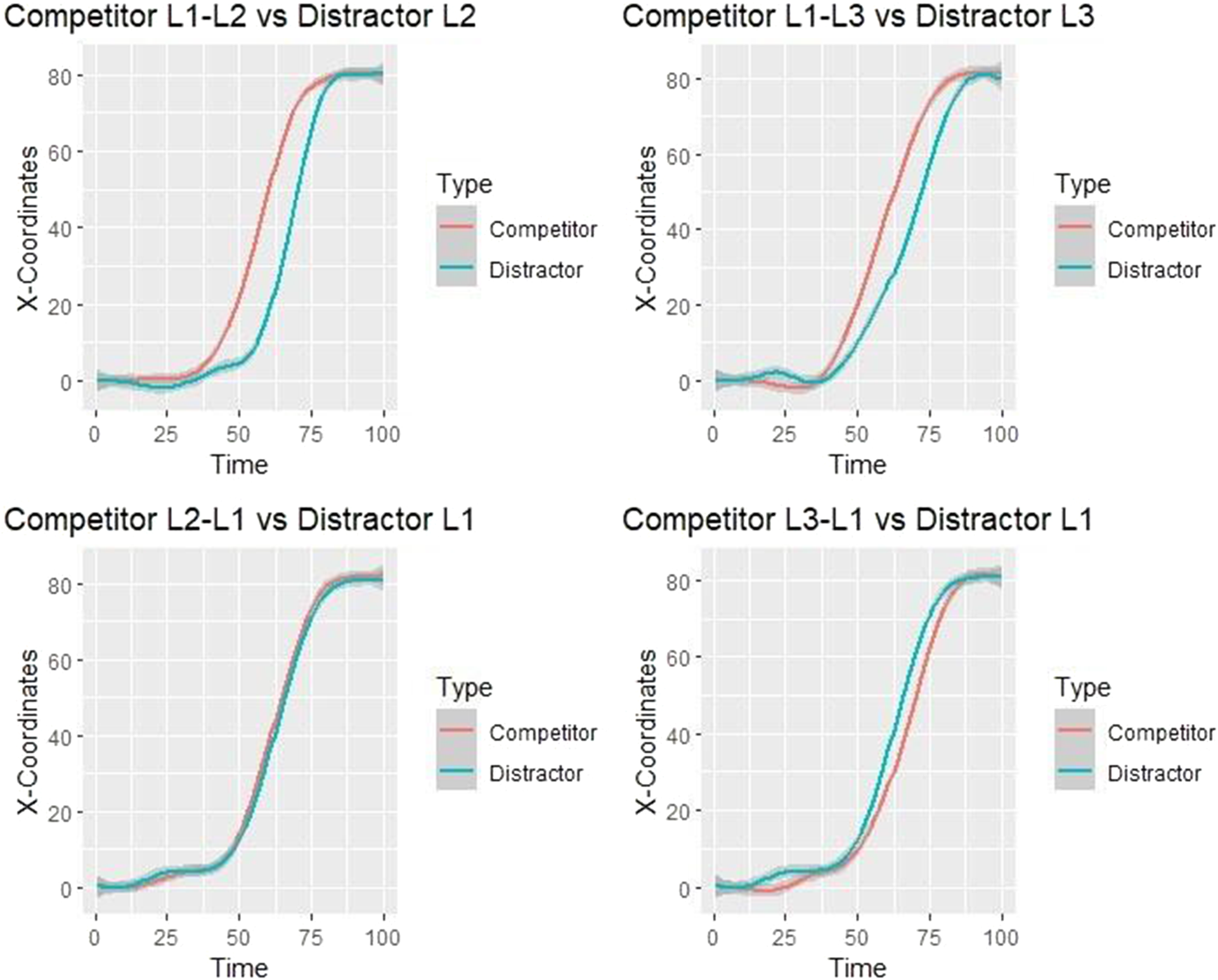
In the plots below (figures 2–4), we have shown phonological cohorts in terms of competitor and directionality (for example, competitor L1-L2) and non-phonological cohort as distractor, without mentioning the direction as the input word in the non-phonological distractor condition did not match phonologically with the distractor word on the opposite side of the target word. AUC and MD are also combined in the same plot.
Activation differences across three language directions in phonological cohort and non-phonological cohort conditions in 100 time steps for X coordinates.
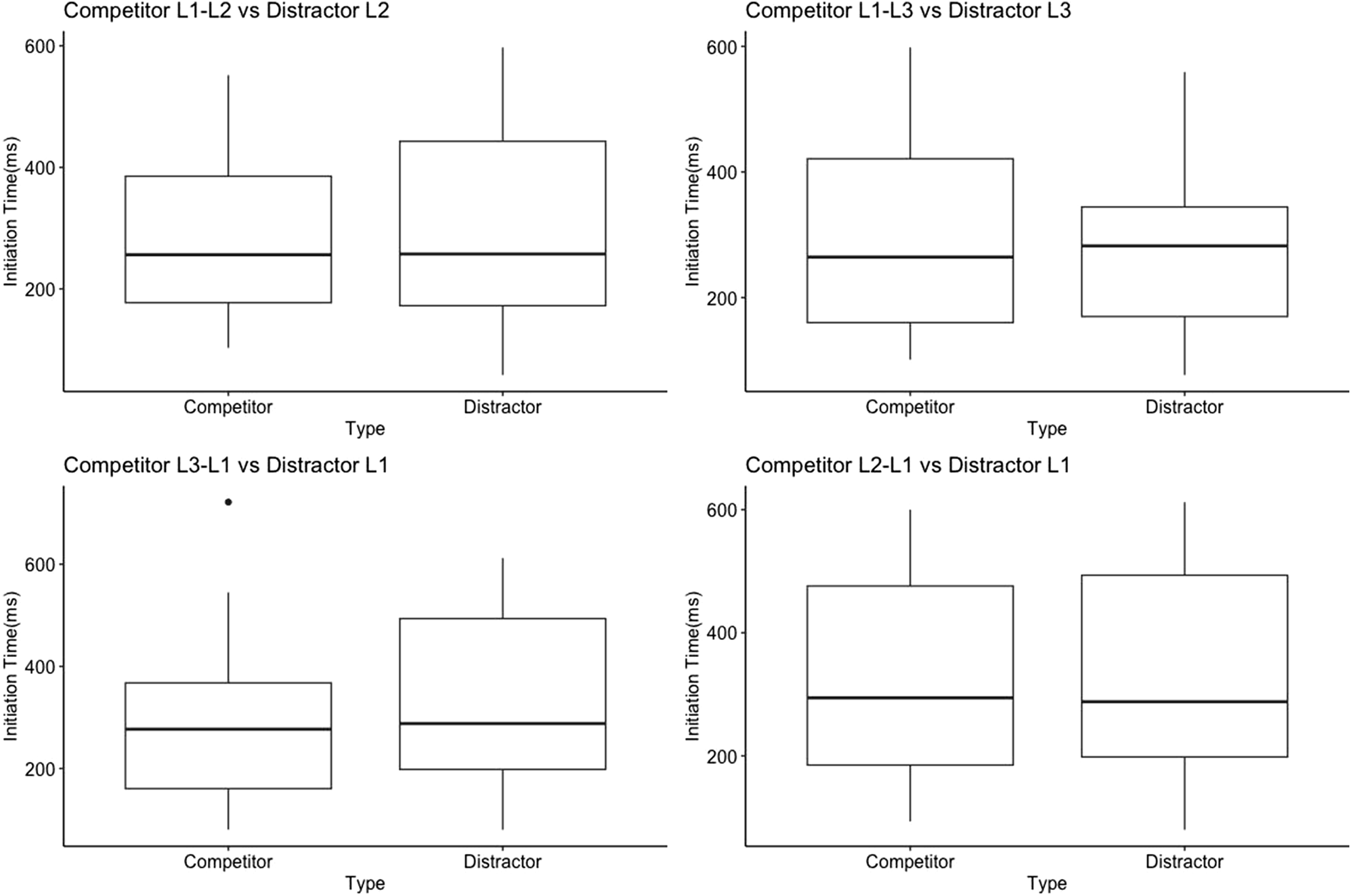
Initiation time (in ms) across three language directions in phonological cohort and non-phonological cohort conditions. The dot is an outlier.
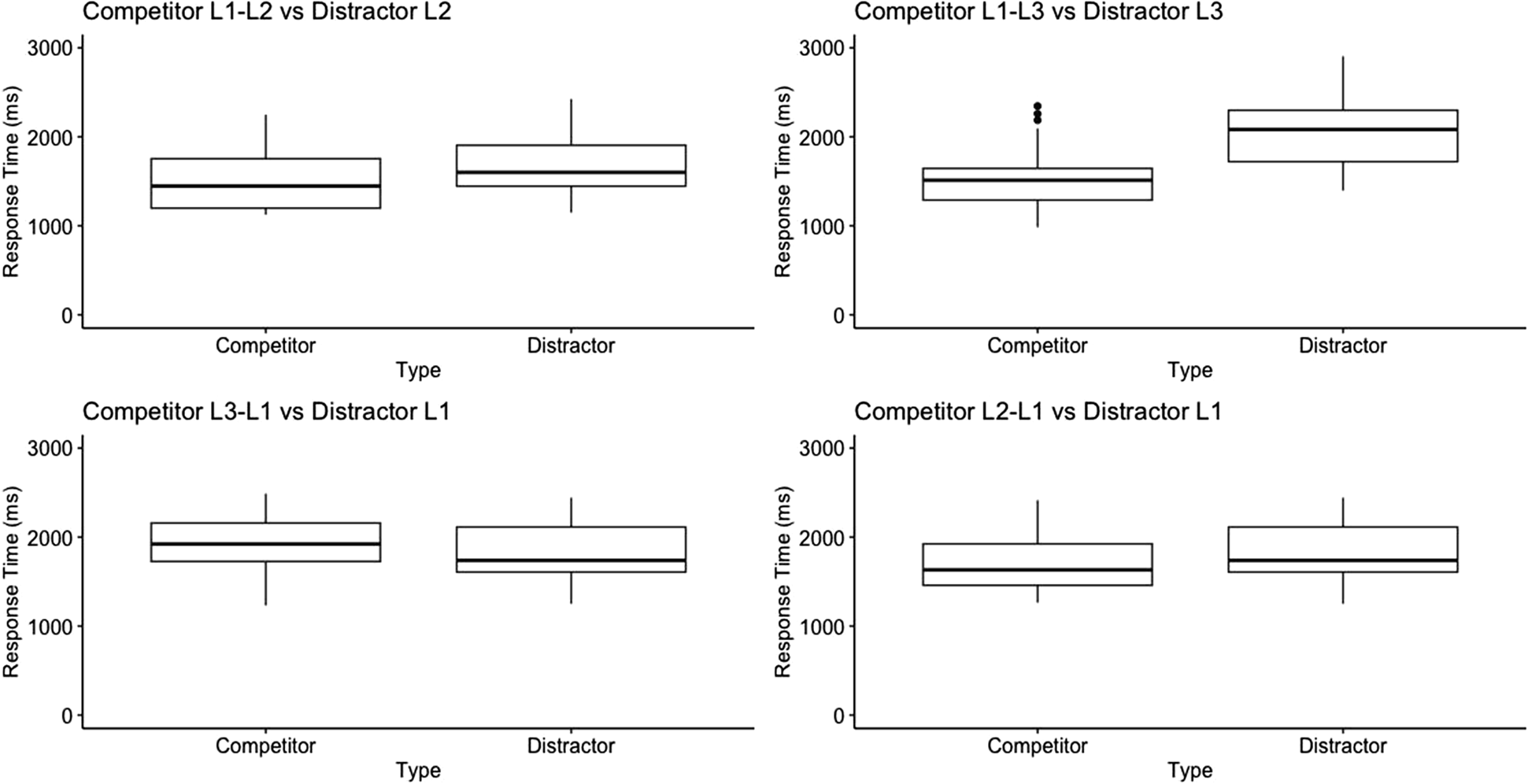
Response time (in ms) across three language directions in phonological cohort and non-phonological cohort conditions.
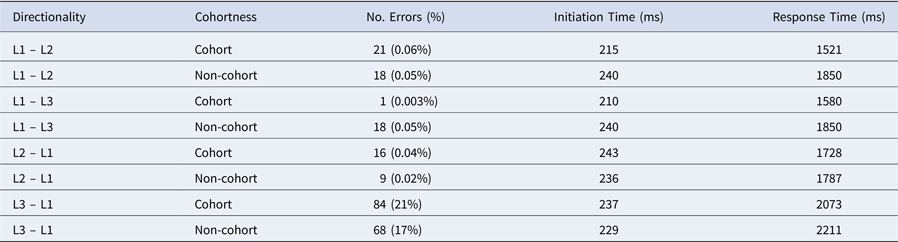
Scores of errors, initiation time and response in cohort (phonologically matching) and non-cohort (phonologically non-matching) conditions are given in Table 2.
Scores of errors, initiation time and response in cohort and non-cohort conditions with directionality
Results
Trilingual processing mouse tracking measures: Area Under the Curve (AUC)
L1 and L2 AUC
A subject wise 2 x 2 repeated measures ANOVA was performed with language (L1 and L2) and type (competitor and distractor) as within subject factors. The main effect for type was significant**, F (1, 24) = 17.132, p < 0.001, ηp2 = 0.417 showing overall deviation of the mouse trajectory toward unselected response was higher for distractor (Mean = 0.796, SE = 0.109) than competitor (Mean = 0.533, SE = 0.056). Follow up comparison indicated that each pairwise difference was significant**, p < 0.001. The main effect for language was not significant, F (1, 24) = 2.147, p = .156, ηp2 = 0.082 indicating that the auditory input of the language had no effect on the mouse movement.
L1 and L3 AUC
A subject wise 2 x 2 repeated measures ANOVA was performed with language (L1 and L3) and type (competitor and distractor) as within subject factors. The main effect for language was significant**, F (1, 24) = 20.561, p < 0.001, ηp2 = 0.461 showing overall deviation of the mouse trajectory toward unselected response was higher for L3 (Mean = 0.982, SE = 0.122) than L1 (Mean = 0.660, SE = 0.092). Follow up comparison indicated that each pairwise difference was significant**, p < 0.001. The main effect for type was marginally significant, F (1, 24) = 3.230, p = 0.085, ηp2 = 0.119 indicating that the auditory similarity of the input language had no significant effect on the mouse movement. The trajectory deviation toward unselected response for distractor was higher (Mean = 0.886, SE = 0.119) than competitor (Mean = 0.757, SE = 0.097) with no significant pairwise difference, p > 0.05 (p = 0.085). See Figure 2 for activation differences across three language directions in phonological cohort and non-phonological cohort conditions in 100 time steps for X coordinates. Both AUC and MD are represented in figure 2.
Maximum Deviation (MD)
L1 and L2
A subject wise 2 x 2 repeated measures ANOVA was performed with language (L1 and L2) and type (competitor and distractor) as within subject factors. The main effect for type was significant**, F (1, 24) = 16.179, p < 0.001, ηp2 = 0.403 showing overall deviation of the mouse trajectory toward unselected response was higher for distractor (Mean = 0.406, SE = 0.041) than competitor (Mean = 0.306, SE = 0.027). Follow up comparison indicated that each pairwise difference was significant**, p < 0.001. The main effect for language was also significant, F (1, 24) = 6.538, p = 0.017, ηp2 = 0.214 indicating that the auditory input of the language also had significant effect on the mouse movement. Pairwise comparison showed the deviation of mouse movement toward unselected response was higher for L1 (Mean = 0.323, SE = 0.036) than for L2 (Mean = 0.389, SE = 0.034) with significant difference, p = 0.017. The main effect for language x type interaction was significant*, F (1, 24) = 9.681, p = 0.005, ηp2 = 0.287. Pairwise comparisons indicated that when the auditory input was in L1 there was significant* (p = 0.005) difference between response latency in competitor (Mean = 0.258, SE = 0.032) compared to distractor (Mean = 0.387, SE = 0.046) which showed there was less deviation for competitor compared to distractor. However, for auditory input in L2, there was no significant (p = 0.255) difference between response latency in competitor (Mean = 0. 354, SE = 0.030) compared to distractor (Mean = 0.425, SE = 0.043).
L1 and L3
A subject wise 2 x 2 repeated measures ANOVA was performed with language (L1 and L3) and type (competitor and distractor) as within subject factors. The main effect for language was significant**, F (1, 24) = 18.278, p < 0.001, ηp2 = 0.432 showing overall deviation of the mouse trajectory toward unselected response was higher for L3 (Mean = 0.465, SE = 0.045) than L1 (Mean = 0.358, SE = 0.038). Follow up comparison indicated that each pairwise difference was significant**, p < 0.001. The main effect for type was not significant, F (1, 24) = 2.315, p = 0.141, ηp2 = 0.088 indicating that the phonological condition had no significant effect on the mouse movement in either of the language directions. The main effect for language x type interaction was significant, F (1, 24) = 12.525, p < 0.05, ηp2 = 0.343. Pairwise comparisons indicate that when the auditory input was in L1 there was significant (p = 0.002) difference between response latency in competitor (Mean = 0.329, SE = 0.036 compared to distractor (Mean = 0.387, SE = 0.046) showing less deviation in phonological competitor condition compared to non-phonological distractor. Moreover, for auditory input in L3 also, there was significant (p = 0.007) difference between response latency in competitor (Mean = 0. 457, SE = 0.049) compared to distractor (Mean = 0.478, SE = 0.048) showing less deviation in competitor condition compared to distractor condition.
Initiation Time
L1 and L2
A subject wise 2 x 2 repeated measures ANOVA was performed with language (L1 and L2) and type (competitor and distractor) as within subject factors. The main effect for language was not significant, F (1, 24) = 1.043, p = 0.317, ηp2 = 0.042. The main effect for type was also not significant, F (1, 24) = 0.593, p = 0.05, ηp2 = 0.449. The main effect for language x type interaction was not significant, F1 (1, 24) = 2.633, p = 0.118, ηp2 = 0.099.
L1 and L3
A subject wise 2 x 2 repeated measures ANOVA was performed with language (L1 and L2) and type (competitor and distractor) as within subject factors. The main effect for language was not significant, F (1, 24) = 0.330, p = 0.571, ηp2 = 0.014. The main effect for type was also not significant, F (1, 24) = 0.868, p = 0.361, ηp2 = 0.035. The main effect for language x type interaction was not significant, F (1, 24) = 2.112, p = 0.159, ηp2 = 0.081. (Figure 3)
Response Time
L1 and L2
A subject wise 2 x 2 repeated measures ANOVA was performed with language (L1 and L2) and type (competitor and distractor) as within subject factors. The main effect for type was significant**, F (1, 24) = 81.077, p < 0.001, ηp2 = 0.772 showing overall response time was faster in presence of phonological competitor (Mean = 1624.239 ms, SE = 65.435) than distractor (Mean = 1818.504 ms, SE = 79.667). Follow up comparison indicated that each pairwise difference was significant**, p < 0.001. The main effect for language was not significant, F (1, 24) = 2.096, p = 0.161, ηp2 = 0.080 indicating that the auditory input of the language (L1 or L2) did not have significant effect on the mouse movement. The main effect for language x type interaction was significant**, F (1, 24) = 21.805, p < 0.001, ηp2 = 0.476. Pairwise comparisons indicated that when the auditory input was in L1 there was significant** (p < 0.001) difference between response latency in competitor (Mean = 1520.928 ms, SE = 70.498) compared to distractor (Mean = 1850.053 ms, SE = 95.120) in which participants responded faster in phonological similar conditions. However, for auditory input in L2, there was no significant (p = 0.338) difference between response latency in competitor (Mean = 1727. 551 ms, SE = 69.265) compared to distractor (Mean = 1786.956 ms, SE = 75.714)
L1 and L3
A subject wise 2 x 2 repeated measures ANOVA was performed with language (L1 and L2) and type (competitor and distractor) as within subject factors. The main effect for type was significant**, F (1, 24) = 22.416, p < 0.001, ηp2 = 0.483 showing overall response time was faster in presence of phonological competitor (Mean = 1826.258 ms, SE = 67.668) than distractor (Mean = 2030.657 ms, SE = 93.889). Follow up comparison indicated that each pairwise difference was significant**, p < 0.001. The main effect for language was significant*, F (1, 24) = 15.918, p = 0.001, ηp2 = 0.399 indicating that overall response time was faster when the auditory input language was L1 (Mean = 1714.796, SE = 80.967) compared to when the auditory input language was L3 (Mean = 2142.119, SE = 107.900) Follow up comparison indicated that each pairwise difference was significant*, p = 0.001. The main effect for language x type interaction was not significant, F (1, 24) = 2.367, p = 0.137, ηp2 = 0.090. (Figure 4)
Verbal fluency task: phonetic and semantic fluency
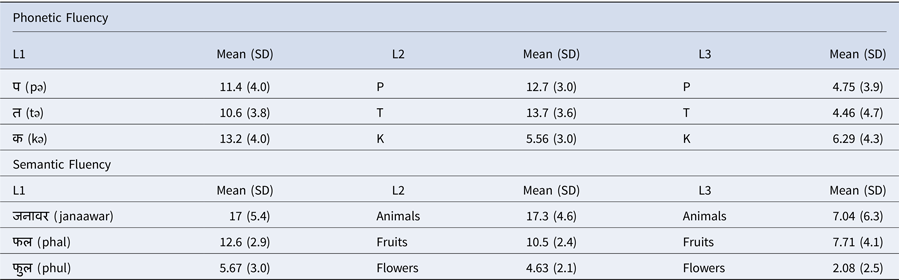
For phonetic fluency, a subject wise 3 x 3 repeated measures ANOVA was performed with language (L1, L2 and L3) and phonetic fluency (p. t and k) as within subject factors. The main effect for language was significant**, F (2, 23) = 14.190, p < .001, ηp2 = 0.552. Pairwise comparison showed nonsignificant difference between L1 and L2 (p = .094), significant difference between L1 and L3 (p < .001), significant difference between L2 and L3 (p < .001). Language wise, the mean number of words they created in each language was L1 M = 11.747 (SE = .689), L2 M = 10.667 (SE =.452), L3 M = 5.880 (SE = .814). The main effect for phonetic fluency was significant, F (2, 23) = 11.352, p < .001, ηp2 = 0.497. Pairwise comparison showed nonsignificant difference between /p/ and /t/ (p = .161), significant difference between /p/ and /k/ (p = .001), significant difference between /t/ and /k/ (p < .001). Phonetic fluency wise, the mean number of words they created with each phoneme was /p/ M = 9.627 (SE = .453), /t/ M = 10.267 (SE =.538), /k/ M = 8.400 (SE = .372). The interaction between language and phonetic fluency was significant**, F (4, 21) = 41.402, p < .001, ηp2 = 0.887. Pairwise comparison showed the mean difference in number of words created for /p/ between L1 and L2 was not significant (p = .113), between L1 and L3 was significant (p < .001), between L2 and L3 was significant (p < .001). The mean difference in number of words created for /t/ between L1 and L2 was significant (p < .001), between L1 and L3 was significant (p = .003), between L2 and L3 was significant (p < .001). Likewise, the mean difference in number of words created for /k/ between L1 and L2 was significant (p < .001), between L1 and L3 was significant (p < .001), between L2 and L3 was not significant (p = .480. The mean number of words generated by participants in L1 for /p/ was M = 11.400 (SE = .804), for /t/ M = 10.600 (SE = .755), for /k/ M = 13.240 (SE = .794); the mean number of words generated in L2 for /p/ was M = 12.720 (SE = .593), for /t/ M = 13.720 (SE = .713), for /k/ M = 5.560 (SE = .600); the mean number of words generated in L3 for /p/ was M = 4.760 (SE = .764), for /t/ M = 6.480 (SE = .928), for /k/ M = 6.400 (SE = .850).
For semantic fluency, a subject wise 3 x 3 repeated measures ANOVA was performed with language (L1, L2 and L3) and semantic fluency (animals. fruits and flowers) as within subject factors. The main effect for language was significant**, F (2, 23) = 20.772, p < .001, ηp2 = 0.644. Pairwise comparison showed nonsignificant difference between L1 and L2 (p = .102), significant difference between L1 and L3 (p < .001), significant difference between L2 and L3 (p < .001) in the number of words created. Language wise, the mean number of words they created in each language was L1 M = 11.787 (SE = .593), L2 M = 10.787 (SE =.504), L3 M = 5.653 (SE = .783). The main effect for semantic fluency was significant, F (2, 23) = 189.081, p < .001, ηp2 = 0.943. Pairwise comparison showed significant difference between L1 and L2 (p < .001), L1 and L3 (p < .001) and L2 and L3 (p < .001) in the numbers of words generated from the given category. Semantic category wise, the mean number of words they created in animal category was M = 13.773 (SE = .750), for fruit category M = 10.267 (SE = 372), and for flower category M = 4.187 (SE = .348). The interaction between language and semantic fluency was significant, F (4, 21) = 15.652, p < .001, ηp2 = 0.749. Pairwise comparison showed the mean difference in number of words created for animal category between L1 and L2 was not significant (p = .753), between L1 and L3 was significant (p < .001), between L2 and L3 was significant (p < .001); the mean difference in number of words created for fruit category between L1 and L2 was significant (p = .007), between L1 and L3 was significant (p < .001), between L2 and L3 was significant (p = .005); likewise, the mean difference in number of words created for flower category between L1 and L2 was not significant (p = .115), between L1 and L3 was significant (p < .001), between L2 and L3 was significant (p = .001). The mean number of words generated by participants in L1 for animal category was M = 17.000 (SE = 1.063), for fruit category M = 12.640 (SE = .568), for flower category M = 5.720 (SE = .587); the mean number of words generated in L2 for animal category was M = 17.280 (SE = .910), for fruit category M = 10.440 (SE = .480), for flower category M = 4.640 (SE = .420); the mean number of words generated in L3 for animal category was M = 7.040 (SE = 1.232), for fruit category M = 7.720 (SE = .807), for flower category M = 2.200 (SE = .497). See Table 3 for mean scores in VFT.
Verbal fluency task performance mean score (standard deviation given in brackets)
Discussion
In this study, we investigated language comprehension and production in a migrant population in trilingual design parallel language activation paradigm in a mouse tracking paradigm for language comprehension and verbal fluency task for language production which also serves as executive control task. In the mouse-tracking experiment, analysis of Area Under the Curve showed effect of proficiency and stimuli type. Since the participants were almost equally proficient in both L1 and L2, there was no significant effect of language input which indicates that activation of both the languages was almost equal in both the directions. The effect was seen only in the response stimuli type where a facilitation effect of phonological similarity was observed with the mouse trajectory moving faster toward the target when it matched phonologically with the auditory input compared to when there was no phonological similarity. For example, when they heard maakho (house fly) in their L1 and saw the visual display of a fly and a magnet (both the words sharing the phonological onset similarity of /m/), the movement of the mouse toward the target (here, maakho (house fly)) was faster in comparison to when they heard khaabo (pillar) in L1 and saw the visual display of a pillar and a medal (both the words with different phonological onset). Likewise, when they heard “leopard” in their L2 and saw the visual display of a leopard and a stick (lauro in L1), the mouse moved faster toward the target compared to when they heard “burger” and saw the picture of a burger and a tail (puchchhar in L1), with no phonological matching. This is important while comparing this effect with previous studies. In the seminal study paper using MouseTracker to study phonological competition, Spivey et al. (Reference Spivey, Grosjean and Knoblich2005) reported phonological cohort conditions (words with phonological overlap, e.g. candle vs candy) showed longer response times compared to controlled conditions (words with no phonological overlap, e.g. candle vs jacket). Marian and Spivey (Reference Marian and Spivey2003) tested parallel language activation in Russian–English bilinguals in eye-tracking paradigm and found both within-language and between-language phonological competition, participants fixated longer in the phonological cohort conditions compared to control condition with no phonological overlap. Whereas, with proficiency difference in L1 and L3 (L1 as their native language and L3 as a language learnt as an immigrant), the significant effect was observed in language where the participants’ mouse trajectory deviated more toward the unselected response when the auditory input was in L3 compared to L1 indicating the lexical access took longer and they experienced more competition from their L1 activation than their L3 activation. The greater dominance of L1 compared to L3 might have also delayed the lexical search and access in L3.
The analysis of Maximum Deviation toward unselected response shows that effects are significant language wise and also type wise. In L1 and L2 condition, the response shows facilitation effect of phonological competitor where the response to target is faster compared to phonologically non-matching distractor. The auditory input language effect is significant as the latency of deviation toward unselected response, when the auditory input is in L1, is higher compared to when it is in L2 reflecting the immigration and immersion effect of language as the participants are living in non-L1 environment and their regular language use is L2. This is shown by lesser deviation toward unselected response in L2 input and reaching the response faster. The activation is higher and faster in L1–L2 direction compared to L2–L1. We define direction as the response effect from another language when the input is in one language – that is, whether there is deviation toward unselected response in L2 when the input is in L1. In this case, for example, when the participants heard maakho (housefly) in L1, the mouse trajectory deviated more toward the unselected response “magnet” in L2 compared to when they heard “leopard” in L2 and saw a phonological competitor lauro (cane) in L1. This finding goes against the prediction of Inhibitory Control Model (Green, Reference Green1998) which predicts switching back to more dominant language takes longer time compared to less dominant language. This indicates that language processing dynamics in a bilingual situation are different from those in a trilingual situation.
The effect of language is more significant in language input compared to stimuli type in L1 and L3 environment. When the auditory input was in L1, participants moved the mouse faster towards the target compared to when the auditory input was in L3 as shown by higher deviation toward unselected response. This shows the parallel language activation was higher and faster in L3–L1 direction compared to when it was in L1–L3 direction. The participants had been using their L3 as immigrants and had not reached native like proficiency which delayed their response movement toward the target when the auditory input was in L3 in comparison to when the auditory input was in L1. Whereas in response stimuli type processing, ‘competitor’ was processed faster showing phonological cohort had facilitation effect.
In Initiation Time, irrespective of the auditory language input and directionality (L1–L2, L1–L3, L2–L1, L3–L1) and the type of target response (competitor or distractor), the participants did not show significant difference in initiating the mouse movement and started moving the mouse in similar manner.
In Response Time, the effect of the presence of phonological cohort in response pattern is clearly visible in the analysis of the response latency – that is, the speed of the response. When the auditory input was in L1, the response was faster compared to when it was in L2 or L3 in presence of the image whose name shared phonological similarity with the auditory word. The degree of language activation and latency varied in relation to the proficiency of the language used by the participants with lowest latency in L1 and higher in L2 and highest in L3. As the participants were using mainly L2 for all communication outside their own circle there was not much difference in the response latency when the auditory input was either in L1 or L2. However, when it was in relation to L1 or L3, there was significant difference as they had not yet reached the level of proficiency in their L3 compared to their L2.
We believe these results are the combined effects of trilingual lexical representation and processing. English and Norwegian are similar in many aspects like using the same Roman script and share many cognates unlike L1 Nepali which uses Devnagari script and does not share cognates with L2 English and L3 Norwegian the way the latter do. These results are indicative of more of the mental representation and dominance. L1 and L2 with greater dominance and proficiency are processed differently than the combined effect of L3 with L1 and L2. The presence of less dominant L3 has contributed in the faster processing of more dominant L1 and L2.
In the verbal fluency task, we used three stimuli each of phonetic and semantic fluency: voiceless stop consonants /p/, /t/ and /k/ for phonetic and animal, fruit and flower for semantic fluency. We chose the three phonemes/letters for consistency in comparison across all the three languages as unlike in English (which uses mostly F, A, and S for phonetic fluency task), there is no normative study of verbal fluency task (for example, as in Kosmidis et al., Reference Kosmidis, Vlahou, Panagiotaki and Kiosseoglou2004) in Nepali and Norwegian to establish standard testable phonemes; however, semantic categories are similar across many languages. ANOVA results showed the participants were equally fluent in L1 and L2 but the difference was significant between L1 and L3, L2 and L3 in both phonetic and semantic fluency. They created more words in L1 and L2 compared to L1 and L3 and L2 and L3. Verbal fluency task is a simple but powerful neuropsychological tool that can measure both executive control ability and verbal ability component in just one single framework (Shao et al., Reference Shao, Janse, Visser and Meyer2014). Therefore, this task can be used effectively as a tool to measure executive control (phonetic fluency) as well as language production (semantic fluency) (Pathak et al., Reference Pathak, Rijal and Pathak2021). Generating words in semantic or category condition is similar to the lexical access in interconnected network as in over learned process of the language production of ordinary language whereas generating words in phonetic or letter condition is more effortful as phonemic generation is not common strategy of word organization and retrieval. So, there is increased demand for executive control in phonetic fluency (Luo et al., Reference Luo, Luk and Bialystok2010). Consistent with this situation, our participants generated more words in semantic fluency compared to phonetic fluency. One advantage of using the verbal fluency task in trilingual processing is, it gives a baseline in one language to compare with the other two languages. Previous studies with bilingualism have shown bilingual disadvantage in the verbal fluency task compared to monolinguals (Luo et al., Reference Luo, Luk and Bialystok2010) because of smaller vocabulary (Bialystok & Feng, Reference Bialystok, Feng, Durgunoglu and Goldenberg2011; Portocarrero et al., Reference Portocarrero, Burright and Donovick2007) and slower retrieval (Gollan et al., Reference Gollan, Montoya, Fennema-Notestine and Morris2005; Ivanova & Costa, Reference Ivanova and Costa2008). Our results showed trilingual participants generated words in the verbal fluency task as per their dominance and proficiency in each language – that is, almost equal number of words in L1 and L2 and less in L3 as they had not attained the degree of proficiency in their L3 as in their L1 and L2. Even though, a verbal fluency task in previous studies has been used across languages in between-participants situation, we have used it in within-participants situation in our study as the test can effectively be administered in both the situations, testing the degree and magnitude of language production by an individual.
Nepali uses Devanagari script whereas English and Norwegian use Roman Script. While it is true that the kind of orthography that a language uses may impact lexical access (Opitz & Bordag, Reference Opitz and Bordag2022), we do not believe this was the case in our study as neither the comprehension task with mouse tracking nor the production task with VFT involved lexical access mediated through orthography. The only task where orthography was involved was LexTALE, but this was a lexical decision task rather than lexical access and it was used only to establish the L2 proficiency and was not directly related to L1 and L3.
A modulating mechanism for multiple languages is control (Green, Reference Green1986, Reference Green1998) that operates both linguistically and cognitively. Cognitively, control regulates the conflict monitoring and resolution; linguistically, it regulates activation and inhibition of languages in current use. The additional requirement to process three languages adds to the cognitive load as noticed in decreased accuracy and fluency (Mägiste, Reference Mägiste1984) or reduction in speed of processing (Mägiste, Reference Mägiste and Vaid1986). During parallel activation of lexicon in multiple languages, control mechanism directs attention to one word in one language by activating the selected word and inhibiting the competing words in other unselected languages (Paradis, Reference Paradis, Boller and Grafman1989). Green (Reference Green1986) proposes three possible states of activation in speech production – selected, active and dormant – and only one language can be selected at any one time. In trilingual parallel activation, there could be one of the three states of activation: one selected, one active and one dormant; one selected and two dormant; one selected and two active in a combination unique to trilingual activation (Festman, Reference Festman2006; see also Festman, Reference Festman2020 for a conceptual review on processing of multiple languages). Festman (Reference Festman2006) makes a distinction between a general (determined by language proficiency indicating basic state of activation) and current (the three possible states of activation; as proposed by Green, Reference Green1986) level of activation. Inhibition, on the other hand, is a mechanism opposite to activation which reduces and suppresses the level of activation for irrelevant and distracting information that could interfere with the processing of currently selected information (Bjork, Reference Bjork, Roediger and Craik1989; Festman, Reference Festman2006, Reference Festman2020; Green, Reference Green1998; Neumann et al., Reference Neumann, McCloskey and Felio1999; Querné et al., Reference Querné, Eustache and Faure2000). Inhibitory Control Model (Green, Reference Green1998) predicts that when a language is being processed (IC Model is primarily a production model rather than comprehension model) by bilingual (by extension, trilingual or multilingual) speaker, the currently unselected language is inhibited to avoid interference to allow for the activation of the selected language. In trilingual processing, whether in comprehension or in production like in our study, an individual is required to activate one language and inhibit the other two (or more, if the individual is a polyglot). In our study, when the participants listened to their L1, they would be required to activate L1 and inhibit L2 and L3, Likewise, when they listened to L2 they needed to inhibit L1 and L3 and while listening to L3 they had to inhibit their L1 and L2 in order to comprehend the incoming auditory input and respond by clicking on the picture matching with the incoming auditory stimuli.
Green and Abutalebi's Adaptive Control Hypothesis (2013) outlines three patterns of everyday conversational contexts in bilinguals (single language, dual language and dense code-switching contexts) that interact with eight cognitive control processes: goal maintenance; interference control; conflict monitoring and interference suppression; salient cue detection; selective response inhibition; task disengagement; task engagement; and opportunistic planning. Of these eight processes, only opportunistic planning interacts with dense code-switching context. Two of them – goal maintenance and interference control – interact with single language context and all seven control processes (except opportunistic planning) interact with dual language context. Bilinguals use one language in one language environment and another language in another environment maintaining a distinct interaction in the single language context. Whereas, in dual language context, bilinguals use both the languages but typically with different speakers, they may switch their language within a conversation but not within an utterance. But in a dense code-switching context, speakers regularly interleave their languages even within the single utterance and adapt and intermix words from either of their two languages. These control processes keep cascading during interaction. In our study, we tested language comprehension in parallel language activation paradigm and production in a lexical retrieval paradigm using verbal fluency task. Participants were asked to listen to the spoken word in their L1, L2 or L3 and mouse-click the picture on the computer screen that matched with the incoming spoken word. The task made the participants recruit their proactive control (Braver, Reference Braver2012; Briscoe & Gilchrist, Reference Briscoe and Gilchrist2020) by maintaining the goal of listening to the auditory input and matching the semantic feature with one of the pictures displayed on the screen. Upon hearing the spoken word and looking at the image on the screen, which also activated nontarget phonologically matching cohort word on the opposite side of the target image, the participants were expected to face interference as a result of onset activation of both the words phonologically matching and competing with each other for selection. They would be required to control the interference by monitoring the conflict posed by phonologically matching cohort and suppress the interference with salient cue detection from the features of the target image building up the meaning of the auditory input and exert selective response inhibition toward the image posing the phonological competition and disengage from the task of moving the mouse toward the unselected activation and engage in the task of moving mouse toward the target image and resolve the conflict by clicking on the target image. However, such cascading of control processes that predicts bilingual processing didn't align completely with trilingual parallel activation in our study. It aligned this way only in L3–L1 direction, that too in the presence of non-phonological matching distractor but not in L1–L2 and L1–L3 direction in the presence of phonologically matching cohort. Our participants showed delayed response only when the auditory input was in L3 and the distractor in the response stimuli in the visual display did not share the phonological similarity with the target word. This discovery of differences in parallel activation in bilingualism and trilingualism propels us to rethink and revisit that the theories and models of bilingualism cannot be posited upon trilingualism and it calls for a different treatment and approach.
In the previous studies of parallel language activation in bilinguals, researchers have found that when the distractor matches phonologically with the incoming auditory input, the target and distractor compete for selection and the response is delayed before the conflict is resolved and the target is finally selected (see for example, Blumenfeld & Marian, Reference Blumenfeld and Marian2013; Marian & Spivey, Reference Marian and Spivey2003, Reference Marian and Spivey2003b; Marian et al., Reference Marian, Blumenfeld, Mizrahi, Kania and Cordes2013, Reference Marian, Chabal, Bartolotti, Bradley and Hernandez2014; Mishra & Singh, Reference Mishra and Singh2013; Singh & Mishra, Reference Singh and Mishra2015). Recent evidence of parallel activation shows that the early segment of an auditory utterance initiates lexical activation which is largely automatic and the competition between the activated candidates is largely resource dependent where a critical resource is the phonological processing (Zhanga & Samuel, Reference Zhanga and Samuel2018). Trilingual phonological, lexical processing as in our study, provides more phonological and lexical resources compared to bilingual processing and we assume that when competition crosses a certain threshold of selection, the cognitive mechanism of conflict resolution becomes more efficient and it does not face competition anymore; there is, rather, a facilitative effect of processing. But this processing benefit is achieved only with the experience and more practice as in our study participants processed the lexical selection faster when the target and distractor shared phonological similarity in L1 and L2 as these two languages were used most by the participants whereas in the less dominant language L3, the processing for selection was slower when the target and distractor shared phonological similarity. Here, it is to be noted that the finding in our study for L3 processing is similar to previous findings in parallel language activation in bilinguals. This finding from our study is evidence of additive benefit of trilingualism which is not exactly the same as in bilingualism.
How to account for this effect of multilingual processing? Festman (Reference Festman2020) suggests five effects resulting from the learning and processing of multiple languages: (a) stimulating effect – children exposed to more than one language in the early age become sensitive and interested in phonetic contrast and are faster in disengagement of attention affecting executive function in babies even before they learn to speak (see also Claussenius-Kalman & Hernandez, Reference Claussenius-Kalman and Hernandez2019; D'Souza et al., Reference D'Souza, Brady, Haensel and D'Souza2020; Höhle et al., Reference Höhle, Bijeljac-Babic and Nazzi2020); (b) facilitating effect – a larger linguistic repertoire, with increased number of languages represented in the brain provides positive transfer both quantitatively (larger mental lexicon) and qualitatively (diverse knowledge of tonality, morphological processing etc.); (c) catalytic effect – acquisition of new information especially word learning and grammatical learning is sped up in the multilingual learners (see also Montanari, Reference Montanari, Montanari and Quay2019; Rothman, Reference Rothman2010); (d) modulating effect – formal instruction and literacy acquisition in heritage languages causing biliteracy, especially in typologically nonrelated languages helps in developing superior metalinguistic skills (Sanz, Reference Sanz, Pérez-Vidal, Juan-Garau and Bel2007); (e) triggering effect – using the principle of convergence (using existing structures and representation to build new ones) and adaptation (strength of connections like control circuits being changed to accommodate new processing demands), the brain extends a well-organized language network to incorporate additional languages. Such a process of convergence and adaptation may be indicative of triggering effect of multilingualism: that learning new languages may prompt process of adaptation for managing language control and in turn improve cognitive control and linguistic control. Linking these effects to our study, we believe, our participants’ pre-existing L1 and L2 stimulated and facilitated the learning of their L3. As they were also biliterate in their L1 and L2, it might have modulated and helped speed up their learning and processing of L3. Our finding is also indicative of triggering effect, the language control network converging and adapting to the new language and strengthening the control circuits to allow for the processing of additional language and becoming efficient enough to not face competition while processing the phonologically similar information, but resolve the conflict more efficiently and create a facilitative effect in processing.
As discussed in the Introduction, Cumulative Enhancement Model provides some explanation to our results as well. This model assumes a facilitative role of subsequently acquired languages. In the absence of clearly articulated theory that precisely explains our results, we would assume that the late acquisition of third language Norwegian, might have strengthened the connections between the previously acquired first two languages and hence they were processed faster in comparison to the late acquired less dominant third language.
As far as we know, this is the first study that investigated trilingual processing using parallel language activation paradigm and mouse tracking as a tool. What we can conclude regarding our novel finding is that, even though some of the studies have found faciliatory effect in cognate word production (Costa et al., Reference Costa, Santestebana and Caño2005) in naming by an aphasic bilingual or the role of orthographic regularity of words in bilingual language detection in Spanish-Basque bilinguals and Spanish monolinguals (Casaponsa et al., Reference Casaponsa, Carreiras and Duñabeitia2015), much of the previous studies with parallel language activation with bilingual design have found interference effect in both language directions. In our study, there is facilitation effect with three language design where the participants listened to the spoken words in all three languages in random order. We can argue that when multiple languages are active in our mental lexicon, the processing becomes faster in the language conditions that are phonologically related, especially among dominant languages.
We believe, this study also contributes to Norwegian multilingualism and multilingual education (Haukås et al., Reference Haukås, Storto and Tiurikova2021a), even though the Nepali speaking population is very small in Norway. It may inform Norwegian institutions in policy decisions while designing foreign language curriculum and understanding school students’ requirement of foreign language choice (Norwegian Directorate for Education and Training, 2019; Norwegian National Centre for Foreign Languages in Education, 2020). This study also contributes to the study of Nepalese multilingualism and cognition (Pathak, Reference Pathak2022a), besides throwing more light on trilingual processing among language learners (Festman, Reference Festman, Singleton and Aronin2019; Stoehr et al., Reference Stoehr, Jevtovic, de Bruin and Martin2023).
Limitations and future directions
This study is limited to within subject design which does not provide a basis to compare with control group. Future research should investigate the multiple language processing pattern among different populations like the refugees who have been settled in the third country: how do they process the new language in the course of assimilation, what is the difference between first generation heritage speakers and second-generation heritage speakers? Our design may also allow to investigate multiple language processing pattern among the student population and people who have migrated for job or resettlement. An important future direction for this study would be to study the language attrition among the population who studied in Norway and returned to Nepal and lost regular touch with Norwegian language and to see if they process the three languages in the same manner as when they were in Norway.
Theoretically, future studies in trilingual processing should also incorporate emerging theories and models (Pliatsikas, Reference Pliatsikas2020; Yee et al., Reference Yee, Yap, Korenar, Saddy and Pliatsikas2023) or postulate one that explains and predicts the mechanism better.
Future study with trilingualism should also include cognitive control measures as modulated by processing of three languages, possibly controlling for age limit with lesser variation in the sample, measuring between-subject design across all the three directions.
Acknowledgments
The authors gratefully acknowledge the NTNU Erasmus + Global Mobility grant nr. 90030800 awarded to Mila Vulchanova for a research and study visit by the first and last authors. The first author expresses gratitude to Nepalese Society in Trondheim (NEST) Pariwar for help in recruiting participants for this study, to University Grants Commission, Nepal for partial financial support under Faculty Fellowship No. 1266/2070-71 for PhD and to Tribhuvan University, Nepal for granting study leave for PhD.
Funding
The first and last authors were supported by the NTNU Erasmus + Global Mobility grant nr. 90030800 awarded to Mila Vulchanova for a research and study visit to NTNU. The first author received partial financial support from University Grants Commission, Nepal under Faculty Fellowship No. 1266/2070-71 for PhD.
Author contribution
LSP conceptualized the study, designed experiments, collected and analyzed the data and wrote the manuscript; MV conceptualized the study, obtained ethical clearance and edited the manuscript; PP analyzed the data and created the tables and plots in R; RKM conceptualized the study. All the authors approved the manuscript submission for publication.
Competing interests
The authors declare none.
Data Availability
The data files can be viewed here: https://osf.io/ngvjz/?view_only=9c70f05abd4643d0bc7d8f37b2ab8df5
Appendix: Lexical stimuli used in trilingual parallel language activation
Language Direction: L1-L2
Language Direction: L1-L3
Language Direction: L2-L1
Language Direction: L3-L1
Distractor: L1
Distractor: L2
Distractor: L3


 Open access

