


Introduction
In 1992, the Ontario Court of Justice observed that “Canada is the only country in the western world which does not make provision for absentee voting for all citizens who are residing abroad who wish to participate in a national election” (Clifford v. Attorney General of Canada et al., 1992: 5–6). Parliamentarians soon picked up the court’s comparative assertion in the push to enfranchise nonresident Canadians, leading one Liberal opposition MP, Marcel Prud’homme, to retort, “If you eliminate western democracies, what the hell are we being compared with?” (Canada, 1992b: 25). In 1993, Parliament enfranchised emigrants,Footnote 1 though it added a sunset clause stipulating that Canadians could not vote if they resided out of the country for five or more consecutive years. This was eventually challenged in court in Frank v. Attorney General of Canada, where the Frank legal team argued that “the majority of democracies” allow broad nonresident voting (Supreme Court of Canada, 2018: 46). The Conservative Harper government defended the sunset clause, with then Minister for Democratic Reform Pierre Poilievre noting that “similar democracies” followed similar practices. Unlike Poilievre, the Attorney General and expert witnesses delimited a more precise set of countries, arguing that sunset clauses “are ubiquitous in the other main Westminster Parliamentary systems” (Factum of Respondent, 2016: para. 3). The Supreme Court of Canada (SCC) explicitly rejected this argument about comparative standards, with the majority opinion noting, “the history of the Canadian electoral system is one of progressive enfranchisement. Canada is an international leader in this respect” (Frank v. Attorney General of Canada, 2019: para. 62).
As is clear in the debates, the enfranchisement of nonresident Canadians took place in a broader international context, which shaped the political knowledge and self-understanding of political actors within Canada. It shows signs of international policy diffusion, a process occurring “when government policy decisions in a given country are systematically conditioned by prior policy choices made in other countries” (Simmons et al., Reference Simmons, Dobbin and Garrett2006: 787). Remarkable in the examples—and the broader debate about the international context—is an overriding concern with conforming to international standards. In contrast to the dominant rationalist models of policy diffusion, political actors rarely drew lessons from other countries, nor did they seek to identify how international actors might influence the costs and benefits of policy change. In discussing the international context, Canadian actors sought to emulate rather than calculate.
This article asks: how does international policy diffusion influence domestic debate? Which diffusion mechanisms receive attention from domestic actors? And, more precisely, how do domestic political actors discuss the process of emulation? To make sense of the Canadian debate about emigrant voting rights, we draw on concepts from the constructivist literature on international norms, particularly the attention paid to rhetoric. As constructivist scholars assert, norms both constitute actors and regulate behaviours. Public debate reveals crucial information about the structure and strength of international norms. We depart from typical international relations scholarship in focussing on a domestic issue area lacking position-taking from international actors. Even in a context where international standards and behavioural expectations are vague, the perception that a norm exists and should be followed is enough to significantly influence debate. In examining the structure of normative discourse within a domestic context, we argue that emulation involves three rhetorical elements that can generate disagreement: (1) setting peer countries to emulate; (2) identifying existing policy positions; and (3) envisioning the preferred policy position vis-à-vis peers. We find that in the Canadian debate about emigrant voting, the overall contestation increased over time; where only peer groups were contested in the early debates leading up to the initial 1993 enfranchisement, all three elements were contested when discussing the removal of the sunset clause two decades later.
Beyond adding new tools for constructivist analyses of rhetoric, we make three additional contributions to the literature. First, going against the grain of most enfranchisement literature, we highlight the importance of noninstrumental motives for extending voting rights. Canada’s elected legislators regularly returned to discussions of international standards, and during the period of study, did not publicly weigh the potential benefits of enfranchisement accrued by their party or their opponents. At least in terms of rhetoric, global trends in emigrant enfranchisement prompted a discussion about the appropriateness of behaviour, rather than the political consequences of policy change. Second, we challenge existing diffusion models of emigrant voting on the basis of geographic proximity (Turcu and Urbatsch, Reference Turcu and Urbatsch2015). Canadian policy makers constructed and reconstructed their peer groups on the basis of cultural congruence, historical ties and regime type; neighbour practices entered the conversation, but mattered less than “likeminded” countries half a world away. Third, we provide the first account of emigrant enfranchisement in Canada focussing on the political processes rather than legal analysis (Burton, Reference Burton2021). In so doing, our study adds to a modest Canadian literature interested in the mechanisms of diffusion and is the first to explicitly focus on rhetoric.
The article proceeds as follows. Section II places emigrant enfranchisement in Canada within a global context, explaining why existing theories of enfranchisement broadly—and emigrant enfranchisement specifically—cannot explain the pattern of emulation rhetoric we see in the Canadian case. Section III introduces the concept of international policy diffusion, highlighting the existence of a dominant rationalist model. In contrast to the rationalist model, we introduce the constructivist accounts of international norms and rhetorical action. In Section IV, we apply insights from the constructivist approach to domestic debates, introducing our three key rhetorical elements that generate contestation. Section V introduces our methodology and provides background for our periodization of the Canadian case. Section VI includes our qualitative document analysis. In Period 1, while discussing the initial enfranchisement of 1993, we see low levels of contestation, though some disagreement on setting peers. In Period 2, preceding the 2019 decision in Frank v. Attorney General of Canada challenging the 5-year sunset clause, we see significant debate on setting peers (Westminster countries vs. democracies), country positioning and envisioned preference (within the norm versus leading by example). Section VII wraps up with some conclusions and directions for future research.
Canadian Emigrant Enfranchisement in a Global Context
Since 1990, two significant legal changes have effectively enfranchised nonresident Canadians. The first is the passage of Bill C-114 in 1993 (An Act to amend the Canada Elections Act). Prior to C-114, only certain categories of nonresident citizens could participate in elections; namely, members of the armed forces, members of the diplomatic core and international development workers, as well as the families of the members of these groups. All other Canadians were expected to register in the typical manner and vote from within a Canadian constituency. The initial legal change allowed all Canadian citizens to vote from abroad, provided they had not resided outside of Canada for five or more years.Footnote 2
The second legal change came via a court challenge to the 5-year sunset clause attached to nonresident voting rights. In 2012, Gillian Frank (initially joined by Jamie Duong) challenged the sunset clause as a violation of Section 3 of the Charter. The case made its way to the SCC, which found the temporal restriction on emigrant voting unconstitutional. Thereafter, Canadian citizens would be permitted to vote from abroad regardless of the length of time spent outside the country.
Canadian legal changes occurred in a broader context of emigrant enfranchisement. Figure 1 demonstrates the remarkably quick spread of emigrant voting rights across the globe.Footnote 3 In 1982, the year the Charter was enacted, the practice was relatively rare, with only 13 per cent of the world’s countries offering broad emigrant enfranchisement (Wellman et al., Reference Wellman, Allen and Nyblade2022). By the time Parliament extended emigrant voting rights in 1993, 34 per cent of countries had adopted such rights. This had climbed to 65 per cent by 2012, the year Frank and Duong filed their petition. The international environment transformed significantly in the time period Canada extended emigrant voting rights, playing an important role in the way Canadian policy makers discussed the issue.
Legal Enfranchisement of Emigrants Across Countries Over Time

Explaining enfranchisement
A significant comparative literature has developed that seeks to explain franchise extensions. The common approach is to view enfranchisement as a form of instrumental exchange between incumbent rulers and some sizeable segment of the non-enfranchised electorate (for example, “working-class,” “women”). Strategic rulers extend the vote (or remove de facto restrictions) when the perceived benefits outweigh the costs. Reasons include maintaining social peace (Acemoglu and Robinson, Reference Acemoglu and Robinson2000), rallying support for war (Ticchi and Vindigni, Reference Ticchi and Vindigni2008) or creating a new voting bloc (Llavador and Oxoby, Reference Llavador and Oxoby2005). While the extent to which incumbent rulers are left better off varies (Przeworski, Reference Przeworski2009), these accounts all underline the instrumental logic of enfranchising new groups.
The instrumental logic of exchange is prevalent in accounts of emigrant enfranchisement. One approach emphasizes the influence of electoral contestation in shaping enfranchisement decisions (Rhodes and Harutyunyan, Reference Rhodes and Harutyunyan2010). In short, rulers extend rights to emigrants when they anticipate electoral gain. Within coalition governments, strategic parties can make enfranchisement the price of co-operation (Lafleur, Reference Lafleur2013; Reference Lafleur2015). Wellman (Reference Wellman2021) extends this logic to consider the implementation of rights and the inclusivity of electoral rules. These accounts highlight the pivotal role of vote-seeking parties and politicians in the decision to broaden enfranchisement. Electoral accounts also provide a partial account for temporal trends; as “the third wave” (Huntington, Reference Huntington1991) of democratization advanced, increased electoral contestation opened new opportunities for emigrant enfranchisement.
A second account focusses on the broader context of state—diaspora relations. Globalization facilitates the movement of information, people and capital. In this context, states view diaspora groups as potentially valuable resources, providing financial and political support from abroad. Diasporas, in turn, use their leverage to bargain for expanded rights and privileges from their home state (Itzigsohn, Reference Itzigsohn2000). As such, voting rights emerge out of a complex set of state—diaspora relations affected by—among other factors—the size of the diaspora (Collyer and Vathi, Reference Collyer and Vathi2007), its organization (Lafleur, Reference Lafleur2015) and the existence of security crises (Brand, Reference Brand2010). Since valuable international capital flows such as remittances correlate with emigrant voting practices (Wellman et al., Reference Wellman, Allen and Nyblade2022), enfranchisement trends may be accounted for by increasing the value of these flows in a globalizing world.
While the accounts of enfranchisement are compelling, limitations exist, particularly in the Canadian case. Explanations of temporal patterns focus on variables (for example, increased democratic competition and increased diaspora capital) that are unlikely to influence emigrant voting rules in wealthy, established democracies such as Canada. Furthermore, they say little about expectations for enfranchisement debates, beyond an emphasis on instrumental exchange. However, the near absence of partisan gain (or accusations of such) stands out in the Canadian case. Although emigrants launched a court case to expand voting rights, there are no signs of state actors bargaining with emigrants as a group to achieve ends. International trends shape Canadian domestic debate, but not in a way we might expect from instrumental explanations of enfranchisement.
Policy Diffusion and Emulation
Mechanisms of policy diffusion
Countries do not adopt policies and create institutions in an international vacuum. The literature commonly identifies four key mechanisms of international diffusion: learning, competition, coercion and emulation (see: Gilardi, Reference Gilardi, Carlsnaes, Risse and Simmons2012; Marsh and Sharman, Reference Marsh and Sharman2009). Learning refers to the use of experience in a foreign country to inform decision making (Gilardi, Reference Gilardi, Carlsnaes, Risse and Simmons2012: 463). The competition mechanism posits that jurisdictions adopt policies and institutions similar to their peers so as not to fall behind in a struggle for scarce resources (Gilardi, Reference Gilardi, Carlsnaes, Risse and Simmons2012: 462). Coercion has jurisdictions changing policies and institutions under threat of costs imposed by an external actor (Gilardi, Reference Gilardi, Carlsnaes, Risse and Simmons2012: 461). Finally, emulation is “the process whereby policies diffuse because of their normative and socially constructed properties instead of their objective characteristics” (Gilardi, Reference Gilardi, Carlsnaes, Risse and Simmons2012: 466). As Gilardi and Wasserfallen (Reference Gilardi and Wasserfallen2019: 1249) point out, the fourth mechanism—emulation—is distinct from the “dominant” model of diffusion, in which rational policy makers use “fact-based assessments of policy consequences.”
Although studies of diffusion mechanisms in Canada stretch back decades (for example, Poel Reference Poel1976; Lutz Reference Lutz1989), Boyd’s recent review of the literature finds “surprisingly little academic study” focussing on the Canadian case (Reference Boyd, Boyd and Olive2021: 4). Within the work on diffusion mechanisms that exists, the dominance of the rationalist model is often evident, sometimes even in the titles; for instance, Harrison’s prominent volume Racing to the Bottom? (Reference Harrison2006) and Wallner’s Learning to School (Reference Wallner2014) signal the analytical importance of competition and learning, respectively. Wallner suggests the dominance of rationalist models is in part methodological, noting, “The evidence that can be brought to bear on emulation is the least tangible of all the diffusion processes” (Reference Wallner2014: 103).
Rationalist models of diffusion have been employed to understand the cross-national spread of emigrant voting rights. Turcu and Urbatsch (Reference Turcu and Urbatsch2015) theorize such a mechanism using a learning model, in which states adopt emigrant voting after observing the benefit in a neighbouring country. Cross-national evidence suggests a neighbourhood effect may be occurring, though the domestic processes associated with this theory are left unexamined. Rhodes and Harutyunyan (Reference Rhodes and Harutyunyan2010) argue that “global-norms” influence emigrant enfranchisement decisions, though they do not detail mechanisms of transmission. To make sense of the public debate we see in Canada surrounding emigrant voting rights, and the mechanisms associated with norm conformity, we need to look closely at the international literature on emulation developed by constructivist scholars.
International norms and emulation
As opposed to rationalist accounts of behaviour, the emulation argument leans heavily on the concept of the “logic of appropriateness,” in which “rules are followed because they are seen as natural, rightful, expected, and legitimate” (March & Olsen, Reference March, Olsen, Goodin, Moran and Rein2009: 689). Where rationalist models of diffusion are dominant among domestic policy studies, emulation receives the most theoretical attention from international relations scholars. “Appropriateness” in this literature is determined by the existence of norms, defined as “collective expectations about proper behavior for a given identity” (Jepperson et al., Reference Jepperson, Wendt, Katzenstein and Katzenstein1996: 54). Norms both “constitute” actors and roles and “regulate” behaviour by proscribing or prescribing actions for a given identity.
Constructivists are particularly concerned with the way norms emerge, spread (“cascade”) and attain an internalized “taken for granted” status (Finnemore and Sikkink, Reference Finnemore and Sikkink1998). The process by which international norms are internalized and implemented is referred to as socialization (Risse and Sikkink, Reference Risse and Sikkink1999: 120). Actors may be motivated by different factors at different stages; whereas the norm emergence stage contains strategic calculations by norm entrepreneurs, the cascade is typified by “role playing” involving the adoption of certain roles in particular settings, but without a full internalization of norms (Gilardi, Reference Gilardi, Carlsnaes, Risse and Simmons2012: 467). By the final internalization stage, actors engage in moral suasion to change understandings of appropriateness through discursive interaction.
Parsing logics of “appropriateness” and “consequences” is inherently difficult when both are simultaneously operative in socialization. In part, this inferential challenge motivates close attention to rhetoric. Arguments allow us to study not just policy outcomes but also the structure of norms (Winston, Reference Winston, Gibney and Haschke2023) and “norm strength” (Stimmer, Reference Stimmer2025). One vein in this research agenda focusses on the way actors use normative claims instrumentally in policy arguments to impose political costs on target states (see: Bower Reference Bower2020; Schimmelfennig, Reference Schimmelfennig2001; Krebs and Jackson, Reference Krebs and Jackson2007). Another analyzes the process and politics of “norm contestation,” in which actors debate the justifications and behavioural claims associated with international norms (for example, Orchard and Wiener, Reference Orchard, Wiener, Mello and Ostermann2023; Stimmer, Reference Stimmer2025). Broadly, the constructivist literature prompts us to study not simply policy change, but the rhetoric of policy debates and what this says about international norms as well.
Understandably, the literature focusses largely on international actors and outcomes. However, the influence of international norms and debates also occurs in domestic contexts, in which the policy choices do not directly affect or involve international actors. One important and relevant exception is the study of enfranchisement, particularly the extension of voting rights to women. The diffusion of women’s suffrage, from emergence to global entrenchment, has been tracked and measured (Ramirez et al., Reference Ramirez, Soysal and Shanahan1997; Finnemore and Sikkink, Reference Finnemore and Sikkink1998). According to Keck and Sikkink (Reference Keck and Sikkink1998), the success of women’s suffrage campaigners is partially explained by congruence with the preexisting societal norms; namely, legal equality of opportunity. They argue women’s suffrage “lent itself to framing and action that appealed to the most basic values of the liberal state—equality, liberty, and democracy” (53). After policy change by a “critical mass” of countries, enfranchisement became “an essential attribute of the modern state” (211). Democratic practices can change quickly, leading to international convergence on new standards. As Przeworski remarked, “Giving women the vote was inconceivable before 1860 and inevitable after 1948” (Reference Przeworski2009: 314). Paying close attention to domestic enfranchisement debates as these changes occur provides a valuable window into the process of emulation.
The Rhetoric of Emulation
Analysing the domestic “translation” (Engstrom, 2001) or “localization” (Acharya, Reference Acharya2004) of international norms necessitates attention to the process by which actors frame international norms for a domestic context. Emulation requires domestic actors to address three challenges: the first is setting peer countries to emulate; the second involves identifying existing policy positions; and the third task is envisioning the preferred policy position vis-à-vis peers. This process may pass without controversy, as actors converge, or it may spark contentious debate.
As Marsh and Sharman point out, most international diffusion literature assumes dichotomous outcomes, while domestic public policy scholars perceive degrees of change (Reference Marsh and Sharman2009: 278). We adopt the domestic policy approach, positing a single unidimensional plane along which we can arrange countries given the rules and procedures they adopt for emigrant voting. This dimension runs from “restrictive” on one end to “inclusive” on the other. Countries employ a series of rules and procedures pertaining to eligibility, voting modality and institutional incorporation that collectively determine their place on the unidimensional space. Rules that lower the costs of participation (for example, electronic voting) and increase opportunities (for example, extending voting rights beyond national to subnational elections) move a country’s legal framework closer to the inclusive pole. The extreme restrictive pole denotes rules that prevent emigrants from any electoral participation, whereas the extreme end of the inclusive pole indicates legal frameworks in which emigrant citizens face no additional obstacles to electoral participation as compared with resident citizens.
In Figure 2, we place a series of countries along this unidimensional plane. In our starting example, we have a cluster positioned close to the restrictive pole (A, B, C and D). From there, the remaining countries (E, F and G) are spread out, indicating relatively more inclusive policies.
Hypothetical Countries Organized by Restrictiveness-Inclusiveness of Emigrant Voting Rules

A political actor looking to discern an international standard in this simplified world might place the “restrictiveness” of rules around country D, which is the median position. However, as Risse and Sikkink (Reference Risse and Sikkink1999) point out, “much socialization occurs among peer groups” (125). The first step in emulation, then, requires setting peer countries that will constitute the international standard. Reasons for selection may include ideological similarity (Butler et al., Reference Butler, Volden, Dynes and Shor2017) or cultural similarity (Simmons and Elkins, Reference Simmons and Elkins2004). Still, it is a choice that affects the understanding of appropriate behaviour; returning to the very definition of norms (Jepperson et al., Reference Jepperson, Wendt, Katzenstein and Katzenstein1996), peer selection is an act of choosing both a “collective” and affirming an “identity,” both of which influence future actions.
This is demonstrated in Figure 3. A standard based on the entire population of countries may sit at country D, which lies close to the restrictive pole of emigrant voting rights. However, a bifurcation of the sample separating “peers” and “non-peers” leads to a different assessment. In our example, an actor identified their peer group as countries E, F and G. The new median level of restrictions now sets around country F, significantly closer to the inclusive pole than before. Peer groups matter because they determine possible standards.
Effect of Peer Selection on the Interpretation of International Standards

The examples thus far assume an easy process of identifying existing peer policy positions. Countries are neatly located along a specific point. However, a politically important degree of uncertainty exists with regard to the position of the peer countries. As Stimmer explains, “actors who follow a logic of appropriateness gather information on role expectation by observing how others like them behave” (Reference Stimmer2025: 85). We might not know the exact position of peer countries; rather, these positions may be up for debate in the emulating country. Dueling observers may argue that country E’s policy sits at either Point E1 or Point E2. The same is true for countries F and G. If we arrange these three peers along a plane, we see that the international standard—defined as the median point—is influenced by uncertainty. The debate can be consequential. Figure 4 plots the median position for one interpretation that is relatively restrictive (Median1) and one that is relatively inclusive (Median2). The first interpretation sees an international standard that is substantively more restrictive than the second interpretation. Importantly, rather than claim that one interpretation is correct, we direct attention to an area of debate about the precise “expectations” the “collective” might place on behaviour.
Effect of Peer Policy Identification on the Interpretation of International Standards

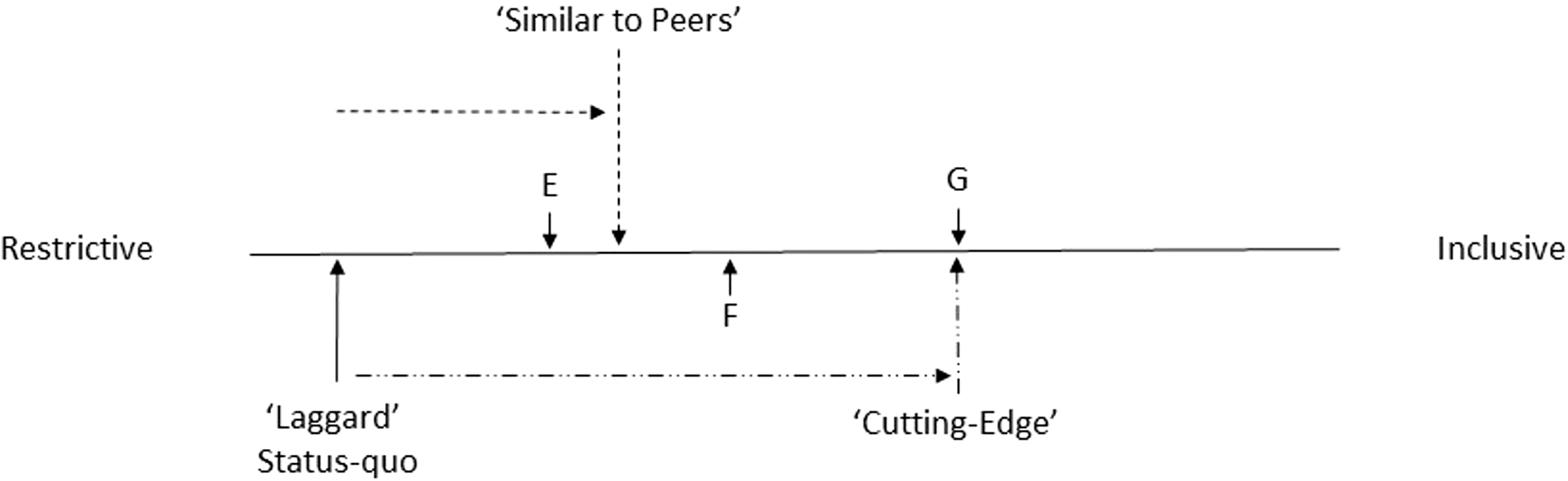
Finally, after choosing a peer group and identifying an international standard, political actors still need to select their preferred policy position vis-à-vis the standard. Thus far, we have assumed that actors want to emulate a median position; this is broadly consistent with Weyland’s observation that “governments dread the stigma of backwardness and therefore adopt policy innovations, regardless of functional needs” (Reference Weyland2005: 270). Relaxing this assumption points toward a third type of debate in the emulation process, as actors pitch different envisioned positions vis-à-vis the peer group standard. Some might advocate a position “similar to peers.” The reform proposal will expand inclusiveness, but still might fall below a “median” position. Such a proposal is mapped in Figure 5, as one group advocates moving policy from the “laggard” status-quo level of restrictions to a position deemed “similar to peers.” Another group advocating a “cutting-edge” position might counter this limited reform proposal. Even if the country was not an entrepreneur in the area, it can still be among the pioneers by overshooting the international median. Accordingly, this group recommends a reform that places policy close to the most inclusive peer. Given the distance between “similar to peers” and “cutting-edge” proposals, we can plausibly expect contentious debate on envisioned policy positions.
Preferred Policy Positioning vis-a-vis Peers

In sum: even countries that are seemingly changing their policies to conform to international standards must decide which countries generate standards worth following, the basic content of the international standard and the countries’ preferred positions in relation to this standard. Factors that are often taken for granted in an international context—peer groups, collective expectations and envisioned policy positioning—must be chosen when policies are domestic. In some domestic contexts, the perceived existence of an international norm opens a debate about conformity.
Methods of Analysis
In providing a typology for the ways domestic actors negotiate and debate the process of emulation, we avoid presenting a clear causal story. Instead, we use qualitative document analysis (Wesley, Reference Wesley, Kaal, Marks and van Elfrinkhof2014) to describe and demonstrate the use of our typology. Although this effort can be dismissed as “mere description” (Gerring, Reference Gerring2012), we see effective description of process as a prelude to theorizing outcomes.
The empirical points we make are threefold. First, in terms of norm diffusion, domestic discourse around emigrant voting rights focusses heavily on emulation (as opposed to learning, competition or coercion). Second, political actors in Canada—at various times—debate relevant peers, policy positioning and envisioned preferences. Third, we see change over time in the content of debate. Specifically, actors for inclusive change increasingly emphasize a broader set of peers, identify a relatively inclusive set of existing peer group policies and advocate for a leading position vis-à-vis peers.
We take several steps to bolster the validity and reliability of our analysis. First, to aid replicability, we choose a preselected sample of documents. These come from the case of Frank v. Attorney General of Canada (2019). They include all documents used in the case: appellant and respondent records, transcripts and judgements. Furthermore, we obtained contents of a Freedom of Information request to Elections Canada connected to the case. The material is clearly defined and publicly available, improving the impartiality of the analysis, an important aspect in the “trustworthiness” of qualitative document analysis (Wesley, Reference Wesley, Kaal, Marks and van Elfrinkhof2014: 145). In total, it consists of 5,429 pages spanning parliamentary debate, committee proceedings, government reports, expert testimony, oral arguments, judicial rulings and bureaucratic emails.
There are sample biases to note. Submission of evidence is, by definition, strategic and limited in that it is meant to bolster a case. For our study, the bias is minor for two reasons. First, both contending parties made international norms an important part of their case. While these actors had opposing “restrictive” and “inclusive” readings of norms, they were inspired to collect all available evidence to bolster their positions. Second, the material is close to exhaustive as it relates to the issue area. An important argument in the Frank case is the government’s lack of clear justification for a 5-year sunset clause on voting rights for emigrants. To demonstrate the point, they include considerable parliamentary discussion of the issue in the appellants’ record.
Although we primarily use qualitative assessment of evidence, to enhance precision (reliability) of our claims, we also quantify all instances in which actors discuss international norms and practices. This allows for a weighting of different diffusion discourses (emulation, learning, competition and coercion). In total, we identify 90 instances in which international practices or norms are the topic of discussion, making international comparison a modest, albeit important, piece of the overall discussion around emigrant enfranchisement;Footnote 4 77 (86%) of these were explicitly concerned with establishing international standards, which we code as emulation. The next closest diffusion mechanism was learning (11%), primarily concerned with the relationship between rules and voter turnout.Footnote 5 A small percentage of observations allude to competition;Footnote 6 none mention coercion. Emulation, then, was the dominant—but not solitary—theme of discussion when referencing international practice.
Case selection: Canada’s two periods of emigrant enfranchisement debate
Canada was neither a leader nor an exceptional laggard in the enfranchisement of emigrants. This makes the country a useful case study for policy diffusion; an international example is most likely to influence those behaving consistently with group trends. As a liberal democracy, Canada has accessible records of public debates, facilitating the study of rhetoric. The presence of two significant public debates in different periods let us assess diffusion mechanisms across varying international contexts. While the actors and settings of debate are quite different between periods, there is consistency in the structure of arguments as they relate to international norms.
Period 1 comprises the lead-up to the initial time-limited extension of voting rights to Canadians abroad, regardless of occupational status, which occurred between 1980 and 1993. Bill C-237 (An Act to amend the Canada Elections Act), which would have extended voting rights to emigrants, was proposed in 1980 and recommended by committee in 1981, but did not reach a third reading. The adoption of the Charter of Rights in 1982 set in motion a series of further investigations of the issue. There was an open question whether the residency requirements in place violated Section 3 of the new Charter, which states that “every citizen of Canada has the right to vote in an election of members of the House of Commons or of a legislative assembly and to be qualified for membership therein.” Elections Canada officials initially raised this concern. This resembled processes described by Hiebert (Reference Hiebert, Courtney and Smith2010), in which bureaucratic officials preemptively assess legislation for the risk of a Charter challenge. This was particularly acute for Elections Canada officials, given the potential administrative challenge of incorporating emigrants with little preparation. Elections Canada Chief Electoral Officer (CEO) Jean-Marc Hamel was the first to start prodding Parliament to address the issue. The next CEO, Jean-Pierre Kingsley, took up the baton and, following his retirement, served as an expert witness in Frank et al. v. Attorney General.Footnote 7
Legislators sought to retain their ability to determine voting rights prior to a judicial ruling. This motive became more pressing following a legal challenge to residency requirements filed in the lead up to the 1991 constitutional referendum (Clifford v Attorney General Canada et al., 1992). While dismissed on a technicality, the judge recommended Parliament address the issue, and the case underlined the likelihood of future legal challenges. Several legislators expected that the judiciary would eventually follow the American precedent in its broad defence of voting rights. Progressive Conservative [PC] Senator Gerald Beaudoin, then Chairman of the Standing Senate Committee on Legal and Constitutional Affairs, commented that, “The right to vote is the basis of Democracy. Since this was said in the supreme court of the United States, our Supreme Court may be influenced by that, and rightly so, and come [to] the same conclusion” (Canada, 1993). The anticipated involvement of the court was not welcomed by legislators, a sentiment that crossed partisan divides during Period 1. As Liberal MP Prud’homme complained at the time, “I’m tired of hearing all these appeals by any goddamn Joe Smith judge in any place in Canada who may have a different point of view” (Canada, 1992a: 44). The comments indicate a belief at the time that the court would extend emigrant voting rights, perhaps beyond the preferences of legislators. This outcome could be forestalled by timely legislation.
In terms of the partisan context, the issue of emigrant voting rights initially came to the fore during Liberal governments under Prime Ministers Pierre Trudeau and John Turner, though it received the most in-depth consideration during the second term of Brian Mulroney’s PC government. Populist reaction to the Meech Lake Accord process and a spike in political advertising by interest groups during the 1988 election prompted serious consideration of electoral reform (Carty and Young, 2012). Efforts were structured in relatively cooperative, multiparty venues; namely, the House of Commons Special Committee on Electoral Reform (or Lortie Commission, after its Nonpartisan Chair Pierre Lortie) and the House of Commons Special Committee on Electoral Reform (or Hawkes Committee, after its PC Chair Jim Hawkes). Emigrant voting rights were taken up as a minor technical issue in a larger systemic assessment of election financing and party regulation. At least in Period 1, only hints of a partisan divide existed; Liberal MP Prud’homme—the self-described “devil’s advocate” on the issue (Canada 1992a: 43)—needled the government repeatedly, without ever accusing them of seeking electoral gain.
A second round of debate (2006–2019) occurred in the lead up to the 2019 Supreme Court decision on the constitutionality of the 5-year sunset clause. In 2012, Gillian Frank (initially joined by Jamie Duong) filed a case challenging the sunset clause as a violation of Section 3 of the Charter. The legal challenge relied significantly on the precedent in the Sauvé v. Canada (2002) decision, in which limitations on the voting rights of prisoners were struck down (Burton, Reference Burton2021). The Frank case wound its way through the legal system, in the process prompting position-taking from a range of academics, civil society groups, legislators, election officials, judges and lawyers. Whereas the first round of debate took place primarily in legislative committees, the second unfolded primarily in depositions and oral arguments, though the government took public positions on the issue.
Compared with the first period, the emigrant voting issue had a moderately higher level of saliency, as evidenced by public news articles about the topic (see: Perkel, Reference Perkel2015). The partisan context surrounding the issue was also more contentious than Period 1. The Conservative Harper government did not act on a multiparty parliamentary committee’s 2006 recommendation to remove the sunset clause, and in 2009, restricted citizenship rights for Canadians living abroad (Government of Canada, 2025). In the years preceding the Frank case, the Conservative government of Stephen Harper received significant criticism from the opposition for alleged abuses of the democratic system (Russell and Sossin, Reference Russell and Sossin2009; Nadeau Reference Nadeau2011). In 2011, the New Democratic Party (NDP) attained federal Official Opposition status for the first time. Both Frank and Duong lobbied parliamentarians from the NDP (MPs Megan Leslie and Thomas Mulcair, respectively) to take up the emigrant voting issue (Frank, Reference Frank2012: paras. 25–26; Duong, Reference Duong2012: para. 27). From the NDP, they received assistance circulating a petition and a pledge to pursue emigrant voting rights in Parliament. Although the case originated in civil society, the opposition lent support on the broader issue, and the legal effort complemented a partisan critique of the Harper government. The 2015 ascension of Justin Trudeau’s Liberal government shifted the partisan dynamic; his government’s promised removal of the sunset was delayed, however, and the Frank case proceeded despite the government’s own disagreement with the Attorney General’s arguments.
Though the legal and partisan contexts of Period 1 and Period 2 were distinct, the incorporation of international practices and experiences into the debate followed a similar structure. We track this pattern below, organizing periods by distinct elements of rhetorical emulation.
The Rhetoric of Emulation in Canada’s Emigrant Enfranchisement Debates
Period 1—Selecting peers
During the first period, the selection of peers solidified over time, eventually being defined as “Western” countries. However, this peer group is only set once a critical mass of countries enfranchised. In one of the earliest acts of peer selection, the Chairman of the Standing Committee on Privileges and Elections asked Jean-Marc Hamel, then CEO of Elections Canada, “Do other countries, such as the western European countries and the United States, have provision for voting abroad in national elections?” (Canada, 1984). Hamel responded, “Not too many countries in the world allow their citizens abroad the right to vote. The U.S., Australia, New Zealand are practically the only ones.” At this early point, the stock of information exists only about Anglo countries. The Anglo tendency appeared again after the United Kingdom enfranchised emigrants in 1985. In 1988, PC MP Patrick Boyer noted the existence of a proposal that “Canadians living abroad be able to vote, much as Americans, Australians, and residents of the United Kingdom are able to do” (Canada, 1988). The list is expanded again after people noticed the emigrant enfranchisement in Germany. The Royal Commission on Electoral Reform and Party Financing (1991) recommended extending the vote to Canadians living abroad, noting, “The United States, France, Germany, Australia, and Great Britain make provision for voters living abroad to be registered and to vote” (46).
It was sometime in the early 1990s that actors set the peer group as some variant of “Western” countries. We see an early example in Clifford v. Attorney General of Canada et al. (1992), an Ontario Superior Court of Justice (OSCJ) case in which a Canadian abroad petitioned for the right to participate in the 1991 referendum. The judge’s ruling noted that former Elections Canada CEO Hamel “testified that Canada is the only country in the western world which does not make provision for absentee voting for all citizens who are residing abroad who wish to participate in a national election” (1992: 5–6). Drawing on this assessment, Chairman Jim Hawkes of the Special Committee on Electoral Reform remarked that “there are court cases and stuff related to this material that says we don’t—we’re the poorest nation in the western world, by the nature of the testimony, for allowing people who are absent from the place of residence to vote. We just don’t have a system like all other democracies have” (Canada, 1992a: 45). In the subsequent day’s hearings, Chairman Hawkes concluded, “A better system of balloting when you’re away from your place of residence has been developed in all other western democracies.” (Canada, 1992b: 25).
The crystallization of “Western” countries as the peer group papered over relevant institutional differences across these countries, several of which were acknowledged at the time. PC MP Howard Crosbie expressed skepticism that practices by some Western countries could be easily emulated. When questioning Hamel in the Standing Committee on Privileges and Elections in 1984, he rejected the possibility of following America’s lead in the enfranchisement of emigrants. He asserted, “The United States is no precedent because an American citizen could be in Borneo and still vote for the President of the United States without creating any difficulty” (Canada, 1984: 29). In other words, the U.S. system of fixed election dates and separate elections for executive and legislative branches eased the process of implementing voting abroad, setting an example inappropriate for the Canadian context. It was only later in time, when the proportion of Western countries enfranchising emigrants had increased, that the international standard appeared irresistible to those involved.
During the Hawkes Committee, Prud’homme also pushed back against the “Western” standard, drawing again on the U.S. example to challenge the appropriateness of broad international comparisons. Prud’homme began to argue, “They don’t have the same system. In the United States…” (Canada, 1992a: 45). At this point he was interrupted by the chair, who closed the comparative discussion by asserting, “I just said we’re the poorest in the western world on allowing people who are absent from home to be able to vote” (Canada, 1992a: 45). The matter was not closed, with Chairman Hawkes and Prud’homme clashing on the same topic the next day. Commenting on the research in the Clifford case, Hawkes noted, “of all western democracies, our system of absentee balloting is the most regressive” (Canada, 1992b: 25). Prud’homme shot back, “If you eliminate western democracies, what the hell are we being compared with?” The retort betrays both frustration with what he viewed as a vague, inappropriate standard as well as a lack of imagination about alternative peer countries beyond the West.
Period 1—Identifying policy positions
Prud’homme’s comment also reflects the information deficit that existed at the time, which prevented the identification of emigrant voting rights positions of peers and non-peers alike. For instance, Hamel’s early 1984 assessment that Australia, the United States and New Zealand were “practically the only ones” (Canada, 1984: 25) with emigrant voting was incorrect, as a number of non-Anglo countries (for example, Indonesia, Iran) enfranchised by this time. He was better able to acknowledge his uncertainty in the European context, noting, “some of the European countries [have provisions for emigrant voting], but it is a bit limited, or in some cases the mechanism is so complex or the time allowed is so short that it is very difficult to do it within the time allowed, particularly where they have a second ballot, as in France” (Canada, 1984: 25). Epistemic modesty in the European context was abandoned within a few years, following the crystallization of the Western standard. The assessment that Canada was “the only country in the western world which does not make provision for absentee voting for all citizens” (Clifford v. Attorney General of Canada et al., 1992: 5) took off despite numerous counterpoints, including Belgium, Italy, Ireland and Denmark. Despite these exceptions, the Western democracies demonstrated momentum toward emigrant enfranchisement between 1982 and 1993, which contributed to a sense of urgency.
Period 1—Envisioning preferred policy positioning
The record demonstrates an obvious concern about being a voting rights laggard. However, this position is always implied; there is never an explicit conversation about where Canada should sit vis-à-vis peers. There is an awareness that Canada is not a voting rights entrepreneur in the policy space, and a concern with not being the “poorest” in the peer group. In terms of rhetoric, though, discussions of emigrant voting rights were frequently prefaced by reminding the audience of Canada’s leading position on some element of voter inclusion. In 1987, NDP MP Nelson Riis preceded comments on the proposed extension of emigrant voting rights by noting that Canada was one of the few countries in the world to hold free and fair elections (Canada, 1987: 11331). Several months later, PC MP Patrick Boyer followed his discussion of emigrant voting rights with the comment that Canada has the “highest rate of eligible voters on its voters’ list of any of the democracies” (Canada, 1988: 13828). Peter Lortie, who led the Royal Commission which recommended emigrant enfranchisement, prefaced the commission’s broader work by arguing that Canada should be at the “forefront of democratic practice” and should be a “model to emulate” (Canada, 1991: 26). While the preferred positioning on emigrant voting rights was never discussed directly, the self-image contrasts notably with the laggard self-perception vis-à-vis peers.
Period 2—Selecting peers
Ironically, as the debate about emigrant voting rights shifted from Parliament to the courts, the historical importance of Canada’s legislative structure took on an outsize role. The government’s defence of existing sunset clauses layered one emulation argument over another. To summarize, the government argued that the peers worth emulating in terms of emigrant voting are those that have emulated British political institutions. These Westminster systems give pride of place to geographic representation. Even if emigrants maintain an attachment to Canada, nonresidents live outside geographic constituencies, lacking community ties and relationships with their MPs. The sunset clause, requiring residency within the last 5 years, is thus as justifiable a limit on Section 3 rights as it is consistent with the logic of the overall system, and the temporal limitations are common among the Westminster peer group.
Although multiple actors advanced the Westminster selection of peers, the affidavit of political scientist Munroe Eagles formed the foundation of the argument. As Eagles explained, “The traditional importance of principles and practices associated with “representation by place” leads most former British colonies either to deny non-residents the right to vote altogether, or adopt strict time limits on the exercise of such rights” (Eagles, Reference Eagles2013a: para. 18). Most of the discussion asserted a four-country peer group of Britain, Canada, New Zealand and Australia, with the latter three distinguished as “settler societies” that adopted British-inspired institutions. Eagles explained that the United States should be excluded due to its radical departure from representational forms in the “British-inspired” countries. While the British-inspired systems are most often presented as a foursome, Eagles also referred more broadly to the British institutional legacy when discussing cross-national research, implying that the proper referent group should go beyond Britain and the settler societies. Eagles’ formulation was also used by the attorney general; the Factum of the Respondent discussed the “three main comparators” (Australia, New Zealand and Britain) at greatest length, but it is also punctuated with references to “Westminster Parliamentary systems” (Attorney General of Canada, 2016: paras. 3, 73, 82, 86).
The peer group identified by other government actors was similar, albeit less precisely defined. Even before the OSCJ offered a ruling in Frank et al. v. Canada (Attorney General), the opposition began to push the Conservative Harper government to remove the sunset clause. NDP MP Megan Leslie introduced a private member’s bill (C-575, An Act to amend the Canada Elections Act [residence of electors]) to that effect in February 2014. When asked about the bill, then Minister of Citizenship and Immigration Chris Alexander responded that “most countries, especially those with a first past the post representative single-member constituency, do not hold full scale elections abroad” (Elections Canada, 2014: 1). Following the OSCJ’s ruling in favour of Frank, NDP MPs again questioned the government on the issue. Pierre Poilievre, then Minister of State for Democratic Renewal, stated that it “is fair and reasonable, and it is comparable with other similar democracies around the world” (Elections Canada, 2014: 1). The parliamentary back-and-forth prompted Elections Canada to brief their CEO on practices of “likeminded democracies” (Elections Canada, 2015: 2). The basis for the selection of the countries (Australia, Britain, New Zealand and the United States) was their “similar Westminster traditions or proximity to Canada” and that they “have historically been used by the Agency for comparison” (Elections Canada, 2015: 1). Though the overlap in groups was never exact, these government actors narrowed the peer group from the “Western” consensus of the 1990s to a limited “likeminded” formulation, drawing heavily on Westminster countries.
Advocates of inclusive reform—concretely, those against the sunset clause—addressed the “Westminster” argument using several tactics. One of these included expanding the peer group. The most frequent variant compared Canada with “democracies.” Frank’s lawyers—specifically, Shaun O’Brien—used this framing in their questioning of Eagles (Eagles, Reference Eagles2013b: para. 214). It also featured in oral arguments, with O’Brien arguing, “non-resident voting is allowed around the world and many, many democracies allowed non-resident voting indefinitely” and “the majority of democracies that have been assessed by the respondent’s expert allow non-resident voting” (Supreme Court of Canada, 2018: 46). Canada’s sunset rules are a “very unusual requirement in other democracies” (Supreme Court of Canada, 2018: 118). The Frank legal team’s leaning into the “democracy” peer group in SCC oral arguments likely reflected their success with such formulations in the OSCJ. There, Judge Penny’s ruling repeatedly referenced practices within “democracies” and noted that “strong democracies” tend to allow voters abroad to keep their vote indefinitely (Frank et al. v. Attorney General of Canada, 2014: para. 140). Thus, whereas the status-quo side of the argument sought to narrow the peer group from the old Western formulation, the reform side sought to broaden it to include all democracies (and beyond).
Period 2—Identifying policy positions
In addition to reframing peer groups, Frank’s legal team took seriously the identification of policy positions to highlight Canada’s departure from norms. Eagles’ argument held that Canada’s level of emigrant electoral inclusivity, clipped though it was by the sunset clause, was “generally in line with those of Australia and New Zealand” (Eagles, Reference Eagles2013a: para. 81). Accepting for argument the Westminster foursome forwarded by Eagles, Frank’s lawyers sought to show that the other Westminsters were more inclusive than Canada. This is clearest in their cross-examination of Eagles. Underlining the limits of the systemic argument, O’Brien noted, “in spite of the similar roots, those other countries [New Zealand and Australia] have given greater prominence to voter equality than Canada” (Eagles, Reference Eagles2013b: para. 96). O’Brien then dove into the minutia of sunset clauses, noting that there are mechanisms for citizens of New Zealand and Australia to provide the ability to vote from abroad indefinitely; the former by physically returning every 3 years and the latter by declaring an intent to resume living in Australia every 6 years. O’Brien explained, “So while in both Australia and New Zealand it’s possible to be resident outside of the country indefinitely and still continue to vote from outside the country as long as you take certain steps, that is not permissible in Canada” (Eagles, Reference Eagles2013b: para 204). O’Brien went on to note that, had Canada used the same rules as New Zealand, Frank would be allowed to vote from abroad. A similar argument was seen in the public debate, including a short opinion piece by political scientist Semra Sevi that caught the attention of Elections Canada (Elections Canada, 2014: 2). The clear implication: even compared with a limited peer group, Canada’s rules remained outside the norm.
The ability to identify positions and norms increased significantly between the first and second periods of debate. This knowledge base was pushed along by both academics and the community of election management officials. Proponents and opponents of the sunset clause clashed using three cross-national datasets to buttress their points (Blais et al., Reference Blais, Massicotte and Yoshinaka2001; Ellis et al., Reference Ellis, Carlos Navarro, Gratschew and Braun2007; Collyer and Vathi, Reference Collyer and Vathi2007). O’Brien drew on Blais et al. to demonstrate the scarcity of emigrant voting restrictions that resembled Canada’s, noticing, for instance, that only three countries required nonresidents demonstrate an intention of returning to live in the state of origin (Eagles, Reference Eagles2013b: para. 223). Turning to Collyer and Vathi, O’Brien interpreted the study as finding that 80 per cent of countries offered emigrant voting. She quoted directly from the article: “This is a much higher figure than given in any of the partial studies of phenomenon that have been published recently and reveals that far from being a minor discrepancy from the standard of territorially based participation, extra-territorial voting is actually the norm” (Eagles, Reference Eagles2013b: para. 258). Eagles called the publication a work of advocacy, noting he “wouldn’t recommend anyone to use this study” (Eagles, Reference Eagles2013b: para. 259), preferring instead the research from the Institute for Democracy and Electoral Assistance (Ellis et al., Reference Ellis, Carlos Navarro, Gratschew and Braun2007). Leaving aside the validity of each dataset, the existence of the research allowed the actors to make much more refined comparisons than existed in the debate two decades prior. The research underpinned the Frank legal team’s claim that Canada was falling behind the practices of other democracies.
Period 2—Envisioning preferred policy positioning
Proponents and opponents of the sunset clause also maintained distinct visions of appropriate policy positioning. The proponents’ position was that Canada is comparable to the Westminster systems, those countries have sunset clauses and as such, Canada’s level of restriction on emigrant enfranchisement is within an acceptable set of parameters. Eagles acknowledged the critique that Canada is more restrictive than the Westminster peer group and he viewed this as generally consistent with Canada’s choice to prioritize representation by place, “reflecting the country’s distinctive, unique geography and the need to temper the representation by population by considerations of the distinctive geographic communities that exist in the country” (Eagles, Reference Eagles2013b: para. 371). Deviation from the Westminster pack is thus justified by Canada’s particular circumstances. Canada does not have to reach any particular peer group median position; rather, it should have rules providing a level of inclusion similar to the Westminster systems, but also one that takes into account national distinctiveness. The ambiguity in the envisioned positioning likely reflects that Canada was more restrictive than the peer group; there was little incentive to advocate a laggard position on voting rights before the court.
Frank’s legal team, on the contrary, forwarded an argument that Canada should be leading the pack in voter inclusion. Contrasting Canada’s rules on emigrant voting, O’Brien called Canada “leading edge” in voting rights for other groups, such as those with mental disabilities (Eagles, Reference Eagles2013b: para. 230). O’Brien deployed this argument several times in the oral arguments, asserting that “the approach Canada has taken has been as a leader in voting rights” (Supreme Court of Canada, 2018: 46). Shortly thereafter, she noted that “we are ahead of the game when it comes to other types of voting,” referencing rules concerning the mentally disabled and prisoners (Supreme Court of Canada, 2018: 46). The clear implication is that Canada, a world leader in voting rights, should maintain few restrictions on emigrant voting.
This logic struck a chord with the judiciary. The OSCJ ruling noted, “I have real hesitation about the extent to which international comparisons are reliable or useful in this context. Canada is already a world leader in voter enfranchisement” (Frank et al. v. Attorney General of Canada, 2014: para. 140). The judgement goes on to call sunset clauses in Westminster countries only “superficially similar” to those in Canada, concluding, “I place little stock in the insights to be gleaned from international rules and authorities.” Similarly, the majority opinion in the SCC reads, “the history of the Canadian electoral system is one of progressive enfranchisement. Canada is an international leader in this respect” (Frank v. Attorney General of Canada, 2019: para. 62). This standard of comparatively expansive voting rights is discussed in relation to mental disabilities and prisoners. The ruling goes on to note, “We must not defer to the standards of comparable systems in other countries to establish that there is a rational connection between restricting non-residents’ voting rights and ensuring electoral fairness” (para. 62). Turning to the Westminster comparison, the ruling reads, “I place little stock in comparisons with other countries for the purpose of determining whether this legislation is constitutional. I would simply note that such comparisons are unhelpful in any event” (para. 74). The majority opinion later reviewed O’Brien’s points demonstrating that Canada’s sunset clause is more restrictive than those in the other Westminster systems.
Dissenting judges Côté and Brown explicitly pushed back against the majority’s dismissal of comparative practice. They note that the objective of maintaining close relations between representatives and communities “is pressing and substantial, and the means that Parliament chose to achieve it—a voting regime akin to those in place in comparable Westminster democracies, whose parliaments, like Canada’s, are constituted of elected community representatives—are demonstrably justifiable in a free and democratic society” (para. 112). They observe that the 5-year sunset clause “falls well within the range of limits adopted by other Westminster democracies” (para. 164). Beyond accepting the validity and usefulness of the peer group comparison, the minority question the principle by which the majority rejects such comparison, writing, “in rejecting other Westminster parliamentary comparisons, the majority’s patriotism risks descending into exceptionalism” (para. 166). Commenting on the claim that international jurisdiction has nothing to offer Canada, Burton observes, “this stance is particularly odd given the influence of foreign legal practice in drafting the Charter, and because of the otherwise largely accepted practice of drawing on foreign legal sources in interpreting the Charter” (Reference Burton2021: 647).
Conclusions
Canada’s enfranchisement of emigrant voters occurred in tandem with broader global trends, influencing the way Canadian policy makers debated the issue. Contrary to dominant models of policy diffusion emphasizing instrumental assessments of costs and benefits of policy choices, Canadian actors—politicians, judges, attorneys and civil servants—used information about global practices primarily to discuss international standards of appropriate behaviour. Despite the absence of international actors in the domestic debate, Canadian actors concerned themselves with abiding by international norms, however hazy they may be.
Drawing on constructivist analyses of norms and rhetoric, we argue that debates about emulation focussed on three main elements, which generated varying levels of consensus and contestation: setting peers, identifying existing positions and envisioning preferred policies. In each of these areas, the level of dispute increased over time. The “Western” peer group consensus of the 1980s and 1990s was replaced in the 2010s by a struggle to frame the peer group as either “Westminsters” or “democracies.” A technical debate emerged pertaining to existing peer policy positioning. Finally, actors more forcefully articulated their envisioned policy preferences, particularly those advocating that Canada take a “leading edge” position on emigrant enfranchisement. Where we might expect a global norm to clarify expectations of behaviour over time, prompting consensus within domestic debates, instead we see increasing contestation about the requirements of norm compliance.
The increasing diversity of debate suggests a preliminary hypothesis for future research pertaining to information and emulation. In its earliest manifestations, information constraints limit public discourse. In the absence of accurate information, debate focusses on the selection of peers rather than on existing positions or on envisioned preferences. The corollary of this argument holds that the progression of time increases the stock of information about a policy area. With the increase of information, debate about the policy shifts to identifying international standards and debating preferred policy positions. The hypothesis is, of course, preliminary; testing it is beyond the scope of this modest one-country, one-policy study.
Our rhetoric of emulation typology facilitates analysis of debate in at least one issue area (emigrant enfranchisement) in at least one case (Canada). The portability of the typology remains untested. It may not be surprising that domestic actors in an established democracy such as Canada seek to conform to global practices in an issue area overlapping with preexisting norms about the legal equality of opportunity (Keck and Sikkink, Reference Keck and Sikkink1998). To borrow Stimmer’s (Reference Stimmer2025) terminology, in other issue areas, we may find less concern with the “behavioural claim” and more with the “norm frame,” or underlying normative justification. Or, conversely, norm debate may be absent or less prominent than discussions of other diffusion mechanisms, such as learning and coercion. Future work may consider how the rhetoric of emulation interacts with the issue area.
Our focus on rhetoric leaves a challenging question unanswered: did the international norm determine Canadian policy outcomes? Beyond norm conformity, numerous factors were moving Canada toward emigrant enfranchisement. The legal foundation generated by the enactment of the Charter, and thereafter, precedents such as the Sauvé case, left the constitutionality of excluding emigrants in question, keeping the issue on the agenda of domestic actors. Political windows of opportunity facilitated enfranchisement moves as well; the 1993 enfranchisement legislation passed during a turn to electoral reform generated by the political tumult of the late 1980s, and the filing of Frank was at least partially encouraged by the NDP’s growth in 2011 and the political saliency of democratic norms during the Harper years. We have only provided a brief sketch of the domestic political and legal context in this article; a full accounting of policy change requires a more thorough assessment of these factors.
While the global context is hardly a sufficient condition to explain outcomes and timing in the Canadian case, it may well have been a necessary condition. A counter-factual scenario, with most countries moving away from emigrant enfranchisement, or one where emigrant enfranchisement was not standard practice, is unlikely to have invoked a similar pro-enfranchisement assessment among key actors. For legislators, the desire to “keep up” with other countries likely shaped preferences about a little-known issue. Beyond avoiding the “laggard” stigma, legislators in the 1990s also suspected the judiciary would be influenced by international standards and practices, which prompted action to ensure any policy change reflected their own preferences.
The SCC’s decision in the Frank case stated plainly that the majority was not swayed by international standards, a position belied by the attention given to the issue by politicians and legal teams anticipating their sensitivity, as well as the majority’s own rhetoric extolling Canada for being an “international leader” in “progressive enfranchisement.” Although the rhetoric of emulation by legislators and judicial actors focussed on similar elements, the focus and function of these institutions differ. Assessing the treatment and influence of norms in different domestic arenas is a productive area for future research, particularly regarding emigrant voting rights, where the judiciary plays an increasingly assertive role across countries (Allen & Wellman, Reference Allen and Wellman2024). Though the independent effect of international norms remains difficult to isolate, what is clear is the influence international trends had on public debate, with the rhetoric of emulation demonstrating a consistent structure across time periods and institutional arenas.
Supplementary material
The supplementary material for this article can be found at https://doi.org/10.1017/S0008423925100644
Competing interests
For 3 years, the first author worked for Asia Pacific Foundation of Canada (APFC), which provided research and an expert witness in support of the appellant in Frank v. Attorney General. The author was not directly involved in any APFC work related to the case. The manuscript was written after the author’s employment at APFC was completed and do not reflect the views of APFC.




 Open access

