

On June 15, 2020, more than 121 national- and state-based American Muslim organizations signed a community letter initiated by the civil rights law firm Muslim Advocates to condemn police violence. In this statement, they asserted that “Black lives matter. Yet, the murders of George Floyd and Breonna Taylor are just the latest high-profile acts of violence against Black people at the hands of police. This disregard for Black lives is not new; it is woven into our country’s very existence and dates back centuries” (Muslim Advocates and Muslim Wellness Foundation 2020).
The letter not only discussed the central victims that emerged in the 2020 iteration of the Black Lives Matter (BLM) movement but also centered a forgotten element of the Movement for Black Lives: the number of Black Muslims who recently have been killed through police violence. The letter cited several examples—namely, the death of “Stephon Clark, a Black Muslim and father of two children, was shot eight times by Sacramento police—three times in the back—in his grandparents’ backyard” (Muslim Advocates and Muslim Wellness Foundation 2020).
Historically, Black Muslims have led American Muslim political leadership and activism (Chan-Malik Reference Chan-Malik2018); however, more insight is needed to understand the impact of Black Muslims on American Muslim spaces. In their seminal work, Can We All Get Along, McClain and Carew (Reference McClain and Carew2018, 3) reflected on interminority group relations and asserted that “Although these groups share racial minority group status within the United States, there are fundamental differences in their experiences, orientations, and political behaviors that affect the relationships among racial minority groups.” Expanding on that perspective, this article emphasizes the shared histories between American Muslims and Black Americans. It is important to understand whether American Muslims have shared solidarity with other minorities and, in this case, whether they are concerned with issues that center the interests of Black social movements—given that Black history is the core of American Muslim history—or whether differences in experiences may diminish that connection (Diouf Reference Diouf2013; Turner Reference Turner2021).
American politics research on minority-group solidarity focuses on ethnoracial alliances, primarily Black, Asian, and Latino (Chan and Jasso Reference Chan and Jasso2023; Merseth Reference Merseth2018; Pérez Reference Pérez2021). There is limited understanding of American Muslims and whether they have a sense of solidarity toward other minorities. In an era in which Muslims in the United States are racialized, being Muslim has emerged as a racialized social identity wherein Muslims exhibit signs of behaving similar to other marginalized communities (Dana et al. Reference Dana, Lajevardi, Kassra and Walker2019; Jamal Reference Jamal2005; Lajevardi Reference Lajevardi2020; Oskooii Reference Oskooii2016; Sediqe Reference Sediqe2020). This study examines the centrality of support for Black Americans among American Muslims and explores the degree to which American Muslims (from all ethnoracial backgrounds) support the BLM movement and the factors that influence this support.
Because American Muslims are a faith-based group that is racialized, they are compared to both faith-based groups and ethnoracial groups in extant literature (Mogahed and Chouhoud Reference Mogahed and Chouhoud2017; Sediqe Reference Sediqe, Brown and Gershon2023). Moreover, emerging research on support for Muslim-related issues suggests signs of solidarity toward Muslims, but more research is needed to understand how Muslims themselves perceive the social movements and preferences of other minorities (Bonilla and Lajevardi Reference Bonilla and Lajevardi2025). Compared to other religious groups, are Muslims more likely to hold a sense of solidarity with Black Americans? Compared to other ethnoracial groups, are they more likely to hold a sense of solidarity with Black Americans? If so, what are the boundaries of this support?
Examining two online panel surveys of Muslims in 2020—the Institute for Social Policy and Understanding (ISPU) and the Collaborative Multiethnic Post-Election Survey (CMPS)—reveals that Muslims are supportive of issues that affect Black Americans and they tend to display more support of BLM than respondents from other faith-based groups. American Muslims also report higher levels of support for BLM compared to Latinos. Finally, examining what drives this support among Muslims themselves reveals that Muslims who have a higher sense of linked fate with Black Americans, an increased perception of discrimination, and a more liberal political ideology are more likely to support the BLM movement.
BOUNDARIES OF SOLIDARITY: THE CASE OF AMERICAN MUSLIMS
The boundaries of solidarity remain a key question in political science. Paula D. McClain et al. (Reference McClain and Carew2018, 250) revealed the promises and challenges of the politics of coalition building, which they defined as “the aggregation of groups to pursue a specific political goal.” They identified that both competition and coalition building are possible, contingent on the political conditions, common interests, and needs of each group. As a result, situations may arise wherein competition becomes the primary route; we cannot presume that solidarity is always the immediate choice because there may be boundaries and conditions for when competition or solidarity persists (e.g., Black–Asian tensions in Los Angeles in 1992).
Signs of cooperation have been revealed in recent research, indicating that people of color have a distinctive social identity that may unite Black and Latino voters (Chan and Jasso Reference Chan and Jasso2023; Pérez Reference Pérez2021). This research expands on extensive solidarity literature suggesting that circumstances, particularly shared marginalized status, can bring minorities together and strengthen their supraordinate identity as people of color (Brown and Jones Reference Brown and Jones2016). These studies bring important insight to how Black, Latino, and Asian Americans perceive one another but they have not fully interrogated whether these sentiments may exist for American Muslims.
For Muslim Americans, their solidarity with Black Americans is based on their shared history. American Muslims have resided in the United States since the days of chattel slavery, when they were brought here as enslaved labor during the height of the slave trade (Diouf Reference Diouf2013). Forcibly detaching individuals from their indigenous cultures contributed to the demise of Islam among the enslaved Muslims (Diouf Reference Diouf2013). There was a 60-year gap between the demise and the reemergence of Islam among Black Americans. Islam reemerged among Black Muslims as a protest religion; the acceptance of Islam served as a tool to push back against systemic racism in the wake of the Jim Crow era and lynchings in the South and, for many, as a reclamation of traditions to empower Black Americans.
Islam reemerged among Black Muslims as a protest religion; the acceptance of Islam served as a tool to push back against systemic racism in the wake of the Jim Crow era and lynchings in the South and, for many, as a reclamation of traditions to empower Black Americans.
Different manifestations of Islam emerged through American history that have shaped American Muslim politics. Noble Drew Ali, formerly known as Timothy Drew, established the Moorish Science Temple in 1913. More notably, the Nation of Islam (NOI) emerged as an influential part of the Black Power era. Founded by Fard Muhammad and popularized after the ascension of Elijah Muhammad as the head of NOI, the NOI gained popularity among Black Americans during the 1950s and 1960s by focusing on the needs and challenges of the most marginalized and disenfranchised Black citizens. The NOI expanded exponentially within the prison system and with formerly incarcerated individuals, and it was central in advocating for prisoner rights (Felber Reference Felber2020).
In particular, the NOI gained national popularity with its spokesperson, El Hajj Malik El‐Shabazz, popularly referred to as Malcolm X. Its presence was fostered because, as religion scholar Edward Curtis (Reference Curtis2005, 659) noted, “African American Muslim identities have often reflected, if not revolved around, the idea that the historical destiny of Black people as a whole is linked to the religion of Islam.” After the passing of Elijah Muhammad—whose leadership had made the NOI exponentially larger—his son, W. D. Muhammad, took the helm of the organization. On the direct guidance of W. D. Muhammad and the NOI’s transition to traditional practices of Sunni Muslims (Curtis Reference Curtis2005), 90% of NOI’s Black Muslims made a similar shift to mainstream Islam.Footnote 1 The community lead by W. D. Muhammad began referring to itself as “Bilalian,” a term that references one of the most important Muslim leaders during the early history of Islam who was known as Bilal. Since W. D. Muhammad’s leadership, most Muslims who are Black American subscribe to Sunni Islam. This is evident in Black activists’ utilization of Islamic rhetoric but in contrast to the mainstream popular depiction of Black Muslims, which continues to misattribute Black Americans as NOI rather than part of Sunni Islam (Abdul Khabeer Reference Abdul Khabeer2016).
Currently, Black Muslims are part of both predominantly Black and multiracial Muslim communities. For example, historic mosques that exist in Chicago, Atlanta, Detroit, Oakland, and Brooklyn are predominantly Black. Black American Muslims comprise approximately 20% to 30% of the Muslim community (Diouf Reference Diouf2013; Pew Research Center 2025). In addition, American Muslims include South Asians (20%), Arab Americans (20%), and Latinos, who are the fastest-growing community to convert to Islam. Prominent Black Muslim leaders head multiracial mosques in communities including in Northern Virginia. The first Muslim to serve in the US Congress was Black American Keith Ellison, and three of the four Muslims currently in the US Congress are Black American: Lateefah Simon (CA-12), Andre Carson (IN-07), and Ilhan Omar (MN-05). Black Muslims also have been in the leadership of social movements such as the Movement for Black Lives, with abolitionists including Blaire Imani and Mariame Kaba.
Individuals like Congresswoman Omar face the double-barreled challenges of both anti-Black racism and Islamophobic animus. Islamophobia is “built upon the core stereotypes and baseline distortions of Islam and Muslims embedded in American institutions and the popular imagination” (Beydoun Reference Beydoun2018, 29). The prevalence of anti-Muslim animus manifests through negative public opinion and negative media stereotypes (D’Urso and Bonilla Reference D’Urso and Bonilla2023; Lajevardi Reference Lajevardi2020; Peek Reference Peek2005), and it targets people who publicly appear to be Muslim, such as Muslim women who wear a headscarf (i.e., hijab) (Dana et al. Reference Dana, Lajevardi, Kassra and Walker2019). Muslims’ experiences with discrimination influence how they mobilize (Oskooii Reference Oskooii2016). American Muslims are a diverse religious collective that has experienced racialization, which is the process of “ascribing racial meaning to a group, practice, or identity such that it is understood and treated as a racial category…” (Omi and Winant Reference Omi and Howard2014, 105). Therefore, both Asian Muslims and Black Muslims are susceptible to Islamophobia’s consequences.
Because Black Muslims comprise the public face, Islamophobia has directly impacted their safety (e.g., Ilhan Omar being the target of violent reaction), and this ties the experiences of Islamophobia and anti-Blackness to the imaginary for many American Muslims. As visible Black Muslim women report, Islamophobia is so far reaching that “My hijab erases my blackness” (Sediqe Reference Sediqe, Brown and Gershon2023, 39). How Black American Muslims serve as the key voices and often are on the frontlines of experiencing Islamophobia suggest that this centers shared interests between Black Americans and American Muslims. This motivates the key questions of this study: Do the interests of Black American Muslims influence the interests of American Muslims? Do their interests affect how American Muslims shape their support for Black American social movements?
STUDY 1: MUSLIM SUPPORT FOR BLACK LIVES MATTER COMPARED TO OTHER FAITH GROUPS
Because American Muslims traditionally are considered a faith-based community, the first study examined American Muslims compared to other faith-based groups. This comparison reveals the variation in religious groups, given that American Muslims are both a minority group and a faith-based community. American Muslims may have stronger solidarity with Black Muslims based on the history of American Islam being intertwined with Black American history. Moreover, in comparison to other faith-based communities in the United States, Muslim communities are more multiracial (Pew Research Center 2025). For Muslims who are socialized into multiracial mosque settings, the common interests of their collective community may be more apparent. Conversely, other religious groups—particularly Christians, despite holding rich traditions of Black Christianity—tend to be more segregated, which may limit their empathy for Black Americans. This has been exacerbated by the rise of white Christian nationalism, which has a more exclusionary outlook toward nonwhite Christians (Joshi Reference Joshi2020).
In addition, assisting one another is included in the five pillars of the Muslim faith and centers on solidarity in their teachings. The core tenets of Islam include these five pillars. The third pillar is alms giving (i.e., zakat), which prescribes that financially stable Muslims contribute 2.5% of their total net worth to the neediest members of their community. This pillar identifies at least eight categories of need, including “helping the poor and needy, refugees and displaced people, and liberating those in bondage” (Rehman and Pickup Reference Rehman and Pickup2018). Zakat is considered a form of social responsibility, a service toward God, and it is articulated explicitly as such in explanations for the general public. The fourth pillar of Islam involves fasting (i.e., Ramadan) during the lunar calendar month in the Muslim calendar. The Muslim fast is believed to be a way to build empathy for others who have more challenging circumstances. In the context of the United States, Sediqe (Reference Sediqe2025) found that these religious beliefs are coupled with Muslim community discourse in reaction to Muslims facing dire circumstances. They found that American Muslims socialized into American life have a communal, social-justice orientation because of the role of community organizations (e.g., HEART Chicago and Muslim Women For). The social-justice praxis oriented within American Muslim politics and community discourse contextualizes the primary expectation of this study: Muslims are more likely to support BLM compared to other American faith-based groups (hypothesis H1).
Study 1 Methodology
To test this expectation, I drew from a unique dataset of the ISPU. According to its 2020 online panel survey fielded from March 17 to April 22, 2020, there were approximately 801 Muslims, 351 Jewish, and 1,015 general respondents, totaling 2,167 individuals in the survey. Both telephone and web-based survey modalities were used. Support for BLM policies was modeled using a multivariate regression analysis to understand which factors increased the likelihood of their support (Sediqe Reference Sediqe2026).Footnote 2
Study 1 Results
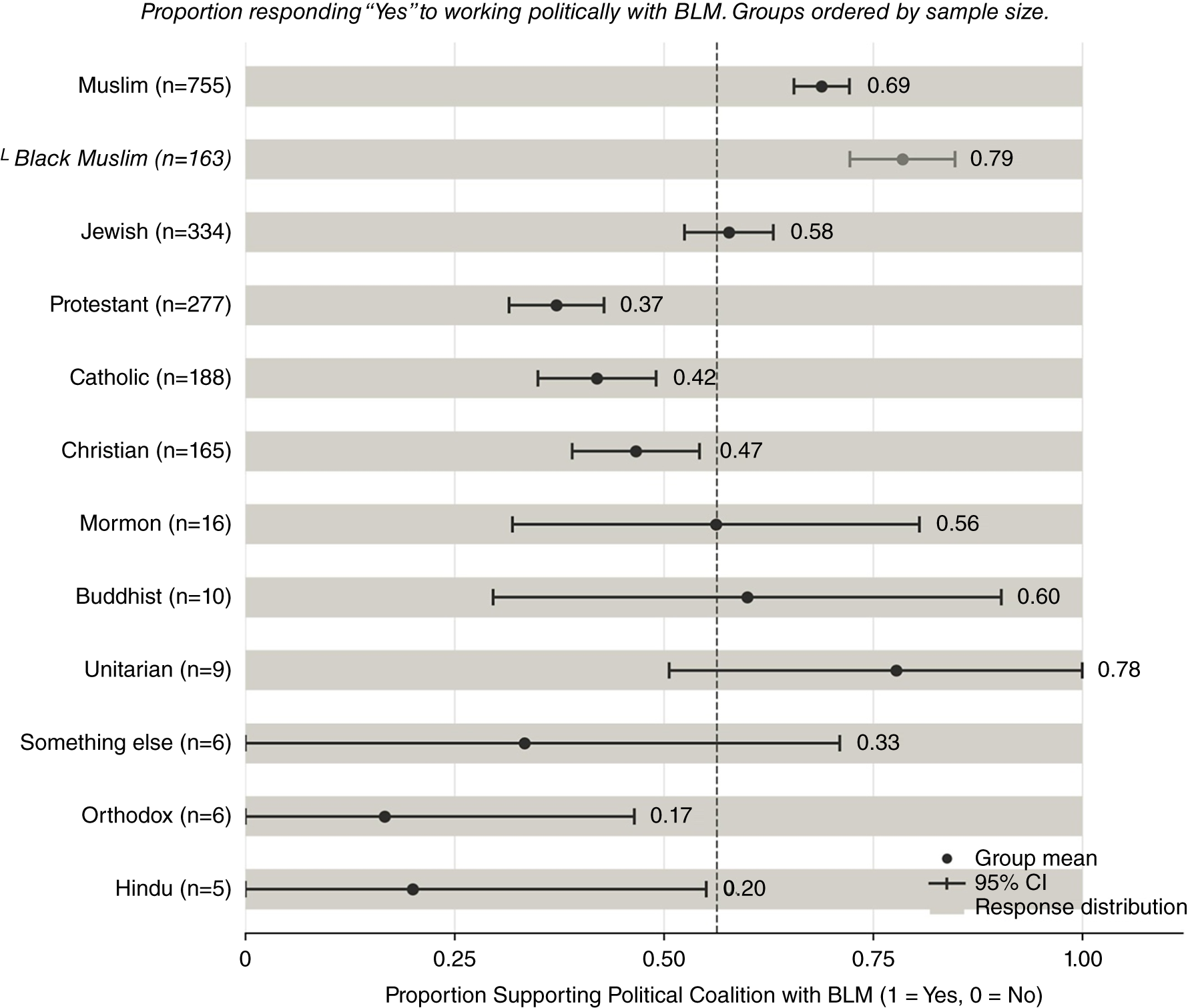
Figure 1 is a descriptive overview of differences by religious background. The summary results highlight that Muslims are more likely than other faith-based groups to state that they would support BLM initiatives. That is, 69% of Muslims answered yes, compared to 37% of Protestants, 42% of Catholics, and 58% of Jewish respondents.
Muslims are more likely than other faith-based groups to state that they would support BLM initiatives.
Support for Black Lives Matter Coalition by Faith Background
Note: 95% CIs calculated as mean ± 1.96 ×
$ \left(\mathrm{SD}/\sqrt{\mathrm{n}}\right) $
 . Dashed line = overall sample proportion (0.56, N=1,771).
Black Muslim is a subgroup of Muslim. Question: “Would you support politically working with Black Lives Matter?” Data: ISPU 2020.

Figure 1. Long description
From top to bottom, faith groups are ordered by sample size: Muslim (n equals 755) has a mean support of 0.69, Black Muslim (n equals 163) 0.79, Jewish (n equals 334) 0.58, Protestant (n equals 277) 0.37, Catholic (n equals 188) 0.42, Christian (n equals 165) 0.47, Mormon (n equals 16) 0.56, Buddhist (n equals 10) 0.60, Unitarian (n equals 9) 0.78, Something else (n equals 6) 0.33, Orthodox (n equals 6) 0.17, Hindu (n equals 5) 0.20. Each group is represented by a dot for the mean and a horizontal line for the 95 percent confidence interval. The x axis ranges from zero to one, labeled as proportion supporting political coalition with B L M, with a dashed vertical line at 0.5. Highest support is among Black Muslims, Unitarians, and Muslims. Lowest support is among Orthodox and Hindu groups.
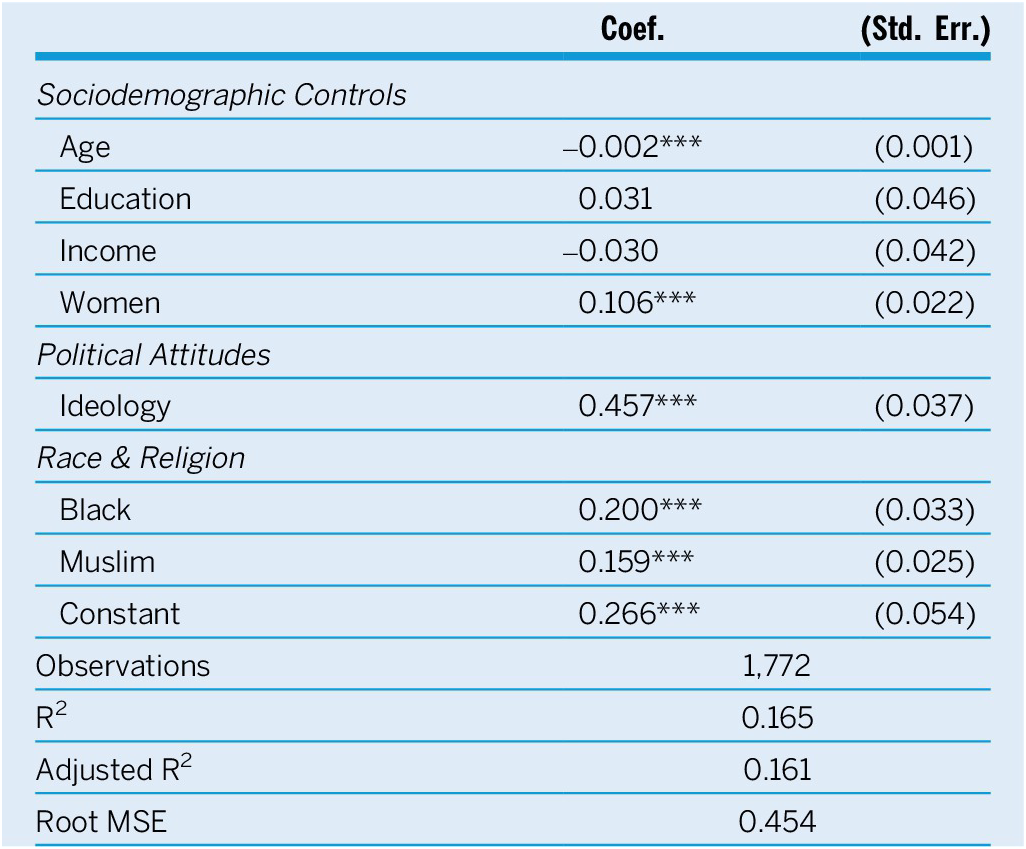
Results of the multivariate regression analysis presented in table 1 reveal that the distinction between Muslim and non-Muslim respondents remains significant even after controlling for other factors. In general, the model explains approximately 16.5% of the variance in support for BLM, and the results are statistically significant at conventional levels. It is important to note that ideology is the strongest predictor, wherein respondents who self-reported as more liberal were more likely to support BLM. Similarly, Black respondents were more likely to support BLM compared to non-Black respondents, and gender mattered because women were more likely to support BLM compared to men. Although the findings include a more complex factor in the decisions, it is noteworthy how Muslim respondents were more likely to favor their support, which is consistent with hypothesis H1.
Intra-Faith Support for Black Lives Matter

Table 1. Long description
Beginning at the top, the table is divided into three main sections: sociodemographic controls, political attitudes, and race and religion. Under sociodemographic controls, Age has a coefficient of minus 0.002 with three asterisks and a standard error of 0.001, Education is 0.031 with a standard error of 0.046, Income is minus 0.030 with a standard error of 0.042, and Women is 0.106 with three asterisks and a standard error of 0.022. The political attitudes section lists Ideology with a coefficient of 0.457 with three asterisks and a standard error of 0.037. The race and religion section includes Black with a coefficient of 0.200 with three asterisks and a standard error of 0.033, Muslim with a coefficient of 0.159 with three asterisks and a standard error of 0.025, and Constant with a coefficient of 0.266 with three asterisks and a standard error of 0.054. At the bottom, Observations are 1,772, R-squared is 0.165, Adjusted R-squared is 0.161, and Root M S E is 0.454. Three asterisks indicate p less than 0.01. The dependent variable is support for politically working with Black Lives Matter, coded as 1 for Yes and 0 for No. Data source is I S P U 2020 with N equals 1,772.
Note: OLS coefficients with standard errors in parentheses.
Dependent variable: “Would you support politically working with Black Lives Matter?”
(1 = Yes, 0 = No). Data: ISPU 2020 (N = 1,772).
*** p < .01
STUDY 2: COMPARING MUSLIMS’ SUPPORT FOR BLM TO OTHER RACIALIZED MINORITIES
Considering Muslims as a minority, they have a well-documented history of being marginalized and treated like a racialized minority. This suggests further exploration of how their solidarity compares to other racialized minorities (Cainkar and Selod Reference Cainkar and Selod2018; Selod Reference Selod2018). If Muslims are racialized, how does this compare to other racialized minorities? I drew on the understanding that anti-Blackness is what “anchors the racial social order,” which complicates solidarity because other minority groups in the social order have positions of privilege relative to Black Americans (Hua and Junn Reference Hua and Junn2021, 28; Masuoka and Junn Reference Masuoka and Junn2013). Given the racialized status of Muslims in the social order, I expected that Muslims were more likely to support BLM compared to the dominant majority group, white Americans (hypothesis H1).
When the racialized social order among other minorities is considered, the conditions complicate how non-Black minorities position their solidarity and make it contingent on specific conditions (Bonilla-Silva Reference Bonilla-Silva2003; Masuoka and Junn Reference Masuoka and Junn2013; Kim Reference Kim2000). For American Muslims, their connection to Black Muslims and the conditions of Islamophobia render their position in the social order as less privileged, which motivates them to increase their solidarity with Black Americans. For Asian Americans and Latinos, there is mixed evidence of moments of solidarity (Gaines and Lien Reference Gaines and Lien2024; Merseth Reference Merseth2018) and competition (Kim Reference Kim2000; McClain Reference McClain1993). For Asian Americans, the racial social order may serve as “A hierarchy that grants Asians some semblance of racial privilege often mistaken for full equality…which creates incentives for Asian Americans to preserve the status quo” and makes it easier for variance in degrees of solidarity (Hua and Junn Reference Hua and Junn2021). Similar incentives exist for Latinos and may garner more variance in levels of support (Fraga et al. Reference Fraga, Garcia, Segura, Jones-Correa, Hero and Martinez-Ebers2010). Although American Muslims also may have some related variance, I expected that, on average, Muslims were more likely to express support for BLM compared to Latinos and Asian American respondents who are not Muslim (hypothesis H2). Although support does exist among Asian American and Latino communities, I expected that there was more heterogeneity compared to American Muslims.
For American Muslims, because Black American Muslims comprise the majority of US Muslims (i.e., 20% to 30%) and often are on the frontline of protecting American Muslims in congressional advocacy and Islamophobia work, there is more consistent support on an individual level compared to other minoritized communities. This also leads to ask which Muslims may provide more solidarity; I argue that specific subgroups of Muslims may be more likely to support BLM. First, I expected that Black Muslims were more likely to support BLM compared to non-Black Muslims, given their proximity to other Black Americans (hypothesis H3).Footnote 3 Second, I expected that Muslims who identify as ideologically liberal were more likely to support BLM (hypothesis H4). Third, I expected that Muslims with increased perceptions of discrimination were likely to support BLM, given the ties that shared marginalization has with elevating empathy (hypothesis H5).
Fourth, the role of psychological resources has been foundational for racialized minorities, and linked fate—the belief that what happens to one individual in a group may impact their own life—is a meaningful measure of solidarity (Dawson Reference Dawson1994; Smith et al. Reference Smith, Clemons, Krishnamurthy, Martinez, McLaren and White2024). I expected that Muslims who view their fate as tied to Black Americans were more likely to support BLM (hypothesis H6). This expectation stems from their intertwined histories and similar patterns of government surveillance that impact both communities, and is shaped by the role of Black Muslims connecting non-Muslim Black Americans and non-Black American Muslims.
Study 2 Methodology
The 2020 CMPS (Frasure et al. Reference Frasure, Wong, Barreto and Vargas2025) is a large oversample of minorities, including a national sample of Muslims (N=579); Asians (N=3,955); Black Americans (N=4,843); and Latinos (N=4.577). The 2020 data were administered online between April 2 and October 4, 2021, with further insight on the methodology articulated in Frasure et al. (Reference Frasure, Wong, Barreto and Vargas2025). Numerous scholars have used this dataset to understand minority political behavior (Chan and Jasso Reference Chan and Jasso2023; Masuoka, Ramanathan, and Junn Reference Masuoka, Ramanathan and Junn2019). Two primary dependent variables of interest asked respondents: “How strongly do you agree or disagree with the following statements? ‘I have a responsibility to support the Black Lives Matter movement.’” This first question was a meaningful measure because it moves beyond support and also discusses the sense of obligation that an individual may have toward the community.Footnote 4 The second question asked respondents whether they donated more than $20 to the BLM movement, which helped to determine whether solidarity remains when material costs are involved.
Study 2 Results
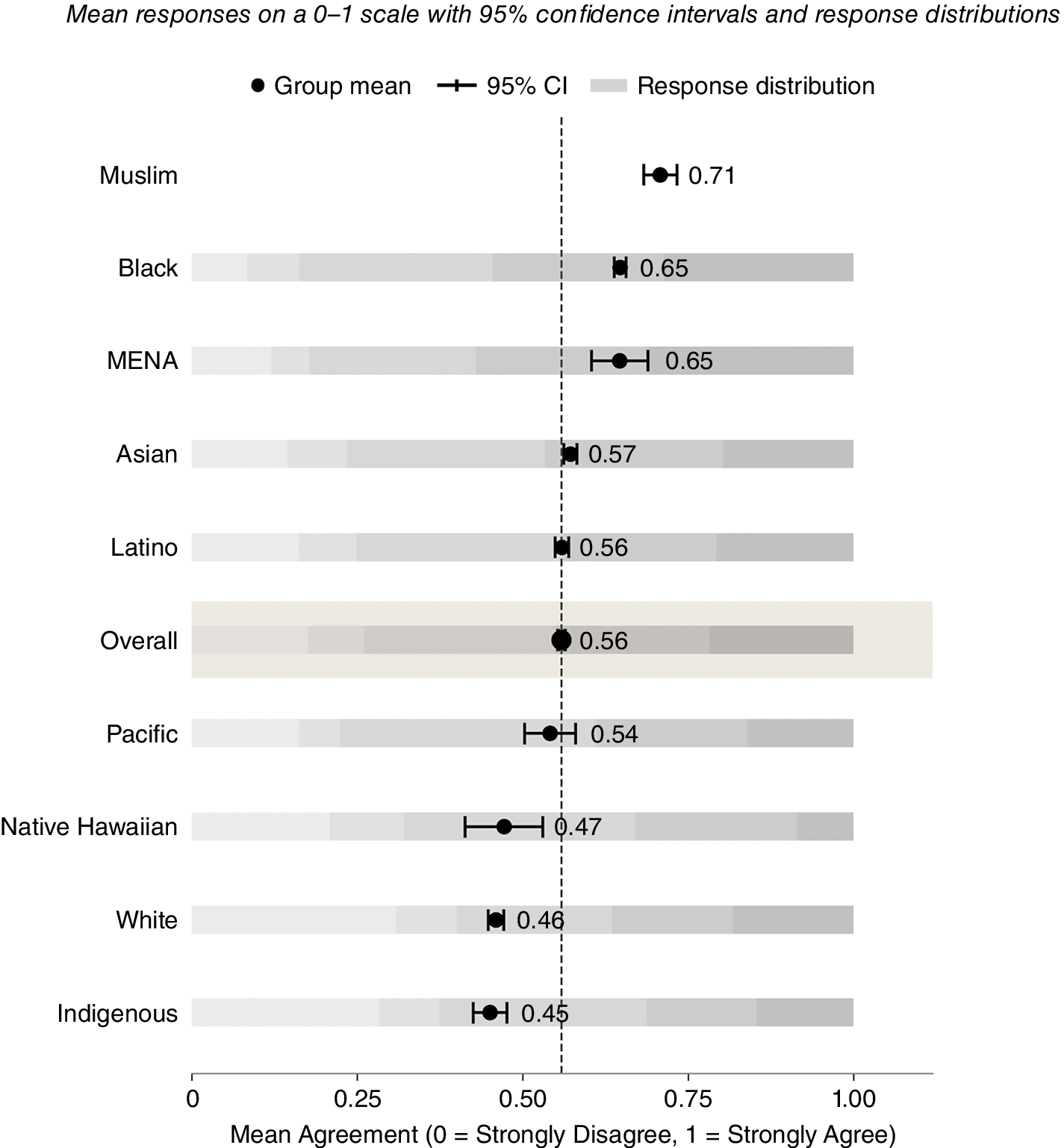
The analysis compared Muslims to all other respondents within the sample. Figure 2 highlights the average support response and reveals that 35.41% of Muslims strongly agreed that they have a responsibility to support the BLM movement. The group mean was 0.71 on a scale of 0 to 1, which was higher than the collective mean of 0.56 in the CMPS sample. Footnote 5 In comparison, 28.56% of Black respondents strongly agreed; the percentage decreased for Asian Americans (19.92%), Latinos (21.32%), and whites (18.71%).
Support for Black Lives Matter Movement by Subgroup (CMPS 2020)
Note: Responses measured on a 0 (strongly disagree) to 1 (strongly agree) scale. 95% CIs calculated as mean ± 1.96 ×
$ \left(\mathrm{SD}/\sqrt{\mathrm{n}}\right) $
 from group-level frequency distributions.
Group sample sizes: Muslim (n=579), Black (n=4,613), MENA (n=226), Asian (n=3,836), Latino (n=3,873), Pacific (n=255), Native Hawaiian (n=106), White (n=3,923), Indigenous (n=713); total N=17,545. Dashed vertical line indicates the overall sample mean. Groups ordered by mean value.
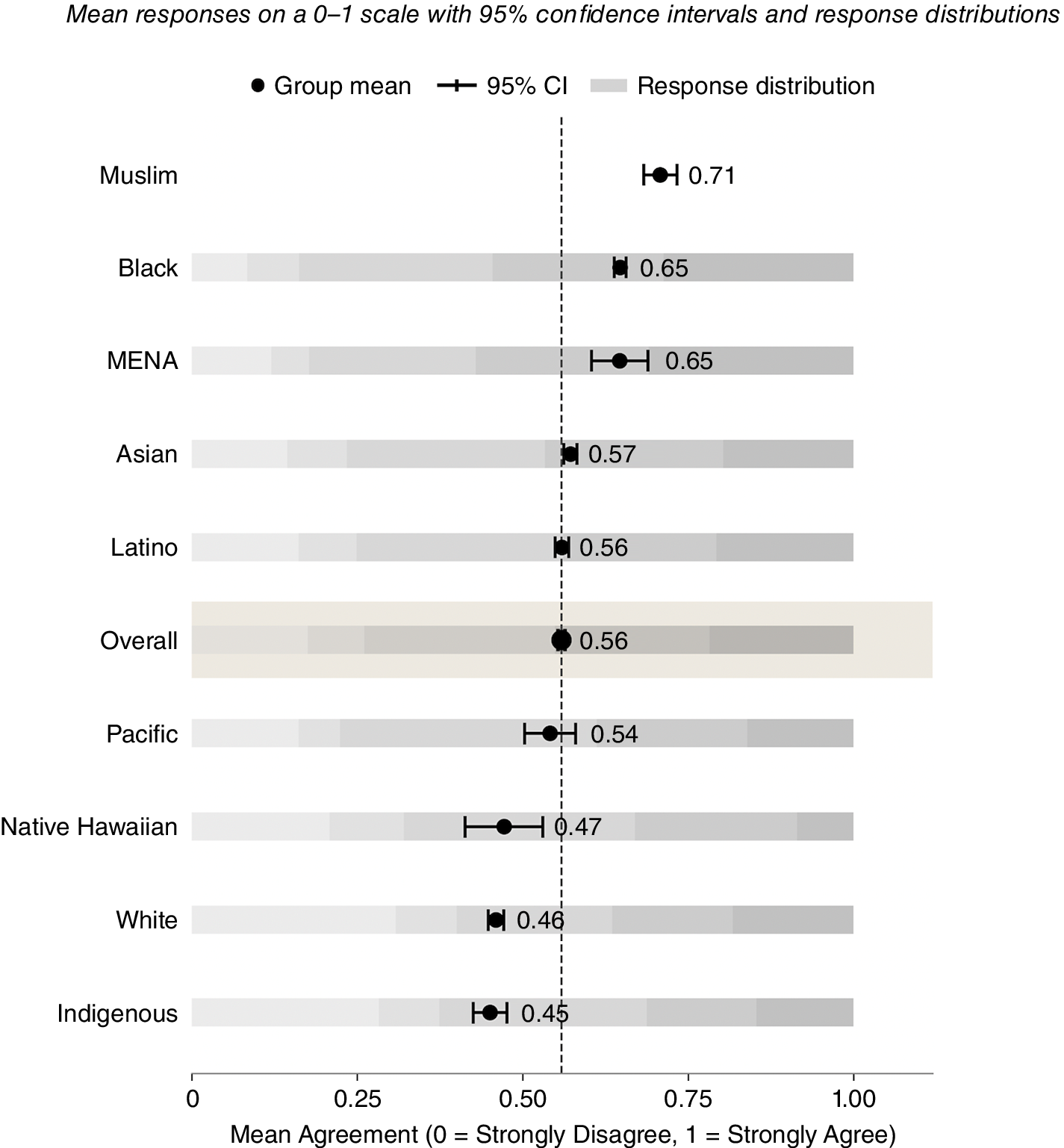
Figure 2. Long description
From top to bottom, the chart lists Muslim, Black, M E N A, Asian, Latino, Overall, Pacific, Native Hawaiian, White, and Indigenous. Each group has a horizontal bar representing the response distribution, a black dot for group mean, and a horizontal line for the 95 percent confidence interval. The mean agreement values are Muslim 0.71, Black 0.65, M E N A 0.65, Asian 0.57, Latino 0.56, Overall 0.56, Pacific 0.54, Native Hawaiian 0.47, White 0.46, and Indigenous 0.45. The x-axis runs from 0 to 1, labeled as Mean Agreement (0 equals Strongly Disagree, 1 equals Strongly Agree). The vertical dashed line marks the overall mean at 0.56. Muslims show the highest mean support, followed by Black and M E N A groups. Indigenous and White groups have the lowest means. Confidence intervals are narrowest for larger groups and wider for smaller groups.
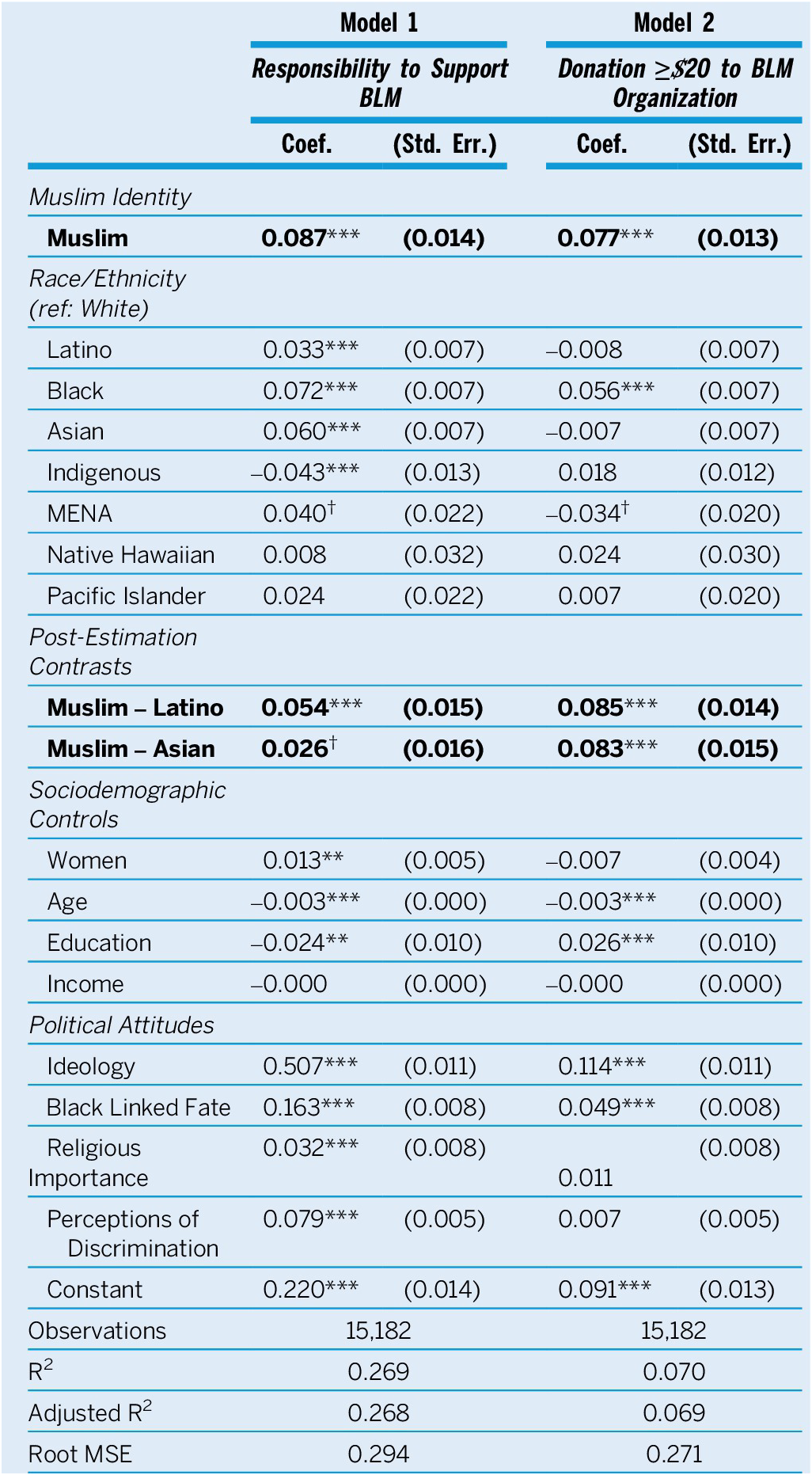
A multivariate regression analysis was implemented with BLM as the dependent variable to determine whether this dynamic was significant, controlling for other factors.Footnote 6 The results shown in table 2 provide partial support for hypothesis H3, which expected Muslims to express greater support for the BLM movement than Latino and Asian respondents who were not Muslim. Muslim identity was positive and statistically significant (β=0.087, p<0.001), indicating that Muslims reported higher levels of responsibility to support the movement than non-Muslims—even after accounting for racial identity and other demographic and political controls. It is important to note that Latino and Asian respondents also reported higher levels of responsibility to support BLM than whites. Postestimation comparisons of the differences among Muslims, Latinos, and Asian respondents indicate that Muslims reported significantly higher levels of responsibility to support BLM than Latinos (p<0.001). Although Muslims also reported somewhat higher levels of responsibility than Asian respondents, this difference did not attain conventional levels of statistical significance.
Support and Donation to Black Lives Matter Movement (CMPS 2020)
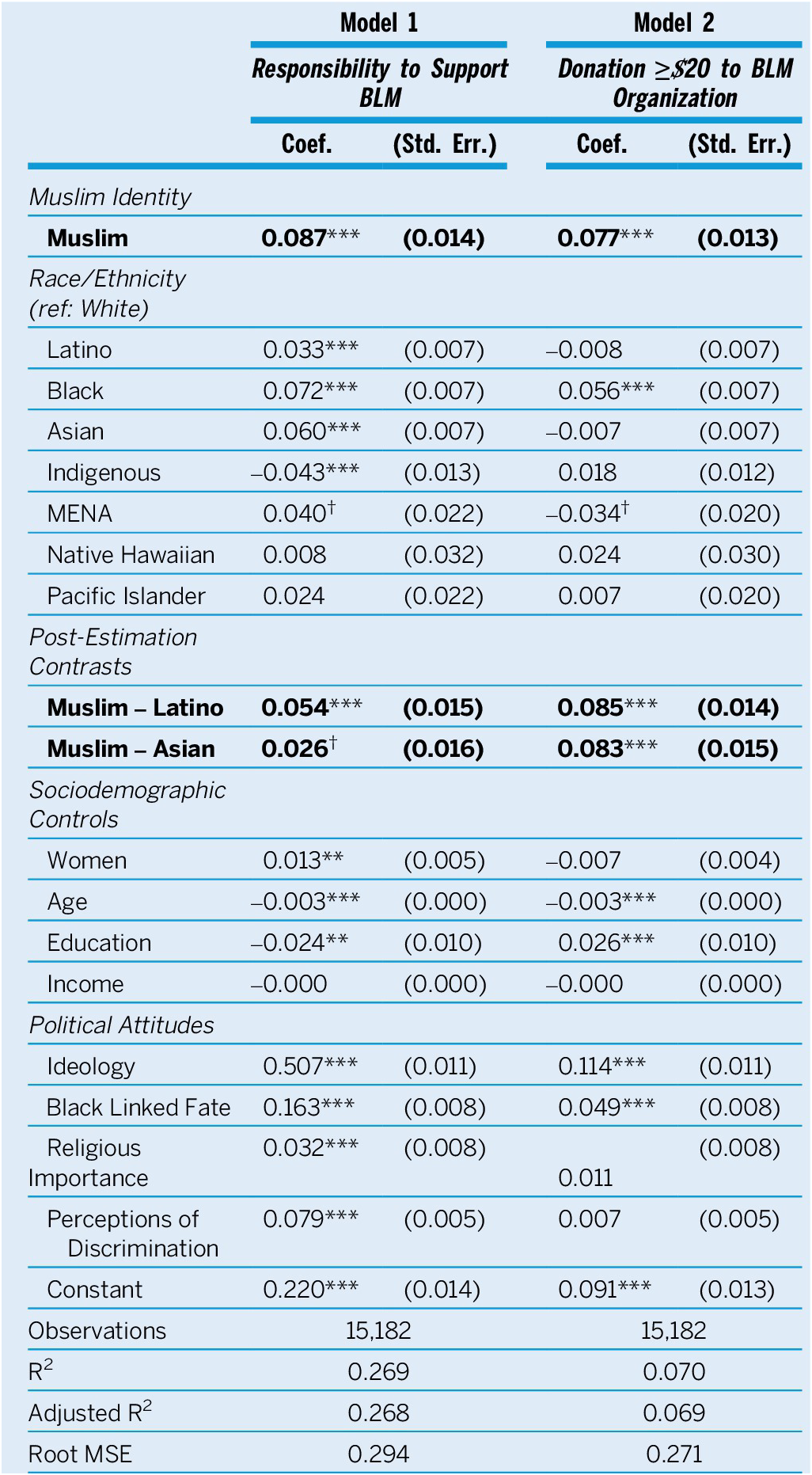
Table 2. Long description
The table presents O L S regression results for two outcomes: Model 1, responsibility to support Black Lives Matter on a zero to one scale, and Model 2, donation of at least twenty dollars to a B L M organization, coded one for donated and zero for not. The first column lists variables grouped as Muslim identity, race or ethnicity with White as reference, post-estimation contrasts, sociodemographic controls, and political attitudes. For Muslim identity, the coefficient for Muslim is zero point zero eight seven with standard error zero point zero one four in Model 1, and zero point zero seven seven with standard error zero point zero one three in Model 2, both highly significant. For race or ethnicity, Latino has zero point zero three three with standard error zero point zero zero seven in Model 1, and negative zero point zero zero eight with standard error zero point zero zero seven in Model 2. Black has zero point zero seven two with standard error zero point zero zero seven in Model 1, and zero point zero five six with standard error zero point zero zero seven in Model 2, both highly significant. Asian has zero point zero six zero with standard error zero point zero zero seven in Model 1, and negative zero point zero zero seven with standard error zero point zero zero seven in Model 2. Indigenous is negative zero point zero four three with standard error zero point zero one three in Model 1, and zero point zero one eight with standard error zero point zero one two in Model 2. M E N A is zero point zero four zero with standard error zero point zero two two in Model 1, and negative zero point zero three four with standard error zero point zero two zero in Model 2. Native Hawaiian and Pacific Islander coefficients are not significant. Post-estimation contrasts show Muslim minus Latino is zero point zero five four in Model 1 and zero point zero eight five in Model 2, both significant. Muslim minus Asian is zero point zero two six in Model 1 and zero point zero eight three in Model 2. Controls include women, age, education, income, ideology, Black linked fate, religious importance, and perceptions of discrimination, with coefficients and standard errors provided for each. Model 1 has R squared zero point two six nine, adjusted R squared zero point two six eight, and root M S E zero point two nine four. Model 2 has R squared zero point zero seven zero, adjusted R squared zero point zero six nine, and root M S E zero point two seven one. All models use fifteen thousand one hundred eighty-two observations. Statistical significance is indicated by asterisks and daggers as noted below the table.
Note: OLS coefficients with standard errors In parentheses. Reference category: White Non-Muslim respondents.
Model 1 DV: “I have a responsibility to support the Black Lives Matter movement” (0-1 continuous scale).
Model 2 DV: “In the past year, have you made a monetary donation of at least $20 to any BLM organization?” (1 = donated; 0 = did not).
Model 2 Isa linear probability model. Annotations show Muslim – racial group contrasts from post-estimation tests.
Data: Collaborative Multiracial Post-Election Survey (CMPS) 2020 (N = 15,182).
† p<.10 ** p < .05 *** p < .01
The second related question for support of the BLM movement moved beyond affective support. Respondents were expected to share their insight on support to a question that captured an understanding of their tangible support. They were asked about donations: “Thinking about your overall giving or donations to different organizations and causes, how much, if any, did you donate to Black Lives Matter?” Table 2 highlights the results and indicates that Muslims were more likely to have reported donating to BLM compared to non-Muslims in the sample. Postestimation contrasts further revealed that Muslims were significantly more likely to report donating to BLM than both Latino and Asian respondents, which highlights comparatively higher levels of tangible support among Muslims relative to those groups. Notably, whereas Black respondents also were more likely to report donating, the coefficients for Latino and Asian respondents were not statistically distinguishable from white non-Muslims. This underscores that the donation gap primarily reflects stronger participation among Muslims rather than reduced participation among the other groups.
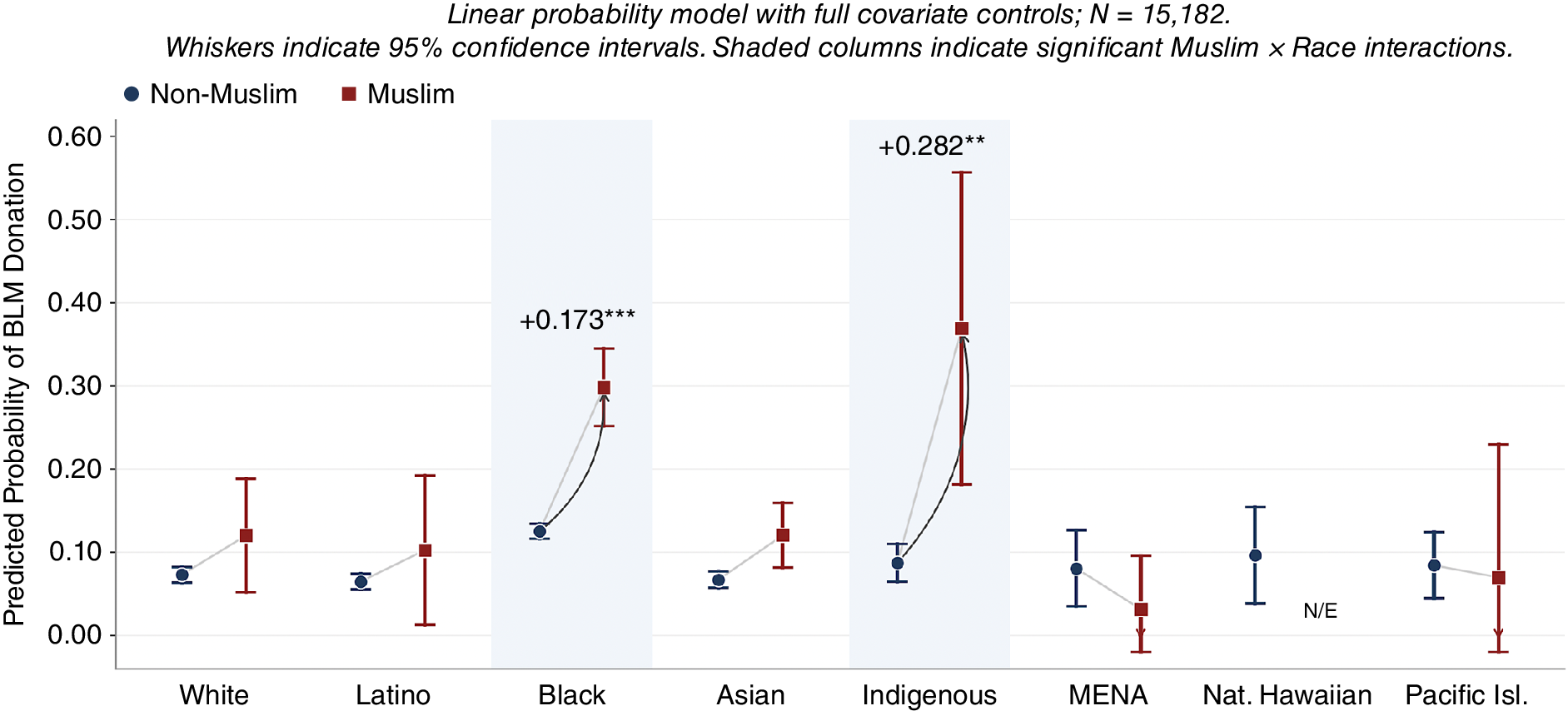
To understand whether this effect varied across racial groups within the Muslim community, I estimated models that interacted Muslim identity with race.Footnote 7 For BLM responsibility, none of the interaction terms attained conventional significance, suggesting that Muslims felt responsibility to support BLM fairly uniformly across racial groups. The donation model, however, revealed more distinctive patterns. When the interaction terms were included, the Muslim main effect became statistically insignificant, indicating that differences in donation behavior were not uniform across Muslims but instead varied by racial subgroup. In particular, Black Muslims were 12.6 percentage points more likely to report donating to BLM than their non-Muslim Black counterparts (p=0.003), a substantial effect that underscores the distinctive support of Black Muslims—a community situated at the intersection of Black and Muslim communities. Figure 3 presents the predicted probabilities of donating to BLM by racial group and Muslim identity, highlighting the especially pronounced gap between Black Muslims and Black non-Muslims.
Margins Plot for Black Lives Matter Movement Donations (CMPS 2020)
Note: Circles = Non-Muslim respondents; Squares = Muslim respondents. Annotations show Muslim – racial group interaction contrast. Native Hawaiian Muslim not estimable (empty cell). MENA and Pacific Islander Muslim CIs cross zero.
** p < .05 *** p< .01. Data: CMPS 2020.

Figure 3. Long description
The x-axis lists racial groups from left to right: White, Latino, Black, Asian, Indigenous, M E N A, Nat. Hawaiian, Pacific Isl. The y-axis shows predicted probability of B L M donation from 0.00 to 0.60. For each group, two points are plotted: blue circles for Non-Muslim and red squares for Muslim, connected by lines. Error bars represent 95 percent confidence intervals. For White, Latino, Asian, M E N A, Nat. Hawaiian, and Pacific Isl., both groups have low probabilities, with overlapping intervals. For Black and Indigenous, shaded columns highlight significant differences: Black Muslims have a predicted probability around 0.30, Non-Muslims around 0.13, with a labeled difference of plus 0.173 (triple asterisk). Indigenous Muslims have a predicted probability near 0.40, Non-Muslims near 0.12, with a labeled difference of plus 0.282 (double asterisk). N/E is noted for Nat. Hawaiian Muslims. The legend at top left identifies Non-Muslim as blue circles and Muslim as red squares. The graph title and notes specify a linear probability model with full covariate controls, N equals 15,182, and that whiskers indicate 95 percent confidence intervals.
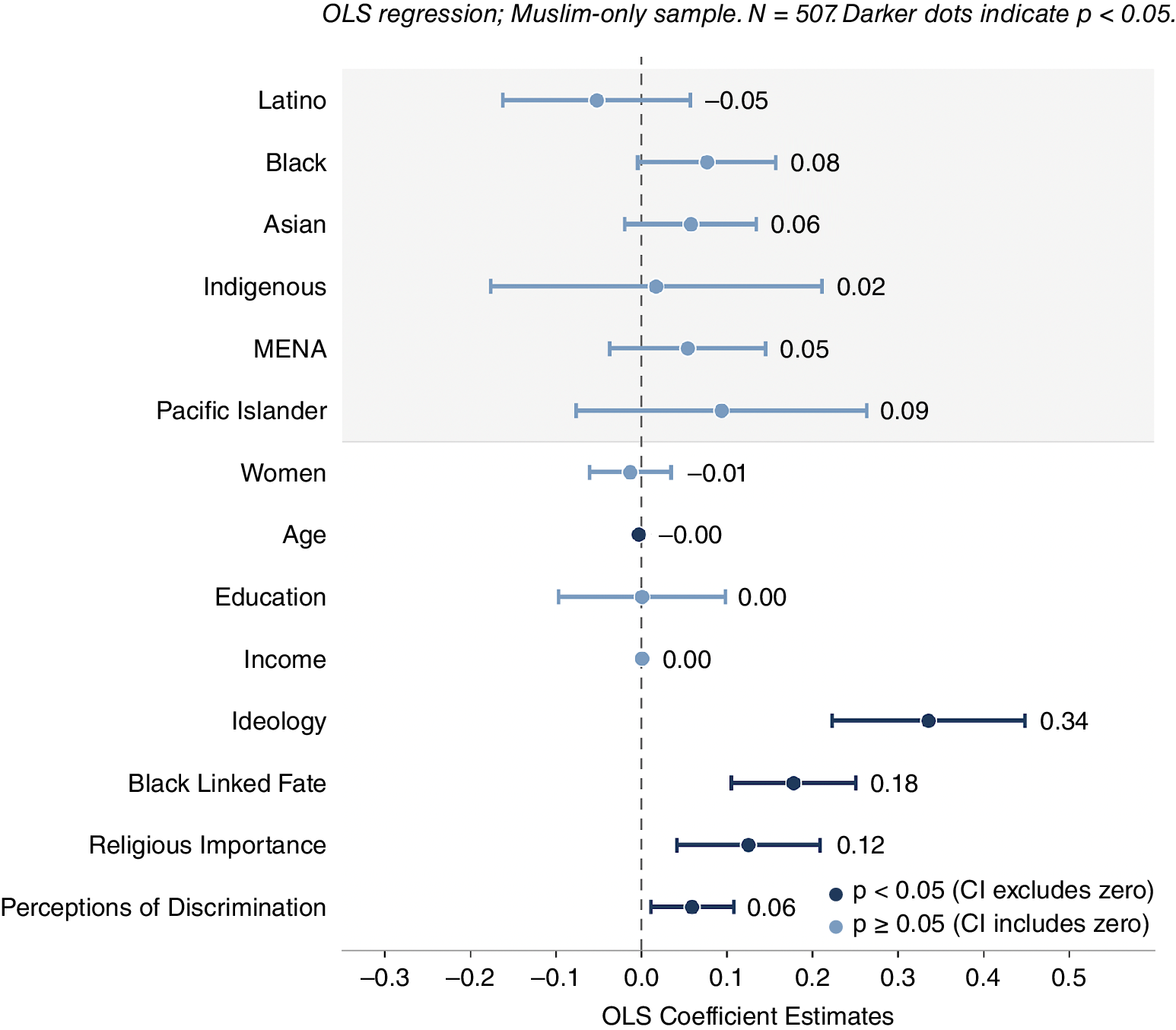
To determine the variation within the Muslim sample alone, the CMPS sample was narrowed to focus on the 579 respondents who identified as Muslims in the Muslim/Middle East or North Africa (MENA) sample. Figure 4 presents the results. Considering hypothesis H3 that Black Muslims would be more supportive, the difference between Black and non-Black Muslims supporting BLM was not statistically significant, which differs from the expectation. Turning to hypothesis H5, Muslims who identified as ideologically liberal were more likely to support BLM, which is consistent with the expectation. Ideology emerged as the strongest predictor of support in the model, indicating that political orientation had a central role in shaping Muslims’ attitudes toward the BLM movement. Finally, perceptions of shared fate and marginalization were aligned with increased support. Muslims with increased perceptions of discrimination were more likely to support BLM (hypothesis H6) as well as Muslims who felt a higher sense of linked fate with Black Americans (hypothesis H7). These findings suggest that experiences of marginalization and cross-racial solidarity influenced support for BLM within the Muslim community. It is interesting to note that Muslims who reported a higher sense of religious importance were more likely to support BLM, indicating that religiosity also may reinforce engagement with racial-justice concerns among Muslims.
Predictors of Muslim Support for Black Lives Matter Movement

Figure 4. Long description
The plot displays 14 predictors on the vertical axis: Latino, Black, Asian, Indigenous, M E N A, Pacific Islander, Women, Age, Education, Income, Ideology, Black Linked Fate, Religious Importance, and Perceptions of Discrimination. The horizontal axis is labeled O L S Coefficient Estimates, ranging from negative 0.3 to 0.5. Each predictor has a dot representing the coefficient and a horizontal line for the confidence interval. Dots are darker when p is less than 0.05 and lighter when p is greater than or equal to 0.05. From top to bottom, coefficients and their values are: Latino negative 0.05, Black 0.08, Asian 0.06, Indigenous 0.02, M E N A 0.05, Pacific Islander 0.09, Women negative 0.01, Age negative 0.00, Education 0.00, Income 0.00, Ideology 0.34, Black Linked Fate 0.18, Religious Importance 0.12, Perceptions of Discrimination 0.06. The largest positive coefficients are for Ideology and Black Linked Fate, both with dark dots indicating statistical significance. Most other predictors have coefficients near zero with confidence intervals crossing zero.
DISCUSSION AND CONCLUSION
McClain’s seminal text clarified that “minorities sometimes get along” (McClain and Carew Reference McClain and Carew2018) and the findings in this study provide further insight into American Muslims and their support for the BLM movement. Given the proximity of Black history and communities to American Muslims, it is important to understand that it is not only Black Muslims but also American Muslims from other ethnoracial backgrounds who supported the BLM movement. These findings also reveal the degrees of support. In Study 2, there was variation wherein donations to the BLM movement were driven by Black Muslims relative to non-Black Muslims, which highlights the conditions in which material support demonstrates differences in the levels of cross-racial support. In general, the results indicate a connection between non-Black Muslims and Black Muslims and more empathy toward Black Americans that is likely conditioned by the heightened climate of anti-Muslim racism.
Given the proximity of Black history and communities to American Muslims, it is important to understand that it is not only Black Muslims but also American Muslims from other ethnoracial backgrounds who supported the BLM movement.
This is meaningful when we consider that perceiving a sense of linked fate with Black Americans was more predictive of support for BLM across the three different analyses in Study 2. The feeling of shared fate reveals the ways that American Muslims feel a sense of connection with Black Americans and their experiences. This is compounded by surveillance by law enforcement that Black Americans historically have experienced, which shifted the American Muslim experience post-9/11. The findings on linked fate and responsibility suggest that it would be beneficial for future research to further explore why American Muslims from other ethnoracial backgrounds feel a sense of linked fate with Black Americans.
Moreover, those respondents for whom religion is important in their self-concept as Muslims were more likely to support the BLM movement. This finding parallels the sense of communal obligation Muslims have that is related to their sense of community and social justice that American Muslim scholars have alluded to in their studies (Bonilla and Lajevardi Reference Bonilla and Lajevardi2025). Recent findings highlight that American Muslims have a collective responsibility toward others that is easier to develop because of the religious references to the Muslim community and the ways that social obligation is embedded in religious belief (Sediqe Reference Sediqe2025). Social justice as a concept remains salient for American Muslims precisely because marginalization is an active process that they are navigating in today’s sociopolitical climate, which mirrors the experiences of communities to whom they are connected, particularly Black Americans.
The findings in this study suggest that these mechanisms are not simply additive but instead are likely to be mutually reinforcing in important ways. Racialization may serve as the foundational condition that renders the other mechanisms more important. When Muslims experience profiling and collective stigmatization, they may have an internal perception through which Black Americans’ experiences become obvious and proximate rather than distant or unrelated. It is within this context of shared marginalization that linked fate becomes emotionally and politically meaningful. This is elevated by Muslim religious teachings that emphasize social justice and collective obligation, which provide the moral motivation to translate felt solidarity into active support. Ideological liberalism likely amplifies this further because politically progressive Muslims may be more attentive to structural explanations of racial inequality and more predisposed to movement participation. Overall, racialization may catalyze or elevate the factors that underlie support. Understanding these mechanisms as layered and likely interconnected contextualizes why Muslim support for the BLM movement is both broadly distributed across racial subgroups and particularly significant among Black Muslims, who occupy the intersection of all of these reinforcing forces.
Recent activism highlights American Muslims on the frontlines of social movements in expected ways (e.g., pro-Palestine activism) but less has been discussed about their active engagement in the BLM movement. Moving forward, it also is important to better understand the impact of Black Muslim political engagement on Black American social movements. As protest engagement escalates in the wake of shifts in American democratic processes, it is critical to understand and pay attention to the role of minority-group solidarity. The findings presented in this article advance our understanding of how minorities build solidarity and relationships, even amid a turbulent period in which democratic engagement is shifting.
SUPPLEMENTARY MATERIAL
To view supplementary material for this article, please visit http://doi.org/10.1017/S1049096526102327.
DATA AVAILABILITY STATEMENT
Research documentation and data that support the findings of this study are openly available at the PS: Political Science & Politics Harvard Dataverse at https://doi.org/10.7910/DVN/WPZTOB.
CONFLICTS OF INTEREST
The author declares that there are no ethical issues or conflicts of interest in this research.




 Open access

