




Introduction
The cultivation of perennial grain crops for human consumption has been researched for the past few decades, initially by researchers in nonprofit organizations and more recently by universities. Falling within the vision of ‘perennial agriculture’, the intent has been to combine the positive attributes of human-selected annual crops with the advantages of perenniality (e.g., reduced soil disturbances, reduced production costs, C sequestration) as a way of enacting a more sustainable agricultural paradigm. It is expected that perennial grains will help row crop systems to progress along the ecological succession gradient, reducing disturbances and improving nutrient cycling and soil functionality (Crews et al., Reference Crews, Blesh and Culman2016). Almost 30 years ago, intermediate wheatgrass (Thinopyrum intermedium (Host) Barkworth & D.R. Dewey, commercial name Kernza®, hereafter IWG) was proposed as a potential perennial grain within academic circles and breeding efforts started in the USA. As an iteroparous, allogamous, heterozygous species, IWG exhibits high levels of genetic and phenotypic diversity, as well as an age-dependent reproductive strategy. In addition, it has small seeds (with a thousand kernel weight between 7 and 10 g depending on the breeding cycle) and grain yield tends to decline over the years (Fernandez et al., Reference Fernandez, Ehlke, Sheaffer and Jungers2020; Hunter et al., Reference Hunter, Sheaffer, Culman and Jungers2020). These features make it very different from annual grain crops and constitute major challenges for breeders and agronomists alike, particularly in terms of improving and maintaining grain yield over time.
The proposed advantages of IWG include grain and forage production as well as ecosystem services. The key objective has been to sustain a reasonable grain production for two to four years, after which the yield decline becomes too severe. Ecosystem services are defined here as ‘the ecosystem structure (e.g., landscape matrix) or processes (e.g. in the Common International Classification of Ecosystem Services: filtration, sequestration, storage, accumulation) from which humans benefit’ (Dardonville et al., Reference Dardonville, Legrand and Clivot2022). In the case of IWG cultivation, ecosystem services include soil and water conservation, improved soil health, weed control, nutrient use efficiency, and carbon sequestration (Pimentel et al., Reference Pimentel, Cerasale and Stanley2012). Farmer surveys and interviews have corroborated the central place of ecosystem services in farmers’ interest in perennial grains, notably because they provide a year-round soil cover and a deep, dense rooting system that improves soil fertility (Marquardt et al., Reference Marquardt, Vico and Glynn2016; Wayman et al., Reference Wayman, Debray and Parry2019; Lanker et al., Reference Lanker, Bell and Picasso2020; Ginot et al., Reference Ginot, Bathellier and David2024). Thus, results of recent agronomic studies of the potential of IWG to deliver these expected ecosystem services in comparison with annual crops have been encouraging, for instance, on soil structure and water infiltration (Rakkar et al., Reference Rakkar, Jungers and Sheaffer2023; Kundert et al., Reference Kundert, Rakkar, Gutknecht and Jungers2024), earthworm (Förster et al., Reference Förster, David and Dumont2023) and fungal communities (McKenna et al., Reference McKenna, Crews, Kemp and Sikes2020), and reduction of nitrogen leaching (Jungers et al., Reference Jungers, DeHaan and Mulla2019).
Whether hoped for or already supported by studies, the combination of grain and forage products and ecosystem services have led scientists to present IWG as a multipurpose crop (Duchene et al., Reference Duchene, Celette and Ryan2019). From this perspective, the maximization of one purpose is not necessarily to be achieved at the expense of all others, as is the case with most cash crops, but a balance between different purposes is sought, regardless of whether they include commercial remuneration. Nevertheless, it is unlikely that a single crop can fulfill all the outlined purposes at once, so breeding and agronomy work needs to prioritize particular purposes (Jungers et al., Reference Jungers, Runck and Ewing2023). Land allocation, rotations, and cropping practices thus reflect this balance among targeted purposes (Duchene et al., Reference Duchene, Celette and Ryan2019; Ginot et al., Reference Ginot, Bathellier and David2024).
The possibility of achieving multiple purposes in one crop has garnered IWG considerable attention in the past decade. Until 2010, efforts to improve IWG grain yield relied on less than half of the effort of one plant breeder per year in the nonprofit The Land Institute in Kansas (KS), USA (DeHaan et al., Reference DeHaan, Anderson and Bajgain2023), but since then, IWG breeding has expanded into full-scale programs in Minnesota and Utah (USA), Manitoba (Canada), Uppsala (Sweden), Paysandú (Uruguay), and Omsk (Russia). This has been accompanied by increasing international IWG research in agronomy and food science, supported by increasing funding and broader participation. Agronomic research has mainly been focused on (i) characterizing IWG physiology and developmental morphology, (ii) investigating the effects of various agronomic practices on grain and forage production, and (iii) studying the contributions of IWG to various ecosystem services, most often in comparison with annual crops. The number of IWG growers has also expanded, although most growers have had small test plots, rather than full IWG fields. In the United States in 2024, there were 1,323 IWG hectares under 75 active growers across 15 states (The Land Institute, 2025). Just seven years prior, in 2017, there were only 32 active growers (Lanker et al., Reference Lanker, Bell and Picasso2020). Farmer involvement led to the production of technical resources, such as the 2023 Kernza® Grower Guide (Tautges et al., Reference Tautges, Detjens and Jungers2023), aiming at transferring results from research and early experiences into practical guidance for growers. It also led to the development of institutional support for technology transfer and adoption (Cureton et al., Reference Cureton, Peters and Skelly2023). Commercialization of Kernza® requires a coalition of key actors including growers, supply chain actors, and end users (Cureton et al., Reference Cureton, Peters and Skelly2023). Stakeholders have emerged to clean, process, and market the crop under the commercial name Kernza®, including Perennial Pantry and the Perennial Promise Grower’s Cooperative in Minnesota (MN), Sustain-A-Grain in KS, and the Michael Fields Agricultural Institute in Wisconsin (WI). These groups play key roles in supplying Kernza® grain and flour to local brewers, bakers, and distillers. Regional companies use its distinctive nutty taste to craft beers, whiskies, baked goods, pastas, and more. Nationally, Kernza® has gained traction with brands such as Patagonia Provisions (Kernza® Lager), General Mills (Cascadian Farm Climate Smart Kernza® Grains Cereal), and Kodiak Cakes (Kernza® Cakes Flapjack & Waffle Mix).
Despite this expansion, IWG remains a niche in the US agricultural landscape measured by acreage, grower and processor numbers, research funding, and product volumes. IWG is often promoted as a transformative or disruptive technology, embracing ecological and socially driven arguments at both farm and global scales, so that it may serve as an example of innovation and niche structuration, as illustrated by Cureton et al. (Reference Cureton, Peters and Skelly2023), and offer insights relevant to developing other minor crops. Recognizing niches as ‘incubation rooms’ for radical innovation, Geels (Reference Geels2004) points to a tension likely to arise between the niche and the socio-technical system in which it is embedded. Socio-technical systems are defined as ‘the linkages between elements necessary to fulfil societal functions (e.g., transport, communication, nutrition)’; they ‘encompass production, diffusion and use of technology [and] are the outcome of the activities of human actors’ (Geels, Reference Geels2004). The discrepancy between the existing socio-technical system and the specificities of emerging novel crops is known to create lock-ins at every level of their production and value chains which hinder their development (Meynard et al., Reference Meynard, Charrier and Fares2018).
The degree of radicality of IWG stems specifically from its potential to combine multiple purposes in one crop and to value equally, at least in theory, non-commercial purposes and marketable goods. Consequently, the recognition of the non-commercial value of the crop led to the presentation of IWG as an opportunity for multifunctional agriculture (Ryan et al., Reference Ryan, Crews and Culman2018). The concept of multifunctional agriculture was introduced in the 1990s by international organizations (OECD, FAO, European Commission) to recognize the joint production of commodities (i.e., marketable agricultural goods), and non-commodities, i.e., ‘outputs of agriculture for which markets do not exist or function inadequately’ (Renting et al., Reference Renting, WAH and JCJ2009). This concept counters contemporary emphasis on reducing agriculture to its market interactions and brings focus to agricultural functions beyond those with potential financial returns, that is, to non-commodities that are unsuitable for such compensation (e.g., food security, community building, rural employment, environmental quality) (Groupe Polanyi, Reference Polanyi2008). Nevertheless, the original market regulation approach of multifunctional agriculture (Renting et al., Reference Renting, WAH and JCJ2009) has intended to commodify these functions by considering them as sources of remuneration from either the market or the state (e.g., carbon markets, payments for ecosystem services). In contrast, an actor-oriented approach of multifunctional agriculture also emerged in which economic considerations are deemphasized, and multifunctional agriculture is conceived as a sociopolitical construction driven by stakeholders’ decision-making processes (Renting et al., Reference Renting, WAH and JCJ2009). This perspective conveys a socially and ecologically driven narrative in which non-commercial functions are recognized and protected in their own right, that is, as being of intrinsic value, rather than being viewed as potential sources of additional revenue.
Thus, as IWG continues to develop in the Midwest, we sought to shed light on the links between uses of the crop, its cropping practices, and the broader-scale perennial agriculture vision and intents in terms of multifunctional agriculture. Through semi-structured interviews, we aimed to address two main questions: (i) to what extent is farmers’ choice to grow IWG part of a wider rationale regarding agricultural functions? and (ii) how is IWG cultivated and in what way do cropping practices reflect current farming challenges and farmers’ attempts to improve IWG’s ability to fulfill certain functions of agriculture?
Material and methods
Selection of participants
We conducted 16 semi-structured interviews with farmers who were growing IWG in Minnesota (MN) and Wisconsin (WI) for most of them, which are the two states with the largest planted area in 2024 (The Land Institute, 2025). To recruit participants, we reached out to all current and former IWG farmers in WI via email, explaining the goals of our study and inviting them to participate. In MN, we attended the Perennial Promise Grower’s Cooperative annual meeting where we described the project and extended the invitation to its members. Interviews were conducted in January and February 2024 with respondents who voluntarily agreed to participate. These interviews, lasting one to two hours, were conducted in person, over the phone, or via video call. Interviews followed the approved Institutional Review Board (IRB) protocol (ID: 2023–1761). Eventually, one interview was removed from the dataset. The two associate farmers were in their first year on this novel farm and, although they had explored extensively IWG potential and market, they had not yet started experimenting with it and had therefore no cropping experience with IWG.
Interviews were organized in four parts: (i) history and general information about the farm, (ii) description of the farming system and practices, (iii) description of the socioeconomic context, and (iv) interests in IWG, practices, and indicators of successes. At the end of each interview, a discussion of the research and breeding priorities was added. In our interviews, we aimed at characterizing each farmer’s production system and context (technical, economic, social) to situate his/her motivations for growing IWG and the practices employed. The guide for the interview is included as Supplementary 1.
Steps of analysis
Two researchers conducted each interview, enabling them to take detailed notes throughout and retain the most striking quotes from the participants. We have named the resulting written documents ‘transcripts’ hereafter. As a first step, a descriptive coding was performed on each transcript to identify the themes and sub-themes discussed by farmers. To increase reliability and reduce coding errors, the procedure proposed by Campbell et al. (Reference Campbell, Quincy, Osserman and Pedersen2013) was used with adaptations, starting with an initial grid developed jointly by the researchers. The codes were meant to be non-overlapping, and the minimal transcript unit was a fragment of sentence. Then, the researchers independently coded the same two interviews and compared the results. Codes were further clarified in cases where they were used differently or where they were too overlapping. Codes for missing concepts were also added after discussion. In total, the descriptive grid contained 28 codes grouped in six themes (Table 1): IWG ecosystem services, agronomic management, products, value chain, future development, and farmer context. All transcripts were then coded with this grid, and the content of codes for each farmer was reported in a table that served as basis for further analyses.
Descriptive coding grid used for the first step of analysis

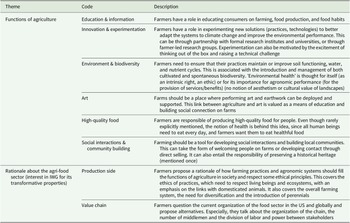
Following this descriptive step, we compiled management and technical information in a table and wrote a cross-farmer description by practice. The code ‘Values’ in the descriptive coding grid proved ineffective because values were rarely openly stated by the interviewees, but rather were implicit in the justifications offered for past and present choices, and because the content of our discussions with farmers was not restricted to their farms. It was therefore necessary to perform a new set of analytical coding (Table 2). These new analytical codes were made to capture farmers’ insights regarding the functions of agriculture in society and their opinions about the current organization of the agri-food sector. Consequently, the codes were not restricted to IWG, although the alternatives proposed for the agri-food sector were captured through the discussion of the IWG case. The grid was built iteratively from the content of interviews. The final grid was made of six codes for the functions of agriculture and two codes for the organization of the agri-food sector (Table 2).
Analytic coding grid for the functions of agriculture and the rationale about the agri-food sector as raised by farmers

Results and discussion
Description of participants
Participants were located primarily in the Upper Midwest, mostly in MN and WI. In addition, one farmer was from Iowa (IA) and was a member of the PPGC, and another farmer, recommended by a participant of the study, was from KS (Figure 1). Our sample was not representative of the total number of IWG growers in each state. At the time, three farmers had more than five years of experience with IWG (from KS and MN), five had between two and five years of experience (from MN and WI), and seven farmers had less than two years of experience (one from IA and the others from WI) (Figure 1; Table 3). All fields but two on which IWG was grown ranged from one to eight hectares, and the other two fields were 49 and 81 hectares. Of the 15 participants, 11 were men, one was a farming couple (man and woman), and three were women. Additionally, 40% (6/15) of participants identified as conventional farmers, while 60% (9/15) were organic (Table 3).
Distribution of interviewees. One participant was in Kansas, one in Iowa, three in Minnesota, and 10 in Wisconsin, USA. See Table 1 for corresponding information about every 637 farms and farmers.

Summary of farm locations, management practices, farming systems, intermediate wheatgrass (IWG) establishment dates, field sizes, stand ages at data collection, and dual-use status reported by Interviewees. The interview that was removed from the dataset is not included

1 No mention during the interview.
In this group, 67% (10/15) of farmers relied primarily on off-farm income for their livelihoods. Participants were deeply engaged in crop and livestock diversification practices, with 67% (10/15) integrating crops and livestock and 20% (3/15) experimenting with agroforestry by incorporating fruit and nut trees into their operations. They were also highly involved in their local and farming communities, partnering with regional universities on on-farm research, hosting field days for schools and farmer gatherings, selling directly at farmers’ markets, and participating in local farm education initiatives. Thus, participants of this study had permissive external (second sources of income, markets, communities, etc.) and internal (farming system, general finance, land or time pressures) conditions for agricultural activity that allowed the exploration of this disruptive innovation. These characteristics may explain the positive attitude of IWG growers toward the risks and uncertainties associated with this novel crop which has been previously reported in the US (Lanker et al., Reference Lanker, Bell and Picasso2020) and France (Ginot et al., Reference Ginot, Bathellier and David2024). In fact, literature pertaining to the early adoption of innovations in agriculture has highlighted the pivotal roles played by financial resources, risk perception and aversion, social networks, and perceptions of innovation characteristics in engaging with novel practices or technologies (Dessart et al., Reference Dessart, Barreiro-Hurlé and van Bavel2019; Romanova et al., Reference Romanova, Gold, Hall and Hendrickson2022). The boldness of IWG growers to take on a high-risk grain crop is well recognized (Cureton et al., Reference Cureton, Peters and Skelly2023).
Through IWG, farmers expressed a desire to promote a greater socio-ecological balance in agriculture
IWG as a multipurpose crop: targeting agronomic benefits
Participants’ reasons for growing IWG were marketable products and ecosystem services. Grain production was a target for all farmers, but they commonly pointed out a discrepancy between the expected yields and what they could really harvest. The gap was primarily caused by harvest losses from seed shattering and the challenge of adjusting combines to handle very small seeds, as well as contamination from weed seeds that can reduce the crop’s marketability. Using forage as a second income source was subject to different views depending on the region and the farmer. For instance, Farmer 3 reported that KS farmers value forage to the point they sometimes sacrifice grain, while IWG is rarely used as forage in MN because, as explained by Farmer 1, ‘there is not enough use for it and the quality isn’t good enough. In MN, there are not many dairies that would use it, so that unless you have animals on the farm, the value is not there’. Some farmers perceived IWG as too dusty and not the best for high-quality hay, but the majority of them were keen to produce forage. Ten of the interviewees, all having livestock on their farm or on neighboring farms, mentioned being interested in or already using IWG as a dual-purpose crop. Finally, five farmers aimed at using the straw, mainly as bedding, on their farms or to give away or sell. Straw was never the primary objective, with the notable exception of Farmer 9 who planted IWG in his alley cropping system for the purpose of producing straw as close as possible to the trees to facilitate mulching. This farmer used IWG as mulch to protect and ‘feed’ the trees, replacing the straw that was currently brought manually.
In total, 73% of the interviewed farmers (11/15 interviewees) talked specifically about ecosystem services as a motivation for IWG cropping. Soil health and soil protection against erosion were specifically mentioned for IWG in 10 interviews. In these farmers’ discourses, it included holding the soil, enhancing soil structure, building organic matter, retaining moisture, using deep tillage for better water infiltration, and sequestering carbon. Farmers attributed these benefits first to IWG’s deep rooting system, rather than to year-round soil cover or reduced tillage. There was a general agreement that IWG could be an excellent tool for reducing erosion on farms in the upper Midwest, and the crop was specifically targeted to be grown on sloping fields. Farmers who had a few years of experience with the crop further reported field observations of soil health improvements when rotating back to annual crops, which they assumed to be linked to increased organic matter, better soil aggregation, and improved water infiltration. They also noted that IWG’s roots could hold moisture and boost soil biotic activity. Surprisingly, nutrient capture and improvement of water quality were only cited twice, by two farmers with streams on their properties. Finally, interviewees commonly valued the multiple purposes of the crop and its potential to transform farming systems on a shorter timeline than with trees. Thus, the potential of IWG to act as a multipurpose crop, often promoted by academic literature, also materialized in farmers’ discourses. These results regarding IWG marketable product and expected ecosystem services were in line with previous studies (Lanker et al., Reference Lanker, Bell and Picasso2020; Ginot et al., Reference Ginot, Bathellier and David2024).
IWG as a tool for the multifunctionality of agriculture: targeting benefits for society
Our results suggest that interest in IWG extended beyond the direct agronomic benefits for farmers, aligning with a sense of responsibility regarding the social, environmental, and economic functions of agriculture: ‘Having a farm is a responsibility but also an opportunity’ (Farmer 15). In line with the findings of Cureton et al. (Reference Cureton, Peters and Skelly2023), interviewees did not separate technical innovation from the potential for social and cultural innovation. Farmers 10 and 12 mentioned being inspired by Mark Shepard’s, Reference Shepard2013 book Restoration Agriculture: Real-World Permaculture for Farmers (Shepard, Reference Shepard2013); a book in which perennial agriculture is promoted. Farmer 13 stated: ‘Perennial agriculture is something we need to develop - the next major agricultural innovation!’ Farmers 8 and 9 referred to ‘agroforestry’ as the model to emulate, once again highlighting concerns for soil health. Farmer 12 went further by referring to the interdependence between animal health, soil health, and farmer well-being. These insights suggest that IWG appealed to these farmers because it aligned with the ‘perennial agriculture vision’ and its potential for transformative effects.
Through our interview analysis, five main functions of agriculture emerged as priorities for farmers. The participants emphasized the importance of producing food for human consumption, in opposition to the prevailing Midwest corn-soybean system where most land is dedicated to animal feed and ethanol production. They further went against the system of economies of scale for food production: ‘Capitalism is the biggest impediment to Kernza® development: why we have terrible food in the first place is because it is cheap and easy so people will buy it. It is much harder to deliver high-quality food on a large scale’ (Farmer 14). Interviewees also highlighted their environmental concerns. They described a range of conservation practices aimed at improving soil health and reducing erosion (‘I want to grow soil’, said Farmer 7), enhancing water quality and nutrient cycling (‘I want the farm stream clean and [don’t] want the nitrates to eventually run off into the Gulf of Mexico’, said Farmer 2), and minimizing agriculture’s environmental footprint (‘I’m concerned about the biosphere’, said Farmer 12). A third functionality was education and information. Several farmers described how they could share information more effectively through personal discussions (on farms and at markets), field days, demonstrations, and even art (theatre and land art). ‘So few people understand where their food comes from. There is just no thinking about it’, remarked Farmer 7. Farmer 12 added, ‘Part of our job is to educate people and teach them how to use these products. I am not an expert, but I can speak to average consumers about it’. Field days were a common way to showcase innovative practices, whether to neighboring farmers (Farmers 7 and 8), children (Farmer 6), or policymakers (Farmer 7). Farming was also perceived as an activity to build local communities and foster social interactions. ‘Farming is a community project almost no matter what!’ exclaimed Farmer 1. Building relationships with consumers was a driving motivation for the farmers engaged in direct sales, and several expressed a desire to have their farms be public spaces for leisure, such as artistic events (e.g., music or earthwork). Farms and their products were viewed as means for building strong connections, not only with consumers but also with other farmers, enabling the sharing of information and experiences. Finally, the participants aimed to be innovators and agents of change. They sought new practices and technologies, such as novel crops or varieties. Interviewees rarely experimented alone as they were often connected to farmer-led groups, universities, or nonprofit organizations (section ‘Description of participants’). On-farm research projects ranged from specific practices (e.g., intercropping, no-till) to long-term agronomic systems (e.g., agroforestry, alley cropping) and monitoring of biodiversity and soil health indicators. These types of projects were mentioned by most participants suggesting that innovation is an important part of their work.
Previous studies have demonstrated that the functions of agriculture can be linked to the different roles of farmers as producers, owners, and citizens (Primdahl et al., Reference Primdahl, Kristensen and Busck2013). In our study, the five functions of agriculture were linked to the different roles of farmers in society. The role of producers was not tied to commodity production or economic rationality, as in Primdahl et al. (Reference Primdahl, Kristensen and Busck2013)’s findings. Instead, we found it to be focused on producing food and feed even though that was not always the most profitable choice. One interviewee remarked: ‘Growing perennial forages is a value-based decision. Do I make more money than with corn? No’. This was linked to rejecting the region’s traditional corn-soybean system and moving toward crop diversification. Besides, interviewees often saw themselves as environmental stewards, prioritizing soil health, clean water, and biodiversity. They justified practices like no-till farming and growing perennial crops at multiple scales—farm, regional, national, and even global, with the aim of respecting and favoring ecological processes. Focus on innovation to improve farming systems bridged the ‘producer’ and ‘environmental steward’ roles. Finally, interviewees embraced the role of citizen through education, community building, and public engagement. Their farms were no longer places of production only but were also places to welcome local people for learning or for recreational activities, and farm products were central artifacts for these processes. This role extended beyond the farm boundaries, motivating activities like direct sales and, for one farmer interviewee, participating in public debate.
IWG cultivation was constrained by limited economic opportunities
Growing IWG: the need for economic profitability
The organization of the IWG value chain came up spontaneously in 80% (12/15) of the interviews and was a central theme in farmers’ discussion. The frequent mention of the IWG value chain by the participants revealed their deep economic and technical concerns, which highlight their embeddedness in a socio-technical system where the profitability and availability of food chain processing and logistics are decisive. On one hand, the functions of agriculture associated with IWG (section ‘IWG as a tool for the multifunctionality of agriculture: targeting benefits for society’) were linked to the issue of commodities in agriculture: ‘I don’t want a commodity system; I want to grow food’, asserted Farmer 7. On the other hand, however, interviewees were concerned about IWG economic profitability, as it was previously observed in France (Ginot et al., Reference Ginot, Bathellier and David2024). The possibility to market IWG grain for human consumption was a central concern for making this crop economically sustainable. Farmers commonly pointed to the lack of a consistent and reliable market for IWG; a condition that made production a risky and uncertain venture. They attributed this uncertainty to three main factors: (i) the high price of IWG grain, (ii) the lack of resources for companies to invest in testing new processes and recipes tailored to the grain, and (iii) the mismatch between the small volumes produced by farmers and the large-scale processing and marketing operations of American food companies. This strongly supports Jungers et al. (Reference Jungers, Runck and Ewing2023)’s idea that ‘developing markets and supply chains for emerging perennial crops is a major barrier to their incorporation into agricultural systems’. Jungers et al. (Reference Jungers, Runck and Ewing2023) further argue that ‘tightly linking production to market demand also has opportunities to increase grower economic security’ (Jungers et al., Reference Jungers, Runck and Ewing2023). Research on the development of other minor crops has highlighted similar economic impediments to their development (Meynard et al., Reference Meynard, Charrier and Fares2018). It has further showed that the adoption of a minor crop may require specific investments for farmers (e.g., machinery, crop trials, labor), meaning guaranteeing a stable market and technical support is crucial (Meynard et al., Reference Meynard, Charrier and Fares2018). A recent analysis of IWG production and Kernza® commercialization rendered similar conclusions (Cureton et al., Reference Cureton, Peters and Skelly2023).
Consequently, the farmers discussed IWG pricing because it constituted a pivotal element in their anticipated earnings. In the interviews, they linked the high price of IWG grains to the low yields, coupled with the fact that lowering production costs did not offset their low yields. Farmer 4 explained:
The only important thing is how much dollars we can generate by acre. So, it’s not a question of yield only, but the price the grain will be sold. If we produce more but the price drops, the amount of money can remain unchanged. But indeed, lowering Kernza® price is a challenge today, so we would like higher yields.
On his side, Farmer 1 added:
In MN, the benchmark is corn. And that is a fact. If Kernza® is not able to compete with corn, it won’t be possible. If you make it competitive enough and if make it easier for growers, then the landscape will change. Because the price of land is very high.
This analysis was shared by Farmer 3 in KS:
Kernza® price is very high because of its opportunity cost, and the opportunity cost is the land cost. Farmers rent the land and whatever is grown on it needs to pay the rent: In KS, rent is 100/acre, so you at least need to make that. Then you add the production costs and inputs, divided by a few lbs: $35/acre for combine harvest, $20-25/acre for planting with a tractor/drill. With $2 for Kernza®, most growers were coming out with net incomes for $100-150/acre (this is really good!) but if you don’t get paid, it is not good at all… Kernza® is a high-risk specialty crop.
These quotes highlight that the economic profitability of IWG is understood from the relation between yields and land area because of the opportunity cost of not planting a high-earning crop. When asked about priorities for research and breeding, Farmer 6 mentioned two priorities: increasing yields and supporting farmer income, explaining, ‘Farmers need to be productive, or you won’t be around tomorrow!’
These results show that generating profit was a necessary requirement for the farmers, as with any cash crop. They found themselves engaged in two processes that were in a state of constant tension: legitimation and transgression. First, a process of ‘legitimization’ (conforming to markets, rules, or habits) which involved the adherence to the prevailing socio-technical system in which economic rationality dominates. ‘Legitimacy is achieved first and foremost through the viability of a technology to perform on farms and in products, and its ability to achieve given societal outcomes’ (Cureton et al., Reference Cureton, Peters and Skelly2023). Yet, achieving alternative societal goals points to the second process, a process of ‘transgression’ of rules or habits. Through their choice of crops and cropping systems, farmers embodied alternative social and environmental rationalities. The two processes were essential to each other, in that the new crop must be legitimized so as not to become a discredited niche innovation, while at the same time retaining the transgressive attributes that gave it its own identity. In this context, institutional support is crucial for scaling innovation and alleviates the risk otherwise assumed entirely by farmers (Cureton et al., Reference Cureton, Peters and Skelly2023). Public or private support such as carbon markets or payments for ecosystem services could alleviate farmers’ dependency on land and food markets, but many IWG growers do not currently rely on these mechanisms (J. Jungers, personal communication).
Organizing the IWG value chain: addressing cleaning and processing challenges
Downstream of production, participants consistently described the harvested grain crop as difficult, labor intensive, and expensive to clean and process. They questioned who should be responsible for these tasks and who should bear the associated costs. Farmers connected the high price of the crop to the combined costs of cleaning, processing, limited production volumes, and the expense of having and maintaining food-safe facilities and machinery. This challenge stems from the gap between the raw product that comes directly from the combine and the level of grain cleanliness that processing companies require for their recipes, such as flour, flakes, or cleaned whole grains. Binned grain contains stems, hulls, weed seeds, and other debris, meaning that approximatively 40% of the weight is lost during the cleaning process (The Land Institute, 2025). Many interviewees stored their grain on-farm in gravity bins, and cleaning was mostly done off-farm along with the grain from other farms. Farmers’ limited time and resources further complicated post-harvest management because cleaning and processing require considerable labor, coordination, and access to equipment. This has led to missed harvests and unprocessed grain sitting on farms (Farmer 5). Thus, interviewees usually considered cleaning and processing IWG grain on their farms unrealistic due to limited time, expertise, and machinery, although at least one farmer experimented with these processes on their own farm (e.g., Farmer 12). Others (e.g., Farmers 13, 3, 4, and 11) organized cleaning and processing collectively. Farmer 3 added that small-scale processing companies often cannot afford to take on cleaning, dehulling, and milling the grain, while production volumes are too small to attract large-scale companies.
This illustrates that transforming IWG from a technical (or biological) invention into a usable innovation requires linking the development and transfer of knowledge of breeding and cropping practices with cascading innovations in the storage, cleaning, processing, and marketing of the new crop (Jungers et al., Reference Jungers, Runck and Ewing2023). These challenges, combined with added logistical and transaction costs, are also well-documented barriers to the development of other minor crops (Meynard et al., Reference Meynard, Charrier and Fares2018). As a result, there was a general agreement that middlemen were necessary. Farmer 3 summed up the dilemma: ‘That step [middlemen for cleaning and milling] is what everybody needs, but that is a step that nobody can afford’. Pooling grain also raised concerns about trucking costs and environmental impacts. Farmer 13 regretted that the grain produced in MN and WI was sent to North Dakota for cleaning and processing before being marketed in Chicago or Minneapolis, thus undermining the crop’s net carbon sequestration benefits. Because the farmers also wanted to educate people and build relationships with consumers (section ‘IWG as a tool for the multifunctionality of agriculture: targeting benefits for society’), many emphasized the value of smaller-scale and local chains. Overall, the results indicate that regional clustering of IWG production may offer a way to balance environmental gains, logistical demands, and community engagement, as seen in MN through the PPGC and Forever Green Initiative (Cureton et al., Reference Cureton, Peters and Skelly2023).
The role of the middlemen in the IWG value chain needs further study, especially regarding how the structure and length of the value chain may affect the social and ecological benefits that farmers hope to achieve. At the regional level, the capacity to deliver functions such as food production may quickly reach limitations if processing and distribution are too complex or if their profitability is too low. In contrast, ecological benefits like soil improvement are most visible at the farm scale, although their broader contribution to agricultural sustainability depends on widespread adoption. The long-term viability of IWG in regional and global systems hinges on aligning food production with socio-technical infrastructures that support scaling, which may vary by state or region. For instance, Cureton et al. (Reference Cureton, Peters and Skelly2023) demonstrated that the lower development of the IWG production and market in WI compared to MN can be attributed to differences in institutional support and funding. On that note, the fact that 10 of our interviewees were in WI may have influenced participant responses on the structuration of the value chain.
These findings suggest that the institutional and economic contexts shaping IWG development warrant further study. The issues farmers raised about the IWG value chain opened broader discussions about how the agri-food sector in the USA is organized and the power relations within it. On that note, research on perennial grains in Africa highlights the need to consider economic and political factors beyond the farm, such as markets, land tenure, and power dynamics to fully understand adoption patterns (Isgren et al., Reference Isgren, Andersson and Carton2020). Isgren et al. (Reference Isgren, Andersson and Carton2020) further argue that political ecology offers a valuable framework for exploring the justice dimensions of perennial agriculture. Applying this perspective in the United States could deepen understanding of IWG and the broader development of perennial grain systems.
Experimenting and improving cropping practices: a way to move along the multifunctionality gradient?
The everyday decisions about cropping practices affect the agricultural ecosystem functions performed on farms. These decisions can create real and visible changes in the field, which makes the farm scale an important place to observe multifunctional intentions (Wilson, Reference Wilson2008). Recent research shows that different combinations of cropping practices shape ecological, production, and labor related outcomes, including biodiversity conservation, pest control, and food and fiber production (Alignier et al., Reference Alignier, Carof and Aviron2024). In IWG systems, studies have shown that decisions about land allocation, crop rotations, and specific management practices reflect farmers’ goals for both production and ecosystem services (Duchene et al., Reference Duchene, Celette and Ryan2019; Ginot et al., Reference Ginot, Bathellier and David2024). Other work links individual management strategies to agroecosystem functions such as soil health and pest suppression (Ryan et al., Reference Ryan, Crews and Culman2018).
As a new crop, IWG provides farmers with opportunities to experiment and test a range of management strategies. Table 4 highlights the interviewees’ variation in their decisions related to establishment, fertilization, weed control, livestock integration, grain harvest, and storage. Technical guides such as the Kernza® Grower Guide (Tautges et al., Reference Tautges, Detjens and Jungers2023) offer recommendations, but farmers adapt practices to their soils, equipment, labor, markets, and prior experience. Some decisions were relatively consistent, while others differed widely. For example, most farmers planted IWG in the fall with the goal of reducing weed pressure associated with spring planting and used seeding rates of 15–25 kg ha−1 with 18 cm row spacing. Common crop establishment challenges included weed seed contamination, low seedling populations, and inconsistent no-till drill performance.
Description of agronomic management practices per interviewee for topics such as land allocation, stand establishment, weed management, fertilization, forage management, grain harvest, grain storage and cleaning, and stand termination

1 No mention in the interview.
Weed management was also a common challenge, particularly for farmers planting IWG in former hayfields (Farmers 10, 12). Although Tautges et al. (Reference Tautges, Detjens and Jungers2023) advised against planting IWG in weedy fields, farmers often have limited choices because IWG was often placed on marginal land due to low expected yields and uncertain grain markets (Lanker et al., Reference Lanker, Bell and Picasso2020). Weed control strategies included mowing (Farmers 6, 13, 14), overseeding with legumes (Farmer 8), and, for one conventional farmer (Farmer 6), applying 2,4-D amine herbicide which is currently the only product labeled for IWG grain (Shoenberger et al., Reference Shoenberger, Jungers and Law2023). Forage management practices varied even more, shaped by differences in forage markets, equipment access, and attitudes toward hay quality described in section ‘IWG as a multipurpose crop: targeting agronomic benefits’.
Across farms, interviewees described the main function of IWG as coming primarily from growing the crop, rather than by specific management practices. Its continuous living cover, deep roots, human edible grain, and forage potential contributed to many of the benefits they associated with it. Because it is a new perennial grain crop, IWG often sparked dialogue among farmers, researchers, and processors, which positioned it as more than a production crop. Many farmers saw IWG as a practical way to address sustainability challenges while also opening space to question the role of grain crops in agriculture, as described in section ‘IWG as a tool for the multifunctionality of agriculture: targeting benefits for society’. Their perspectives fit with the idea of IWG as a political crop that acts as a ‘co-producer of agrarian change’, described by Fischer et al. (Reference Fischer, Jakobsen and Westengen2022). This framing also overlaps with the concept of an ‘anti-commodity’ (Hazareesingh and Maat, Reference Hazareesingh and Maat2016), where a crop or product is used intentionally to resist standard commodity functions, and becomes tied to values that extend beyond economic gain.
Management still shapes how these functions are expressed. Some effects are ecological and occur within agroecosystems where farmers act as environmental stewards. Other effects are social, occurring through grain production and community engagement, in which farmers act as food producers and citizens. More research is needed to understand how IWG performs its multifunctional roles at the farm scale and which management strategies best support those roles. The degree of multifunctionality likely varies across farms and depends on how IWG is integrated with other farm components, shaped by broader socio-technical contexts, and influenced by management choices. Figure 2 summarizes these relationships and shows how IWG may enhance agricultural multifunctionality at the farm scale.
Links between IWG, farming systems, socio-technical systems, and the functions of agriculture mentioned by farmers. By being present on farms and fulfilling multiple purposes, IWG is expected to contribute to the greater multifunctionality of agriculture. However, objectives are prioritized and achieved based on the influence of agricultural and socio-technical systems. This results in different contributions to the multifunctionality of agriculture.

Conclusion
In our study, farmer interviewees consistently described IWG as having dual qualities: as a multipurpose crop that generates on-farm benefits, such as marketable products and improved soil health, and as a tool that helps them fulfill their farmer’ roles as food producers, environmental stewards, and citizens. Their motivations for growing IWG often extended beyond their farms and reflected non-commercial functions of agriculture, including community building, education, and innovation. We describe IWG’s ‘disruptive’ character not as evidence that the crop itself transforms farmers’ thinking but as recognition that its unique traits compel both farmers and researchers to reconsider what roles grain crops can and should play. At the same time, IWG remains a small and experimental component of most of the operations in which it is grown. The farmers producing IWG do not depend on it for their primary income and frequently cited persistent challenges such as low yields, cleaning costs, and uncertain markets. Taken together, the findings indicate that achieving economic viability and establishing a secure grain value chain are fundamental to enabling farmers to grow IWG and, in turn, to support its broader non-commercial functions. The results also show the critical importance of integrating social science perspectives into perennial crop development to account for the social factors that can either legitimize or constrain innovation. In the end, IWG offers more than a new crop; it offers a different way of thinking about agriculture, one that brings together agronomic productivity, environmental stewardship, and social meaning.
Supplementary material
To view supplementary material for this article, please visit http://doi.org/10.1017/S1742170526100337.
Data availability statement
Data will be made available upon reasonable request.
Acknowledgements
Authors would like to warmly thank the farmers who took time to answer our questions and share their experiences. A special thanks is also due to Dr. Michael Bell and Dr. Marisa Lanker for their insights at the early stage of the study, and to Dr. Jake Jungers and Dr. Christophe David for their advices at the finishing stage of this article.
Author contribution
Conceptualization: C.G., E.S., O.D.; Design of the study and methodology: C.G. and E.S.; Investigation: C.G. and E.S.; Formal analysis: C.G. and E.S.; Supervision: O.D., V.D.P.; Writing—original draft preparation: C.G. and E.S.; Design of figures: C.G., E.S, O.D.; Writing—review and editing: E.S., C.G., O.D., V.D.P.
Funding statement
This work was supported by the mobility grant from the ‘Thomas Jefferson Fund’; the BiodivClim ERA-Net COFUND program [grant numbers 549R.8003.20]; the Nuzum Kickapoo Valley Reforestation Fund; the University of Wisconsin-Madison Center for Integrated Agriculture Systems Summer Mini Grant; and the University of Wisconsin-Madison Center for Ecology and the Environment Aldo Leopold Graduate Research Award.
Competing interests
The authors declare none.



 Open access

