


Introduction
Climate change is a serious problem facing humanity and development. Its impact is not uniform across sectors, communities, regions and countries (Tarfa et al., Reference Tarfa, Ayuba, Onyeneke, Idris, Nwajiuba and Igberi2019). This implies that it affects virtually all aspects of life but at varying degrees. Nigeria is susceptible to climate risks because the majority of the populace (about three-quarter) depend on rain-fed agricultural systems for their livelihood. The National Adaptation Strategy and Plan of Action on Climate Change for Nigeria states that if nothing is done to manage climate change-related hazards and shocks in Nigeria, the country may lose between 2 and 11% of her gross domestic product by 2020 and this may increase to 6–30% by 2050 (Building Nigeria's Response to Climate Change and Federal Ministry of Environment, 2011). This implies that if climate change is not addressed in long-term action, the costs will be high.
To the people of Ebonyi State, the impact of climate change on agriculture, especially rice production, is very important. This is because the majority of the inhabitants depend on rice production for their livelihood. Rice is highly susceptible to climate vagaries because of its sensitivity to changing climatic conditions. Climate change is affecting the livelihoods of rural communities in Ebonyi, which are mainly rice-based, and increasing their vulnerability as well (NEST, 2011; Onyeneke et al., Reference Onyeneke, Igberi, Aligbe and Amadi2018a; Choko et al., Reference Choko, Olabisi, Onyeneke, Chiemela, Liverpool-Tasie and Rivers2019). The increasing variability, intensity and erratic nature of rainfall, rising incidence of flood and soil erosion, and serious decline in agricultural yields are among the obvious climate change hazards ravaging communities in Ebonyi State Nigeria (Choko et al., Reference Choko, Olabisi, Onyeneke, Chiemela, Liverpool-Tasie and Rivers2019). Ebonyi State has a policy on agriculture which seeks to ‘ensure sustainable increase in food production; production of raw materials for the industries; employment generation; improved access to agro-inputs; improved extension service delivery; stimulation of greater private sector investment in agriculture; value addition to improved processing, packaging and storage; poverty alleviation; and generally improving the quality of life of rural dwellers’ (Ebonyi State Ministry of Agriculture and Natural Resources, 2010). The possibility of realizing this lofty aim of the State's agriculture policy is doubtful considering the increasing risk of climate change in the State. Furthermore, climate change is not mainstreamed into the policy, indicating that the climate change impacts on rice production and profitability will get worse.
Adaptation is an essential response action for minimizing the vulnerability of farmers to climate change. Many countries in the world have focused on strategic adaptation plans and actions to reduce the vulnerability of sectors, communities and regions. Communities in Ebonyi have been managing climate risks using indigenous and local adaptation measures (Choko et al., Reference Choko, Olabisi, Onyeneke, Chiemela, Liverpool-Tasie and Rivers2019). Responses to climate change should be forward-looking and affordable considering the uncertainty and increasing impact on farmers in Ebonyi State. Given the severity of current climate impacts and expected vulnerabilities, these indigenous and local responses will not be sufficient for the necessary adaptation (Tarfa et al., Reference Tarfa, Ayuba, Onyeneke, Idris, Nwajiuba and Igberi2019). Making the communities less vulnerable provides an opportunity for adaptation and opens frontiers to realize the objectives of agricultural development programs in the State.
As stated earlier, Ebonyi State is vulnerable to the impacts of climate change largely because more than three-quarter of the inhabitants depend on smallholder rain-fed agriculture. The impact of climate change is very visible in most rural communities in the State (Onyeneke et al., Reference Onyeneke, Igberi, Aligbe and Amadi2018a; Choko et al., Reference Choko, Olabisi, Onyeneke, Chiemela, Liverpool-Tasie and Rivers2019). The increasing population coupled with high poverty levels is making huge demands on Nigeria's natural resources such as agricultural land and forest resources. Climate change impacts compound existing pressures on these resources. These challenges, if unaddressed, will become sure recipes for food, nutrition and livelihood insecurity in Ebonyi. Therefore, all rational farmers must pursue adaptation as a response to climate risks. It is in recognition of the growing impact of climate change on the livelihood of rural communities in Ebonyi that a study to investigate the strategies that farmers have adopted to manage climate risks and the determinants and effectiveness of such measures becomes necessary.
Adaptation is very important in managing risks posed by climate change to rice farming. The literature on climate change adaptation strategies of crop farmers in Ebonyi State and Nigeria is growing (Egwu, Reference Egwu2014; Ezeh and Eze, Reference Ezeh and Eze2016; Oselebe et al., Reference Oselebe, Nnamani, Efisue, Onu, Eze and Ogunji2016; Diagi and Nwagbara, Reference Diagi and Nwagbara2018; Ume et al., Reference Ume, Ezeano and Anozie2018; Igwe, Reference Igwe2018; Onyeneke et al., Reference Onyeneke, Igberi, Aligbe and Amadi2018a,Reference Onyeneke, Igberi, Uwadoka and Aligbeb; Choko et al., Reference Choko, Olabisi, Onyeneke, Chiemela, Liverpool-Tasie and Rivers2019). However, most of these published studies did not pay close attention to the determinants of adaptation decisions of the farmers in Ebonyi State. Climate change adaptation studies at a farm or household level should examine the socio-economic, farm, contextual and institutional characteristics that influence farmers' decisions to adapt or not (Gbetibouo, Reference Gbetibouo2009) and even the intensity of adaptation. This information is necessary to promote policies and program that support adaptive management.
Furthermore, scientists and policymakers believe that climate change adaptation contributes to food security, income, efficiency, profitability or productivity goals of farmers (Di Falco et al., Reference Di Falco, Veronesi and Yesuf2011; Yegbemey et al., Reference Yegbemey, Yabi, Aïhounton and Kokoye2014; Feleke et al., Reference Feleke, Berhe, Gebru and Hoag2016; Peck, Reference Peck2017; Kabir et al., Reference Kabir, Alauddin and Crimp2017; Thamo et al., Reference Thamo, Addai, Pannell, Robertson, Thomas and Young2017; Berhe et al., Reference Berhe, Hoag, Tesfay, Tadesse, Oniki, Kagatsume and Keske2017). However, this is not always the case because addressing different climate change stressors in isolation often lead to maladaptation which turns out to increase the risk of climate change or diminish the buffer and adaptive capacities of farmers (Yesuf and Bluffstone, Reference Yesuf and Bluffstone2009; Haydu, Reference Haydu2010; McDowell and Hess, Reference McDowell and Hess2012; Barnett and O'Neill, Reference Barnett, O'Neill, Palutikof, Boulter, Ash, Smith, Parry, Waschka and Guitart2013; Karlan et al., Reference Karlan, Osei, Osei-Akoto and Udry2014; Reidsma et al., Reference Reidsma, Wolf, Kanellopoulos, Schaap, Mandryk, Verhagen and Van Ittersum2015; Harrison et al., Reference Harrison, Dunford, Holman and Rounsevell2016; Terdoo and Feola, Reference Terdoo and Feola2016; Holzkämper, Reference Holzkämper2017; Müller et al., Reference Müller, Johnson and Krever2017; Stupak, Reference Stupak2017). This calls for studies which link climate change adaptation to farmers' welfare outcomes—returns to scale, profitability, productivity and food security—as a sure way to gauge the effectiveness of chosen adaptation strategies and check maladaptation. Incidentally, research in this context is rare in Nigeria specifically and Africa generally. This study, therefore, explored the determinants of adaptation strategies chosen by rice farmers in Ebonyi State and the effect of such strategies on farmers' returns to scale to inform policies, programs and plans that will help in climate change adaptation management in the agricultural sector of the State. Specifically, this paper analyzed the trend of climatic stressors (temperature and precipitation) in the area, examined adaptation decisions of farmers and the factors that shape such decisions, and determined the effect of climate change adaptation decisions of farmers on the profitability of rice farming.
Adaptation options
The importance of adaptation in climate change management cannot be overemphasized. The vulnerability of rice production to climate change has received attention from researchers. Terdoo and Feola (Reference Terdoo and Feola2016) observed rice production, especially in sub-Saharan Africa, is highly sensitive to climate change. Therefore, there is an urgent need to reduce the vulnerability of the rice sector to climate change. Adapting rice production to climate change is necessary to increase farmers' yields and food security. There are several local adaptation practices used by farmers in managing climate risks in different parts of the world. Some of the local adaptation practices include minimum tillage, drainage and bond, combined use of organic and inorganic fertilizer, crop diversification, improved rice varieties, use of nursery, use of pesticides, livelihood diversification and changing planting and harvesting dates (Oselebe et al., Reference Oselebe, Nnamani, Efisue, Onu, Eze and Ogunji2016; Roco et al., Reference Roco, Bravo-Ureta, Engler and Jara-Rojas2017; Unique-Kulima, 2017; Quan et al., Reference Quan, Li, Song, Zhang and Wang2019; Rondhi et al., Reference Rondhi, Khasan, Mori and Kondo2019; Teklewold et al., Reference Teklewold, Mekonnen and Kohlin2019).
Several researchers have noted the importance of minimum tillage in controlling flood and erosion, enhancing soil fertility and climate resilience as well as conserving the environment (Verhulst et al., Reference Verhulst, Govaerts, Sayre, Sonder, Romero-Perezgrovas, Mezzalama, Dendooven, Wollenberg, Nihart, Tapio-Biström and Grieg-Gran2012; Kuntashula et al., Reference Kuntashula, Chabala and Mulenga2014; Richards et al., Reference Richards, Sapkota, Stirling, Thierfelder, Verhulst, Friedrich and Kienzle2014). The combined use of organic and chemical fertilizer is also an important climate change adaptation strategy in agricultural production. Climate change depletes soil fertility through increased flooding, erosion, runoff and washing away of soil nutrients (Brevik, Reference Brevik2013) thereby adversely affecting soil pH, water holding capacity, bulk density and other soil properties (García-Fayos and Bochet, Reference García-Fayos and Bochet2009). Correct use of organic and chemical fertilizers (in terms of getting the fertilizers from the right sources, using the right rate and applying the fertilizer at the right time and place) enhances soil fertility and increases yield thereby reducing farmers' vulnerability to climate change. Similarly, improved rice varieties have been used by many farmers in managing climate risks (Unique-Kulima, 2017; Aryal et al., Reference Aryal, Jat, Sapkota, Khatri-Chhetri, Kassie, Rahut and Maharjan2017). Early maturing rice varieties, for instance, are better suited for managing delayed onset and early cessation of rain that now characterize agricultural production in many parts of Nigeria (Babatunde et al., Reference Babatunde, Salami and Tadross2011; Tarfa et al., Reference Tarfa, Ayuba, Onyeneke, Idris, Nwajiuba and Igberi2019).
The construction of local drainages and bunds for managing climate risks in agricultural systems has received considerable attention by researchers (Iglesias and Garrote, Reference Iglesias and Garrote2015; Roesch-Mcnally, Reference Roesch-Mcnally2016; Mo et al., Reference Mo, Hu, Lin, Liu and Xia2017; Onyeneke et al., Reference Onyeneke, Igberi, Aligbe and Amadi2018a). These practices help to reduce flooding and erosion on agricultural lands and farms and increases farmers' resilience to climate change (FAO, 2012; Iglesias and Garrote, Reference Iglesias and Garrote2015; Morton et al., Reference Morton, Hobbs, Arbuckle and Loy2015; Roesch-Mcnally, Reference Roesch-Mcnally2016; Mo et al., Reference Mo, Hu, Lin, Liu and Xia2017; Roesch-Mcnally et al., Reference Roesch-Mcnally, Arbuckle and Tyndall2017; Onyeneke et al., Reference Onyeneke, Igberi, Aligbe and Amadi2018a).
Crop diversification reduces the impacts of climate change on farmers and contributes to their buffer capacity (Belay et al., Reference Belay, Recha, Woldeamanuel and Morton2017; Fadina and Barjolle, Reference Fadina and Barjolle2018; Tarfa et al., Reference Tarfa, Ayuba, Onyeneke, Idris, Nwajiuba and Igberi2019). Crop diversification contributes to climate change adaptation in rice production because production and income risks are spread through planting different crops, which in turn leads to minimization of farmers' vulnerability (Lin, Reference Lin2011; FAO, 2018; Waha et al., Reference Waha, van Wijk, Fritz, See, Thornton, Wichern and Herrero2018; Huang et al., Reference Huang, Jiang, Wang and Hou2014). Similar to crop diversification, diversifying into different livelihood activities also protects farmers against climate shocks. Lasco et al. (Reference Lasco, Habito, Delfino, Pulhin and Concepcion2011), Idoma et al. (Reference Idoma, Ikpe, Ejeh and Mamman2017), Fadina and Barjolle (Reference Fadina and Barjolle2018) and Ho and Shimada (Reference Ho and Shimada2019) demonstrated the benefits of livelihood diversification in climate change management. Livelihood diversification builds farmers' resilience to climate change by spreading their income and production risks (Nigerian Environmental Study Action Team and Woodley, Reference Woodley2012). Use of nursery in rice production helps farmers adapt to climate vagaries (Deng et al., Reference Deng, Chen, Feng, Chen and Zhang2017; Oselebe et al., Reference Oselebe, Nnamani, Efisue, Onu, Eze and Ogunji2016; Bhandari, Reference Bhandari2009). Having the rice seedlings on the nursery first before transplanting to the field enables farmers to make a better decision on whether to transplant the seedlings to rice field or not and the best time to transplant considering climate risks.
The incidence of pests and diseases is increasing due to the changing climate (Harvey et al., Reference Harvey, Rakotobe, Rao, Dave, Razafimahatratra, Rabarijohn, Rajaofara and Mackinnon2014; Warren et al., Reference Warren, Price, Graham, Forstenhaeusler and VanDerWal2018). Changing climatic conditions may create new pests and insects in crops (Ibrahim, Reference Ibrahim2014; Macfadyen et al., Reference Macfadyen, McDonald and Hill2018; Heeb et al., Reference Heeb, Jenner and Cock2019). With the rising prevalence of crop pests and diseases, the demand for pesticides is also increasing. Pesticide combination, appropriate application rate, time and place conserve the environment and soil and contribute to climate resilience and incremental yield (Heeb et al., Reference Heeb, Jenner and Cock2019). Researchers have reported the use of pesticides for climate change adaptation (Dhakal et al., Reference Dhakal, Sedhain and Dhakal2016; Bhandari, Reference Bhandari2009; Fadina and Barjolle, Reference Fadina and Barjolle2018). Climate change is increasing the variability, pattern and distribution of rainfall in sub-Saharan Africa (Choko et al., Reference Choko, Olabisi, Onyeneke, Chiemela, Liverpool-Tasie and Rivers2019; Onyeneke et al., Reference Onyeneke, Mmagu and Aligbe2017). The changing rainfall regimes observed in sub-Saharan is affecting rice agronomic practices such as time for planting and harvesting. Farmers have resorted to adjusting their planting and harvesting dates as a strategy for managing changing rainfall pattern, duration and distribution. This adaptation practice is popular among farmers in developing countries (Arimi, Reference Arimi2014; Ezeh and Eze, Reference Ezeh and Eze2016; Mbah and Ezeano, Reference Mbah and Ezeano2018; Gahatraj et al., Reference Gahatraj, Jha and Singh2018; Tarfa et al., Reference Tarfa, Ayuba, Onyeneke, Idris, Nwajiuba and Igberi2019).
Methodology
Study area
The study was carried out in Ebonyi State. Ebonyi State is located between latitudes 5°40′ and 6°45′ north of the Equator and longitudes 7°30′ and 8°46′ east of the Greenwich Meridian. The climate of the state is mainly that of the tropical rainforest and derived savannah. This climate favors the cultivation of rice. The inhabitants of the state are mainly farmers. The population of the state as in 2016 was 2,880,383 persons (Central Bank of Nigeria, 2016) with about 80% of this population living in poverty (National Bureau of Statistics, 2012). This demonstrates how vulnerable the state is to climate risks.
Sampling technique and data collection
Ebonyi State is divided into three zones – Ebonyi South, Ebonyi Central and Ebonyi North zones. There are five Local Government Areas (LGAs) in Ebonyi South, four LGAs in Ebonyi Central and four LGAs in Ebonyi North. Rice is cultivated in all the LGAs. This paper adopted cluster sampling and partitioned the State into three clusters – Ebonyi North, Ebonyi Central and Ebonyi South. In each cluster, two LGAs were randomly selected. The paper used random selection because rice is cultivated in all the 13 LGAs of Ebonyi State. The LGAs selected were Ivo and Afikpo South LGAs from Ebonyi South, Ikwo and Ishielu LGAs from Ebonyi Central, and Izzi and Ohaukwu LGAs from Ebonyi North. After this stage, the author chose four communities from each of the study LGAs. This made the number of sampled communities 24. The final stage of the sampling process was the selection of ten rice farmers from each sampled community making the sample size of the study 240 rice farmers.
The author used a climate risk adaptation questionnaire to elicit data from the respondents. The questionnaire was divided into five sections. Section one covered the socio-economic, contextual and institutional characteristics of the farmers. Section two dealt with climate change awareness level of the farmers. This was measured using a five-point Likert type scale—very low level of awareness, low level of awareness, moderate level of awareness, high level of awareness and very high level of awareness, with their respective scores as 1, 2, 3, 4 and 5. Section three covered measures adopted by the farmers to address climate risks in rice farming. In eliciting information on adaptation practices used in addressing climate risks, the author used a ‘grounded approach’ which allowed the adaptation strategies to emerge from the farmers themselves. Nine adaptation practices emerged as strategies used in counteracting the negative impacts of climate change. Section four covered inputs and costs of rice production, while section five was about the output, market price of the output and the revenue. The survey was conducted from June to November 2018 with the help of six enumerators—one for each LGA. Also, data on annual average temperature and yearly total volume of rainfall for a period of 21 years (1997–2017) were collected from the Meteorological Unit of the Federal College of Agriculture, Ishiagu in Ebonyi State. This study used all available climate data from the Federal College of Agriculture Ishiagu, which appears to be the only institution in the state with meteorological data spanning over a long period in Ebonyi State.
Method of data analysis
The paper adopted trend analysis to describe the trend of climatic stressors in the State. The simple linear trend analysis was adopted to model how temperature and rainfall changed over time in the area and determine the correlation and trend coefficient of the linear graphs of the climatic variables with time. This approach is useful in determining the direction of change of climatic variables especially ones collected from a single meteorological station over time. The analysis mainly shows whether the variables are increasing, decreasing or have remained unchanged over the period under study (Mudelsee, Reference Mudelsee2019; Djaman et al., Reference Djaman, Balde, Rudnick, Ndiaye and Irmak2017; Nwosu et al., Reference Nwosu, Onyeneke, Joshua, Mmagu and Nwaodu2014; Clark et al., Reference Clark, Yiridoe, Burns and Astatkie2005). This method is popular in the climate change literature and has been used by many researchers in modeling the trend of climatic variables (Anuforom, Reference Anuforom2010; Tarfa et al., Reference Tarfa, Ayuba, Onyeneke, Idris, Nwajiuba and Igberi2019; Babatunde et al., Reference Babatunde, Salami and Tadross2011; NEST, 2011; Mudelsee, Reference Mudelsee2019; Clark et al., Reference Clark, Yiridoe, Burns and Astatkie2005). The trend models are stated thus:
 $$R{\rm}= f\lpar t\rpar $$
 $$H{\rm}= f\lpar t\rpar $$
where R, annual volume of rainfall (mm); H, annual average temperature (°C); t, time.
In examining measures used in managing climate risks in rice farming, the author used descriptive statistics to categorize farmers' responses on their adaptation actions and the number of such actions adopted. Multivariate probit (MVP) regression was employed in analyzing the determinants of adaptation. There are nine adaptation options identified in this study, which formed the endogenous variables of the MVP model of this study. The model is stated thus:
 $$Y_j = 1\;{\rm if}\;{\rm \delta }X_i + {\rm \varepsilon } \gt 0$$
and
 $$Y_j = 0\;{\rm if}\;{\rm \delta }X_i + {\rm \varepsilon } \le 0j = 1\comma \;2\comma \;\ldots \comma \;9$$
where Yj, adaptation strategies of the jth farmer; j, 1,2, … ,9 are the number of identified adaptation options.
Xi is a vector of the independent variables; δ, parameter estimates of the independent variables and ε, the error term (Mulwa et al., Reference Mulwa, Marenya, Rahut and Kassie2017). The endogenous and independent variables of the MVP are elaborated below.
Endogenous variables
The author investigated the actions rice farmers take in managing climate risks. The responses indicated that there are nine categories of adaptation practices used by rice farmers to manage risks associated with climate change. These include minimum tillage, drainage and bonds, combined use of fertilizer (organic and inorganic fertilizer), crop diversification, improved rice varieties, use of nursery, use pesticide, livelihood diversification, and adjusting planting and harvesting dates. These measures are used as the endogenous variables in both the MVP and instrumental variable regressions (IVRs) conducted in this study. These adaptation strategies are further stated as follows in the MVP model:
Y 1, minimum tillage (yes = 1, no = 0); Y 2, drainage and bonds (yes = 1, no = 0); Y 3, use of organic and inorganic fertilizer (yes = 1, no = 0); Y 4, crop diversification (yes = 1, no = 0); Y 5, improved rice varieties (yes = 1, no = 0); Y 6, use of nursery (yes = 1, no = 0); Y 7, use of pesticide (yes = 1, no = 0); Y 8, livelihood diversification (yes = 1, no = 0); Y 9, adjusting planting and harvesting dates (yes = 1, no = 0).
Independent variables
Several socio-economic, institutional, contextual and farm characteristics affect climate change adaptation in crop production (Tarfa et al., Reference Tarfa, Ayuba, Onyeneke, Idris, Nwajiuba and Igberi2019). After literature review and consultation with researchers and extension agents in the State, the following variables were chosen as independent variables affecting rice farmers' adaptation decisions to climate change:
X 1, education (years spent in school); X 2, age (years); X 3, household size (number of persons); X 4, income (Naira); X 5, gender (male = 1, female = 0); X 6, contact with agricultural extension agents (yes = 1, no = 0); X 7, farming experience (years); X 8, marital status (married = 1, not married = 0); X 9, credit (Naira); X 10, farm size (Ha); X 11, member of farmer association (yes = 1, no = 0); X 12, received training on rice farming (yes = 1, no = 0); X 13, experienced flood (yes = 1, no = 0); X 14, Ebonyi South (yes = 1, no = 0); X 15, Ebonyi Central (yes = 1, no = 0); X 16, Ebonyi North (yes = 1, no = 0).
In determining the impact of adaptation methods on the returns to scale of rice farming, the IVR was used. A valid instrument is required for this model. There are basically two criteria for selecting an instrument—relevance criterion and exclusion criterion (Chege et al., Reference Chege, Andersson and Qaim2015). A valid instrument must be significantly related to the endogenous variable (relevance criterion)—adaptation options (measured as the number of adaptation options adopted by the farmer), and not related to the dependent variable (exclusion criterion)—returns to scale of rice farming. The return to scale is the ratio of the total value of rice output to the total cost of production. Awareness to climate change emerged as a valid instrument for this model because it was not related returns to scale from the result of the simple regression carried out between returns to scale and awareness to climate change. However, farmers' awareness level climate change was significantly related to the number of adaptation options (see Table 5) and was exogenous to all the other independent variables/control variables in the model. To further check the suitability of the level of awareness to climate change variable as the valid instrument of this study, an additional variable (number of household members that have received training on climate change management) was introduced into the IVR model as a new instrument and tests of overidentifying restrictions were conducted. The results of the Sargan (score) χ2 and Basmann χ2 were not statistically significant. This further confirms the validity of the level of awareness of climate change as a suitable instrument for the model. Therefore, awareness of climate change satisfied all the conditions for selecting valid instruments. The model is stated below:
 $$Z_i = {\rm \sigma }_ 1C_i + {\rm \alpha }_ 2G_i{\rm}+ {\rm \mu }_ 1$$
 $$C_i{\rm}= D_i{\hat{\rm o}}_ 1{\rm}+ \hat{\rm o}_ 2G_i{\rm}+ {\rm \mu }_ 2$$
where Zi, returns to scale of the ith farmer; Ci, adaptation actions of the ith farmer (count) with parameter estimate, σ1; Gi, vector of independent variables with parameter vectors, α2; Di, climate change awareness level with parameter estimate, ô1; μ1 and μ2, error terms.
The analysis was taken a step further to provide unbiased estimates of the impact of adaptation on the profitability of rice production. This was done using the endogenous treatment effect model, which takes care of unobservable factors that may affect the treatment and outcome. Any farmer who combined five or more adaptation options to manage risks associated with climate change in rice production was coded 1, and any farmer who used less than five adaptation options was coded 0. The profit of rice production was estimated by subtracting the total cost of rice production from the total revenue. The model of the endogenous treatment effect used in this paper is stated thus:
 $${\rm ATE}\lpar x_i\rpar = E\lpar y_{i1}-y_{i0}\;{\rm \vert }x_i\comma \;\;D_i\rpar $$
 $${\rm ATET}\lpar x_i\rpar = E\lpar y_{i1}-y_{i0}\;{\rm \vert }x_i\comma \;\;T_i = 1\comma \;D_i\rpar $$
 $${\rm ATENT}\lpar x_i\rpar = E\lpar y_{i1}-y_{i0}\;{\rm \vert }x_i\comma \;\;T_i = 0\comma \;D_i\rpar $$
where E, the mean operator; Ti, treatment taking only two values, 1 and 0. It takes the value of 1 for farmers using five or more adaptation options and 0 using less than five adaptation options; Di, climate change awareness level of farmers serving as the instrument; xi, vector of explanatory variables; y i1, profit of the ith rice farmer in the subpopulation of farmers using five or more adaptation options; y i1, profit of the ith rice farmer in the subpopulation of farmers using less than five adaptation options; ATE, average impact of climate change adaptation on the profit of rice production in the population; ATET, average impact of climate change adaptation on the profit of rice production on the subpopulation of farmers using five or more adaptation options; ATENT, average impact of climate change adaptation on the profit of rice production on the subpopulation of farmers using less than five adaptation options.
Results and discussion
Trend of temperature and rainfall in Ebonyi State
Temperature
Figure 1 shows the trend of average temperature in Ebonyi State for the period under study. The figure indicates that temperature in Ebonyi State over time was increasing and significant. The coefficient of correlation between temperature and time is significant and strong in the area. This means that the temperature in the area has changed significantly. Figure 1 shows this clearly. This implies that global warming in Ebonyi is significant. This is similar to the documentation of Nwosu et al. (Reference Nwosu, Onyeneke, Joshua, Mmagu and Nwaodu2014), Babatunde et al. (Reference Babatunde, Salami and Tadross2011), NEST (2011) and Anuforom (Reference Anuforom2010). These researchers reported an increasing and significant temperature trend in different States in Nigeria's rainforest and derived savannah zones, where Ebonyi is situated. Rising and significant trend in surface and atmospheric temperature in different parts of the world are well documented. Rising temperature may impact rice farming negatively through stress, reduced soil fertility, increased incidence of pests and diseases, and scorching.
Linear trend of annual average temperature in Ebonyi State from 1997 to 2017. Data source: Federal college of agriculture Ishiagu, Ebonyi State.

Rainfall
The rainfall volume in Ebonyi showed a slight increase over time. The trend, though not significant, shows high variability in rainfall distribution in the area (Fig. 2). This signifies that rainfall pattern and distribution in the State is becoming highly variable, and the occurrence of extreme rainfall events such as flood is likely under this new climate. This is in line with the findings of Onyeneke et al. (Reference Onyeneke, Mmagu and Aligbe2017). Flood will affect rice farming negatively through the destruction of land and other farm assets. The unpredictability of rainfall in terms of onset, cessation and distribution affects sowing and harvesting dates and other activities in rice production.
Linear trend of annual aggregate rainfall in Ebonyi State from 1997 to 2017. Data source: Federal college of agriculture Ishiagu, Ebonyi State.

Descriptive characteristics of sampled farmers
The author first presented the result of the socio-demographic characteristics of the farmers in Table 1 before reporting and discussing the climate change adaptation actions in rice production. Table 1 shows that the average age of the farmers was 43.89 years with an average farm size of 2.74 hectares, average household size of five persons and farming experience of 17.48 years. Married men dominated rice production in the area with about 68% of them having access to agricultural extension services. Also, 49% of the farmers were members of farmers' associations, while only 24% received training on rice farming. Seventy-five percent of the farmers reported that their farms have been affected by flood before the survey. This result signifies that about three-quarter of the sampled have experienced climate change event (flood) and the farmers also reported that they have adopted available adaptation measures in their area to manage the effects of climate change.
Descriptive characteristics of sampled farmers

Adaptation actions
Table 2 shows rice farmers' responses to climate change. Rice farmers adopted broad range strategies in managing risks associated with climate change in Ebonyi. These include using nursery, livelihood diversification, crop diversification, adjusting planting and/or harvesting dates, using pesticides, cultivating improved rice varieties, combined use of organic and inorganic fertilizer, minimum tillage and use of drainage and bonds. Use of nursery was the most common adaptation practice for climate change management in the area. Majority (86.7%) of the farmers adopted this practice. Nursery plays an important role in rice farming because it helps in quickening rice germination and growth (Oselebe et al., Reference Oselebe, Nnamani, Efisue, Onu, Eze and Ogunji2016). The reasons for the high adoption rate of this practice are to guide against climate-associated risks (scorching and flooding on the field) on the field and to quicken germination and growth.
Distribution of farmers according to adaptation practices
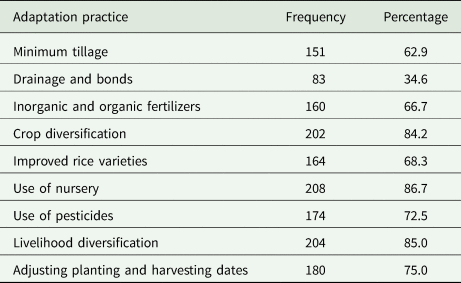
Livelihood diversification, which is a risk management strategy, was adopted by 85% of the farmers. Diversifying into other sources of income guides farmers against risks associated with climate change. When rice farms are affected by climate change, farmers depend on other sources of livelihood to cater for their families. Ho and Shimada (Reference Ho and Shimada2019) and Idoma et al. (Reference Idoma, Ikpe, Ejeh and Mamman2017) also reported livelihood diversification as an important and common adaptation strategy to climate change risk management in Africa and Asia. Also, crop diversification was highly adopted by the farmers. About 84% of the farmers adopted this practice. Farmers in sub-Saharan tend to plant different crops on their farms as a way to manage risks and maximize the use of land. Tarfa et al. (Reference Tarfa, Ayuba, Onyeneke, Idris, Nwajiuba and Igberi2019) found that crop diversification is the most common adaptation strategy to climate change in the Guinea Savanna area of Nigeria. FAO (2018), Waha et al. (Reference Waha, van Wijk, Fritz, See, Thornton, Wichern and Herrero2018), Huang et al. (Reference Huang, Jiang, Wang and Hou2014) and Lin (Reference Lin2011) also observed that crop diversification helps to moderate climate change impacts by spreading production and income risks through planting different crops, thus reducing farmers' exposure and sensitivity to climate shock.
Adjusting planting and/or harvesting dates was also adopted by many farmers (75%). The changing pattern of rainfall (onset and cessation) and variability observed in sub-Saharan Africa (Choko et al., Reference Choko, Olabisi, Onyeneke, Chiemela, Liverpool-Tasie and Rivers2019; Onyeneke et al., Reference Onyeneke, Mmagu and Aligbe2017) affect sowing and harvesting dates for rice and other crops because water is important for the growth and development of agricultural crops. Also, agriculture in this region is largely rain-fed and depends on rainfall (pattern and distribution) for cultivation and harvesting. Arimi (Reference Arimi2014), Ezeh and Eze (Reference Ezeh and Eze2016), Mbah and Ezeano (Reference Mbah and Ezeano2018), Gahatraj et al. (Reference Gahatraj, Jha and Singh2018) and Tarfa et al. (Reference Tarfa, Ayuba, Onyeneke, Idris, Nwajiuba and Igberi2019) reported high adoption rates of this practice by farmers in Africa and Asia.
Use of pesticides, planting improved rice varieties and use of fertilizer were adopted by a significant percentage of the farmers. Table 2 shows that 72.5, 68.3 and 66.7% of the farmers used pesticides, improved rice varieties and fertilizers, respectively, in responding to climate risks. Agrochemicals and improved rice varieties are very important inputs in rice farming. These inputs also contribute to controlling pests and diseases, which may arise due to increasing risks associated with climate change (Harvey et al., Reference Harvey, Rakotobe, Rao, Dave, Razafimahatratra, Rabarijohn, Rajaofara and Mackinnon2014; Warren et al., Reference Warren, Price, Graham, Forstenhaeusler and VanDerWal2018). Similarly, fertilizers (organic and chemical) enhance soil fertility, which has been depleted by climate change through increased flooding, erosion, runoff and washing away of soil nutrients (Brevik, Reference Brevik2013) thereby adversely affecting soil pH, water holding capacity, bulk density and other soil properties (García-Fayos and Bochet, Reference García-Fayos and Bochet2009). Correct use (fertilizer best management practices) of organic and inorganic fertilizers by applying the right quantity of fertilizer from a right source at the right time and place helps to build farmers' resilience to climate change, restores soil fertility with the co-benefit of conserving the environment (Dinesh and Vermeulen, Reference Dinesh and Vermeulen2016; International Fertilizer Association, 2016). These were the reasons why many farmers opted for these strategies in responding to climate change. Nwalieji and Onwubuya (Reference Nwalieji and Onwubuya2012), Herath and Thirumarpan (Reference Herath and Thirumarpan2016), Ezeh and Eze (Reference Ezeh and Eze2016) and Idoma et al. (Reference Idoma, Ikpe, Ejeh and Mamman2017) found these practices important in managing climate risks.
Planting improved rice varieties (early maturing, disease-resistant and flood-tolerant varieties) is an important climate-resilient strategy and 68.3% of the farmers opted for this strategy in climate change management. Table 2 also shows that about 63% of the farmers adopted minimum tillage as an adaptation action in managing climate risks. The benefits of minimum tillage as a climate-smart agricultural practice are well-documented in the literature. These include conservation of the environment, reduced erosion, reduced vulnerability to climate change, soil fertility improvement and increased yield (Marenya et al., Reference Marenya, Kassie, Jaleta, Rahut and Erenstein2017; Grabowski et al., Reference Grabowski, Kerr, Haggblade and Kabwe2014; Gattinger et al., Reference Gattinger, Jawtusch, Müller and Mäder2011; FAO, 2000). These benefits could be the central reason why many opted for this option as climate change management strategy.
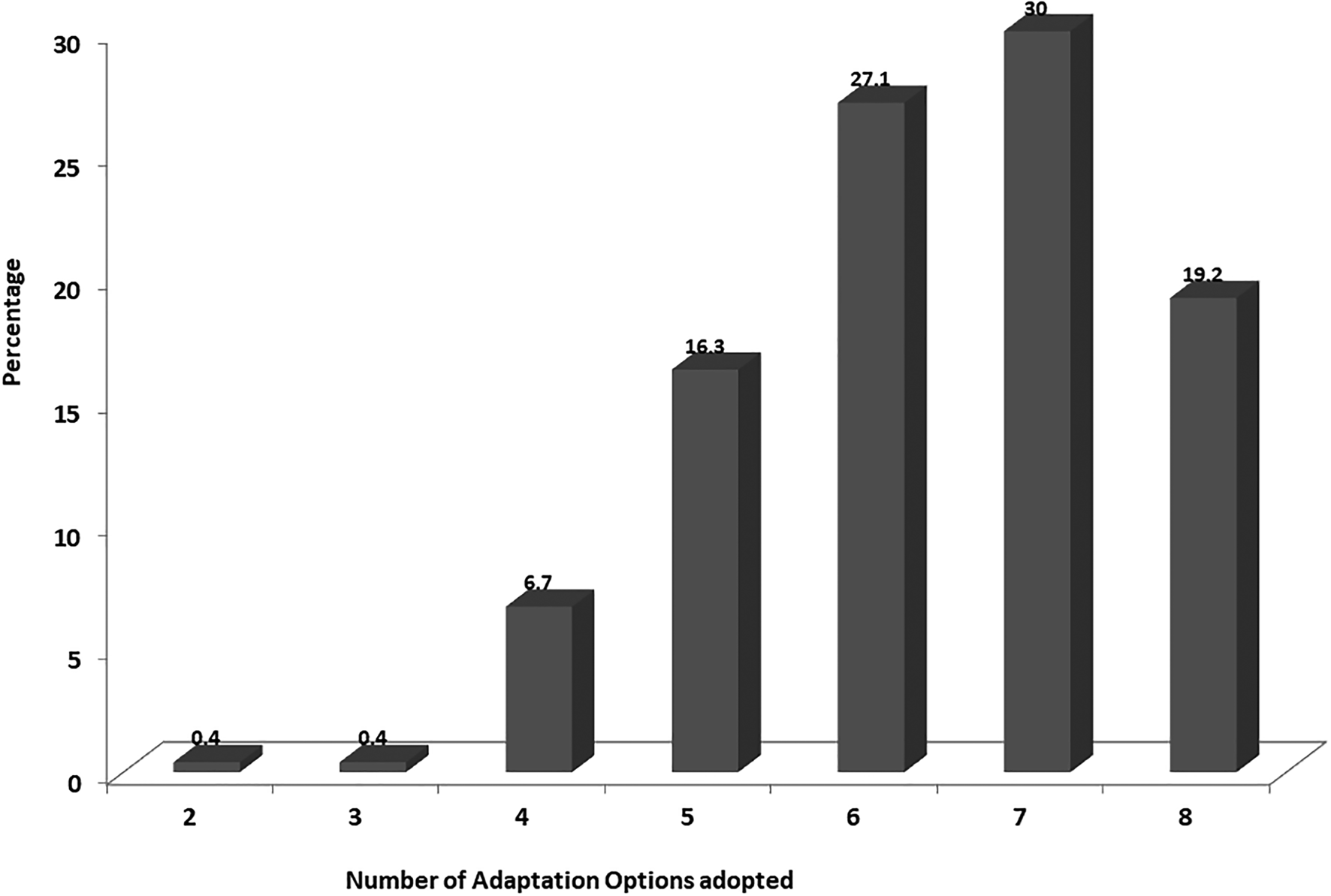
Figure 3 shows the percentage distribution of rice farmers according to the number of adaptation options adopted. It can be deduced from the figure that the farmers adopted multiple adaptation strategies to counteract the negative effects of climate change on rice production. More than 90% of the farmers adopted between five and eight adaptation strategies in managing risks associated with climate change. This implies that the adaptation strategies exhibited some degree of interdependency. This is similar to the findings of Tarfa et al. (Reference Tarfa, Ayuba, Onyeneke, Idris, Nwajiuba and Igberi2019) in the Guinea Savanna area of Nigeria. Several studies (see Maguza-Tembo et al., Reference Maguza-Tembo, Mangison, Edris and Kenamu2017; Saguye, Reference Saguye2016; Bate et al., Reference Bate, Kimengsi and Amawa2019; Aryal et al., Reference Aryal, Rahut, Maharjan and Erenstein2018; Ojo and Baiyegunhi, Reference Ojo and Baiyegunhi2018; Fadina and Barjolle, Reference Fadina and Barjolle2018) across Africa have reported similar results and it was clear from the findings that farmers usually combine multiple strategies in responding to climate change. This result informed the choice of MVP model to analyze the determinants of farmers' adaptation decisions.
Percentage distribution of farmers according to the number of adaptation practices adopted.
Determinants of adaptation decisions in rice farming
The result of the pairwise correlations of the adaptation actions of the MVP model presented in Table 3 indicated that rice farmers simultaneously adopted different adaptation practices for managing climate impacts. The correlation results of the MVP yielded 36 possible pairs of adaptation strategies in rice farming. Of the 36 pairs, the correlation coefficients of 26 pairs were significant. This indicates that the error terms of the multiple adaptation equations are correlated. The likelihood ratio χ2 reported in Tables 3 and 4 was statistically significant indicating the overall significance of the MVP making it an appropriate model for analyzing the determinants of adaptation decisions of rice farmers. Minimum tillage and bonds exhibited significant positive association implying that rice farmers consider these options as complements. Also, minimum tillage yielded significant positive correlation coefficients with other seven strategies (fertilizer use, crop diversification, livelihood diversification, use of improved varieties, use of nursery, adjusting planting and harvesting dates and use of pesticides). This implies that minimum tillage complements all the other adaptation measures. Drainage and bond exhibited a negative association with the use of nursery, pesticide and livelihood diversification meaning that these pairs were substitutes while the use of fertilizer and improved rice varieties yielded positive and significant relationship with bond and drainage indicating that farmers considered these combinations as complements. Use of fertilizer complemented livelihood diversification and adjusting planting and harvesting dates but yielded negative association with crop diversification, use of improved rice varieties, nursery and pesticides. The use of rice-improved varieties complemented the use of nursery, pesticide, livelihood diversification and adjusting planting and harvesting dates. Also, the relationship between the use of nursery and the use of pesticide was positive and significant implying that the pair was complementary. Similarly, the use of nursery complemented adjusting planting and harvesting dates.
Pairwise correlation coefficients of adaptation actions by rice farmers

Likelihood ratio test of rho21 = rho31 = rho41 = rho51 = rho61 = rho71 = rho81 = rho91 = rho32 = rho42 = rho52 = rho62 = rho72 = rho82 = rho92 = rho43 = rho53 = rho63 = rho73 = rho83 = rho93 = rho54 = rho64 = rho74 = rho84 = rho94 = rho65 = rho75 = rho85 = rho95 = rho76 = rho86 = rho96 = rho87 = rho97 = rho98 = 0: χ2 (36) = 84.448***.
Note: Y 1 = minimum tillage, Y 2 = drainage and bonds, Y 3 = use of organic and inorganic fertilizer, Y 4 = crop diversification, Y 5 = improved rice varieties, Y 6 = use of nursery, Y 7 = use of pesticide, Y 8 = livelihood diversification, Y 9 = adjusting planting and harvesting dates.
***P < 0.01, **P < 0.05, *P < 0.10.
Multivariate probit result of determinants of adaptation actions.
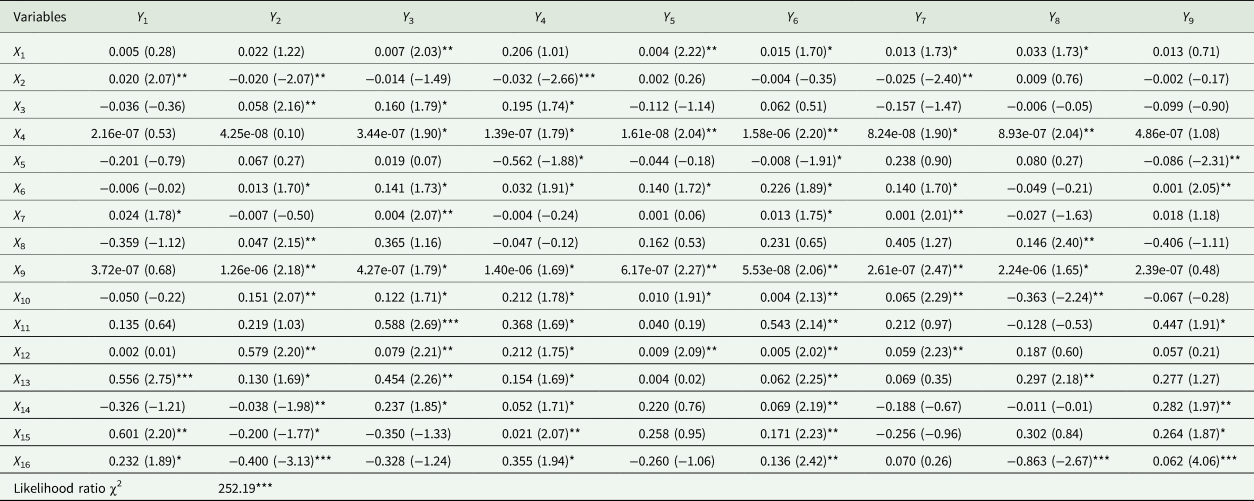
Note: values in parenthesis are z-values.
***P < 0.01; **P < 0.05; *P < 0.10.
Socio-economic characteristics
The results of the effect of certain farmers' socio-economic, farm, institutional and location characteristics on adaptation decisions are presented in Table 4. The study identified seven important socio-economic characteristics of farmers affecting their adaptation decisions. They include farming experience, marital status, education level, age, household size, income and gender. The educational level of farmers was statistically and positively related to the adoption of fertilizer, improved rice varieties, nursery, pesticide and livelihood diversification. This implies that education increased the uptake of the strategies. Educated farmers are usually more innovative and experimental than the uneducated farmers. Therefore, educated farmers are in an advantageous position of adopting technologies that will enhance climate resilience. A 1-year increase in the number of years spent in school is likely to increase the adoption of fertilizer by 0.7%, improved rice varieties by 0.4%, nursery by 1.5%, pesticide by 1.3% and livelihood diversification by 3.3%. This result highlights the importance of education in climate-resilient rice production in the area and similar contexts. The finding corroborates the results of various studies across Africa Teklewold et al. (Reference Teklewold, Mekonnen and Kohlin2019), Amusa et al. (Reference Amusa, Okoye and Enete2015), Fadina and Barjolle (Reference Fadina and Barjolle2018), Aryal et al. (Reference Aryal, Rahut, Maharjan and Erenstein2018) and Saguye (Reference Saguye2016), who respectively reported that education influences the uptake of similar adaptation practices.
Age significantly decreased the probability of uptake of bond and drainage, crop diversification and nursery but significantly increased the uptake of minimum tillage. This implies that younger farmers adopted bond and drainage, crop diversification and pesticide more than older farmers. This is expected because younger farmers are more experimental and productive and could try practices and technologies that would enhance their adaptive and buffer capacities. A 1-year increase in the age of farmers resulted in a 2, 3.2 and 2.5% decrease in the adoption of bond and drainage, crop diversification and pesticide, respectively. This is similar to the findings of Tarfa et al. (Reference Tarfa, Ayuba, Onyeneke, Idris, Nwajiuba and Igberi2019), Onyeneke et al. (Reference Onyeneke, Igberi, Aligbe and Amadi2018a), Maguza-Tembo et al. (Reference Maguza-Tembo, Mangison, Edris and Kenamu2017) and Aryal et al. (Reference Aryal, Jat, Sapkota, Khatri-Chhetri, Kassie, Rahut and Maharjan2017), who respectively found a negative relationship between age and adoption of climate change adaptation practices in farming. For minimum tillage, older farmers tended to adopt this practice more than their younger counterparts. The reason could be largely as a result of the knowledge and experience older farmers have gained over time in using this practice to maintain soil fertility, conserve the environment and respond to flood and erosion. Research findings have demonstrated the positive relationship between age and adoption of minimum for soil fertility management and climate change adaptation (Nyambose and Jumbe, Reference Nyambose and Jumbe2013; Grabowski et al., Reference Grabowski, Kerr, Haggblade and Kabwe2014; Ntshangase et al., Reference Ntshangase, Muroyiwa and Sibanda2018).
Household size demonstrated a positive and significant effect on the adoption of drainage and bond, fertilizer application and crop diversification. Household size, always used as a proxy for family labor in farming, increased the uptake of drainage and bond, fertilizer application and crop diversification because labor is required to implement these adaptation practices and which in most instances are provided farm family members (Onyeneke et al., Reference Onyeneke, Iruo and Ogoko2012). An additional person in the farmers' family would increase the adoption of drainage and bond, fertilizer application and crop diversification by 5.8, 16 and 19.5%, respectively. Abid et al. (Reference Abid, Scheffran, Schneider and Ashfaq2015) and Ali and Erenstein (Reference Ali and Erenstein2016) also observed a significant positive relationship between household size and adaptation to climate change.
Income increased the uptake of fertilizer, crop diversification, improved rice varieties, nursery, pesticide and livelihood diversification. Teklewold et al. (Reference Teklewold, Mekonnen and Kohlin2019), Amusa et al. (Reference Amusa, Okoye and Enete2015) and Agabi (Reference Agabi2012) found similar results in their respective studies. Income helps farmers to acquire inputs and technologies such as improved rice varieties, pesticide and fertilizer. For farmers who opted for livelihood diversification as a means of enhancing resilience to climate shocks, income also assisted in pursuing other means of livelihood.
Gender had a negative and significant coefficient with crop diversification, use of nursery and adjusting planting and harvesting calendar. This implies that female farmers adopted crop diversification and nursery and adjusted planting and harvesting calendar more than male colleagues. Women are more involved in farming than men and this could be the reason why they adopted these strategies more readily than men (Nchu et al., Reference Nchu, Kimengsi and Kapp2019). Being a female farmer increased the adoption of crop diversification, nursery and adjusting planting and harvesting calendar by 56.2, 0.8 and 8.6%, respectively. This is similar to the findings of Aryal et al. (Reference Aryal, Rahut, Maharjan and Erenstein2018) in India where women adopted site-specific nutrient management, laser land leveling, stress-tolerant varieties and crop diversification as climate-smart agricultural practices. Onyeneke et al. (Reference Onyeneke, Iruo and Ogoko2012) also recorded similar findings in the Niger Delta region of Nigeria.
Rice farming experience yielded a positive effect on the adoption of minimum tillage, fertilizer, nursery and pesticide. This implies that experienced farmers adopted these strategies for managing climate risks more than the inexperienced farmers. Adaptation is a learning process and experienced farmers have gained a better knowledge of adapting rice farming to climate risks than inexperienced or less experienced farmers. Also, Saguye (Reference Saguye2016) and Fadina and Barjolle (Reference Fadina and Barjolle2018) found that experience enhances climate change response. A 1-year increase in farming experience increased the adoption of minimum tillage by 2.4%, fertilizer by 0.4%, nursery by 1.3% and pesticide by 0.1%.
Marital status recorded a positive and significant coefficient with the adoption of bond and drainage as well as livelihood diversification. Married farmers adopted these measures more than their counterparts who are not married. This is similar to the findings of Balew et al. (Reference Balew, Agwata and Anyango2014) who found a positive relationship between marital status and adaptation to climate change in Ethiopia. Being a married farmer increased the adoption of bond and drainage by 4.7% and livelihood diversification by 14.6%.
Farm characteristics
The farm size variable showed a positive and significant impact on the likelihood to adopt drainage and bond, fertilizer, crop diversification, improved rice varieties, nursery and pesticide. Farmers with larger farm holdings opted for these adaptation practices more than their counterparts with smaller landholdings. The impact of farm size on the uptake of livelihood diversification was significant and negative implying that farmers small farm size diversified their means of livelihood more than their counterparts with larger hectarage of land cultivated. A one hectare increase in farm size led to 15.1, 12.2, 21.2, 1, 0.4 and 6.5% increase in the likelihood of adopting drainage and bond, fertilizer, crop diversification, improved rice varieties, nursery and pesticide, respectively, but decreased the uptake of livelihood diversification by 36.3%. Adaptation occurs rapidly in larger farms because farmers with larger landholdings, often referred to as large-scale farmers, would seek resilient practices to climate shocks as a way to respond and increase productivity. Such farmers usually have the capacity to invest in risk management in farming and are better positioned to adapt. This is similar to the findings of Aryal et al. (Reference Aryal, Rahut, Maharjan and Erenstein2018), Maguza-Tembo et al. (Reference Maguza-Tembo, Mangison, Edris and Kenamu2017), Amusa et al. (Reference Amusa, Okoye and Enete2015) and Ayanwuyi et al. (Reference Ayanwuyi, Ogunlade and Oyetoro2010) who found that farm size increases the probability of uptake climate change adaptation practices.
An earlier experience of flood significantly increased the uptake of minimum tillage, drainage and bond, fertilizer application, crop diversification, nursery and livelihood diversification. An earlier experience of flood increased the probability of adopting minimum tillage, drainage and bond, fertilizer application, crop diversification, nursery and livelihood diversification by 55.6, 13, 45.4, 15.4, 6.2 and 29.7%, respectively. Farmers who had experienced climate shocks tend to adapt to future risks as they would not want to be victims again. Mulwa et al. (Reference Mulwa, Marenya, Rahut and Kassie2017) found similar results in Malawi.
Training and services
The impact of agricultural extension services on adaptation was positive across all adaptive responses but significant on the adoption of drainage and bond, fertilizer application, crop diversification, improved rice varieties, nursery, pesticide, and adjusting planting and harvesting dates. Agricultural extension plays an essential role in technology adoption (Maddison, Reference Maddison2007) and this could be the reason why it positively impacted the adoption of climate change resilience practices in this paper. Agricultural extension providers are increasingly becoming aware of climate change and are disseminating technologies and information useful for climate change resilience in rural farming communities. Having a contact with agricultural extension agents increased the uptake of drainage and bond, fertilizer application, crop diversification, improved rice varieties, nursery, pesticide, and adjusting planting and harvesting dates by 1.3, 14.1, 3.2, 14, 22.6, 14 and 0.1%, respectively. This corroborates the findings of Ojo and Baiyegunhi (Reference Ojo and Baiyegunhi2018), Aryal et al. (Reference Aryal, Jat, Sapkota, Khatri-Chhetri, Kassie, Rahut and Maharjan2017) and Abid et al. (Reference Abid, Schilling, Scheffran and Zulfiqar2016) that agricultural extension service enhances farmers' responses to climate change.
Credit access significantly increased farmers' adaptive capacity through adopting drainage and bond, fertilizer, crop diversification, improved rice varieties, nursery, pesticide and livelihood diversification. Credit is an important factor in climate risk management because finance is required to acquire inputs needed for adaptation. Farmers' own financial resources are usually limited and may not be sufficient to buy the essential inputs (such as pesticide, fertilizer and improved rice varieties) needed for responding to climate risks. This finding is consistent with previous results (Ojo and Baiyegunhi, Reference Ojo and Baiyegunhi2018; Onyeneke et al., Reference Onyeneke, Igberi, Aligbe and Amadi2018a; Ho and Shimada, Reference Ho and Shimada2019) that credit enhances adaptation to climate shocks.
The variable of training on rice farming was positively and significantly related to the adoption of drainage and bond, fertilizer, crop diversification, improved rice varieties, nursery and pesticide. This means that farmers who had received training on rice farming were more likely to respond to climate risks through the use of drainage and bond, fertilizer, crop diversification, improved rice varieties, nursery and pesticide. Farmers build their adaptive capacity through learning and receiving training on rice farming exposes farmers to improved rice management practices and technologies, and prepares them to respond to climate risks. Having received training on rice farming increased the uptake of drainage and bond, fertilizer, crop diversification, improved rice varieties, nursery and pesticide by 57.9, 7.9, 21.2, 0.9, 0.5 and 5.9%, respectively. This result is consistent with the findings of Arimi (Reference Arimi2014) and Trinh et al. (Reference Trinh, Simelton and Le2018), who observed that training increases farmers' adaptation to climate change.
Membership of farmer association had a positive and significant impact on the adoption of fertilizer, crop diversification, nursery and adjusting planting and harvesting. Farmers receive important information about climate risks and improved farming techniques from their associations. They also share their experiences and farm-related problems with fellow members who often render assistance by providing advice or other forms of support in solving the problems encountered by such farmers. This is in line with the findings of Kassie et al. (Reference Kassie, Jaleta, Shiferaw, Mmbando and Mekuria2013), Onyeneke (Reference Onyeneke2017) and Ojo and Baiyegunhi (Reference Ojo and Baiyegunhi2018).
Location
Previous studies (Aryal et al., Reference Aryal, Rahut, Maharjan and Erenstein2018; Liverpool-Tasie et al., Reference Liverpool-Tasie, Sanou and Tambo2018; Below et al., Reference Below, Mutabazi, Kirschke, Franke, Sieber, Siebert and Tscherning2012; Hinkel, Reference Hinkel2011) have demonstrated the importance of location in climate change adaptation. All the agricultural zones yielded a significant and positive impact on the adoption of crop diversification, nursery and adjusting planting and harvesting calendar. This implies that these adaptation measures were practiced in all locations in the area. Contrarily, the agricultural zones exhibited an inverse relationship with the probability of adopting bond and drainage. Having a farm or living in Ebonyi North significantly decreased the uptake of diversifying means of livelihood. This could be associated with the fact that the agricultural zone produces the bulk of the main local rice in the State popularly known as Abakaliki rice.
Impact of adaptation on the profitability of rice production
To consistently model the impact of climate change adaptation on the profitability of rice production, the author adopted IVR and endogenous treatment effect models, which jointly control for every bias—observable and unobservable factors—that might lead to overestimating or underestimating the impact. An instrument is required to successfully apply this model, and farmers' awareness level of climate change emerged as the valid instrument of this study because it met the relevance and exclusion criteria of the models.
Instrumental variable estimates of the impact of adaptation on returns to scale of rice production
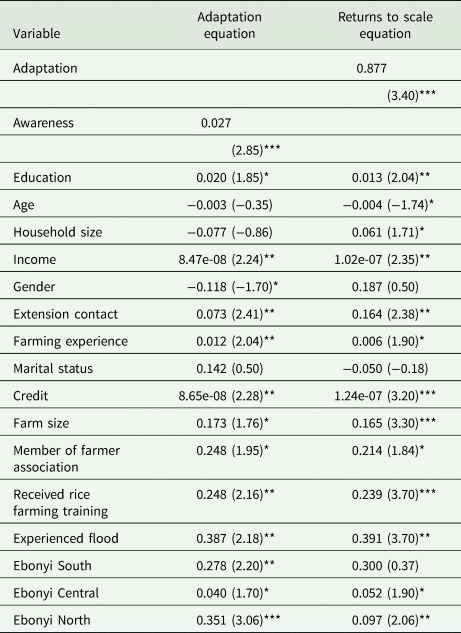
Table 5 presents the result of IVR of the impact of adaptation on returns to scale of rice production. As stated earlier, awareness emerged as a significant predictor of adaptation to climate change. This is a priori correct because farmers who respond to climate change must be aware that the climate has changed and seek for actions to respond. This study further revealed that as awareness level increased, the intensity of adaptation increased too. This implies that policy measures or programs for increasing awareness of climate change among farmers will result in increased resilience. Deressa et al. (Reference Deressa, Hassan, Ringler, Alemu and Yesuf2008) and Gbetibouo (Reference Gbetibouo2009) noted that adaptation involves two stages—perception (in this case awareness) and adaptation. Also, other researchers (Ricart et al., Reference Ricart, Olcina and Rico2018; Abid et al., Reference Abid, Scheffran, Schneider and Ashfaq2015; Adger et al., Reference Adger, Dessai, Goulden, Hulme, Lorenzoni, Nelson, Naess, Wolf and Wreford2009) have documented the importance of climate change information and awareness on adaptation.
Instrumental variable regression estimates of the impact of adaptation on returns to scale of rice production
Note: values in parenthesis are t-values.
***Significant at 1% level, **Significant at 5% level; *Significant at 10% level.
Adaptation to climate change was a significant predictor of returns to scale of rice production. The number of adaptation practices increased the returns to scale of rice production. A unit increase in the number of climate risk management measures yielded a corresponding 0.877 increase in the returns to scale. This implies that for farmers to increase their profit and productivity, they need to increase their resilience by increasing the number of adaptation practices. This is in line with the findings of Roco et al. (Reference Roco, Bravo-Ureta, Engler and Jara-Rojas2017) that adaptation significantly increased farm-level productivity. Similarly, Ali and Erenstein (Reference Ali and Erenstein2017) found that climate change adaptation strategies increased food security and reduced poverty in Pakistan. This finding evidences the importance of adaptation in rice productivity and profitability. Education, household size, income, extension, farming experience, farm size, access to credit, membership of farmers' association, rice farming training, experienced flood, having farms in Ebonyi North and Ebonyi Central agricultural zones were the control variables that significantly increased returns to scale of rice production while age decreased the returns to scale of rice production.
Endogenous treatment effect estimates of the impact of adaptation on the profitability of rice production
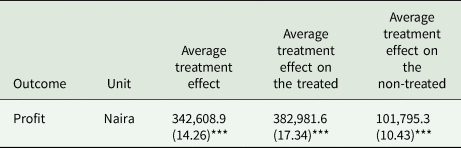
Table 6 presents the result of the endogenous treatment effect model of the impact of adaptation on the profitability of rice production. The average treatment effect (ATE) of the model shows that using five or more adaptation options in rice production significantly increased the profitability of the business in the entire population of rice farmers by ₦342,608.9 (US$945.60). The ATE on the treated also indicates that farmers who used five or more climate change adaptation practices in rice production recorded significant incremental profit. Their profit in rice production increased by ₦382,981.6 (US$1057.03). Interestingly, farmers who used less than five adaptation options also recorded increased and significant profit. Their profit increased by ₦101,795.3 (US$280.95) as a result of combining less than five adaptation responses to climate change. However, the incremental profit of this group of farmers (₦101,795.3) was not as high as the group of farmers that used five or more adaptation options (₦382,981.6) as well as that for the entire population of rice farmers (₦342,608.9). Roco et al. (Reference Roco, Bravo-Ureta, Engler and Jara-Rojas2017) found a similar result in Central Chile where climate change adaptation increased technical efficiency of farmers. Similarly, Kuntashula et al. (Reference Kuntashula, Chabala and Mulenga2014) estimated the impact of adaptation strategies such as minimum tillage and crop rotation on maize yield and production. Their findings indicated that adaptation strategies significantly increased maize yield and production in Zambia. The finding demonstrates the growing importance of climate change adaptation in rice production in particular and agriculture in general.
Endogenous treatment effect estimates of the impact of climate change adaptation on the profitability of rice production
Note: ***Significant at 1% level.
Values in parenthesis are z-values.
Conclusion
This paper investigated the effect of rice farmers' chosen climate risk management measures on returns to scale of rice production in Ebonyi State. Trend analysis was used to model the change observed in climatic variables over time, MVP regression was employed to analyze the determinants of simultaneous adaptation decisions of rice farmers while IVR modeled the impact of farmers' adaptation actions on returns to scale of rice production. Temperature and rainfall are changing with temperature increasing significantly and rainfall demonstrating high variability. This implies that climate change is real in the area and this informed farmers' decision to adapt. The descriptive analysis shows that farmers are responding to changing climate through adaptation. They have adopted a wide range of strategies to counteract the adverse impacts of climate change. Such strategies include minimum tillage, use of fertilizer, crop diversification, improved rice varieties, use of nursery, pesticide, livelihood diversification and adjusting planting dates.
The pairwise correlation result indicates that farmers make simultaneous decisions in the choice of adaptation strategies. The adaptation strategies chosen are interdependent with most of them exhibiting complementary relationships while few are substitutes. Socio-economic, farm and location characteristics of farmers as well as access to training and services drive choices made in climate change adaptation. Interestingly, being a female farmer increased the adoption of several adaptation strategies. This study therefore concludes that increasing women's access to production resources will increase agricultural resilience of Ebonyi and other regions with similar contexts. Income, farm size, credit and agricultural extension are major drivers of adaptation especially the adoption of fertilizer, pesticide, improved varieties, crop diversification and livelihood diversification. Therefore, increasing farmers' access to land, credit, extension services as well as income opportunities are going to increase the buffer and adaptive capacities of rice farmers.
This study demonstrates the importance of climate change awareness in adaptation. The need to increase climate change awareness campaigns in rural areas cannot be overemphasized. This will help increase farmers' resilience to climate change. This paper validates the importance of linking climate change adaptation to farmers' productivity as an effective way of checking maladaptation. In this study, adaptation to climate change is an important predictor of rice productivity and profitability. Therefore, this paper recommends that climate change adaptation should be mainstreamed into agricultural policies, plans and programs that aim at increasing agricultural productivity and profitability.



