


The gastrointestinal tract harbours approximately 1014 microbial cells, consisting of over 1000 species or phylotypes, the majority of which reside in the colon( Reference Qin, Li and Raes 1 , Reference Rajilic-Stojanovic and de Vos 2 ). The colonic microbiota has been associated with a wide range of health benefits including improved immune function and maturation, modified behaviour, regulation of satiety, inhibition of pathogens and augmentation of mineral absorption( Reference Buffie and Pamer 3 – Reference Parnell and Reimer 5 ). Imbalances in microbial community composition may be caused by diet, genetics, age, stress or xenobiotics and can induce a state of dysbiosis that may promote a more disease-susceptible microbiota. Consumption of certain types of dietary components can have a major influence on the communities of colonic micro-organisms, with changes typically being observed within 24 h of consumption( Reference Walker, Ince and Duncan 6 , Reference Wu, Chen and Hoffmann 7 ).
Kiwifruit has been implicated in promoting several aspects of gut health including improving stool frequency, increasing commensal bacteria and improving aspects of immune function( Reference Bentley-Hewitt, Blatchford and Parkar 8 – Reference Rush, Patel and Plank 10 ). These benefits are thought to derive from the inherent levels of digestion-resistant carbohydrates, polyphenols and vitamin C( Reference Chan, Leung and Tong 11 ). The laxative effect of kiwifruit is undoubtedly the most well-studied health impact, whereas prebiotic effects are less well understood. In addition to host absorption of nutrients, enhancement of colonic microbial composition is thought to mediate many of the beneficial health effects of kiwifruit. Organic acids such as acetate, propionate and butyrate are produced as a result of microbial fermentation of kiwifruit digestion-resistant carbohydrates( Reference Parkar, Rosendale and Paturi 9 ). Organic acids may be absorbed by colonocytes into the bloodstream where they are further metabolised in the liver, muscle and other peripheral tissues, and are associated with the mediation of immune effects, cholesterol, satiety, and improved mineral absorption( Reference Hamer, Jonkers and Venema 12 – Reference Wong, de Souza and Kendall 14 ).
As the importance of a robust and diverse colonic microbiota is increasingly apparent and the potential of kiwifruit to modulate the microbiota is being unearthed, a human intervention study was conducted to ascertain the effect of kiwifruit-derived supplements on colonic microbial composition and metabolism. Two kiwifruit-derived supplements, ACTAZIN™ green-fleshed (Actinidia chinensis var. deliciosa ‘Hayward’) and Livaux™ gold-fleshed (Actinidia chinensis var. chinensis ‘Zesy002’) (Anagenix Ltd), were used as dietary interventions in the trial. These capsules are cold-processed dietary supplements, from which the skin and seeds are removed, formulated to maintain the integrity of innate kiwifruit compounds. The objective of this study was to assess the impact of ACTAZIN™ and Livaux™ on the composition of colonic bacteria, metabolites and gut pH, which was measured by 16S rRNA gene sequencing, organic acid analysis and SmartPill® technology, respectively.
Materials and methods
Study protocol
The study design was a randomised double-blind placebo-controlled cross-over trial with participants consuming four different interventions for 4 weeks each, with a 2-week washout between each intervention. A schematic view of the trial design is shown in Supplementary Fig. S1. The interventions were delivered in 4 × 600 mg capsules supplied by Anagenix Ltd prepared to look identical to preserve intervention blinding (Table 1). Detailed information on ingredient composition, trial recruitment and participant inclusion and exclusion criteria can be found in the Ansell et al. ( Reference Ansell, Butts and Paturi 15 ) paper reporting laxation endpoints of this trial. Briefly, participants consumed four different intervention combinations: placebo (isomalt coloured green) (2400 mg/d), ACTAZIN™ L (600 mg/d), ACTAZIN™ H (2400 mg/d) and Livaux™ (2400 mg/d) for 28 d each intervention, with a 14 d washout period between each treatment phase. ACTAZIN™ L (low dose, green kiwifruit) and ACTAZIN™ H (high dose, green kiwifruit) were formulated from cold-processed Actinidia chinensis var. deliciosa ‘Hayward’ green kiwifruit and Livaux™ was formulated from cold-processed Actinidia chinensis var. chinensis ‘Zesy002’ gold-fleshed kiwifruit. The placebo ingredient was isomalt (1-O-α-d-glucopyranosyl-d-mannitol). Subjects were asked to exclude high-fibre dietary supplements such as Metamucil, Benefibre and Phloe as well as maintaining their habitual dietary intakes and physical activity habits and to refrain from eating fresh kiwifruit for the study period. At the beginning and end of each 4-week intervention period, participants were asked to provide a faecal sample. The washout period of 2 weeks was chosen to allow sufficient time to return bowel habits to baseline for the parameters measured (microbial ecology, microbial metabolites and SmartPill® pH measurements). This study was conducted according to the guidelines laid down in the Declaration of Helsinki and all procedures involving human subjects/patients were approved by the New Zealand Human Disability and Ethics Committee (application number 12/STH/72/AM01). Written informed consent was obtained from all subjects/patients. The trial was registered with the Australia New Zealand Clinical Trials Registry (registration number ACTRN: 12612001270808) (http://www.anzctr.org.au/).
Description of intervention composition

L, low dose; H, high dose.
DNA extraction and 16S rRNA gene sequencing
All faecal samples were collected and stored at −20°C until analysis. Each sample (250 mg) was weighed into a sterile microtube and DNA extracted using the MO-BIO PowerSoil® DNA Isolation Kit (catalogue no. 12888; MO-BIO Laboratories). Illumina MiSeq 16S rRNA gene sequencing was performed as described in a previous study( Reference Blatchford, Bentley-Hewitt and Stoklosinski 16 ).
Bioinformatics
Quantitative Insights Into Microbial Ecology (QIIME) software version 1.8.0 was used to analyse the Illumina MiSeq sequencing data( Reference Caporaso, Kuczynski and Stombaugh 17 ). To assemble paired-end reads into a single continuous sequence, PANDASeq was used with parameters of at least 40 bp overlap, a minimum of 350 bp length and maximum of 500 bp length( Reference Masella, Bartram and Truszkowski 18 ). Putative chimeras were filtered from the sequences and the reads clustered into operational taxonomic units based on a 97 % identity threshold value using USEARCH and UCLUST( Reference Edgar 19 ). A subsample of the total reads was taken to allow faster processing of the samples and to normalise at approximately 15 000 reads per sample, which is sufficient for phylogenetic and taxonomic assignment( Reference Caporaso, Lauber and Walters 20 , Reference Schloss, Schubert and Zackular 21 ). Alignment of the sequences was carried out using PyNAST( Reference Caporaso, Bittinger and Bushman 22 ) with reference to the Greengenes core reference database (version 13_8)( Reference DeSantis, Hugenholtz and Larsen 23 ). Taxonomic assignment was made using the Ribosomal Database Project (RDP) naive Bayesian classifier( Reference Wang, Garrity and Tiedje 24 ). Healthy and functionally constipated (FC) groups were analysed separately and the effect of each of the four treatments on microbial community composition determined by comparing the average abundance of each bacterial genus following treatment (greater than 1 % abundance in at least one of the eight samples) with the average value before intervention.
Organic acid quantification by GC
A 500–1000 mg portion of each faecal sample was weighed into a clean tube and diluted 1:10 in PBS. An internal standard (ethyl butyrate) was included to give a final concentration of 5 mm. Organic acids were quantified by GC using a modified method( Reference Richardson, Calder and Stewart 25 ). Analysis was performed on a Shimadzu GC system (GC-17A) equipped with a flame ionisation detector and fitted with an HP-1 column (Agilent Technologies). The instrument was controlled and chromatograms acquired using GC Solution Chromatography Data System software (Shimadzu, version 2.3). Organic acid concentrations were expressed as μmol/g faeces.
SmartPill®
SmartPill® is a single-use, ingestible capsule and used in clinical medicine as an alternative approach for determining gastrointestinal transit time( Reference Timm, Willis and Thomas 26 ) instead of using radio-opaque markers and scintigraphy. SmartPill® is able to measure in situ gastrointestinal pH, pressure and temperature and uses telemetry to relay information wirelessly to a small receiving device worn during the study. Six participants from the FC group underwent SmartPill® testing whilst on either the placebo or ACTAZIN™ H treatments. SmartPill® data were compared between treatments to ascertain whether ingestion of ACTAZIN™ H capsules had an impact on pH. Migration of the SmartPill® capsule past the ileocaecal junction into the proximal colon was characterised by a distinct decline in pH. The entire colonic pH from the ileocaecal junction to passing the capsule was averaged and compared between treatments for all participants. Faecal samples originate from the distal bowel, therefore distal rectosigmoid colon pH was determined by taking the last 35·4 % of total colonic pH measurements as calculated in a study interpreting segmental colonic transit times( Reference Metcalf, Phillips and Zinsmeister 27 ). Bacterial groups were correlated with distal colonic pH data from SmartPill® measurements. A graphical example of SmartPill® data output for a participant is shown in Supplementary Fig. S2.
Statistical analysis
Statistical calculations were conducted in RStudio using the statistics package( 28 ). Bacterial groups were correlated with rectosigmoid pH data from SmartPill® measurements using the Spearman's rank correlation calculation. The Wilcoxon signed rank test was performed to assess significant differences between taxa and significant differences between organic acid concentrations before and after each treatment. A P value of less than 0·05 was deemed significant after correcting for multiple comparisons using the false discovery rate (FDR) method in the p.adjust function in RStudio( Reference Benjamini and Hochberg 29 ).
Results
16S rRNA gene sequencing
High-throughput sequencing of variable regions of the 16S rRNA gene, amplified from faecal sample-derived bacterial DNA, resulted in 26·3 million reads. After quality filtering, chimera removal and subsampling, a total of 3·72 million reads were obtained at an average of 14 879 (14 139 minimum–14 999 maximum) sequences per sample. Over all samples, 218 species-level phylotypes were observed at a 97 % sequence identity threshold.
Analysis of the participants’ faecal microbiota composition before intervention showed marked differences between the healthy and FC cohorts. A total of thirty-two genera were measured at greater than 1 % abundance in at least one sample, ten of which differed significantly between the baseline healthy and FC groups (Fig. 1). Furthermore, the ratio of Firmicutes to Bacteroidetes differed between the groups at 2·25 and 3·19 for the healthy and FC groups, respectively. These numbers agree with other studies that show an increase in Firmicutes in irritable bowel syndrome patients relative to healthy controls( Reference Rajilic-Stojanovic, Biagi and Heilig 30 ).
Boxplots displaying bacterial taxa in healthy (a) and functionally constipated (b) baseline samples of faecal microbiota that are present at greater than 1 % abundance in at least one sample. The genera in bold font are significantly more abundant compared with the other group, as calculated by the Wilcoxon signed rank test after false discovery rate correction for multiple comparisons (P ≤ 0·05). Ruminococcus_R, from Ruminococcaceae family; Ruminococcus_L, from Lachnospiraceae family.

In the healthy group, Clostridiales increased significantly after Livaux™ supplementation from 5·0 to 7·6 % (P = 0·042) (Table 2). In the FC group, Dorea spp. increased from 0·9 to 1·4 % (P = 0·008) after the ACTAZIN™ H treatment (Table 3). In the FC group, Faecalibacterium prausnitzii significantly increased after Livaux™ treatment from 3·4 to 7·0 % (P = 0·024), a two-fold increase as can be seen in Table 3. Individual participant responses can be seen in Supplementary Fig. S3, where eight out of the nine participants exhibited a net increase in F. prausnitzii.
Relative abundance of prevalent bacterial groups in response to treatments in the healthy group†
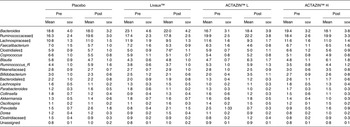
L, low dose; H, high dose; Ruminococcus_R, from Ruminococcaceae family.
* Significantly different compared with pre-treatment based on the Wilcoxon signed rank test after false discovery rate correction for multiple comparisons (P ≤ 0·05).
† Illumina MiSeq sequencing data displaying genera that are present at greater than 1 % abundance in at least one sample. Data are the calculated average values for all participants with their standard errors before and after each treatment period.
‡ Some bacteria could only be classified as far as the order or family level.
Relative abundance of prevalent bacterial groups in response to treatments in the functionally constipated group†

L, low dose; H, high dose; Ruminococcus_R, from Ruminococcaceae family.
* Significantly different compared with pre-treatment based on the Wilcoxon signed rank test after false discovery rate correction for multiple comparisons (P ≤ 0·05).
† Illumina MiSeq sequencing data displaying genera that are present at greater than 1 % abundance in at least one sample. Data are the calculated average values for all participants with their standard errors before and after each treatment period.
‡ Some bacteria could only be classified as far as the order or family level.
Organic acid production
Succinate significantly decreased in concentration from 2·3 to 1·7 µmol/g (P = 0·040) following placebo treatment in the FC group (Fig. 3). There were no other significant alterations to organic acid concentrations with any of the treatments. Quantitative differences before and after each treatment were generally modest, except for acetate which increased or decreased by up to 13 µmol/g after some treatments (Figs 2 and 3).
Organic acid concentrations in faecal samples in response to the four treatments in the healthy group as measured by GC, expressed in μmol/g faeces. ░, Pre-treatment; ■, after treatment; L, low dose; H, high dose. Values are means, with standard errors represented by vertical bars.

Organic acid concentrations in faecal samples in response to the four treatments in the functionally constipated group as measured by GC, expressed in μmol/g faeces. ░, Pre-treatment; ■, after treatment; L, low dose; H, high dose. Values are means, with standard errors represented by vertical bars. * Significantly different compared with pre-treatment based on the Wilcoxon signed rank test after false discovery rate correction for multiple comparisons (P ≤ 0·05).

SmartPill®
SmartPill® data were used to determine the pH of the colonic environment in a small group of participants taking the ACTAZIN™ H capsules and the placebo treatment. Comparable pH values were observed between treatments, with an average pH of 6·38 in the ACTAZIN H treatment and an average pH of 6·30 in the placebo treatment (Supplementary Table S4). A Spearman rank correlation between bacterial groups and rectosigmoid pH provided two significant values: Bifidobacterium spp. negatively correlated with pH (−0·41; P = 0·044) and Coprococcus spp. positively correlated with pH (0·43; P = 0·039).
Discussion
Other results arising from this trial, assessing laxation endpoints, were published separately and showed that the kiwifruit supplements were able to significantly increase bowel movements in healthy individuals( Reference Ansell, Butts and Paturi 15 ). There is a strong relationship between stool consistency and microbiota composition and diversity( Reference Gilbert and Alverdy 31 , Reference Vandeputte, Falony and Vieira-Silva 32 ), which is unsurprising as microbial metabolic end products such as SCFA and gases can affect colonic transit time( Reference Lewis and Heaton 33 , Reference Soares, Lederman and Fagundes-Neto 34 ). However, in this trial no correlations were observed in those participants that exhibited an increase in stool frequency and microbiota composition. Comparison between the baseline microbiota composition of the healthy and FC groups has provided valuable insight to the bacterial aetiology of functional constipation. Interesting findings between the cohorts were a significantly higher Bacteroidales abundance in healthy individuals and significantly higher Akkermansia spp. abundance in FC participants. Both patterns agree with a study assessing microbiota composition and stool consistency( Reference Vandeputte, Falony and Vieira-Silva 32 ).
In the present study, we found that several bacterial groups were significantly altered in abundance following kiwifruit supplementation. Clostridiales increased by 2·6 % after Livaux™ supplementation in the healthy group, but as the order includes a wide range of families and genera, including Lachnospiraceae, Clostridiaceae, Ruminococcaceae, Veillonellaceae, etc. and some pathogens, it is difficult to draw meaningful conclusions about the consequence of this increase. Dorea spp. increased modestly after ACTAZIN H treatment in the FC group and these members of the diverse Lachnospiraceae family are major gas producers, mainly CO2 and H2 ( Reference Taras, Simmering and Collins 35 ).
A non-significant decrease in F. prausnitzii from 7·2 to 5·3 % was observed in the healthy group which could be due to already high levels at baseline. Other studies have observed depleted F. prausnitzii in irritable bowel syndrome patients compared with healthy control subjects( Reference Rajilic-Stojanovic, Biagi and Heilig 30 ). It has been demonstrated that the effect of baseline concentrations of a bacterial group may have a substantial bearing on the magnitude of effect observed in response to a dietary intervention( Reference Kolida, Meyer and Gibson 36 , Reference Tuohy, Kolida and Lustenberger 37 ). F. prausnitzii abundance was significantly elevated (3·6 %) in the FC group after a 4-week period of supplementation with the gold kiwifruit-based Livaux™. F. prausnitzii is one of the more populous species in the human gastrointestinal tract, being typically observed at over 5 % of the total proportion of the colonic microbiota of healthy adults( Reference Miquel, Martin and Rossi 38 ), in agreement with abundance data presented in this study. Members of the Firmicutes phylum, F. prausnitzii are commensal inhabitants of the human large bowel, with demonstrated anti-inflammatory properties in vivo ( Reference Furet, Kong and Tap 39 , Reference Sokol, Seksik and Furet 40 ). One study found that F. prausnitzii was able to utilise pectin and uronic acids as substrates for growth and both are known constituents of kiwifruit( Reference Lopez-Siles, Khan and Duncan 41 ). Green and gold kiwifruit have been shown to exhibit differences in digestibility, leading to altered soluble and insoluble fibre compositions reaching the large bowel( Reference Carnachan, Bootten and Mishra 42 ), which may be why differences were observed in the effect of green and gold kiwifruit fibre in this study. Low amounts of F. prausnitzii have been associated with a range of intestinal disorders including irritable bowel syndrome, atopy, diabetes and inflammatory bowel diseases such as Crohn's disease and ulcerative colitis( Reference Rajilic-Stojanovic, Biagi and Heilig 30 , Reference Furet, Kong and Tap 39 , Reference Sokol, Seksik and Furet 40 , Reference Candela, Rampelli and Turroni 43 , Reference Willing, Dicksved and Halfvarson 44 ). These consistent observations show that a depleted concentration of F. prausnitzii is an undesirable endpoint and therefore any treatment that can selectively stimulate its proliferation in situ is likely to be a promising intervention strategy.
The mechanisms by which F. prausnitzii facilitates its health-promoting impact are most probably through butyrate production and subsequent anti-inflammatory effects. Butyrate is the preferred energy source for colonic epithelial cells and plays a role in alleviating inflammation as well as mitigating carcinogenesis, pathogenic colonisation and oxidative stress( Reference Hamer, Jonkers and Venema 12 , Reference Macfarlane and Macfarlane 45 ). A mouse study by Sokol et al.( Reference Sokol, Seksik and Furet 40 ) found that F. prausnitzii or F. prausnitzii culture supernatant reduced the severity of chemical-induced colitis, promoted the synthesis of anti-inflammatory cytokines and mitigated pro-inflammatory cytokine production, suggesting that anti-inflammatory effects are mediated by secreted metabolites. Therefore, increasing the amount of F. prausnitzii in the colon may help mitigate the symptoms of gastrointestinal disorders, potentially through elevated butyrate production.
There were minor differences between organic acids after treatments which could be attributed to using faecal samples as a proxy for in situ determination of organic acid composition and concentration. Organic acid concentrations decrease distally in the large bowel due to a number of reasons including secondary fermentation, absorption into the bloodstream and/or utilisation of organic acids (particularly butyrate) by colonocytes. Therefore, measurement of organic acids in faecal samples would greatly underestimate the concentration of in situ organic acids( Reference Millet, Van Oeckel and Aluwe 46 ). Despite these limitations, butyrate was slightly higher in faecal samples from participants after Livaux™ treatment in the FC group, which aligns with the increased F. prausnitzii abundance but it was not to a significant level.
It has been demonstrated that pH can alter microbial populations( Reference Walker, Duncan and McWilliam Leitch 47 ) and therefore it stands to reason that an altered pH in the colon could modify the colonic microbial profile. In the present study, correlating pH with bacterial groups has revealed one significantly positive and one significantly negative correlation. The discovery that Bifidobacterium spp. abundance was significantly higher at lower pH is an expected result as it is an acid-producing bacterium, and hence tolerant of such conditions. Increased bifidobacteria abundance is positive because it is recognised as an established probiotic genus, and in general a lower pH is seen as desirable as it can exclude the growth of competing pathogens( Reference Sanchez, Champomier-Verges and Collado Mdel 48 ).
In conclusion, Livaux™ appears to stimulate proliferation of the commensal F. prausnitzii in participants with low initial F. prausnitzii concentrations and this may be associated with higher in situ butyrate concentrations, although this is difficult to measure in a human study. These results bear clinical relevance as stimulating an increase in an abundant butyrogenic bacterium could have beneficial consequences for ulcerative colitis patients. Future work to corroborate these results could entail in vitro studies to measure butyrate production and F. prausnitzii stimulation in a closed system.
Supplementary material
The supplementary material for this article can be found at https://doi.org/10.1017/jns.2017.52
Acknowledgements
We appreciate statistical review of this paper by Duncan Hedderley. We acknowledge the technical assistance of Nayer Ngametua and Genelle Healey with 16S rRNA gene sequencing sample preparation. ACTAZIN™ and Livaux™ were provided by Anagenix Ltd.
This study was funded from the New Zealand Ministry of Business, Innovation and Employment (Foods for Health at Different Life Stages programme, contract C11X1312), Anagenix Ltd and Stratum Nutrition (Saint Charles, MO, USA).
The authors have declared no conflict of interest.


 Open access

