


Introduction
Despite a brief module in Year 7 studying the Romans, I had little contact with the ancient world. My school did not offer Latin, Ancient Greek, Classical Civilisation or Ancient History. Yet when the time came to decide what I would pursue after A Levels, my plan was resolute and irrevocable. I wanted to go to university and study Ancient History. I did not question or really understand my decision until recently, during the writing of this research paper. Where did this motivation to study Ancient History come from? It was not a coincidence that in 2012, the year I had chosen my university course, the sequel of Rome: Total War (RTW) named ‘Total War: Rome II’ (TWR2) was released. As it was updated and more realistic in almost every way, I purchased it instantly due to how engaging RTW had been. I remember it inspired me to conduct autodidactic research of the ancient world, watching countless documentaries concerning Roman military and political history – even at the expense of my core A Level subjects.
This area of research is therefore of particular significance for me, as the release of RTW proved to be the start of my academic journey into Classical subjects. It provided a long-standing, intrinsic motivation that simultaneously increased my intercultural communication competence. Most of the implicit knowledge I brought with me to university came from either RTW or TWR2. Their value to my individual learning has been substantial and it naturally leads to the question of how effective TW:S can be for current students. This research will become increasingly more relevant due to the latest instalment of the series released at the start of this academic year, ‘Total War: Troy’ (TWT). This demonstrated that Creative Assembly wanted to broaden their horizon from History into the Classics – offering free copies of the game to any player who downloaded it on the day of release. We are therefore reaching another potential pedagogical milestone, where the educational values of these digital games are steadily recognised and the literature surrounding the topic is growing as a consequence.
Literature Review
This section will be broken up into three distinct sections that sporadically overlap. The first section will review the successes and potential pitfalls of game-based learning and its ability to foster implicit knowledge, whether linguistic or non-linguistic. It will also define key terms within game-based learning that are vital in understanding why digital games can be so engaging. The second section examines the relationship between game-based learning and its effects on motivation, drawing from other subjects such as STEM to do so. A small section will be dedicated to males in particular, who are the target area of this research. Finally, I will also examine motivation and engagement from a purely pedagogical standpoint in an attempt to see how game-based learning can be implemented appropriately within the classroom.
Game-based learning and implicit knowledge
Considering that RTW, TWR2 and the rest of the Saga have had a predominately historical emphasis until recently, a natural and central starting point is Adam Chapman's Digital Games as History: How Videogames Represent the Past and Offer Access to Historical Practice (2016). Chapman dedicates large sections of his book to establishing digital games as a source of historical learning. The purpose of this is to understand how far history can be replicated outside of traditional modes of learning such as academic historical writing and historiography. Chapman notes that history in popular culture, digital games included, aims to ‘make meaning of the past’ by using ‘historical themes, theories, evidence and/or arguments’ (Chapman, Reference Chapman2016, p.11). Therefore, whilst digital games do not always retain rigorous historicism, they reflect how current society perceives the past and add great value for that reason. By deconstructing the stigma that popular culture does not offer students (or adults) a valuable source of historical information, Chapman (Reference Chapman2016) introduces a new and rich educational avenue in the guise of digital games.
This is vital in understanding how game-based learning, and TW:S in particular, can increase intercultural communication competence. One area of specific importance to this research paper is ‘ludic aesthetics of historical description’ (Chapman, Reference Chapman2016). In essence, this pertains to how the game developers have decided to visually represent history within their games. Ludic aesthetics of historical description, I believe, can offer more to an historically uninformed student than a radical historicist would believe. These visuals can be a blend of realist and conceptual simulations (as is the case with RTW and TWRII), causing the student to question how far the game that they are playing is a true representation of history. Subsequently, students can become motivated to undergo that research on their own and then engage with traditional and non-traditional sources of history. This is precisely the outcome that this action research paper wishes to produce.
Before students (and indeed any player) can reach that stage, we must ask why people play games in the first place. Chapman (Reference Chapman2016) offers a highly descriptive explanation. He argues that ‘agency’, the ability to control and decide outcome within the programming of a game, has a huge influence in engaging an audience (Chapman, Reference Chapman2016, p. 59). Within agency in historical games there are two subsections; ‘reading’ and ‘doing’. Reading requires players to consume (historical) information that pertains to the outcome of the game. The information provided in Figure 1 is a perfect example of this – players must decide on the basis of the information provided whether the military unit they wish to recruit is of value to them.
TW:S Player's information view.
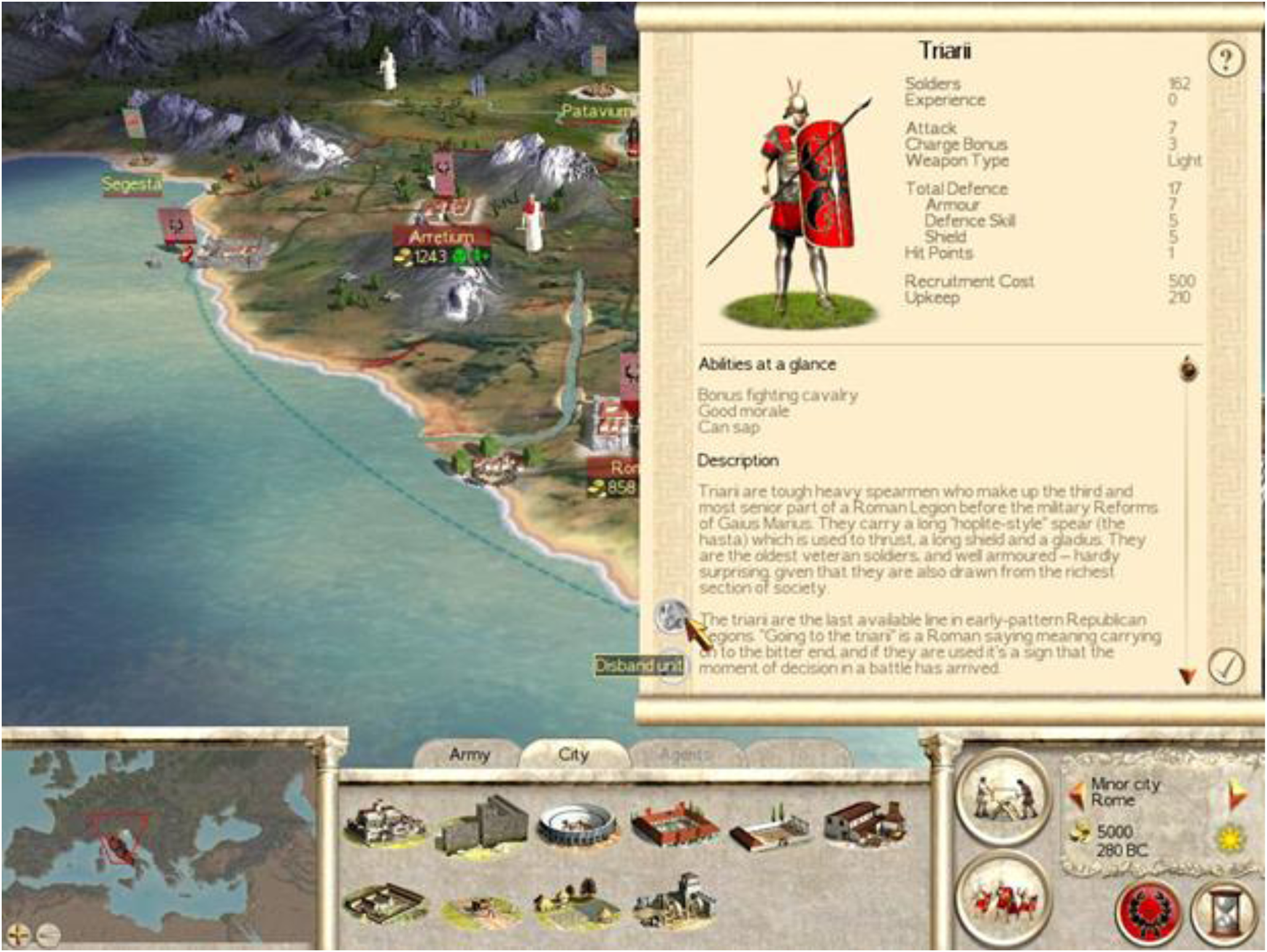
They are given both rudimentary military information and added specialist historical information. The second subsection, ‘doing’, is the active participation of a player within a game and largely accounts for why digital games are so engaging.
This can certainly come with its pitfalls. Renniger and Hidi (Reference Renniger and Hedi2016) adopted a blend of educational psychology and neuroscience as the basis of their work, The Power of Interest for Motivation and Engagement. They recounted that a particular after-school club designed to use gaming (World of Warcraft) to help adolescent males develop an interest in effective school-related behaviours proved counterproductive. Students exhibited to researchers a ‘let me know when she stops talking problem’ (Renniger & Hidi, Reference Renniger and Hedi2016, p.109), where they paid little attention to the teacher and listened in so far that it would allow them to return to playing the game faster. In this instance vital information that the teacher is trying to distribute is being directly ignored with latent defiance. This is perhaps due to digital games, even in a traditional classroom setting, causing students to transpose themselves outside of a learning environment and into a non-learning environment. Understanding the nodal point between genuine learning achieved and counter-productive procrastination is therefore vital for any action research aimed at understanding the value of digital game-based learning.
Returning to Chapman (Reference Chapman2016), the agency that accompanies the ‘doing’ part of digital games can also be heightened with two components; real-time strategy (RTS) and realist or conceptual simulation. RTS forces students to be reactive, analytical, and most obviously strategical – the latter will be discussed in greater length in the ‘Research Findings’ section of this essay. RTS is consequently a natural element to most digital games that can be used within the classroom to generate engagement and subsequent motivation. Moreover, RTS can be enhanced through adding collaborative elements to the gaming and learning experience. In discussing the pedagogic benefits to games, Whitton surmised that they promoted ‘active, collaborative and experiential learning’ (Whitton, 2013, p. 425). RTS in a collaborative sphere requires students to work together. They must be in the present and aware of changing configurations in the game (active) and the achievement of success as a collective heightens the experience of the learning (experiential). Finding a way to promote a method of collaborative play in what is predominately a single-player game can be either an obstacle or an opportunity within this research, or indeed any educational research.
Secondly, classical/historical digital games can pique interest and engage students through the way in which they show (simulate) content. Realist simulation, as defined by Chapman (Reference Chapman2016), does not necessarily retain a radically historicist representation. It simply needs to have an historically-informed stylistic approach that implies a general view of history. Realist simulation is engaging and can provide a clear path to motivating students through its ‘high degree of visual specificity’ and some ‘degree of fidelity to the physical evidence of the past and the everyday world’ (Chapman, Reference Chapman2016, p. 61). Seeing the ancient world through the lens of a digital game can, in theory, provide a potentially compelling route to achieving intercultural communication competence and this will be discussed in subtopic I of the Research Findings section of this essay.
Conceptual simulation is less concerned with an audio-visual representation but offers an abstract way to introduce historical elements. In doing so, it can replicate intangible concepts that are accessible to players and students as core game mechanics. One such example from the TW:S is a unit of soldiers moving into specialist formations (in this case a hoplite wall) and explaining their benefits through a mathematical combat bonus (Figure 2). Chapman (Reference Chapman2016) categorises the ‘Decisive Battles’ within TW:S as oscillating between both realist and conceptual simulation. The eclectic approach in RTW and TWR2 provides an opportunity to offer a complete game-based learning experience – the past is brought alive through high resolution graphics and made accessible using a conceptual Heads Up Display (HUD) interface.
TW:S Hoplite battle formation view.

Attempts to bridge the gap between students and the ancient world has resulted in teachers transforming their practice and thinking innovatively. Craft's chapter in Teaching Classics with Technology is highly useful in understanding how to establish a link between game-based learning and increasing implicit knowledge of antiquity (Craft, Reference Craft, Natoli and Hunt2019). Craft (Reference Craft, Natoli and Hunt2019) believes that using a blended approach of students playing Minecraft and pre-recorded videos of him demonstrating the game can contribute highly to comprehensible input. What is vital, like the realist simulation within TW:S, is the audio-visual aspect of gameplay and pre-recorded videos. They ‘infuse lots of comprehensible meaning into a scene or sequence of scenes while staying in the TL (target language)’ (Craft, Reference Craft, Natoli and Hunt2019, p. 193). The need for greater linguistic proficiency to understand more complex or abstract ideas is reduced which is highly useful for secondary school students, particularly in Key Stage 3. Therefore, the strength of digital games as a tool for learning is that, like videos, they establish meaning with images. If the ludic aesthetics in TW:S can achieve similar results, like Craft with Minecraft, then there is the potential for raising the intercultural communication competence of the students involved in this research.
Minecraft is used by Craft so that ‘student buy-in’ is high to ensure student participation and TL (target language) acquisition (Craft, Reference Craft, Natoli and Hunt2019, p. 183). In contrast to the Total War: Saga series, Minecraft is a popular digital game amongst most children and teens. Almost all students in Craft's lessons have either played the game or have reasonable knowledge of its content and its mechanics. This level of pre-existing familiarity with a digital game has huge benefits, as there is no need to explain game controls in detail and students will readily subscribe to the game if they play it independently. Where the aim of Craft's lessons is to create content compelling enough for students to learn their target language, the aim of this research is to provide content compelling enough to generate an interest in the ancient world and motivate students to be autodidacts.
Game-based learning in increasing motivation: productive or counterproductive?
It is erroneous to suggest that using digital game-based learning will instantly fix years of disinterest in school, or even gradually change the way in which students self-regulate their behaviour. The same students may not even be interested in (digital) games at all. These concerns are raised by Wooten (2013) when discussing that pre-existing literature is quick to assume an increase in intrinsic motivation:
A possible explanation for this widely held and little-questioned assumption is that games researchers tend to find games motivating, and do not consider those individuals who are not interested in playing games, or indeed are demotivated by them. It is also self-selecting (typically male) gamers who often participate in game-based learning studies, which only serves to propagate the assumption. (Wooten, 2013, pp. 427–428)
Most of the areas of concern above are valid in this action research paper. I myself found RTW and TWR2 motivating as a younger student and I am now attempting to replicate the same experience in boys that a) may not even need extra motivation to study the ancient world b) have little desire to play a history-based game and c) would much prefer to read a book or watch a documentary to increase their intercultural communication competence.
In addition, digital games can have counterintuitive effects. Some of the more problematic ones are described by Mitchell and Savill-Smith (Reference Mitchell and Savill-Smith.2004) who note that as well as the psycho-social issues such as replacing meaningful relationships with a dependency on games, attitudes to school can be significantly altered (Mitchell and Savill-Smith, Reference Mitchell and Savill-Smith.2004). Students are less positive towards school and tend to be those considered to be falling below their academic targets who prefer non-directed time-consuming activities like playing digital games (Mitchell and Savill-Smith, Reference Mitchell and Savill-Smith.2004). This fits in with the case study that Renniger and Hidi discussed concerning the ‘let me know when she stops talking problem’ (Renniger & Hidi, Reference Renniger and Hedi2016, p. 109), where any genuine attempt to transpose digital games into an educational tool can backfire and serve to perpetuate these issues. For the same reason, attempting to generate motivation via digital game-based learning can be counterproductive.
Secondly, digital games can have a desensitising effect on young children that can lead to a predisposition to violence. Mitchell and Savill-Smith (Reference Mitchell and Savill-Smith.2004) incorporate a substantial variety of literature, which struggles either way to argue with certainty if playing violent games directly leads to violent behaviour. Yet there is an influence of violent games on cognition. Bensley and Van Eenwyk argue that students can imitate aggressive or immoral behaviour and ‘evoke thoughts of aggression in players, who may be more likely to interpret ambiguous behaviour as aggressive’ (Benslet & Van Eenwyk, cited in Mitchell & Savill-Smith, Reference Mitchell and Savill-Smith.2004, p. 11). This is certainly a concern with TW:S, a game very much built on normalising violence to achieve the end goal. Out of the various genres of digital games, there are supposedly only two that should be used within an educational setting: puzzles and weird games (Mitchell & Savill-Smith, Reference Mitchell and Savill-Smith.2004). It is therefore reasonable to argue that violent digital games do not have a place in the classroom and TW:S, as one such game, should be excluded altogether.
However, whilst there may be violence and underlying competitiveness in certain digital games, they appeal to males for that reason. Males, according to Mitchell and Savill-Smith, ‘play to win and are significantly more likely to play sports simulations and violent games and adventure games’ (Mitchell & Savill-Smith, Reference Mitchell and Savill-Smith.2004, p. 43). The same games elicit visual and spatial skills such as depth perception and image solving. The ability to also expend pent up aggression within the supposedly harmless means of a digital game can be very beneficial. As Bensley and Van Eenwyk argue, digital games can be a safe outlet that ‘has a relaxing effect by channelling latent aggression and therefore has a positive effect on behaviour’ (Bensley & Van Eenwyk, cited in Mitchell & Savill-Smith, Reference Mitchell and Savill-Smith.2004, p. 11). In this way, TW:S may not necessarily help generate motivation in a specific subject, but may help students to self-regulate their behaviour in school and motivate them in general.
If there is also any way in which games can have a direct link to greater intrinsic motivation and appreciation of deep strategy, it may not be in the active participation of the game. Contrary to some of the motivating benefits of agency discussed earlier, Vos et al. argue that there is evidence that ‘game building’ is a more effective means to generate intrinsic motivation (Vos et al., cited in Whitton, 2013, p. 14). The concept of the player as the creator is interesting, as they change from the active role or player to the active role of game-designer. As game-designers, students become the ‘holders of knowledge’ and the teacher in consequence becomes a ‘facilitator of learning’ (Whitton, 2013, p. 13).
This has been experimented with in particular research in STEM subjects. Evans et al. (Reference Evans, Jones and Akalin2017) focused their action research on game-building in the sciences in an attempt to stop the attrition of students in higher academic levels. The emphasis was to motivate students using the MUSIC mode (eMpowerment, Understanding, belief in Succeeding, Interest and pastoral Care) from the teachers. The students played a particular game extensively under supervision to gain familiarity with it and understand its mechanics before designing aspects of the game themselves. Evans et al. (2017) recounted the following:
This phase incorporated most components of the MUSIC model: It promoted empowerment by providing students with some choices and fostered caring in a supportive environment that allowed students to succeed at building their skills in an interesting activity (Evans et al., 2017, p. 20).
One of the limitations of combining game-based learning and game- building, however, is the short timeframes that restrict a seamless incorporation into Classics and History curricula. Where game-building may be natural in computer science lessons, other obligations for teachers of Classics and Humanities make this hard to achieve. It is already difficult enough to foresee TW:S in the immediate future becoming a consistent educational tool without a specific blended approach. However, if game-building gains greater traction in motivational studies, then there is a workable means of combining game-building with TW:S. ‘Mods’ (modifications) of games allow greater agency in the design of games and TW:S has a dedicated section for it (Steam Workshop and How to Make Mods, 2020). When students reach a point of familiarity with the content, they can begin to make wholesale changes to the game to offer more historical representation which offers a separate, more holistic means of generating motivation.
Engagement and Motivation in KS3 students.
To become autodidacts, students must transition away from the rewards that inspire extrinsic motivation (like top grades or even parental approval). They should see the pursuit and acquisition of knowledge as a reward in itself. Renniger and Hidi recount that greater research is being conducted to understand the intrinsic rewards of ‘curiosity and interest’ (Renniger & Hidi, Reference Renniger and Hedi2016, p. 38) which inevitably lead to intrinsic motivation. This is an important link to establish, as raising engagement in class does not always lead to a strong intrinsic motivation to study a subject – interest and/or curiosity are vital ingredients in the process. Moreover, Gottlieb et al. (2016) argue that ‘intrinsic rewards may be based on uncertainty, surprise, and learning progress and that such rewards may be learned or innate’ (Gottlieb et al., as cited in Renniger & Hidi, Reference Renniger and Hedi2016, p. 39). Therefore, whilst some students will have a greater capacity to become autodidacts, it is promising to note that there is a capacity to develop intrinsic motivation over time. For the latter, this is where digital games such as TW:S may prove to be the catalyst.
Whilst Mccrea's condensed Motivated Teaching (2020) may not be considered as academic as other literature, it has been incorporated in this study for a particular reason. Namely, Motivated Teaching is included in the school's continuous professional development sessions for Newly Qualified Teachers. In consequence I developed ideas from the book that would allow me to remain consistent with motivational values and methods in the classroom whilst also informing my own practice. Mccrea argues for five ways in which teachers can motivate students; secure success, run routines, nudge norms, build belonging and boost buy-in (Mccrea, Reference Mccrea2020). As the last method, ‘boost buy-in’, has been referred to implicitly and explicitly in the literature review, I will focus on the fourth method - building belonging.
A pertinent subtopic of Mccrea's ‘building belonging’ is cultivating affinity (2020). Cultivating affinity is itself broken up into three more subsections: a) Unifying Purpose b) Shared Identity and c) Common Ground. The first two are highly relevant within this research. With the right approach students will first gain a shared identity, creating togetherness as a collective that will drive them to achieving the unifying purpose. Identity is similarly described by Renniger and Hidi (Reference Renniger and Hedi2016) as a means of understanding why certain individuals hold particular interests. They will consequently absorb information differently to others. For example, a classicist may digest a piece of information about Pythagoras’ Theorem differently to a mathematician. Both Mccrea (Reference Mccrea2020) and Renniger and Hidi (Reference Renniger and Hedi2016) contribute to a greater understanding of motivation through their ideas on identity and have influenced the creation of two research questions below.
Research Questions
One of the difficulties of this research was establishing its end goal. At first, I wanted to establish that an increase of engagement in class would lead to an interest in the ancient world. This interest would translate into a persistent motivation for studying the subject, which in turn would lead to increased intercultural communication competence through in-class learning and an increase in autodidactic study. During the phase of writing the literature review, I simplified this process by focusing on three key areas that have been adapted into the form of research questions:
Q1: How could I create a blended curriculum that would combine my own subject and game knowledge with the realist simulation of TW:S to increase intercultural communication competence?
Q2: How could I cultivate a shared identity within these lessons that speaks out to the classicist, the archaeologist, the musician, the mathematician etc…?
Q3: How could I provide engaging RTS collaborative play that can harness shared identity and generate motivation and inspire autodidactic learning?
Teaching Sequence
The research takes place over 11 lessons during an extra-curricular class after school. The school has a variety of extra-curricular clubs that span ‘Film Club’ and ‘Scholars Club’, with the latter being compulsory for certain high-attaining Key Stage 3 students (aged 11–14). My 11 lessons were delivered in the ‘Ancient Civilisation and Archaeology’ club and due to spanning multiple terms saw students come in and out of the lessons. There was a group of core individuals, however, that remained throughout. The breakdown of the lessons can be seen in Table 1.
Lesson sequence

Lessons One and Two were delivered on Microsoft Teams due to the Covid-19 national lockdown and all TW:S games were unavailable due to safeguarding.
Methodology
To answer the research questions, this research paper has taken the form of action research. Action research was the most bespoke method that allowed me to observe the effects of RT:S whilst being able to influence the classroom through a blended approach.
This comes with a variety of benefits and causes for concern. Tim Cain discusses the ontology of teacher positioning in the classroom:
Thus, the direction of influence is not unidirectional, from teacher to students; rather, the teacher listens attentively and observes perceptively, altering her teaching in the interests of better mutual understanding. Teachers sometimes stand back, to observe their students, to give them independence, to allow them to learn from each other or to learn from making (safe) mistakes, but such standing back is always constrained, to a greater or lesser extent, by the teacher's responsibility to influence. (Standing back to observe is essential to teachers’ action research but cannot compromise their responsibility to influence, which is an ethical priority.) Teachers’ roles are thus co-constructed in a dialectic of mutual influence with their students (Cain, Reference Cain2011, p. 7).
Cain highlights an issue for researchers who, like myself, need to dedicate time to observing particular phenomena such as engagement and motivation. Yet a desire to influence the class is a fundamental trait of most, if not all, teachers. Cain refers to it directly as an ethical priority, and as such emphasises the position action researchers can find themselves in. There is therefore a limit to what can be achieved, even with a secondary teacher in the room. My mentor, Lisa, observed the lessons but still retained ‘an authority’ disposition. It is difficult for Lisa to turn off this air of authority, with students asking her for help when I am not available and the innate responsibility to always ensure physical and emotional wellbeing.
Both Cain (Reference Cain2011) and Feldman (Reference Feldman2007) discuss the issue of (non)-quality data in action research. In assessing 25 different action research papers, Forster reported ‘in nearly all the reports insufficient evidence is presented to support key claims including “unconvincing” causal claims’ (Forster, as cited in Cain, Reference Cain2011, p. 4). This can be a problem when certain action research, such as this one, requires more qualitative evidence as it is largely concerned with perspectives (an inherently subjective angle). Sophistical interpretation of qualitative data can lead to misleading findings and can be highly counterproductive. Moreover, Feldman (Reference Feldman2007) also discusses whether issues such as moral, ethical and political aspects have been adopted into the action research. Given how TW:S contains audio-visual representations of war, there have been attempts to highlight these issues during lessons. I have included quotes from ancient writers that comment on the tragic repetition of war (moral and ethical) and brought in International Relations Theory to highlight its relevance in modern international politics.
Research Methods
This action research will collate and analyse documentary evidence and observations from 11 weeks of after-school enrichment lessons and from one regular timetabled lesson. In discussing the nature of the primary data, Gibson and Brown (Reference Gibson and Brown2009) compartmentalise documentary evidence into either analytically focused data or analytically filtered data. Their description of analytically focused methods is important to detail as it ascertains the nature of my documentary evidence:
Analytically focused methods involve creating strategies for generating data that is relevant to the research question(s) being asked. The interview method is an analytically focused method because it entails the creation of a discourse that is designed, through the engagement of both parties with the specific questions being asked and the responses given, to answer the research question. (Gibson & Brown, Reference Gibson and Brown2009, p. 2).
Given that my documentary evidence contains various methods of assessment to understand how students are progressing in their intercultural communication competence, they fall under analytically focused data. This is because they were created with the purpose of answering research Q1. Gibson and Brown (Reference Gibson and Brown2009) also provide a summary that the questions are designed in interviews with the objective of answering research questions. Again, my interviews were aimed at understanding motivation and intercultural communication competence (Q1, 2 and 3) and fall under the bracket of analytically focused data. Despite the evident (time-consuming) concerns of conducting face-to-face interviews that Gillham raises (Reference Gillham2000), they form a significant part of the research. Interviews offer valuable insight into student and teacher perceptions and are therefore included as forms of evidence to inform a judgement on the outcome of the research. In this paper, interviews will be conducted as semi-structured.
To better inform myself into the long-term effects of the TW:S, I circulated a questionnaire among friends and family who have played historical versions within the game franchise. Most responses were within the 18–24 age bracket but also 25+, highlighting the impact of the TW:S since its inception. Part one of the questionnaire is briefly summarised:
a) which particular TW:S games players had engaged with and if they believed those editions were effective representations of their respective historical periods.
b) whether they felt that their school curricula adequately covered any of the historical periods which those games concerned themselves with.
c) whether they researched historical periods independently and the various methods in which they had done so.
d) if they pursued a career in Classics, Ancient or Modern History.
Part two then asks participants to rate the mechanics from 1-5 (5 being high) of RTW and TWR2, allowing me to understand which elements were worth constructing my curriculum around. This covers whether:
1. The battle simulations are effective representations of ancient battles in general.
2. The game engine in battles is appropriately weighted (e.g. to account for terrain, unit combat bonuses, weather etc)
3. The campaign game mechanics effectively illustrate the systems of politics for the factions.
4. The campaign provides a sense of a ‘grand strategy’ that mirrors ancient imperialism.
5. Building reconstruction is detailed and appropriately portrays the ancient buildings and what they would still look like.
During the course of this research, I then sent an adapted version of the questionnaire to a YouTube Gamer who plays and reviews the TW:S franchise. YouTube and some players of the TW:S franchise receive and can generate almost a million views on their videos concerning historical representation in a TW:S game. Under the pseudonym ‘Admiral Price’, he provided interesting feedback that reflected that of the acting Head of History at the school ‘Homer’.
Data and Research Findings
As mentioned in the Teaching Sequence, there were various students joining, leaving and then returning. The last few lessons were where I had the highest population of eight students. These can be seen in Table 2.
List of Students, their Learning Needs and Learning Groups.
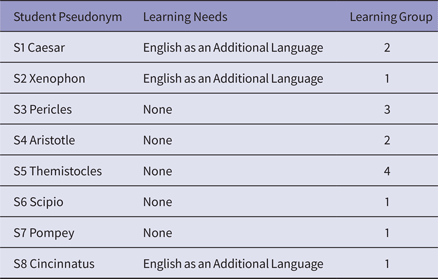
Most of the analysis will therefore focus on the first five students, four core students and a late comer (S3 Pericles) who became so engaged they demanded to be part of the interviews.
As mentioned in the Research Methods section, I initially began this research with understanding the long-term effects of TW:S and how players have interpreted its ludic aesthetics of historical description. Two questionnaires from friends yielded the results in Table 3.
Table of Aspects of the Games and (1-5) Responses from Longstanding Players.
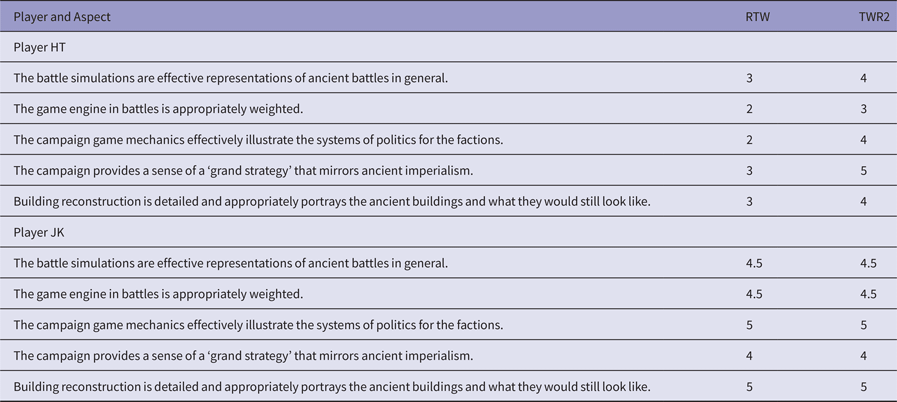
Where Player HT critiques aspects of RTW from a modern perspective, Player JK allowed for a relative feedback for how RTW was received in 2004. On the TWR2 column, their critiques of the game are highly similar. Note that in the first aspect, representations of ancient battles in general, the evaluations are very similar, despite Player HT progressing down a quantitative route in his career (Geology) and Player JK progressing down a qualitative route (History). Both enjoyed History for different reasons. Whilst they may not have a shared academic identity and have perhaps absorbed the game differently, they have both come to similar conclusions about its efficacy to represent history. Both ascertain that they are not experts in this field and the historical information they extract from the game and subsequent reading is enough to satiate their interest. ‘Admiral Price’, a YouTuber and a PhD Islamic Studies student in the US, provided the opposite critique – all 1s. ‘Admiral Price’ began playing at the age of 13-15 and after reaching higher levels of historical academia now makes (valid) judgements on its historical representation. In this case, ‘Admiral Price’ was intrinsically motivated to go all the way and find out the historicism of the game himself.
Source of Historical Knowledge and Increasing Intercultural Communication Competence
The interview with ‘Homer’, the acting Head of History at the school, generated a similar response. An-early player of the game, ‘Homer’ believed that TW:S was a starting point into various ‘niche’ historical periods such as antiquity and medieval Europe and acted as a ‘spark’ to learning more about it:
Yes, I think it gives you a starting point of like exposure. So the primary thing they give you is exposure to different historical periods, different historical cultures, historical figures and then that kind of sparks your curiosity and you want to know more about it. So like what on earth is Parthia? Like what is that? Let's learn more about that. I think particularly what the Civ series are really good at now is that there is a whole range of different cultural reference points and then they have their encyclopaedia entries linked to those, so that as you play it you can open up a window with more historical information about the thing you are currently doing (Homer, Supplementary Appendix 1, para 16).
These encyclopaedic entries in TW:S, covering all buildings, factions and military units in the main campaign screen, contain enough information to supplement a student's curiosity, but not completely satiate it (Figure 1). In RTW, these pages are even designed to simulate the unfurling of ancient papyri, adding to a sense of historical discovery.
However, Homer's entry into higher education came with an increased critical understanding of the past, and how the game ‘exploits tropes of historiography that are not necessarily true’ (Homer, Supplementary Appendix 1, para 22). The Romano-centricity of the game is also questioned, alongside the inaccuracies of the ludic aesthetics surrounding urbanism and cities:
That's what I mean I would be more interested in. Most of my research is about urbanism so I know a lot about Roman urbanism and the cities in the Total War series are ridiculously inaccurate. They are like 100m sq so incredibly small they are little rectangular plans nothing like the real living breathing cities which I always thought was a limitation. […] I think because I am more interested in settlement and space and things like that it was very disappointing that idiosyncrasies of particular cities were left out so obviously if you are able to defend the real Constantinople it would be much easier than a procedurally generated square on a map. It's not taking into account the landscape, it's not taking into account the urban environment, that's always been a bit of a missed opportunity for the games. (Homer, Supplementary Appendix 1, paras 22–4).
Contrary to the radical historicists who stigmatise non-traditional forms of history, this does not have to be an issue. Homer surmised that we neglect as teachers how little cultural capital KS3 students have:
I think personally I feel sometimes we underestimate the lack of cultural capital that some of the students have in terms of, as a history teacher, we sometimes assume that they have a basic visualisation of what the past looked like and actually making that more immediate and visceral to them through something they associate with fun as well like they associate with games. So I think being able to visualise the past in an interesting and engaging way will create that interest. (Homer, Supplementary Appendix 1, para 51).
In fact, S1 Caesar, S2 Xenophon, S3 Pericles and S4 Aristotle all gave 8 or 9/10 for historical representation. Generally, the students responded that it still had its errors and, knowing that, they responded positively to the question of whether they would go and research the period independently. For example, in interview, S4 Aristotle said:
PC Do you feel like this represents history very well?
S4 I think it's accurate like as to when it comes to history of different wars.
PC On a scale of 1 to 10 how effective does the game represent history?
S4 I would give it a nine out of ten because it might not be accurate in some senses.
PC So does it sort of motivate you to want to go off on your own and find out if it could be may be a 10 or could even be less than 10?
S4 Yeah
PC Have you managed to do that?
S4 No, not yet.
[..]
PC Do you think that playing with different factions, not just playing with Rome all the time, would increase your knowledge of history?
S4 Yes
PC That's good. Do you feel motivated to learn about the ancient world?
S4 I like how basically you can see how different wars were done and how the generals run their military.
PC Does this game motivate you to want to study other stuff?
S4 It makes me like more of history side and ancient civilisations. And it's easier for me to understand that.
And, in interview, S1 Caesar said:
PC Do you feel that the curriculum at the school covers this sort of history?
S1 Not very much because it deals with all other stuff, not like the battles.
PC So do you feel that this is a good middle ground then? Do you feel motivated to learn about the ancient world?
S1 Yes, a bit more.
PC On a scale of 1 to 10, how much more?
S1 Nine.
Motivation in the classes remained high, according to observations by Lisa. Moreover, in knowing that inaccuracies existed, students became keen and professional ancient historians. This was exemplified through their desire to learn and retain specialist vocabulary, ranging from military specific units such as ‘incendiary pigs’ to more complex and abstract concepts such as a ‘thalassocracy’. The ‘spark’ that a (potentially ahistorical) video game such as TW:S could ignite can therefore be highly undervalued.
Engaging content and Increase in Motivation
I made the conscious choice at the beginning of the sequence of the lessons that I would mainly be operating the controls on the laptop. The complexity of the game controls in areas of ‘Decisive Battles’ are conceptually simulated and I agreed with Chapman (Reference Chapman2016) in that they ‘can easily contain heavy and complex ludic information loads’ (Chapman, Reference Chapman2016, p. 72). Therefore, the data here are not conclusive in ascertaining engagement and motivation, as I was mainly the agent of action and the students my advisors. This method still worked to great effect. My observer Lisa mentioned where she was so engaged herself, she tended to write fewer observation notes which can account for the non-applicable rows in lesson 4 and lesson 10. These were in fact two of the most chaotic lessons in terms of activities. Lesson 4 was the first major ‘Decisive Battle’ that we fought together and lesson 10 was the first collaborative battle fought with a distinguished chain of command. A general pattern that can be surmised though is that once the game was introduced, engagement did become much higher on a consistent level. Extracts from Lisa's classroom observation notes are included in Table 4.
Classroom observation notes (transcribed extracts) from 7 lessons

A breakdown of how student engagement increased over time can be seen in Table 5. TW:S was not introduced until lesson three, given COVID, and lesson 6 was dedicated primarily to a knowledge test.
List of Lessons Observed by Lisa, in Relation to Engagement.

This section relates to the RTS (real time strategy) and realist and conceptual simulations within ‘Decisive Battles’ that have piqued students’ interest in various ways. The audio-visual elements of the game had an engaging effect on the students. S2 Xenophon was quoted in a lesson saying that ‘It is like a movie… a tragedy’ (S2 Xenophon, quoted in observation notes, see Table 4). Not only does this show that the realism of the gameplay caused higher interest in class, but also how students become associated and invested with the protagonist(s). In a way it contributes to building a shared identity, which was similarly achieved through the establishing of the curriculum as a ‘School of the General’. Students were referred to, inside and outside of the enrichment class as imperatores. I asked students to form hoplite walls and testudos, creating a sense of camaraderie that is essential in cultivating affinity. This is vital as S2 Xenophon, when I asked him after a lesson whether he had a favourite subject, replied he had none. Yet S2 Xenophon still finds the game and lessons highly fun and engaging, alongside those who already had a pre-existing interest in (ancient) history:
PC Do you think the school could benefit from having a game like this?
S4 Yeah.
PC Why do you think that?
S4 Because it's fun.
PC Really nice. Do you think the game should be part of the school curriculum?
S4 Yeah.
PC Does the game want to make you study more about the ancient world?
S4 Yeah.
PC Why does it do that?
S4 Because it is interesting (S2 Xenophon, Supplementary Appendix 5, paras 20 & 26).
This implies that TW:S could offer something to any student - the mathematician, the musician, or the student that has not quite found their strength yet.
The aforementioned physical activities helped to cement this ‘togetherness’ whilst mirroring the movements of ancient soldiers, something they enjoyed greatly (Table 4). To affirm that togetherness, I used the ‘School of the General’ as a means of unifying the group with a teleological purpose of graduating the ‘School’. Their end assignment would be a ‘Decisive Battle’ that required the students to work together in real time. Each lesson brought a new discussion of tactics and Lisa's observations suggest that the students both understood and enjoyed military strategy (Table 4).
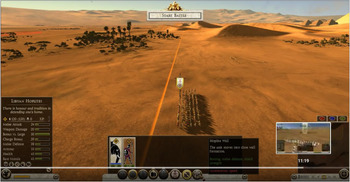
During ‘Decisive Battles’, I was able to pause and enter the conceptually simulated ‘Tactical Map’ which provided a holistic picture of unit positioning and geographical terrain (Figure 3).
TW:S Tactical map view.
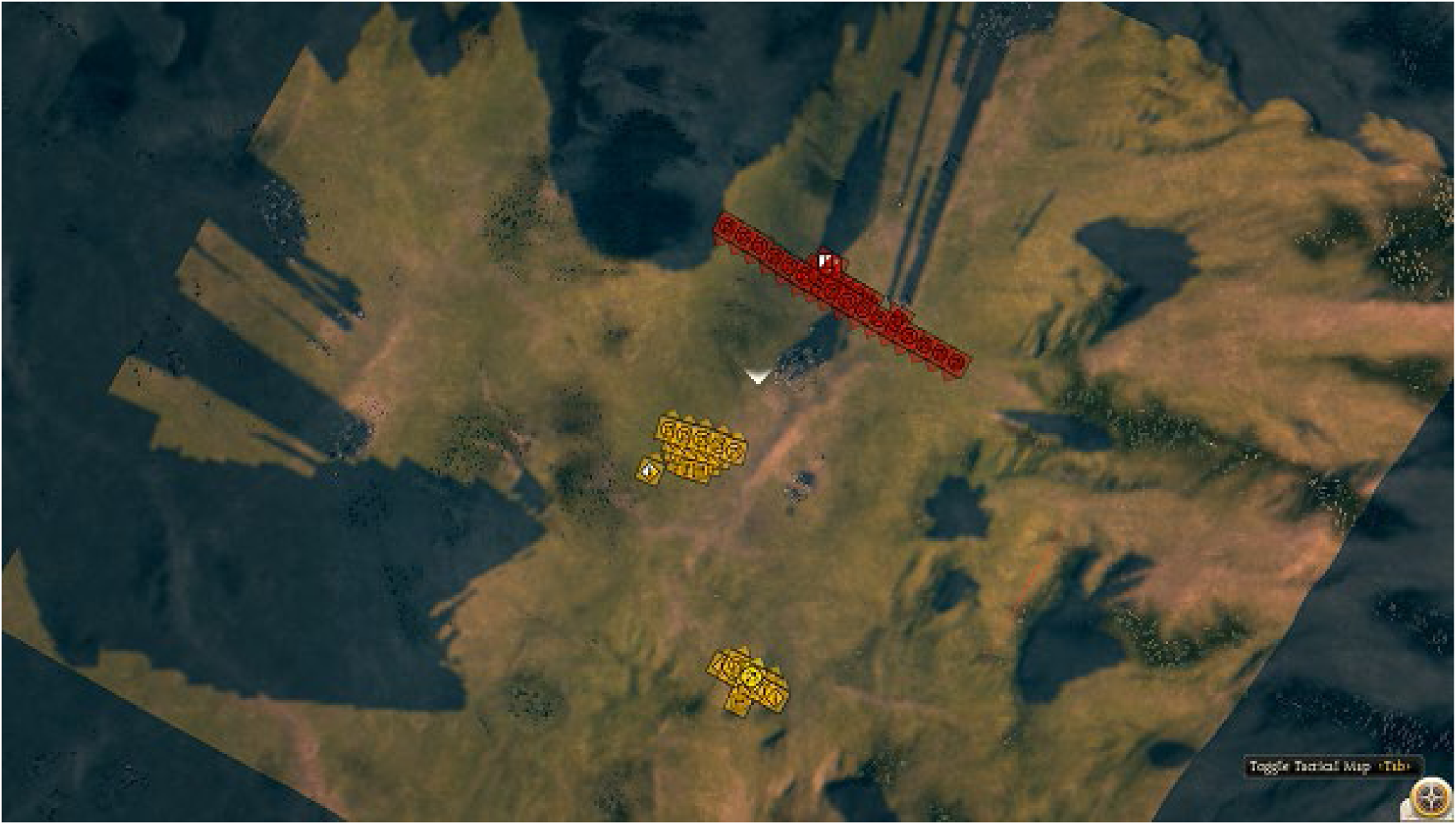
By connecting my personal laptop into the classroom interactive whiteboard (IWB), the students and I were able to use pen annotation within the game. We drew circles and arrows to strategise advantageous soldier movement and manoeuvres. This became a highly efficient way of running the lessons that caused students to buy into the ‘School’ and learn history along the way. Lisa surmised an ‘intrinsically interesting subject heightened by an interactive way of presenting the activities’ (Table 4). Although the result of the final battle was close and the students lost, they were fantastic in respect of the chain of command by the final lesson (Table 4). The RTS collaboration was the highest point of engagement and interest in the game. For one student in particular, the lessons had a remarkable impact on their attitude to school. Pericles responded to the interview question ‘So does it make you motivated to do well in other classes?’ with ‘Yeah. It makes me like Wednesdays’ (Appendix 6, para 28). Whether it was engaging video game-based lessons, or a sense of classroom camaraderie that resulted from them, Pericles could find a day where he was motivated to come into school.
Regular Timetabled Lessons
After the initial success of TWR2 in the Enrichment Lessons, I was asked by my mentor (Lisa) to conduct a ‘Decisive Battle’ in a Classical Civilisation lesson for her Year 8 group. This indicated that Lisa appreciated the value of the game, specifically the battle simulations, to such an extent that it was worth trialling in a regular timetabled lesson. This cohort of Year 8 students were placed into Classical Civilisation rather than Latin, as is common practice at most schools, due to a belief they would struggle with the linguistic elements of Classics. Poor behaviour is usually a feature of this class with a mix of low-attaining students and students with SEND. Yet my previous observations of this class suggest that high levels of engagement came sporadically but fiercely. Therefore, for the final half of a 50-minute lesson, I would conduct a shorter length ‘Decisive Battle’ – the feature of the game that has consistently elicited the highest amount of engagement.
I intended to use TWT, which would have been the most relevant version of the game given its classical nature. However, where other Digital Rights Management platforms like ‘Steam’ have an ‘offline mode’, the DRM platform ‘Epic Games’ was unable to launch the game due to School A's wi-fi restricted access. I consequently used an extended version of TWR2 called ‘The Wrath of Sparta’, a DLC (downloadable content) which focuses on the events of the Peloponnesian War in 5th century Greece and Asia Minor. Before the battle, I explained the technique of a hoplite wall and provided details on hoplite soldiers. This explanation largely became implicit knowledge – students many weeks afterwards were able to recount how they studied ‘hot-potato’ soldiers. The battle simulation itself proved successful, as students ran to move their chairs closer to the IWB and become immersed in the battle. Whilst most did not offer tactical suggestions as in the Enrichment lessons, a few did attempt logical and useful ideas. The next day, Lisa informed me that the students went into their next period still discussing and debating the battle. Therefore, whilst it did not motivate the students to engage with Maths in quite the same way, it did generate an interest in the classical/ancient world.
Conclusion
From those students who were asked whether they would like to see this as part of the curriculum, the answer was unsurprisingly yes. However, one of the greatest concerns with having a TW:S game as a component in the curriculum is the logistics of standardising the software school-wide. Given the move away from physical CD copies, the company Steam has largely been Total War's main Digital Rights Management (DRM). This leads to issues with copyright and financial availability, which students mentioned in the interviews. Games like Minecraft are much cheaper and easier to play on a personal laptop. Moreover, this paper set out to answer certain questions but, in the process, posed more. Specifically, is there a way of quantifying motivation through measuring student receptiveness to icons and iconography in TW:S? Can it also be quantified through measuring a receptiveness to specialist language? These answers require systematic planning to create formal and informal methods of assessments to achieve this.
Whilst there is much left unsaid, there is initial positivity in laying the groundwork for future research. When S3 Pericles said in his interview that the enrichment lessons made him like Wednesdays and he wanted to come into school, I reaffirmed the value of TW:S after a period of doubt. This doubt came from celebrating and normalising the iconography of warfare that could have a traumatic cognitive effect in these students. Similar doubt came in the literature that recounted the negative effects on boys concerning academic performance and psycho-socio issues. S1 Caesar and S4 Aristotle, who are students with EAL, proved that with the right scaffolding (blended approach) a TW:S game can have huge effects on oracy and vocabulary building. These lessons, in my view, were never meant to be an hour of the day where no learning was done. I wanted to stretch the students as far as possible and see genuine learning taking place. They were also intended to decrease the stigma around video game-based learning, for teacher and student alike. In the first lesson, S1 Caesar admitted that he never plays video games, preferring to read in his spare time. By the final lesson he expressed a desire to buy both RTW and TWR2. Perhaps, in the future, historical video games can be considered as sources of historical information and as valuable educational tools. They can also be fun too.
Supplementary material
The supplementary material for this article can be found at https://doi.org/10.1017/S2058631021000775



 Open access

