




“This is kind of- convention for any lab. So I actually went through many different labs, and all the lab meetings are happening with door closed.” (Jihun, research participant)
INTRODUCTION
Embodiment has received more attention recently in sociolinguistics as in other fields in the humanities and social sciences. Philosophical shifts initiated by posthumanism in the Global North and decolonial epistemologies in the Global South have led to an appreciation of the agentive role of material resources and conditions in human communication. Posthumanism draws from the findings of quantum physics to move beyond treating objects as lifeless substances that can be manipulated by humans in predictable ways. The findings have led scholars to a revaluation of objects, treating physical nature as agentive and animated, with its own complexity and self-regulating capacity (see Latour Reference Latour2005; Barad Reference Barad2007; Coole & Frost Reference Coole and Frost2010). Relatedly, the project of decolonizing epistemologies has led to an appreciation of indigenous philosophies of nonduality in the Global South, which question European dichotomies such as mind/body, human/nonhuman, and individual/environment (see Henne-Ochoa, Elliott-Groves, Meek, & Rogoff Reference Henne–Ochoa, Elliott-Groves, Meek; and Rogoff2020; Canagarajah Reference Canagarajah2021). These dichotomies are grounded in 2,800 years of Judeo-Christian and Greek philosophy (see Joseph Reference Joseph2018). Epistemologies from the Global South have motivated an exploration of how these entities work together in an embodied manner.
Embodiment contests two constructs that have been at the heart of linguistics—that is, mentalism and logocentricism. Chomskyan linguistics motivated scholars to look at semiotic resources as used by humans for their communicative purposes with minds that transcended representational systems. This orientation perceived human minds as employing representational systems to understand and regulate the environment, with semiotic resources which they controlled. Embodiment means that people engage with diverse social networks and material ecologies for distributed practice in meaning-making, being influenced by semiotic resources as much as using them. Logocentrism led scholars to treat language as the preeminent representational system. Other semiotic resources were treated as secondary in significance. Similarly, material objects were perceived as represented by language and not making meanings by themselves. Embodiment asserts that diverse resources, including bodies and objects, are equally representational and shape language in its meaning-making capacity. As we can see, recent theorizations of embodiment go beyond earlier orientations where embodiment was given a secondary role of mediating or situating thinking and communication, and not participating in generating them more integrally (see Lakoff & Johnson Reference Lakoff and Johnson1999; Thelen Reference Thelen2000; Clark Reference Clark2008).
Sociolinguists have now begun to explore how to address the generative role of bodies in communication. They now assume that human and nonhuman bodies are not dependent on the mind and language for their meaning, but that they have the capacity to generate activity and meanings that influence human cognition and communication. Bucholtz & Hall have recently called for ‘an embodied sociolinguistics’ (Reference Bucholtz, Hall and Coupland2016:174) that will ‘recognize and accommodate the distribution of agency beyond language to include human bodies as well as nonhuman entities, such as animals, other living beings, material objects, and the physical world’ (Reference Bucholtz, Hall and Coupland2016:184). They have joined other sociolinguists like Mondada in critiquing ‘a logocentric view of language’ (Reference Bucholtz, Hall and Coupland2016:340) that has traditionally influenced the discipline. However, to do justice to the far-reaching implications of embodiment, we have to make radical shifts in our theoretical and analytical orientations. Bucholtz & Hall conclude their article with a long list of new questions ‘to further sociolinguistic theorizing of such fundamental concepts as indexicality, discourse, and agency’ (Reference Bucholtz, Hall and Coupland2016:188).
To analyze the indexicality of objects, we build from studies in applied linguistics and social semiotics on how multimodal resources work together in meaning-making. Scholars have analyzed the way human agents use multimodal resources creatively in communication (Kress & van Leeuwen Reference Kress and van Leeuwen2001; Norris Reference Norris2004; Mondada Reference Mondada, Seyfeddinipur and Gullberg2014, Reference Mondada, Kissmann and Loon2019; Jewitt, Bezemer, & O'Halloran Reference Jewitt, Bezemer and O'Halloran2016; Kusters, Spotti, Swanwick, & Tapio Reference Kusters, Spotti, Swanwick and Tapio2017). Some semiotic studies do look at the way multimodal resources work together and shape human interaction, though they don't address shared human agency (Boeriis & Nørgaard Reference Boeriis and Nørgaard2013; Ravelli & McMurtrie Reference Ravelli, McMurtrie, Carvalho, Goodyear and de Laat2017; Boxenbaum, Jones, Meyer, & Svejenova Reference Boxenbaum, Jones, Meyer and Svejenova2018). A few go further to explore the way agency is distributed, with objects also having the capacity to shape the cognition and communication of human participants (see Kell Reference Kell2015; Mondada Reference Mondada2016). An embodied approach will go further than multimodality studies which traditionally treated diverse semiotic resources as indexing meanings separately or as supplementary to language, cognition, and human agents. Mondada (Reference Mondada2016:338) outlines the corrective as ‘a view of modalities as constitutively intertwined, and language as integrated within this plurality as one among other resources, without any apriori hierarchy’. She labels the way these resources work collaboratively to shape each other and configure interactions as ‘multimodal gestalts’.
In this article, we analyze how material resources participate in meaning-making in the activity of a group of multinational and multilingual microbiologists. We adopt interactional sociolinguistics (IS, hereafter; Gumperz Reference Gumperz, Tannen, Hamilton and Schiffrin2015), known for facilitating a close sequential analysis informed by broader sociocultural conditions. We expand the IS constructs and their application to address the ways meanings are indexed by objects. Our data comes from a research group meeting (RGM hereafter; Swales Reference Swales and Swales2004) where a team of microbiologists troubleshoot their experimental findings in preparation for a submission. For this article, we focus on a mundane object in the room, the door, to demonstrate how it shapes the communicative activity. We demonstrate how the door serves to configure the space for that interaction, provide contextualization cues on the opening and composition of meetings, help index the variable status of the participants, and construct an ‘ecological huddle’ to frame the ‘professional vision’ by bringing into salience the functional semiotic resources, participation frameworks, and ethos for this discourse activity. Our focus on the door is for analytical purposes only. We recognize that the door develops its indexicality in co-occurrence with diverse other semiotic resources, and in relation to the ongoing interactional practices of the participants, which shape enregisterment.
Our data analysis demonstrates that the focus on objects has significant implications for language use. Embodied sociolinguistics is not of only theoretical or methodological interest. We bring out the serious pedagogical and policy implications after our data analysis. We demonstrate that the notion of distributed practice suggests that a heavy reliance on a knowledge of English grammar for admission, recruitment, or remediation of international STEM scholars in American educational and professional institutions is misguided. Their embodied practices demonstrate that multilingual scholars draw from diverse semiotic resources effectively and negotiate meanings successfully in high-stakes scientific communication.
CONCEPTUAL ORIENTATION
It is difficult to avoid certain philosophical debates that impinge on our analytical focus. The notion of embodiment articulated above raises questions such as the following: if duality is critiqued, does that mean that individuals and objects are not separate entities anymore? Is the agency of humans ceded to the agency of things? If objects are agentive, do they think and speak? It is beyond the scope of this article to enumerate the positions adopted by diverse scholars in fields beyond sociolinguistics. For the purposes of our analysis, we adopt ‘the distribution of agency’ articulated by Bucholtz & Hall (Reference Bucholtz, Hall and Coupland2016:174) above and hold that people and objects are engaged in shared practices in generating thinking and communicating, without losing their identity. Since agency is shared and distributed, we hold that both human and non-human participants are better conceived as ‘mediants’ (as theorized by Amin Reference Amin2012; Appadurai Reference Appadurai2015). Mediating the influences of diverse material and semiotic resources does involve agency, but in a qualified manner. Bucholtz & Hall (Reference Bucholtz, Hall and Coupland2016) adopt Ahearn's classic formulation of ‘the socioculturally mediated capacity to act’ (Reference Ahearn2001:112) to explain such qualified agency.
As for the representational capacity of things, the notion of indexicality allows for the possibility that material resources can communicate meanings by ‘themselves’ without being always deployed by human users. Bucholtz & Hall draw from processes of enregisterment and adopt ‘indexical iconization’—which they define as ‘an ideological process that rationalizes and naturalizes semiotic practice as inherent essence, often by anchoring it within the body’ (Reference Bucholtz, Hall and Coupland2016:178). Furthermore, one object can affect or shape the configuration of other objects in a given environment, demonstrating its agency, as in the domino effect. Some semioticians use the term ‘interobjectivity’ (Latour Reference Latour1996; Landowski & Marrone Reference Landowski and Marrone2002; Caronia & Mortari Reference Caronia and Mortari2015) to refer to the ways objects configure each other, analogous to the way people engage in intersubjectivity. Through such constructs, we can conceive how things might communicate by themselves, without having to adopt anthropomorphic concepts like ‘thinking’ and ‘speaking’.
As for representing the meanings of objects from their own point of view, we have to accept certain phenomenological limitations. To view interactions by adopting an insider perspective on objects requires ingenious research methods, more complicated than the futile effort to represent the authentic ‘native point of view’ in anthropology (Geertz Reference Geertz1983). However, semioticians adopt an analysis ‘on the human side’—that is, how people relate to objects in their communication along with other resources—distinct from a perspective from ‘the side of things’ (Caronia & Mortari Reference Caronia and Mortari2015:403). In this article, we undertake the modest objective of describing the meanings of objects from the perspective of human interlocutors, while accommodating material agency. Our choice of IS as our methodological paradigm is suitable for analyzing the role of objects from the lens of human participants, though with some expansion of its original constructs to address the role of objects.
METHODOLOGICAL CHALLENGES
When we treat meanings as emerging out of the distributed practice of diverse social agents, semiotic repertoires, and material resources, a challenge we face is defining the object of analysis. If everything is connected to everything else, where do we focus? The traditional separation of text/context or interaction/setting conveniently reduced to secondary-status diverse material resources and conditions. However, if we abandon this separation in favor of treating all entities as participating in embodied communication, we should be open to the possibility that everything is potentially indexical and that all resources are interconnected in expanding scales of time and space. But certain semiotic resources become significant for specific interactions. Mondada (Reference Mondada2016:361) observes of multimodal resources: ‘Their indexicality does not exclude their methodical establishment and selection, as well as conventionalization and grammaticalization through repetitive use’ requiring ‘an analysis of the way they are methodically mobilized and interpreted within specific sequential environments’. Her metaphor ‘grammaticalization’ is similar to the better-known sociolinguistic concept of enregisterment (Agha Reference Agha2005; Silverstein Reference Silverstein, Enfield, Kockelman and Sidnell2014). We must analyze how through ongoing social interactions, certain resources become enregistered with meanings for a community. Kusters and colleagues observe that such enregisterment can point to how ‘some resources are permanent and enduring and others are temporary and dynamic’ (Reference Kusters, Spotti, Swanwick and Tapio2017:5). This can help identify ‘hierarchical constellations’ of semiotic resources (Reference Kusters, Spotti, Swanwick and Tapio2017:8), mapping their relative importance for specific interactions.
To identify the semiotic resources that are significant for our participants, we decided to focus on critical moments which indicate a ‘trouble source’ in interactions (Sidnell Reference Sidnell2010). These moments relate to Hornberger's (Reference Hornberger2013) notion of ‘methodological rich points’. These are moments wherein the researchers realize that existing approaches to analyzing data do not sufficiently afford them an understanding of the interaction in question. Other scholars in social semiotics have similarly relied ‘on the cues traceable in members’ practices’ (Caronia & Mortari Reference Caronia and Mortari2015:404; similar to the IS notion of contextualization cues) to reveal the role of objects. The methodological rich points in our data demonstrated why we had to expand our orientation to objects in order to address the trouble source in the interaction. Though we started this study with the objective of analyzing multilingualism in RGMs, we found that certain objects played an equally important role. We illustrate below the critical moments that pointed to the role of the door in RGM interactions.
To analyze the data, we draw from IS, which problematizes ‘conversational inference’ (Gumperz Reference Gumperz, Tannen, Hamilton and Schiffrin2015:313) as interactively achieved in relation to diverse semiotic repertoires in expansive spatiotemporal contexts. It thus expands the focus of analysis beyond the grammatical system and the face-to-face interaction. Gumperz's construction of ‘repertoire’ goes beyond single labeled languages to accommodate other semiotic resources. He defined repertoire as containing ‘all the accepted ways of formulating messages’ (Reference Gumperz1964:137–38), being ‘the totality of linguistic forms regularly employed within the community in the course of socially significant interaction’ (Reference Gumperz1971:182). Sociolinguists have now expanded ‘all the accepted ways of formulating messages’ beyond ‘linguistic forms’. Rymes's (Reference Rymes, Hornberger and Mackey2010:528) notion of ‘communicative repertoire’ includes ‘the collection of ways individuals use language and literacy and other means of communication (gestures, dress, posture, or accessories) to function effectively in the multiple communities in which they participate’. Blommaert & Backus (Reference Blommaert, Backus, de Saint-Georges and Weber2013:25) go further to argue that ‘A repertoire is composed of a myriad of different communicative tools, with different degrees of functional specialization. No single resource is a communicative panacea; none is useless’. These expansions of the notion of semiotic resources enable a consideration of objects for their meaning-making capacity.
To discern which resources gain indexicality in a given interaction, IS adopts two complementary constructs—that is, contextualization cues and frames. They shape each other—that is, the former working at the micro level and the latter at the macro level of the interaction. Contextualization cues point to the relevant frames; and frames shape the contexts for the specific indexicality of the repertoires. Gumperz defines contextualization cues as ‘any verbal sign which, when processed in co-occurence with symbolic grammatical and lexical signs, serves to construct the contextual ground for situated interpretation and thereby affects how constituent messages are understood’ (Reference Gumperz, Tannen, Hamilton and Schiffrin2015:315). Though Gumperz refers to contextualization cues as verbal, lexical, and grammatical signs, we broaden the construct to include material cues, such as objects and gestures, which are often strategically used to contextualize interactions.
The ‘contextual ground’ that is cued is the frame (developed also by Goffman Reference Goffman1974) which helps us orientate to the expanding and layered contexts that shape talk. Bauman & Sherzer (Reference Bauman and Sherzer1975:106) define frames as ‘a metacommunicative device which signals the interpretive context within which a message is to be understood, a set of interpretive guidelines for discriminating between orders of message’. Frames are a better substitute for ‘context’, as it doesn't have the traditional connotations of being static, extra-linguistic, or secondary. Frames can range from discoursal, cultural, institutional, national, geopolitical, and ideological, to relevant scales of space and time. In fact, a combination of them might be relevant for interpreting any given interaction. Frames are discursively and collaboratively constructed by participants in order to signal and establish the relevant context for semiotic resources, and they could change in the middle of an interaction. Beyond its pedigree in IS, framing is also used in multimodality studies in social semiotics (see Kress & van Leeuwen Reference Kress and van Leeuwen2001; Boeriis & Nørgaard Reference Boeriis and Nørgaard2013). Frames provide valuable insights into what interlocutors perceive as structuring their talk, including the relevant footing, repertoires, and dispositions. The frames for specific interactions will unveil if and which objects play a significant role in shaping the meanings constructed in that communicative activity. As we demonstrate below, objects in the setting also agentively shape the relevant frames guiding that interaction.
It is not only interlocutors who rely on contextualization cues and framing to make inferences about talk. Researchers should also rely on them. Gal (Reference Gal2014:125) observes that Gumperz's notion of conversational inference progressed from being an ‘investigative method’ to ‘the subject of his research’ in a ‘strong reflexive move’. In other words, why researchers make particular interpretations about the relevant repertoires and indexicalities in an interaction can also be unveiled by frames. While it is difficult to disentangle layered, changing, and expansive frames out of context, researchers can gain more clarity in situated interactions through contextualization cues. Researchers should examine how the frames they adopt relate to the frames invoked by the participants in order to triangulate their interpretations.
What helped us home in on the indexicality of the door were two frames that emerged as significant for the RGM discourse—that is, ecological huddle and professional vision. Goffman's (Reference Goffman1963) perceptive observations on the spatial framing of ‘focused interactions’ as an ‘ecological huddle’ unveiled the role of the door in configuring the repertoires for the RGM discourse. After describing the role of ‘opening moves’ for ‘ritually establishing an avowed openness to verbal statements and a rightfully heightened mutual relevance of acts’ (Reference Goffman1963:92), Goffman observes:
Eye-to-eye ecological huddle tends to be carefully maintained, maximizing the opportunity for participants to monitor one another's mutual perceivings. The participants turn their minds to the same subject matter and (in the case of talk) their eyes to the same speaker, although of course this single focus of attention can shift within limits…. A shared definition of the situation comes to prevail. This includes agreement concerning perceptual relevancies and irrelevances, and a ‘working consensus’, involving a mutual considerateness, sympathy, and a muting of opinion differences. Often a group atmosphere develops—what Bateson has called ethos. (Reference Goffman1963:96–97, emphasis in original)
The spatial and material dimension of the ecological huddle is useful for our analysis. That is, the way the setting of the interaction is configured, together with the layout of the objects such as chairs, door, and projection screens, plays a significant role in shaping the interaction. The notion of ecological huddle can also unveil which objects in a setting become perceptually relevant and influence language use. More importantly, the ‘opening moves’ can involve the arrangement of objects which configure the ecological huddle.
As for the influence of the ecological huddle on the dispositions of the participants, we demonstrate that its spatial framing has significance for the relevant semiotic resources, footing, and ethos that constituted this group's ‘professional vision.’ Goodwin defines professional vision as ‘the discursive practices used by members of a profession to shape events in the domain of professional scrutiny they focus their attention upon. The shaping process creates the objects of knowledge that become the insignia of a profession's craft: the theories, artifacts and bodies of expertise that are its special and distinctive domain of competence’ (Reference Goodwin1994:606). We demonstrate how certain objects constitute the professional vision in RGM discourse.
DATA AND PARTICIPANTS
The data for this article comes from an ongoing study of RGMs of STEM (science, technology, engineering, mathematics) scholars in a large US public university in the midwest. Swales (Reference Swales and Swales2004:173) defines RGMs as ‘more or less regular meetings of those involved in the work of a particular laboratory or concerned with a particular sub-discipline in a broader department or who come together to work on a particular research project’. As in the case of the other ‘research genres’ in his book, Swales has opened a preliminary inquiry into this genre in terms of its discourse. He has defined the talk that typically takes place in RGMs and its discourse conventions.
This article focuses on the interactions of a research group in microbiology. The participants collaborate on a project devoted to the formation of cellulose microfibrils. The principal investigator (PI) for this project, whom we call Nick, is an Anglo-American full professor of biochemistry and molecular biology. Our focal participant is Jihun, a postdoctoral scholar from Korea and the ‘point man’ for this project. He conducts the experiments, reports to the group, and leads their efforts in drafting the findings for publication. Other members of this research group are Mohan, an associate professor in chemical engineering and a co-PI for this project from India; Jie, a postdoctoral scholar from China; and Steve and Megan, graduate students in microbiology from Ireland and the US, respectively. The members are thus multilingual and multinational and meet weekly to discuss the progress on their shared research project.Footnote 1
The data for this article consists of four video-recorded RGMs held on different days, photos of the meeting room, interviews with the focal participant for background information, and a stimulated recall of his activities in our video transcripts. The videos were selected from a larger set of data collected for an ethnographic study that examines the multilingual identities and disciplinary socialization of STEM scholars in a range of fields and in a variety of academic contexts since 2013. Among these video recordings, we selected those that captured the RGMs of the microbiology scholars, as some trouble spots in their interactions pointed to the critical importance of objects in the setting. Three recordings were captured from beginning to end and lasted from forty-five to ninety minutes. One video recording contained only the first twelve minutes of the meeting. Relevant excerpts from the videos were transcribed (see the appendix for transcription conventions) and supplemented with the photos of the lab. The interview data was transcribed broadly as we were interested only in the content for the opinions and attitudes expressed. Since the video camera was placed in the same corner in all the meetings, the recordings offered only a partial view of the room. To gain a better understanding of how space was configured, and to supplement the video recordings, we visited the lab and took multiple photographs of those parts of the room that were not visible in the videos. The visuals enabled us to develop a detailed description of the meeting space and its role in the RGMs. Having analyzed the data, we met with the focal participant (Jihun) to interview him and triangulate our preliminary findings. The orientational side of the interview consisted of several general questions that aimed to elicit more information about the use of the room. After that, we used a stimulated recall method and showed Jihun excerpts from the video data, asking him to comment on critical moments in the RGMs. Although the time lapse between the meetings and his reflections was quite significant (one year and ten months), video clips served as effective cues to elicit recall (Gass & Mackey Reference Gass and Mackey2017:44–45). The stimulated recall lasted fifty minutes and was audio-recorded and transcribed.
We first analyze how the door constructs the ecological huddle, through its important role in the opening ritual.
CONFIGURING THE ECOLOGICAL HUDDLE
Scollon & Scollon have argued that ‘there are no spaces in the world that are discursively ‘pure’’ (Reference Scollon and Scollon2003:175), suggesting that no setting has only one semiotic meaning. The room where these microbiology scholars hold their weekly meetings provides an example of a complex and semiotically loaded setting. Some objects and the way they are arranged indicate that this is a meeting or seminar room. A projector screen hanging on the wall, with several cords, a keyboard, a mouse, a long desk with chairs around it, and a whiteboard with markers, index that this space is used for research discussions. The keyboard and the mouse are connected to the screen; the shape of the oblong desk suggests the arrangement of the chairs; the chairs are facing the screen, allowing all the participants to focus on the presentation. The chairs have casters and can be easily turned to face the whiteboard or each other (see Figures 1 and 2). In this case, we can imagine how the shape of the table configures the other physical objects and facilitates the interaction in a case of interobjectivity. As the group's activity mostly involves viewing images from ongoing experiments to troubleshoot the findings, the screen is the center of attention.
Objects that frame the space as a meeting room.

Objects that frame the space as a meeting room.

At the same time, a microwave, a fridge, a coffee maker, and a storage cabinet filled with miscellaneous kitchen items (e.g. a paper roll, plastic cups, soy sauce, wood stir sticks, coffee sweetener, a coffee maker, Ziploc bags, and mugs) create a very different kind of meaning. They index that this space is also used as a dining or socializing room (see Figures 3 and 4).
Objects that frame the space as a recreational room.

Objects that frame the space as a recreational room.

The scholars make some effort to separate the meaning and functions of this room from other activities in their neighboring lab. An ice chest located just outside the room has a label indicating that the contents should not be consumed by humans (Figure 5). A note on the refrigerator in the meeting room (‘food use only’) distinguishes a separate refrigerator for this purpose, distinct from the ice chest for chemicals. The note thus warns against mixing laboratory supplies with food. Aimed at protecting health and safety, these signs distinguish the material resources of the lab and the socializing room.
An ice chest next to the room.

As a socializing space, the room is accessible to any member of the department and serves as a lounge and refreshments area. A note on the door (Figure 6) is addressed to all the potential users of the room and highlights that it should remain accessible at all times.
A hand-written note on the door.

This responsibility to keep the room unlocked is shared by all the members of the department and thus characterizes them as an expansive community (distinct from the restricted or specialized RGM). Jihun added that when the room is used to eat lunch, the door usually remains open and anybody is free to come in. When members of the lab have their refreshments here, the space helps them enjoy community. At the same time, by shutting the door, different research groups can separate themselves from the rest of the department to have protected discussions on their data and experiments. To do so, they are required to reserve the room. When specific research groups hold their RGM, they will close the door. Thereby they convert this setting from a discursively open space into a private place for a specific group discourse. (We adopt here the metaphors from geographers on how expansive space is territorialized into place by social activity; see Massey Reference Massey2005).
In his work ‘Bridge and door’, Simmel examines the symbolic meaning of the door and states that it reveals the ability to ‘separate a portion out of the continuity and infinity of space’ and transform it ‘into a particular unity in accordance with a single meaning’ (Reference Simmel1994:7). By shutting the door, the participants create a ‘single meaning’ (i.e. the place for a particular discourse activity), activate their in-group status, and engage in discussions which they wish to keep confidential. The resulting ecological huddle facilitates ‘a single focus of attention’ and a place with ‘a shared definition of the situation’ (Goffman Reference Goffman1963:96).Footnote 2
Note that the design and positioning of the door can in fact index slightly different meanings and cue variable interactions. In a social semiotic study that doesn't focus on talk but building architecture, Boeriis & Nørgaard (Reference Boeriis and Nørgaard2013) demonstrate how the door frames communicative interactions in the ways it is designed and positioned. They show that the fully closed, partially closed, or fully open door can indicate the relative availability and confidentiality of meetings with administrators in that university. For example, depending on whether the door is fully open or closed, they can index how confidential and formal the interaction is. Boeriis & Nørgaard also discuss how the material of construction can allow different levels of permeability of sight and sound. That is, doors constructed by glass might permit sight to outsiders, but not sound. Other types of construction can permit neither or both. The construction of the door might thus cue the extent of confidentiality permitted in discourse in that space.
The door in our study had a glass frame with a cloth curtain that could be drawn to block sight. During the RGM, the door was closed and curtain drawn. The reason for this became evident in our interview in (1) below.

The closed door thus facilitates the discussion of confidential topics in this group. Jihun added that other groups also closed the door when they met and explained that the research groups in the department were competing with each other since they were sometimes studying the same problem using different approaches. He went on to contrast the meeting room with the lab space that had no doors (but a virtual boundary with the adjoining corridor and offices).

Despite the competition, the absence of partitions in the labs encouraged broader disciplinary interactions and sharing of machines and resources. The configuration of the lab boundary therefore cues that interactions there are not private and that the instruments might be shared with diverse members of that department. According to Jihun, the groups did not worry about possible information leakage because their talk in the lab was (in Jihun's words) ‘fragmental’ (i.e. suggesting that the details may not be useful without sufficient context) and the competitors could not use the overheard information to their advantage. In contrast, the PowerPoint slides and drafts of journal submissions discussed in RGMs could provide valuable information about their findings to non-members.
For the above reasons, the door was consistently closed when the RGM was in progress. Furthermore, the groups drew the curtain so that their images were not accessible to non-members, as shown in Figure 7.
The door curtain is drawn while the meeting is in progress.

In contrast, on the day when one of us visited the lab, the department members were having lunch, and the curtain was only partially drawn (Figure 8). The partial closing and covering of the door indexed that the meeting was semi-private. Though this is not an RGM in session, the scholars eating together probably didn't appreciate anyone barging into the room or disturbing their convivial gathering.
Curtain open when no RGM is in session.

However, by closing the door and drawing the curtain, each group can achieve privacy and indicate that they do not wish to be heard and their data seen. In the closed mode, both sound and vision are blocked, indexing ‘total impermeability’ (Boeriis & Nørgaard Reference Boeriis and Nørgaard2013:93).
When the door was closed, it transformed the space into a place with a particular interactional meaning, and reconfigured the semiotic resources. For example, objects such as the microwave for warming food or ice chest for storing chemicals became irrelevant, while others such as the computer monitor, oblong desk, and seating arrangement became the center of attention and practice. The door thus served to form the ecological huddle that shaped the semiotic resources that were functional in the RGM genre. In this sense, the configuration of that setting also framed the group's ‘professional vision’. The participants changed their footing to suit the RGM. Though Goodwin (Reference Goodwin1994) demonstrates semiotic practices such as coding, highlighting, and graphic segmentation adopted by professionals to frame the mode of interpreting their texts, we find that there are also resources outside the text (such as the door and the configuration of the place) that can shape the professional vision. The door brought certain semiotic resources into ‘perceptual relevancies’, and backgrounded others as ‘irrelevances’ for this ecological huddle, thus generating interobjectivity and facilitating the professional vision.
In the following section, we analyze some critical moments that unveil the liminal space between shifting activities and discourses, suggesting the role of the door in indexing the start of the RGM.
DOOR AS A CONTEXTUALIZATION CUE
In the analyzed videos, the meetings in progress were never interrupted by those who wanted to use the room for any other purpose. The closed door cued to them that an RGM was in session, which was out of bounds to non-members who were not part of this ecological huddle. In the beginning of the fourth meeting, while the door was still open, a person who was not a member of Jihun's research group (Dave) entered the room, intending to use the microwave.

In line 2, Dave smiles while greeting Jihun and continues walking towards the microwave. However, in lines 3–4, Dave steps back and hesitates whether he could use the microwave. Jihun seated at the table and arranging things for the meeting might have made Dave think that a meeting was about to start. Though Dave entered the room only after Jihun said ‘no no go ahead’, he further hesitates while looking at the clock. We see a tension between the clock and the door as to which actually indexes the beginning of the meeting. As it is noon, when the meeting is scheduled, the open door suggests that the start of meeting is indexed by the closed door and not the clock.

Looking at the clock, Dave asks whether there was going to be a meeting (in line 9), as he recognizes it is noon. Jihun replies in the negative, perhaps because other members have not arrived. However, Jihun immediately takes back his statement in line 15 in another trouble source. This happens when Steve walks in. Jihun now states that they were indeed having a meeting, implying that Dave should leave. This is a critical moment that unveils the indexicality of the door. Dave leaves because the door will be closed thereafter and he will not be able to pick up the mug for more than an hour. Though the microwave is not in use, the closing of the door will exclude the use of this place as a kitchen. The utterance “oh we gonna have meeting now” cued to Dave that the door was going to be closed. Therefore, Dave immediately removes his mug despite not completing his task.
What we see in these excerpts is the collision between two possible discourse practices indexed by the door. The open door suggested that the room was in its open space frame. Yet, the arrival of a member called for the closed place frame for RGM and motivated Jihun to convey to Dave that the door will be closed. The arrival of the RGM member Steve meant that the space was getting redefined as the ecological huddle. The hesitation is caused by the liminality in the point of transition.
The video recording goes on to show Jihun turning on the screen and moving the kitchen items (a paper roll, salt, and pepper) to the left edge of the desk (see Figures 9 and 10), initiating the transformation of the lunchroom into a meeting room. Typically, this will be accompanied by closing the door and configuring the space according to its newly signified meaning, with participants moving cups and other kitchen utensils on the table to transform the room into their meeting place. This configuration of the space, with the closing of the door, is an important mechanism of constructing the ecological huddle and framing the RGM genre as such, and we will describe the implications for the participation frameworks and semiotic repertoires constituting the professional vision later.
Jihun moves ‘kitchen items’ to the side of the table.

Jihun moves ‘kitchen items’ to the side of the table.

INDEXING MEMBER IDENTITIES
Another critical moment in the above interaction suggested the status differences of the participants. Unlike other meetings we videotaped, the door remained open for about twenty minutes beyond the scheduled starting time, though Jihun engaged in transforming the space as suitable for the RGM by moving the kitchen utensils away from their work space. Steve and Jihun were waiting for the other group members to arrive. Jie and Mohan soon joined them, while Nick was still busy in his office. The group then discussed topics unrelated to their experiments. Ten minutes later, the participants decided to start informally by listening to Jihun's update on what he had done since the previous meeting, but did not close the door. This was unusual, as we earlier observed that RGMs always involve a closed door. Here is the context leading to this critical moment.

In line 5, Jihun mentioned that Nick was coming, so it is reasonable to assume that the door stayed open because they were waiting for him. Indeed, after Nick finally joined the meeting, Jihun interrupted himself to shut the door (see Figures 11 and 12).

Jihun closes the door after Nick comes in.

Jihun closes the door after Nick comes in.

The fact that the door was not closed until Nick arrived helps index the status differences in this group. As we know, Nick is the PI of the project and thus the ‘hierarchical leader’ of this RGM (Swales Reference Swales and Swales2004:178). Even though he was about twenty minutes late, the door remained open. It appears that Nick's status as the ‘hierarchical leader’ did not allow them to shut the door. The implication is that the meeting had still not started formally, though they were informally reviewing some images. Nick's presence, the beginning of the meeting, and the closing of the door go together. This is part of the opening ritual for the RGM. These meanings are cued by Jihun's use of “so” (line 3) in relation to Nick's arrival and the need to close the door.
Contrastively, when the other members of the group were late, Jihun did not hesitate to shut the door. As long as Nick was in the room, the RGM was formally constituted even when other members could be absent. For instance, in the second meeting, Jihun closed the door immediately after turning on the camera. Nick, Steve, and Megan were in the room, but Mohan was still missing. He appeared three minutes later, saying ‘sorry’, which cued that he was late. However, unlike in the previous episode, the door was not open when he arrived. Though he was an associate professor and a co-PI, the closed door indexed that his role was secondary compared to Nick who led the research projects, owned the lab, and received the relevant grants. Note also how the door serves as a contextualization cue to index that the meeting had formally started, and that Nick is in attendance. Mohan apologizes as soon as he enters without having to check if Nick is present. As he is second in seniority in this group, he would have been deferential only to Nick. The closed door would have indexed to him that Nick was present.
Another example on how the closing of the door indexed status differences comes from the third meeting. When the video recording started, the only other members present in the room were Megan and Steve. The door was open despite the loud noise coming from the corridor. The group members turned their heads towards the door when the noise started, but it did not motivate them to close it. In two minutes, Jie entered the room, put her belongings on the desk, and left. Soon Nick came in, and Jihun closed the door, although Jie was not back yet.

This excerpt further illustrates that the absence of one of the junior participants is not a reason to keep the door open. Jie's notepad, phone, pen, and USB stick were on the desk conveying that she was there to participate in the meeting. When Nick took a seat, there was a continuing loud noise from the corridor, after which Jihun pointed to Jie's belongings and said something inaudible in line 5. Then, he turned towards the door, while the noise continued, and decided to close it. Since the noise was heard earlier in the video when Nick was not in the room, we can infer that the noise was not the reason why Jihun shut the door. It was Nick's presence and his status in the project that influenced Jihun's decision. Waiting for the other participant, even though her belongings were in the room, was not considered. The closing of the door suggests that Jie held lower status, and it non-verbally indexes Nick's position of power as the PI of the project and the necessity of his presence in starting the formal proceedings of the meeting.
To member-check this interpretation, we showed this part of the recording to Jihun and asked him to explain what happened and what he said before shutting the door.

Jihun's comments confirm our claims and indicate that the “official beginning of the meeting” (line 7) required the presence of the PI and he must always be present because “he need to know everything” (line 20). This detail suggests that the closed door not only indexes the meeting's place (by turning the room from a kitchen into an RGM) and time (i.e. the official beginning of the meeting as distinct from informal conversations) but also the composition (i.e. the members necessary for starting the RGM). We thus see that the closing of the door as the opening ritual in configuring the ecological huddle plays a significant role in constituting the RGM.
The act of closing the door also indexes Jihun's status and identity. In the analyzed videos, it is always Jihun who closes the door. This convention confirms that Jihun is responsible for organizing and running the meetings. His position at the head of the table (always next to the monitor and using the keyboard and mouse to project slides and images), and the fact that he is the one who turns on the monitor, support this interpretation. As the person who ritually closes the door, he is the facilitator of the RGM. Thus, the door indexes his role differently from the role it indexes for Nick and others. What we find is that the door, in combination with other co-occurring resources in the multimodal gestalt, indexes the different statuses of the group members: that is, Nick as the leader and sponsor of this group, Jihun as the point man for experiments and facilitating the meeting, and others as participants with lower status. We realize that the ‘group atmosphere’ cultivated by the ecological huddle doesn't elide the different statuses and roles among the members.
FRAMING THE PROFESSIONAL VISION
The closed door and the resulting ecological huddle also play a role in facilitating the professional vision on the relevant interactional patterns, footing, and ethos for RGMs. Note Goffman's description of a group's ‘ethos’ as ‘involving a mutual considerateness, sympathy, and a muting of opinion differences’ (Reference Goffman1963:96–97). Though the multinational scholars bring diverse identities, statuses, and repertoires, they negotiate them effectively with egalitarian footing and collaborative strategies because of this ethos. Their functional inequalities in roles and statuses are overridden by the ethos relevant for that activity.
The implications of this professional vision stand out better in relation to communication in other academic spaces (with different spatial and semiotic configurations of their own). Jihun and Nick adopt a formal relationship as boss and employee outside the RGM, sometimes marked by the understandable impositions of a boss with his priorities. Jihun narrated that Nick once prevailed upon him to do additional research and publish in a different journal, when Jihun thought that the research was adequate for a journal he had in mind. This interaction occurred in Nick's office.

We learn that there is a difference of opinion on a course of action, and Jihun felt pressured to accept Nick's suggestion. Jihun was generally apprehensive about his relationship with PIs, as he was aware that “There are a few PIs on [this university] who are really bad, they are notorious, for they are bossy and doing micromanagement. They treat their students like slaves”. These statements suggest that the relationship can be hierarchical and the footing impositional in certain types of academic communication marked by different frames and participation frameworks.
Jihun also narrated a somewhat agonistic footing with the broader professional community as he experienced it in a major conference. He observed that his proficiency as a nonnative English speaker was brought into salience in the question-and-answer period, when the audience judged him negatively. In an interview, he had earlier mentioned “It'll be better if I can understand spoken language better and I am more fluent”. Assuming that his language competence might come into question in his talk, Jihun had almost memorized his talk.

Jihun suggests that he failed to communicate effectively during the discussion. He fears that he came off as incompetent for the audience. The conference interaction was differently framed, and featured different semiotic resources and participation frameworks, compared to the RGM. Jihun doesn't have familiar spatial resources in the conference site (whose configuration he didn't know until he arrived there). The audience constitutes an impersonal social group, with participants coming with different dispositions and statuses, framed around competitive professional relations.
However, we see that Jihun is confident and fluent in the RGM, as the interaction is framed differently, with different semiotic repertoires, participation frameworks, and ethos.
We now analyze a typical interaction in the RGM to demonstrate that the professional vision for RGM motivates them to focus on the visuals more than language and adopt a collaborative footing rather than agonistic. We also demonstrate how the ecological huddle activates diverse embodied resources to shape language in this interaction. Therefore, the outcome of talk is also different, compared to the other two interactions described above.
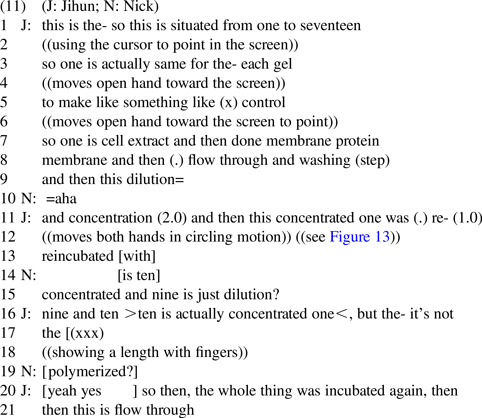
Consider the following example for how communication works in the RGM. The team is troubleshooting some unexpected and intriguing findings in their experiment. As the ‘point man’ for the experiment, Jihun explains what he has obtained. Recall the ‘perceptual relevancies’ when the door closes and configures the ecological huddle. The seating arrangement, including members’ proximity and their positions, are relevant as they all sit facing the monitor, their gaze directed uniformly on the visuals Jihun is projecting and on his gestures pointing to relevant details in the images.
Circling gesture to retrieve ‘incubated’.

There is distributed practice between the social actors, but also between the semiotic resources, to generate meaning. First, note how semiotic resources work together to mediate and shape their indexicality in multimodal gestalts. Though sociolinguists have pointed to the role of the ‘co-text’ (Silverstein Reference Silverstein, Enfield, Kockelman and Sidnell2014; Wortham & Reyes Reference Wortham and Reyes2015; similar to Gumperz's notion of co-occurring signs referred to above) for enregistering indexicals, we should also include the role of material objects and spatial configuration for shaping such meanings. For example, the frequent demonstratives (“this”) and adverbs (“then”) in Jihun's speech work with the visuals on the screen and Jihun's synchronous activity of pointing with his gesture or the cursor for their entexutalization (see Silverstein Reference Silverstein, Enfield, Kockelman and Sidnell2014). To understand that the “this” in lines 1, 9, 11, and 21 are different from each other, the interlocutors should be interpreting the deictic in relation to the embodied resources. Though deictics such as these have denotational value, they work with co-texts in situated interactions for their pragmatic meaning. Furthermore, though Jihun's utterances are marked by frequent pauses, hesitations, and word searches, the screen of the monitor, the cursor, Jihun's body and pointing gestures, and the images on the monitor work together to generate meaning for the participants. The interaction proceeds without any communicative breakdown. Jihun's interlocutors don't register any failure of uptake (as it happened in his conference interaction). Apart from helping others (which we illustrate next), the material resources help Jihun himself in his verbal production. In line 11, he is stuck for a word. He pauses and gestures for a while in a circular motion. Then he supplies the word “reincubated”, in a clear example of ‘lexical affiliate’ where gestures precede the verbal indexical (see Schegloff Reference Schegloff, Atkinson and Heritage1985). It is possible that the bodily movement provides a space for him to retrieve the word. The word could be embodied with this gesture for him to recall the word. Scholars have used the term ‘thinking with your hands’ to indicate how the body facilitates thinking (van Compernolle & Williams Reference van Compernolle and Williams2011:203). Note also that the visuals on the monitor help Jihun communicate fluently, as the focus on his words is reduced (which made him anxious in his conference talk).
The embodied resources become functional because the participants adopt a supportive and collaborative footing in the RGM genre of talk. To begin with, they have to adopt the disposition to attune to the whole communicative ecology and be willing to draw from all relevant semiotic repertoires. Their professional vision helps them adopt the collaborative ethos, which shapes their footing. Nick always signals his alignment through back channeling cues, as in line 10 above. In some instances, when Jihun is lost for words, the embodied resources help Nick and other interlocutors to supply the words Jihun is looking for. In line 18, there is a pause as Jihun gestures with elongated fingers when he looks for a word. Nick prompts “polymerized”. Note that Nick should be attuned to all the spatial repertoires in the setting (i.e. visuals, Jihun's cursor, and gestures), in addition to the preceding talk, to supply the needed word. Nick's utterances are latched to Jihun's when he supplies the word Jihun is looking for, suggesting his alignment. Furthermore, Nick's contributions are not done with an attitude of condescension or chastisement, as in ‘foreigner talk’ (Ferguson Reference Ferguson1975). Nor is he impatient or judgmental as a native speaker in a superior institutional position might be expected to act. He aligns and affiliates to move the conversation forward for everyone's benefit. Though Nick is the hierarchical leader, his footing thus changes to collaboration in RGM interactions. In fact, his contributions in lines 15 and 19 are framed as questions for confirmation, suggesting that Jihun enjoys epistemic authority.
CONCLUSION
Our analysis demonstrates how the door in the room where the RGM meets serves to transform a space with multiple uses and resources into a place with shared purposes and meanings when it is closed. It thus plays an important role in constituting the ecological huddle. In configuring the place for the RGM, the door makes certain semiotic resources salient and functional as constituting the group's professional vision. The door also indexes the roles of the participants, cues the opening and constitution of the meeting, and shapes the ethos or footing relevant for this interaction. Our analysis of the conversational interaction goes on to demonstrate how the objects in the ecological huddle mediate language for meaning-making among the multilingual and multinational scholars in this RGM.
We have to acknowledge that not all objects in a given interaction are functional in meaning-making or have the same importance. Some objects are less significant and many are not relevant for given activities, as suggested by Mondada (Reference Mondada2016) and Kusters et al. (Reference Kusters, Spotti, Swanwick and Tapio2017). How certain objects become semiotic repertoires that have predictable meanings in a specific genre of discourse depends on their enregisterment. For that, objects don't work in isolation. The co-occurring resources and reciprocal interactions serve as metapragmatic processes. The interactional sequences in our transcripts and Jihun's metapragmatic comments in our interviews suggest that the door plays a significant role in the RGM discourse. They confirm Jihun's claim in his interview comment (quoted in the epigraph) that the closed door is a “convention” which he has observed in other labs and universities he has worked in.
Our finding suggests that certain non-verbal resources should be described in definitions of academic genres and other discourse activities. Genre descriptions may not be complete when they are restricted to verbal repertoires alone. It is important to conduct situated and longitudinal research to understand which objects index what meanings for given social groups. We know from observations of an engineering group in our data that this RGM also meets with its door closed, although it meets in a less busy and crowded setting in the department. Jihun also commented that the other research groups in his department shut the door and drew the curtain during their meetings. These pieces of evidence suggest that the door has been enregistered to index certain predictable and shared meanings for RGMs in scientific disciplines.
There are important pedagogical and policy implications from embodied sociolinguistics and object-oriented studies such as ours. Consider the implications for language proficiency for international scholars in STEM, currently assessed through TOEFL and IELTS which largely focus on verbal resources and individual language competence (see Looney & Bhalla Reference Looney, Bhalla, Looney and Bhalla2019 for a critique). Our study demonstrates that disciplinary and professional interactions require more than normative grammar and individual grammatical proficiency. Not all genres of academic communication give importance to normative grammar in English. In addition to drawing from a wider corpus of semiotic repertoires, STEM scholars also need the ability to engage in distributed practice with social networks and spatial ecologies for successful interactions. Jihun's interview comments make evident that he has been socialized into the functions of the door and related practices of multimodal gestalts through his previous work in Korean and American universities. In fact, scientists seem to be socialized into drawing from such an expansive range of semiotic repertoires, even if linguists have failed to address them. Salö (Reference Salö2022) has recently demonstrated in this journal that academic communities in Sweden also draw from their habitus shaped by their spatial ecology to switch languages as relevant for different spaces and discourse genres. The professional development, assessment practices, and remedial programs for international scientists should be expanded to accommodate such embodied repertoires and distributed practice, countering the overly logocentric and mentalist approaches adopted currently.
APPENDIX: TRANSCRIPTION CONVENTIONS
Adapted from CLAN Manual for the CEAPP Project
- =
contiguous utterances (latching)
- [
overlapping utterances
- (.)
micro-pause (0.2 seconds or shorter)
- (1.3)
length of the pause
- > <
faster speech
- < >
slower speech
- ° °
soft speech
- :
elongation (each represents 0.2 seconds)
- -
abrupt stop in articulation.; cut-off
- ,
slight rise in pitch at the end of an utterance; continuing intonation
- .
fall in pitch at the end of an utterance
- ?
rising intonation
- ( )
uncertain utterances; surrounds the transcriber's best guess
- (xxx)
unintelligible syllables (the number of x's represents the number of unintelligible syllables)
- (( ))
description of nonverbal conducts
- underline
stressed word


 Open access

