





Introduction
Among multiple ecological consequences of biological invasions, the emergence of novel interspecific interactions and the alteration of existing ones are considered particularly important in the context of global change. These processes can destabilise ecological balances in local communities, ultimately leading to declines in native species (Jeschke et al. Reference Jeschke, Bacher, Blackburn, Dick, Essl, Evans, Gaertner, Hulme, Kühn, Mrugała, Pergl, Pyšek, Rabitsch, Ricciardi, Richardson, Sendek, Vilà, Winter and Kumschick2014; Wauters et al. Reference Wauters, Lurz, Santicchia, Romeo, Ferrari, Martinoli and Gurnell2023). Parasites often play a role in such interactions: they may expand their range with introduced hosts, infect new local host species, or broaden their host spectrum due to the arrival of novel, suitable hosts (Dunn et al. Reference Dunn, Torchin, Hatcher, Kotanen, Blumenthal, Byers, Coon, Frankel, Holt and Hufbauer2012; Schatz and Park Reference Schatz and Park2023; Díaz-Morales et al. Reference Díaz-Morales, Sures, Jolma, Thieltges, Smit and Sures2025). In addition to these direct parasitic interactions, indirect trophic relationships between non-native species and free-living parasite stages also emerge as ecologically relevant yet understudied mechanisms (Stanicka et al. Reference Stanicka, Soldánová, Migdalski, Szopieray, Lesiak, Cichy, Żbikowska and Jermacz2023; Díaz-Morales et al. Reference Díaz-Morales, Sures, Jolma, Thieltges, Smit and Sures2025). These phenomena are less predictable and harder to observe. They include dilution effects, whereby parasite transmission is disrupted by the presence of non-host organisms, the latter often being non-native members of the local community (Stanicka et al. Reference Stanicka, Dlouhy, Cichy, Żbikowska and Jermacz2025). One important mechanism behind this effect involves the removal of free-living larval parasite stages (e.g. digenean cercariae) from the environment through their consumption (Koprivnikar et al. Reference Koprivnikar, Thieltges and Johnson2023; Rosen et al. Reference Rosen, Staat, Andrews, Budhathoki, Jackson, Kwisera and Mecham2025). The ability to feed on these larvae appears to be highly species-specific (Hopper et al. Reference Hopper, Poulin and Thieltges2008; Welsh et al. Reference Welsh, Hempel, Markovic, Van Der Meer and Thieltges2019), depending on both parasite dispersal strategies and foraging behaviours of potential consumers (Selbach et al. Reference Selbach, Rosenkranz and Poulin2019). Although trematode larvae constitute a potential energy-rich food source (McKee et al. Reference McKee, Koprivnikar, Johnson and Arts2020), their role in supporting the ecological success of their non-native consumers has received limited scientific attention.
The freshwater pulmonate snail Physa acuta (Draparnaud, 1805) (Physidae), native to North America and now distributed globally, appears to be a suitable candidate for exploring trophic interactions between non-host consumers and free-living parasite stages. Depending on the region, it is considered a non-native or even invasive species (Cieplok and Spyra Reference Cieplok and Spyra2020). Its success is attributed to broad environmental tolerance, resistance to pollution, an omnivorous diet, and high reproductive output (Piechocki and Wawrzyniak-Wydrowska Reference Piechocki and Wawrzyniak-Wydrowska2016). In some European habitats, e.g. in Poland, population densities can reach up to 4000 individuals per square metre (Spyra et al. Reference Spyra, Cieplok, Strzelec and Babczyńska2019). Due to its widespread occurrence and ecological plasticity, P. acuta has become a model organism in ecological and parasitological research. Given its ecological ubiquity and feeding strategy, P. acuta is not only a potential host for local parasites and a vector for alien ones, but may also affect parasite populations through other mechanisms, such as predation on their free-living stages (Stanicka et al. Reference Stanicka, Migdalski, Szopieray, Cichy, Jermacz, Lombardo and Żbikowska2021a).
Gastropods are integral to the life cycles of digenean trematodes (Digenea), which usually rely on molluscs as their first intermediate hosts (Faltýnková et al. Reference Faltýnková, Našincová and Kablásková2008). Although P. acuta is rarely exploited as a first intermediate host by digenean trematodes in its non-native range, it has been recorded as a second intermediate host (Pantoja et al. Reference Pantoja, Faltýnková, O’Dwyer, Jouet, Skírnisson and Kudlai2021). Its regular co-occurrence with free-living trematode larvae in invaded habitats suggests it may influence parasite transmission through other mechanisms. One plausible mechanism is the direct consumption of larvae while grazing periphyton from submerged surfaces (Selbach et al. Reference Selbach, Rosenkranz and Poulin2019). Free-living digenean larvae are known to be consumed by active predators and filter feeders (Koprivnikar et al. Reference Koprivnikar, Thieltges and Johnson2023), yet little is known about their role in the diet of scrapers, such as P. acuta (Selbach et al. Reference Selbach, Rosenkranz and Poulin2019; Stanicka et al. Reference Stanicka, Migdalski, Szopieray, Cichy, Jermacz, Lombardo and Żbikowska2021a). Energy reserves of free-living digenean stages are limited, resulting in a short lifespan (Marszewska et al. Reference Marszewska, Cichy, Heese and Żbikowska2016). Before dying, cercariae reduce their motility, shed their tails, and gradually sink to the bottom, eventually undergoing rapid body disintegration (Braun et al. Reference Braun, Grimes and Templeton2018). It is therefore possible that P. acuta primarily feeds on such exhausted and dying cercariae near the substrate. As a scraper, this snail may find such immobile prey easier to access and energetically less costly to consume. Importantly, the consumption of larvae that have already lost their infective capacity does not contribute to the dilution effect. Instead, it would provide a unilateral advantage to the consumer, offering a readily available and nutritionally valuable source of proteins and energy. On the other hand, it cannot be a priori excluded that snails may be capable of feeding on live, vigorous cercariae. Moreover, they may feed on sedentary larval types, such as adolescariae. This would contribute to the dilution of affected digenean species in the environment. Therefore, it is important to determine whether P. acuta is also capable of feeding on live, infective digenean larvae.
To better understand how interactions with non-host organisms might affect digenean transmission, it is important to briefly outline the biology of their free-living larval stages. Digeneans have complex life cycles involving several hosts, and their free-living stages, such as miracidia and cercariae, are exposed to various ecological pressures, including predation and competition (Johnson et al. Reference Johnson, Dobson, Lafferty, Marcogliese, Memmott, Orlofske, Poulin and Thieltges2010). Miracidia, the first larval stage, actively or passively infect the first intermediate host, typically a snail. Cercariae, in turn, are released into the environment in large numbers and seek the next host. In some species, a third free-living larval stage – adolescaria – develops from a cercaria. This encysted metacercarial form attaches to submerged surfaces in the environment, bypassing the second intermediate host (Simon-Vicente et al. Reference Simon-Vicente, Mas-Coma, Lopez-Roman, Tenora and Gallego1985; Galaktionov and Dobrovolskij Reference Galaktionov and Dobrovolskij2013; Gonchar et al. Reference Gonchar, Jouet, Skírnisson, Krupenko and Galaktionov2019). Notably, adolescariae are also present in the life cycles of species of medical and veterinary relevance, such as Fasciola hepatica Linnaeus, 1758 and Fasciolopsis buski (Lankester, 1857) (Fasciolidae) (Mas-Coma et al. Reference Mas-Coma, Valero, Bargues, Xiao, Ryan and Feng2015).
Apart from digeneans themselves, other invertebrates also interact with freshwater snails, potentially affecting their relations with parasites. A well-known case is the oligochaete Chaetogaster limnaei limnaei Baer, 1827. This species, considered commensal or mutualist, is found worldwide and typically resides in the mantle cavity of its snail host (including P. acuta), feeding on mucus and microorganisms (Stoll et al. Reference Stoll, Früh, Westerwald, Hormel and Haase2013; Okeke and Ubachukwu Reference Okeke and Ubachukwu2017; Bashê Reference Bashê2023). Importantly, C. limnaei limnaei can also prey on free-swimming digenean larvae, reducing infection success in the host snail (Hobart et al. Reference Hobart, Moss, McDevitt-Galles, Stewart Merrill and Johnson2021). Although some negative effects of C. limnaei limnaei on the snail have been observed in experimental settings, such situations seem to be rare (Stoll et al. Reference Stoll, Früh, Westerwald, Hormel and Haase2013).
This study aimed to determine whether P. acuta can reduce the number of free-living larvae of digenean trematodes. We hypothesised that larval reduction would be detectable and depend on larva type and consumer size. Specifically, larger snails were expected to consume more than smaller individuals, and a greater reduction was anticipated for substrate-attached adolescariae compared to actively swimming cercariae. We also assumed that colonisation of P. acuta by other organisms could influence consumption of larvae: trematode metacercariae were expected to impair their host snail’s consumption efficiency, while the presence of the commensal C. limnaei limnaei might enhance larval removal.
Material and methods
Experimental prey
Free-living larvae of digenean trematodes were used as prey. These were cercariae of Diplostomum sp. (Diplostomidae) and Trichobilharzia sp. (Schistosomatidae), as well as adolescariae of Notocotylus sp. (Notocotylidae).
Among the digenean representatives used, the genus Diplostomum usually shows the highest prevalence in mollusc hosts in European waters (Faltýnková and Haas Reference Faltýnková and Haas2006; Soldánová et al. Reference Soldánová, Faltýnková, Scholz and Kostadinova2011; Stanicka et al. Reference Stanicka, Cichy, Bulantová, Labecka, Ćmiel, Templin, Horák and Żbikowska2022). It is characterised by a three-host life cycle and uses various fish species as second intermediate hosts, which makes it important from the ecological, economic, and veterinary point of view (Antychowicz et al. Reference Antychowicz, Bernat, Kramer, Glowacka and Pekala2016). Diplostomiasis poses a significant risk to fish farming, severely affecting the visual organ’s function in fish (Karvonen and Seppälä Reference Karvonen and Seppälä2008).
The genus Trichobilharzia, although widespread and commonly recorded in snail hosts, usually reaches a relatively low prevalence (Soldánová et al. Reference Soldánová, Selbach, Kalbe, Kostadinova and Sures2013; Stanicka et al. Reference Stanicka, Cichy, Bulantová, Labecka, Ćmiel, Templin, Horák and Żbikowska2022). In their two-host life cycle, they use aquatic birds as definitive hosts. They are of medical significance due to cercariae causing a persistently itchy rash (swimmers’ itch) in humans, who serve as dead-end hosts (Marszewska et al. Reference Marszewska, Cichy, Heese and Żbikowska2016).
Notocotylus spp. are widely distributed in marine, brackish, and fresh waters (Cribb Reference Cribb1991; Flores et al. Reference Flores, Hernández-Orts and Viozzi2023). They have a two-host life cycle, with a specifically short cercarial stage (Morley et al. Reference Morley, Crane and Lewis2002) and a free-living adolescaria infecting the definitive host, an aquatic bird (including domestic fowl) or mammal, by ingestion. Adults can induce intestinal pathologies in their hosts, leading even to their death (Graczyk and Shiff Reference Graczyk and Shiff1993).
Cercariae were obtained from naturally infected Lymnaea stagnalis collected from Lake Licheńskie (Poland, 52°19′26.6″N, 18°20′55.9″E). Adolescariae originated from naturally infected Planorbarius corneus (Linnaeus, 1758) (Gastropoda: Planorbidae) obtained from Lake Iławskie (Poland, 53°35′42.5″N, 19°37′07.2″E). The snails were collected in the second half of summer.
We placed infected molluscs in beakers with a small amount of dechlorinated tap water under an artificial light source (desk lamp). Cercariae of Diplostomum sp. and Trichobilharzia sp. that emerged into the water column were pipetted under a stereomicroscope (Science ETD-101, Bresser, Germany). Adolescariae were collected from the bottom and sides of the beakers, to which Notocotylus sp. cercariae were released. The larvae were used in the experiments no later than 3 hours after their release. Preliminary tests conducted during the development of the experimental protocol, along with literature data on larval survival (Karvonen et al. Reference Karvonen, Paukku, Valtonen and Hudson2003; Al-Jubury et al. Reference Al-Jubury, Kania, Bygum and Buchmann2020), indicate that this timeframe ensured their viability throughout the experiment.
Sampling and acclimation of Physa acuta
We collected P. acuta from Lake Licheńskie (Poland, 52°19′26.6″N, 18°20′55.9″E) in the second half of summer. First, the snails were kept individually in beakers with dechlorinated tap water for two hours. This incubation aimed to check for the release of cercariae, thus excluding patent digenean infections in the experimental snails. Next, P. acuta individuals were weighed using an electronic laboratory balance (AS 110/X, RADWAG, Poland) and divided into two size groups: 1) small – 0.05 g (SE ± 0.002 g), and 2) large – 0.12 g (SE ± 0.003 g). Finally, they were kept individually in beakers for 48 hours without access to food to acclimate them to the experimental thermal conditions (20 °C).
Experimental design and procedure
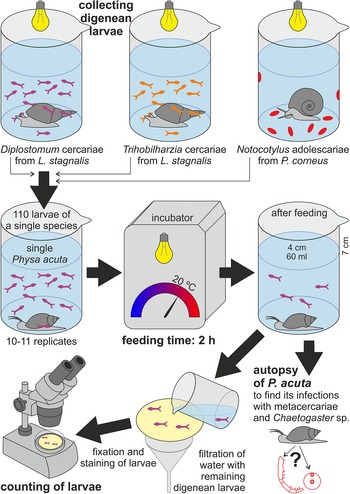
We placed individual P. acuta in experimental beakers (height × diameter: 70 mm × 40 mm) with a specified number of digenean larvae of a given species (110 individuals in 60 mL of water). The beakers were placed in a MIR 253 incubator (Sanyo, Japan) for 2 hours at 20 °C with artificial lighting (Figure 1). A control variant was included using larvae of each parasite species incubated in the absence of P. acuta. Each variant (experimental/control) was replicated 10-11 times. In total, 65 snails and 3520 digenean larvae were used in the experiment.
Schematic diagram of the experimental setup.

After incubation, P. acuta were immediately removed from the beakers and examined under a stereomicroscope to check for the presence of any larvae on their body surface (Stanicka et al. Reference Stanicka, Migdalski, Szopieray, Cichy, Jermacz, Lombardo and Żbikowska2021a). The contents of each beaker were then filtered using a filtration set (Filter holder with receiver PSF, Thermo Scientific, USA) with a hand vacuum pump (Mityvac MV8010 Selectline Hand Vacuum Pump, SKF, Sweden). Subsequently, the inner walls of each beaker were rinsed twice with clean water to ensure that no digenean larvae remained attached, and the rinsing suspension was also filtered. Digenean larvae were retained on the surface of membrane filters with a diameter of 47 mm and a pore size of 12.0 μm (Whatman Cyclopore Polycarbonate Track-Etched Membrane (PCTE), Cytvia, Germany) (Figure 1). Before counting, the larvae were preserved in 70 % ethanol and stained (Nile Blue A, Sigma, USA) (Born-Torrijos et al. Reference Born-Torrijos, Paterson, van Beest, Vyhlídalová, Henriksen, Knudsen, Kristoffersen, Amundsen and Soldánová2021). Finally, P. acuta were necropsied to look for parasites and commensals (Stanicka et al. Reference Stanicka, Migdalski, Zając, Cichy, Lachowska-Cierlik and Żbikowska2021b).
Data analysis
We analysed digenean larvae consumption by snails (a fraction of consumed individuals) using a Generalised Linear Mixed Model (GLMM) with binomial distribution and logit link function, including (1) digenean larva taxon present in water (Diplostomum sp., Trichobilharzia sp., Notocotylus sp.) and (2) snail size group (small/large) as categorical factors. Moreover, abundances of the most common parasites and commensals detected in experimental snails: (3) xiphidiometacercariae (Digenea: Plagiorchiida) and (4) C. limnaei Baer, 1827 (Annelida: Oligochaeta) were included as continuous covariates. Echinostome and tetracotyle metacercariae were also detected in experimental snails, but their presence was not considered in the analyses due to their low abundance. Finally, (5) snail individual was included in the model as a random factor. The loss of larvae in control trials without snails was negligible (see Results), therefore, possible losses were not taken into account in further analyses.
Initially, we included all main fixed effects and their interactions in the model. Then, we conducted a model simplification by removing non-significant highest-order interactions. As needed, for significant main effects of categorical factors and their interactions, we conducted pairwise contrasts as a post-hoc procedure. For significant interactions between categorical factors and covariates, we first checked the significance of regression slopes for each level of the categorical factor and then compared significant slopes with each other.
The analyses were run using SPSS 29.0 statistical software (IBM Corporation).
Results
Consumption of vigorous free-living digenean larvae by Physa acuta
In control vessels, digenean larva reduction ranged between 0.5% (Notocotylus sp. adolescariae) to 2% (cercariae of both species), indicating that their mortality due to other reasons than snail predation was negligible.
The reduction in the number of digenean larvae relative to their initial abundance in the vessel (consumption) was observed in all experimental variants. Further evidence supporting the potential feeding of P. acuta on digenean larvae is the detection of numerous Notocotylus sp. adolescariae in the digestive system of experimental snails (Fig. SM1).
Consumption of digenean larvae by snails (Figure 2A) depended on two-way interactions of digenean larva taxon with snail size group and abundances of xiphidiometacercariae and C. limnaei limnaei in snails (Table 1). A digenean larva taxon*snail size group interaction (Table S1A) resulted from large snails consuming more Notocotylus sp. adolescariae compared to the other digenean larvae. In contrast, small snails consumed them less efficiently than cercariae. Moreover, large snails generally consumed more digenean larvae (all species) than small individuals. Also, large snails consumed more cercariae of Trichobilharzia sp. than those of Diplostomum sp.
Consumption of digenean larvae by small and large Physa acuta, depending on larva species (A), infection of snails with xiphidiometacercariae (B) and presence of the oligochaete commensal Chaetogaster limnaei limnaei in snail mantle cavity (C). Different letters in panel A indicate significant differences between experimental treatments. Asterisks in panels B and C indicate a significant slope, while different letters show significant differences between the slopes.

Generalised Linear Mixed Model to test consumption of digenean larvae by snails depending on digenean taxon, snail size group (small/large) and abundance of xiphidiometacercariae and Chaetogaster limnaei limnaei present in the snails. The model also included a snail individual as a random factor (not shown). The highest order non-significant interactions were dropped in a model simplification procedure

cov – continuous covariate.
Consumption of digenean larvae by snails depended on their infection level and type (Table 1). Infection by xiphidiometacercariae (Figure 2B) increased consumption of Notocotylus sp. and Trichobilharzia sp., but reduced that of Diplostomum sp. (Table SM1B). On the other hand, infection by C. limnaei limnaei (Figure 2C) increased consumption of Diplostomum sp., decreased consumption of Notocotylus sp. and did not affect that of Trichobilharzia sp. (Table SM1C).
Parasites and symbionts of Physa acuta
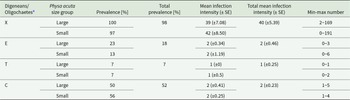
Only one individual of P. acuta did not serve as a second intermediate host for digenean metacercariae in our experiment. The total number of metacercariae was 2462, of which nearly 99% were xiphidiometacercariae (prevalence: 98%, mean infection intensity: 40 metacercariae per snail) (Fig. SM2). The remaining 1% comprised echinostome and tetracotyle metacercariae, with a prevalence of 18 % and 7%, and a mean infection intensity of two and one individuals per snail, respectively (Table 2). Additionally, over half of the examined snails (52%) were colonised by C. limnaei limnaei, with a total number of 79 individuals. The mean colonisation intensity of P. acuta by these oligochaetes was two individuals per snail (Table 2).
Prevalence and mean infection intensity of metacercariae and Chaetogaster limnaei limnaei in Physa acuta

a X – xiphidiometacercariae, E – echinostome metacercariae, T – tetracotyle metacercariae, C – Chaetogaster limnaei limnaei.
Discussion
Our tests indicate that P. acuta can feed on live, free-living digenean larvae, including those actively swimming in the water column (cercariae). However, the efficiency of feeding depends on the snail’s size, the larval species, and the presence of other parasites – for example, larger individuals consume Notocotylus sp. adolescariae more effectively, and the level of metacercarial infection may increase or decrease the consumption of specific larval taxa. Additionally, our study suggests a potential role of C. limnaei limnaei, a commensal inhabiting P. acuta, as an additional diluter of free-swimming cercariae. These findings highlight that the presence of the non-native P. acuta may disrupt parasite transmission, potentially benefiting host organisms, and, in the case of parasites of medical or veterinary importance, also human welfare. In turn, an important next research question emerges as a result of our findings: can the consumption of digenean cercariae by P. acuta contribute to an increase in its condition and reproductive success, and, consequently, facilitate its establishment and further spread as a non-native species? Given the widespread and continuous presence of digenean cercariae in aquatic environments, this potential advantage may play a significant role in invasion dynamics and warrants further investigation. Finally, our findings confirmed that P. acuta serves as an intermediate host for digenean metacercariae in non-native regions, broadening the host range and potentially facilitating the spread of parasitic species.
Consumption of various types of digenean prey by snails
Differences in the consumption of various types of larvae can be explained by linking their behaviour and vertical distribution in the water column to the feeding strategy of P. acuta. Food located on the substratum is more accessible to scrapers than material suspended in the water column (Piechocki Reference Piechocki1979). In our study, food associated with the bottom included adolescariae of Notocotylus sp. (Galaktionov and Dobrovolskij Reference Galaktionov and Dobrovolskij2013), as well as, to some extent, cercariae of Trichobilharzia sp., which are known to attach to the walls of experimental vessels (Stanicka et al. Reference Stanicka, Migdalski, Szopieray, Cichy, Jermacz, Lombardo and Żbikowska2021a). However, cercariae of Diplostomum sp. and most of Trichobilharzia sp. primarily remain suspended in the water column (Haas et al. Reference Haas, Beran and Loy2008; Stanicka et al. Reference Stanicka, Migdalski, Szopieray, Cichy, Jermacz, Lombardo and Żbikowska2021a). Accordingly, large snails consumed Notocotylus sp. adolescariae most efficiently and Diplostomum sp. cercariae least efficiently. Similar conclusions were drawn by Selbach et al. (Reference Selbach, Rosenkranz and Poulin2019), who found that P. acuta consumed only bottom-dwelling cercarial species, but not free-swimming ones.
On the other hand, small P. acuta individuals consumed more cercariae than adolescariae. A possible explanation for this may be that smaller snails need to surface more frequently to obtain air. This behaviour likely increases their chance of encountering cercariae suspended in the water column (Stanicka et al. Reference Stanicka, Migdalski, Szopieray, Cichy, Jermacz, Lombardo and Żbikowska2021a), while simultaneously reducing their exposure to larvae settled on the substratum.
The effect of metacercarial burden on snail foraging
An increase in prey consumption was observed in snails infected with xiphidiometacercariae. This pattern may reflect the elevated energy demands commonly associated with parasitic infections (Kuris and Warren Reference Kuris and Warren1980), which often trigger more intensive foraging behaviour in hosts (Shinagawa et al. Reference Shinagawa, Urabe and Nagoshi2001; Díaz-Morales et al. Reference Díaz-Morales, Bommarito, Knol, Grabner, Noè, Rilov, Wahl, Guy-Haim and Sures2023). Notably, parasitised P. acuta were more effective at consuming adolescariae, the encysted and inactive form of the parasite.
Although metacercariae are generally considered to be of low pathogenicity (Ballabeni Reference Ballabeni1994; Shirakashi et al. Reference Shirakashi, Waki and Ogawa2020), some studies report their negative effects on host condition and survival. These impacts depend on factors such as infection intensity and parasite localisation (Majoros Reference Majoros1999; Ogawa et al. Reference Ogawa, Nakatsugawa and Yasuzaki2004; Bates et al. Reference Bates, Poulin and Lamare2010; Varas et al. Reference Varas, Pulgar, Duarte, García-Herrera, Abarca-Ortega, Grenier, Rodríguez-Navarro, Zapata, Lagos, García-Huidobro and Aldana2022) and may include altered behaviour that increases susceptibility to predation by the final host (Seppälä et al. Reference Seppälä, Karvonen and Tellervo Valtonen2004). For example, Martin and Conn (Reference Martin and Conn1990) demonstrated that echinostome metacercariae can impair kidney function in frog hosts.
Furthermore, the process of active transmission – i.e. the simultaneous penetration of the host’s body surface by numerous cercariae – can be harmful to second intermediate hosts (Kuris and Warren Reference Kuris and Warren1980; Majoros Reference Majoros1999; Bates et al. Reference Bates, Poulin and Lamare2010). The subsequent migration of larvae through tissues and organs before encystment also poses risks (Islam Reference Islam1986; Majoros Reference Majoros1999).
Therefore, it is reasonable to assume that even metacercarial infections – especially as intense as those observed in this study – can influence host fitness and mobility, ultimately affecting their foraging efficiency across different prey types.
The effect of the oligochaete presence on snail foraging
The presence of C. limnaei limnaei led to increased consumption of Diplostomum sp. cercariae and decreased consumption of Notocotylus sp. adolescariae. This outcome is most likely attributable to the combined feeding activity of both P. acuta and C. limnaei limnaei. Cercariae have previously been observed in the digestive tract of C. limnaei limnaei (Khalil Reference Khalil1961; Fashuyi and Williams Reference Fashuyi and Williams1977; Fried et al. Reference Fried, Peoples, Saxton and Huffman2008), indicating that the oligochaete can directly ingest these larvae.
Although C. limnaei limnaei is capable of temporarily leaving its snail host (Sankurathri and Holmes Reference Sankurathri and Holmes1976), no oligochaetes were found on membrane filters during larval counting. This suggests that the worms remained within the snails and only protruded from the mantle cavity, as previously observed (Sankurathri and Holmes Reference Sankurathri and Holmes1976). Such behaviour is likely associated with the consumption of larvae suspended in the water column, such as Diplostomum sp. cercariae.
In addition to direct feeding, experimental studies have shown that C. limnaei limnaei can influence the behaviour of its host, including foraging activity (Stoll et al. Reference Stoll, Früh, Westerwald, Hormel and Haase2013). At high infestation levels, P. acuta individuals tend to spend less time foraging and more time resting (Stoll et al. Reference Stoll, Früh, Westerwald, Hormel and Haase2013). This behavioural change may account for the reduced consumption of settled Notocotylus sp. adolescariae, which are not targeted by the oligochaete.
Physa acuta as a host for digenean larvae
The limited role of non-native and invasive species in parasite transmission within introduced ranges is frequently emphasised (Ebbs et al. Reference Ebbs, Loker and Brant2018). However, in the present study, P. acuta commonly functioned as a second intermediate host for digeneans. The detection of digenean metacercariae in P. acuta raises several key research questions: (I) Can non-native parasites be co-introduced with this invasive snail and subsequently infect native host species (parasite spillover)? (II) Does P. acuta serve as an alternative host for native or previously established parasites, potentially increasing their transmission (parasite spillback)?
Without molecular data, the precise taxonomic identification of Digenea, especially those isolated from intermediate hosts, remains difficult due to substantial intra-generic morphological similarity and high species-level variability (Dvorak et al. Reference Dvorak, Vanacova, Hampl, Flegr and Horák2002; Kudlai et al. Reference Kudlai, Pantoja, O’Dwyer, Jouet, Skírnisson and Faltýnková2021; Pantoja et al. Reference Pantoja, Faltýnková, O’Dwyer, Jouet, Skírnisson and Kudlai2021). Nevertheless, based on morphological characteristics of the metacercariae observed in this study and comparative data from the literature (Graczyk and Shiff Reference Graczyk and Shiff1993; Faltýnková et al. Reference Faltýnková, Našincová and Kablásková2007; Cichy and Żbikowska Reference Cichy and Żbikowska2016; Stanicka et al. Reference Stanicka, Zając, Lachowska-Cierlik, Cichy, Żbikowski and Żbikowska2020; Bespalaya et al. Reference Bespalaya, Kondakov, Travina, Khrebtova, Kropotin, Aksenova, Gofarov, Lyubas, Tomilova and Vikhrev2022; Kanarek et al. Reference Kanarek, Gabrysiak, Pyrka, Jeżewski, Stanicka, Cichy, Żbikowska, Zaleśny and Hildebrand2023), the digenean species associated with P. acuta in its non-native range appear to belong to taxa that are common and widely distributed in Europe. Therefore, based on the present study, P. acuta can be involved in parasite spillback in Europe. However, it should also be considered that for some digenean species, P. acuta may act as a dead-end host.
Conclusion
Our study demonstrates that the non-native snail P. acuta can interact with free-living stages of digenean parasites, diluting both cercariae and adolescariae. These findings highlight its dual ecological role – not only as a potential host for metacercariae but also as a consumer that may reduce the abundance of infective larval stages in the environment. In addition, the commensal oligochaete C. limnaei limnaei associated with P. acuta may further contribute to the dilution of cercariae through its own feeding activity. Given the widespread distribution, ecological plasticity, and often high densities of P. acuta, such interactions could modify parasite transmission dynamics and energy flow within freshwater ecosystems. This study provides insight into how non-native species and their symbionts can jointly shape host–parasite–commensal networks, with potential consequences at the community and ecosystem levels. Future research linking individual-level feeding behaviour with ecosystem-scale outcomes would help better understand these complex trophic relationships.
Supplementary material
The supplementary material for this article can be found at https://doi.org/10.1017/S0031182025101169.
Data availability statement
The data that support the findings of this study are available from the corresponding author, AS, upon reasonable request.
Author contributions
AS: conceptualisation, resources, methodology, investigation, project administration, visualisation, writing – original draft, writing – review & editing. JK: methodology, formal analysis, visualisation, writing-original draft preparation, writing – review & editing. ZK: investigation, writing – original draft preparation, writing – review & editing. ML: investigation, writing – original draft preparation, writing – review & editing. WP: investigation, writing – review & editing. AG: investigation, writing – review & editing. SG: investigation, writing – review & editing. AC: resources, methodology, writing – review & editing. EZ: resources, methodology, writing – review & editing.
Financial support
This research was funded by the Polish Ministry of Education and Science as part of the second edition of the ‘Student Scientific Clubs Create Innovations’ competition (grant no. SKN/SP/536076/2022).
Competing interests
None.
Ethical standards
Not applicable.




 Open access

