





Self-control is an umbrella construct that includes the capacity to monitor, evaluate, deploy and inhibit behavior or emotions to attain a behavioral goal (Masten & Coatsworth, Reference Masten and Coatsworth1998; Moilanen, Shaw, & Fitzpatrick, Reference Moilanen, Shaw and Fitzpatrick2010). It includes both top-down/executive (i.e., behavioral, emotional) components as well as bottom-up/reactive components (i.e., behavioral inhibition/fear, impulsivity) (Bridgett et al., Reference Bridgett, Burt, Edwards and Deater-Deckard2015). Dual-systems models of self-control posit that self-regulatory failure can result from strong impulses, weak inhibitory control, or both (Tao et al., Reference Tao, Wang, Fan and Gao2014).
The ability to self-regulate is a primary developmental task in early childhood (Kopp, Reference Kopp1982; National Research Council and Institute of Medicine, Reference Shonkoff and Phillips2000; Posner & Rothbart, Reference Posner and Rothbart2000). As proposed by Kopp’s ontogenetic framework, self-control builds from core neurophysiological modulation, which, in turn, undergirds sensorimotor modulation and subsequent self-initiation of behavioral and affective control (Kopp, Reference Kopp1982). Key to this developmental unfolding is a transition from external regulation in infancy – when there is almost an exclusive reliance on parents to regulate emotion – to internally initiated self-regulation (Calkins & Leerkes, Reference Calkins, Leerkes, Vohr and Baumerister2011; Kopp, Reference Kopp1982). Self-control supports individuals in processing emotional arousal, facilitates impulse control and delay of gratification, and helps with managing social relationships (Blair & Raver, Reference Blair and Raver2015).
Individual differences in attention and impulsivity are measurable as early as toddlerhood (Olson et al., Reference Olson, Sameroff, Kerr, Lopez and Wellman2005) and there is evidence of moderate developmental stability in self-control in childhood and adolescence (Kopp; Murphy, Eisenberg, Fabes, Shepard, & Guthrie; Raffaelli, Crockett, & Shen). Murphy et al. (Reference Murphy, Eisenberg, Fabes, Shepard and Guthrie1999) and Raffaelli et al. (Reference Raffaelli, Crockett and Shen2005) found correlations of 0.41–0.67 in parent- and teacher-rated attentional, emotional, and inhibitory control and behavioral regulation over 4–8 years of follow-up between childhood and adolescence. Studies of the relationship between child regulatory capacities (e.g., delay of gratification, restlessness, planfulness) and later outcomes related to self-control (e.g., social competence, externalizing behaviors) offer evidence of moderate stability in these capacities (Caspi et al., Reference Caspi, Henry, McGee, Moffitt and Silva1995; Mischel et al., Reference Mischel, Shoda and Rodriguez1989).
Early self-control and young adult outcomes
International cohort studies lend support for the role of self-control in childhood in predicting success and well-being decades later. The Dunedin Multidisciplinary Health and Development Study followed a representative sample of 1,037 children (92% white) born in the province of Dunedin, New Zealand, in 1972–1973. In this cohort, Moffitt et al. (Reference Moffitt, Arseneault, Belsky, Dickson, Hancox, Harrington and Caspi2011) found that a gradient of self-control in early and middle childhood (ages 3–11) predicted health, criminal justice, and economic outcomes at 32 years of age. Children with better self-control had less cardiovascular disease, substance abuse, and fewer financial troubles and criminal convictions in adulthood. Effects persisted but were attenuated by the inclusion of intermediate adolescent outcomes including early substance use, educational attainment, and pregnancy (Moffitt et al., Reference Moffitt, Arseneault, Belsky, Dickson, Hancox, Harrington and Caspi2011).
In studies in New Zealand (Fergusson et al., Reference Fergusson, Boden and Horwood2013) and Britain (Daly et al., Reference Daly, Egan, Quigley, Delaney and Baumeister2016) self-control measured between childhood and early adolescence (ages 6–12 years) predicted less smoking, greater likelihood of college graduation, and less criminal offending in adulthood. Similarly, in a cohort of French-Canadian children in Montreal (n = 4,340, 95% white), Vitaro et al. (Reference Vitaro, Brendgen, Larose and Tremblay2005) found that hyperactivity/inattention measured in Kindergarten was the strongest predictor of trajectories leading to high school dropout. These studies, like the Dunedin study, however, relied on cohorts of predominately white children. The current study examines this relationship in a US-based cohort of children in Baltimore most of whom are Black and low-income. Prior studies have not examined the experiences of youth raised in US urban centers where poverty is highly concentrated, nor the experiences of Black youth.
Self-control and educational outcomes
Self-control is thought to be related to learning and academic persistence by increasing children’s willingness to engage with academic activities and by improving problem solving (Duncan & Magnuson, Reference Duncan, Magnuson, Duncan and Murnane2011). Aspects of self-control like motivation, orientation toward learning, persistence, attentional control, and cognitive flexibility facilitate a constellation of “learning behaviors” that support classroom success (Stott et al., Reference Stott, McDermott, Green and Francis1988). These learning behaviors have been linked to classroom adjustment, school attendance, and longer-term socio-behavioral adjustment (e.g., better social competence, lower odds of school failure) (McDermott et al., Reference McDermott, Rikoon and Fantuzzo2016; Sasser et al., Reference Sasser, Bierman and Heinrichs2015). Students with better self-control, particularly better emotion regulation, may enjoy better relationships with their teachers, more acceptance by their peers, and pay more attention to their academic work (Trentacosta & Izard, Reference Trentacosta and Izard2007).
Duncan et al. used data from six large longitudinal cohort studies, four of which were from the United States, to examine predictors of academic achievement (2007). They found that, across cohorts, attention at school entry was among the strongest predictors of later achievement (and crime) (Duncan et al., Reference Duncan, Dowsett, Claessens, Magnuson, Huston, Klebanov and Japel2007). Similarly, in a sample of low-income Kindergarteners, Trentacosta and Izard (Reference Trentacosta and Izard2007) found that students with lower teacher-rated emotion regulation had lower academic competence in first grade and that this relationship was mediated by lower teacher ratings of their attention in the classroom (Trentacosta & Izard, Reference Trentacosta and Izard2007). Not all studies, however, have implicated early self-control in later academic outcomes. For example, in a study using the National Longitudinal Survey of Youth (NLSY), which oversampled Black, Latinx, and low-income children and followed them between the ages of 5 and 14, Duncan and Magnuson (Reference Duncan, Magnuson, Duncan and Murnane2011) found that antisocial beahvior (ASB), but not attention, predicted high school graduation. Similarly, Currie and Stabile (Reference Currie and Stabile2006) found no relationship between early childhood hyperactivity and school persistence at 16–18 years old using data from the NLSY and its Canadian analog.
Self-control and health and antisocial behavior
Poor self-control has been associated with a variety of negative health and behavioral outcomes including substance use and dependence, internalizing behavior, delinquency, and ASB (Buhringer et al., Reference Buhringer, Wittchen, Gottlebe, Kufeld and Goschke2008; Dishion & Connell, Reference Dishion and Connell2006; Garber, Reference Garber2006; Gardner et al., Reference Gardner, Dishion and Connell2008; Lengua et al., Reference Lengua, West and Sandler1998; Wills & Stoolmiller, Reference Wills and Stoolmiller2002; Wills et al., Reference Wills, Walker, Mendoza and Ainette2006; Wong et al., Reference Wong, Nigg, Zucker, Puttler, Fitzgerald, Jester and Adams2006). Poor self-control in early life may lead to more disciplinary action, teacher-student conflict, and peer exclusion, thereby anchoring trajectories of health and behavioral risk (Parker & Asher, Reference Parker and Asher1987). Consistent with this, in the Dunedin cohort, Caspi et al. and Moffitt and Caspi found that a composite of self-control at age three both predicted adolescent ASB and differentiated life-course-persistent and adolescent-limited trajectories of ASB (Caspi et al., Reference Caspi, Henry, McGee, Moffitt and Silva1995; Caspi & Silva, Reference Caspi and Silva1995; Moffitt & Caspi, Reference Moffitt and Caspi2001). In a cohort of boys in Montreal, high levels of both hyperactivity and inattention were associated with trajectories of persistently high physical aggression from 6 to 15 years of age, and higher rates of delinquency and involvement with the criminal justice system at 17 and 18 years of age (Nagin & Tremblay, Reference Nagin and Tremblay2001).
Some prior research has helped to illuminate the processes linking early self-control and later health outcomes and ASB. Much of this research implicates social adjustment (Caspi et al., Reference Caspi, Henry, McGee, Moffitt and Silva1995; Denham et al., Reference Denham, Blair, DeMulder, Levitas, Sawyer, Auerbach-Major and Queenan2003; Sette et al., Reference Sette, Spinrad and Baumgartner2013). For example, Trentacosta and Shaw found that 3-year-old boys who had trouble deploying adaptive emotion regulation strategies were more likely to be rejected by their peers in middle childhood, which, in turn, predicted more ASB at ages 11–12 years (Trentacosta & Shaw, Reference Trentacosta and Shaw2009). The authors suggest that early emotion regulation challenges may presage difficulties with managing anger and frustration as children age, which may cause them to be rejected by their peers.
An additional pathway through which early life self-control may impact long-term health outcomes is increased health risk behavior. Poor childhood self-control has been linked to health behaviors that increase the likelihood of outcomes from cardiovascular disease to early pregnancy (Francis & Susman, Reference Francis and Susman2009; Magnusson et al., Reference Magnusson, Crandall and Evans2019; Meinzer et al., Reference Meinzer, LeMoine, Howard, Stehli, Arnold, Hechtman and Chronis-Tuscano2020). For example, impulsivity, lack of task persistence, and behavioral inhibition have been shown to prospectively predict substance use into adulthood (Molina & Pelham, Reference Molina and Pelham2014). Children with ADHD are also twice as likely to experience an early pregnancy as those without ADHD via greater risk-taking, particularly delinquency and substance use (Meinzer et al., Reference Meinzer, LeMoine, Howard, Stehli, Arnold, Hechtman and Chronis-Tuscano2020). Poorer self-control may also increase the likelihood of sexual risk behaviors such as lower age at first sex, greater number of partners, and lack of consistent contraceptive use, which may lead to unintended pregnancy (Magnusson et al., Reference Magnusson, Crandall and Evans2019; Owens & Hinshaw, Reference Owens and Hinshaw2020).
Self-control and long-term outcomes in minoritized communities
Cicchetti and Lynch’s (Reference Cicchetti and Lynch1993) ecological-transactional model conceptualizes children’s development and adaptation as occurring in nested levels of influence (i.e., ontogenic development, microsystem, mesosystem, macrosystem) that continuously interact to drive development and adaptation. Accordingly, factors such as cultural beliefs and values, access to opportunity, neighborhood conditions, discrimination and disenfranchisement may play just as important a role in shaping individual developmental trajectories as temperament or cognitive style (Cicchetti & Lynch, Reference Cicchetti and Lynch1993). Moreover, in the United States, access to early environments and supports that optimize self-regulatory development (e.g., stable nurturing caregiving relationships, high-quality childcare and early education experiences, good nutrition, protection from trauma and chronic stress) is also inequitably distributed (National Research Council and Institute of Medicine, Reference Shonkoff and Phillips2000). Adaptive self-regulatory behaviors may look different across groups defined by race, ethnicity, culture, and/or nativity (Supplee et al., Reference Supplee, Skuban, Shaw and Prout2009). For example, cultural and racial socialization of emotion regulation, in which parents work to socialize their children for success in their developmental niche, is well documented (Hughes et al., Reference Hughes, Rodriguez, Smith, Johnson, Stevenson and Spicer2006) and has been shown to shape the development and manifestation of self-control (Jaramillo et al., Reference Jaramillo, Rendon, Munoz, Weis and Trommsdorff2017; Trommsdorff et al., Reference Trommsdorff, Cole and Heikamp2012).
There are other reasons to believe that the relation between early self-control and later outcomes might vary around the world and across contexts in the United States. During the transition to adulthood, Black children are likely to have qualitatively different family and school experiences, job prospects, and interactions with the criminal justice system than white children. Black young adults have lower rates of high school graduation and college participation and higher rates of teen pregnancy than white young adults (Hamilton et al., Reference Hamilton, Martin, Osterman, Curtin and Matthews2018; Heckman & Lafontaine, Reference Heckman and Lafontaine2010; McFarland et al., Reference McFarland, Hussar, Zhang, Wang, Wang, Hein and Barmer2019). Black adolescents and young adults are also disproportionately more likely to be stopped by the police, arrested, and/or incarcerated for the same offenses compared to their white counterparts (de Brey et al., Reference de Brey, Musu, McFarland, Wilkinson-Flicker, Diliberti, Zhang, Branstetter and Wang2019; Fagan et al., Reference Fagan, Braga, Brunson and Pattavina2017; Hardaway & McLoyd, Reference Hardaway and McLoyd2009; Robles-Ramamurthy & Watson, Reference Robles-Ramamurthy and Watson2019). Thus, for Black children, the relationship between self-control and success in the transition to adulthood may be different than for white children. Evaluating this relationship in a primarily Black sample in the urban US allows for comparison with existing studies and could suggest differences or similarities in the importance of self-control in predicting later outcomes in minoritized and non-minoritized communities.
Interventions to support self-control in childhood
Prior studies support the role of childhood interventions in supporting the foundations of self-control. A systematic review and meta-analysis of RCTs (n = 50) found that the majority of curriculum-based self-control interventions (76%), which were most often implemented in schools, led to improved academic, social, or behavioral outcomes in intervention participants compared to controls (Pandey et al., Reference Pandey, Hale, Das, Goddings, Blakemore and Viner2018). Family and school-based preventive interventions like Promoting Alternative Thinking Strategies and the Incredible Years have shown impacts on child social, emotional, and behavioral regulation (Arda & Ocak, Reference Arda and Ocak2012; Vazsonyi & Huang, Reference Vazsonyi and Huang2010; Webster-Stratton, Reference Webster-Stratton1984). Family Checkup (FCU), a strengths-based program designed to promote positive parenting and improve family management practices, has been deployed in a variety of settings (schools, clinical settings, community social service agencies). FCU has been shown to have positive effects on inhibitory control and teacher-reported self-control through school age, and longer-term indirect effects on emotion regulation and internalizing and externalizing symptoms in adolescence (Chang et al., Reference Chang, Shaw, Dishion, Gardner and Wilson2014; Hentges et al., Reference Hentges, Weaver Krug, Shaw, Wilson, Dishion and Lemery-Chalfant2020). Overall, the results of these preventive interventions demonstrate that self-control is malleable in response to child- and family-focused interventions.
Person-centered approaches to self-control
Previous studies have evaluated dose-response relationships between childhood self-control and adult outcomes; however, these studies have primarily relied on variable-based approaches have not evaluated variation in self-control across subgroups of children, or whether these subgroups are differentially related to adult outcomes. Latent profile analysis can capture underlying heterogeneity in self-control using a data-driven approach rather than a priori assumptions and can identify qualitatively distinct subgroups of self-control. Characterizing subgroups of children with respect to self-control and long-term outcomes can help guide primary, secondary, and tertiary prevention.
While previous research suggests that the umbrella of self-control lacks coherence as a discrete construct and emphasizes the need to investigate informative subgroups (Isaksson et al., Reference Isaksson, Stickley, Koposov and Ruchkin2018), few studies have examined self-control in childhood using a person-centered approach. Using a person-centered approach in the nationally representative Early Childhood Longitudinal Study Kindergarten Cohort (ECLS), Pan and Zhu found that children sorted into three trajectories of self-control development between kindergarten and second grade based on level – high, medium, or low. Levels of teacher and parent-rated self-control within each group tended to be stable across time (Pan & Zhu, Reference Pan and Zhu2018). Other studies have identified subgroups defined based on distinct combinations of self-control skills. For example, in a study of cognitive and behavioral aspects of self-control from first to second grade, Mägi identified five developmental profiles of self-control, those with consistently low planning and task persistence (poor self-regulation profile), those with relatively low levels of planning and decreasing task persistence over time (low self-regulation profile), those with improving planning and average task persistence (mixed self-regulation profile), those with relatively high planning and high and increasing task persistence (high self-regulation profile), and high and increasing task persistence and planning group (excellent self-regulation profile) (Mägi et al., Reference Mägi, Männamaa and Kikas2016). The profiles differentially predicted math and reading skills in third grade, a key milestone for long-term academic success (Hernandez, Reference Hernandez2011; Mägi et al., Reference Mägi, Männamaa and Kikas2016).
The present study
This study extends previous research into long-term prediction of adult outcomes by early life self-control conducted in predominately white cohorts. The goal of this study was to examine the relationship between teacher-rated self-control in first grade and indicators of success during the transition to adulthood. We also explored whether the relationship between self-control subgroups and young adult outcomes was malleable in response to early intervention. We relied on a longitudinal cohort of children in Baltimore, 87% of whom are Black, who participated in a RCT of a universal school-based preventive intervention in first grade. Significant proximal (elementary school) (Ialongo et al., Reference Ialongo, Werthamer, Kellam, Brown, Wang and Lin1999) intermediate (middle school) (Furr-Holden et al., Reference Furr-Holden, Ialongo, Anthony, Petras and Kellam2004; Petraset al., Reference Petras, Masyn and Ialongo2011; Storr et al., Reference Storr, Ialongo, Kellam and Anthony2002) and longer-term (high school/early adulthood) (Bradshaw et al., Reference Bradshaw, Zmuda, Kellam and Ialongo2009) intervention impacts have been documented for ASB, substance abuse, psychiatric disorders, and educational attainment. Intervention effects have been most pronounced for males and those with high levels of aggression at baseline (Petras et al., Reference Petras, Masyn and Ialongo2011). Lending support for a person-centered approach, prior investigations in this cohort have found that latent classes of academic and behavior problems and their co-occurrence in first grade are differentially related to academic, behavioral, and mental health outcomes in middle school (Reinke et al., Reference Reinke, Herman, Petras and Ialongo2008) and high school (Darney et al., Reference Darney, Reinke, Herman, Stormont and Ialongo2013).
Teacher reports are likely to capture specific kinds of self-control failures observable in classroom settings such as interrupting and talking out of turn, challenges with paying attention, and persistent out-of-seat behavior. Borrowing the framework used in the DSM-V criteria for a common clinical manifestation of self-control failure, ADHD, which also commonly involves teacher ratings, we hypothesized four latent classes of self-control. We expected a class characterized by primarily cognitive and attentional challenges (inattention), one characterized by primarily motor impulsivity challenges (hyperactivity), a combined hyperactivity/inattention class, and a class characterized by no self-control challenges in either domain. We expected that being in a subgroup characterized by better self-control would be associated with a greater likelihood of success in the transition to adulthood. Finally, we hypothesized that children in classes characterized by poor self-control who received intervention would have better outcomes than children with poor self-control who did not receive intervention.
Method
Participants and setting
Participants were children in the Johns Hopkins Prevention Intervention Research Center 2nd generation cohort (n = 678). They participated in a RCT of two universal preventive interventions implemented in nine Baltimore City public schools in first grade. The interventions were designed to reduce early risk behaviors related to poor achievement and aggressive behaviors. Both interventions were informed by Patterson et al.’s early starter model, which posits that parents and teachers play key roles in helping children develop appropriate social skills (Ialongo et al., Reference Ialongo, Werthamer, Kellam, Brown, Wang and Lin1999). Without this teaching, patterns of maladaptive behavior become entrenched across time and development. Ultimately, lack of adaptation to adult roles, ASB, and psychological distress increases the chance of negative outcomes in adulthood (Bailey et al., Reference Bailey, Hill, Guttmannova, Oesterle, Hawkins, Catalano and McMahon2013; McCarty, McMahon, & Conduct Problems Prevention Research, 2003; Shaw et al., Reference Shaw, Connell, Dishion, Wilson and Gardner2009).
The classroom-centered intervention sought to reduce poor achievement and improve behavioral regulation by enhancing classroom curricula and teacher instructional and behavior management practices (Barrish et al., Reference Barrish, Saunders and Wolf1969). The primary behavior management strategy used was a classroom management program called The Good Behavior Game, which engaged the class to decrease disruptive behaviors during specific periods during the school day. The Good Behavior Game has been associated with improvements in both proximal and distal student behavior (Embry, Reference Embry2002).
The family–school partnership intervention sought to improve parent–teacher collaboration and enhance parents’ teaching and behavior management skills using the evidence-based Parents and Children series (Webster-Stratton, Reference Webster-Stratton1984). The intervention involved training for teachers and staff in parent–teacher communication and partnership building, provided home-school learning and communication activities for parents and students, and offered workshops for parents on supporting child academic development and prosocial behavior. For more information about the interventions, see Ialongo et al., (Reference Ialongo, Werthamer, Kellam, Brown, Wang and Lin1999).
Data collection
In the fall of 1993, teachers (n = 27) rated student self-control. After measurement of self-control, students and teachers were randomly assigned to one of the two interventions or a control condition. The control condition received no intervention. Follow-up data collection was conducted in grades 1–3, 6–12, and at ages 19–26 years.
The current study included 570 of the 678 children (84%) who had pre-intervention assessments of self-control and covariates. This research was approved by the Johns Hopkins School of Public Health Institutional Review Board. Before age 18, consent was obtained from parents and youth provided assent; consent was obtained from participants at ages 18 and older.
Measures
Self-control
Self-control was rated on the Teacher Observation of Classroom Adaptation-Revised (TOCA-R) by 27 classroom teachers using the same procedures. The TOCA-R is a 43-item structured interview implemented by a trained assessor (Werthamer-Larsson et al., Reference Werthamer-Larsson, Kellam and Wheeler1991). It assesses the frequency of oppositional and aggressive behavior, cognitive and behavioral inhibition, attention, task engagement, and hyperactivity on a 6-point Likert scale from almost never (1) to almost always (6). This study used 12 items from the TOCA-R chosen to reflect self-control. Items include: concentrates, pays attention, stays on task, waits for turn, easily distracted, cannot sit still, out of seat/runs around, always on the go/acts as if driven by a motor. The TOCA-R has good internal consistency in this sample (α = 0.77–0.96, depending on subscale) (Darney et al., Reference Darney, Reinke, Herman, Stormont and Ialongo2013; Racz et al., Reference Racz, King, Wu, Witkiewitz and McMahon2013). In other samples, TOCA-R ratings in kindergarten through second grade have been found to predict ADHD diagnosis, externalizing symptoms, and cigarette using in high school, as well as involvement in violent behavior in males (Petras et al., Reference Petras, Chilcoat, Leaf, Ialongo and Kellam2004; Schaeffer et al., Reference Schaeffer, Petras, Ialongo, Masyn, Hubbard, Poduska and Kellam2006; Schaeffer et al., Reference Schaeffer, Petras, Ialongo, Poduska and Kellam2003).
Outcomes in the transition to adulthood
Study outcomes were measured using six indicators assessed during late adolescence and emerging adulthood (ages 19–26) (Arnett, Reference Arnett2000). Responses across the interval were collapsed based on preliminary analyses suggesting no differences in missing data patterns based on age.
On-time high school graduation
School district records were used to determine whether students graduated in four years (yes/no); when district records were unavailable (5% of students) self-reports were substituted.
College participation
Participants self-reported whether they matriculated to 2- or 4-year college (yes/no).
Teen pregnancy
Teen pregnancy was defined as being pregnant or causing a pregnancy before the age of 20. Beginning at age 19, participants self-reported whether they had been pregnant or caused a pregnancy in the last year.
Incarceration
Incarceration records were obtained from the Maryland Criminal Justice Information System.
Criminal justice system involvement
Criminal justice system involvement, based on arrest records, was obtained from the Maryland Criminal Justice Information System.
Substance use disorder
Substance use disorder was defined using the questions and scoring algorithms used in the National Survey on Drug Use and Health (Substance Abuse and Mental Health Services Administration, 2001), consistent with the Diagnostic and Statistical Manual of Mental Disorders 4th edition (American Psychiatric Association, 2000). Substance use disorder was coded as present if the individual met diagnostic criteria for dependence on alcohol or any illegal drug between ages 19 and 26.
Covariates evaluated in the fall of first grade included child gender (male/female), race (Black or white), eligibility for free/reduced-price school meals (yes/no), and parent education (≤ high school diploma vs. > some college). To control for other key dimensions of behavioral adjustment, we included teacher-rated aggressive and disruptive behavior at baseline as a covariate. The TOCA-R aggressive/disruptive subscale includes 14 items related to aggression and disruptive behavior in the classroom and oppositional behavior towards teachers and other adults. The alpha for this subscale was high at baseline (0.94) and the subscale was correlated with disciplinary problems at baseline demonstrating concurrent validity.
Statistical analysis
First, we modeled the heterogeneity of teacher-rated self-control in first grade using latent profile analysis. This approach groups children into distinct classes based on patterns of self-control indicators. To determine the number of latent classes, we compared goodness-of-fit indices using standard fit statistics (Nylund et al., Reference Nylund, Asparoutiov and Muthen2007). We also compared the entropy for one- through five-class models (Table 1). The model was run without covariates to obtain BCH weights (BCH refers to the approach proposed by Bolck, Croon, and Hegenaars (Reference Bolck, Croon and Hagenaars2004)), which were then used in additional models with distal outcomes and covariates. This method uses a weighted multiple-group model to avoid class shifting that can occur in other 3-step approaches (Asparouhov & Muthen, Reference Asparouhov and Muthen2014; Bakk et al., Reference Bakk, Tekle and Vermunt2013; Vermunt, Reference Vermunt2010).
Comparison of fit statistics across models with two to five latent classes of self-control

Note. BIC = Bayesian Information Criterion; LL = log likelihood; LRT = Lo-Mendell–Rubin LR test.
In a second model, utilizing BCH weights, we tested for differences in the prevalence of adult outcomes across self-control classes, modeling the influence of covariates on both the latent class variable and the outcomes of interest. Moderation of the relationship between class membership and distal outcomes was explored by allowing the path between intervention status (with the inclusion of dummy codes reflecting each intervention) and the distal outcome to vary across classes. Full information maximum likelihood estimation was used to adjust parameter estimates to reflect missingness. Data were available for 85.8% of the original sample. This missing data approach is considered the appropriate method for handling data that can reasonably be assumed to be missing at random. Analyses were conducted in Mplus 8.16 (Muthén & Muthén, Reference Muthén and Muthén2017). For more information, including sample Mplus code, see Nylund-Gibson et al. (Reference Nylund-Gibson, Grimm, Quirk and Furlong2014).
Results
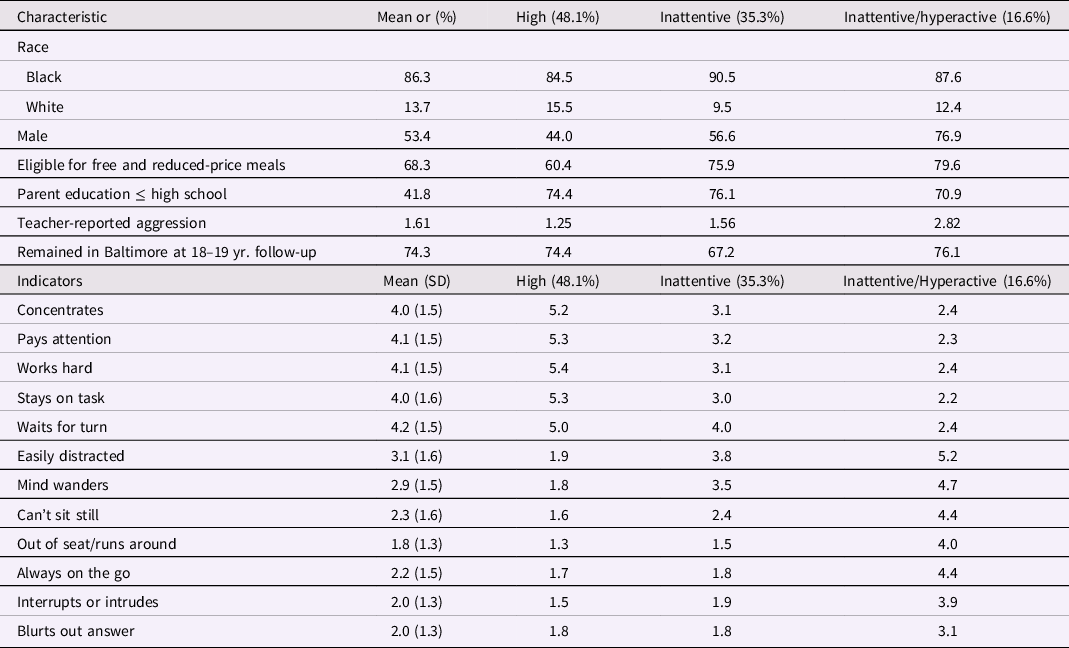
Characteristics of the sample are summarized in Table 2. Most participants were Black (87%), and more than two-thirds (69%) were eligible for free or reduced-price meals.
Characteristics of study participants in the full sample and by high, inattentive, and inattentive/hyperactive self-control class (n = 570)
Self-control classes
Model comparison indicated that three classes provided the best fit for the data (Table 1). Although the BIC increased as additional classes were extracted, other fit indices supported the three-class model. The three classes corresponded to distinct and interpretable classes of self-control (Figure 1). The high self-control class (n = 279, 48.1%) had low probabilities of self-control problems like being easily distracted and high probabilities of behaviors such as staying on task. The inattentive class (n = 201, 35.3%) had moderate probabilities of problems like mind-wandering or being easily distracted but relatively low probabilities of hyperactive or impulsive behaviors such as running around or blurting out answers. The inattentive/hyperactive class (n = 90, 16.6%) demonstrated the highest probabilities of self-control problems on both inattentive and hyperactive/impulsive dimensions. In exploratory sensitivity analyses given the small proportion of white participants, we found the class structure and relationships between classes and outcomes to be similar.
Latent classes of teacher-rated self-control in first grade based on observed frequency of 13 specific behaviors rated from 1 (almost never) to 6 (almost always).

Role of covariates
Males were more likely to be in the inattentive/hyperactive class than the high self-control (OR = 3.73, 95% CI: 2.34, 5.94) or inattentive class (OR = 2.16, 95% CI: 1.33, 3.51). They were also more likely to be in the inattentive class compared to the high self-control class (OR = 1.72, 95% CI: 1.25, 2.37). Black children were somewhat more likely to be in the inattentive as compared to the high self-control class (OR = 1.80, 95%, CI: 1.10, 2.96). Children who received free/reduced meals were more likely to be in the inattentive/hyperactive (OR = 2.27, 95% CI: 1.38, 3.75) and inattentive (OR = 1.67, 95% CI: 1.17, 2.38) classes than the high self-control class. Parent education was unrelated to class membership.
The relationships between race, gender, receipt of free/reduced meals, parent education, and teacher-reported aggression and the outcomes of interest were examined. Race (Black; OR = 1.21), free/reduced meals (OR = 0.89), and parent education (OR = 1.15) were significant predictors of on-time high school graduation. Similarly, race (Black; OR = 1.21), gender (male; OR = 0.85), free/reduced lunch (OR = 0.87), and parent education (OR =1.09) were also significant predictors of college participation. Gender (male, OR = 0.77) and free/reduced lunch (OR = 1.19) were significant predictors of teen pregnancy but race, parent education, and teacher-reported aggression were not. Only race (Black, OR = 0.89) and free or reduced lunch (OR = 1.07) were significant predictors of substance use disorder, and only gender (male; OR = 1.19) and free or reduced lunch status (OR = 1.09) were significant predictors of involvement in the criminal justice system. Gender (male; OR = 1.12) was a significant predictor of incarceration but race, free/reduced lunch, parent education, and teacher-reported aggression were not.
Self-control and success in the transition to adulthood
The prevalence of some indicators of success during the transition to adulthood was significantly different in proportion across the latent classes of self-control (Table 3). On-time high school graduation differed across the classes (χ2(2) = 14.57, p = 0.0007); the largest proportion of individuals who graduated on time were in the high self-control class. College participation also differed across the latent classes (χ2(2) = 10.74, p = .005), with the highest proportion in the high self-control class. For both educational outcomes (high school graduation, college participation), we observed a dose–response relationship such that children in the inattentive/hyperactive class had more negative outcomes in the transition to adulthood than those in the inattentive class who, in turn, had more negative outcomes than the high self-control class. We observed this same dose-dependent trend for both incarceration (χ2(2) = 1.09, p = .58) and substance use disorder (χ2(2) = 0.354, p = .84) but differences among the classes were not statistically significant for these outcomes.
Relationship between latent classes of self-control in childhood and indicators of adaptation during the transition to adulthood and demographic covariates based on Omnibus chi-squared test of latent class means or pairwise comparisons (n = 570)
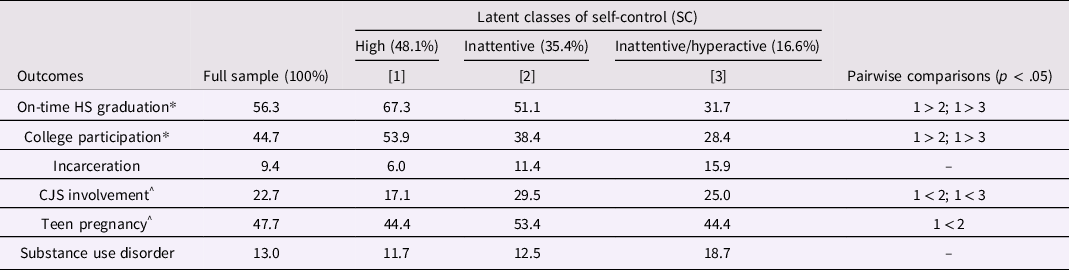
CJS = Criminal justice system; HS = High school.
* Denotes significant (p < .05) omnibus Chi-squared test of group difference between latent class means.
^ Denotes significant (p < .10) omnibus Chi-squared test of group difference between latent class means.
Differences across classes in criminal justice system involvement approached statistical significance, (χ2(2) = 5.27, p = .07) with the largest proportion of individuals involved with the criminal justice system in the inattentive class. Significant pairwise differences were found between the high self-control and inattentive/hyperactive classes as well as the high self-control and inattentive classes for criminal justice system involvement. Similarly, differences across classes approached but did not reach statistical significance for teen pregnancy (χ2(2) = 6.611, p = .06), with significant pairwise differences found between the high self-control and the inattentive class.
We explored whether the classroom-centered or family–school partnership intervention in first grade moderated the relationship between class membership and adult outcomes in both adjusted and unadjusted models (Table 4). In unadjusted models, assignment to the classroom-centered intervention moderated the relationship between self-control classes and teen pregnancy, incarceration, and criminal justice involvement. In models accounting for covariates, several moderation estimates reached statistical significance. Individuals in the high self-control class who received the classroom-centered intervention were less likely to have criminal justice system involvement (est. = −0.110, OR = 0.90, p = 0.031). Similarly, individuals in the high self-control class who received the classroom-centered intervention were less likely to meet diagnostic criteria for a substance use disorder (est. = −0.121, OR = 0.89, p = 0.007).
Results of moderation analysis by intervention status. Estimates are odds ratios and 95% CIs
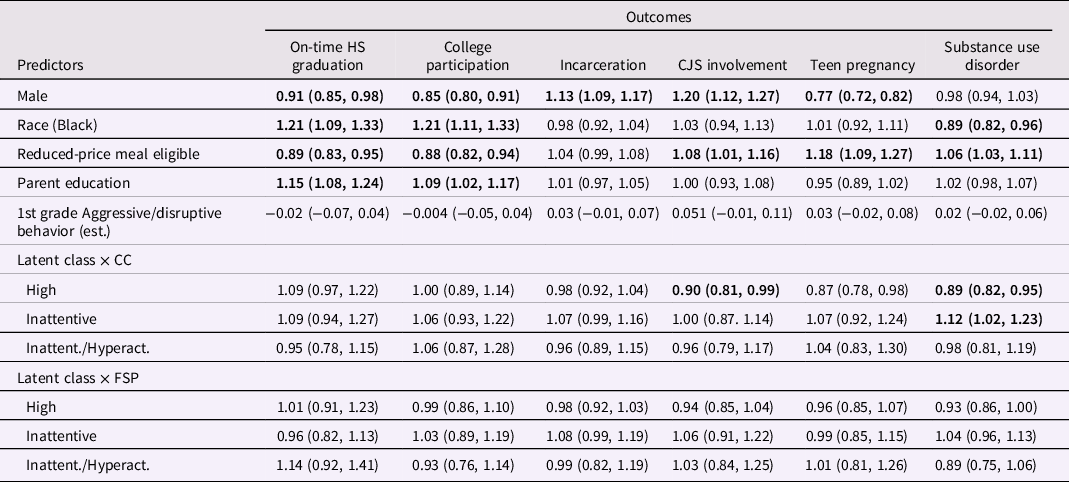
Note. HS = High school; CJS = Criminal justice system; CC = Classroom Centered Intervention; FSP = Family School Partnership Intervention; Inattent./Hyperact. = inattentive/hyperactive.
Discussion
This study evaluated the prospective relationship between self-control in first grade and young adult outcomes in a sample of children in the urban US, most of whom identify as Black; prior studies outside of the United States have focused on predominately white samples. Understanding the developmental antecedents of young adult outcomes with substantial individual and public health burden across developmental contexts is important to informing preventive interventions and targeted supports.
We expected to find classes of self-control that generally reflected the inattentive, hyperactive, and inattentive/hyperactive typologies typically associated with ADHD. Partially consistent with our hypothesis, three classes of children were identified: one class characterized by good self-control, another by moderate frequency of inattentive behaviors but infrequent hyperactive behaviors, and a third by high frequency of both inattentive and hyperactive behaviors. Overall, the high prevalence of children in the inattentive (35.4%) and inattentive/hyperactive (16.6%) classes reflects that our measure captured non-clinical levels of ADHD symptoms. In contrast, in a longitudinal study conducted of low-income children, Shaw et al. (Reference Shaw, Lacourse and Nagin2005) found that only 20% of children were in a trajectory group characterized by persistent teacher-rated inattention between ages 6 and 10; however, the study evaluated the persistence of inattention across development using the CBCL, which is commonly used in clinical settings. Interestingly, counter to our expectations, we did not observe a class characterized by hyperactivity alone. This may be because hyperactivity in the absence of attention and engagement in classroom tasks was too infrequent to capture using this approach. It also may be that teachers were more sensitive to off-task behavior and inattention among students with motor impulsivity.
Young children who exhibited better self-control were more likely to graduate from high school on time and matriculate to college. Our results are generally consistent with findings in predominately white samples linking poor self-control in adolescence to greater likelihood of being caught in “adolescent snares” that can impact individuals’ life trajectories (Fergusson et al., Reference Fergusson, Boden and Horwood2013; Moffitt et al., Reference Moffitt, Arseneault, Belsky, Dickson, Hancox, Harrington and Caspi2011). Importantly, however, we failed to find statistically significant associations between early life self-control and later criminal justice system involvement, teen pregnancy, incarceration, or substance use disorder, which have been previously documented in some international cohorts (Fergusson et al., Reference Fergusson, Boden and Horwood2013; Moffitt et al., Reference Moffitt, Arseneault, Belsky, Dickson, Hancox, Harrington and Caspi2011).
For educational outcomes, namely on-time high school graduation and college participation, we observed a dose-response relationship such that having more domains of self-control challenge was associated with poorer outcomes, even after accounting for aggressive/disruptive behavior. For example, more than two-thirds of children in the high self-control class graduated on time compared to half of those in the inattentive class and less than a third of those in the inattentive/hyperactive class. A similar pattern was observed for college participation. These findings echo the graded relationship between self-control and adult outcomes noted in international cohorts (Moffitt et al., Reference Moffitt, Arseneault, Belsky, Dickson, Hancox, Harrington and Caspi2011). While differences among the classes did not reach statistical significance, we also observed this dose-response trend for incarceration and substance use disorder. Children who are both inattentive and hyperactive may encounter more challenges with classroom, may be labeled as disruptive, or may be more likely to be involved in risky behaviors that compound the impact of inattention alone.
Interestingly, for criminal justice system involvement, we did not observe this dose–response relationship. Children in the inattentive class were most likely to have criminal justice system involvement. There was no significant added risk associated with hyperactivity. The reason for this is unclear. Prior research demonstrates that among young adults of color in urban environments, contact with police is common; people of color are more likely to be stopped by police than their white peers for the same or lesser infractions (Pierson et al., Reference Pierson, Simoiu, Overgoor, Corbett-Davies, Jenson, Shoemaker and Goel2020). Thus, in our sample, the likelihood of arrest may be related not just to behavioral dysregulation or engagement in ASBs but also disproportionate scrutiny by law enforcement.
Like criminal justice system involvement, we observed the highest likelihood of teen pregnancy among those in the inattentive group. While we did not see significant differences among the classes, our results may have been related to gender differences across the classes. The majority of those in the inattentive/hyperactive class, the class in which the likelihood of teen pregnancy was lowest, were male. Males may have been unaware of causing a pregnancy. The lack of findings related to teen pregnancy may also have been influenced by the shorter interval in which individuals were at risk for the outcome compared to criminal justice system involvement, for example, which was assessed through age 26.
Our findings differ from prior longitudinal cohort studies in predominately white international cohorts that have found that better childhood self-control is related to less substance dependence and incarceration (Fergusson et al., Reference Fergusson, Boden and Horwood2013; Moffitt et al., Reference Moffitt, Arseneault, Belsky, Dickson, Hancox, Harrington and Caspi2011). The difference in findings may be partially explained by prevalence; substance use disorder was approximately half as prevalent in the current sample as in some prior studies (Moffitt et al., Reference Moffitt, Arseneault, Belsky, Dickson, Hancox, Harrington and Caspi2011). Further, it is possible that different age patterns of substance use contribute to differences in detected associations. Rates of substance use among Black individuals are lower than among white individuals during adolescence and emerging adulthood before climbing later in adulthood (Banks & Zapolski, Reference Banks and Zapolski2018; Wu et al., Reference Wu, Woody, Yang, Pan and Blazer2011).
The reasons that childhood self-control was less predictive of some outcomes in the current study compared to prior international studies is unclear; these differences might be explained, in part, by children in this cohort’s greater exposure to concentrated socioeconomic disadvantage and structural and interpersonal racism. This suggests that to optimize outcomes for young people across the spectrum of early childhood self-control, interventions that address structural barriers to opportunity and good health should be considered alongside individual- and family-based strategies (O’Brien et al., Reference O’Brien, Neman, Seltzer, Evans and Venkataramani2020).
Even modest gains in self-control in early life have been shown to improve adult outcomes (Moffitt et al., Reference Moffitt, Arseneault, Belsky, Dickson, Hancox, Harrington and Caspi2011). Interventions to improve self-control have been associated with better social skills, academic achievement, mental health, and behavior, as well as less substance abuse in children and adolescents (Pandey et al., Reference Pandey, Hale, Das, Goddings, Blakemore and Viner2018). However, individual differences in self-control are multifactorial; current evidence points to the role of attachment and caregiving relationships, temperament, nutrition, chronic stress, toxic exposures, sleep, and contextual factors (Jackson & Beaver, Reference Jackson and Beaver2013). Thus, interventions must address both individual and contextual influences on self-control. Life course models of human development (Bronfenbrenner, Reference Bronfenbrenner1979; Bronfenbrenner & Ceci, Reference Bronfenbrenner and Ceci1994; Elder, Reference Elder1998; Kellam & Rebok, Reference Kellam, Rebok, McCord and Tremblay1992) suggest that intervening early to improve self-control can prevent disruptions during the transition to adulthood (Bailey et al., Reference Bailey, Hill, Guttmannova, Oesterle, Hawkins, Catalano and McMahon2013). Studies of long-term outcomes of early self-control interventions like FCU demonstrate that family-based interventions to support the development of self-control in early childhood can support better inhibitory control in middle childhood and reduced internalizing and externalizing symptoms by the transition into high school (Hentges et al.). Indirect intervention effects on teacher-reported self-control and oppositional defiant behavior in the classroom have also been demonstrated (Chang et al., Reference Chang, Shaw, Dishion, Gardner and Wilson2014).
In the current study, we found that children in the high self-control class who received the classroom intervention were less likely to have criminal justice system involvement and less likely to meet diagnostic criteria for a substance use disorder. While we hypothesized that the effects of the interventions would be concentrated among those with poor self-control at baseline, we saw unanticipated benefits for those in the high self-control class. It is possible that children with high self-control at baseline were best positioned to be able to reap the benefits of improved classroom environments. Children with deficits in self-control were the smaller proportion of participants; this, combined with the relatively low prevalence of some outcomes (e.g., incarceration) may have limited power to detect moderating relationships.
Strengths and limitations
Strengths of this analysis include 20 years of follow-up of children underrepresented in previous studies, teacher-rated self-control, and self and administratively reported outcomes. This multi-informant approach reduces shared method biases.
The results of this study should also be considered in light of several limitations. A larger number of teacher-rated self-control items may have revealed more nuanced classes. We were unable to account for teacher characteristics such as gender and race that might have biased teacher reports of child self-control. Prior studies suggest that Black boys’ behavior may be rated more negatively by educators, regardless of their race (Gilliam et al., Reference Gilliam, Maupin, Reyes, Accavitti and Shic2016). It is also possible that teachers were more sensitive to some kinds of self-control failure than others; this could have influenced self-control class assignments since teachers rated all students in their classroom. We did not include intermediate outcomes between first grade and young adult assessments. Pregnancies could have been underestimated by male participants who were unaware of the outcome in their female partners. At the 18–19-year follow-up, 63% of participants remained in Baltimore; this proportion was similar across classes of self-control; however, we were not able to account for duration in Baltimore for those who moved. Unmeasured confounding could bias study results despite the relative homogeneity of the cohort with respect to community and school experiences. Additionally, sensitivity analyses suggested that self-control class structure was similar by race; however, a larger sample of white participants is needed to test measurement invariance and differential item functioning. Finally, prior studies in this cohort have identified gender differences in intervention effectiveness (Ialongo et al., Reference Ialongo, Werthamer, Kellam, Brown, Wang and Lin1999; Petras et al., Reference Petras, Masyn and Ialongo2011). We were not powered to examine the potential moderating relationships between self-control classes and study outcomes separately by gender.
Implications
Self-control in childhood provides a foundation for health and success in the transition to adulthood; this transition, in turn, sets the stage for health and productivity across the life course. The multilevel determinants of self-regulatory development underscore the need for a multifactorial approach to intervention. For example, given that parents and caregivers are central (Colman et al., Reference Colman, Hardy, Albert, Raffaelli and Crockett2006), programs that support the economic stability of families with young children, increase access to high-quality childcare, promote positive parenting, and support parental mental health and well-being, can play a role in reducing the individual and societal burden of negative outcomes in the transition to adulthood.
The predictive validity of self-control has been demonstrated in preschool, highlighting the opportunity to intervene to support self-control development well before school age (Robson et al., Reference Robson, Allen and Howard2020). Early childhood self-control challenges deserve specific focus and intervention in clinical and preventive interventions. For young children with self-control challenges, a tiered approach that includes more intensive, tailored selected or indicated interventions, alongside universal intervention approaches that support all students, may help alter trajectories of behavioral risk (Conduct Problems Prevention Research, 2000). Interventions that are harmonized across multiple settings (home, school, health care) rather than delivered in a single setting are most effective (Conduct Problems Prevention Research, 2000).
While the results of this study provide additional support for the link between early life self-control and long-term outcomes, in this sample of children raised in Baltimore, self-control predicted a narrower range of outcomes than in some previous cohort studies in predominately white samples. Thus, alongside deploying interventions to promote self-control, efforts are also needed to further understand and address structural factors that drive young adult outcomes in the urban US. There is some evidence that self-control comes at a biological cost for disadvantaged groups. In a study of African American adolescents exposed to substantial adversity, Miller and colleagues found that those with high self-control had better outcomes but evidence of faster biological aging at age 22 (Miller et al., Reference Miller, Yu, Chen and Brody2015). Similar studies of young children are lacking. Nonetheless, Miller’s findings suggest caution in advocating individually-focused interventions to improve self-control without parallel efforts to reduce structural barriers to success. An intervention approach that conceptualizes individual developmental processes in their broader familial, neighborhood, and social contexts is essential.
Acknowledgments
This study was supported by NIH R01HD093643 to SBJ and RJM and R01MH57005 and R01DA11796 to NI.
Conflicts of interest
None.


 Open access

