

The Upper Santa Cruz Valley
The Upper Santa Cruz Valley is located within extreme southern Arizona and northern Sonora, Mexico. Its headwaters begin in Arizona’s San Rafael Valley and take a 60 km southward–northward flow through Sonora before reentering Arizona for approximately 30 km, crossing through present-day Nogales, Rio Rico, and Tumacácori (Figure 1). Many tributaries—including Sonoita Creek, Potrero Creek, and Nogales Wash—feed into the Santa Cruz and served as essential lifelines for the region’s precolonial inhabitants. These waters also became important trade routes that linked local inhabitants to the Hohokam of present-day southern Arizona and the Trincheras of northern Sonora.
Map of Arizona-Sonora borderlands highlighting precolonial sites with plain ware that were analyzed for this project. Inset map includes traditional Trincheras and Hohokam boundaries in relation to project area (map prepared by Hunter M. Claypatch).

Although the Upper Santa Cruz (subsequently “USC”) is significant for reconstructing precolonial trade and cultural “frontiers,” formal archaeological research is markedly less than elsewhere in Arizona or Sonora. Edward Danson (Reference Danson1946) provided the only systematic survey of the valley, and many sites that he recorded have never been subject to reevaluation. Our limited understanding of the region can, in part, be attributed to an absence of urban development and the need for cultural resource management projects. The contemporary US-Mexico border also inhibits knowledge dissemination, and those working in the USC are typically tied to institutions within the precolonial Hohokam heartland (Tucson or Phoenix, Arizona). Trincheras material culture from northern Sonora is abundant along the USC, but researchers have historically failed to incorporate critical archaeological knowledge from south of the international border (see McBrinn and Webster Reference McBrinn, Webster, Webster and McBrinn2008). Instead, investigators have reinforced traditional culture area boundaries, intrusive decorated ceramics, and Wallerstein’s (Reference Wallerstein1974) “core/periphery” model for mapping precolonial “World Systems.” These models frame the USC as culturally peripheral to Hohokam or Trincheras cultural “cores,” and, in turn, outside wider academic discourse.
As with all regions across the Southwest United States and Northwest Mexico (subsequently “Southwest/Northwest”), plain wares dominate ceramic assemblages. Unfortunately, within the USC, considerably more attention has been paid to identifying intrusive decorated pottery. Previous scholars have provisionally described the region’s plain wares (see Heckman Reference Heckman, Deaver and Van West2001; Jácome Reference Jácome1986; Montgomery and Deaver Reference Montgomery, Deaver and Kwiatkowski2002), but there has been no consensus regarding their descriptions or their value in reconstructing precolonial Indigenous lifeways. Ceramics produced by neighboring Trincheras and Hohokam artisans differed in their methods of construction, with Trincheras potters using the coil-and-scrape technique and the Hohokam utilizing paddle-and-anvil construction. Given that Indigenous populations along the USC lived between these better-studied regions, a study of construction techniques provides fruitful possibilities for reconstructing local communities of practice and potter responses to external influences. Such a study, until now, has never been conducted.
Contrary to earlier scholars, who positioned the region as peripheral to neighboring cultural “cores,” we incorporate Homi Bhabha’s (Reference Bhabha2004) concept of “third space” and multiscalar communities of practice to argue that the USC was a dynamic region of cultural expression. Although practice theory has been widely applied within archaeological literature, comparatively few studies have incorporated Third Space theory. We believe that its application has considerable potential for exploring precolonial frontiers across the Americas and beyond.
Previous Research in the Upper Santa Cruz
Over a century ago, excavations at Sonoita Street (AZ EE:09:68) in downtown Nogales, Arizona, provided the first research from within our study area (ASM Site Card). Several reconstructible vessels were recovered, including the first examples assigned to the Trincheras tradition. Shortly after, Gladwin and Gladwin (Reference Gladwin and Gladwin1929) and Sauer and Brand (Reference Sauer and Brand1931) conducted surveys across the Arizona-Sonora borderlands. Their investigations led to the formal definition of the Trincheras tradition and the suggestion that the precolonial Trincheras-Hohokam “boundary” aligned remarkably closely with the modern international border.
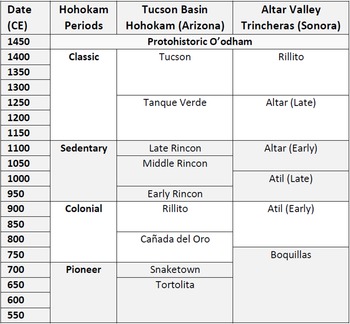
As research within the Phoenix and Tucson basins expanded, interest in the USC focused on better understanding its relationship to the Hohokam heartland (Figure 2). Paloparado (AZ DD:08:12) was the first site in the area to be systematically excavated, and it included an extremely large habitation that spanned several centuries. From this, Charles Di Peso (Reference Peso and Charles1956:251–268) constructed a complex and fanciful history, whereby Indigenous populations inhabited the region until approximately AD 900. Following this, Di Peso argued for a “Hohokam intrusion”—one that displaced local populations and resulted in the region’s Hohokam-like characteristics. By approximately AD 1250, Indigenous populations purportedly reasserted themselves and drove the Hohokam from the USC. Within this narrative, the Trincheras tradition was interpreted as culturally distinct from Indigenous populations (Di Peso Reference Peso and Charles1956:273, 356).
Hohokam and Trincheras periods and phases discussed within this article (from Claypatch [Reference Claypatch2022] and Wallace [Reference Wallace and Wallace2003]).

Di Peso’s (Reference Peso and Charles1956:298–305) work at Paloparado also resulted in the first discussion of local plain wares. He categorically organized the pottery into two types—“Ramanote Plain” and “Paloparado Plain”—and suggested that they could be differentiated based on the presence of tool polishing (Paloparado Plain) or hand-finishing (Ramanote Plain). Di Peso’s “Hohokam Intrusion” model and established ceramic typologies, however, both fell under immediate criticism. In the 1960s, Paul Grebinger conducted excavations at a new portion of Paloparado and at Potrero Creek (AZ EE:09:53), a site located within present-day Nogales, Arizona. Contrary to Di Peso, Grebinger (Reference Grebinger1971:71, 159–167) interpreted Potrero Creek as a Hohokam-derived cultural manifestation and suggested that many diagnostic Trincheras artifacts were also locally produced. He also argued that the distinction between Di Peso’s (Reference Peso and Charles1956) “Ramanote Plain” and “Paloparado Plain” were baseless because diverse morphological traits could be observed within a single vessel (Brown and Grebinger Reference Brown and Grebinger1969:190). The ability to replicate Di Peso’s typologies has been repeatedly questioned, and they have not been used by academics for several decades (Claypatch and Vega Reference Claypatch and Vega2025; Doyel Reference Doyel1977a:26–29; Heckman Reference Heckman, Deaver and Van West2001:92; Jácome Reference Jácome1986:53).
By the 1980s, academic and cultural resource management projects led to the documentation of numerous sites along the USC (Doyel Reference Doyel1977a; Jácome Reference Jácome1986; Reinhard and Fink Reference Reinhard and Fink1982; Reinhard and Shipman Reference Reinhard1978). Most authors were based in Tucson, Arizona, and they used growing knowledge of Hohokam ceramics to suggest a peak regional occupation during the Rillito and Rincon phases (AD 850–1150). From this, David Doyel (Reference Doyel1977b:102) suggested that the region was a “near empty niche” that the Hohokam began exploiting around AD 850. These projects also reinforced earlier assumptions that the modern Arizona-Sonora border acted as a boundary between the Hohokam and the Trincheras. Karl Reinhard used excavations from Sonoita Street (AZ EE:09:68) and St. Andrew’s (AZ EE:09:67) to frame the USC as a “contact zone” between the two traditions and suggested that the region was dynamically impacted by both regional heartlands (Reinhard and Fink Reference Reinhard and Fink1982; Reinhard and Shipman Reference Reinhard1978:247).
Contrasting interpretations of the USC continued into the early twentieth century. Excavations by Carla Van West and William Deaver (Reference West, Carla, Deaver, Deaver and Carla2001:185) at El Macayo (AZ EE:09:107) resulted in an emphasis on localized cultural practices—ones that derived inspiration from neighboring regions but were reinterpreted in unique ways. By contrast, Scott Kwiatkowski’s (Reference Kwiatkowski and Kwiatkowski2002:451–454) work at Aldea Inesperada (AZ EE:09:175), approximately 12 km north of El Macayo, led to a proposed “frontier” model, whereby residents from either heartland gradually coalesced into a region believed to have been sparsely populated previously.
Recent archaeologists have not applied typological names to local USC plain wares. Instead, they have aimed to describe surface treatment and temper variability. Importantly, virtually no attempt has been made to document local construction techniques (see Montgomery and Deaver [Reference Montgomery, Deaver and Kwiatkowski2002:189] for a brief discussion from Aldea Inesperada). Following excavations at Nogales Wash (AZ EE:09:93), Felipe Jácome (Reference Jácome1986:52–53) employed three plain-ware categories for his assemblage: Plain I, II, and III. Plain I and II were differentiated based on the presence of surface polishing, and Plain III was used for highly micaceous Gila Plain pottery produced by the Hohokam. Robert Heckman (Reference Heckman, Deaver and Van West2001:90–92) developed a similar classification for his work at El Macayo. He used “Type I” for “hand-modeled” pinch pots and “Type II” for the majority of locally produced plain ware.
Archaeological “Third Spaces”
As illustrated, previous scholars have interpreted the USC differently, with each perspective derived from individual sites and with virtually no regional comparison or synthetic discussion. Di Peso (Reference Peso and Charles1956) and Van West and Deaver (Reference West, Carla, Deaver, Deaver and Carla2001) emphasized the presence of a distinctive Indigenous population but presented their data in vastly different ways. In contrast, Doyel (Reference Doyel1977b), Reinhard and Shipman (Reference Reinhard1978), and Kwiatkowski (Reference Kwiatkowski and Kwiatkowski2002) suggested either a cultural “frontier” or a sparsely populated landscape that was free for migrating populations to instill their cultural values. In all cases, inhabitants along the USC were interpreted as passively subordinate to Trincheras or Hohokam cultural “cores.” These perspectives also fail to consider how the emergence of new people and/or ideas would have dramatically altered Indigenous lifeways or how local responses would have further catalyzed their identities as something unique and agentive.
Since the 1970s, Immanuel Wallerstein’s (Reference Wallerstein1974) World Systems model has influenced archaeologists interested in regional cultural interactions. By studying contemporary economic and political structures, Wallerstein created a framework for mapping the relationship between colonial “core” powers and their exploited “peripheral” subjects. Although influential, archaeologists have critiqued the World Systems model for its capitalist-derived framework and its assumption that “peripheral” frontiers were passive and without agency (see Lightfoot and Martinez Reference Lightfoot and Martinez1995; Wolf Reference Wolf1982). Within these critiques, interdisciplinary scholars argue that populations within liminal frontiers are not “peripheral” but socially charged and capable of catalyzing their own unique forms of cultural expression (see Anzaldúa Reference Anzaldúa and Keating2015; Bhabha Reference Bhabha2004; Cusick Reference Cusick2000; Lightfoot and Martinez Reference Lightfoot and Martinez1995).
Bhabha’s (Reference Bhabha2004:55–56) Third Space theory critically considers the impact of migration on Indigenous populations. Bhabha conceptualizes “third spaces” as places of liminality, where Indigenous populations are engaged in constant acts of negotiation, rejection, hybridization, and/or acceptance of external peoples or ideas (Kalua Reference Kalua2009:25). Through this tension, third spaces become places of kinetic movement, resilience, and agency—ones born from the unique fusion of multiple cultures and manifested in ways that best suit local identities. Although initially envisioned as a framework for contemporary colonialism, the aim of third space to understand the repercussions of cross-cultural interactions has applicability to both past and present cultures.
As a concept, “third space” is applicable not only to physical spaces, or material objects, but to internalized identities. As Stuart Hall (Reference Hall, Williams and Chrisman1994:225) notes, cultural identities are ever-evolving and are the product of a lived/shared history that is in a continuous “play” with external forces. Gloria Anzaldúa’s (Reference Anzaldúa and Keating2015:68–74), study of Mestizaje along the US-Mexico border explores this history and highlights how “dwelling in liminalities” creates distinctive and hybridized identities that often contrast with outside social norms. As with Bhabha, Anzaldúa’s work explores the physical and ideological outcomes of living in a “space” created by the confluence of two or more cultures.
Despite its wide usage in contemporary border studies, and its direct applicability for critically evaluating precolonial cultural boundaries, third space has seen surprisingly little usage within archaeological literature (see Naum [Reference Naum2010] for a noteworthy exception). As an archaeological tool, we believe that “third space” can critically interrogate the dynamic cultural interplay between opposing and/or distinct populations and also provide a platform for discussing historically understudied precolonial regions. An examination of material evidence from these regions through a third space framework enables us to explore how Indigenous populations actively negotiated external influences and responded in ways that best aligned with their ever-changing identity.
“Third Space” and Communities of Practice
Ceramics from the USC provide an exceptional opportunity for understanding local cultural expression at a precolonial third space and for tracing communities of practice on a multiscalar level. In recent decades, practice theory—or communities of practice—has been widely applied in archaeological contexts to emphasize the process of embodied learning and its impacts on the social world (Joyce Reference Joyce, Cordell and Habicht-Mauche2012). Key tenets to communities of practice are knowledge acquisition through situated learning and formalized apprenticeship. The crafts resulting from this learning are therefore reflective of wider community values, ensuring that engrained social doxa persists through time (Cordell and Habicht-Mauche Reference Cordell, Habicht-Mauche, Cordell and Habicht-Mauche2012; Crown Reference Crown, Skibo and Feinman1999; Eckert et al. Reference Eckert, Schleher and James2015; Lara et al. Reference Lara, Ramón and Bray2024).
Although plain wares dominate ceramic assemblages across the Southwest/Northwest, practice theory has most traditionally been applied to decorated ceramics. This is because plain wares are thought to possess fewer measurable attributes and to undergo slower rates of stylistic change than their decorated counterparts (Habicht-Mauche and Burgess Reference Habicht-Mauche, Burgess, Brown, Condie and Crotty2016:134). This, however, undermines the potential value of plain ware within a community and means that the extrapolation of potter identity is formed though only a small portion of a given assemblage. Recent application of practice theory to plain wares has shed important insights into trade and interaction and into identifying subtle differences in manufacturing techniques (Espinosa et al. Reference Espinosa, Druc, Millaire, Prieto, Bracamonte and Alva2024; Habicht-Mauche and Burgess Reference Habicht-Mauche, Burgess, Brown, Condie and Crotty2016). As Alicia Espinosa et alia (Reference Espinosa, Druc, Millaire, Prieto, Bracamonte and Alva2024:690) have noted for ceramics in Peru, the slow rate of stylistic change within plain wares is particularly useful for documenting “profound changes” that occur over several centuries.
As Etienne Wenger (Reference Wenger1998:126–127) and others acknowledge, even highly formalized practices are subject to external influence, particularly in dynamic frontiers where various communities of practice may overlap. Individuals in these regions may belong to numerous communities of practice and consciously amalgamate their practice to satisfy outsiders or to emphasize distinctive identities (Peelo Reference Peelo2011; Stahl Reference Stahl, Roddick and Stahl2016). These dynamic practices may crosscut families, sites, or regional boundaries and may be held together by what Wenger (Reference Wenger1998) calls “brokers,” or individuals who bridge various disparate communities. As with frontiers themselves, brokers may exist outside local communities of practice, but can enact dynamic cultural change, particularly within regional third spaces (Stahl Reference Stahl, Roddick and Stahl2016).
Research Methods
Beginning in 2023, we began a regional reanalysis of plain-ware ceramics from 23 sites along the USC and its tributaries. We were particularly interested in documenting the region’s manufacturing techniques and the way regional and/or temporal variability could aid in understanding communities of practice within this archaeological third space. Occupation of our chosen sites spanned from approximately AD 850 to 1500, and artifacts were housed at five curation facilities across Arizona: Arizona State Museum and the Western Archaeological Conservation Center in Tucson; Pimeria Alta Historical Society and St. Andrew’s Episcopal Church in Nogales; and the Amerind Museum inDragoon.
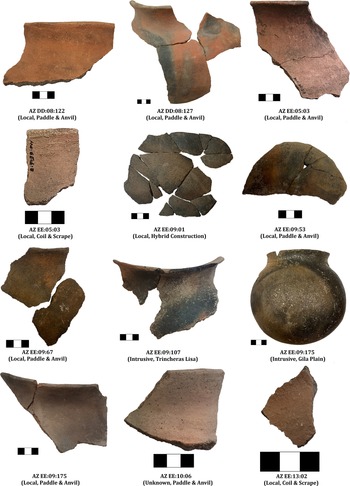
In total, 1,839 sherds were analyzed, including 89 reconstructible vessels (Figure 3). All conjoining sherds and vessels were recorded as a single dataset, ensuring that data were not improperly skewed by sherds that belong to the same vessel. In some cases, available assemblages were biased by institutional culling and/or historical collection methods. At St. Andrew’s, Sonoita Street, and Cemetery Ruin, excavators had preferred the collection of complete and reconstructible vessels, and relatively few sherds were available for analysis. Similarly, plain ware from Potrero Creek was extremely limited, and it primarily comprised reworked sherds and a small survey collection at Arizona State Museum.
Selected analyzed sherds (sherds photographed by authors and used with permission from Arizona State Museum). (Color online)

Most sites follow 30 km of development along Interstate 19, from the international border to Tumacácori Mission. This included eight sites within present-day Nogales, Arizona; two near the boundary of Nogales and Rio Rico; and eight between Rio Rico and Tumacácori. Two sites, Screaming Eagle (AZ EE:05:01) and AZ EE:05:03, were located along Sonoita Creek, near present-day Patagonia. An additional two sites, AZ EE:10:06 and AZ EE:13:02, fell within poorly documented areas near the start of the Santa Cruz. AZ EE:13:02 was the only sampled site located in Sonora, Mexico, and is among the few sites documented along the Sonoran side of the USC (Danson Reference Danson1946). AZ EE:09:06, another Sonoran site, was also selected for analysis; however, only one highly fragmentary sherd was curated by Arizona State Museum. An additional site, AZ DD:07:22, was located approximately 27 km west of the Santa Cruz River. It was selected because of its distinctive temper source that we hoped could be identified within the other analyzed sites (Montgomery and Deaver Reference Montgomery, Deaver and Kwiatkowski2002; Whittlesey and Ciolek-Torrello Reference Whittlesey and Ciolek-Torrello1992).
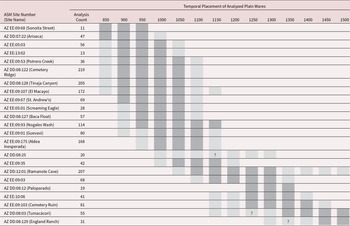
Whenever possible, we prioritized ceramics originating from features yielding either chronometric dates and/or decorated ceramics for indirect dating (Table 1). In all but six sites (AZ EE:05:01; AZ EE:05:03; AZ EE:09:03; AZ EE:09:35; AZ EE:10:06; and AZ EE:13:02), ceramics were recovered from excavated contexts. The six surface-collected sites contained abundant decorated ceramics and could be dated indirectly. They were also selected because they enhanced our understanding of regional ceramic variability. Guevavi (AZ EE:09:01) and Tumacácori (AZ DD:08:03) are well-known Mission-era sites (post–AD 1690), but we specifically targeted features that were directly or indirectly dated prior to European contact (Burton Reference Burton2004; Heidke et al. Reference Heidke, Palacios, Bondra, Thiel and Pavao-Zuckerman2017). Similarly, Paloparado had a long occupation, but interpreting site stratigraphy or occupational sequences has proven challenging (Wilcox Reference Wilcox and Doyel1987). Owing to this, we only selected reconstructible vessels from Classic period (AD 1150–1450) floor contexts.
Archaeological Sites Used within This Analysis, Including Total Analysis Count Proposed Temporal Placement.

Note: Shading indicates intensity of occupation within analyzed features/sites.
Our analysis began by selecting sherds weighing 10 g or more, because prior research demonstrated that smaller sherds provide insufficient attribute information. Nine attributes were analyzed for all sherds, including vessel form, vessel portion, construction technology, presence of polishing, sooting, scraping/wiping, fire clouding, sherd thickness, and paste/inclusions. An additional four attributes were measured if they were rim fragments and/or reconstructible vessels: rim form, rim orifice, vessel height/width, and percentage of original vessel. Claypatch (Reference Claypatch2022) provided parameters for variability within specific attributes (including “high” or “low” polish). All data were aggregated on a spreadsheet that could be divided by site and occupational period.
Identifying Construction Techniques
Given that inhabitants of the USC resided between two well-studied precolonial traditions, with each using differing ceramic construction techniques, we were particularly interested in understanding how vessel construction could aid in understanding local identities and communities of practice. Hohokam pottery was manufactured using the “paddle-and-anvil” technique, whereas Trincheras potters implemented “coil-and-scrape” manufacture (Haury Reference Haury1976; McGuire and Villalpando Canchola Reference McGuire and Canchola1993). Each technique involves various operational steps (chaîne opératoire) and leaves distinct signatures on the finished product (Lara et al. Reference Lara, Ramón and Bray2024:898; Rice Reference Rice2015).
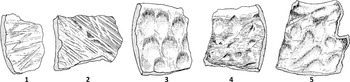
We implemented five construction categories for the analysis: “paddle-and-anvil,” “coil-and-scrape,” “hybrid,” “hand-built,” and “indeterminate” (Figure 4). “Paddle-and-anvil” construction typically results in dimpled interior surfaces and irregular vessel wall thickness. By contrast, “coil-and-scrape” construction produces vessels with comparatively thin and uniform vessel walls. Scrapes or wipe marks are often visible on the finished product. With “hybrid” ceramics, both paddle-and-anvil and coil-and-scrape techniques were coeval and fundamental to the finished product. We identified hybrid pottery based on the presence of multidirectional scrape/wipe marks that were placed intermittently between anvil dimples. Although uncommon, this technique has previously been documented at Trincheras tradition sites following the migration of Hohokam artisans into the region (Chiykowski Reference Chiykowski2016). “Hand-built” pottery, or “pinch pots,” were formed without initial coiling. Vessels are often small and have a highly irregular vessel surface. As anticipated, it was often not possible to determine the primary construction technique. This often occurred if a sherd was either too small or eroded. Equally challenging were rim or neck sherds, which often possessed amalgamated finishing techniques that differed from the main body of the vessel. We classified these sherds as “indeterminate.” These challenges should be expected by future ceramicists working along the USC.
Charles Di Peso’s illustration of different construction techniques from Paloparado: (1–2) various examples of coil-and-scrape construction; (3) paddle-and-anvil construction; (4) “hybrid” construction; (5) hand-molded construction (adapted from Di Peso [Reference Peso and Charles1956:331, Figure 51]; image used with permission from the Amerind Foundation).

Identifying Plain Ware Production Sources
Prior experience with ceramics along the USC provided us with a nuanced understanding of “local” temper variability (Claypatch and Vega Reference Claypatch and Vega2025). As Reynolds (Reference Reynolds1988) notes, the region’s geology consists of “Granitoid rocks (Jurassic)-Granite to diorite, with local alkaline rocks.” Similarly, in a small petrographic study, Montgomery and Deaver (Reference Montgomery, Deaver and Kwiatkowski2002) found that pottery from both El Macayo and Aldea Inesperada contain granitic rock and arkosic sandstone. Our analysis confirms these earlier studies, and it notes that ceramics near Nogales, Arizona/Sonora, are unified by a friable reddish-brown paste and fine alluvial sand inclusions. Rounded quartz is frequently visible, although other inclusions—including mica—are occasionally observed. Pottery from near Rio Rico is broadly homologous to examples from Nogales, but it often has a duller, grayish, paste with the occasional presence of fine biotite mica. Until future petrographic studies are conducted, locally produced ceramics are interpreted as part of the regional continuum of alluvial clay sources that span the USC and its respective tributaries.
In contrast to locally produced pottery, Trincheras Lisa (or “Trincheras Plain”) frequently possesses prominent interior scrape marks. Sherds contain coarse quartz and often bear an exfoliated surface. Trincheras pottery also typically fires a warm reddish-brown color, with a blackened core from incomplete firing oxidation (McGuire and Villalpando Canchola Reference McGuire and Canchola1993). Although provenience studies of Trincheras ceramics are limited, morphologically similar plain ware is regularly encountered within Sonora’s Altar Valley, approximately 80 km from the southern portion of the USC. Similarly, “Gila Plain” was used for highly micaceous muscovite paddle-and-anvil pottery that originated from north of the study area and within the so-called Hohokam heartland (Haury Reference Haury1976:223). Considering the low frequency of mica in USC pottery, Gila Plain was easily distinguishable.
AZ DD:07:22 provided the parameters for ceramics thought to have been produced west of the study area. Montgomery and Deaver (Reference Montgomery, Deaver and Kwiatkowski2002:211) demonstrated that pottery from this site contained a high presence of muscovite-bearing lithic grains and shale. Twenty-five percent of our sample from AZ DD:07:22 consisted of this temper, which suggests that the clay source was nearby. For pragmatic purposes, we classified these examples as “Arivaca-Tempered” pottery. An additional 19 sherds differed from any aforementioned temper source. These sherds contained variable inclusions and may originate from the Papaguería, southeastern Arizona, or other, more distant locations.
Temporal and Spatial Results
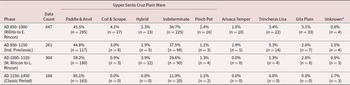
From the 1,839 sherds/vessels, 1,411 could be assigned to one of four temporal ranges: AD 850–1000 (Rillito to Early Rincon phase), AD 1000–1150 (Middle to Late Rincon phase), AD 850–1150 (Indeterminate Preclassic), and AD 1150–1450 (Classic period; Table 2). Site/features that could not be temporally placed were still used for our spatial analysis. Although AZ DD:07:22 served as a useful proxy for temper analysis, it was excluded from our temporal study because it fell outside of our primary study area.
Temporal Frequency of Analyzed Plain Ware.

a Three sherds from this study were classified as “Possible Whetstone Plain.” Two originated from Classic period occupations but were included as “Unknown” for this study.
Across time, paddle-and-anvil pottery remained the dominant local manufacturing technique, but its prevalence gradually increased over time. Locally produced coil-and scrape ceramics declined from 4.1% (AD 850–1000) to 0.0% (AD 1150–1450). A similar trend is also observed with locally produced “hybrid” ceramics. Intrusive plain-ware frequency also decreased over time. Between AD 850 and 1000, Trincheras Lisa, Gila Plain, and Arivaca-tempered pottery all make up a small but consistent portion of the assemblages. By AD 1000, their presence is significantly reduced, and they are entirely absent by the start of the Classic period.
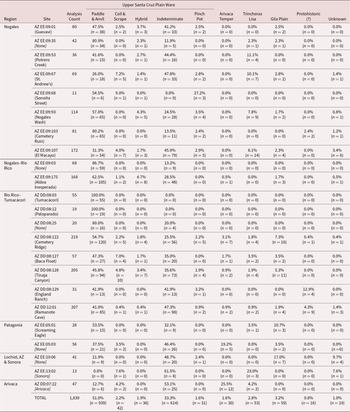
Spatial analysis provided a kaleidoscope of anticipated and intriguing results. Trincheras Lisa was most frequently encountered at sites near present-day Nogales, Arizona/Sonora, making up over 10% of assemblages at Potrero Creek, St. Andrew’s, and AZ EE:13:02 (Table 3). Although we currently have very little information from sites along Sonora’s USC, the high presence of Trincheras Lisa at AZ EE:13:02 (23%) reinforces that geographic proximity to the Trincheras heartland played a key factor in its intrusive frequency. Decorated ceramics from AZ EE:13:02 also suggest a primary occupation between AD 800 and 1050, the period when Trincheras material culture is greatest at other USC sites.
Breakdown of All Analyzed Plain Ware by Site and Identification.

Gila Plain was commonly documented at sites near Tumacácori, Rio Rico, and Patagonia. As with Trincheras Lisa, this was anticipated given these site’s closer proximity to the Tucson Basin. AZ EE:10:06 was a noteworthy exception, where 17.0% of plain-ware sherds were classified as Gila Plain. This site is known only from surface collections, and the high frequency of Gila Plain may be the result of sampling bias. The presence of surface-visible features and other intrusive pottery from Chihuahua and Southern Arizona, however, clearly suggest that it was a prominent regional center during the Classic period and possibly earlier (ASM Site Card).
“Arivaca-tempered” pottery is also geographically restricted. It was most frequently encountered at AZ DD:07:22, near Arivaca, and at sites near Rio Rico and Patagonia. Seven sherds (3.1% of analyzed pottery) were observed at Cemetery Ridge, located approximately 25 km east of AZ DD:07:22. “Arivaca-tempered” pottery was not observed within present-day Nogales; instead, it follows a distribution that is perpendicular to the USC. Although a geographic source for “Arivaca-tempered” clay remains speculative, our study suggests that it likely moved through trade networks which did not rely on the USC.
Sonoita Street possessed the highest frequency of both locally produced coil-and-scrape (9.0%) and hybrid ceramics (9.0%), but these results are skewed by a limited sample size (n = 11), which consists solely of complete vessels. Sites with the next-highest frequency of coil-and-scrape pottery are AZ EE:13:02 (7.6%), St. Andrew’s (7.2%), and Baca Float (7.0%). Considering their geographic location in relation to the Trincheras heartland, the high frequency of coil-and-scrape ceramics at AZ EE:13:02 and St. Andrew’s was anticipated; however, its high presence at the Baca Float site, approximately 22 km north of the international border, is intriguing. Other sites near Baca Float, including Tinaja Canyon (4.8%), also have comparatively high frequencies of local coil-and-scrape pottery. Similarly, the highest frequency of “hybrid” ceramics occurred at Aldea Inesperada (4.7%), Nogales Wash (4.3%), and Guevavi (3.7%). The regional distribution of both coil-and-scrape and hybrid pottery therefore suggests that potter manufacturing techniques were not exclusively dependent on proximity to the Trincheras heartland.
“Pinch Pots” of the Upper Santa Cruz
An unanticipated result from our study was the high frequency of hand-modeled “pinch pots.” In total, we classified 1.6% of all pottery as pinch pots. Bowls made up 38% of the sample and ranged from small hemispherical forms to trough-shaped forms. Jars were typically thick, and they lacked definable rim forms. There was also considerable variability within the thickness of pinch pots, ranging from 5.5 to 14.9 mm and averaging 8.8 mm. Vessel thickness meant that many pinch pots were often extremely heavy in relation to their small size.
Our study is not the first to document a high frequency of pinch pots along the USC. At El Macayo, Heckman (Reference Heckman, Deaver and Van West2001:78) classified 5.9% of all plain wares as pinch pots (or “Type I”). Our regional analysis supports that its frequency within the USC is significantly higher than elsewhere in the Southwest/Northwest. In an analysis of reconstructible vessels across 14 Mogollon Rim sites, pinch pots occurred with only 0.1% frequency (Herr Reference Herr1999:370–371), and Desert Archaeology’s database of over one million sherds from across the Tucson, Phoenix, and Tonto Basins, shows that less than 0.01% of all pottery were either miniature vessels or pinch pots (James Heidke, personal communication 2025). Similarly, pinch pots made up less than 0.1% of all plain ware from three sites recently excavated within Sonora’s Altar Valley (Claypatch Reference Claypatch2022). Comparably high frequencies of pinch pots have been documented during California’s mission period, although, in this case, ceramic innovations were brought to the region and adopted by otherwise aceramic populations (Peelo Reference Peelo2011:657).
Archaeologists across the US Southwest and Mexico often interpret pinch pots as the product of apprenticing children, as toys used for enculturation, or as ritual offerings (Crown Reference Crown2001, Reference Crown, Roddick and Stahl2016; De Lucia Reference De Lucia2010). As Fladd and Barker (Reference Fladd and Barker2019) note, none of these interpretations are necessarily mutually exclusive, and such vessels likely held important meanings among precolonial populations. Despite various interpretations, incentive for their high frequency along the USC remains unclear. Considering their rarity in the Trincheras or Hohokam heartlands, we propose that pinch pots were part of a distinctively local community of practice—one that persisted alongside centuries of external cultural influence and served as an important marker of third space identity. Importantly, several pinch pots from the USC possess an added rim coil (Figure 5), suggesting that potters desired to create a finished and usable vessel. This “finishing” appears incongruent with apprentice or child production.
Two reconstructible pinch pots from near present-day Nogales, Arizona: (left) a neckless jar from St. Andrew’s (AZ EE:09:67); (right) a trough-shaped bowl from El Macayo (AZ EE:09:107) (2001-182-84, ASM). Note evidence of an added coil near the tops of both vessels (drawings by Hunter M. Claypatch).

Reconstructing Communities of Practice along an Archaeological “Third Space”
Diagnostic projectile points confirm that the USC was inhabited very early and that it was not a vacant landscape for migrating Trincheras or Hohokam populations. This evidence includes a late Paleoindian fragment and numerous examples of Archaic and Early Agricultural period projectile points recovered from excavation and/or housed within local historical societies (Brown Reference Brown1967:61; Jácome Reference Jácome1986:64–66). By the eighth century, several centuries of ceramic manufacture across the Sonoran Desert resulted in a well-established—and deeply engrained—cultural practice of vessel manufacturing. Although we lack early dated features from the USC, local artisans were almost certainly skilled ceramicists who utilized their pottery for storage, cooking, and other practices. Around AD 750, intrusive Tucson Basin Hohokam ceramics—including Snaketown Red-on-brown and Cañada del Oro Red-on-brown—appeared in the USC. These early decorated ceramics occur in extremely low quantities and within temporally mixed contexts. Although these early intrusive ceramics highlight gradual interactions with the Tucson Basin, there is an absence of diagnostic Trincheras pottery that precedes AD 800.
A Period of Dynamic Cultural Interplay: AD 850 to 1000
Beginning around AD 850, rapid population growth within the Tucson and Phoenix basins is accompanied by an increase in village sizes, cremation practices, communal ballcourts, and an elaboration of preexisting canal systems (Roth Reference Roth2000:286). Within Sonora’s Altar Valley, an equally dramatic transformation included the rise of early polychrome ceramic manufacture and more expansive trade networks. Across both regions, decorated ceramics share overlapping designs and reflect cultural connectivity and extensive interactions (Claypatch Reference Claypatch2022; Heckman and Whittlesey Reference Heckman, Whittlesey, Heckman, Montgomery and Whittlesey2000). Indigenous inhabitants of the USC were at the heart of these transformations, forming a unique third space that accepted, resisted, and hybridized innovations from the Trincheras and Hohokam.
The introduction of migratory populations into the USC is supported archaeologically, and Anna Neuzil (Reference Neuzil2008:7–8) has observed that populations typically migrate to areas where they have preexisting social connections, including familial relations, trade networks, or shared languages. Although we lack a nuanced understanding of the push-pull factors leading to migration in the area, the high presence—and early occurrence—of Hohokam material culture along the USC suggests that most Indigenous residents retained deep connections and/or familial ties to populations to the north. This is further supported by the high frequency of locally produced paddle-and-anvil pottery. Importantly, variability within plain-ware manufacturing techniques and intrusive ceramics demonstrates that there is no direct correlation between site location and proximity to Trincheras or Hohokam heartlands. This suggests that each community along the USC had differing neighboring kin and that some populations may have retained stronger cultural ties with Trinchereños to the south.
Aside from a high frequency of pinch pots, local USC pottery had additional observable differences from vessels produced in either neighboring heartland. Construction of “hybrid” manufactured ceramics exemplifies third space identity by illustrating the active reinterpretation of Hohokam and Trincheras manufacturing practices. Furthermore, local coil-and-scrape pottery lacks the prominent interior scraping observed on Trincheras pottery within the Altar Valley. These differences highlight local potters’ ability to translate external ideas in new ways. They further suggest that any migratory artisans into the USC acted more as peripheral “brokers”—ones who exercised cultural influence but were incapable of fully disrupting Indigenous cultural practices.
A Gradual Transition: AD 1000–1150
During the eleventh century, or Middle Rincon phase (AD 1000–1100), the Tucson Basin Hohokam and neighboring San Pedro and Lower Verde valleys abandoned many of their larger settlements and ceased using ballcourts as a socially integrative tool (Craig and Woodson Reference Craig, Woodson, Mills and Fowles2017:340–341). From this came more insular communities of practice, whereby community stability was reliant on individual households (Roth Reference Roth2000:286, 291). Similar transformations are observed within Sonora’s Altar Valley. In what is known as the Altar phase (AD 1050–1300), potential conflict and/or resource instability is suggested by a transition toward occupying terraced volcanic hills (McGuire and Villalpando Reference McGuire and Villalpando2015). There are also changes in ceramic production, with simpler motifs and an abandonment of earlier polychrome technology (Claypatch Reference Claypatch2022).
These social transformations are apparent in contemporaneous sites along the USC. Sites such as Sonoita Street and St. Andrew’s were abandoned. There is also evidence for intensified population aggregation at other sites, such as Nogales Wash and Aldea Inesperada (Jácome Reference Jácome1986; Kwiatkowski Reference Kwiatkowski and Kwiatkowski2002). Perhaps most significant is a movement away from diversified ceramic manufacturing techniques and an increasing adoption of Hohokam-like paddle-and-anvil pottery. This technological transition is coupled with a rapid decline of Trincheras material culture and an abandonment of local coil-and-scrape manufacture. Although we do not currently understand the catalyst for these changes along the USC, they further suggest that the Indigenous inhabitants broadly retained deeper shared histories with Hohokam populations to the north than with Trinchereños. Local potters’ flexible adaptation of ceramic styles over only a few generations also reinforces Indigenous agency through their active acceptance and rejection of external innovations.
Even though eleventh-century sites along the USC suggest increasing insularity, the production of “hybrid” constructed vessels also increased. The increased production of hybrid plain wares can be interpreted in two ways. First, as Trincheras cultural influence gradually waned in the USC, communities that formerly produced coil-and-scrape pottery gradually adapted their manufacturing technique to the more dominant technological style. This technological adaptation has previously been proposed at the Sonoran site of Cerro de Trincheras (SON F:10:02) during times of increasing Trincheras-Hohokam interactions (Chiykowski Reference Chiykowski2016). We, however, note that “hybrid” manufacturing is labor intensive and requires skilled mastery of multiple construction techniques. Contrary to earlier notions of cultural absorption, we suggest that Indigenous potters may have mixed technological styles as signature of cultural memory and/or to resist assimilation into paddle-and-anvil potter-communities. In a study of Ancestral Puebloan migrants, Trabert et alia (Reference Trabert, Hill and Beck2023) argued that “nostalgia” and “ancestral homeland” are embedded within construction techniques and become increasingly valuable to communities during periods of dynamic change. It is therefore possible that “hybrid” ceramics represent the work of artisans who used their pottery as a physical reminder of their own past, possibly among those who retained deeper connections to southern Trinchereños.
The Classic Period: AD 1150–1450
Between the mid-1100s and 1300s, wide-reaching changes across the Southwest/Northwest dramatically altered Indigenous lifeways, trade networks, social structures, and ceramic production. Many of these changes can be attributed to growing resource instability in times of drought and famine. The strain on resources challenged many Indigenous populations and prompted numerous large-scale migrations (Neuzil Reference Neuzil2008; McGuire and Villalpando Reference McGuire and Villalpando2015).
Within the Tucson Basin, this period—known as the Classic period—is marked by large-scale settlement reorganization. This reorganization included the abandonment of many smaller sites, an aggregation into larger communities, and a rapid decline in cremations and mortuary offerings. Architectural styles also changed, and trade networks were also restructured. Cultural commonalities with the Phoenix Basin weakened, and new trade with populations in the San Pedro Valley and Tonto Basin emerged. By the AD 1300s, Kayenta migrants from the north introduced radically new ceramic styles and ideologies that fused Hohokam traditions with those from the Ancestral Puebloan world (Clark and Abbott Reference Clark, Abbott, Mills and Fowles2017; Wallace and Holmlund Reference Wallace and Holmlund1984).
Similar transformations are observed within the Trincheras heartland. Cerro de Trincheras dates to the fourteenth century and is the largest known site within the Trincheras heartland. It included over 900 human-made defensive terraces, evidence of craft specialization, social hierarchy, and the importation of nonlocal artifacts through well-established trade networks. The site also has extensive evidence for Hohokam material practices, including paddle-and-anvil plain wares, and has been used to suggest a Hohokam migration from Arizona’s Papaguería (Villalpando and McGuire Reference Villalpando and McGuire2009).
Although Classic period transformations can be observed along the USC, there is an unfortunate dearth in documented sites from this period. Most of the region’s best-studied sites were abandoned by this time, and this may suggest a gradual depopulation or more ephemeral landscape usage. Cemetery Ruin and portions of Paloparado (Claypatch and Vega Reference Claypatch and Vega2025; Di Peso Reference Peso and Charles1956) reflect two of the best-known Classic period sites in the area. Our research also suggests that AZ EE:09:03 was almost exclusively occupied during the Classic period. This site was initially recorded by Danson (Reference Danson1946) and documented ceramics include Classic period redwares and decorated pottery.
Aside from a notable continuation of pinch-pot production, Classic period plain wares along the USC were exclusively produced using the paddle-and-anvil technique. The dominance of this technological style suggests that ceramic communities were more actively receptive to Hohokam cultural practices and/or that alternative manufacturing techniques were gradually lost under a more uniform and monolithic ceramic community. As regional dynamics shifted, it is possible that homogeneity became an increasingly important tactic for binding disparate populations. Across the Sonoran Desert, Classic period plain wares share many commonalities and reflect much of this period’s wider transformations. Regionally, plain-ware pottery is unified by a dominance of paddle-and-anvil ceramic technology, intentional fire-clouding, and new forms, including cauldrons and vessels with applied tabs or formalized handles (Claypatch and Vega Reference Claypatch and Vega2025; Scantling Reference Scantling1940; Villalpando and McGuire Reference Villalpando and McGuire2009). These changes reflect new demands for potters and their conscious decision to adapt in the wake of large-scale social change.
Historic O’odham: Continuity or Transformation after AD 1450?
The fifteenth-century “protohistoric”—or Hohokam-O’odham—cultural transition is the source of considerable debate. It is generally interpreted as a period when population density rapidly decreased and new migratory populations may have entered southern Arizona. It is unclear how local or migratory populations manifested into the earliest archaeologically definable “O’odham,” but we agree with previous scholars and Tribal cultural leaders that contemporary O’odham populations can trace ancestral origins to the precolonial Trincheras, Hohokam, and presumably also inhabitants of the USC (Doelle and Wallace Reference Doelle, Wallace, Minnis and Redman1990; Morgan et al. Reference Morgan, Lewis, Loendorf, Rice, Simon and Loendorf2023; Seymour Reference Seymour1997). Di Peso (Reference Peso and Charles1953) first classified Protohistoric-era (AD 1450–1690) pottery as “Whetstone Plain,” based on its bumpy unpolished surface, a grayish appearance, and thin vessel walls. Although later scholars have noted considerable variability within this type (Jelinek Reference Jelinek2012), its attributes remain an important marker of the protohistoric horizon. Although the Protohistoric period was not the focus of our research, we identified a small number (n = 16) of possible Whetstone Plain sherds. This included a sampling of sherds from England Ranch, a site initially assigned to this period (Doyel Reference Doyel1977a). Many of our observations on this topic are largely heuristic and in need of future investigations to support or refute them.
One of the challenges with understanding the transition from the Classic period to the protohistoric is that definable material artifacts have seldom been found in temporally unmixed contexts (Burton Reference Burton2004; Di Peso Reference Peso and Charles1956). As with previous scholars, evidence for mixed provenience is true for nearly all pottery that we classified as “Whetstone Plain.” The England Ranch assemblage is unique. Doyel (Reference Doyel1977a:112) initially classified this as an “Upper Pima” phase settlement, with much of the plain ware falling within the range of Whetstone Plain. The small sample that we reanalyzed reaffirms the presence of Whetstone Plain pottery but also demonstrates that much of the plain ware resembles precolonial paddle-and-anvil ceramics. Notably, diagnostic “Whetstone Plain” pottery also bears many similarities to precolonial pinch pots observed across the USC, including highly irregular surfaces and an absence of surface polishing. It is possible that Whetstone Plain represents a later iteration of this persistent—and centuries-old—local cultural practice. Such localized practices may have become more prevalent after definably Hohokam and/or Trincheras cultural influences waned in the region.
Beyond Plain Ware: “Third Space” as Manifested in Other Forms along the Upper Santa Cruz
Although local plain wares represent the most abundant material culture along the USC, other forms of expression highlight the region’s adaptation and cultural resilience. Examples of decorated ceramics, burial practices, and foodways demonstrate the influx of migrant populations and ideas. They also reinforce local inhabitants’ conscious adaptation of these practices in new and dynamic ways.
Early scholars recognized locally produced decorated ceramics along the USC (see Di Peso Reference Peso and Charles1956; Reinhard and Shipman Reference Reinhard1978); however, it has become increasingly clear that many of their designs and/or color combinations are unique to the region and reject many aesthetics used by Trincheras or Hohokam potters. These include tan-slipped examples, experimental black and/or polychrome designs, and a propensity for decorated bowl production (Claypatch Reference Claypatch2022:210–211; Heckman Reference Heckman, Deaver and Van West2001:87). Available evidence suggests that these unique ceramics were primarily produced between approximately AD 850 and 1000, the same period during which we observe the most variability within local plain wares. After AD 1000, local ceramicists adopted designs that loosely subscribe to aesthetics from the Tucson Basin. This trend further suggests strong ideological connections to the north (Heckman Reference Heckman, Deaver and Van West2001:85).
Burial practices represent a unique window into the beliefs of Indigenous populations and their incorporation of neighboring ideologies. Prior to AD 1150, Hohokam residents from the Tucson and Phoenix Basins commonly cremated their deceased, whereas Trinchereños primarily practiced primary inhumations before gradually switching to secondary cremations within vessels (Claypatch Reference Claypatch2022:218–220; Rice Reference Rice2016). Populations along the USC flexibly incorporated a unique combination of both funerary practices, and available evidence provides no clear spatial or temporal pattern between practices. This suggests highly localized beliefs that likely varied on the individual family and/or site level. A particularly unique funerary practice is the deposition of multiple cremated individuals into a single funerary vessel. Such practices, which are rare elsewhere, have been documented from numerous USC sites, and they typically include a combination of adult and infant/child remains (Reinhard and Fink Reference Reinhard and Fink1982:156). The interment of multiple individuals into a single vessel suggests a strong valuing of familial and/or kin connections. Further intriguing are numerous vessels with “kill holes”—holes drilled into the bottom or sides (Di Peso Reference Peso and Charles1956; Doyel Reference Doyel1977a; Reinhard and Shipman Reference Reinhard1978). This phenomenon is typically associated with Mimbres communities of southwestern New Mexico and is rare in either Trincheras or Hohokam heartlands. The incentive for this practice within the USC is currently unclear, but it further highlights the region’s unique forms of expression and cultural trajectory, which differed from neighboring populations.
Foodways and agricultural practices from the USC also differed from neighboring regions. The average elevation along the USC is also nearly 400 m higher than its surrounding areas. These environmental differences, including cooler temperatures, still provide a distinct landscape for flora and fauna, and archaeological evidence demonstrates that Indigenous inhabitants had a unique regional diet that combined domesticates with wild plants (Van West and Deaver Reference West, Carla, Deaver, Deaver and Carla2001). Jácome (Reference Jácome1986:96) previously suggested that local inhabitants were primarily consuming dried meats that originated from specialized processing camps, and Czaplicki (Reference Czaplicki1981:10–11) documented evidence of the rare consumption of bison along Sonoita Creek. Even after the arrival of Trincheras and Hohokam innovations, local inhabitants retained these localized foodways. Furthermore, they adopted a mixture of floodplain and dry terraced farming and opted not to establish formal canal irrigation, which was common in the Hohokam heartland (Doyel Reference Doyel1977b).
Discussion
First defined in the early 1900s, culture areas provide archaeologists with a powerful tool for reconstructing precolonial environments and lifeways. Despite ongoing usage, culture areas are largely categorical and have limited applicability in discussing places of cultural confluence or communities that actively rejected external influences. Terms such as “periphery,” “frontier,” “border,” or “contact zone” have often been applied; however, each term inadvertently undermines regional inhabitants by positioning them as subsidiary to better studied geographic regions. Third Space theory aims to problematize these earlier models by providing a theoretical framework and vocabulary for discussing the natural tension between external and Indigenous populations. It further aims to use the material record as a physical manifestation of cultural interplay, resilience, and agency. As with inhabitants of the Upper Santa Cruz, such tension can seldom be reduced to “beneficial” or “detrimental”; they are formed only through direct interaction with populations that were previously culturally, environmentally, or linguistically distinct.
Although scholars have regularly applied “third space” to contemporary communities, particularly those impacted by colonialism, our study demonstrates its useful applicability to precolonial societies. We feel its strengths lie with communities at the intersection of one or more linguistic, ideological, technological, or environmental boundaries. It is within these places when “third space” identity is most clearly manifested, and terms such as “frontier” or “border” are insufficient for describing local identities.
To illustrate the application of “third space” beyond the USC, we have considered its potential elsewhere in the Southwest and in the eastern United States. Discussions of Plains-Pueblo interactions in eastern New Mexico have been subject to a wealth of research, but investigators typically position these cultures as monolithic, with interactions often reduced to the impacts of trade relations and/or varying degrees of conflict and antagonism (see Spielmann Reference Spielmann1991). As Judith Habicht-Mauche (Reference Habicht-Mauche and Spielmann1991) notes, although Plains and Pueblo populations were linguistically, environmentally, and culturally distinct, interactions would have occurred over centuries and necessitated individuals who could transmit knowledge across these boundaries. As with populations along the USC, those residing within this cultural third space not only were capable of conveying and reinterpreting new ideas/innovations but doubtless possessed unique and dynamic identities that were neither fully “Plains” nor “Pueblo.” A future application of third space may enable researchers to better explore these regional identities and the unique forms of cultural expression born from those within these spaces.
As a second example, previous studies into Mississippian cultural “frontiers” often incorporate traditional core/periphery models for the establishment of chiefs who exercised control over Indigenous communities (see Meyers Reference Meyers, Gougeon and Meyers2015). In the case of Mississippian society, heterarchical colonial power dynamics are largely supported archaeologically; however, this emphasis also positions those impacted as passively subordinate to authority and provides little room for acts of cultural resistance, adaptation, or agency. As with Plains-Pueblo interactions, an examination of the material record through Third Space theory may further enhance our understanding of how Mississippian cultural practices were successfully integrated into (or resisted by) populations with diverse regional backgrounds.
Conclusion
Archaeological sites along the Upper Santa Cruz have been known for over a century. Nonetheless, synthetic discussion of the region, or its placement within larger regional histories, has been lacking. On a pragmatic level, this research provides new insights into the Upper Santa Cruz and will aid archaeologists working on both sides of the international border. On a theoretical level, emphasis on the Upper Santa Cruz as an archaeological third space has enabled us to move beyond rigid cultural boundaries by highlighting fluid spaces of negotiation and emphasizing local forms of cultural expression. In the past, the Upper Santa Cruz has been positioned as peripheral to Trincheras and Hohokam cultural “cores.” Our research into adaptive construction techniques demonstrates that the Indigenous inhabitants were neither “peripheral” nor marginalized; instead, they were in constant negotiation with external influences and responded by reinterpreting them in ways that best suited their needs.
In many respects, the precolonial inhabitants of the USC resided in a “past” and “present” third space—“past” given their relationship to the Trincheras and Hohokam “heartlands,” and “present” given the modern region’s proximity to the US-Mexican border. In both cases, past and present communities are at the center of a dynamic interplay between diverse identities and cultures. Although this dynamic relationship adds layered meaning to our study, our article has also highlighted the tremendous potential of applying Third Space theory to precolonial populations across the Americas—and beyond.
Acknowledgments
We wish to extend our gratitude to all facilities that opened their doors to make this research possible. Thanks to the staff at the Arizona State Museum for allowing us to make repeated visits and for working with all our requests.
Funding Statement
This research received no specific grant funding from any funding agency or commercial or not-for-profit sectors.
Data Availability Statement
The analyzed pottery is housed across five facilities in Arizona: the Arizona State Museum and the Western Archaeological Conservation Center in Tucson; the Pimeria Alta Historical Society and St. Andrew’s Episcopal Church in Nogales; and the Amerind Museum in Dragoon. Details regarding the location of each collection are available from the authors upon request.
Competing Interests
The authors declare none.