


We are not the only winners, the winner is Turkey. The winner is our nation with all its segments, our democracy is the winner.
Turkish President Recep Tayyip ErdoğanFootnote 1We have experienced the most unfair election process of recent years.
Turkish opposition candidate Kemal KılıçdaroğluFootnote 2Electoral authoritarianism ranks among the most prevalent forms of government across the world (Bunce and Wolchik Reference Bunce and Wolchik2010; Gandhi and Lust-Okar Reference Gandhi and Lust-Okar2009; Levitsky and Way Reference Levitsky and Way2002; Reference Levitsky and Way2010). As of 2021, about 44 per cent of the world’s population is living under this form of government (V-Dem Institute 2022). From Turkey to Nicaragua to Malaysia, authoritarian incumbents face elections in which many opposition parties and candidates are permitted to participate. However, electoral competition in such regimes is hardly impartial: opposition parties are often unable to organize freely and face restrictions on their activities imposed by the incumbent (Diamond Reference Diamond2002; Magaloni Reference Magaloni2010; Schedler Reference Schedler2015). Nevertheless, several studies have shown that opposition forces have emerged victorious in electoral contests in some instances, leading to further democratization of the political system, despite the tilted playing field (Donno Reference Donno2013; Gandhi and Ong Reference Gandhi and Ong2019; Howard and Roessler Reference Howard and Roessler2006).
Although many societies today are governed by authoritarian incumbents that regularly hold elections that may provide the opposition with the opportunity to win back political power, we know surprisingly little about how citizens living in such regimes assess the quality – that is, the integrity – of these elections. Studies indicate that voters in Russia, including those who support the government, disapprove of elites engaging in voter fraud (Reuter and Szakonyi Reference Reuter and Szakonyi2021). In addition, McAllister and White (Reference McAllister and White2015) show in a study on Russia, Belarus, and Ukraine that perceptions of electoral integrity strongly impact individuals’ satisfaction with democracy. In a recent study in eight Arab countries, Williamson (Reference Williamson2021) further demonstrates that individuals expressing more positive evaluations of election quality tend to show higher legitimacy beliefs and a lower likelihood to participate in protests.
The few studies focusing on electoral authoritarian systems contrast starkly with the rich literature focusing on citizens’ perceptions of electoral integrity in democratic settings (Beaulieu Reference Beaulieu2014; Daniller and Mutz Reference Daniller and Mutz2019; Sinclair, Smith and Tucker Reference Sinclair, Smith and Tucker2018). Even though the quality of elections may vary across democratic systems (Mauk Reference Mauk2022), given the systematic biases in electoral contests, the public’s view of the meaningfulness of elections may differ considerably between democratic and electoral authoritarian systems. This paper thus seeks to advance our knowledge about perceived electoral integrity in electoral autocracies by investigating how incumbent and opposition supporters perceive electoral integrity under electoral authoritarianism, especially compared to democratic regimes. Is the gap between their perceptions substantially larger than the gap we see in democracies? How does this gap evolve over time? And is it susceptible to events that radically increase the salience of elections, such as early election announcements?
We argue that partisan differences between incumbent and opposition supporters are substantially stronger under electoral authoritarianism than under democratic rule. In the logic of electoral authoritarianism, the leader gains legitimacy by generating public support mainly from winning electoral majorities, no matter how (un)fair the preceding electoral contest was. In this highly skewed information environment, where partisanship is especially important for many aspects of life, incumbent supporters adopt the incumbent’s narrative that elections are free and fair and display positive views about elections accordingly. Opposition supporters, by contrast, perceive the electoral process as fundamentally different: having realized that their co-partisan politicians usually lose in elections and are often restricted in their political work, they consider elections unfair and not meaningful.
We provide new comparative evidence from various data sources to examine long- and short-term patterns of partisan divides with respect to perceptions of electoral integrity around the world. We first study to what extent the incumbent’s supporters and opposition forces deviate in their perceptions of electoral integrity compared to electoral and liberal democracies across the globe. Second, we study the development of citizen views of electoral integrity over time to evaluate how the two camps (that is, opposition and incumbent supporters) might change their views of the quality of elections over time. Lastly, to examine short-term perceptual volatility, we zoom in on a salient event concerning elections in a paradigmatic case of electoral authoritarianism, the 2018 Turkish snap election announcement (Esen and Gumuscu Reference Esen and Gumuscu2016; Esen and Yardimci-Geyikci Reference Esen and Yardimci-Geyikc2020; Laebens and Öztürk Reference Laebens and Öztürk2021). Examining the volatility of electoral integrity perceptions, in turn, yields insights into whether increased electoral salience reinforces the perceptual partisan gap and thereby polarizes evaluations of electoral integrity during election season.
We report three main findings. Incumbent and opposition supporters deviate indeed more in their evaluations of electoral integrity in electoral autocracies than in democratic systems. Moreover, as a regime’s democratic quality declines, only opposition and not incumbent supporters become more sceptical about the state of electoral integrity in their country. We do not find evidence that radically increased electoral salience, such as induced by early election announcements, significantly alters the perceptions of incumbent or opposition supporters regarding electoral integrity in the short term.
Our study makes four empirical contributions to scholarship on the relationship between public opinion and regime types. First, we go beyond case studies (Geddes and Zaller Reference Geddes and Zaller1989; Rosenfeld Reference Rosenfeld2020; Reuter and Szakonyi Reference Reuter and Szakonyi2021; Williamson Reference Williamson2021; Letsa Reference Letsa2025) by providing evidence from electoral autocracies, electoral democracies, and liberal democracies around the world to examine the prevalence of partisan divides in perceptions of electoral integrity. In doing so, we offer a comprehensive assessment of how citizen evaluations of electoral institutions, which are systematically biased in electoral authoritarian contexts, differ from those in democratic environments.
Second, we add to the growing body of research on citizen attitudes and perceptions in societies experiencing democratic decline (for example, Laebens and Öztürk Reference Laebens and Öztürk2021) by showing that autocratization toward electoral authoritarianism dampens opposition but not incumbent supporters’ confidence in electoral integrity. Hence, only a segment of the electorate – that is, opposition partisans – updates their perceptions of the integrity of the electoral process, although the quality of elections deteriorated substantially and citizens previously lived in a more democratic system environment.
Third, our analysis of the 2018 Turkish snap election announcement provides a rare insight into the perceptual dynamics of events that make elections considerably more salient in people’s lives. We show that such high-salience events do not substantially alter citizen assessments of electoral integrity. Our study suggests that evaluations of political institutions are shaped by long-term partisan divides rather than by events that are framed as the beginning of the key feature of democracy, namely, competitive electoral campaigns in which citizens have a free and fair choice to make their voices heard.
Fourth, the study carries implications for broader scholarship of electoral authoritarianism, which argues that authoritarian leaders hold elections, even at the risk of being ousted from office, to bolster their legitimacy in the eyes of the public (Levitsky and Way Reference Levitsky and Way2002; Reference Levitsky and Way2010; Morgenbesser Reference Morgenbesser2017). For this legitimacy channel to work, a substantial portion of the electorate would need to perceive elections as fair and reflective of the electorate’s preferences. Our empirical data across various regime types support this premise. We find that supporters of authoritarian leaders exhibit confidence in the electoral process, leading them to perceive the autocratic leader as legitimately chosen through competitive means by the citizenry. Consequently, incumbents in electoral authoritarian regimes can strengthen their authority by leveraging their supporters’ belief in the meaningful vertical accountability provided by elections. However, this narrative simultaneously alienates citizens who align with the opposition.
This paper proceeds as follows. We first describe the core characteristics of electoral authoritarianism and its subtypes, focusing on citizens’ role in such regimes. We then turn to perceptions of electoral integrity in electoral autocracies before we elaborate on the expected partisan divide in those perceptions. Next, we derive three hypotheses, first on the gap in perceptions between incumbent and opposition supporters in electoral autocracies as compared to democratic regimes, second on its development over time, and third on its susceptibility to salient election-related events in electoral autocratic settings. Accordingly, the analysis is divided into three separate analytical parts, each beginning with an explanation of the empirical strategy and data applied to test the respective hypothesis before we present our empirical results. The last section concludes by discussing the evidence in light of our theory.
Electoral Authoritarianism, Perceptions of Electoral Integrity, and Divided Partisans
The Logic of Electoral Authoritarianism
Electoral authoritarian regimes, despite limiting contestation, hold regular elections and thereby allow a limited degree of political competition. This setting allows the authoritarian government to avoid high legitimacy costs and international sanctions associated with more obvious moves toward authoritarian rule. Despite ongoing processes of autocratization in countries worldwide, democracy and multiparty elections remain the global norm (Lührmann and Lindberg Reference Lührmann and Lindberg2019, 1097–1098). The international community, especially bilateral and multilateral donors, continues to condition its aid and support predominantly on the conduct of multiparty elections (Kim and Kroeger Reference Kim and Kroeger2017). Hence, many autocratic and autocratizing regimes refrain from abolishing multiparty elections and decide to leave them in place. Contrary to closed autocracies, these electoral autocracies still hold multiparty elections, but, in contrast to electoral democracies, those elections are autocratic in nature (Schedler Reference Schedler2015).
Importantly, elections in electoral autocracies may differ with regard to their degree of competitiveness (Çalişkan Reference Çalişkan2018; Howard and Roessler Reference Howard and Roessler2006; Levitsky and Way Reference Levitsky and Way2002). The competitiveness of an election is a key characteristic of democratic elections and means that ‘the electorate [is offered] an unbiased choice among alternatives’ (Munck Reference Munck2009, 88). To distinguish electoral autocracies that only mimic competitive elections, often termed hegemonic authoritarian regimes (Howard and Roessler Reference Howard and Roessler2006), and those actually involving some sort of electoral competition, Levitsky and Way (Reference Levitsky and Way2002) introduced the term competitive authoritarianism to denote the latter type of autocratic regime. They define a competitive authoritarian regime as a system in which ‘formal democratic institutions are widely viewed as the principal means of obtaining and exercising political authority, [while] [i]ncumbents violate those rules so often and to such an extent, however, that the regime fails to meet conventional minimum standards for democracy’ (52).
Nevertheless, competitiveness is a matter of degree, and to date, it remains contested as to where to draw the exact boundary between competitive and hegemonic authoritarian regimes, making a valid classification of political systems into these regime types challenging (Handlin Reference Handlin2017). Because of these loose conceptual boundaries and our focus on people’s perceptions within the broader area of tension between authoritarian regime tendencies and multiparty elections, we stick to the concept of electoral autocracies, keeping in mind that this includes both aforementioned regime types as subsets.
Even though electoral autocracies regularly hold multiparty elections in an effort to legitimize the incumbent’s autocratic rule,Footnote 3 incumbent governments routinely abuse their power and resources to skew the playing field between government and opposition in their favour, making it impossible to consider these regimes still democratic. Such tactics include, but are not limited to, severe harassment of opposition supporters and candidates, threatening, arresting, exiling, or even murdering journalists and government critics, and manipulating election results (Levitsky and Way Reference Levitsky and Way2002, 53). Nevertheless, in electoral autocracies, especially in competitive authoritarian regimes, ‘elections are [still] competitive and real’ (Çalişkan Reference Çalişkan2018, 10). Therefore, there is still a chance for the opposition to challenge the incumbent government to win the election, which leads the opposition to stay in the game instead of choosing to exit (Bunce and Wolchik Reference Bunce and Wolchik2010; Çalişkan Reference Çalişkan2018). However, ‘competition in such cases is real but unfair’ (Esen and Gumuscu Reference Esen and Gumuscu2016, 1582).
Notwithstanding the skewed playing field in electoral autocracies, holding multiparty elections involves a certain risk for incumbents, as remaining in power still depends on the ballot box. Similarly, Levitsky and Way (Reference Levitsky and Way2002, 54) argue that the electoral arena is the most binding domain of contestation in such regimes. In some instances, autocratic incumbents also lose electoral contests, leading to a change in government and the loss of power (Howard and Roessler Reference Howard and Roessler2006). However, the incumbent seeks to avert this scenario by gaining a majority of the vote while continuously suppressing the opposition’s latitude to garner citizen support. Consequently, in the logic of electoral authoritarianism, citizens provide a key source of legitimacy, as the incumbent’s power strongly rests on wide popular support.Footnote 4
Despite the prevalence of electoral regimes worldwide (Bernhard, Edgell and Lindberg Reference Bernhard, Edgell and Lindberg2020; Bunce and Wolchik Reference Bunce and Wolchik2010; Gandhi and Lust-Okar Reference Gandhi and Lust-Okar2009; Handlin Reference Handlin2016), citizens’ role in these regimes and their perceptions of electoral contests are still not well understood to date (see Nugent and Brooke Reference Nugent and Brooke2018, 2). Surprisingly, there are only a few studies addressing questions related to citizens’ roles and perceptions in these authoritarian regimes (but see Letsa Reference Letsa2017, Reference Letsa2019; Neundorf and Pop-Eleches Reference Neundorf and Pop-Eleches2020; Nugent and Brooke Reference Nugent and Brooke2018; Reuter and Szakonyi Reference Reuter and Szakonyi2021; Shalaby and Aydogan Reference Shalaby and Aydogan2020; Williamson Reference Williamson2021). In this paper, we aim to contribute to this growing literature by advancing our understanding of how citizens perceive the quality of elections in electoral autocracies.
Perceptions of Electoral Integrity in Electoral Autocracies
The quality of elections is commonly assessed by the standards of electoral integrity. We draw on one of the most widely used definitions of this concept proposed by Norris (Reference Norris2013, 564), who refers to electoral integrity as ‘international conventions and global norms, applying universally to all countries worldwide throughout the electoral cycle, including during the pre-electoral period, the campaign, on polling day, and its aftermath’. These conventions and norms are based on the Universal Declaration of Human Rights (1948) and further laid out in the UN International Covenant for Civil and Political Rights (ICCPR of 1966), as well as subsequent international conventions, working standards, documents, and commitments (for a more detailed description, see Norris Reference Norris2014, 23–26).
In electoral autocracies, citizens’ support expressed in elections is crucial for the incumbent to stay in power and remains a critical source of input legitimacy, significantly influencing the regime’s stability and future trajectory. Without the legitimizing power of elections justifying the incumbents’ prolonged rule, electoral autocracies are likely to fail, ultimately leading to regime change and a potential loss of power for the incumbent. Therefore, the regime’s stability depends on a significant share of the citizenry perceiving elections as meaningful, thus deciding to participate and vote for the incumbent. Consequently, it is not of primary importance whether objective indicators label elections as democratic in these regimes (which they do not), but whether citizens believe in the democratic facade and decide to participate, thereby legitimizing the political regime (Williamson Reference Williamson2021).
Consequently, a key question to understanding the longevity of electoral autocracies is how citizens perceive electoral integrity. On the one hand, to some extent, elections are competitive. On the other hand, citizens may have already become aware of the systematic repression of the autocrat’s challengers, thereby increasingly questioning the democratic facade, especially the fairness and competitiveness of elections. If the electorate becomes disillusioned with the incumbent’s democratic narrative, it might not perceive an election as an expression of the public will.
There is a rich literature on individuals’ perceptions of electoral integrity in democratic contexts (Bowler and Donovan Reference Bowler and Donovan2016; Bowler et al. Reference Bowler, Brunell, Donovan and Gronke2015; Norris, Garnett and Grömping Reference Norris, Garnett and Grömping2020; Schmitt-Beck and Faas Reference Schmitt-Beck, Faas, Weßels and Schoen2021). Additionally, there are many cross-national studies proposing explanations for cross-country variation in perceptions of electoral integrity (Birch Reference Birch2008; Coffé Reference Coffé2017; Garnett Reference Garnett2019; Norris Reference Norris, Herron, Pekkanen and Shugart2018). However, studies focusing on perceptions of electoral integrity in transitioning, semi-democratic, or authoritarian systems are rare (but see McAllister and White Reference McAllister and White2015; Mochtak, Lesschaeve and Glaurdić Reference Mochtak, Lesschaeve and Glaurdić2021; Williamson Reference Williamson2021). Most importantly, despite the potential to uncover valuable insights into the unique tension between authoritarian tendencies and multiparty elections, our understanding of how citizens under electoral authoritarianism perceive electoral contests remains limited. Given the uneven playing field typical of elections in these regimes, this paper focuses on how individual perceptions vary according to partisanship.
The Partisan Divide in Perceived Electoral Integrity
If citizens evaluated electoral processes and the political system in their country from a purely objective standpoint and possessed the same amount of information, we would expect their assessments to be quite similar. At the same time, political attitudes are often divided by partisan lines (Bartels Reference Bartels2002). Acquired early in life and through repeated voting for the same party, partisanship works as a ‘perceptual screen through which the individual tends to see what is favourable to his partisan orientation’ (Campbell et al. Reference Campbell, Converse, Miller and Stokes1960, 133). Understood as a social identity, partisanship facilitates thinking in in- and out-groups (Greene Reference Greene1999; Just Reference Just2024). Consequently, citizens differ substantively in their evaluations of political objects and processes depending on their preferred political party. This is especially true in the context of elections, as electoral contests produce winners and losers along partisan lines (Anderson et al. Reference Anderson, Blais, Bowler, Donovan and Listhaug2005). The gap between those who voted for the winning political camp and those who voted for the losers concerns several attitudes and behaviours (Anderson et al. Reference Anderson, Blais, Bowler, Donovan and Listhaug2005; Daniller and Mutz Reference Daniller and Mutz2019; Pierce, Rogers and Snyder Reference Pierce, Rogers and Snyder2016; Peterson and Iyengar Reference Peterson and Iyengar2021; Schaffner and Luks Reference Schaffner and Luks2018). This differential has been mainly studied in democratic systems.
Recent literature on partisanship in non-democratic settings indicates that partisanship also plays an important role in citizens’ perceptions of these regimes (Carlson Reference Carlson2016; Just Reference Just2024; Laebens and Öztürk Reference Laebens and Öztürk2021). Polarization along partisan lines is especially strong in electoral autocratic environments due to the high stakes in the winner-take-all electoral battles and the skewed information environment (Just Reference Just2024). Additionally, partisanship not only strongly determines political but also non-political aspects of life. For one, personal networks play a critical role in forming partisan identities (Letsa, Reference Letsa2025). For another, expressing support for an incumbent ‘is an opportunity to gain patronage and/or a way to avoid repercussions for supporting the opposition’ (Carlson Reference Carlson2016, 130), which increases partisan polarization and makes partisanship especially prevalent in people’s minds. At the same time, in contrast to democratic system environments, educated citizens may deliberately choose not to engage politically if political participation is unlikely to be meaningful, but will become politically active if political competition increases (Croke et al. Reference Croke, Grossman, Larreguy and Marshall2016). Hence, while educated citizens may also hold partisan identities in electoral authoritarian regimes, they may choose to participate or disengage for strategic reasons.
Applying this logic to electoral integrity, we expect divergent perceptions of electoral integrity in electoral authoritarian regimes, depending on whether citizens support the incumbent and therefore consistently belong to the winning camp in elections, or support the opposition and belong to the losing camp. In addition to partisans, non-partisans in electoral autocracies form another electoral segment that cannot be assigned to either side (Daxecker and Fjelde Reference Daxecker and Fjelde2022). In the logic of electoral authoritarianism, the incumbent sustains a facade of democratic multiparty elections while simultaneously securing repeated electoral victories by upholding the image of a ‘strongman’ (Matovski Reference Matovski2021, 47) solely capable of solving the country’s problems. Incumbent partisans are more receptive to the incumbent’s rhetoric, and the skewed information environment reinforces their views (Just Reference Just2024). Consequently, in line with motivated reasoning and research on partisan cheerleading (Kunda Reference Kunda1990; Leeper and Slothuus Reference Leeper and Slothuus2014; Peterson and Iyengar Reference Peterson and Iyengar2021), we expect incumbent partisans to adopt the incumbent’s narrative about the legitimacy of her prolonged rule and to express positive perceptions of electoral integrity.Footnote 5
The opposite should be true for opposition partisans, as they are more critical of information disseminated by the incumbent (Just Reference Just2024). Aware of the uneven playing field created by the restrictive regime, opposition supporters more realistically assess the state of electoral integrity in their country and express more negative perceptions of electoral integrity. As a result, incumbent and opposition partisans live in different worlds when it comes to evaluating the integrity of elections in their country.
Despite the considerably higher quality of electoral institutions, partisan gaps in perceptions of electoral integrity also exist in democracies (Beaulieu Reference Beaulieu2014; Cantú and García-Ponce Reference Cantú and Garćıa-Ponce2015; Daniller and Mutz Reference Daniller and Mutz2019; Marien and Kern Reference Marien and Kern2018). Given the titled playing field for electoral competition, polarization between partisans, and the importance of partisanship beyond the political realm in electoral autocracies (Carlson Reference Carlson2016; Just Reference Just2024), we expect differences between government and opposition supporters regarding electoral integrity to be substantially stronger under electoral authoritarianism than under democratic rule.Footnote 6 This reasoning translates into our first hypothesis:
Hypothesis 1: The gap between the perceptions of electoral integrity held by incumbent and opposition supporters is larger in electoral autocracies than in democracies.
The potential for negative perceptions of electoral integrity to endanger the stability of democratic political systems also applies to electoral autocracies, as their functioning depends on a large share of citizens believing in the democratic character of elections. Therefore, it is important to investigate how the gap in perceptions of electoral integrity evolves over time. Anderson et al. (Reference Anderson, Blais, Bowler, Donovan and Listhaug2005, 51) argue that in democracies, repeated losing could lead to disillusionment with the political regime and to citizens ‘dropping out’, or to frustration that triggers more politicization and involvement to induce political change. They show that the gap between winners and losers in satisfaction with democracy varies in size but persists over time, and even if losers’ attitudes become more positive before an election, repeated losing has the potential to erode satisfaction with democracy even further (Anderson et al. Reference Anderson, Blais, Bowler, Donovan and Listhaug2005).
This dynamic can also be observed in perceptions of electoral integrity. Daniller and Mutz (Reference Daniller and Mutz2019) show in a panel study in the United States that the negative effects of repeated losing exceed the positive effects of repeated winning, leading to a modest increase in the size of the gap over time. They conclude that ‘Losers’ levels of Perceived Electoral Integrity may become especially problematic when the political parties do not regularly alternate control of the presidency’ (58, emphasis in original).
In electoral autocracies, incumbents use the uneven playing field to win elections, leading to a situation where political power does not alternate between political parties. Thus, while incumbent supporters might evaluate electoral processes positively throughout multiple cycles, as they are satisfied with the election outcome, disillusionment and frustration among opposition supporters aggravate their negative perceptions. We expect this development to be especially visible in political systems that once were democracies and subsequently turned into electoral authoritarian regimes, as citizens in these regimes share experiences with democratic elections, leading to even stronger disillusionment about the new status quo among opposition supporters over time. Based on these considerations, we derive the following hypothesis:
Hypothesis 2: As political systems autocratize, the gap between incumbent and opposition supporters’ perceptions of electoral integrity grows.
In general, citizens’ attitudes toward the political system fluctuate to a certain degree and are susceptible to salient events (Anderson et al. Reference Anderson, Blais, Bowler, Donovan and Listhaug2005, 51). There is a wide range of political events that may raise citizens’ awareness of electoral competition, which, in turn, may affect citizens’ perceptions of electoral integrity and evaluations of democratic governance more generally. The most studied events of such kind are elections. It is well-established in democratic contexts that voters are less satisfied with democracy after election day when they have lost, a pattern that can be attributed to disappointment with the election outcome (Anderson et al. Reference Anderson, Blais, Bowler, Donovan and Listhaug2005; Blais and Gélineau Reference Blais and Gélineau2007; Daniller and Mutz Reference Daniller and Mutz2019; Peterson and Iyengar Reference Peterson and Iyengar2021; Pierce, Rogers, and Snyder Reference Pierce, Rogers and Snyder2016; Ridge Reference Ridge2023; Schaffner and Luks Reference Schaffner and Luks2018; Singh, Karakoç, and Blais Reference Singh, Karakoc¸ and Blais2012). While this pattern can be expected to hold in electoral authoritarian systems as well, citizens also witness other kinds of events that potentially raise awareness of elections in their country, such as early election announcements.
In this paper, we focus on election announcements as one critical form of increasing the salience of electoral competition, hence providing insights into the volatility of perceptions of electoral institutions (Morgan-Jones and Loveless Reference Morgan-Jones and Loveless2023). Whereas electoral losers tend to become more pessimistic in their electoral evaluations right after learning they lost, election day exposes voters to two overlapping kinds of information: citizens are reminded of elections and electoral competition due to media reporting and conversations in personal networks, but they also learn about whether they have lost or won the election. Hence, when analyzing the implications of election day for citizens’ evaluations of democracy, it is challenging to isolate whether the salience of elections, the electoral outcome, or both shapes citizen evaluations of electoral institutions and democracy more generally.
Early election announcements, by contrast, often occur unexpectedly and, most importantly, do not yet provide information about the winner of the electoral contest. Early election announcements are a common phenomenon both in democratic and authoritarian contexts (for democracies, see Schleiter and Tavits Reference Schleiter and Tavits2016, Reference Schleiter and Tavits2018), and therefore provide an opportunity to examine the extent of the volatility of electoral integrity perceptions independent of electoral outcomes.
Specifically, in electoral autocracies, we do not expect citizens to react uniformly but rather along partisan lines to snap election announcements. Whether partisans react positively or negatively to the increased salience of electoral competition might depend on the framing of the event by the incumbent and opposition party leaders, which, in turn, critically hinges on the institutional environment. In electoral autocracies, early election announcements are an opportunity for incumbents to highlight the importance of electoral competition and its importance for political legitimacy. Among other strategies, incumbents may frame the unexpected announcement of elections as an opportunity for citizens to express their political preferences. However, we expect only incumbent supporters to become more positive about the state of elections in their country in response to the prospect of casting votes in the near future.
By contrast, opposition supporters might express ambivalent or even negative feelings about upcoming elections as a response to early election announcements. Even though elections may, in principle, provide a chance to win back political power, the restrictions on opposition activity in political competition may disillusion opposition partisans with the fairness of the electoral process. Therefore, we expect early election announcements, which we consider an event that increases the salience of electoral competition but does not yield information about the actual outcome, to increase the differences in perceptions of electoral integrity in the short term:
Hypothesis 3: Early election announcements make incumbent supporters more optimistic about electoral integrity, while opposition supporters become more pessimistic.
Overall, our predictions enable us to examine overall patterns in partisan gaps (Hypothesis 1 ), the relationship between regime change and partisan gaps (Hypothesis 2 ), and the short-term susceptibility of partisan evaluations of electoral integrity to the increased salience of elections in front of the public (Hypothesis 3 ). In conjunction, these three predictions allow us to study the prevalence of partisan-motivated evaluations of electoral integrity in three critical facets in electoral authoritarian contexts.
Analyzing Partisan Gaps in Perceived Electoral Integrity under Electoral Authoritarianism
In the remainder of this paper, we subject the three hypotheses derived from the theory to empirical testing. Accordingly, we proceed with the following steps: first, we study partisan differences in electoral integrity in different regime types. Second, we examine the trajectories in perceptions of electoral integrity in democracies that turned into electoral autocracies over time. Third, we investigate the case of the 2018 Turkish early election announcement to evaluate how short-term factors affect citizens’ perceptions of the quality of elections.
Comparing the Gap Size Between Regime Types
Is the differential between incumbent and opposition supporters’ perceptions of electoral integrity larger in electoral authoritarian regimes than in democracies? To test our first hypothesis (Hypothesis 1 ), we use data from the 2010–2020 EVS-WVS survey projects (EVS/WVS 2021). These data contain various survey items on perceptions of electoral integrity, allowing us to build a comprehensive measure of perceived electoral integrity as well as to study various facets of views of electoral institutions in detail. Table 1 provides a list of all statements concerning electoral integrity presented to respondents.Footnote 7
World/European Values Survey (EVS/WVS) battery on electoral integrity. Question wording: ‘How often do the following things occur in your country’s elections?’ Response set: ‘Very often’, ‘Fairly often’, ‘Not often’, and ‘Not at all often’

We create a measure of perceived electoral integrity using hierarchical item response models (hIRT) for public opinion data (Zhou Reference Zhou2019). Responses to items related to electoral integrity may be influenced by diverging understandings of electoral institutions across societies, which could make direct comparisons between country samples inaccurate. We employ hIRT measurement models with country and survey waveFootnote 8 intercept terms to account for different baseline responses across items. Detailed results of the hIRT model can be found in SI A.3. We also ran models with mean perception scores, which are consistent with the findings obtained when using individual scores retrieved from the hIRT model (see SI A.4). Similarly, we repeated the analysis for each electoral integrity item separately and found similar patterns as for the aggregate perception scores (see SI A.5).
Our main independent variable of interest is whether respondents support the incumbent government or not. We manually match party preferences indicated by respondents in the EVS/WVS datasets with information about parties’ government status from the V-Party dataset (Lührmann et al. Reference Lührmann, Düpont, Higashijima, Kavasoglu, Marquardt, Bernhard and Döring2020). We code all parties that headed the government, were represented in the cabinet, or supported the government without holding any ministerial posts when the survey was conducted as government parties. All parties that did not fulfil these criteria are coded as opposition parties. Based on this information, we distinguish between government and opposition supporters in the empirical analysis. We extend this analysis to non-partisans (for example, respondents who do not report a party preference) in SI A.7 and do not find any differences in our analysis of government and opposition supporters.
To examine whether the gap between these two partisan groups is larger in electoral autocracies than in democratic systems, we interact the incumbent government vs. opposition variable with the Regimes of the World variable provided by the Varieties of Democracy (V-Dem) project (Coppedge et al. Reference Coppedge, Gerring, Knutsen, Lindberg, Teorell, Altman and Bernhard2020).Footnote 9 V-Dem distinguishes political regimes into closed autocracies, electoral autocracies, electoral democracies, and liberal democracies. Our main focus is on systems that V-Dem considers ‘electoral autocracies’, which are systems in which electoral competition still takes place but is heavily distorted in favour of the authoritarian incumbent. We compare the partisan gap in electoral autocracies with electoral and liberal democracies but drop public opinion data from closed autocracies where not even marginal electoral competition takes place.
In addition to the perceptions of electoral integrity measure and its interaction with different regime types, we control for the following socio-demographic variables at the individual level: interest in politics, interpersonal trust, left-right placement, gender, and age. Aside from these fixed effects accounting for basic socio-demographic factors, we add countries’ unemployment rate, GDP, GDP growth, and consumer price index as country-level controls. We specify country and country/wave random effects and run linear mixed-effects models.
Before presenting the results of the statistical analysis, we evaluate descriptive patterns of perceptual differentials in different regime environments. Figure 1(a) plots varying levels of the polyarchy (that is, electoral democracy) against the average perceived electoral democracy by partisan groups. Across both groups, we find a U-shaped relationship between the polyarchy and perceived electoral integrity: at higher and, even though, to a lesser extent, lower levels of the polyarchy, perceived electoral integrity is more positive than at moderate levels of the polyarchy. However, as Figure 1(b) illustrates, the differential between government and opposition supporters decreases continuously as the quality of the polyarchy shrinks.
Partisan divides in perceptions of electoral integrity conditional on varying levels of the polyarchy. Lines represent generalized additive model (GAM) lines with 95 per cent confidence intervals. Means are adjusted with survey weights. Data source: WVS/EVS 2010-2020.

To examine the prevalence of partisan gaps in a statistical framework, Table 2 presents the results of the mixed-effects models. Figure 2 displays the predicted probabilities of the interaction term between partisanship and regime type. The results provide robust evidence supporting Hypothesis 1, which suggests a substantially larger partisan gap in electoral autocracies compared to electoral and liberal democracies. Substantially, opposition supporters in electoral autocracies evaluate electoral integrity as 8.3 per cent more pessimistically than government supporters. This differential is considerably smaller in electoral and liberal democracies: 2.9 and 2.1 per cent, respectively.
OLS regression of perceived electoral integrity scores with survey weights. Standard errors in parenthesis. Individual and country controls are standardized by 2 standard deviations (except for interpersonal trust [binary variable] and female vs. male). Note that not all individual control items were asked across countries, reducing the number of observations in Model 3. Data source: WVS/EVS 2010-2020
 ${{\rm{\;}}^{{\rm{***}}}}p \lt 0.001$
;
${{\rm{\;}}^{{\rm{***}}}}p \lt 0.001$
; ${{\rm{\;}}^{{\rm{**}}}}p \lt 0.01$
;
${{\rm{\;}}^{{\rm{**}}}}p \lt 0.01$
; ${{\rm{\;}}^{\rm{*}}}p \lt 0.05$
.
${{\rm{\;}}^{\rm{*}}}p \lt 0.05$
.
Predicted values of perceived electoral integrity scores conditional on government vs. opposition supporters and regime type based on Model 3 in Table 2. Bars represent 95 per cent confidence intervals. Data source: WVS/EVS 2010-2020.

Interestingly, when holding all other control variables constant, opposition supporters in electoral democracies do not deviate much in their perceptions of electoral integrity compared to their counterparts in electoral authoritarian regimes. However, government supporters appear to be much more positive about electoral integrity in electoral autocracies than in electoral democracies.
The Trajectory of Perceived Electoral Integrity in Autocratizing Political Systems
Although we have found evidence for a larger partisan gap in electoral autocracies, we have so far neglected the development of perceived electoral integrity over time. Democracies that have turned into electoral authoritarian systems provide an opportunity to examine how these perceptions develop as the institutional environment changes, as stated in Hypothesis 2. To investigate longitudinal trends in public opinion, we rely on the Gallup World Poll (GWP) (Gallup 2021), a survey project that has been conducted annually in almost all countries worldwide over the last decade.Footnote 10 However, in contrast to the EVS-WVS project, the GWP only contains a single item on the integrity of elections, that is, confidence in the honesty of elections.Footnote 11 This item was asked between 2012 and 2021 in repeated cross-sectional surveys, which enables us to examine the longitudinal development of confidence in elections among the public over ten years. The median annual sample size per country is 895, the minimum is 349, and the maximum is 10,690. Overall, the survey data consists of 1,101,484 respondents from 133 countries.
To first evaluate trends by regime type visually, we categorize the data into four different groups depending on the trajectory of the political regime: systems that autocratized from a democracy into an electoral autocracy (autocratization), democratized from electoral autocracy to democracy (democratization), or remained a democracy (stable democracy) or electoral autocracy (stable autocracy) between 2011 and 2021.Footnote 12 We categorize respondents who approve of the way the head of state is handling their job as incumbent supporters and those who do not as opposition supporters. This item comes with the caveat that it is only a weak measure of party support and partisanship, as government supporters may still disapprove of the incumbent, and opposition supporters may nevertheless approve of the country’s leadership. Despite these drawbacks, the repeated cross-sectional surveys from a high number of countries around the world allow us to examine over-time patterns in perceptions of electoral fairness across regimes and their institutional trajectories.
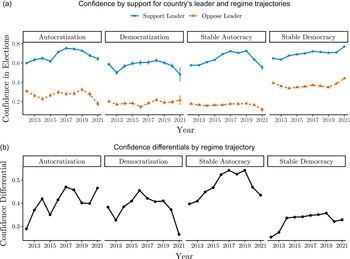
Figure 3(a) displays changes in public confidence in elections over time by regime trajectory type.Footnote 13 Figure 3(b) furthermore shows the difference in confidence in elections between respondents who approved or disapproved of the incumbent. In autocratizing democracies, the differential between the two groups of citizens tends to increase, while there has been a slight decrease in democratizing autocracies over the last two years in the observation period. Consistent with our previous findings, the partisan gap is most pronounced in stable autocracies and the lowest in stable democracies.
Confidence in election by regime types over time. Panel (a): Weighted mean responses to the honesty of elections item in the respondent’s country by support for the country’s leader and regime trajectory. Bars represent 95 per cent confidence intervals. Panel (b): The confidence differential is calculated by subtracting the mean confidence score for respondents who oppose the leader from the score for respondents who support the leader. Data source: Gallup World Poll.

Next, we statistically estimate a two-way fixed effects probit model to predict whether a respondent reports having confidence in the honesty of elections. As the survey data was collected annually in more than a hundred countries around the world,Footnote 14 the two-way fixed approach allows us to estimate whether changes in our independent variables are related to individual variation in confidence in elections within each country. To use a more fine-grained measure of variation in the polyarchy, we include V-Dem’s continuous electoral democracy score instead of the four trajectory types used in the previous descriptive analysis. Furthermore, we include a variable indicating whether the respondent approves of the country’s leader. Importantly, we also include an interaction term between electoral democracy and leader approval to examine whether the relationship between not supporting a country’s leader and electoral confidence is dependent on changing electoral democratic quality.Footnote 15 While the country-fixed effects alleviate concerns over time-invariant confounders, we include the following time-varying control variables at the country level: consumer price index, unemployment rate, GDP, and GDP growth.Footnote 16
Table 3 presents the regression results. Figure 4(a) displays the predicted probability of having confidence in the honesty of elections, conditional on the polyarchy (that is, electoral democracy) and leader approval. Figure 4(b) shows the conditional effect of opposing the countries’ leaders depending on varying levels of the polyarchy on confidence in the honesty of elections.
Two-way fixed effects probit regression: predicting confidence in elections with country’s electoral democracy score and individual leader approval. Standard errors are clustered at the country level in parenthesis. Country controls are standardized by 2 standard deviations. Data source: Gallup World Poll
 ${{\rm{\;}}^{{\rm{***}}}}p \lt 0.001$
;
${{\rm{\;}}^{{\rm{***}}}}p \lt 0.001$
; ${{\rm{\;}}^{{\rm{**}}}}p \lt 0.01$
;
${{\rm{\;}}^{{\rm{**}}}}p \lt 0.01$
; ${{\rm{\;}}^{\rm{*}}}p \lt 0.05$
The relationship between leadership approval and confidence in elections conditional on varying levels of the polyarchy (Model 2 in Table 3). Ribbons represent 95 per cent confidence intervals.

Notably, as political systems become less democratic, citizens’ confidence in electoral integrity decreases, and decreasing approval of the country’s leadership reduces the probability of having confidence in elections. Moreover, as predicted by Hypothesis 2 , in countries with an increasingly less democratic environment, citizens who disapprove of the country’s leaders become significantly more sceptical about the integrity of elections. Specifically, a decline from 1 (perfect electoral democracy) to 0.4 (electoral autocracy) reduces the probability of trusting in the honesty of elections among incumbent disapproving individuals by 54.3 per cent (19.6 percentage points). By contrast, for respondents who support the country’s leadership, a similar shift in the polyarchy reduces their confidence only by 5.3 per cent (3.0 percentage points). Overall, our longitudinal analysis provides strong support for Hypothesis 2 .
Perceptual Volatility and the 2018 Turkish Early Election Announcement
Lastly, we investigate the susceptibility of electoral integrity perceptions to radically increased electoral salience. To this end, we focus on a critical political event in recent Turkish history: the 2018 early election announcement. Following the electoral turmoil after the 2015 elections, President Erdoğan and his AKP party gradually established a presidential system with weak checks and balances and widespread suppression of oppositional forces, effectively turning Turkey into a competitive authoritarian system (Esen and Gumuscu Reference Esen and Gumuscu2016). Nevertheless, as the 2019 Istanbul mayoral election demonstrated, oppositional parties have a chance in electoral contests and can even oust the incumbent party at the sub-national level (Svolik Reference Svolik2023).
On April 18, 2018, President Erdoğan announced that national elections would take place on June 24 that year, eighteen months earlier than expected, after a meeting with his ally Devlet Bahçeli (MHP) (Esen and Yardimci-Geyikçi Reference Esen and Yardimci-Geyikc2020). The call for early elections came from Bahçeli, not Erdoğan, on April 17 (Shaheen Reference Shaheen2018). Erdoğan justified the announcement by citing uncertainty due to developments in Iraq and Syria (Gall Reference Gall2018), as well as political and economic uncertainty. This announcement took political actors by surprise since Erdoğan and his close ministers had repeatedly stated that elections would take place in November 2019 as scheduled (Selçk and Hekimci Reference Selçuk and Hekimci2020, 1503). However, concerns about an economic downturn threatened Erdoğan’s popularity, which may have led to the unexpected event (Esen and Yardimci-Geyikçi Reference Esen and Yardimci-Geyikc2020). In SI C.1, we provide additional qualitative evidence that the snap election announcement was a salient but unexpected event in Turkish politics and justify our case selection in more depth.
To investigate how this unexpected event affected perceptions of electoral integrity, we use an Unexpected Event during Survey Design (UESD) (Muñoz, Falcó-Gimeno and Hernández Reference Muñoz, Falcó-Gimeno and Hernández2020), which employs a regression discontinuity design (RDD) and makes use of the occurrence of an unexpected event during the field period of a public opinion survey. RDDs are based on the idea that the assignment to the treatment and control groups is as good as random around some exogenous threshold (Angrist and Pischke Reference Angrist and Pischke2009; Imbens and Lemieux Reference Imbens and Lemieux2008; Lee Reference Lee2008; Thistlethwaite and Campbell Reference Thistlethwaite and Campbell1960). This guarantees the continuity of the average potential outcomes at the threshold and allows us to argue that the units just below and just above the threshold can be considered counterfactuals of each other.
In practical terms, RDDs require some randomness in the assignment variable’s exact value, and the units of observation cannot manipulate their values around the exogenous threshold. Since survey participants would not have been able to determine the exact day they were interviewed, we can reasonably assume that the assignment to the treatment and control groups around the threshold was indeed random. In the context of our study, the announcement of the 2018 election occurred during the field period of the WVS in Turkey in 2018 (Haerpfer et al. Reference Haerpfer, Inglehart, Moreno, Welzel, Kizilova, Diez-Medrano, Lagos, Norris, Ponarin and Puranen2020). An analysis of newspaper headlines around April 18 indicates that the announcement came as a surprise to citizens, experts, and most political actors (Esen and Yardimci-Geyikçi Reference Esen and Yardimci-Geyikc2020; see SI C.1).
After the announcement (that is, our treatment), the public debate was immediately dominated by the electoral campaign, and on the morning of April 18, all prominent newspapers featured headlines about the early election. News websites and TV stations followed the same pattern as it became suddenly clear that the country was heading to the polls. The WVS survey had already been in the field for eighteen days when the decision to hold early elections became public, providing us with survey responses observed in the control condition. At the same time, survey interviews were also conducted in the weeks following the announcement. We consider these respondents to be in the treatment condition. To avoid non-compliance-induced bias, we exclude the announcement day from the analysis. As the WVS survey fielding in Turkey did not follow a regional pattern but started simultaneously in all regions, regional differences in public opinion in Turkey do not systematically affect our analysis.
As before, we select items on electoral integrity as our outcome variables. In addition to the standardized WVS/EVS items in Table 1, we added two items concerning the integrity of elections that Turkish respondents were asked, namely ‘Women have equal opportunities to run for office’ and ‘Honest elections make a difference’, to the list of outcome variables. Descriptive statistics and figures displaying the opinion data for each item before and after the announcement are shown in SI C.2.
We implement both linear and robust local polynomial RDD models to estimate the local treatment effect of the early election announcement (Cattaneo, Idrobo and Titiunik Reference Cattaneo, Idrobo and Titiunik2019). To determine the optimal bandwidth for the running variable (that is, the number of days before and after the announcement), we rely on the data-driven MSE-optimal bandwidth selector proposed by Magalhaes et al. (Reference Magalhaes, Hangartner, Hirvonen, Meriläinen, Ruiz and Tukiainen2020), which assigns the same interval for included observations below and above the cutoff. We scrutinize the robustness of our findings with the following checks in SI C.4: varying the bandwidth of the running variable (that is, days $ + / - $
the announcement), implementing RDD models with placebo outcomes (that is, response variables that should not be affected by the announcement such as worries about terrorism), testing covariate balance between treatment and control groups, and balance between non-responses before and after the announcement. Lastly, as the sample size shrinks by design as we only consider observations around the cut-off, SI C.5 discusses statistical power and extends the sample around the threshold to increase the number of observations.
$ + / - $
the announcement), implementing RDD models with placebo outcomes (that is, response variables that should not be affected by the announcement such as worries about terrorism), testing covariate balance between treatment and control groups, and balance between non-responses before and after the announcement. Lastly, as the sample size shrinks by design as we only consider observations around the cut-off, SI C.5 discusses statistical power and extends the sample around the threshold to increase the number of observations.
Figure 5 presents the local average treatment effect (LATE) by supporters of the incumbent AKP and MHP parties and all other oppositional parties. Our results only provide weak, if any, evidence that the two political camps reacted differently to the snap election announcement. Notably, incumbent supporters became more supportive of the claim that they have a genuine choice in elections after the early election announcement, while we observe a null effect for opposition partisans. Similarly, incumbent supporters increasingly report believing that women have equal chances to run for office, whereas opposition supporters’ perception of gender equality in electoral races was not affected by the announcement. The results indicate a treatment effect of up to a 0.5-point increase (12.5 per cent on a 4-point scale) for incumbent supporters. However, if we increase the bandwidth up to ten days to improve statistical power, the effect becomes smaller and insignificant in the linear but not in the RD robust models (see SI C.5).
Effect of the 2018 Turkish snap election announcement on perceptions of electoral integrity by partisanship (incumbent vs. opposition supporters). Regression discontinuity models estimated with (a) OLS and (b) RD robust. The thin line shows 95 per cent confidence intervals, and the thick line 90 per cent confidence intervals. Note that higher outcome values indicate higher approval of the electoral integrity statement, some of which are formulated positively (for example, ‘Women have equal opportunities to run’) and others negatively (for example, ‘Voters threatened with violence’). Results in tabular form can be found in C.3. Data source: Turkish World Values Survey sample.

Overall, our study finds only minimal differences in the reactions of government and opposition supporters to the early election announcement, providing limited support for Hypothesis 3. While incumbent supporters showed slightly more enthusiasm about electoral integrity after the announcement, opposition supporters appeared to be unaffected by it. However, there are several possible explanations for why opposition partisans did not react negatively. One potential explanation is that the current political climate in Turkey may constrain opposition supporters from expressing their true views on the electoral process during interviews. They may be concerned about negative repercussions or engaging in self-censorship. As a result, our research may underestimate the negative impact of the election announcement on opposition partisans’ perceptions of electoral integrity in Turkey. Another possibility is that opposition partisans reacted differently based on their affiliation with specific opposition parties. Therefore, some opposition supporters may have received the announcement positively, while others may have had negative reactions or no reaction at all. However, due to the limited number of opposition partisans in our survey sample, we cannot empirically test this claim and must leave it to future research to explore.
Conclusions
A large proportion of citizens worldwide are governed by authoritarian incumbents who face competition in electoral contests (Bunce and Wolchik Reference Bunce and Wolchik2010; Gandhi and Lust-Okar Reference Gandhi and Lust-Okar2009; Levitsky and Way Reference Levitsky and Way2010). While opposition forces are disadvantaged in these contests, incumbents ruling in electoral authoritarian regimes legitimize their power through public support, as reflected in election results. Thus, the survival of the incumbent regime in part depends on citizens’ support expressed in multiparty elections. However, how do citizens living in these regimes perceive the integrity of such elections?
We argue that incumbent partisans perceive the integrity of elections fundamentally differently than their counterparts supporting the opposition, and this gap is considerably larger than in democratic systems. Incumbent supporters adopt the authoritarian leader’s narrative in perceiving elections as free and fair. Therefore, when a majority endorses the incumbent in an electoral contest, incumbent partisans consider this outcome as a mandate for the incumbent to remain in office. Opposition partisans, by contrast, are more aware of restrictions on opposition forces’ political activities and the tilted playing field, therefore evaluating their country’s electoral integrity more realistically, expressing negative perceptions about electoral integrity.
By combining various comparative data sources to examine long- and short-term patterns of partisan gaps in perceptions of electoral integrity, we report three main findings. First, the gap between incumbent and opposition supporters is indeed considerably larger in electoral authoritarian regimes than in democratic ones. Second, in countries that transform from democracy toward electoral authoritarianism, only opposition supporters adjust their perceptions of electoral integrity downward, while incumbent supporters do not.
Lastly, studying the case of the 2018 Turkish early election announcement to elucidate the volatility of perceptions during times of rapidly increased salience of electoral competition, we only find limited evidence that such perceptions are volatile in an electoral authoritarian environment. If at all, government supporters are slightly more confident in making a genuine choice in elections after increased electoral salience due to the unexpected snap election announcement. In the specific case of the 2018 announcement, partisans do not seem to react significantly to this salient event, indicating that the gap in perceptions is stable and persists even in the wake of sudden changes in the political environment.
Overall, citizens in electoral authoritarian regimes appear to live in two vastly different worlds when evaluating the quality of elections. Authoritarian incumbents not only enjoy support from large shares of the electorate but have also been successful in disseminating their narrative of competitive elections despite intervening in the opposition’s political activities. Contrasting with incumbent partisans’ views, opposition supporters assess the state of electoral competition considerably more realistically than their counterparts endorsing the incumbent.
This pattern also extends to autocratization processes, primarily affecting the supporters of opposition parties, who revise their opinions regarding the fairness of elections, while those who support the incumbent regime maintain their confidence in the electoral process. This empirical pattern is compelling as it demonstrates the implications of changing regime environments on divergent assessments between government and opposition supporters. The partisan differential is likely expanding because government supporters maintain a positive view of elections despite the declining quality of democracy, underscoring their significance for the incumbent’s grip on power. Meanwhile, opposition supporters react to the deteriorating state of democracy with increasingly negative perceptions of electoral integrity.
While this paper contributes to the ongoing debate about public opinion in authoritarian systems (for example, Geddes and Zaller Reference Geddes and Zaller1989; Reuter and Szakonyi Reference Reuter and Szakonyi2021), several questions remain to be addressed by future research. For instance, the question arises of how authoritarian incumbents achieve restricted electoral competition while maintaining their support base’s confidence in the electoral process, where a key mechanism in securing public support may be media capture. Moreover, as our analysis of the 2018 Turkish early election announcement illustrates, electoral events provide an opportunity to examine the relationship between elite and citizen behaviour in authoritarian regimes and may be leveraged in future research designs. Lastly, as our analysis relies on direct questions about electoral integrity, future studies could investigate the extent to which survey responses are influenced by social desirability biases and other potential response pressures, particularly for citizens living under authoritarian rule, by implementing experimental approaches (for example, Aarslew, Reference Aarslew2024). Examining how citizens perceive political elections and political institutions under authoritarian rule will ultimately help us better understand why electoral authoritarianism remains a prevalent regime type across the globe.
Supplementary material
To view supplementary material for this article, please visit https://doi.org/10.1017/S0007123424000863
Data availability statement
Replication data for this article can be found at https://doi.org/10.7910/DVN/DHRH5Y.
Acknowledgements
We would like to thank Gloria Gennaro, Anselm Hager, Natalie Letsa, Ugur Ozdemir, Matthias Rosenthal, Greta Schenke, Dan Slater, and Milan Svolik, as well as the audiences at the PolMeth Europe, MPSA, WPSA, and Berlin Political Behaviour Workshop conferences for their helpful comments on the manuscript. We are also grateful to three anonymous reviewers for their valuable feedback. Buket Buse Demirci, Sarah Kromin, Julian Degler, and Lucas Schwarz provided excellent research assistance.
Author contribution
All authors contributed equally to this paper.
Financial support
Jacob acknowledges financial support from the Swiss National Science Foundation (Grant number PZ00P1185908).
Competing interests
None.




 Open access

