




1. Introduction
1.1. The relationship between phonology and sound symbolism
Sound symbolism refers to systematic connections between sounds and meanings (e.g., Hinton et al. Reference Hinton, Nichols and Ohala2006; Perniss et al. Reference Perniss, Thompson and Vigiliocco2010; Akita Reference Akita2015; Dingemanse et al. Reference Dingemanse, Blasi, Lupyan, Christiansen and Monaghan2015; Sidhu & Pexman Reference Sidhu and Pexman2018). For example, in many languages, low vowels like /a/ tend to be associated with larger images than high vowels like /i/ (Sapir Reference Sapir1929; Newman Reference Newman1933; Thompson & Estes Reference Thompson and Estes2011). However, in modern linguistic theories, sound-symbolic patterns have usually been considered to lie outside the realm of linguistic inquiry, perhaps because of the influence of the Saussurian dictum that the connections between sounds and meanings in natural languages are in principle arbitrary (Saussure Reference de Saussure1916; see also Hockett Reference Hockett1959 for another influential paper on arbitrariness).
However, the field has recently witnessed a rapidly increasing rise of interest in sound-symbolic patterns and related phenomena (see in particular Nielsen & Dingemanse Reference Nielsen and Dingemanse2021 for some quantitative evidence). Some scholars now explicitly argue that exploration of sound-symbolic patterns can – and should – be a part of phonological research (see Kawahara Reference Kawahara2020a for a review of the arguments for this view).
For instance, Alderete & Kochetov (Reference Alderete and Kochetov2017) point out that expressive palatalisation – such as that observed in child-directed speech – is caused by a formal requirement to use particular types of sounds (e.g., palatal consonants and high front vowels) to express particular types of meanings, such as smallness. They propose a family of Express(X) constraints in Optimality Theory (OT; Prince & Smolensky [1993] Reference Prince and Smolensky2004) and argue that these constraints interact with other phonological constraints within a single grammatical system. See also Akinbo (Reference Akinbo2021), Akinbo & Bulkaam (Reference Akinbo and Bulkaam2024), Akita (Reference Akita2020), Klamer (Reference Klamer2002), Dingemanse & Thompson (Reference Dingemanse and Thompson2020), Kumagai (Reference Kumagai2019, Reference Kumagai2023) and Jang (Reference Jang2021) for other possible cases in which sound-symbolic requirements affect – or at least interact with – phonological patterns; see also Mithun (Reference Mithun1982) and Monaghan & Roberts (Reference Monaghan and Roberts2021) for possible influences of sound-symbolic effects on diachronic changes, in which expressive vocabularies have resisted diachronic sound changes that applied to other regular, non-iconic vocabulary items.
Approaching this issue from a slightly different perspective, Kawahara (Reference Kawahara2020b) compares particular quantitative signatures of patterns of sound-symbolic judgements and those found in stochastic phonological patterns and argues that there appears to exist an interesting parallel between the two patterns. More concretely, he argues that both sound-symbolic patterns and stochastic phonological patterns exhibit what Hayes (Reference Hayes2020, Reference Hayes2022) refers to as ‘wug-shaped curves’, a quantitative signature that is predicted by maximum entropy harmonic grammar (MaxEnt HG), a framework that is now widely deployed to model a wide range of phonological – and other linguistic – patterns (Smolensky Reference Smolensky, Rumelhart and McClelland1986; Goldwater & Johnson Reference Goldwater, Johnson, Spenader, Eriksson and Dahl2003; Hayes & Wilson Reference Hayes and Wilson2008; McPherson & Hayes Reference McPherson and Hayes2016; Shih Reference Shih2017; Zuraw & Hayes Reference Zuraw and Hayes2017; Hayes Reference Hayes2022).
In short, an increasing number of studies have recently argued that sound-symbolic patterns and phonological patterns are governed by similar – or perhaps the same – mechanisms.
1.2. Counting capability of phonology or lack thereof
Building on these recent proposals which treat sound-symbolic patterns on a par with phonological patterns, the current experiments examine the similarity – or dissimilarity – between the two, by focusing on the counting capability (or lack thereof) of the two systems. To preview the conclusions that follow from these experiments, we will show in this article that phonological systems and sound-symbolic systems are clearly distinct in that only the sound-symbolic systems have a certain type of counting capability.
In order to address the (dis)similarity between the phonological systems and sound-symbolic systems, our experiments make use of the classic observation that phonological systems may count up to two but no more (e.g., Goldsmith Reference Goldsmith1976; McCarthy & Prince Reference McCarthy and Prince1986; Hewitt & Prince Reference Hewitt and Prince1989; Hayes Reference Hayes1995; Myers Reference Myers1997; Nelson & Toivonen Reference Nelson and Toivonen2000; Walker Reference Walker2001; Ito & Mester Reference Ito and Mester2003; Prince & Smolensky [1993] Reference Prince and Smolensky2004, among many others).Footnote 1 While some apparent cases of counting have recently been pointed out in the literature, the following generalisations still hold robustly across known languages:

Let us now review the critical observations made in the literature on this topic in further detail. This now-classic thesis of ‘no counting’ was tacitly assumed in many phonological analyses, but was clearly expressed by McCarthy & Prince (Reference McCarthy and Prince1986: 1):
Consider first the role of counting in grammar. How long may a count run? General considerations of locality, now the common currency in all areas of linguistic thought, suggest that the answer is probably ‘up to two’: a rule may fix on one specified element and examine a structurally adjacent element and no other.
To be more concrete, McCarthy & Prince (Reference McCarthy and Prince1986), for instance, argue that there exist no reduplicative patterns which copy exactly three segments from the base. Schematically, such a reduplicative pattern would look like [bad-badupi], [bia-biadupi], [adu-adupi] and [bla-bladupi], with the reduplicant’s shape varying from CVC, CVV, VCV to CCV. To the best of our knowledge, no such reduplicative patterns have been found even after 1986.
Also, there are many languages that prohibit two occurrences of the same segments or features (i.e., dissimilation patterns; see Bennett Reference Bennett2015, Hansson Reference Hansson2001 and Suzuki Reference Suzuki1998 for extensive typological surveys), but no known languages prohibit three occurrences while allowing two (Ito & Mester Reference Ito and Mester2003: 265). A well-known example comes from the native phonology of Japanese, which prohibits morphemes with two voiced obstruents; on the other hand, no known languages prohibit morphemes with three voiced obstruents, while allowing two. Further, an experimental investigation by Kawahara & Kumagai (Reference Kawahara and Kumagai2023a) using nonce words shows that Japanese speakers do not distinguish between forms with two voiced obstruents and those with three voiced obstruents.
Prince & Smolensky ([1993] Reference Prince and Smolensky2004), in their formulation of OT, spend some good portions of their book discussing why their proposed system does not involve counting. For example, they state that a comparison between two candidates based on the numbers of violations of a particular constraint ‘is not numerical counting, but simply comparisons of more and less’ (Prince & Smolensky [1993] Reference Prince and Smolensky2004: 83; see also their §10.1.1). McCarthy (Reference McCarthy2003: 80) also argues that OT constraints should not count or assess ‘degrees of violations’, stating that ‘no language requires the presence of at least three round vowels to initiate rounding harmony, nor do we ever find that complementisers may be doubly but not trebly filled’.
However, some possible exceptions to the no-counting thesis have been pointed out in some recent work, although as we will see, the generalisations in (1) still seem to hold. First, Paster (Reference Paster2019) challenges the thesis that phonology can only count up to two, demonstrating that there are cases that apparently involve counting. For example, she proposes a tonal association rule for Kuria by which a high tone is associated with the fourth mora from the left edge of a stem. However, Paster (Reference Paster2019: §3) also points out that all the patterns that apparently count are suprasegmental; none are segmental.
Another recent challenge to the classic no-counting thesis comes from Kim (Reference Kim2022), who argues that Japanese disprefers a configuration in which a voiced obstruent is followed by two nasal consonants, implying the presence of a constraint that apparently involves counting three segments (i.e.,  ). However, a later examination demonstrates that evidence for this claim in existing words is very weak at best, and this alleged restriction was not shown to be productive in a nonce word experiment (Kawahara & Kumagai Reference Kawahara and Kumagai2023b).
Finally, some studies have demonstrated that multiple reduplications can induce more intensified meanings, for instance, in Fungwa (Akinbo Reference Akinbo2023). These patterns may mean that morphological operations, such as reduplication, can apply multiple times, and that each operation has a semantic impact. However, these patterns do not necessarily imply that any single phonological constraint has a capability to count beyond two segments.
To summarise, to the best of our knowledge, it is still safe to assume that general no-counting principles, at least those stated in (1), hold as a property of the phonological systems at the segmental level in natural languages. Put from a slightly different perspective, phonological constraints – as we formulate them in OT analyses – related to segmental phonology can count up to two segments, but not three or more in their structural description (McCarthy Reference McCarthy2003).Footnote 2
1.3. Background for the experiments: Pokémonastics
In the experiments reported below, we examined whether the no-counting nature observed in phonological systems would also hold in sound-symbolic patterns, by specifically testing whether three segments can invoke stronger sound-symbolic images than two segments. We took advantage of the Pokémonastics research paradigm, which explores the nature of sound symbolism in the context of Pokémon names (Kawahara et al. Reference Kawahara, Noto and Kumagai2018; for discussion of why it is useful to use Pokémon names in particular to explore sound-symbolic patterns in general, see, e.g., Kawahara & Breiss Reference Kawahara and Breiss2021). In the Pokémon world, some creatures, when they get stronger, can ‘evolve’ into a different creature, with a different name (e.g., [iwaaku] → [haganeeɾu] and [messoɴ] → [ʑimeɾeoɴ]).
A quantitative study of existing Pokémon names (including those up to the sixth generation) reported by Kawahara et al. (Reference Kawahara, Noto and Kumagai2018) shows that as Pokémon characters evolve, the number of voiced obstruents in their names tends to increase, a correlation which was later replicated with a larger set of data by Shih et al. (Reference Shih, Ackerman, Hermalin, Inkelas, Jang, Johnson, Kavitskaya, Kawahara, Miran, Starr and Yu2019). Subsequent experimental studies have demonstrated that Japanese speakers judge nonce forms with voiced obstruents to be more likely as names of post-evolution characters than forms without voiced obstruents (Kawahara & Kumagai Reference Kawahara and Kumagai2019a; Kawahara Reference Kawahara2020b). The first experiment reported below takes advantage of this sound-symbolic connection between voiced obstruents and Pokémon evolution status to address the question of whether three segments cause stronger sound-symbolic images than two segments.
1.4. Previous observations about sound symbolism
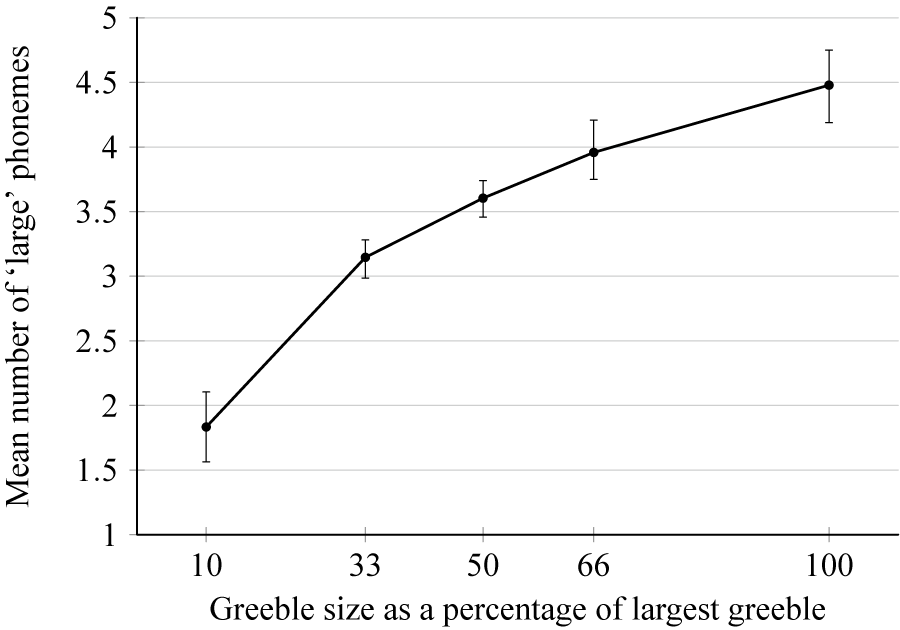
Before moving on, we review some previous studies which address the counting capability of sound symbolism. First, Thompson & Estes (Reference Thompson and Estes2011) built upon the observation that some sounds are associated with images of largeness (e.g., Sapir Reference Sapir1929 et seq.). In one of their experiments, they presented native speakers of English with pictures of an imaginary creature (referred to as a ‘greeble’, following Gauthier & Tarr Reference Gauthier and Tarr1997) in different sizes, and asked to choose from among nonce names containing different numbers of ‘large’ phonemes. Their results showed that the larger the size of the named objects, the more large phonemes were contained in their chosen names. As shown in Figure 1, their results suggest that the counting behaviour goes well beyond two; for example, the largest greebles were assigned names with about 4.5 large phonemes on average.
Results of Thompson & Estes (Reference Thompson and Estes2011: 2399; adapted from their Figure 3), in which the larger the named objects (‘greebles’) were, the more ‘large’ phonemes their names contained.
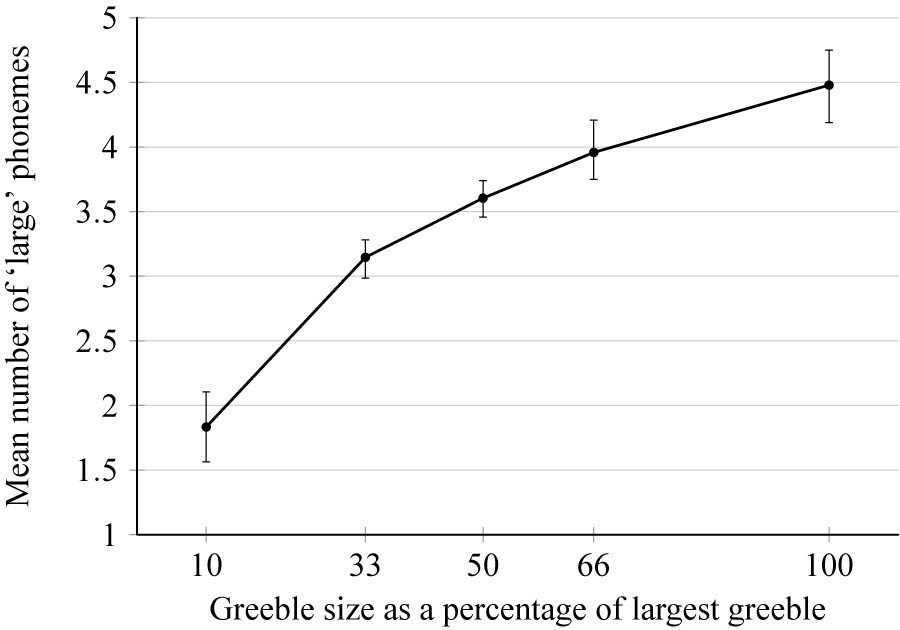
Figure 1 Long description
The x-axis is labelled ‘Greeble size as a percentage of largest greeble’ with values 10, 33, 50, 66, and 100. The y-axis is labelled ‘Mean number of large phonemes’ ranging from 1 to 5. Data points with error bars are plotted at each x value, showing a steady upward trend: at 10 percent, the mean is about 1.8; at 33 percent, about 3.1; at 50 percent, about 3.6; at 66 percent, about 4.0; and at 100 percent, about 4.5. The line connecting these points indicates that larger greeble sizes correspond to higher mean numbers of ‘large’ phonemes in their names.
However, this analysis collapsed three different classes of sounds (viz., back vowels, sonorants and voiced stops) into one set of ‘large’ phonemes, and therefore it is impossible to tell whether it truly instantiates an unambiguous case of counting – the pattern could instead have arisen from the combined effects of three different factors influencing the judgement patterns.Footnote 3 Similarly, several other studies have shown cumulative effects of sound symbolism (Priestly Reference Priestly, Hinton, Nichols and Ohala1994; Cuskley Reference Cuskley2013; D’Onofrio Reference D’Onofrio2014; Dingemanse & Thompson Reference Dingemanse and Thompson2020), but their results are also plausibly attributable to additive effects of different factors, just like the results of Thompson & Estes (Reference Thompson and Estes2011) in Figure 1.
The first two experiments reported below avoid this problem by using a set of sounds that is unambiguously a natural class, from both a phonetic and a phonological perspective. The third experiment used only one kind of segment, to unambiguously exclude the possibility that the counting behaviour arises from influences of different types of segments adding up.Footnote 4
Another candidate for counting in sound symbolism in the previous literature comes from the Pokémonastics experiments reported by Kawahara (Reference Kawahara2020b), in which he varied the numbers of moras from 2 to 6. The results showed that each mora added to the count increased the post-evolution responses. However, to the extent that a mora is a suprasegmental unit – which seems to be a fair assumption to make (McCarthy & Prince Reference McCarthy and Prince1986) – it is not clear whether these results truly instantiate a case of counting at the segmental level: recall that Paster (Reference Paster2019) reports that phonological systems may be able to count, but only at the suprasegmental level. Moreover, given the well-established status of bimoraic feet in Japanese phonology (Ito Reference Ito1990; Mester Reference Mester1990; Poser Reference Poser1990) and the possibility of recursive prosodic phrasing (Ito & Mester Reference Ito, Mester, Borowsky, Kawahara, Shinya and Sugahara2012, Reference Ito and Mester2013), the apparent counting behaviour may be recast in terms of different foot and prosodic word structures.
In short, the current experiments attempted to address the counting capability of sound symbolism at the segmental level in the most unambiguous way possible. The first two experiments also had the advantage of being able to make a fairly direct within-language comparison with a phonological pattern, using the recent result reported by Kawahara & Kumagai (Reference Kawahara and Kumagai2023a), who tested the counting behaviour of voiced obstruents in Japanese phonology.
2. Experiment I
In this experiment, the participants were given one nonce word per trial and were asked to judge whether that name is more suitable for a pre-evolution Pokémon character or a post-evolution Pokémon character. The aim was to explore whether the number of voiced obstruents contained in nonce names, ranging from 0 to 3, would affect the sound-symbolic judgement of these names, and if so, how. A previous study has shown that nonce words containing one voiced obstruent are more likely to be judged as post-evolution names than those without a voiced obstruent (Kawahara Reference Kawahara2020b), and other studies have found that, in addition to that difference, words with two voiced obstruents are more likely to be judged as post-evolution names than those with only one (e.g., Kawahara & Kumagai Reference Kawahara and Kumagai2019a).
The novel contribution of the current experiment is therefore in exploring the difference between the two-voiced-obstruent condition and the three-voiced-obstruent condition. This addition is an important one, however, because it will address the question of how similar or dissimilar sound-symbolic patterns are to segmental phonological constraints, as discussed in §§1.1 and 1.2.
If sound-symbolic patterns can count only up to two, just like phonological constraints, we should not expect a difference between words with two voiced obstruents and those with three voiced obstruents – recall that in the phonological terms of Lyman’s Law, three voiced obstruents are no different from two voiced obstruents. On the other hand, if sound-symbolic patterns simply count without restriction, then we should observe a difference between the two conditions.
2.1. Method
The raw data, R markdown files and Bayesian posterior samples for all three experiments are available in an OSF repository (for the importance of the open science policy in linguistic studies, see, e.g., Cho Reference Cho2021, Garellek et al. Reference Garellek, Gordon, Kirby, Lee, Michaud, Mooshammer, Niebuhr, Recasens, Roettger, Simpson and Yu2020 and Winter Reference Winter2019). A link to this repository is provided at the end of the article.
2.1.1. Stimuli
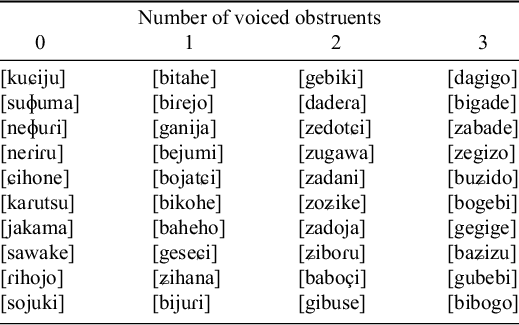
This experiment had four conditions, differing in the numbers of voiced obstruents in the form (zero, one, two and three). Each condition consisted of ten items, and they were all nonce names in Japanese. Each form consisted of three light CV syllables. The position of voiced obstruents was controlled within each condition; for example, in the one-voiced-obstruent condition, they were all word-initial (see Adelman et al. Reference Adelman, Estes and Coss2018 for the importance of word-initial position in sound symbolism). Because [p] is known to have a sound-symbolic effect associated with cuteness (Kumagai Reference Kumagai2019, Reference Kumagai2022, Reference Kumagai2023; see also Experiment III in §4), it was not used in the current stimulus set. The stimuli used are listed in Table 1.
Stimuli used in the first two experiments
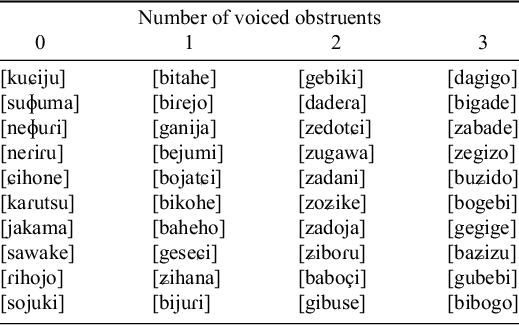
Table 1 Long description
Each column contains ten stimulus words written in the International Phonetic Alphabet. Under the heading 0 voiced obstruents: kuɕiju, suɸuma, neɸuɾi, neɾiɾu, ɕihone, kaɾutsu, jakama, sawake, ɾihojo, sojuki. Under 1 voiced obstruent: bitahe, biɾejo, ganija, bejumi, bojatɕi, bikohe, baheho, geseɕi, ʑihana, bijuɾi. Under 2 voiced obstruents: gebiki, dadeɾa, zedotɕi, zugawa, zadani, zoʑike, zadoja, ʑiboɾu, baboçi, gibuse. Under 3 voiced obstruents: dagigo, bigade, zabade, zegizo, buʑido, bogebi, gegige, baʑizu, gubebi, bibogo.
2.1.2. Procedure
The experiment was administered online using SurveyMonkey. The participants were first presented with some basic background about the Pokémon world, namely, that some Pokémon characters can evolve, and that when they evolve, they tend to get heavier, bigger and stronger. In the main session, within each trial, the participants were presented with one nonce name and were asked to judge whether each name is suitable for a pre-evolution character or a post-evolution character. The stimuli were presented in katakana orthography, which is used for real Pokémon names in general. Although the stimuli were presented in written form, the participants were asked to read and pronounce each stimulus before they register each response. The order of the stimuli was automatically randomised for each participant by SurveyMonkey.
2.1.3. Participants
We obtained data from 110 native speakers of Japanese using the Buy Response function of SurveyMonkey. The qualification requirements for participation were that (a) they had to be a native speaker of Japanese; (b) they had not previously participated in an experiment on Pokémon names; and (c) they had not studied sound symbolism before. Additional data from 38 native speakers of Japanese were collected using a snowball sampling method on the first author’s account on X (formerly Twitter).
2.1.4. Statistics
For statistical analyses, we used a Bayesian mixed effects logistic regression model, using the brms package (Bürkner Reference Bürkner2017). We will not explicate the mechanics of Bayesian analyses in detail here, but instead refer interested readers to accessible introductory articles, including Franke & Roettger (Reference Franke and Roettger2019), Kruschke & Liddell (Reference Kruschke and Liddell2018) and Vasishth et al. (Reference Vasishth, Nicenboim, Beckman, Li and Kong2018). In a nutshell, Bayesian analyses combine prior information (if any) with the obtained experimental data and produce a range of possible values – which are referred to as posterior distributions – for each estimated parameter.
One advantage of Bayesian analyses is that we can interpret the posterior distributions as directly representing the likely values of the estimated parameters. One heuristic to interpret the results of Bayesian modelling is to examine the middle 95% of the posterior distribution, known as the 95% credible interval (95% CrI), of the coefficient we are interested in. If the 95% CrI of a parameter does not include 0, then that parameter can be considered to be credible/meaningful. However, unlike in a frequentist analysis, we do not have to rely on a strict – but arguably arbitrary – dichotomy such as ‘significant’ vs. ‘non-significant’ or ‘credible/meaningful’ vs. ‘not credible/meaningful’. We can instead examine how many samples in the posterior distribution are in the expected direction, which reflects the probability of a particular hypothesis being true.
Another advantage of Bayesian analysis is that we can also address the question of how confidently we can conclude a null effect (Gallistel Reference Gallistel2009), which is impossible in frequentist analyses. This feature of Bayesian analysis is particularly important for the case at hand, because if sound symbolism were to behave like phonological patterns, we would expect a null difference between the two-voiced-obstruent condition and the three-voiced-obstruent condition (cf. Kawahara & Kumagai Reference Kawahara and Kumagai2023a). If it turned out to be that way, we wanted to explore how likely it is that there are truly no differences, which is impossible to test with a frequentist regression analysis.
Moving on to the specifics of the model specifications for the current experiment, the binary dependent variable was whether each item was judged as a post-evolution character name (1) or not (0). The fixed independent variable was the number of voiced obstruents contained in the stimuli. This factor was contrast-coded using the backward-reference coding method, in which a particular level is compared against the immediately prior level: 3 is compared against 2; 2 is compared against 1 and 1 is compared against 0. In addition to this fixed factor, a random intercept of items and participants as well as the random slopes of participants for the fixed factor were included in the model. For prior specifications, a Normal(0, 1) weakly informative prior for the intercept (Lemoine Reference Lemoine2019) and a Cauchy prior with scale of 2.5 for the slope (Gelman et al. Reference Gelman, Jakulin, Pittau and Su2018) were used.
Four chains with 2,000 iterations were run, and the first 1,000 iterations from each chain were discarded as warmups. All the R^-values for the fixed effects were 1.00, and there were no divergent transitions. (See the R markdown file available at the OSF repository for further details.)
2.2. Results
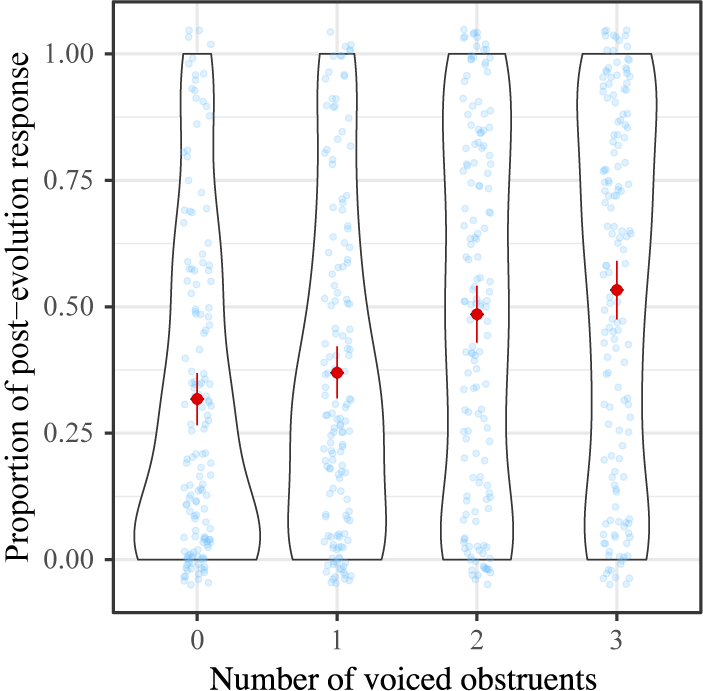
Figure 2 shows the distribution of the proportion of the post-evolution responses for each voiced obstruent condition in the form of violin plots, in which the widths represent normalised probability distributions. Transparent light-blue circles, jittered slightly to avoid overlap, represent the average response for each condition from each participant. Solid red circles are the grand averages in each condition, with their 95% confidence intervals calculated by ggplot (Wickham Reference Wickham2016).
Results of Experiment I, showing the distribution of the proportion of post-evolution responses by the number of voiced obstruents in the stimuli.
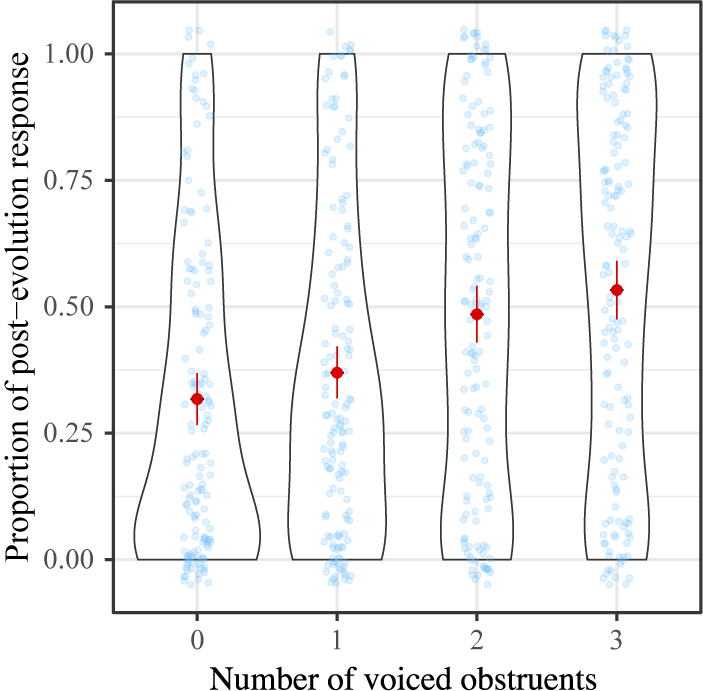
Figure 2 Long description
A single-panel violin plot with the x axis labelled Number of voiced obstruents, ranging from 0 to 3, and the y axis labelled Proportion of post-evolution response, ranging from 0.00 to 1.00. For each integer value on the x axis, a vertical violin plot displays the distribution of individual data points as light blue dots. The width of each violin indicates the density of responses at each y value. Superimposed on each violin is a red diamond marking the mean proportion for that group, with a vertical red line indicating the confidence interval. The means increase from left to right: for 0 voiced obstruents, the mean is below 0.5; for 1, it is near 0.5; for 2 and 3, the means are slightly above 0.5. The spread of data points is similar across all groups, with most values clustered between 0.25 and 0.75.
We observe a steady increase in the post-evolution responses as the number of the voiced obstruents contained in the stimuli increase: the averages for the four conditions were 0.32, 0.37, 0.49 and 0.53.Footnote 5 The central coefficient estimate of the difference between the zero-voiced-obstruent condition and the one-voiced-obstruent condition is 0.35, with its 95% CrI being [−0.09, 0.78]. Although this 95% CrI interval includes zero, the posterior distribution is heavily skewed towards positive values, and about 94% of the posterior samples were positive.
More importantly, the comparison between the two-voiced-obstruent condition and the three-voiced-obstruent condition shows that the central coefficient estimate for this difference is 0.39, with its 95% CrI being [0.08, 0.72], and the posterior probability supporting this difference is 0.99. Finally, the difference between the one-voiced-obstruent condition and the two-voiced-obstruent condition was also robust, with a central coefficient of 0.78 and 95% CrI of [0.40, 1.17]. Its posterior probability of being positive was 1.00.
In short, we observe that each difference between the four conditions was meaningful (although we can be only 94% confident about the difference between the first two conditions).
2.3. Discussion
The current experiment first of all replicated the finding of previous studies that given nonce words, Japanese speakers do indeed generally associate voiced obstruents with post-evolution Pokémon names (Kawahara & Kumagai Reference Kawahara and Kumagai2019a; Kawahara Reference Kawahara2020b). It moreover found that names with three voiced obstruents were more likely to be associated with post-evolution characters than ones with two voiced obstruents, suggesting that sound-symbolic patterns can function in an additive fashion, and count at least up to three (cf. Thompson & Estes Reference Thompson and Estes2011).
The current result is particularly interesting in light of the general question of how similar phonological patterns and sound-symbolic patterns are, given recent proposals that these two systems may have more in common than previously thought (e.g., Alderete & Kochetov Reference Alderete and Kochetov2017; Kawahara Reference Kawahara2020a,Reference Kawaharab), as reviewed in §1.1. Assuming that it is indeed a true property of phonological constraints that they can count only up to two segments (e.g., McCarthy & Prince Reference McCarthy and Prince1986; Ito & Mester Reference Ito and Mester2003; McCarthy Reference McCarthy2003; Prince & Smolensky [1993] Reference Prince and Smolensky2004), just as Japanese phonology counts only up to two voiced obstruents (Ito & Mester Reference Ito and Mester2003; Kawahara & Kumagai Reference Kawahara and Kumagai2023a), the fact that sound-symbolic patterns related to voiced obstruents can count up to three would constitute a non-trivial difference between the two systems. At least within Japanese, phonology and sound symbolism handle voiced obstruents differently from each other.
An anonymous reviewer has asked if the current results – especially the most crucial difference between the two-voiced-obstruent condition and the three-voiced-obstruent condition – could have arisen from participants’ knowledge of existing Pokémon names. This interpretation is unlikely, because there are only 12 existing Pokémon characters whose names contain three voiced obstruents (e.g., [diguda]), of which six are post-evolution characters (the ratio is 0.5, with its binomial 95% confidence interval being [0.25–0.75]).Footnote 6 On the other hand, there are 121 characters whose names contain two voiced obstruents, of which 81 are post-evolution characters (the ratio is 0.67, with a binomial 95% confidence interval of [0.58–0.75]).
Thus, there are not many examples among existing Pokémon names that support the association between three voiced obstruents and post-evolution status in the first place – the confidence interval for this estimate ([0.25–0.75]) is very large, suggesting that the pattern found in the existing names is not very informative about this association. And if anything, the evidence from existing names goes in the opposite direction from the experimental result: attested names with two voiced obstruents are more likely to belong to post-evolution characters than those with three voiced obstruents, although we note that the confidence interval for names with two voiced obstruents ([0.58–0.75]) is properly contained within the one for names with three ([0.25–0.75]).
3. Experiment II
3.1. Preamble
To extend the scope of the findings from Experiment I, we tested another semantic dimension that can be symbolically signalled by voiced obstruents. In Japanese (and perhaps other languages), voiced obstruents are associated with general negative images (Suzuki Reference Suzuki1962; Hamano Reference Hamano1998; Kubozono Reference Kubozono1999), and in the context of Pokémon names, they are overrepresented in the names of villainous characters (Hosokawa et al. Reference Hosokawa, Atsumi, Uno and Shinohara2018; Uno et al. Reference Uno, Shinohara, Hosokawa, Ataumi, Kumagai and Kawahara2020). More specifically, some Pokémon characters belong to particular ‘types’, and it has been found that voiced obstruents are overrepresented in the names of ‘dark-type’ characters (which, in Japanese, are called [aku]-type, literally ‘evil’). The productivity of this sound-symbolic relationship has been confirmed by an experiment using nonce words (Kawahara & Kumagai Reference Kawahara and Kumagai2019b). Experiment II made use of this previously identified sound-symbolic relationship to further address the counting capability of sound-symbolic patterns.
There are a few differences between Experiments I and II. In Experiment II, the participants were asked whether each name was suitable for a dark- (i.e., [aku]-) type character or for a normal-type character. Before the main trials, they were told that all Pokémon characters belong to at least one type, with two examples: [çitokage] ‘Charmander (fire lizard)’ belongs to the fire type, and [goosu] ‘Gastly’ belongs to both the ghost type and the poison type. The stimuli used in the experiment were identical to those used in Experiment I (listed in Table 1). The participants were university students from Meiji University.Footnote 7 After excluding data from those who were not native speakers of Japanese and those who were familiar with research on sound symbolism, the data from 141 native speakers entered into the subsequent statistical analysis. The details of the statistical modelling were identical to those of Experiment I.
3.2. Results
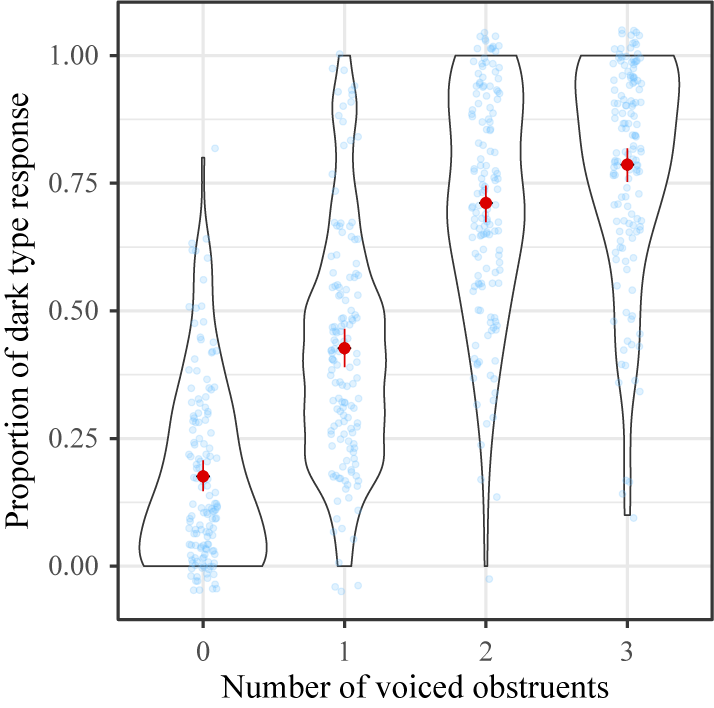
Figure 3 shows the results of Experiment II. As with Experiment I, we observe a steady increase in the dark-type responses as the number of voiced obstruents contained in the stimuli increase. The grand averages for each condition were 0.18, 0.43, 0.71 and 0.79.
The effect of voiced obstruents between each pair of adjacent levels is very robust according to the Bayesian modelling. The difference between the no-voiced-obstruent condition and the one-voiced-obstruent condition was very credible, with a central coefficient estimate of 1.61 and a 95% CrI of [0.95, 2.27]. All the posterior samples were positive.
More importantly, the difference between the two-voiced-obstruent condition and the three-voiced-obstruent condition was also fairly credible. The central coefficient estimate is 0.59, and the 95% CrI is [−0.03, 1.22]. The posterior probability of this crucial comparison being positive is 0.97. The difference between the one-voiced-obstruent and two-voiced-obstruent conditions was also robust (the central coefficient estimate is 1.54, with a 95% CrI of [0.89, 2.19]; the posterior probability of being positive is 1).
Results of Experiment II: proportion of dark-type responses for each voiced obstruent condition.
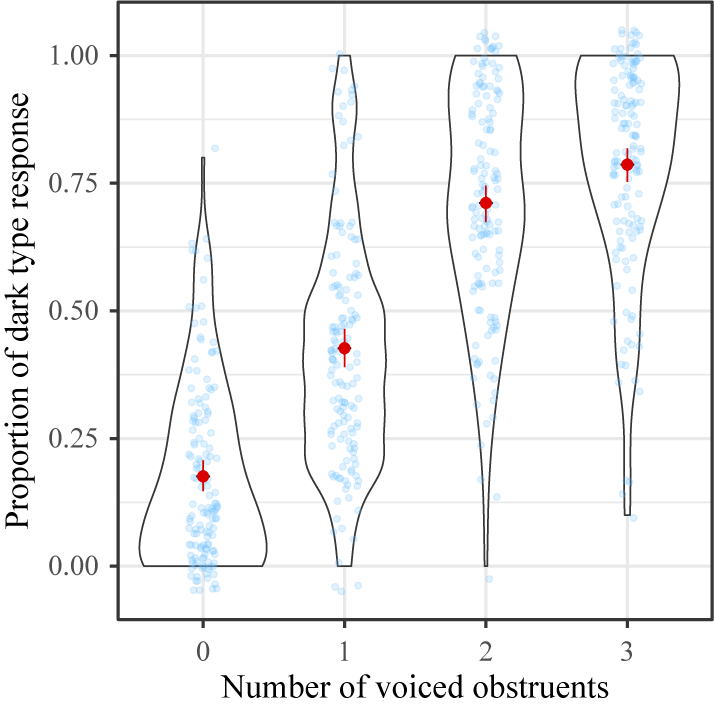
Figure 3 Long description
The x-axis is labelled Number of voiced obstruents, with values 0, 1, 2, and 3 from left to right. The y-axis is labelled Proportion of dark type response, ranging from 0.00 to 1.00. Each vertical violin plot contains light blue dots representing individual data points and a red diamond marker with error bars indicating the mean and variability. For 0 voiced obstruents, the distribution is concentrated at lower proportions, with the mean near 0.25. For 1 voiced obstruent, the distribution is broader, with the mean near 0.5. For 2 and 3 voiced obstruents, distributions are concentrated at higher proportions, with means near 0.75. The overall trend is an increase in the mean proportion of dark-type responses as the number of voiced obstruents increases.
3.3. Discussion
The sound-symbolic effects of voiced obstruent were clearer in Experiment II than in Experiment I: names with no voiced obstruents were unlikely to be judged as dark-type characters, whereas names with three voiced obstruents were very likely to be judged as dark-type characters. And most importantly for our current purposes, we have found a solid distinction between the two-voiced-obstruent condition and the three-voiced-obstruent condition. This difference is unlike how voiced obstruents are treated by the Japanese phonological system (Ito & Mester Reference Ito and Mester2003; Kawahara & Kumagai Reference Kawahara and Kumagai2023a), which arguably reflects a general property of phonological constraints at the segmental level in natural languages (McCarthy & Prince Reference McCarthy and Prince1986; McCarthy Reference McCarthy2003; Prince & Smolensky [1993] Reference Prince and Smolensky2004).
The observed difference between the two-voiced-obstruent condition and the three-voiced-obstruent condition in this experiment could not have arisen from an analogical inference from existing Pokémon names, because there were no dark-type Pokémon characters whose names contained three voiced obstruents.
4. Experiment III
4.1. Introduction
The first two experiments show that a distinction between two segments and three segments matters when it comes to sound-symbolic patterns – a distinction that phonological constraints arguably do not make. However, in both experiments, the target sounds were voiced obstruents, so it seemed important to us to examine how generalisable this counting property is – that is, whether this counting capability is observed for sound-symbolic patterns involving other categories of segments.
Also, we felt it useful to address the possibility that the patterns we observed in the first two experiments arose from different (types of) voiced obstruents – such as [b] and [d] – ‘ganging up’ rather than from pure counting (cf. Jäger & Rosenbach Reference Jäger and Rosenbach2006; Jäger Reference Jäger and Bresnan2007). We reiterate that it is safe to say that voiced obstruents constitute a coherent set of sounds from both the phonetic and the phonological perspective in Japanese (Suzuki Reference Suzuki1962; Ito & Mester Reference Ito and Mester1986, Reference Ito and Mester2003; Hamano Reference Hamano1998; Kubozono Reference Kubozono1999). Nevertheless, it is safer to be conservative and entertain the possibility that effects of different voiced obstruents are governed by different sound-symbolic forces. To this end, we took advantage of the sound-symbolic connection between [p] and ‘cuteness’ (Kumagai Reference Kumagai2019, Reference Kumagai2022, Reference Kumagai2023), which also manifests itself in the fact that labial sounds, including [p], are overrepresented in names of cute, fairy-type Pokémon characters (Hosokawa et al. Reference Hosokawa, Atsumi, Uno and Shinohara2018; Kawahara & Kumagai Reference Kawahara and Kumagai2019b; Uno et al. Reference Uno, Shinohara, Hosokawa, Ataumi, Kumagai and Kawahara2020).
4.2. Method
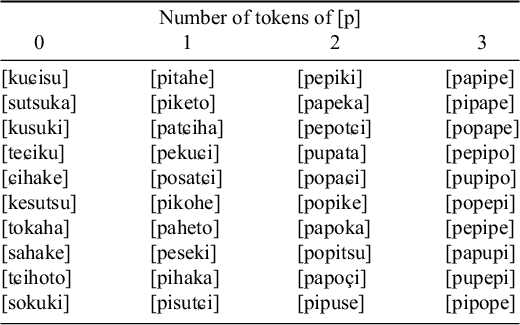
Experiment III used the set of stimuli shown in Table 2. The experiment, like Experiments I and II, varied the number of [p]s that are contained in the stimuli. The position of [p] was controlled within each condition. Each condition consisted of ten items, all of which contain only light CV syllables. Since there could be a difference between sonorants and obstruents in their impact on cuteness judgements (Perfors Reference Perfors, Forbus, Gentner and Regier2005; Shinohara & Kawahara Reference Shinohara and Kawahara2013), the syllables not containing [p] all had voiceless obstruent onsets.
Stiuli used in Experiment III
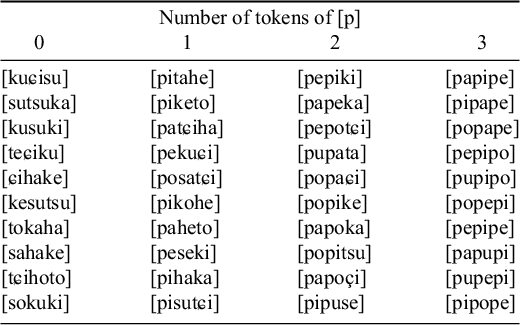
Table 2 Long description
Starting from the leftmost column, labelled 0, the stimuli are kuɕisu, sutsuka, kusuki, teɕiku, ɕihake, kesutsu, tokaha, sahake, tɕihoto, sokuki. The next column, labelled 1, contains pitahe, piketo, patɕiha, pekuɕi, posatɕi, pikohe, paheto, peseki, pihaka, pisutɕi. The third column, labelled 2, lists pepiki, papeka, pepotɕi, pupata, popaɕi, popike, papoka, popitsu, papoçi, pipuse. The rightmost column, labelled 3, includes papipe, pipape, popape, pepipo, pupipo, popepi, pepipe, papupi, pupepi, pipope. Each row contains one stimulus from each column, corresponding to the number of p tokens present.
The responses were gathered using the Buy Response function of SurveyMonkey. Data from a total of 150 native speakers of Japanese were obtained. In this experiment, the participants were asked, for each name, whether the name is more suitable for a normal-type character or for a cute fairy-type character. The details of the statistical analysis were identical to those of Experiments I and II, except that in this analysis, we ran, for each chain, 5,000 iterations with 4,000 warm-ups in order to avoid inappropriate effective sample size (ESS) values and divergent transitions.
4.3. Results
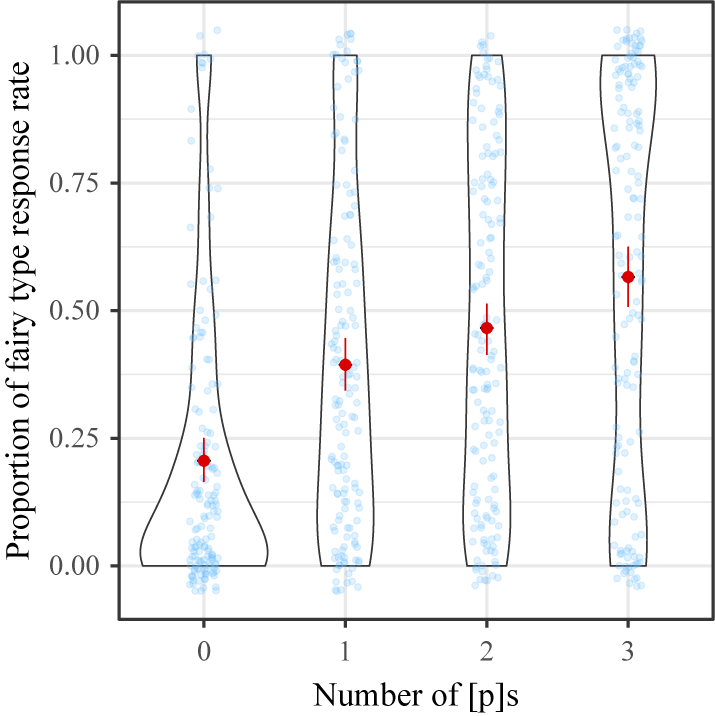
The results are presented in Figure 4, which shows the distribution of the proportions of fairy-type character responses for each condition. Similar to the two previous experiments, we observe a steady increase in fairy-type responses as the number of [p]s contained in the names increases. The grand averages were 0.21 for the no-[p] condition, 0.39 for the one-[p] condition, 0.47 for the two-[p] condition and 0.57 for the three-[p] condition.
Results of Experiment III: distribution of the proportion of fairy-type responses for each condition, which differed in the number of [p]s in the stimuli.
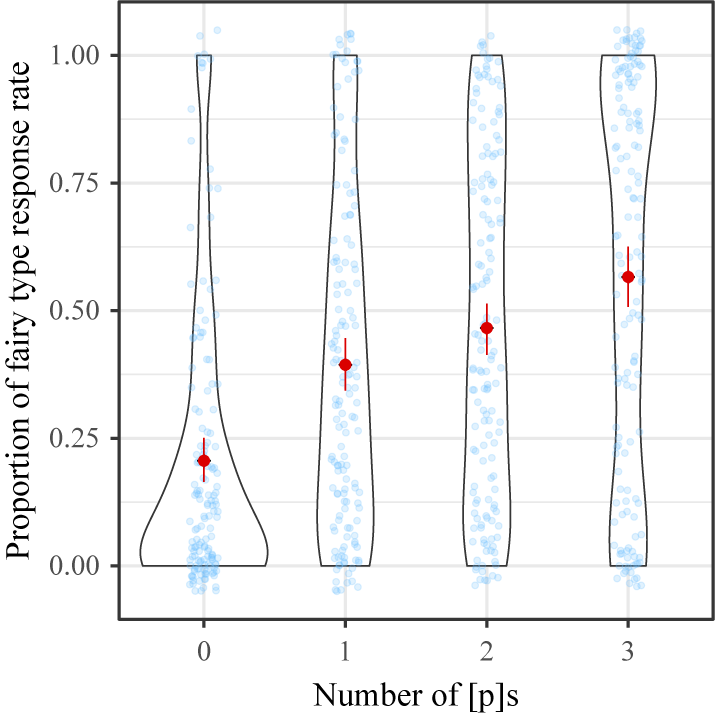
Figure 4 Long description
From left to right, the x-axis shows Number of [p]s with values 0, 1, 2, and 3. The y-axis is labelled Proportion of fairy type response rate, ranging from 0.00 to 1.00 in increments of 0.25. Each x-axis value has a vertical violin plot displaying the distribution of individual data points as light blue dots. The width of each violin indicates the density of responses at each proportion value. At the center of each violin, a red diamond marks the mean response rate for that group, with a vertical red error bar indicating variability. The mean response rate appears lowest for 0 [p]s and increases with more [p]s, peaking at 3 [p]s.
The results of the Bayesian logistic regression show that there is a clear difference between the no-[p] condition and the one-[p] condition (the central coefficient estimate is 1.60, with a 95% CrI of [1.06, 2.17]), with all their posterior samples supporting the difference.
The difference between the two-[p] condition and the three-[p] condition, which is the most important for the purposes of the current study, was also very robust (the central coefficient estimate is 0.80, with a 95% CrI of [0.30, 1.29]; 99.9
$\%$
 of the posterior samples support this difference). To be complete, the difference between the one-[p] condition and the two-[p] condition was also a reliable one (its central coefficient estimate is 0.47, with a 95% CrI of [0.03, 0.93]; 98% of the posterior samples support this difference). In short, every addition of [p] in the names reliably increased the fairy-type responses.
4.4. Discussion
This experiment again shows that sound symbolism can count up to three. In other words, the counting pattern is not unique to voiced obstruents, which might have been explained as different kinds of voiced obstruents ‘ganging up’ (Jäger & Rosenbach Reference Jäger and Rosenbach2006; Jäger Reference Jäger and Bresnan2007); instead, it also holds when we look at a single segment – [p] – invoking the image of cuteness. The difference between the two-[p] condition and the three-[p] condition could not have arisen by an analogical extension from existing names, because there were no fairy characters whose names contain three [p]s.
5. General discussion
5.1. Summary of the results
We started with a general question: how similar or dissimilar sound-symbolic patterns are to phonological patterns. To address this question, we focused on one property of phonological constraints which seems to hold robustly across languages: at least when it comes to constraints related to segmental phonology, they can count only up to two segments, but no more. No known languages have been identified to prohibit three occurrences of the same segment/feature, whereas there are a plethora of examples in which two occurrences of the same segment are banned. Japanese itself exhibits a case of this kind, in which two voiced obstruents within morphemes are prohibited (Ito & Mester Reference Ito and Mester2003), and experimentally, too, Japanese speakers treat forms with three voiced obstruents on a par with forms with two voiced obstruents (Kawahara & Kumagai Reference Kawahara and Kumagai2023a).
To the extent that sound-symbolic patterns and phonological patterns are governed by the same system (see Alderete & Kochetov Reference Alderete and Kochetov2017 and Kawahara Reference Kawahara2020b, in particular), we would have expected that a similar restriction would hold – that Japanese speakers would treat forms with three voiced obstruents just like forms with two voiced obstruents in sound-symbolic judgements. However, the results of two experiments show that this expectation did not hold up when Japanese speakers were asked to make sound-symbolic judgements of forms with different numbers of voiced obstruents.
These results were further corroborated by an additional experiment which shows that three [p]s can evoke stronger sound-symbolic images than two [p]s. It thus seems safe to conclude, given these results, that there is a non-negligible difference between segmental phonological constraints and sound-symbolic patterns, at least in terms of their counting capabilities.
5.2. Some alternative interpretations
An anonymous reviewer pointed out an interesting alternative interpretation of the current results, regarding the counting capability of sound symbolism. More specifically, the difference between 2 and 3 that we identified in the three experiments above may instead be the differences between two and all, given that our 3 condition had three target segments in trisyllabic words (i.e., ![[D dot dot dot D dot dot dot D] w d](https://static.cambridge.org/binary/version/id/urn:cambridge.org:id:binary:20260710050444826-0648:S0952675726100384:S0952675726100384_inline1001.png?pub-status=live) , where D represents a voiced obstruent). We admit that this is a valid interpretation, and if this was the case, it is comparable to a property that phonological systems routinely exhibit – for example, a vowel harmony pattern that targets all the vowels within a domain.
, where D represents a voiced obstruent). We admit that this is a valid interpretation, and if this was the case, it is comparable to a property that phonological systems routinely exhibit – for example, a vowel harmony pattern that targets all the vowels within a domain.
A follow-up experiment is necessary to address this alternative interpretation, by comparing four-syllable words with two or three target sounds; schematically, ![[D dot dot dot D dot dot dot X dot dot dot X] sub w d](https://static.cambridge.org/binary/version/id/urn:cambridge.org:id:binary:20260710050444826-0648:S0952675726100384:S0952675726100384_inline1002.png?pub-status=live) vs.
vs. ![[D dot dot dot D dot dot dot D dot dot dot X] sub w d](https://static.cambridge.org/binary/version/id/urn:cambridge.org:id:binary:20260710050444826-0648:S0952675726100384:S0952675726100384_inline1003.png?pub-status=live) , where X represents a segment other than a voiced obstruent. Then the latter condition would be 3 but not ‘all’.
, where X represents a segment other than a voiced obstruent. Then the latter condition would be 3 but not ‘all’.
Another question that was raised was as follows. In this article, we made a within-language comparison between the behaviour of Lyman’s Law and the sound-symbolic effects of voiced obstruents and showed that only the latter can count up to three. However, while Lyman’s Law is a negative restriction on the presence of multiple voiced obstruents, the current experiments are about how the presence of particular segments positively impact sound-symbolic judgements. Thus, the comparison between Kawahara & Kumagai’s (Reference Kawahara and Kumagai2023a) results and the current experiments may have to do with a difference between a negative restriction and a positive influence.
While this interpretation is not impossible, and more studies are warranted to fully address it, we find this explanation not very likely, given that, for example, no languages seem to require that reduplicative patterns copy three segments; neither do we find phonological patterns which require three tokens of the same feature/segment. In other words, the no-counting thesis is not just about negative restrictions but also holds true of constraints that positively require the presence of particular structures (McCarthy & Prince Reference McCarthy and Prince1986; McCarthy Reference McCarthy2003). Therefore, it is not clear if we can explain the difference between our findings in these experiments and Kawahara & Kumagai’s (Reference Kawahara and Kumagai2023a) findings regarding Lyman’s Law based on the positive or negative nature of the constraints at issue.
5.3. Phonology and sound symbolism again
To the extent that the current experiments have identified a non-trivial difference between phonological systems and sound-symbolic systems, should we conclude that they are completely separate systems? We feel that this conclusion may be going too far as well. Recall that as Alderete & Kochetov (Reference Alderete and Kochetov2017) and others have argued (Mithun Reference Mithun1982; Klamer Reference Klamer2002; Kumagai Reference Kumagai2019, Reference Kumagai2023; Akita Reference Akita2020; Dingemanse & Thompson Reference Dingemanse and Thompson2020; Akinbo Reference Akinbo2021; Jang Reference Jang2021; Monaghan & Roberts Reference Monaghan and Roberts2021; Akinbo & Bulkaam Reference Akinbo and Bulkaam2024), sound-symbolic requirements may be able to affect – or at least interact with – phonological patterns.
To the extent that our conclusion is on the right track, then, when sound-symbolic effects are incorporated into a phonological grammar, there should be some kind of filter that ‘strips off’ the counting capability of sound-symbolic mechanisms. Otherwise, we would expect there to be a constraint like Express(ThreeVcdObs) (cf. Alderete & Kochetov Reference Alderete and Kochetov2017), which requires that there be at least three voiced obstruents to express a particular semantic notion. While it remains to be seen that such patterns are indeed impossible in human languages, at this point we find it highly unlikely that they exist.
And if such a filtering mechanism is to be required, it may be something that is akin to the abstraction mechanism that is at work when phonetic effects are grammaticalised into a phonological system (Hayes Reference Hayes, Darnell, Moravscik, Noonan, Newmeyer and Wheatly1999; Gordon Reference Gordon2002; Smith Reference Smith2002), which reflects a general observation that even when phonetic factors appear to drive phonological generalisations, some details are abstracted away from in the phonological system.
An alternative way of reconciling the current results with the view that phonology and sound symbolism interact in non-negligible ways, as suggested by an anonymous reviewer, may be to posit that phonology actually has an iconic component and a non-iconic component; cf. the ‘co-phonology’ approach which posits several phonological sub-systems within a single language (Inkelas et al. Reference Inkelas, Orgun and Zoll1996; Orgun Reference Orgun1996; Inkelas & Zoll Reference Inkelas and Zoll2007; Sande Reference Sande2020). Once we accept this assumption, we can further posit that only the iconic component has a counting capability.
Japanese sound-symbolic words (i.e., mimetics) have a set of phonological characteristics that distinguish them from non-iconic words, such as the presence of singleton [p]s and active use of reduplication based on bimoraic feet (Ito & Mester Reference Ito, Mester and Goldsmith1995), which is compatible with the idea that phonology can consist of an iconic and a non-iconic component. This idea that only the iconic component of phonology – if such a component exists – can count appears compatible with the view advanced by Akinbo (Reference Akinbo2023), for example, who points out that the number of reduplications correlates with their expressive power (see also Kumagai Reference Kumagai2023). Thus, this general idea appears to be worth extensive exploration in future studies.
However, one potential concern of this hypothesis is that reduplicative patterns, which can be iconic, as is the case with Japanese mimetics, are predicted to be able to count, but this prediction is incompatible with the general no-counting thesis discussed throughout the present article. Even if a certain reduplicative pattern is expressive, the phonological system does not allow that reduplication pattern to copy three segments (McCarthy & Prince Reference McCarthy and Prince1986). There also remains a deeper question regarding why only the iconic component has the privilege of being able to count.
All in all, reconciling the increasing number of proposals regarding the similarity between phonological systems and sound-symbolic systems on the one hand, and the current finding that these two nevertheless show a distinction in counting capability on the other hand, will continue to present an interesting challenge for phonological theorisation.
Data availability statement
The data and the code for all three experiments are available at https://osf.io/zhnda.
Acknowledgements
We are grateful to four anonymous reviewers and the associate editor of the journal for their very constructive suggestions. All remaining errors are ours.
Author contributions
S.K. and G.K. jointly conceived and designed the experiments. G.K. set up and ran the online experiments. S.K. conducted the statistical analysis and wrote the first draft. G.K. revised the manuscript and verified the statistical procedures. Both authors contributed equally to addressing reviewers’ comments and finalizing the manuscript.
Funding statement
The research reported in this article is supported by the following JSPS grants: No. 22K00559, No. 25K04035 and No. 19K13164.
Competing interests
The authors declare no competing interests.



 Open access

