





Introduction
Social withdrawal and peer exclusion are separate but related behaviors and experiences in late childhood that reflect lack of social engagement. They are embedded within specific social and cultural contexts, with consequences that are known to vary widely across cultural and social ecologies (Chen & Liu, Reference Chen and Liu2021, Reference Chen and Liu2023). It is recognized that to fully understand the effects of social withdrawal and peer exclusion, the moderating effects of features of the group need to be considered at the levels of the person and the dyad (Rubin et al., Reference Rubin, Bukowski and Bowker2015). Previous studies have focused on parsing out distinct forms of social withdrawal, identifying their social and affective consequences and assessing individual-level peer-related features as moderators of these consequences (Rubin & Chronis-Tuscano, Reference Rubin and Chronis-Tuscano2021). Less attention has been devoted to group-level features that may attenuate the consequences of social withdrawal and peer exclusion. Using a multilevel design, the present study aims to test the hypothesis that the association between measures of individual-level social withdrawal, peer exclusion, friendship and depressed affect will vary as a function of group-level features. A key feature of our study is the use of a specifically socioecological perspective to assess the degree to which the effects of risks and protective factors vary across cultural contexts. This approach is seen rarely in the study of development and psychopathology. Our goal is to promote a culturally sensitive perspective on the effects of peer experiences on a critical feature of well-being.
Social withdrawal and peer exclusion
A long-standing goal of peer relations research is to identify peer-related factors that can elevate or minimize risk for emotional maladjustment in youth. One well documented risk factor is lack or minimal social engagement with peers (Rubin & Chronis-Tuscano, Reference Rubin and Chronis-Tuscano2021). There is a longstanding recognition that lack of social engagement occurs in two distinct yet related forms, social withdrawal and peer exclusion (Rubin et al., Reference Rubin, Coplan and Bowker2009). Social withdrawal is a behavior marked by lack of social engagement that is self-initiated. The conceptualization and assessment of social withdrawal varies across studies. Some researchers take a subtypes perspective to assess different underlying motivations for withdrawal and their related consequences. For example, these include well specified forms such as anxious-solitude (e.g., high desire for social interaction but high avoidance due to a heightened sense of anxiety about engaging with others) and unsociability (i.e., a disinterest in social interaction, preferring to be alone rather than seeking out social interactions) (Coplan et al., Reference Coplan, Bowker and Nelson2021). Other researchers use social withdrawal as a unitary construct that reflects self-isolation from others, regardless of motivation (Barzeva et al., Reference Barzeva, Richards, Veenstra, Meeus and Oldehinkel2022). In contrast to social withdrawal, peer exclusion refers to lack of social engagement that occurs when a child is left out by their peer group. While social withdrawal stems from a child’s own behavior, peer exclusion results from peer treatment. In this way, our approach distinguishes between whether the source of solitude is the self (regardless of motivation) or if it is imposed by others.
While motivation-based subtypes have some advantages, the source-based approach offers important insights. First, this approach highlights both the individual-level and group-level processes and provides clarity on whether lack of social engagement is an outcome of personal motives or peer treatment. This creates a concrete and observable framework for understanding solitude in the context of the peer group. Second, whether lack of social engagement is self- or other-imposed can shape the way children and their peers interpret and respond to it. These responses can influence the emotional consequences children may face. Finally, motivation-based classifications assume an internal motive to a child’s withdrawn behavior. Such motives may not be accessible to peers. Focusing on whether isolation is self-initiated or imposed allows us to bypass assumptions about motivation and highlight observable social experiences that are directly accessible to peers.
Current evidence recognizes social withdrawal and peer exclusion as separate but interrelated factors that impede the emotional well-being of children (Gazelle & Ladd, Reference Gazelle and Ladd2003; Gazelle & Rudolph, Reference Gazelle and Rudolph2004). In a sample of children who were followed from kindergarten to fourth grade, Gazelle and Ladd (Reference Gazelle and Ladd2003) found that peer exclusion and a form of social withdrawal (anxious-solitude) were associated with higher levels of depressed affect across time. In a separate three-wave longitudinal study, Gazelle and Rudolph (Reference Gazelle and Rudolph2004) used a sample of fifth-and sixth-grade boys and girls and found that anxious-solitude in boys predicted heightened levels of depressed affect at wave one, while its interaction with peer exclusion predicted linear increases in depressed affect across the school year. This interaction was not replicated with the girls in their sample. They also found that for girls, univariate measures of anxious-solitude and peer exclusion predicted depressed affect at wave one.
Peer exclusion is associated with similar internalizing outcomes (Fanger et al., Reference Fanger, Frankel and Hazen2012; Lynn Mulvey et al., Reference Lynn Mulvey, Boswell and Zheng2017; Rubin & Mills, Reference Rubin and Mills1988). Importantly, peer exclusion and social withdrawal often reinforce each other across time, leading to a cyclical downward spiral (Gazelle & Rudolph, Reference Gazelle and Rudolph2004). This combined effect is a strong predictor of internalizing problems (Boivin & Hymel, Reference Boivin and Hymel1997; Gazelle & Ladd, Reference Gazelle and Ladd2003; Gazelle & Rudolph, Reference Gazelle and Rudolph2004; Oh et al., Reference Oh, Rubin, Bowker, Booth-LaForce, Rose-Krasnor and Laursen2008). Despite their interplay, social withdrawal and peer exclusion should be assessed separately as predictors of depressed affect because they represent distinct processes. Social withdrawal arises from internal motivations, whereas exclusion is externally imposed. While both contribute to internalizing problems in youth, the underlying mechanisms driving these associations are likely different, requiring a more nuanced approach to understanding their respective roles in emotional adjustment.
The role of friendship
In spite of the solitude that they experience, isolated youth typically report having at least one best friend (Rubin et al., Reference Rubin, Bukowski and Parker2006). Friendship is known to protect youth from a number of negative social and affective experiences, becoming increasingly important as children transition into early adolescence (Bagwell & Bukowski, Reference Bagwell and Bukowski2018; Giletta et al., Reference Giletta, Choukas-Bradley, Maes, Linthicum, Card and Prinstein2021; Schwartz-Mette et al., Reference Schwartz-Mette, Shankman, Dueweke, Borowski and Rose2020). It is also during this time where experiences of social withdrawal and peer exclusion become increasingly influential on youths’ peer experiences (Gazelle & Rudolph, Reference Gazelle and Rudolph2004). Some studies suggests that friendship at the level of the individual moderates the consequences of solitude. In a three-wave longitudinal study, Bukowski and colleagues (2010) found that social withdrawal and peer exclusion in school-aged children were associated with escalating changes in depressed affect across time for those who were friendless, but not for those who were friended. Markovic and Bowker (Reference Markovic and Bowker2017) found similar results in their three-wave longitudinal study, albeit slightly different patterns emerged for boys and for girls.
Evidence from other studies suggests that the protective role of friendship is more nuanced. For example, studies have shown that socially withdrawn youth are likely to befriend other socially withdrawn youth and to have friendships that are characterized by low quality (Rubin et al., Reference Rubin, Bukowski and Parker2006). A study by Oh and colleagues (2008) demonstrated that though the absence of a best friend predicted time-related increases of social withdrawal, as did the presence of an unstable or withdrawn best friend. There is a significant gap in the literature regarding the friendships of excluded youth, making it difficult to draw conclusions. While not identical concepts, researchers have found that related factors, such as exposure to high levels of relational aggression, are linked to poor friendship quality in youth (Bagwell & Schmidt, Reference Bagwell and Schmidt2011). These findings suggest that while having a friend can help mitigate the consequences of social withdrawal and peer exclusion, the extent of this protection can vary according to other factors.
The role of context
Socioecological and multilevel approaches recognize that developmental processes at the individual level are shaped by the broader contexts in which they occur (Brook et al., Reference Brook, Lee, Finch and Brook2015; Bukowski et al., Reference Bukowski, Dirks, Persram, Santo, DeLay and Lopez2021). From this perspective, the consequences of social withdrawal and peer exclusion can vary according to the larger context in which they are embedded in. One type of context that has been previously assessed is the peer group, who often set the norm for acceptable behavior. Classroom-based peer group norms are known to affect the consequences of lack of social engagement because they determine whether it is tolerated, normalized or stigmatized (Avant et al., Reference Avant, Gazelle and Faldowski2011; Bass et al., Reference Bass, Santo, Da Cunha and Neufeld2016; Bukowski et al., Reference Bukowski, Dirks, Persram, Santo, DeLay and Lopez2021). To date, only three studies have examined whether consequences vary as a function of classroom-level peer group norms. Avant et al. (Reference Avant, Gazelle and Faldowski2011) found that a supportive classroom climate minimized the association between anxious-solitude and peer exclusion. Bass et al. (Reference Bass, Santo, Da Cunha and Neufeld2016) found that at the individual-level a form of social withdrawal (unsociability) predicted higher scores of peer victimization in classrooms categorized by low social withdrawal, whereas individual-level peer exclusion predicted lower scores of peer victimization in classrooms categorized by low peer exclusion. Moreover, a recent study found that the a form of social withdrawal (unsociability) predicted lower levels of peer acceptance in classrooms with low levels of unsociability (Bukowski et al., Reference Bukowski, Dirks, Persram, Santo, DeLay and Lopez2021). These studies illustrate that the broader peer context has important implications for withdrawn and excluded youth. Specifically, the degree to which the behavior fits the group determines the strength of negative outcomes.
As with classroom-based peer group norms, cultural values may also have an impact on the consequences of social withdrawal and peer exclusion. The distinction between collectivistic and individualistic cultures is a commonly used method of describing fundamental differences in cultural values (Hofstede, Reference Hofstede1980). Collectivistic cultures value the needs of the group while individualistic cultures value the needs of the individual (Keller, Reference Keller2019; Triandis, Reference Triandis1993). There are two ways to approach cultural differences. The first approach is to classify entire regions based on presumed levels of individualism or collectivism and infer differences between regions as a function of their presumed scores on these dimensions. In our study, we assess difference between samples in Barranquilla, Colombia and Montreal, Canada as they are known to differ on cultural dimensions of collectivism and individualism, respectively. Two previous studies have examined place effects in the consequences of social withdrawal using a North American and a South American sample. One study examined differences in Canadian and Cuban school-aged children (Valdivia et al., Reference Valdivia, Schneider, Chavez and Chen2005). Their study showed that social withdrawal predicted more loneliness and less peer acceptance in Cuban participants than in Canadian participants. A second study examined whether social consequences of unsociability, a form of social withdrawal, varied between Canadian and Colombian youth (Bukowski et al., Reference Bukowski, Dirks, Persram, Santo, DeLay and Lopez2021). They did not observe place differences in the association between measures of unsociability and sociometric preference after the effects of collectivism and individualism at the level of the peer group had been accounted for.
The second approach to examine cultural differences is to directly assess aspects of culture such as collectivism and individualism as shared norms within specific groups. The advantage of this approach is that conclusions can be drawn based on the group’s endorsement of such dimensions rather than region-based inferences. The few studies that have used this approach assessed these dimensions at the classroom level. One study found that the association between individual-level peer exclusion and peer victimization was weaker in classrooms categorized by high collectivism compared to classrooms characterized by low collectivism. Moreover, the association between individual-level unsociability and peer victimization was strongest among boys in in classrooms categorized by low individualism compared to high individualism (Bass et al., Reference Bass, Santo, Da Cunha and Neufeld2016). A second study showed that the association between a form of social withdrawal (unsociability) and sociometric preference was weaker in classrooms with high levels of collectivism compared to low levels of collectivism (Bukowski et al., Reference Bukowski, Dirks, Persram, Santo, DeLay and Lopez2021). In our study, we consider cultural differences across these two levels by assessing cultural differences as a function of region and as a function of peer-group norms.
The interaction between friendship and context
Socioecological and multilevel approaches also recognize that context influences not only developmental processes at the individual level but also experiences at the dyadic level (Bronfenbrenner, 1992; Bukowski et al., Reference Bukowski, Dirks, Persram, Santo, DeLay and Lopez2021). From this perspective, the consequences of social withdrawal and peer exclusion can vary by context, as can moderators such as friendship. Friend dyads are embedded within broader contexts, including peer groups, schools, and the larger culture, all of which can shape interactions within the dyad and influence the outcomes of socially withdrawn or excluded youth.
To our knowledge, no prior study has assessed how contextual factors moderate the protective role of friendship for socially withdrawn or excluded youth. There are several reasons to expect that this protective factor will vary by context. First, while some studies suggest that friendship buffers withdrawn and excluded youth from negative outcomes, this is not always the case. Although variations in the protective effect of friendship have often been attributed to friendship quality, contextual factors may also play a role. Second, the consequences of not socially engaging can be particularly prominent in groups where this behavior is non-normative, potentially limiting the protective effect of friendship in such environments (Bass et al., Reference Bass, Santo, Da Cunha and Neufeld2016; Bukowski et al., Reference Bukowski, Dirks, Persram, Santo, DeLay and Lopez2021). Finally, the significance and meaning of friendship are known to differ across contexts (Fandrem, Reference Fandrem and James2015). For example, one study found that friendship is more strongly associated with well-being in individualistic cultures than in collectivistic ones (Lu et al., Reference Lu, Oh, Leahy and Chopik2021). Friendship may therefore have greater protective power in classroom-based peer groups where it holds more significance.
The present study
The present study had three aims. The first aim was to assess whether features of the peer group moderated initial levels/change in depressed affect across time. The second aim was to replicate associations between individual-level peer exclusion and social withdrawal and initial levels/change in depressed affect across the school year (Bukowski et al., Reference Bukowski, Laursen and Hoza2010; Gazelle & Rudolph, Reference Gazelle and Rudolph2004) and extend these findings by assessing group-level moderators. We hypothesize that positive associations between social withdrawal, exclusion and initial levels/change in depressed affect will vary based on features of the peer group. The third aim was to reexamine the finding that being friended protects socially withdrawn and excluded youth from initial levels/change in depressed affect (Bukowski et al., Reference Bukowski, Laursen and Hoza2010; Markovic & Bowker, Reference Markovic and Bowker2017) and to extend these findings by assessing whether the protective role of friendship varies according to features of the group. We expect that friendship will buffer against increasing levels of depressed affect in socially withdrawn and excluded youth. Given that the meaning of friendship is known to vary across contexts, we expect that the protective role of friendship will also vary across contexts (Fandrem, Reference Fandrem and James2015; Lu et al., Reference Lu, Oh, Leahy and Chopik2021). We hypothesize that the protective role of friendship will be minimized in context where friendship is less meaningful (e.g., collectivism) (Lu et al., Reference Lu, Oh, Leahy and Chopik2021). The variables assessing context include measures of group-level social withdrawal, group-level peer exclusions, group-level individualism, group-level collectivism, group-level friendship place and gender.
Methods
Participants
The sample consisted of 313 fifth- and sixth-grade girls (N = 169) and boys (N = 144) in mixed-sex schools located in lower-middle- and upper-middle-class neighborhoods in Montreal, Canada (N = 139) and Barranquilla, Colombia (N = 174). The participants represented over 85% of the potential pool of participants. Their ages ranged from 10–12 years old. The Montreal participants reflected the city’s rich and varied international ethnic composition. A significant majority came from families rooted in European backgrounds, notably France, Italy, Ireland, and the United Kingdom. The remaining children represented families originating from the Middle East, Far East, and the Maghreb regions. Predominantly, the children in the Montreal sample were White. According to neighborhood census data, two of the Montreal schools were characterized as lower-middle class while the one was upper-middle class. The ethnic background of the Barranquilla participants is best characterized as Latinx/Caribbean. The remaining participants are distributed among categories including Afrocolombiano, Raizal, Afro-Caribeño, and Mestizo. In Colombia, the designation of upper- or lower-middle-class was based on the government assigned estrato index of neighborhood SES. Based on housing and material resource indicators (Rueda-Garcia, Reference Rueda-Garcia2003), estrato scores range from 1 to 6, with higher scores indicating greater affluence. Based on this index, one school in Barranquilla was characterized as lower-middle class while the other was upper-middle class. Children were recruited through classroom visits by members of the research team using an active consent procedure was to obtain parental permission. Ethical approval was received from the affiliated University’s Human Research and Ethics Committee, followed by informed consent from the schoolboard and the school principals of the participating institutions. There were no exclusion criteria in our study.
Procedure
Data were collected at three times during a single school year. The first wave took place in the tenth week of the year, the second in the 18th week and the third in the 26th week. Using a measurement burst design (Persram et al., Reference Persram, Panarello, Castellanos, Astrologo and Bukowski2021) two assessment points, separated by a one week interval, occurred within each of the three assessment waves. Data from the two bursts within each wave were aggregated to increase the reliability of measures. At each assessment, participants completed a questionnaire on tablets at their classroom desks in a group administration format. The Colombian participants completed a version of the questionnaire that had been translated into Spanish by translators working in the areas of education and psychology. To ensure that the meaning of items was retained in the process the Spanish translation had been back translated into English by a separate group of translators.
Measures
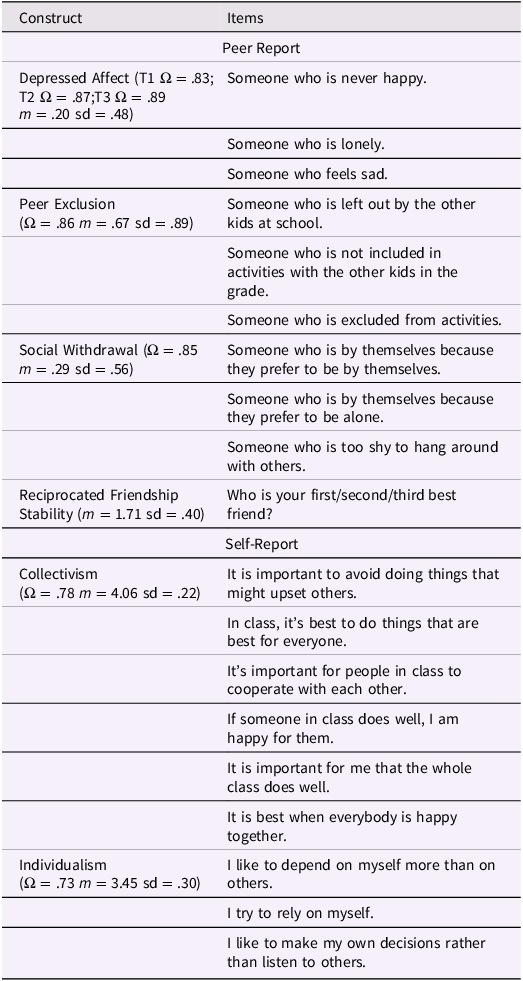
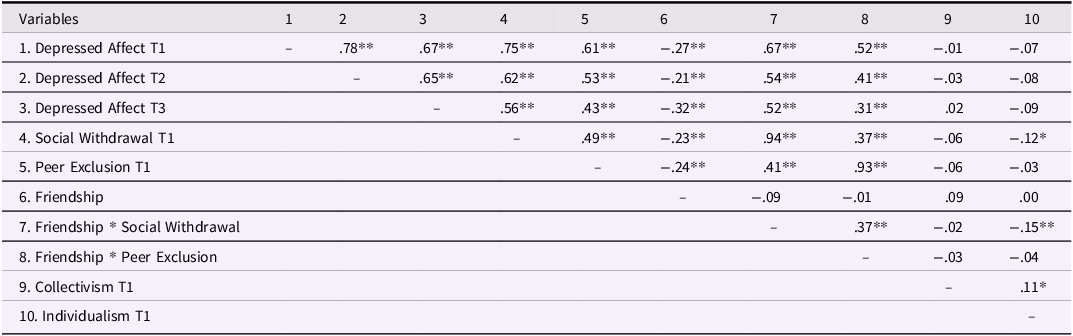
Table 1 presents the items, descriptive statistics, and scale reliabilities for the measures used in this study. Correlation between variables are shown in Table 2. Depressed affect, social withdrawal, and peer exclusion were assessed with an unlimited-choice peer-assessment procedure at each of the three time points. Peer nominations provide a valuable source of information, as children’s daily exposure to their peers allows them to make observations and judgments across different contexts (e.g., classroom, free play, after school). This consistent interaction enables children to gain insights into their peers’ behaviors and emotional expressions. Additionally, using multiple raters (all participating children) enhances the reliability of the assessment by providing a broader perspective on each child. Participants were presented with three items representing each construct and were asked to nominate peers from their classroom who matched each item. Children could nominate as many peers as they wished for each item. A score was calculated for each child on each item indicating how often they were nominated for it by their participating same-gender classroom peers. These scores were adjusted for potential biases that may result from variations in group size were with the regression-based procedure developed by (Velásquez et al., Reference Velásquez, Bukowski and Saldarriaga2013).
Measures and items

Note. The omega statistic assesses the reliability of a scale, with values above .80 indicating strong internal consistency, 0.70–0.80 suggesting acceptable reliability, .60–.70 being weak, and below .60 indicating poor reliability. The collectivism and individualism items were modeled after content of the items in the widely used measure created by Singelis (1994) for use with adults. The wording of items was adapted so their substance would be relevant to an older school-age population.
Correlation matrix of variables in the study
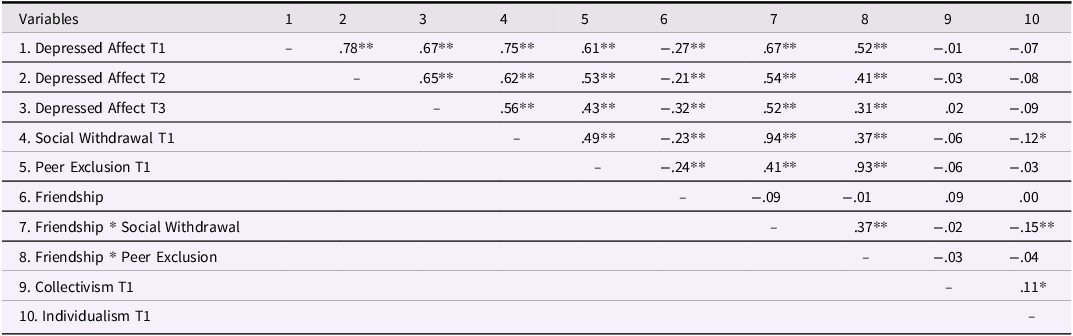
Note. * indicates a p-value less than 0.05. ** indicates a p-value less than 0.01. *** indicates a p-values less than 0.001.
The items used to assess depressed affect were adapted from the Peer Nomination Inventory of Depression (Lefkowitz & Tesiny, Reference Lefkowitz and Tesiny1980). The validity and reliability of this measure has been established in both English and, importantly for our study, in Spanish versions (Ezpeleta et al., Reference Ezpeleta, Penelo, Navarro, Osa and Trepat2020; Tesiny & Lefkowitz, Reference Tesiny and Lefkowitz1982) Like other peer assessment techniques that have assessed depressed affect (e.g., Wiggins & Winder, Reference Wiggins and Winder1961; Pekarik et al., Reference Pekarik, Prinz, Liebert, Weintraub and Neale1976) the Peer Nomination Inventory of Depression is premised on the idea that depressed affect has observable manifestations which are familiar to older school-age children. The goal of our measure was to index normative variations in depressed affect. (It was not intended to be a measure of clinical symptomatology). The items used in this study were Someone who is never happy, Someone who is lonely, and Someone who feels sad. These items were used at each of the three waves. The scores from each wave were subjected to a principal components analysis. The factor loadings observed in the analyses for each wave were used for two purposes. They were used as weights to create a composite measure of depressed affect at each of three waves. The contribution of each item to the composite was weighted by the factor loading. These values were also used to assess the reliability of the weighted measure created at each wave. This assessment was conducted with McDonald’s (Reference McDonald1999) omega. Unlike Cronbach’s alpha, which assumes equal factor loadings, omega uses observed factor loadings to create a more realistic estimate of reliability especially when items have different associations with the underlying construct or factor (Dunn et al., Reference Dunn, Baguley and Brunsden2014). These weighted measures of depressed affect were then adjusted for outliers so that no scores differed from the mean by more than 2.5 standard deviations. The means and standard deviations and reliability of the measure of depressed affect at each of the three waves are reported in Table 1.
The items assessing social withdrawal and exclusion were adapted from prior studies that used peer assessments of these constructs (Bowker et al., Reference Bowker, Bukowski, Zargarpour and Hoza1998; Bukowski et al., Reference Bukowski, Dirks, Persram, Santo, DeLay and Lopez2021). These items have been recognized as valid and reliable measures of these constructs (Rubin et al., Reference Rubin, Coplan and Bowker2009). Empirical evidence shows that school-aged children can reliably distinguish between social withdrawal and peer exclusion, accurately nominating peers for each category (Spangler & Gazelle, Reference Spangler and Gazelle2009). Additionally, the withdrawal items of the revised class play are known to fit a two factor structure representing social withdrawal and peer exclusion (Bowker et al., Reference Bowker, Bukowski, Zargarpour and Hoza1998). An invariance analysis showed that the factor structure of the measures social withdrawal and exclusion did not differ for the participants from Montreal and Barranquilla. Measures of social withdrawal and peer exclusion were created using the same procedures used to create the measures of depressed affect. Again, means and standard deviations and reliability of these measures are reported in Table 1.
Friendship was assessed using a sociometric procedure. The sociometric nominations collected at the two wave 1 bursts were used to create a measure of reciprocated friendship stability. The measure was based on two considerations. The first was whether either of the two peers whom the child chose as their first- and second-best friend had chosen the child as a first- or second-best friend. The second was whether one of the friendship nominations that was reciprocated at the first burst was also reciprocated at the second burst. The measure was scored according to a three-point system. If one of a child’s first two same-gender friendship nominations was reciprocated at both bursts the child was given a score of 2. If one of a child’s first two same-gender friendship nominations was reciprocated at one burst but not the other the child was given a score of 1.5. If neither of a child’s first two same-gender friendship nominations was reciprocated at either burst the child was given a score of 1. A score of 2 was given to 157 participants, 65 received a score of 1.5, and 91 received a score of 1.
Collectivism and individualism were assessed at T1 with self-reports. The items were modeled after content of the items in the widely used measure created by Singelis (1994) for use with adults. The wording of items was adapted so their substance would be relevant to an older school-age population (see Table 1). Participants were asked to indicate how well each statement applied to them. The items were scored on a five-point scale in which ‘1’ indicated ‘very untrue’ and ‘5’ indicated ‘true’. Group scores were computed for measures of social withdrawal, peer exclusion, friendship, collectivism, individualism. These values were the arithmetic means on these measures for the participants in the classroom-based same-gender peer groups. They represent descriptive group norms that are based on the self and peer-reported measures in the study. Same-gender norms were used for three reasons. First, collectivism and individualism are culturally reinforced patterns of behavior that are often learned through gendered socialization. Second, children are influenced by same-gender peers in developing values and behaviors. Third, gender can moderate how collectivistic and individualistic values are expressed, focusing on same-gender norms can reduce variability that comes from combining norms for boys and girls.
Analysis
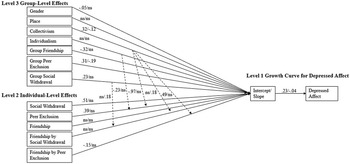
As shown in Figure 1, a three-level hierarchical model was conducted with HLM 6 (Raudenbush & Bryk, Reference Raudenbush and Bryk2002). In this analysis, the T1, T2, and T3 depressed affect scores were nested within each child at Level 1. The children’s scores on social withdrawal, peer exclusion, friendship and two-way interactions between these variables comprised Level 2. The children were nested within their same-gender classroom peer group to form Level 3. The Level-1 analysis was a within-person assessment of change in the measure of depressed affect. This analysis calculated a growth curve for each participant. Two parameters were calculated for each child. They were an intercept (i.e., an index of the level of depressed affect at T1) and a linear slope (i.e., an index of the child’s rate of change across the three waves/time points). The effects of individual-level variables on the intercept for depressed affect and linear slope were modeled at Level-2. The effects of group-level variables, including the group means for social withdrawal, peer exclusion, friendship, collectivism, and individualism, and the measures of gender and place were modeled at Level-3.
Growth curve analysis of peer-reported depressive symptoms over three timepoints during one academic year for children in fifth and sixth grades: individual- and group-level effects. Note. Standardized path coefficients are shown separately for the intercept (shown on the left side) and the slope (shown on the right side). Solid lines indicate L2 and L3 associations with L1, whereas dotted lines indicate the moderating role of L3 on associations between L2 and L1 variables.

Results
A four-step analysis was conducted with Hierarchical Linear Modeling (HLM) (Raudenbush & Bryk, Reference Raudenbush and Bryk2002). The first step consisted of an unconditional model that estimated the amount of variance that was within-persons and how much was between persons. The second step (i.e., Level 1) assessed within person-changes on the measure of depressed affect. In this phase of the analysis a growth curve was computed for each participant. The third step (i.e., Level 2) then assessed between-person differences in these changes and examined the degree to which individual-level characteristics predicted these changes. The fourth step (i.e., Level 3) assessed whether characteristics of the group moderated the effects observed at Levels 1 and 2.
Unconditional model/step 1
The initial analysis examined an unconditional model. This model included each participant’s individual depressed affect scores at each time as outcome variables. No predictors were included in the model. The analysis produced four statistics of interest. They were (a) the value of tau indicating the amount of between-person variance, (b) the value of sigma squared indicating the amount of within-person variance,(c) the coefficient for the intercept (i.e., an estimate of depressed affect at T1), and (d) Chi-square values from tests of whether the intercept was fixed or random at Levels 2 and 3. The values tau and sigma squared were 0.138 and .093, respectively. Using these values, the intraclass correlation (tau/(tau + sigma squared) was computed to be 0.60 indicating that 60% of the total variance in the depressed affect scores was between persons and 40% of the variance in depressed affect was within persons. The observed value for the intercept was .194. The Chi-square values at Level 2 and 3 were 1555.74 (df = 282, p < .001) and 32.09 (df = 30, p = .363), respectively. The Chi-square scores and their p values indicate that the intercept was random at level 2 but not at level 3 meaning that the scores on the measure of depressed affect varied across participants but not across groups.
Level 1 effects/step 2
The next analysis focused on Level 1. It assessed the degree of within-person change. An individual growth curve was created for each participant indicating how much the person’s scores on the measure of depressed affect changed across the three waves of the assessments. In this analysis an index of time was used as a predictor of the measures of depressed affect. For each participant, the analysis calculated a growth curve that included an intercept (i.e., an estimate of depressed affect at T1) and a linear slope (i.e., an estimate of the participant’s rate of change from T1 to T3. The overall value for the intercept was .236, (t = 10.39, p <0.001). The coefficient for the effect of time (i.e., the linear slope) was significant and negative (Coefficient = −.04, t = −3.24, p = 0.03) indicating that depressed affect decreased from T1 to T3. The value of sigma-squared decreased to .066 from .093 indicating that time accounted for 29% of the within-participant variance in the measures of depressed affect. The intercept was observed to be .236 and was observed to be random at Level 3 (chi-square (df = 30) = 53.36, p < .01).
Level 2 effects/step 3
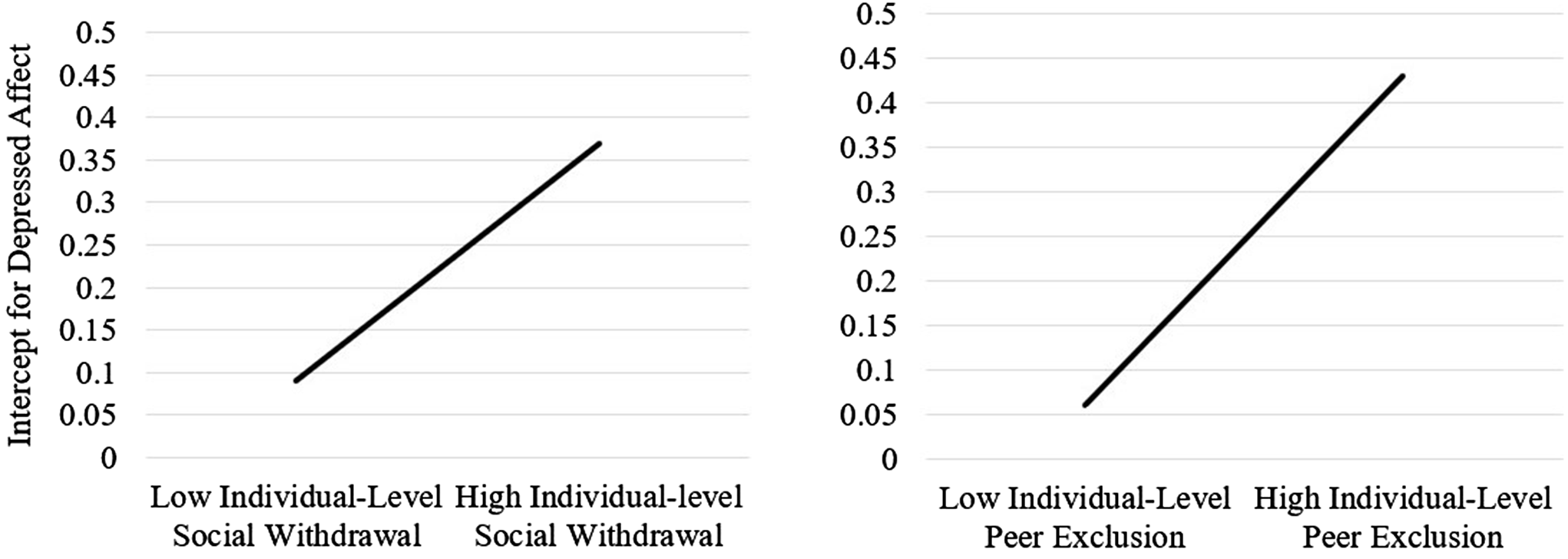
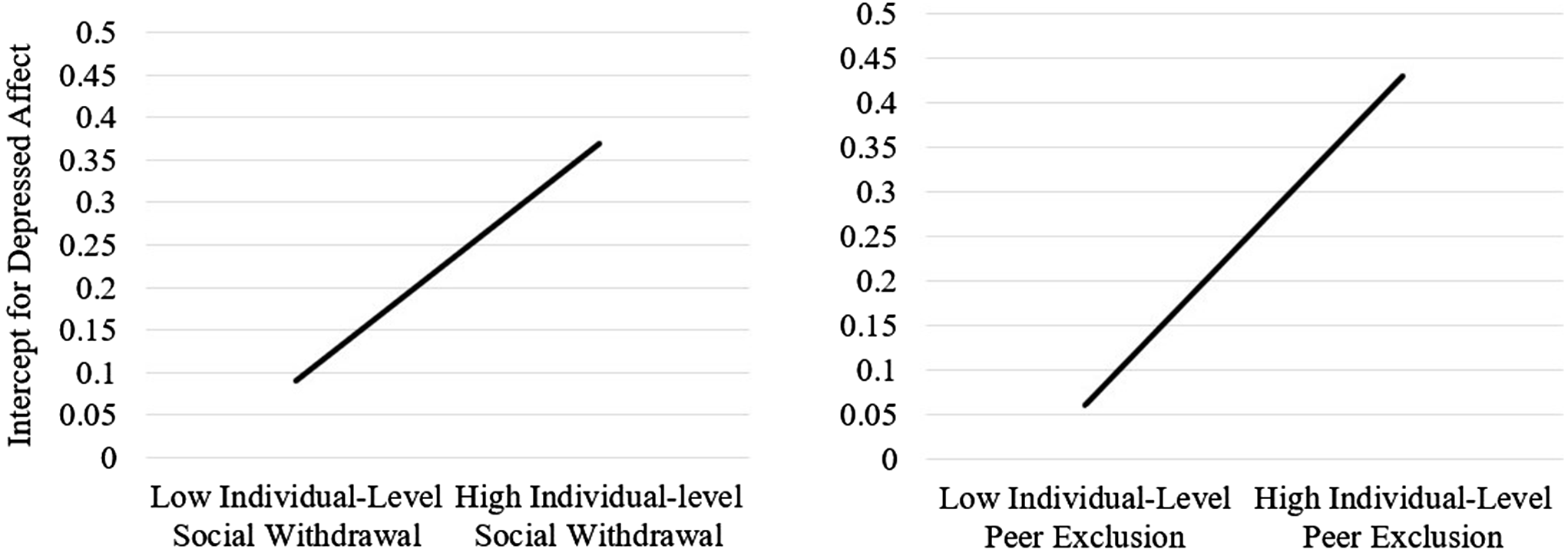
The next analyses assessed the degree to which between-person variance in the on the T1 measure of depressed affect (i.e., the intercept) and in the rate of change (i.e., the linear slope) were associated with the individual level variables included at Level 2. The Level 2 predictors were the measures of social withdrawal, peer exclusion, friendship, and the interactions peer exclusion and friendship, and social withdrawal and friendship. Three variables were observed to account for variance in the intercept. They were social withdrawal, peer exclusion and the interaction between peer exclusion and friendship. The Level 2 measures of social withdrawal and peer exclusion were positively associated with the intercept (Coefficient = .514, t = 11.74, p <0.001 for social withdrawal; Coefficient = .387, t = 4.32, p <0.001 for peer exclusion). These findings are shown in Figure 2. The association between social withdrawal on the intercept was observed to be fixed at Level 3; association between peer exclusion and the intercept was observed to be random at Level 3 (Chi-square = 42.87 (df = 29, p < .05) indicating that the strength of the interaction varied across the groups. Although the measure of friendship was not associated with the intercept (Coefficient = −.039, t = −.815, p >0.05), the interaction between peer exclusion and friendship was negatively associated with it (Coefficient = −.145, t = −2.55, p <0.05). A clarification of the interaction indicated the negative association between peer exclusion and the intercept was stronger for unfriended children than for friended children.
Effects of individual-level social withdrawal and peer exclusion on the intercept for depressed affect.
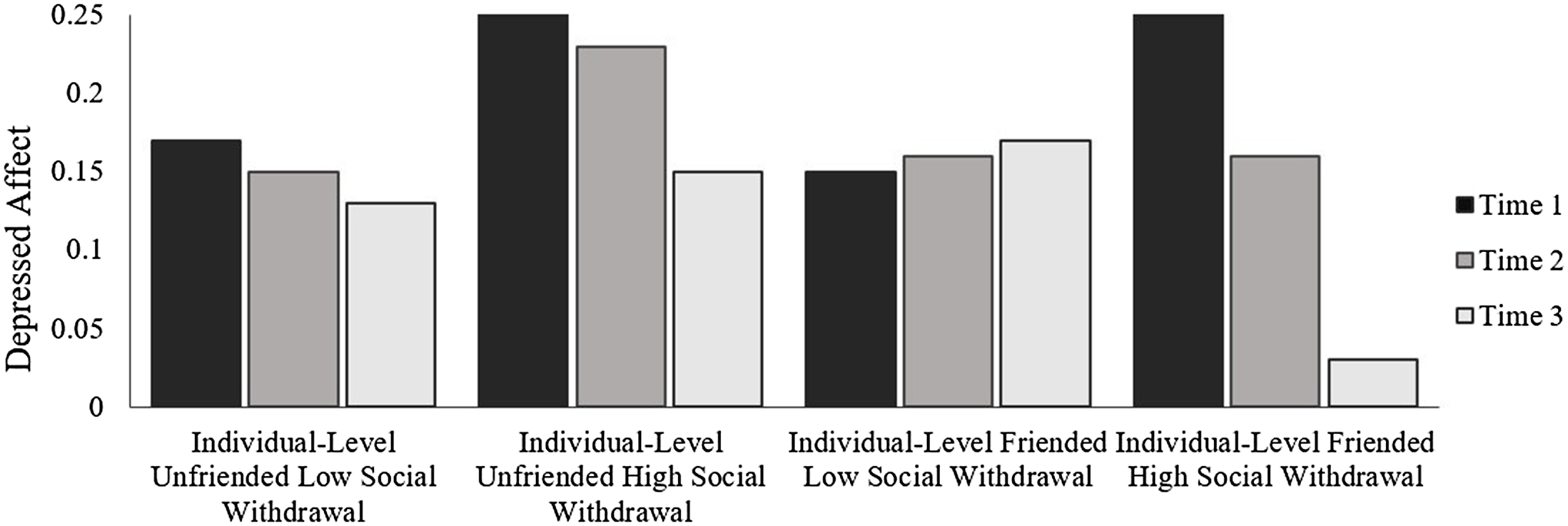
Only one of the Level 2 predictors was associated with variance in the linear slope for time. The interaction between social withdrawal and friendship was observed to be a negative predictor of the effect of time (Coefficient = −.17, t = −3.19, p <0.05). A clarification of this interaction indicated that the association between the measure of social withdrawal and the variance in the linear slope for time was stronger for children who were unfriended than for children who were friended, indicating that children who scored high on social withdrawal and were friended had steeper decreases in depressed affect across time. This effect was random at Level 3 (Chi-square = 44.13 (df = 29, p < .05) (see Figure 3).
Effect of individual-level social withdrawal by friendship on the intercept for depressed affect across three timepoints.

Level 3 effects/step 4
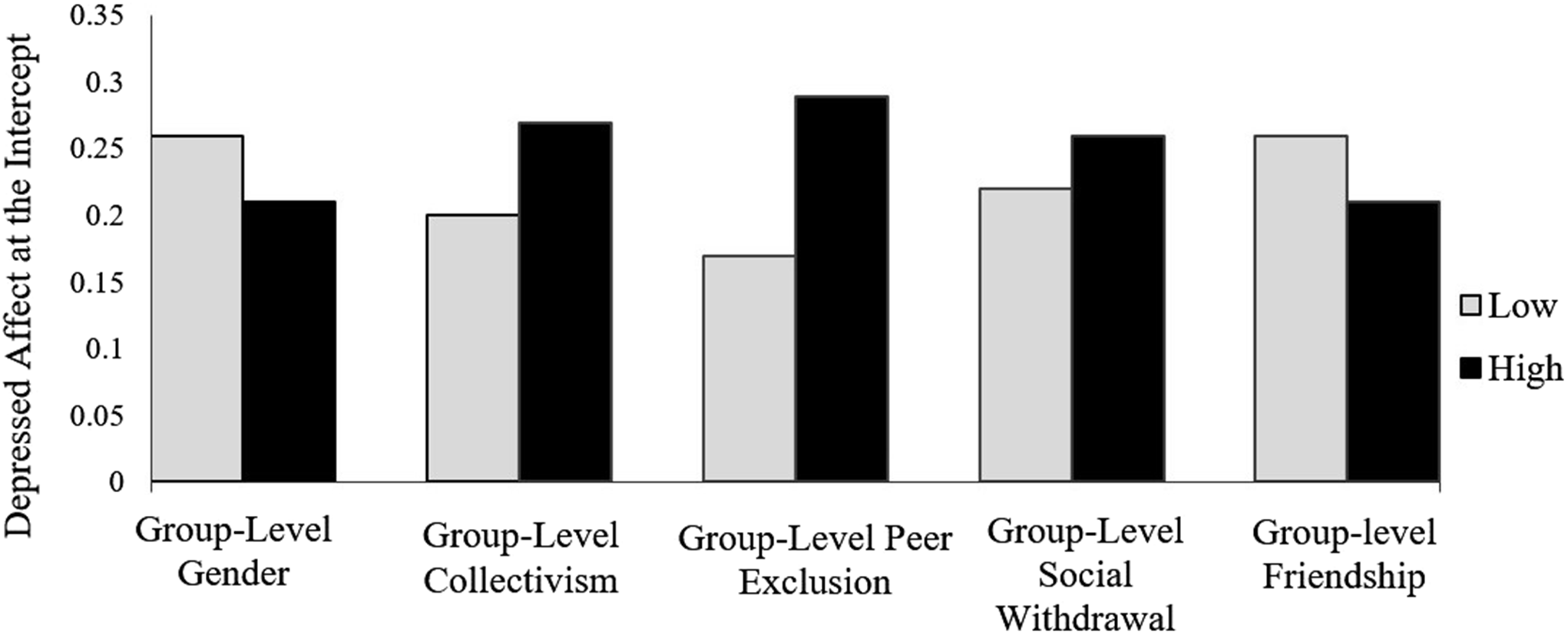
The Level 3 model assessed whether variables at level 3 (i.e., characteristics of the group) were associated with variation in effects observed at Level 1 and Level 2. Five Level 3 variables were observed to be associated with between-group variance in the T1 measure of depressed affect (i.e., the intercept). Gender (scored as .5 for girls and −.5 for boys) and the group mean for friendship were both negatively associated with variance in the intercept (Coefficient = -.05, t = −2.64, p <0.01 for gender and Coefficient = −.32, t = −3.17, p <0.05 for friendship), whereas the group means for collectivism, peer exclusion, and social withdrawal were positively associated with it (Coefficient = .32, t = 3.09, p <0.005, for collectivism, Coefficient = .31, t = 7.77, p <0.005, for peer exclusion, and Coefficient = .23, t = 3.37, p <0.005 for social withdrawal). These findings indicate groups comprised of girls and groups with high levels of stable friendedness had lower scores on the T1 measure of depressed affect the intercept, whereas groups with high mean scores on collectivism, peer exclusion, and social withdrawal had higher scores on this measure (See Figure 4).
Group-level effects on the intercept for depressed affect. Note. Boys are coded as “Low” and girls as “High” within the gender category, and ‘Friended is coded as “Low” and unfriended as “High”’ within the friendship category.

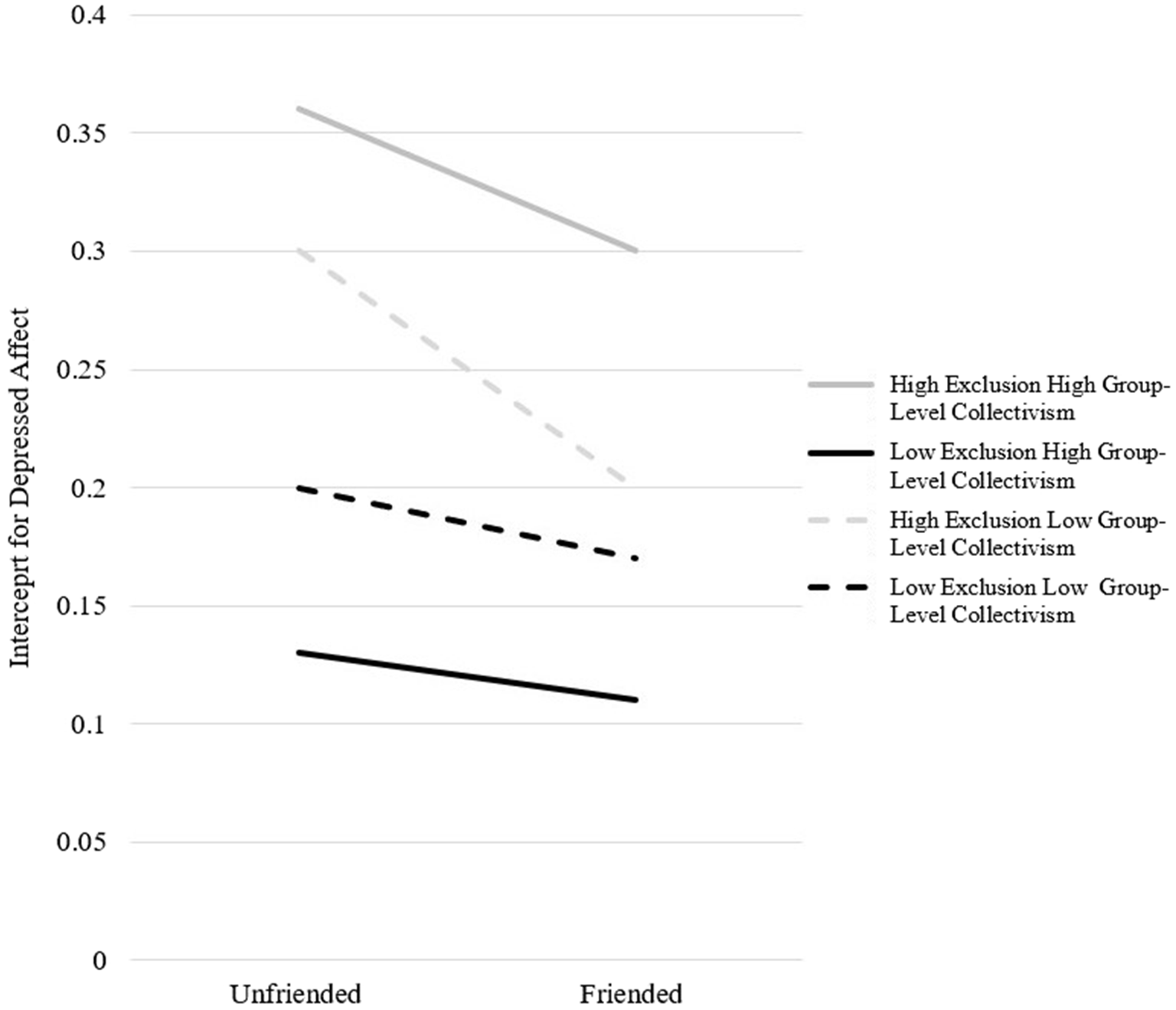
Two Level 3 measures were negatively associated with between-person variance in the Level 2 effect of peer exclusion on the level of depressed affect at T1. They were the measures of collectivism and for individualism (Coefficients = −.97 (t = −2.31, p <0.05) and −.23 (t = −2.92, p <0.05) for collectivism and individualism, respectively). High scores on each of these measures were associated with weaker effects for the Level 2 measure of peer exclusion on the intercept (i.e., an estimate of depressed affect at T1). The Level 3 measure of collectivism was also associated with variance in the Level 2 effect of the interaction between peer exclusion and friendship interaction on the intercept. In this case, the association was positive (Coefficient = .48, t = 1.77, p <0.05) indicating that the effect of the interaction between friendship by peer exclusion for initial levels of depressed affect was stronger in groups that were low in collectivism (See Figure 5).
Effect of the interaction between individual-level peer exclusion and friendship on depressed affect moderated by group-level collectivism.

Two Level 3 variables accounted for variance in the Level 1 linear slope for time. The group mean for collectivism and the group mean for peer exclusion were observed to be negatively associated with variance in the effect of time (Coefficients = −.12 (t = −2.28, p <0.03) and −.19 (t = −9.84, p <0.001) for collectivism and peer exclusion, respectively). These coefficients indicate that the time-related decrease in depressed affect was steeper in groups that had high mean scores on collectivism and groups that had high mean scores on the measure of peer exclusion. These effects are shown in Figure 6.
Effect of group-level collectivism and peer exclusion on depressed affect across three timepoints.

Two Level 3 variables were associated with variance in the effect of the Level 2 interaction between social withdrawal and friendship on the Level 1 linear slope for time. The group mean for social withdrawal and the group mean for collectivism were positively associated with variance in the association between the Level 2 interaction between social withdrawal and friendship (Coefficient = .18, t = 3.97, p <0.05 for social withdrawal and Coefficient = .18, t = 2.081, p <0.05 for collectivism). Both Level 3 variables weakened the negative effect of the interaction between social withdrawal and friendship on the Level 1 linear slope for time. They indicate that despite being friended, decreases in depressed affect across time were less steep in peer groups with high collectivism and social withdrawal. Of note, the Level 3 place was tested at each step and found to be non-significant (p >0.05).
Discussion
A multilevel approach was used to examine how the intersection between measures taken from different levels of social complexity predicted initial levels and rates of change of depressed affect in older school-age children. Two major findings were revealed. The first showed that the affective consequences of individual-level social withdrawal and peer exclusion were dependent on group-level features. The second was the observation that strength of the protective effect of friendship was varied as a function of group-level factors. Together these findings reveal the critical embeddedness of individual level measures in a broader socioecological structure. They provide compelling evidence that maladjustment is contextually embedded, shaped by the interaction between individual experiences and the broader social environment.
The role of group-level features on depressed affect
Initial levels of depressed affect, as manifested in the intercept, were observed to be associated with measures from all three levels of analysis. Group-level measures of gender, collectivism, peer exclusion, social withdrawal and friendship were associated with initial levels of depressed affect. Three group-level effects were expected. Specifically, high levels of group peer exclusion and social withdrawal and low levels of group friendship were associated with higher initial levels of depressed affect. Though previous studies have shown that measures of individual-level social withdrawal, peer exclusion and friendlessness contribute to emotional difficulties in youth (Rubin et al., Reference Rubin, Coplan and Bowker2009), we extend these findings by showing that they operate similarly at the level of the peer group. Two findings were in the unexpected direction. Boys and children in groups with a high score on collectivism exhibited higher initial levels of depressed affect. The first finding may be explained by the age of the participants. Though girls typically have higher rates of depressed affect than boys, this difference begins to emerger after age thirteen (Hankin & Abramson, Reference Hankin and Abramson1999). Participants in the study did not exceed age twelve. The second finding may be a consequence of the measurement system itself. Depressed affect was assessed using peer nominations. It may be that in collectivistic context, children are more sensitive to the presence of depressed affect in one of their peers. This heightened sensitivity may explain the higher scores on the peer-assessed measures of depressed affect in peer groups that are high in collectivism.
Change in depressed affect was also predicted by group-level measures, specifically collectivism and peer exclusion. Compared to peer groups with low scores of collectivism, steeper decreases in depressed affect were observed in groups with high scores on collectivism. Taken together with the effect of group collectivism on the level of depressed affect at T1, our findings suggest while group collectivism is associated with higher levels of peer-assessed depressed affect at the start of the school year, it functions to reduce depressed affect as the year progresses. Similarly, peer groups with low scores on peer exclusion showed decrease in depressed affect over time such that the levels of depressed affect at each time point were lower compared to peer groups with high scores on peer exclusion. Though depressed affect also decreased for peer groups with high scores on peer exclusion, their overall scores were higher across each time point.
Group-level moderators of the association between social withdrawal, exclusion and depressed affect
Group-level measures also moderated the association between the individual level measures of social withdrawal and peer exclusion and the initial levels of depressed affect. In doing so they align with prior findings that show that the consequences of forms of solitude vary across context (Avant et al., Reference Avant, Gazelle and Faldowski2011; Bass et al., Reference Bass, Santo, Da Cunha and Neufeld2016; Bukowski et al., Reference Bukowski, Dirks, Persram, Santo, DeLay and Lopez2021). Consistent with our hypothesis, the present findings extended the prior results by showing that the association between peer exclusion and initial levels of depressed affect varied as a function of two group-level features, collectivism and individualism. Children who scored high on the measure of peer exclusion had lower initial levels of depressed affect when they belong to peer groups categorized by high collectivism, compared to children who were in peer groups characterized by low collectivism. A previous study showed that peer-group level collectivism moderated the social consequences of a measure of peer exclusion (Bass et al., Reference Bass, Santo, Da Cunha and Neufeld2016). Specifically, they showed that excluded children experienced less victimization in peer groups where collectivism was high. The present findings demonstrate that the protective effect of collectivism in peer groups extends beyond social consequences to also influence the affective consequences of peer exclusion. Collectivism often fosters norms of inclusion, acceptance, and fairness (Triandis, Reference Triandis1993). When these norms are recognized and supported, children may be more likely to provide support those who are excluded. These inclusive norms may lessen the negative consequences of peer exclusion. Much has been written to extoll the benefits of collectivism (Keller & Kitayama, Reference Schmidt, Fox, Schulkin and Gold2019; Triandis, Reference Triandis1993). Discussions of the impact of collectivism are typically richer in theory and in their emphasis on outcomes rather than on empirically supported evidence of the mechanisms or processes by which collectivism has its effects. The present findings provide evidence of one of these explanatory processes.
One unexpected finding was the observation that high scores on group individualism also minimized the affective consequences of peer exclusion. Individualism may create a significative system that supports the value of exclusion. Whereas collectivist cultures prioritize interdependence and social support, individualistic cultures emphasize independence and autonomy (Triandis, Reference Triandis1993). This emphasis on self-reliance and self-directed activities might equip children with coping strategies that mitigate the negative emotional consequences of social exclusion. By focusing on personal goals and accomplishments, children in individualistic contexts may be better able to redirect their attention away from the distress associated with being excluded.
Moderating role of friendship and features of the group
Consistent with previous research (Bukowski et al., Reference Bukowski, Laursen and Hoza2010; Markovic & Bowker, Reference Markovic and Bowker2017), being friended buffered against the negative impact of individual-level peer exclusion on initial levels of depressed affect and individual-level social withdrawal on increases in depressed affect. However, in line with our hypothesis, the protective effect of friendship varied across contexts, namely the mean for peer group collectivism and peer group social withdrawal. The moderating role of peer group collectivism was observed for both peer exclusion and social withdrawal. In peer groups where collectivism was high friendship was less protective against baseline levels of depressed affect for excluded youth and change in depressed affect for socially withdrawn youth, compared to peer groups where collectivism was low. In this way, collectivism at the level of the group functioned to reduce the protective effect of friendship at the level of the individual.
Prior studies have demonstrated that children in collectivistic peer groups experience greater negative outcomes from social withdrawal, as this behavior conflicts with collectivistic norms (Bass et al., Reference Bass, Santo, Da Cunha and Neufeld2016; Bukowski et al, Reference Bukowski, Dirks, Persram, Santo, DeLay and Lopez2021). This supports the misfit effect, wherein individuals who deviate from group norms face more difficulties. Our study extends these findings by showing that the protective role of friendship is less effective in collectivistic peer groups. Withdrawal represents a deviation from collectivistic norms by keeping to oneself, lack of interactions with the larger peer group and excessive focus on the self (Rubin et al., Reference Rubin, Coplan and Bowker2009; Schmidt et al., Reference Schmidt, Fox, Schulkin and Gold1999). Exclusion is also associated with behaviors that run against collectivistic norms, like aggression (Bergmüller, Reference Bergmüller2013). Given that collectivistic settings emphasize harmony, cohesion and interconnectedness (Triandis, Reference Triandis1993), it may be challenging for a friend to provide support to a child whose behaviors run against to these expectations. As a result, the protective effect of friendship in this context is limited. Additionally, children in collectivistic peer groups likely derive a sense of belonging from their connection with the group as a whole. Thus, for a withdrawn or excluded child, simply having a friend may not be sufficient to foster a true sense of belonging, limiting the extent to which friendship buffers against depressive affect. Indeed, studies have shown that dyadic friendship may hold less meaning in collectivistic contexts as individuals tend to organize relationships around the broader context of the group (Fandrem, Reference Fandrem and James2015; Lu et al., Reference Lu, Oh, Leahy and Chopik2021). Alternatively, collectivism may offer the same protective provisions as friendship but at a different level of social complexity. In this way, collectivism minimizes friendship effects.
Notably, the weaker protective effect of friendship on depressed affect was observed concurrently for peer exclusion and longitudinally for social withdrawal, further supporting the distinction between these constructs (Bowker et al., Reference Bowker, Bukowski, Zargarpour and Hoza1998; Rubin et al., Reference Rubin, Coplan and Bowker2009). As peer exclusion is externally imposed, the distress it elicits may be more acute, particularly in tightly knit peer groups where social dynamics appear uncontrollable (Blackhart et al., Reference Blackhart, Eckel and Tice2007; Dickerson & Zoccola, Reference Dickerson, Zoccola and DeWall2013). In contrast, the distress associated with social withdrawal is more dynamic, reflecting the internal factors that may underly withdrawn behavior. For instance, shy children often experience an internal conflict between the desire to approach others and desire to avoid others out of fear (Asendorpf, Reference Asendorpf1990). These fluctuations in internal conflict may contribute to corresponding variations in affective experiences over time. It is also worth considering the different mechanisms by which peer exclusion and social withdrawal interact with collectivism to weaken the protective role of friendship. For excluded youth in collectivistic peer groups, belonging may stem more from connection with the larger group rather than from friendships. Simply having a friend may not be enough to feel a sense of inclusion. For withdrawn youth, collectivistic peer groups may encourage participation in group activities, placing pressure on them to engage socially. This pressure could heighten internal distress and diminish the protective benefits of friendship.
Peer group-level social withdrawal also moderated the degree to which friendship was protective. For socially withdrawn youth, being friended predicted steeper decreases in depressed affect in peer groups where the prevalence for social withdrawal was low, compared to peer groups where the prevalence was high. Compared to children who are not withdrawn, those who score high on measures of social withdrawal are likely develop to friendships with youth who are also withdrawn (Rubin et al., Reference Rubin, Bukowski and Parker2006). Studies have shown that they also tend to report their friendships as being of low quality, lacking in help/guidance, intimate exchange, conflict resolution, companionship, security, closeness, warmth. Their friendships are also less stable, and they report feeling less safe with their friends (Ponti & Tani, Reference Ponti and Tanin.d.; Rubin et al., Reference Rubin, Bukowski and Parker2006). In groups with low social withdrawal, children may have more opportunities to interact and form friendships with those who differ from them on key dimensions. They may develop friendships with peers who are less withdrawn and more accepted and thus are able to benefit from valuable social resources that may buffer against negative experiences. In peer groups where withdrawal is high, children may be more likely to form friendships with others who are also withdrawn, reinforcing the negative aspects of these friendships and minimizing their protective value.
The present findings showed that associations between peer exclusion, social withdrawal, friendship and depressed affect did not vary between participants from Montreal and Barranquilla. This lack of findings suggests that classroom-based same-gender peer group norms may play a more important role than broad place differences in shaping the emotional outcomes for children who are isolated. A likely explanation for this lack of explicit place-based findings may be that these differences may have been accounted for by the measures of norms and the two cultural dimensions of culture. Group norms and explicit measures of culture may be more relevant and influential than broader cultural or geographic distinctions as they directly shape the social environment where solitude is experienced and processed. It may also be that places are simply too heterogeneous to have specific effects.
Strengths and limitations
The present study has several strengths. First, we used a multiwave longitudinal design within a multilevel model which allowed us to assess contextual variability in within-person change in depressed affect across the school year. Second, research in this area has mostly focused on samples from Western, Educated, Industrialized, Rich, and Democratic societies and cross-place comparisons have been examined rarely. Our study examined differences in participants from Canada and Colombia making cross-cultural comparisons possible. Third, our study expands on a growing body of literature that aims to better understand the factors that moderate the affective consequences of social withdrawal and peer exclusion. Whereas much of the current literature has focused on the role of moderators as the level of the individual on social outcomes, we considered moderators at the level of the group and their impact on affective outcomes. These second and third strengths point to the importance of using culturally informed designs that go beyond between-place comparisons to assess the effects of specific dimensions of culture such as collectivism (Bukowski et al., Reference Bukowski, Dirks, Persram, Santo, DeLay and Lopez2021)
A further strength of our study is the use of dimensional measures to assess the complex additive and interactive processes that account for the effects of forms of withdrawal on changes in depressed affect. Some recent approaches have relied on the use of subtypes that are operationally defined according to combinations of categorical measures. It is hard to tell whether the effects observed with these categorical measures are indicators of additive of interactive dynamics. This limitation is largely avoided by using well-specified dimensional measures.
Some possible limitations must be noted. First, though the study examined descriptive norms, injunctive norms were not assessed. Descriptive norms provide information on the prevalence of a behavior in a group, whereas injunctive norms describe the degree to which individuals see a behavior as acceptable. As such, we could not arrive at conclusions about participant’s perceptions of the acceptability of social withdrawal Second, we relied on self-report and peer-assessed forms of measurement. Each approach has its strengths. Efforts to replicate our findings with other measures would be useful. Third, some of our measures were assessed with few items. Though the reliability of the measures were still satisfactory or better, additional items could have improved their internal consistency. Third, dimensions of cultural variations are not limited to collectivism and individualism. Future studies may benefit from assessing other measures of cultural dimensions such as masculinity/femininity or power distance.
Implications and future directions
The present study underscores the importance of considering the group context when examining the consequences of social withdrawal and peer exclusion. It is consistent with theories that emphasize the role of context in shaping the moderators and outcomes of a social behaviors and experiences. Future studies that aim to identify factors that buffer against the consequences withdrawal and exclusion should not only consider features at the level of the individual, but also at the level of the group. Our findings have practical implications that can help inform intervention strategies targeting social problems in youth. By recognizing the significance of the group context, interventions can be tailored to create supportive environments that promote positive peer relationships.
Data availability statement
The authors are willing to consider all reasonable requests for possible collaborations with the data used in the present study. This study was not preregistered.
Acknowledgements
Level 2 TOP standards were followed.
Funding statement
Work on this paper was supported by grants to the first, second, and fourth authors from the Social Sciences and Humanities Research Council of Canada (grant number 400002283).
Competing interests
The authors declare none.
Ethics Statement: This study complies with APA ethical standards (ethics certification number 30016861)


 Open access

