





1. Introduction
There is a large body of results in extremal graph theory focusing on determining the minimum degree threshold which forces the containment of a target subgraph. For example, a classical result of Dirac [Reference Dirac6] states that any $n$
-vertex graph with minimum degree at least
$n$
-vertex graph with minimum degree at least $n/2$
contains a Hamilton cycle. Although this result is tight, graphs with minimum degree
$n/2$
contains a Hamilton cycle. Although this result is tight, graphs with minimum degree $n/2$
are quite dense, so it is natural to suspect that they are Hamiltonian in a rich sense. In this direction, Sárközy, Selkow, and Szemerédi [Reference Sárközy, Selkow and Szemerédi25] showed that
$n/2$
are quite dense, so it is natural to suspect that they are Hamiltonian in a rich sense. In this direction, Sárközy, Selkow, and Szemerédi [Reference Sárközy, Selkow and Szemerédi25] showed that $n$
-vertex graphs with minimum degree
$n$
-vertex graphs with minimum degree $n/2$
contain
$n/2$
contain $\Omega (n)^n$
distinct Hamilton cycles (we refer to such results as enumeration results; see also [Reference Cuckler and Kahn5]). Moreover, randomly sparsifying the edge set of an
$\Omega (n)^n$
distinct Hamilton cycles (we refer to such results as enumeration results; see also [Reference Cuckler and Kahn5]). Moreover, randomly sparsifying the edge set of an $n$
-vertex graph with minimum degree
$n$
-vertex graph with minimum degree $n/2$
yields, with high probability, another Hamiltonian graph, as long as each edge is kept with probability
$n/2$
yields, with high probability, another Hamiltonian graph, as long as each edge is kept with probability $\Omega (\log n /n)$
. This follows from an influential result of Krivelevich, Lee, and Sudakov [Reference Krivelevich, Lee and Sudakov17] (such results are referred to as robustness results; see [Reference Sudakov26]), which generalises Pósa’s celebrated result stating that the random graph
$\Omega (\log n /n)$
. This follows from an influential result of Krivelevich, Lee, and Sudakov [Reference Krivelevich, Lee and Sudakov17] (such results are referred to as robustness results; see [Reference Sudakov26]), which generalises Pósa’s celebrated result stating that the random graph $G(n,C\log n/n)$
is Hamiltonian with high probability.
$G(n,C\log n/n)$
is Hamiltonian with high probability.
The study of random graphs was recently revolutionised by Frankston, Kahn, Narayanan, and Park’s [Reference Frankston, Kahn, Narayanan and Park7] proof of the fractional expectation threshold vs. threshold conjecture of Talagrand [Reference Talagrand27] (see also [Reference Park and Pham21] for a proof of the even stronger Kahn–Kalai conjecture [Reference Kahn and Kalai11]). In our context, these breakthroughs imply that the enumeration and robustness results stated in the first paragraph, which themselves are fairly general, admit a a further common generalisation. To state this generalisation, we need the language of spread distributions which we will define momentarily. In a nutshell, the key idea is to show that a graph $G$
, with minimum degree large enough to necessarily contain a copy of a target graph
$G$
, with minimum degree large enough to necessarily contain a copy of a target graph $H$
, actually supports a random embedding of
$H$
, actually supports a random embedding of $H$
that (roughly speaking) resembles a uniformly random function from
$H$
that (roughly speaking) resembles a uniformly random function from $V(H)$
to
$V(H)$
to $V(G)$
. The formal definition we use is below.
$V(G)$
. The formal definition we use is below.
Definition 1 [Reference Pham, Sah, Sawhney and Simkin24]. Let $X$
and
$X$
and $Y$
be finite sets, and let
$Y$
be finite sets, and let $\mu$
be a probability distribution over injections
$\mu$
be a probability distribution over injections $\varphi : X \rightarrow Y$
. For
$\varphi : X \rightarrow Y$
. For $q \in [0, 1]$
, we say that
$q \in [0, 1]$
, we say that $\mu$
is
$\mu$
is $q$
-spread if for every two sequences of distinct vertices
$q$
-spread if for every two sequences of distinct vertices $x_1, \dots , x_s \in X$
and
$x_1, \dots , x_s \in X$
and $y_1, \dots , y_s \in Y$
,
$y_1, \dots , y_s \in Y$
,
 \begin{equation*} \mu \left (\left \{\varphi : \varphi (x_i)=y_i \text{ for all }i \in [s]\right \}\right ) \leqslant q^s. \end{equation*}
In our context, $X=V(H)$
,
$X=V(H)$
, $Y=V(G)$
,
$Y=V(G)$
, $|X|=|Y|=n$
, and
$|X|=|Y|=n$
, and $\mu$
is a probability distribution over embeddings of
$\mu$
is a probability distribution over embeddings of $H$
into
$H$
into $G$
. The gold standard for us is constructing distributions
$G$
. The gold standard for us is constructing distributions $\mu$
that are
$\mu$
that are $O(1/n)$
-spread. Such distributions have the optimal spread (up to the value of the implied constant factor) that is also attained by a uniformly random injection from
$O(1/n)$
-spread. Such distributions have the optimal spread (up to the value of the implied constant factor) that is also attained by a uniformly random injection from $V(H)$
to
$V(H)$
to $V(G)$
. We remark that Definition 1, originally introduced in [Reference Pham, Sah, Sawhney and Simkin24], is different to the usual definition of spreadness phrased in terms of edges instead of vertices. However, for embedding spanning subgraphs, the above definition turns out to be more convenient (see [Reference Kelly, Müyesser and Pokrovskiy14, Reference Pham, Sah, Sawhney and Simkin24] for more details).
$V(G)$
. We remark that Definition 1, originally introduced in [Reference Pham, Sah, Sawhney and Simkin24], is different to the usual definition of spreadness phrased in terms of edges instead of vertices. However, for embedding spanning subgraphs, the above definition turns out to be more convenient (see [Reference Kelly, Müyesser and Pokrovskiy14, Reference Pham, Sah, Sawhney and Simkin24] for more details).
The breakthroughs on the Kahn–Kalai conjecture have created a lot of incentive to show “spread versions” of Dirac-type results in graphs and hypergraphs, as such results directly imply enumeration and robustness results, thereby coalescing two streams of research which have, until now, been investigated independently. We refer the reader to the recent papers [Reference Anastos and Chakraborti2, Reference Joos, Lang and Sanhueza-Matamala9, Reference Kang, Kelly, Kühn, Osthus and Pfenninger12, Reference Kelly, Müyesser and Pokrovskiy14, Reference Pham, Sah, Sawhney and Simkin24] that obtain several results in this direction (see also [Reference Allen, Böttcher and Corsten1]). Most of the aforementioned work focuses on constructing spread distributions for target graphs with rather simple structures, such as perfect matchings or Hamilton cycles. One notable exception is the result from [Reference Pham, Sah, Sawhney and Simkin24] for bounded-degree trees. To introduce this result, we first cite the following classical result in extremal graph theory.
Theorem 2 (Komlós–Sárközy–Szemerédi [Reference Komlós, Sárközy and Szemerédi15]). For every $\Delta \in \mathbb N$
and
$\Delta \in \mathbb N$
and $\alpha \gt 0$
, there exists
$\alpha \gt 0$
, there exists $n_0\in \mathbb N$
such that the following holds for all
$n_0\in \mathbb N$
such that the following holds for all $n\geqslant n_0$
. If
$n\geqslant n_0$
. If $G$
is an
$G$
is an $n$
-vertex graph with
$n$
-vertex graph with $\delta (G)\geqslant (1+\alpha )\frac {n}{2}$
, then
$\delta (G)\geqslant (1+\alpha )\frac {n}{2}$
, then $G$
contains a copy of every
$G$
contains a copy of every $n$
-vertex tree with maximum degree bounded by
$n$
-vertex tree with maximum degree bounded by $\Delta$
.
$\Delta$
.
Theorem 2 admits a spread version, as demonstrated in [Reference Pham, Sah, Sawhney and Simkin24].
Theorem 3 (Pham, Sah, Sahwney, Simkin [Reference Pham, Sah, Sawhney and Simkin24]). For every $\Delta \in \mathbb N$
and
$\Delta \in \mathbb N$
and $\alpha \gt 0$
, there exists
$\alpha \gt 0$
, there exists $n_0, C\in \mathbb N$
such that the following holds for all
$n_0, C\in \mathbb N$
such that the following holds for all $n\geqslant n_0$
. If
$n\geqslant n_0$
. If $G$
is an
$G$
is an $n$
-vertex graph with
$n$
-vertex graph with $\delta (G)\geqslant (1+\alpha )\frac {n}{2}$
, and
$\delta (G)\geqslant (1+\alpha )\frac {n}{2}$
, and $T$
is a
$T$
is a $n$
-vertex tree with
$n$
-vertex tree with $\Delta (T)\leqslant \Delta$
, there exists a
$\Delta (T)\leqslant \Delta$
, there exists a $(C/n)$
-spread distribution on embeddings of
$(C/n)$
-spread distribution on embeddings of $T$
onto
$T$
onto $G$
.
$G$
.
Using the $s=n$
case of Definition 1, Theorem 3 allows us to deduce that in the context of Theorem 2,
$s=n$
case of Definition 1, Theorem 3 allows us to deduce that in the context of Theorem 2, $G$
contains
$G$
contains $\Omega (n)^n$
copies of a given bounded-degree tree (see [Reference Joos and Schrodt10] for a more precise result). Furthermore, Theorem 3 implies that the random subgraph
$\Omega (n)^n$
copies of a given bounded-degree tree (see [Reference Joos and Schrodt10] for a more precise result). Furthermore, Theorem 3 implies that the random subgraph $G'\subseteq G$
obtained by keeping each edge of
$G'\subseteq G$
obtained by keeping each edge of $G$
with probability
$G$
with probability $\Omega (\log n/n)$
also contains a given bounded-degree tree (see [Reference Pham, Sah, Sawhney and Simkin24] for a precise statement).
$\Omega (\log n/n)$
also contains a given bounded-degree tree (see [Reference Pham, Sah, Sawhney and Simkin24] for a precise statement).
The original proof [Reference Komlós, Sárközy and Szemerédi15] of Theorem 2 constitutes one of the early applications of the Szemerédi regularity lemma (used in conjunction with the blow-up lemma of Komlós, Sárközy, and Szemerédi). The proof of the more general Theorem 3 in [Reference Pham, Sah, Sawhney and Simkin24] can be interpreted as a randomised version of the proof in [Reference Komlós, Sárközy and Szemerédi15]. Indeed, readers familiar with applications of the regularity/blow-up lemma would know that whilst embedding a target subgraph with this method, there is actually a lot of flexibility for where each vertex can go. Thus, a choice can be made randomly from the available options as a reasonable strategy towards proving Theorem 3.
The main contribution of the current paper is a proof of Theorem 3 that uses Theorem 2 as a black box. The most obvious advantage of such a proof is that, as Theorem 2 has a more modern proof due to Montgomery and Kathapurkar [Reference Kathapurkar and Montgomery13] that circumvents the use of Szemerédi regularity lemma, our proof yields a regularity-free proof of Theorem 3 which naturally has better dependencies between the constants (see Remark 17). Our proof is presented in Section 3, and Section 3.1 contains an overview explaining the key ideas.
1.1 Future directions
Our proof can also be interpreted as modest progress towards a more ambitious research agenda, hinted to in [Reference Kelly, Müyesser and Pokrovskiy14], which asserts that all Dirac-type results admit a spread version, regardless of the target structure being embedded. One reason why such a general result could hold is that in Dirac-type results, host graphs have linear minimum degree. Thus, Chernoff’s bound can be used to show that almost all $O(1)$
-sized induced subgraphs of such dense host graphs maintain the same (relative) minimum degree condition. If the target graph itself has some recursive structure, we may use this to our advantage whilst constructing a random embedding with optimal spread. The strategy would be to first break up the target graph into pieces of size
$O(1)$
-sized induced subgraphs of such dense host graphs maintain the same (relative) minimum degree condition. If the target graph itself has some recursive structure, we may use this to our advantage whilst constructing a random embedding with optimal spread. The strategy would be to first break up the target graph into pieces of size $O(1)$
, for example, in the case of Hamilton cycles, we would simply break up the cycle into several subpaths. For each
$O(1)$
, for example, in the case of Hamilton cycles, we would simply break up the cycle into several subpaths. For each $O(1)$
-sized subpath, almost all
$O(1)$
-sized subpath, almost all $O(1)$
-sized subsets of the host graph have large enough minimum degree to necessarily contain a copy of the subpath (simply by invoking Dirac’s theorem), so we may choose one such host subset randomly while constructing a random embedding with good spread.
$O(1)$
-sized subsets of the host graph have large enough minimum degree to necessarily contain a copy of the subpath (simply by invoking Dirac’s theorem), so we may choose one such host subset randomly while constructing a random embedding with good spread.
A variant of the above strategy was successfully implemented in [Reference Kelly, Müyesser and Pokrovskiy14] in the context of hypergraph Hamilton cycles. In this paper, we devise a novel strategy that works for bounded-degree spanning trees, which, like Hamilton cycles, have a recursive structure, albeit a lot more complex than that of Hamilton cycles. In particular, a Hamilton cycle can be thought of as a union of subpaths of essentially the same length, whereas any partition of a tree into further subtrees needs to use subtrees of a wide range of possible sizes (see Section 2.1), which makes it difficult to extend the techniques of [Reference Kelly, Müyesser and Pokrovskiy14] to bounded-degree trees.
Our proof is fairly short; however, we explain the key idea in Section 3.1. We believe our methods are fairly general, and they could translate to construct spread distributions in the context of directed trees [Reference Kathapurkar and Montgomery13], hypertrees [Reference Pavez-Signé, Sanhueza-Matamala and Stein22, Reference Pehova and Petrova23], or other related structures such as spanning grids.
It remains an interesting open problem to find an even larger class of target graphs for which the Dirac-type theorem admits a spread generalisation. For example, it would be natural to investigate graph families with sublinear bandwidth, and we believe our methods could be applicable here. Note that this would entail more than simply randomising the blow-up lemma-based proof of the Bandwidth Theorem [Reference Böttcher, Schacht and Taraz3], as this theorem does not always give the optimal minimum degree condition for the containment of every graph family with sublinear bandwidth. Though, of course, obtaining a spread version of the bandwidth theorem would be of independent interest.
Komlós, Sárközy, and Szemerédi [Reference Komlós, Sárközy and Szemerédi16] actually proved a stronger result than Theorem 2, where the maximum degree hypothesis is relaxed as $\Delta (T)=o(n/\log n)$
. It would be interesting to similarly strengthen Theorem 3 by weakening the assumption on
$\Delta (T)=o(n/\log n)$
. It would be interesting to similarly strengthen Theorem 3 by weakening the assumption on $\Delta (T)$
.
$\Delta (T)$
.
2. Preliminaries
We use the standard notation for hierarchies of constants, writing $x\ll y$
to mean that there exists a non-decreasing function
$x\ll y$
to mean that there exists a non-decreasing function $f\, : \, (0,1] \rightarrow (0, 1]$
such that the subsequent statements hold for
$f\, : \, (0,1] \rightarrow (0, 1]$
such that the subsequent statements hold for $x\leqslant f(y)$
. Hierarchies with multiple constants are defined similarly. We use standard graph theory notations, given a graph
$x\leqslant f(y)$
. Hierarchies with multiple constants are defined similarly. We use standard graph theory notations, given a graph $G$
,
$G$
, $V(G)$
denote the vertex set of
$V(G)$
denote the vertex set of $G$
,
$G$
, $E(G)$
the edges set, and
$E(G)$
the edges set, and $|G| = |V(G)|$
denotes the size of the vertex set.
$|G| = |V(G)|$
denotes the size of the vertex set.
We will use the following theorem to embed our subtrees of bounded size. It generalises Theorem 2 and was proved in [Reference Montgomery, Müyesser and Pehova20], using tools from [Reference Kathapurkar and Montgomery13]. In particular, the proof of the following theorem does not rely on the Szemerédi regularity lemma.
Theorem 4 (Theorem 4.4 [Reference Montgomery, Müyesser and Pehova20]). Let $1/n\ll 1/\Delta ,\alpha$
. Let
$1/n\ll 1/\Delta ,\alpha$
. Let $G$
be an
$G$
be an $n$
-vertex graph with
$n$
-vertex graph with $\delta (G)\geqslant (1/2+\alpha )n$
. Let
$\delta (G)\geqslant (1/2+\alpha )n$
. Let $T$
be an
$T$
be an $n$
-vertex tree with
$n$
-vertex tree with $\Delta (T)\leqslant \Delta$
. Let
$\Delta (T)\leqslant \Delta$
. Let $t\in V(T)$
and
$t\in V(T)$
and $v\in V(G)$
. Then,
$v\in V(G)$
. Then, $G$
contains a copy of
$G$
contains a copy of $T$
with
$T$
with $t$
copied to
$t$
copied to $v$
.
$v$
.
2.1 Tree-splittings
Definition 5.
Let $T$
be an
$T$
be an $n$
-vertex tree. A tree-splitting of size
$n$
-vertex tree. A tree-splitting of size $\ell$
is a family of edge-disjoint subtrees
$\ell$
is a family of edge-disjoint subtrees $(T_i)_{i\in [\ell ]}$
of
$(T_i)_{i\in [\ell ]}$
of $T$
such that
$T$
such that $\bigcup _{i \in [\ell ]} E(T_i) = E(T)$
. Note that for any
$\bigcup _{i \in [\ell ]} E(T_i) = E(T)$
. Note that for any $i \neq j$
, the subtrees
$i \neq j$
, the subtrees $T_i$
and
$T_i$
and $T_j$
intersect on at most one vertex. Given a tree-splitting
$T_j$
intersect on at most one vertex. Given a tree-splitting $(T_i)_{i \in [\ell ]}$
of an
$(T_i)_{i \in [\ell ]}$
of an $n$
-vertex tree
$n$
-vertex tree $T$
, we define the bag-graph of the tree-splitting to be the graph whose nodes are indexed by
$T$
, we define the bag-graph of the tree-splitting to be the graph whose nodes are indexed by $[\ell ]$
and in which the nodes
$[\ell ]$
and in which the nodes $i$
and
$i$
and $j$
are adjacent if
$j$
are adjacent if $V(T_i) \cap V(T_j) \neq \emptyset$
. A bag-tree of a tree-splitting is simply a spanning tree of the bag-graph.
$V(T_i) \cap V(T_j) \neq \emptyset$
. A bag-tree of a tree-splitting is simply a spanning tree of the bag-graph.
We will use the following simple proposition to divide a tree into subtrees (see, for example, [Reference Montgomery19, Proposition 3.22]).
Proposition 6.
Let $n,m\in \mathbb{N}$
such that
$n,m\in \mathbb{N}$
such that $1\leqslant m\leqslant n/3$
. Given any
$1\leqslant m\leqslant n/3$
. Given any $n$
-vertex tree
$n$
-vertex tree $T$
containing a vertex
$T$
containing a vertex $t\in V(T)$
, there are two edge-disjoint trees
$t\in V(T)$
, there are two edge-disjoint trees $T_1,T_2\subset T$
such that
$T_1,T_2\subset T$
such that $E(T_1)\cup E(T_2)=E(T)$
,
$E(T_1)\cup E(T_2)=E(T)$
, $t\in V(T_1)$
and
$t\in V(T_1)$
and $m\leqslant |T_2|\leqslant 3m$
.
$m\leqslant |T_2|\leqslant 3m$
.
This implies that a tree can be divided into many pieces of roughly equal size, as follows (see [Reference Montgomery, Müyesser and Pehova20] for the simple proof).
Corollary 7.
Let $n,m\in \mathbb{N}$
satisfy
$n,m\in \mathbb{N}$
satisfy $m\leqslant n$
. Given any
$m\leqslant n$
. Given any $n$
-vertex tree
$n$
-vertex tree $T$
, there exists a tree-splitting
$T$
, there exists a tree-splitting $(T_i)_{i \in [\ell ]}$
of
$(T_i)_{i \in [\ell ]}$
of $T$
such that for each
$T$
such that for each $i\in [\ell ]$
, we have
$i\in [\ell ]$
, we have $m\leqslant |T_i|\leqslant 4m$
.
$m\leqslant |T_i|\leqslant 4m$
.
2.2 Probabilistic results
Below we give a lemma that encapsulates a simple argument often used when computing the spreadness of a random permutation.
Lemma 8.
Let $n \in \mathbb{N}$
,
$n \in \mathbb{N}$
, $s \leqslant n$
, and
$s \leqslant n$
, and $L_1,\ldots ,L_s \subseteq [n]$
. For any distinct integers
$L_1,\ldots ,L_s \subseteq [n]$
. For any distinct integers $1 \leqslant x_1,\ldots ,x_s \leqslant n$
, a uniformly sampled permutation
$1 \leqslant x_1,\ldots ,x_s \leqslant n$
, a uniformly sampled permutation $\pi$
of
$\pi$
of $[n]$
satisfies
$[n]$
satisfies $ \mathbb{P}\left [\bigwedge _{i=1}^s \pi (x_i) \in L_i\right ] \leqslant \prod _{i=1}^s \frac {e|L_{i}|}{n}.$
Proof of Lemma 8. We have the following,
 \begin{align*} \mathbb{P}\left [\bigwedge _{i=1}^s \pi (x_i) \in L_i\right ] &= \prod _{i=1}^s \mathbb{P}\left [ \pi (x_i) \in L_i \left | \bigwedge _{j=1}^{i-1} \pi (x_j) \in L_j \right .\right ] \leqslant \prod _{i=1}^s \frac {|L_i|}{n-i+1} \leqslant \prod _{i=1}^s \frac {e|L_{i}|}{n}, \end{align*}
where in the last step we used the fact that $\prod _{i=1}^s n-i+1 \geqslant \left (\frac {n}{e}\right )^s$
, which is a well-known application of Stirling’s approximation.
$\prod _{i=1}^s n-i+1 \geqslant \left (\frac {n}{e}\right )^s$
, which is a well-known application of Stirling’s approximation.
Next, we present a lemma that records several properties we need from a random vertex partition of a dense graph.
Lemma 9.
Let $1/n\ll \eta , 1/C, 1/K, \delta , \alpha$
, and suppose
$1/n\ll \eta , 1/C, 1/K, \delta , \alpha$
, and suppose $1/C \ll 1/K \ll \alpha$
. Fix two sequences of integers
$1/C \ll 1/K \ll \alpha$
. Fix two sequences of integers $(a_c)_{C\leqslant c \leqslant 4C}\geqslant 1$
and
$(a_c)_{C\leqslant c \leqslant 4C}\geqslant 1$
and $(b_c)_{C\leqslant c\leqslant 4C}\geqslant 1$
such that
$(b_c)_{C\leqslant c\leqslant 4C}\geqslant 1$
such that $\sum _{C \leqslant c \leqslant 4C} b_ca_c\lt n$
,
$\sum _{C \leqslant c \leqslant 4C} b_ca_c\lt n$
, $b_c\geqslant \eta n$
and
$b_c\geqslant \eta n$
and $C-K \leqslant a_c \leqslant 4C-K$
for each
$C-K \leqslant a_c \leqslant 4C-K$
for each $C \leqslant c \leqslant 4C$
. Set
$C \leqslant c \leqslant 4C$
. Set $\varepsilon \, :\! = \, e^{-\alpha ^2C/12}$
. Let
$\varepsilon \, :\! = \, e^{-\alpha ^2C/12}$
. Let $G$
be a
$G$
be a $n$
-vertex graph with
$n$
-vertex graph with $\delta (G)\geqslant (\delta +\alpha )n$
and let
$\delta (G)\geqslant (\delta +\alpha )n$
and let $v \in V(G)$
. Then, there exists a random labelled partition
$v \in V(G)$
. Then, there exists a random labelled partition $\mathcal{R} = (R_{c}^{\, j})_{C \leqslant c \leqslant 4C, j \in [b_c]}$
of a subset of
$\mathcal{R} = (R_{c}^{\, j})_{C \leqslant c \leqslant 4C, j \in [b_c]}$
of a subset of $V(G)\setminus \{v\}$
into
$V(G)\setminus \{v\}$
into $\sum _{C\leqslant c \leqslant 4C} b_c$
parts, with the following properties,
$\sum _{C\leqslant c \leqslant 4C} b_c$
parts, with the following properties,
-
A1 $\forall c \in [C, 4C], \forall j \in [b_c], |R_{c}^{\, j}| = a_c$
, meaning there are exactly
$b_c$
parts of size
$a_c$
;
$\forall c \in [C, 4C], \forall j \in [b_c], |R_{c}^{\, j}| = a_c$
, meaning there are exactly
$b_c$
parts of size
$a_c$
; -
A2
$\forall R_{c}^{\, j} \in \mathcal{R}, \, |\{ u \in V(G) \, | \, \deg (u,R_{c}^{\, j}) \geqslant (\delta + \frac {\alpha }{2}) |R_{c}^{\, j}+u|\}| \geqslant (1 - 3e^{-\frac {\alpha ^2C}{10}}) |V(G)|$
; -
A3
$\forall u \in V(G), \, |\{ R_{c}^{\, j} \in \mathcal{R} \, | \, \delta (G[R_{c}^{\, j}+u]) \geqslant (\delta + \frac {\alpha }{2})|R_{c}^{\, j}|\}| \geqslant (1 - 3e^{-\frac {\alpha ^2C}{10}}) |\mathcal{R}|.$


Moreover, call $R_{c}^{\, j}\in \mathcal{R}$
good if
$R_{c}^{\, j}\in \mathcal{R}$
good if $\delta (G[R_{c}^{\, j}])\geqslant (\delta +\alpha /2)|R_{c}^{\, j}|$
. Call
$\delta (G[R_{c}^{\, j}])\geqslant (\delta +\alpha /2)|R_{c}^{\, j}|$
. Call $R_{c}^{\, j},R_d^k\in \mathcal{R}$
a good pair if
$R_{c}^{\, j},R_d^k\in \mathcal{R}$
a good pair if $\delta (G[R_{c}^{\, j}+v])\geqslant (\delta +\alpha /2)|R_{c}^{\, j}+v|$
for each
$\delta (G[R_{c}^{\, j}+v])\geqslant (\delta +\alpha /2)|R_{c}^{\, j}+v|$
for each $v\in R_d^k$
, and the same statement holds with
$v\in R_d^k$
, and the same statement holds with $j$
and
$j$
and $c$
interchanged with
$c$
interchanged with $k$
and
$k$
and $d$
. Let
$d$
. Let $A$
be the auxiliary graph with vertex set
$A$
be the auxiliary graph with vertex set $\mathcal{R}$
where
$\mathcal{R}$
where $R_{c}^{\, j}\sim _A R_d^k$
if and only if
$R_{c}^{\, j}\sim _A R_d^k$
if and only if $R_{c}^{\, j},R_d^k$
is a good pair. Then, there exists a subgraph
$R_{c}^{\, j},R_d^k$
is a good pair. Then, there exists a subgraph $ A'$
of
$ A'$
of $A$
such that
$A$
such that
-
B1
$\forall c\in [C,4C], A'_c \, :\! = \, \{ R_{c}^{\, j} \in A'\}$
has size at least
$(1 - \varepsilon ) b_c$
; -
B2
$ \forall R_{c}^{\, j} \in A', \forall d \in [C, 4C], \deg _{A'}(R_{c}^{\, j}, A'_d) \geqslant (1 - \varepsilon )|A'_d|$
; -
B3
$\forall R_{c}^{\, j} \in A'$
,
$R_{c}^{\, j}$
is good.


Furthermore, the following spreadness property holds. For any function $f\colon \{u_1,\ldots , u_s\}\to \mathcal{R}$
(where
$f\colon \{u_1,\ldots , u_s\}\to \mathcal{R}$
(where $\{u_1,\ldots , u_s\}\subseteq V(G)$
),
$\{u_1,\ldots , u_s\}\subseteq V(G)$
), $\mathbb{P}[u_i\in f(u_i)]\leqslant (12C/n)^s$
.
$\mathbb{P}[u_i\in f(u_i)]\leqslant (12C/n)^s$
.
The proof of Lemma 9 consists of standard applications of well-known concentration inequalities, that we state before proving Lemma 9.
Lemma 10 (Chernoff bound [Reference Chernoff4]). Let $X \, :\! = \,\sum _{i=1}^m X_i$
where
$X \, :\! = \,\sum _{i=1}^m X_i$
where $(X_i)_{i\in [m]}$
is a sequence of independent indicator random variables, and let
$(X_i)_{i\in [m]}$
is a sequence of independent indicator random variables, and let ${ \mathbb E\left [X\right ] }=\mu$
. For every
${ \mathbb E\left [X\right ] }=\mu$
. For every $\gamma \in (0, 1)$
, we have
$\gamma \in (0, 1)$
, we have ${ \mathbb P\left [|X-\mu |\geqslant \gamma \mu \right ] }\leqslant 2e^{-\mu \gamma ^2/3}$
.
${ \mathbb P\left [|X-\mu |\geqslant \gamma \mu \right ] }\leqslant 2e^{-\mu \gamma ^2/3}$
.
Lemma 11 ([Reference Gupta, Hamann, Müyesser, Parczyk and Sgueglia8], Lemma 3.5). Let $\ell \in \mathbb{N}$
,
$\ell \in \mathbb{N}$
, $0\lt \delta ' \lt \delta \lt 1$
and
$0\lt \delta ' \lt \delta \lt 1$
and $1/n, 1/\ell \ll \delta -\delta '$
. Let
$1/n, 1/\ell \ll \delta -\delta '$
. Let $G$
be a
$G$
be a $n$
-vertex graph with
$n$
-vertex graph with $\delta (G) \geqslant \delta n$
. If
$\delta (G) \geqslant \delta n$
. If $A\subseteq V(G)$
is a vertex set of size
$A\subseteq V(G)$
is a vertex set of size $\ell$
chosen uniformly at random, then for every
$\ell$
chosen uniformly at random, then for every $v \in V(G)$
we have that
$v \in V(G)$
we have that ${ \mathbb P\left [\deg (v,A) \lt \delta ' \ell \right ] }\leqslant 2 \exp (\! - \! \ell (\delta - \delta ')^2/2).$
Finally, we need the following result due to McDiarmid, which appears in the textbook of Molloy and Reed [Reference Molloy and Reed18, Chapter 16.2]. Here, a choice is the position that a particular element gets mapped to in a permutation.
Lemma 12 (McDiarmid’s inequality for random permutations). Let $X$
be a non-negative random variable determined by a uniformly sampled random permutation
$X$
be a non-negative random variable determined by a uniformly sampled random permutation $\pi$
of
$\pi$
of $[n]$
such that the following holds for some
$[n]$
such that the following holds for some $c,r\gt 0$
:
$c,r\gt 0$
:
-
1. Interchanging two elements of
$\pi$
can affect the value of
$X$
by at most
$c$
-
2. For any
$s$
, if
$X\geqslant s$
then there is a set of at most
$rs$
choices whose outcomes certify that
$X\geqslant s$
.


Then, for any $0\leqslant t\leqslant \mathbb{E}[X]$
, we have that
$0\leqslant t\leqslant \mathbb{E}[X]$
, we have that $\mathbb{P}(|X-\mathbb{E}[X]|\geqslant t + 60c\sqrt {r\mathbb{E}[X]})\leqslant 4\exp (\! -t^2/(8c^2r\mathbb{E}[X])).$
Proof of Lemma 9. Let us consider a uniformly sampled partition $\mathcal{R}$
of a subset of
$\mathcal{R}$
of a subset of $V(G) \setminus v$
with exactly
$V(G) \setminus v$
with exactly $b_c$
parts of size
$b_c$
parts of size $a_c$
. We show that
$a_c$
. We show that $\mathcal{R}$
, conditional on the events A1, A2, A3, B1, B2 and B3, has the desired spreadness property. First, we show the intersection of the events A1, A2, A3, B1, B2 and B3 has probability
$\mathcal{R}$
, conditional on the events A1, A2, A3, B1, B2 and B3, has the desired spreadness property. First, we show the intersection of the events A1, A2, A3, B1, B2 and B3 has probability $1-o(1)$
.
$1-o(1)$
.
We denote by $\mathcal{R}_c \, :\! = \, \bigcup _{j=1}^{b_c} R_{c}^{\, j}$
the set of all vertices contained in a set of size
$\mathcal{R}_c \, :\! = \, \bigcup _{j=1}^{b_c} R_{c}^{\, j}$
the set of all vertices contained in a set of size $a_c$
. For
$a_c$
. For $u\in V(G)$
and
$u\in V(G)$
and $R_{c}^{\, j}\in \mathcal{R}$
, we say that
$R_{c}^{\, j}\in \mathcal{R}$
, we say that $(u,R_{c}^{\, j})$
is a good pair if
$(u,R_{c}^{\, j})$
is a good pair if $\delta (G[R_{c}^{\, j}+u])\geqslant (\delta +2\alpha /3)|R_{c}^{\, j}+u|$
, and we say it is a bad pair if it is not a good pair. By Lemma 11, for any
$\delta (G[R_{c}^{\, j}+u])\geqslant (\delta +2\alpha /3)|R_{c}^{\, j}+u|$
, and we say it is a bad pair if it is not a good pair. By Lemma 11, for any $u$
and
$u$
and $R_{c}^{\, j}$
, we have that
$R_{c}^{\, j}$
, we have that
 \begin{equation} \mathbb{P}[\text{$(u,R_{c}^{\, j})$ is a good pair}]\geqslant 1-e^{-\alpha ^2|R_{c}^{\, j}|/10} \geqslant 1-e^{-\alpha ^2C/10} \end{equation}
Consider some $R_{c}^{\, j} \in \mathcal{R}$
and some
$R_{c}^{\, j} \in \mathcal{R}$
and some $d \in [C,4C]$
, and let
$d \in [C,4C]$
, and let $X_{R_{c}^{\, j},d}$
be the random variable counting the number of good pairs
$X_{R_{c}^{\, j},d}$
be the random variable counting the number of good pairs $(u,R_{c}^{\, j})$
where
$(u,R_{c}^{\, j})$
where $u \in \mathcal{R}_d \setminus R_{c}^{\, j}$
. We can naturally view the sets in
$u \in \mathcal{R}_d \setminus R_{c}^{\, j}$
. We can naturally view the sets in $\mathcal{R} \setminus \{R_{c}^{\, j}\}$
as being obtained by looking at consecutive intervals of given lengths in a random permutation
$\mathcal{R} \setminus \{R_{c}^{\, j}\}$
as being obtained by looking at consecutive intervals of given lengths in a random permutation $\pi$
of
$\pi$
of $V(G) \setminus R_{c}^{\, j}$
. Then, interchanging two elements from
$V(G) \setminus R_{c}^{\, j}$
. Then, interchanging two elements from $\pi$
affects
$\pi$
affects $X_{R_{c}^{\, j},d}$
by at most
$X_{R_{c}^{\, j},d}$
by at most $2$
, and for each
$2$
, and for each $s$
if
$s$
if $X_{R_{c}^{\, j},d}\geqslant s$
, we can certify this with specifying
$X_{R_{c}^{\, j},d}\geqslant s$
, we can certify this with specifying $4Cs$
coordinates of
$4Cs$
coordinates of $\pi$
(as each
$\pi$
(as each $a_d\leqslant 4C$
). Thus Lemma 12 gives us the following inequality (using that
$a_d\leqslant 4C$
). Thus Lemma 12 gives us the following inequality (using that $\mathbb{E}[X_{R_{c}^{\, j},d}] \geqslant \left (1 - e^{-\alpha ^2C/10}\right )a_db_d$
, which follows from (*),
$\mathbb{E}[X_{R_{c}^{\, j},d}] \geqslant \left (1 - e^{-\alpha ^2C/10}\right )a_db_d$
, which follows from (*),
 \begin{equation*} \mathbb{P}\left [X_{R_{c}^{\, j},d} \leqslant \left (1 - 3e^{-\alpha ^2C/10}\right )a_db_d\right ] \leqslant 4e^{-\tfrac {e^{-\alpha ^2C/10}}{100}\eta n} = o(n^{-1}).\end{equation*}
By taking a union bound over all sets $R_{c}^{\, j}$
in the partition
$R_{c}^{\, j}$
in the partition $\mathcal{R}$
, we obtain, with probability
$\mathcal{R}$
, we obtain, with probability $1 - o(1)$
, that for every set
$1 - o(1)$
, that for every set $R_{c}^{\, j} \in \mathcal{R}$
and for every
$R_{c}^{\, j} \in \mathcal{R}$
and for every $d \in [C,4C]$
, the number of bad pairs
$d \in [C,4C]$
, the number of bad pairs $(u,R_{c}^{\, j})$
, with
$(u,R_{c}^{\, j})$
, with $u \in \mathcal{R}_d$
, is at most
$u \in \mathcal{R}_d$
, is at most $3e^{-\alpha ^2C/10}b_d$
. Summing over all
$3e^{-\alpha ^2C/10}b_d$
. Summing over all $d$
, we see that A2 is satisfied with probability
$d$
, we see that A2 is satisfied with probability $1 - o(1)$
. A similar reasoning over the random variable that counts the number of good pairs
$1 - o(1)$
. A similar reasoning over the random variable that counts the number of good pairs $(u,R_{c}^{\, j})$
for a fixed
$(u,R_{c}^{\, j})$
for a fixed $u$
instead of a fixed
$u$
instead of a fixed $R_{c}^{\, j}$
, implies that A3 is satisfied with probability
$R_{c}^{\, j}$
, implies that A3 is satisfied with probability $1 - o(1)$
.
$1 - o(1)$
.
For given sets $R_d^k, R_{c}^{\, j}\in \mathcal{R}$
, a union bound and (*) shows that
$R_d^k, R_{c}^{\, j}\in \mathcal{R}$
, a union bound and (*) shows that
 \begin{equation} \mathbb{P}[\forall u \in R_d^k, (R_{c}^{\, j},u) \text{ is a good pair}] \geqslant 1 - e^{-\alpha ^2C/20}. \end{equation}
Define $A'$
to consist of the good sets
$A'$
to consist of the good sets $R^j_c\in \mathcal{R}$
. The events B1 and B2 hold with high probability. This follows from (**) and by computing the corresponding expectation and invoking 12 as before.
$R^j_c\in \mathcal{R}$
. The events B1 and B2 hold with high probability. This follows from (**) and by computing the corresponding expectation and invoking 12 as before.
Let $E$
denote the conjunctions of all of A1, A2, A3, B1, B2 and B3, noting
$E$
denote the conjunctions of all of A1, A2, A3, B1, B2 and B3, noting $E$
has probability
$E$
has probability $1-o(1)$
. Consider
$1-o(1)$
. Consider $s$
distinct vertices
$s$
distinct vertices $u_1,\ldots ,u_s \in V(G)$
and a function
$u_1,\ldots ,u_s \in V(G)$
and a function $f:\{u_1\ldots ,u_s\}\mapsto \mathcal{R}_c^j$
,
$f:\{u_1\ldots ,u_s\}\mapsto \mathcal{R}_c^j$
,
 \begin{align*} \mathbb{P}\left [\left .\bigwedge _{i=1}^s u_i \in f(u_i) \right | E \right ] & \leqslant \mathbb{P}(E)^{-1} \cdot \mathbb{P}\left [\bigwedge _{i=1}^s u_i \in f(u_i) \right ] \leqslant (1 - o(1)) \left (\frac {4eC}{n}\right )^s \leqslant \left (\frac {12C}{n}\right )^s, \end{align*}
where the second inequality follows from Lemma 8 for $x_i = u_i$
and
$x_i = u_i$
and $L_i = f(u_i)$
.
$L_i = f(u_i)$
.
2.3 Good spread with high minimum degree
If the minimum degree of the host graph is larger than the size of the target graph we wish to embed, a simple random greedy algorithm can find a distribution with good spread. The following lemma records a version of this where vertices of the target and host graphs are coloured, and the embedding we produce respects the colour classes. This is used in the proof whilst (randomly) embedding the bag-tree of a tree splitting into an auxiliary graph where vertices represent random subsets of a host graph, edges represent good pairs (as in Lemma 9), and the colours represent the size of the random set.
Lemma 13.
Let $1/n\ll \gamma \ll \eta \leqslant 1$
. Let
$1/n\ll \gamma \ll \eta \leqslant 1$
. Let $G$
be a graph and
$G$
be a graph and $v \in V(G)$
. Let
$v \in V(G)$
. Let $V_1\cup \ldots \cup V_k$
be a partition of
$V_1\cup \ldots \cup V_k$
be a partition of $V(G) \setminus \{v\}$
where
$V(G) \setminus \{v\}$
where $|V_i| \geqslant \eta n$
for all
$|V_i| \geqslant \eta n$
for all $i\in [k]$
and so that for all
$i\in [k]$
and so that for all $i\in [k]$
, for all
$i\in [k]$
, for all $u\in V(G)$
,
$u\in V(G)$
, $\deg (u, V_i)\geqslant (1-\gamma )|V_i|$
. Let
$\deg (u, V_i)\geqslant (1-\gamma )|V_i|$
. Let $T$
be a tree and let
$T$
be a tree and let $t$
be a vertex of
$t$
be a vertex of $T$
. Let
$T$
. Let $c$
be a
$c$
be a $k$
-colouring of
$k$
-colouring of $T-t$
such that the number of vertices coloured
$T-t$
such that the number of vertices coloured $i$
is at most
$i$
is at most $(1-\eta )|V_i|$
. Then, there exists a random embedding
$(1-\eta )|V_i|$
. Then, there exists a random embedding $\phi \colon T\to G$
such that the following all hold.
$\phi \colon T\to G$
such that the following all hold.
-
1. With probability
$1$
,
$\phi (t) = v$
. -
2. With probability
$1$
, any
$i$
-coloured vertex of
$T$
is embedded in
$V_i$
. -
3. The random embedding induced via
$\phi$
by restricting to the forest
$T-t$
is a
$\left (\frac {2}{\eta ^2 n}\right )$
-spread embedding.


Proof.
Let us consider an ordering $t, t_1,t_2,\ldots ,t_m$
of the vertices of
$t, t_1,t_2,\ldots ,t_m$
of the vertices of $T$
rooted in
$T$
rooted in $t$
, where
$t$
, where $T[\{t,t_1,\ldots , t_i\}]$
is a subtree for each
$T[\{t,t_1,\ldots , t_i\}]$
is a subtree for each $i\in [m]$
. We define
$i\in [m]$
. We define $\phi : T \rightarrow G$
greedily vertex by vertex following the ordering of
$\phi : T \rightarrow G$
greedily vertex by vertex following the ordering of $V(T)$
. Let
$V(T)$
. Let $\phi (t) \, :\! = \, v$
. We denote by
$\phi (t) \, :\! = \, v$
. We denote by $p_i$
the parent of
$p_i$
the parent of $t_i$
in
$t_i$
in $T$
for all
$T$
for all $i\geqslant 1$
, and define
$i\geqslant 1$
, and define $\phi (t_i)$
conditioned on some value of
$\phi (t_i)$
conditioned on some value of $\phi (t),\phi (t_1),\ldots \phi (t_{i-1})$
to be the random variable following the uniform distribution over
$\phi (t),\phi (t_1),\ldots \phi (t_{i-1})$
to be the random variable following the uniform distribution over $\left (V_{c(t_i)} \cap N(\phi (p_i))\right ) \setminus \bigcup _{j=1}^{i-1} \phi (t_j)$
. Note that,
$\left (V_{c(t_i)} \cap N(\phi (p_i))\right ) \setminus \bigcup _{j=1}^{i-1} \phi (t_j)$
. Note that,
 \begin{align*} \left |\left (V_{c(t_i)} \cap N(\phi (p_i) \right ) \setminus \bigcup _{j=1}^{i-1} \{\phi (t_j)\}\right | &\geqslant \deg (p_i,V_{c(t_i)}) - |c^{-1}(c(t_i))|\\ &\geqslant \left ((1 - \gamma ) - (1 - \eta )\right ) |V_{c(t_i)}| \geqslant (\eta - \gamma ) \eta n. \end{align*}
We now discuss the spreadness of $\phi$
. Fix an integer
$\phi$
. Fix an integer $s \leqslant k$
and two sequences
$s \leqslant k$
and two sequences $t'_1,\ldots ,t'_s \in V(T) \setminus \{t\}$
and
$t'_1,\ldots ,t'_s \in V(T) \setminus \{t\}$
and $v_1,\ldots ,v_s \in V(G) \setminus \{v\}$
of distinct elements. Moreover, let us suppose that
$v_1,\ldots ,v_s \in V(G) \setminus \{v\}$
of distinct elements. Moreover, let us suppose that $t'_1,t'_2,\ldots ,t'_s$
appear in this order in the ordering chosen above. Observe that
$t'_1,t'_2,\ldots ,t'_s$
appear in this order in the ordering chosen above. Observe that
 \begin{align*} \mathbb{P}\left [\bigwedge _{i=1}^{s} \phi (t'_i) = v_i\right ] & = \prod _{i=1}^s \mathbb{P}\left [\phi (t'_i) = v_i \, \left | \, \bigwedge _{j=1}^{i-1} \phi (t'_j) = v_j\right .\right ] \leqslant \left (\frac {1}{(\eta - \gamma )\eta n}\right )^s. \end{align*}
The last inequality follows as for any $u \in V(G)$
and
$u \in V(G)$
and $i \in [k]$
the probability that
$i \in [k]$
the probability that $\phi (t_i) = u$
conditioned on any value of
$\phi (t_i) = u$
conditioned on any value of $\phi (t),\phi (t_1),\ldots ,\phi (t_{i-1})$
is at most
$\phi (t),\phi (t_1),\ldots ,\phi (t_{i-1})$
is at most $\frac {1}{(\eta - \gamma )\eta n}$
. In particular, the lemma follows as we have
$\frac {1}{(\eta - \gamma )\eta n}$
. In particular, the lemma follows as we have $\gamma \leqslant \eta /2$
.
$\gamma \leqslant \eta /2$
.
2.4 Spread distributions on star matchings
At some point during our analysis, we will have to adjust precisely the size of some random partition of $G$
, and we need to do this without damaging the randomness properties or the minimum degree conditions of the partition (coming from Lemma 9). The following lemma gives us a way to achieve this in the special case where each random set is meant to receive exactly one new element. In this context, the lemma below should be interpreted as being applied to an auxiliary bipartite graph, where one side of the bipartition represents the leftover vertices to be reassigned, and the other side represents the parts of the partition. There is an edge between a vertex
$G$
, and we need to do this without damaging the randomness properties or the minimum degree conditions of the partition (coming from Lemma 9). The following lemma gives us a way to achieve this in the special case where each random set is meant to receive exactly one new element. In this context, the lemma below should be interpreted as being applied to an auxiliary bipartite graph, where one side of the bipartition represents the leftover vertices to be reassigned, and the other side represents the parts of the partition. There is an edge between a vertex $ v$
and a part
$ v$
and a part $ R$
if and only if adding
$ R$
if and only if adding $ v$
to
$ v$
to $ R$
preserves the randomness properties stated in Lemma 9.
$ R$
preserves the randomness properties stated in Lemma 9.
Lemma 14 (Lemma 3.1 in [Reference Kelly, Müyesser and Pokrovskiy14]). There exists an absolute constant $C_{14}$
with the following property. If
$C_{14}$
with the following property. If $G$
is a balanced bipartite graph on
$G$
is a balanced bipartite graph on $2n$
vertices with
$2n$
vertices with $\delta (G)\geqslant 3n/4$
, then there exists a random perfect matching
$\delta (G)\geqslant 3n/4$
, then there exists a random perfect matching $M$
of
$M$
of $G$
such that for any collection of edges
$G$
such that for any collection of edges $e_1,\ldots , e_s\in E(G)$
,
$e_1,\ldots , e_s\in E(G)$
, $\mathbb{P}[\bigwedge _{i\in [s]} e_i\in M]\leqslant (C_{14}/n)^s$
.
$\mathbb{P}[\bigwedge _{i\in [s]} e_i\in M]\leqslant (C_{14}/n)^s$
.
We will need a slightly more general version, where a single part of the random partition will be assigned multiple vertices. The next result generalises the previous lemma into this context.
Corollary 15.
There exists an absolute constant $C_{15}$
with the following property. Let
$C_{15}$
with the following property. Let $1/n\ll 1/k$
. Let
$1/n\ll 1/k$
. Let $G$
be a bipartite graph with partition
$G$
be a bipartite graph with partition $(A,B)$
, with
$(A,B)$
, with $|A|=n, |B|=kn$
. Suppose for each
$|A|=n, |B|=kn$
. Suppose for each $a\in A$
,
$a\in A$
, $d(a, B)\geqslant (99/100)|B|$
and for each
$d(a, B)\geqslant (99/100)|B|$
and for each $b\in B$
,
$b\in B$
, $d(b, A)\geqslant (99/100)|A|$
. Then, there is a random
$d(b, A)\geqslant (99/100)|A|$
. Then, there is a random $K_{1,k}$
-perfect-matching
$K_{1,k}$
-perfect-matching $M$
of
$M$
of $G$
(where the centres of the
$G$
(where the centres of the $K_{1,k}$
are embedded in
$K_{1,k}$
are embedded in $A$
) such that for any collection of edges
$A$
) such that for any collection of edges $e_1,\ldots , e_s\in E(G)$
,
$e_1,\ldots , e_s\in E(G)$
, $\mathbb{P}[\bigwedge _{i\in [s]} e_i\in M]\leqslant (C_{15}/n)^s$
.
$\mathbb{P}[\bigwedge _{i\in [s]} e_i\in M]\leqslant (C_{15}/n)^s$
.
Proof.
There exists an equipartition of $B$
as
$B$
as $B_1,\ldots , B_k$
such that each
$B_1,\ldots , B_k$
such that each $G[A\cup B_i]$
(
$G[A\cup B_i]$
( $i\in [k]$
) is a graph with minimum degree at least
$i\in [k]$
) is a graph with minimum degree at least $(98/100)n$
. Indeed, a random partition of
$(98/100)n$
. Indeed, a random partition of $B$
would have this property with high probability (as
$B$
would have this property with high probability (as $n/k\to \infty$
, see, for example, Lemma 3.5 from [Reference Gupta, Hamann, Müyesser, Parczyk and Sgueglia8]). Now, Lemma 14 gives us a random perfect matching
$n/k\to \infty$
, see, for example, Lemma 3.5 from [Reference Gupta, Hamann, Müyesser, Parczyk and Sgueglia8]). Now, Lemma 14 gives us a random perfect matching $M_i$
in each
$M_i$
in each $G[A\cup B_i]$
(
$G[A\cup B_i]$
( $i\in [k]$
), and
$i\in [k]$
), and $\bigcup _{i\in [k]}M_i=:M$
is a random
$\bigcup _{i\in [k]}M_i=:M$
is a random $K_{1,k}$
-perfect-matching of
$K_{1,k}$
-perfect-matching of $G$
.
$G$
. $M$
clearly has the desired spread with
$M$
clearly has the desired spread with $C_{15}=C_{14}$
.
$C_{15}=C_{14}$
.
3. Proof of Theorem 3
3.1 Overview
As briefly discussed in Section 1.1, our proof capitalises on several desirable properties (as collected in Lemma 9) satisfied by a random partition of the vertex-set of the host graph $G$
. In this way, our proof bears resemblance to the proof in [Reference Kelly, Müyesser and Pokrovskiy14]; however, we emphasise that the specific constructions of the distributions are otherwise quite different. In particular, the key idea in the current work could be used to give a distinct and more concise proof of the results in [Reference Kelly, Müyesser and Pokrovskiy14].
$G$
. In this way, our proof bears resemblance to the proof in [Reference Kelly, Müyesser and Pokrovskiy14]; however, we emphasise that the specific constructions of the distributions are otherwise quite different. In particular, the key idea in the current work could be used to give a distinct and more concise proof of the results in [Reference Kelly, Müyesser and Pokrovskiy14].
To start, we split $T$
into
$T$
into $O(1)$
-sized edge-disjoint subtrees via Corollary 7 and take a random partition
$O(1)$
-sized edge-disjoint subtrees via Corollary 7 and take a random partition $\mathcal{R}$
of the host graph given by Lemma 9 (we will comment on the choice of parameters momentarily). Almost all of the random subsets
$\mathcal{R}$
of the host graph given by Lemma 9 (we will comment on the choice of parameters momentarily). Almost all of the random subsets $R$
in
$R$
in $\mathcal{R}$
have good enough minimum degree to contain all bounded-degree trees of size
$\mathcal{R}$
have good enough minimum degree to contain all bounded-degree trees of size $|R|$
by just applying Theorem 2 as a black box. Now, we need to decide (randomly), which subtrees of
$|R|$
by just applying Theorem 2 as a black box. Now, we need to decide (randomly), which subtrees of $T$
will embed into which random subsets of
$T$
will embed into which random subsets of $V(G)$
. This corresponds to randomly embedding a bag-tree of the tree-splitting into
$V(G)$
. This corresponds to randomly embedding a bag-tree of the tree-splitting into $A'$
, the auxiliary graph given in Lemma 9 that encodes the pairs of random sets with good minimum degree. Thus, we reduce Theorem 3 to a weaker version of itself where the host graph
$A'$
, the auxiliary graph given in Lemma 9 that encodes the pairs of random sets with good minimum degree. Thus, we reduce Theorem 3 to a weaker version of itself where the host graph $G$
is nearly complete (thanks to B2). Unfortunately, we do not have a way of directly producing the necessary random embedding even in this simpler context where the minimum degree of the host graph is extremely large.Footnote
1
$G$
is nearly complete (thanks to B2). Unfortunately, we do not have a way of directly producing the necessary random embedding even in this simpler context where the minimum degree of the host graph is extremely large.Footnote
1
To circumvent this problem, we introduce the following trick, which we hope might have further applications. While applying Lemma 9, we make the sizes of the random sets an $\varepsilon$
-fraction smaller than the sizes of the subtrees they are meant to contain. This gives us extra space as we then have more random sets than subtrees we need to embed. Afterwards, using a simple random greedy strategy (see Lemma 13), we can produce the necessary random embedding
$\varepsilon$
-fraction smaller than the sizes of the subtrees they are meant to contain. This gives us extra space as we then have more random sets than subtrees we need to embed. Afterwards, using a simple random greedy strategy (see Lemma 13), we can produce the necessary random embedding $\psi$
of the bag-tree into
$\psi$
of the bag-tree into $A'$
. Two problems remain: some random sets are unused by
$A'$
. Two problems remain: some random sets are unused by $\psi$
and the random sets that are used by
$\psi$
and the random sets that are used by $\psi$
are too small to contain the subtrees we wish to embed. We fix both of these issues by randomly reallocating all vertices of the unused random sets into the used random sets using Corollary 15.
$\psi$
are too small to contain the subtrees we wish to embed. We fix both of these issues by randomly reallocating all vertices of the unused random sets into the used random sets using Corollary 15.
To finish the embedding, we need to convert $\psi$
into a random embedding
$\psi$
into a random embedding $\phi : V(T) \to V(G)$
. We may do this by ordering the subtrees so that each subtree intersects the previous ones in at most one vertex and using Theorem 4, which is a slight strengthening of Theorem 2 that allows us to prescribe the location of a root vertex in advance. To illustrate, suppose
$\phi : V(T) \to V(G)$
. We may do this by ordering the subtrees so that each subtree intersects the previous ones in at most one vertex and using Theorem 4, which is a slight strengthening of Theorem 2 that allows us to prescribe the location of a root vertex in advance. To illustrate, suppose $T_1,\ldots , T_{i-1}$
are already embedded, and suppose that
$T_1,\ldots , T_{i-1}$
are already embedded, and suppose that $\psi (T_i)$
is an empty random set large enough to contain
$\psi (T_i)$
is an empty random set large enough to contain $T_i$
. Say there exists some
$T_i$
. Say there exists some $t\in V(T_{i})\cap V(T_j)$
for some
$t\in V(T_{i})\cap V(T_j)$
for some $j\lt i$
, then
$j\lt i$
, then $\phi (t)$
is already determined, as
$\phi (t)$
is already determined, as $T_j$
is already embedded. The properties of
$T_j$
is already embedded. The properties of $\psi$
, coming from Lemma 9 and Lemma 13, guarantee that
$\psi$
, coming from Lemma 9 and Lemma 13, guarantee that $\phi (t)\cup \psi (T_i)$
has large minimum degree, so we may invoke Theorem 4 to extend
$\phi (t)\cup \psi (T_i)$
has large minimum degree, so we may invoke Theorem 4 to extend $\phi$
to embed vertices of
$\phi$
to embed vertices of $T_i$
in
$T_i$
in $\psi (T_i)$
, respecting the previous choice of
$\psi (T_i)$
, respecting the previous choice of $\phi (t)$
, as desired.
$\phi (t)$
, as desired.
3.2 Proof of Theorem 3
We actually prove a stronger version of Theorem 3 where the location of a root vertex is specified in advance (similar to Theorem 4) as we believe this stronger result could have further applications. The unrooted version, i.e. Theorem 3, follows simply by choosing $t\in V(T)$
arbitrarily, and
$t\in V(T)$
arbitrarily, and $v\in V(G)$
uniformly at random, setting
$v\in V(G)$
uniformly at random, setting $\phi (t)=v$
, and using Theorem 16 to complete this to a full
$\phi (t)=v$
, and using Theorem 16 to complete this to a full $O(1/n)$
-spread embedding of
$O(1/n)$
-spread embedding of $T$
.
$T$
.
Theorem 16.
Let $1/n \ll 1/C_* \ll \alpha ,1/\Delta$
. Let
$1/n \ll 1/C_* \ll \alpha ,1/\Delta$
. Let $G$
be a
$G$
be a $n$
-vertex graph with
$n$
-vertex graph with $\delta (G)\geqslant (1/2+\alpha )n$
. Let
$\delta (G)\geqslant (1/2+\alpha )n$
. Let $T$
be a tree on
$T$
be a tree on $n$
vertices, with
$n$
vertices, with $\Delta (T)\leqslant \Delta$
. Let
$\Delta (T)\leqslant \Delta$
. Let $t \in V(T)$
and let
$t \in V(T)$
and let $v \in V(G)$
. Then, there exists a random embedding
$v \in V(G)$
. Then, there exists a random embedding $\phi \colon T\to G$
such that
$\phi \colon T\to G$
such that $\phi (t) = v$
with probability 1 and
$\phi (t) = v$
with probability 1 and $\phi$
restricted to
$\phi$
restricted to $T-t$
is
$T-t$
is $\left (\frac {{C_*}}{n}\right )$
-spread.
$\left (\frac {{C_*}}{n}\right )$
-spread.
Remark 17.
All of the dependencies between the constants that arise from our proof are polynomial. However, we also need that $C_*$
is at least a polynomial function in
$C_*$
is at least a polynomial function in $f(\alpha , \Delta )$
, where
$f(\alpha , \Delta )$
, where $f$
is the function from Theorem
4
that ultimately relies on [Reference Kathapurkar and Montgomery13]. Unfortunately, [Reference Kathapurkar and Montgomery13] does not cite an explicit bound (though their proof does not use the Szemerédi regularity lemma).
$f$
is the function from Theorem
4
that ultimately relies on [Reference Kathapurkar and Montgomery13]. Unfortunately, [Reference Kathapurkar and Montgomery13] does not cite an explicit bound (though their proof does not use the Szemerédi regularity lemma).
Proof of Theorem 16. Let $C$
be a new constant such that
$C$
be a new constant such that $1/n \ll 1/C_* \ll 1/C \ll \alpha ,1/\Delta$
. Let
$1/n \ll 1/C_* \ll 1/C \ll \alpha ,1/\Delta$
. Let $(T_i)_{i \in [\ell ]}$
be a tree-splitting of
$(T_i)_{i \in [\ell ]}$
be a tree-splitting of $T$
obtained by Corollary 7 applied with
$T$
obtained by Corollary 7 applied with $m \leftarrow C$
. Notice that adding
$m \leftarrow C$
. Notice that adding $T_* \, :\! = \,\{t\}$
to this tree-splitting produces another tree-splitting. Let
$T_* \, :\! = \,\{t\}$
to this tree-splitting produces another tree-splitting. Let $T'$
be a bag-tree of
$T'$
be a bag-tree of $(T_1, \dots T_\ell , T_{*})$
rooted in
$(T_1, \dots T_\ell , T_{*})$
rooted in $T_*$
. Since
$T_*$
. Since $T$
has maximum degree at most
$T$
has maximum degree at most $\Delta$
, each vertex of
$\Delta$
, each vertex of $T$
belongs to at most
$T$
belongs to at most $\Delta$
subtrees of any tree-splitting, moreover
$\Delta$
subtrees of any tree-splitting, moreover $|T_i| \leqslant 4C$
for all
$|T_i| \leqslant 4C$
for all $i \in [l] \cup \{*\}$
, so
$i \in [l] \cup \{*\}$
, so $T'$
has maximum degree at most
$T'$
has maximum degree at most $4C\Delta$
.
$4C\Delta$
.
Step 1: Randomly partition $\boldsymbol{V}(\boldsymbol{G}) \setminus \{\boldsymbol{v}\}$
. We assign to each subtree
$\boldsymbol{V}(\boldsymbol{G}) \setminus \{\boldsymbol{v}\}$
. We assign to each subtree $T_i$
a colour that corresponds to its size. Formally, define the colouring
$T_i$
a colour that corresponds to its size. Formally, define the colouring $f: V(T') \setminus \{T_*\} \to [C,4C]$
via
$f: V(T') \setminus \{T_*\} \to [C,4C]$
via $f(T_i) \, :\! = \, |T_i|$
for each subtree
$f(T_i) \, :\! = \, |T_i|$
for each subtree $T_i$
. In particular,
$T_i$
. In particular, $|\, f^{-1}(c)|$
counts the number of subtrees of size
$|\, f^{-1}(c)|$
counts the number of subtrees of size $c$
in the tree-splitting. Fix an integer
$c$
in the tree-splitting. Fix an integer $K$
to be the amount by which the random clusters are shrunk compared to the subtrees that we embed into them, such that
$K$
to be the amount by which the random clusters are shrunk compared to the subtrees that we embed into them, such that $1/C \ll 1/K \ll \alpha$
. For each colour
$1/C \ll 1/K \ll \alpha$
. For each colour $c \in [C,4C]$
, let
$c \in [C,4C]$
, let $a_c \, :\! = \, c -1 - K$
and
$a_c \, :\! = \, c -1 - K$
and $b_c \, :\! = \, |\, f^{-1}(c)| + \left \lfloor \frac {K}{32C^3} n \right \rfloor$
.
$b_c \, :\! = \, |\, f^{-1}(c)| + \left \lfloor \frac {K}{32C^3} n \right \rfloor$
.
We use Lemma 9 on $G$
with the following parameters,
$G$
with the following parameters, $(a_c)_{C \leqslant c \leqslant 4C} \leftarrow (a_c)_{C \leqslant c \leqslant 4C}$
,
$(a_c)_{C \leqslant c \leqslant 4C} \leftarrow (a_c)_{C \leqslant c \leqslant 4C}$
, $(b_c)_{C \leqslant c \leqslant 4C} \leftarrow (b_c)_{C \leqslant c \leqslant 4C}$
,
$(b_c)_{C \leqslant c \leqslant 4C} \leftarrow (b_c)_{C \leqslant c \leqslant 4C}$
, $\delta \leftarrow \frac 12$
,
$\delta \leftarrow \frac 12$
, $K \leftarrow K+1$
, and
$K \leftarrow K+1$
, and $C, \alpha , v\leftarrow C,\alpha , v$
. To do so, we only need to check that
$C, \alpha , v\leftarrow C,\alpha , v$
. To do so, we only need to check that $\sum _c a_cb_c \lt n$
, as the other conditions follow directly from our choice of constants. Observe
$\sum _c a_cb_c \lt n$
, as the other conditions follow directly from our choice of constants. Observe
 \begin{align*} \sum _{c=C}^{4C} a_cb_c &= \sum _{i = 1 }^\ell (|T_i| -1 - K) + \left \lfloor \frac {K}{32C^3} n \right \rfloor \sum _{c= C}^{4C}(c- 1 - K) \lt |T| - \ell K + \left \lfloor \frac {K}{32C^3} n \right \rfloor \frac {5C(3C+1)}{2} \\&\leqslant n - \frac {K}{4C}n + \frac {K}{4C}n. \end{align*}
We can thus obtain a random partition $\mathcal{R} = (R_{c}^{\, j})_{C \leqslant c \leqslant 4C, j \in [b_c]}$
of a subset of
$\mathcal{R} = (R_{c}^{\, j})_{C \leqslant c \leqslant 4C, j \in [b_c]}$
of a subset of $V(G) \setminus \{v\}$
and an auxiliary graph
$V(G) \setminus \{v\}$
and an auxiliary graph $A'$
whose vertex set
$A'$
whose vertex set $V(A')$
is a subset of
$V(A')$
is a subset of $ \mathcal{R}$
, satisfying the conditions listed in Lemma 9. Add to
$ \mathcal{R}$
, satisfying the conditions listed in Lemma 9. Add to $A'$
a vertex
$A'$
a vertex $R_* = \{v\}$
adjacent to all
$R_* = \{v\}$
adjacent to all $R_{c}^{\, j} \in \mathcal{R}$
such that
$R_{c}^{\, j} \in \mathcal{R}$
such that $\delta (G[R_{c}^{\, j}+v]) \geqslant \left (\frac 12 + \frac \alpha 2 \right )|R_{c}^{\, j}+v|$
. For each colour
$\delta (G[R_{c}^{\, j}+v]) \geqslant \left (\frac 12 + \frac \alpha 2 \right )|R_{c}^{\, j}+v|$
. For each colour $c \in [C, 4C]$
, let us denote by
$c \in [C, 4C]$
, let us denote by $V_c \, :\! = \, \{R_{c}^{\, j} \mid j \in [b_c] \} \cap V(A')$
. We define the colouring
$V_c \, :\! = \, \{R_{c}^{\, j} \mid j \in [b_c] \} \cap V(A')$
. We define the colouring $g:V(A') \to [C,4C]$
that associates the colour
$g:V(A') \to [C,4C]$
that associates the colour $c$
to all parts in
$c$
to all parts in $V_c$
. Formally,
$V_c$
. Formally, $\forall c \in [C,4C], \forall R_{c}^{\, j} \in V_c, g(R_{c}^{\, j}) = c$
.
$\forall c \in [C,4C], \forall R_{c}^{\, j} \in V_c, g(R_{c}^{\, j}) = c$
.
Step 2: Construct $\boldsymbol{\psi} _{\mathcal{{R}}}\colon {\boldsymbol{T}}'\to {\boldsymbol{A}}'$
. Conditional on a fixed outcome of
$\boldsymbol{\psi} _{\mathcal{{R}}}\colon {\boldsymbol{T}}'\to {\boldsymbol{A}}'$
. Conditional on a fixed outcome of $\mathcal{R}$
(and thus,
$\mathcal{R}$
(and thus, $A'$
), we describe
$A'$
), we describe $\psi _{\mathcal{R}}$
, which is a random embedding of
$\psi _{\mathcal{R}}$
, which is a random embedding of $T'$
into
$T'$
into $A'$
. We apply Lemma 13 to
$A'$
. We apply Lemma 13 to $A'$
with partition
$A'$
with partition $V_C\cup \ldots \cup V_{4C}$
and
$V_C\cup \ldots \cup V_{4C}$
and $T'$
coloured by
$T'$
coloured by $f$
, with parameters
$f$
, with parameters $t \leftarrow T_*$
,
$t \leftarrow T_*$
, $v \leftarrow R_*$
,
$v \leftarrow R_*$
, $\gamma \leftarrow e^{-\alpha ^2 C/12}$
and
$\gamma \leftarrow e^{-\alpha ^2 C/12}$
and $\eta \leftarrow \left \lfloor \frac {K}{32C^3}\right \rfloor$
to obtain a random embedding
$\eta \leftarrow \left \lfloor \frac {K}{32C^3}\right \rfloor$
to obtain a random embedding $\psi _{\mathcal{R}}$
. To apply the lemma, we need the following conditions to be satisfied:
$\psi _{\mathcal{R}}$
. To apply the lemma, we need the following conditions to be satisfied:
-
•
$1/n \ll \gamma = e^{-\alpha ^2C/12} \ll \eta = \Theta \left (\frac {K}{C^3}\right )$
, -
• for all
$i\in [C,4C]$
, for all
$u \in V(A')$
,
$\deg (u,V_i) \geqslant (1 - \gamma ) |V_i|$
, -
• for all
$c$
, the number of subtrees coloured
$c$
is at most
$(1-\eta )|V_c|$
.


The first condition is satisfied by our constant hierarchy. Our choice of $\gamma$
and condition B1 of Lemma 9 is tailored so that
$\gamma$
and condition B1 of Lemma 9 is tailored so that $V(A')$
satisfies the second condition. The third condition is less direct. Let
$V(A')$
satisfies the second condition. The third condition is less direct. Let $n_c$
be the number of subtrees coloured
$n_c$
be the number of subtrees coloured $c$
in
$c$
in $T'$
, what we aim to show is
$T'$
, what we aim to show is $n_c \leqslant (1 - \eta )|V_c|$
. By Condition B1 of Lemma 9 and the definition of
$n_c \leqslant (1 - \eta )|V_c|$
. By Condition B1 of Lemma 9 and the definition of $b_c$
, we have that
$b_c$
, we have that $ |V_c| \geqslant \left(1-e^{-\frac {\alpha ^2C}{12}} \right)\left(n_c + \eta n\right)$
. Hence,
$ |V_c| \geqslant \left(1-e^{-\frac {\alpha ^2C}{12}} \right)\left(n_c + \eta n\right)$
. Hence,
 \begin{align*} (1 - \eta )|V_c| &\geqslant (1 - \eta ) {\kern-1pt}\left(\!1 - e^{-\tfrac {\alpha ^2C}{12}} {\kern-1pt}\right)(n_c + \eta n) \geqslant \!\left(\!1 - \eta - e^{-\tfrac {\alpha ^2C}{12}} \right){\kern-1pt}(n_c + \eta n) \geqslant (1 - 2\eta ) {\kern-1pt}\left(\!1 + \frac {\eta n}{n_c} \right){\kern-1pt}n_c \\ &\geqslant (1 - 2\eta )(1 + C\eta )n_c \geqslant n_c \end{align*}
where we used that $e^{-\tfrac {\alpha ^2C}{12}} \ll \eta = \Theta \left (\frac {K}{C^3}\right )$
, and for the last step that
$e^{-\tfrac {\alpha ^2C}{12}} \ll \eta = \Theta \left (\frac {K}{C^3}\right )$
, and for the last step that $n_c\leqslant \frac {n}{C}$
and
$n_c\leqslant \frac {n}{C}$
and $C\geqslant 4$
.
$C\geqslant 4$
.
Recall that $\psi _{\mathcal{R}}: V(T') \to V(A')$
denotes the random embedding obtained from Lemma 13. By construction,
$\psi _{\mathcal{R}}: V(T') \to V(A')$
denotes the random embedding obtained from Lemma 13. By construction, $\psi _{\mathcal{R}}$
restricted to
$\psi _{\mathcal{R}}$
restricted to $T' \setminus \{T_*\}$
is
$T' \setminus \{T_*\}$
is $(\frac {{{2^{15}C^6}}}{n})$
-spread, and note that this spreadness condition holds independently of the values of
$(\frac {{{2^{15}C^6}}}{n})$
-spread, and note that this spreadness condition holds independently of the values of $\mathcal{R}$
and
$\mathcal{R}$
and $A'$
that we condition on. Lemma 13 also ensures that with probability
$A'$
that we condition on. Lemma 13 also ensures that with probability $1$
,
$1$
, $\psi _{\mathcal{R}}$
preserves the colouring given by
$\psi _{\mathcal{R}}$
preserves the colouring given by $g$
, i.e.
$g$
, i.e. $\forall i \in [\ell ], f(T_i) = g(\psi _{\mathcal{R}}(T_i))$
.
$\forall i \in [\ell ], f(T_i) = g(\psi _{\mathcal{R}}(T_i))$
.
Step 3: Adjust the size of the bags. In this step, we describe how to obtain a randomised partition $\mathcal{M}$
of
$\mathcal{M}$
of $V(G)\setminus \{v\}$
. We define
$V(G)\setminus \{v\}$
. We define $\mathcal{M}$
conditional on fixed values of
$\mathcal{M}$
conditional on fixed values of $\mathcal{R}$
and
$\mathcal{R}$
and $\psi _{\mathcal{R}}$
. Informally, our goal is to build, for all
$\psi _{\mathcal{R}}$
. Informally, our goal is to build, for all $R_{c}^{\, j} \in \textrm {Im}(\psi _{\mathcal{R}})$
, a set
$R_{c}^{\, j} \in \textrm {Im}(\psi _{\mathcal{R}})$
, a set $M_c^j$
satisfying
$M_c^j$
satisfying $R_{c}^{\, j} \subseteq M_c^j$
and
$R_{c}^{\, j} \subseteq M_c^j$
and $|M_c^j| = c-1$
while preserving the minimum degree condition given by Lemma 9 for the set
$|M_c^j| = c-1$
while preserving the minimum degree condition given by Lemma 9 for the set $\textrm {Im}(\psi _{\mathcal{R}})$
and the edges induced by
$\textrm {Im}(\psi _{\mathcal{R}})$
and the edges induced by $\psi _{\mathcal{R}}$
. Formally, defining
$\psi _{\mathcal{R}}$
. Formally, defining $N(R_{c}^{\, j}) = \{ R \in \textrm {Im}(\psi _{\mathcal{R}}) | \{\psi _{\mathcal{R}}^{-1}(R_{c}^{\, j}),\psi _{\mathcal{R}}^{-1}(R)\} \in E(T')\}$
, we want
$N(R_{c}^{\, j}) = \{ R \in \textrm {Im}(\psi _{\mathcal{R}}) | \{\psi _{\mathcal{R}}^{-1}(R_{c}^{\, j}),\psi _{\mathcal{R}}^{-1}(R)\} \in E(T')\}$
, we want $\mathcal{M}$
to satisfy the following three properties:
$\mathcal{M}$
to satisfy the following three properties:
-
C1
$\forall R_{c}^{\, j} \in \textrm {Im}(\psi _{\mathcal{R}})$
,
$|M_c^j| = c-1$
; -
C2
$\forall R_{c}^{\, j} \in \textrm {Im}(\psi _{\mathcal{R}})$
,
$\delta (G[M_c^j]) \geqslant \left (\frac 12 + \frac \alpha 3 \right )|M_c^j|$
; -
C3
$\forall R_{c}^{\, j} \in \textrm {Im}(\psi _{\mathcal{R}})$
,
$\forall R_{c'}^{j'} \in N(R_{c}^{\, j})$
,
$\forall v \in M_c^j$
,
$\delta \left (G\left [M_{c'}^{j'} + v\right ]\right ) \geqslant \left (\frac 12 + \frac {\alpha }{3}\right )|M_{c'}^{j'} +v|$
.


Consider the following bipartite graph $H$
with bipartition
$H$
with bipartition $(A,B)$
where
$(A,B)$
where $A = V(G) \setminus \left ( \{v \} \cup \bigcup _{R\in \mathcal{R}} R\right )$
and
$A = V(G) \setminus \left ( \{v \} \cup \bigcup _{R\in \mathcal{R}} R\right )$
and $B=\mathcal{R}$
. Put an edge between
$B=\mathcal{R}$
. Put an edge between $u \in A$
and
$u \in A$
and $R \in B$
if
$R \in B$
if $\forall R' \in \{R\} \cup N(R)$
,
$\forall R' \in \{R\} \cup N(R)$
, $\delta (G[R'+u]) \geqslant \left (\frac 12 + \frac \alpha 2 \right )|R'+u|$
. Note that, for all
$\delta (G[R'+u]) \geqslant \left (\frac 12 + \frac \alpha 2 \right )|R'+u|$
. Note that, for all $(a,b) \in A \times B$
, A2 and A3 imply that
$(a,b) \in A \times B$
, A2 and A3 imply that $d(a,B) \geqslant (1 -(4\Delta C +1)3e^{-\frac {\alpha ^2C}{10}})|B| \geqslant \frac {99}{100}|B|$
and that
$d(a,B) \geqslant (1 -(4\Delta C +1)3e^{-\frac {\alpha ^2C}{10}})|B| \geqslant \frac {99}{100}|B|$
and that $d(b,A) \geqslant (1 -(4\Delta C +1)3e^{-\frac {\alpha ^2C}{10}}) \geqslant \frac {99}{100}|B|$
. Therefore, we may use Corollary 15 on
$d(b,A) \geqslant (1 -(4\Delta C +1)3e^{-\frac {\alpha ^2C}{10}}) \geqslant \frac {99}{100}|B|$
. Therefore, we may use Corollary 15 on $H$
with
$H$
with $k \leftarrow K$
, to associate to each
$k \leftarrow K$
, to associate to each $R_{c}^{\, j}$
a disjoint random set of
$R_{c}^{\, j}$
a disjoint random set of $K$
elements of
$K$
elements of $B$
, satisfying the spreadness property stated in the lemma (regardless of the value of
$B$
, satisfying the spreadness property stated in the lemma (regardless of the value of $\mathcal{R}$
and
$\mathcal{R}$
and $\psi _{\mathcal{R}}$
that is being conditioned upon). Consider
$\psi _{\mathcal{R}}$
that is being conditioned upon). Consider $L_c^j \subseteq A$
, the set of random vertices that are matched by the
$L_c^j \subseteq A$
, the set of random vertices that are matched by the $K_{1,K}$
-perfect-matching to
$K_{1,K}$
-perfect-matching to $R_{c}^{\, j}$
, and define
$R_{c}^{\, j}$
, and define $M_c^j \, :\! = \, R_{c}^{\, j} \cup L_c^j$
. Note C1 is then directly satisfied. The definition of an edge in
$M_c^j \, :\! = \, R_{c}^{\, j} \cup L_c^j$
. Note C1 is then directly satisfied. The definition of an edge in $H$
and the fact that
$H$
and the fact that $K/C \ll \alpha$
imply that C2 and C3 are also both satisfied. We define
$K/C \ll \alpha$
imply that C2 and C3 are also both satisfied. We define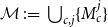 $\mathcal{M} \, :\! = \,\bigcup _{c,j} \{M_c^j\}$
.
$\mathcal{M} \, :\! = \,\bigcup _{c,j} \{M_c^j\}$
.
Having defined the random variable $\mathcal{M}$
, we now show the following spreadness property. To clarify,
$\mathcal{M}$
, we now show the following spreadness property. To clarify, $\psi _{\mathcal{R}}$
and
$\psi _{\mathcal{R}}$
and $\mathcal{R}$
are not considered to be fixed anymore.
$\mathcal{R}$
are not considered to be fixed anymore.
Claim 17.1.
For any $s \in \mathbb{N}$
and any function
$s \in \mathbb{N}$
and any function $h : \{v_1,\dots ,v_s\} \to \mathcal{M}$
where
$h : \{v_1,\dots ,v_s\} \to \mathcal{M}$
where $\{v_1,\dots ,v_s\} \subseteq V(G)$
, we have
$\{v_1,\dots ,v_s\} \subseteq V(G)$
, we have $\mathbb{P}\left [\wedge _{i=1}^s v_i \in h(v_i)\right ] \leqslant (\frac {12C \cdot C_{15}}{n})^s$
.
$\mathbb{P}\left [\wedge _{i=1}^s v_i \in h(v_i)\right ] \leqslant (\frac {12C \cdot C_{15}}{n})^s$
.
Proof.
Note that if $v \in \{v_1,\ldots ,v_s\}$
then
$v \in \{v_1,\ldots ,v_s\}$
then $\mathbb{P}[v \in h(v)] = 0$
because
$\mathbb{P}[v \in h(v)] = 0$
because $\mathcal{M}$
is a random partition of
$\mathcal{M}$
is a random partition of $V(G) \setminus \{v\}$
. Suppose this is not the case, and let us partition
$V(G) \setminus \{v\}$
. Suppose this is not the case, and let us partition $\{v_1,\ldots ,v_s\}$
into
$\{v_1,\ldots ,v_s\}$
into $\{x_1,\ldots ,x_{s_1}\} \subseteq A$
and
$\{x_1,\ldots ,x_{s_1}\} \subseteq A$
and $\{y_1,\ldots ,y_{s_2}\} \subseteq V(G) \setminus (A \cup \{v\})$
. Observe that
$\{y_1,\ldots ,y_{s_2}\} \subseteq V(G) \setminus (A \cup \{v\})$
. Observe that
 \begin{equation*} \mathbb{P}\left [\bigwedge _{i=1}^s v_i \in h(v_i)\right ] = \mathbb{P}\left [\bigwedge _{i=1}^{s_2} y_i \in h(y_i)\right ] \mathbb{P}\left [\bigwedge _{i=1}^{s_1} x_i \in h(x_i) \, \left | \, \bigwedge _{i=1}^{s_2} y_i \in h(y_i)\right .\right ] \leqslant \left (\frac {12C}{n}\right )^{s_2} \left (\frac {C_{15}}{n}\right )^{s_1},\end{equation*}
where we used the spreadness property from Lemma 9 and Corollary 15 in the last step.
Step 4: Embed the subtrees. From now on, we redefine $g$
and
$g$
and $\psi _{\mathcal{R}}$
as being maps to
$\psi _{\mathcal{R}}$
as being maps to $\mathcal{M} \cup \{R_*\}$
(by composing
$\mathcal{M} \cup \{R_*\}$
(by composing $g$
and
$g$
and $\psi _{\mathcal{R}}$
with the natural bijection
$\psi _{\mathcal{R}}$
with the natural bijection $\mathcal{R} \to \mathcal{M} \cup \{R_*\}$
that associates
$\mathcal{R} \to \mathcal{M} \cup \{R_*\}$
that associates $M_c^j$
to
$M_c^j$
to $R_{c}^{\, j}$
, and
$R_{c}^{\, j}$
, and $R_*$
to itself).
$R_*$
to itself).
We fix $\phi (t) \, :\! = \, v$
, by doing so we embed
$\phi (t) \, :\! = \, v$
, by doing so we embed $T_*$
into
$T_*$
into $R_*$
. The goal is now to embed each
$R_*$
. The goal is now to embed each $T_i$
in
$T_i$
in $\psi _{\mathcal{R}}(T_i) \in \mathcal{M}$
. Note that
$\psi _{\mathcal{R}}(T_i) \in \mathcal{M}$
. Note that $|\psi _{\mathcal{R}}(T_i)| = |T_i| - 1$
for all
$|\psi _{\mathcal{R}}(T_i)| = |T_i| - 1$
for all $i \in [\ell ]$
(by 1). We define
$i \in [\ell ]$
(by 1). We define $\phi$
as follows: While there exists a subtree
$\phi$
as follows: While there exists a subtree $T_i$
that is not fully embedded into
$T_i$
that is not fully embedded into $G$
, pick a subtree
$G$
, pick a subtree $T_i$
that has exactly one vertex
$T_i$
that has exactly one vertex $t_i$
already embedded say
$t_i$
already embedded say $\phi (t_i) = v_i$
and apply Theorem 4 to embed the rest of
$\phi (t_i) = v_i$
and apply Theorem 4 to embed the rest of $T_i$
in
$T_i$
in $\psi _{\mathcal{R}}(T_i)$
. We can use Theorem 4, due to C1, C2 and C3. This procedure is well defined because
$\psi _{\mathcal{R}}(T_i)$
. We can use Theorem 4, due to C1, C2 and C3. This procedure is well defined because $T'$
is a tree. Let us define the native atom of a vertex
$T'$
is a tree. Let us define the native atom of a vertex $y \in V(T)$
, denoted by
$y \in V(T)$
, denoted by $T(y)$
, to be the first
$T(y)$
, to be the first $T_i$
that contains
$T_i$
that contains $y$
.
$y$
.
Checking spreadness. We now prove that the random embedding $\phi$
constructed this way is
$\phi$
constructed this way is $\left (\frac {{C_*}}{n}\right )$
-spread. The spreadness of this embedding comes from two different randomness sources: the partition
$\left (\frac {{C_*}}{n}\right )$
-spread. The spreadness of this embedding comes from two different randomness sources: the partition $\mathcal{M}$
via Claim 17.1, and the random embedding
$\mathcal{M}$
via Claim 17.1, and the random embedding $\psi _{\mathcal{R}}$
via Lemma 13.
$\psi _{\mathcal{R}}$
via Lemma 13.
Let us fix two sequences of distinct elements $y_1, \dots , y_s \in V(G - v)$
and
$y_1, \dots , y_s \in V(G - v)$
and $x_1, \dots x_s \in V(T-t)$
. Let
$x_1, \dots x_s \in V(T-t)$
. Let $b \, :\! = \, |\{T_{x_i} \mid i \in [s]\}|$
, where
$b \, :\! = \, |\{T_{x_i} \mid i \in [s]\}|$
, where $T_{x_i}$
is the first subtree of the tree-splitting that is embedded, among those containing
$T_{x_i}$
is the first subtree of the tree-splitting that is embedded, among those containing $x_i$
. We may suppose, up to reordering, that
$x_i$
. We may suppose, up to reordering, that $x_1,\dots ,x_b$
each have distinct native atoms, this way we have
$x_1,\dots ,x_b$
each have distinct native atoms, this way we have $\{T_{x_1},\ldots ,T_{x_b}\} = \{T_{x_1},\ldots ,T_{x_s}\}$
. Let us split our probability on the two sources of spreadness as follows. Set
$\{T_{x_1},\ldots ,T_{x_b}\} = \{T_{x_1},\ldots ,T_{x_s}\}$
. Let us split our probability on the two sources of spreadness as follows. Set $C_0 \, :\! = \,{12C \cdot C_{15}}$
.
$C_0 \, :\! = \,{12C \cdot C_{15}}$
.
 \begin{align*} \mathbb{P}\left [\bigwedge _{i=1}^s \phi (x_i) = y_i\right ] &= \sum _{h : [b] \to \mathcal{M}} \mathbb{P}\left [ \bigwedge _{i=1}^s \phi (x_i) = y_i \left | \bigwedge _{i=1}^s y_i \in h(i) \right .\right ] \cdot \mathbb{P}\left [\bigwedge _{i=1}^s y_i \in h(i) \right ]\\ &\leqslant \sum _{h : [b] \to \mathcal{M}} \mathbb{P}\left [ \bigwedge _{i=1}^s \phi (x_i) = y_i \left | \bigwedge _{i=1}^s y_i \in h(i) \right .\right ] \cdot \left (\frac {C_0}{n}\right )^s \qquad\quad\quad \text{ by Claim 17.1} \\ & \leqslant \sum _{h : [b] \to \mathcal{M}} \mathbb{P}\left [\bigwedge _{i=1}^b \psi _{\mathcal{R}}(T(x_i)) = h(i)\right ] \cdot \left (\frac {C_0}{n}\right )^s \\ & \leqslant \sum _{h : [b] \to \mathcal{M}} \left (\frac {2C^2}{\eta ^2n}\right )^b \left (\frac {C_0}{n}\right )^s \leqslant |\mathcal{M}|^b \left (\frac {2C^2}{\eta ^2n}\right )^b \left (\frac {C_0}{n}\right )^s \\ &\leqslant n^b \left (\frac {2C^2}{\eta ^2n}\right )^b \left (\frac {C_0}{n}\right )^s \qquad\qquad\qquad\qquad\qquad\qquad\qquad\qquad \text{ by Lemma 9}\\ & \leqslant \left (\frac {2C^2C_0}{\eta ^2n}\right )^s \leqslant \left (\frac {{C_*}}{n}\right )^s \qquad\qquad\qquad\qquad\qquad\qquad\,\qquad\quad \text{ $b\leqslant s$} \end{align*}
To justify the second inequality, it is sufficient to observe that $\phi (x_i) = y_i$
only if
$\phi (x_i) = y_i$
only if $ \psi _{\mathcal{R}}(T(x_i)) = h(i)$
. Moreover by the remark made above,
$ \psi _{\mathcal{R}}(T(x_i)) = h(i)$
. Moreover by the remark made above, $T(x_1),\dots ,T(x_b)$
are all distinct, so we can indeed invoke the spreadness property of
$T(x_1),\dots ,T(x_b)$
are all distinct, so we can indeed invoke the spreadness property of $\psi _{\mathcal{R}}$
coming from Lemma 13.
$\psi _{\mathcal{R}}$
coming from Lemma 13.


 Open access

