

Introduction
Iran’s society has faced various sanctions-related economic challenges over the past decade. Iran’s natural resource-based economy heavily relies on its oil sales and revenues. In the early 2010s’ due to controversies over Iran’s nuclear programme, a restrictive oil embargo and a series of financial sanctions reduced the government’s oil revenue and, consequently, Iran’s Gross Domestic Product (GDP) (Aghazadeh, Reference Aghazadeh2014; Khabbazan and Farzanegan, Reference Khabbazan, Farzanegan, Farzanegan and Alaedini2016). It has been shown that such sanctions could significantly reduce Iranian households’ income and economic welfare (Farzanegan et al., Reference Farzanegan, Khabbazan, Sadeghi, Farzanegan and Alaedini2016; Ezzati and Salmani, Reference Ezzati and Salmani2017; Barardehi and Milani, Reference Barardehi and Milani2022).Footnote 1 However, depending on social standing and resource availability, the extent of such impacts may differ.
In the meantime, the population of Iran has grown older. The percentage of individuals aged sixty and older increased from 5 per cent in 1970 to 8 per cent in 2015. This group is projected to constitute more than 30 per cent of the total population in 2050 (Mehri et al., Reference Mehri, Messkoub and Kunkel2020). Declining fertility rates and increasing longevity have contributed to this phenomenon (Teymoori et al., Reference Teymoori, Dadkhah and Shirazikhah2006; Ghorbani et al., Reference Ghorbani, Raeissi and Milani2016). Such a demographic change poses a variety of economic challenges. For instance, longer lifespans could lead to lower post-retirement consumption (Poterba, Reference Poterba2014). The integrity of the social security and pension systems may also be substantially compromised (Bloom et al., Reference Bloom, Boersch-Supan, McGee and Seike2011). Thus, it is crucial to gain a deeper understanding of Iranian older population’s economic security and policy environment.
Iranian older adults’ economic circumstances depend on various sources, such as pensions, government in-kind and cash transfers, and intergenerational transfers (Mehri et al. Reference Mehri, Messkoub and Kunkel2020). The Iranian older population is largely supported by a traditional family support system, similar to older age groups in many developing nations (Palacios and Pallarès-Miralles, Reference Palacios and Pallares-Miralles2000). The primary shortcoming associated with such private transfer systems is a lack of risk pooling, which could be eliminated by government pension provision (Jung and Tran, Reference Jung and Tran2012). Iran’s pension system was established more than six decades ago as an intergenerational redistribution mechanism that offers a wide range of benefits to various groups, including older adults (Whitehouse, Reference Whitehouse2006). Official reports published by the Ministry of Cooperative, Labor, and Social Welfare (MCLSW) indicate that most pensioners are concentrated in the bottom half of the income distribution. According to the MCLSW’s latest report, most of these recipients reside in urban areas. Furthermore, from 2012 to 2019, the number of pension recipients increased by more than 50 per cent. However, almost only 50 per cent of individuals over sixty enjoy pension benefits. The social security system provides most of these recipients with an old-age pension due to their working-age employment status; they either worked in the formal private sector or were employed by the government. In contrast, non-recipients spent their working years in the informal sector without any social security entitlement. Such a disparity in coverage renders non-pensioners more vulnerable to economic hardships and uncertainties than pensioners. Therefore, it is vital to understand the extent to which the economic sanctions have affected Iranian older persons’ material circumstances, given their unfavourable economic circumstances and the shortcomings of the pension system.
The purpose of the current study is to examine how older Iranians’ material well-being has changed throughout the comprehensive sanctions period. It also seeks to study whether Iran’s pension system has alleviated sanctions’ economic shock, especially in urban areas. For this purpose, we use nationally representative household-level data and a combination of descriptive and regression analyses. In a similar vein to Meyer and Sullivan’s (Reference Meyer and Sullivan2008) study, we focused on exploring the underlying well-being trends and differences between comparison groups during the sanctions era instead of identifying causal effects. Our study is among the first to operationalise Iranian older adults’ material well-being using a consumption-based measure. It contributes to two strands of literature. The first examines the micro-level economic effects of sanctions. The number of studies in this field is limited; none have focused on the older population. The second strand of the literature typically studies various institutional and social support system aspects. Iran’s pension system has received little attention in this body of literature. We have relied on household-level income and expenditure data to create income- and consumption-based measures of material well-being. We find significant income and consumption differences between pensioners and non-pensioners. Furthermore, our quantile regression analysis indicates substantial well-being losses among non-pensioners, with losses much greater at the lower quantiles of the distribution than those at the higher quantiles.
The rest of the article is organised as follows. Section ‘Institutional Structure’ introduces Iran’s social security system. In section ‘Literature’, we summarise the theoretical and empirical literature on the well-being impacts of sanctions and pension systems in developing countries. We describe our methodology in section ‘Methodology’, and section ‘Results’ presents descriptive and regression results. Finally, section ‘Discussion and Conclusive Remarks’ offers a brief discussion and conclusive remarks.
Institutional structure
Iranians’ economic welfare in old age depends on various sources, such as assets, family transfers, and institutional support (e.g., work-based pensions). Middle-class and disadvantaged groups mostly rely on institutional support, while wealthy groups can afford to remain independent of government-based support. The origins of Iran’s welfare system can be traced back to 1920 when the government established salary structures and pension funds for its employees (Harris, 2017). However, the first law on social security was not enacted until 1953, and since then, it has undergone several revisions to ensure its relevance in light of evolving societal needs (McClanahan et al., Reference McClanahan, Gerecke, Braumann, Jankowski and Danforth2016). The Social Security Organisation (SSO) of Iran, which is the largest retirement fund in the country, offers a broad range of services, including old-age pensions, cash transfers, health services, and disability and survivor benefits. Notably, old-age pensions account for 60 per cent of SSO expenditure, while survivor pensions and disability pensions constitute 33 per cent and 7 per cent, respectively (Nikpour, Reference Nikpour2005). The SSO’s contributory system primarily provides coverage to formal private sector workers. Another noteworthy state retirement fund is the Civil Service Retirement Organisation (CSRO), which extends pension coverage to less than two million civil servants and government employees. In addition to the SSO and CSRO, a multitude of public pension funds have been established by industrial and service companies operating in diverse sectors such as oil, mining, and telecommunications that offer comparable pension programmes to their employees. All these funds constitute Iran’s contributory pension system, which covers the majority of the country’s labour force.Footnote 2
Under current retirement law, the retirement age for men is sixty, and for women, it is fifty-five. However, women can collect retirement benefits at age forty-two, provided they have completed twenty years of legal work by that age. Moreover, employees with thirty years of retirement contributions can also retire early at a certain age (age fifty for men and forty-five for women). Employees who have worked for at least thirty-five years under normal conditions are also eligible for retirement. Retirement benefits are available for those with hazardous jobs after twenty continuous years of work or twenty-five non-continuous years. The pension entitlement is calculated by dividing the average salary earned during the final two years of employment by thirty and multiplying the result by the number of years of contribution. In cases of hazardous occupations, one year of service is regarded as equivalent to one and a half years. However, the monthly pension cannot be lower than the minimum monthly wage of unskilled labour, which is established annually by the representatives of employees, employers, and the government in the Supreme Labour Council (McClanahan et al., Reference McClanahan, Gerecke, Braumann, Jankowski and Danforth2016).
The replacement rate varies between 50 per cent with fifteen years of work and 116 per cent with thirty-five years of work (Robalino et al., Reference Robalino, Musalem and Bogomolova2003; Whitehouse, Reference Whitehouse2006).Footnote 3 Hence, the retirement benefits of many Iranians could be higher than their pre-retirement earnings. Notably, this rate for low-income workers in the Organisation for Economic Co-operation and Development (OECD) is approximately 65 per cent, surpassing the same rate for average-income earners, i.e., 53 per cent for males and 52 per cent for females (OECD, 2017).
Iran’s pension payment structure is a defined benefit plan financed by a pay-as-you-go (PAYG) scheme (World Bank, 2003). This framework entails that insurance premium revenues are allocated towards current pension disbursements. In this system, the contribution is not solely on employees’ shoulders. Employees are responsible for paying 7 per cent of their earnings, while employers are mandated to pay 20 per cent (with an additional 3 per cent allocated for unemployment benefits). Furthermore, the government is also responsible for contributing 3 per cent towards pensions (Whitehouse, Reference Whitehouse2006). Another avenue for financing the current obligation is through investing in productive sectors. For instance, to provide sustainable pension benefits and support the older population, the SSO established the Social Security Investment Company (Shasta), which invests available funds in profitable sectors such as mining, industrial, and commercial sectors (Nikpour, Reference Nikpour2005).Footnote 4
Literature
The available literature on the impact of sanctions on Iran’s economy is limited. Some scholars, such as Aghazadeh (Reference Aghazadeh2014), have attempted to shed light on the macroeconomic consequences of the sanctions. Her analysis revealed that international sanctions and the government’s mismanagement substantially impacted Iran’s economy. She argued that the imposition of further rigorous sanctions could impede economic growth and exacerbate the unemployment rate. Khabbazan and Farzanegan (Reference Khabbazan, Farzanegan, Farzanegan and Alaedini2016) employed a simulation method to demonstrate that banking sanctions had a notable negative impact on macro-level indicators such as the GDP, private consumption, and total imports, as well as some micro-level indicators, specifically household welfare. Through an examination of computable general equilibrium model, Farzanegan et al. (Reference Farzanegan, Khabbazan, Sadeghi, Farzanegan and Alaedini2016) concluded that sanctioning Iran’s oil industry could reduce governments’ oil revenues, GDP, imports, and ultimately Iranian households’ income. They also stated that the post-sanctions era would likely witness a decline in households’ capital income, which would be offset by an increase in labour income. Furthermore, they suggested that the implementation of oil sanctions might improve non-oil exports and reduce the consumer price index. Ezzati and Salmani (Reference Ezzati and Salmani2017) investigated how trade and financial restrictions could affect Iranian consumers’ welfare. Their welfare analysis showed that sanctions had a negative effect on consumers’ welfare, which could potentially be ameliorated upon their removal. The authors asserted that the imposition of sanctions would result in the government incurring higher welfare costs, while consumers’ behaviour would be altered due to fluctuations in income and prices.
A small group of researchers has investigated some aspects of Iranian older adults’ well-being and the implications of rapid population aging. For instance, Kamal and his colleagues (Reference Kamal, Basakha and Alkire2022) used a multidimensional approach to evaluate the well-being of older individuals residing in Tehran. Their empirical findings indicated that more than half of these individuals experienced multidimensional poverty, while a significant proportion faced income poverty and encountered challenges in meeting their basic needs. The post-retirement employment of older persons also garnered researchers’ attention. Basakha et al. (Reference Basakha, Kermani and Mohaqeqi Kamal2022) probed the odds of post-retirement employment among older adults in Tehran. They discovered that many educated older individuals over sixty were less likely to be employed. Furthermore, the findings indicated that older widows without pension coverage were among the most economically vulnerable groups. Sheykhi (Reference Sheykhi2016) expanded this literature by focusing on the intricate issue of widowhood in Iran. He noted that due to a gender difference in longevity, the number of aging widows increased. He studied a small sample of solitary Iranian men and women and concluded that the transition to widowhood in later life was relatively less challenging in Tehran in comparison to other regions. The work of Amini and his colleagues (Reference Amini, Chee, Sen and Ingman2021) elaborately described the future challenges of the elder care system in Iran. Their findings suggest an urgent need for the expansion of long-term care services in Iran. They also asserted that Iran’s social and imminent demographic changes would create an unprecedented demand for systemic support for the older adult population. Mehri et al. (Reference Mehri, Messkoub and Kunkel2020) also discussed the consequences of population aging, such as the socio-economic insecurity of older individuals. The authors advocated for the expansion of institutional support programmes to ensure that the basic needs of this demographic would be met.
The literature has underscored the significance of social security in fostering economic growth and development in developing countries (Nikpour, Reference Nikpour2005; Gongcheng and Scholz, Reference Gongcheng and Scholz2019). Moreover, social security plays a critical role in safeguarding older populations against unforeseeable economic adversities and potentially mitigating poverty (Van Ginneken, Reference Van Ginneken2003). In light of these goals, all developing countries have developed a form of institutional social security. However, despite these efforts, various obstacles have impeded their efforts to enhance the quality of life for the older segment of population through social security programmes (Bloom and McKinnon, Reference Bloom and McKinnon2013). Existing literature posits that rapid transformations in family structures and labour market changes have a bearing on the adequacy and effectiveness of social insurance programmes. The decreasing fertility rates, rising prevalence of cohabitation, out-of-wedlock childbirth, and increasing women’s labour market participation, alongside the expanding informal economies, could potentially undermine social security programmes (Lundberg and Pollak, Reference Lundberg and Pollak2007; Bloom and McKinnon, Reference Bloom and McKinnon2013; Standing, Reference Standing2014). Some of these demographic and labour market changes would shrink the size of the formal sector and, consequently, reduce the active population’s contributions to PAYG pension schemes. This, in turn, would lead to financial and budget imbalances. Under such circumstances, a typical PAYG pension structure in developing countries would be unable to maintain adequate funds to fulfil current commitments (Bloom and McKinnon, Reference Bloom and McKinnon2013). In addition to the issue of budget imbalance, a large informal sector could adversely affect the pension coverage rate. Van Ginneken (Reference Van Ginneken1999) posited that a considerable proportion of the workforce remained excluded from pension programmes due to the rise in informal-sector employment in developing countries. Bloom et al. (Reference Bloom, Canning and Fink2010) asserted that the material conditions of older individuals who had been formally employed were significantly superior to those who had worked in the informal sector, mainly due to the availability of pension plans. Among unprotected older groups, older women seemed to be the most vulnerable (Bloom et al., Reference Bloom, Canning and Fink2010). These observations imply that informal-sector employees/workers are often unable to maintain their pre-retirement living standards since they have insufficient wealth as they approach retirement age.
Methodology
Measures and data
A large body of international literature has examined different aspects of individuals’ well-being, including economic well-being. Various approaches have been utilised to gauge individuals’ material circumstances, leading to a diverse set of measures. In the context of Iran, studies on material well-being have traditionally relied on income-based metrics of the standard of living. Researchers have widely used aggregate income and income-based poverty lines as indicators of Iranian material well-being and economic hardship (Salehi-Isfahani, Reference Salehi-Isfahani2009). However, the literature suggests that consumption provides a more precise representation of an individual’s economic resources and material well-being, particularly among economically vulnerable groups, when compared to income (Meyer and Sullivan, Reference Meyer and Sullivan2003).
Arguments in favour of consumption underscore its conceptual and reporting superiorities over income.Footnote 5 In order to capitalise on these benefits, we evaluated the material well-being of older adults using both income and consumption as metrics. We constructed these measures based on data from the Household Income and Expenditure Survey (HIES). The HIES is a nationally representative cross-sectional data collected annually by the Statistical Center of Iran. It is a comprehensive survey in which respondents are asked to report their income from various sources and provide detailed information on their expenditures. Our analysis measured income as the sum of all reported income items. However, obtaining the consumption measure required several methodological adjustments to enable the conversion of reported expenditures into consumption. First, we converted expenditures on major durables (i.e., homes and vehicles) into service flows. We started this process by substituting the reported purchase value with the reported rental equivalent (i.e., implicit rental value) of the home to capture owners’ housing service flows. For tenants, we incorporated the value of their monthly rent as their housing consumption services in their overall consumption measure.
To convert car purchases into vehicle consumption services, we divided our sample into two strata: households who acquired vehicles during the interview period and those who purchased vehicles prior to the interview period. For newly purchased cars, we calculated consumption services as a function of the depreciation rate instead of using the reported purchase values. However, this value was missing for respondents who purchased in the previous periods. We generated these missing service values using a regression-based imputation procedure developed based on available information.Footnote 6
This approach also required the exclusion of several non-consumption expenditure categories. We eliminated health and education expenditures as they are considered human capital investments. Moreover, cash transfers to others as well as fines and cash penalties were also deducted from our consumption measure. To account for the economies of scale associated with household size, we modified our aggregate income and consumption measures using OECD’s equivalent scale. Finally, we adjusted our measures for inflation. This step was essential since the government’s policies successfully reduced the inflation rate during the period of interest by more than 25 percentage points (Le Borgne et al., Reference Le Borgne, Karakurum-Ozdemir, Mobasherfard, Hayati, Matta, Kazemi, Kouame, Viswanath, Salehi-Isfahani, Mostafavi, Sarraf, Heger, Lee, Anaraki, Nedeljkovic and Salim2016).
Sample and analytical method
We extracted our sample from the 2011 and 2015 urban surveys of the HIES. We selected and combined these surveys because comprehensive economic sanctions were initially imposed in 2011, and by 2015, they had been fully adopted and implemented by the international community. Hence, their impacts on Iran’s economy were fully evident by the end of this period. The 2011 survey collected information on respondents’ income, and expenditures realised in the pre-sanctions era, while the 2015 survey reported post-sanctions income and expenditures data. We restricted our sample to individuals aged sixty-five and older.Footnote 7 We focused on urban older adults since the majority of Iranian pension recipients reside in urban regions. Ideally, to investigate the vulnerability of aging groups and properly infer causal relationships, a panel data of sufficient richness is required. However, due to a lack of such data sets, we opted for an exploratory assessment based on available cross-sectional data.
First, we used graphical and descriptive analyses to compare the socio-economic characteristics of non-pensioner and pensioner sub-samples. This comparative procedure revealed the economic well-being and resource heterogeneity of these two groups. We continued our analysis by investigating trends in older adults’ income and consumption throughout the period under study. However, instead of focusing on sample means, we focused on the distributional component of these trends. For this purpose, we relied on Growth Incidence Curves (GIC), which allowed us to compute inter-decile percentage changes at different points (i.e., deciles) of income and consumption distributions.Footnote 8 This tool enabled us to determine whether fluctuations (i.e., growth or contraction) in the material well-being of older persons vary across the distribution.
Comparing means over time without accounting for potential variations in the characteristics of older adults may lead to inaccurate conclusions about the trends in material well-being. To address this issue, we utilised regression analyses to investigate trends more effectively. Moreover, employing this technique facilitated the identification of potential disparities in the material well-being of our comparison groups. A precise illustration of our regression model is formulated as follows:
 $$\ln \left( {{y_i}} \right) = {\beta _1} + \;{\beta _2}{D_{2015}} + {\beta _3}{D_{Non - pensioner}} \times {D_{2015}} + \;{\beta _4}{X_i} + {\varepsilon _i}$$
where our dependent variable was the natural logarithm of the older persons’ monthly real income or consumption. ${D_{2015}}$
captured the average change in the older individuals’ material well-being during the sanctions period;
${D_{2015}}$
captured the average change in the older individuals’ material well-being during the sanctions period;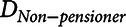 ${D_{Non - pensioner}}$
was a dichotomous variable distinguishing pension recipients from non-recipients, which was equal to one for non-pensioners and zero otherwise; and
${D_{Non - pensioner}}$
was a dichotomous variable distinguishing pension recipients from non-recipients, which was equal to one for non-pensioners and zero otherwise; and ${X_i}$
represented a vector of control variables. The latter included household demographic and economic characteristics, including the older people’s age composition, number of children, educational attainment, marital status, size of the residence, and house and car ownership indicators. The coefficient associated with the period indicator estimated the average change in logarithmic consumption levels of older adults throughout the post-sanction interval. On the other hand, the coefficient related to the interaction between the group indicator and the 2015 year dummy, i.e.,
${X_i}$
represented a vector of control variables. The latter included household demographic and economic characteristics, including the older people’s age composition, number of children, educational attainment, marital status, size of the residence, and house and car ownership indicators. The coefficient associated with the period indicator estimated the average change in logarithmic consumption levels of older adults throughout the post-sanction interval. On the other hand, the coefficient related to the interaction between the group indicator and the 2015 year dummy, i.e., ${\beta _3}$
, can be construed as the average difference between the changes in consumption patterns of non-pensioners in comparison to those of pensioners over the sanctions period.
${\beta _3}$
, can be construed as the average difference between the changes in consumption patterns of non-pensioners in comparison to those of pensioners over the sanctions period.
We used a quantile regression approach to estimate equation (1) and investigated the effects of key dependent variables on the entire conditional distribution instead of conditional means. By adopting this method, we avoided the assumption that variables behave identically at the upper/lower tails of the distributions, as they do at the mean. Such an approach generated results compatible with those of GICs as it fitted a regression function of consumption on all explanatory variables for each quantileFootnote 9 . Apart from its computational benefits, quantile regression is a robust method that can handle outliers effectively. Furthermore, it does not rely on any assumptions concerning parameter distribution and exhibits superior efficiency in the presence of heteroscedasticity (Cameron and Trivedi, Reference Cameron and Trivedi2005).
Results
Descriptive statistics
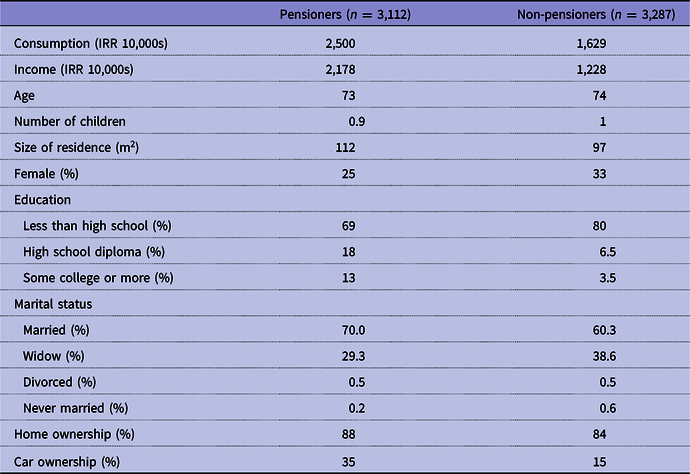
Table 1 presents summary statistics for the outcomes of interest and older persons’ characteristics included in the vector of control variables. The weighted means for pension recipients and non-pensioners are presented in columns 1 and 2, respectively. On average, urban seniors with pension coverage exhibited a higher consumption than those without such coverage. A notable income difference also existed between our older sub-populations in favour of pensioners. Moreover, regarding the size of the residence, pension recipients appeared to reside in more spacious dwellings compared to their non-pensioner counterparts. Relative to pensioners, the non-pensioner sub-population consisted of more females. Furthermore, almost 30 per cent of pensioners had completed high school or college, whereas only 10 per cent of non-pensioners had obtained such degrees. The likelihood of being married was higher among pensioners than among non-pensioner older adults. Finally, car ownership was also a relatively common attribute among those who had pension coverage.
Mean characteristics of older adults

Notes: All values are adjusted by sample weights to represent the population.
Figure 1 depicts the distribution of primary income sources, i.e., salary, self-employed income, unearned income, and cash welfare transfers, across different deciles of non-pensioners. This graph revealed that low-decile non-pensioners heavily relied on cash subsidies, whereas the share of such incomes was relatively small for top-decile non-pensioners. Moreover, unearned income, comprising rents, interest, and aids (i.e., financial transfers from non-government institutions), was a significant source of income for non-pensioners. A similar visual analysis of pensioners’ income is presented in Figure 2. This graph demonstrated that earned income and cash subsidies, on average, contributed to less than one-fourth of pensioners’ income, thereby highlighting the prevalence of unearned income as the principal source of income for these senior citizens.
Shares of non-pensioners’ income sources by decile
Source: Households Income and Expenditure Survey, Statistical Center of Iran (2019)

Shares of pensioners’ income sources by decile
Source: Households Income and Expenditure Survey, Statistical Center of Iran (2019)

To effectively investigate these two groups’ income heterogeneities, particular attention was given to their unearned income. Pensioners received over 90 per cent of their unearned income from the SSO or other pension and retirement funds. However, as shown in Figure 3, those with no pension coverage relied heavily on other unearned income sources, including but not limited to rental income, interest income, and transfers from both non-governmental institutions and family members. Irrespective of their position across the income distribution, family transfers emerged as a critical income source for non-pensioners. Nonetheless, the higher the non-pensioners’ decile, the larger the share of rental and interest income, and the lower the share of non-government institutional transfers. This observation suggests that the economic well-being of comparatively affluent non-pensioners relied heavily on their asset base, including rental properties and investments, in addition to family transfers. However, as we demonstrated in Table 1, despite higher proportions and a great diversity of unearned income sources among non-pensioners, their average income remained lower than that of pensioners due to the lack of a secure pension income. Furthermore, the variety of income sources increased concerns about the reliability of reported income for non-pensioners. As noted by Meyer and Sullivan (Reference Meyer and Sullivan2003), the diversity of income sources could worsen the income under-reporting issue, potentially widening the income gap between our comparison groups.
Components of non-pensioners’ unearned income
Source: Households Income and Expenditure Survey, Statistical Center of Iran (2019)

Figure 4 portrays the distribution of our comparison groups across the consumption spectrum. Pension beneficiaries exhibited a higher average consumption, whereas non-pensioners were predominantly clustered in the lower half of the distribution. Our descriptive analysis reveals that non-pensioners not only had lower income and consumption levels compared to pensioners but also relied heavily on unearned income from transient sources, making them potentially more susceptible to economic shocks.
Distribution of urban older adults across consumption deciles by pension coverage
Source: Households Income and Expenditure Survey, Statistical Center of Iran (2019)

GICs and regression results
We utilised GICs to examine the average changes in income and consumption among older sub-population groups during the sanctions period. As depicted in Figure 5, between 2011 and 2015, non-pensioners income and consumption trends were similar. All deciles experienced a decline in their income and consumption, except for the top decile, where income increased by 7 per cent over the 2011–2015 period. Moreover, the findings in Figure 5 suggested the presence of inter-decile differences. For instance, the top deciles demonstrated comparatively smaller economic well-being declines than the bottom deciles. It is worth noting that the reduction in consumption levels from 2011 to 2015 was more significant than the decline in average income over the same period. Figure 6 showed similar decreasing patterns in pensioners’ income-only and consumption-based measures. Nevertheless, the shape of pensioners’ consumption GIC differed from that of non-pensioners, indicating that the decline in consumption levels among top-decile pensioners was more significant than that of economically disadvantaged pensioners. Our analysis, as presented in the consumption GICs, indicated that, on average, urban older people’s pre-sanction material well-being declined. These distributional analyses did not account for other possible sources of material well-being heterogeneity among older adults. For instance, the socio-economic characteristics of these individuals could determine their consumption level. Due to the complex nature of these characteristics, we employed regression analysis to control for their effects on the material well-being of older adults.
Changes in urban non-pensioners’ income and consumption by decile, 2011–2015
Source: Households Income and Expenditure Survey, Statistical Center of Iran (2019)

Changes in urban pensioners’ income and consumption by decile, 2011–2015
Source: Households Income and Expenditure Survey, Statistical Center of Iran (2019)

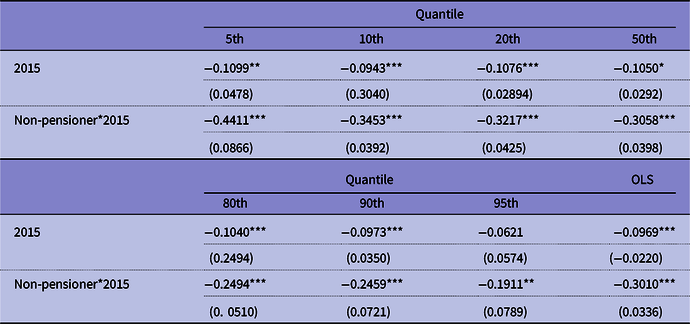
To provide a comprehensive overview of our inquiry into income and consumption variations across the distribution and between our comparison groups, we have compiled the findings of our analyses in Tables 2 and 3. These tables present the results of applying quantile regression and Ordinary Least Squares (OLS) to estimate equation (1). For the sake of brevity, we did not report the control variables’ coefficients in these tables. As listed in Table 2, the estimated coefficients of the 2015 dummy variable revealed that changes in older individuals’ income, considering their socio-economic and demographic characteristics, deviated from the decile-specific means obtained from the GICs. Our results revealed that income for low-income older persons in 2015 was higher than in 2011, while for middle- and high-income individuals, income either remained unchanged or declined during the sanctions period. The OLS estimate of the same variable was not statistically significant, substantiating the noted inter-decile difference in income change among older adults over the same period.
Quantile and Ordinary Least Squares (OLS) estimates of older adults’ income by pension coverage status, 2011–2015

Notes: Standard errors in parentheses. *** p < 0.01, ** p < 0.05, * p < 0.1.
Quantile and Ordinary Least Squares (OLS) estimates of older adults’ consumption by pension coverage status, 2011–2015
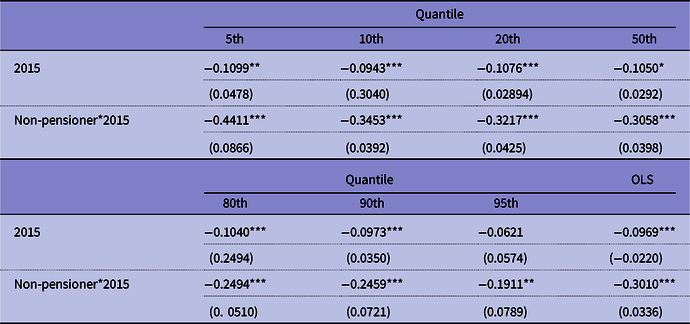
Notes: Standard errors in parentheses. *** p < 0.01, ** p < 0.05, * p < 0.1.
Our findings also showed that non-pensioners’ average income in 2015 decreased relative to pension recipients, highlighting the evident disparities in income levels between the two groups. The regression analysis revealed that the observed decrease in non-pensioners’ average income relative to pension recipients was consistent across all income groups, as indicated by the coefficients on our interaction terms. In contrast, low-income non-pensioners experienced more substantial declines in their relative income during the sanctions period. For instance, the fifth quantile’s relative income declined by 65 percentage points (a factor of −1.04), whereas for the ninety-fifth quantile, relative income dropped by only 7 per cent (factor of −0.07). Moreover, in terms of the direction of changes, these findings were compatible with our OLS result reported in the last column of Table 2. While our estimates suggest a decline in non-pensioners’ income relative to pensioners during the sanctions period, we cannot draw a definitive conclusion. Given the conceptual advantages of consumption over income as a measure of material well-being and our credible concern regarding the under-reporting of income among non-pensioners, these results should be cautiously interpreted.
Table 3 presents the estimates for changes in the consumption of older individuals, as captured by the year dummy and non-pensioners’ relative consumption (i.e., the interaction term). Our findings indicated a significant decrease in the level of consumption for the older urban population between 2011 and 2015, evident across various consumption percentiles except for the ninety-fifth percentile. The results suggested a decline of roughly ten percentage points in the consumption of older adults during comprehensive sanctions. This finding is indeed consistent with inter-decile changes summarised by consumption GICs, as the results comparing changes in our sub-population’s consumption provided reasonable evidence that non-pensioners’ relative consumption declined throughout the comprehensive sanctions period. All reported coefficients were significantly different from zero, indicating a decrease of 18 to 32 percentage points in non-pensioners’ consumption relative to that of pension recipients between 2011 and 2015. Our OLS regression result, which measured the difference in consumption between our comparison groups at the mean also suggested that non-pensioners were worse off than pensioners. We further discovered a distributional disparity in relative declines that favoured high-consumption non-pensioners. In other words, the higher the consumption level, the smaller the relative consumption loss.Footnote 10
Discussion and conclusive remarks
Discussion and policy implications
The imposition of economic coercion by governments and international organisations has become common. Although such measures may generate some political gains, they significantly damage the livelihoods of the citizens of the targeted countries (Jazairy, Reference Jazairy2018). Iran’s economy has been subject to numerous multilateral and severe sanctions. These sanctions can directly impact the well-being of Iranian citizens, particularly disadvantaged groups such as older adults, who have fewer resources to cope with economic shocks. Therefore, it is essential to understand the potential consequences of economic sanctions on the material well-being of older adults and to identify potential protective factors such as pensions.
This study depicts a picture of changes in Iranian older adults’ material well-being while comprehensive economic sanctions were imposed on Iran’s economy. We recorded income and consumption heterogeneity among Iranian urban older groups. Specifically, our analysis revealed that non-pensioners relied heavily on informal support systems, with their economic well-being significantly dependent upon cash transfers from family members. This finding is compatible with the existing literature on the importance of intergenerational transfers in providing pecuniary support to older individuals in developing countries. (Rosenzweig, Reference Rosenzweig1988; Dercon, Reference Dercon2002; Barrientos et al, Reference Barrientos, Gorman and Heslop2003). In Iran’s traditional society, where familial support networks are essential, sanctions-induced stagflation can erode the ability of family members to provide financial assistance to their older relatives, which could destabilise a crucial source of unearned income for non-pensioners. However, these findings should be approached cautiously, since our understanding of in-kind and instrumental intergenerational transfers from adult children to older persons is limited. Given the added economic hardships caused by sanctions, many adult children may switch from pecuniary support to non-monetary alternatives. This study cannot examine such behavioural changes due to inadequate information. Therefore, further research is necessary to investigate the mechanisms underlying these intergenerational transfers.
We also provided evidence that older urban persons’ average consumption dropped during the sanctions period. This reduction was substantially higher among older adults without pensions than among pensioners. Both income and consumption data indicated a notable reduction in the material well-being of individuals not covered by the pension system, relative to pensioners, particularly for those with low income and consumption. The observed disparity could be attributed, in part, to a historical legacy of structured inequality that has resulted in an uneven distribution of wealth among older adults, impeding low-wealth non-pensioners’ access to material resources and unearned income in their later years. The formal sector has historically provided better opportunities for those with higher levels of education, enabling them to retire with a pension. Conversely, the growing informal economy has absorbed the majority of low-educated individuals, leaving them with no access to old-age pensions. This trend is prevalent in many developing nations and contributes to persistent old-age poverty (Barrientos et al., Reference Barrientos, Gorman and Heslop2003). Our findings on the socially disproportionate economic consequences of sanctions align with the existing literature, which highlights a well-established correlation between economic sanctions and inequality (Afesorgbor and Mahadevan, Reference Afesorgbor and Mahadevan2016; Jeong, Reference Jeong2020).
These findings are relevant to the current dire economic situation of the Iranian retired population. Older adults’ well-being and economic security are increasingly endangered due to high inflation, a weak currency, and limited access to affordable healthcare (Aloosh et al., Reference Aloosh, Salavati and Aloosh2019). To mitigate the negative economic impact of economic sanctions on non-pensioner older adults, the government should consider implementing targeted welfare programmes, such as food assistance, cash transfers, and health subsidies. These programmes would require efficient identification of the economically disadvantaged non-pensioner population. In developing countries like Iran, where reliable income and economic data are often scarce, policymakers often resort to implementing universal or highly inclusive welfare policies to minimise errors of inclusion or exclusion (Hanna and Olken, Reference Hanna and Olken2018). Past experiences in Iran have shown that inclusive welfare policies have been only partly effective (Salehi-Isfahani et al., Reference Salehi-Isfahani, Wilson Stucki and Deutschmann2015). While such policies may cover all non-pensioners, including those in need and those who are not, this approach creates additional financial challenges for the government. Comprehensive economic sanctions have already reduced government revenues, making it challenging to fund targeted welfare programmes (Kazemi et al., Reference Kazemi, Le Borgne, Jha, Atamanov, Mostafavi, Takeuchi, Wai-Po, Hoogeveen and Shah2020). Therefore, implementing effective targeted measures requires a domestic taxation plan to finance them. Future research is needed to define eligibility criteria for targeted transfers, identify impoverished older adults, and develop an optimal tax scheme.
Conclusion
Older Iranians’ material well-being declined throughout the sanction-induced economic recession. Our study underscores the critical importance of pensions as a protective mechanism for older Iranians while highlighting the absence of adequate social safety nets for non-pensioners, who heavily rely on an informal family support system. However, given the country’s precarious economic prospects, the long-term sustainability of this informal support system remains doubtful. Therefore, immediate policy solutions are needed to strengthen the country’s social security infrastructure and address the economic hardship faced by economically disadvantaged older Iranians and non-pensioners.



 Open access

