


Introduction
In situ and ex situ conservation are seen as two distinct approaches to the protection of wild species. In situ conservation, defined by the Convention on Biological Diversity (CBD) with reference to the protection of species in their natural surroundings, derives primarily from scientific considerations concerning the conservation benefits that accrue from the protection of integrated habitats and ecosystems. Since the 1992 Earth Summit in Rio de Janeiro, Brazil, in situ conservation has been designated, expressly, as the legal and institutional priority. The CBD and other global instruments and funding strategies address a range of practices relating to in situ measures for conservation and relegate ex situ approaches to a subordinated supply role (CBD, 1992: Articles 8 & 9).
We believe, however, that ex situ conservation has a more important role to play, especially in the face of the evidence of increasing extinction rates, exacerbated by climate change. We wish to stimulate discussions about the need to revise the contributions that ex situ approaches can make to conservation. Integrated conservation management approaches hold much potential but we must recognize the significance of institutional factors, not just the science, that have hitherto constrained the development of direct conservation contributions from ex situ and integrated techniques. We question the continued validity of the in situ / ex situ distinction.
Increased capacity and continued constraints within ex situ institutions
The vehicles of ex situ conservation are those organizations that hold wild plants and animals: zoos, aquaria, botanical gardens, arboreta and seed banks. Although these already lay claim to support conservation through a range of education, research and funding activities (Christie, Reference Christie, Tilson and Nyhus2010), their potential to contribute in more direct ways to the conservation of species has increased with recent developments. Specifically, these organizations and their networks have proliferated across the globe (BGCI, 2001; WAZA, 2005). For example, the International Species Information System is an international non-profit organization serving zoos and aquariums worldwide, and manages a comprehensive database of animal species and their environments for animal management and conservation goals. It records 825 zoos and aquaria in 76 countries that exchange data on over 2 million captive animals of almost 15,000 taxa and 10,000 species.
Similarly, Botanic Gardens Conservation International (BGCI) manages a database with records of 2,561 botanic gardens worldwide, with 1,000 of these added in the last 10 years. These gardens cultivate > 80,000 species in living collections, and increasingly hold seed banks and in vitro collections. Close to 700 botanic gardens have supplied collection data to BGCI for the global PlantSearch database that contains > 500,000 records of c. 180,000 taxa. Facilities for storing and exchanging plant genetic material of cultivated crops have also expanded, primarily in response to the food security and resilience agenda, conforming, inter alia, to the requirements of the International Treaty on Plant Genetic Resources for Food and Agriculture. Whereas in the 1970s 0.5 million samples were held in < 10 gene banks, now > 6.1 million samples are stored in 1,308 gene banks (FAO, 2009).
These represent infrastructural and professional advances to deal with challenges that have hitherto frustrated the capacities of ex situ facilities (Keller et al., Reference Keller, Korn, Schmid and Weisser2002; Havens et al., Reference Havens, Vitt, Maunder, Guerrant and Dixons2006). Similarly, other earlier limitations of ex situ facilities to conserve species have been overcome given improved technical knowledge and practices with regard to collection strategies, genetic assessment, storage techniques and captive population management (Maunder & Byers, Reference Maunder and Byers2005). Ex situ organizations have also accumulated a portfolio of direct, tangible impacts on conservation and performance indicators have been refined to measure this role (Havens et al., Reference Havens, Vitt, Maunder, Guerrant and Dixons2006). The world’s botanic gardens contain > 12,000 globally threatened plant species and c. 800 botanic gardens are managed with a specific focus on plant conservation (IUCN, 2002). Many botanic gardens also manage nature reserves and other forms of protected areas to combine ex situ methods with in situ plant conservation, and have increased engagement with local communities on livelihood issues, a key component of contemporary, holistic conservation strategies. Botanic gardens also play an important role in the implementation of the Global Strategy for Plant Conservation.
The ex situ breeding of animals or plants for direct conservation purposes has been frustrated by limited or conflicting organizational missions (Keller et al., Reference Keller, Korn, Schmid and Weisser2002; Havens et al., Reference Havens, Vitt, Maunder, Guerrant and Dixons2006). But a further move away from the mere possession of extensive horticultural or exotic animal collections to one fulfilling a more active conservation role is thwarted by a lack of financial incentives. The largest source of international biodiversity funding, the Global Environmental Facility (the funding mechanism of the CBD), has no thematic or cross-cutting programme for ex situ activities.
How to balance the need, or preference, to generate revenue from visitor attraction with achieving direct conservation is a central and contentious theme within and amongst ex situ institutions. The financial pressure is perhaps less acute for botanical institutions as threatened plant species can be kept in a relatively straightforward and inexpensive manner (Kramer & Havens, Reference Kramer and Havens2009; Oldfield, Reference Oldfield2009). However, this dilemma is particularly challenging for zoos (Stanley Price & Fa, Reference Stanley Price, Fa, Zimmermann, Hatchwell, Dickie and West2007). Whilst claims and counter-claims abound regarding the nature and levels of support that zoos actually provide to conservation (Gusset & Dick, Reference Gusset, Dick, Dick and Gusset2010), sections of the zoo community (Fa et al., Reference Fa, Funk and O’Connell2011) urge zoos to involve themselves more in the immediate task of saving greater numbers of species from extinction, and ‘preserving wildlife...through field conservation initiatives’ (Bonner, Reference Bonner2010) as part of their existing multifaceted portfolio of approaches to support conservation.
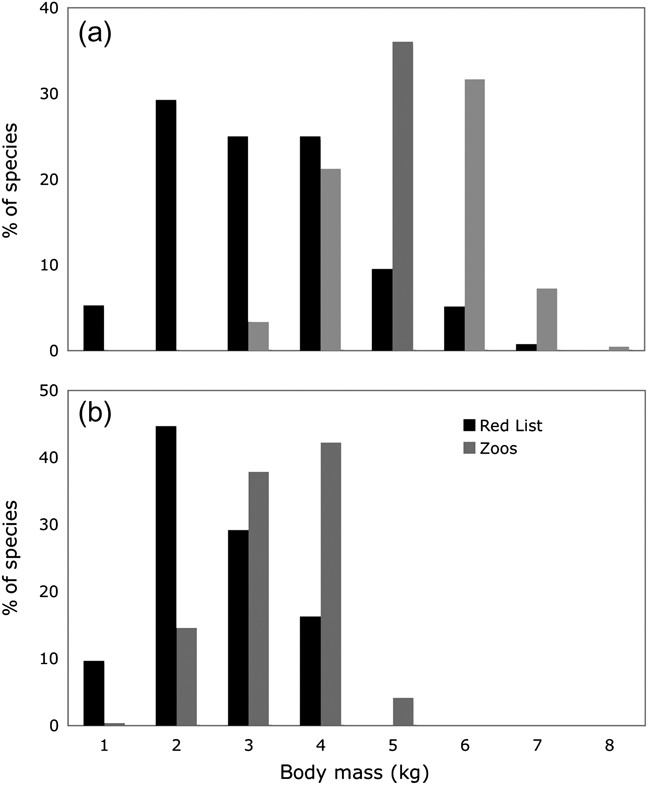
This more direct contribution can coexist with the other conservation support approaches that ex situ facilities currently employ. While it remains to be defined how this can be best achieved, in the case of zoos an immediate advance would be to focus on keeping more individuals of smaller threatened species and to coordinate effective captive-breeding programmes for them, given their higher breeding rates and lower maintenance costs. Evidence from European and North American animal collections (Fig. 1) demonstrates that this is not happening. The emphasis on large charismatic animals (Fa et al., Reference Fa, Funk and O’Connell2011) persists despite the lack of evidence that the public visit zoos primarily to see these species (Balmford et al., Reference Balmford, Mace and Leader-Williams1996).
Distribution of log body mass of (a) mammals and (b) birds on the IUCN Red List (Critically Endangered and Endangered; IUCN, 2011) compared to those held in captive breeding programmes by American and European zoo associations (Fa et al., Reference Fa, Funk and O’Connell2011). Body mass data for extant birds from Dunning (Reference Dunning2008) and for mammals from Smith et al. (Reference Smith, Lyons, Ernest, Jones, Kaufman and Dayan2003). Species lists from AZA (2010) and EAZA (2010).
Whereas international law and policy already deals with in situ conservation in relatively complex prescriptive provisions, frameworks that prescribe a meta-strategy for ex situ centres have not been developed. For example, although initiatives such as the European Union’s Zoos Directive support ex situ strategies (EC Council Directive, 1999), and global documents, such as the World Association of Zoos and Aquariums Conservation Strategy, urge zoos to contribute to conservation, these fall short of effectively linking zoos into collaborative and strategic conservation activities (Rees, Reference Rees2005). The impact of such initiatives is limited by the absence of effective international coordination, which necessarily, being a global issue, cannot be addressed by the array of regional associations and coordinated breeding programmes that currently exist. There is no centralized institutional mechanism to access and disseminate data on animal genetic resources within zoos similar to the Food and Agriculture Organisation’s Domestic Animal Diversity Information System (FAO, 2009). This is a tool to conserve elements of global animal biodiversity even though it was established to manage animal genetic resources for food security and resilience strategies.
Despite remaining shortcomings ex situ conservation has an increasingly important role to play. Current circumstances, especially climate change, expose the vulnerability of our reliance on in situ approaches that seek to maintain natural systems and processes in specific geographical locations.
Crises facing the in situ paradigm
Projections of species distributions in scenarios of future climate indicate high numbers of species threatened by climate change alone (Thomas et al., Reference Thomas, Williams, Cameron, Green, Bakkenes and Beaumont2004) or in conjunction with land-use changes (Jetz et al., Reference Jetz, Wilcove and Dobson2007). Climatic and environmental change will compromise the ability of many species to survive unless they are able to adapt, disperse or migrate to other latitudes or altitudes. Species’ ranges are shifting (Secretariat of the CBD, 2010), and those with specific habitat requirements and limited dispersal mechanisms are most vulnerable to extinction (Hawkins et al., Reference Hawkins, Sharrock and Havens2008). Changes in climate will cause concomitant shifts in the viable geographical ranges for many species and habitats (Walther et al., Reference Walther, Post, Convey, Menzel, Parmesan and Beebee2002, Reference Walther, Berger and Sykes2005; Thuiller et al., Reference Thuiller, Broennimann, Hughes, Alkemade, Midgley and Corsi2006; Secretariat of the CBD, 2010) and species’ ranges in the extreme polar areas and in high montane areas (from where many species cannot shift) are already receding (Thuiller, Reference Thuiller2007). Although various models do not agree on the precise scope of these shifts, without human intervention fragile ecosystems may disappear altogether and some apparently robust ecosystems may shift geographical range and distribution (Bakkenes et al., Reference Bakkenes, Alkemade, Ihle, Leemans and Latour2002). Given this, protected areas may at some point in the future no longer harbour the species or habitats for which they were originally designated.
This scenario is exacerbated by the rapidity of climate change (Pounds et al. Reference Pounds, Fogden and Campbell1999; Jansen et al., Reference Jansen, Overpeck, Briffa, Duplessy, Joos, Masson-Delmotte, Solomon, Qin, Manning, Chen, Marquis and Averyt2007; Green et al., Reference Green, Collingham, Willis, Gregory, Smith and Huntley2008; Gregory et al., Reference Gregory, Willis, Jiguet, Voříšek, Klvaňová and van Strien2009) and the ongoing fragmentation of habitats. Together, these processes inhibit migration processes and create barriers to species, preventing the colonization of new ranges or even adjoining habitats (Opdam & Wascher, Reference Opdam and Wascher2004). Conservation strategies that focus primarily on protected areas and habitat management will need to be reviewed.
These trends undermine the validity of key assumptions of the in situ paradigm. Because individual species respond differentially to climate change the underlying principle of in situ conservation—that site-specific ecosystem conservation ensures the protection of component species—becomes less compelling. Moreover, in a rapidly changing world the concept of natural may be outmoded, or at least in need of a re-conceptualization. The situation may call for drastic measures. At the very least we are challenged to define a new set of integrated ideas and practices so that we can shift to management systems that take into account the variety of conditions that lie between the extremes of a population entirely under human control and a free-ranging population.
Integrated approaches—not just rhetoric
The use of management systems that effectively integrate in situ and ex situ techniques and processes into one framework is not a new approach. In the early 1980s the concept of integrated management of threatened species was proposed in which a managed population comprised individuals held both ex situ and in situ (Foose, Reference Foose and Gipps1991a). Such populations are characteristically isolated, limited by their size and affected by chance variations in factors such as disease or loss of genetic diversity. Institutions deploying these approaches seek to maximize survival by interlacing knowledge about captive and wild populations to enhance management practices in accordance with the suggestions of some experts (Hanski & Gilpin, Reference Hanski and Gilpin1991) and those proposing the theory of interactive meta-population management (Foose, Reference Foose1991b; May, Reference May and Gipps1991; Stanley Price, Reference Stanley Price and Gipps1991) There is more scope for further application of this type of expertise and theory to enhance wildlife management practices.
Hybrid in situ–ex situ strategies can also be appropriate in other instances. An example is where new populations of declining species are established within their former much larger range thus providing a ‘reliable and cost effective hedge against extinction’ (Burney & Burney, Reference Burney and Burney2007). The establishment of ex situ facilities within the range countries of threatened animal species also represents an important development and addresses ethical concerns regarding the removal of species from their country of origin. The successful reintroductions into the wild of, for example, the Mauritius kestrel Falco punctatus (Groombridge et al., Reference Groombridge, Jones, Bruford and Nichols2000; Cade & Jones, Reference Cade and Jones2002), and Pygmy hog Porcula salvania (Narayan et al., Reference Narayan, Oliver, Fa, Funk, Macdonald and Ganslosser2008) suggest that the location of intensive management facilities within the species’ habitat offers a productive way forward (Fa et al., Reference Fa, Funk and O’Connell2011). In both cases free-living wild populations have been established from captive-bred animals. These arrangements add to the growing portfolio of experiences of the manipulation of the reproductive potential of wild pairs, captive propagation, and reintroduction or restocking of species in environments that are increasingly human-dominated.
If the ultimate goal of captive breeding is to re-establish new populations in the wild it is imperative for zoos and botanic gardens (irrespective of their existing support in other ways to conservation) to become more involved in the breeding and reintroduction of populations. Once there is scientific consensus on the conditions under which species should be moved from their known historical range these and other ex situ centres are likely to assume an important role in assisted migration and colonization, involving the translocation of species to more favourable habitats that they are unlikely to reach naturally. Assisted migration may be the only way to save some of the world’s species (McLachlan et al., Reference McLachlan, Hellmann and Schwartz2007).
There is already a shift in the recognition of ex situ conservation as a set of techniques that can support integrated management of wild and captive populations (Maunder & Byers, Reference Maunder and Byers2005). Through its published guidelines on ex situ conservation, which are currently being revised, IUCN has stressed that such practices must be adopted because in situ conservation will not always be sufficient to ensure the long-term existence of many species (IUCN, 2002). However, the need to develop ex situ capacity further is not yet reflected in international discussions concerning future nature conservation strategies. For example, it is not mentioned in Global Biodiversity Outlook 3 (Secretariat of the CBD, 2010) as a future strategy nor was it on the agenda of the 2010 meeting of the Conference of the Parties to the CBD.
Scope for change
If the most important objective of the global conservation mission, to minimize extinctions, is to be coupled successfully with the wider global agenda, including food security and human health, then ex situ strategies can no longer be regarded as mere support mechanisms for in situ conservation. Emphasis must not only be on increasing the number of threatened species in ex situ collections but on assessing and ensuring the conservation value of such collections. For plants a major issue is that c. 33% of globally threatened plant species are cultivated only in one botanic garden. In addition, genetically representative collections are essential if they are to be used for recovery and restoration work (Sharrock et al. Reference Sharrock, Hird, Kramer and Oldfield2010). For animals there are known consequences of captive environments on morphology, behaviour and physiology that still need resolution but substantial improvements have being made on how animals should optimally be kept in captivity (Hosey et al., Reference Hosey, Melfi and Pankhurst2009).
Independently of debates concerning the scientific merits of ex situ approaches there are other entrenched obstacles to an enhanced role for ex situ techniques. Prevailing in situ conservation work is institutionalized through myriad public and private groups who operate at local, national and international levels. The large international organizations that characterize conservation science and practice exert influence on international conservation policy and facilitate the flow of funding (Fairhead & Leach, Reference Fairhead and Leach1998; Adams, Reference Adams2004). Borrowing from policy analysis, we can appreciate how the interests of such groups (Haas Reference Haas1997; Mosse Reference Mosse2005) of conservation organizations (Ladle & Jepson, Reference Ladle and Jepson2008) may become linked to the perpetuation of particular policy interventions around the in situ paradigm. Integrating techniques from both in situ and ex situ approaches may contribute to removing the professional chasm that has for so long divided ex situ and in situ specialists. The observation that agents of conservation during the 20th century proved adept at modifying their approaches and strategies to improve conservation practice (Adams, Reference Adams2004) provides a source of hope.
A key political consideration that has tempered the role of ex situ strategies since the negotiations leading up to the multilateral agreements defined at the 1992 Earth Summit has now been partly addressed. At that time biodiversity rich, usually developing nations were particularly concerned to retain sovereignty over their biological resources (Glowka et al., Reference Glowka, Burhenne-Guilmin and Synge1994), which reinforced the logic of the in situ focus. However, many range countries have now enacted strict access and benefit laws in line with CBD provisions that make it more difficult for commercially stronger nations to expropriate natural resources. To these ends, the 2010 Nagoya Protocol on Access to Genetic Resources and the Fair and Equitable Sharing and Benefits Arising from their Utilization (Secretariat of the CBD, 2010) should further reduce the need for the historic subordination of ex situ strategies.
Recognition of an expanded role for ex situ conservation techniques will necessarily involve a re-evaluation of accepted concepts and the related legal prescriptions concerning the meaning of what constitutes the range of a species. Range may become meaningless for those species for which predictions imply rapid and unpredictable perturbations in their former natural surroundings. This presents a profound challenge to the notion of in situ conservation and may result in the distinction between ex situ and in situ conservation blurring to the point of disappearing altogether. It is conceivable that a more nuanced appreciation may emerge that goes beyond this false dichotomy to identify instead how best to harness respective and complementary techniques.
Biographical sketches
Diana Pritchard’s research interest focuses on global biodiversity conservation policy and transnational networks and communities. She advises on community-based conservation and has particular expertise in Latin America. Julia Fa specializes in the biology of threatened species, zoo conservation biology and faunal overexploitation. Sara Oldfield is Secretary General of Botanical Gardens Conservation International and is interested in all aspects of plant conservation and the implementation of international biodiversity policy. Stuart Harrop is Director of the Durrell Institute for Conservation and Ecology, an interdisciplinary institution dealing with a wide range of applied conservation issues. His particular focus is international conservation policy and regulation.



