



1. Introduction
It has sometimes been assumed that lexically restricted phenomena are of less interest to linguists and less revealing than phenomena that make up the more general and more regular core of the structure of a language. One contribution of cognitive and usage-based approaches has been to demonstrate that even restricted, lexically determined constructions reveal the same processing mechanisms that operate in more general constructions. In this paper, we turn the spotlight on phonological phenomena that at first blush seem to be irregular, ‘special’, and outside the mainstream phonological trends – the extreme reduction that very frequent phrases and words undergo. Our argument rests on the fact that such reduction occurs in ongoing language use, and therefore turns out to provide evidence for the cognitive processes that shape phonology and grammar. We argue specifically that special reduction is one end of a continuum of interaction between the normal phonetic processes that occur in automated production and the frequency of use of words and phrases in particular contexts.
The importance of special reduction to comprehension and production can be demonstrated with the example of the words can and can’t. These two auxiliaries both undergo some reductive processes which help to keep them distinct. Can reduces by the change of the sequence [æn] to a syllabic nasal, giving [kņ] in most fluent pronunciations. This reduction can be considered special because other instances of can when it is a noun, as in can of beans, do not reduce in this way. The reduction that can’t undergoes is different because of the different phonetic context: in English a nasal consonant nasalizes the preceding vowel in the same syllable, and if it is followed by a voiceless obstruent it shortens, sometimes to the extent that no closure overlaps with the nasality, so that no nasal consonant is present (Malécot, Reference Malécot1960; Beddor, Reference Beddor2009). This particular reduction is not so special, as it is quite regular, occurring in words such as bent, camp, or bank. The fact that these two related auxiliaries undergo reduction in different ways produces a phonetic contrast between them that relies heavily on the presence (in the affirmative) of a nasal consonant vs. the absence (in the negative) of such a consonant. The importance of these phonetic details is that the difference between can and can’t is not in the presence of the final [t] of can’t, as the spelling might indicate, but in the presence or absence of the nasal consonant, a fact that often presents difficulties for non-native speakers of English.
2. What is special reduction and why is it important?
Phonetic reduction depends upon a variety of factors, including the segmental context, the degree of stress, and the frequency of use. As the last two factors constitute a gradient continuum, the line between regular reduction and special reduction may not always be clear. The cases we will consider here are characterized by the occurrence of discrete variants that exist only for particular words or phrases in particular contexts. A good example, to which we will return, is the reduction of the phrase I don’t know, especially when used as a discourse marker. The vowel of don’t is reduced to schwa, the first consonant is flapped or deleted, and the alveolar nasal consonants from the end of don’t and the beginning of know are coalesced and flapped ; Bybee & Scheibman, Reference Bybee and Scheibman1999).
With only a few exceptions (Zwicky, Reference Zwicky1972, Reference Zwicky1983; Zwicky & Pullim, Reference Zwicky and Pullum1983; Kaisse, Reference Kaisse1985; Johnson, Reference Johnson, Yoneyama and Maekawa2004), special reduction has been considered outside the legitimate realm of phonology. But there are several important reasons for taking up its study, and, as we will argue, this phenomenon provides insights into language processing and representation. Our discussion focuses on motivating the following hypotheses concerning the interaction of frequency of use with articulatory factors:
Hypotheses:
-
1. Special reduction follows the articulatory trends already present in the language. Such trends are accelerated in certain high-frequency phrases due to the automation of neuromotor activities.
-
2. Special reduction is phonetically gradual, characterized by a continuum of phonetic variation.
-
3. With high frequency of use, even stressed syllables can become reduced. Sequences with multiple stressed syllables are chunked as single units, leading to one prominent stress.
-
4. Special reduction is not a sign of sloppy or lazy speech, but is rather finely-tuned behavior that is accurately modeled within a speech community.
-
5. Special reduction can be a precursor of sound changes to come.
-
6. An exemplar model in which individual tokens of use are subject to reductive pressures and whose resulting phonetic shape is recorded in the exemplar cluster for a word or phrase is a good fit for the phenomenon.
-
7. Special reduction is further evidence for the hypothesis that phonetic change affects words and phrases at different rates, depending upon how often the word or phrase occurs in the contexts that favor the change, including not just the phonetic context, but the functional, lexical and grammatical context as well (Bybee Reference Bybee2002; Brown & Raymond, Reference Brown and Raymond2012; Raymond & Brown, Reference Raymond, Brown, Gries and Divjak2012; Raymond, Brown, & Healy, Reference Raymond, Brown and Healy2014).
It follows from these hypotheses that a study of special reduction will reveal phonetic trends in a language and therefore help us to understand the phonetics of speech production in real situations since it takes place in language use. In addition, closely examined, special reduction could help us understand how cognitive representations of words and phrases change as the phonetics of usage events change. In terms of linguistic theory and its applications, special reduction presents a challenge to models of phonology that posit segmental, single-entry lexical storage. In addition, special reduction presents a challenge to speech recognition models, as Johnson (Reference Johnson, Yoneyama and Maekawa2004) points out, and to first and second language learners and those who communicate with them.
3. The types of units that develop special reduction
A critical factor in the development of special reduction is high frequency of use. Thus we find special reduction in greetings, forms of address, grammaticalizing constructions, and discourse markers, but also in frequently used combinations without special functions, such as sequences of pronouns and prepositions or determiners and prepositions.
Greetings: Special reduction is often noted in greetings, such as hi from how are you or tsup or sup from What’s up?, or ciao from the Venetian expression s-ciao /ˈstʃao/ from s-chiavo vostro ‘I am your servant, slave’.
Forms of address: Mrs and Miss are both reductions of mistress, which originally occurred only when that noun was used before a proper name.
Grammaticalizing constructions: As constructions that are grammaticalizing become more frequent, their phonetic reduction becomes more extreme. Thus the Romance inflectional future is the result of the extreme reduction of the forms of Latin habēre when it occurred after an infinitive. For instance cantare + habeō gives future forms for first person singular in French such as chanterai, Spanish cantaré, Italian canterò, and Portuguese cantarei ‘I will sing’. The English auxiliary will from the OE verb willan ‘to want’ contracts with the pronoun and reduces to a mere syllabic lateral in I’ll, he’ll, and so on.
Discourse markers: Another salient type of case involves discourse markers such as English I don’t know and Spanish o sea. These will be discussed in detail in Section 5.
Frequent sequences: As we will see, discourse markers, like greetings and grammaticalizing constructions, undergo semantic and functional change with the frequency increases that also lead to special reduction. However, it is also possible to have special reduction in frequent sequences without any functional change. Thus in French, Spanish, and Portuguese certain high-frequency prepositions fuse with the following article: French de + il > du, a + il > au; Spanish de + el > del, a + el > al; Portuguese de + o > do, de + a > da, de + um > dum.
4. Exemplar models and special reduction: gradualness and the role of frequency
In the theory adopted here, the cognitive representation of the phonetic shape of words and phrases is a cluster of phonetic exemplars, organized by their similarity to one another. The associated theory of lexical diffusion of sound change, as outlined in Bybee (Reference Bybee, Broe and Pierrehumbert2000a, Reference Bybee, Barlow and Kemmer2000b), and modeled in Pierrehumbert (Reference Pierrehumbert, Bybee and Hopper2001), proposes that changes in articulation that occur during production create new phonetic tokens that affect the cognitive representation of the form of words and phrases by creating new exemplars. Because words and phrases are affected by production biases towards reduction and retiming in every instance of use (at least in principle), the exemplar cluster representing the phonetic shape of a word or phrase changes continually. This model accounts naturally for the empirical finding that higher-frequency words and phrases change more rapidly when sound change is taking place, because the more a word or phrase is used, the more it is subject to production biases. Footnote 1 So if an exemplar that has been created through the application of reduction or retiming processes during production is chosen for production again, it is subject to further reduction or retiming, creating another exemplar that is more advanced in these phonetic processes. Thus the more frequent exposure of certain words and phrases to production biases means that words and phrases that are used more often will be subject to more change.
We propose that the extra reduction and retiming found in the cases we refer to as special reduction are predictable from the extreme high frequency of the affected forms (although in Section 6 we will consider some other factors that contribute). Thus the model just outlined predicts that special reduction will occur in cases of high frequency in which the words or phrases in question are continually exposed to reductive pressures during production, which leads to the development of reduced exemplars, which in turn can be chosen for production and thereby reduced even further. Notice that, in this model, frequency of use per se does not directly cause the phonetic change; rather, it is the phonetic factors that cause the change. However, the phonetic changes cannot progress without the repetition that exposes forms to these pressures.
Since we do not have access to studies over time that document how special reduction proceeds in detail, we draw conclusions from what we observe in phonetic variation in synchronic corpora. As we will see in the case studies in the next section, the range of variation found in corpora strongly support the claim that over time special reduction takes place gradually. We will also see that the most reduced forms occur in the most frequent combinations, in line with the proposed model.
In discussing the examples from English, Brazilian Portuguese, and Colombian Spanish, we observe that the phonetic trends present in the language determine the path of change as shown by the range of variants found. It appears that in early stages the phrases examined undergo the same reduction as other sequences of words, but as these sequences are used together repeatedly they become a ‘chunk’ or unit of processing in their own right. There are two consequences of the chunking process: first, the unit begins to behave as a word, so that word-internal phonetic changes can affect it; and second, the reduction of some of the instances of word stress in the phrase allows further segmental reduction in those syllables. The reduction of previously stressed syllables is one of the factors that make this type of reduction special. These extreme phonetic changes, and in some cases (but not all) functional changes, lead to the establishment of an autonomous unit with only tenuous ties to its source phrase.
5. Case studies
5.1. english i don’t know
The discussion in this section is based on the data and discussion in Bybee and Scheibman (Reference Bybee and Scheibman1999) and Scheibman (Reference Scheibman2000), studies based on a small conversational corpus. Originally conceived as an examination of the reduction of don’t, it quickly became apparent that don’t reduces the most only in certain contexts. These are not phonetic contexts, but rather lexical and grammatical contexts (preceded by I and followed by certain verbs), distinguished by their high frequency.
As suggested by Kaisse (Reference Kaisse1985, p. 57), the auxiliary don’t is subject to a number of regular phonological processes that occur in connected speech. She mentions in particular the nasalization of the vowel, deletion of the nasal consonant, and deletion of the final /t/. In the Bybee and Scheibman (Reference Bybee and Scheibman1999) data, these processes were so pervasive in all variants that it was difficult to distinguish the variants by these criteria. However, another regular phonological process which is considered to usually occur within words – the flapping of the initial /d/ – occurred in some variants. Since flapping does not usually occur at the beginning of lexical words, this might be considered part of the special reduction process. It is explainable as the result of the chunking of the pronoun with don’t. As shown in Table 1, the flapping does not occur with a lexical subject. Kaisse takes the reduction of the vowel of don’t to schwa to be the indicator of its special status – in her analysis the cliticization of don’t. Footnote 2 We also find the vowel reduction to be a major indicator of special reduction, since ordinarily stressed vowels do not reduce. A further indicator of special reduction (not mentioned by Kaisse) is the deletion of the initial /d/ of don’t.
Variants of don’t by type of item preceding or type of construction (Bybee & Scheibman, Reference Bybee and Scheibman1999, p. 581)

Thus the four variants categorized in Table 1 represent the full form, the chunked form with regular flapping applied to it, the special forms with the schwa vowel, and the most reduced form, with the deletion of /d/. The variants identified, then, show a phonetically gradual development from full to most reduced form. Further evidence for the gradualness of the development is the fact that in listening to the variants in context, it is often difficult to distinguish clearly among these categories. Nasalization of the vowel in don’t is not indicated in the table because it was too difficult to discern whether or not the vowel was nasalized, both when the nasal consonant was present, and, for different reasons, when the phrase was highly reduced.
The most striking conclusion to be drawn from Table 1, however, is the strong association of reduction, especially the most extreme reduction, with the frequency of the context. The sign of greatest reduction – the presence of the schwa – was found only with the most frequent pronoun – I. The one case of reduction to schwa outside that context was in the phrase why don’t you + VERB when used as a suggestion or request. The phrase I don’t precedes a variety of verbs, but don’t only reduces to schwa before verbs of high frequency such as know, think, have, have to, want, like, mean, feel, and care. Some of these phrases, especially I don’t know, have developed special discourse pragmatic functions, but the reduction to schwa also occurs in high-frequency phrases such as I don’t have and I don’t want, which are fully compositional in their meaning and function, underscoring the importance of repetition to special reduction.
The English case, then, illustrates our major points: the phonetic reduction that occurs in these special cases includes the regular reduction processes present in the language: here we see the regular processes of flapping of /d/, vowel nasalization, and loss of final /t/ and /n/, and the further more extreme reduction of the vowel /o/ to schwa, deletion of the flap, and loss of vowel nasalization. The more extreme reductions are continuations of processes already begun in the regular reduction observable elsewhere in the language: reduction of a full vowel to schwa is an ongoing process that affects all unstressed vowels; flapping is the reduction of the duration of the alveolar contact and if continued in this same direction, leads to deletion; vowel nasalization and weakening of a nasal consonant if continued in a reduction context leads to loss of nasalization. All of these processes depend upon changes in the stress pattern of the phrase. The full phrase I don’t + VERB has three prominent syllables, one for each unit. But in the reduced phrase, don’t loses its prominence, leaving two prominent syllables in the phrase and leading to the reduction of don’t. We will see similar trends in the other two cases we discuss.
5.2. brazilian portuguese: the reduction of deixa eu
One of the key characteristics of Portuguese that distinguishes it from closely related Spanish is the large number of unstressed vowel reduction phenomena that have continuously affected its phonology. Historically, the full oral vowel inventory [i e ɛ a ɔ o u] as found in stressed syllables was reduced to five vowels [i e a o u] in non-final unstressed position and in unstressed final position to a three-vowel system [ɪ ə ʊ] in most dialects of Brazilian Portuguese (Câmara Jr, Reference Câmara1972, Teyssier, Reference Teyssier1984; Cristófaro-Silva, Reference Cristófaro-Silva1999). While stressed oral vowels have maintained a high degree of stability since the early days of the language, unstressed vowels have frequently undergone further reductions in Brazilian Portuguese. These include the raising of non-final [e a o] to [ɪ ə ʊ] (Callou, Leite, & Moraes, Reference Callou, Leite and Moraes2002; Ribeiro, Reference Ribeiro2007), extreme reduction or deletion of unstressed high oral vowels [ɪ ʊ] (cf. Bisol & Hora, Reference Bisol and Hora1993; Amaral, Reference Amaral, Bisol and Collischonn2009; Napoleão de Souza, Reference Napoleão de Souza2014), and deletion of unstressed final [ə] when followed by a stressed vowel across words (Bisol, Reference Bisol, Bisol and Collischonn2002). It is noteworthy that raised vowels are also subject to deletion (Soares & Barbosa, Reference Soares and Barbosa2010). Footnote 3
The reduction of the phrase deixa eu [ˈdeɪ.ʃə ˈeʊ] ‘let me’, lit. ‘let I’ to a single syllable pronounced [tʃo] in contemporary Brazilian Portuguese is another example of how special reduction affects very frequent phrases. The sequence deixa eu + verb is a construction used as a discourse marker (e.g., deixa eu ver ‘let me see/think’) or as a means to express polite suggestions, as in deixa eu te ajudar ‘allow me to help you’. It can occur followed by any verb in the infinitive or by a second person oblique pronoun when the speaker is addressing the hearer directly, as in deixa eu te ajudar.
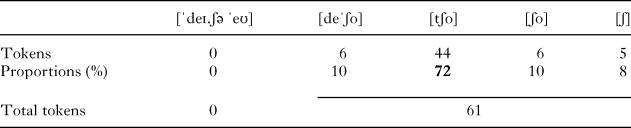
The phrase deixa eu is pervasive in conversational corpora and almost always appears in reduced form. An investigation of a corpus of spoken contemporary spontaneous Brazilian Portuguese (Raso & Mello, Reference Raso and Mello2012) yielded sixty-one occurrences of the construction deixa eu + verb, none of which corresponded to the historically full form [ˈdeɪ.ʃə ˈeʊ]. In fact, even the least reduced form found in the corpus, [deˈʃo], shows some characteristics of special reduction, given that the verb and the pronoun occur as a single chunk and the prominence of the first syllable in the word deixa is totally lost. Table 2 distinguishes four variants, the most common of which is [tʃo], occurring 72% of the time. The fuller form [deˈʃo] only occurred in 10% of tokens and two more reduced forms, [ʃo] and [ʃ], also occurred.
Variants of deixa eu by degree of reduction
The variants observed suggest a phonetically gradual development from full to the most extremely reduced form. The present data and previous literature allow for the hypothesis that this special reduction followed a specific path in which successive reductions affected the phrase to yield each of the variants found and some others we did not observe. The possible special reduction cline for deixa eu is shown below, with bolded characters representing the reductions present in our data:
-
(1) [ˈdeɪ.ʃə ˈeʊ] > [ˈde.ʃə ˈeʊ] > [de.ˈʃeʊ] > [de.ˈʃo] > [tʃo] > [ʃo] > [ʃ].
The first reduced form above, [ˈde.ʃə ˈeʊ], although unattested in the present data, shows frequently occurring reduction patterns in that [eɪ] is monophthongized to [e] before [ʃ] (cf. Almeida, Reference Almeida2008; Brescancini, Reference Brescancini, Bisol and Collischonn2009). The remaining reductions are special in the sense that there is chunking of the two elements in the original phrase and a subsequent loss of stress in the word deixa in each of these cases. In [de.ˈʃo], the least reduced form in our data, the consequences of chunking in the loss of the unstressed final vowel in deixa are already apparent, but more importantly, the maintenance of the stress on the syllable containing eu seems to condition the loss of stress on the first syllable. To arrive at the variants that are attested, the [eʊ] diphthong becomes a monophthong. The most common variant in the corpus, [tʃo], illustrates a further reduction, in which the now unstressed vowel [e] of the first syllable is deleted and there is a voicing assimilation in [dʃ], which yields [tʃ]. Loss of [e] is noteworthy given that high vowels alone tend to be deleted in unstressed position in Brazilian Portuguese (see discussion in the beginning of this section). In [ʃo] we observe the loss of all segmental information in the erstwhile stressed syllable of deixa plus a lenition of the affricate [tʃ] to [ʃ]. Last, the five occurrences of [ʃ] show an extreme case of special reduction in that the only remnant of the segmental (and indeed suprasegmental) information in the phrase [ˈdeɪ.ʃə ˈeʊ] is the palatal fricative. It is relevant that all of the tokens analyzed in this corpus exhibit a loss of prominence that was present in the original word deixa. The loss of prominence makes way for reduction phenomena to occur. As we will show in Section 6, the loss of prominence is due to the chunking of the sequence as a unit and its high frequency.
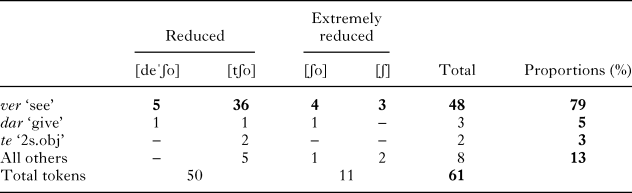
A closer examination of the context of each of the four reduced variants in the corpus revealed that almost two-thirds (64%) of the occurrences of the extremely reduced forms [ʃo] and [ʃ] were followed by the verb ver in the phrase deixa eu ver ‘let me see/think’. In fact, the phrase deixa eu ver alone represented 79% of the total tokens of deixa eu in the spoken corpus investigated. The second most frequent word, dar ‘give’, only had three tokens, followed by te (2s.obj), which had only two. The eight remaining occurrences of the phrase each combined with a different verb. These results suggest that the greatest variation – including the highest number of tokens of extreme reduction – occurs in the context in which the phrase is used most frequently, just as in the case of English don’t. Table 3 shows the variation in the reduction type according to frequency.
Reduction type of deixa eu according to token frequency
In order to investigate the specific role of frequency in the special reduction of deixa eu ver, an analysis of a much larger corpus of contemporary Brazilian Portuguese, the Corpus Brasileiro, was undertaken. In that corpus, the collocation with ver alone represents 39% out of the 383 occurrences (0.3 per million) of the construction deixa eu + verb. The second most common collocation of deixa eu contains an oblique pronoun in the first slot, as in deixa eu te falar ‘let me tell you’ and had 68 tokens (18%) in total. The third most frequent collocation, with the verb fazer ‘do/make’, occurred in only 4% of the tokens. Table 4 contains the results of the frequency analysis.
Frequency of different words occurring in the verb slot of the construction deixa eu in the Brasileiro corpus of contemporary Brazilian Portuguese (one billion words)

Our examination of the variants of deixa eu, then, shows that the greatest reduction occurs in the most frequent context, just as we found in the case of the reduction of I don’t. We also found that a major factor in the extreme reduction of this phrase was the loss of stress or prominence on the first syllable, which, we argue below, is the result of the chunking of this phrase. Given the starting point of the phrase and the existing variants, we also have reason to believe that all the reductive changes that occurred were phonetically gradual.
5.3. caleño spanish o sea
The Spanish discourse marker, o sea ‘that is’ or literally ‘or be+subj+3s’, has been the focus of numerous studies in pragmatics (cf. Schwenter, Reference Schwenter1996; Galán Rodríguez, Reference Galán Rodríguez1998; Félix-Brasdefer, Reference Félix-Brasdefer, Face and Klee2006), which have been primarily aimed at classifying the pragmatic uses of the phrase in discourse, and how it fits into earlier typologies of discourse markers (Schiffrin, Reference Schiffrin1987; Fraser, Reference Fraser1999). Relying primarily on data from Alicante, Spain, Schwenter (Reference Schwenter1996) notes that the uses of o sea have extended beyond the simple subjunctive form of the verb ser ‘to be’ to encompass meanings that can be grouped into two broad classes within the category of discourse markers: connectives and epistemics. He defines connective uses as being those that “guide hearers to the correct semantic interpretation between propositions”, while “epistemic uses mark speakers’ degree of commitment to what they say, increasing the modal content of their utterances” (p. 855). An example of each follows:
-
(2) Connective:
Nos sentábamos siempre en el mismo lugar, o sea como en la segunda, como en el segundo bloque de sillas que hay en la catedral.
‘We always sat in the same place, that is like in the second, like in the second block of seats that are there in the cathedral.’
-
(3) Epistemic:
¿Qué hacemos los universitarios? Pues que depende o sea yo creo los estudiantes universitarios nos dividimos como en dos lados.
‘What do we students do? Well that depends I mean I think that we university students are divided into two groups.’
In terms of phonetic variation, o sea has received very little attention beyond impressionistic analyses. Schwenter notes that it occurs in a prosodically independent position, often separated from the surrounding context by pauses, intonation breaks, or both, and is subject to reduction: “Although often reduced from its full phonological form /osea/ to [osa] or [sa] and unstressed, it may also be stressed with an elongated final vowel [osea:] when in final position” (1996, p. 858); Félix-Brasdefer (Reference Félix-Brasdefer, Face and Klee2006) makes similar observations with respect to the reduction in present-day Mexican Spanish.
Here we examine the distributional data and the gradient phonetic properties of both the o sea discourse marker (DM) and its subjunctive (SUBJ) predecessor in sociolinguistic interviews produced by fourteen people (11 females, 3 males) from Cali, Colombia. In terms of overall distribution frequency, we report a 28:1 ratio in favor of the DM over the SUBJ uses, which is in stark contrast to distributional data retrieved from publically available corpora such as El Corpus del Español, a corpus consisting predominately of written texts and formal registers. In that corpus the SUBJ accounts for 68,633 (91%) vs. the DM with 6,796 (9%) overall; the count for the twentieth century is SUBJ 6,699 (53%) vs. DM 5,870 (47%), and 2,859 (35%) vs. 5,403 (65%) in the twentieth-century oral genre only. We suggest that frequency counts based on dialect-specific, spontaneous, informal speech styles (when available) are more likely to capture patterns of phonetic reduction.
To arrive at a more objective analysis of the gradient reduction of o sea, an acoustic analysis was undertaken using 174 tokens of the DM and 11 tokens of SUBJ. This gradient analysis not only corroborates the impressionistic intuitions provided by Schwenter and Félix Brasdefer, but also provides more specific details regarding the types of reduction present, which include both temporal and gestural dimensions. Some of these are represented in Figure 1. Overall, the DM is produced with shorter mean durations than the SUBJ (195ms vs. 256ms) as shown in the first boxplot, with a range between the DM and SUBJ of 51ms; the median durations are even more notable: DM 175ms and SUBJ 262ms. These measurements do not include the /o/ gesture, but even when that is included, the DM is still significantly shorter (–35ms). In terms of individual gestures, they examine the /s/ and /ea/ sequences separately.
Temporal and gestural reduction in discourse marker o sea vs. subjunctive sea.
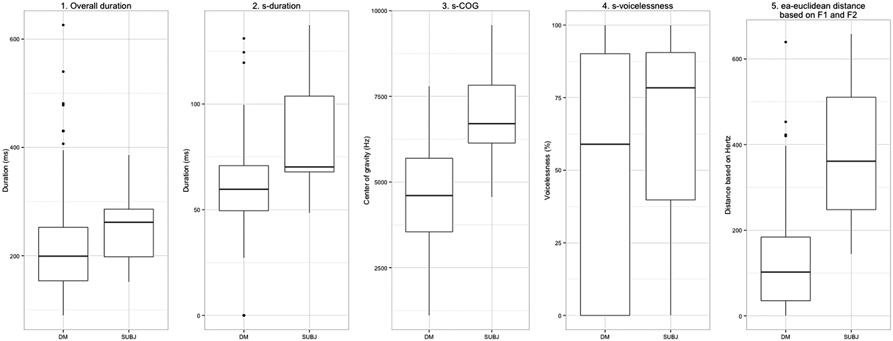
In the DM, the sibilant /s/ is realized with a significantly shorter duration (boxplot 2), a lower center of gravity (boxplot 3), and tends to be produced with more voicing (boxplot 4) when compared to the /s/ in the SUBJ. The center of gravity is based on one of the spectral moments identified in Forrest, Weismer, Milenkovic, & Dougall (Reference Forrest, Weismer, Milenkovic and Dougall1988), which measures the central tendency (i.e., the mean) of the spectrum and is a weighted average of the frequency peaks over a specified interval. Lowering of the centroid is interpreted as a weakening tendency in terms of a lowered tongue gesture (cf. Erker, Reference Erker2010; File-Muriel & Brown, Reference File-Muriel and Brown2010, Reference File-Muriel and Brown2011). The weakening of /s/ in syllable-initial position is a known tendency in Caleño Spanish (Brown & Brown, Reference Brown, Brown, File-Muriel and Orozco2012), as well as in other varieties (Brown & Torres Cacoullos, Reference Brown, Torres Cacoullos and Nunez-Cedeno2003). The important point here is that s-reduction is more advanced in the high-frequency DM than in the infrequent SUBJ, which lends support to our hypotheses.
Regarding the articulation of the vocalic sequence /ea/, interestingly, there does not appear to be a significant difference with regard to duration between the SUBJ use and DM use, likely due to the fact that the DM is often elongated in utterance-final position. However, upon considering the formant trajectories and, specifically, the degree of acoustic differentiation between the early [e]-like part, and the later [a]-like part in terms of a Euclidean distance measure of two sets of F1 and F2 measurements (Figure 1, boxplot 5), the DM tends towards a monophthongal articulation (i.e., [a]), while the SUBJ appears to be more diphthongal or hiatus-like (i.e., [ea]). The Euclidean Distance is a metric distance from point A to point B in a Cartesian system (derived from the Pythagorean Theorem) and is represented as follows: Distance ← sqrt((F1 = x1–x2)^2+(F2 = y1–y2)^2). Point 1 is taken 25ms following the offset of frication from [s], to compensate for formant transitions, and point 2 is taken at the maximum F1, which defines the [a]-gesture. Thus, monophthongal articulations, such as that shown in Figure 2, have lower distance measures than more diphthongal and hiatus-like articulations, such as that shown in Figure 3.
Monophthongal articulation of discourse marker o sea.

Hiatus-like articulation of subjunctive sea.

It should be noted that the reduction of vowels in hiatus (e.g., /e.a/) to diphthongal realizations [ja] is a general tendency that has been observed in the Romance languages to different degrees depending on the language (cf. Chitoran & Hualde, Reference Chitoran and Hualde2007), and specifically in Latin American Spanish (Alba, Reference Alba2008; Garrido, Reference Garrido2013). Alba notes that “hiatus is commonly resolved in some way in speech. Possible resolutions include deletion of one vowel (e.g. /a/+/e/ > [e]), creation of a diphthong (e.g. /a/+/e/>[ai̯]), coalescence of the two vowels into a different one (e.g. /a/+/e/>[ɛ]) and insertion of a consonant (e.g. /a/+/o/>[aɣo]. Although hiatus is most often resolved in one of these ways, it may also simply be maintained” (p. 251).
In short, this analysis shows that the DM o sea is characterized by clear patterns of gestural reduction when compared to the SUBJ sea, from which it evolved. The highly frequent DM is not only shorter in duration overall, but shows patterns of reduction in terms of s-realization (i.e., shorter duration, lower center of gravity, and more voicing) and the monophthongization of the vocalic sequence /ea/. It was pointed out that the gestural reduction observed in o sea are patterns seen elsewhere in the language, but o sea is much farther along than its SUBJ predecessor.
6. How special is ‘special reduction’?
6.1. phonetic effects of chunking
The case studies from the three languages support Hypotheses 1 and 2, i.e., that special reduction is determined by phonetic trends already present in the language which are accelerated in high-frequency phrases, and that special reduction is phonetically gradual. In an exemplar model, all words and phrases are subject to certain phonetic biases and the resulting phonetic tokens affect the stored exemplars, often moving these phonetic processes along. Two factors make special reduction special: one is high frequency, which allows the accumulated phonetic biases to create a wider range of variation, including extremely reduced variants, and the second is the chunking of a sequence of words or morphemes into a single production unit. Footnote 4 As noted above, high frequency does not cause reduction, but it facilitates it because high-frequency items are more often exposed to the production biases that cause reduction.
Chunking plays a role in the three examples described in the previous section. In fact, chunking would seem to be the first step in the process of special reduction. Barth-Weingarten and Couper-Kuhlen (Reference Barth-Weingarten, Couper-Kuhlen, Auer and Pfänder2011) argue that the production of a sequence as a single prosodic unit and the implementation of the regular phonetic processes that occur in such units is an important first stage in the creation of a new morphosyntactic whole, be it a discourse marker or a new construction. Our examples show that subsequent repetitions push these regular processes beyond their usual outcomes.
Our examples also show chunks within chunks. The phonetic fusion found in I don’t seems to be a good indicator of chunking. This chunk in turn occurs in larger chunks such as I don’t know, I don’t think, and I don’t mean, as well as other combinations. Similarly, deixa eu becomes a single processing unit, but it also occurs in the chunk deixa eu ver ‘let me see/think’, which takes on an expanded interactional function. But the reduced form of deixa eu also occurs with some other frequent verbs, so it is a chunk within a larger chunk. The Spanish discourse marker o sea is a simpler composition, consisting of one unitary chunk.
The examples also show, in accordance with Hypothesis 3, that one outcome of the frequent repetition of chunks is the loss of some of the prominence on what were earlier stressed syllables. Thus I don’t know in its fullest and original form would have the same stress pattern as I don’t inhale – that is, full prominence on don’t and the verb. The reduced forms are characterized by less prominence on don’t and a declining prominence on I as well. As the prominence we designate as ‘stress’ is manifested as increased duration and amplitude and higher pitch, the diminution of these properties is in itself reduction. Thus we are less inclined to describe these changes as a loss of stress and more inclined to think of them as the normal outcome of increased reduction. Thus the whole unit I don’t reduces and only the verb (in this case know) retains lexical stress.
Brazilian deixa eu also started with stress on the first syllable of deixa and a stress on eu. As we explained above, the fusion of the final (unstressed) vowel of deixa with the pronoun eu yielded a stressed syllable in [de.ˈʃeʊ]. The relative prominence of [de] is much less than the following syllable, and it is the one that further reduces.
In Spanish, it is common for two vowels in sequence (in hiatus) to undergo change, starting with diphthongization and continuing to a monophthongal realization. This is precisely what is occurring in the o sea DM, but not in the infrequent SUBJ, which appears to be maintaining the two original vowels. It should be noted that, in the original construction, tonic stress is said to fall on the first vowel in the sequence (e.g., /ˈse.a/). This is precisely the vowel gesture that appears to be undergoing reduction (e.g., [ˈsa]), in line with our Hypothesis 4. A further reduction affects the vowel /o/, which in the majority of cases (61%) is not realized.
We propose that the chunking of the words into a single unit, and the continued reduction they undergo, is responsible for the loss of syllables as well as the reduction of prominence on syllables that were earlier stressed.
6.2. pragmatic and semantic factors in chunking and special reduction
Since chunking and fusion can occur in the absence of semantic/pragmatic change, and indeed, chunking does not require extremely high frequency, we conjecture that it occurs independently of functional change and in fact precedes any change in meaning or function. Examples of chunked sequences undergoing special reduction in the absence of functional change are the fusion of prepositions with articles (listed above), the contraction of English auxiliaries with preceding pronouns (I’ll, I’ve, he’s, he’d, etc.) and the contraction of English not with a preceding auxiliary (can’t, don’t, couldn’t, wouldn’t, etc.). Thus, chunking may occur rather mechanistically, with the cognitive system responding to the frequency of sequences in experience (Saffran, Aslin, & Newport, Reference Saffran, Aslin and Newport1996). However, there are two ways that functional factors also come into play in chunking and thus in special reduction.
First, it is commonly noted that chunked sequences, especially those of high frequency, take on new functions in context. Most of the examples we have cited here show some functional change: I don’t know can be used as a discourse marker (Scheibman, Reference Scheibman2000), as can o sea (Schwenter, Reference Schwenter1996). Deixa eu ver has interactional functions as well. Special reduction is characteristic of grammaticalization, which also includes functional change. However, detailed studies of the relation between reduction and function do not show a one-to-one correspondence in the variable stage. Bybee and Scheibman (Reference Bybee and Scheibman1999) find in the corpus used that the reduced vowel in I don’t know occurred in both the compositional meaning and in the discourse function, and, while the full vowel favored the compositional meaning, it also occurred once in the discourse function. Thus new functions do not cause special reduction, but rather coincide with it. However, new functions can play a role in that they usually mean an increase in the frequency of use, which helps to propel reduction forward. The new functions also reinforce the unitary nature of the expression, leading to a loss of compositionality of meaning. As the component parts within the expression are less likely to be activated when the expression is used, nothing prevents further phonetic reduction.
Second, a much more subtle role of function can be seen early in the development of chunks, as pointed out by Barth-Weingarten and Couper-Kuhlen (Reference Barth-Weingarten, Couper-Kuhlen, Auer and Pfänder2011). They argue that the development of a chunk requires that it occur in a single turn-constructional unit in conversation, that it implement a single action by the speaker in the conversation, and that it have phonetic and prosodic integration. The construction they discuss, VP1 and VP2, can be used in various ways. It can depict two separate actions, as in think that over and find out, or one single action, as in come and deliver, go ahead and take it, or cases that are intermediate. Their finding is that, even with novel combinations, the phonetic and prosodic integration corresponds to the extent to which a single action is depicted, as in the following example, about driving on a road after it has been paved, in which the two VPs describe a single event:
-
(4) It’s so delightful to come down the road and not be followed by a cloud of dust.
The integration of the two VPs prosodically, and the reduction of and in a novel combination, suggest (as the authors note) the development of a new construction. At the same time, as we would predict, certain more frequent combinations have become constructions, called hendiadic constructions (Hopper, Reference Hopper, Bybee and Noonan2001). Examples are try and … , go ahead and … , come and … , go and … .
Thus the study of chunking to date has identified a number of factors that contribute to the process: the sequence should be repeated in experience, produced as a prosodic and phonetic unit, it should occur within a single turn-constructional unit and implement a single function within the discourse. These factors set up the conditions under which regular phonetic processes occur. With repeated use and changes in the exemplar representation for the phonetic shape, as well as changes in the set of semantic and pragmatic exemplars, special reduction begins to emerge.
7. The nature of reduction
Another important issue that our examples help us understand is the exact nature of phonetic reduction and its gradualness, as noted in Hypothesis 2. Our examples involve the reduction of both consonants and vowels. A pervasive process in both BP and Spanish, and one that affects our examples early, is the reduction of vowels when they occur in contact with other vowels. Thus the earliest reduction of deixa eu involves the deletion of [ə] before /eu/, and a second step is the monophthongization of [eʊ] into [o]. The analysis of Spanish o sea shows that monophthongization occurs even in cases where there does not appear to be shortening. In the SUBJ, there is a visible tongue gesture in F1 and F2 trajectories indicative of a front, mid tongue configuration [e] with a transition to the low central vowel [a]. For the DM o sea, this gesture is reduced, as observed in the flattening of the formant structure, which indicates an absence of the tongue movement seen in the SUBJ.
Vowel reduction and deletion that occurs between consonants also involves both a gradual decrease in the magnitude of the gestures involved and a decrease in their duration. Mowrey and Pagliuca’s (Reference Mowrey and Pagliuca1995) EMG study focuses on the reduction of the unstressed vowel in English suppose in casual vs. formal styles. In the casual style, the vowel is voiceless in most tokens and in the formal style it is voiced in most tokens. The muscular gesture for the production of the unstressed schwa in the casual style tokens is much closer to the gesture for the [ph], showing a compression of the gestures. These points indicate a decrease in gestural magnitude (at the glottis) and a decrease in duration through compression of the gestures in vowel reduction and loss. Interestingly, even in tokens where a transcriber would not perceive a vowel, there is some tongue movement towards the vowel position, indicating clearly that vowel reduction and deletion occurs gradually. There is no strict line between presence vs. absence of a reducing vowel.
The consonant reduction instances we have examined also show a decrease in magnitude of the gestures and temporal compression. The flapping of English /t/ and /d/ is the shortening of the closure at the alveolar ridge; its eventual deletion constitutes the gradual loss of the closure entirely. Final /t/ as in don’t has been shown to be shorter in high-frequency words, a factor that leads to its deletion (Lociewicz, Reference Lociewicz1992). As for the Spanish examples of o sea DM and SUBJ, the center of gravity measurements of the [s] show that a lowered (decreased) tongue gesture occurs in the DM uses, but not in the SUBJ.
Our vowel and consonant reduction data suggest, in line with the proposal of Mowrey and Pagliuca (Reference Mowrey and Pagliuca1995), that there is no major reorganization between formal and casual speech or among variants with different degrees of reduction. Rather, the gestures that are diachronically present undergo subtle changes involving gestural reduction and temporal compression. In line with Hypothesis 4, this suggests that speakers are not being ‘lazy’ or ‘sloppy’, as is often reported, but rather are evincing finely controlled motor behavior that entails a large range of variation, but one that is rather consistent across members of a speech community, given the appropriate functional context.
Another argument against the ‘sloppy speech’ depiction of special reduction is that the results are in some cases articulations that are actually quite difficult in the sense that they are typologically uncommon and difficult to acquire. As mentioned in Section 5.2, vowel deletion in BP can lead to consonant clusters that are otherwise non-occurring in the language. The English case of negative contraction, which produces the standard variant didn’t [dɪ̃ʔn̩] is phonetically unusual and difficult for both first and second language learners. Again, we conclude that reduction processes are the result of finely tuned neuro-motor behavior.
As mentioned, all of our examples are suggestive of phonetic gradualness (Hypothesis 2), but the o sea case study also illustrates the advantages offered by an instrumental approach (File-Muriel & Brown, Reference File-Muriel and Brown2011). Capturing the subtle differences in acoustic variation is not always possible using the traditional transcription approach, as it limits the representation of gradient phenomena to symbolic units of the International Phonetic Alphabet. An obvious consequence of symbolic representation is that it reduces the chances of understanding not only which factors influence a particular sound, but also how different aspects of the sound are affected. Upon representing a sound symbolically, the researcher chooses between one or more available devices (e.g., /s/ as [s], [z], [h], Ø). Clearly, these symbols are unable to provide more than a binary or (at best) ternary categorization of important features that comprise the sound, such as temporal, spectral, and energy characteristics. For example, the classification of voicing is reduced to ‘presence or absence’, when in reality voicing is quite gradient. Instrumental approaches allow us to observe patterns of reduction that would likely not be perceived within an impressionistic analysis.
8. Language-specific phonetic trends and future sound changes
Special reduction is found in every language, but it produces different outcomes based on the phonology of the language in question. This is because special reduction depends upon a number of phonetic factors that are language-specific, such as segmental context and degrees of prominence. On the other hand, some factors that motivate it pertain to language use in general, such as pragmatic function or the frequency of use of the words in question. These can be observed in every language.
Indeed, frequency plays a prominent role in special reduction in that it helps to advance phonetic trends already present in a language to more extreme levels. That is, in special reduction the regular phonological phenomena that apply to a language get a boost from the very high frequency of occurrence of the items it affects. Since both frequency of use and the articulatory gestures involved in speech production are continuous variables, special reduction produces different outcomes that constitute a gradient continuum. The reduction of don’t from [dõt] through [ɾõ] to [ə̃] are examples of such a continuum.
We mentioned above that special reduction is based on current phonetic processes in a language, but it is important to note that such processes often represent long-term trends affecting the phonology of that language, as captured in Hypothesis 5. Thus, a special reduction observed at a specific point in time might predict sound changes that could affect a wider number of contexts in the future. In other words, what is special reduction at one point may end up becoming regular sound change at a later stage in the diachrony of a language. In order to illustrate that point, we now review some early reductions reported in the history of English, Portuguese, and Spanish in an attempt to illustrate how a reduction that is special can serve as a predictor of regular changes to come.
8.1. loss of initial consonants in english
In some of the more extreme reductions of a phrase like I don’t know, one observes not only the expected reduction and subsequent deletion of vowels that have lost stress, but also the deletion of all consonantal segments in extreme cases like the variant [ə̃]. Although deletion of final [d] and [t] is a common process in American English (Bybee, Reference Bybee, Barlow and Kemmer2000b), initial and intervocalic consonant deletion is not found so often. However, the in the contexts in which /t/ and /d/ become flaps, they are often so short as to be barely audible, suggesting that they might eventually undergo a deletion process as does the /d/ in I don’t know.
High-frequency phrases can create the conditions in which consonants may undergo reduction. For instance, under certain conditions, the glottal fricative [h] is lost in the pronouns him and her, as in Give him the cookie, in which the words give and him form a unit that is pronounced [ˈgɪvɨm]. We argue that this is related to a much earlier change in which the Old English third person neuter pronoun hit lost its initial glottal fricative to give rise to it. Another special reduction involving the loss of an initial consonant is the reduced rendering of I’m gonna, which occurs only in the intention/future expression. Here, the [g] in gonna might be completely deleted yielding [ˈaɪmə̃ɾ̃ə̃], [ˈaɪmnə] or even [ˈaɪmə].
The special reduction of don’t and others like her/him and gonna point to the fact that at least some English consonants may be prone to deletion when they occur in the appropriate context. If the initial segments in these words are consistently lost when produced intervocalically, this sound change trend might at some point apply more generally in the language.
8.2. vowel deletions giving rise to consonant clusters in portuguese
When chunking of the elements in the phrase deixa eu causes the historically stressed vowel in [ˈdeɪ.ʃə] to delete, the result is the unexpected consonant cluster [tʃ]. This seems to go against a commonly reported trend in Brazilian Portuguese to eliminate consonant clusters through epenthesis (Câmara, Reference Câmara1972), but in fact the creation of new clusters has a long history of occurrence in the language.
As early as the Late Latin period, word-medial unstressed vowels were lost, giving rise to consonant clusters in early Romance. The loss of those vowels in Latin words like vetulu, tegula, and oculu ‘old’, ‘tile’, and ‘eye’ created different clusters like /tl/, /gl/, and /kl/. Although most of these clusters were subsequently changed to a single segment [ʎ] by the Early Portuguese period (around the twelfth century), the trend has nonetheless persisted well into the present. As mentioned above, the deletion of unstressed vowels which causes consonant clusters to emerge has been reported both in word-medial (cf. Bisol, Reference Bisol2000; Amaral, Reference Amaral, Bisol and Brescancini2002) and word-initial (Amaral, Reference Amaral, Bisol and Collischonn2009; Napoleão de Souza, Reference Napoleão de Souza2014) positions in more recent years. In the aforementioned studies, it is mostly the vowels [i u] that are deleted, but word-medial unstressed [ə ɨ] have also been reported to reduce to zero.
The phonetic trend in which unstressed vowels become shorter and prone to deletion stems from the fact that lexical stress has become increasingly correlated with longer vowel duration in Portuguese (to a much greater extent than in Spanish). Though the consequences of such a reduction may seem extreme in cases like deixa eu [ˈdeɪ.ʃə ˈeʊ] becoming [tʃo], the phonetic patterns that motivate it have been operational in the language for quite a long time. The special reduction data in this paper suggest that all unstressed vowels, independent of height, may be prone to deletion in the future. Moreover, the present and previous studies seem to indicate that the consonants adjacent to the deleted vowel may be preserved in some form. The present changes might thus indicate that new consonant clusters will once again emerge in Portuguese. In the case of [tʃ] in [tʃo], the most frequent reduced variant of deixa eu, the results of the reduction might be viewed as a precursor of the full phonologization of the consonant (for further evidence, see Cristófaro-Silva, Reference Cristófaro-Silva2003).
8.3. vowel and consonant deletions in spanish
In the history of Spanish, phonological processes that lead to consonant lenition seem to be responsible for some of the major changes that took place in the language. For instance, Spanish lenited early Romance [ʎ] resulting from the consonant clusters /tl/, /gl,/ and /kl/ mentioned above to [j] or [χ], depending on the context. Also, there is evidence that now regular lenition of intervocalic /b d g/ to [β ð ɣ] and their ongoing deletion in many present-day dialects may have started in the Old Spanish period. By the fourteenth century, the early Old Spanish [d] in second person plural marking of present tense verbs -des was variably deleted, as in [kanˈtades] > [kanˈtaes] ‘you (pl.) sing’ (Penny, Reference Penny1991, p. 138). This change subsequently progressed to other verb tenses until it reached the entire verb paradigm, suggesting that what was once a special reduction became a regular change that affected all second person plural forms.
The vowel assimilation we report in [oˈsea] becoming [oˈsa] differs from the more regularly observed changes in Spanish in that it affects vowels instead of consonants. When one looks into the history of the language, however, it is possible to identify similar instances of two vowels reducing to one given the right phonetic context and frequency of use. The contraction of prepositions and articles is one such example, as in a + el [a el] to al [al] ‘to the’ or de + el to del ‘from the’. The reduction of a hiatus in a highly frequent construction may indicate that similar sequences could get reduced in the future. As consonants lenite and face deletion in many contemporary varieties of Spanish, as in lado [laðo] > [lao] ‘side’, the number of appropriate contexts for such a reduction to occur may abound in the future.
At first glance, special reduction might seem to operate in ways that are incompatible with the phonology of the language it affects. Indeed, some of the more extreme outcomes of special reduction might differ significantly from more regular phonological patterns one finds in a language. However, special reduction follows phonetic trends that have been present in the language, often for hundreds of years. The combination of right phonetic context – which is specific to each language – with a very high frequency of use may accelerate the process, sometimes creating unexpected outcomes. Nonetheless, as the study of historical facts discussed in this section illustrates, special reduction might presage regular sound change phenomena occurring at a later date.
9. Conclusion
We hope to have presented here a unified approach to special reduction in the context of a usage-based view of language, and to have illustrated the importance of special reduction for the deeper understanding of language-specific phonetic trends, reduction occurring during speech production and the long-term trajectory of sound change. We have emphasized the role of chunking and high levels of frequency, not in causing special reduction, but in setting up the circumstances under which phonetic processes can affect a particular word sequence. As a sequence of words is produced as a single prosodic unit, and repeated often in this way, production biases have a chance to affect the sequence, creating a range of phonetic variants.
We have chosen to think of the diachronic processes that create special reduction in terms of an exemplar model, and the outcome of our investigation lends support to Hypothesis 6, in that the data point to cognitive representations in terms of clusters of exemplars, rather than the stricter categories of phonemes and allophones. Two points also support Hypothesis 7: first, we find that the phonetic divergence that occurs in high-frequency phrases is not restricted to phonetic environments (as is required of variants of phonemes), but rather responds to the lexical and functional environment as well as to frequency of use. Second, we find phonetic variants, which would not traditionally be considered to have phonemic value, serving expressive functions, for example within discourse markers, much as other researchers have found phonetic variants serving a social function (Foulkes & Docherty, Reference Foulkes and Docherty2006). These findings suggest some gradience in the phonetic categories of a language, such that not all of them are strictly assignable to phonemes, and the resulting theory encourages a data-rich approach to phonology (Port, Reference Port2010), which seeks explanations not just for the existing patterns of segments and prosody, but also for the emerging units and patterns.



