


Introduction
For decades, Africa south of the Sahara has been on the margins of the study of the technology, development and history of glass, with a narrative that emphasises the exchange and trade of glass objects. This view places sub-Saharan Africa in two positions: one that sees the region as participating in the global economic system mainly by consuming imported goods. Implicit as a result of this first position is the second, which excludes the sub-continent from discourse on the development, innovation and invention of glass technology. While there is abundant archaeological and historical evidence that amplifies the former view, there is only limited evidence to contest the latter. Over ten years ago, however, James Lankton, Akin Ige and Thilo Rehren (2006) challenged the narrative that no primary glass production existed in pre-industrial sub-Saharan Africa by highlighting the uniqueness of the high lime, high alumina (HLHA) glass from Ile-Ife, south-west Nigeria (Figure 1). They argued that it must have been made locally, from materials available within the surrounding environment, during the twelfth century AD (Lankton et al. Reference Lankton, Ige and Rehren2006; Freestone Reference Freestone2006; Ige Reference Ige, Ignatiadou and Antonaras2012).
South-west Nigeria showing the location of Ile-Ife (figure by Abidemi Babalola).

Recent archaeological investigations at Igbo Olokun, an early glass workshop in Ile-Ife, have confirmed that HLHA glass was the product of a local recipe developed by early inhabitants of Ile-Ife (Babalola et al. Reference Babalola, McIntosh, Dussubieux and Rehren2017, Reference Babalola, Rehren, Ige and McIntosh2018). It has also been demonstrated that HLHA glass beads were manufactured on a large scale, suggesting access to a ready market and high demand for the product during the classical era of Ile-Ife (Babalola Reference Babalola and Berzock2019). Recent work has identified very similar bead-making evidence from early Osogbo, some 45km north of Ile-Ife and dating to a few centuries later (Ogundiran & Ige Reference Ogundiran and Ige2015). While significant work has been undertaken on the production of glass beads in classical Ile-Ife and seventeenth-century AD Osogbo, it is nowhere near complete, and further investigations are needed, especially in the wake of the discovery of what appeared to be semi-finished glass.
2016 and 2017 investigations
Abidemi Babalola undertook fieldwork at Ile-Ife between 2016 and 2017. The purpose was twofold: first, to revisit sites where evidence of glass-bead making had previously been reported, geo-reference their locations and assess their integrity for future excavation. Second, to examine artefact assemblages in the storage facility of the Natural History Museum of the Obafemi Awolowo University, collected or excavated from archaeological sites around Ile-Ife. The storage facility proved fruitful, yielding several crucible fragments with examples of semi-finished glass that had not been identified during collection. These significantly enhance our understanding of glassmaking in sub-Saharan Africa.
Semi-finished glass
Three fragments of crucible vessels with semi-finished glass encrusted on their interior were discovered in the museum store (Figure 2A–B). This identification was based on comparison with semi-finished glass from Egypt (e.g. Rehren & Pusch Reference Rehren and Pusch2005; Smirniou & Rehren Reference Smirniou and Rehren2011) and Greece (Rehren et al. Reference Rehren, Spencer, Triantafyllidis and Cool2005). The crucible fragments are recorded as having been collected at Igbo Olokun. Two are body fragments with a thin and corroded layer of suspected semi-finished glass, while the third sample is a crucible base with a well-preserved chunk of semi-finished glass. The third fragment is about one-third of the size of a flat crucible base. The total thickness is 35mm, while the wall thickness is approximately 25mm, consistent with glass crucibles from known reliably dated archaeological contexts (Babalola Reference Babalola2016) and those previously excavated at Ile-Ife (Willett Reference Willett2004).
Crucible fragments from Natural History Museum storage with suspected semi-finished glass: A) (sample IF0108) the well-made glass layer beneath the chunk of the semi-finished glass indicates that the crucible must have been used multiple times in glass production; B) (sample IF0113) the striations in the glass surface indicate scraping out of the soft glass paste while it was still hot, a common observation on many crucible fragments from Ile-Ife (figure by Abidemi Babalola).

Laboratory analysis
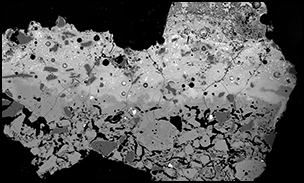
The samples are currently being analysed at the Science and Technology in Archaeology and Culture Research Center of the Cyprus Institute. Their matrix is heterogeneous, consisting of a glassy phase with residual quartz and feldspar and newly formed wollastonite, a typical phase in the glass-forming reaction, as well as several intermediate phases (Figure 3A–B). The glass matrix of the samples shares all compositional characteristics of finished HLHA glass objects. The heterogeneity of this melt phase and the included residual mineral phases, however, are typical for primary glassmaking processes, with different alkali ratios in different parts next to each other within the same sample. This heterogeneity reflects the incomplete melting of the raw materials, primarily feldspars of varying compositions, and would have disappeared once the glass became fully molten and worked into objects.
Backscatter electron images of the semi-finished glass with heterogeneous matrix: A) (sample IF0113) molten upper part, and a more sintered lower part still showing the original particles of the raw material, namely quartz (darker grey) and feldspar (lighter grey), while in the fused part the light crystals are wollastonite (a transient crystal phase forming during glass making in regions rich in lime), indicating a higher lime content here. Some residual dark quartz is also still visible in the molten part; B) (sample IF0108) air bubbles appear as round black holes, the different grey shades in the matrix reflect different chemical compositions of the glass (figure by the authors).

Implications and concluding remarks
Semi-finished glass is a direct indicator of primary glass production (Smirniou & Rehren Reference Smirniou and Rehren2011). The semi-finished glass from Ile-Ife is the first to be reported from sub-Saharan Africa, and is consistent with semi-finished glass known from glassmaking centres elsewhere (e.g. Rehren & Pusch Reference Rehren and Pusch2005; Jackson & Nicholson Reference Jackson, Nicholson and Nicholson2007; Pusch & Rehren Reference Pusch and Rehren2007). Its composition provides archaeological proof for the suggestion by Freestone (Reference Freestone2006: 140) that such HLHA glass would have been made with feldspar-rich immature granitic sand or pegmatite as indicated by the high alumina, and that the high lime content is derived from the addition of a calcium carbonate-rich material, such as limestone or shell. Our data are also consistent with the result of Ige's (2012: 489) experimental work, which demonstrated that a mixture of feldspar-rich sand and snail shell, when melted in small crucibles at temperatures above approximately 700°C, indeed produces glass with a composition similar to the Ile-Ife HLHA. Archaeological work at Osogbo has uncovered a feldspar-rich substance suggested to have been used in glassmaking during the early period in Osogbo in the seventeenth century AD (Ogundiran & Ige Reference Ogundiran and Ige2015), demonstrating the longevity and geographic spread of this technology and perhaps its disappearance and reinvention. This feldspar-lime glass has no parallel in pre-modern glassmaking, decisively confirming the autonomous origin of the Ile-Ife glassmaking technology.
Many questions remain unanswered about the primary glass-production process in sub-Saharan Africa. How was it organised? What do we know about the raw materials (the clay used for the crucibles, the sand for the glassmaking, fuel used in the furnace), their processing and the further treatment of the semi-finished glass? Did these indigenous glass beads carry a distinct value connotation compared to the imported glass beads, and if so, how were they recognised? Ongoing research opens a new chapter in the archaeology and history of glassmaking in sub-Saharan Africa and situates the sub-continent within the global discourse of invention and innovation in early societies.
Acknowledgements
The authors are grateful for the support of UCL Qatar in facilitating initial sample preparation and SEM analyses on these finds. The research is generously supported by the A.G. Leventis Foundation as part of a current project addressing primary glassmaking in Ile-Ife. Support from the Association of the History of Glass and Corning Museum of Glass—Rakow Grant 2017 and the D.M. McDonald grant 2018—enabled further fieldwork at Ile-Ife.



