




Policy Significance Statement
This study offers a comprehensive evaluation of 31 Chinese AI policies using nine primary variables, emphasizing the importance of viewing artificial intelligence as a cultural and social technology rather than merely a technical tool. By constructing a PMC evaluation system that integrates technological, risk, and socio-cultural dimensions, this research fills a gap in existing studies concerning the assessment of social and cultural institutional aspects within China’s AI policy framework. The findings highlight AI’s significant role in reshaping social structures, cultural expression, and institutional processes. This study provides valuable insights for policymakers, encouraging the development of more inclusive, sustainable, and responsible AI governance strategies and supporting ongoing institutional innovation in China and beyond.
1. Introduction
The rapid development of artificial intelligence (AI) technologies is driving profound transformations across economic, social, and cultural domains worldwide. Governments increasingly prioritize establishing robust governance frameworks to address the multifaceted ethical, technical, and institutional challenges posed by AI. In China, AI governance is particularly complex, involving not merely technical or regulatory concerns but also deeply institutionalized processes embedded within specific social, political, and cultural contexts. These particular contexts significantly shape the objectives, instruments, and implementation mechanisms of AI governance policies.
In recent years, academia has increasingly redefined AI—especially large language models (LLMs) and multimodal models—not simply as “intelligent agents” but rather as novel cultural and social technologies. This perspective challenges the traditional view of AI as merely a new technological object for governance. Instead, it emphasizes AI’s role as a socio-technical system that reorganizes and restructures large-scale information flows, cultural expressions, and knowledge power distributions. Understanding AI from this vantage point calls for governance strategies that go beyond technical metrics or universal ethical principles and instead deeply engage with the dynamics of social and cultural institutions shaping policy design and societal impact.
Moreover, AI exhibits a dual potential on the cultural front, simultaneously driving tendencies toward homogenization while also enabling the promotion of diversity—a tension resonant with classical sociological theories of rationalization. At the same time, AI’s economic and institutional effects—especially regarding data control and platform power concentration—raise urgent issues related to fairness, participation, and institutional reform, which are particularly salient in China’s digital ecosystem. Addressing these challenges requires developing integrated governance mechanisms combining normative frameworks, regulatory oversight, and participatory processes, alongside fostering interdisciplinary collaboration between social sciences and computer science to better understand how technology reshapes social, political, and economic structures.
Although research on AI governance is expanding, existing policy evaluation methods often overlook critical socio-cultural institutional factors specific to China’s AI policy environment. The Policy Modeling Consistency (PMC) index model offers a quantitative tool for assessing the internal consistency and multidimensional performance of policy design. While the PMC model has been applied to evaluate digital economy and high-tech industry policies, its specific use in the AI policy domain remains limited, with few studies developing tailored evaluation indicators that capture the complexities of AI governance.
This study aims to fill this gap by constructing a PMC-based evaluation framework specifically adapted to China’s AI governance policies. By integrating technological attributes, risk governance, and socio-cultural institutional dimensions, it systematically assesses the effectiveness of AI policies. The research not only deepens the theoretical understanding of the interplay between technological innovation, policy design, and socio-cultural institutional dynamics but also provides practical support for the innovation of AI governance policies in China and beyond.
2. Literature review
2.1. AI as a new cultural and social technology: understanding the underlying logic of AI governance
To further clarify the theoretical foundations of this perspective, it is useful to situate AI within broader traditions that examine the relationship between technology, culture, and society. Media theorists have long argued that communication technologies fundamentally reshape social structures and cultural practices. For example, McLuhan’s well-known proposition that “the medium is the message” suggests that media technologies reorganize human perception, patterns of communication, and cultural production (McLuhan, Reference McLuhan1994). In this sense, technological systems should not be understood merely as neutral tools but as infrastructures that reshape social interaction and the circulation of knowledge.
Building on media theory, the field of Science and Technology Studies (STS) further conceptualizes technological systems as sociotechnical arrangements embedded within cultural and institutional contexts. One influential concept is Jasanoff’s theory of sociotechnical imaginaries, which refers to “collectively held, institutionally stabilized, and publicly performed visions of desirable futures” associated with scientific and technological development (Jasanoff, Reference Jasanoff, Jasanoff and Kim2015). Sociotechnical imaginaries highlight how technological innovation is intertwined with collective expectations about social order, governance priorities, and desirable futures. As such, technological systems do not simply solve technical problems; they also embody cultural values and institutional visions of societal development.
From a cultural perspective, recent scholarship also highlights the emergence of “algorithmic culture,” referring to the ways algorithmic systems increasingly mediate cultural production, knowledge circulation, and everyday social practices. Seaver argues that algorithms should be understood as cultural actors embedded in social practices, shaping how information is curated, interpreted, and consumed in digital environments (Seaver, Reference Seaver2017). Algorithmic systems, therefore, influence not only economic and technical processes but also cultural meaning-making and public knowledge infrastructures.
Beyond cultural mediation, scholars also emphasize the governance implications of algorithmic systems. Yeung conceptualizes algorithmic systems as mechanisms of social coordination and regulation, arguing that algorithmic decision-making increasingly participates in organizing institutional processes, shaping governance practices, and structuring social interactions (Yeung, Reference Yeung2018). In this sense, algorithms function as infrastructures of governance rather than merely computational tools. Like other modern social institutions such as markets and democracies, AI governance increasingly functions as a form of social technology characterized by algorithmic profiling and the selective exclusion of targeted populations, reshaping social boundaries and power structures (Simon, Reference Simon1988; Bigo, Reference Bigo and David2006).
From an institutional perspective, sociotechnical imaginaries represent more than abstract visions of future technologies; they constitute collectively held and institutionally embedded narratives that shape how societies link science and technology with national development goals and governance priorities (S. S. Jasanoff, Reference Jasanoff2007). These imaginaries operate across disciplinary domains—from computing and biotechnology to environmental governance and artificial intelligence—by constructing shared expectations of desirable futures that both enable and legitimize specific policy agendas. Research on national sociotechnical imaginaries shows how states articulate visions of technological progress that become embedded in public policy and strategic planning, thus stabilizing particular institutional logics rather than merely reflecting technological possibilities (Wang and Downey, Reference Wang and Downey2025). In the Chinese context, such imaginaries are particularly visible in state-led initiatives like the integration of ecological civilization into national policy frameworks, where long-term visions of technological modernization and environmental stewardship are translated into hierarchical governance structures from central ministries to local bureaucracies, effectively aligning institutional priorities with broader development narratives (Sheng et al., Reference Sheng, Rui and Han2022). This top-down institutionalization of sociotechnical imaginaries not only mobilizes resources and knowledge coordination across government sectors but also embeds technology governance within overarching narratives of national modernization and state capacity building, making sociotechnical imaginaries integral components of China’s evolving governance architecture (Huang and Westman, Reference Huang and Westman2021).
Recent research on AI governance increasingly indicates that AI, particularly large language models (LLMs) and multimodal models, should no longer be simply categorized as “intelligent agents” (Farrell et al., Reference Farrell, Gopnik, Shalizi and Evans2025). A growing body of literature argues that these models are better understood as novel cultural and social technologies (Oladoyinbo et al., Reference Oladoyinbo, Olabanji, Olaniyi, Adebiyi, Okunleye and Ismaila Alao2024), whose significance far exceeds that of traditional automation tools or humanoid behavior simulation systems (Fu et al., Reference Fu, Zhao, Wu, Wetzstein and Finn2024; Tong et al., Reference Tong, Liu and Zhang2024). This perspective not only challenges our fundamental understanding of the nature of AI systems but also provides a profound theoretical foundation for building AI governance frameworks, particularly in terms of the responsiveness of social institutions and cultural dimensions (Rageth et al., Reference Rageth, Caves and Renold2021).
First, from a historical perspective, AI is not the product of a sudden technological breakthrough but rather a continuation and integration of the development of information media (Trattner et al., Reference Trattner, Jannach, Motta, Costera Meijer, Diakopoulos, Elahi, Opdahl, Tessem, Borch, Fjeld, Øvrelid, de Smedt and Moe2022; Tiernan et al., Reference Tiernan, Costello, Donlon, Parysz and Scriney2023), such as images, printing, video, and internet search, which enable humans to access and disseminate information more efficiently (Imran et al., Reference Imran, Ofli, Caragea and Torralba2020). Its significance lies even more in its enhanced capacity for reorganizing, restructuring (Zhuang et al., Reference Zhuang, Wu, Chen and Pan2017), and transforming information (Jarrahi et al., Reference Jarrahi, Askay, Eshraghi and Smith2023), a characteristic that draws parallels with social technical systems like market mechanisms. Some studies define large models as a new variant of “human social artificial systems” (Simon, Reference Simon1979). This implies that AI development should not be understood in isolation from human social and cultural institutional contexts but rather regarded as a technological leap in information governance and cultural orchestration systems (Duéñez-Guzmán et al., Reference Duéñez-Guzmán, Sadedin, Wang, McKee and Leibo2023).
Second, research clearly indicates that despite the impressive human-like capabilities of large models in generating text, images, and audio, their fundamental nature remains that of statistical modeling systems (Friedrich et al., Reference Friedrich, Antes, Behr, Binder, Brannath, Dumpert, Ickstadt, Kestler, Lederer, Leitgöb, Pauly, Steland, Wilhelm and Friede2022; Hong et al., Reference Hong, Lian, Xu, Min, Wang, Freeman and Deng2023). These models do not possess cognition, motivation, or consciousness; rather, they generate outputs by analyzing massive corpora and learning the probabilistic associations between words, images, and other elements (Korzynski et al., Reference Korzynski, Mazurek, Krzypkowska and Kurasinski2023; Oppenlaender et al., Reference Oppenlaender, Linder and Silvennoinen2024). This approximation-based generation mechanism grants them efficiency in expression and cultural influence, yet inevitably introduces issues of uncertainty, bias, and lack of interpretability (Linardatos et al. Reference Linardatos, Papastefanopoulos and Kotsiantis2020; Tomsett et al., Reference Tomsett, Preece, Braines, Cerutti, Chakraborty, Srivastava, Pearson and Kaplan2020; Hassija et al., Reference Hassija, Chamola, Mahapatra, Singal, Goel, Huang, Scardapane, Spinelli, Mahmud and Hussain2024). Therefore, the tendency to perceive large models as “cognitive agents” (Huhns and Singh Reference Huhns and Singh1998) obscures their true nature as socio-technical systems embedded in algorithmic structures (Cangelosi, Reference Cangelosi2010).
Therefore, this study argues for a fundamental reexamination of the object targeted by AI governance policies. If we accept the premise that large models constitute cultural and social technologies, then the task of AI governance is no longer merely about regulating an isolated technical system (Taeihagh, Reference Taeihagh2021; Birkstedt et al., Reference Birkstedt, Minkkinen, Tandon and Mäntymäki2023). Instead, it requires a deep understanding of how such technologies, as integral components of broader social mechanisms (Tacchetti et al., Reference Tacchetti, Koster, Balaguer, Leqi, Pislar, Botvinick, Tuyls, Parkes and Summerfield2025), reshape the structures of information circulation, modes of cultural expression, and the operational logic of institutions (Rohlfing et al. Reference Rohlfing, Cimiano, Scharlau, Matzner, Buhl, Buschmeier, Esposito, Grimminger, Hammer and Häb-Umbach2020). For China’s AI policy, this implies that policy formulation should move beyond concerns over AGI (Artificial General Intelligence) threats (Torres, Reference Torres2019; McLean et al., Reference McLean, Read, Thompson, Baber, Stanton and Salmon2023), technical benchmarks, or industrial competitiveness, and incorporate institutional and cultural response dimensions—recognizing the profound impacts AI systems exert on public knowledge, cultural diversity, and social structures (Collins, Reference Collins, Bijker, Hughes and Pinch2012; Bao et al., Reference Bao, Krause, Calice, Scheufele, Wirz, Brossard, Newman and Xenos2022).
2.2. Challenges, opportunities, and governance needs of AI for social and cultural institutions: an analytical framework for China’s AI policies
Viewing AI as a new form of cultural and social technology prompts a fundamental reconsideration of the socio-technical systems involved in AI governance—particularly how policymakers understand and manage the complex societal transformations driven by these models (Krafft et al., Reference Krafft, Young, Katell, Huang and Bugingo2020; Schiff et al., Reference Schiff, Biddle, Borenstein and Laas2020; Ulnicane et al., Reference Ulnicane, Knight, Leach, Stahl and Wanjiku2021). AI not only inherits the capabilities of earlier technologies like broadcasting and internet search, enabling access to information, but also resembles social systems such as “markets” by organizing, integrating, and redistributing information at scale (Savona, Reference Savona2019; Spiekermann et al., Reference Spiekermann, Slavny, Axelsen and Lawford-Smith2021). It is this capacity that transforms AI from a mere tool into a new kind of social infrastructure capable of facilitating large-scale coordination (Robbins and Van Wynsberghe, Reference Robbins and Van Wynsberghe2022). Its impact now extends far beyond the realm of technology, becoming deeply embedded in social, cultural, and institutional structures (Rudko et al., Reference Rudko, Bashirpour Bonab, Fedele and Formisano2025).
AI, which learns and processes data by identifying common patterns within its training datasets (Liang et al., Reference Liang, Tadesse, Ho, Fei-Fei, Zaharia, Zhang and Zou2022), tends to overlook minority or marginalized cultures (Yuan et al., Reference Yuan, Bennett Gayle, Knight, Dubois, Yuan, Wu and Bennett Gayle2023; Toliver and Nakib, Reference Toliver and Nakib2025), potentially leading to a trend of cultural and social homogenization—a phenomenon that echoes Max Weber’s notion of rationalization (Gerth et al., Reference Gerth, Weber and Mills2013). At the same time, however, AI also holds the potential to uncover and integrate diverse cultural perspectives, thereby creating new possibilities for solving complex problems and advancing scientific progress (Jiang et al., Reference Jiang, McClure, Tatar, Bickel, Rosé and Chao2024). This duality offers an analytical lens for understanding how China’s AI policy can strike a balance between cultural heritage and diversity—particularly in areas such as dialect support, minority representation, and localized content regulation (Hagerty and Rubinov, Reference Hagerty and Rubinov2019).
As a form of cultural technology, AI is reshaping the economic relationships among content producers (Anantrasirichai and Bull, Reference Anantrasirichai and Bull2022; Hughes, Reference Hughes2025), platforms, and users. Its high speed, large scale, and centralized ownership intensify tensions over data control and value distribution, reinforcing the concentration of power within platforms. How AI policies regulate these power structures to ensure fairness and diversity has become a critical issue in institutional design (Roche et al., Reference Roche, Wall and Lewis2023; Alvarez et al., Reference Alvarez, Colmenarejo, Elobaid, Fabbrizzi, Fahimi, Ferrara, Ghodsi, Mougan, Papageorgiou, Reyero, Russo, Scott, State, Zhao and Ruggieri2024).
In response to the socio-cultural transformations brought by AI, it is essential to develop a set of institutional mechanisms—including norms, regulatory frameworks, and participatory processes (Feher and Katona, Reference Feher and Katona2021; Abulkassova et al., Reference Abulkassova, Muldasheva, Nurtazin, Tleukhanov and Kuspanova2025). These institutions must be driven by collaborative interactions among both internal and external stakeholders of the technology. Viewing AI as a cultural and social technology facilitates interdisciplinary cooperation between the social sciences and computer science (Cioffi-Revilla, Reference Cioffi-Revilla, David, Orit and Schneider2017), enabling a more comprehensive understanding of how technology reshapes social, political, and economic structures, and thereby offers more effective responses to complex policy challenges (Milano et al., Reference Milano, O’Sullivan and Gavanelli2014; Nitzberg and Zysman, Reference Nitzberg and Zysman2022).
The Policy Modeling Consistency PMC) index model is grounded in Ruiz Estrada’s principle of dialectical materialism and the “Omnia Mobilis” assumption, which posits that policy components are interconnected and of equal significance (Estrada, Reference Estrada2011; Liu et al., Reference Liu, Tang, Rustam and Liu2023). This theoretical foundation aligns with sociotechnical systems theory, as both perspectives reject reductionist approaches that isolate technical elements from social and institutional contexts. By quantifying the internal consistency across multiple dimensions—including those capturing socio-cultural institutional factors—the PMC model operationalizes the sociotechnical insight that effective governance requires coherence between technological capabilities and broader social arrangements. Further, by expanding traditional PMC indicators to include socio-cultural institutional embedding, multi-stakeholder coordination, and other relevant dimensions, the model is transformed from a technical policy audit tool into an instrument capable of assessing how AI governance policy frameworks institutionalize social values and negotiate collective visions of technological futures. Thus, the multidimensional and integrative nature of the PMC model enables it to effectively characterize the socio-cultural dynamics embedded within AI policies.
In summary, this study utilizes the PMC index model to systematically evaluate the multidimensional performance and integrative coherence of China’s AI policies, addressing key aspects such as policy objectives, technological attributes, risk governance, socio-cultural institutional embedding, and so on. While the PMC index model has been previously applied to the evaluation of the digital economy (Hong et al., Reference Hong, Wang, Fu and Li2024) and high-tech industry policies (Liu et al., Reference Liu, Li and Xu2022), its specific application to AI policy remains limited, with even fewer efforts devoted to developing tailored evaluation dimensions that capture the unique complexities of AI governance. This gap underscores the need for both theoretical and methodological advancements to better elucidate the ways in which social and cultural institutions are embedded within AI policy frameworks.
3. Methods
This study adopts a quantitative research approach, focusing on policy documents related to artificial intelligence (AI) in China between 2017 and 2025. The Policy Modeling Consistency (PMC) index model is employed as the main analytical tool to conduct a systematic assessment. The PMC model enables scientific evaluation of policy design by quantifying the internal consistency and structural coherence of policy texts.
Originally proposed by Estrada, the PMC index model has been widely used to assist researchers and policymakers in assessing the strengths and weaknesses of public policies. By constructing a multidimensional index system, the model transforms qualitative content into quantitative scores, facilitating comparative evaluation and visualization of policy effectiveness. The PMC approach has been applied across various sustainable development fields, including pharmaceutical policies, renewable energy and environmental policies, education, talent development, and social policy research (Qi et al., Reference Qi, Chen, Li, Song and Ge2024).
In recent years, the PMC model has also been applied to the study of China’s AI policy. However, existing research often overlooks the influence of dynamic social and cultural institutions on AI policy and lacks evaluation indicators specifically designed for the AI policy domain.
To address this research gap, this study develops a PMC evaluation framework tailored to the governance of AI policy in China. It includes the design of targeted evaluation criteria, calculation methods, and a grading system to quantitatively assess policy performance. This framework not only incorporates traditional functional policy attributes but also integrates socio-cultural institutional dimensions related to AI governance, with a focus on the unique governance challenges in the AI policy context.
In summary, this study employs the PMC index model to conduct a rigorous, data-driven evaluation of China’s AI policies. It aims to deepen theoretical and practical understanding of the interplay between technological innovation, policy design, and the evolving dynamics of social and cultural institutions.
3.1. PMC index model for AI policy
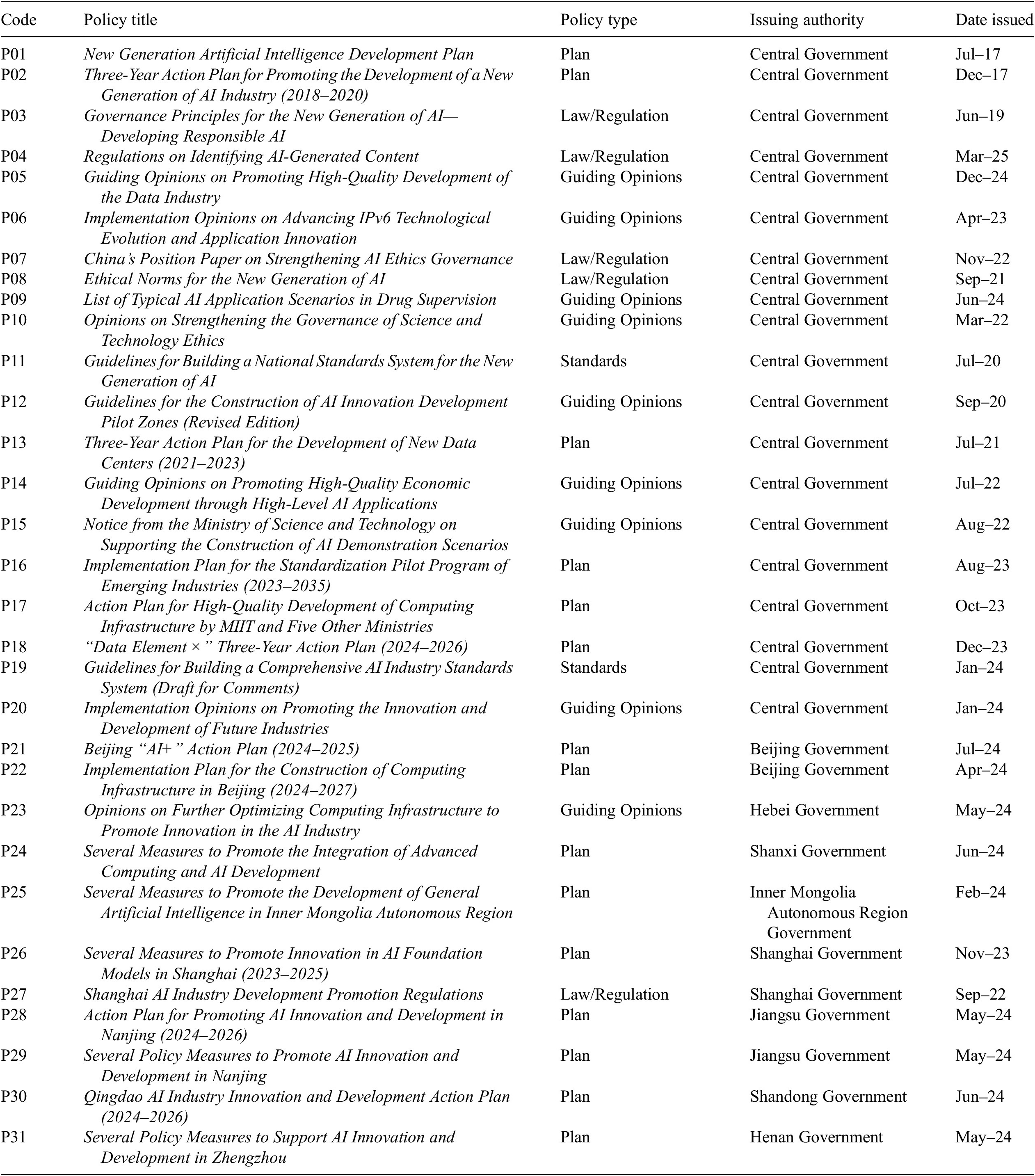
This article defines the sample time frame for artificial intelligence (AI) policies as 2017–2025. China’s earliest policy involving AI appeared in 2017. Specifically, in July 2017, the State Council of China issued the New Generation Artificial Intelligence Development Plan, which set out the guiding principles and strategic objectives for the development of China’s next-generation artificial intelligence by 2030. This article defines the sample time frame for artificial intelligence (AI) policies as 2017–2025. This study selected 20 central-level policies (P01–P20) and 11 local-level policies (P21–P31). In selecting local policies, this study aims to ensure both regional diversity and policy representativeness. Specifically, we included eastern coastal innovation regions (such as Shanghai, Nanjing, and Qingdao), central provinces (such as Beijing, Shanxi, and Henan), and inland regions (such as Inner Mongolia and Hebei), thereby covering areas with different levels of development and industrial foundations. At the same time, the relevance of the policies to artificial intelligence was taken into account. This combination not only reflects the implementation of national strategies at the local level but also provides a representative cross-sectional view for analyzing regional variations and the overall landscape of China’s AI policies. We conducted a systematic search of the Chinese central government website (中国政府网), as well as provincial and municipal government portals(地方政府网). Retrieval strings included “artificial intelligence” (人工智能), “generative artificial intelligence” (生成式人工智能), and “AI governance” (人工智能治理). The search was last updated on 18 June 2025. In terms of inclusion and exclusion criteria, we selected official government-issued documents explicitly related to artificial intelligence, while excluding purely academic or enterprise guidelines. All identified policy documents were downloaded, screened, and compiled, resulting in a final analytical corpus of 31 policy documents (see Table 1).
31 AI policy samples
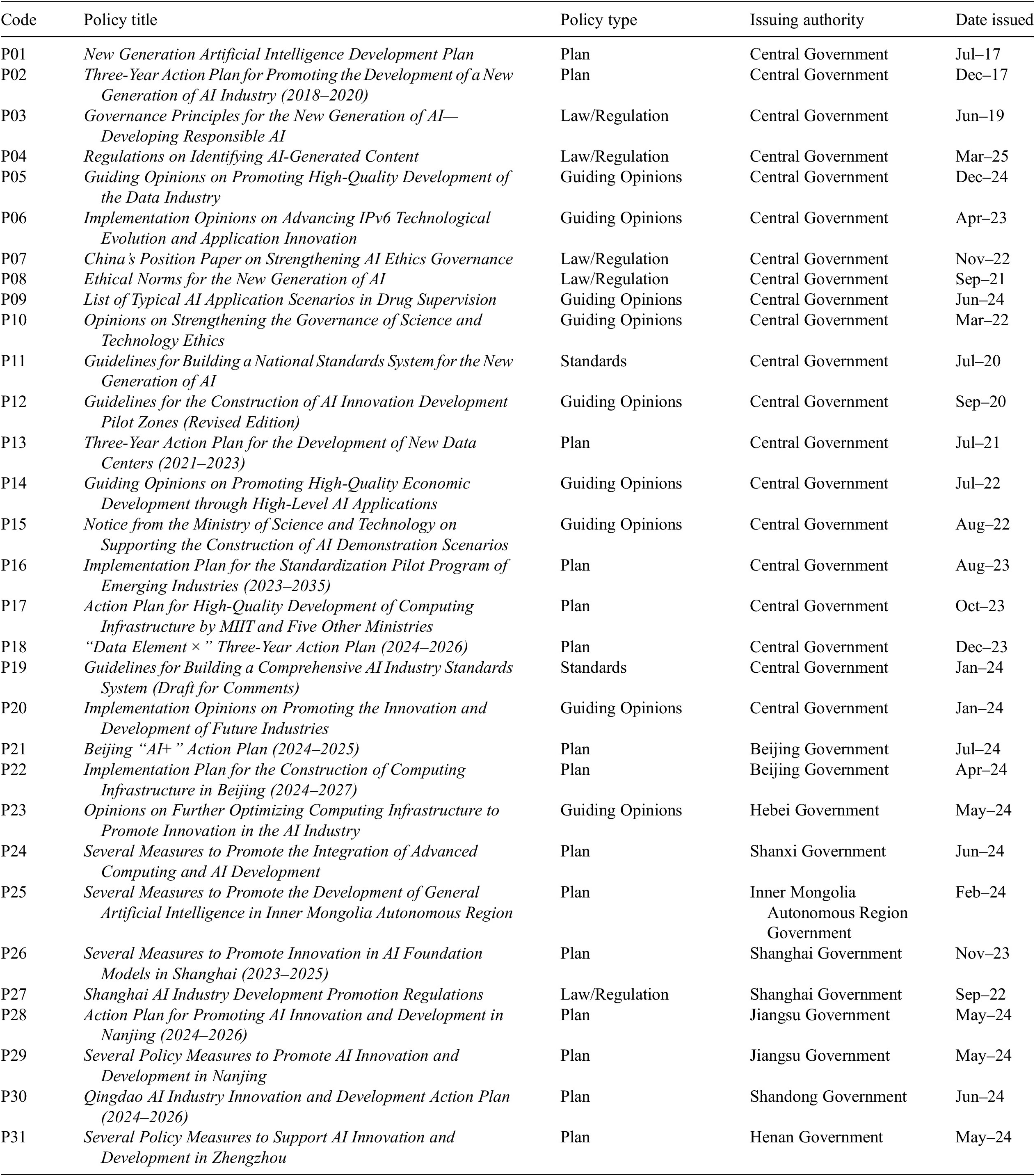
Table 1. Long description
The table contains 31 rows, each representing an AI policy sample. Columns from left to right are: Code, Policy title, Policy type, Issuing authority, and Date issued. Codes range from P01 to P31. Policy titles include examples such as New Generation Artificial Intelligence Development Plan, Three-Year Action Plan for Promoting the Development of a New Generation of AI Industry (2018–2020), Governance Principles for the New Generation of AI—Developing Responsible AI, and Regulations on Identifying AI-Generated Content. Policy types include Plan, Law/Regulation, Guiding Opinions, and Standards. Issuing authorities are primarily Central Government, with some policies from Beijing, Hebei, Shanxi, Inner Mongolia Autonomous Region, Shanghai, Jiangsu, Shandong, and Henan governments. Dates issued span from July 2017 to July 2024, with formats such as Jul–17, Dec–17, Jun–19, and Mar–25. Each row details a unique combination of these attributes, providing a comprehensive overview of AI policy documents across different regions and years.
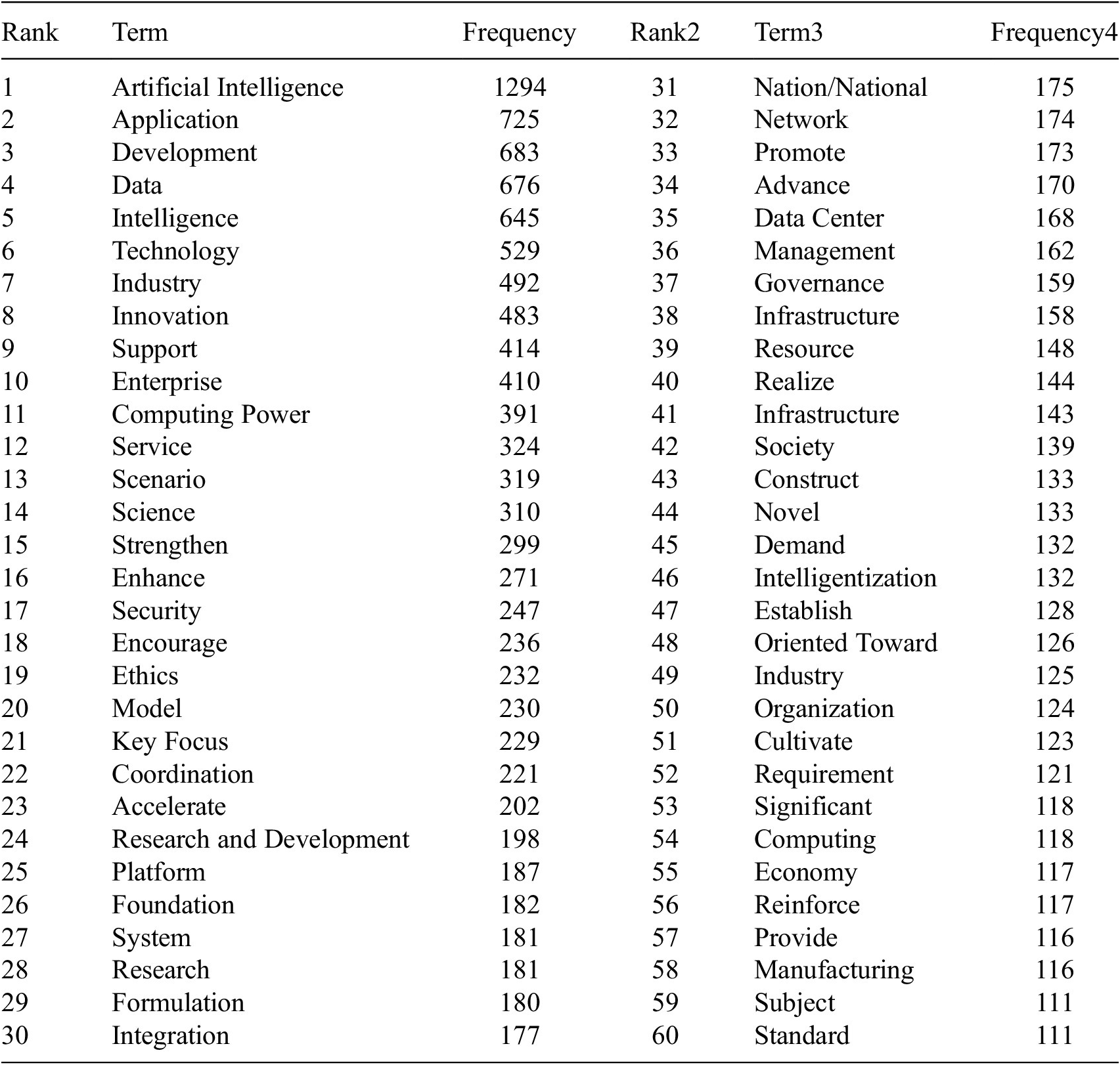
Following the variable settings proposed by Estrada, we selected 10 primary variables: (X1) Policy Nature, (X2) Policy Timeframe, (X3) Policy Domain, (X4) Policy Objectives, (X5) Policy Instruments, (X6) Level of Application, (X7) Incentive Measures, (X8) Sustainable Development, (X9) Policy Functions, and (X10) Citation Recourse. Moreover, to ensure the maximal completeness and accuracy of statistical analysis, word segmentation was performed on 31 AI policies from 2017 to 2025 using the “Jieba” library in Python, resulting in a list of the top 90 high-frequency terms (see Table 2).
High-frequency word statistics
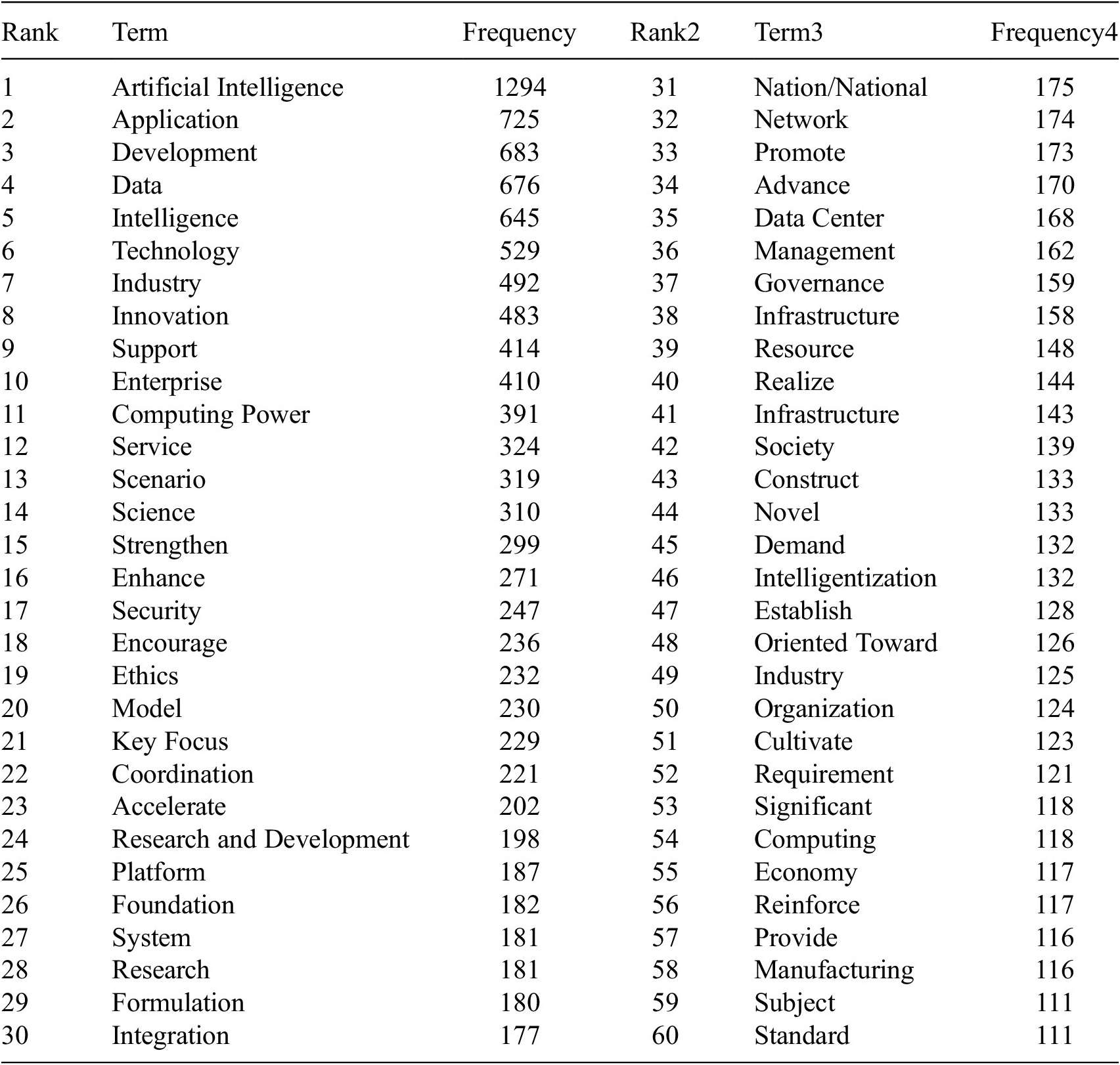
Table 2. Long description
Beginning at the top row, the table displays two columns of ranked terms and their frequencies. The left columns show ranks 1 to 30, with terms such as ‘Artificial Intelligence’ at 1294, ‘Application’ at 725, ‘Development’ at 683, ‘Data’ at 676, and ‘Intelligence’ at 645. The right columns show ranks 31 to 60, pairing each with a term and its frequency, such as ‘Nation/National’ at 175, ‘Network’ at 174, ‘Promote’ at 173, ‘Advance’ at 170, and ‘Data Center’ at 168. Each row pairs a left and right term with their respective counts, continuing down to ‘Standard’ at 111. The structure is strictly vertical, with no graphical elements or color coding.
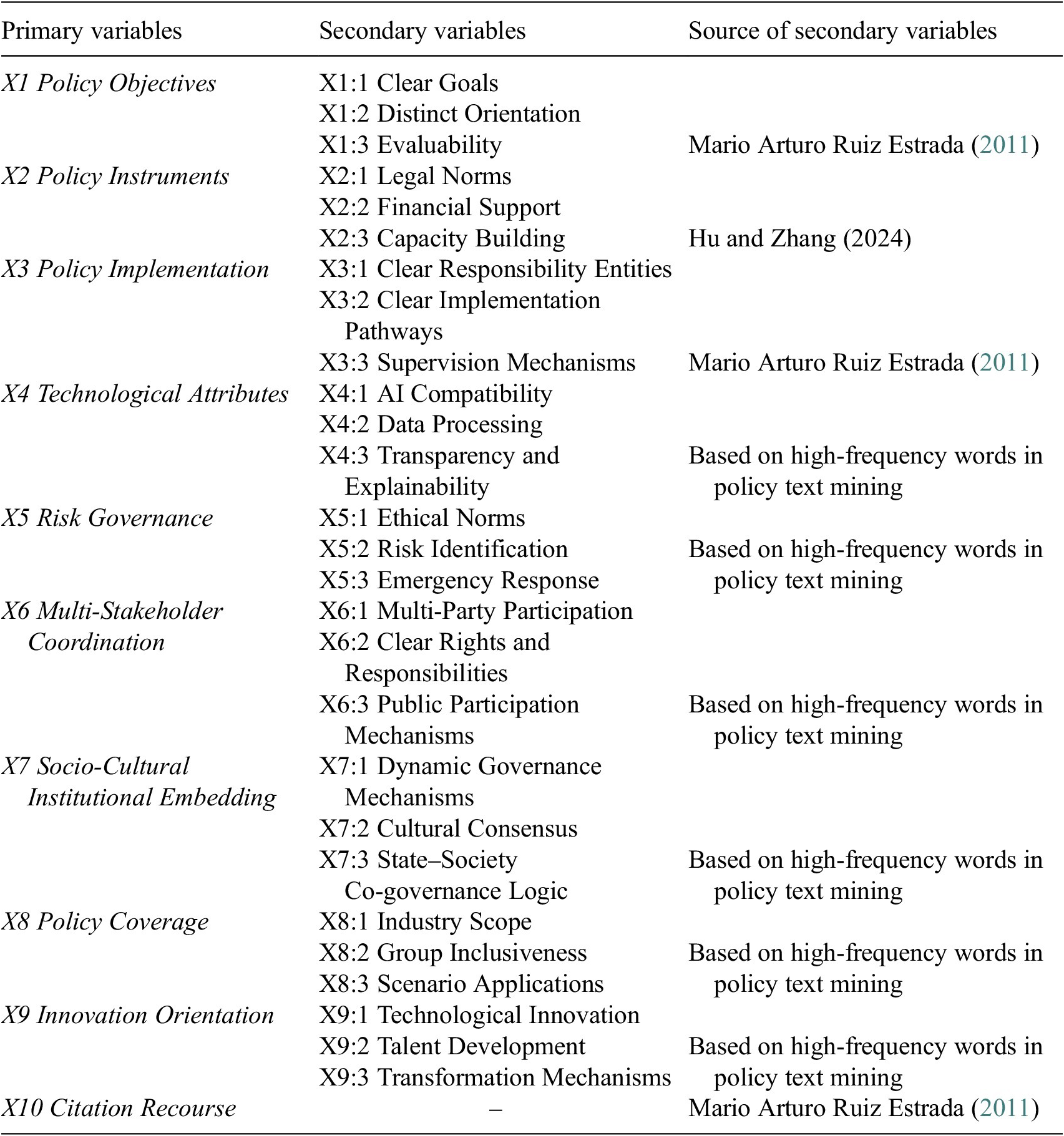
Based on high-frequency word statistics, secondary variables under X4–X9 were established. The secondary variables for X1–X3 and X10 are based on Estrada’s original model index and relevant PMC studies. Finally, this article formed a PMC index model for evaluating China’s AI policies from 2017 to 2025, comprising 10 primary variables and 35 secondary variables (see Table 3).
PMC index framework for AI policy evaluation
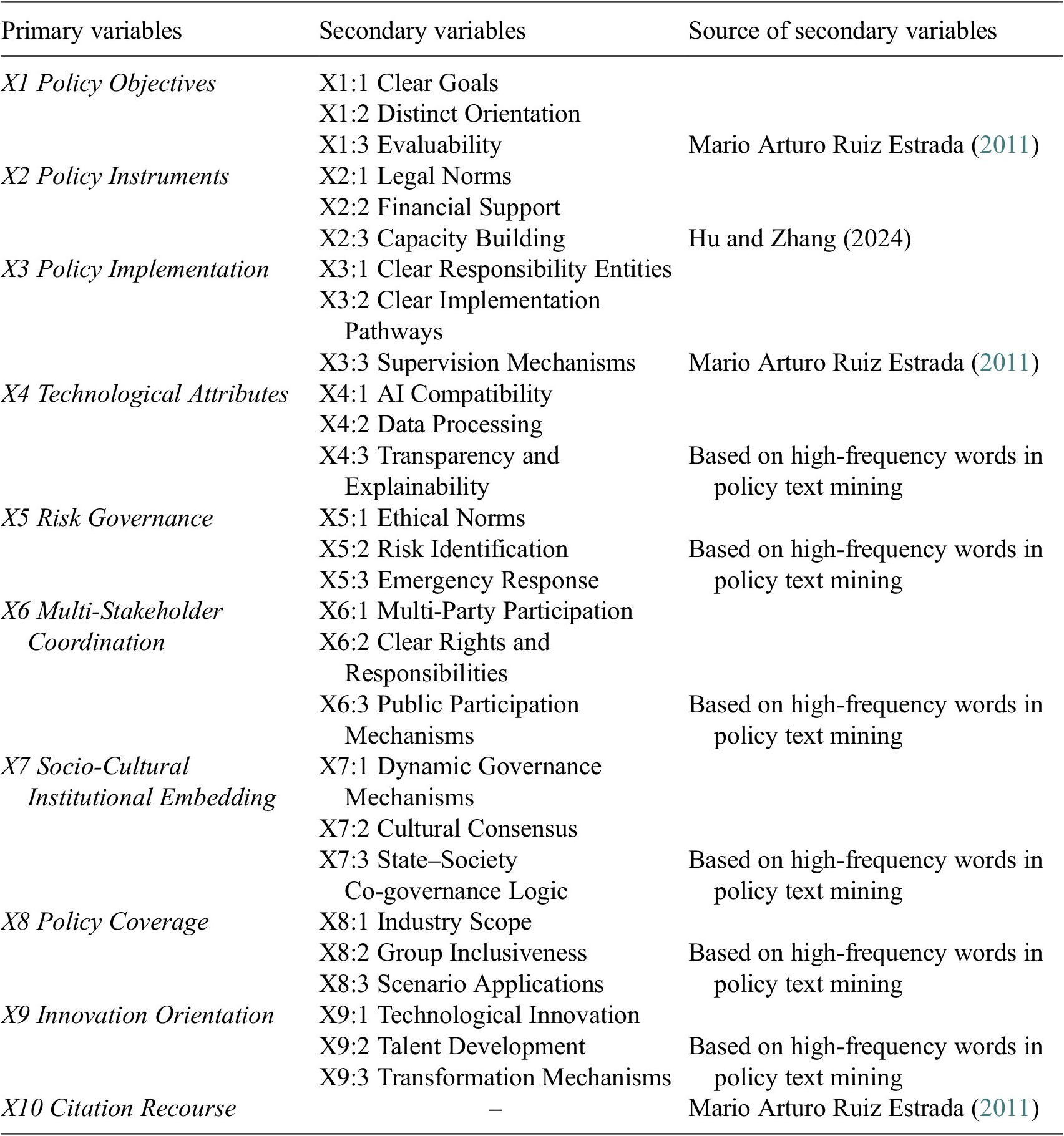
Table 3. Long description
Starting from the top row, the leftmost column lists primary variables labeled X1 through X10. For each primary variable, the middle column details three secondary variables, except X10 which has none. The rightmost column provides the source for each set. X1 Policy Objectives includes X1:1 Clear Goals, X1:2 Distinct Orientation, X1:3 Evaluability, sourced from Mario Arturo Ruiz Estrada Reference Estrada2011. X2 Policy Instruments includes X2:1 Legal Norms, X2:2 Financial Support, X2:3 Capacity Building, sourced from Hu and Zhang 2024. X3 Policy Implementation includes X3:1 Clear Responsibility Entities, X3:2 Clear Implementation Pathways, X3:3 Supervision Mechanisms, sourced from Mario Arturo Ruiz Estrada Reference Estrada2011. X4 Technological Attributes includes X4:1 AI Compatibility, X4:2 Data Processing, X4:3 Transparency and Explainability, based on high-frequency words in policy text mining. X5 Risk Governance includes X5:1 Ethical Norms, X5:2 Risk Identification, X5:3 Emergency Response, also based on high-frequency words in policy text mining. X6 Multi-Stakeholder Coordination includes X6:1 Multi-Party Participation, X6:2 Clear Rights and Responsibilities, X6:3 Public Participation Mechanisms, based on high-frequency words in policy text mining. X7 Socio-Cultural Institutional Embedding includes X7:1 Dynamic Governance Mechanisms, X7:2 Cultural Consensus, X7:3 State–Society Co-governance Logic, based on high-frequency words in policy text mining. X8 Policy Coverage includes X8:1 Industry Scope, X8:2 Group Inclusiveness, X8:3 Scenario Applications, based on high-frequency words in policy text mining. X9 Innovation Orientation includes X9:1 Technological Innovation, X9:2 Talent Development, X9:3 Transformation Mechanisms, based on high-frequency words in policy text mining. X10 Citation Recourse has no secondary variables and is sourced from Mario Arturo Ruiz Estrada Reference Estrada2011. The table is organized vertically, with each primary variable grouping its secondary variables and source.
The PMC model employed in this study is constructed around nine primary indicators to evaluate the comprehensiveness and coherence of AI-related policies. X1 (Policy Objectives) assesses the clarity, strategic orientation, and evaluability of policy goals. X2 (Policy Instruments) focuses on the diversity and appropriateness of policy tools, including legal norms, financial support, and capacity-building measures. X3 (Policy Implementation) evaluates the implementation structure, emphasizing responsible agencies, operational pathways, and mechanisms of supervision and accountability. X4 (Technological Attributes) measures the extent to which policies are aligned with AI technologies, such as algorithms, data governance, and explainability. X5 (Risk Governance) investigates how the policy anticipates, identifies, and responds to ethical and technical risks. X6 (Multi-Stakeholder Coordination) captures the degree of participation from various societal actors and the clarity of rights and responsibilities. X7 (Socio-Cultural Institutional Embedding) examines how AI policy design incorporates dynamic governance mechanisms, cultural consensus, and state–society coordination. X8 (Policy Coverage) reflects the inclusiveness and applicability of the policy across industries, population groups, and real-world application scenarios. Lastly, X9 (Innovation Orientation) assesses the promotion of technological advancement, talent development, and the transformation of research into practical outcomes. This multidimensional framework enables a structured and culturally contextualized analysis of AI governance in the Chinese policy context. X10 (Citation Recourse) evaluates whether relevant literature is cited within the policy to support its rationale and legitimacy.
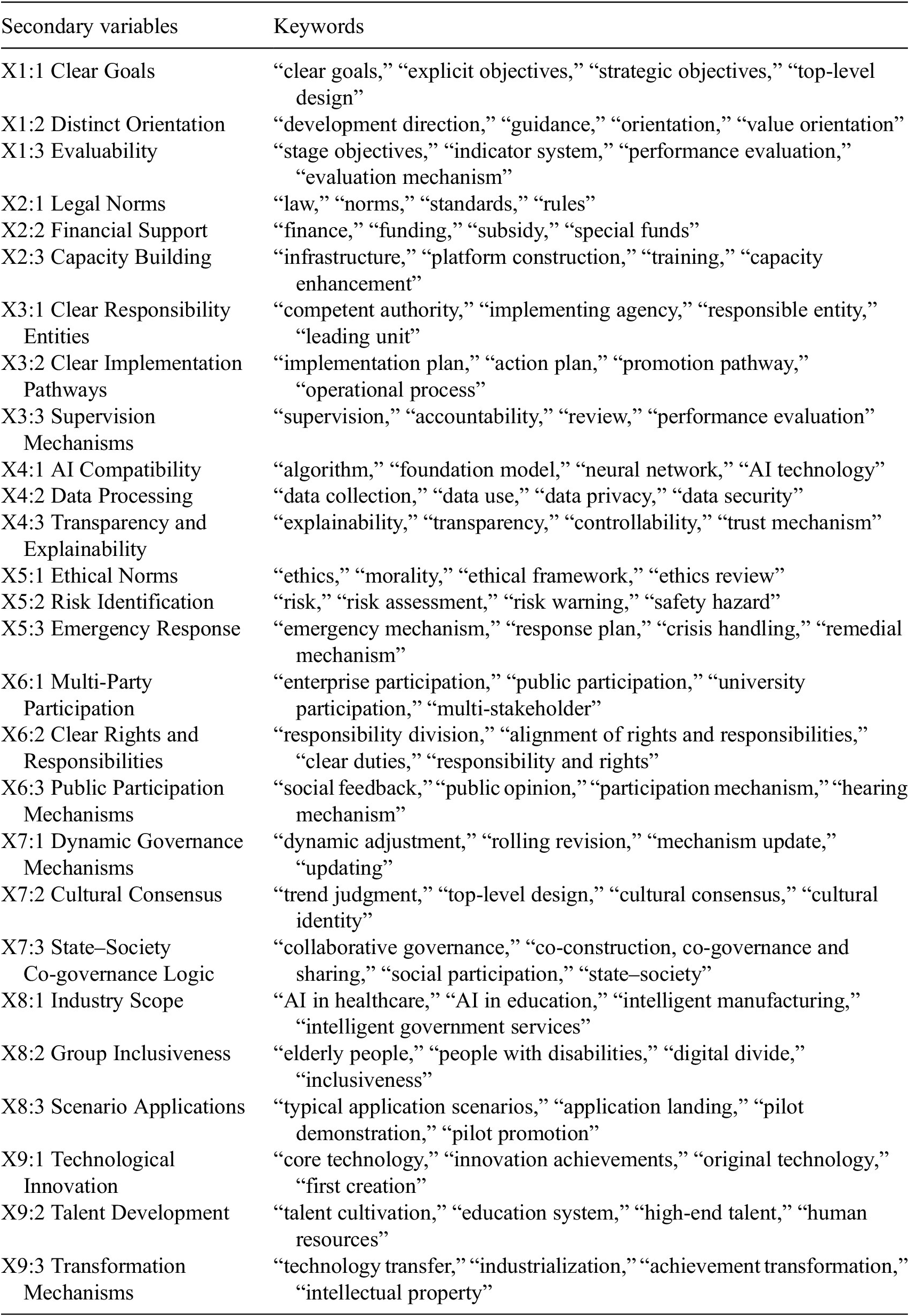
For example, in the case of indicator X3 (Policy Implementation), each secondary indicator was designed with reference to Mario Arturo Ruiz Estrada (Reference Estrada2011), while the scoring keywords were selected after reviewing all 31 policy documents and considering Chinese linguistic semantics. Under X3, the secondary indicator X3:1 “Clear Responsibility Entities” was coded using keywords such as “competent authority” (主管部门), “implementing agency” (执行单位), “responsible entity” (责任主体), and “leading unit” (牵头单位). The secondary indicator X3:2 “Clear Implementation Pathways” corresponded to keywords including “implementation plan” (实施方案), “action plan” (行动计划), “promotion pathway” (推进路径), and “operational process” (操作流程). The secondary indicator X3:3 “Supervision Mechanism” was identified through terms such as “supervision” (监督), “accountability” (问责), “review” (审查), and “performance evaluation” (绩效考核).
In summary, the PMC indicator system constructed in this study aims to systematically evaluate AI policies across nine core dimensions, assessing their structural coherence and institutional fit. This model not only reveals the technological and governance elements within policy texts but also highlights the embedding of socio-cultural institutions in AI governance, providing an effective tool for the scientific evaluation and optimization of AI policies.
3.2. PMC index calculation and grading classification
The data in this study are based on policy content, with values assigned to secondary variables to obtain the relevant data. Python scripts were employed to assign scores for each secondary variable, whereby the scripts read the AI policy documents and identified keywords to determine the values. Both primary and secondary indicators retained the same number of keywords to ensure fairness in the results (see Table 4). In addition, several evaluation indicators specifically tailored to AI policies were summarized and derived from the high-frequency terms identified across the 31 selected AI policy documents. According to the principles of the PMC index system, the scoring rule is: 1 for meeting the standard, and 0 for not meeting it.
Secondary variables and corresponding keywords for PMC index evaluation
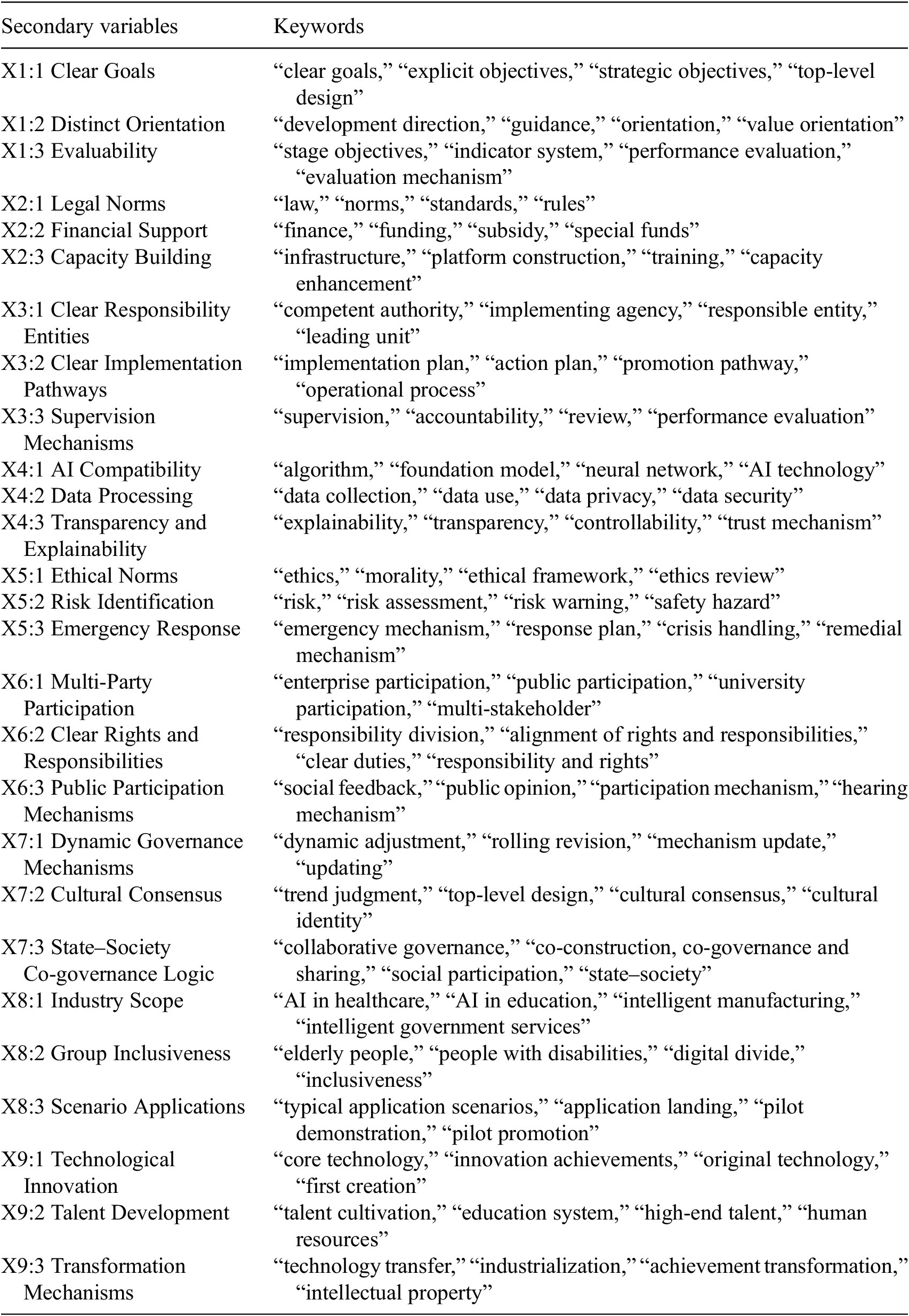
Table 4. Long description
Beginning at the top, the table header displays ‘Secondary variables’ and ‘Keywords’. Each row pairs a variable code and name with four keywords. The first section, X1, covers Clear Goals (‘clear goals’, ‘explicit objectives’, ‘strategic objectives’, ‘top-level design’), Distinct Orientation (‘development direction’, ‘guidance’, ‘orientation’, ‘value orientation’), and Evaluability (‘stage objectives’, ‘indicator system’, ‘performance evaluation’, ‘evaluation mechanism’). X2 includes Legal Norms (‘law’, ‘norms’, ‘standards’, ‘rules’), Financial Support (‘finance’, ‘funding’, ‘subsidy’, ‘special funds’), and Capacity Building (‘infrastructure’, ‘platform construction’, ‘training’, ‘capacity enhancement’). X3 details Clear Responsibility Entities (‘competent authority’, ‘implementing agency’, ‘responsible entity’, ‘leading unit’), Clear Implementation Pathways (‘implementation plan’, ‘action plan’, ‘promotion pathway’, ‘operational process’), and Supervision Mechanisms (‘supervision’, ‘accountability’, ‘review’, ‘performance evaluation’). X4 addresses AI Compatibility (‘algorithm’, ‘foundation model’, ‘neural network’, ‘AI technology’), Data Processing (‘data collection’, ‘data use’, ‘data privacy’, ‘data security’), and Transparency and Explainability (‘explainability’, ‘transparency’, ‘controllability’, ‘trust mechanism’). X5 covers Ethical Norms (‘ethics’, ‘morality’, ‘ethical framework’, ‘ethics review’), Risk Identification (‘risk’, ‘risk assessment’, ‘risk warning’, ‘safety hazard’), and Emergency Response (‘emergency mechanism’, ‘response plan’, ‘crisis handling’, ‘remedial mechanism’). X6 includes Multi-Party Participation (‘enterprise participation’, ‘public participation’, ‘university participation’, ‘multi-stakeholder’), Clear Rights and Responsibilities (‘responsibility division’, ‘alignment of rights and responsibilities’, ‘clear duties’, ‘responsibility and rights’), and Public Participation Mechanisms (‘social feedback’, ‘public opinion’, ‘participation mechanism’, ‘hearing mechanism’). X7 presents Dynamic Governance Mechanisms (‘dynamic adjustment’, ‘rolling revision’, ‘mechanism update’, ‘updating’), Cultural Consensus (‘trend judgment’, ‘top-level design’, ‘cultural consensus’, ‘cultural identity’), and State–Society Co-governance Logic (‘collaborative governance’, ‘co-construction, co-governance and sharing’, ‘social participation’, ‘state–society’). X8 lists Industry Scope (‘AI in healthcare’, ‘AI in education’, ‘intelligent manufacturing’, ‘intelligent government services’), Group Inclusiveness (‘elderly people’, ‘people with disabilities’, ‘digital divide’, ‘inclusiveness’), and Scenario Applications (‘typical application scenarios’, ‘application landing’, ‘pilot demonstration’, ‘pilot promotion’). X9 concludes with Technological Innovation (‘core technology’, ‘innovation achievements’, ‘original technology’, ‘first creation’), Talent Development (‘talent cultivation’, ‘education system’, ‘high-end talent’, ‘human resources’), and Transformation Mechanisms (‘technology transfer’, ‘industrialization’, ‘achievement transformation’, ‘intellectual property’).
Following the method proposed by Ruiz Estrada, the calculation model consists of four steps: First, secondary variables are treated as multiple input and output indicators and assigned values through empirical analysis; second, all secondary variables are constrained within the [0,1] interval, with the assignment methods detailed in formulas (1) and (2); third, as shown in formula (3), each primary variable is calculated as the average value of its corresponding secondary variables; finally, formula (4) is applied to compute the PMC index for each indicator.


Based on Formulas (1)–(4) outlined above, this study calculated the PMC index scores for the cultural industry policies. These scores were subsequently used to categorize all evaluated policies into graded tiers. Given that the evaluation framework includes 10 first-level variables, the PMC index ranges from 0 to 10. The classification criteria adhere to Estrada’s established grading standards for cultural policy PMC index scores (see Table 5).
Classification of PMC index levels for AI policies

Table 5. Long description
The table has three columns for PMC index score ranges: 7 to 10, 4 to 6.99, and 0 to 3.99. The first row under each column lists the policy grade: Excellent for 7 to 10, Acceptable for 4 to 6.99, and Poor for 0 to 3.99. The second row lists the grade code: A for Excellent, B for Acceptable, and C for Poor. The leftmost column labels the rows as Policy grade and Grade code.
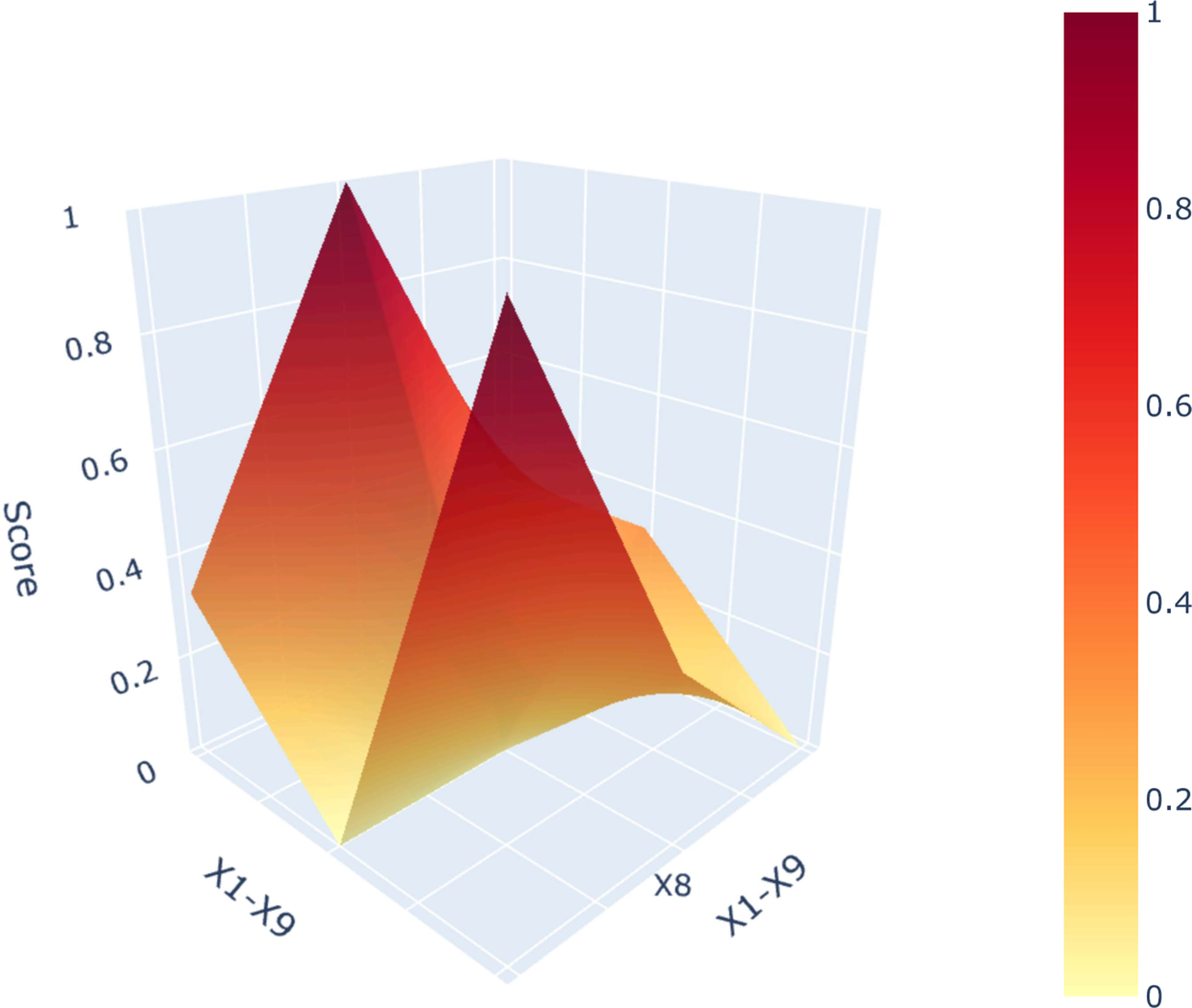
To scientifically and comprehensively evaluate AI policies, this study employs the PMC surface construction method based on the aforementioned evaluation criteria and index scores for comparative analysis. The PMC surface visualizes all results contained in the PMC matrix, intuitively displaying the strengths and weaknesses of the evaluated policies within a multidimensional coordinate space, thereby more vividly reflecting overall policy performance. The PMC surface is constructed from a 3 × 3 variable PMC matrix, encompassing independent scores for nine key variables. According to the AI policy grading system, the closer the PMC surface approaches the upper limit value of 1, the higher the PMC index score of the policy. When the scores of the 3 × 3 variable matrix are balanced and approach 1, the PMC surface exhibits an ideal full-score shape, indicating the best possible policy evaluation performance.
This article defines a total of 10 first-level variables, among which variable X10 represents the policy document reference value. Since none of the sampled policies mention reference documents, this variable scores 0 across all policies and lacks differentiation. Therefore, variable X10 is excluded, and the PMC matrix is constructed using the scores of the remaining nine first-level variables, as shown in Formula (5). This approach effectively eliminates the interference of the policy document reference value on the overall score, allowing for a more accurate reflection of the intrinsic quality and structural characteristics of the policies.

4. Results
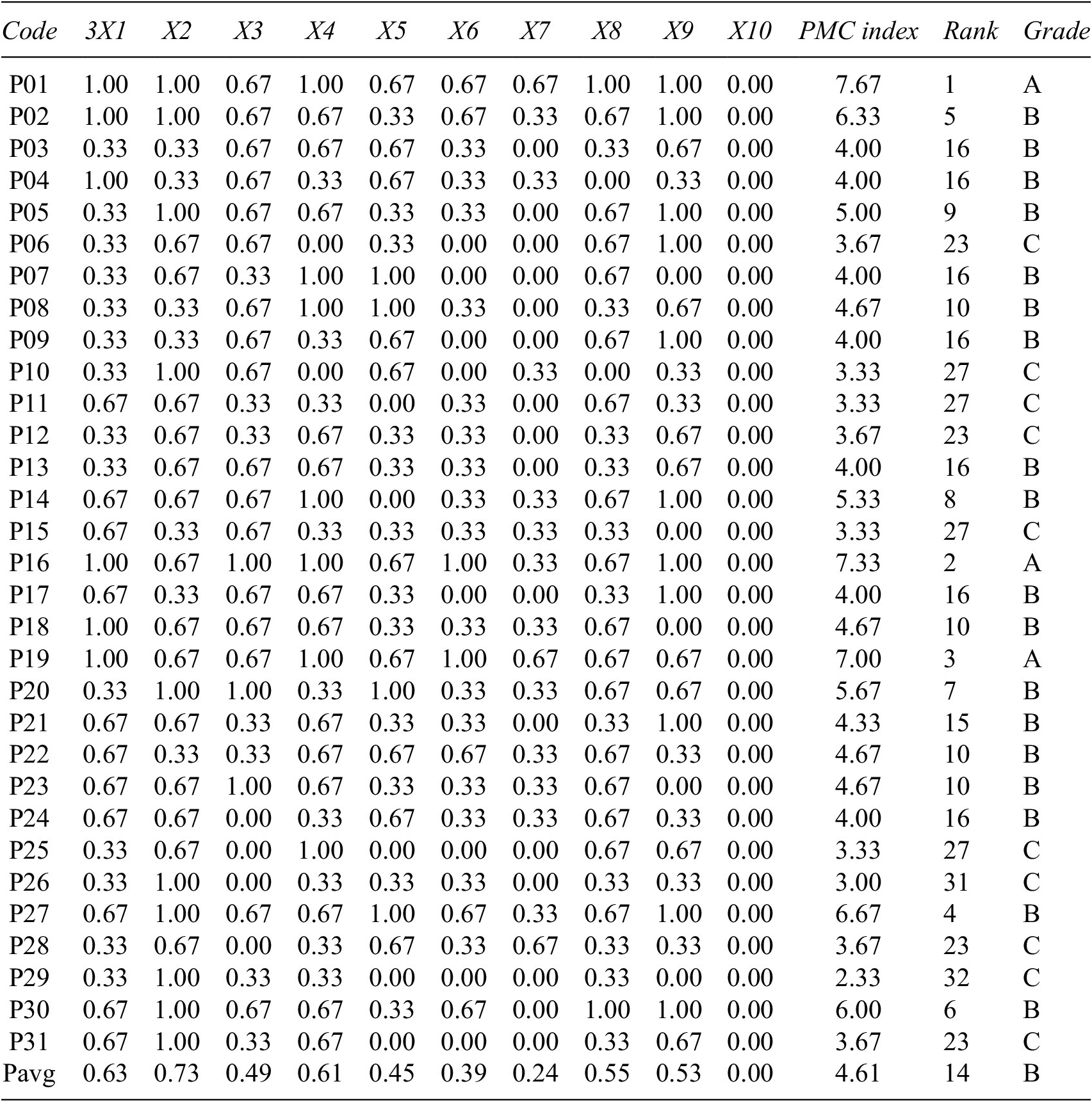
Based on Formulas (1), (2), (3), and (4), this study calculated the PMC index scores for AI policies. Additionally, the average PMC score (Pavg) was computed across 31 policies. According to the grading criteria in Table 6, the policies enacted between 2017 and 2025 were classified into their respective grades. The policies were classified into four categories according to their different legal force (Law/Regulation, Guiding Opinions, Standards, and Plan).
PMC index and grades of AI policies
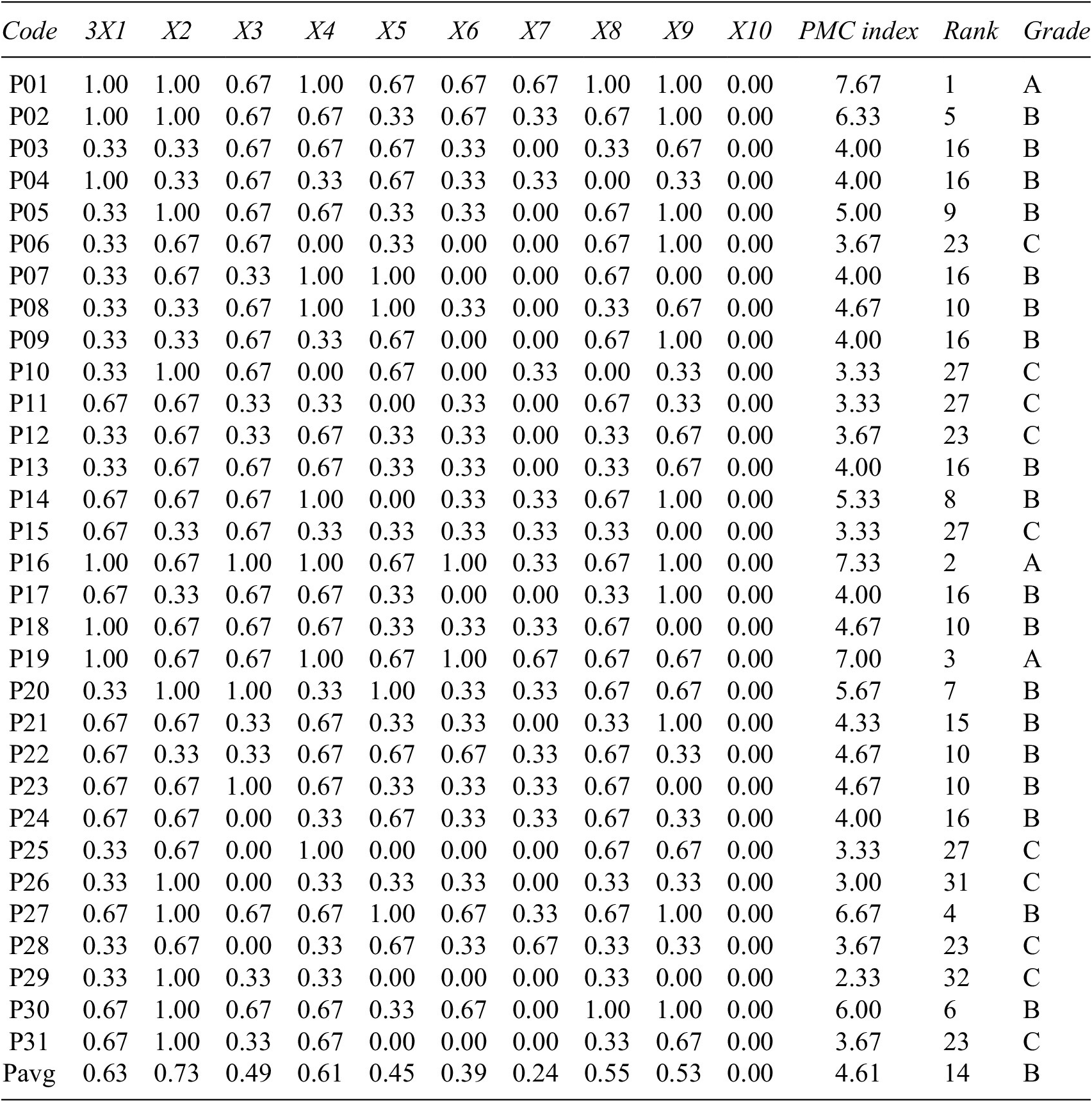
Table 6. Long description
The table header lists columns: Code, 3 X 1, X 2, X 3, X 4, X 5, X 6, X 7, X 8, X 9, X 10, PMC index, Rank, Grade. Each row represents a policy code from P 01 to P 31, plus P avg. For P 01, values are 1.00 for 3 X 1, X 2, X 4, X 8, X 9; 0.67 for X 3, X 5, X 6, X 7; 0.00 for X 10; PMC index 7.67, rank 1, grade A. P 16 and P 19 also have high PMC indices, 7.33 and 7.00, grades A, ranks 2 and 3. Most codes have PMC indices between 2.33 and 6.67, with grades B or C. P avg row shows average values: 0.63 for 3 X 1, 0.73 for X 2, 0.49 for X 3, 0.61 for X 4, 0.45 for X 5, 0.39 for X 6, 0.24 for X 7, 0.55 for X 8, 0.53 for X 9, 0.00 for X 10, PMC index 4.61, rank 14, grade B. The table highlights variation in policy scores, with only three codes graded A, and most policies clustered in B or C grades.
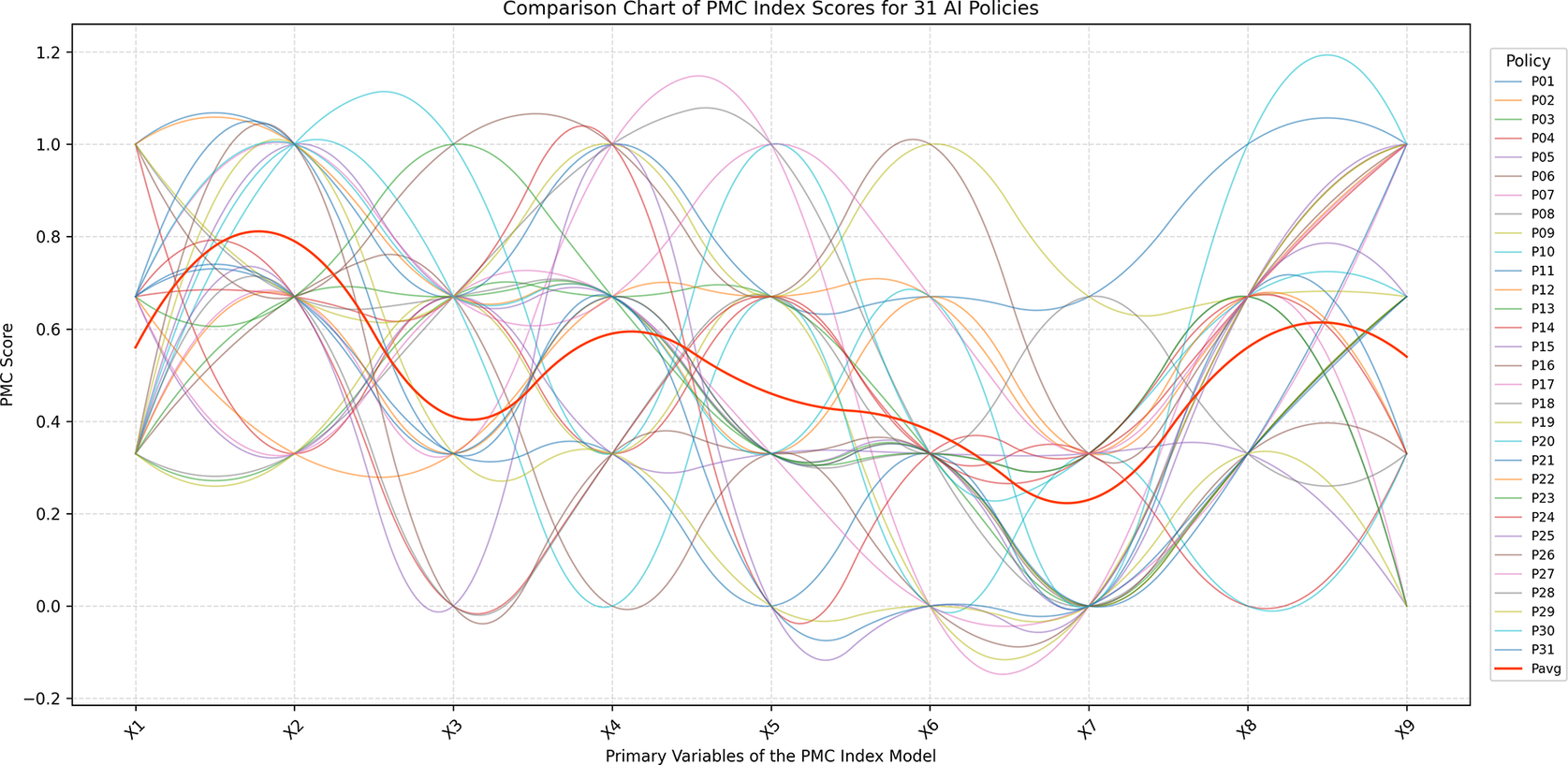
This study compares the scoring trends of all 31 selected AI policies across the nine first-level variables (X1–X9) of the PMC index model (see Figure 1). The horizontal axis represents the first-level variables of the PMC model, while the vertical axis shows the corresponding scores, ranging from 0 to 1, indicating the policy’s score on each dimension. Each curve represents the score variation of a specific policy, and the curves are smoothed to facilitate observation of the overall distribution and trends.
Comparison chart of PMC index scores for 31 AI policies.

Figure 1. Long description
The chart uses a Cartesian grid with the x-axis labeled Primary Variables of the P M C Index Model, marked X1 through X9 from left to right. The y-axis is labeled P M C Score, ranging from 0.0 to 1.2. Thirty-one colored lines, each corresponding to a policy (P01 to P31), are plotted. Each line fluctuates across the nine variables, showing unique patterns of peaks and troughs. The legend at the top right lists all policies and highlights Pavg, the average, in bold red. The red line (Pavg) undulates smoothly, peaking near X2 and X9, dipping near X4 and X6. Other policy lines cross and overlap, showing high variability, with some policies peaking where others dip. The gridlines aid in comparing the relative heights of each policy at each variable. No two policies follow the exact same trajectory, emphasizing diversity in P M C index scores across the variables.
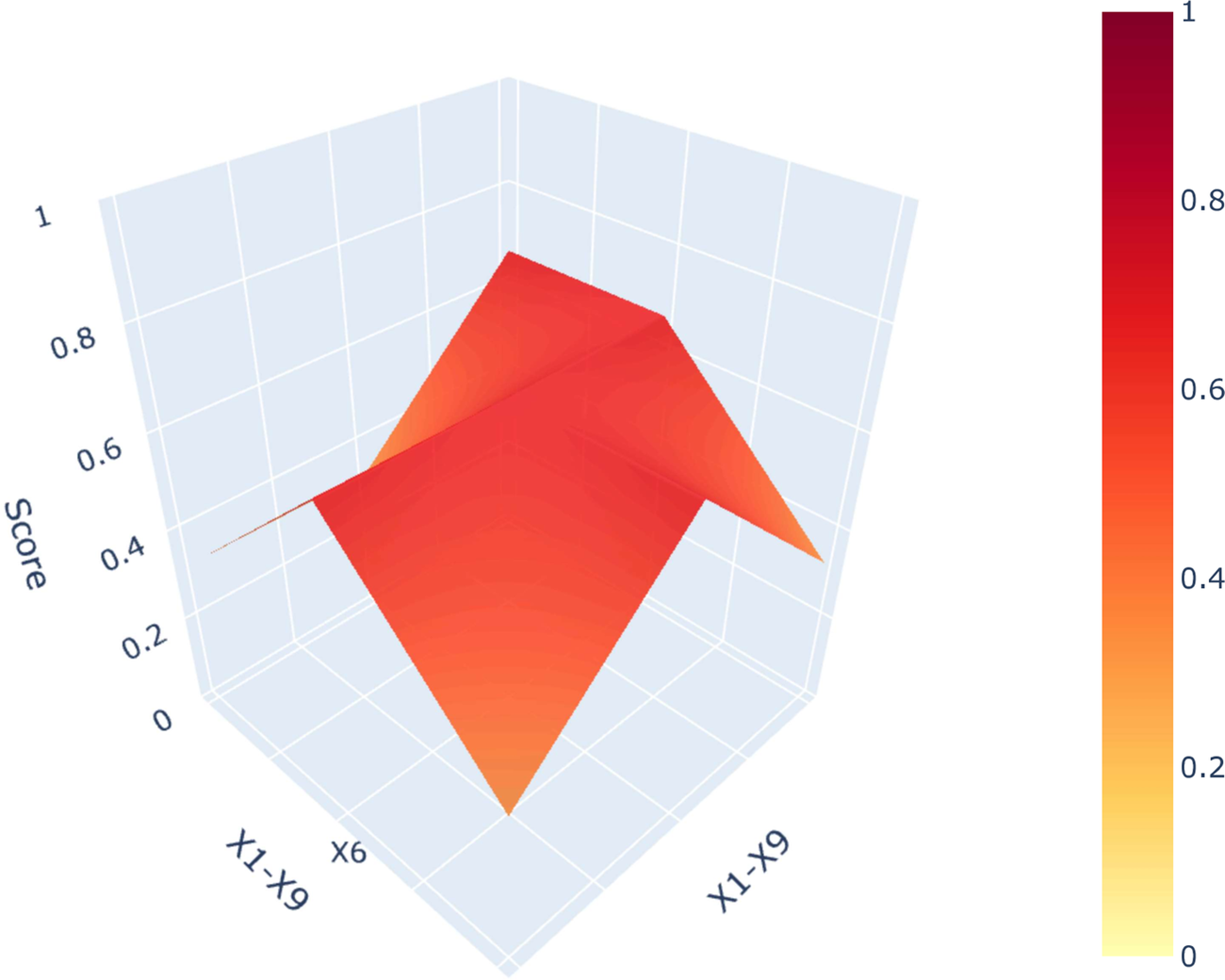
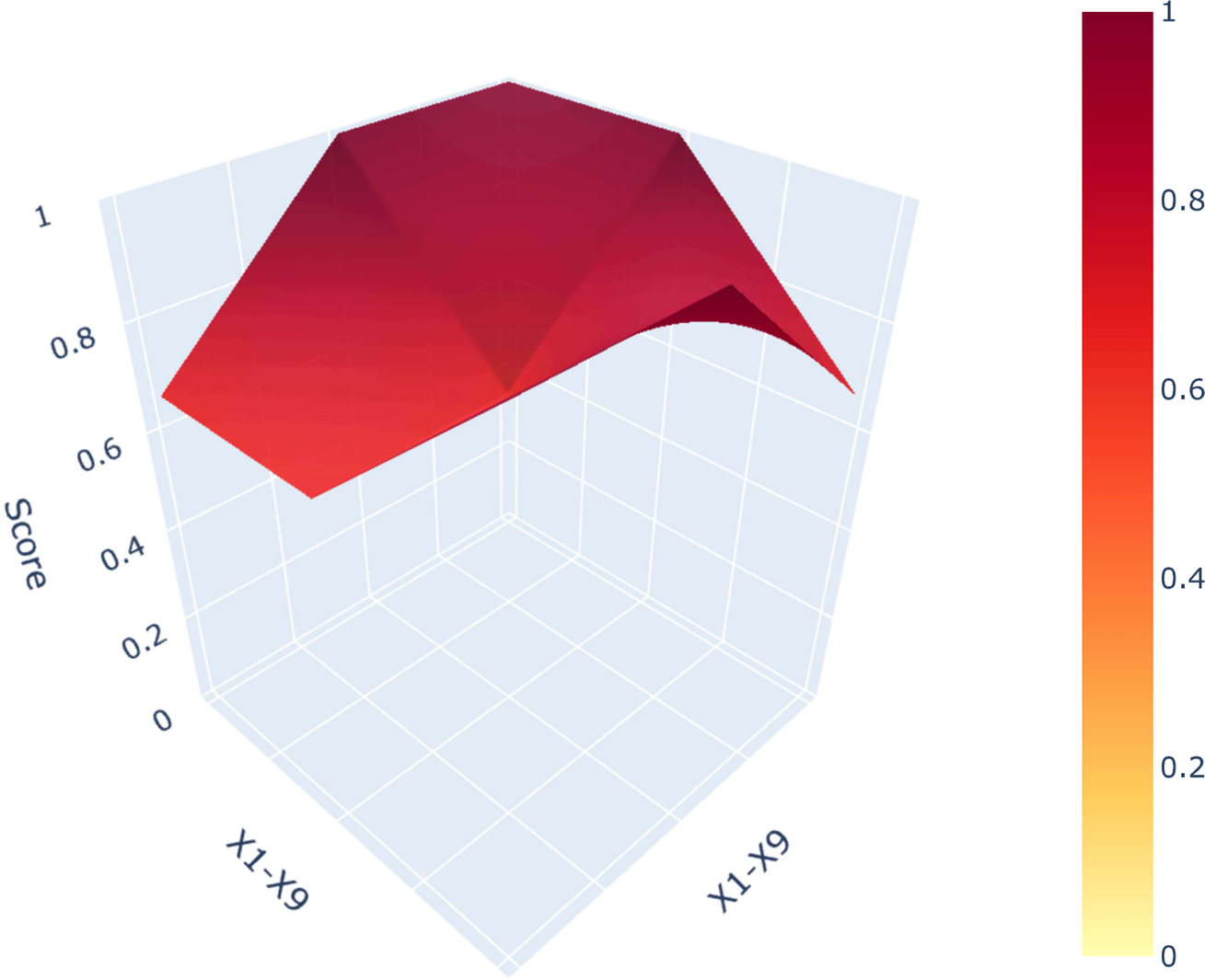
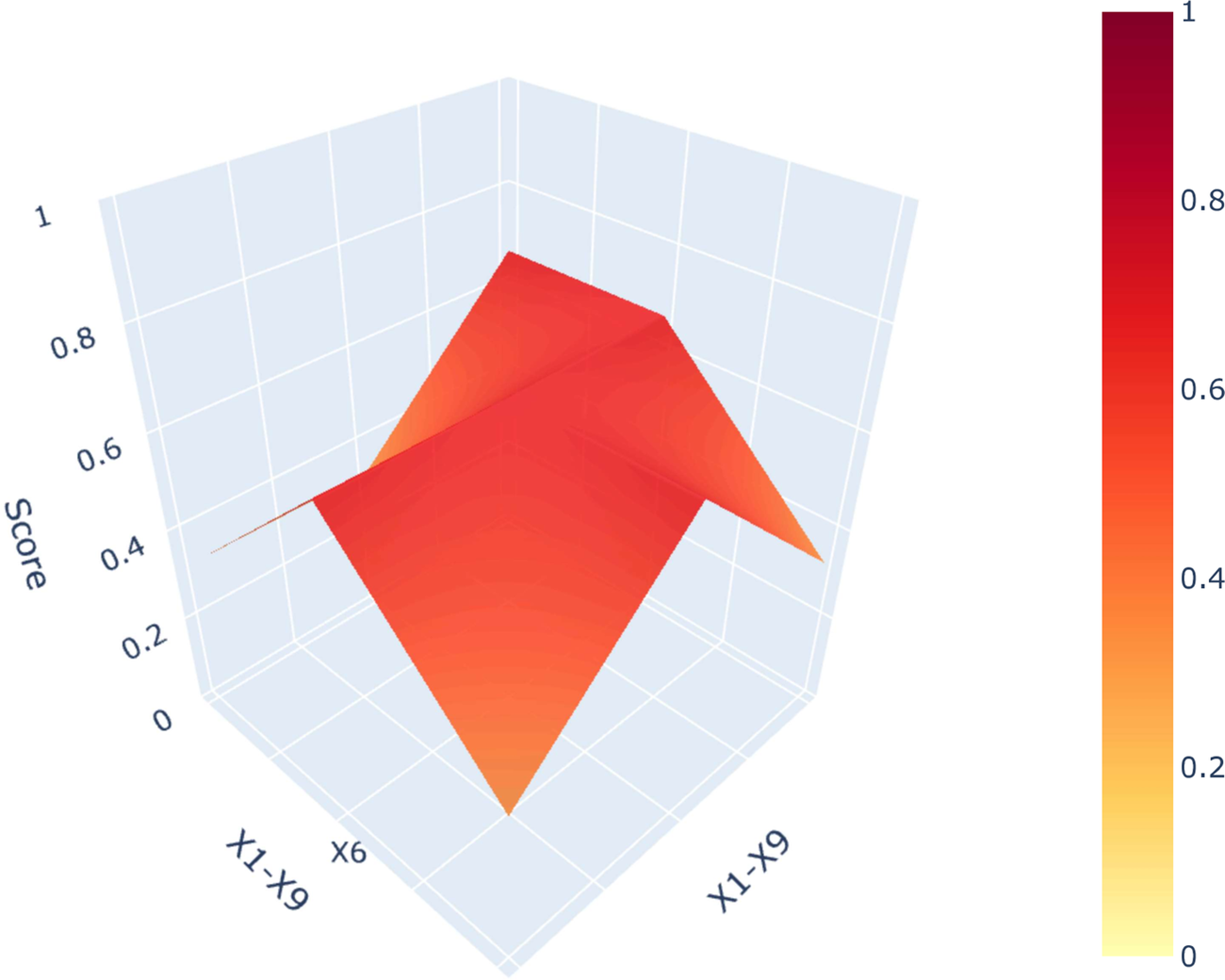
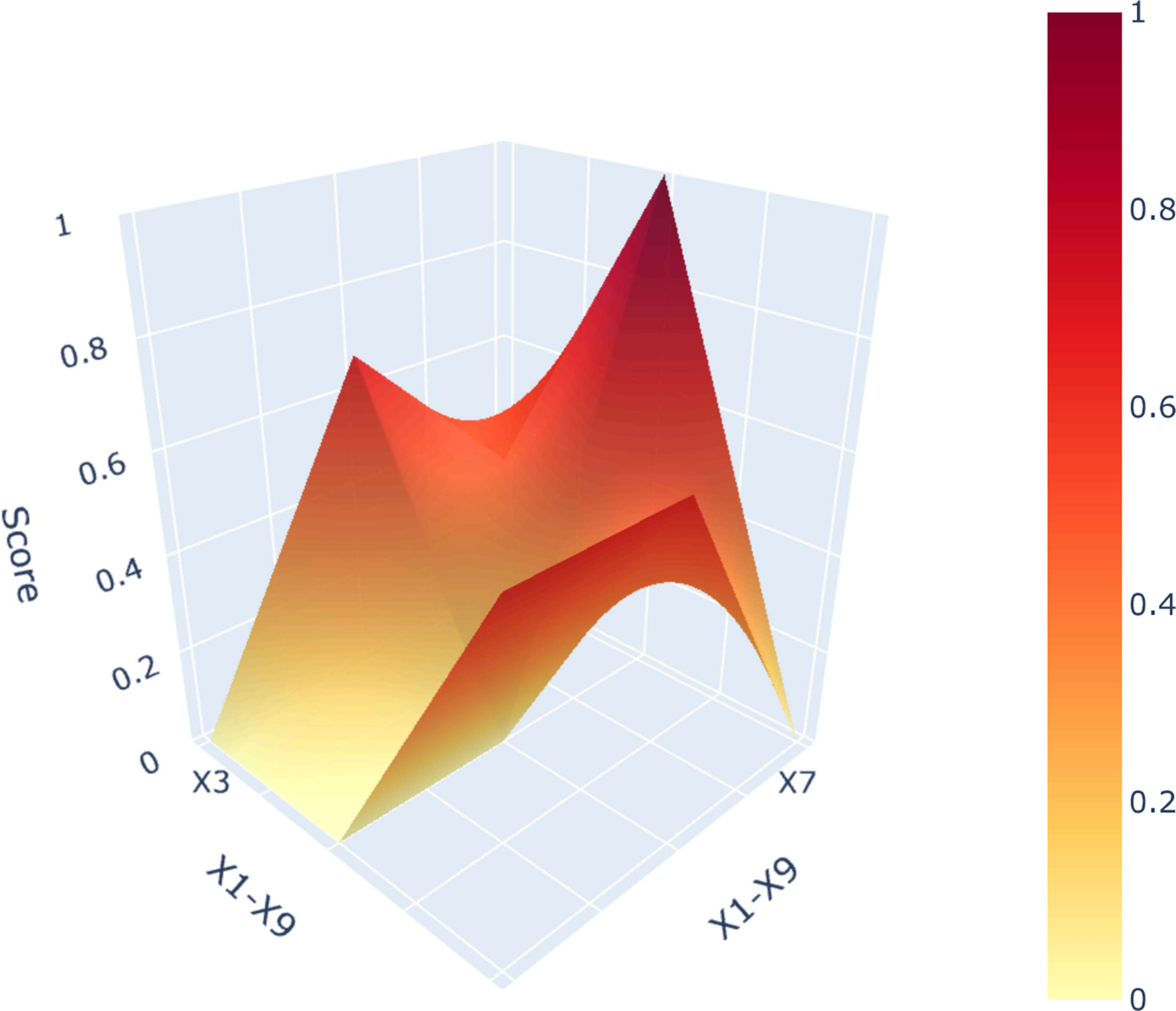
From the 31 policy samples, three representative policies (P01, P22, and P25) were selected, corresponding to grades A, B, and C, respectively. Among them, P01 was issued by the central government, while P22 and P25 were issued by local governments. In addition, the average value (Pavg) of all 31 policy samples was included for PMC surface plot analysis. A total of four PMC surface plots (Figure 2–5) were generated to comparatively examine the performance of different policies across various variable dimensions.
PMC surface plot of P01.
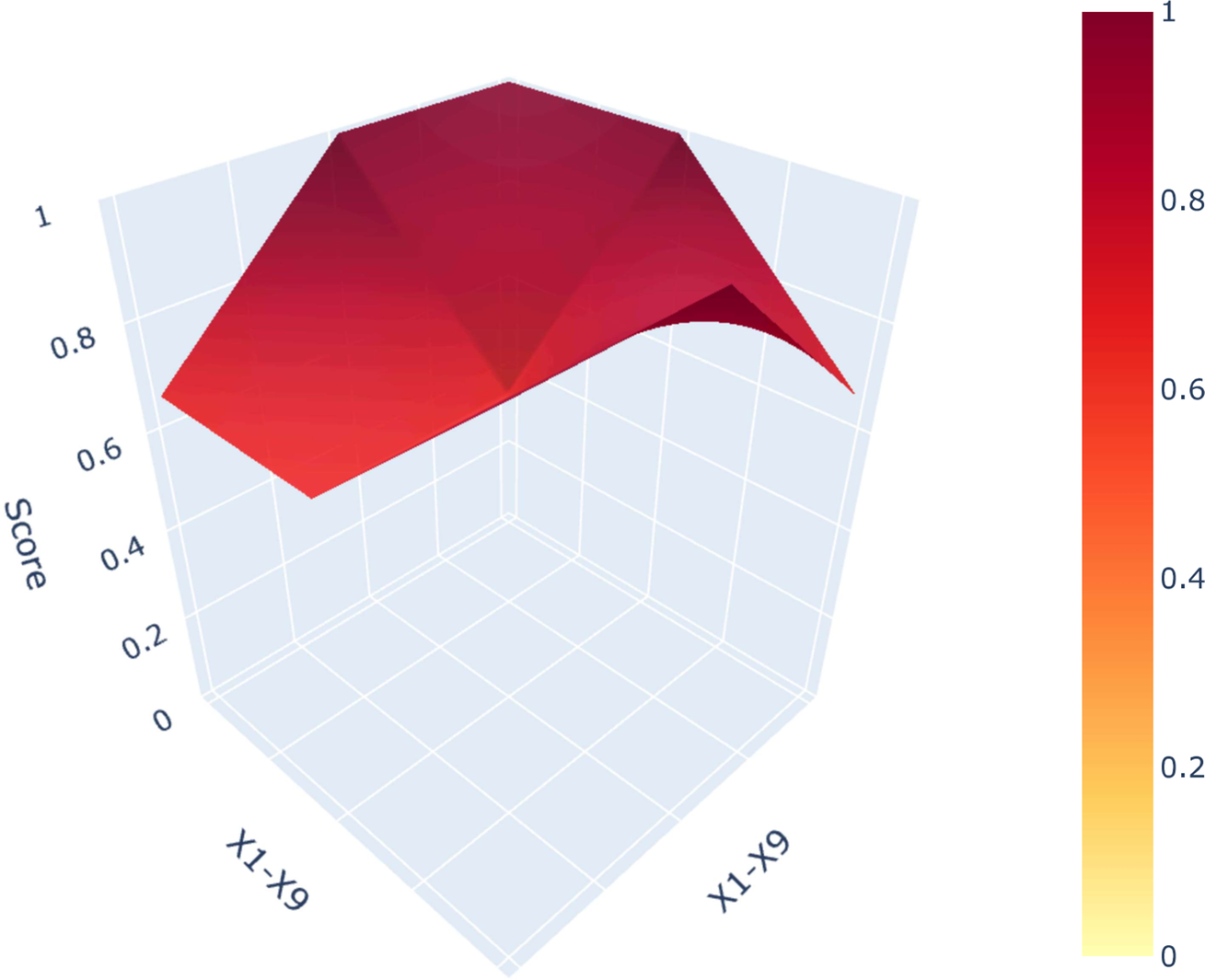
Figure 2. Long description
The plot presents a three-dimensional surface where the base is defined by two axes, both labeled X 1 minus X 9, and the vertical axis is labeled Score, ranging from 0 to 1. The surface rises to a central peak where Score approaches 1, with lower values at the corners. The color gradient overlays the surface, transitioning from yellow at the lowest Score values to dark red at the highest. To the right, a vertical color bar shows the mapping of color to Score, with yellow at 0 and dark red at 1. The grid lines on all axes provide reference points for interpreting the surface’s shape and height.
PMC surface plot of P22.
PMC surface plot of P25.
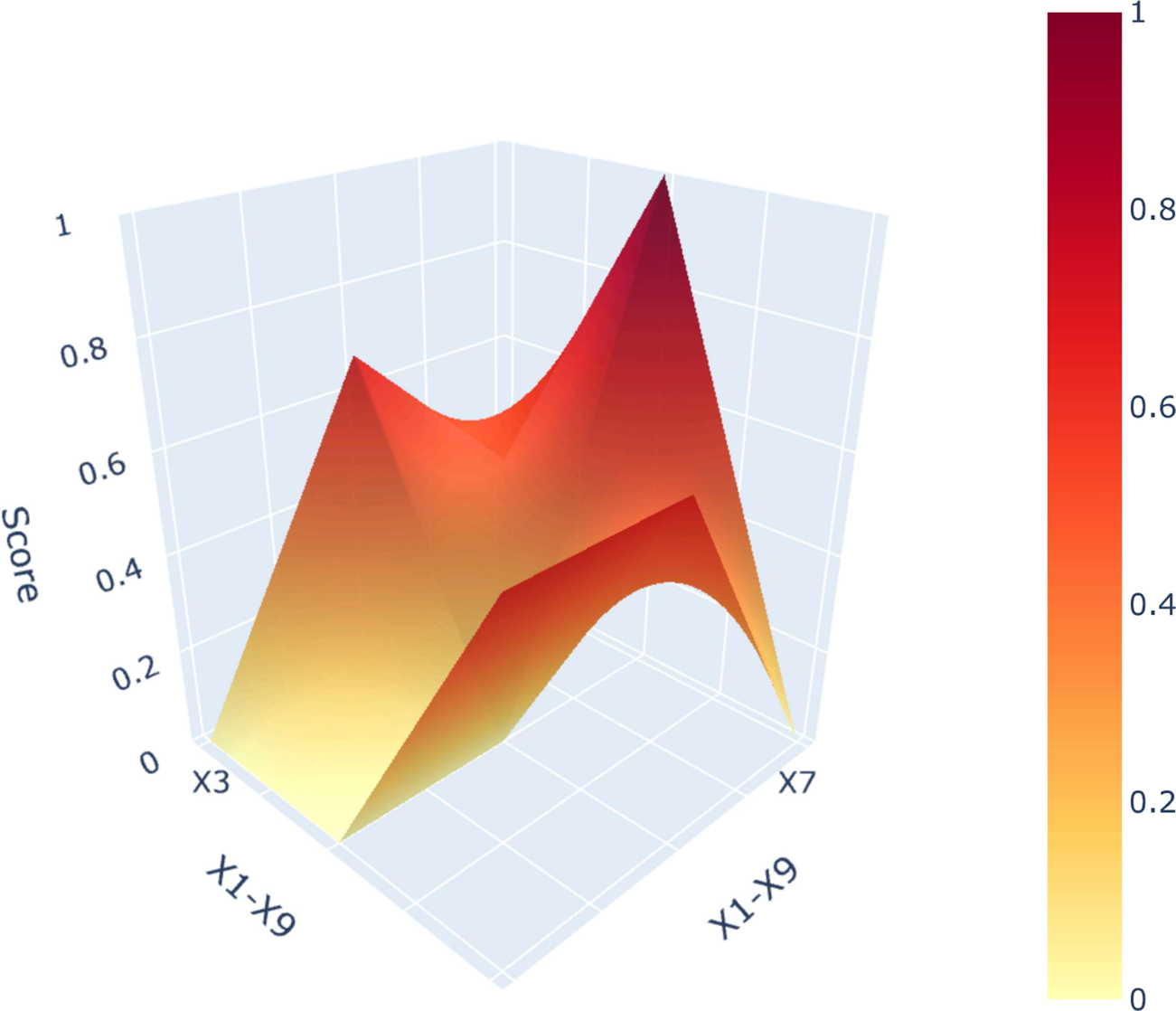
Figure 4. Long description
The 3D surface plot has the X axis labeled X1 to X9, the Y axis labeled X3 to X7, and the Z axis labeled Score ranging from 0 to 1. The surface forms a central peak with steep slopes and valleys, colored from yellow at the lowest values to red at the highest. The color bar on the right maps Score values from 0 at the bottom (yellow) to 1 at the top (dark red). The grid lines on each axis provide reference points for the surface’s position and height.
PMC surface plot of Pavg.
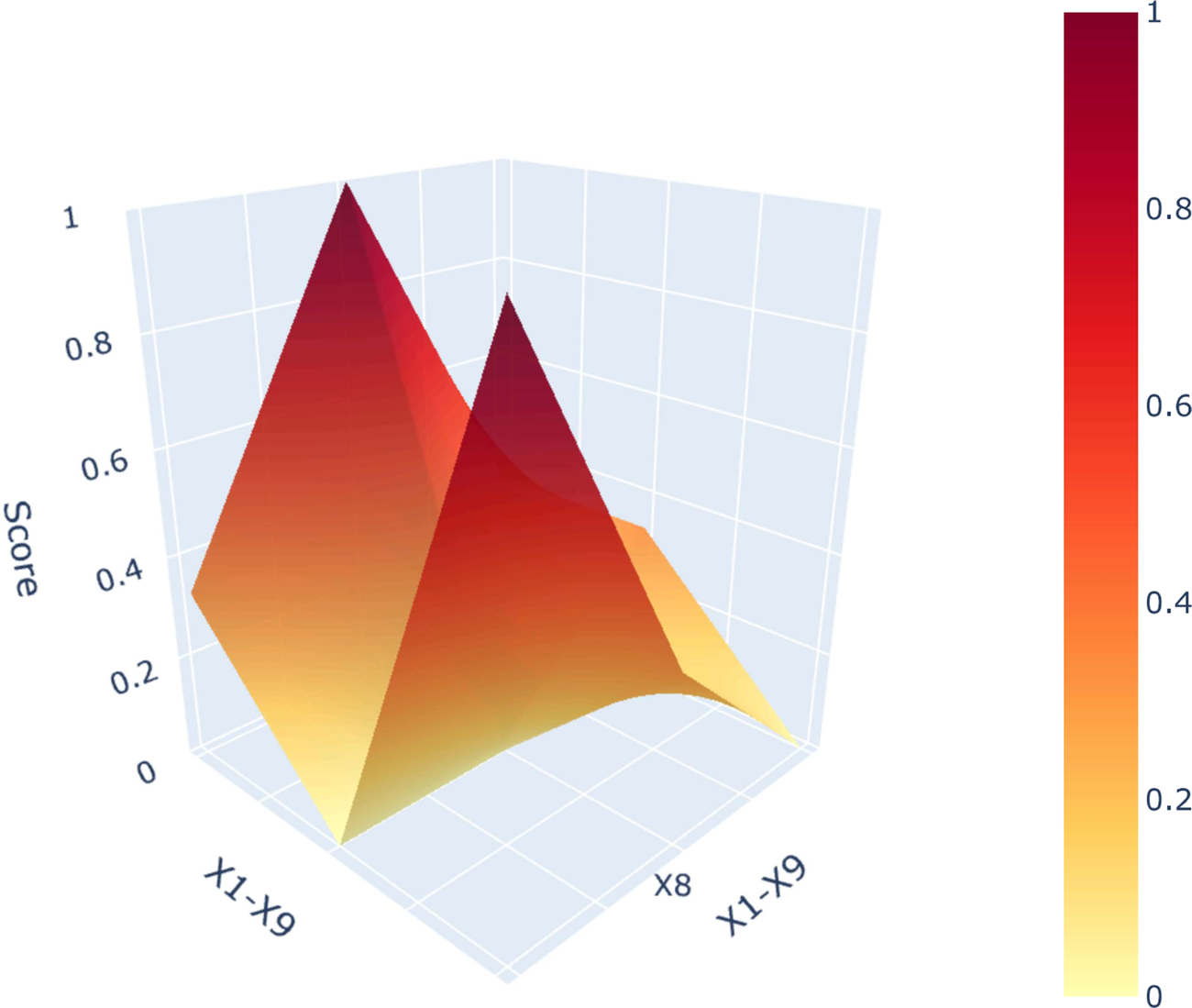
Figure 5. Long description
The plot displays a three-dimensional surface where the X axis at the front left is labeled X1 minus X9, the axis to the right is labeled X8, and the vertical axis is labeled Score ranging from 0 to 1. The surface rises to two distinct peaks, one near the front left and one toward the center, with the highest peak reaching Score 1. The surface color transitions from yellow at the lowest values to dark red at the highest, matching the vertical color bar on the right, which is labeled from 0 at the bottom to 1 at the top. The grid lines on all axes provide reference points for the surface’s height and position.
5. Discussion
Based on the average PMC index score of all 31 AI policies (Pavg = 4.61), we find that the overall policy performance falls within the B-grade “Acceptable” level. However, Socio-Cultural Institutional Embedding (X7) scores the lowest, with an average of only 0.24—significantly lower than other variables (e.g., X1 Policy Objectives at 0.63; X5 Risk Governance also performs higher). In contrast, the sample policies generally perform better in Policy Instruments (X2) and Innovation Orientation (X9), with average scores of 0.73 and 0.53, respectively. This disparity suggests that policies tend to emphasize AI-driven technological innovation while overlooking the profound influence of socio-cultural mechanisms in shaping effective AI governance.
The average curve of the 31 AI policy PMC reveals several critical patterns across the nine primary variables:
X1–X3 (Policy Objectives, Instruments, and Implementation):
On the whole, policies demonstrate clear objectives and a diverse set of policy instruments, such as technical standards, platform responsibilities, and institutional mandates. These elements collectively contribute to a structured policy framework that aligns with the core challenges of AI-generated content governance. However, the implementation dimension tends to be underdeveloped. Many policies lack detailed articulation of supervisory mechanisms, institutional accountability, and feedback loops, which may compromise practical enforceability and regulatory efficacy.
X4–X5 (Technological Attributes and Risk Governance):
These two dimensions reflect a certain degree of “technology–ethics tension.” On the one hand, most policies exhibit high technological alignment, explicitly referencing key AI capabilities such as deep synthesis technologies and digital watermarking. These elements suggest strong technical foresight and practical relevance. On the other hand, risk governance remains relatively weak. While platform responsibilities and technical regulation are emphasized, policies seldom offer comprehensive responses to broader ethical concerns, such as public perception, misinformation risks, or value-sensitive design.
X6–X7 (Multi-Stakeholder Coordination and Socio-Cultural Institutional Embedding):
Most policies are primarily led by central and local government bodies, with limited involvement of cultural communities or civil society actors. Particularly in X7 (Socio-Cultural Institutional Embedding), policies show a clear deficiency in addressing the cultural and social dimensions of AI governance. There is a noticeable absence of flexible governance mechanisms that engage local communities or foster culturally adaptive implementation. This technologically driven yet culturally detached approach may lead to governance silos and reduce both the practical relevance and social legitimacy of the policy.
X8–X9 (Policy Coverage and Innovation Orientation):
Policies generally display broad applicability, covering various platforms, sectors, and stakeholder groups. They also encourage technological R&D and industry innovation, reflecting a certain degree of strategic vision in guiding AI’s role in the digital economy. This reinforces their potential as tools for industrial advancement.
To further explore the performance of AI policies across different first-level variables, we selected one representative policy from each grade: Grade A (P01 New Generation Artificial Intelligence Development Plan), Grade B (P22 Implementation Plan for the Construction of Computing Infrastructure in Beijing [2024–2027]), and Grade C (P25 Several Measures to Promote the Development of General Artificial Intelligence in Inner Mongolia Autonomous Region).
The performance of policy samples across A, B, and C grades is similar. Generally, they perform well in X1 Policy Objectives and X4 Technological Attributes, indicating that current AI policies have relatively clear objectives and strong technology-driven approaches. However, they perform poorly in X5 Risk Governance and X7 Socio-Cultural Institutional Embedding, possibly because policy formulation tends to focus more on technological innovation and industrial development, while overlooking the systematic integration of ethical risk prevention and socio-cultural factors.
In the legal force classification, the Law/Regulation category achieved the highest PMC index score (5.668), followed by Standards (5.165), Plans (4.600), and finally Guiding Opinions (4.297). In terms of X3 Policy Implementation (see Table 7), however, Guiding Opinions performed best (0.725), whereas Plans scored lowest (0.423). This pattern may be explained by the fact that legally binding documents (laws and regulations) tend to provide comprehensive and coherent frameworks, resulting in higher overall PMC indices, while Guiding Opinions, though weaker in overall scope, often specify clear implementing agencies and pathways, strengthening their implementation performance. By contrast, Plans are typically strategic and visionary in nature, with less emphasis on concrete implementation mechanisms, which may explain their lower X3 scores.
Policy types with sample size, X3 average score, and PMC average index

Table 7. Long description
Column headers from left to right are Type, Sample size, X3 Avg. score, and PMC Avg.index. The first row lists Law forward slash regulation with sample size 5, X3 Avg. score 0.602, PMC Avg.index 5.668. The second row is Guiding opinions with sample size 9, X3 Avg. score 0.725, PMC Avg.index 4.297. The third row is Standards with sample size 2, X3 Avg. score 0.5, PMC Avg.index 5.165. The fourth row is Plan with sample size 15, X3 Avg. score 0.423, PMC Avg.index 4.6.
In terms of issuing authority, central government policies (n = 20) achieved a higher average PMC index score (4.75) compared with local government policies (n = 11, score = 4.212) (see Table 8). This difference may be attributed to the fact that central-level policies are generally broader in scope and more systematically designed. A key pattern is that central government policies exhibit greater overall structural completeness and systemic coherence, consistent with their role as top-level strategic frameworks that unify national objectives. However, the overall gap is relatively small, reflecting that local and central governments are largely aligned, with a high degree of policy coherence and national consistency. Notably, central government policies also score marginally higher on dimension X7 (Socio-Cultural Institutional Embedding) (0.199) than local government policies (0.181). This slight but informative gap can be interpreted from three interrelated perspectives. First, central policies are inherently designed to institutionalize overarching social values, cultural norms, and long-term institutional orientations at the national level, which naturally strengthen their performance in socio-cultural embedding. Second, local policies tend to prioritize operational feasibility, regional adaptation, and on-the-ground implementation, which may dilute explicit attention to abstract socio-cultural and institutional integration. Third, the narrow difference itself demonstrates strong vertical alignment and policy transmission within China’s AI governance system: local governments largely follow and internalize the socio-cultural and institutional principles established at the central level, rather than deviating from national priorities.
Average score and average PMC index by issuing authority

Table 8. Long description
Column headers from left to right are Issuing authority, Sample size, X7 Avg. score, and P M C avg dot index. The first row lists Central Government, sample size 20, X7 Avg dot score 0.199, P M C avg dot index 4.75. The second row lists Local Government, sample size 11, X7 Avg dot score 0.181, P M C avg dot index 4.212. All values are aligned under their respective columns.
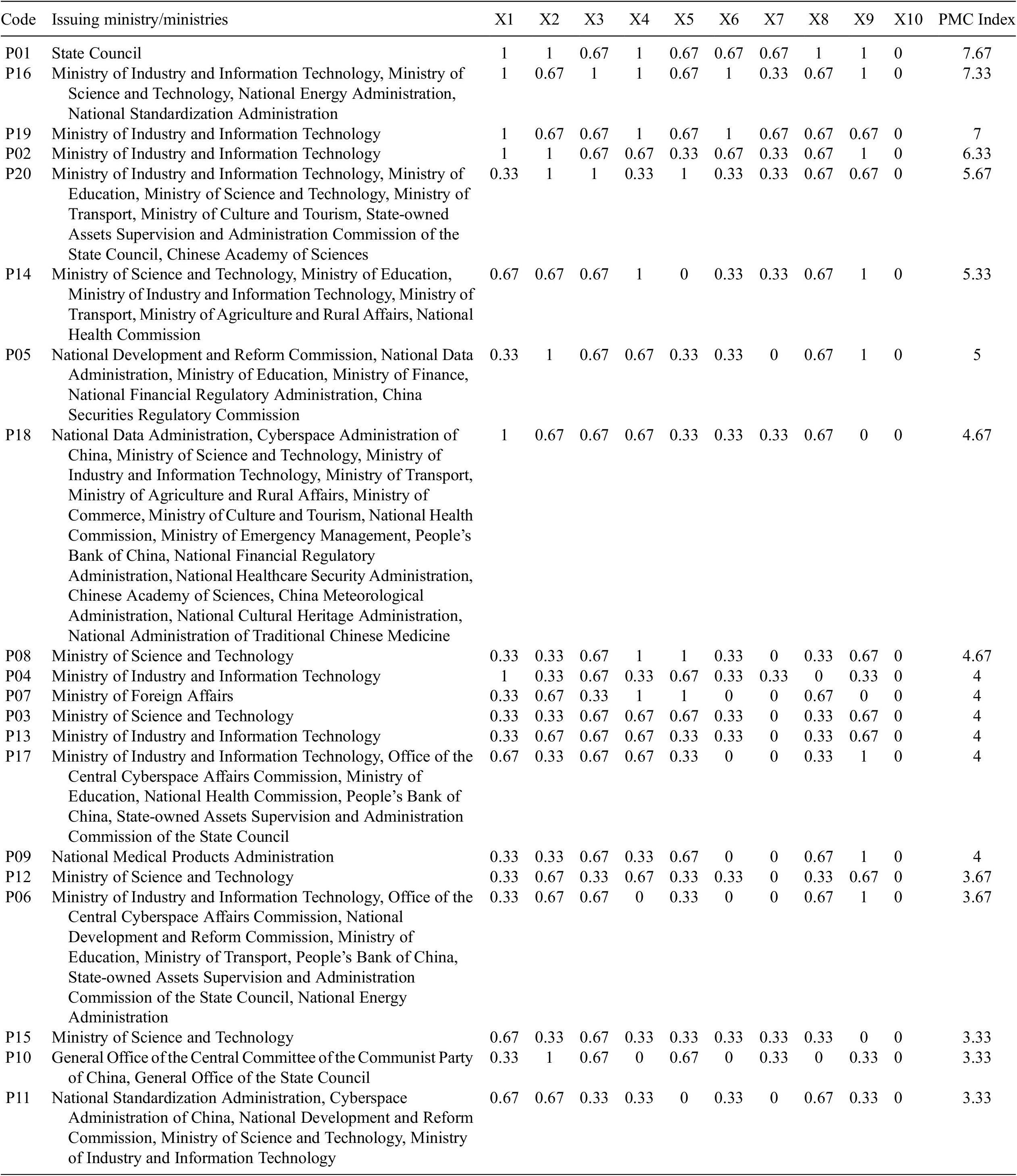
The policy scoring results reveal distinct political logics among different issuing authorities (see Table 9). Based on the PMC scoring results, clear differences can be observed in the governance orientations of AI policies issued by different ministries. Policies led by the State Council or high-level central authorities tend to achieve the highest PMC index scores, indicating a more comprehensive policy design. For example, P01 (PMC = 7.67) demonstrates strong performance across multiple dimensions, including policy objectives, policy instruments, technological attributes, and policy coverage. These policies typically integrate multiple governance elements and provide a more systematic framework for AI development and regulation. In contrast, policies led by the Ministry of Industry and Information Technology (MIIT) generally exhibit a strong emphasis on technological development and industrial innovation. Policies such as P19 and P02 show relatively high scores in technological attributes (X4), policy implementation (X3), and innovation orientation (X9), reflecting a clear focus on promoting industrial application, technological deployment, and sectoral upgrading. However, these policies tend to score lower on socio-cultural institutional embedding (X7), suggesting that their primary orientation is toward industrial development rather than broader societal integration. Policies led by the Ministry of Science and Technology (MOST) display a somewhat different pattern. While they also emphasize technological attributes and research development, their overall PMC scores are comparatively moderate, ranging between 3.33 and 4.67. These policies tend to focus on scientific capability building and technological advancement, but place less emphasis on multistakeholder coordination (X6) and socio-cultural institutional embedding (X7). This indicates a governance orientation that prioritizes research and technological capacity rather than comprehensive policy coordination.
PMC scores of AI policies issued by different central government ministries
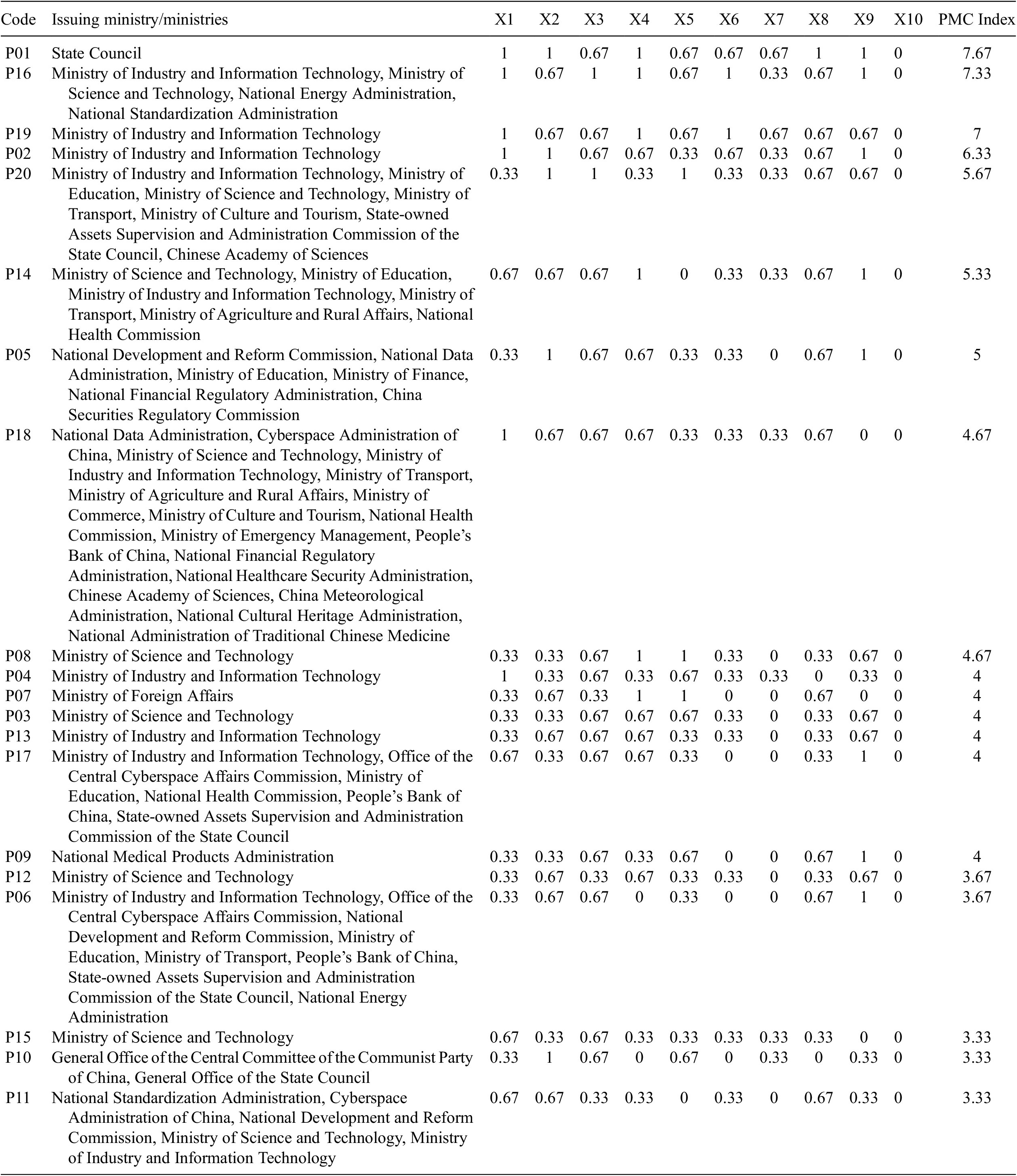
Table 9. Long description
From the top row downward, the table lists policy codes, issuing ministries, ten variables labeled X1 to X10, and the PMC Index. The State Council (P01) has the highest PMC Index at 7.67, followed by Ministry of Industry and Information Technology, Ministry of Science and Technology, National Energy Administration, and National Standardization Administration (P16) at 7.33. Ministry of Industry and Information Technology (P19) scores 7. Ministry of Industry and Information Technology (P02) scores 6.33. Ministry of Industry and Information Technology, Ministry of Education, Ministry of Science and Technology, Ministry of Transport, Ministry of Culture and Tourism, State-owned Assets Supervision and Administration Commission of the State Council, and Chinese Academy of Sciences (P20) score 5.67. Ministry of Science and Technology, Ministry of Education, Ministry of Industry and Information Technology, Ministry of Transport, Ministry of Agriculture and Rural Affairs, and National Health Commission (P14) score 5.33. National Development and Reform Commission, National Data Administration, Ministry of Education, Ministry of Finance, National Financial Regulatory Administration, and China Securities Regulatory Commission (P05) score 5. Lower scores are seen for National Data Administration and multiple ministries (P18) at 4.67, Ministry of Science and Technology (P08) at 4.67, Ministry of Industry and Information Technology (P04) at 4, Ministry of Foreign Affairs (P07) at 4, Ministry of Science and Technology (P03) at 4, Ministry of Industry and Information Technology (P13) at 4, Ministry of Industry and Information Technology and others (P17) at 4, National Medical Products Administration (P09) at 4, Ministry of Science and Technology (P12) at 3.67, Ministry of Industry and Information Technology and others (P06) at 3.67, Ministry of Science and Technology (P15) at 3.33, General Office of the Central Committee of the Communist Party of China and General Office of the State Council (P10) at 3.33, and National Standardization Administration and others (P11) at 3.33. Each policy row includes values for X1 to X10, ranging from 0 to 1, with some intermediate values such as 0.33 and 0.67. The PMC Index is calculated as the sum of these variables for each policy.
The observed variation across ministries reflects differences in institutional mandates, governance responsibilities, and policy priorities within China’s administrative system. Industrial agencies such as the Ministry of Industry and Information Technology are primarily responsible for promoting industrial upgrading and technological application, which explains their stronger emphasis on technological attributes, policy implementation, and innovation orientation. Their policies are therefore designed to accelerate the deployment of AI technologies in manufacturing, digital industries, and industrial ecosystems, resulting in higher scores in technology-related and implementation-oriented dimensions. In contrast, the Ministry of Science and Technology operates mainly within the domain of scientific research governance. As a result, its policies tend to prioritize research capacity building and technological advancement rather than comprehensive governance coordination, which may explain the relatively lower scores in dimensions such as multistakeholder coordination and socio-cultural institutional embedding. Meanwhile, cross-ministerial policies present mixed results. Some jointly issued policies, such as P16 (PMC = 7.33), perform strongly across several dimensions, particularly in policy implementation and multistakeholder coordination, suggesting effective inter-agency collaboration. However, other highly collaborative policies involving many ministries, such as P18, achieve relatively lower scores (PMC = 4.67). This suggests that while broad multi-ministerial participation may enhance representational coverage, it does not necessarily guarantee stronger policy design or clearer implementation mechanisms. Taken together, these findings show that differences in PMC scores are closely linked to the institutional roles and policy functions of different ministries.
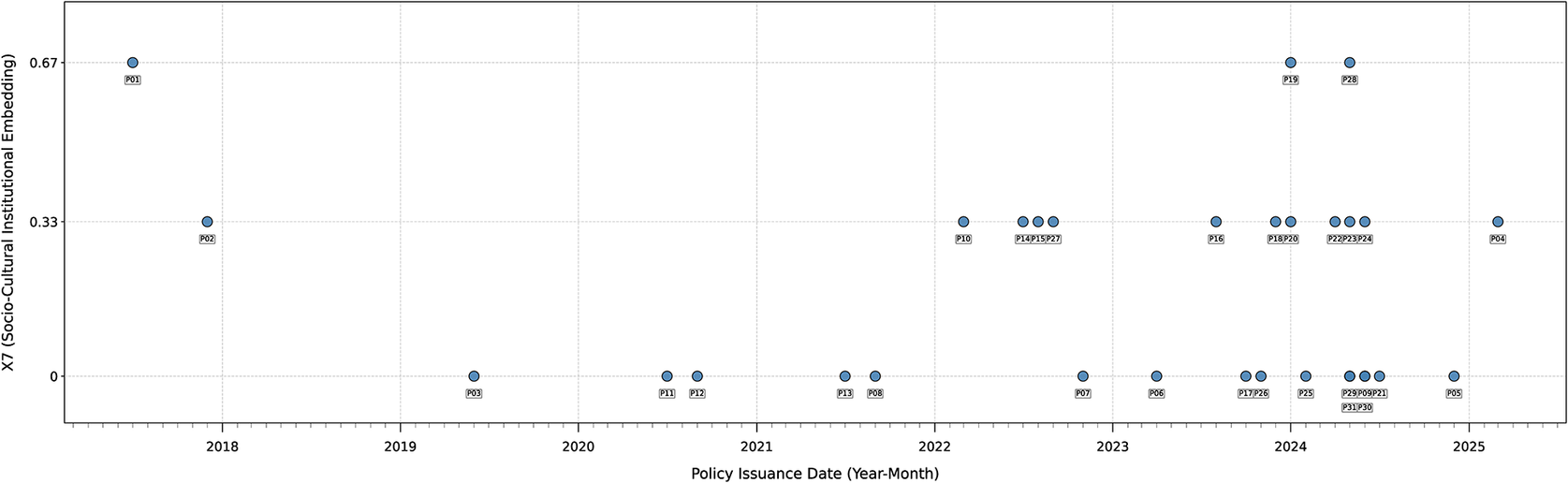
To address how socio-cultural institutional embedding (X7) varies over time from 2017 to 2025, we analyzed the temporal distribution of X7 scores across 31 AI-related policies (see Figure 6). Overall, the socio-cultural indicator exhibits a nonlinear but gradually consolidated trend over the 8-year period: In the early phase (2017–2021), X7 scores were either sporadic (e.g., P01: 0.67; P02: 0.33) or entirely zero (2019–2021), reflecting that socio-cultural and institutional integration was not a core focus of AI policy design in the initial stage. Among them, the earliest policy, P01 New Generation Artificial Intelligence Development Plan, issued in July 2017, represents China’s first national-level strategic plan dedicated to AI. It achieved a notably high score of 0.67 on X7 (socio-cultural institutional embedding), which clearly reflects that China takes into account socio-cultural values and institutional norms in the top-level design of AI governance. This high score can also be attributed to the fact that, as a foundational strategic document, it was intentionally formulated to embed social and cultural considerations into the long-term institutional framework of AI development, rather than focusing merely on technical or industrial objectives. A turning point emerged in 2022, where X7 scores became consistently positive (0.33) across multiple policies (P10, P14, P15, and P27), indicating that socio-cultural dimensions were gradually incorporated into local and national AI policy frameworks. From 2023 to 2025, the indicator maintained stable positive values (0.33) with intermittent peaks (e.g., P19: 0.67 in Jan-24; P28: 0.67 in May-24), while zero scores still appeared in some policies (e.g., P25 in Feb-24; P29/P31 in May-24). Overall, the performance of AI policies on X7 has gradually strengthened compared with earlier periods. This pattern suggests that socio-cultural institutional embedding has become increasingly important yet unevenly implemented in AI governance. This may be due to the fact that AI policies issued in different years vary significantly in their positioning, functions, and regulatory focus, leading to inconsistent emphasis on socio-cultural institutional embedding across documents.
X7 scores distribution of 31 AI policies by policy issuance date.

Figure 6. Long description
The x axis is labeled Policy Issuance Date Year dash Month, spanning from 2017 to 2025. The y axis is labeled X7 Socio dash Cultural Institutional Embedding, ranging from 0 to 6.67. Each blue dot represents an AI policy, labeled P01 through P31. In 2017, P01 is at y equals 6.67 and P02 at 3.33. From 2019 to 2025, most policies cluster at y equals 0, with occasional dots at 3.33 and 6.67. In 2022, P18, P19, P20, and P21 are at 3.33, while P22 and P23 are at 0. In 2023, P25 is at 0 and P26 at 3.33. In 2024, P27, P28, P29, and P30 are at 0, P31 at 3.33, and P24 at 6.67. The distribution shows a concentration of low X7 scores in recent years, with only a few policies reaching higher values.
The strong performance in innovation-related indicators reflects China’s long-standing emphasis on science-and-technology-driven modernization. Centralized planning traditions and performance-indicator-driven incentives encourage policymakers to prioritize industrial competitiveness, R&D breakthroughs, and infrastructure development. Moreover, the dominance of industrial ministries, research institutions, and platform enterprises in agenda-setting further reinforces the technological framing of AI governance. By contrast, institutionalized channels for public participation, cultural communities, and civic organizations remain underdeveloped, which contributes to the relatively low scores on X7. This demonstrates that policy design has largely privileged efficiency and competitiveness over inclusiveness and cultural adaptability.
The lack of socio-cultural institutional embedding carries several implications. First, it risks creating governance silos, where technical regulation is decoupled from the lived realities of affected communities. Second, weak cultural embedding may result in compliance theatre, where policies exist on paper but fail to secure social legitimacy or genuine stakeholder engagement. Third, the absence of participatory and culturally adaptive mechanisms can exacerbate regional and group disparities, particularly for marginalized populations, thereby undermining fairness and inclusiveness in AI governance. These risks suggest that without cultural and institutional responsiveness, AI policy may reproduce structural inequalities rather than mitigate them.
Overall, the PMC results provide insight into the evolving trajectory of China’s AI governance. The relatively high scores observed in dimensions such as policy objectives (X1), technological attributes (X4), and innovation orientation (X9) indicate that China’s AI policy framework continues to prioritize technological advancement and industrial development as core policy goals. At the same time, the results show a gradual expansion of governance considerations beyond purely technological promotion. Several policies incorporate elements of risk governance (X5), multistakeholder coordination (X6), and broader policy coverage (X8), suggesting an increasing recognition of the societal implications of AI development.
These findings also suggest that China’s AI governance is technologically robust but culturally under-embedded. To move beyond this imbalance, future policy frameworks should strengthen socio-cultural mechanisms, including institutionalized public participation, regional cultural adaptation, and community co-governance models. This would enhance both the legitimacy and effectiveness of AI policies. Moreover, recognizing differences in legal force and issuing authority can help policymakers tailor implementation strategies and improve multilevel governance coordination. By situating AI as both a technological system and a socio-cultural institution, this study underscores the need for governance models that balance innovation and inclusiveness, thereby avoiding the pitfalls of technological instrumentalism while ensuring socially responsive and sustainable AI development.
6. Conclusion
To enhance the comprehensiveness and responsiveness of AI policy, it is recommended to establish a systematic framework for the identification and mitigation of ethical risks, with a focus on high-risk areas such as content generation, surveillance, and automated decision-making. Policy design should actively strengthen socio-cultural institutional embedding by incorporating cultural diversity, public participation, and local governance mechanisms. Furthermore, it should foster community co-governance frameworks, accommodate regional cultural variations, and promote inclusive decision-making processes. The involvement of multiple disciplines from social and cultural fields—such as ethics, sociology, and law—should be promoted in policy formulation, fostering cross-departmental and cross-sectoral collaboration. At the same time, governance should move beyond traditional compliance-based regulation toward resilient, adaptive, participatory, and culturally grounded frameworks to effectively respond to the evolving social impacts of artificial intelligence. Only through such efforts can AI policy truly achieve a dynamic and coherent integration of technological advancement and social value, driving the comprehensive upgrading and continuous optimization of the AI governance policy system.
Meanwhile, AI policy formulation should recognize that AI does not evolve solely through technological advancement but develops within a collaborative “human–model–institution” environment. Ignoring the participatory role of human knowledge and the reflexivity of cultural systems may lead to governance approaches detached from actual social mechanisms, resulting in a “technological instrumentalism” governance pitfall. Therefore, conceptualizing AI as a socio-cultural technology enhances the foresight and adaptability of AI policies and provides a theoretical foundation for institutional innovation and cultural embedding in AI governance systems.
Acknowledgments
The authors would like to gratefully acknowledge the support of the National Social Science Fund of China and the China Scholarship Council.
Data availability statement
The dataset containing 31 Chinese AI policy documents used in this study is available at Zenodo: https://zenodo.org/records/15860069. Python scripts for PMC index policy evaluation and jieba word frequency, together with related code, are available at Zenodo: https://zenodo.org/records/17102623. All other relevant data supporting the findings of this study are included within the manuscript.
Author contribution
X.X., A.B.: Conceptualization; X.X., C.Q.: Methodology; C.Q., X.Z.: Data curation; C.Q.: Data visualization; C.Q., X.Z.: Writing—original draft. All authors approved the final submitted draft.
Funding statement
This research was funded by the Major Program of the National Social Science Fund of China (23&ZD087) and the China Scholarship Council (Grant No.:202406260457).
Competing interests
The authors declare none.
Provenance
This article was submitted for consideration for the 2025 Data for Policy Conference to be published in Data & Policy on the strength of the Conference review process.




 Open access


Comments
No Comments have been published for this article.