





1. Introduction
One of the key features of the human cognitive system is the ability to entertain and express hypothetical thought. Linguistically, hypothetical thought is prototypically encoded in conditional if-clauses (and similar constructions across the world’s languages), which express a condition under which some proposition may occur (e.g., If the sky is clear, we will see the fireworks). Although conditional if…then statements are one of the most well-studied constructions in the history of cognitive science, our knowledge of how they emerge in early child language is limited. Existing evidence comes primarily from early naturalistic studies on children’s production of if-clauses in English and a few other languages (e.g., Bates, Reference Bates1976; Bowerman, Reference Bowerman, Traugott, Ter Meulen, Reilly and Ferguson1986; Clancy et al., Reference Clancy, Jacobsen and Silva1976; Cromer, Reference Cromer1968; Kuczaj & Daly, Reference Kuczaj and Daly1979; McCabe et al., Reference McCabe, Evely, Abramovitch, Corter and Pepler1983; Reilly, Reference Reilly1982; Slobin, Reference Slobin, Smith and Miller1966, Reference Slobin, Ferguson and Slobin1973; Smoczyńska, Reference Smoczyńska and Slobin1986). Often, the main goal of these investigations was to study the order in which children produce various conjoined clauses (including if-clauses). These investigations have revealed that the conjunction if is very infrequent in children’s early spontaneous speech and tends to appear later than other conjunctions such as and, because, so, but, and when (see Diessel, Reference Diessel2004).
According to traditional language acquisition accounts, this and similar delays in early child language, especially when they are cross-linguistically robust, are taken to reflect gaps in children’s conceptual inventories (e.g., Bowerman, Reference Bowerman, Traugott, Ter Meulen, Reilly and Ferguson1986; E. Clark, Reference Clark1973; H. Clark, Reference Clark1973; Dromi, Reference Dromi1987; Huttenlocher et al., Reference Huttenlocher, Smiley and Charney1983; Johnston & Slobin, Reference Johnston and Slobin1979; Kuczaj & Daly, Reference Kuczaj and Daly1979). Specifically, the late emergence of if-clauses in children’s speech has been linked to the Piagetian concrete operational stage, when children develop the ability to suspend reality and view the world from perspectives other than their own (see Bates, Reference Bates1976, Cromer, Reference Cromer1968, and Reilly, Reference Reilly, Traugott, Ter Meulen, Snitzer-Reilly and Ferguson1986, for extensive discussion of these ideas). However, given that these views have been developed on the basis of sparse empirical evidence with inherent limitations (mostly naturalistic data from few subjects), both the existence of such a delay and its origins remain open.
In the present study, we conduct a systematic experimental investigation of children’s and adults’ production of hypothetical language with the goal of exploring whether conditionals are indeed delayed in children’s speech and what the scope of this delay is. Understanding how conditionals are acquired will not only advance our knowledge of how children acquire semantically and syntactically complex language but also provide a window into the development of children’s hypothetical thinking. Furthermore, the systematic exploration of the origins of a relatively understudied language production pattern will strengthen our theoretical understanding of the processes underlying language acquisition. We begin by discussing the semantic and syntactic properties of if-clauses. Next, we discuss findings on the acquisition of if-clauses as well as theories that account for their late emergence in child language. Finally, we test the predictions of the two accounts experimentally by eliciting hypothetical language by children and adults.
1.1. Semantic and syntactic properties of conditional (if…then) statements
Conditionals are semantically and syntactically complex linguistic constructions that allow speakers to make statements about concepts and events that are not part of the actual world. In English, the canonical form of a conditional is a two-part sentence consisting of an antecedent proposition (p) marked with the overt hypotheticality conjunction if and a consequent proposition (q) sometimes marked with the word then (e.g., “If it is sunny, then we will go to the beach”). Conceptually, conditionals are defined as a relation between the two propositions, such that the antecedent states a condition under which the event in the consequent occurs. In traditional logic, this relation is defined in terms of truth conditions: the conditional is true either when both p and q are true or both p and q are false or p is false and q is true (excluding the situation when p is true and q is false) (Comrie, Reference Comrie, Traugott, Ter Meulen, Reilly and Ferguson1986; von Fintel, Reference von Fintel, von Heusinger, Maienborn and Portner2011). Structurally, the consequent is the main clause of the conditional construction, and the antecedent if-clause is an adverbial embedded clause, syntactically dependent on the main clause.
A critical aspect of the meaning of conditionals is that they do not refer to events in the actual world, but instead they refer to events in a hypothetical world (i.e., they are remote from reality – or, more accurately, they denote the speaker’s intention to detach the utterance from reality), and, in this respect, they are critically different from other grammatically complex constructions, which refer to factual states of affairs (e.g., compare “If it is sunny, we will go the beach” vs. “Since it is sunny, we will go the beach”; see Comrie, Reference Comrie, Traugott, Ter Meulen, Reilly and Ferguson1986; Reilly, Reference Reilly, Traugott, Ter Meulen, Snitzer-Reilly and Ferguson1986, for discussion). Importantly, conditionals can encode different degrees of remoteness from reality, with most languages having dedicated formal devices for distinguishing different degrees of hypotheticality (Bjorkman & Halpert, Reference Bjorkman, Halpert, Arregui, Rivero and Salanova2017; Comrie, Reference Comrie, Traugott, Ter Meulen, Reilly and Ferguson1986; Iatridou, Reference Iatridou2000; James, Reference James1982).Footnote 1 A well-known division exists between indicative conditionals, which express low hypotheticality (e.g., “If it is sunny, we will go to the beach”), and counterfactuals, which express high hypotheticality (e.g., “If it had been sunny, we would have gone to the beach”). However, more fine-grained distinctions exist within these two broad types (e.g., Athanasiadou & Dirven, Reference Athanasiadou, Dirven, Athanasiadou and Dirven1997). For instance, indicative conditionals include generic or habitual conditionals which describe two regularly co-occurring events or states (e.g., “If it is sunny, we (always) go to the beach”) and future predictions which describe an open possibility in the future (e.g., “If it is sunny (next Sunday), we will go to the beach”). Counterfactual conditionals include present counterfactuals which describe an unrealized possibility in the present (e.g., “If it were sunny (today), we would go to the beach”) and past counterfactuals which describe an unrealized possibility in the past (e.g., “If it had been sunny (last Sunday), we would have gone to the beach”). The different types of conditionals are expressed through different linguistic forms. Generic conditionals often include the present tense in both the antecedent and the consequent (if + present, present), while predictive conditionals include future tense (if + present, will + VP) in the consequent. Present counterfactuals include the past tense in the antecedent and consequent (if + past, would + VP) and past counterfactuals the pluperfect (if + pluperfect, would have + VP). Crucially, the tense marking on conditionals is only morphological, with past tense (often referred to as “fake past”; see Iatridou, Reference Iatridou2000; cf. Ippolito, Reference Ippolito2006) being used to denote counterfactuality, without contributing to the time reference of the utterance (e.g., “If it were sunny (tomorrow), we would go to the beach”).
Evidently, these intricate syntactico-semantic properties of conditionals pose a particularly complex challenge for the learner. To use conditional if…then constructions effectively, children need to have several cognitive and linguistic abilities in place. First, children need to have an understanding of contingency relations between the antecedent and the consequent propositions (which are typically temporal/causal in nature) and to be able to express those by using complex sentences with sentence-internal clausal embedding. Furthermore, children need to be able to represent multiple possibilities (i.e., non-actual state of affairs) and match the different types of possibilities expressed by the different types of conditionals to specific morphological forms. Each type of conditional poses distinct cognitive and linguistic challenges. For instance, generic conditionals rely on the cognitive notion of “timelessness,” and thus their acquisition requires children to develop the ability to decenter in time and view the world from a perspective other than their own (Cromer, Reference Cromer1968; Reilly, Reference Reilly1982). While all conditionals require the ability to hold multiple possibilities in mind, counterfactuals also require the ability to consider a false possibility as true (Beck et al., Reference Beck, Riggs and Gorniak2009; Byrne, Reference Byrne2007). Past counterfactuals are conceptually highly challenging as they involve not only the ability to reason counterfactually but also the ability to mentally travel in the past (Nyhout & Ganea, 2019). Counterfactuals are also challenging from a linguistic perspective as their linguistic form requires the use of “fake” past tense, which creates a mismatch between morphological tense and temporal orientation. The acquisition of counterfactuals requires children to recognize this mismatch and map the morphological form of “fake” past to the property of counterfactuality (Tulling & Cournane, Reference Tulling and Cournane2022).
1.2. The acquisition of if-clauses
Research on the acquisition of conditionals has looked at different aspects of conditional meaning and structure. Children’s comprehension of conditionals has been investigated mainly through conditional reasoning tasks. Given the complication of conditional reasoning even for adults, this research typically focuses on school-aged children and shows full comprehension of conditional meaning in early adolescence (Barrouillet & Gauffroy, Reference Barrouillet and Gauffroy2015; Barrouillet & Lecas, Reference Barrouillet and Lecas1999; Kuhn, Reference Kuhn1977; Markovits et al., Reference Markovits, Brisson and de Chantal2016; Rumain et al., Reference Rumain, Connell and Braine1983; but see Cummins, Reference Cummins1996; Grigoroglou & Ganea, Reference Grigoroglou and Ganea2022; Grigoroglou et al., Reference Grigoroglou, Shmanova and Ganea2023; Rouvoli et al., Reference Rouvoli, Tsakali, Kazanina, Brown and Dailey2019, for evidence from younger children). Other research has focused on children’s ability to reason counterfactually and has shown successful understanding of counterfactual language (including counterfactual conditional statements in the form of if-clauses) as early as age 4 (e.g., Guajardo & Turley-Ames, Reference Guajardo and Turley-Ames2004; Harris et al., Reference Harris, German and Mills1996; Nyhout & Ganea, Reference Nyhout and Ganea2019a; but see Beck et al., Reference Beck, Robinson, Carroll and Apperly2006; Rafetseder et al., Reference Rafetseder, Schwitalla and Perner2013, for evidence of later comprehension). These lines of research have targeted the reasoning aspect of indicative conditionals and counterfactuals and have been less concerned with the acquisition of the relevant structures.
Research focusing on the acquisition of conditional structure per se has examined the timeline of the emergence of conditionals in children’s language production. Some studies have investigated the emergence of conditionals only (Bates, Reference Bates1976; Bowerman, Reference Bowerman, Traugott, Ter Meulen, Reilly and Ferguson1986; Eisenberg, Reference Eisenberg1980; Jakubowicz, Reference Jakubowicz, Bronckart, Kail and Noizet1983; Kuczaj & Daly, Reference Kuczaj and Daly1979; McCabe et al., Reference McCabe, Evely, Abramovitch, Corter and Pepler1983; Reilly, Reference Reilly1982), while others have investigated the emergence of conditionals as one type of complex sentence among others (Bloom et al., Reference Bloom, Lahey, Hood, Lifter and Fiess1980; Bowerman, Reference Bowerman, Fletcher and Garman1979; Clancy et al., Reference Clancy, Jacobsen and Silva1976; Hood et al., Reference Hood, Lahey, Lifter, Bloom and Sackett1978; Katis, Reference Katis, Angeliki and Dirven1997; Limber, Reference Limber and Moore1973; Reilly, Reference Reilly, Traugott, Ter Meulen, Snitzer-Reilly and Ferguson1986). The evidence from this line of research presents a mixed acquisition picture. Specifically, a series of naturalistic studies report that, across languages, children produce explicitly marked conditionals (if-clauses) after 2.5 years of age, significantly later than the production of other adverbial subordinate clauses such as temporal (when-clauses), causal (because-clauses), and purpose clauses (so-clauses) (e.g., Bowerman, Reference Bowerman, Traugott, Ter Meulen, Reilly and Ferguson1986; Reilly, Reference Reilly1982, Reference Reilly, Traugott, Ter Meulen, Snitzer-Reilly and Ferguson1986; McCabe et al., Reference McCabe, Evely, Abramovitch, Corter and Pepler1983, for English; Bates, Reference Bates1976, for Italian; Clancy et al., Reference Clancy, Jacobsen and Silva1976, for Italian, German, Turkish, English; Smoczyńska, Reference Smoczyńska and Slobin1986, for Polish; Slobin, Reference Slobin, Smith and Miller1966, for Russian), while experimental studies demonstrate even later emergence (e.g., Kuczaj & Daly, Reference Kuczaj and Daly1979; Reilly, Reference Reilly1982; Werner & Kaplan, Reference Werner and Kaplan1963). However, other naturalistic studies report earlier emergence of conditionals, at around age 2 (e.g., Akatsuka & Clancy, Reference Akatsuka, Clancy and Clancy1993, for Japanese and Korean; Katis, Reference Katis, Angeliki and Dirven1997, for Modern Greek). There is also disagreement in terms of the first type of conditional to emerge in children’s speech, with certain studies showing that future predictions are the earliest produced form of conditional, followed by generics (e.g., Bowerman, Reference Bowerman, Traugott, Ter Meulen, Reilly and Ferguson1986; Cromer, Reference Cromer1968; Reilly, Reference Reilly1982, Reference Reilly, Traugott, Ter Meulen, Snitzer-Reilly and Ferguson1986), while others report that generics appear before future predictions (e.g., Katis, Reference Katis, Angeliki and Dirven1997). Across studies, counterfactual conditionals are the latest form of conditional to emerge, although there is significant variation across studies and individual children. Some studies show that present counterfactuals are produced at around age 4 (Kuczaj & Daly, Reference Kuczaj and Daly1979; Reilly, Reference Reilly1982; Scholnick & Wing, Reference Scholnick and Wing1992), while others show uses of present counterfactuals before age 3 (Bowerman, Reference Bowerman, Traugott, Ter Meulen, Reilly and Ferguson1986; Tulling & Cournane, Reference Tulling and Cournane2022). Past counterfactual conditionals are shown to emerge after age 3 (Tulling & Cournane, Reference Tulling and Cournane2022), while their emergence may be delayed until age 5 (Kuczaj & Daly).
Although the finding, shared across multiple studies, that counterfactuals are produced later than indicative conditionals is hardly unexpected, given their greater conceptual complexity, most studies find surprising that (indicative) if-clauses emerge later in children’s speech than other subordinate adverbial clauses, such as temporal (when-clauses), causal (because-clauses), and purpose clauses (so-clauses). As Bowerman (Reference Bowerman, Traugott, Ter Meulen, Reilly and Ferguson1986, p. 287) observes, “[…] conditionals pose a puzzle. Even though they are morphosyntactically similar to sentences with conjunctions such as and, when, because, so, etc., and share certain elements of meaning with these, they are consistently among the last to appear.” Although not directly explained by Bowerman, we consider morphosyntactic similarity to refer to the fact that if-clauses are finite, adverbial embedded clauses which require rich morphology on the verb, similarly to other adverbial embedded clauses (e.g., when-clauses, because-clauses, so-clauses, etc.; see also Haegeman, Reference Haegeman2003). In this respect, they should be distinguished from main clauses conjoined through coordination (which do not involve embedding), as well as non-finite subordinate clauses that are complements of verbs and do not require morphological marking on the verb (e.g., they are infinitival).Footnote 2 In sum, given that if-clauses appear later than other adverbial subordinate clauses in most studies, despite sharing basic morphosyntactic properties with them, the source of this delay must lie beyond linguistic difficulties.
Different explanations have been proposed to account for the relatively late acquisition timeline of conditionals. According to one explanation, children’s later acquisition of if-clauses compared to other morphosyntactically similar constructions reflects greater conceptual complexity underlying such clauses. As mentioned by Kuczaj & Daly (Reference Kuczaj and Daly1979, p. 565) “it is not the syntactic characteristics of the conditional […] which make them late acquisitions, but rather the initial absence of the cognitive abilities which allow one to comprehend the meanings expressed by the linguistic forms.” Recall that, unlike other complex constructions such as temporal (e.g., when-clauses) or causal clauses (e.g., because-clauses) that make assertions about the actual world, conditionals, even the least hypothetical ones, always specify two hypothetical situations (Comrie, Reference Comrie, Traugott, Ter Meulen, Reilly and Ferguson1986). Therefore, a potential difficulty children face with conditionals may be linked to the fact that they cannot simultaneously conceptualize two hypothetical events (Bates, Reference Bates1976). Relatedly, children’s difficulty with habitual or generic conditionals may be due to an inability to conceive “timeless” events, as events that exist beyond the here and now (Cromer, Reference Cromer1968; Reilly, Reference Reilly1982). Thus, on the conceptual complexity hypothesis, children acquire conditionals later than other adverbial subordinate clauses (e.g., when-clauses, because-clauses) because they lack the cognitive abilities required to understand their hypothetical meaning (Bates, Reference Bates1976; Kuczaj & Daly, Reference Kuczaj and Daly1979; see also Bowerman, Reference Bowerman, Traugott, Ter Meulen, Reilly and Ferguson1986, for discussion). This proposal is consistent with classic Piagetian views about how abstract reasoning (including hypothetical reasoning) is a late developmental achievement (Piaget & Inhelder, Reference Piaget and Inhelder1967), as well as classic theoretical accounts of language acquisition as a straightforward mapping process between linguistic forms and concepts (e.g., Bowerman, Reference Bowerman, Traugott, Ter Meulen, Reilly and Ferguson1986; Dromi, Reference Dromi1987; Huttenlocher et al., Reference Huttenlocher, Smiley and Charney1983; Kuczaj & Daly, Reference Kuczaj and Daly1979; Slobin, Reference Slobin, Ferguson and Slobin1973). According to such views any observed asymmetric patterns in the emergence of lexical items and grammatical constructions in children’s speech, especially when these are cross-linguistically robust, should always be viewed as an indication of underlying conceptual asymmetries (e.g., see Bowerman, Reference Bowerman, Bloom, Peterson, Nadel and Garrett1996; Choi & Bowerman, Reference Choi and Bowerman1991; E. Clark, Reference Clark1973; Johnston, Reference Johnston1984; Johnston & Slobin, Reference Johnston and Slobin1979, for similar arguments in the acquisition of spatial language).
According to an alternative hypothesis, the delayed emergence of if-clauses in children’s speech is not the result of an asymmetric pattern of acquisition of if-clauses compared to other constructions of similar morphosyntactic complexity but rather the byproduct of pragmatic overlap of if-clauses with other constructions in conversation. According to the pragmatic overlap hypothesis, children may produce if-clauses later and less frequently than other constructions, because their meaning is pragmatically superfluous and can be expressed by alternative constructions, which are potentially less costly to produce (Katis, Reference Katis, Angeliki and Dirven1997; McCabe et al., see Bowerman, Reference Bowerman, Traugott, Ter Meulen, Reilly and Ferguson1986, for a discussion). In support of this hypothesis, naturalistic studies that show earlier production of conditionals compared to other adverbial subordinate clauses (e.g., temporals; see Katis, Reference Katis, Angeliki and Dirven1997) were conducted in languages other than English, where explicitly marked conditionals that appear early in both children’s speech and their input have discourse functions that in English are often expressed through other constructions. Specifically, Katis (Reference Katis, Angeliki and Dirven1997) found that the earliest explicitly marked conditionals in Modern Greek expressed (self) regulatory (e.g., prohibitive) functions (e.g., “Τha peso. Ama piδao, tha peso” “I will fall. If I jump, I will fall”). Similarly, Akatsuka and Clancy (Reference Akatsuka, Clancy and Clancy1993) found that the early emergence of explicitly marked conditionals in Japanese and Korean was related to their deontic meaning (unavailable in English), which is also used to regulate other people’s behavior. The tendency for early conditionals to express regulatory meanings is also exhibited in English, with McCabe et al. (Reference McCabe, Evely, Abramovitch, Corter and Pepler1983) finding that in conversations with peers, children’s earlier and more frequent if-clauses expressed bribes and threats (e.g., “If you want a cup, you have to play my games”; McCabe et al., Reference McCabe, Evely, Abramovitch, Corter and Pepler1983, p. 256). Interestingly, however, in English, it has also been observed that children can express the same functions much earlier than the emergence of if-clauses using grammatically simpler linguistic devices (juxtaposition, coordination) that do not require clause embedding (e.g., “Don’t break that (or/;) I’ll hit you”; Bowerman, Reference Bowerman, Traugott, Ter Meulen, Reilly and Ferguson1986, p. 294). Thus, according to the pragmatic overlap hypothesis, the late emergence of if-clauses in children’s language production in certain naturalistic studies may not necessarily reflect limitations in their ability to express hypothetical thought but rather the availability of a wide range of syntactic constructions that can also express aspects of conditional meaning. This proposal is in accordance with more recent linguistic analyses of conditionality, acknowledging that if-clauses are not the only syntactic device available to express conditional meaning (e.g., compare “If you take her cellphone she will scream” vs. “Take her cellphone and she will scream” vs. “Don’t take her cellphone or she will scream”), and that a variety of phenomena inextricably linked with conditional if-clauses (e.g., conditional perfection: the tendency to interpret conditionals as bi-conditionals) can occur with other syntactic constructions as well (Comrie, Reference Comrie, Traugott, Ter Meulen, Reilly and Ferguson1986; Elder & Jaszczolt, Reference Elder and Jaszczolt2016; Horn, Reference Horn2000; von Fintel, Reference von Fintel, von Heusinger, Maienborn and Portner2011).
So far, arguments in favor of the conceptual complexity and the pragmatic overlap hypotheses have been largely based on data from early naturalistic studies, with several methodological limitations. These studies typically involved a small number of children (1–4 children each) and examined longitudinally for varying periods of time, mostly in naturalistic parent–child interactions (but see McCabe for evidence from peer interactions of siblings), which were not designed to elicit hypothetical language per se. Therefore, the sparsity of if-clauses on children’s early language production could be due to a lack of opportunity to use if-clauses rather than a true gap in children’s conceptual inventory.Footnote 3 Conversely, it is possible that the contexts of naturalistic production favored the use of other embedded constructions expressing contingency relations (e.g., when-clauses, because-clauses), which resulted in the reported asymmetric pattern in the use of if-clauses and other adverbial clauses. Furthermore, the few existing experimental studies did not directly compare the production of conditional constructions to other complex constructions (one of the key comparisons for the delayed acquisition claims) but rather elicited different types of if-clauses exclusively (e.g., by asking children “What if X is/were/had been?” questions; Reilly, Reference Reilly1982; Kuczaj & Daly, Reference Kuczaj and Daly1979). Given these limitations, it is currently unclear whether children’s acquisition of if-clauses is delayed compared to the acquisition of other, grammatically similar constructions, and whether this limitation – to the extent that it exists – is due to the conceptual complexity of if-clauses or to their pragmatic superfluousness.
1.3. Current study
In the current study, we report data from an experimental investigation of children’s expression of conditional thought, with the goal of clarifying whether if-clauses are asymmetrically delayed in children’s speech compared to other constructions, and, to the extent that they are, what the origin of this asymmetry is.
Unlike much prior research that focused on children’s production of if-clauses in naturalistic settings, here we elicit descriptions of conditional events experimentally and manipulate the degree of hypotheticality (i.e., remoteness from reality) in the context of elicitation. To explore the role of hypotheticality in children’s use of conditionals, we chose two extreme cases on the hypotheticality continuum: a low-hypotheticality scenario describing two co-occurring events (aimed to elicit indicative conditionals) and a high-hypotheticality scenario describing an unrealized possibility in the past (aimed to elicit counterfactuals). Furthermore, unlike prior experimental studies that prompted the use of if-clauses by using them in the elicitation question (Reilly, Reference Reilly1982, 1986; Kuczaj & Daly, Reference Kuczaj and Daly1979) and requiring children to use this specific form over others (e.g., by telling them “Can you say it just like I did?”; Reilly, Reference Reilly, Traugott, Ter Meulen, Snitzer-Reilly and Ferguson1986), here we presented children with two events with a causal/conditional structure (cause and effect) and asked them to describe them freely. This way, we aimed to elicit complex sentences and investigate how children and adults choose to link the two events in speech.
We first presented children with a physical apparatus with a simple causal structure (i.e., a “blicket detector”), which has been used to assess causal and counterfactual reasoning in young children (e.g., Gopnik et al., Reference Gopnik, Sobel, Schulz and Glymour2001; Nyhout & Ganea, Reference Nyhout and Ganea2019b; Sobel et al., Reference Sobel, Tenenbaum and Gopnik2004). During the task, participants became familiar with the causal structure of the apparatus: on each trial, one of two “toys” led to a positive outcome (i.e., the box lighting up), while the other “toy” led to a negative outcome (i.e., the box not lighting up). Given that a key aspect of the meaning of conditionals is understanding the causal link between antecedent and consequent propositions (Comrie, Reference Comrie, Traugott, Ter Meulen, Reilly and Ferguson1986), we reasoned that a novel – yet simple – causal apparatus in the physical domain would constitute an excellent basis for eliciting conditionals in children.
To motivate participants to use conditional language, we introduced a conversational teaching context, where participants’ task was to teach a “student” how to make the apparatus work. Half of the stimuli concerned low-hypotheticality scenarios, where the “student” requested information about how to make the box work. The goal of such trials was to elicit indicative conditionals (see Pretest section in Materials below for details about how we chose the “student’s” elicitation questions). The other half of the stimuli concerned high-hypotheticality scenarios, aiming to elicit counterfactuals: the “student” made a failed attempt to make the box light up (i.e., by placing the inert “toy” on top of the apparatus) and subsequently asked how she could have made the box work. Based on evidence that negative or surprising outcomes tend to elicit counterfactual thinking (Byrne, Reference Byrne2005; Epstude & Roese, Reference Epstude and Roese2008), we expected that a negative outcome would constitute prime context for eliciting past counterfactuals.
To examine the emergence and development of if-clauses, our investigation spanned across a wide age range of children, from ages 3 to 6. Prior research indicates that English-speaking children begin producing indicative if-clauses after age 2.5 (e.g., Bates, Reference Bates1976; Bowerman, Reference Bowerman, Traugott, Ter Meulen, Reilly and Ferguson1986; McCabe et al., Reference McCabe, Evely, Abramovitch, Corter and Pepler1983; Reilly, Reference Reilly1982) and counterfactual if-clauses between the ages of 3 and 5 (e.g., Bowerman, Reference Bowerman, Traugott, Ter Meulen, Reilly and Ferguson1986; Kuczaj & Daly, Reference Kuczaj and Daly1979; Reilly, Reference Reilly1982; Scholnick & Wing, Reference Scholnick and Wing1992; Tulling & Cournane, Reference Tulling and Cournane2022), while they begin to reason counterfactually at around age 4 but more robustly around age 6 (e.g., Nyhout & Ganea, Reference Nyhout and Ganea2019a). Thus, the selected age range spans a time when children are at the cusp of producing conditionals to an age where the conceptual prerequisites are in place and children should be able to use both indicative and counterfactual conditionals effectively. Furthermore, unlike prior research that has focused exclusively on child language data, we extend our investigation to adults, as a critical control group for adjudicating between the conceptual complexity and the pragmatic overlap hypotheses of the late acquisition of if-clauses.
Assuming that our data show late emergence of if-clauses in children’s speech, the current study seeks to adjudicate between the two explanations outlined in the previous section. Recall that the two hypotheses make distinct predictions concerning whether if-clauses should be more delayed compared to other constructions, and – to the extent that such an asymmetry exists – who is expected to exhibit it.
First, the two hypotheses differ in terms of the scope of the asymmetry between if-clauses and other constructions. If conditional if-clauses are acquired late because they express hypothetical meanings that are cognitively difficult for young children, as proposed by the conceptual complexity hypothesis, they should be used later and less frequently than other constructions of similar grammatical complexity (i.e., adverbial finite embedded clauses), which, however, are not hypothetical (e.g., when-clauses, because-clauses, etc.). Alternatively, if if-clauses are infrequent in children’s early language because they are pragmatically superfluous, and their meaning can be expressed by other grammatical constructions, as suggested by the pragmatic overlap hypothesis, then if-clauses might be produced less frequently than other constructions, but these constructions should not be necessarily grammatically equivalent (e.g., alternative constructions may be grammatically less complex).
Second, the two hypotheses make distinct predictions concerning the contexts where the asymmetry between if-clauses and other clauses should arise. If if-clauses are learned by children later due to their hypotheticality, then we expect that children’s tendency to produce if-clauses less frequently than other finite embedded clauses should arise more strongly in higher (rather than lower) hypotheticality contexts. By contrast, if if-clauses are produced infrequently because of pragmatic overlap with other constructions, then we expect that the tendency to produce if-clauses less frequently than other finite embedded clauses may arise equally frequently in high- and low-hypotheticality contexts.
Finally, the two hypotheses differ in terms of which age groups should show such an asymmetry. If conditional if-clauses are produced late by children due to conceptual difficulties with their hypothetical meaning, then only younger children (3- to 4-year-olds), who are in their earlier stages of development of hypothetical/counterfactual reasoning, should produce if-clauses less frequently than other finite embedded clauses; older children (5- to 6-year-olds) and even more so adults, who have more mature hypothetical/counterfactual reasoning, should not use if-clauses less frequently than other finite embedded clauses. By contrast, if conditional if-clauses are produced infrequently because of pragmatic overlap with other constructions with a similar meaning, then any asymmetries in the use of if-clauses and other constructions observed in younger children should also be observed in adults and older children.
2. Methods
2.1. Participants
Nineteen 3-year-olds (M = 3;8, range = 3;0–3;11, 10 female), twenty-three 4-year-olds (M = 4;5, range = 4;0–4;10, 9 female), twenty-one 5-year-olds (M = 5;5, range = 5;0–5;11, 11 female), twenty-three 6-year-olds (M = 6;6, range = 6;0–6;11, 11 female), and twenty-two adults (M = 33;5, range = 21–71, 18 female) participated in the study. All participants were native speakers of English. Children included in the study were required to be using English at least 75% of the time, cumulatively across contexts (e.g., home, daycare, school). Six children were excluded from the study because of unwillingness to provide answers in more than 50% of the trials (N = 5) or because of vision problems which may have affected responses (N = 1). Child participants were recruited from a database of parents who had voluntarily given their contact information to be approached for participation in research studies at recruitment venues, as well as through ongoing flyer distributions (N = 74) or from the website www.childrenhelpingscience.com (N = 8). Adult participants were recruited from the University of Toronto subject pool (N = 11), as well as the same family database children were recruited (N = 11). Participants were of diverse ethnic backgrounds and were living in households of middle to high socioeconomic status. From participants who provided demographic information, 40 identified as White, 16 as South Asian, 16 as Asian, and 12 as Other. All participants included in the sample were tested online using videoconferencing software (i.e., Zoom).
2.2. Materials
Pretest: To increase the likelihood of participants producing conditional statements for test materials, a separate group of 20 adults was given a preliminary task. This group was presented with the materials from the test phase (see below), but instead of hearing a question aimed to elicit a conditional statement, participants heard a beep and were asked to guess the “mystery” question. To facilitate their guesses, participants were provided with a sheet containing conditional sentences as responses to the “mystery” question. In low-hypotheticality trials, participants were provided with a conditional answer in the indicative form (e.g., If you put the red block on the box, then the box will light up); in high-hypotheticality trials, participants were provided with a conditional answer in the past counterfactual form (e.g., If you had put the red block on the box, then the box would have lit up). Participants were asked to write down the question they thought was most likely, given the answer. Participants’ questions were coded for the type of question word that introduced them (e.g., how, why, what, etc.). Low-hypotheticality trials predominantly elicited how-questions (e.g., How do I make the box work? – 74% of the time), and, thus, this question type was chosen for the test stimuli. High-hypotheticality trials elicited more variable responses, with the two most predominant responses being why-questions (Why did not it work? – 36% of the time) and how-questions (e.g., How could I have made the box work? – 26% of the time). Because we anticipated that why-questions would elicit because-clauses as answers, we decided to use how-questions in the high-hypotheticality trials, similarly to the low-hypotheticality trials.
Test: Test stimuli involved eight hypothetical scenarios, with a blicket detector (a box that lights up when you put the “right toy” on top of it) and two potential enablers (referred to as “toys”). In each scenario, one of the “toys” was active and could make the box light up, while the other was inactive and could not make the box light up. The positions (left/right) of the active and inactive toys were counterbalanced. Two versions were created for each scenario (see Figure 1 for example stimuli and Appendix A, for a full list of stimuli): In the low-hypotheticality version, participants saw the two potential enablers in front of the light box and were asked a question about the function of the box with a future orientation, aiming to elicit an indicative conditional (i.e., How do I make the box work?); in the high-hypotheticality version, participants were presented with a negative outcome (i.e., the inactive toy was on the box) and were asked a question with a past orientation, aiming to elicit a past counterfactual conditional (i.e., How could I have made the box work?). Hypotheticality (high vs. low) was manipulated within-subjects, but each participant saw only one version of each hypothetical scenario. Participants received four high- and four low-hypotheticality trials in total. Test stimuli were arranged in two basic stimulus lists, each of which contained a single version of each hypothetical scenario, such that if participants assigned to List A received the low-hypotheticality version of a given scenario, participants assigned to List B received the high-hypotheticality version of this scenario. The order of trials across the two lists was pseudo-randomized, such that both lists started with a low-hypotheticality trial, followed by a high-hypotheticality trial.
Example test stimuli in (a) low-hypotheticality and (b) high-hypotheticality trials. In low-hypotheticality trials, participants heard audio of the student–puppet (here Mr. Moose) requesting information. In high-hypotheticality trials, participants saw the student make a failed attempt to make the box work by using the inert “toy” (blue block) and then heard audio requesting information.

2.3. Procedure
Participants were tested online, in real time, using video conferencing software (Zoom). All stimuli were presented in Microsoft PowerPoint. Before the main experiment began, participants (and their parents) received a series of instructions about their computer screen and audio settings aiming at providing an optimal and uniform experience to all participants in the study. Consent for participation in the study was provided by participants (or their parents) orally at the beginning of the session. Additionally, children were asked to provide oral assent before the beginning of the study.
Introduction: Participants were told by the experimenter that they would watch videos of a teacher showing them how a toy works and then it would be their turn to teach some students how to play with the toy. Participants were then presented with a teacher named Ms. Clark (a hand-held puppet) and a blicket detector (light box) with all its potential enablers (referred to as “toys”). Ms. Clark introduced herself to the participants, showed them her light box, and explained its general function (i.e., “Hi! I am Ms. Clark and I am a teacher! Today I will show you how to play with my toys. This is my toy! It’s a box with lights, see? I also have these other toys. Some of these toys can make the box light up. Now, I will show you how my box works!”).
Demonstration phase: At the beginning of each trial, participants watched a video depicting the light box and two “toys” that were potential enablers of the box (e.g., a red block and a blue block; see Figure 1). To demonstrate the function of the box, Ms. Clark picked up each toy and placed it on the box, revealing that only one of the two toys could make the box light up. The video included pre-recorded audio of Ms. Clark describing what was happening (e.g., “Look! I have a red block and a blue block. The red block makes the box light up. The blue block does not make the box light up”).
Test phase: Following the demonstration phase, participants were told by the experimenter that now it was their turn to teach a student–puppet how the light box works. On each trial, participants watched a new video, depicting the light box with the same two “toys” they were exposed to in the demonstration phase, and a new character (different on each trial) who wanted to learn about the function of the light box (e.g., “Hi, I am Mr. Moose! I want to play with this box!”). In the low-hypotheticality condition, the student asked a question aiming to elicit an indicative conditional (i.e., “How does the box work?”). In the high-hypotheticality condition, the student placed the inactive toy on the box (which resulted in a negative outcome) and asked a question aiming to elicit a past counterfactual conditional (i.e., “Oh no, it did not work! How could I have made the box work?”).
2.4. Coding
Participants’ responses were coded for mention of antecedent (X “toy” on box) and consequent propositions (box lights up), and how these related (i.e., with parataxis or subordination). These were classified as: one main clause, typically describing only the antecedent proposition (e.g., “Take the red one instead of the blue one”), two main clauses, linking antecedent and consequent paratactically (e.g., “You put the red block on the box and it will light up”), and one main and one embedded clause linking antecedent and consequent through subordination (e.g., “If you use the red block, it would have worked”). When subordination was present, responses were coded for the type of embedded construction participants used. Embedded clauses were either finite (i.e., tensed) or non-finite (i.e., untensed). Finite embedded clauses included if-clauses and when-clauses. Non-finite embedded clauses included manner, causative, and purpose clauses. As if-clauses, we coded participants’ responses that included the conjunction if (e.g., “If he added the blue one, it could work”) and as when-clauses, we coded responses that included the conjunction when (e.g., “When you put the red block on top of the box, the box lights up”). As manner clauses, we coded responses that included embedded clauses introduced with the preposition by (e.g., “You can make the box work by putting the red cube on top of it”) and adjunct clauses with the preposition with (e.g., “With the green block it does light up”). As causative clauses, we coded responses that included the causative construction X makes Y verb (e.g., “The red makes the light go on”). As purpose clauses, we coded complex sentences with embedded clauses introduced by to + verb (e.g., “Use the red block to light it up”), the preposition for (e.g., “You put the green block on top of it for it to light up”), and the conjunction so (e.g., “So you put the orange bubbles on it so it will light up”).Footnote 4 In cases where participants used multiple sentences with various embedded constructions, only their first sentence was coded (e.g., the response “When you put the turtle on the box it will light up, but if you put the duck on the box it won’t light up” was coded as involving a when-clause).
We also coded for the presence of conditional meaning across different construction types. We categorized conditional meanings across six sub-categories: Footnote 5 as co-occurring events, we coded sentences that expressed the co-occurring nature of the antecedent and consequent propositions in our scenarios and included the present tense in both antecedent and consequent propositions (e.g., “If you put the yellow block on top, it works”). As predictive conditionals, we coded sentences that expressed an open possibility in the future and included the future tense in the consequent proposition (e.g., “If you put the green block on, then it will light up”). As deontic conditionals, we coded sentences expressing some type of directive deontic meaning and included a modal verb in the antecedent proposition (e.g., “If you want to light up the box, you have to put the turtle”). As present counterfactuals, we coded sentences that expressed an unrealized possibility in the future and included the (morphological) past tense in the antecedent and consequent propositions (e.g., “If he added the blue one, it could work”). As past counterfactuals, we coded sentences that expressed an unrealized possibility in the past and included the past perfect in the consequent proposition (e.g., “If you use the red block, it would have worked”). Finally, as other, we coded conditional sentences (if-clauses only) that included only the antecedent proposition (e.g., “If you put the purple block on top”).
3. Results and discussion
3.1. Coding reliability
Two independent raters coded participant’s transcribed responses. Inter-rater reliability analyses using the kappa statistic were performed to determine consistency among raters.
Reliability of coders was high (kappa = 0.93, p < 0.001). Discrepancies were examined and resolved by the first author.
3.2. Descriptive analysis of the data
In total, participants provided 824 data points. A first important finding, already revealed from the coding section, was that participants in our data used a wide variety of constructions to describe our hypothetical scenarios. In particular, participants used main clauses and five types of embedded clauses: if-clauses, when-clauses, purpose clauses, manner clauses, causative clauses. Figure 2 graphically illustrates the distribution of the different types of clauses participants used at each age group and hypotheticality condition. Table 1 illustrates the same data in a numerical form.
Proportion use of different types of clauses across age groups and hypotheticality conditions.

Figure 2. Long description
The chart consists of two side-by-side panels labeled low-hypotheticality on the left and high-hypotheticality on the right. The Y-axis is labeled Mention of clause type and ranges from 0.0 to 1.0. The X-axis for both panels lists five age groups: 3s, 4s, 5s, 6s, and adults. A legend on the right identifies six clause types stacked from bottom to top: main (gray), manner (blue), causative (lavender), purpose (teal), when (yellow), and if (pink).
In the low-hypotheticality panel, the main clause proportion decreases steadily from approximately 0.9 in 3s to 0.25 in adults. As age increases, the if clause (pink) grows significantly, becoming the largest non-main category for adults. Causative and purpose clauses also expand with age.
In the high-hypotheticality panel, the main clause proportion remains higher for longer, staying above 0.6 for 3s through 6s, before dropping to roughly 0.35 in adults. The manner clause (blue) is more prominent in the 5s and 6s groups compared to the low-hypotheticality condition. For adults, the if clause is again the dominant subordinate type, followed by purpose and causative clauses.
Frequency of use of different types of clauses across age groups and hypotheticality conditions

Table 1. Long description
The table is organized with age groups as primary columns: 3-year-olds, 4-year-olds, 5-year-olds, 6-year-olds, and Adults. Each age group is subdivided into Low and High hypotheticality conditions. The rows represent different clause types.
* If-clauses: 3-year-olds (Low 1, High 0); 4-year-olds (Low 1, High 2); 5-year-olds (Low 17, High 9); 6-year-olds (Low 17, High 7); Adults (Low 16, High 17).
* When-clauses: 3-year-olds (Low 0, High 0); 4-year-olds (Low 0, High 2); 5-year-olds (Low 2, High 0); 6-year-olds (Low 3, High 0); Adults (Low 4, High 2).
* Purpose clauses: 3-year-olds (Low 1, High 0); 4-year-olds (Low 5, High 1); 5-year-olds (Low 1, High 0); 6-year-olds (Low 2, High 3); Adults (Low 14, High 11).
* Causative clauses: 3-year-olds (Low 5, High 6); 4-year-olds (Low 11, High 11); 5-year-olds (Low 9, High 11); 6-year-olds (Low 10, High 7); Adults (Low 20, High 18).
* Manner clauses: 3-year-olds (Low 7, High 19); 4-year-olds (Low 4, High 7); 5-year-olds (Low 1, High 6); 6-year-olds (Low 5, High 16); Adults (Low 12, High 11).
* Main clauses: 3-year-olds (Low 69, High 65); 4-year-olds (Low 62, High 62); 5-year-olds (Low 51, High 59); 6-year-olds (Low 56, High 70); Adults (Low 25, High 36).
Relatedly, a second important finding was that the use of if-clauses by all participants was relatively limited (even adults used if-clauses around 21% of the time). At first glance, this finding could be taken to suggest that our scenarios did not elicit hypothetical language. However, as we describe later, our investigation revealed that participants chose various linguistic devices to express conditional meanings. Notably, the use of if-clauses was particularly limited in young children. In fact, we found that there was only one if-clause used by a 3-year-old (in a low-hypotheticality scenario) and three if-clauses used by a single 4-year-old child. By contrast, if-clauses were used more systematically by 5- and 6-year-olds (16% and 14% of the time, respectively, compared to 21% of the time in adults).
A third noteworthy finding for our purposes was that from the variety of grammatical constructions participants used to describe our stimuli, only when-clauses are comparable to if-clauses in terms of morphosyntactic complexity (i.e., adverbial finite embedded clauses requiring tense and person agreement), while the rest of embedded clauses are morphosyntactically simpler (i.e., they are non-finite). Therefore, in subsequent sections, we analyze whether children (but not adults) use if-clauses less frequently than when-clauses (a key prediction of the conceptual hypothesis).
The rest of the results section is organized as follows. First, to test for developmental effects in the production of if-clauses, we analyze the use of if-clauses across age groups and hypotheticality conditions. Then, to test for the main prediction of the conceptual hypothesis that if-clauses should be used less frequently than when-clauses by young children, we compare the frequency of use of each clause type, within each age group. To investigate the main prediction of the pragmatic overlap hypothesis that conditional meanings can be expressed through a variety of linguistic means, we look for conditional meaning beyond if-clauses. Finally, we analyze the use of all clauses with conditional meaning across age groups and hypotheticality conditions.
3.3. Mention of if-clauses across age groups and degrees of hypotheticality
First, we analyzed participants’ use of if-clauses across age groups and hypotheticality conditions. This was a binary-dependent variable coded as 1 (if-clause present) or 0 (if-clause absent). Data were analyzed using multi-level mixed-effects modeling (Baayen, Reference Baayen2008; Baayen et al., Reference Baayen, Davidson and Bates2008) and were fit using the glmer function of the lme4 package (version: 1.1.35.1; Bates, Mächler, et al., Reference Bates, Mächler, Bolker and Walker2015) in R (version 4.3.2; R Core Team, 2023). This model included Hypotheticality (Low vs. High) as a first-level predictor, Age Group (Adults, Older, Younger) as a second-level predictor and their interaction. Originally, Age Group included four groups (Adults, 6-, 5-, 4-, 3-year-olds). However, due to convergence failure, resulting from sparse mentions of if-clauses in our younger age groups, the fixed effect of Age Group was recoded so that 3- and 4-year-olds, and 5- and 6-year-olds were grouped together (in groups of Younger and Older children, respectively). The model also included a random intercept for Participants. A random intercept for Items was not included in the model, due to convergence failure (this random effect had 0 variability and was, thus, removed; Barr et al., Reference Barr, Levy, Scheepers and Tily2013). The fixed effect of Hypotheticality was coded with centered contrasts (−1/2, 1/2). The fixed effect of Age Group was analyzed with two planned comparisons using simple contrast coding (c1(−1/3, 2/3, −1/3) and c2(−1/3, −1/3, 2/3)). This coding strategy allowed us to compare children in each of the two groups to the adult reference group while the intercept corresponded to the grand mean (UCLA IDRE, 2011). Table 2 presents fixed effect parameter estimates for the multi-level model of participants’ use of if-clauses. Results showed a significant interaction between Hypotheticality and Age Group, which was due to the fact that older children (5- and 6-year-olds) used if-clauses more frequently in the low-hypotheticality than the high-hypotheticality condition (β = 2.16, SE = 0.56, z = 3.84, p < 0.001; M Low = .21, M High = .10), while adults used if-clauses equally frequently across the two hypotheticality conditions (β = 0.25, SE = 0.50, z = 0.50, p = 0.618, n.s.; M Low = .22, M High = .19). Younger children’s (3- and 4-year-olds) use of if-clauses was particularly low and did not differ across hypotheticality conditions (β = −0.01, SE = 1.22, z = −0.01, p = 0.999, n.s.; M Low = .01, M High = .01). The analysis yielded two marginally significant effects of Hypotheticality and Age Group for adults versus younger children (p’s < .01) but no significant effect of Age Group for adults versus older children and no interaction of Hypotheticality and Age Group (p’s > .05, n.s.).
Fixed effect estimates for multi-level model of participants’ use of if-clauses

Table 2. Long description
The table consists of four columns: Effect, Estimate, S E, and z-Value.
* Intercept: Estimate minus 7.10, S E 1.52, z-Value minus 4.66 with three asterisks.
* Hypotheticality (low versus high): Estimate minus 0.80, S E 0.48, z-Value minus 1.68 followed by a dot.
* Age group (adult versus older): Estimate minus 1.49, S E 1.45, z-Value minus 1.03.
* Age group (adult versus younger): Estimate minus 3.74, S E 1.91, z-Value minus 1.95 followed by a dot.
* Hypotheticality (L versus H) interaction with age group (adult versus older): Estimate minus 1.91, S E 0.75, z-Value minus 2.54 with one asterisk.
* Hypotheticality (L versus H) interaction with age group (adult versus younger): Estimate 0.25, S E 1.32, z-Value 0.19.
Footnote: A dot indicates p is less than 0.1, one asterisk indicates p is less than 0.05, and three asterisks indicate p is less than 0.001.
*p < 0.1, *p < 0.05, ***p < 0.001.
3.4. Mention of if-clauses compared to other clause types
To test the main prediction of the conceptual complexity hypothesis that young children should use if-clauses less frequently than other constructions of similar morphosyntactic complexity (here when-clauses), we assessed the frequency of each type of construction in participants’ responses. Figure 2 shows the distribution of different types of clauses in participants’ speech. As revealed during coding, participants used a variety of grammatical constructions to describe our stimuli, including main clauses and five types of embedded clauses: if-clauses, when-clauses, purpose clauses, manner clauses, causative clauses. Of these, only when-clauses are comparable to if-clauses in terms of morphosyntactic complexity (i.e., finite embedded clauses requiring tense and person agreement), while the rest are morphosyntactically simpler (i.e., non-finite). Therefore, of interest is whether children (but not adults) use if-clauses less frequently than when-clauses.
To assess this prediction, we analyzed each age group and hypotheticality condition (low, high hypotheticality) separately with log-linear models with Poisson-distributed residuals. Models were fit using glm function with stats package in R (version 4.3.2; R Core Team, 2023). Significance levels for pairwise comparisons with corrections for multiple comparisons were obtained using emmeans (version 1.8.9; Lenth, Reference Lenth2023) and multcomp (version 1.4.25; Hothorn et al., Reference Hothorn, Bretz and Westfall2008). These models tested the fixed effect of clause type (if-, when-, purpose, causative, manner, main clause) on counts of mention (1 = mentioned, 0 = not mentioned) at the trial level as the dependent variable. The fixed effect of clause type was analyzed with five planned comparisons using simple contrast coding (c1 (−1/6, 5/6,-1/6,-1/6, −1/6, −1/6), c2 (−1/6,-1/6, 5/6,-1/6, −1/6, −1/6), c3 (−1/6,-1/6,-1/6, 5/6, −1/6, −1/6), c4 (−1/6, −1/6,-1/6, −1/6, 5/6, −1/6), c5 (−1/6, −1/6, -1/6, −1/6, −1/6, 5/6)). This coding strategy allowed us to treat if-clauses as the reference group to be compared with each other clause type, while the intercept corresponded to the grand mean (UCLA IDRE, 2011).
Overall, results go against the predictions of the conceptual complexity hypothesis; if-clauses were never used less frequently than when-clauses (the only other morphosyntactically similar clause type in the data), across all age groups and hypotheticality conditions (see Table 3 for an at-a-glance summary of the results). More specifically, beginning with the low-hypotheticality condition, results showed that adults used if-clauses more frequently than when-clauses (β = −1.56, SE = 0.55, z = −2.83, p = 0.005; M Conditional = .22 vs. M Temporal = .05) and purpose clauses (β = −1.00, SE = 0.44, z = −2.26, p = 0.024; M Purpose = .08). No other effects were significant (see Appendix B for tables with fixed effect parameter estimates for the multi-level model of participants’ use of different clause types). Demonstrating broadly similar patterns, 6-year-olds used if-clauses more frequently than when-clauses (β = −1.79, SE = 0.62, z = −2.87, p = 0.004; M Conditional = .21, M Temporal = .03), purpose clauses (β = −2.89, SE = 1.03, z = −2.81, p = 0.005; M Purpose = .01), and manner clauses (β = −2.20, SE = 0.75, z = −2.95, p = 0.003; M Manner = .02), but less frequently than main clauses (β = 1.02, SE = 0.28, z = 3.72, p < 0.001; M Main = .57). Similarly, 5-year-olds used if-clauses clauses more frequently than when-clauses (β = −2.14, SE = 0.75, z = −2.86, p = 0.004; M Conditional = .21, M Temporal = .03) and purpose clauses (β = −2.83, SE = 1.03, z = −2.75, p = 0.006; M Purpose = .01), but less frequently than main clauses (β = 1.10, SE = 0.28, z = 3.92, p < 0.001; M Main = .64). Patterns were somewhat different for 3- and 4-year-olds, who used if-clauses less frequently than most other constructions but, crucially, never less frequently than when-clauses (which were never mentioned by 3- and 4-year-olds). In particular, 4-year-olds used if-clauses less frequently than causative clauses (β = 2.30, SE = 1.05, z = 2.20, p = 0.028; M Conditional = .01 vs. M Causative = .13) and main clauses (β = 4.16, SE = 1.01, z = 4.13, p < 0.001; M Main = .80), while 3-year-olds used if-clauses less frequently than main clauses (β = 4.23, SE = 1.01, z = 4.20, p < 0.001; M Conditional = .01 vs. M Main = .91).
Orders of frequency of use of different clause types per age group and hypotheticality conditions, based on pairwise comparisons. Critical if- and when-clauses are bolded. Less-than signs indicate statistically significant comparisons, and commas indicate no statistical difference. Clause types not used by participants are not included in the table

Table 3. Long description
The table consists of three columns. The first column lists age groups: 3 s, 4 s, 5 s, 6 s, and Adults. The second column is Low-hypotheticality trials, and the third column is High-hypotheticality trials. Data is presented as follows.
* 3 s: In both trial types, causative is less than main.
* 4 s: In low-hypotheticality, manner, purpose, and if are less than causative, which is less than main. In high-hypotheticality, purpose and causative are less than main.
* 5 s: In low-hypotheticality, purpose and when are less than or equal to causative, and if is less than main. In high-hypotheticality, causative and if are less than main.
* 6 s: In low-hypotheticality, purpose and when are less than or equal to causative, and if is less than main. In high-hypotheticality, causative and if are less than main.
* Adults: In low-hypotheticality, when, purpose, manner, and if are less than or equal to causative, which is less than main. In high-hypotheticality, when, purpose, manner, and if are less than or equal to causative and main.
A similar set of analyses in the high-hypotheticality condition yielded broadly similar results. Adults used if-clauses more frequently than when-clauses (β = −2.14, SE = 7.47, z = −2.86, p = 0.004; M Conditional = .19 vs. M Temporal = .02). Six-year-olds used if-clauses less frequently than main clauses (β = 2.13, SE = 4.00, z = 5.33, p < 0.001; M Conditional = .08 vs. M Main = .67), but there was no difference in the frequency of mention of if-clauses compared to other embedded clauses (all p’s > 0.05, n.s.). Similarly, 5-year-olds used if-clauses less frequently than main clauses (β = 1.79, SE = 0.36, z = 4.98, p < 0.001; M Main = .67, M Conditional = .08). Four-year-olds used if-clauses less frequently than causative clauses (β = 1.71, SE = 7.67, z = 2.21, p = 0.027; M Conditional = .03, M Causative = .14) and main clauses (β = 3.45, SE = 7.18, z = 4.80, p < 0.001; M Main = .80). Three-year-olds did not use if-clauses at all in the high-hypotheticality condition and, thus, no statistical test was run.
3.5. Conditionality across different clause types
To investigate the prediction of the pragmatic overlap hypothesis that conditionality may be expressed by different types of linguistic means (not just if-clauses), we looked for conditional meanings across all constructions in our data. Importantly, we found that conditional meaning was expressed not only by if-clauses but also when-clauses, purpose clauses, and frequently main clauses. This finding clearly indicates that the expression of hypothetical thought in both children and adults is not limited to a certain type of construction (if-clauses), and that, instead, it can be expressed through a wide variety of linguistic devices.
Beginning with if-clauses, we found that participants frequently used if-clauses to express that the antecedent and consequent events in our scenarios were co-occurring (see Table 4). These co-occurring event conditionals were marked by the use of present tense in both the consequent and antecedent. Participants also frequently used predictive conditionals to describe our stimuli. Although, at first glance this might seem surprising given that our low-hypotheticality scenarios illustrate two co-occurring events (i.e., active block lights up the light box), which may have been described by our participants as such, the conversational context of our experiment (explaining how the box works to a student–puppet) gave rise to predictive conditionals, marked by the use of future tense in the consequent. Following Comrie’s categorization of conditionals, we would say that this type of conditional in our data denoted greater hypotheticality than the co-occurring event conditional. Further support for this conclusion (and our decision to code these conditionals separately from co-occurring events) is provided by the fact that, in high-hypotheticality trials, participants preferred to use predictives than co-occurring event conditionals, thus marking a greater distance from reality. Notably, participants in our sample used counterfactual conditionals more rarely (for a detailed breakdown of the use of each conditional type per age group, see Appendix C). These counterfactual conditionals were of a “mixed type” with the antecedent being in present tense (thus indicating some form of actuality), while the consequent carrying the counterfactual meaning through the use of past and perfect tense. Participants also used deontic conditionals. These conditionals arose as a result of the conversational context of the experiment and expressed some type of directive deontic modality (e.g., a prompt or suggestion for the student–puppet). Their modal meaning was marked by the use of modal verbs such as can, need to, have to, etc.
Examples of different types of if-clause conditionals in low- and high-hypotheticality trials. Numbers in parentheses indicate number of occurrences in the data

Table 4. Long description
The table consists of three columns. The first column lists the type of conditional, the second column provides examples for Low hypotheticality, and the third column provides examples for High hypotheticality. Numbers in parentheses indicate frequency.
* Co-occurring events. Low: If you put the green block on top of it, it lights up. 20. High: The chicken if you put it on top, makes the box light up. 2.
* Predictive conditionals. Low: If you put the green one on it, it will work. 22. High: If you put the orange bottle on top, the box will light up. 19.
* Deontic conditionals. Low: If you want to light up the box, you have to put the turtle. 5. High: You need to put the turtle on top of the box if you want the box to light up. 4.
* Present counterfactuals. Low: If he did with the turtle it would not work. 1. High: If he did it with the green one it would work. 2.
* Past counterfactuals. Low: If you use the turtle, it would have. If you use the duck it does not. 1. High: If you use the green block it would have worked. 4.
* Other. Low: If you put the blue block on it. 2. High: If you put the green square on top of the box. 3.
Another type of construction that had a conditional meaning was when-clauses. All examples of when-clauses in our data had a temporal/conditional rather than purely temporal meaning (see Table 5). Most examples of when-clause conditionals expressed co-occurring events, while fewer expressed future prediction. The data also illustrated one case of a deontic conditional when-clause.
Examples of different types of when-clause conditionals in low- and high-hypotheticality trials. Numbers in parentheses indicate number of occurrences in the data

Table 5. Long description
The table is organized into three columns: an unlabeled first column for conditional types, a second column for Low hypotheticality, and a third column for High hypotheticality.
* Row 1, Co-occurring events: The Low hypotheticality example is ‘The box works when you put the red block on top.’ with 8 occurrences. The High hypotheticality example is ‘The box works when you put the purple car on top of it.’ with 2 occurrences.
* Row 2, Predictive conditionals: The Low hypotheticality example is ‘When you put the turtle on the box it will light up, but if you put the duck on the box it will not light up.’ with 1 occurrence. The High hypotheticality example is ‘When you put the red block on, it will not work but when you put the green block on it would work.’ with 1 occurrence.
* Row 3, Deontic conditionals: The Low hypotheticality cell is empty. The High hypotheticality example is ‘When you want to make this block work you have to use the chicken.’ with 1 occurrence.
Our data showed that purpose clauses were also used as conditionals in disguise (see Table 6). Evidence for their conditionality can be provided by the fact that all these utterances could be paraphrased into an if-clause (the prototypical conditional construction). Similarly to other constructions, purpose clauses frequently expressed co-occurring events. Interestingly, however, most purpose clause conditionals expressed a deontic conditional meaning in both low- and high-hypotheticality scenarios.
Examples of different types of purpose clause conditionals in low- and high-hypotheticality trials. Numbers in parentheses indicate number of occurrences in the data

Table 6. Long description
The table consists of three columns and four rows. The header row contains two categories for comparison: Low hypotheticality and High hypotheticality.
Row 1: Co-occurring events.
- Low hypotheticality: You use the turtle to light it up. (5 occurrences).
- High hypotheticality: So, you put the chicken on the box for it to light up. (5 occurrences).
Row 2: Predictive conditionals.
- Low hypotheticality: So you put the orange bubbles on it so it will light up. (1 occurrence).
- High hypotheticality: This cell is empty.
Row 3: Deontic conditionals.
- Low hypotheticality: You have to use the green to light it up. (17 occurrences).
- High hypotheticality: You can use the green block to make the box light up. (10 occurrences).
Finally, participants frequently used main clauses to express conditional meanings (see Table 7). Two main clauses, linked through coordination (and) or juxtaposition were used to express co-occurring events or predictive conditionals. Similarly to if-clauses, in high-hypotheticality trials, main clauses were typically used to express prediction. Main clauses were also used to express counterfactuality in adults (see Appendix C for an age breakdown).
Examples of different types of main-clause conditionals in low- and high-hypotheticality trials. Numbers in parentheses indicate number of occurrences in the data

Table 7. Long description
The table consists of three columns and four rows.
Row 1 (Header): The first cell is empty. The second column is labeled Low hypotheticality. The third column is labeled High hypotheticality.
Row 2 (Co-occurring events):
- Low hypotheticality: You just put the purple car on and it lights up. (15)
- High hypotheticality: You put this bottle on the box and then it makes it work. (4)
Row 3 (Predictive conditionals):
- Low hypotheticality: You put the red box on the box and then it will light up. (15)
- High hypotheticality: Ms. elephant, put the blue one, blue block on next time and then it will light up. (24)
Row 4 (Past counterfactuals):
- Low hypotheticality: You can put the blue block on top of the box and it would have lit up. (1)
- High hypotheticality: Mr. Chicken, you could have put the purple car on top of the box and it would have lit up. (1)
3.6. Mention of any type of conditional clause across age groups and degrees of hypotheticality
Finally, for completeness,Footnote 6 we looked at the total number of conditional responses given by our participants across all construction types (see Table 8). This was a binary-dependent variable coded as 1 (conditionality present) or 0 (conditionality absent). The mixed-effects logistic regression model included Hypotheticality (Low vs. High) as a first-level predictor, Age (Adults, 6-, 5-, 4-, 3-year-olds) as a second-level predictor and their interaction. The model also included a random intercept for Participants. A random intercept for Items was not included in the model, due to convergence failure (this random effect had 0 variability and was, thus, removed; Barr et al., Reference Barr, Levy, Scheepers and Tily2013). As in previous analyses, the fixed effect of Hypotheticality was coded with centered contrasts (−1/2, 1/2). The fixed effect of age was analyzed with four planned comparisons using simple contrast coding (c1(−1/5, 4/5,-1/5,-1/5, −1/5), c2(−1/5, −1/5, 4/5,-1/5, −1/5), c3(−1/5, −1/5, −1/5, 4/5, −1/5), c4(−1/5, −1/5, −1/5,-1/5, 4/5)). This coding strategy allowed us to compare children in each age group to the adult reference group while the intercept corresponded to the grand mean (UCLA IDRE, 2011). Table 9 presents fixed effect parameter estimates for the multi-level model of participants’ use of any type of conditional clause. Results of this analysis showed a significant effect of Hypotheticality, with speakers using conditionals more frequently in low- than high-hypotheticality scenarios (β = −1.16, SE = 0.34, z = −3.37, p < 0.001; M Low = .28, M High = .20). There was also a significant effect of Age, with adults using conditionals more frequently than 4-year-olds (β = −3.91, SE = 1.07, z = −3.67, p < 0.001; M Adult = 0.44, M 4 = 0.08) and 3-year-olds (β = −5.39, SE = 1.26, z = −4.28, p < 0.001; M 3 = 0.05) but not 6- or 5-year-olds (M 6 = 0.32, M 4 = 0.27). These results were qualified by a significant interaction of Hypotheticality and Age, at the level of the comparison between adults and 6-year-olds (β = −1.34, SE = 0.62, z = −2.16, p < 0.01) and adults and 5-year-olds (β = −1.49, SE = 0.70, z = −2.14, p < 0.01). Follow-up analyses showed that this interaction was due to the fact that 5- and 6-year-olds were more likely to use conditional constructions in Low- rather than High-Hypotheticality scenarios (6-year-olds: M Low = .28, M High = .20; 5-year-olds: M Low = .28, M High = .20), but adults, 4-year-olds, and 3-year-olds used conditionals equally frequently in both Hypotheticality conditions. Importantly, follow-up analyses showed that the use of conditionals did not differ between adults and 6-year-olds or adults and 5-year-olds in any Hypotheticality condition.
Frequency of conditional responses (across all clause types) per age group and hypotheticality condition. Numbers in parentheses indicate corresponding proportions

Table 8. Long description
The table consists of four columns: Age Group, Low hypotheticality, High hypotheticality, and Total.
* 3-year-olds: 6 responses at 0.08 proportion for low, 2 at 0.03 for high, totaling 8 at 0.05.
* 4-year-olds: 8 responses at 0.10 for low, 5 at 0.06 for high, totaling 13 at 0.08.
* 5-year-olds: 27 responses at 0.34 for low, 16 at 0.20 for high, totaling 43 at 0.27.
* 6-year-olds: 35 responses at 0.40 for low, 21 at 0.24 for high, totaling 56 at 0.32.
* Adults: 39 responses at 0.44 for low, 39 at 0.44 for high, totaling 78 at 0.44.
* Total: 115 responses at 0.28 proportion for low hypotheticality, 83 at 0.20 for high hypotheticality, with a grand total of 198 responses at 0.24 proportion.
Fixed effect estimates for multi-level model of participants’ use of any type of conditional clause

Table 9. Long description
The table consists of four columns: Effect, Estimate, S E, and z-Value.
* Intercept: Estimate -3.01, S E 0.44, z-Value -6.87 (significant at p < 0.001).
* Hypotheticality (low vs. high): Estimate -1.16, S E 0.34, z-Value -3.37 (significant at p < 0.001).
* Age group (adult vs. 6-year-old): Estimate -1.13, S E 0.94, z-Value -1.21.
* Age group (adult vs. 5-year-old): Estimate -1.69, S E 0.99, z-Value -1.71 (significant at p < 0.1).
* Age group (adult vs. 4-year-old): Estimate -3.91, S E 1.07, z-Value -3.67 (significant at p < 0.001).
* Age group (adult vs. 3-year-old): Estimate -5.39, S E 1.26, z-Value -4.28 (significant at p < 0.001).
* Interaction of Hypotheticality (L vs. H) and age group (adult vs. 6): Estimate -1.34, S E 0.62, z-Value -2.16 (significant at p < 0.05).
* Interaction of Hypotheticality (L vs. H) and age group (adult vs. 5): Estimate -1.49, S E 0.70, z-Value -2.14 (significant at p < 0.05).
* Interaction of Hypotheticality (L vs. H) and age group (adult vs. 4): Estimate 0.66, S E 0.79, z-Value -0.83.
* Interaction of Hypotheticality (L vs. H) and age group (adult vs. 3): Estimate -2.31, S E 1.38, z-Value -1.67.
*p < 0.1, * p < 0.05, *** p < 0.001.
Overall, these results clearly indicate a prolonged developmental path for the expression of conditional thought in children’s speech. Although 3-year-olds used some form of conditional 5% of the time, 6-year-olds used conditionals 32% of the time. Importantly, our statistical analysis indicated that by age 5 children are using conditionals at a rate similar to adults. The fact that 5- and 6-year-olds used conditionals more often to express low than high hypotheticality suggests that the use of counterfactual language remains a challenge.
4. General discussion
Previous research shows that across languages, children appear to produce if-clauses relatively late, and, in particular, later than other constructions of similar morphosyntactic complexity (i.e., finite embedded clauses such as when-clauses, because-clauses, so-clauses,. etc.). This asymmetry has been attributed either to conceptual complexity of if-clauses, having to do with the fact that, contrary to other constructions, they refer to hypothetical situations, or to pragmatic overlap in the meaning of if-clauses and other constructions that can also be used to express conditional meanings. The current experimental investigation put these two hypotheses to test.
Our investigation yielded two main findings. First, our results confirm prior findings about the relatively late emergence of if-clauses in children’s speech; if-clauses were rarely produced by 3- and 4-year-olds in our data, but their use became more systematic in 5- and 6-year-olds. Crucially, however, unlike prior research, results from our experimental investigation showed no evidence that the production of if-clauses is asymmetrically delayed compared to the production of other morphosyntactically similar embedded clauses. Although our stimuli elicited a variety of clause types, across all age groups and degrees of hypotheticality, if-clauses were never produced less frequently than when-clauses (i.e., the only other finite embedded clause type participants produced in our data). Instead, in both children and adults, if-clauses were often used more frequently than many other embedded clause types (i.e., when-clauses, purpose clauses, manner clauses) and were only outranked by causative clauses (e.g., “The red makes the light go on”) and main clauses (e.g., “You put the red block on the box and it will light up”). Together, these findings disconfirm the main prediction of the conceptual complexity hypothesis, which expects if-clauses to be used less frequently than other morphosyntactically similar clauses by young children.
Second, another key finding in our study was that both adults and children used a wide range of constructions to express conditional meaning in their speech – not solely if…then constructions. Specifically, our investigation showed that participants frequently used when-clauses, purpose clauses, and main clauses to express conditional meanings. Most characteristically, when-clauses in our data clearly expressed a temporal/conditional, rather than purely temporal meaning (e.g., compare “The box works when you put the red block on top” vs. “When he entered the room, Tom realized his suitcase was missing”) and could be easily paraphrased with an if-clause (i.e., “The box works if you put the block on top”). In fact, when is a well-known explicit conditionality marker (Elder & Jaszczolt, Reference Elder and Jaszczolt2016; Humberstone, Reference Humberstone2011), with the main difference between the two connectives being that when tends to express less uncertainty compared to if (Comrie, Reference Comrie, Traugott, Ter Meulen, Reilly and Ferguson1986). It is noteworthy that children in our data used if more frequently than when, even if both connectives were entirely appropriate for our low-hypotheticality scenarios (where the speaker had great degree of certainty about which “toy” could light up the box). Similarly, purpose clauses constitute another grammatical construction which can take a conditional meaning (see May, Reference May1990). Participants in our data frequently used purposive constructions to express conditionality (e.g., “You use the turtle to light it up,” “You have to put the green block on top for it to light up”), which can easily be paraphrased with an if-clause (i.e., “If you use the turtle, it will light up,” “If you put the green block on top, it will light up”). Finally, the expression of antecedent and consequent propositions in our data through the use of two main clauses linked paratactically (with or without overt coordination) was another construction used to express conditionality (e.g., “You just put the purple car on and it lights up,” “You put the orange bottle on the box. The box will light up”). Several analyses have described the conditional properties of such constructions (e.g., Comrie, Reference Comrie, Traugott, Ter Meulen, Reilly and Ferguson1986; Elder & Jaszczolt, Reference Elder and Jaszczolt2016; Horn, Reference Horn2000, 2013; von Fintel, Reference von Fintel, von Heusinger, Maienborn and Portner2011), while the conjunction marker and is commonly described as having a conditional meaning (among its many other meanings; cf. Humberstone, Reference Humberstone2011; Klinedinst & Rothschild, Reference Klinedinst and Rothschild2012). All these examples indicate that the expression of hypothetical thought is not limited to a certain type of construction (if-clauses), and that, instead, it can be expressed through a wide variety of linguistic devices. These findings are more in accordance with the pragmatic overlap hypothesis, which predicts that if-clauses are not the only way speakers use to express conditional meanings.
These general conclusions were further nuanced by more fine-grained findings showing that children’s ability to express conditional thought undergoes significant development over the preschool years. First, although 3-year-olds in our sample produced a range of constructions that conveyed conditional meaning (e.g., if-clauses, purpose clauses, main-clause combinations), they did so in only 5% of trials – and close inspection revealed that most of these examples came from a single child. Four-year-olds showed slightly greater use of conditional language (8% of trials), and importantly, six different children in this age group produced wider variety of conditional constructions (e.g., if-clauses, when-clauses, purpose clauses, main clauses). The very limited use of any linguistic device to express conditionality among the two youngest groups – especially the 3-year-olds – poses challenges for the pragmatic overlap hypothesis as an explanation for the lack of if-clauses in early child language. Although 3- and 4-year-olds produced more main clauses with conditional meaning than if-clauses (as a less costly alternative, as predicted by the pragmatic overlap hypothesis), these numbers are too small to support strong conclusions; the more striking pattern is simply that young children rarely expressed conditional thought at all.
At first glance, this low rate of conditional expression among 3- and 4-year-olds might suggest conceptual difficulty with expressing conditional thought, at least for the co-occurring and counterfactual events targeted in our study. In fact, the conceptual complexity hypothesis was meant to explain the delay in the production of conditional if-clauses (irrespective of conditional meaning type) compared to other, non-conditional complex clauses, as it occurs in naturalistic data. Here, we disconfirmed the prediction that children use other types of adverbial embedded clauses more frequently than if-clauses, but importantly, the only embedded adverbial alternative that our task elicited – when-clauses – appeared in conditional/temporal uses rather than in strictly temporal ones. Therefore, the limited use of when-clauses in our data could be interpreted as another sign of conceptual difficulty with expressing conditional meanings.
Still, such an interpretation requires caution. Because our task focused on elicited production, not comprehension or non-linguistic reasoning, a child’s failure to produce a certain construction does not necessarily imply lack of knowledge. In fact, existing comprehension studies (from at least age 4 onward) show no evidence that temporal clauses (with when, after, before) are easier to understand than conditional if-clauses (Amidon, Reference Amidon1976; de Ruiter et al., Reference de Ruiter, Theakston, Brandt and Lieven2018). More broadly, comprehension of adverbial clauses lags well behind production, with reliable – though not adult-like – understanding emerging only after age 5 (de Ruiter et al., Reference de Ruiter, Theakston, Brandt and Lieven2018). These studies also show that children’s comprehension is strongly influenced by a variety of linguistic factors, including semantic (e.g., whether clause order matches event order), syntactic (e.g., position of main subordinate clause), and pragmatic factors (e.g., whether the information in the complex clause is given or new) (Amidon, Reference Amidon1976; Amidon & Carey, Reference Amidon and Carey1972; E.V. Clark, Reference Clark1971; de Ruiter et al., Reference de Ruiter, Theakston, Brandt and Lieven2018, Reference de Ruiter, Lieven, Brandt and Theakston2020; Diessel, Reference Diessel2004; Gorrell et al., Reference Gorrell, Crain and Fodor1989; Junge et al., Reference Junge, Theakston and Lieven2015). Such findings from the comprehension literature indicate that the acquisition of adverbial embedded clauses is a highly complex phenomenon relying on a wide variety of factors, beyond conceptual understanding of different types of contingency relations. Following this line of reasoning, the fact that 3- and 4-year-olds in our data did not use if- or when-clauses frequently (i.e., avoided using adverbial clauses) may reflect linguistic – rather than conceptual – limitations.
Taken together, the low rates of conditional constructions among 3- and 4-year-olds in our task need not be attributed solely – or even primarily – to conceptual limitations. Instead, they may reflect linguistic challenges in mapping event structure onto particular clause types. Beyond grammatical difficulties with clause embedding, the fact that natural language employs various types of constructions to express conditional meanings (i.e., the “pragmatic overlap”) may further complicate form-to-meaning mappings for young children, thus delaying acquisition of conditional structures. This suggests a much more complex interplay of conceptual, linguistic, and pragmatic factors in the acquisition of conditionals than originally hypothesized.
Second, our investigation revealed a notable increase in children’s use of conditional constructions at age 5. Five-year-olds produced some type of conditional 27% of the time, and 6-year-olds did so 32% of the time, which was not statistically different compared to adult rates of 44%. This pattern aligns with previous experimental production studies showing that conditionals emerge around age 5 (Kuczaj & Daly, Reference Kuczaj and Daly1979; Reilly, Reference Reilly1982), and it also mirrors findings from comprehension research indicating more reliable understanding of complex clauses from this age onward (de Ruiter et al., Reference de Ruiter, Theakston, Brandt and Lieven2018). Importantly, our results show that by age 5 children can already use a variety of linguistic forms to express conditional meanings and can flexibly deploy these different devices in their speech, very similarly to adults. Taken together, these findings indicate that the ability to use complex clauses to express conditional thought is well established by this age: by age 5, children have developed a conceptual understanding of conditionality, learned to produce complex adverbial clauses, and acquired the knowledge that multiple linguistic forms can encode conditional meanings.
Finally, our data also showed a delay in the use of conditional constructions to express counterfactuality in children compared to adults. Although adults used conditional constructions equally frequently for both indicative and counterfactual trials, children systematically used conditionals less frequently in counterfactual than indicative trials. This finding can be attributed to the greater conceptual complexity of counterfactuals compared to indicatives (Beck et al., Reference Beck, Riggs, Burns, Hoerl, McCormack and Beck2011; Byrne, Reference Byrne2007), a conclusion well supported by counterfactual reasoning studies showing protracted development of counterfactual reasoning in children (e.g., Beck et al., Reference Beck, Robinson, Carroll and Apperly2006; Guajardo & Turley-Ames, Reference Guajardo and Turley-Ames2004; Harris et al., Reference Harris, German and Mills1996; Nyhout & Ganea, Reference Nyhout and Ganea2019b; Rafetseder et al., Reference Rafetseder, Schwitalla and Perner2013). Importantly, however, we see this asymmetry persisting even in 6-year-olds who have been shown to have mature counterfactual reasoning (Nyhout & Ganea, Reference Nyhout and Ganea2019b), thus suggesting that – beyond conceptual difficulties – producing counterfactuals may pose additional linguistic (syntactico-semantic) challenges for children. In fact, producing (past) counterfactual conditionals requires children to have mastered not only the use of conditional constructions (to link two logically dependent propositions) but also the appropriate use of past perfect, which involves perfect aspect and “fake” past tense inflection (Tulling et al., Reference Tulling, Bacon and Cournane2025). These grammatical issues are further exacerbated by the fact that there is no one-to-one correspondence between linguistic forms and counterfactual meaning, further complicating the task of language acquisition. Given these difficulties, children may require prolonged linguistic experience and support in order to learn such constructions. In line with this, a recent study examining semi-naturalistic parent–child conversations showed that children’s ability to express counterfactuals is still under development at age 6 and is heavily scaffolded by adults who often provide the counterfactual linguistic frame or initiate the conversation (Nyhout et al., Reference Nyhout, Veall and Ganea2025). No such support was provided in the present study.
Our findings have important theoretical and methodological implications for language acquisition research. Our study showed that default attribution of asymmetries in children’s spontaneous language production to conceptual difficulties should be carefully re-examined using experimental tasks, in researcher-controlled contexts, with adults as a control group. Contrary to prior naturalistic evidence, our study found limited use of if-clauses in both children and adults (adults used if-clauses 21% of the time) and no asymmetric delay in the use of if-clauses compared to other adverbial embedded clauses at any age group. Instead, we found that children (at least after age 4 onward) could use a variety of linguistic constructions to express conditionality, which reached adult-like levels by age 5. Although it is still possible that 3-year-olds (and to some extent 4-year-olds) face conceptual limitations with understanding conditionality, our data point to a more complex interplay of conceptual, linguistic, and pragmatic difficulties shaping the acquisition of conditional language. As such, our work contributes to an increasing body of research which reconsiders the factors that affect language acquisition. This newer work demonstrates that the order and frequency children produce certain linguistic expressions may not always have to do with the order that children develop the corresponding concepts but might instead be due to pragmatic pressures active in both child and adult speakers (Grigoroglou et al., Reference Grigoroglou, Johanson and Papafragou2019, Reference Grigoroglou, Landau and Papafragou2024) or due to linguistic difficulties having to do with how meaning is mapped onto linguistic form (Cournane, Reference Cournane2020; Cournane et al., Reference Cournane, Hirzel and Hacquard2024, Reference Cournane, Dieuleveut, Repetti-Ludlow and Hacquard2026; de Ruiter et al., Reference de Ruiter, Theakston, Brandt and Lieven2018; Tulling et al., Reference Tulling, Bacon and Cournane2025). Beyond targeted experimental linguistic tasks, future research should also look at children’s non-linguistic understanding of hypothetical thought to target the conceptual underpinnings of conditional language.
Acknowledgements
We wish to thank An Li, Chang Liu, Amina Shmanova, Ami Kshatriya, and Mila Milicevic for their assistance with data collection and coding.
Funding statement
This work was supported by funds from the Social Sciences and Humanities Research Council of Canada (Insight Development grant no. 430190309) awarded to P.G. and M.G.
Statement of ethical approval
This research was approved by the University of Toronto Social Sciences, Humanities and Education Research Ethics Board (protocol #27966). Informed consent was obtained from adult participants and the parents of child participants. Additional verbal assent was obtained from children.
Appendix A
Test stimuli list.

Table A1. Long description
The table consists of seven columns and eight numbered rows.
Columns from left to right are:
1. Trial number.
2. Student-puppet name.
3. Active toy.
4. Inactive toy.
5. Position of active toy.
6. Hypotheticality in List A.
7. Hypotheticality in List B.
Row data is as follows:
- Row 1: Mr. Moose, Red block, Blue block, Left, Low, High.
- Row 2: Ms. Zebra, Duck, Turtle, Right, High, Low.
- Row 3: Mr. Squirrel, Yellow block, Green block, Right, Low, High.
- Row 4: Ms. Hippo, Chicken, Crab, Left, High, Low.
- Row 5: Ms. Rabbit, Red block, Green block, Right, High, Low.
- Row 6: Mr. Chicken, Purple car, Green car, Left, Low, High.
- Row 7: Ms. Elephant, Blue block, Yellow block, Left, High, Low.
- Row 8: Mr. Dog, Purple bottle, Orange bottle, Right, Low, High.
Appendix B
Fixed effect estimates for multi-level model of adults’ use of different clause types in low-hypotheticality trials

Table B1. Long description
The table consists of four columns: Effect, Estimate, S E, and z-Value.
* Intercept: Estimate -1.97, S E 0.13, z-Value -15.03 with three asterisks.
* if-clauses versus when-clauses: Estimate -1.56, S E 0.55, z-Value -2.83 with two asterisks.
* if-clauses versus purpose clauses: Estimate -1.00, S E 0.44, z-Value -2.26 with one asterisk.
* if-clauses versus causative clauses: Estimate 0.27, S E 0.30, z-Value 0.90.
* if-clauses versus manner clauses: Estimate -0.55, S E 0.38, z-Value -1.44.
* if-clauses versus main clauses: Estimate 0.19, S E 0.31, z-Value 0.62.
Footnote: One asterisk indicates p is less than 0.05, two asterisks indicate p is less than 0.01, and three asterisks indicate p is less than 0.001.
*p < 0.05, **p < 0.01, ***p < 0.001.
Fixed effect estimates for multi-level model of 6-year-olds’ use of different clause types in low-hypotheticality trials

Table B2. Long description
The table consists of four columns: Effect, Estimate, S E, and z-Value.
* Intercept: Estimate -2.68, S E 0.24, z-Value -11.31 with three asterisks.
* if-clauses versus when-clauses: Estimate -1.79, S E 0.62, z-Value -2.87 with two asterisks.
* if-clauses versus purpose clauses: Estimate -2.89, S E 1.03, z-Value -2.81 with two asterisks.
* if-clauses versus causative clauses: Estimate -0.69, S E 0.41, z-Value -1.70 followed by a dot.
* if-clauses versus manner clauses: Estimate -2.20, S E 0.75, z-Value -2.95 with two asterisks.
* if-clauses versus main clauses: Estimate 1.02, S E 0.28, z-Value 3.72 with three asterisks.
Footnote: dot indicates p is less than 0.1, two asterisks indicate p is less than 0.01, and three asterisks indicate p is less than 0.001.
*p < 0.1, **p < 0.01, ***p < 0.001.
Fixed effect estimates for multi-level model of 5-year-olds’ use of different clause types in low-hypotheticality trials

Table B3. Long description
The table consists of four columns: Effect, Estimate, S E, and z-Value.
* Intercept: Estimate -5.26, S E 175.66, z-Value -0.03.
* if-clauses versus when-clauses: Estimate 2.14, S E 0.75, z-Value -2.86 with two asterisks indicating p is less than 0.01.
* if-clauses versus purpose clauses: Estimate -2.83, S E 1.03, z-Value -2.75 with two asterisks indicating p is less than 0.01.
* if-clauses versus causative clauses: Estimate -0.64, S E 0.412, z-Value -1.54.
* if-clauses versus manner clauses: Estimate -17.75, S E 1053.9, z-Value -0.02.
* if-clauses versus main clauses: Estimate 1.10, S E 0.28, z-Value 3.92 with three asterisks indicating p is less than 0.001.
Footnote: Two asterisks indicate p is less than 0.01, and three asterisks indicate p is less than 0.001.
**p < 0.01, ***p < 0.001.
Fixed effect estimates for multi-level model of 4-year-olds’ use of different clause types in low-hypotheticality trials

Table B4. Long description
The table consists of four columns: Effect, Estimate, S E, and z-Value.
* Intercept: Estimate minus 8.34, S E 409.56, z-Value minus 0.020.
* if-clauses versus when-clauses: Estimate minus 15.92, S E 1737.6, z-Value minus 0.009.
* if-clauses versus purpose clauses: Estimate 1.61, S E 1.095, z-Value 1.469.
* if-clauses versus causative clauses: Estimate 2.30, S E 1.05, z-Value 2.20 with one asterisk indicating p is less than 0.05.
* if-clauses versus manner clauses: Estimate minus 15.92, S E 1737.6, z-Value minus 0.01.
* if-clauses versus main clauses: Estimate 4.16, S E 1.01, z-Value 4.13 with three asterisks indicating p is less than 0.001.
*p < 0.05, ***p < 0.001.
Fixed effect estimates for multi-level model of 3-year-olds’ use of different clause types in low-hypotheticality trials

Table B5. Long description
The table consists of four columns: Effect, Estimate, S E, and z-Value.
* Intercept: Estimate 11.81, S E 848.50, z-Value minus 0.01.
* if-clauses versus when-clauses: Estimate minus 16.97, S E 2939.3, z-Value minus 0.01.
* if-clauses versus purpose clauses: Estimate minus 16.97, S E 2939.3, z-Value minus 0.01.
* if-clauses versus causative clauses: Estimate 1.79, S E 1.080, z-Value 1.66.
* if-clauses versus manner clauses: Estimate minus 16.97, S E 2939.3, z-Value minus 0.01.
* if-clauses versus main clauses: Estimate 4.23, S E 1.01, z-Value 4.20. This final row is marked with three asterisks indicating p is less than 0.001.
***p < 0.001.
Fixed effect estimates for multi-level model of adults’ use of different clause types in high-hypotheticality trials

Table B6. Long description
The table consists of four columns: Effect, Estimate, S E, and z-Value.
* Intercept: Estimate negative 1.64, S E 2.43, z-Value negative 6.78 with three asterisks.
* if-clauses versus when-clauses: Estimate negative 2.14, S E 7.48, z-Value negative 2.86 with two asterisks.
* if-clauses versus purpose clauses: Estimate negative 5.31, S E 3.99, z-Value negative 1.33.
* if-clauses versus causative clauses: Estimate 9.38, S E 3.43, z-Value 0.00.
* if-clauses versus manner clauses: Estimate negative 2.68, S E 3.68, z-Value negative 0.73.
* if-clauses versus main clauses: Estimate 5.34, S E 3.06, z-Value 1.75.
Footnote: Two asterisks indicate p is less than 0.01. Three asterisks indicate p is less than 0.001.
**p < 0.01, ***p < 0.001.
Fixed effect estimates for multi-level model of 6-year-olds’ use of different clause types in high-hypotheticality trials

Table B7. Long description
The table consists of four columns: Effect, Estimate, S E, and z-Value.
* Intercept: Estimate minus 5.05, S E 1.67, z-Value minus 0.03.
* if-clauses versus when-clauses: Estimate minus 1.68, S E 1.01, z-Value minus 0.02.
* if-clauses versus purpose clauses: Estimate minus 8.47, S E 6.90, z-Value minus 1.23.
* if-clauses versus causative clauses: Estimate 2.73, S E 5.35, z-Value 0.00.
* if-clauses versus manner clauses: Estimate 3.57, S E 4.93, z-Value 0.72.
* if-clauses versus main clauses: Estimate 2.13, S E 3.10, z-Value 5.33. This final z-Value is marked with three asterisks indicating p is less than 0.001.
***p < 0.001.
Fixed effect estimates for multi-level model of 5-year-olds’ use of different clause types in high-hypotheticality trials

Table B8. Long description
The table consists of four columns: Effect, Estimate, S E, and z-Value.
* Intercept: Estimate -7.98, S E 409.56, z-Value -0.02.
* if-clauses versus when-clauses: Estimate -18.12, S E 1737.6, z-Value -0.01.
* if-clauses versus purpose clauses: Estimate -18.12, S E 1737.6, z-Value -0.01.
* if-clauses versus causative clauses: Estimate 0.29, S E 0.44, z-Value 0.65.
* if-clauses versus manner clauses: Estimate -0.59, S E 0.56, z-Value -1.05.
* if-clauses versus main clauses: Estimate 1.79, S E 0.36, z-Value 4.98. This row is marked with three asterisks indicating p is less than 0.001.
***p < 0.001.
Fixed effect estimates for multi-level model of 4-year-olds’ use of different clause types in high-hypotheticality trials

Table B9. Long description
The table consists of four columns: Effect, Estimate, S E, and z-Value.
* Intercept: Estimate minus 3.05, S E 0.29, z-Value minus 10.39 with three asterisks.
* if-clauses versus when-clauses: Estimate 0.01, S E 1.00, z-Value 0.01.
* if-clauses versus purpose clauses: Estimate minus 0.68, S E 1.23, z-Value minus 0.56.
* if-clauses versus causative clauses: Estimate 1.72, S E 0.77, z-Value 2.23 with one asterisk.
* if-clauses versus manner clauses: Estimate minus 0.68, S E 1.22, z-Value minus 0.56.
* if-clauses versus main clauses: Estimate 3.45, S E 0.72, z-Value 4.80 with three asterisks.
Footnote: One asterisk indicates p is less than 0.05. Three asterisks indicate p is less than 0.001.
*p < 0.05, ***p < 0.001.
Appendix C
Frequency of different types of conditionals for if-clauses, across age groups and hypotheticality conditions

Table C1. Long description
The table is organized with age groups as columns (3-year-olds, 4-year-olds, 5-year-olds, 6-year-olds, and Adults), each subdivided into Low and High hypotheticality conditions. The rows list six types of conditionals:
* Co-occurring events: 3-year-olds (0 Low, 0 High), 4-year-olds (0 Low, 0 High), 5-year-olds (6 Low, 0 High), 6-year-olds (10 Low, 1 High), Adults (4 Low, 1 High).
* Predictive conditionals: 3-year-olds (1 Low, 0 High), 4-year-olds (0 Low, 0 High), 5-year-olds (6 Low, 5 High), 6-year-olds (6 Low, 2 High), Adults (9 Low, 12 High).
* Deontic conditionals: 3-year-olds (0 Low, 0 High), 4-year-olds (0 Low, 0 High), 5-year-olds (3 Low, 0 High), 6-year-olds (0 Low, 0 High), Adults (2 Low, 4 High).
* Present counterfactuals: 3-year-olds (0 Low, 0 High), 4-year-olds (1 Low, 2 High), 5-year-olds (0 Low, 0 High), 6-year-olds (0 Low, 0 High), Adults (0 Low, 0 High).
* Past counterfactuals: 3-year-olds (0 Low, 0 High), 4-year-olds (0 Low, 0 High), 5-year-olds (1 Low, 4 High), 6-year-olds (0 Low, 0 High), Adults (0 Low, 0 High).
* Other: 3-year-olds (0 Low, 0 High), 4-year-olds (0 Low, 0 High), 5-year-olds (1 Low, 0 High), 6-year-olds (1 Low, 3 High), Adults (0 Low, 0 High).
Frequency of different types of conditionals for when-clauses, across age groups and hypotheticality conditions

Table C2. Long description
The table is organized with age groups as the primary columns: 3-year-olds, 4-year-olds, 5-year-olds, 6-year-olds, and Adults. Each age group is subdivided into Low and High hypotheticality conditions. The rows list six types of conditionals.
* Co-occurring events: 3-year-olds (Low 0, High 0); 4-year-olds (Low 0, High 0); 5-year-olds (Low 3, High 2); 6-year-olds (Low 3, High 2); Adults (Low 3, High 0).
* Predictive conditionals: 3-year-olds (Low 0, High 0); 4-year-olds (Low 0, High 1); 5-year-olds (Low 0, High 0); 6-year-olds (Low 0, High 0); Adults (Low 0, High 0).
* Deontic conditionals: 3-year-olds (Low 0, High 0); 4-year-olds (Low 0, High 1); 5-year-olds (Low 0, High 0); 6-year-olds (Low 0, High 0); Adults (Low 0, High 0).
* Present counterfactuals: All values are 0 across all age groups and conditions.
* Past counterfactuals: All values are 0 across all age groups and conditions.
* Other: All values are 0 across all age groups and conditions.
Frequency of different types of conditionals for purpose clauses, across age groups and hypotheticality conditions

Table C3. Long description
The table is organized with age groups as primary column headers: 3-year-olds, 4-year-olds, 5-year-olds, 6-year-olds, and Adults. Each age group is sub-divided into Low and High hypotheticality conditions. The rows list six types of conditionals.
* Co-occurring events: 3-year-olds (0 Low, 0 High); 4-year-olds (3 Low, 0 High); 5-year-olds (0 Low, 0 High); 6-year-olds (0 Low, 3 High); Adults (2 Low, 2 High).
* Predictive conditionals: 3-year-olds (0 Low, 0 High); 4-year-olds (0 Low, 0 High); 5-year-olds (0 Low, 0 High); 6-year-olds (1 Low, 0 High); Adults (0 Low, 0 High).
* Deontic conditionals: 3-year-olds (1 Low, 0 High); 4-year-olds (2 Low, 1 High); 5-year-olds (1 Low, 0 High); 6-year-olds (1 Low, 0 High); Adults (12 Low, 9 High).
* Present counterfactuals: All values are 0 across all age groups and conditions.
* Past counterfactuals: All values are 0 across all age groups and conditions.
* Other: All values are 0 across all age groups and conditions.
Frequency of different types of conditionals for main clauses, across age groups and hypotheticality conditions

Table C4. Long description
The table columns are organized by age group: 3-year-olds, 4-year-olds, 5-year-olds, 6-year-olds, and Adults. Each age group is sub-divided into Low and High hypotheticality conditions. The rows represent different types of conditionals.
* Co-occurring events: 3-year-olds (Low: 2, High: 0); 4-year-olds (Low: 2, High: 0); 5-year-olds (Low: 6, High: 1); 6-year-olds (Low: 5, High: 2); Adults (Low: 0, High: 1).
* Predictive conditionals: 3-year-olds (Low: 2, High: 2); 4-year-olds (Low: 0, High: 0); 5-year-olds (Low: 1, High: 6); 6-year-olds (Low: 8, High: 9); Adults (Low: 4, High: 7).
* Deontic conditionals: All age groups and conditions recorded 0.
* Present counterfactuals: All age groups and conditions recorded 0.
* Past counterfactuals: All children recorded 0; Adults (Low: 1, High: 1).
* Other: 6-year-olds (High: 1); all other groups and conditions recorded 0.


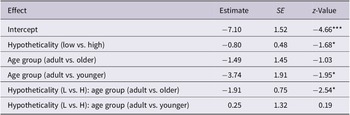
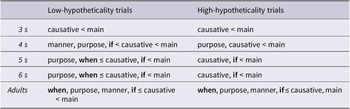
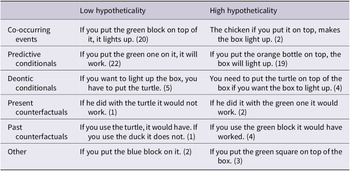
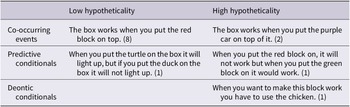

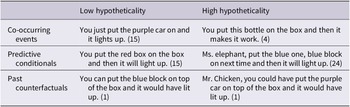
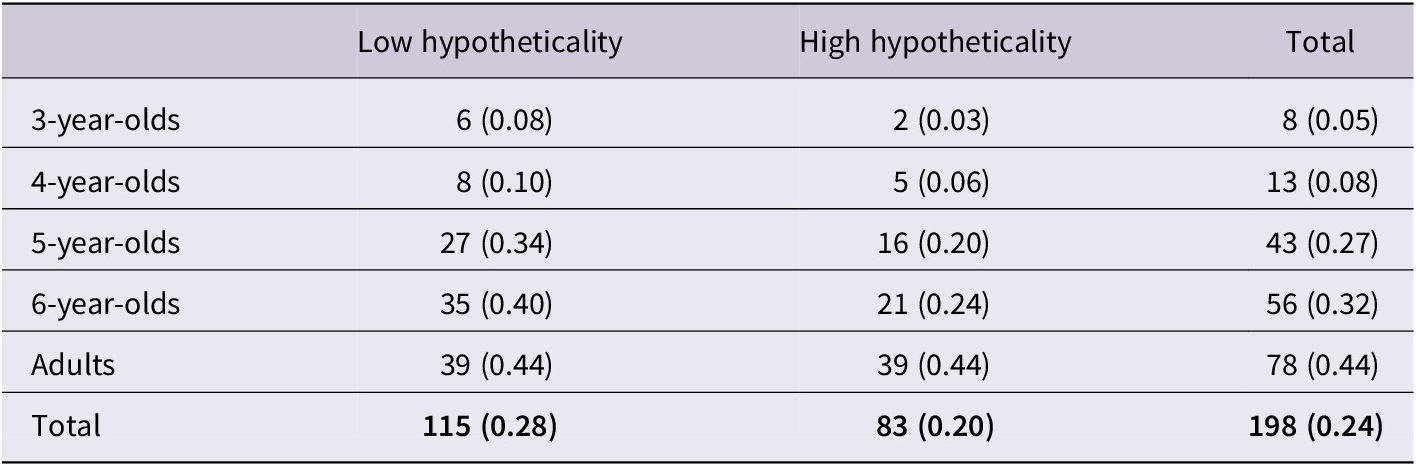
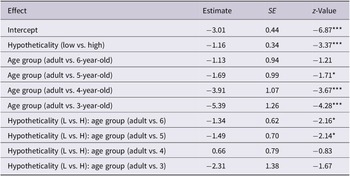

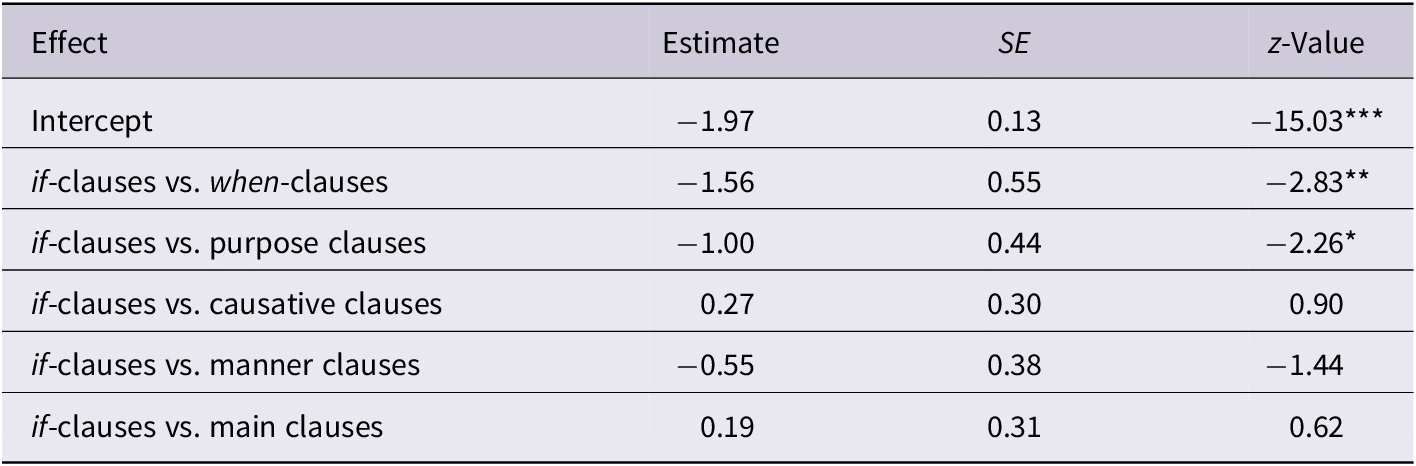
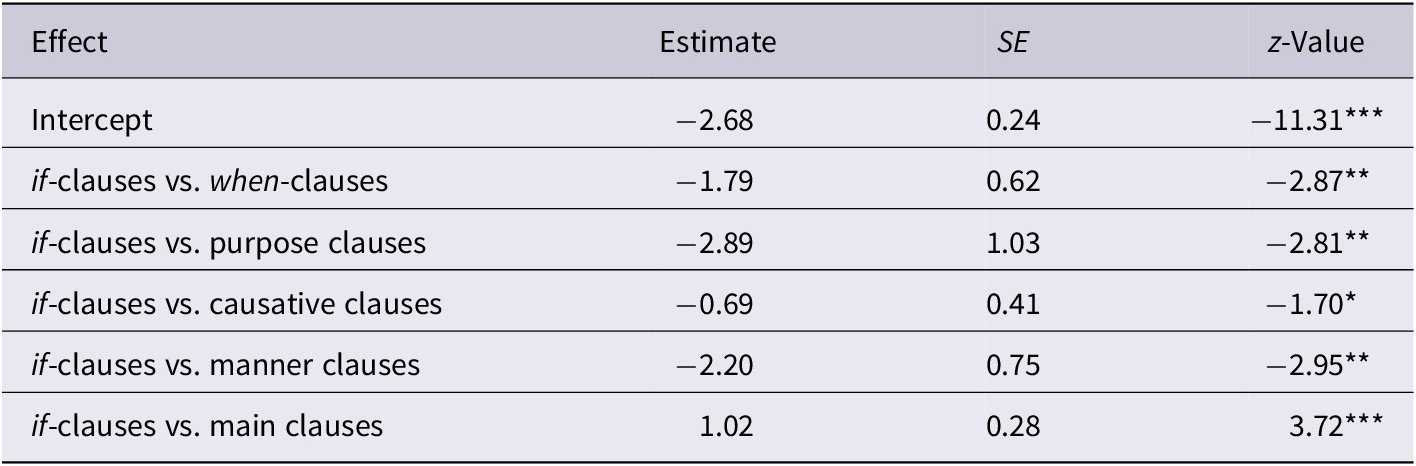
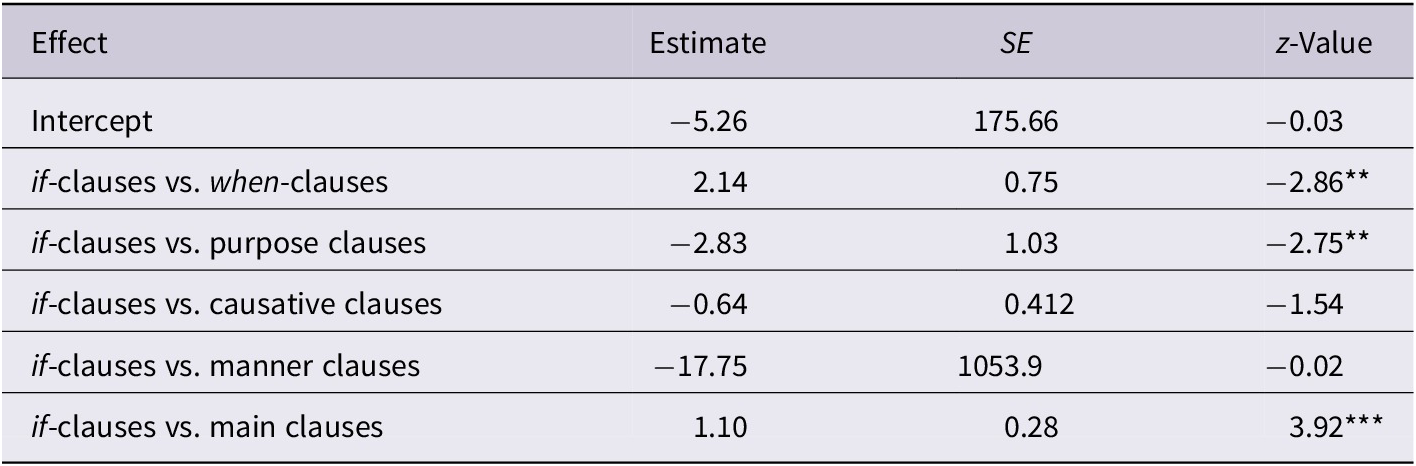
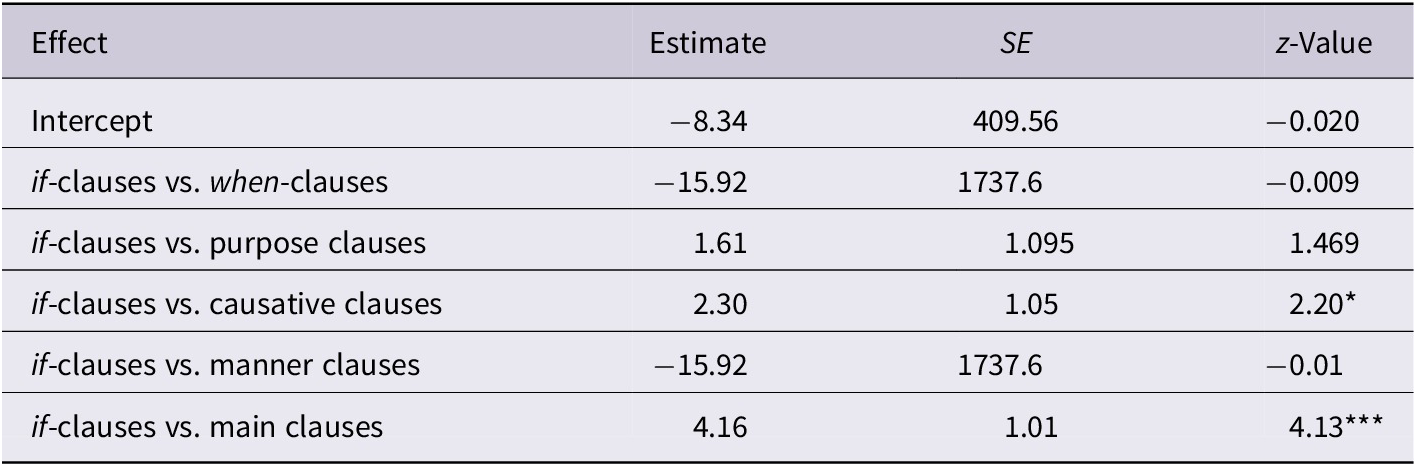
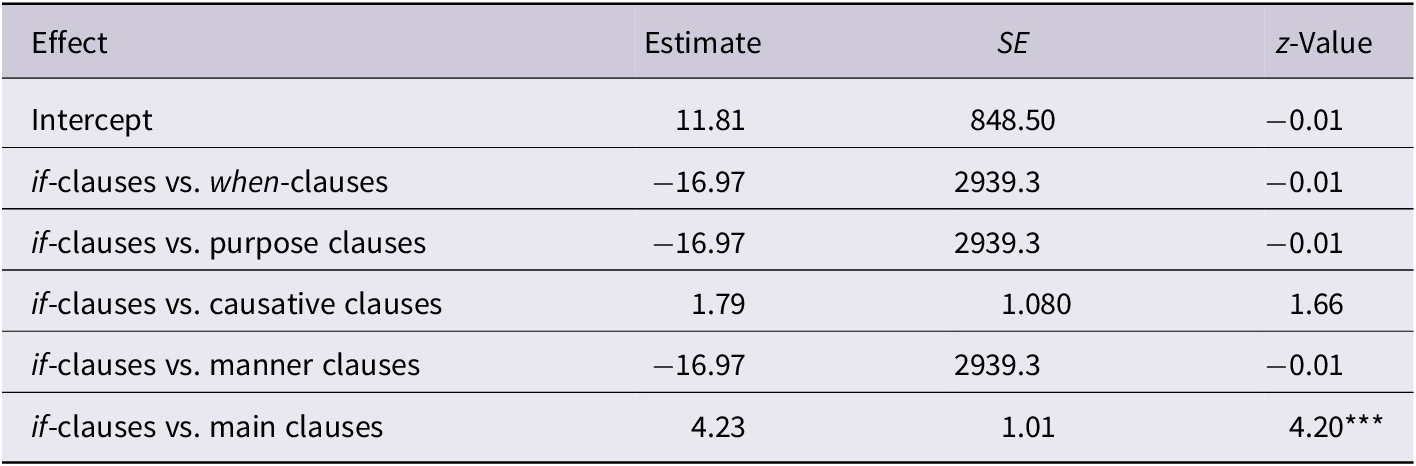
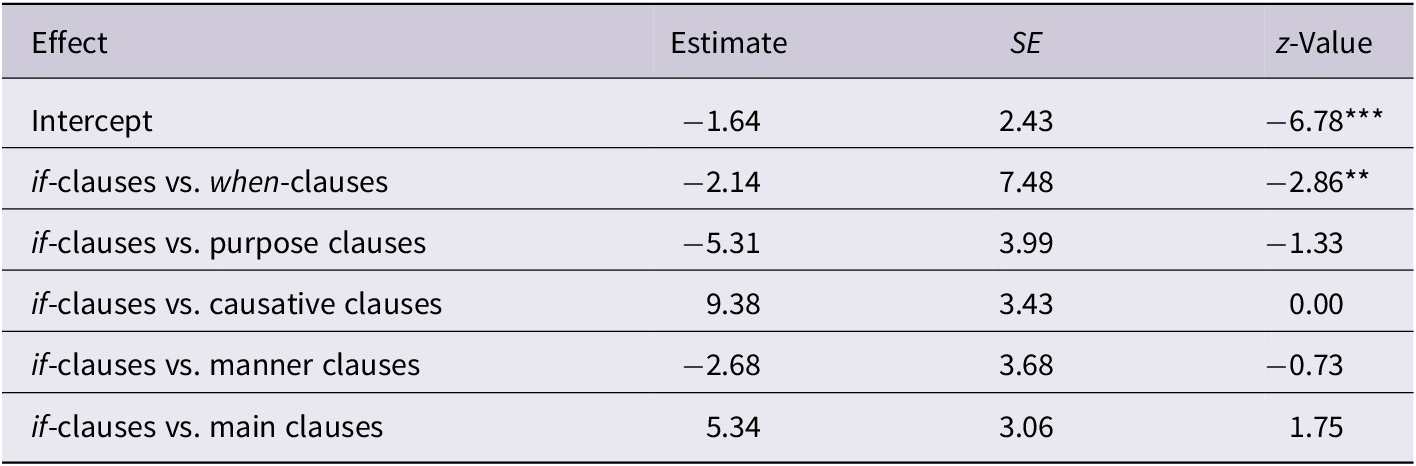
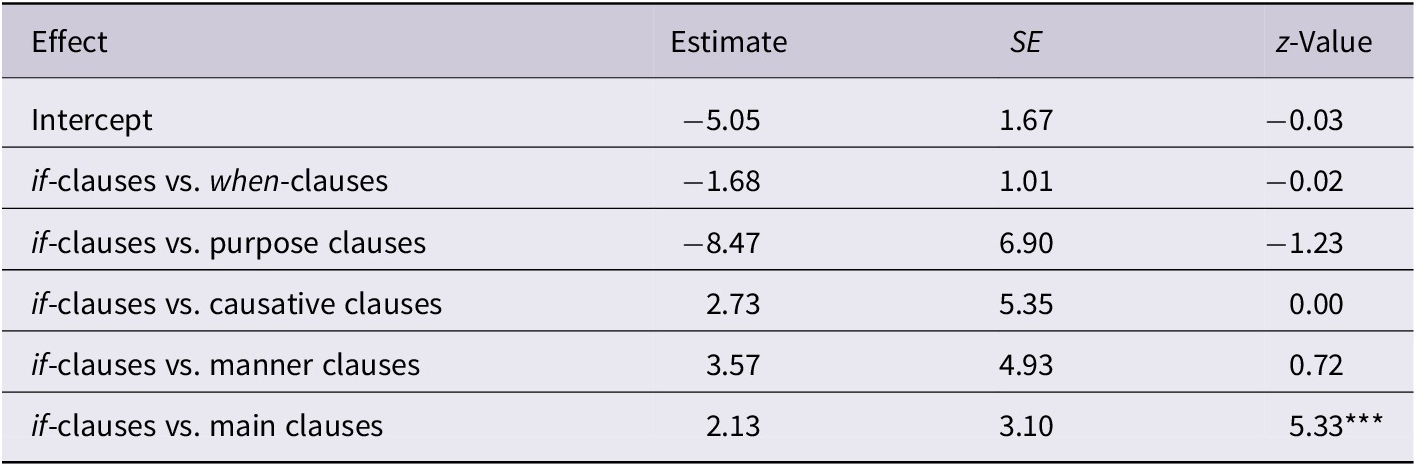
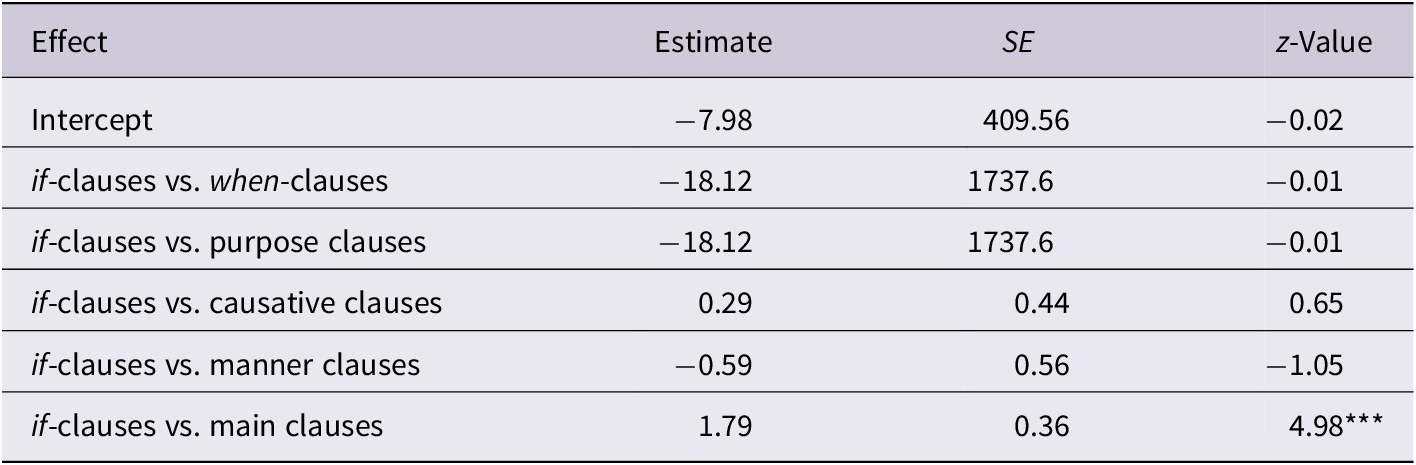
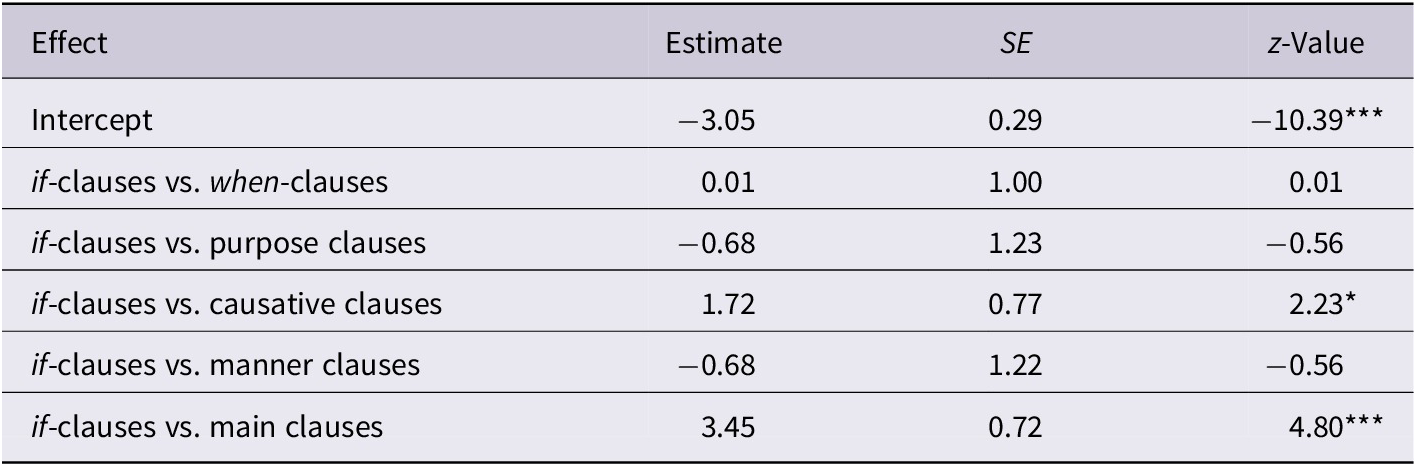


 Open access

