



The policy challenges arising from public health nutrition (PHN) and environmental sustainability problems are unprecedented. Dietary behaviours contribute to 1·4 billion people globally being overweight and obese( 1 ) and are implicated in fourteen of the top twenty determinants of global deaths( Reference Lim, Vos and Flaxman 2 ). Along with an increasing population size, dietary behaviours also place significant demands on the environment to provide a sufficient food supply. Relatedly, diminishing environmental resources( Reference Searchinger, Hanson and Ranganathan 3 ) and climate change threaten global food and nutrition security( 4 ) with reportedly 868 million people currently undernourished( 5 ).
These PHN and environmental sustainability problems are interconnected and share common dietary causes and solutions – a healthy diet is largely a sustainable diet( Reference Friel, Barosh and Lawrence 6 – Reference Milner, Green and Dangour 12 ). According to the FAO, sustainable diets are ‘those diets with low environmental impacts which contribute to food and nutrition security and to healthy life for present and future generations. Sustainable diets are protective and respectful of biodiversity and ecosystems, culturally acceptable, accessible, economically fair and affordable; nutritionally adequate, safe and healthy; while optimizing natural and human resources’( 13 ).
Public policy, as well as community and industry actions are required to achieve healthy and sustainable diets (HSD). Although the importance of incorporating environmental sustainability themes into PHN policy reference standards was recognised at least as far back as 1986( Reference Gussow and Clancy 14 ), it is relatively recently that calls for policy responses to redesign food systems to promote HSD have gained traction and become a focus for food policy( 4 , 13 , Reference Lang and Barling 15 ). A significant research investment investigating PHN and environmental sustainability problems is now underway and a substantial amount of evidence is emerging. However, PHN and environmental sustainability problems are classic examples of ‘wicked’ policy problems – they are complex and their causes and solutions are unclear and contested( Reference Hamm 16 ). There can be a lack of context to the collected data and uncertainty about their utility for policy making. Also, the substantial amount of evidence being generated and the pace at which it is being accumulated can be overwhelming to policy makers. The intractability of these challenges frequently results in food and nutrition policy activities being politicised and fragmented.
Policy formulation, which is the process of identifying and targeting policy solutions to policy problems( Reference Howlett 17 ), is a critical step in strengthening the evidence–policy relationship to promote HSD. Policy formulation research focuses on providing tools to strengthen communication between researchers and policy makers to promote evidence-informed policy making. A policy formulation tool is defined as ‘a technique, scheme, device or operation … which can be used to collect, condense and make sense of different kinds of policy relevant knowledge to perform some or all of the various inter-linked tasks of policy formulation’( Reference Turnpenny, Jordan and Benson 18 ).
The objective of the present research was to develop a policy formulation tool for strategically informing food and nutrition policy activities to promote HSD. The objective was achieved through the development of two complementary components. First, a conceptual framework of the environment–PHN relationship was constructed as a heuristic device to characterise the situation and conceptualise the HSD problem. Second, an ‘Orders of Food Systems Change’ schema was developed to operationalise the framework by helping identify, assess and prioritise policy options. The implications of the policy formulation tool for food and nutrition policy are discussed.
Method
The research objective was achieved by adapting Turnpenny and colleagues’ ‘five key tasks of policy formulation’: (i) characterisation of the current situation; (ii) problem conceptualisation; (iii) identification of policy options; (iv) assessment of potential policy options; and (v) proposing a specific policy design( Reference Turnpenny, Jordan and Benson 18 ). A policy formulation tool consisting of two complementary components was developed to address these policy formulation tasks. These components are well suited for helping the tool account for the ideological and contested nature of the policy-making process. First, a conceptual framework was constructed to organise thinking about the complex nature and scope of environmental and PHN problems and their causes (characterising the current situation; problem conceptualisation). Second, an ‘orders of change’ schema was adapted for a food systems context to analyse the ideological contexts and circumstances associated with the policy setting (identification of policy options; assessment of potential policy options; proposing a specific policy design).
The conceptual framework was developed from a narrative review of the PHN and food systems literature. The Orders of Food System Change schema was informed by a review of the literature on systems change dynamics and practices, where systems change is understood as an ‘intentional process designed to alter the status quo by shifting and realigning the form and function of a targeted system’( Reference Foster-Fishman, Nowell and Yang 19 ). The systems change literature covers many dimensions, including where to intervene in a system( Reference Meadows 20 ) and the degree of change for a system. In keeping with the identified theoretical insights for policy formulation tools, we adapted to a food systems context McLachlan and Garrett’s ‘Nutrition Change Strategies’( Reference McLachlan and Garrett 21 ) which itself is largely derivative of Pruitt and Waddell’s ‘Criteria for Distinguishing Orders of Change in Problem Solving Initiatives’( Reference Pruitt and Waddell 22 ). These strategies and initiatives organise policy activities around ‘first’-, ‘second’- or ‘third’-order change, distinguished by contrasting ideological perspectives on the type and extent of change needed to ‘solve’ a policy problem. The schema is intended to be applied to an analysis of the modern industrialised food system. The resulting schema shares common features with Garnett’s three perspectives on sustainable food security – (i) efficiency (first-order change); (ii) demand restraint (second-order change); and (iii) food system transformation (third-order change) – that also draw on different ideologies towards what is achievable and what is desirable in addressing this problem( Reference Garnett 23 ).
Results
The conceptual framework of the environment–public health nutrition relationship
The proposed conceptual framework comprises three integrated dimensions:
-
1. a structure built around a bidirectional relationship mediated via the food system;
-
2. internal mechanisms that operate through system dynamics; and
-
3. external interactions that influence the nature and scope of the framework within ecological parameters.
The structure of the framework
The structural dimension to the conceptual framework is depicted in Fig. 1. The environment and PHN coexist sharing a dynamic bidirectional relationship with the food system( Reference Friel, Barosh and Lawrence 6 ). In one direction (black arrows), the environment provides the resource supply, in the form of water, energy, soil, nutrients and biodiversity, as well as the climate that together influence the quantity, quality, composition, variety and safety of the food supply. The food supply and its consumption impact on PHN, as measured in terms of the population’s nutritional status( Reference Tait, McMichael and Hanna 24 – Reference Edwards, Dixon and Friel 26 ). In the other direction (grey arrows), PHN has a modest influence (thinner arrow) on food demand, particularly the type and amount of food selected. Food demand, in turn, has an influence on resource demand in the form of water, energy, soil, nutrients and biodiversity. Also, when demanded food is not consumed it results in food waste which has an indirect impact on resource demand because it represents an inefficient use of resources, and a direct impact on climate because it is a contributor to greenhouse gas emissions( Reference Vermeulen, Campbell and Ingram 27 ). This resource demand and wastage have a negative impact on environmental sustainability( Reference Garnett 28 , Reference Moomaw, Griffin and Kurczac 29 ).
Conceptual framework of the environment–pubic health nutrition relationship
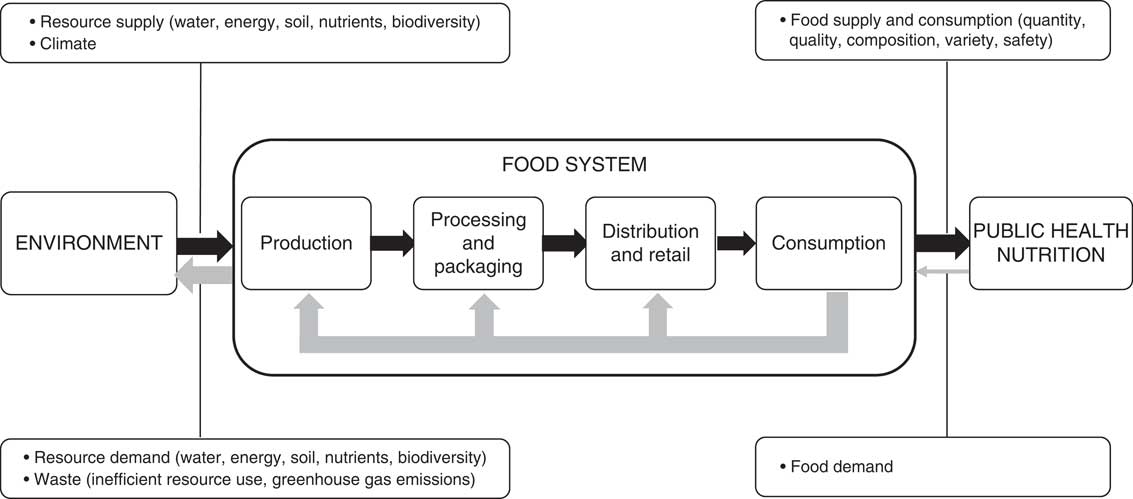
In both directions the relationship is mediated via the food system( Reference Lang 30 , Reference Kickbusch 31 ). The food system incorporates food production, processing and packaging, distribution and retail, and consumption. The application of food systems thinking to strategically plan, develop and evaluate food and nutrition policy was first proposed by Heywood and Lund-Adams( Reference Heywood and Lund-Adams 32 ), who articulated the concept and provided a simple framework consisting of four interlinked sub-components. Since then, food systems thinking has been advocated for policy action by many researchers( Reference Sobal, Khan and Bisogni 33 – Reference Rutten, Yaroch and Story 36 ), including those who have explicitly recommended using it to connect environment and PHN problems( Reference Lang 30 , Reference Kickbusch 31 , Reference Hammond and Dubé 37 – Reference Burlingame 39 ).
The internal mechanisms of the framework
The internal mechanisms of the conceptual framework are dependent on the operation of the food system through which the environment–PHN relationship is mediated. A system is understood in this context as an interconnected set of elements that is coherently organised in a way that achieves something( Reference Meadows 40 ). Systems thinking is used for strategic planning and evaluation in a variety of settings. Its ability to investigate complex policy problems means that it is particularly well suited to the analysis of PHN and environmental sustainability problems through its adaption to a food systems context.
The existence of multiple interrelationships within food systems means that synergies exist between health and environmental intermediates and outcomes. This has two contrasting ramifications. There may arise co-risks if an unstable system is not adjusted. Alternatively, there may be co-benefits if that system is stabilised. For example, shifting from the current Western-style diet to a relatively more plant-based diet is likely not only to be better for public health, but also lessen greenhouse gas emissions( Reference Friel, Dangour and Garnett 41 ).
The external interactions of the framework
The food system does not exist in isolation; instead it interacts with ecological, social, economic and political systems( Reference Hammond and Dubé 37 ). In the context of the environment–PHN relationship it is the external interactions between the food and ecological systems that are especially significant in influencing the nature and scope of the conceptual framework. This influence is exerted through the dynamics of the following three ecological parameters.
-
1. Physical limits on the food system. The food system operates within finite boundaries( Reference Rockstrom, Steffen and Noone 42 ) dictated by the physical constraints of resource availability and waste management as originally outlined by the Club of Rome’s landmark ‘Limits to Growth’ analysis of ecological systems( Reference Meadows, Meadows and Randers 43 ).
The food system’s role in mediating the environment–PHN relationship is finely balanced. Historically, although there have been fluctuations in the relationship’s stability, the environment has continually provided a food supply sufficient to nurture a critical number of people at least until reproductive age, and food consumption patterns have been compatible with environmental sustainability. Now, assessments are that the relationship is unbalanced and demands are overloading its resource capacity( Reference McMichael 44 ).
-
2. Complex interconnected relationships within the food system. The food system consists of a series of integrated components. The integrity of the system is dependent on functioning interconnected relationships between these components which in turn are determined by the exposure of each relationship component to a range of environmental and behavioural inputs and outputs. A fully operational relationship requires the functioning of a high level of multiple complex interrelationships within the system’s structure. These interrelationships operate through feedback loops and time delays and are unpredictable( Reference Hammond and Dubé 37 ). A change in one interrelationship can have complex flow-on effects impacting on other parts of the system.
An implicit assumption with many analyses is that there are linear responses to changes in one part of a system. Yet, as the likelihood of exceeding ecological thresholds and tipping points increases, the assumptions about linearity implicit in ecologically influenced systems become less certain. The complexity and fragility of systems, and their vulnerability to shocks and destabilising of their basic interrelationships, point to the possibility of non-linear responses and a ‘cascade of risks’( 45 ) rather than incremental adaptive responses.
-
3. Dynamic nature of the food system. The food system is a constantly evolving and adapting entity. Its resilience enables many changes in inputs and outputs to be accommodated to maintain the integrity of the system. However, if the underpinning ecological principles are disrupted, for example the finite limits are crossed or the internal relationships are unravelled, then it is inevitable that the system’s structure and operation will become unstable. The capacity to prevent, reverse or adapt to system degradation depends on the extent and pace of the disruption. An additional consideration with protecting the integrity of the environment–PHN relationship is the need for continuity of supply. Relatively brief shocks that might disrupt the food system for just a few months can be catastrophic as people’s nutritional reserves cannot extend beyond several weeks without replenishment. For example, Suweis et al.( Reference Suweis, Carr and Maritan 46 ) report that over the past two decades the resilience and stability of food systems have diminished as they have become increasingly susceptible to perturbations in demographic growth and the intensification of international food trade as more countries increase their reliance on food imports.
The interrelationships among the structure, internal mechanisms and external interactions of the conceptual framework (Fig. 1) are many and complex. For example, climate affects the structure and operation of the food system. The climate is changing with increased and unprecedented concentrations of carbon dioxide and ozone in the environment( 47 ) and recent significant temperature rises along with increased and more severe occurrences of extreme weather events( 48 ). These climate change measures can have adverse effects on food yield( Reference Challinor, Watson and Lobell 49 , Reference Ray, Gerber and MacDonald 50 ), quality( Reference Chakraborty and Newton 51 , Reference Battisti and Naylor 52 ), micronutrient( Reference Myers, Zanobetti and Kloog 53 ) and macronutrient( Reference Bloom, Burger and Kimball 54 ) composition, and safety( Reference Tirado, Clarke and Jaykus 55 ). These adverse effects on the food supply can, in turn, affect food security and PHN. Conversely, BMI is a proxy indicator of how PHN can place demands on the food system. Globally, 39 % of adults have a BMI classifying them as overweight or obese( 56 ). Overweight and obesity are proxy indicators of food overconsumption. In many countries, per capita caloric consumption is, on average, about 2092 kJ/d (500 kcal/d) greater than is needed nutritionally( 13 ). This overconsumption, in turn, has an adverse effect on carbon dioxide emissions as consumption of food beyond a person’s energy requirements represents an unnecessary demand on the production, processing and distribution of food. This adverse effect on carbon dioxide emissions can, in turn, affect climate change and the environment.
The data from this small number of examples indicate that relationships mediated by the food system are operating outside physical limits and into the future the integrity of the environment–PHN relationship will be increasingly ecologically unsustainable. Food systems are broken. Historically, food systems’ structures and operations have been subjected to continual variation in inputs and outputs; the difference in contemporary times is that the extent and pace of variations are destabilising the ecological balance of food systems.
The Orders of Food System Change schema
The Orders of Food Systems Change schema is presented in Table 1. The schema’s columns are organised around three orders of change for redesigning food systems. A first-order change relates to the need to compensate for and/or build resilience to existing HSD problems and that this outcome can be achieved by adjustments to individual components of the food system to improve their performance efficiency. A second-order change is organised around the need to reduce the risk of HSD problems arising and that this outcome can be achieved by reforming interactions among components within the food system. A third-order change relates to the need to promote the food system as a resource for HSD and that this outcome can be achieved by transforming the orientation of the food system as a whole.
The Orders of Food System Change schema
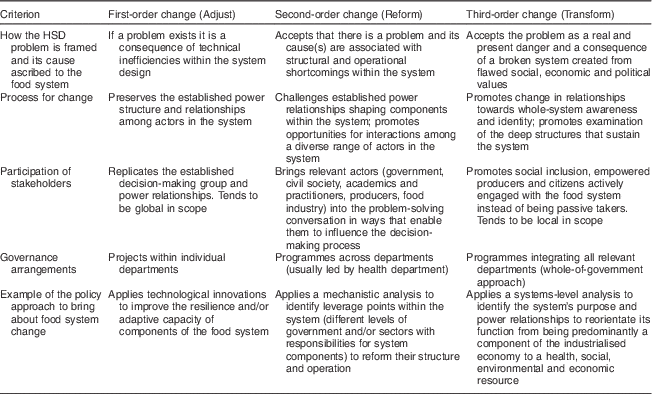
HSD, healthy and sustainable diet.
The schema’s rows specify details of the criteria that characterise the ideological distinctions between the three orders of food system change. These criteria are: (i) how the HSD problem is framed and its cause ascribed to the food system; (ii) the process for change; (iii) participation of stakeholders; and (iv) governance arrangements. An example of a policy approach to bring about food system change is also provided to illustrate each order of change.
Discussion
Food and nutrition policy activities are essential to redesign the structure and operation of the food system to promote HSD. The two components of the policy formulation tool work together to fulfil Turnpenny et al.’s five tasks necessary to strategically inform food and nutrition policy activities. How the combination of the conceptual framework and schema forms an integrated policy formulation tool to strengthen communication between researchers and policy makers to promote evidence-informed policy making is discussed below.
The conceptual framework is normative, proposing that there are structural, internal and external dynamics in the characterisation of the nature and scope of the environment–PHN relationship and conceptualising HSD problems. Structurally, the framework’s mapping of the food system within the environment–PHN relationship provides a point of reference to identify sectors and levels of governance that impact on the structure and operation of the food system.( Reference Sacks, Swinburn and Lawrence 57 ) It affirms the notion of identifying leverage points or strategic places to intervene within a system( Reference Meadows 20 , Reference West, Gerber and Engstrom 58 ). The framework highlights the need to recognise the nexus between food supply and food demand impacts on the operation of the food system and therefore the need for food policy activities to address these supply and demand components in a synchronised manner( Reference Bajzelj, Richards and Allwood 59 ). As Capone et al. comment, ‘Changes in both food consumption and food production are important to ensure more sustainable food systems and to achieve food and nutrition security. … Moving towards healthy and sustainable food consumption and production means addressing systemically the consumptive demand as well as productive supply’( Reference Capone, El Bilali and Debs 60 ). For example, a government health department might not only set a policy to promote healthy and sustainable food procurement practices in health-care settings( Reference Harvie, Mikkelsen and Shak 61 ) but also work to synchronise this policy activity with nutrition education activities to foster demand for healthy food in these same settings.
The framework’s internal mechanisms in terms of food systems thinking encourages policy practitioners to extend their analysis and framing of policy problems and solutions from immediate to distal causes and consequences. As Malhi et al. observe, ‘When tackling a complex problem, the tendency is to oversimplify the problem and the causal linkages or pathways that give rise to outcomes of interest. But for systems where variables have many inputs and outputs, and multiple interacting components create both balancing and reinforcing feedback loops, the outcomes of interest emerge from the system as a whole’( Reference Malhi, Karanfil and Merth 38 ).
The external interactions of the framework highlight that policy to change the food system can have flow-on effects to the ecological, political, economic and social systems and vice versa. For example, change in the food system that leads to food insecurity can result in civil unrest and affect the stability of the political system. Conversely, change in the political system may lead to civil unrest and result in food system instability and this can affect food security. These external interactions can become self-perpetuating.
The schema is the necessary complement to operationalise the conceptualisation of HSD problems by helping identify, assess and propose policy options. It is necessary because as the insights from the brief review of policy science theories highlighted, policy making is a political process. For example, the rapid assessment of just two sequences of linear relationships within the conceptual framework provided evidence that the integrity of the environment–PHN relationship is at risk, but there are contrasting ideological views on the cause of this risk and the preferred policy response. The schema’s three orders of change help to understand the characteristics of these ideological views and account for political realities in formulating policy activities.
Generally, interventions consistent with first-order changes that modestly adjust existing food systems to address specific problems are relatively uncontroversial and usually able to be decided upon and implemented more rapidly than interventions aligned with second- and third-order changes. Yet, many food policy researchers believe that framing HSD problems as isolated events and tackling with modest system adjustments misrepresents the complex multiple interactions within the environment–PHN relationship and promotes fragmented attempts to fix a complex problem. They often argue that the magnitude of the problem is sufficiently substantial and the need for a policy response so urgent, that second- or third-order food system changes are required to mitigate the cause of the problem and find a solution. For example, in relation to second-order change, Reisch et al. call for food system reforms by acting on the drivers of food production and consumption using integrative, cross-sectoral and population-wide policies( Reference Reisch, Eberle and Lorek 62 ). An example of third-order change thinking is contained in the International Panel of Experts on Sustainable Food Systems’ paper, ‘The New Science of Sustainable Food Systems’( 63 ) and in particular its analysis of the role of power imbalances in determining the way food systems operate. This analysis resonates with that of others calling for third-order change: for example, promoting the notions of ‘food democracy’, which Lang describes as ‘the demand for greater access and collective benefit from the food system’( Reference Lang 64 ), and food sovereignty( Reference Burlingame 39 ) through which local food producers and citizens are empowered to actively engage with the food system.
The reality is that strategically we may need a combination of all three orders of change. As Garnett has argued, there is a need to reorientate policy thinking away from pitting one order of change over another, to a situation in which insights from all three orders of change are considered in a coherent and nuanced approach( Reference Garnett 28 ). The balance among these different orders will vary with contexts, political feasibility, and economic and social circumstances in different regions of the world( Reference Albrecht, Johnson and Hamann 65 ). Unexpected shocks to the current system, furthermore, may result in rapid attitude shifts and lead to broad support for higher orders of change. For example, if a major disruption was to occur there may need to be greater investment in adaptive technological strategies such as novel food fortification interventions to protect food and nutrition security( Reference Millward and Garnett 66 ).
These contingencies indicate a range of policies from different orders of change are likely to be required at different points and in different contexts in seeking to redesign the food system to promote HSD. In the context of addressing food insecurity and poor nutrition Friel and Ford argue for policy that targets the systemic causes of these problems. This approach, which equally applies to shifting to a HSD, ‘has implications for economic, agriculture, food, social and health policy at the global, regional, national and local levels’( Reference Friel and Ford 67 ). In their analysis of policy options to tackle food and nutrition security, Qureshi et al. conclude that the effectiveness of such policies is determined by selecting the best ‘bundle’ of policy instruments (targeted at demand, access and supply) for the specific context and country to achieve goals and avoid perverse outcomes( Reference Qureshi, Dixon and Wood 68 ).
Strengths and limitations of the policy formulation tool
The policy formulation tool is novel, innovative, practical, problem-solving oriented and theory-driven. Its two individual components have their own inherent strengths. The conceptual framework extends the thinking presented in other food systems frameworks by locating the food system as the mediating variable within the bidirectional relationship between the environment and PHN. The schema helps account for political realities in policy making with its premise that the choice of which orders of change is less about evidence and more about reflecting the inevitable presence of ideology in decision making about the structure and operation of the food system. It is the combination of the framework’s organisation of the structure and operation of the food system and the schema’s capturing of ideological-based views that provides the high-level analysis necessary for the policy formulation tool to strategically inform policies to promote HSD.
The substantial size and complexity of the environment–PHN relationship and its multiple components and interrelationships mean that inevitably there may be limitations with the conceptual framework. The food system portrayed in Fig. 1 was a generic representation and cannot be expected to depict the diversity of interconnected local, national and regional food systems that vary in size, structure and operation. In addition, the need to simplify the dynamic nature of the food system meant that it was presented in isolation rather than interacting with many social, economic and political systems.
The orders of change framework has potential limitations. For example, there may be challenges in classifying some activities between categories. As Garnett comments, ‘these perspectives are not rigid and mutually exclusive. There will often be overlap between them and they are perhaps better viewed as ideological “tendencies” rather than closed belief systems’( Reference Garnett 23 ).
Conclusion
The 21st century food-related population health and environmental challenges are unprecedented in their nature, scope and scale. The conceptual framework helps orientate the multiple interconnected causes and consequences of environmental and PHN problems and these challenges. The schema helps account for political realities in policy making and is a key link to operationalise the framework’s concepts to policy actions aimed at redesigning food systems. In combination they provide a policy formulation tool for strategically informing food and nutrition policy activities to redesign food systems and promote HSD.
Acknowledgements
Acknowledgements: The authors would like to thank Julie Woods for her comments on earlier drafts of the paper. Financial support: This research received support from the Australian Research Council Linkage Project entitled ‘Modelling policy interventions to protect Australia’s food security in the face of environmental sustainability challenges’ (LP120100168). The funder had no role in the design, analysis or writing of this article. Conflict of interest: None. Authorship: M.A.L. led the conception and design of the research, the review and interpretation of the literature, and the drafting of the article; S.F., K.W., S.W.J. and S.C. contributed to the literature review and analysis, and the drafting of the article. Ethics of human subject participation: Not applicable.



