




Introduction
Prehistoric and medieval burials accompanied by weapons have been documented since the nineteenth century (e.g. Härke Reference Härke1990: 22; Treherne Reference Treherne1995: 105; Pedersen Reference Pedersen2014: 15). Varying spatially and temporally, the practice expresses both lived warriorhood and the aspiration to, or identification with, such status (e.g. Lindqvist Reference Lindqvist2004; Price et al. Reference Price, Hedenstierna-Jonson, Zachrisson, Kjellström, Storå, Krzewińska, Sobrado, Jokobsson and Götherström2019: 192). In the post-Roman period (c. AD 400–700), weapon burials became particularly widespread, with examples from the North Sea zone in the west to the Black Sea in the east (Steuer Reference Steuer1982; Halsall Reference Halsall1995; Härke Reference Härke, de Jong, Theuws and van Rhijn2001, Reference Härke2014; Hines & Bayliss Reference Hines and Bayliss2013). In Britain, burial with weaponry is attested from the Late Iron Age to the early medieval period (c. first century BC to the eleventh century AD) (Härke Reference Härke1990: 25; Harding Reference Harding2015)—and is particularly evident in early medieval England, where one in five furnished Early Anglo-Saxon male burials have weapons (Härke Reference Härke1990: 25). A martial ideology in this society is also known through Old English epic poetry such as Beowulf and The Battle of Maldon (Swanton Reference Swanton1978; Scragg Reference Scragg1991; Bazelmans Reference Bazelmans1999).
Weapon burials are rare in Ireland and northern Britain (e.g. O'Brien Reference O'Brien and Edwards2009: 136–38; O'Brien & Bhreathnach Reference O'Brien, Bhreathnach, Edmonds and Russell2011; Maldonado Reference Maldonado2013; O'Sullivan et al. Reference O'Sullivan, McCormick, Kerr and Harney2014: 283–99), but other categories of material evidence still testify to a warrior ideology and its materialisation in regionally specific ways. In Ireland, early medieval literature and law codes evidence and glorify the heroic behaviours of various warrior-leaders (Edel Reference Edel2015), including Cú Chulainn and Fergus mac Róich in the Táin Bó Cúailnge of the Ulster Cycle (Kinsella Reference Kinsella1969), and more generally in law codes such as the Críth Gablach (Kelly Reference Kelly1988: 19). While there are numerous early medieval historical references to sieges and battles in northern Britain, there are few surviving details concerning these encounters, or the mentality and ethos of the combatants (Alcock Reference Alcock2003: 144–45; for a comparative study, see Fraser Reference Fraser, Spiers, Crang and Strickland2012). The exception is a group of poems known as Y Gododdin (Koch Reference Koch1997; Clancy Reference Clancy1998: 46–78), which praises the warriors of a polity centred on the Forth to Tyne area, and portrays, around AD 600, a life of feasting, plundering and heroic death (Haycock Reference Haycock, Rekdal and Doherty2016). The ideals reflected in these texts indicate that, as in Anglo-Saxon England, the brave and successful warrior was accorded high social and ideological status in Ireland and northern Britain, although the scarcity, relative to that farther south, of graves with weaponry demonstrates that this ideology was materialised in different and regionally specific ways.
The Tulloch stone
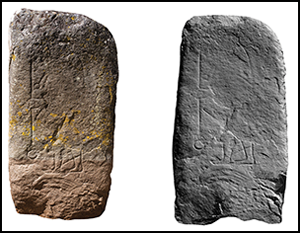
It is against the scant burial and textual records from northern Britain that we can set the recent discovery of a carved, weapon-bearing figure from eastern Scotland (Figures 1–2). In September 2017, a chance discovery provided a dramatic addition to the corpus of first-millennium AD representational art from Scotland (Hall Reference Hall2018: 10–11). During the construction of a new road on the north-west side of Perth, ground-clearance works uncovered a large monolith bearing, on one face, an incised human figure. The stone was found face down at approximately one metre below the ground's surface, in what appears to have been reconstituted ground from previous (unrecorded) development and landscaping in the area. The stone is a large, oblong, glacial erratic (Hall Reference Hall2018: 10), measuring 1.94m in height × 0.70m in width, and weighing approximately one tonne. The 1.02m-tall carving depicts a human figure holding a spear.
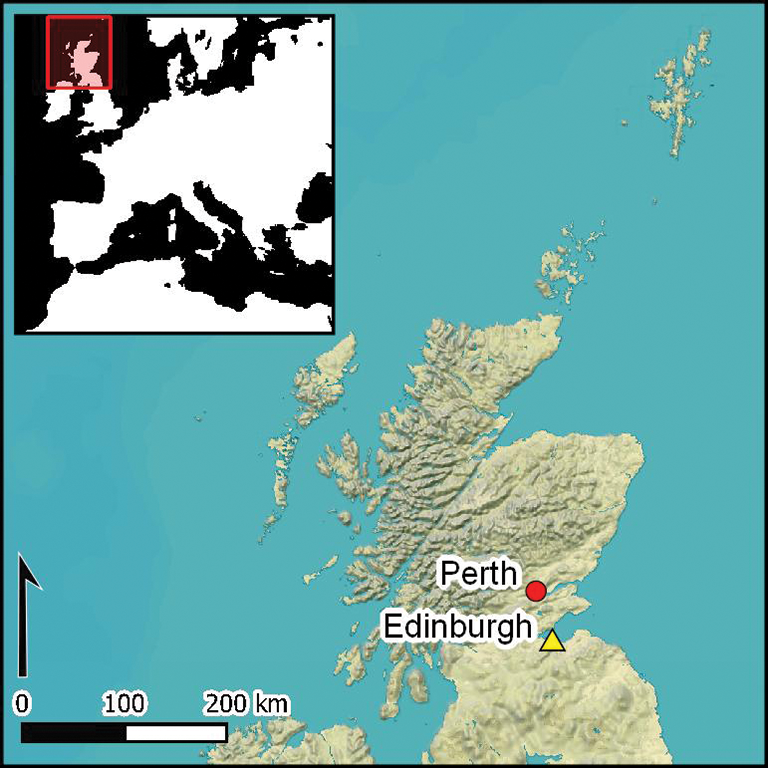
Location of the main sites discussed in the text (in green) and other weapon-bearing depictions on Pictish stones in eastern and northern Scotland, against the probable extent of Pictland (© Crown Copyright/database 2019, Ordnance Survey/EDINA).

The Tulloch stone: a) photogrammetric image; b) hillshade model; c) interpretation (figure credit: University of Aberdeen).

The surface of the stone has partially delaminated, and the carving is faint in places. Photogrammetry and 3D imaging, however, have clarified the original design (Figure 2) (see also the 3D models in the online supplementary material (OSM)). The figure carries in its right hand a spear with a kite-shaped blade and a doorknob-style butt. The individual's distinctive head shape probably indicates an elaborate hairstyle rather than a helmet or other headgear. The torso is robust and the buttocks pronounced; the naked appearance is ambiguous in that faint lines at the ankles may suggest footwear or tight leggings.
The stone was found on the edge of a glacial gravel mound or terrace in the grounds of the city crematorium (Figure 3). Construction of a nearby football stadium in the 1980s probably removed a significant portion of the mound or terrace on which the stone was found and probably displaced it from its original position. The only documented archaeological site in the immediate area is a ring-ditch recorded on an aerial photograph from 1977 (NRHE 2018, see https://canmore.org.uk/site/26740/newton), and seemingly destroyed when the stadium was built. The ring-ditch was approximately 10m in diameter, with no obvious entrance; associated cropmarks show a possible central feature that may have been a burial. Plotting the stone's findspot indicates that it probably stood near the perimeter of the ring-ditch before it was displaced (Figure 3).
Findspot of the Tulloch stone and an aerial photograph of a ring-ditch adjacent to the findspot (inset) (map © Crown Copyright/database 2019, Ordnance Survey/EDINA; image © Historic Environment Scotland, image SC 1706280).

The wider context
The discovery of the Tulloch stone brings into new relief a small number of similar stones depicting weapon-bearing figures from elsewhere in eastern and northern Scotland—all in areas that were once part of Pictland. The Picts, first recorded in late Roman sources (Hall Reference Hall2007: 3), went on to create the dominant polity of early medieval Scotland (Woolf Reference Woolf2007; Fraser Reference Fraser2009; Evans Reference Evans2014). A rich corpus of sculptured stones constitutes the most iconic remains associated with the Picts (Henderson & Henderson Reference Henderson and Henderson2004; Fraser Reference Fraser2008; Noble et al. Reference Noble, Goldberg and Hamilton2018). Carved stone monuments were erected from at least the fifth century AD, and probably as early as the third or fourth centuries AD. Their artistic peak is represented by a series of elaborately carved eighth- and ninth-century Christian cross-slabs (Henderson & Henderson Reference Henderson and Henderson2004; Noble et al. Reference Noble, Goldberg and Hamilton2018: 1341–42). While human figures are relatively common on cross-slabs, they are rare amongst the earlier examples of carved stone monuments. There are, nonetheless, a small number of parallels for the Tulloch carving.
The closest parallels are two incised figures: one from Rhynie (stone 3) in Aberdeenshire, the other from Newton of Collessie, Fife. The Rhynie figure (Figure 4) is carved on a 1.35m-high block of whinstone, and shows a human figure around 0.78m in height. As with the Tulloch and Collessie examples, this figure holds a spear with a doorknob-shaped butt and carries a rectangular shield. Logan's (Reference Logan1829: 56 & pl. V) illustration suggests that the figure may have worn a helmet, a long necklace or some other form of decorative item around the neck and a cloak, but the stone's condition makes it difficult to identify any of these features other than the neck adornment. As at Collessie, a symbol, or pair of symbols, may have accompanied the Rhynie warrior (Logan Reference Logan1829: 56; Fraser Reference Fraser2008: 38, fig. 43.3); only one is visible today, and is incomplete due to partial delamination of the stone (Figure 4). The symbol could have been an arch, or perhaps the ‘S’ or ‘ogee’ symbol found on a small number of stones, on cave walls at East Wemyss in Fife and on a silver chain from Parkhill, Aberdeenshire (Blackwell et al. Reference Blackwell, Goldberg and Hunter2017: fig. 8.5).
Rhynie stone (3): a) flash photography (© Michael Sharpe); b) hillshade model; c) interpretation (figure credit: University of Aberdeen).

The appearance of the Collessie carving is even more dramatic (Figures 5–7). When first identified in 1925, it was reported that the “sculpturings of an incised man and a narrow arch, now almost indecipherable” were present on the south-eastern face of a 2.74m-high monolith (Maxwell Reference Maxwell1933: 57). Positioned on the upper part of the upright stone, the 1.10m-tall human figure is naked and depicted walking to the left, holding a spear, and with distinctive hair or a head accoutrement that is reminiscent of the Tulloch carving. An arch symbol is located on an adjacent face (Figure 7). In 1993, a rubbing of the stone was interpreted as revealing a second symbol: a ‘Pictish beast’ (Lines Reference Lines and Batey1993: 30; Fraser Reference Fraser2008: 70). Photogrammetric survey by the authors, however, has identified a rectangular symbol similar to examples found on a number of Pictish symbol-bearing monuments from Angus to Shetland (Allen & Anderson Reference Allen and Anderson1903: 66). The photogrammetric survey also clarified some details: the figure is wearing a torc or some other neck adornment (Figure 7), the shield has a central boss; and the spear has a lozenge-shaped head and a doorknob-shaped butt that closely resembles the weapon carried by the Tulloch figure.
The Collessie stone: warrior figure (right) and symbol on adjacent face (left) (© Historic Environment Scotland, images DP 027894 and DP 027896).

The Collessie stone: a) photogrammetric image; b) slope model; c) interpretation (figure credit: University of Aberdeen).

Detail of photogrammetry showing the arch and rectangle symbols on the face adjacent to the warrior figure at Collessie (figure credit: University of Aberdeen).

Two further carvings of walking figures and a small group of axe-wielding figures also deserve consideration. A carving at Westerton, Angus, depicts part of a human figure in a pose similar to that described above. Mack (Reference Mack2007: 43) suggests that it may be another example of a warrior, although delamination of the stone has removed most of the carving, largely obscuring the figure (Fraser Reference Fraser2008: 62; see Figure S4 in the OSM). The carving known as the Balblair Stone (stone 1) from Kilmorack in Inverness-shire also shows a walking figure (Stuart Reference Stuart1867: 72; Allen & Anderson Reference Allen and Anderson1903: 95; Fraser Reference Fraser2008: 80) (Figure S4 in the OSM). Unlike the other carvings of walking figures, the Balblair individual is shown walking to the right, wearing a short tunic and carrying a club or staff rather than a spear. The stone is more modest in size (1.37m high and 0.61m wide; NRHE 2018, see https://canmore.org.uk/site/269922/balblair), and the carving is not as obviously martial in theme, suggesting perhaps a different social status for the figure depicted, or a different function for the stone. While there are examples of axe-wielding figures, including Rhynie (stone 7), Mail and Papil, Shetland, Golspie, Sutherland, and Glamis, Angus, these again differ from the spear-bearing figures, and perhaps signal yet another kind of status or societal role for these figures (Fraser Reference Fraser2008: 54, 98, 130–33; see discussion in Hall Reference Hall, Meller and Maraszek2013: 104; Noble et al. Reference Noble, Gondek, Campbell and Cook2013: 1147, Reference Noble, Gondek, Campbell, Evans, Hamilton, Ross and Taylor2019).
Discussion
The Tulloch figure is a remarkable addition to the small corpus of first-millennium AD martial imagery from northern Britain. While there is limited evidence for the original landscape context of the Tulloch stone, the location of the other examples is a useful guide. The Rhynie stone described above, for example, was found in the nineteenth century in association with a stone cairn, one of numerous cairns that Logan (Reference Logan1829: 56) reports as having stood just to the south of the modern village. Human remains, including burials within long cists, probably dating to the fifth to seventh centuries AD (cf. Maldonado Reference Maldonado2013: 6), were found nearby during nineteenth-century road-construction works through the village (Figure 8; RCAHMS 2007: 121).
Landscape context of Rhynie, with stones 2, 3 and 4 (map © Crown Copyright/database 2019, Ordnance Survey/EDINA).

Approximately 200m south, aerial photography in the 1980s revealed two large square enclosures. These were excavated in 2013, revealing two adjacent square barrows (Figure 8), one containing a partially preserved skeleton. Noble et al. (Reference Noble, Gondek, Campbell, Evans, Hamilton, Ross and Taylor2019) radiocarbon-dated the buried individual to cal AD 420–570 (SUERC-52935 1559±30 BP; MAMS-21252 1602±21 BP; 95% probability). The larger square enclosures were not burial monuments; they have been interpreted as playing a role during funerary ceremonies held at a major cemetery (Noble et al. Reference Noble, Gondek, Campbell, Evans, Hamilton, Ross and Taylor2019: 73). The enclosures resemble monuments found at other high-status Pictish sites and are also similar to a type of enclosure found in association with some Anglo-Saxon cemeteries (Blair Reference Blair1995; Mitchell & Noble Reference Mitchell and Noble2017: 17; Campbell et al. Reference Campbell, Driscoll, Gondek, Maldonado and Blackwell2019: 90–91). The cemetery at Rhynie may have been extensive, encompassing all the monuments described above, and perhaps extended farther south, as barrows have been recorded up to 500m away, along the route of the modern road (NMRS no. 80306).
The Newton of Collessie stone was also found close to a series of barrows identified by aerial photography and geophysical survey (Figure S3 in the OSM). The complex includes a massive square barrow—one of the largest such monuments yet identified at approximately 23m in diameter. Its shape, along with that of the associated monuments, is characteristic of those found within early medieval Pictish monumental cemeteries (Figure 9; Ashmore Reference Ashmore1980; Winlow Reference Winlow, Driscoll, Geddes and Hall2011: 341; Mitchell & Noble Reference Mitchell and Noble2017: 12 & 27). Less than a kilometre to the east lies another barrow cemetery, again of early medieval form. It comprises ten square and circular barrows of more modest, and more typical, dimensions that range between 6.50 and 10.50m in diameter (Figure 9). Given their similar landscape context, it seems probable that both the Rhynie and Newton of Collessie carved stones were erected in association with contemporaneous cemeteries. While the intensive development of the area that led to the redeposition and subsequent discovery of the stone makes it difficult to pinpoint the immediate findspot of the Tulloch example, it is perhaps telling that the Tulloch stone was found next to a now destroyed ring-ditch with a possible central burial (Figure 3).
Landscape context of Collessie, based on aerial photography from Historic Environment Scotland archives and geophysical survey by the University of Aberdeen (map © Crown Copyright/database 2019, Ordnance Survey/EDINA); see the OSM for geophysical survey results.

The landscape context of the stones and the objects depicted in the carvings can help to establish the chronology of these monuments. Images of humans are exceptionally rare in prehistoric Britain and particularly so in Scotland; representing the human form on carved stone monuments appears to have been developed through contact with the Roman world (e.g. Hunter Reference Hunter2007: 38–42). The cemeteries at Rhynie and Newton of Collessie are of a form closely dated to the fifth to early seventh centuries cal AD (Maldonado Reference Maldonado2013: 6; Mitchell & Noble Reference Mitchell and Noble2017: fig 15). More specifically, one of the square barrows at Rhynie has been directly dated to the fifth or early sixth century AD (Noble et al. Reference Noble, Gondek, Campbell, Evans, Hamilton, Ross and Taylor2019).
The objects carried by the figures shown on the stones can also help to refine the chronology of these carved stone monuments. All three of the weapons carried by the Tulloch, Collessie and Rhynie figures are of a distinctive type: doorknob-butted spears. The Rhynie and Collessie examples are relatively simple, with circular terminals added to the single incised lines of the spear shaft. The Tulloch example is more detailed, with the circular butt terminating in a flared end where it meets the base of the spear's shaft (which closely resembles surviving examples of the object). Writing in the early third century about the Maeatae and Caledonii who lived north of the Roman frontier, Cassius Dio (Roman History 76.12.3) referred to similarly shaped spears when he stated that they used “a short spear with a bronze apple on the end of the shaft” (Cary Reference Cary1927: 262 & 264; see also Mann & Penman Reference Mann and Penman1996: 40). In terms of actual archaeological objects that can be securely dated, examples of doorknob-butted spears have been found at several sites across Britain and Ireland (Heald Reference Heald2001: 689). Although the date for this type has traditionally been uncertain, in Scotland mould fragments from Loch na Beirgh, Lewis, have been found in a well-stratified sequence (Harding & Gilmour Reference Harding and Gilmour2000: 62–63; Heald Reference Heald2001: 689). The phase in which the moulds were found dates to cal AD 310–395 (68 per cent probability; see the OSM for the full model). Thus, these objects were certainly in circulation in the fourth century AD, and the context of other moulds from the Northern Isles of Scotland and finds from graves in southern England suggest that these objects were in use around the third to fifth or sixth centuries AD (Heald Reference Heald2001: 690). Given the dates of the spears depicted and of the associated cemeteries, it is probable that the spear-bearing figures were carved in the late Roman period or, perhaps more likely, in the immediate post-Roman period. The probable dating of these monuments places them of the first few centuries of a vibrant stone-carving tradition in areas that later became part of the early medieval Pictish kingdoms of north-east Scotland (Noble et al. Reference Noble, Goldberg and Hamilton2018: 1341–42).
What or whom do the carvings depict? It could be that the stones represented individuals buried in the associated cemeteries. Additional carvings may even name the individuals portrayed: photogrammetric survey on the Collessie stone, for example, has confirmed that there are two symbols on the stone: an arch and a rectangular symbol (Figure 7), two common motifs in Pictish sculpture (Allen & Anderson Reference Allen and Anderson1903: 64 & 66). Although the examples on Rhynie stone 3 are less certain due to degradation of the stone surface, there was at least one symbol carved below the feet of the armed individual. Our best understanding of the Pictish symbol tradition is that it was a form of writing, with limited syntax representing names (Samson Reference Samson1992; Forsyth Reference Forsyth and Henry1997; Lee Reference Lee2010; Lee et al. Reference Lee, Jonathan and Ziman2010). In this respect, the stones may have depicted specific individuals with the imagery highlighting the martial prowess—real or imagined—of the dead.
Despite the presence of the symbols that may have denoted names, we cannot be certain that these were actual individuals, either living or recently deceased. The symbols may represent the names of particular social groups, mythical heroes, ancestors or even gods. As noted, depictions of the human form are exceedingly rare before the Roman period (Ritchie Reference Ritchie2006: 1–2); the very act of carving representations of people into stone—a tradition that was largely without precedent in eastern Scotland—must have been a significant and powerful statement in itself, and underlines the importance of these rare images. Indeed, previous commentators have suggested that the Collessie figure may represent a warrior-god (e.g. Mack Reference Mack2007: 164). The rarity of such images certainly suggests that they were carved only in very special circumstances. The similarity in pose and weaponry may point to a more universal figure, such as a god or mythical/semi-mythical being, perhaps a generic hero, leader or a lesser deity, such as a royal guardian (including any crossover between them) (cf. Irby-Massie Reference Irby-Massie1999: 104–12; de Maret Reference de Maret and Insoll2011).
Other Pictish carvings of weapon-bearing figures have been argued to represent cult figures, their religious imagery underpinning the status of particular leaders and centres of power (e.g. Hall Reference Hall, Meller and Maraszek2013: 104; Noble et al. Reference Noble, Gondek, Campbell and Cook2013: 1147, Reference Noble, Gondek, Campbell, Evans, Hamilton, Ross and Taylor2019: 87). Given the dating evidence outlined above, Roman inspiration for the martial motifs is possible. An obvious Roman model might be Mars, the god of war, usually represented helmeted and sometimes with a spear and shield. Mars was frequently honoured across the Empire, but also inspired more localised deities and cults on its fringes, particularly around the northern frontier on Hadrian's Wall in Britain (e.g. Ross Reference Ross1967: 238 & 221–60; Irby-Massie Reference Irby-Massie1999: 99–100 & 104–12). Mercury is another possibility. Enright (Reference Enright1996: 169–282), for example, explores how a Mercury-inspired figure may have been the foundation of rebellious warrior-cults in the Rhineland and northern Spain in the second quarter of the first millennium AD. The figures on the stones in north-east Scotland, however, do not closely match those of either Mars or Mercury, and are distinctive in their own right. The nakedness of the Collessie (and possibly Tulloch) figure recalls classical tropes about barbarian warriors, a stereotype or actual practice that may have been embraced north of the frontier, and one that may have influenced the depiction of more locally inspired gods or hero-like figures (Whittaker Reference Whittaker1969: 358–61; see also Ritchie Reference Ritchie1994: 4–5).
It seems probable that the weapon-bearing figures from north-east Scotland, whether real, semi-divine or gods, were images that ultimately underlined the status, power and ideology of an elite. Across Northern Europe in the first millennium AD, sacral and martial imagery was used to underpin the new social and political hierarchies of the Late Iron Age and early medieval period (e.g. Enright Reference Enright1996; Hedeager Reference Hedeager, Dickinson and Griffiths1999: 151; Ringtved Reference Ringtved, Dickinson and Griffiths1999: 50; Price Reference Price2002). The Rhynie stone (3) came from a cemetery associated with a high-status central place, perhaps an early royal centre (Noble et al. Reference Noble, Gondek, Campbell and Cook2013: 1142, Reference Noble, Gondek, Campbell, Evans, Hamilton, Ross and Taylor2019). Although the original location of the Tulloch stone is uncertain, its findspot overlooks a later Pictish royal centre: the final stretch of the River Almond. Here lies the Roman fort of Bertha, which may have been Rathinveramon (the fort at the confluence of the Almond) where King Domnall mac Ailpín, King of the Picts, died in AD 862 (Woolf Reference Woolf2007: 104). At the same confluence, opposite Bertha and across the Tay, is Scone, the royal inauguration site of the medieval kingdom of Alba and later medieval Scotland (Woolf Reference Woolf2007: 134–38). Just five miles to the south-west of Tulloch is the site of the Pictish and later royal centre of Forteviot (Campbell et al. Reference Campbell, Driscoll, Gondek, Maldonado and Blackwell2019; Campbell & Driscoll Reference Campbell and Driscollin press). The Newton of Collessie stone is located less than a kilometre east of Collessie, the centre of a medieval parish and a pre-twelfth-century territorial unit (Taylor & Márkus Reference Taylor and Márkus2010: 45–46, 199–200, 211). Collessie includes the unusual lios place-name element that may denote the presence of an aristocratic residence or administrative centre, which is perhaps closer in meaning to the Welsh llys (‘court’ or ‘hall’) than the very common Old Gaelic les (generally meaning ‘enclosure’ or 'palisaded enclosure), as the Pictish names are rare but often used for later medieval parishes or secular centres (Taylor & Márkus Reference Taylor and Márkus2012: 426–28). While some of these associations rely on later historical significance rather than contemporaneous evidence, the well-contextualised Rhynie example at least shows that the carved stone figure at this site was situated within a landscape of elite power.
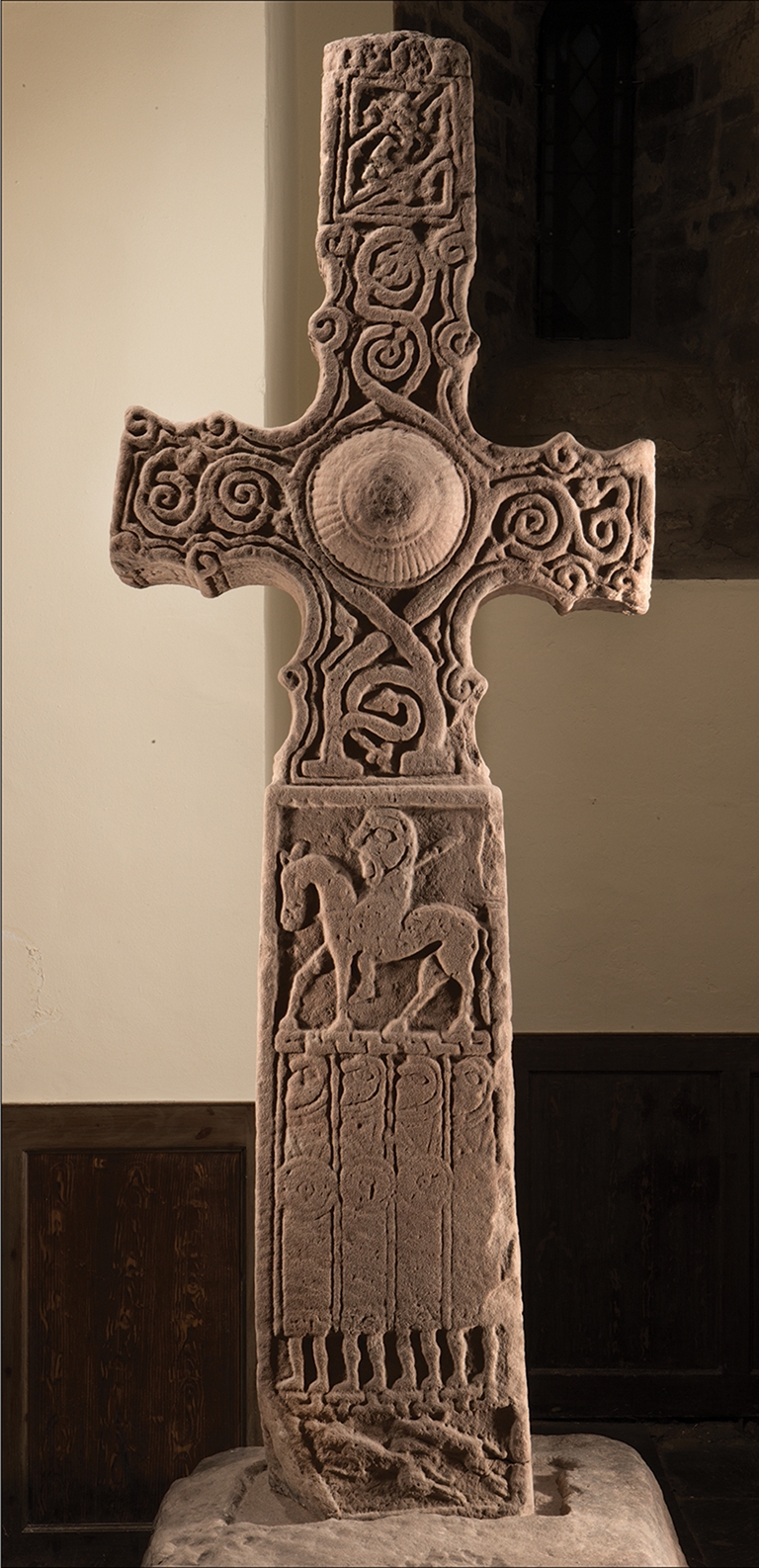
As elsewhere in Europe, war and warfare underpinned leadership in the late Roman and early medieval periods in northern Britain. Alex Woolf (Reference Woolf2007: 26) has highlighted that elites in early medieval northern Britain were first and foremost leaders in war, with leadership-in-conflict one of the main qualities sought amongst aspiring rulers. Images of armed figures are found throughout the Pictish corpus, with the Tulloch, Newton of Collessie and Rhynie stones early examples of a series of monuments with martial imagery that spanned at least five centuries. On Pictish cross-slabs of probable seventh- to ninth-century date, armed figures are also a common motif (e.g. Brough of Birsay, Orkney; Shandwick and Nigg, Easter Ross; Inchbrayock, St Vigeans and Kirriemuir, Angus; Fordoun and Mortlach, Aberdeenshire; Burghead, Moray; Edderton Churchyard, Easter Ross; and Dull, Benvie, Logierait and Dunkeld, Perthshire (Figure 1; Allen & Anderson Reference Allen and Anderson1903: 84, 138, 155, 247, 278, 284, 292; Fraser Reference Fraser2008: 22, 56, 90, 92, 114)). One of the most famous early medieval monuments from Scotland, from near Forteviot (Figure 10), shows a mounted leader, most probably King Constantín (c. AD 788–820), a powerful Pictish ruler (Forsyth Reference Forsyth and Bourke1995), carrying a spear, and below him his retinue, all armed with spears (Allen & Anderson Reference Allen and Anderson1903; Hall et al. Reference Hall, Driscoll, Campbell, Scott, Campbell and Driscollin press). By the ninth century, the imagery of a warrior king had been infused with Christian and Roman Imperial connotations (Henderson Reference Henderson1972: 158–60), but the iconography clearly had earlier roots traceable to the stones of Tulloch, Rhynie (3) and Collessie.
The Cross of Constantine, originally located near Forteviot, showing a mounted warrior, probably King Constantine, with a spear and his retinue below (© Historic Environment Scotland, image DP 245565).
Conclusions
While there are few documented Iron Age and early medieval burials with weaponry in northern Britain, the newly discovered Tulloch stone and its peers are striking materialisations of a martial ideology expressed in stone. In the late Roman period, the Picts were involved in many military confrontations with the Roman Empire, and, in the early medieval period, the warband became a fundamental part of social organisation (Fraser Reference Fraser2009: 43–63, Reference Fraser, Spiers, Crang and Strickland2012: 77–83). The weapon-bearing individuals shown on these stones may represent a war-oriented social organisation that was integral to resisting the Roman Empire and to creating the overtly hierarchical societies of the post-Roman period. The stones may have depicted individuals who were themselves warriors, or perhaps more abstractly, a martial ethos embodied and legitimised by invoking a mythical hero, ancestral figure or god. While these figures can be viewed as part of a broader European phenomenon most commonly identified through the practice of depositing weapons with the dead, in north-east Scotland, martial values were conveyed in a very public fashion on carved stone monuments. They were probably associated with important cemeteries that may have belonged to elite groups. New finds such as the Tulloch figure have much to reveal about the regionally specific deployment of a warrior ethos in late Roman and post-Roman Europe.
Acknowledgements
Our thanks to the finders of the Tulloch stone, Brice Prentice and Alex Campbell, for their prompt reporting of it, and to Balfour Beatty for their support in transporting it. Our thanks are also due to the colleagues who attended two workshops at Perth Museum to discuss the discovery. Simon Gilmour provided access to radiocarbon information on Loch na Beirgh. Aberdeenshire Council and Historic Environment Scotland gave permission to excavate around the base of the Rhynie stone (3), the excavations being supported by the University of Aberdeen Development Trust and Historic Environment Scotland. The writing of this article was supported by a Leverhulme Trust Research Leadership Award (RL-2016-069; PI Gordon Noble).
Supplementary material
To view supplementary material for this article, please visit https://doi.org/10.15184/aqy.2019.214


 Open access

