





1. Introduction
One characteristic of language abilities involves the formation of sentences according to statistical regularities present in the input (Ambridge, Reference Ambridge2013). In the field of cognitive linguistics, this ability has been formalized as “statistical preemption,” a cognitive mechanism that enables speakers to distinguish unconventional expressions from well-established, conventional alternatives based on the probabilistic tendencies underlying the combination of linguistic components (Ambridge et al., Reference Ambridge, Bidgood, Twomey, Pine, Rowland and Freudenthal2015; Boyd & Goldberg, Reference Boyd and Goldberg2011; Clark, Reference Clark and MacWhinney1987; Ellis, Reference Ellis2002; Goldberg, Reference Goldberg2006; Perek & Goldberg, Reference Perek and Goldberg2015; Perek & Goldberg, Reference Perek and Goldberg2017; Robenalt & Goldberg, Reference Robenalt and Goldberg2015). While this mechanism works well in first language (L1) acquisition, its operation in second language (L2) acquisition remains less known. For example, L1 English speakers readily accept conventional sentences, such as He explained the lesson to me, while rejecting unconventional expressions, such as He explained me the lesson. In contrast, adult L2 learners often display a reduced ability to detect anomalies in sentences that, while semantically plausible, deviate from the patterns typically favored by L1 speakers (e.g., Ambridge & Brandt, Reference Ambridge and Brandt2013; Goldberg, Reference Goldberg2019; Robenalt & Goldberg, Reference Robenalt and Goldberg2016; Kang, Reference Kang2017; Sonbul et al., Reference Sonbul, El-Dakhs, Conklin and Carrol2023; Tachihara & Goldberg, Reference Tachihara and Goldberg2020; Zhang & Mai, Reference Zhang and Mai2018).
The current study aims to enhance our understanding of the mechanisms underlying statistical preemption in L2 learning by investigating L2 learners’ ability to differentiate between conventional and unconventional expressions during sentence judgment and real-time sentence processing. We adopt two interrelated hypotheses regarding the use of statistical preemption in L2 contexts as our theoretical frameworks: the noisy representations account (Tachihara & Goldberg, Reference Tachihara and Goldberg2020) and the noisy channel model (Futrell & Gibson, Reference Futrell and Gibson2017). Both models posit that language experience is a driving force in the L2 acquisition of verb usage in sentence formulations. However, the noisy representation account addresses the general aspects of learners’ linguistic systems, whereas the noisy channel model pertains specifically to language processing. Specifically, the noisy representations account suggests that the linguistic information stored in the mental representations of L2 learners tends to be ambiguous and noisy due to insufficient and diffuse L2 input and the influence of their L1, causing uncertainty when assessing the acceptability of unconventional sentence formulations. Extending the notion of noisy representation to L2 processing, the noisy channel model posits that L2 learners, due to their weak and noisy memory traces of form–meaning associations in linguistic information, encounter difficulties in accurately recalling and applying the syntactic probability of utterances in real-time L2 use.
Previous studies have provided substantial evidence of vague and noisy representations in L2 learners, primarily through offline sentence judgment tasks (e.g., Ambridge & Brandt, Reference Ambridge and Brandt2013; Robenalt & Goldberg, Reference Robenalt and Goldberg2016; Tachihara & Goldberg, Reference Tachihara and Goldberg2020). However, it remains less clear whether this pattern extends to real-time sentence processing. Offline tasks such as acceptability judgments are presumed to tap into learners’ explicit knowledge (Ellis, Reference Ellis2005). However, these tasks, which evaluate learners’ untimed knowledge of grammatical constraints, do not fully inform how learners apply their grammatical knowledge during real-time processing. In contrast, online tasks such as self-paced reading are proposed to assess more implicit or automatized knowledge (Jiang, Reference Jiang2007). Such tasks allow for temporally sensitive investigations into learners’ application of processing strategies and comprehension dynamics. Given the well-documented differences in L2 performance between offline and online tasks (e.g., Ellis, Reference Ellis2005; Grüter, Lew-Williams, & Fernald, Reference Grüter, Lew-Williams and Fernald2012; Suzuki & DeKeyser, Reference Suzuki and DeKeyser2017), further exploration is necessary to understand how the purported effect of noisy representations manifests during L2 sentence processing. In particular, building upon previous findings that L2 learners experience difficulty in detecting grammatical errors during real-time processing (e.g., Jiang, Reference Jiang2007; Jiang, Novokshanova, Masuda, & Wang, Reference Jiang, Novokshanova, Masuda and Wang2011), our study investigates whether such tendencies extend to the sensitivity to the syntactic probability of utterances during L2 processing, an underexplored issue in cognitive linguistics.
Another issue to consider is the presence of additional variables that may contribute to the status of L2 representations of sentence formulations, particularly those related to a learner’s language experience. Recent research indicates that repeated exposure to conventional expressions can enhance L2 learners’ sensitivity to the unacceptability of unconventional formulations (Tachihara & Goldberg, Reference Tachihara and Goldberg2022, Reference Tachihara and Goldberg2024). This finding suggests that the L2 learning experience may play a significant role in shaping L2 learners’ memory of utterances, which may potentially extend beyond offline sentence judgments to online processing. Additionally, L2 proficiency is another potentially influential factor. Previous research suggests that the probabilistic knowledge of verb–construction association in L2 speakers becomes more fully entrenched as L2 proficiency increases (e.g., Ellis & Ferreira-Junior, Reference Ellis and Ferreira-Junior2009; Kim, Shin, & Hwang, Reference Kim, Shin and Hwang2020; Robenalt & Goldberg, Reference Robenalt and Goldberg2016; Tachihara & Goldberg, Reference Tachihara and Goldberg2020; Zhang & Mai, Reference Zhang and Mai2018). Despite these insights, however, the impacts of language learning experience and L2 proficiency on the L2 processing of conventional and unconventional sentence formulations remain underexplored.
To address these questions, the current study conducted two experiments to examine the extent to which L2 learners can distinguish unconventional formulations in English dative constructions (e.g., Amber explained Zach the answer) from their conventional competing alternatives (e.g., Amber explained the answer to Zach). This study also examined the effect of the L2 learning experience by comparing two groups of college students: those learning English as a Foreign Language (EFL) and those learning English as a Second Language (ESL). Through these investigations, the current study aims to ascertain whether the influence of noisy representations manifests not only in offline sentence judgments but also in L2 sentence processing. In addition, it seeks to explore whether factors related to language experience can modulate the status of L2 representations in the context of L2 processing.
2. Noisy representations in L2 sentence comprehension
One of the essential linguistic abilities required for comprehending sentence formulations involves the integration of a verb and an argument structure construction (Bybee, Reference Bybee2010; Goldberg, Reference Goldberg1995, Reference Goldberg2006; Tomasello, Reference Tomasello2003). An argument structure construction (hereafter referred to as a “construction”) is defined as a clause-level unit that carries its own meaning in a distinct structure (Goldberg, Reference Goldberg1995, Reference Goldberg2006). Through the integration of a verb and a construction, L1 speakers show the flexibility of their language abilities in understanding and producing a wide array of sentences, including those containing verbs without certain argument roles or with less specific semantic content (e.g., Ambridge, Pine, Rowland, & Young, Reference Ambridge, Pine, Rowland and Young2008; Kako, Reference Kako2006).
Crucially, speakers do not arbitrarily combine verbs and constructions in entirely novel ways. Instead, their integration is constrained by statistical regularities, specifically how frequently a verb co-occurs with a construction (Ambridge et al., Reference Ambridge, Bidgood, Twomey, Pine, Rowland and Freudenthal2015; Boyd & Goldberg, Reference Boyd and Goldberg2011; Ellis, Reference Ellis2002; Robenalt & Goldberg, Reference Robenalt and Goldberg2015). For instance, English speakers use productive verb–construction combinations such as Mike busted me some fries. However, they reject unconventional combinations such as Mike explained me the story due to the presence of the conventional competing forms, such as Mike explained the story to me. This probabilistic learning mechanism, formalized as statistical preemption (Ambridge et al., Reference Ambridge, Bidgood, Twomey, Pine, Rowland and Freudenthal2015; Boyd & Goldberg, Reference Boyd and Goldberg2011; Clark, Reference Clark and MacWhinney1987; Goldberg, Reference Goldberg1995, Reference Goldberg2006, Reference Goldberg2019), underscores L1 speakers’ nuanced understanding of the probabilistic distribution that constrains the co-occurrence of verbs and constructions, a sensitivity fine-tuned through extensive language experience. According to statistical preemption, a language speaker notices the acceptability of a certain formulation when it repeatedly appears in a given context (e.g., Mike explained me the story) where the speaker might have expected an alternative formulation with similar meanings (e.g., Mike explained the story to me). This information functions as indirect negative evidence, enabling the speaker to reject unconventional formulations. Conversely, in the absence of conventional and regular patterns, speakers readily accept novel formulations (e.g., Mike busted me some fries).Footnote 1
Unlike native speakers, L2 learners often exhibit a reduced ability to take advantage of statistical preemption. For example, Tachihara and Goldberg (Reference Tachihara and Goldberg2020) assessed L2 learners’ sensitivity to unconventional verb–construction formulations, such as Amber explained Zach the answer, in comparison to L1 English speakers. In their study, L2 learners with various L1 backgrounds, who had moderate proficiency levels (self-rated), participated in a series of tasks involving acceptability judgment, production, and verbatim recognition. The results showed that L2 learners were less likely than L1 speakers to reject unconventional sentences in acceptability judgment tasks. In addition, these learners demonstrated a limited ability to provide more conventional paraphrases of their unconventional counterparts in production. These findings suggest their diminished sensitivity to statistical regularities associated with verb–construction combinations (see Robenalt & Goldberg, Reference Robenalt and Goldberg2015, for similar findings). Tachihara and Goldberg attributed this diminished effect of statistical preemption in L2 speakers to nosier and less stable linguistic representations compared to those of L1 speakers. According to their account of noisy representations, L2 learners typically receive a limited amount of input in restricted contexts, such as classroom settings, and constantly experience interference from their L1 activation, resulting in unclear linguistic representations.
Consistent with the noisy representations account, Futrell and Gibson (Reference Futrell and Gibson2017) proposed the noisy channel model. This model posits a significant difference in the memory storage of L1 speakers and L2 learners. Specifically, it assumes higher noise rates in the memory traces of L2 learners, stemming from their fundamentally distinct processes of experiencing and remembering linguistic information. Unlike L1 speakers, L2 learners constantly encounter noises in their L2 input, comprising diffuse and skewed linguistic information obtained from classroom settings and interference from their L1 activation. Consequently, the noisy channel model predicts increased uncertainty among L2 learners when evaluating the probabilistic tendencies of certain combinations of a verb and a construction, particularly during real-time language use.
The reduced ability of L2 learners to extract regular patterns in linguistic formulations leads to a specific prediction regarding their integration of verbal and constructional information during online processing. Considering L2 learners’ limited exposure to the target language and their noisier constructional representations in the L2 (Futrell & Gibson, Reference Futrell and Gibson2017; Robenalt & Goldberg, Reference Robenalt and Goldberg2016; Tachihara & Goldberg, Reference Tachihara and Goldberg2020), it is expected that they will encounter difficulty in detecting erroneous combinations of a verb and a construction like Amber explained Zach the answer, processing them in a manner similar to conventional sentences like Amber explained the answer to Zach.
3. Influential factors in the integration of a verb and a construction during processing
The role of noisy representations in L2 learners may be modulated by a number of additional factors related to language experience. One such factor is exposure to L2 input. Given that the weakened effect of statistical preemption in L2 learners results from insufficient and inconsistent L2 input (Futrell & Gibson, Reference Futrell and Gibson2017; Robenalt & Goldberg, Reference Robenalt and Goldberg2015; Tachihara & Goldberg, Reference Tachihara and Goldberg2020), their sensitivity to statistical regularities of sentence formulations could be improved with extensive language experience (e.g., Tachihara & Goldberg, Reference Tachihara and Goldberg2022, Reference Tachihara and Goldberg2024). Drawing upon these insights, the current study predicts that L2 learning contexts will exert a significant influence on L2 learners’ sensitivity to sentence formulations.
The impact of language learning contexts on L2 learning and use is well illustrated by two distinctive groups of English learners, EFL and ESL learners (Kachru, Reference Kachru, Quirk and Widdowson1985). A key distinguishing feature between these groups lies in the quantity and quality of L2 input they receive. In the ESL context, learners often encounter numerous opportunities for daily exposure to a variety of L2 inputs in different social settings (Barrot & Gabinete, Reference Barrot and Gabinete2021). In contrast, EFL learners have limited experience with English, primarily within a classroom setting, with most of their L2 input derived from textbooks and limited exposure to spoken language (Barrot & Gabinete, Reference Barrot and Gabinete2021). The repercussions of this contrast are evident in previous studies demonstrating that L2 learners with extensive naturalistic exposure exhibit more structure-based processing compared to learners with classroom exposure (e.g., Dussias, Reference Dussias2003; Frenck-Mestre, Reference Frenck-Mestre, Altarriba and Herridia2002; Pliatsikas & Marinis, Reference Pliatsikas and Marinis2013). Based on these findings, one might expect significant differences in the sensitivity to conventional and unconventional sentence formulations during L2 processing between EFL and ESL learners, with the performance of ESL learners aligning more closely with that of L1 English speakers.
In tandem with language learning contexts, L2 proficiency is considered an important indicator of one’s L2 experience. Several studies have demonstrated an enhanced ability in L2 learners to efficiently integrate verbal and constructional information as their proficiency increases (e.g., Ellis & Ferreira-Junior, Reference Ellis and Ferreira-Junior2009; Kim et al., Reference Kim, Shin and Hwang2020; Kyle & Crossley, Reference Kyle and Crossley2017). Furthermore, L2 learners with higher proficiency are found to exhibit greater sensitivity in distinguishing unconventional expressions from conventional competing alternatives (e.g., Tachihara & Goldberg, Reference Tachihara and Goldberg2020; Zhang & Mai, Reference Zhang and Mai2018). Within the domain of L2 processing, proficiency is consistently recognized as a crucial factor influencing L2 sentence processing patterns (e.g., Omaki & Schulz, Reference Omaki and Schulz2011; Sagarra & Herschensohn, Reference Sagarra and Herschensohn2010; Witzel, Witzel, & Nicol, Reference Witzel, Witzel and Nicol2012). Therefore, it is plausible that increased proficiency enables L2 learners to better detect anomalies in unconventional expressions during sentence processing.
Another factor to consider is the influence of learners’ L1 knowledge. Ample evidence indicates that constructions formed similarly across learners’ L1 and L2 can facilitate the acquisition and processing of those constructions in the L2 (e.g., Kim, Chen, & Liu, Reference Kim, Chen and Liu2022; Oh, Reference Oh2010; Tokowicz & MacWhinney, Reference Tokowicz and MacWhinney2005; Whong-Barr & Schwartz, Reference Whong-Barr and Schwartz2002). Relevant to our current focus, the English dative construction demonstrates distinct patterns in its association with verbs compared to those in Korean and Tagalog, the native languages of the learners examined in this study. Like English, Korean allows for syntactic alternation between a double-object form and a postpositional dative form when the verb conveys a benefactive meaning (O’Grady, Reference O’Grady1991; Song, Reference Song1993). However, the postpositional dative is much more frequent than the double-object form (Choi, Reference Choi2009). Also, unlike English, the dative alternation in Korean is indicated by differential case markers attached to a recipient without changing word order. Consider (1), for example.

Tagalog also exhibits a dative alternation between a double-object and prepositional dative form (Rackowski, Reference Rackowski2002). Unlike Korean, Tagalog involves changes in word order during dative alternation, as exemplified in (2).

While the syntactic and semantic characteristics of dative constructions in Korean and Tagalog show notable differences, a comprehensive explanation of these distinctions lies beyond the scope of this study. For a detailed analysis, see O’Grady (Reference O’Grady1991) and Song (Reference Song1993) for Korean dative constructions and Rackowski (Reference Rackowski2002) for Tagalog dative constructions. This study does not aim to compare specific L1 transfer effects of Korean and Tagalog. Crucially for the focus of the current study, both languages allow dative alternation regardless of the verb used, which contrasts with English, where the distribution of dative forms is more verb-specific, particularly with respect to the verbs selected for this study.Footnote 3 This cross-linguistic variation suggests that Korean and Tagalog speakers are unlikely to rely solely on their L1 knowledge when assessing and processing the conventionality of verb–construction integration in this study.
Building on the roles of language learning contexts and L2 proficiency in shaping L2 linguistic representations, the current study investigates the effects of these factors on the processing of conventional and unconventional formulations in English among EFL and ESL learners. The specific research questions thus formulated are as follows:
-
1. Are L2 learners less sensitive than L1 English speakers in distinguishing between conventional and unconventional formulations in English dative constructions during sentence processing?
-
2. How do language learning contexts and L2 proficiency affect the processing of these constructions?
4. Experiment 1
The objective of this experiment is to examine whether the reduced sensitivity to verb–construction formulations among L2 learners, as previously observed in acceptability judgment studies, extends to the domain of L2 sentence processing. To this end, we administered both acceptability judgment and self-paced reading tasks with EFL learners with intermediate to advanced proficiency.
4.1. Participants
A total of 94 participants took part in this experiment, consisting of 54 L1-Korean college students learning English as a foreign language (EFL group; 10 male and 44 female) and 40 L1 English speakers (Control group; 15 male and 25 female).
The EFL group comprised undergraduate and graduate students who were taking linguistics classes in local universities in South Korea and participated in the study for course credit. A language background questionnaire revealed that they had their initial exposure to English through a standard school curriculum. The average duration that they had spent in English-speaking countries was 5.2 months. Their English proficiency was estimated through LexTALE (Lemhöfer & Broersma, Reference Lemhöfer and Broersma2012), a vocabulary size test widely employed as a global measure of L2 English proficiency. In this task, participants made lexical decisions for word strings presented on a computer screen. LexTALE scores for the EFL group ranged from 44 to 98.75%, indicating intermediate to advanced proficiency levels. Detailed participant information is provided in Table 1.
Experiment 1: Participants information

Participants in the Control group were born in the United States and have acquired and spoken English as their first language since early childhood. They reported predominantly using English in their daily lives and having only minimal or intermediate proficiency in other languages, such as Spanish, German, and French. They received monetary compensation for their involvement in the study.
This study obtained approval from the Institutional Review Board at the second author’s institution.
4.2. Materials
Experiment 1 involved both acceptability judgment and self-paced reading tasks. The stimuli for the acceptability judgment task consisted of 18 pairs of English dative constructions, counterbalanced across two conditions: conventional (e.g., Jenny explained the difference to Tom) and unconventional formulations (e.g., *Jenny explained Tom the difference). For the target verbs, we chose 9 verbs that can exclusively appear in a prepositional dative form but not in a double-object dative form, including explain, describe, return, donate, say, carry, shout, whisper and display. These verbs were used twice across items, each time with different noun phrases. Participants were randomly assigned to one of the lists, ensuring that they encountered only one of the two conditions for each item. The experimental items were interspersed with 42 filler items representing events in various structures. Since sentences in the unconventional condition consistently featured a double-object dative form, 11 of the fillers were constructed in a legitimate double-object dative form (e.g., The lady gave her son the cake).
The experimental stimuli for the self-paced reading task were derived from those used in the acceptability judgment task, with some minor modifications. To mitigate potential practice effects between tasks, we introduced variations in noun phrases for each item while maintaining the verb and construction consistent. Moreover, we added a clause to the end of each item in order to accommodate for regions susceptible to possible spillover effects. Each sentence was presented in seven regions (Rs), as described in (3).

As the postverbal complements, presented within a single frame in R3, represent the earliest region for assessing the felicitousness of sentence formulations, we focused on this part as the critical region. The following region (R4) was analyzed as a spillover region. The filler items comprised 42 sentences drawn from those used in the acceptability judgment task, with modified noun phrases.
The list of experimental sentences in Experiment 1 can be found in Appendix A for the acceptability judgment task and in Appendix B for the self-paced reading task.
4.3. Procedure
Participants completed the tasks individually in the following order: self-paced reading task, LexTALE (only for the EFL group), language background questionnaire, and acceptability judgment task. All tasks were administered through a web-based platform.
The language background questionnaire and the acceptability judgment task were administered using Google Forms. In the acceptability judgment task, participants read each sentence on a single page displayed on a computer screen and were asked to rate its acceptability using a scale from 1 (very unnatural) to 4 (very natural). An additional option, “I don’t know,” was provided to prevent any random decision-making in cases of uncertainty. Prior to the main experiment, participants received written instructions and had the opportunity to familiarize themselves with the task procedure through two practice items. Each participant spent approximately 20 minutes completing both the language background questionnaire and the acceptability judgment task.
The self-paced reading experiment was conducted using the web-based platform PCIbex Farm (https://farm.pcibex.net/). Before the task, participants received written instructions and familiarized themselves with the procedure through five practice items. The task employed a noncumulative moving window paradigm (Just, Carpenter, & Woolley, Reference Just, Carpenter and Woolley1982), presenting each sentence region-by-region. At the beginning of each trial, a series of dashes indicated the position of each region in the target sentence on the screen. Participants revealed each phrase sequentially by pressing the spacebar at their own pace. Following each sentence, a true-false comprehension check-up question assessed participants’ understanding of the target sentence. Comprehension questions for the experimental items focused on the action in the second clause (e.g., Did they finish the test? for Amber explained the answer to Zach after they finished the test), while those for the fillers targeted either the first or the second clause. Participants responded by clicking on one of two options presented below the question. Participants’ reading times and accuracy on the comprehension check-up questions were automatically recorded by the program. The self-paced reading task took approximately 20 minutes.
4.4. Results and discussion
We first begin by reporting outcomes from the acceptability judgment task, aiming to draw comparisons with previous findings by Tachihara and Goldberg (Reference Tachihara and Goldberg2020). Subsequently, we present findings from the self-paced reading task, seeking to explore whether the effect of noisy representations in L2 learners manifests in L2 processing. All data and analysis scripts used for this study are available at https://osf.io/r9ybm/.
4.4.1. Acceptability judgment task
We first checked “I don’t know” responses, which occurred in 0.1% of the dataset in the EFL group (1 case; 0% in the NS group). These responses were removed from further analysis.
Participants’ mean judgment ratings for each condition are displayed in Figure 1. A visual inspection of the graph indicates that acceptability ratings were consistently higher for sentences in the conventional condition than those in the unconventional condition for both the Control and the EFL groups. However, the rating gap between the two conditions was smaller for the EFL group.
Experiment 1: Mean acceptability judgment ratings.

For a detailed comparison between the two groups, we conducted cumulative link mixed-effects regression, a statistical approach recommended for analyzing ordinal data (Taylor, Rousselet, Scheepers, & Sereno, Reference Taylor, Rousselet, Scheepers and Sereno2023). The model included two fixed effects: Group (Control, EFL) and Conventionality (conventional, unconventional), along with their interaction. Each fixed effect was contrast-coded, assigning a value of −0.5 to the EFL group and the conventional condition and 0.5 to the Control group and the unconventional condition. Subsequently, the coded variables were centered around the grand mean, following the approach suggested by Yaremych, Preacher, and Hedeker (Reference Yaremych, Preacher and Hedeker2021). While the model initially included the maximal random-effects structure, it was simplified due to convergence issues, containing a by-participant random slope for Conventionality and a by-item random slope for Group, as well as random intercepts for participants and items. The modeling was conducted using the clmm package (Christensen, Reference Christensen2015) in R version 4.3.1 (R Core Team, 2023).
The model outcomes are presented in Table 2.
Experiment 1: Model outcomes from acceptability judgment task

*** p < .001.
We found the main effect of Conventionality and its interaction with the Group. Given this interaction, we conducted separate analyses for each group, generating cumulative link mixed-effects models that included Conventionality as a fixed factor (contrast-coded and centered), along with a by-participant random slope for Conventionality and random intercepts for participants and items. Due to multiple comparisons, the alpha level for this by-group analysis was adjusted to .025.
The models for the by-group analyses revealed a main effect of Conventionality for both the Control group (β = −5.358, SE = 0.410, p < .001) and the EFL group (β = −2.812, SE = 0.357, p < .001). These results indicate that both groups accepted sentences in the conventional condition more often than those in the unconventional condition. However, as evident in the interaction between Group and Conventionality, the rating gap between the two conditions was significantly smaller for the EFL group, suggesting their reduced grammatical sensitivity in comparison to the L1 English speakers.
To investigate the influence of L2 proficiency on the EFL group’s acceptability judgments, we incorporated LexTALE scores (centered around the mean) as an interactive factor in the model for the EFL group. The findings revealed a marginal interaction between LexTALE scores and Conventionality at the adjusted alpha level (β = −0.051, SE = 0.026, p = .045). In other words, the effect of Conventionality became more pronounced, albeit weak, as participants’ LexTALE scores increased. To inspect this interaction in detail, we conducted a correlation analysis between LexTALE scores and the differences in acceptability ratings for conventional and unconventional sentences. The analysis revealed a weak positive correlation, indicating increasing sensitivity (i.e., higher difference score) as the LexTALE score was higher (r = .27, p = .048).
In summary, the results of the acceptability judgment task demonstrated reduced grammatical sensitivity in the EFL group compared to the Control group. Furthermore, there was a weak trend toward increased sensitivity in the EFL group as their proficiency was higher. These results align with the findings of Tachihara and Goldberg (Reference Tachihara and Goldberg2020), who observed diminished sensitivity to the distinction between conventional and unconventional formulations among L2 learners. The marginal effect of proficiency in our study also resonates with the modest role of proficiency in predicting L2 learners’ judgments in Tachihara and Goldberg (Reference Tachihara and Goldberg2020).
4.4.2. Self-paced reading task
We first inspected accuracies in the comprehension check-up questions. Mean accuracies were 95.4% (SD = 3.3) in the Control group and 91.7% (SD = 7.0) in the EFL group. Trials where participants provided incorrect responses were excluded from further analysis.
Prior to data analysis, we removed RTs longer than 6000 milliseconds (ms) and shorter than 10 ms as outliers, affecting 0.1% in the Control group (4,739 out of 4,746) and 0.3% of the data in the EFL group (5,962 out of 5,982).Footnote 4 Subsequently, RTs beyond 3 standard deviations from the mean were removed, affecting 1.2% of the data in the Control group (4,681 out of 4,739) and 3.0% of the data in the EFL group (5,783 out of 5,962). For data normality, the remaining RTs were converted to log-transformed values. Due to variations in word length across conditions and individuals’ reading speed, we further calculated residual RTs based on all trials by subtracting the predicted RTs from the log-transformed RTs (Ferreira & Clifton, Reference Ferreira and Clifton1986).
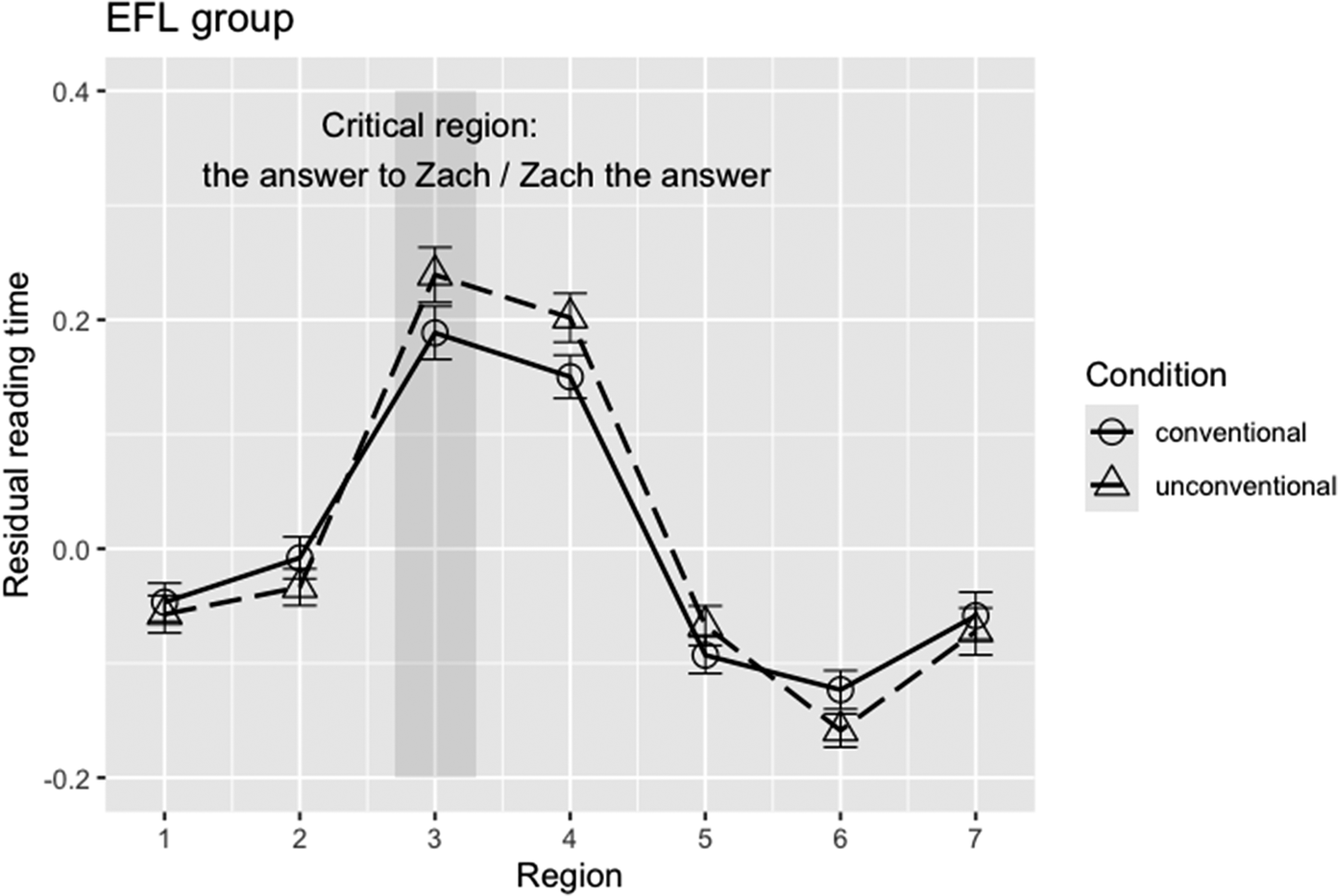
Figures 2 and 3 illustrate the residual RTs for the Control and EFL groups, respectively. An examination of the graphs indicates that the Control group exhibited longer times in the unconventional than the conventional condition in the spillover region (R4). In contrast, the RTs of the EFL group did not show a notable difference between the two conditions, either in the critical region (R3) or in the spillover region (R4).
Experiment 1: Residual RT profiles for the control group.
Note: Error bars denote 95% confidence intervals. The grey area indicates the critical region.

Experiment 1: Residual RT profiles for the EFL group.
Note: Error bars denote 95% confidence intervals. The grey area indicates the critical region.
To examine the reading time patterns across conditions for the two groups, we employed linear mixed-effects regression (Baayen, Reference Baayen2008), using the lmer function (Bates, Maechler, Bolker, & Walker, Reference Bates, Maechler, Bolker and Walker2015). Two separate models were generated, one for the critical region (R3) and another for the spillover (R4) region. Each model included fixed effects of Group (Control, EFL) and Conventionality (conventional, unconventional) and their interaction. These fixed factors were contrast-coded (EFL and conventional conditions were coded as −0.5; Control and unconventional conditions were coded as 0.5) and then centered around the mean. We constructed the simplified random-effects structure allowed by the design by including a by-participant random slope for Conventionality and a by-item random slope for Group, as well as random intercepts for participants and items. The modelling was conducted in R version 4.3.1 (R Core Team, 2023).
The outputs of the models for the critical and spillover regions are presented in Table 3.
Experiment 1: Model outcomes from self-paced reading task

*** p < .001.
** p < .01.
The model focusing on the critical region (R3) revealed a main effect of Group, driven by longer RTs in the EFL group compared to the Control group, reflecting a general trend of slower processing in L2 learners. In addition, there was a significant effect of Conventionality without its interaction with the Group, suggesting that the combined data from both groups showed significantly longer reading times in the unconventional than the conventional condition in this region.
Although a significant interaction was not found, it was necessary to examine each group’s processing patterns individually for two primary reasons. First, we needed to compare their performance with that of the ESL group in Experiment 2 to accurately assess the influence of different learning contexts. Moreover, separate analyses allowed us to scrutinize the impact of proficiency, which was relevant only to the learner groups. As a result, we conducted separate analyses for each group, using an adjusted alpha level of .017 (.05 divided by 3) to account for the comparisons among the Control group, EFL group, and ESL group.
In the separate analyses for each group, the models for the critical region (R3) did not return a significant effect of Conventionality for either the Control group (β = 0.055, SE = 0.035, p = .124) or the EFL group (β = 0.054, SE = 0.030, p = .075), suggesting their lack of sensitivity to the ungrammaticality of the unconventional sentences in this region. When LexTALE scores were added to the model for the EFL group as an additional factor, no interaction between LexTALE and Conventionality was found (β = −0.002, SE = 0.002, p = .425), indicating that proficiency did not affect the EFL learners’ processing patterns in the critical region.
Turning to the spillover region (R4), the global model revealed a significant effect of Conventionality, with longer RTs in the unconventional condition compared to the conventional condition. There was no significant effect of the Group or its interaction with Conventionality.
When conducting separate analyses for each group, we found a significant effect of Conventionality for the Control group (β = 0.092, SE = 0.033, p = .009) but not for the EFL group (β = 0.053, SE = 0.032, p = .107). These results suggest that only the L1 speakers exhibited grammatical sensitivity in the spillover region. Notably, when adding LexTALE scores to the model for the EFL group, there was a weak trend toward enhanced grammatical sensitivity as the learners’ LexTALE scores were higher (β = 0.004, SE = 0.002, p = .058).
In summary, the results of the self-paced reading task in Experiment 1 indicated the EFL group’s reduced ability to detect the distinction between conventional and unconventional formulations during sentence processing. These findings lend support to the noisy representations account (Tachihara & Goldberg, Reference Tachihara and Goldberg2020) and the noisy channel model (Futrell & Gibson, Reference Futrell and Gibson2017). As proposed by these theoretical accounts, we interpret our findings as a result of our EFL learners’ limited experience with English, impeding their use of statistical regularities underlying the combination of dative verbs and constructions during sentence processing.
However, it is possible that the status of L2 representations may be modulated by additional factors associated with language experience (e.g., Tachihara & Goldberg, Reference Tachihara and Goldberg2022, Reference Tachihara and Goldberg2024). To test this hypothesis, Experiment 2 involves ESL learners who have received naturalistic exposure to English. This experiment aims to explore whether extensive language experience can allow learners to show sensitivity to conventionality underlying verb–construction formulations.
5. Experiment 2
5.1. Participants
We recruited 64 adult Tagalog-speaking learners who learned English in ESL contexts. Data from three participants were removed because they did not complete the self-paced reading task. As a result, the remaining 61 participants constituted the ESL group (49 female).
Participants in the ESL group comprised undergraduate and graduate students from universities in the US, UK, Canada, New Zealand, Australia, and Ireland. Recruitment procedures employed the snowball sampling technique, implemented through online channels. Initially, with the help of a research assistant who was a Filipino student, a flyer was distributed on the website targeting Filipino student organizations within these universities. Eligible candidates then initiated contact with the researcher via the email address provided on the flyer. Subsequently, they received the survey link for participation.
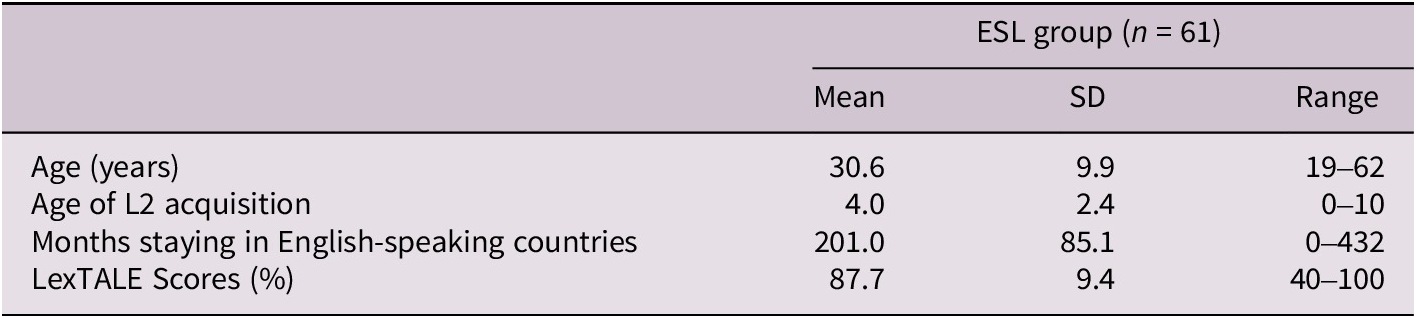
A language background questionnaire revealed that they started learning English at varying ages, ranging from 0 to 10 years old, either in the Philippines or in English-speaking countries. While most of them were native speakers of Tagalog, some participants spoke regional languages, including Bicol (n = 2), Binisaya (n = 2), Cebuano (n = 1), and Ilocano (n = 1). Among the participants, 31 had initial exposure to English before the age of 4. Nevertheless, they were classified as L2 learners since they predominantly used Tagalog in their daily lives and expressed a greater level of comfort with this language compared to English. With nearly all participants (60 out of 61) having experience staying in English countries for at least four years, the majority of participants reported engaging in more than 5 hours per week of outside classroom activities, such as listening to English media sources (83%), reading English materials (79%), and conversing in English with family, friends, and other foreigners (84%).
When assessing their English proficiency through LexTALE, participants achieved mean scores of 87.7%, ranging from 50 to 100%. These scores were statistically higher than those of the EFL group in Experiment 1, t(113) = 7.159, p < .001, Cohen’s d = 1.338, suggesting that the ESL group had higher proficiency than the EFL group.
Detailed information on the ESL group is summarized in Table 4.
Experiment 2: Participants information
All participants in the ESL group received monetary compensation for their participation in the study.
5.2. Materials
The stimuli for the acceptability judgment and self-paced reading tasks in Experiment 2 were identical to those used in Experiment 1.
5.3. Procedure
Experiment 2 was conducted in the same manner as Experiment 1.
5.4. Results and discussion
As in Experiment 1, we first present the results from the acceptability judgment task, followed by the outcomes from the self-paced reading task.
5.4.1. Acceptability judgment task
We first identified and removed “I don’t know” responses, which constituted 0.1% of the dataset (1 case). Figure 4 illustrates participants’ mean judgment ratings for each condition. As visible in the graph, the ESL group was more likely to accept sentences in the conventional condition than those in the unconventional condition. Notably, the gap in ratings between the conditions in this group was nearly identical to that found among the L1 speakers in Experiment 1.
Experiment 2: Mean acceptability judgment ratings.

To examine the statistical difference in acceptability ratings between conditions in the ESL group, we constructed a cumulative link mixed-effects model. For the comparison with the performance of L1 speakers and the EFL group, we retrieved the data from Experiment 1. The model included fixed effects of Group (ESL, EFL, Control), Conventionality (conventional, unconventional) and their interaction. Helmert coding was applied to the Group factor, with the first contrast being between ESL and Control groups and the second contrast being between ESL and EFL groups. The Conventionality factor was contrast-coded, assigning a value of −0.5 to the conventional condition and centered around the grand mean. The random effects structure of the model included a by-participant random slope for Conventionality, a by-item random slope for Group, and random intercepts for participants and items.
The model outcomes are summarized in Table 5.
Experiment 2: Model outcomes from acceptability judgment task

*** p < .001.
* p < .05.
The model revealed a main effect of Conventionality, with higher ratings in the conventional condition compared to the unconventional condition. In addition, the effect of Conventionality showed a significant interaction with Group, both in comparisons between the ESL and Control groups and between the ESL and EFL groups. As illustrated in Figures 1 and 4, these interactions suggest that the gap in acceptability ratings between conventional and unconventional sentences was the largest for the Control group, followed by the ESL group, and smallest for the EFL group. In light of these interactions, we conducted separate analyses for each group, with an adjusted alpha level of .017. These analyses revealed a significant effect of Conventionality for all groups (Control group: β = −5.716, SE = 0.424, p < .001; ESL group: β = −4.401, SE = 0.336, p < .001; EFL group: β = −2.812, SE = 0.357, p < .001). However, as indicated by the significant interactions and the different coefficients in the by-group models, the effect of Conventionality was most pronounced for the Control group, followed by the ESL group, and then by the EFL group.
When adding LexTALE scores to the model for the ESL group, a significant interaction emerged between LexTALE and Conventionality (β = −0.102, SE = 0.029, p < .001). Compared to the marginal interaction of proficiency with Conventionality for the EFL group, the ESL group exhibited a robust tendency for their sensitivity to sentence formulations to increase as their proficiency was higher. However, it is important to note that this difference may be due to the distinct distributions of LexTALE scores for each group. Specifically, the ESL group’s scores were significantly higher than those of the EFL group. Moreover, the ESL group exhibited a less dispersed score distribution (SD = 9.2) compared to the EFL group (SD = 12.9). Thus, the varying distributional patterns of LexTALE scores likely influenced each group’s conventionality judgments in different ways. (Further details on model outcomes, including groups and LexTALE scores, can be found in Appendix D.)
In summary, the acceptability judgment patterns of the ESL group differed from those of the EFL group.Footnote 5 The ESL group demonstrated stronger sensitivity compared to the EFL group. Furthermore, there was a significant effect of proficiency. Compared to the marginal interaction of proficiency with Conventionality for the EFL group, the ESL group exhibited a robust tendency for their sensitivity to sentence formulations to increase as their proficiency was higher. These findings align with Tachihara and Goldberg (Reference Tachihara and Goldberg2022, Reference Tachihara and Goldberg2024), who found an instrumental role of language experience in shaping L2 knowledge of verb–construction combinations. In the following section, we investigate whether similar findings are obtained in real-time sentence processing.
5.4.2. Self-paced reading task
When scrutinizing accuracies in the comprehension check-up questions, the mean accuracies of the ESL group were 92.2% (SD = 5.7). Trials with incorrect responses in the comprehension check-up questions were removed from further analysis.
We trimmed the RT data for the ESL group in the same manner as in Experiment 1. RTs longer than 6000 ms and shorter than 10 ms were removed (0.8% of the data; 6,534 out of 6,587). Also removed were RTs beyond 3 standard deviations from the mean (3.0% of the data; 6,336 out of 6,534). The remaining RTs were log-transformed and converted to residual RTs.
The ESL group’s RT profile is depicted in Figure 5. The graph indicates that the ESL group spent longer time in the unconventional condition than the conventional condition in both the critical region (R3) and the spillover region (R4).
Experiment 2: Residual RT profiles for the ESL group.
Note: Error bars denote 95% confidence intervals. The grey area indicates the critical region.

To statistically compare the ESL group’s processing patterns with those of the Control and EFL groups, we retrieved the data from Experiment 1 and constructed linear mixed-effects models for the critical and spillover regions. Aa in the analysis of the acceptability judgment data, the Group factor was coded using Helmert contrasts.
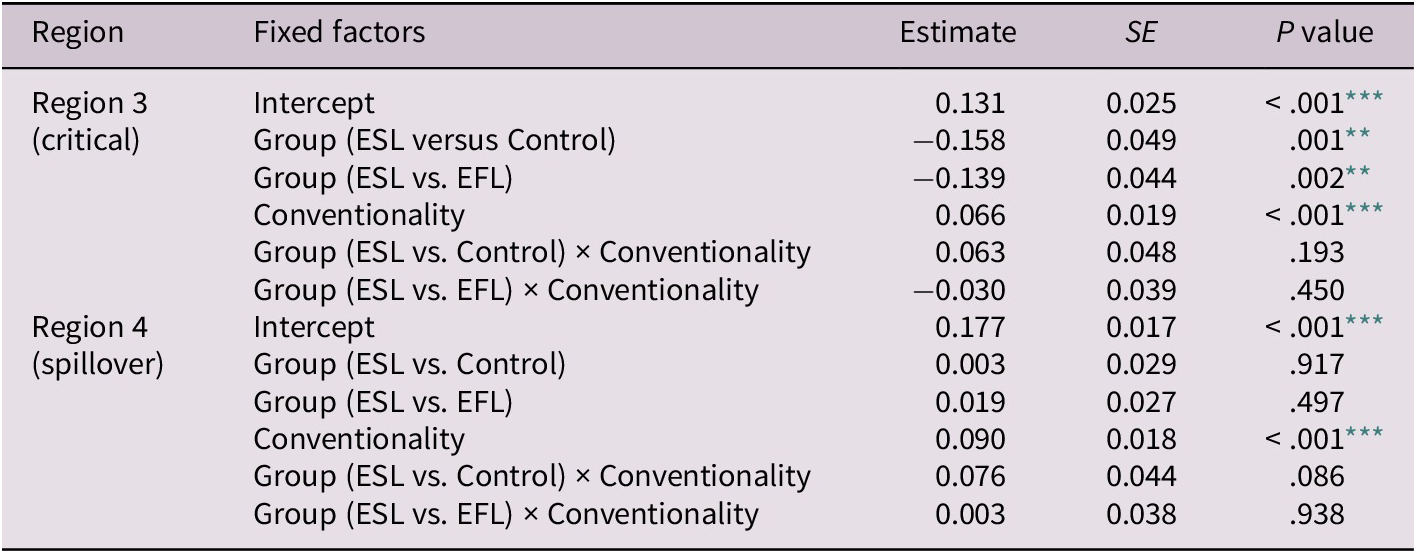
The model outcomes are presented in Table 6.
Experiment 2: Model outcomes from self-paced reading task
*** p < .001.
** p < .01.
The models yielded consistent outcomes across the critical region (R3) and the spillover region (R4). In R3, there was a significant effect of Group in comparisons between the ESL and the Control groups as well as between the ESL and the EFL groups. These effects arose from the shortest reading times observed in the Control group, followed by the ESL group, with the EFL group showing the slowest reading times.
Other than these effects, the only significant finding in R3 and R4 was the effect of Conventionality, driven by longer RTs in the unconventional condition compared to the conventional condition, irrespective of group. Again, despite the absence of interactions, we opted to conduct separate analyses for each group to obtain a more precise understanding of their respective performances. This decision was driven by our objective to thoroughly examine how the EFL and ESL learners, differing in their language learning experiences and proficiency levels, process target structures. By scrutinizing each group’s performance independently, we aimed to disentangle nuanced effects associated with language experiences and proficiency that might be obscured in a combined analysis.
In the analyses focusing on the ESL group, with the adjusted alpha level of .017, a significant effect of Conventionality emerged both in the critical region (β = 0.101, SE = 0.032, p = .003) and in the spillover region (β = 0.127, SE = 0.026, p < .001). This contrasted with the results of the EFL group, which did not show any effect of Conventionality either in the critical region (β = 0.054, SE = 0.030, p = .075) or in the spillover region (β = 0.053, SE = 0.032, p = .107). When adding LexTALE scores to the ESL group’s models in each region, there was no significant interaction between LexTALE and Conventionality, both in the critical region (β = 0.001, SE = 0.003, p = .772) and in the spillover region (β = 0.001, SE = 0.003, p = .694), indicating no modulating role of proficiency in the ESL group’s processing patterns.
Given the variety in the ESL learners’ L1, we also incorporated their L1 as an additional factor along with Conventionality. The results showed that the L1 factor did not significantly interact with Conventionality, either in the critical or the spillover region (all ps > .1), suggesting that participants’ L1 did not affect their processing patterns.
In conclusion, the results from the self-paced reading task in Experiment 2 suggest that higher proficiency and extensive exposure to language in naturalistic contexts enable learners to efficiently distinguish conventional formulations from unconventional ones. In the following section, we discuss these findings in detail in light of our research questions.
6. General discussion
The goal of this study was to investigate L2 learners’ sensitivity to unconventional combinations of dative verbs and constructions in English, examining both offline sentence judgment and online sentence processing. The study also aimed to explore the modulating roles of L2 learning contexts and proficiency. Results from Experiment 1 revealed that EFL learners exhibited a reduced sensitivity compared to L1 speakers, as evident in both acceptability judgment and self-paced reading. Furthermore, L2 proficiency emerged as a modulating factor, marginally affecting acceptability judgments and self-paced reading. In Experiment 2, ESL learners demonstrated processing patterns akin to L1 speakers, although their sensitivity in the judgment task was weaker. Their L2 proficiency significantly influenced acceptability judgment but had no impact on self-paced reading. Collectively, the findings from both experiments suggest that while L2 learners have a reduced sensitivity to the statistical regularities constraining the integration of verbal and constructional information, the L2 learning contexts and proficiency may play a modulating role in influencing this sensitivity.
6.1. Impact of noisy representations in EFL learners’ acceptability judgment and sentence processing
The results of Experiment 1 for the EFL group largely replicated the findings reported by Tachihara and Goldberg (Reference Tachihara and Goldberg2020). In Tachihara and Goldberg’s (Reference Tachihara and Goldberg2020) study, the L2 participants with low to intermediate proficiency demonstrated a reduced ability to discern between conventional and unconventional formulations. Similarly, our EFL learners, characterized by lower proficiency (compared to the ESL group) and limited experience with English, showed weaker sensitivity to unconventional combinations of dative verbs and constructions in the acceptability judgment task and no sensitivity in the self-paced reading task. Our findings go further in extending the results of offline measurements to the domain of online sentence processing, shedding light on the potential impact of limited and inconsistent language experience on the L2 processing of verb–construction formulations.
Furthermore, our findings provide insights into the distinct roles of implicit versus explicit knowledge in the acquisition and processing of sentence formulations in an L2. Previous research has shown that L2 learners often display discrepancies in their performance across offline and online tasks (e.g., Ellis, Reference Ellis2005; Suzuki & DeKeyser, Reference Suzuki and DeKeyser2017), reflecting the different aspects of knowledge assessed by each task type. By examining both offline judgment and online processing tasks, we were able to explicate the mechanisms underlying L2 learners’ application of knowledge in their comprehension of dative constructions. Specifically, although the EFL learners demonstrated explicit knowledge in the acceptability judgment task, their limited sensitivity to the ungrammaticality of the unconventional sentences in the self-paced reading task indicates challenges in effectively deploying this knowledge during real-time processing. These findings extend beyond previous research that primarily focused on offline judgments, highlighting the necessity for separate investigations into how L2 learners utilize implicit and explicit knowledge when assessing their sensitivity to sentence formulations in an L2.
Consistent with the noisy representations account (Tachihara & Goldberg, Reference Tachihara and Goldberg2020) and the noisy channel model (Futrell & Gibson, Reference Futrell and Gibson2017), we attribute the EFL learners’ reduced sensitivity to the statistical regularities of verb–construction association primarily to their limited experience with the L2, suggesting that the knowledge of paradigmatic associations between verbs and constructions may not be firmly established in the memory of EFL learners. Specifically, the insufficient and noisier input they received, such as input from instructional settings and other L2 speakers, may have weakened the associations between dative verbs and constructions in their memory representations. Consequently, they may have found it challenging to statistically preempt the unconventional use of verbs in a double-object form, leading to difficulties in recognizing the ill-formedness of unconventional combinations of dative verbs and constructions.
This interpretation is supported by the observation that participants exhibited increased sensitivity, albeit marginally, when their proficiency was higher, indicating that more experience with the L2 allowed them to more effectively recognize the unconventionality of verb–construction associations. Additionally, unlike the EFL learners, the ESL learners, characterized by extensive language experience in naturalistic settings and higher proficiency, demonstrated processing patterns similar to those of L1 speakers. In the following section, we discuss the effects of L2 learning contexts and proficiency in greater detail.
6.2. Effects of L2 learning contexts and proficiency
Alongside the divergent processing patterns observed in our EFL learners, we found modulating roles of L2 learning contexts and proficiency among the ESL learners. The findings from Experiment 2 suggest that extensive language experience in naturalistic settings can enhance the ability to take advantage of statistical preemption. Several studies indicate that language learners gradually develop probabilistic inferences in their memory through repeated exposure to frequently encountered formulations, allowing them to avoid infrequent, unconventional alternatives (Ambridge et al., Reference Ambridge, Bidgood, Twomey, Pine, Rowland and Freudenthal2015; Boyd & Goldberg, Reference Boyd and Goldberg2011; Clark, Reference Clark and MacWhinney1987; Goldberg, Reference Goldberg1995, Reference Goldberg2006). This mechanism has been well-documented in children, who often demonstrate a reluctance to apply verbs in unconventional constructions (e.g., Ambridge, Reference Ambridge2013; Ambridge, Pine, & Rowland, Reference Ambridge, Pine and Rowland2012; Brooks, Tomasello, Dodson, & Lewis, Reference Brooks, Tomasello, Dodson and Lewis1999).
Similarly, our findings from Experiment 2 suggest that such statistical preemption is operative in L2 learners with extensive language experience. The ESL participants in our study had been extensively immersed in English-friendly environments, with the majority (60 out of 61) having resided in English-speaking countries for a minimum of four years. This prolonged exposure to English likely facilitated the establishment of robust representations regarding the usage of the target dative verbs, making them more sensitive to the unconventional associations between these verbs and the double-object construction. The influential role of language experience found in our study is consistent with the outcomes of Tachihara and Goldberg (Reference Tachihara and Goldberg2022, Reference Tachihara and Goldberg2024), where L2 learners improved their sensitivity to unconventional expressions in sentence judgments after three days of exposure to conventional sentences. Our study extends these findings by showing that long-term language experience can further enhance the impact of statistical preemption, influencing not only offline sentence judgment but also real-time sentence processing.
The ESL learners’ target-like processing aligns with the well-documented influence of naturalistic exposure in L2 sentence processing. These participants started learning English before the age of 11, with a mean onset age of 4. In particular, half of them (31 of 61) were exposed to English before the age of 4, possibly acquiring both their L1 (Tagalog) and English simultaneously. Despite being classified as L2 learners due to their predominant use of Tagalog in daily routines, these learners closely resemble L1 speakers. Therefore, their prolonged immersion in English may have facilitated their attunement to the distributional patterns of verb–construction associations in the input, leading to the successful detection of unconventional formulations during real-time processing. These findings correspond to previous research highlighting the role of extensive language environments in L2 syntactic processing (e.g., Dussias, Reference Dussias2003; Frenck-Mestre, Reference Frenck-Mestre, Altarriba and Herridia2002; Pliatsikas & Marinis, Reference Pliatsikas and Marinis2013), suggesting that the impact of naturalistic exposure extends to the integration of verbs and constructions during sentence processing.
However, it should be noted that extensive language experience is closely linked with increased proficiency. As demonstrated in previous research on the role of language learning experiences, disentangling the effect of language experiences from language proficiency is challenging due to their strong correlation (e.g., Frenck-Mestre, Reference Frenck-Mestre, Altarriba and Herridia2002; Pliatsikas & Marinis, Reference Pliatsikas and Marinis2013). Likewise, in our study, the ESL learners not only had longer immersive experiences but also exhibited higher proficiency compared to the EFL learners. To address these confounding factors, we conducted an exploratory analysis focusing on a subset of EFL and ESL learners, controlling for proficiency scores. We selected data from 25 EFL participants and 29 ESL participants with closely matched LexTALE scores, t(52) = 0.119, p = .906, Cohen’s d = 0.032. We then examined their processing patterns in the critical and spillover regions using linear mixed-effects regression models, as in the main analysis. In the critical region, we found a significant interaction among Group, Conventionality, and LexTALE scores (β = 0.022, SE = 0.006, p < .001). In the by-group analyses, the model for the EFL group showed a significant effect of Conventionality (β = 0.122, SE = 0.038, p = .002), qualified by an interaction with LexTALE scores (β = −0.003, SE = 0.005, p < .001). These results indicate that while the EFL learners were sensitive to conventionality, this sensitivity enhanced with increased proficiency. In contrast, the ESL group exhibited a significant effect of Conventionality (β = 0.158, SE = 0.044, p = .001) without an interaction with LexTALE scores, indicating their sensitivity regardless of proficiency levels. In the spillover region, a single effect of Conventionality (β = 0.132, SE = 0.025, p < .001) without an interaction with Group or LexTALE scores.
This exploratory analysis reveals a slight group effect, indicating that the ESL group exhibited more consistent sensitivity in the critical region compared to the EFL group. However, these results should be interpreted with caution due to limitations arising from the high proficiency subset of participants. To ensure comparable proficiency levels across groups in these analyses, we truncated the data by removing participants with low LexTALE scores from the EFL group and participants with high scores from the ESL group. Thus, these results do not provide a comprehensive view of the processing patterns of EFL and ESL learners. To more precisely assess the role of language experience independent of proficiency, further studies should involve proficiency-matched participants from EFL and ESL backgrounds, ensuring an adequate sample size and including a wider range of proficiency levels within these groups.
6.3. Limitations and suggestions for further studies
We acknowledge several limitations of the study that require further refinement. First, beyond distinguishing between EFL and ESL contexts, there may exist individual variations among participants, potentially affecting the results. As noted by a reviewer, some participants in the ESL group might more precisely be described as non-proficient speakers living in English-speaking countries rather than as L2 learners. Such distinctions can influence motivation and specific contexts of learning English, rendering the classification of EFL and ESL contexts somewhat simplistic and tenuous. In addition, various aspects of learner-internal and external factors, such as the richness of the English environment, language usage patterns in different contexts, socio-economic status, and language aptitude, can significantly affect the L2 learning of statistical regularities regarding verb–construction associations. Therefore, finer-grained measures are needed to classify L2 participants based on detailed information about their language learning background and contexts.
Second, it is difficult to pinpoint the exact sources of language experience that contributed to the disparities between our EFL and ESL learners. As a reviewer pointed out, our study did not account for specific L2 learning profiles, such as the quantity and quality of input from various sources, in the analysis of participants’ judgment and processing patterns. Therefore, further investigation is necessary to examine the potential role of input quantity and quality in L2 sensitivity to conventional and unconventional utterances in sentence processing. Such exploration will provide a better understanding of how language exposure influences L2 learners’ implicit knowledge of conventionality, as emphasized by Tachihara and Goldberg (Reference Tachihara and Goldberg2024).
Third, while both Korean and Tagalog, the L1s of the L2 learners in our study, differ from English in their integration of dative verbs with dative constructions, we recognize that the varied L1 backgrounds present a significant limitation. As a reviewer noted, our current design, which involved Korean L1 speakers for the EFL group and Tagalog L1 speakers for the ESL group, does not provide a fair comparison between the two groups, making it difficult to fully disentangle the effects of learning context and L1 background. This limitation raises caution in interpreting our results and making broader generalizations across different L1 populations. We acknowledge that L1-specific transfer effects may have influenced the differences observed between EFL and ESL learners, potentially interacting with the learning context and proficiency effects that were the primary focuses of our study. To address this issue, further research should systematically control for L1 transfer factors by comparing learners with the same L1 but different L2 learning contexts. This approach will allow for more controlled and rigorous examinations of L2 sensitivity to the statistical regularities underlying verb–construction integration.
7. Conclusion
The current study shows the effect of noisy representations among EFL learners in their acceptability judgment and processing of unconventional combinations of dative verbs and constructions in English. While these results support the noisy representations account (Tachihara & Goldberg, Reference Tachihara and Goldberg2020), the study extended this perspective to real-time sentence processing, highlighting the potential impact of limited and inconsistent language experience on L2 processing of verb-construction formulations. Furthermore, the findings from ESL learners highlight the modulating roles of L2 learning contexts and proficiency. Overall, this study contributes to the understanding of L2 learning and processing mechanisms, emphasizing the significant roles of language experience and proficiency in shaping learners’ sensitivity to syntactic probabilities underlying verb–construction combinations. Further research on the effect of noisy representations in L2 should involve learners with diverse language learning backgrounds across various languages.
Supplementary material
The supplementary material for this article can be found at http://doi.org/10.1017/langcog.2024.65.
Data availability statement
All data and analysis scripts used for this study are available at https://osf.io/r9ybm/.
Competing interest
The authors declare none.


 Open access

