


Introduction
Forests are a considerable source of biodiversity and, as such, are inextricably linked to people's food security, nutrition and health (Sunderland, Reference Sunderland2011). In many tropical forest areas the majority of rural households and a large proportion of urban households rely on non-timber forest products (NTFPs) to meet part of their nutritional, health and livelihood needs. One of the most controversial examples of NTFPs traded both in rural and urban areas and increasingly the focus of international attention is bushmeat, or the use of wild animals as a source of meat. The Bushmeat Liaison Group of the Convention on Biological Diversity defines bushmeat (or wild meat) hunting as the harvesting of wild animals in tropical and subtropical forests for food and non-food purposes, including medicinal use (Nasi et al., Reference Nasi, Brown, Wilkie, Bennett, Tutin, van Tol and Christophersen2008). Although invertebrates can be locally important dietary constituents, larger vertebrates constitute the majority of the terrestrial wild animal biomass consumed by humans. Insects, crustaceans, grubs, molluscs and fish are excluded from this definition. Bushmeat has long been part of the staple diet of forest-dwelling peoples (Elliott et al., Reference Elliott, Grahn, Sriskanthan and Arnold2002), often being the only available source of animal-derived food.
In Central Africa, fuelled by human population increase, civil unrest and growing extractive industries, bushmeat trade has increased (Hart, Reference Hart, Robinson and Bennett2000; Fa & Péres, Reference Fa, Péres, Reynolds, Mace, Redford and Robinson2001), causing the local depletion of several threatened species (Oates et al., Reference Oates, Abedi-Lartey, McGraw, Struhsaker and Whitesides2000; van Vliet et al., Reference van Vliet, Nasi, Emmons, Feer, Mbazza and Bourgarel2007). The growing demand from urban areas, combined with larger populations, is often highlighted as the main driver of the unsustainable use of bushmeat, with negative effects on both ecosystems and livelihoods (Fa & Brown, Reference Fa and Brown2009; van Vliet et al., Reference van Vliet, Nasi, Taber, Shackleton, Shackleton and Shanley2011, Reference van Vliet, Nebesse, Gambalemoke, Akaibe and Nasi2012). Global attention has been drawn to the ecological consequences of the unsustainable use of bushmeat primarily through debates about the ‘empty forest’ syndrome; however, more recent developments have shifted the focus to the linkages between bushmeat and livelihoods, and particularly food security (Nasi et al., Reference Nasi, Taber and van Vliet2011; van Vliet et al., Reference van Vliet, Nebesse, Gambalemoke, Akaibe and Nasi2012). Bushmeat is a significant source of animal protein in all Central African countries and is important for food security in the region (Fa et al., Reference Fa, Currie and Meeuwig2003). The nutritional role of bushmeat goes beyond that of being a source of protein, as it is often the only source of iron (Golden et al., Reference Golden, Fernald, Brashares, Rasolofoniaina and Kremen2011) and fat (Siren & Machoa, Reference Siren and Machoa2008) as well.
The consumption of bushmeat by rural communities is often portrayed as legitimate, being part of local tradition and cultural identity; however, urban consumption generates controversy among conservation and development practitioners. Unlike rural or forest dwellers, urban consumers usually have a choice of meat but may opt for bushmeat for a variety of reasons (e.g. cost, taste or preference) that vary between regions. Therefore the level of bushmeat consumption can vary according to variations in the cost of alternative foods, such as fish (Wilkie et al., Reference Wilkie, Starkey, Abernethy, Effa, Telfer and Godoy2005). Understanding why people eat bushmeat and the role that bushmeat consumption plays in household nutrition and income, both in rural and urban settings, is critical to developing politically acceptable ways to manage wildlife hunting and trading and reduce unsustainable exploitation (Schenck et al., Reference Schenck, Effa, Starkey, Wilkie, Abernethy and Telfer2006). Such an understanding is essential to predict the consequences of species loss for local livelihoods, particularly in relation to food security (Brashares et al., Reference Brashares, Golden, Weinbaum, Barrett and Okello2011).
Other studies have investigated bushmeat consumption patterns in Gabon (Starkey, Reference Starkey2004; Wilkie et al., Reference Wilkie, Starkey, Abernethy, Effa, Telfer and Godoy2005; Foerster et al., Reference Foerster, Wilkie, Morelli, Demmer, Starkey, Telfer and Stei2011), Equatorial Guinea (Fa et al., Reference Fa, Albrechtsen, Johnson and Macdonald2009; Kümpel et al., Reference Kümpel, Milner-Gulland, Cowlishaw and Rowcliffe2010), Democratic Republic of Congo (de Merode et al., Reference de Merode, Homewood and Cowlishaw2004), Ghana, Cameroon, Tanzania, Madagascar (Brashares et al., Reference Brashares, Golden, Weinbaum, Barrett and Okello2011; Jenkins et al., Reference Jenkins, Keane, Rakotoarivelo, Rakotomboavonjy, Randrianandrianina and Razafimanahaka2011) and Congo (Mbete et al., Reference Mbete, Banga-Mboko, Racey, Mfoukou-Ntsakala, Nganga and Vermeulen2011). Consumption data are usually collected using semi-structured interviews from a random sample of households. Information gathered usually includes the type and weight of all meat consumed by the sampled households, by a 24-hour recall of all items purchased the day before the interview intended for that day's main meals. These studies highlight a number of factors that affect bushmeat consumption, including household size (Albrechtsen et al., Reference Albrechtsen, Macdonald, Johnson, Castelo and Fa2007), ethnicity (East et al., Reference East, Kümpel, Milner-Gulland and Rowcliffe2005; Kümpel et al., Reference Kümpel, Milner-Gulland, Cowlishaw and Rowcliffe2010) and household wealth (Fa et al., Reference Fa, Albrechtsen, Johnson and Macdonald2009). The role of wealth as an interesting explanatory variable fuels the debate about the linkages between bushmeat use and poverty. The shape of the bushmeat consumption curve varies depending on the range of wealth of consumer households. In some places the wealth range results in a consumption curve that is an inverted U; in others there is no curve, just an increase as wealth increases. Studies among urban households in Gabon (Wilkie et al., Reference Wilkie, Starkey, Abernethy, Effa, Telfer and Godoy2005; Foerster et al., Reference Foerster, Wilkie, Morelli, Demmer, Starkey and Telfer2012), Equatorial Guinea (East et al., Reference East, Kümpel, Milner-Gulland and Rowcliffe2005; Fa et al., Reference Fa, Albrechtsen, Johnson and Macdonald2009), Cameroon, Nigeria and Madagascar (Brashares et al., Reference Brashares, Golden, Weinbaum, Barrett and Okello2011) show that bushmeat consumption increases monotonically as income increases, and bushmeat is more expensive than domestic meat in Ghana (Cowlishaw et al., Reference Cowlishaw, Mendelson and Rowcliffe2005), Nigeria (Ladele et al., Reference Ladele, Joseph, Omotesho and Ijaiya1996) and Gabon (Starkey, Reference Starkey2004). In large cities of Equatorial Guinea, Gabon and Cameroon, bushmeat is a luxury product. Although preferred for its taste, it is consumed less frequently than frozen mackerel, chicken or pork because they cost less (Kümpel, Reference Kümpel2006). East et al. (Reference East, Kümpel, Milner-Gulland and Rowcliffe2005) found that wealthier urban households in Equatorial Guinea consumed more bushmeat than poorer households. Fa et al. (Reference Fa, Albrechtsen, Johnson and Macdonald2009) showed that mean protein consumption in Equatorial Guinea was correlated with household wealth but the strength of this effect varied among sites. At the site of highest mean wealth (Bata, the most urban site), bushmeat was more expensive and wealthier households ate more of it. Elsewhere bushmeat consumption was not associated with wealth. Similarly, in Gabon, Wilkie et al. (Reference Wilkie, Starkey, Abernethy, Effa, Telfer and Godoy2005) showed that consumption of bushmeat, fish, livestock and chicken increased with household wealth. In a comparative study of Ghana, Cameroon, Tanzania and Madagascar, Brashares et al. (Reference Brashares, Golden, Weinbaum, Barrett and Okello2011) found that wealthier households consumed more bushmeat in settlements nearer urban areas but the opposite pattern was observed in more isolated settlements. In contrast, a study on the island of Bioko in Equatorial Guinea showed that bushmeat consumption decreased as income increased (Albrechtsen et al., Reference Albrechtsen, Fa, Barry and Macdonald2005), which indicates that wealthier households replace bushmeat with other sources of meat. These differences observed in the relationships between bushmeat consumption and wealth are difficult to explain because bushmeat was used as a generic term without differentiating between bushmeat species and the parts of the animals consumed.
Although previous results provide a good understanding of the linkages between consumption patterns and socio-economic backgrounds in Central Africa, there are still a number of unresolved questions: (1) Does the positive link between wealth and bushmeat consumption in urban areas and the opposite for more remote settlements also apply in areas where bushmeat is still the cheapest source of animal protein? In some towns (such as Kisangani, Democratic Republic of Congo, or Bangui, Central African Republic) bushmeat is cheaper than many other sources of animal protein (Fargeot, Reference Fargeot2010; van Vliet et al., Reference van Vliet, Nebesse, Gambalemoke, Akaibe and Nasi2012). Our hypothesis is that poorer households consume more bushmeat than wealthier households in urban areas. (2) Is use of the generic term bushmeat sufficiently rigorous to disentangle the links between the socio-economic background of consumers and bushmeat consumption or is this linkage very dependent on the type of bushmeat species? We hypothesize that bushmeat species consumed more frequently by rural households differ from those consumed more frequently by urban households and that within urban areas species consumed by wealthier households differ from those consumed by poorer households. (3) Given the need to provide accurate meat consumption data at national or regional levels to inform policy-makers, are there options for developing low-cost and time-efficient methodologies to monitor meat consumption data and the importance of bushmeat in the nutrition of urban and rural households?
We address these questions with a case study from Province Orientale in the Democratic Republic of Congo, comparing meat (fish, beef, mutton, goat, chicken, pork, caterpillars and bushmeat) consumption patterns of school children in the provincial capital, Kisangani, and in villages located > 50 km away.
Study area
Our study was conducted in Kisangani, in north-east Democratic Republic of Congo, and in several villages along the roads leading from Kisangani to Opala, Banalia, Ubundu, Mambasa, Yangambi and Lubutu (Fig. 1). Kisangani lies along the Congo River, in the district of Tshopo. The city is connected by river to Yangambi and by road to the main towns of Opala, Lubutu and Ubundu to the south, Buta to the north, and Mambasa (Ituri) to the east. Several important protected areas lie < 400 km from Kisangani (Maiko National Park to the south-east, Okapi Wildlife Reserve to the east, Rubi-Tele hunting reserve to the north and Yangambi Biosphere Reserve 50 km to the west along the Congo River).
Location of Kisangani and the surrounding area, where surveys were carried out in 12 urban schools and 18 rural schools (Table 1). The rectangle on the inset indicates the location of the main map in the Democratic Republic of Congo.

Methods
Data collection
From April to June 2011 CN interviewed 301 pupils in 12 schools in Kisangani and 309 pupils in 18 schools in 12 villages (Table 1). Permission for working with children was obtained, with the informed consent of competent authorities (school directors, teachers) and parents (through signed authorizations), following the ethical research guidelines of the Center for International Forestry Research. Our interviews were conducted during the rainy season to investigate bushmeat consumption during the open hunting season, when more bushmeat carcasses are available in the Kisangani market, as observed during initial field work in 2009 (N. van Vliet et al., unpubl. data). Our results therefore represent consumption for the rainy season only.
Rural and urban schools where surveys were carried out, with location, distance from Kisangani, and the number of children interviewed (a total of 309 in rural areas and 301 in Kisangani).

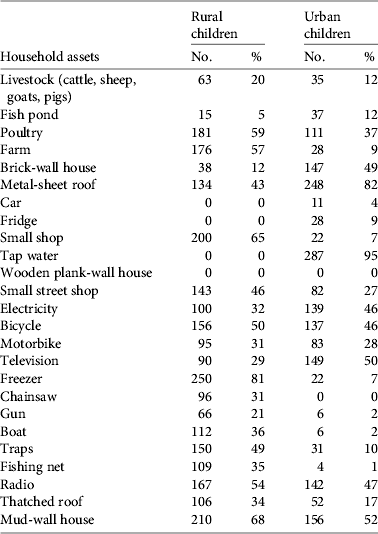
We interviewed children of 9–12 years old; they were old enough to understand the questions asked and recall the composition of their meals. Children were interviewed concurrently by distributing a simple written questionnaire during class. We explained each question and gave the children time to complete the questionnaire with help from the teacher and the researchers. The presence of the teacher ensured that children responded with accuracy and completed the questionnaire in silence, thereby guaranteeing the independence of individual responses. The questionnaire contained general questions about the children and their families (age, ethnic group, religion, number of adults and children in the household), their wealth status, the composition of their meals consumed the day before the interview (breakfast, lunch and dinner) and their preferred bushmeat species. In studies where classic household surveys are used the most common approach for monitoring wealth is through self-reported incomes (or expenditure as a proxy for income) but the reliability of income data has been questioned on the basis of imperfect recall by respondents, imperfect communication with surveyors, and the tendency of respondents to engage in strategic behaviours (responses) if they perceive that such things as tax payments or eligibility for public assistance will be based on their answers or observed behaviours (Albrechtsen et al., Reference Albrechtsen, Macdonald, Johnson, Castelo and Fa2007). We therefore used three proxies for wealth that could be easily identified and described by the children: (1) father's profession (retired, student, farmer/hunter/fisherman, temporary or unqualified job, small business holder, housekeeper or unemployed, civil servant or other salaried job); (2) mother's profession (retired, student, farmer/hunter/fisherman, temporary or unqualified job, small business holder, housekeeper or unemployed, civil servant or other salaried job); (3) whether the household had a number of material assets (Table 2) used to indicate wealth. Household assets as indicators of household wealth were defined based on the knowledge of CN, who is a native of the region and has extensive experience of conducting socio-economic studies there.
Household assets among rural and urban children in Province Orientale, Democratic Republic of Congo.
For each of the meals consumed the day before the interview, children were asked if they had eaten any of the most common sources of meat available: fish, caterpillars, pork, chicken, mutton, beef, goat or bushmeat. If they had consumed bushmeat, we asked about the state of the meat (fresh or smoked) and the species consumed. All duiker species were grouped together, as were all small monkey species, because children were not always able to identify specific species. We analysed the meat composition of 488 meals in Kisangani (149 breakfasts, 114 lunches, and 225 dinners) and 440 meals in rural areas (192 breakfasts, 27 lunches and 221 dinners; rural children usually eat only twice a day, which explains the limited number of lunches reported).
Data analysis
We compared the frequency of consumption of meat in general and of bushmeat specifically, as well as the importance of different meats for rural and urban children. We computed a correspondence factor analysis (χ2 test), using XLSTAT 2010 (Addinsoft SARL, Paris, France), to test whether there was a significant difference between the number of children that ate meat and bushmeat in rural and urban areas. We also analysed the diversity of meats consumed, using the Shannon index of diversity:
 $$H = - \sum p_i ^* \ln (\,p_i )$$
where H is the index of diversity and p i is the percentage of meals with meat i.
For rural and urban children we compared the most frequently consumed species, the most preferred species, the percentage of fresh/smoked bushmeat and the percentage of small (< 10 kg), medium (10–50 kg) and large (> 50 kg) species consumed.
To identify the socio-economic variables that best described meat and bushmeat consumption among rural and urban children we conducted the following statistical analyses. We used a linear regression to assess the correlations between consumption of meat/bushmeat (number of meals with meat/bushmeat in the 24 hours prior to the interview) and household size. We conducted an ANOVA and pairwise post hoc analysis to analyse the correlations between meat/bushmeat consumption (number of meals with meat/bushmeat in the 24 hours prior to the interview) and father's/mother's main occupation among rural and urban children. For urban children we computed an additional ANOVA and pairwise post hoc analysis between meat/bushmeat consumption (number of meals with meat/bushmeat in the 24 hours prior to the interview) and a variable that distinguished mothers with income-generating activities from those who worked mainly in the home. We calculated a wealth index as the value of owned assets (no depreciation for old assets was used) and used a linear regression to identify the relation between the wealth index and meat/bushmeat consumption (number of meals with meat/bushmeat in the 24 hours prior to the interview) for both rural and urban children. We used an ANOVA to investigate correlations between wealth and the most consumed bushmeat species.
Results
Comparisons of nutritional patterns of rural and urban children
A higher percentage of children from rural areas than children from Kisangani ate meat the day before the interview (Table 3) but there was no significant difference (χ2 test, P = 0.1) in the number of children who ate meat between urban and rural sites. Rural meals contained a higher diversity of meats than urban meals (Shannon index in rural areas = 0.81; in urban areas = 0.64). Meals in rural areas also contained more wild sources of animal protein (fish, caterpillars or bushmeat) and less domestic meat than those in Kisangani (Figs 2 & 3).
Percentage of rural and urban children who reported having consumed each protein type the day before the interview.

Percentage of meals containing each bushmeat species consumed by rural and urban children.

Protein and bushmeat consumption patterns among rural and urban children in Province Orientale, Democratic Republic of Congo.
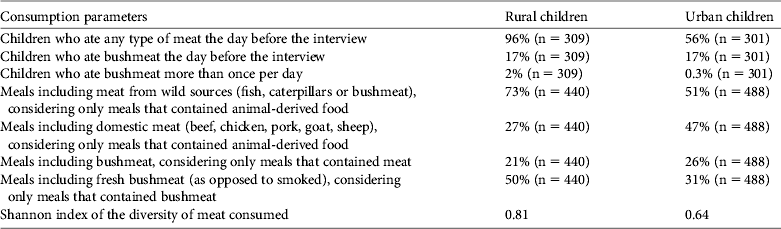
The percentage of children who consumed bushmeat the day before the interview was equal among rural and urban children (17%) and the number of children who consumed bushmeat in rural areas was not significantly different from that in urban areas (χ2 test, P = 0.9). The percentage of children who had more than one meal with bushmeat the day before the interview was higher among rural than among urban children. Bushmeat was twice as common in rural meals as in urban meals. If we consider only the meals that contained meat, bushmeat was slightly more common in meals consumed in urban areas (26% in urban meals vs 21% in rural meals). In rural areas bushmeat was most often consumed fresh, whereas in Kisangani most bushmeat consumed was smoked.
Most consumed and most preferred bushmeat species
In rural schools children most often ate meat from duikers Cephalophus spp., brush-tailed porcupines Atherurus africanus, small diurnal monkeys Cercopithecus and Cercocebus spp. and African pouched rats Cricetomys emini, which accounted for almost 80% of all bushmeat meals consumed (Fig. 3). In urban schools the most consumed species were duiker and red river hog Potamochoerus porcus, which accounted for almost 60% of the bushmeat meals consumed. Preferences for bushmeat species were similar among rural and urban children (Fig. 4). For both rural and urban children, the most preferred meat sources were mainly duikers but also small monkeys, brush-tailed porcupines, small pangolins Manis tricuspis and elephants Loxodonta africana. Rural children preferred meat from duikers and small monkeys but consumed more meat from brush-tailed porcupines than from small monkeys. In urban areas children preferred meat from small monkeys and brush-tailed porcupines to red river hog but consumed more of the latter. Elephant or okapi Okapia johnstoni meat was present in 9% of urban bushmeat meals and 4% of rural bushmeat meals consumed the day before the interview. The percentage of meals containing meat from protected or partially protected species was 3.2% among urban children and 2.2% among rural children.
Numbers of rural and urban children who expressed a preference for bushmeat from each species.

Urban children consumed a higher percentage of large species (mean weight > 50 kg, 38%) and fewer small species (mean weight < 10 kg, 16%) than rural children (mean weight > 50 kg, 10%; mean weight < 10 kg, 46%). The percentage of medium-sized species in the meals consumed the day before the interview was similar for urban and rural children. Rural children preferred small or medium-sized species (mean weight < 10 kg, 45%; mean weight 10–50 kg, 39%) and urban children also expressed a preference for smaller species (mean weight < 10 kg, 39%; mean weight 10–50 kg, 40%).
Links between bushmeat consumption and socio-economic background
In urban areas the number of meals with meat was higher (but not significantly) for children from wealthier families (linear regression, P = 0.25). Among urban children the number of meals with bushmeat was higher (but not significantly) for children from poorer households (linear regression, P = 0.19). Meat and bushmeat consumption were not correlated with the father's profession (ANOVA, meat: P = 0.87; bushmeat: P = 0.71) or with the mother's profession (meat: P = 0.21; bushmeat: P = 0.30). However, children whose mother had an income-generating activity ate meat and bushmeat more frequently than others (meat: P = 0.14; bushmeat: P = 0.05). We found no correlation between meat/bushmeat consumption and household size (linear regression, meat: P = 0.79; bushmeat: P = 0.67). Meat and bushmeat consumption was not influenced by whether the household kept poultry, livestock or fish. Wealthier households ate significantly more bush pig Potamochoerus porcus, chevrotain Hyemoschus aquaticus and crocodile Crocodylus sp. and poorer households consumed brush-tailed porcupine and small monkeys (Fig. 5).
Mean value of wealth of households that consumed different bushmeat species the day before the interview.

In rural areas the number of meals with meat was higher (but not significantly) for children from poorer families (linear regression, P = 0.09). Among rural children the number of meals with bushmeat was higher (but not significantly) for children from poorer households (linear regression, P = 0.71). Consumption of bushmeat and meat was not significantly correlated with the father's profession (ANOVA, meat: P = 0.50; bushmeat: P = 0.4) or with the mother's profession (meat: P = 0.48; bushmeat: P = 0.5). However, children whose fathers were farmers, hunters or fishermen ate bushmeat and meat more frequently than those whose fathers were involved in business or were employees. Children from larger households ate significantly more protein than those from small families (linear regression, meat: P = 0.000; bushmeat: P = 0.005). Poorer households ate significantly more brush-tailed porcupine (P = 0.002) and Gambian rat (P = 0.07) and wealthier households consumed more chevrotain, crocodile and pangolin.
Discussion
Our results are dependent on the children's capacity to provide reliable information on their consumption of meat and their socio-economic characteristics. We limited the number of false responses by administering the questionnaire in class as a normal assignment that required the same rigour as any other class exercise. We think the use of simple variables such as household assets and parental occupation is an efficient way for children to provide an indication of their wealth. Our study was conducted in the rainy season and thus we could not examine any seasonality in bushmeat consumption compared to other sources of meat (particularly compared to the seasonal caterpillars). Our results do not predict whether bushmeat is used as a substitute for caterpillars during the dry season or whether meat consumption falls during the dry season in rural areas. To examine these matters, surveys would need to be conducted during the dry season (which also corresponds to the legally closed hunting season).
Despite this limitation our results show that surveys conducted among school pupils can provide information about the consumption of meat from different sources in rural and urban households. The approach requires fewer resources than household interviews because children in the same class can be interviewed simultaneously and because the methodology uses existing structures and resources (schools, classrooms and teachers). If conducted in close collaboration with ministries of education, surveys of primary school pupils can be used to cover a wide sample at provincial or national scales over a short period of time. However, because only c. 50% of children in West and Central Africa attend primary school (UNESCO, 2005) the sample is biased towards those households that can afford to send their children to school; therefore the poorest households are not included in the analysis.
Our results show that despite the availability of different sources of domestic meat in urban areas, urban children are less likely than rural children to eat meat. A majority did not consume any type of meat the day before our survey. A high percentage of urban and rural households in Province Orientale still consume meat from the wild. We found that 73 and 51% of the meals with meat consumed by rural and urban children, respectively, contained meat from wild-caught animals (fish, caterpillars or bushmeat). In comparison, Jenkins et al. (Reference Jenkins, Keane, Rakotoarivelo, Rakotomboavonjy, Randrianandrianina and Razafimanahaka2011) found that in rural and urban communities in Madagascar only 13.7% of meals contained meat from wild-caught animals. We also show that children from rural areas eat meat more frequently and have a more diversified meat intake than urban children, in particular because they have access to a variety of meats from the wild (mainly fish, caterpillars and bushmeat). Caterpillars are particularly important as an alternative meat source during the rainy season and were consumed as frequently as bushmeat in rural meals during our study. As shown by de Merode et al. (Reference de Merode, Homewood and Cowlishaw2004) for a rural community in the Democratic Republic of Congo, wild foods not only fulfil a key nutritional role but are also an important source of income for purchasing commodities such as medical supplies and to procure assets such as fishing nets, which enables households to enhance their livelihood strategies.
Among the different sources of meat from the wild, bushmeat and fish were the most frequently consumed by children in Kisangani and fish was the most frequently consumed in villages. In our sample the percentage of children who had eaten bushmeat the day before the interview was the same for rural and urban children but the number of meals with bushmeat was higher among rural children. Although we did not measure the exact amount consumed per child our results support those obtained elsewhere indicating that rural per capita consumption exceeds urban per capita consumption (Chardonnet et al., Reference Chardonnet1995; Wilkie & Carpenter, Reference Wilkie and Carpenter1999; Starkey, Reference Starkey2004).
One of our main findings is that poorer urban households eat meat less frequently but eat bushmeat more frequently than wealthier households, which is relevant to discussions of whether bushmeat is a luxury product rather than a necessity in urban contexts. Our findings support those of van Vliet et al. (Reference van Vliet, Nebesse, Gambalemoke, Akaibe and Nasi2012), who demonstrated that the most commonly sold bushmeat species were significantly less expensive than fish and other sources of domestic meat (except pork) and were therefore mostly consumed by poorer urban households. In our study region poor urban households are more dependent than rural households on bushmeat because they have no alternative at a similar price, whereas rural households can fish or rely on other harvested products such as caterpillars.
Another result with policy implications is that although bushmeat is an important component of the meat intake of both rural and urban children, different animal species are used by rural and urban households. Urban children eat more bushmeat from larger species (duikers and red river hog) than rural children (who eat rodents and small monkeys), probably because rural households tend to consume the less marketable species, as also observed in Bata, Equatorial Guinea (Kümpel et al., Reference Kümpel, Milner-Gulland, Cowlishaw and Rowcliffe2010) and in Ntsieté, Gabon (van Vliet & Nasi, Reference van Vliet and Nasi2008). Red river hog seems to be hunted mainly for income, as it is commonly consumed by urban children but not by rural children. In Kisangani red river hog is less common and more expensive than other commonly sold bushmeat species (N. van Vliet et al., unpubl. data). Among the most frequently sold species (African pouched rat, blue duiker, small diurnal monkeys and brush-tailed porcupine) van Vliet et al. (Reference van Vliet, Nebesse, Gambalemoke, Akaibe and Nasi2012) found that small monkeys were the most expensive in 2008–2009. The higher market value of small monkeys compared to rodents might explain why rural children eat more brush-tailed porcupine than small monkeys despite their preference for the latter. More expensive meat tends to be sold, whereas less marketable meat is consumed locally. Protected and threatened species are consumed more frequently by urban children; however, in Kisangani elephant meat is consumed mainly by poorer households. A possible explanation is that elephant meat is only a sub-product of the hunting and the large amount of meat must be sold quickly, given the illegality of the product (Stiles, Reference Stiles2011). Consumption of elephant meat is significantly lower in Kisangani than in Brazzaville but still exceeds the consumption of other species sold in the market (Stiles, Reference Stiles2011; van Vliet et al., Reference van Vliet, Nebesse, Gambalemoke, Akaibe and Nasi2012). Poorer households may consume elephant meat more frequently because they receive it as a gift from rural relatives rather than purchasing it in the market.
Another result from our study that has implications for development is the correlation between the main activity of the household and children's nutrition. A shift in rural livelihoods towards off-farm/off-forest activities is associated with better housing and increased access to material goods but not necessarily with increased frequency of meat consumption. We found that rural children whose fathers were involved in business or were employees ate meat and bushmeat less frequently than those whose fathers were farmers, hunters or fishermen. In rural areas there is a significant relationship between household size and meat/bushmeat consumption, supporting traditional rural strategies to increase household size as a way to improve livelihoods. This result highlights the need for further research to understand the implications of the transition from hunting and gathering to farming and gradually to off-farm/off-forest income-generating activities. Among pygmy groups in Cameroon this transition has increased people's dependency on the monetary economy and triggered a nutritional transition from wild or farmed foods to processed foods, with dramatic consequences for diet and nutritional status (Dounias & Froment, Reference Dounias and Froment2011).
Our study also highlights the influence of the mother's income on the nutrition of urban households. Urban children whose mother had an income-generating activity ate meat and bushmeat more frequently than others. This suggests that women spend their income on the nutrition of their family whereas men tend to spend their income on other items, and there is evidence that this is the case elsewhere (Coad et al., Reference Coad, Abernethy, Balmford, Manica, Airey and Milner-Gulland2010; Meinzen-Dick et al., Reference Meinzen-Dick, Behrman, Menon and Quisumbing2011). Improvements in household food security and nutrition associated with increased female participation in household decisions on expenditure have been reported (FAO, 1996; IFAD, 1999). However, the positive effect on children's health and nutrition can be negated if children are left without proper care while mothers engage in salaried work outside the home (Sonowal, Reference Sonowal2010).
Despite the observed changes in the socio-economic context and the tendency towards more urbanized population profiles, wildlife harvesting remains a critical component of nutritional security in both rural and urban areas in the Democratic Republic of Congo. Studies in the 1970s and 1980s found that up to 90% of the meat consumed was derived from wild animals (Wilkie & Carpenter, Reference Wilkie and Carpenter1999), and this may still be the case in some places. In Kisangani and surrounding villages the nutritional transition (from traditional diets high in fibre and wild sources of meat to diets high in sugars, fat and meat from domestic animals) observed among forest dwellers elsewhere in the Amazon (Sereni Murrieta et al., Reference Sereni Murrieta, Bakri, Adams, De Souza Oliveira and Strumpf2008) and in the Congo Basin (Dounias & Froment, Reference Dounias and Froment2011) has not yet taken place. This is partly because wild foods serve multiple functions beyond the purely consumptive and have cultural and spiritual significance (van Vliet et al., Reference van Vliet, Nasi, Taber, Shackleton, Shackleton and Shanley2011). Conservation measures that restrict the use of forest resources can have consequences for the resilience of local communities, including reduced food security, greater dependence on external food supplies, reduced dietary diversity and loss of environmental knowledge (Golden et al., Reference Golden, Fernald, Brashares, Rasolofoniaina and Kremen2011; Ibarra et al., Reference Ibarra, Barreau, Del Campo, Camacho, Martin and Mccandless2011). Solutions to reduce threats to wildlife while enhancing local people's sustainable livelihoods are not straightforward but it is the responsibility of policy-makers to resolve the tensions between biodiversity conservation and human health and nutrition.
Acknowledgements
We are grateful to the teachers and parents who gave their consent for the children to participate in this study. We also acknowledge the contributions of USAID and the CGIAR Research Program on Forests, Trees and Agroforestry for their technical and financial support for this research.
Biographical sketches
Nathalie van Vliet’s research interests focus on natural resources management in the tropics, and the complex links between nature and society. She has a particular interest in the wildlife of Central Africa. Casimir Nebesse has been studying the bushmeat supply chain around Kisangani, Democratic Republic of Congo, for several years. Robert Nasi has been researching the ecology and management of tropical forests since 1982.



