 RUst(M_,L)
 ℓ
ℓ θW,F
θW,F [θW,F]
 Hq(B)
Hq(B)





1. Introduction
1.1 Main results
Diffeomorphism classification of high-dimensional smooth manifolds is one of the basic problems of differential topology. While classical surgery theory provides a way to obtain a diffeomorphism classification from a homotopy classification, the latter is only known for a few special classes of manifolds, leaving the problem largely open.
In the case of even-dimensional manifolds, classification up to a weaker equivalence relation, stable diffeomorphism, has proven to be more attainable. Recall that two closed connected smooth 2q-manifolds M and N are stably diffeomorphic if there are integers $k, l \geqslant 0$
such that
$k, l \geqslant 0$
such that $M \# k(S^q \times S^q)$
is diffeomorphic to
$M \# k(S^q \times S^q)$
is diffeomorphic to $N \# l(S^q \times S^q)$
. By Kreck’s theorem [Reference KreckKre99, Corollary 3] we have the following result.
$N \# l(S^q \times S^q)$
. By Kreck’s theorem [Reference KreckKre99, Corollary 3] we have the following result.
Theorem (Kreck [Reference KreckKre99]). A pair of 2q-manifolds are stably diffeomorphic if and only if they have the same normal $(q{-}1)$
-type and they admit bordant normal
$(q{-}1)$
-type and they admit bordant normal $(q{-}1)$
-smoothings over it.
$(q{-}1)$
-smoothings over it.
(See [Reference KreckKre99, § 2] and § 5.1 for the definition of normal smoothings etc., and our conventions.)
In this paper we will consider simply-connected 2q-manifolds, with $q \geqslant 2$
even. Our main result is that the addition of a single homological invariant is enough to obtain a classification up to diffeomorphism (h-cobordism, if
$q \geqslant 2$
even. Our main result is that the addition of a single homological invariant is enough to obtain a classification up to diffeomorphism (h-cobordism, if $q=2$
), when the following condition is satisfied.
$q=2$
), when the following condition is satisfied.
 \begin{align} \text{The normal $(q{-}1)$-type of the manifolds has free homology in degree ${q}$.} \end{align}
Namely, we define the Q-form associated to a closed, oriented, simply-connected 2q-manifold M, with q even, and a map $f : M \rightarrow B$
(for example, when f is a normal
$f : M \rightarrow B$
(for example, when f is a normal $(q{-}1)$
-smoothing),
$(q{-}1)$
-smoothing),
 \[E_q(M,f) = (H_q(M), \lambda_M, H_q(f)), \]
which consists of the intersection form $\lambda_M : H_q(M) \times H_q(M) \rightarrow \mathbb{Z}$
of M together with the induced homomorphism
$\lambda_M : H_q(M) \times H_q(M) \rightarrow \mathbb{Z}$
of M together with the induced homomorphism $H_q(f) : H_q(M) \rightarrow H_q(B)$
(see § 5.2). This is an example of an extended quadratic form over the abelian group
$H_q(f) : H_q(M) \rightarrow H_q(B)$
(see § 5.2). This is an example of an extended quadratic form over the abelian group $H_q(B)$
(see § 2). Isomorphism of extended quadratic forms over a fixed abelian group is defined in the obvious way, and we have the following theorem.
$H_q(B)$
(see § 2). Isomorphism of extended quadratic forms over a fixed abelian group is defined in the obvious way, and we have the following theorem.
Theorem 1.1. Suppose that $q \geqslant 2$
is even. A pair of simply-connected 2q-manifolds satisfying (*) are diffeomorphic (h-cobordant, if
$q \geqslant 2$
is even. A pair of simply-connected 2q-manifolds satisfying (*) are diffeomorphic (h-cobordant, if $q=2$
) if and only if they have the same normal
$q=2$
) if and only if they have the same normal $(q{-}1)$
-type and they admit bordant normal
$(q{-}1)$
-type and they admit bordant normal $(q{-}1)$
-smoothings with isomorphic Q-forms over it.
$(q{-}1)$
-smoothings with isomorphic Q-forms over it.
Theorem 1.1 follows from Theorem 1.2 below, which proves Crowley’s Q-form conjecture (see [Reference Bowden, Crowley, Davis, Friedl, Rovi and TillmannBCD+20, Problem 11]) in the special case when $H_q(B)$
is free. In fact we get a stronger statement, also showing that any normal bordism between the normal smoothings is bordant to an h-cobordism.
$H_q(B)$
is free. In fact we get a stronger statement, also showing that any normal bordism between the normal smoothings is bordant to an h-cobordism.
Theorem 1.2 (Q-form conjecture for simply-connected and even, with free $H_q(B)$
) Let B be a simply-connected space,
$H_q(B)$
) Let B be a simply-connected space, $\xi$
a stable bundle over it and
$\xi$
a stable bundle over it and $q \geqslant 2$
an even integer. Let
$q \geqslant 2$
an even integer. Let $M_0$
and
$M_0$
and $M_1$
be two closed oriented 2q-manifolds. Let
$M_1$
be two closed oriented 2q-manifolds. Let $f_i : M_i \rightarrow B$
be a normal
$f_i : M_i \rightarrow B$
be a normal $(q{-}1)$
-smoothing over
$(q{-}1)$
-smoothing over $(B,\xi)$
(
$(B,\xi)$
( $i=0,1$
), and
$i=0,1$
), and $F_0 : W_0 \rightarrow B$
a normal bordism between
$F_0 : W_0 \rightarrow B$
a normal bordism between $f_0$
and
$f_0$
and $f_1$
. Suppose that
$f_1$
. Suppose that $H_q(B)$
is free. If
$H_q(B)$
is free. If $E_q(M_0,f_0) \cong E_q(M_1,f_1)$
, then
$E_q(M_0,f_0) \cong E_q(M_1,f_1)$
, then $F_0$
is normally bordant (rel boundary) to a normal bordism
$F_0$
is normally bordant (rel boundary) to a normal bordism $F' : W' \rightarrow B$
such that W’ is an h-cobordism.
$F' : W' \rightarrow B$
such that W’ is an h-cobordism.
Remark 1.3. In the other direction, if there is a normal bordism $F' : W' \rightarrow B$
between
$F' : W' \rightarrow B$
between $f_0$
and
$f_0$
and $f_1$
such that W’ is an h-cobordism, then the inclusions
$f_1$
such that W’ is an h-cobordism, then the inclusions $M_i \rightarrow W'$
determine a homotopy equivalence
$M_i \rightarrow W'$
determine a homotopy equivalence $H : M_0 \rightarrow M_1$
such that
$H : M_0 \rightarrow M_1$
such that $f_0 \simeq f_1 \circ H : M_0 \rightarrow B$
. This shows that the condition
$f_0 \simeq f_1 \circ H : M_0 \rightarrow B$
. This shows that the condition $E_q(M_0,f_0) \cong E_q(M_1,f_1)$
is necessary.
$E_q(M_0,f_0) \cong E_q(M_1,f_1)$
is necessary.
To prove Theorem 1.2 we develop a new version of surgery theory. This is the main achievement of the paper, and we will summarise it in § 1.3 below. We will also present two applications of Theorem 1.2.
In the first application we consider the classification of $(q{-}1)$
-connected 2q-manifolds for
$(q{-}1)$
-connected 2q-manifolds for $q=4,8$
, or more specifically, the computation of their inertia groups. Recall that
$q=4,8$
, or more specifically, the computation of their inertia groups. Recall that $\Theta_n$
denotes the group of homotopy n-spheres, and the inertia group of an n-manifold M is the subgroup
$\Theta_n$
denotes the group of homotopy n-spheres, and the inertia group of an n-manifold M is the subgroup
 \[I(M) = \{ \Sigma \in \Theta_n \mid M \# \Sigma \approx M \} \leqslant \Theta_n . \]
That is, the inertia group of a manifold is its stabiliser under the action of $\Theta_n$
, which acts on n-manifolds by taking the connected sum.
$\Theta_n$
, which acts on n-manifolds by taking the connected sum.
Wall [Reference WallWal62b] started the classification of $(q{-}1)$
-connected 2q-manifolds based on the action of
$(q{-}1)$
-connected 2q-manifolds based on the action of $\Theta_{2q}$
, for
$\Theta_{2q}$
, for $q \geqslant 3$
. Two manifolds are in the same orbit of
$q \geqslant 3$
. Two manifolds are in the same orbit of $\Theta_{2q}$
if and only if they become diffeomorphic after cutting out a disc
$\Theta_{2q}$
if and only if they become diffeomorphic after cutting out a disc $D^{2q}$
. Thus, the set of orbits can be understood by studying punctured manifolds, which have a relatively simple handlebody decomposition. Wall has identified a set of invariants that classify
$D^{2q}$
. Thus, the set of orbits can be understood by studying punctured manifolds, which have a relatively simple handlebody decomposition. Wall has identified a set of invariants that classify $(q{-}1)$
-connected 2q-manifolds with boundary a homotopy
$(q{-}1)$
-connected 2q-manifolds with boundary a homotopy $(2q{-}1)$
-sphere up to diffeomorphism. In particular, this includes the above-mentioned punctured manifolds, hence the given invariants classify closed
$(2q{-}1)$
-sphere up to diffeomorphism. In particular, this includes the above-mentioned punctured manifolds, hence the given invariants classify closed $(q{-}1)$
-connected 2q-manifolds up to connected sum with homotopy 2q-spheres. For
$(q{-}1)$
-connected 2q-manifolds up to connected sum with homotopy 2q-spheres. For $q=4$
(respectively, 8) the relevant invariants are the intersection form together with the Pontryagin class
$q=4$
(respectively, 8) the relevant invariants are the intersection form together with the Pontryagin class $p_1$
(respectively,
$p_1$
(respectively, $p_2$
).
$p_2$
).
In order to precisely characterise the set of orbits of the action of $\Theta_{2q}$
, one needs to determine which of the possible values of the invariants can be realised by closed
$\Theta_{2q}$
, one needs to determine which of the possible values of the invariants can be realised by closed $(q{-}1)$
-connected 2q-manifolds. The answer is now known for all
$(q{-}1)$
-connected 2q-manifolds. The answer is now known for all $q \neq 63$
; see [Reference Burklund and SengerBS24] for an overview. The
$q \neq 63$
; see [Reference Burklund and SengerBS24] for an overview. The $q=4,8$
cases were solved by Wall [Reference WallWal62b] as follows. There exists a closed 3-connected 8-manifold (respectively, 7-connected 16-manifold) with a given intersection form of signature
$q=4,8$
cases were solved by Wall [Reference WallWal62b] as follows. There exists a closed 3-connected 8-manifold (respectively, 7-connected 16-manifold) with a given intersection form of signature $\sigma$
and Pontryagin class
$\sigma$
and Pontryagin class $p_1$
(respectively,
$p_1$
(respectively, $p_2$
) if and only if
$p_2$
) if and only if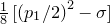 $\frac{1}{8} \left[ \left( {p_1}/{2} \right)^{\smash{2}} - \sigma \right]$
(respectively,
$\frac{1}{8} \left[ \left( {p_1}/{2} \right)^{\smash{2}} - \sigma \right]$
(respectively,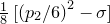 $\frac{1}{8} \left[ \left( {p_2}/{6} \right)^{\smash{2}} - \sigma \right]$
) is divisible by 28 (respectively, 8128).
$\frac{1}{8} \left[ \left( {p_2}/{6} \right)^{\smash{2}} - \sigma \right]$
) is divisible by 28 (respectively, 8128).
Finally, we need to understand each individual orbit. This requires computing the inertia groups of $(q{-}1)$
-connected 2q-manifolds, which we will discuss in more detail in § 1.4. Early progress in this area showed that for most values of q the inertia groups of all
$(q{-}1)$
-connected 2q-manifolds, which we will discuss in more detail in § 1.4. Early progress in this area showed that for most values of q the inertia groups of all $(q{-}1)$
-connected 2q-manifolds are trivial (see [Reference WallWal62a, Reference StolzSto85]), while [Reference Kramer and StolzKS07] proved that some 8- and 16-dimensional manifolds, including
$(q{-}1)$
-connected 2q-manifolds are trivial (see [Reference WallWal62a, Reference StolzSto85]), while [Reference Kramer and StolzKS07] proved that some 8- and 16-dimensional manifolds, including ${\mathbb{H}}P^2$
and
${\mathbb{H}}P^2$
and ${\mathbb{O}}P^2$
, have non-trivial inertia groups. Stable homotopy computations together with modified surgery theory have led to the determination of inertia groups for all
${\mathbb{O}}P^2$
, have non-trivial inertia groups. Stable homotopy computations together with modified surgery theory have led to the determination of inertia groups for all $q \neq 4,8$
; see [Reference Senger and ZhangSZ25].
$q \neq 4,8$
; see [Reference Senger and ZhangSZ25].
By combining Theorem 1.2 and the calculations of Senger and Zhang [Reference Senger and ZhangSZ25], we can determine the inertia groups for $q = 4,8$
as follows. See Theorems 1.7 and 1.8 for more details, [Reference Senger and ZhangSZ25, § 7] for the treatment of Senger and Zhang, and the announcement [CN19] in the
$q = 4,8$
as follows. See Theorems 1.7 and 1.8 for more details, [Reference Senger and ZhangSZ25, § 7] for the treatment of Senger and Zhang, and the announcement [CN19] in the $q=4$
case.
$q=4$
case.
Theorem 1.4. The inertia group of a 3-connected 8-manifold (respectively, 7-connected 16-manifold) is trivial if and only if its Pontryagin class $p_1$
(respectively,
$p_1$
(respectively, $p_2$
) is divisible by 8 (respectively, 24).
$p_2$
) is divisible by 8 (respectively, 24).
Note that $\Theta_8 \cong \Theta_{16} \cong \mathbb{Z}_2$
, so when the inertia group is non-trivial, it is equal to
$\Theta_8 \cong \Theta_{16} \cong \mathbb{Z}_2$
, so when the inertia group is non-trivial, it is equal to $\Theta_8$
or
$\Theta_8$
or $\Theta_{16}$
. Theorem 1.4 thus completes the final step in the classification of 3-connected 8-manifolds and 7-connected 16-manifolds.
$\Theta_{16}$
. Theorem 1.4 thus completes the final step in the classification of 3-connected 8-manifolds and 7-connected 16-manifolds.
In the second application we consider the stable class $\mathcal{S}^{\mathrm{st}}(M)$
of a manifold M; see § 1.5. This is the set of diffeomorphism classes (s-cobordism classes in dimension 4) within the stable diffeomorphism class of M. In other words, the stable class measures the difference between the stable diffeomorphism and diffeomorphism classifications. Theorem 1.1 shows that the Q-form is the extra (and only) invariant responsible for this difference, and this allows us to obtain an algebraic description of the stable class; see Theorem 1.11. To illustrate the use of this description in explicit computations, we consider manifolds whose intersection form is hyperbolic of rank 2.
$\mathcal{S}^{\mathrm{st}}(M)$
of a manifold M; see § 1.5. This is the set of diffeomorphism classes (s-cobordism classes in dimension 4) within the stable diffeomorphism class of M. In other words, the stable class measures the difference between the stable diffeomorphism and diffeomorphism classifications. Theorem 1.1 shows that the Q-form is the extra (and only) invariant responsible for this difference, and this allows us to obtain an algebraic description of the stable class; see Theorem 1.11. To illustrate the use of this description in explicit computations, we consider manifolds whose intersection form is hyperbolic of rank 2.
Theorem 1.5.
Let M be a simply-connected 2q-manifold, with $q \geqslant 2$
even. Let
$q \geqslant 2$
even. Let $(B,\xi)$
be its normal
$(B,\xi)$
be its normal $(q{-}1)$
-type, and
$(q{-}1)$
-type, and $f : M \rightarrow B$
a normal
$f : M \rightarrow B$
a normal $(q{-}1)$
-smoothing. Suppose that
$(q{-}1)$
-smoothing. Suppose that $H_q(B)$
is free,
$H_q(B)$
is free, $\mathop{\mathrm{rk}}\nolimits H_q(M)=2$
and the induced intersection form on
$\mathop{\mathrm{rk}}\nolimits H_q(M)=2$
and the induced intersection form on $H_q(M) / \mathop{\mathrm{Tor}}\nolimits(H_q(M)) \cong \mathbb{Z}^2$
is isomorphic to
$H_q(M) / \mathop{\mathrm{Tor}}\nolimits(H_q(M)) \cong \mathbb{Z}^2$
is isomorphic to $\bigl[ \begin{smallmatrix} 0 & 1 \\ 1 & 0 \end{smallmatrix} \bigr]$
. Then
$\bigl[ \begin{smallmatrix} 0 & 1 \\ 1 & 0 \end{smallmatrix} \bigr]$
. Then
 \[|\mathcal{S}^{\mathrm{st}}(M)| =\begin{cases}1 & \text{if $\mathop{\mathrm{rk}}\nolimits H_q(B)=0$ or 2,} \\1 & \text{if $\mathop{\mathrm{rk}}\nolimits H_q(B)=1$ and $|ab| \leqslant 1$,} \\2^{r-1} & \text{if $\mathop{\mathrm{rk}}\nolimits H_q(B)=1$ and $|ab| \geqslant 2$,}\end{cases} \]
where in the $\mathop{\mathrm{rk}}\nolimits H_q(B)=1$
case we fix an identification
$\mathop{\mathrm{rk}}\nolimits H_q(B)=1$
case we fix an identification $H_q(B) \cong \mathbb{Z}$
and elements
$H_q(B) \cong \mathbb{Z}$
and elements $x,y \in H_q(M)$
such that [x],[y] is a basis of
$x,y \in H_q(M)$
such that [x],[y] is a basis of $H_q(M) / \mathop{\mathrm{Tor}}\nolimits(H_q(M))$
in which the intersection form is given by the matrix
$H_q(M) / \mathop{\mathrm{Tor}}\nolimits(H_q(M))$
in which the intersection form is given by the matrix $\bigl[ \begin{smallmatrix} 0 & 1 \\ 1 & 0 \end{smallmatrix} \bigr]$
, we define
$\bigl[ \begin{smallmatrix} 0 & 1 \\ 1 & 0 \end{smallmatrix} \bigr]$
, we define $a = f_*(x), b=f_*(y) \in H_q(B) \cong \mathbb{Z}$
, and r is the number of primes dividing
$a = f_*(x), b=f_*(y) \in H_q(B) \cong \mathbb{Z}$
, and r is the number of primes dividing $|ab|$
.
$|ab|$
.
Conway, Crowley, Powell and Sixt [Reference Conway, Crowley, Powell and SixtCCP+23, Proposition 2.2, Theorem 3.3] constructed two families of manifolds with rank-2 hyperbolic intersection form, $N_{a,b}$
and
$N_{a,b}$
and $M_{a,b}$
, and gave bounds for the size of their stable class. The manifolds
$M_{a,b}$
, and gave bounds for the size of their stable class. The manifolds $N_{a,b}$
are simply-connected, 4k-dimensional and stably parallelisable with homology concentrated in even dimensions, while the
$N_{a,b}$
are simply-connected, 4k-dimensional and stably parallelisable with homology concentrated in even dimensions, while the $M_{a,b}$
are
$M_{a,b}$
are $(4k-1)$
-connected 8k-manifolds. Theorem 1.5 strengthens these results by determining the exact size of the stable class, and covering a more general class of manifolds.
$(4k-1)$
-connected 8k-manifolds. Theorem 1.5 strengthens these results by determining the exact size of the stable class, and covering a more general class of manifolds.
1.2 Background
Kreck’s theorem is the basis of a strategy for classifying even-dimensional manifolds up to diffeomorphism, which starts with a stable diffeomorphism classification. Explicit stable diffeomorphism classification has been obtained for some classes of manifolds; see, for example, Hambleton, Kreck and Teichner [Reference Hambleton, Kreck and TeichnerHKT09] and Kasprowski, Land, Powell and Teichner [Reference Kasprowski, Land, Powell and TeichnerKLP+17] for 4-manifolds with certain fundamental groups. Then the next step is understanding manifolds in a given stable diffeomorphism class, that is, determining the stable class. The main tool for this is Kreck’s modified surgery obstruction (see [Reference KreckKre99, Theorem 4]).
In some cases it can be used to show that the diffeomorphism classification is determined by the stable diffeomorphism classification. By [Reference KreckKre99, Theorem D] two simply-connected 2q-manifolds, with q odd, are diffeomorphic if and only if they are stably diffeomorphic and have the same Euler characteristic. This is not true for an arbitrary fundamental group and q. In general, the stable class can be arbitrarily large, or infinite, as shown by examples constructed in Conway et al. [Reference Conway, Crowley, Powell and SixtCCP+23, Reference Conway, Crowley, Powell and SixtCCP+21] (including the manifolds $N_{a,b}$
and
$N_{a,b}$
and $M_{a,b}$
mentioned above).
$M_{a,b}$
mentioned above).
Nevertheless, under some assumptions, the stable diffeomorphism classification still determines the diffeomorphism classification for manifolds that are already sufficiently stabilised. It follows from [Reference KreckKre99, Corollary 4] that stably diffeomorphic 2q-manifolds with finite fundamental group and the same Euler characteristic are in fact diffeomorphic if they split off two copies of $S^q \times S^q$
, or just one copy, if q is even and the manifolds are simply-connected. These cancellation results have been generalised to other fundamental groups (see, for example, Crowley and Sixt [Reference Crowley and SixtCS11]), and also strengthened in the special case of 4-manifolds (where diffeomorphism is replaced by s-cobordism or homeomorphism) (see, for example, Hambleton and Kreck [Reference Hambleton and KreckHK93b] and Hambleton [Reference HambletonHam23]).
$S^q \times S^q$
, or just one copy, if q is even and the manifolds are simply-connected. These cancellation results have been generalised to other fundamental groups (see, for example, Crowley and Sixt [Reference Crowley and SixtCS11]), and also strengthened in the special case of 4-manifolds (where diffeomorphism is replaced by s-cobordism or homeomorphism) (see, for example, Hambleton and Kreck [Reference Hambleton and KreckHK93b] and Hambleton [Reference HambletonHam23]).
There are few results where unstable classification has been obtained from the stable classification without assuming that the manifolds are already stabilised. As, in general, the stable and unstable classifications do not coincide, additional invariants are needed for the latter. Wall [Reference WallWal64], Freedman and Quinn [Reference Freedman and QuinnFQ90] and Hambleton and Kreck [Reference Hambleton and KreckHK93a] showed that stably homeomorphic 4-manifolds with trivial or cyclic fundamental group are classified up to s-cobordism/homeomorphism by their equivariant intersection form. However, by Kreck and Schafer [Reference Kreck and SchaferKS84], this is not true for arbitrary 4-manifolds. Our Theorem 1.1 provides a new condition of this type for simply-connected 2q-manifolds satisfying (*), for all even $q \geqslant 2$
(which, in the
$q \geqslant 2$
(which, in the $q=2$
case, recovers the earlier results on spin simply-connected smooth 4-manifolds). This can be used to complete the second step of this classification strategy and determine the stable class of a manifold.
$q=2$
case, recovers the earlier results on spin simply-connected smooth 4-manifolds). This can be used to complete the second step of this classification strategy and determine the stable class of a manifold.
1.3 Extended surgery theory
We will prove Theorem 1.2 (the special case of the Q-form conjecture), and hence Theorem 1.1, by introducing and studying a new type of surgery obstruction associated to a normal bordism.
We start the proof by applying surgery below the middle dimension to replace $F_0$
with a q-connected normal bordism
$F_0$
with a q-connected normal bordism $F : W \rightarrow B$
. Note that, for this F, Kreck’s modified surgery obstruction is defined [Reference KreckKre99, § 6], with the property that the obstruction is elementary if and only if W is bordant (over
$F : W \rightarrow B$
. Note that, for this F, Kreck’s modified surgery obstruction is defined [Reference KreckKre99, § 6], with the property that the obstruction is elementary if and only if W is bordant (over $(B,\xi)$
, rel boundary) to an h-cobordism. It is defined using the intersection form on
$(B,\xi)$
, rel boundary) to an h-cobordism. It is defined using the intersection form on $H_q(\partial U)$
, where
$H_q(\partial U)$
, where $U \subset W$
is a collection of embedded copies of
$U \subset W$
is a collection of embedded copies of $S^q \times D^{q+1}$
such that
$S^q \times D^{q+1}$
such that $\mathop{\mathrm{Im}}\nolimits(H_q(U) \rightarrow H_q(W))$
is the surgery kernel
$\mathop{\mathrm{Im}}\nolimits(H_q(U) \rightarrow H_q(W))$
is the surgery kernel $\mathop{\mathrm{Ker}}\nolimits(H_q(F) : H_q(W) \rightarrow H_q(B))$
. Then [Reference KreckKre99, Proposition 8] relates the obstruction to the intersection form on
$\mathop{\mathrm{Ker}}\nolimits(H_q(F) : H_q(W) \rightarrow H_q(B))$
. Then [Reference KreckKre99, Proposition 8] relates the obstruction to the intersection form on $\mathop{\mathrm{Ker}}\nolimits(H_q(f_0) : H_q(M_0) \rightarrow H_q(B))$
. This is the basis of [Reference KreckKre99, Theorem D] and other cancellation results.
$\mathop{\mathrm{Ker}}\nolimits(H_q(f_0) : H_q(M_0) \rightarrow H_q(B))$
. This is the basis of [Reference KreckKre99, Theorem D] and other cancellation results.
That is not what we will use though. Instead, we will define a new obstruction $[\theta_{W,F}]$
(see § 6). While the definition of
$[\theta_{W,F}]$
(see § 6). While the definition of $[\theta_{W,F}]$
will follow the overall logic of [Reference KreckKre99], we will make significant changes. The main novelty of
$[\theta_{W,F}]$
will follow the overall logic of [Reference KreckKre99], we will make significant changes. The main novelty of $[\theta_{W,F}]$
, compared to the modified surgery obstruction and the obstructions in classical surgery theory (see Browder [Reference BrowderBro72], Wall [Reference WallWal99]), is that it is no longer defined on the surgery kernel. Quite the opposite, we will use a codimension-0 submanifold
$[\theta_{W,F}]$
, compared to the modified surgery obstruction and the obstructions in classical surgery theory (see Browder [Reference BrowderBro72], Wall [Reference WallWal99]), is that it is no longer defined on the surgery kernel. Quite the opposite, we will use a codimension-0 submanifold $U \subset W$
such that the map
$U \subset W$
such that the map $H_q(U) \rightarrow H_q(W)$
(and hence the composition
$H_q(U) \rightarrow H_q(W)$
(and hence the composition $H_q(U) \rightarrow H_q(W) \rightarrow H_q(B)$
) is surjective. Furthermore, the monoid
$H_q(U) \rightarrow H_q(W) \rightarrow H_q(B)$
) is surjective. Furthermore, the monoid $\ell_{2q+1}(B,\xi)$
in which
$\ell_{2q+1}(B,\xi)$
in which $[\theta_{W,F}]$
lives is no longer determined by the fundamental group alone, but also depends on
$[\theta_{W,F}]$
lives is no longer determined by the fundamental group alone, but also depends on $H_q(B)$
and the Wu class
$H_q(B)$
and the Wu class $v_q(\xi)$
. Its elements are represented by quasi-formations on extended quadratic forms over
$v_q(\xi)$
. Its elements are represented by quasi-formations on extended quadratic forms over $H_q(B)$
(see §§ 2 and 4).
$H_q(B)$
(see §§ 2 and 4).
We will define a group $L_{2q+1}(B,\xi)$
, which is the analogue of the classical L-group, and prove that it is the group of invertible elements of
$L_{2q+1}(B,\xi)$
, which is the analogue of the classical L-group, and prove that it is the group of invertible elements of $\ell_{2q+1}(B,\xi)$
. This will rely on a generalisation of Wall’s [Reference WallWal99, Lemma 6.2] to metabolic forms (see Theorem 3.7). Moreover, we will show that if
$\ell_{2q+1}(B,\xi)$
. This will rely on a generalisation of Wall’s [Reference WallWal99, Lemma 6.2] to metabolic forms (see Theorem 3.7). Moreover, we will show that if $H_q(B)$
is free, then
$H_q(B)$
is free, then $L_{2q+1}(B,\xi)$
is trivial.
$L_{2q+1}(B,\xi)$
is trivial.
We will also define the subsemigroup of elementary elements of $\ell_{2q+1}(B,\xi)$
, and prove that F is normally bordant to an h-cobordism if and only if
$\ell_{2q+1}(B,\xi)$
, and prove that F is normally bordant to an h-cobordism if and only if $[\theta_{W,F}]$
is elementary. Along with its definition, this step is where the main technical difficulty of working with
$[\theta_{W,F}]$
is elementary. Along with its definition, this step is where the main technical difficulty of working with $[\theta_{W,F}]$
lies (see Lemma 6.28), due to our choice of a more complicated U.
$[\theta_{W,F}]$
lies (see Lemma 6.28), due to our choice of a more complicated U.
Then, similarly to [Reference KreckKre99, Proposition 8], we will relate $[\theta_{W,F}]$
to the Q-form of
$[\theta_{W,F}]$
to the Q-form of $f_0$
. However, since the intersection form of
$f_0$
. However, since the intersection form of $M_0$
is non-singular (in contrast to its restriction to
$M_0$
is non-singular (in contrast to its restriction to $\mathop{\mathrm{Ker}}\nolimits H_q(f_0)$
), we will find that
$\mathop{\mathrm{Ker}}\nolimits H_q(f_0)$
), we will find that $[\theta_{W,F}]$
has better algebraic properties. In fact, under some assumptions, we will be able to compute
$[\theta_{W,F}]$
has better algebraic properties. In fact, under some assumptions, we will be able to compute $[\theta_{W,F}]$
in terms of the Q-forms of
$[\theta_{W,F}]$
in terms of the Q-forms of $f_0$
and
$f_0$
and $f_1$
, up to the action of
$f_1$
, up to the action of $L_{2q+1}(B,\xi)$
(see Theorem 7.6). In the case when
$L_{2q+1}(B,\xi)$
(see Theorem 7.6). In the case when $H_q(B)$
is free and the Q-forms are isomorphic, this will allow us to deduce that
$H_q(B)$
is free and the Q-forms are isomorphic, this will allow us to deduce that $[\theta_{W,F}]$
is elementary and complete the proof of Theorem 1.2 (see § 8).
$[\theta_{W,F}]$
is elementary and complete the proof of Theorem 1.2 (see § 8).
1.4 Inertia groups of highly-connected manifolds
As an application, we next consider the inertia groups of $(q{-}1)$
-connected 2q-manifolds. When
$(q{-}1)$
-connected 2q-manifolds. When $q=4$
or 8, we will use Theorem 1.2 to identify the inertia group with the kernel of a bordism map.
$q=4$
or 8, we will use Theorem 1.2 to identify the inertia group with the kernel of a bordism map.
Given an oriented manifold M, let $\nu_M$
denote the stable normal bundle of M, and also its classifying map
$\nu_M$
denote the stable normal bundle of M, and also its classifying map $\nu_M : M \rightarrow BSO$
. If M is
$\nu_M : M \rightarrow BSO$
. If M is $(q{-}1)$
-connected and
$(q{-}1)$
-connected and $A = \mathop{\mathrm{Im}}\nolimits(\pi_q(\nu_M): \pi_q(M) \rightarrow \pi_q(BSO))$
, then the normal
$A = \mathop{\mathrm{Im}}\nolimits(\pi_q(\nu_M): \pi_q(M) \rightarrow \pi_q(BSO))$
, then the normal $(q{-}1)$
-type of M is
$(q{-}1)$
-type of M is $(BSO\langle q, A\rangle,\xi_{q,A})$
; see Definition 9.1 and Proposition 9.2.
$(BSO\langle q, A\rangle,\xi_{q,A})$
; see Definition 9.1 and Proposition 9.2.
Definition 1.6. For a subgroup $A \leqslant \pi_q(BSO)$
let
$A \leqslant \pi_q(BSO)$
let $\eta_{2q}^A :\Theta_{2q} \rightarrow \Omega_{2q}(BSO\langle q, A\rangle;\xi_{q,A})$
be the map which sends a homotopy 2q-sphere
$\eta_{2q}^A :\Theta_{2q} \rightarrow \Omega_{2q}(BSO\langle q, A\rangle;\xi_{q,A})$
be the map which sends a homotopy 2q-sphere $\Sigma$
to the bordism class of a normal map
$\Sigma$
to the bordism class of a normal map $\Sigma \rightarrow BSO\langle q,A\rangle$
. (This map is a well-defined homomorphism by Propositions 9.2 and 9.5.)
$\Sigma \rightarrow BSO\langle q,A\rangle$
. (This map is a well-defined homomorphism by Propositions 9.2 and 9.5.)
It follows from a standard obstruction theory argument that if M is a $(q{-}1)$
-connected 2q-manifold and
$(q{-}1)$
-connected 2q-manifold and $A = \mathop{\mathrm{Im}}\nolimits(\pi_q(\nu_M))$
, then
$A = \mathop{\mathrm{Im}}\nolimits(\pi_q(\nu_M))$
, then $I(M) \leqslant \mathop{\mathrm{Ker}}\nolimits(\eta_{2q}^A)$
; see Proposition 9.6. Based on this observation, the inertia group I(M) can be determined by completing the following two steps: computing
$I(M) \leqslant \mathop{\mathrm{Ker}}\nolimits(\eta_{2q}^A)$
; see Proposition 9.6. Based on this observation, the inertia group I(M) can be determined by completing the following two steps: computing $\mathop{\mathrm{Ker}}\nolimits(\eta_{2q}^A)$
; and showing that
$\mathop{\mathrm{Ker}}\nolimits(\eta_{2q}^A)$
; and showing that $I(M) = \mathop{\mathrm{Ker}}\nolimits(\eta_{2q}^A)$
.
$I(M) = \mathop{\mathrm{Ker}}\nolimits(\eta_{2q}^A)$
.
The subgroup $\mathop{\mathrm{Ker}}\nolimits(\eta_{2q}^A)$
is now known for every q and A, due to the work of several authors. The final cases were resolved by Senger and Zhang [Reference Senger and ZhangSZ25]; see [Reference Senger and ZhangSZ25] also for the history and earlier results. In particular,
$\mathop{\mathrm{Ker}}\nolimits(\eta_{2q}^A)$
is now known for every q and A, due to the work of several authors. The final cases were resolved by Senger and Zhang [Reference Senger and ZhangSZ25]; see [Reference Senger and ZhangSZ25] also for the history and earlier results. In particular, $\mathop{\mathrm{Ker}}\nolimits(\eta_{2q}^A) = 0$
for every A if
$\mathop{\mathrm{Ker}}\nolimits(\eta_{2q}^A) = 0$
for every A if $q \neq 4,8,9$
, and then the inertia group is also trivial by the relation
$q \neq 4,8,9$
, and then the inertia group is also trivial by the relation $I(M) \leqslant \mathop{\mathrm{Ker}}\nolimits(\eta_{2q}^A)$
. Moreover, Kreck’s [Reference KreckKre99, Theorem D] implies that if q is odd, then
$I(M) \leqslant \mathop{\mathrm{Ker}}\nolimits(\eta_{2q}^A)$
. Moreover, Kreck’s [Reference KreckKre99, Theorem D] implies that if q is odd, then $I(M) = \mathop{\mathrm{Ker}}\nolimits(\eta_{2q}^A)$
; see Theorem 9.8(a). Hence, the second step is settled and the inertia group is determined by the above results in all cases, except when
$I(M) = \mathop{\mathrm{Ker}}\nolimits(\eta_{2q}^A)$
; see Theorem 9.8(a). Hence, the second step is settled and the inertia group is determined by the above results in all cases, except when $q=4,8$
.
$q=4,8$
.
In these cases $\mathop{\mathrm{Ker}}\nolimits(\eta_{2q}^A)$
is computed as follows.
$\mathop{\mathrm{Ker}}\nolimits(\eta_{2q}^A)$
is computed as follows.
Theorem 1.7 ( $q=4$
, Senger and Zhang [Reference Senger and ZhangSZ25, Theorem 7.14] and Crowley and Nagy [CN19];
$q=4$
, Senger and Zhang [Reference Senger and ZhangSZ25, Theorem 7.14] and Crowley and Nagy [CN19]; $q=8$
, Senger and Zhang [Reference Senger and ZhangSZ25, Theorem 7.15], Crowley and Olbermann (unpublished)). Suppose that
$q=8$
, Senger and Zhang [Reference Senger and ZhangSZ25, Theorem 7.15], Crowley and Olbermann (unpublished)). Suppose that $q = 4$
or 8 and
$q = 4$
or 8 and $A \leqslant \pi_q(BSO) \cong \mathbb{Z}$
. Then
$A \leqslant \pi_q(BSO) \cong \mathbb{Z}$
. Then $\mathop{\mathrm{Ker}}\nolimits(\eta_{2q}^A) = 0$
if
$\mathop{\mathrm{Ker}}\nolimits(\eta_{2q}^A) = 0$
if $A \leqslant 4\mathbb{Z}$
and
$A \leqslant 4\mathbb{Z}$
and $\mathop{\mathrm{Ker}}\nolimits(\eta_{2q}^A) = \Theta_{2q} \cong \mathbb{Z}_2$
if
$\mathop{\mathrm{Ker}}\nolimits(\eta_{2q}^A) = \Theta_{2q} \cong \mathbb{Z}_2$
if $A \not\leqslant 4\mathbb{Z}$
.
$A \not\leqslant 4\mathbb{Z}$
.
Now the Q-form conjecture can be used to show that $I(M) = \mathop{\mathrm{Ker}}\nolimits(\eta_{2q}^A)$
; see Theorem 9.8(b). Namely, given a
$I(M) = \mathop{\mathrm{Ker}}\nolimits(\eta_{2q}^A)$
; see Theorem 9.8(b). Namely, given a $(q{-}1)$
-connected 2q-manifold M with
$(q{-}1)$
-connected 2q-manifold M with $A = \mathop{\mathrm{Im}}\nolimits(\pi_q(\nu_M))$
, if
$A = \mathop{\mathrm{Im}}\nolimits(\pi_q(\nu_M))$
, if $\Sigma \in \mathop{\mathrm{Ker}}\nolimits(\eta_{2q}^A)$
, then the (unique) normal
$\Sigma \in \mathop{\mathrm{Ker}}\nolimits(\eta_{2q}^A)$
, then the (unique) normal $(q{-}1)$
-smoothings of M and
$(q{-}1)$
-smoothings of M and $M \# \Sigma$
over
$M \# \Sigma$
over $(BSO\langle q, A\rangle, \xi_{q,A})$
are normally bordant. If q is even, then their Q-forms are defined and isomorphic, and, unless
$(BSO\langle q, A\rangle, \xi_{q,A})$
are normally bordant. If q is even, then their Q-forms are defined and isomorphic, and, unless $q \equiv 2$
mod 8, every subgroup of
$q \equiv 2$
mod 8, every subgroup of $\pi_q(BSO)$
is free, so the manifolds satisfy (*). Therefore, by Theorem 1.2, M is diffeomorphic to
$\pi_q(BSO)$
is free, so the manifolds satisfy (*). Therefore, by Theorem 1.2, M is diffeomorphic to $M \# \Sigma$
. These arguments are summarised as follows.
$M \# \Sigma$
. These arguments are summarised as follows.
Theorem 1.8.
Suppose that $q \equiv 0$
, 4 or 6 mod 8. Let M be a
$q \equiv 0$
, 4 or 6 mod 8. Let M be a $(q{-}1)$
-connected 2q-manifold and
$(q{-}1)$
-connected 2q-manifold and $A = \mathop{\mathrm{Im}}\nolimits(\pi_q(\nu_M): \pi_q(M) \rightarrow \pi_q(BSO))$
. Then
$A = \mathop{\mathrm{Im}}\nolimits(\pi_q(\nu_M): \pi_q(M) \rightarrow \pi_q(BSO))$
. Then
 \[I(M) = \mathop{\mathrm{Ker}}\nolimits(\eta_{2q}^A : \Theta_{2q} \rightarrow \Omega_{2q}(BSO\langle q, A\rangle; \xi_{q,A})) . \]
So if $q=4,8$
, then the combination of Theorems 1.7 and 1.8 determines the inertia groups. Theorem 1.4 is then obtained by rephrasing the condition of Theorem 1.7 on
$q=4,8$
, then the combination of Theorems 1.7 and 1.8 determines the inertia groups. Theorem 1.4 is then obtained by rephrasing the condition of Theorem 1.7 on $A = \mathop{\mathrm{Im}}\nolimits \pi_q(\nu_M)$
in terms of a Pontryagin class of M (see § 9).
$A = \mathop{\mathrm{Im}}\nolimits \pi_q(\nu_M)$
in terms of a Pontryagin class of M (see § 9).
1.5 The stable smoothing set and stable class
We can also apply Theorem 1.2 to compute the stable smoothing set and the stable class of a manifold. Fix a 2q-manifold M, let $(B,\xi)$
be its normal
$(B,\xi)$
be its normal $(q{-}1)$
-type, and let
$(q{-}1)$
-type, and let $f : M \rightarrow B$
be a normal
$f : M \rightarrow B$
be a normal $(q{-}1)$
-smoothing.
$(q{-}1)$
-smoothing.
Definition 1.9. The stable class of M, denoted by $\mathcal{S}^{\mathrm{st}}(M)$
, is the set of s-cobordism classes of 2q-manifolds N such that N is stably diffeomorphic to M and
$\mathcal{S}^{\mathrm{st}}(M)$
, is the set of s-cobordism classes of 2q-manifolds N such that N is stably diffeomorphic to M and $\chi(N)=\chi(M)$
(where
$\chi(N)=\chi(M)$
(where $\chi(M)$
denotes the Euler characteristic of M).
$\chi(M)$
denotes the Euler characteristic of M).
The stable smoothing set of M, denoted by $\mathcal{S}^{\mathrm{st}}(M,f)$
, consists of equivalence classes of normal
$\mathcal{S}^{\mathrm{st}}(M,f)$
, consists of equivalence classes of normal $(q{-}1)$
-smoothings
$(q{-}1)$
-smoothings $g : N \rightarrow B$
such that g is normally bordant to f and
$g : N \rightarrow B$
such that g is normally bordant to f and $\chi(N)=\chi(M)$
. Two such normal
$\chi(N)=\chi(M)$
. Two such normal $(q{-}1)$
-smoothings,
$(q{-}1)$
-smoothings, $g : N \rightarrow B$
and
$g : N \rightarrow B$
and $g' : N' \rightarrow B$
, are equivalent if there is a normal bordism
$g' : N' \rightarrow B$
, are equivalent if there is a normal bordism $G : W \rightarrow B$
between them such that W is an s-cobordism between N and N’.
$G : W \rightarrow B$
between them such that W is an s-cobordism between N and N’.
Note that the normal $(q{-}1)$
-smoothing f is unique up to an automorphism of
$(q{-}1)$
-smoothing f is unique up to an automorphism of $(B,\xi)$
(see § 5.1), so if
$(B,\xi)$
(see § 5.1), so if $f' : M \rightarrow B$
is another normal
$f' : M \rightarrow B$
is another normal $(q{-}1)$
-smoothing, then
$(q{-}1)$
-smoothing, then $\mathcal{S}^{\mathrm{st}}(M,f) \cong \mathcal{S}^{\mathrm{st}}(M,f')$
.
$\mathcal{S}^{\mathrm{st}}(M,f) \cong \mathcal{S}^{\mathrm{st}}(M,f')$
.
By Kreck’s theorem a manifold N represents an element of $\mathcal{S}^{\mathrm{st}}(M)$
if and only if there is a normal map
$\mathcal{S}^{\mathrm{st}}(M)$
if and only if there is a normal map $g : N \rightarrow B$
that represents an element of
$g : N \rightarrow B$
that represents an element of $\mathcal{S}^{\mathrm{st}}(M,f)$
. Hence, forgetting the normal map defines a surjective map
$\mathcal{S}^{\mathrm{st}}(M,f)$
. Hence, forgetting the normal map defines a surjective map $\mathcal{S}^{\mathrm{st}}(M,f) \rightarrow \mathcal{S}^{\mathrm{st}}(M)$
. Since for a fixed N the normal map
$\mathcal{S}^{\mathrm{st}}(M,f) \rightarrow \mathcal{S}^{\mathrm{st}}(M)$
. Since for a fixed N the normal map $g : N \rightarrow B$
is unique up to an automorphism of
$g : N \rightarrow B$
is unique up to an automorphism of $(B,\xi)$
, the fibres of the forgetful map
$(B,\xi)$
, the fibres of the forgetful map $\mathcal{S}^{\mathrm{st}}(M,f) \rightarrow \mathcal{S}^{\mathrm{st}}(M)$
are the orbits of the action of
$\mathcal{S}^{\mathrm{st}}(M,f) \rightarrow \mathcal{S}^{\mathrm{st}}(M)$
are the orbits of the action of $\mathop{\mathrm{Aut}}\nolimits(B,\xi)_{[M,f]}$
on
$\mathop{\mathrm{Aut}}\nolimits(B,\xi)_{[M,f]}$
on $\mathcal{S}^{\mathrm{st}}(M,f)$
, where
$\mathcal{S}^{\mathrm{st}}(M,f)$
, where $\mathop{\mathrm{Aut}}\nolimits(B,\xi)_{[M,f]}$
denotes the stabiliser of the normal bordism class of
$\mathop{\mathrm{Aut}}\nolimits(B,\xi)_{[M,f]}$
denotes the stabiliser of the normal bordism class of $f : M \rightarrow B$
in
$f : M \rightarrow B$
in $\mathop{\mathrm{Aut}}\nolimits(B,\xi)$
. Therefore,
$\mathop{\mathrm{Aut}}\nolimits(B,\xi)$
. Therefore, $\mathcal{S}^{\mathrm{st}}(M) \cong \mathcal{S}^{\mathrm{st}}(M,f) / \mathop{\mathrm{Aut}}\nolimits(B,\xi)_{[M,f]}$
. An automorphism of
$\mathcal{S}^{\mathrm{st}}(M) \cong \mathcal{S}^{\mathrm{st}}(M,f) / \mathop{\mathrm{Aut}}\nolimits(B,\xi)_{[M,f]}$
. An automorphism of $(B,\xi)$
determines an automorphism of
$(B,\xi)$
determines an automorphism of $H_q(B)$
, and we will denote the image of the map
$H_q(B)$
, and we will denote the image of the map $\mathop{\mathrm{Aut}}\nolimits(B,\xi)_{[M,f]} \rightarrow \mathop{\mathrm{Aut}}\nolimits(H_q(B))$
by
$\mathop{\mathrm{Aut}}\nolimits(B,\xi)_{[M,f]} \rightarrow \mathop{\mathrm{Aut}}\nolimits(H_q(B))$
by $A^{(B,\xi)}_{[M,f]}$
.
$A^{(B,\xi)}_{[M,f]}$
.
From now on assume that q is even and M is simply-connected. We will next consider extended quadratic forms over abelian groups; see § 2 for the definitions. For example, the Q-form $E_q(N,g)$
of a normal
$E_q(N,g)$
of a normal $(q{-}1)$
-smoothing
$(q{-}1)$
-smoothing $g : N \rightarrow B$
is an extended quadratic form over
$g : N \rightarrow B$
is an extended quadratic form over $H_q(B)$
.
$H_q(B)$
.
Definition 1.10. Let $\underline{E}$
be an extended quadratic form over an abelian group Q. We define
$\underline{E}$
be an extended quadratic form over an abelian group Q. We define $\mathcal{S}^{\mathrm{st}}(\underline{E})$
to be the set of isomorphism classes of extended quadratic forms
$\mathcal{S}^{\mathrm{st}}(\underline{E})$
to be the set of isomorphism classes of extended quadratic forms $\underline{E}{}'$
over Q such that
$\underline{E}{}'$
over Q such that $\underline{E} \oplus \underline{H}_{2k} \cong \underline{E}{}' \oplus \underline{H}_{2k}$
for some
$\underline{E} \oplus \underline{H}_{2k} \cong \underline{E}{}' \oplus \underline{H}_{2k}$
for some $k \geqslant 0$
.
$k \geqslant 0$
.
Theorem 1.11.
-
(a) Taking the Q-form of a normal $(q{-}1)$
-smoothing induces a well-defined surjection
$E_q : \mathcal{S}^{\mathrm{st}}(M,f) \rightarrow \mathcal{S}^{\mathrm{st}}(E_q(M,f))$
. If
$H_q(B)$
is free, then this map is a bijection.
$(q{-}1)$
-smoothing induces a well-defined surjection
$E_q : \mathcal{S}^{\mathrm{st}}(M,f) \rightarrow \mathcal{S}^{\mathrm{st}}(E_q(M,f))$
. If
$H_q(B)$
is free, then this map is a bijection.
-
(b) The group
$A^{(B,\xi)}_{[M,f]}$
acts on
$\mathcal{S}^{\mathrm{st}}(E_q(M,f))$
, and the map
$E_q$
induces a surjection
$\mathcal{S}^{\mathrm{st}}(M) \rightarrow \mathcal{S}^{\mathrm{st}}(E_q(M,f)) / A^{(B,\xi)}_{[M,f]}$
. If
$H_q(B)$
is free, then this map is a bijection.








Thus, when $H_q(B)$
is free, the Q-form conjecture reduces the computation of the stable smoothing set and the stable class to algebraic problems. The former only depends on the Q-form of a normal
$H_q(B)$
is free, the Q-form conjecture reduces the computation of the stable smoothing set and the stable class to algebraic problems. The former only depends on the Q-form of a normal $(q{-}1)$
-smoothing
$(q{-}1)$
-smoothing $f : M \rightarrow B$
, while for the latter we further need to know the subgroup
$f : M \rightarrow B$
, while for the latter we further need to know the subgroup $A^{(B,\xi)}_{[M,f]} \leqslant \mathop{\mathrm{Aut}}\nolimits(H_q(B))$
and understand its action on
$A^{(B,\xi)}_{[M,f]} \leqslant \mathop{\mathrm{Aut}}\nolimits(H_q(B))$
and understand its action on $\mathcal{S}^{\mathrm{st}}(E_q(M,f))$
. Theorem 1.11 will be proved in § 10. There we also prove Theorem 1.5 by solving the corresponding algebraic problem.
$\mathcal{S}^{\mathrm{st}}(E_q(M,f))$
. Theorem 1.11 will be proved in § 10. There we also prove Theorem 1.5 by solving the corresponding algebraic problem.
The paper is organised as follows. Sections 2–4 are concerned with the algebra underlying our constructions, introducing extended quadratic forms over an abelian group, the group $\mathop{\mathrm{RU}}\nolimits_{\mathrm{st}}(\underline{M},L)$
and the monoid
$\mathop{\mathrm{RU}}\nolimits_{\mathrm{st}}(\underline{M},L)$
and the monoid $\ell_{2q+1}(Q,v)$
, respectively. Section 5 contains preliminaries for the geometric results. In § 6 we define the extended surgery obstruction associated to a normal bordism, and prove some of its main properties. In § 7 we give a formula for the surgery obstruction in terms of the Q-forms of
$\ell_{2q+1}(Q,v)$
, respectively. Section 5 contains preliminaries for the geometric results. In § 6 we define the extended surgery obstruction associated to a normal bordism, and prove some of its main properties. In § 7 we give a formula for the surgery obstruction in terms of the Q-forms of $f_0$
and
$f_0$
and $f_1$
. In § 8 we apply the results of the earlier sections to prove Theorem 1.2. Finally, §§ 9 and 10 contain the proofs of Theorems 1.8, 1.4, 1.11 and 1.5.
$f_1$
. In § 8 we apply the results of the earlier sections to prove Theorem 1.2. Finally, §§ 9 and 10 contain the proofs of Theorems 1.8, 1.4, 1.11 and 1.5.
This paper is based on Chapter 4 of the author’s thesis [Nagy21]. Here we will often omit straightforward arguments, and refer to [Nagy21] for those details. Compared to [Nagy21], a new § 3 is added, introducing the groups $\mathop{\mathrm{RU}}\nolimits_{\mathrm{st}}(\underline{M},L)$
which allow us to prove Theorem 4.26 ([Nagy21, Theorem 4.2.21]) without the assumption that Q is free. Sections 4 and 7 are updated accordingly. Section 9 is based on [Nagy21, § 5.2.3].
$\mathop{\mathrm{RU}}\nolimits_{\mathrm{st}}(\underline{M},L)$
which allow us to prove Theorem 4.26 ([Nagy21, Theorem 4.2.21]) without the assumption that Q is free. Sections 4 and 7 are updated accordingly. Section 9 is based on [Nagy21, § 5.2.3].
All abelian groups will be assumed to be finitely generated and all manifolds will be assumed to be smooth, compact (closed, unless indicated otherwise) and oriented.
2. Extended quadratic forms
In this section we define and study (symmetric) extended quadratic forms over an abelian group.
Definition 2.1. Let Q be an abelian group. An extended quadratic form over Q is a triple
 \[\underline{M} = (M, \lambda, \mu) \]
where M is an abelian group, $\lambda : M \times M \rightarrow \mathbb{Z}$
is a symmetric bilinear function, and
$\lambda : M \times M \rightarrow \mathbb{Z}$
is a symmetric bilinear function, and $\mu : M \rightarrow Q$
is a homomorphism.
$\mu : M \rightarrow Q$
is a homomorphism.
Definition 2.2. Let $\underline{M}$
be an extended quadratic form as above:
$\underline{M}$
be an extended quadratic form as above:
-
–
$\underline{M}$
is called free if the abelian group M is free; -
–
$\underline{M}$
is non-singular if the adjoint of
$\lambda$
,
$\mathop{\mathrm{ad}}\nolimits \lambda : M \rightarrow \mathop{\mathrm{Hom}}\nolimits(M, \mathbb{Z}) = M^*$
, induces an isomorphism
$M / \mathop{\mathrm{Tor}}\nolimits M \cong M^*$
; -
– a subgroup
$V \leqslant M$
is called a half-rank direct summand if it is a direct summand in M and
$\mathop{\mathrm{rk}}\nolimits V = \frac{1}{2} \mathop{\mathrm{rk}}\nolimits M$
; -
– a subgroup
$L \leqslant M$
is a free Lagrangian if it is a free half-rank direct summand in M,
$\lambda \big| _{L \times L} = 0$
and
$\mu \big| _L = 0$
; -
– a subgroup
$L \leqslant M$
is a T-Lagrangian if it is a half-rank direct summand in M,
$\mathop{\mathrm{Tor}}\nolimits M \leqslant L$
,
$\lambda \big| _{L \times L} = 0$
and
$\mu \big| _L = 0$
; -
–
$\underline{M}$
is metabolic if it is non-singular and there is a T-Lagrangian
$L \leqslant M$
; -
–
$\underline{M}$
is hyperbolic if it is free, non-singular and there are two Lagrangians
$L, L' \leqslant M$
such that
$M = L \oplus L'$
(as an internal direct sum); -
–
$\underline{M}$
is full if
$\mu$
is surjective; -
–
$\underline{M}$
is even if
$\lambda(x,x)$
is even for every
$x \in M$
; -
–
$\underline{M}$
is geometric with respect to a homomorphism
$v : Q \rightarrow \mathbb{Z}_2$
if for every
$x \in M$
we have
$\varrho_2 \circ \lambda(x,x) = v \circ \mu(x)$
, where
$\varrho_2 : \mathbb{Z} \rightarrow \mathbb{Z}_2$
is reduction mod 2; -
– the rank of
$\underline{M}$
, denoted by
$\mathop{\mathrm{rk}}\nolimits \underline{M}$
, is the rank of the group M.





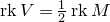





If $\underline{M}$
is free, T-Lagrangians coincide with free Lagrangians, and we simply call them Lagrangians.
$\underline{M}$
is free, T-Lagrangians coincide with free Lagrangians, and we simply call them Lagrangians.
Remark 2.3. Baues [Reference BauesBau94] and Ranicki [Reference RanickiRan01] introduced the notion of an extended quadratic form over a quadratic form parameter P. Using the terminology and notation from Crowley and Nagy [CN24], extended quadratic forms over an abelian group A, as defined here, are equivalent to extended quadratic forms over the quadratic form parameter $Q^+ \oplus A$
. More specifically, the form
$Q^+ \oplus A$
. More specifically, the form $(M, \lambda, \mu)$
over A corresponds to the form
$(M, \lambda, \mu)$
over A corresponds to the form $(M, \lambda, (q_{\lambda},\mu))$
over
$(M, \lambda, (q_{\lambda},\mu))$
over $Q^+ \oplus A$
, where
$Q^+ \oplus A$
, where $q_{\lambda} : M \rightarrow \mathbb{Z}$
is defined by
$q_{\lambda} : M \rightarrow \mathbb{Z}$
is defined by $q_{\lambda}(x) = \lambda(x,x)$
.
$q_{\lambda}(x) = \lambda(x,x)$
.
Given a symmetric quadratic form parameter P, there is a canonical ‘extended symmetrisation’ morphism of quadratic form parameters $P \rightarrow Q^+ \oplus SP$
. This induces a map that sends forms over P to forms over
$P \rightarrow Q^+ \oplus SP$
. This induces a map that sends forms over P to forms over $Q^+ \oplus SP$
. By [CN24, Lemma 2.29] this map is a bijection between forms over P and those forms over
$Q^+ \oplus SP$
. By [CN24, Lemma 2.29] this map is a bijection between forms over P and those forms over $Q^+ \oplus SP$
that correspond to geometric (with respect to
$Q^+ \oplus SP$
that correspond to geometric (with respect to $v_P : SP \rightarrow \mathbb{Z}_2$
) forms over the abelian group SP. For example, ordinary quadratic forms used in classical simply-connected surgery are forms over the quadratic form parameter
$v_P : SP \rightarrow \mathbb{Z}_2$
) forms over the abelian group SP. For example, ordinary quadratic forms used in classical simply-connected surgery are forms over the quadratic form parameter $Q_+$
, and they are equivalent to geometric extended quadratic forms over the abelian group
$Q_+$
, and they are equivalent to geometric extended quadratic forms over the abelian group $SQ_+ = 0$
(with respect to
$SQ_+ = 0$
(with respect to $v_{Q_+} = 0 : 0 \rightarrow \mathbb{Z}_2$
).
$v_{Q_+} = 0 : 0 \rightarrow \mathbb{Z}_2$
).
2.1 Preliminaries
In this section we will collect a few lemmas which are well known for ordinary ‘symmetric forms’ (that is, pairs $(M, \lambda)$
, where M is an abelian group and
$(M, \lambda)$
, where M is an abelian group and $\lambda : M \times M \rightarrow \mathbb{Z}$
is a symmetric bilinear function) (see, for example, [Reference Milnor and HusemollerMH73]) and can be directly applied in the extended setting (see [Nagy21, Lemmas 4.1.10–13]). But first, we recall the following elementary lemma, which we will often use to check that a subgroup of an abelian group is a direct summand.
$\lambda : M \times M \rightarrow \mathbb{Z}$
is a symmetric bilinear function) (see, for example, [Reference Milnor and HusemollerMH73]) and can be directly applied in the extended setting (see [Nagy21, Lemmas 4.1.10–13]). But first, we recall the following elementary lemma, which we will often use to check that a subgroup of an abelian group is a direct summand.
Lemma 2.4. Let A be an abelian group and $B \leqslant A$
a subgroup. The following assertions are equivalent:
$B \leqslant A$
a subgroup. The following assertions are equivalent:
-
(i) B is a direct summand in A and
$\mathop{\mathrm{Tor}}\nolimits A \leqslant B$
; -
(ii)
$A / B$
is free;
-
(iii) for every
$a \in A$
and
$k \in \mathbb{Z} \setminus \{ 0 \}$
, if
$ka \in B$
then
$a \in B$
.


Definition 2.5. Let $\underline{M} = (M, \lambda, \mu)$
be a non-singular form, and
$\underline{M} = (M, \lambda, \mu)$
be a non-singular form, and $X \subseteq M$
a subset. Then
$X \subseteq M$
a subset. Then $X^{\perp}$
denotes the subgroup
$X^{\perp}$
denotes the subgroup $\{ y \in M \mid \lambda(x,y) = 0 \text{ for all x X} \}$
.
$\{ y \in M \mid \lambda(x,y) = 0 \text{ for all x X} \}$
.
For any subset X, the subgroup $X^{\perp}$
contains
$X^{\perp}$
contains $\mathop{\mathrm{Tor}}\nolimits M$
and it is a direct summand in M. Moreover, if X is a subgroup of M, then
$\mathop{\mathrm{Tor}}\nolimits M$
and it is a direct summand in M. Moreover, if X is a subgroup of M, then $\mathop{\mathrm{rk}}\nolimits X + \mathop{\mathrm{rk}}\nolimits X^{\perp} = \mathop{\mathrm{rk}}\nolimits M$
. Therefore, if X is a subset of M such that
$\mathop{\mathrm{rk}}\nolimits X + \mathop{\mathrm{rk}}\nolimits X^{\perp} = \mathop{\mathrm{rk}}\nolimits M$
. Therefore, if X is a subset of M such that $\mu \big| _X = 0$
, then X is a T-Lagrangian if and only if
$\mu \big| _X = 0$
, then X is a T-Lagrangian if and only if $X = X^{\perp}$
.
$X = X^{\perp}$
.
Lemma 2.6
Let $\underline{M} = (M, \lambda, \mu)$
be a free non-singular form. If
$\underline{M} = (M, \lambda, \mu)$
be a free non-singular form. If $X \leqslant M$
is a subgroup such that
$X \leqslant M$
is a subgroup such that $\lambda \big| _{X \times X}$
is non-singular, then
$\lambda \big| _{X \times X}$
is non-singular, then $M = X \oplus X^{\perp}$
(as an internal direct sum).
$M = X \oplus X^{\perp}$
(as an internal direct sum).
Lemma 2.7 Let $\underline{M} = (M, \lambda, \mu)$
be a free non-singular form. Let
$\underline{M} = (M, \lambda, \mu)$
be a free non-singular form. Let $X, Y \leqslant M$
be subgroups such that
$X, Y \leqslant M$
be subgroups such that $M = X \oplus Y$
(as an internal direct sum). Then:
$M = X \oplus Y$
(as an internal direct sum). Then:
-
(a)
$\mathop{\mathrm{ad}}\nolimits \lambda$
defines an isomorphism
$Y^{\perp} \cong X^*$
; -
(b)
$M = X^{\perp} \oplus Y^{\perp}$
(as an internal direct sum);
-
(c) and if
$X \leqslant X^{\perp}$
(hence,
$X \oplus Y^{\perp}$
is a subgroup of M by (b)), then
$\lambda \big| _{(X \oplus Y^{\perp}) \times (X \oplus Y^{\perp})}$
is non-singular.






Lemma 2.8.
Let $\underline{M} = (M, \lambda, \mu)$
be a metabolic form. If
$\underline{M} = (M, \lambda, \mu)$
be a metabolic form. If $L \leqslant M$
is a T-Lagrangian and
$L \leqslant M$
is a T-Lagrangian and $N \leqslant M$
is a direct complement of L, then
$N \leqslant M$
is a direct complement of L, then $\mathop{\mathrm{ad}}\nolimits \lambda$
defines an isomorphism
$\mathop{\mathrm{ad}}\nolimits \lambda$
defines an isomorphism $N \cong L^*$
.
$N \cong L^*$
.
Lemma 2.9.
Let $\underline{M} = (M, \lambda, \mu)$
be a free metabolic form of rank 2k, and let
$\underline{M} = (M, \lambda, \mu)$
be a free metabolic form of rank 2k, and let $L \leqslant M$
be a Lagrangian. Then M has a basis
$L \leqslant M$
be a Lagrangian. Then M has a basis $e_1, e_2, \ldots , e_k, f_1, f_2, \ldots , f_k$
such that
$e_1, e_2, \ldots , e_k, f_1, f_2, \ldots , f_k$
such that $L = \left\langle e_1, e_2, \ldots , e_k \right\rangle$
, and in this basis
$L = \left\langle e_1, e_2, \ldots , e_k \right\rangle$
, and in this basis $\lambda$
is given by the block matrix
$\lambda$
is given by the block matrix
 \[\begin{bmatrix}0\;\;\;\; & I_k \\I_k\;\;\;\; & D\end{bmatrix} \]
where $I_k$
is the
$I_k$
is the $k \times k$
identity matrix and D is a diagonal matrix such that each of its entries is either 0 or 1.
$k \times k$
identity matrix and D is a diagonal matrix such that each of its entries is either 0 or 1.
2.2 Basic constructions
Definition 2.10. Let Q and N be abelian groups, let $\underline{M} = (M, \lambda, \mu)$
be an extended quadratic form over Q, and let
$\underline{M} = (M, \lambda, \mu)$
be an extended quadratic form over Q, and let $h : N \rightarrow M$
be a homomorphism. The pullback of
$h : N \rightarrow M$
be a homomorphism. The pullback of $\underline{M}$
by h is
$\underline{M}$
by h is
 \[h^*(\underline{M}) = (N, h^*\lambda, h^*\mu) \]
where $h^*\lambda(x,y) = \lambda(h(x),h(y))$
and
$h^*\lambda(x,y) = \lambda(h(x),h(y))$
and $h^*\mu = \mu \circ h$
; this is also an extended quadratic form over Q.
$h^*\mu = \mu \circ h$
; this is also an extended quadratic form over Q.
Definition 2.11. Let $\underline{M}$
and
$\underline{M}$
and $\underline{N}$
be extended quadratic forms over some abelian group Q. A morphism
$\underline{N}$
be extended quadratic forms over some abelian group Q. A morphism $h : \underline{N} \rightarrow \underline{M}$
of extended quadratic forms is a homomorphism
$h : \underline{N} \rightarrow \underline{M}$
of extended quadratic forms is a homomorphism $h : N \rightarrow M$
such that
$h : N \rightarrow M$
such that $\underline{N} = h^*(\underline{M})$
.
$\underline{N} = h^*(\underline{M})$
.
If $\underline{M} = (M, \lambda_M, \mu_M)$
and
$\underline{M} = (M, \lambda_M, \mu_M)$
and $\underline{N} = (N, \lambda_N, \mu_N)$
, then
$\underline{N} = (N, \lambda_N, \mu_N)$
, then $\underline{N} = h^*(\underline{M})$
if and only if
$\underline{N} = h^*(\underline{M})$
if and only if $\lambda_M(h(x),h(y)) = \lambda_N(x,y)$
and
$\lambda_M(h(x),h(y)) = \lambda_N(x,y)$
and $\mu_M(h(x)) = \mu_N(x)$
for every
$\mu_M(h(x)) = \mu_N(x)$
for every $x,y \in N$
.
$x,y \in N$
.
Composition of morphisms can be defined in the obvious way, and extended quadratic forms over a fixed group Q together with the above-defined morphisms form a category. In this category a morphism $h : \underline{N} \rightarrow \underline{M}$
is an isomorphism if and only if the underlying homomorphism
$h : \underline{N} \rightarrow \underline{M}$
is an isomorphism if and only if the underlying homomorphism $h : N \rightarrow M$
is an isomorphism.
$h : N \rightarrow M$
is an isomorphism.
Definition 2.12. The standard rank-2k hyperbolic form is $\underline{H}_{2k} = (\mathbb{Z}^{2k}, \bigl[ \begin{smallmatrix} 0 & I_k \\ I_k & 0 \end{smallmatrix} \bigr], 0)$
.
$\underline{H}_{2k} = (\mathbb{Z}^{2k}, \bigl[ \begin{smallmatrix} 0 & I_k \\ I_k & 0 \end{smallmatrix} \bigr], 0)$
.
Since the third component of $\underline{H}_{2k}$
is zero, it can be regarded as an extended quadratic form over any abelian group Q.
$\underline{H}_{2k}$
is zero, it can be regarded as an extended quadratic form over any abelian group Q.
Lemma 2.13. Let $\underline{M} = (M, \lambda, \mu)$
be an extended quadratic form over some abelian group Q. The following assertions are equivalent:
$\underline{M} = (M, \lambda, \mu)$
be an extended quadratic form over some abelian group Q. The following assertions are equivalent:
-
(i)
$\underline{M}$
is hyperbolic;
-
(ii)
$\underline{M}$
is free, metabolic, even and
$\mu = 0$
; -
(iii)
$\underline{M}$
is isomorphic to
$\underline{H}_{2k}$
, where
$2k = \mathop{\mathrm{rk}}\nolimits \underline{M}$
.


Proof. $\rm (i) \Rightarrow (ii) \Rightarrow (iii) \Rightarrow (i)$
. The
$\rm (i) \Rightarrow (ii) \Rightarrow (iii) \Rightarrow (i)$
. The $\rm (ii) \Rightarrow (iii)$
step follows from Lemma 2.9.
$\rm (ii) \Rightarrow (iii)$
step follows from Lemma 2.9.
Remark 2.14. If $Q=0$
, then automatically
$Q=0$
, then automatically $\mu=0$
, and conversely if
$\mu=0$
, and conversely if $\mu=0$
, then Q can be replaced with 0. Furthermore, an extended quadratic form
$\mu=0$
, then Q can be replaced with 0. Furthermore, an extended quadratic form $\underline{M}$
over 0 is even if and only if it is geometric (that is, it corresponds to an ordinary quadratic form). Thus, Lemma 2.13 adapts the classical result that an ordinary quadratic form is hyperbolic if and only if it is metabolic (see, for example, [Reference RanickiRan02, Theorem 11.51]) to the setting of extended quadratic forms.
$\underline{M}$
over 0 is even if and only if it is geometric (that is, it corresponds to an ordinary quadratic form). Thus, Lemma 2.13 adapts the classical result that an ordinary quadratic form is hyperbolic if and only if it is metabolic (see, for example, [Reference RanickiRan02, Theorem 11.51]) to the setting of extended quadratic forms.
Definition 2.15. Let $\underline{M} = (M, \lambda_M, \mu_M)$
and
$\underline{M} = (M, \lambda_M, \mu_M)$
and $\underline{N} = (N, \lambda_N, \mu_N)$
be extended quadratic forms over some abelian group Q. Their direct sum is
$\underline{N} = (N, \lambda_N, \mu_N)$
be extended quadratic forms over some abelian group Q. Their direct sum is
 \[\underline{M} \oplus \underline{N} = (M \oplus N, \lambda_M \oplus \lambda_N, \mu_M \oplus \mu_N) \]
where $(\lambda_M \oplus \lambda_N)((x_1,y_1),(x_2,y_2)) = \lambda_M(x_1,x_2) + \lambda_N(y_1,y_2)$
and
$(\lambda_M \oplus \lambda_N)((x_1,y_1),(x_2,y_2)) = \lambda_M(x_1,x_2) + \lambda_N(y_1,y_2)$
and $(\mu_M \oplus \mu_N)(x,y) = \mu_M(x) + \mu_N(y)$
; this is also an extended quadratic form over Q.
$(\mu_M \oplus \mu_N)(x,y) = \mu_M(x) + \mu_N(y)$
; this is also an extended quadratic form over Q.
Definition 2.16. Let $\underline{M} = (M, \lambda, \mu)$
be an extended quadratic form over some abelian group Q. We define
$\underline{M} = (M, \lambda, \mu)$
be an extended quadratic form over some abelian group Q. We define
 \[\begin{aligned}-\underline{M} &= (M, -\lambda, -\mu), \\ \underline{M}{}^* &= (M, \lambda, -\mu),\end{aligned} \]
where $(-\lambda)(x,y) = -\lambda(x,y)$
and
$(-\lambda)(x,y) = -\lambda(x,y)$
and $(-\mu)(x) = -\mu(x)$
.
$(-\mu)(x) = -\mu(x)$
.
If $\underline{M}$
and
$\underline{M}$
and $\underline{N}$
are free/non-singular/metabolic/hyperbolic/even/geometric (with respect to some homomorphism), then the same property also holds for
$\underline{N}$
are free/non-singular/metabolic/hyperbolic/even/geometric (with respect to some homomorphism), then the same property also holds for $\underline{M} \oplus \underline{N}$
,
$\underline{M} \oplus \underline{N}$
, $-\underline{M}$
and
$-\underline{M}$
and $\underline{M}{}^*$
. If
$\underline{M}{}^*$
. If $\underline{M}$
is full, then
$\underline{M}$
is full, then $\underline{M} \oplus \underline{N}$
,
$\underline{M} \oplus \underline{N}$
, $-\underline{M}$
and
$-\underline{M}$
and $\underline{M}{}^*$
are full too.
$\underline{M}{}^*$
are full too.
Definition 2.17. Let $I : A \rightarrow B$
be an isomorphism of abelian groups. We define the diagonal and anti-diagonal with respect to I:
$I : A \rightarrow B$
be an isomorphism of abelian groups. We define the diagonal and anti-diagonal with respect to I:
 \[\begin{aligned}\Delta_I &= \{ (x,I(x)) \mid x \in A \} \leqslant A \oplus B, \\ \Delta^*_I &= \{ (x,-I(x)) \mid x \in A \} \leqslant A \oplus B.\end{aligned} \]
Lemma 2.18. Let $\underline{M} = (M, \lambda_M, \mu_M)$
and
$\underline{M} = (M, \lambda_M, \mu_M)$
and $\underline{N} = (N, \lambda_N, \mu_N)$
be free extended quadratic forms over some abelian group Q and let
$\underline{N} = (N, \lambda_N, \mu_N)$
be free extended quadratic forms over some abelian group Q and let $I : \underline{M} \rightarrow \underline{N}$
be an isomorphism. Then:
$I : \underline{M} \rightarrow \underline{N}$
be an isomorphism. Then:
-
(a)
$\Delta_I$
is a Lagrangian in
$\underline{M} \oplus (-\underline{N})$
; -
(b)
$\Delta^*_I$
is a Lagrangian in
$\underline{M} \oplus (-\underline{N}{}^*)$
.


Verifying that $\Delta_I$
and
$\Delta_I$
and $\Delta^*_I$
have the required properties is straightforward (or see [Nagy21, Lemma 4.1.22]). See also [Nagy21, Lemmas 4.1.23–25] for more detailed proofs of Lemmas 2.19–2.21 below.
$\Delta^*_I$
have the required properties is straightforward (or see [Nagy21, Lemma 4.1.22]). See also [Nagy21, Lemmas 4.1.23–25] for more detailed proofs of Lemmas 2.19–2.21 below.
Lemma 2.19. Let $\underline{M} = (M, \lambda, \mu)$
be an extended quadratic form. The homomorphism
$\underline{M} = (M, \lambda, \mu)$
be an extended quadratic form. The homomorphism $-\mathop{\mathrm{id}}\nolimits : \underline{M} \rightarrow \underline{M}{}^*$
is an isomorphism of extended quadratic forms.
$-\mathop{\mathrm{id}}\nolimits : \underline{M} \rightarrow \underline{M}{}^*$
is an isomorphism of extended quadratic forms.
Lemma 2.20.
Let $\underline{M} = (M, \lambda, \mu)$
be a free metabolic form, and let
$\underline{M} = (M, \lambda, \mu)$
be a free metabolic form, and let $L \leqslant M$
be a Lagrangian. There is an isomorphism
$L \leqslant M$
be a Lagrangian. There is an isomorphism $J : \underline{M} \rightarrow -\underline{M}$
such that
$J : \underline{M} \rightarrow -\underline{M}$
such that $J \big| _L = \mathop{\mathrm{id}}\nolimits_L$
.
$J \big| _L = \mathop{\mathrm{id}}\nolimits_L$
.
Proof. Let $e_1, e_2, \ldots , e_k, f_1, f_2, \ldots , f_k$
be a basis of M given by Lemma 2.9, and let
$e_1, e_2, \ldots , e_k, f_1, f_2, \ldots , f_k$
be a basis of M given by Lemma 2.9, and let $d_i = \lambda(f_i,f_i)$
(so
$d_i = \lambda(f_i,f_i)$
(so $d_1, d_2, \ldots , d_k$
are the diagonal entries of D). Let
$d_1, d_2, \ldots , d_k$
are the diagonal entries of D). Let $f'_i = d_ie_i - f_i$
, and define
$f'_i = d_ie_i - f_i$
, and define $J : M \rightarrow M$
by setting
$J : M \rightarrow M$
by setting $J(e_i)=e_i$
and
$J(e_i)=e_i$
and $J(f_i)=f'_i$
.
$J(f_i)=f'_i$
.
Lemma 2.21.
Let $\underline{M} = (M, \lambda, \mu)$
be a free metabolic form of rank 2k, and let
$\underline{M} = (M, \lambda, \mu)$
be a free metabolic form of rank 2k, and let $L \leqslant M$
be a Lagrangian. There is an isomorphism
$L \leqslant M$
be a Lagrangian. There is an isomorphism $I : \underline{M} \oplus \underline{M} \rightarrow \underline{M} \oplus \underline{H}_{2k}$
such that
$I : \underline{M} \oplus \underline{M} \rightarrow \underline{M} \oplus \underline{H}_{2k}$
such that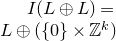 $I(L \oplus L) = L \oplus (\{ 0 \} \times \mathbb{Z}^k)$
.
$I(L \oplus L) = L \oplus (\{ 0 \} \times \mathbb{Z}^k)$
.
Proof. Let $e_1, e_2, \ldots , e_k, f_1, f_2, \ldots , f_k$
be a basis of M given by Lemma 2.9, and let
$e_1, e_2, \ldots , e_k, f_1, f_2, \ldots , f_k$
be a basis of M given by Lemma 2.9, and let $d_i = \lambda(f_i,f_i)$
. We will also use the notation
$d_i = \lambda(f_i,f_i)$
. We will also use the notation $e_i$
,
$e_i$
, $f_i$
for the basis of the first component in
$f_i$
for the basis of the first component in $M \oplus M$
and
$M \oplus M$
and $M \oplus \mathbb{Z}^{2k}$
, and the basis of the second component of
$M \oplus \mathbb{Z}^{2k}$
, and the basis of the second component of $M \oplus M$
will be denoted by
$M \oplus M$
will be denoted by $\bar{e}_i$
and
$\bar{e}_i$
and $\bar{f}_i$
. Let
$\bar{f}_i$
. Let $a_1, a_2, \ldots , a_k, b_1, b_2, \ldots , b_k$
denote the standard basis of
$a_1, a_2, \ldots , a_k, b_1, b_2, \ldots , b_k$
denote the standard basis of $\mathbb{Z}^{2k}$
. With this notation let
$\mathbb{Z}^{2k}$
. With this notation let $I(e_i)=e_i+b_i$
,
$I(e_i)=e_i+b_i$
, $I(f_i)=f_i+d_ib_i$
,
$I(f_i)=f_i+d_ib_i$
, $I(\bar{e}_i)=-b_i$
and
$I(\bar{e}_i)=-b_i$
and $I(\bar{f}_i)=f_i-a_i$
.
$I(\bar{f}_i)=f_i-a_i$
.
2.3 Full geometric metabolic forms
In this section we prove Theorem 2.27, which states that free full geometric metabolic forms are unique up to stable isomorphism. We will need two lemmas.
Definition 2.22. Let $\underline{M} = (M, \lambda, \mu)$
be a metabolic form over an abelian group Q. For a T-Lagrangian
$\underline{M} = (M, \lambda, \mu)$
be a metabolic form over an abelian group Q. For a T-Lagrangian $L \leqslant M$
we define the homomorphism
$L \leqslant M$
we define the homomorphism $\hat{\mu}_L : L^* \rightarrow Q$
as follows.
$\hat{\mu}_L : L^* \rightarrow Q$
as follows.

The composition $M \rightarrow L^*$
of
$M \rightarrow L^*$
of $\mathop{\mathrm{ad}}\nolimits \lambda$
and the dual of the inclusion
$\mathop{\mathrm{ad}}\nolimits \lambda$
and the dual of the inclusion $L \rightarrow M$
has kernel L, hence induces an isomorphism
$L \rightarrow M$
has kernel L, hence induces an isomorphism $M/L \cong L^*$
. Since
$M/L \cong L^*$
. Since $\mu \big| _L = 0$
,
$\mu \big| _L = 0$
, $\mu$
induces a map
$\mu$
induces a map $M/L \rightarrow Q$
. The composition of the inverse of the isomorphism
$M/L \rightarrow Q$
. The composition of the inverse of the isomorphism $M/L \cong L^*$
and the map
$M/L \cong L^*$
and the map $M/L \rightarrow Q$
will be denoted by
$M/L \rightarrow Q$
will be denoted by $\hat{\mu}_L$
.
$\hat{\mu}_L$
.
Lemma 2.23. Let Q be an abelian group and $v : Q \rightarrow \mathbb{Z}_2$
a homomorphism. Let
$v : Q \rightarrow \mathbb{Z}_2$
a homomorphism. Let $\underline{M} = (M, \lambda, \mu)$
and
$\underline{M} = (M, \lambda, \mu)$
and $\underline{M}{}' = (M', \lambda', \mu')$
be extended quadratic forms over Q. Suppose that they are metabolic, free and geometric (with respect to v), and let
$\underline{M}{}' = (M', \lambda', \mu')$
be extended quadratic forms over Q. Suppose that they are metabolic, free and geometric (with respect to v), and let $L \leqslant M$
and
$L \leqslant M$
and $L' \leqslant M'$
be Lagrangians. Suppose that
$L' \leqslant M'$
be Lagrangians. Suppose that $I_0 : L \rightarrow L'$
is an isomorphism of abelian groups. Then there is an isomorphism
$I_0 : L \rightarrow L'$
is an isomorphism of abelian groups. Then there is an isomorphism $I : \underline{M} \rightarrow \underline{M}{}'$
such that
$I : \underline{M} \rightarrow \underline{M}{}'$
such that $I \big| _L = I_0$
if and only if
$I \big| _L = I_0$
if and only if $\hat{\mu}'_{L'} = \hat{\mu}_L \circ I_0^* : (L')^* \rightarrow Q$
.
$\hat{\mu}'_{L'} = \hat{\mu}_L \circ I_0^* : (L')^* \rightarrow Q$
.
Proof. If an isomorphism I exists, it induces a commutative diagram.

Hence, $\hat{\mu}'_{L'} = \hat{\mu}_L \circ I_0^*$
.
$\hat{\mu}'_{L'} = \hat{\mu}_L \circ I_0^*$
.
For the other direction, suppose that $\hat{\mu}'_{L'} = \hat{\mu}_L \circ I_0^* : (L')^* \rightarrow Q$
. Since
$\hat{\mu}'_{L'} = \hat{\mu}_L \circ I_0^* : (L')^* \rightarrow Q$
. Since $L \leqslant M$
and
$L \leqslant M$
and $L' \leqslant M'$
are direct summands, they have direct complements
$L' \leqslant M'$
are direct summands, they have direct complements $N \leqslant M$
and
$N \leqslant M$
and $N' \leqslant M'$
. By Lemma 2.8,
$N' \leqslant M'$
. By Lemma 2.8, $N \cong L^*$
, and similarly
$N \cong L^*$
, and similarly $N' \cong (L')^*$
. Hence,
$N' \cong (L')^*$
. Hence, $I_0^*$
can be regarded as an isomorphism
$I_0^*$
can be regarded as an isomorphism $I_0^* : N' \rightarrow N$
, and the condition means that
$I_0^* : N' \rightarrow N$
, and the condition means that $\mu' \big| _{N'} = \mu \big| _N \circ I_0^* : N' \rightarrow Q$
.
$\mu' \big| _{N'} = \mu \big| _N \circ I_0^* : N' \rightarrow Q$
.
Let $r = \mathop{\mathrm{rk}}\nolimits N (= \mathop{\mathrm{rk}}\nolimits N' = \mathop{\mathrm{rk}}\nolimits L = \mathop{\mathrm{rk}}\nolimits L')$
. Let
$r = \mathop{\mathrm{rk}}\nolimits N (= \mathop{\mathrm{rk}}\nolimits N' = \mathop{\mathrm{rk}}\nolimits L = \mathop{\mathrm{rk}}\nolimits L')$
. Let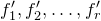 $f'_1, f'_2, \ldots , f'_r$
be a basis of N’, and let
$f'_1, f'_2, \ldots , f'_r$
be a basis of N’, and let $f_i = I_0^*(f'_i)$
. The basis
$f_i = I_0^*(f'_i)$
. The basis $f_1, f_2, \ldots , f_r$
of
$f_1, f_2, \ldots , f_r$
of $N \cong L^*$
determines a dual basis
$N \cong L^*$
determines a dual basis $e_1, e_2, \ldots , e_r$
of L (satisfying
$e_1, e_2, \ldots , e_r$
of L (satisfying $\lambda(e_i,f_j)=0$
if
$\lambda(e_i,f_j)=0$
if $i \neq j$
and
$i \neq j$
and $\lambda(e_i,f_i)=1$
). Similarly, L’ has a basis
$\lambda(e_i,f_i)=1$
). Similarly, L’ has a basis $e'_1, e'_2, \ldots , e'_r$
which is dual to the basis
$e'_1, e'_2, \ldots , e'_r$
which is dual to the basis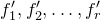 $f'_1, f'_2, \ldots , f'_r$
of N’.
$f'_1, f'_2, \ldots , f'_r$
of N’.
The isomorphism $N \cong L^*$
is given by the composition
$N \cong L^*$
is given by the composition $N \rightarrow M \rightarrow M^* \rightarrow L^*$
, hence
$N \rightarrow M \rightarrow M^* \rightarrow L^*$
, hence $f_j \in N$
corresponds to
$f_j \in N$
corresponds to $\mathop{\mathrm{ad}}\nolimits \lambda(f_j) \big| _L \in L^*$
. So we have
$\mathop{\mathrm{ad}}\nolimits \lambda(f_j) \big| _L \in L^*$
. So we have $\lambda'(f'_j,I_0(e_i)) = (\mathop{\mathrm{ad}}\nolimits \lambda'(f'_j) \big| _{L'})(I_0(e_i)) = (I_0^*(\mathop{\mathrm{ad}}\nolimits \lambda'(f'_j) \big| _{L'}))(e_i) = (\mathop{\mathrm{ad}}\nolimits \lambda(f_j) \big| _L)(e_i) = \lambda(f_j,e_i) = \lambda'(f'_j,e'_i)$
for every i,j (using the definition of
$\lambda'(f'_j,I_0(e_i)) = (\mathop{\mathrm{ad}}\nolimits \lambda'(f'_j) \big| _{L'})(I_0(e_i)) = (I_0^*(\mathop{\mathrm{ad}}\nolimits \lambda'(f'_j) \big| _{L'}))(e_i) = (\mathop{\mathrm{ad}}\nolimits \lambda(f_j) \big| _L)(e_i) = \lambda(f_j,e_i) = \lambda'(f'_j,e'_i)$
for every i,j (using the definition of $f_j$
and the dual bases). Since
$f_j$
and the dual bases). Since $N' \cong (L')^*$
, this implies that
$N' \cong (L')^*$
, this implies that $I_0(e_i)=e'_i$
for every i.
$I_0(e_i)=e'_i$
for every i.
Next we define the elements $\bar{f}_1, \bar{f}_2, \ldots , \bar{f}_r \in M$
recursively. Let
$\bar{f}_1, \bar{f}_2, \ldots , \bar{f}_r \in M$
recursively. Let $\bar{f}_1 = f_1$
, and let
$\bar{f}_1 = f_1$
, and let $\bar{f}_{i+1} = f_{i+1} - \sum_{j=1}^i \lambda(\bar{f}_j,f_{i+1})e_j - \left\lfloor {\lambda(f_{i+1},f_{i+1})}/{2} \right\rfloor e_{i+1}$
. By induction we see that
$\bar{f}_{i+1} = f_{i+1} - \sum_{j=1}^i \lambda(\bar{f}_j,f_{i+1})e_j - \left\lfloor {\lambda(f_{i+1},f_{i+1})}/{2} \right\rfloor e_{i+1}$
. By induction we see that $e_1, e_2, \ldots , e_r, \bar{f}_1, \bar{f}_2, \ldots , \bar{f}_i$
is a basis of
$e_1, e_2, \ldots , e_r, \bar{f}_1, \bar{f}_2, \ldots , \bar{f}_i$
is a basis of $L \oplus \left\langle f_1, f_2, \ldots , f_i \right\rangle$
, therefore
$L \oplus \left\langle f_1, f_2, \ldots , f_i \right\rangle$
, therefore $e_1, e_2, \ldots , e_r, \bar{f}_1, \bar{f}_2, \ldots , \bar{f}_r$
is a basis of M. By construction
$e_1, e_2, \ldots , e_r, \bar{f}_1, \bar{f}_2, \ldots , \bar{f}_r$
is a basis of M. By construction $\lambda(e_i,\bar{f}_j)=\lambda(e_i,f_j)$
for every i,j,
$\lambda(e_i,\bar{f}_j)=\lambda(e_i,f_j)$
for every i,j, $\lambda(\bar{f}_i,\bar{f}_j)=0$
if
$\lambda(\bar{f}_i,\bar{f}_j)=0$
if $i \neq j$
, and
$i \neq j$
, and $\lambda(\bar{f}_i,\bar{f}_i)=0$
if
$\lambda(\bar{f}_i,\bar{f}_i)=0$
if $\lambda(f_i,f_i)$
is even and
$\lambda(f_i,f_i)$
is even and $\lambda(\bar{f}_i,\bar{f}_i)=1$
if
$\lambda(\bar{f}_i,\bar{f}_i)=1$
if $\lambda(f_i,f_i)$
is odd. Furthermore,
$\lambda(f_i,f_i)$
is odd. Furthermore,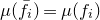 $\mu(\bar{f}_i)=\mu(f_i)$
. We define the elements
$\mu(\bar{f}_i)=\mu(f_i)$
. We define the elements $\bar{f}'_1, \bar{f}'_2, \ldots , \bar{f}'_r \in M'$
analogously.
$\bar{f}'_1, \bar{f}'_2, \ldots , \bar{f}'_r \in M'$
analogously.
Let $I : M \rightarrow M'$
be the homomorphism given by
$I : M \rightarrow M'$
be the homomorphism given by $I(e_i) = e'_i$
and
$I(e_i) = e'_i$
and $I(\bar{f}_i) = \bar{f}'_i$
. This is an isomorphism of abelian groups, and
$I(\bar{f}_i) = \bar{f}'_i$
. This is an isomorphism of abelian groups, and $I \big| _L = I_0$
. We need to check that I is a morphism of extended quadratic forms. For every i we have
$I \big| _L = I_0$
. We need to check that I is a morphism of extended quadratic forms. For every i we have $\mu(e_i) = 0 = \mu'(e'_i)$
and
$\mu(e_i) = 0 = \mu'(e'_i)$
and $\mu(\bar{f}_i) = \mu(f_i) = \mu \circ I_0^*(f'_i) = \mu'(f'_i) = \mu'(\bar{f}'_i)$
, therefore
$\mu(\bar{f}_i) = \mu(f_i) = \mu \circ I_0^*(f'_i) = \mu'(f'_i) = \mu'(\bar{f}'_i)$
, therefore $\mu = \mu' \circ I$
. For every i,j we have
$\mu = \mu' \circ I$
. For every i,j we have $\lambda(e_i,e_j) = 0 = \lambda'(e'_i,e'_j)$
. If
$\lambda(e_i,e_j) = 0 = \lambda'(e'_i,e'_j)$
. If $i \neq j$
, then
$i \neq j$
, then $\lambda(e_i,\bar{f}_j) = 0 = \lambda'(e'_i,\bar{f}'_j)$
and
$\lambda(e_i,\bar{f}_j) = 0 = \lambda'(e'_i,\bar{f}'_j)$
and $\lambda(\bar{f}_i,\bar{f}_j) = 0 = \lambda'(\bar{f}'_i,\bar{f}'_j)$
. For every i we have
$\lambda(\bar{f}_i,\bar{f}_j) = 0 = \lambda'(\bar{f}'_i,\bar{f}'_j)$
. For every i we have $\lambda(e_i,\bar{f}_i) = 1 = \lambda'(e'_i,\bar{f}'_i)$
. Finally, both
$\lambda(e_i,\bar{f}_i) = 1 = \lambda'(e'_i,\bar{f}'_i)$
. Finally, both $\lambda(\bar{f}_i,\bar{f}_i)$
and
$\lambda(\bar{f}_i,\bar{f}_i)$
and $\lambda'(\bar{f}'_i,\bar{f}'_i)$
are either 0 or 1. And since
$\lambda'(\bar{f}'_i,\bar{f}'_i)$
are either 0 or 1. And since $\underline{\tilde{M}}$
and
$\underline{\tilde{M}}$
and $\underline{\tilde{M}}{}'$
are geometric,
$\underline{\tilde{M}}{}'$
are geometric, $\varrho_2 \circ \lambda(\bar{f}_i,\bar{f}_i) = v \circ \mu(\bar{f}_i) = v \circ \mu' \circ I(\bar{f}_i) = v \circ \mu'(\bar{f}'_i) = \varrho_2 \circ \lambda'(\bar{f}'_i,\bar{f}'_i)$
, so this means that
$\varrho_2 \circ \lambda(\bar{f}_i,\bar{f}_i) = v \circ \mu(\bar{f}_i) = v \circ \mu' \circ I(\bar{f}_i) = v \circ \mu'(\bar{f}'_i) = \varrho_2 \circ \lambda'(\bar{f}'_i,\bar{f}'_i)$
, so this means that $\lambda(\bar{f}_i,\bar{f}_i) = \lambda'(\bar{f}'_i,\bar{f}'_i)$
. Therefore,
$\lambda(\bar{f}_i,\bar{f}_i) = \lambda'(\bar{f}'_i,\bar{f}'_i)$
. Therefore, $\lambda(x,y) = \lambda'(I(x),I(y))$
for every
$\lambda(x,y) = \lambda'(I(x),I(y))$
for every $x,y \in M$
, so I is an isomorphism of extended quadratic forms.
$x,y \in M$
, so I is an isomorphism of extended quadratic forms.
Remark 2.24. Lemma 2.23 generalises [Reference WallWal99, Corollary 5.3.1] (see also Corollary 2.25 below). Indeed, if $Q=0$
(that is, in the case of ordinary quadratic forms), then
$Q=0$
(that is, in the case of ordinary quadratic forms), then $\hat{\mu}_L = \hat{\mu}'_{L'} = 0$
, so every isomorphism
$\hat{\mu}_L = \hat{\mu}'_{L'} = 0$
, so every isomorphism $I_0$
satisfies the condition, and hence can be extended to an isomorphism I. However, if
$I_0$
satisfies the condition, and hence can be extended to an isomorphism I. However, if $Q \not\cong 0$
, then, depending on
$Q \not\cong 0$
, then, depending on $\hat{\mu}_L$
and
$\hat{\mu}_L$
and $\hat{\mu}'_{L'}$
, it may happen that no isomorphism
$\hat{\mu}'_{L'}$
, it may happen that no isomorphism $I_0$
satisfies the condition, so there is no isomorphism
$I_0$
satisfies the condition, so there is no isomorphism $I : \underline{M} \rightarrow \underline{M}{}'$
with
$I : \underline{M} \rightarrow \underline{M}{}'$
with $I(L) = L'$
. So a geometric metabolic form is essentially unique when
$I(L) = L'$
. So a geometric metabolic form is essentially unique when $Q=0$
, but this is not true over arbitrary pairs (Q,v) (cf. [Reference Lück and MackoLM24, Remark 15.196]).
$Q=0$
, but this is not true over arbitrary pairs (Q,v) (cf. [Reference Lück and MackoLM24, Remark 15.196]).
We will obtain a uniqueness result for arbitrary (Q,v) by requiring the forms also to be full; see Theorem 2.27. We will get uniqueness only in a weaker sense (up to stable isomorphism, and instead of extending a given isomorphism between Lagrangians, we can only prescribe the image of a Lagrangian), but this will still be sufficient for our applications in § 4.
An immediate corollary is the following result.
Corollary 2.25.
Let $\underline{H} = (H, \lambda, \mu)$
and
$\underline{H} = (H, \lambda, \mu)$
and $\underline{H}{}' = (H', \lambda', \mu')$
be hyperbolic extended quadratic forms over some abelian group Q such that
$\underline{H}{}' = (H', \lambda', \mu')$
be hyperbolic extended quadratic forms over some abelian group Q such that $\mathop{\mathrm{rk}}\nolimits \underline{H} = \mathop{\mathrm{rk}}\nolimits \underline{H}{}'$
. Let L and L’ be Lagrangians in
$\mathop{\mathrm{rk}}\nolimits \underline{H} = \mathop{\mathrm{rk}}\nolimits \underline{H}{}'$
. Let L and L’ be Lagrangians in $\underline{H}$
and
$\underline{H}$
and $\underline{H}{}'$
, respectively. Then there is an isomorphism
$\underline{H}{}'$
, respectively. Then there is an isomorphism $I : \underline{H} \rightarrow \underline{H}{}'$
such that
$I : \underline{H} \rightarrow \underline{H}{}'$
such that $I(L) = L'$
.
$I(L) = L'$
.
Proof. Since $\mathop{\mathrm{rk}}\nolimits L = \frac{1}{2} \mathop{\mathrm{rk}}\nolimits H = \frac{1}{2} \mathop{\mathrm{rk}}\nolimits H' = \mathop{\mathrm{rk}}\nolimits L'$
, there is an isomorphism
$\mathop{\mathrm{rk}}\nolimits L = \frac{1}{2} \mathop{\mathrm{rk}}\nolimits H = \frac{1}{2} \mathop{\mathrm{rk}}\nolimits H' = \mathop{\mathrm{rk}}\nolimits L'$
, there is an isomorphism $I_0 : L \rightarrow L'$
. Since
$I_0 : L \rightarrow L'$
. Since $\mu = \mu' = 0$
, we also have
$\mu = \mu' = 0$
, we also have $\hat{\mu}_L = \hat{\mu}'_{L'} = 0$
. So by Lemma 2.23 there is an isomorphism
$\hat{\mu}_L = \hat{\mu}'_{L'} = 0$
. So by Lemma 2.23 there is an isomorphism $I : \underline{H} \rightarrow \underline{H}{}'$
such that
$I : \underline{H} \rightarrow \underline{H}{}'$
such that $I \big| _L = I_0$
, in particular
$I \big| _L = I_0$
, in particular $I(L)=L'$
.
$I(L)=L'$
.
We will also need the following lemma, part (a) of which can be extracted from the proof of [Reference KreckKre99, Proposition 8(ii)].
Lemma 2.26. Let F, G and A be abelian groups, and suppose that F and G are free. Let $f : F \rightarrow A$
and
$f : F \rightarrow A$
and $g : G \rightarrow A$
be surjective homomorphisms. Then the following assertions hold.
$g : G \rightarrow A$
be surjective homomorphisms. Then the following assertions hold.
-
(a) There exist free abelian groups F’, G’, and an isomorphism
$h : F \oplus F' \rightarrow G \oplus G'$
such that
$(f+0) = (g+0) \circ h : F \oplus F' \rightarrow A$
. -
(b) If, in addition, A is free and
$\mathop{\mathrm{rk}}\nolimits F = \mathop{\mathrm{rk}}\nolimits G$
, then there is an isomorphism
$h : F \rightarrow G$
such that
$f = g \circ h$
.




Proof. (a) Since F is free and g is surjective, the homomorphism f can be lifted to a homomorphism $\bar{f} : F \rightarrow G$
such that
$\bar{f} : F \rightarrow G$
such that $f = g \circ \bar{f}$
. Let
$f = g \circ \bar{f}$
. Let $\bar{f}_0 : F_0 \rightarrow \mathop{\mathrm{Ker}}\nolimits g \subseteq G$
be a surjective homomorphism from some free abelian group
$\bar{f}_0 : F_0 \rightarrow \mathop{\mathrm{Ker}}\nolimits g \subseteq G$
be a surjective homomorphism from some free abelian group $F_0$
to
$F_0$
to $\mathop{\mathrm{Ker}}\nolimits g$
. Let
$\mathop{\mathrm{Ker}}\nolimits g$
. Let $F_1 = F \oplus F_0$
and
$F_1 = F \oplus F_0$
and $\bar{f}_1 = \bar{f} + \bar{f}_0 : F_1 = F \oplus F_0 \rightarrow G$
.
$\bar{f}_1 = \bar{f} + \bar{f}_0 : F_1 = F \oplus F_0 \rightarrow G$
.
We prove that $\bar{f}_1$
is surjective. Let
$\bar{f}_1$
is surjective. Let $y \in G$
be an arbitrary element; then there is an
$y \in G$
be an arbitrary element; then there is an $x \in F$
such that
$x \in F$
such that $f(x) = g(y)$
(because f is surjective). Let
$f(x) = g(y)$
(because f is surjective). Let $y_0 = \bar{f}(x) \in \mathop{\mathrm{Im}}\nolimits \bar{f} \subseteq \mathop{\mathrm{Im}}\nolimits \bar{f}_1$
; then
$y_0 = \bar{f}(x) \in \mathop{\mathrm{Im}}\nolimits \bar{f} \subseteq \mathop{\mathrm{Im}}\nolimits \bar{f}_1$
; then $y-y_0 \in \mathop{\mathrm{Ker}}\nolimits g = \mathop{\mathrm{Im}}\nolimits \bar{f}_0 \subseteq \mathop{\mathrm{Im}}\nolimits \bar{f}_1$
, therefore
$y-y_0 \in \mathop{\mathrm{Ker}}\nolimits g = \mathop{\mathrm{Im}}\nolimits \bar{f}_0 \subseteq \mathop{\mathrm{Im}}\nolimits \bar{f}_1$
, therefore $y = y_0 + (y-y_0) \in \mathop{\mathrm{Im}}\nolimits \bar{f}_1$
.
$y = y_0 + (y-y_0) \in \mathop{\mathrm{Im}}\nolimits \bar{f}_1$
.
Since G is free, $\bar{f}_1$
has a right inverse, that is, there is a homomorphism
$\bar{f}_1$
has a right inverse, that is, there is a homomorphism $c : G \rightarrow F_1$
such that
$c : G \rightarrow F_1$
such that $\bar{f}_1 \circ c = \mathop{\mathrm{id}}\nolimits_G$
. This also implies that
$\bar{f}_1 \circ c = \mathop{\mathrm{id}}\nolimits_G$
. This also implies that $F_1 = \mathop{\mathrm{Ker}}\nolimits \bar{f}_1 \oplus \mathop{\mathrm{Im}}\nolimits c \cong \mathop{\mathrm{Ker}}\nolimits \bar{f}_1 \oplus G$
.
$F_1 = \mathop{\mathrm{Ker}}\nolimits \bar{f}_1 \oplus \mathop{\mathrm{Im}}\nolimits c \cong \mathop{\mathrm{Ker}}\nolimits \bar{f}_1 \oplus G$
.
Let $F' = F_0 \oplus G$
and
$F' = F_0 \oplus G$
and $G' = F_1$
. Then
$G' = F_1$
. Then $F \oplus F' = F \oplus (F_0 \oplus G) \cong F_1 \oplus G$
and
$F \oplus F' = F \oplus (F_0 \oplus G) \cong F_1 \oplus G$
and $G \oplus G' = G \oplus F_1$
, and we can define the homomorphism
$G \oplus G' = G \oplus F_1$
, and we can define the homomorphism $h : F_1 \oplus G \rightarrow G \oplus F_1$
by the formula
$h : F_1 \oplus G \rightarrow G \oplus F_1$
by the formula $h(x,y)= (\bar{f}_1(x), x+c(y))$
.
$h(x,y)= (\bar{f}_1(x), x+c(y))$
.
To show that h is an isomorphism, we use the decomposition $F_1 \cong \mathop{\mathrm{Ker}}\nolimits \bar{f}_1 \oplus G$
. For
$F_1 \cong \mathop{\mathrm{Ker}}\nolimits \bar{f}_1 \oplus G$
. For $(x_1,y_2) \in \mathop{\mathrm{Ker}}\nolimits \bar{f}_1 \oplus G \cong F_1$
we have
$(x_1,y_2) \in \mathop{\mathrm{Ker}}\nolimits \bar{f}_1 \oplus G \cong F_1$
we have $\bar{f}_1(x_1,y_2)=y_2$
, and for
$\bar{f}_1(x_1,y_2)=y_2$
, and for $y \in G$
we have
$y \in G$
we have $c(y) = (0,y) \in \mathop{\mathrm{Ker}}\nolimits \bar{f}_1 \oplus G \cong F_1$
. Hence, under the decompositions
$c(y) = (0,y) \in \mathop{\mathrm{Ker}}\nolimits \bar{f}_1 \oplus G \cong F_1$
. Hence, under the decompositions $F \oplus F' \cong F_1 \oplus G \cong (\mathop{\mathrm{Ker}}\nolimits \bar{f}_1 \oplus G) \oplus G$
and
$F \oplus F' \cong F_1 \oplus G \cong (\mathop{\mathrm{Ker}}\nolimits \bar{f}_1 \oplus G) \oplus G$
and $G \oplus G' = G \oplus F_1 \cong G \oplus (\mathop{\mathrm{Ker}}\nolimits \bar{f}_1 \oplus G)$
the map h is given by the formula
$G \oplus G' = G \oplus F_1 \cong G \oplus (\mathop{\mathrm{Ker}}\nolimits \bar{f}_1 \oplus G)$
the map h is given by the formula $h((x_1,y_2),y) = (y_2, (x_1,y_2+y))$
, therefore it is an isomorphism.
$h((x_1,y_2),y) = (y_2, (x_1,y_2+y))$
, therefore it is an isomorphism.
Finally, for any $x \in F$
,
$x \in F$
, $x_0 \in F_0$
and
$x_0 \in F_0$
and $y \in G$
we have
$y \in G$
we have $(g+0) \circ h((x,x_0),y) = g \circ \bar{f}_1(x,x_0) = g \circ (\bar{f} + \bar{f}_0)(x,x_0) = g \circ \bar{f}(x) = f(x) = (f+0)(x,(x_0,y))$
, where we used that
$(g+0) \circ h((x,x_0),y) = g \circ \bar{f}_1(x,x_0) = g \circ (\bar{f} + \bar{f}_0)(x,x_0) = g \circ \bar{f}(x) = f(x) = (f+0)(x,(x_0,y))$
, where we used that $g \circ \bar{f}_0 = 0$
, because
$g \circ \bar{f}_0 = 0$
, because $\mathop{\mathrm{Im}}\nolimits \bar{f}_0 = \mathop{\mathrm{Ker}}\nolimits g$
. Therefore,
$\mathop{\mathrm{Im}}\nolimits \bar{f}_0 = \mathop{\mathrm{Ker}}\nolimits g$
. Therefore, $(f+0) = (g+0) \circ h$
.
$(f+0) = (g+0) \circ h$
.
(b) Since A is free, there are maps $c : A \rightarrow F$
and
$c : A \rightarrow F$
and $d : A \rightarrow G$
such that
$d : A \rightarrow G$
such that $f \circ c = g \circ d = \mathop{\mathrm{id}}\nolimits_A$
. We get the decompositions
$f \circ c = g \circ d = \mathop{\mathrm{id}}\nolimits_A$
. We get the decompositions $F = \mathop{\mathrm{Ker}}\nolimits f \oplus \mathop{\mathrm{Im}}\nolimits c$
and
$F = \mathop{\mathrm{Ker}}\nolimits f \oplus \mathop{\mathrm{Im}}\nolimits c$
and $G = \mathop{\mathrm{Ker}}\nolimits g \oplus \mathop{\mathrm{Im}}\nolimits d$
, where
$G = \mathop{\mathrm{Ker}}\nolimits g \oplus \mathop{\mathrm{Im}}\nolimits d$
, where $\mathop{\mathrm{Im}}\nolimits c \cong \mathop{\mathrm{Im}}\nolimits d \cong A$
. The subgroups
$\mathop{\mathrm{Im}}\nolimits c \cong \mathop{\mathrm{Im}}\nolimits d \cong A$
. The subgroups $\mathop{\mathrm{Ker}}\nolimits f$
and
$\mathop{\mathrm{Ker}}\nolimits f$
and $\mathop{\mathrm{Ker}}\nolimits g$
are free, and
$\mathop{\mathrm{Ker}}\nolimits g$
are free, and $\mathop{\mathrm{rk}}\nolimits \mathop{\mathrm{Ker}}\nolimits f = \mathop{\mathrm{rk}}\nolimits F - \mathop{\mathrm{rk}}\nolimits A = \mathop{\mathrm{rk}}\nolimits G - \mathop{\mathrm{rk}}\nolimits A = \mathop{\mathrm{rk}}\nolimits \mathop{\mathrm{Ker}}\nolimits g$
, therefore there is an isomorphism
$\mathop{\mathrm{rk}}\nolimits \mathop{\mathrm{Ker}}\nolimits f = \mathop{\mathrm{rk}}\nolimits F - \mathop{\mathrm{rk}}\nolimits A = \mathop{\mathrm{rk}}\nolimits G - \mathop{\mathrm{rk}}\nolimits A = \mathop{\mathrm{rk}}\nolimits \mathop{\mathrm{Ker}}\nolimits g$
, therefore there is an isomorphism $h_0 : \mathop{\mathrm{Ker}}\nolimits f \rightarrow \mathop{\mathrm{Ker}}\nolimits g$
. Then we can take
$h_0 : \mathop{\mathrm{Ker}}\nolimits f \rightarrow \mathop{\mathrm{Ker}}\nolimits g$
. Then we can take $h = h_0 \oplus (d \circ f) \big| _{\mathop{\mathrm{Im}}\nolimits c} : F = \mathop{\mathrm{Ker}}\nolimits f \oplus \mathop{\mathrm{Im}}\nolimits c \rightarrow G = \mathop{\mathrm{Ker}}\nolimits g \oplus \mathop{\mathrm{Im}}\nolimits d$
.
$h = h_0 \oplus (d \circ f) \big| _{\mathop{\mathrm{Im}}\nolimits c} : F = \mathop{\mathrm{Ker}}\nolimits f \oplus \mathop{\mathrm{Im}}\nolimits c \rightarrow G = \mathop{\mathrm{Ker}}\nolimits g \oplus \mathop{\mathrm{Im}}\nolimits d$
.
Theorem 2.27. Let Q be an abelian group and $v : Q \rightarrow \mathbb{Z}_2$
a homomorphism. Let
$v : Q \rightarrow \mathbb{Z}_2$
a homomorphism. Let $\underline{M} = (M, \lambda, \mu)$
and
$\underline{M} = (M, \lambda, \mu)$
and $\underline{M}{}' = (M', \lambda', \mu')$
be extended quadratic forms over Q. Suppose that they are metabolic, free, full and geometric (with respect to v), and let
$\underline{M}{}' = (M', \lambda', \mu')$
be extended quadratic forms over Q. Suppose that they are metabolic, free, full and geometric (with respect to v), and let $L \leqslant M$
and
$L \leqslant M$
and $L' \leqslant M'$
be Lagrangians. Then the following assertions hold.
$L' \leqslant M'$
be Lagrangians. Then the following assertions hold.
-
(a) For some integers
$k,l \geqslant 0$
there is an isomorphism
$I : \underline{M} \oplus \underline{H}_{2k} \rightarrow \underline{M}{}' \oplus \underline{H}_{2l}$
such that
$I(L \oplus (\{ 0 \} \times \mathbb{Z}^k)) = L' \oplus (\{ 0 \} \times \mathbb{Z}^l)$
. -
(b) If, in addition, Q is free and
$\mathop{\mathrm{rk}}\nolimits \underline{M} = \mathop{\mathrm{rk}}\nolimits \underline{M}{}'$
, then there is an isomorphism
$I : \underline{M} \rightarrow \underline{M}{}'$
such that
$I(L) = L'$
.






Proof. (a) Since the homomorphisms $\mu : M \rightarrow Q$
and
$\mu : M \rightarrow Q$
and $\mu' : M' \rightarrow Q$
are surjective, the same is true for the induced maps
$\mu' : M' \rightarrow Q$
are surjective, the same is true for the induced maps $M/L \rightarrow Q$
and
$M/L \rightarrow Q$
and $M'/L' \rightarrow Q$
, and for
$M'/L' \rightarrow Q$
, and for $\hat{\mu}_L : L^* \rightarrow Q$
and
$\hat{\mu}_L : L^* \rightarrow Q$
and $\hat{\mu}'_{L'} : (L')^* \rightarrow Q$
. By Lemma 2.26(a) there are free abelian groups A, A’ and an isomorphism
$\hat{\mu}'_{L'} : (L')^* \rightarrow Q$
. By Lemma 2.26(a) there are free abelian groups A, A’ and an isomorphism $h : (L')^* \oplus A' \rightarrow L^* \oplus A$
such that
$h : (L')^* \oplus A' \rightarrow L^* \oplus A$
such that $(\hat{\mu}'_{L'} +0) = (\hat{\mu}_L +0) \circ h : (L')^* \oplus A' \rightarrow Q$
. Let
$(\hat{\mu}'_{L'} +0) = (\hat{\mu}_L +0) \circ h : (L')^* \oplus A' \rightarrow Q$
. Let $k = \mathop{\mathrm{rk}}\nolimits A$
and
$k = \mathop{\mathrm{rk}}\nolimits A$
and $l = \mathop{\mathrm{rk}}\nolimits A'$
.
$l = \mathop{\mathrm{rk}}\nolimits A'$
.
Let $\underline{\tilde{M}} = (\tilde{M}, \tilde{\lambda}, \tilde{\mu})$
denote the direct sum
$\underline{\tilde{M}} = (\tilde{M}, \tilde{\lambda}, \tilde{\mu})$
denote the direct sum $\underline{M} \oplus \underline{H}_{2k}$
, that is,
$\underline{M} \oplus \underline{H}_{2k}$
, that is, $\tilde{M} = M \oplus \mathbb{Z}^{2k}$
,
$\tilde{M} = M \oplus \mathbb{Z}^{2k}$
,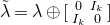 $\tilde{\lambda} = \lambda \oplus \bigl[ \begin{smallmatrix} 0 & I_k \\ I_k & 0 \end{smallmatrix} \bigr]$
and
$\tilde{\lambda} = \lambda \oplus \bigl[ \begin{smallmatrix} 0 & I_k \\ I_k & 0 \end{smallmatrix} \bigr]$
and $\tilde{\mu} = \mu \oplus 0$
. Similarly, let
$\tilde{\mu} = \mu \oplus 0$
. Similarly, let $\underline{\tilde{M}}{}' = (\tilde{M}', \tilde{\lambda}', \tilde{\mu}') = \underline{M}{}' \oplus \underline{H}_{2l}$
. Let
$\underline{\tilde{M}}{}' = (\tilde{M}', \tilde{\lambda}', \tilde{\mu}') = \underline{M}{}' \oplus \underline{H}_{2l}$
. Let $\tilde{L} = L \oplus (\{ 0 \} \times \mathbb{Z}^k)$
and
$\tilde{L} = L \oplus (\{ 0 \} \times \mathbb{Z}^k)$
and $\tilde{L}' = L' \oplus (\{ 0 \} \times \mathbb{Z}^l)$
; these are Lagrangians in
$\tilde{L}' = L' \oplus (\{ 0 \} \times \mathbb{Z}^l)$
; these are Lagrangians in $\underline{\tilde{M}}$
and
$\underline{\tilde{M}}$
and $\underline{\tilde{M}}{}'$
, respectively. Hence, the new extended quadratic forms
$\underline{\tilde{M}}{}'$
, respectively. Hence, the new extended quadratic forms $\underline{\tilde{M}}$
and
$\underline{\tilde{M}}$
and $\underline{\tilde{M}}{}'$
are again metabolic, free, (full) and geometric. Moreover, we have
$\underline{\tilde{M}}{}'$
are again metabolic, free, (full) and geometric. Moreover, we have $\hat{\tilde{\mu}}_{\tilde{L}} = \hat{\mu}_L + 0 : \tilde{L}^* \cong L^* \oplus (\{ 0 \} \times \mathbb{Z}^k)^* \rightarrow Q$
and
$\hat{\tilde{\mu}}_{\tilde{L}} = \hat{\mu}_L + 0 : \tilde{L}^* \cong L^* \oplus (\{ 0 \} \times \mathbb{Z}^k)^* \rightarrow Q$
and $\hat{\tilde{\mu}}'_{\tilde{L}'} = \hat{\mu}'_{L'} + 0 : (\tilde{L}')^* \cong (L')^* \oplus (\{ 0 \} \times \mathbb{Z}^l)^* \rightarrow Q$
.
$\hat{\tilde{\mu}}'_{\tilde{L}'} = \hat{\mu}'_{L'} + 0 : (\tilde{L}')^* \cong (L')^* \oplus (\{ 0 \} \times \mathbb{Z}^l)^* \rightarrow Q$
.
If we fix some isomorphisms $A \cong (\{ 0 \} \times \mathbb{Z}^k)^*$
and
$A \cong (\{ 0 \} \times \mathbb{Z}^k)^*$
and $A' \cong (\{ 0 \} \times \mathbb{Z}^l)^*$
, then h can be regarded as an isomorphism
$A' \cong (\{ 0 \} \times \mathbb{Z}^l)^*$
, then h can be regarded as an isomorphism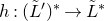 $h : (\tilde{L}')^* \rightarrow \tilde{L}^*$
such that
$h : (\tilde{L}')^* \rightarrow \tilde{L}^*$
such that $\hat{\tilde{\mu}}'_{\tilde{L}'} = \hat{\tilde{\mu}}_{\tilde{L}} \circ h$
. Let
$\hat{\tilde{\mu}}'_{\tilde{L}'} = \hat{\tilde{\mu}}_{\tilde{L}} \circ h$
. Let $I_0 = h^* : \tilde{L} \rightarrow \tilde{L}'$
. Then by Lemma 2.23 there is an isomorphism
$I_0 = h^* : \tilde{L} \rightarrow \tilde{L}'$
. Then by Lemma 2.23 there is an isomorphism $I : \underline{\tilde{M}} \rightarrow \underline{\tilde{M}}{}'$
such that
$I : \underline{\tilde{M}} \rightarrow \underline{\tilde{M}}{}'$
such that $I \big| _{\tilde{L}} = I_0$
, in particular
$I \big| _{\tilde{L}} = I_0$
, in particular $I(\tilde{L}) = \tilde{L}'$
.
$I(\tilde{L}) = \tilde{L}'$
.
(b) In this case we can use part (b) of Lemma 2.26 instead of part (a). Hence, we can take $A = A' = 0$
, so the statement of part (a) holds with
$A = A' = 0$
, so the statement of part (a) holds with $k = l = 0$
.
$k = l = 0$
.
3. The group
$\mathop{\mathrm{RU}}\nolimits_{\mathrm{st}}(\underline{M},L)$

Fix an abelian group Q with a homomorphism $v : Q \rightarrow \mathbb{Z}_2$
. In this section every extended quadratic form we consider will be over Q, and will be assumed to be free and geometric (with respect to v).
$v : Q \rightarrow \mathbb{Z}_2$
. In this section every extended quadratic form we consider will be over Q, and will be assumed to be free and geometric (with respect to v).
For a metabolic form $\underline{M}$
and a Lagrangian L we introduce the group
$\underline{M}$
and a Lagrangian L we introduce the group $\mathop{\mathrm{RU}}\nolimits(\underline{M},L)$
, and its stable version
$\mathop{\mathrm{RU}}\nolimits(\underline{M},L)$
, and its stable version $\mathop{\mathrm{RU}}\nolimits_{\mathrm{st}}(\underline{M},L)$
. The group
$\mathop{\mathrm{RU}}\nolimits_{\mathrm{st}}(\underline{M},L)$
. The group $\mathop{\mathrm{RU}}\nolimits(\underline{M},L)$
generalises the group
$\mathop{\mathrm{RU}}\nolimits(\underline{M},L)$
generalises the group $\mathop{\mathrm{RU}}\nolimits^+(\mathbb{Z}^r)$
used in classical and modified surgery (see [Reference KreckKre99, § 6] and [Reference WallWal99, § 6]). In particular,
$\mathop{\mathrm{RU}}\nolimits^+(\mathbb{Z}^r)$
used in classical and modified surgery (see [Reference KreckKre99, § 6] and [Reference WallWal99, § 6]). In particular, $\mathop{\mathrm{RU}}\nolimits(\underline{H}_{2k},\{0\} \times \mathbb{Z}^k) = \mathop{\mathrm{RU}}\nolimits^+(\mathbb{Z}^k)$
(cf. [Nagy21, Remark 4.2.23]). Note, however, the dependence of
$\mathop{\mathrm{RU}}\nolimits(\underline{H}_{2k},\{0\} \times \mathbb{Z}^k) = \mathop{\mathrm{RU}}\nolimits^+(\mathbb{Z}^k)$
(cf. [Nagy21, Remark 4.2.23]). Note, however, the dependence of $\mathop{\mathrm{RU}}\nolimits(\underline{M},L)$
on the Lagrangian L (which is implicit in the classical/modified setting, but will be important in our arguments) and that the stable group
$\mathop{\mathrm{RU}}\nolimits(\underline{M},L)$
on the Lagrangian L (which is implicit in the classical/modified setting, but will be important in our arguments) and that the stable group $\mathop{\mathrm{RU}}\nolimits_{\mathrm{st}}(\underline{M},L)$
consists of automorphisms of the same
$\mathop{\mathrm{RU}}\nolimits_{\mathrm{st}}(\underline{M},L)$
consists of automorphisms of the same $\underline{M}$
, in contrast to
$\underline{M}$
, in contrast to $\mathop{\mathrm{RU}}\nolimits^+(\mathbb{Z}) = \lim_r \mathop{\mathrm{RU}}\nolimits^+(\mathbb{Z}^r)$
.
$\mathop{\mathrm{RU}}\nolimits^+(\mathbb{Z}) = \lim_r \mathop{\mathrm{RU}}\nolimits^+(\mathbb{Z}^r)$
.
We will show that $\Phi \oplus \Phi^{-1} \in \mathop{\mathrm{RU}}\nolimits_{\mathrm{st}}(\underline{M} \oplus \underline{M}, L \oplus L)$
for any
$\Phi \oplus \Phi^{-1} \in \mathop{\mathrm{RU}}\nolimits_{\mathrm{st}}(\underline{M} \oplus \underline{M}, L \oplus L)$
for any $\Phi \in \mathop{\mathrm{Aut}}\nolimits(\underline{M})$
, which will play a key role in the proof of Theorem 4.26.
$\Phi \in \mathop{\mathrm{Aut}}\nolimits(\underline{M})$
, which will play a key role in the proof of Theorem 4.26.
Definition 3.1. Given a metabolic form $\underline{M}$
and a Lagrangian L in
$\underline{M}$
and a Lagrangian L in $\underline{M}$
, we define the subgroup
$\underline{M}$
, we define the subgroup $\mathop{\mathrm{RU}}\nolimits(\underline{M},L) \leqslant \mathop{\mathrm{Aut}}\nolimits(\underline{M})$
, which is generated by the following elements:
$\mathop{\mathrm{RU}}\nolimits(\underline{M},L) \leqslant \mathop{\mathrm{Aut}}\nolimits(\underline{M})$
, which is generated by the following elements:
-
– automorphisms
$f : \underline{M} \rightarrow \underline{M}$
such that
$f(L)=L$
; -
–
$I^{-1} \circ (\sigma \oplus \mathop{\mathrm{id}}\nolimits_{M'}) \circ I$
for every isomorphism
$I : \underline{M} \rightarrow \underline{H}_2 \oplus \underline{M}{}'$
(for some metabolic form
$\underline{M}{}'$
) such that
$I(L) = (\{ 0 \} \times \mathbb{Z}) \oplus L'$
for some Lagrangian L’ in
$\underline{M}{}'$
, where
$\sigma : \mathbb{Z}^2 \rightarrow \mathbb{Z}^2$
is the flip map (that is,
$\sigma(a,b)=(b,a)$
).









Definition 3.2. Given a metabolic form $\underline{M}$
and a Lagrangian L in
$\underline{M}$
and a Lagrangian L in $\underline{M}$
, let
$\underline{M}$
, let
 \[\mathop{\mathrm{RU}}\nolimits_{\mathrm{st}}(\underline{M},L) = \{ f \in \mathop{\mathrm{Aut}}\nolimits(\underline{M}) \mid \exists (\underline{N},K) : f \oplus \mathop{\mathrm{id}}\nolimits_N \in \mathop{\mathrm{RU}}\nolimits(\underline{M} \oplus \underline{N}, L \oplus K) \} \]
where $\underline{N}$
denotes some metabolic form with a Lagrangian K.
$\underline{N}$
denotes some metabolic form with a Lagrangian K.
If $f \in \mathop{\mathrm{RU}}\nolimits(\underline{M},L)$
, then
$f \in \mathop{\mathrm{RU}}\nolimits(\underline{M},L)$
, then $f \oplus \mathop{\mathrm{id}}\nolimits_N \in \mathop{\mathrm{RU}}\nolimits(\underline{M} \oplus \underline{N}, L \oplus K)$
for any
$f \oplus \mathop{\mathrm{id}}\nolimits_N \in \mathop{\mathrm{RU}}\nolimits(\underline{M} \oplus \underline{N}, L \oplus K)$
for any $(\underline{N},K)$
, showing that
$(\underline{N},K)$
, showing that $\mathop{\mathrm{RU}}\nolimits_{\mathrm{st}}(\underline{M},L)$
is a subgroup of
$\mathop{\mathrm{RU}}\nolimits_{\mathrm{st}}(\underline{M},L)$
is a subgroup of $\mathop{\mathrm{Aut}}\nolimits(\underline{M})$
, and
$\mathop{\mathrm{Aut}}\nolimits(\underline{M})$
, and $\mathop{\mathrm{RU}}\nolimits(\underline{M},L) \leqslant \mathop{\mathrm{RU}}\nolimits_{\mathrm{st}}(\underline{M},L)$
.
$\mathop{\mathrm{RU}}\nolimits(\underline{M},L) \leqslant \mathop{\mathrm{RU}}\nolimits_{\mathrm{st}}(\underline{M},L)$
.
Lemma 3.3.
Suppose that $\underline{M}$
and
$\underline{M}$
and $\underline{N}$
are metabolic forms with Lagrangians L and K, respectively. If
$\underline{N}$
are metabolic forms with Lagrangians L and K, respectively. If $F : \underline{M} \rightarrow \underline{N}$
is an isomorphism such that
$F : \underline{M} \rightarrow \underline{N}$
is an isomorphism such that $F(L)=K$
, then
$F(L)=K$
, then $\mathop{\mathrm{RU}}\nolimits(\underline{M},L) = F^{-1} \circ \mathop{\mathrm{RU}}\nolimits(\underline{N},K) \circ F$
.
$\mathop{\mathrm{RU}}\nolimits(\underline{M},L) = F^{-1} \circ \mathop{\mathrm{RU}}\nolimits(\underline{N},K) \circ F$
.
Proof. Suppose that $f \in \mathop{\mathrm{Aut}}\nolimits(\underline{N})$
. Then f is a generator of
$f \in \mathop{\mathrm{Aut}}\nolimits(\underline{N})$
. Then f is a generator of $\mathop{\mathrm{RU}}\nolimits(\underline{N},K)$
if and only if
$\mathop{\mathrm{RU}}\nolimits(\underline{N},K)$
if and only if $F^{-1} \circ f \circ F$
is a generator of
$F^{-1} \circ f \circ F$
is a generator of $\mathop{\mathrm{RU}}\nolimits(\underline{M},L)$
.
$\mathop{\mathrm{RU}}\nolimits(\underline{M},L)$
.
Lemma 3.4.
Suppose that $\underline{M}$
is a metabolic form, and L and K are Lagrangians in
$\underline{M}$
is a metabolic form, and L and K are Lagrangians in $\underline{M}$
. If there is an
$\underline{M}$
. If there is an $f \in \mathop{\mathrm{RU}}\nolimits(\underline{M},L)$
such that
$f \in \mathop{\mathrm{RU}}\nolimits(\underline{M},L)$
such that $f(L)=K$
, then
$f(L)=K$
, then $\mathop{\mathrm{RU}}\nolimits(\underline{M},L) = \mathop{\mathrm{RU}}\nolimits(\underline{M},K)$
.
$\mathop{\mathrm{RU}}\nolimits(\underline{M},L) = \mathop{\mathrm{RU}}\nolimits(\underline{M},K)$
.
Proof. We have $\mathop{\mathrm{RU}}\nolimits(\underline{M},K) = f \circ \mathop{\mathrm{RU}}\nolimits(\underline{M},L) \circ f^{-1} = \mathop{\mathrm{RU}}\nolimits(\underline{M},L)$
by Lemma 3.3 and because
$\mathop{\mathrm{RU}}\nolimits(\underline{M},K) = f \circ \mathop{\mathrm{RU}}\nolimits(\underline{M},L) \circ f^{-1} = \mathop{\mathrm{RU}}\nolimits(\underline{M},L)$
by Lemma 3.3 and because $f \in \mathop{\mathrm{RU}}\nolimits(\underline{M},L)$
.
$f \in \mathop{\mathrm{RU}}\nolimits(\underline{M},L)$
.
Lemma 3.5.
Let $\underline{M}$
be an extended quadratic form and
$\underline{M}$
be an extended quadratic form and $\Phi \in \mathop{\mathrm{Aut}}\nolimits(\underline{M})$
. Then we have
$\Phi \in \mathop{\mathrm{Aut}}\nolimits(\underline{M})$
. Then we have $\Phi \oplus \Phi \in \mathop{\mathrm{RU}}\nolimits(\underline{M} \oplus (-\underline{M}), \Delta_{\mathop{\mathrm{id}}\nolimits})$
.
$\Phi \oplus \Phi \in \mathop{\mathrm{RU}}\nolimits(\underline{M} \oplus (-\underline{M}), \Delta_{\mathop{\mathrm{id}}\nolimits})$
.
Proof. Since $\Delta_{\mathop{\mathrm{id}}\nolimits}$
is the diagonal,
$\Delta_{\mathop{\mathrm{id}}\nolimits}$
is the diagonal, $(\Phi \oplus \Phi)(\Delta_{\mathop{\mathrm{id}}\nolimits}) = \Delta_{\mathop{\mathrm{id}}\nolimits}$
.
$(\Phi \oplus \Phi)(\Delta_{\mathop{\mathrm{id}}\nolimits}) = \Delta_{\mathop{\mathrm{id}}\nolimits}$
.
Proposition 3.6.
Let $\underline{M}$
be a metabolic form and L a Lagrangian in
$\underline{M}$
be a metabolic form and L a Lagrangian in $\underline{M}$
. Then
$\underline{M}$
. Then
 \[\mathop{\mathrm{RU}}\nolimits(\underline{M} \oplus (-\underline{M}), \Delta_{\mathop{\mathrm{id}}\nolimits}) = \mathop{\mathrm{RU}}\nolimits(\underline{M} \oplus (-\underline{M}), L \oplus L) . \]
Proof. Denote the rank of $\underline{M}$
by 2k. Let
$\underline{M}$
by 2k. Let $e_1, e_2, \ldots , e_k, f_1, f_2, \ldots , f_k$
be a basis of M given by Lemma 2.9, and let
$e_1, e_2, \ldots , e_k, f_1, f_2, \ldots , f_k$
be a basis of M given by Lemma 2.9, and let $d_i = \lambda(f_i,f_i)$
. We will use the notation
$d_i = \lambda(f_i,f_i)$
. We will use the notation $e_i$
,
$e_i$
, $f_i$
when M is regarded as the underlying abelian group of
$f_i$
when M is regarded as the underlying abelian group of $\underline{M}$
, and the same elements will be denoted by
$\underline{M}$
, and the same elements will be denoted by $\bar{e}_i$
and
$\bar{e}_i$
and $\bar{f}_i$
when M is regarded as the underlying abelian group of
$\bar{f}_i$
when M is regarded as the underlying abelian group of $-\underline{M}$
. Let
$-\underline{M}$
. Let $a_1, a_2, \ldots , a_k, b_1, b_2, \ldots , b_k$
denote the standard basis of
$a_1, a_2, \ldots , a_k, b_1, b_2, \ldots , b_k$
denote the standard basis of $\mathbb{Z}^{2k}$
. Let
$\mathbb{Z}^{2k}$
. Let $I : \underline{M} \oplus \underline{M} \rightarrow \underline{M} \oplus \underline{H}_{2k}$
and
$I : \underline{M} \oplus \underline{M} \rightarrow \underline{M} \oplus \underline{H}_{2k}$
and $J : \underline{M} \rightarrow -\underline{M}$
denote the isomorphisms from Lemmas 2.21 and 2.20, respectively.
$J : \underline{M} \rightarrow -\underline{M}$
denote the isomorphisms from Lemmas 2.21 and 2.20, respectively.
The composition of the flip map $\underline{M} \oplus (-\underline{M}) \rightarrow (-\underline{M}) \oplus \underline{M}$
,
$\underline{M} \oplus (-\underline{M}) \rightarrow (-\underline{M}) \oplus \underline{M}$
, $J^{-1} \oplus \mathop{\mathrm{id}}\nolimits_M$
and I is an isomorphism
$J^{-1} \oplus \mathop{\mathrm{id}}\nolimits_M$
and I is an isomorphism $F : \underline{M} \oplus (-\underline{M}) \rightarrow \underline{M} \oplus \underline{H}_{2k}$
given by
$F : \underline{M} \oplus (-\underline{M}) \rightarrow \underline{M} \oplus \underline{H}_{2k}$
given by $F(e_i)=-b_i$
,
$F(e_i)=-b_i$
, $F(f_i)=f_i-a_i$
,
$F(f_i)=f_i-a_i$
, $F(\bar{e}_i)=e_i+b_i$
and
$F(\bar{e}_i)=e_i+b_i$
and $F(\bar{f}_i)=d_ie_i-f_i$
. Therefore,
$F(\bar{f}_i)=d_ie_i-f_i$
. Therefore,
 \begin{align*}F(L \oplus L) &= F(\left< e_1, \ldots , e_k, \bar{e}_1, \ldots , \bar{e}_k \right\rangle) \\&= \left< -b_1, \ldots , -b_k, e_1+b_1, \ldots , e_k+b_k \right\rangle = \left< b_1, \ldots , b_k, e_1, \ldots , e_k \right\rangle = L \oplus (\{0\} \times \mathbb{Z}^k)\end{align*}
and
 \begin{align*}F(\Delta_{\mathop{\mathrm{id}}\nolimits}) &= F(\langle e_1+\bar{e}_1,\ldots , e_k+\bar{e}_k, f_1+\bar{f}_1, \ldots , f_k+\bar{f}_k \rangle) \\&= \left< e_1, \ldots , e_k, d_1e_1-a_1, \ldots , d_ke_k-a_k \right\rangle = \left< e_1, \ldots , e_k, a_1, \ldots , a_k \right\rangle = L \oplus (\mathbb{Z}^k \times \{0\}) .\end{align*}
If $\Sigma : \mathbb{Z}^{2k} \rightarrow \mathbb{Z}^{2k}$
denotes the flip map (that is,
$\Sigma : \mathbb{Z}^{2k} \rightarrow \mathbb{Z}^{2k}$
denotes the flip map (that is, $\Sigma(a,b)=(b,a)$
for
$\Sigma(a,b)=(b,a)$
for $a,b \in \mathbb{Z}^k$
), then
$a,b \in \mathbb{Z}^k$
), then $\mathop{\mathrm{id}}\nolimits_M \oplus \Sigma \in \mathop{\mathrm{RU}}\nolimits(\underline{M} \oplus \underline{H}_{2k}, L \oplus (\{0\} \times \mathbb{Z}^k))$
. Since
$\mathop{\mathrm{id}}\nolimits_M \oplus \Sigma \in \mathop{\mathrm{RU}}\nolimits(\underline{M} \oplus \underline{H}_{2k}, L \oplus (\{0\} \times \mathbb{Z}^k))$
. Since $(\mathop{\mathrm{id}}\nolimits_M \oplus \Sigma)(L \oplus (\{0\} \times \mathbb{Z}^k)) = L \oplus (\mathbb{Z}^k \times \{0\})$
, we have
$(\mathop{\mathrm{id}}\nolimits_M \oplus \Sigma)(L \oplus (\{0\} \times \mathbb{Z}^k)) = L \oplus (\mathbb{Z}^k \times \{0\})$
, we have $\mathop{\mathrm{RU}}\nolimits(\underline{M} \oplus \underline{H}_{2k}, L \oplus (\{0\} \times \mathbb{Z}^k)) = \mathop{\mathrm{RU}}\nolimits(\underline{M} \oplus \underline{H}_{2k}, L \oplus (\mathbb{Z}^k \times \{0\}))$
by Lemma 3.4. Therefore,
$\mathop{\mathrm{RU}}\nolimits(\underline{M} \oplus \underline{H}_{2k}, L \oplus (\{0\} \times \mathbb{Z}^k)) = \mathop{\mathrm{RU}}\nolimits(\underline{M} \oplus \underline{H}_{2k}, L \oplus (\mathbb{Z}^k \times \{0\}))$
by Lemma 3.4. Therefore,
 \[\begin{aligned}\mathop{\mathrm{RU}}\nolimits(\underline{M} \oplus (-\underline{M}), \Delta_{\mathop{\mathrm{id}}\nolimits}) &= F^{-1} \circ \mathop{\mathrm{RU}}\nolimits(\underline{M} \oplus \underline{H}_{2k}, L \oplus (\mathbb{Z}^k \times \{0\})) \circ F \\ &= F^{-1} \circ \mathop{\mathrm{RU}}\nolimits(\underline{M} \oplus \underline{H}_{2k}, L \oplus (\{0\} \times \mathbb{Z}^k)) \circ F \\ &= \mathop{\mathrm{RU}}\nolimits(\underline{M} \oplus (-\underline{M}), L \oplus L)\end{aligned} \]
by Lemma 3.3.
The following result is a generalisation of Wall’s [Reference WallWal99, Lemma 6.2].
Theorem 3.7.
Let $\underline{M}$
be a metabolic form, and L a Lagrangian in
$\underline{M}$
be a metabolic form, and L a Lagrangian in $\underline{M}$
. For any
$\underline{M}$
. For any $\Phi \in \mathop{\mathrm{Aut}}\nolimits(\underline{M})$
we have
$\Phi \in \mathop{\mathrm{Aut}}\nolimits(\underline{M})$
we have
 \[\Phi \oplus \Phi^{-1} \in \mathop{\mathrm{RU}}\nolimits_{\mathrm{st}}(\underline{M} \oplus \underline{M}, L \oplus L) . \]
Proof. By Lemma 3.5 and Proposition 3.6 we have $\Phi \oplus \Phi \in \mathop{\mathrm{RU}}\nolimits(\underline{M} \oplus (-\underline{M}), L \oplus L)$
. This implies that
$\Phi \oplus \Phi \in \mathop{\mathrm{RU}}\nolimits(\underline{M} \oplus (-\underline{M}), L \oplus L)$
. This implies that
 \[\mathop{\mathrm{id}}\nolimits_M \oplus \Phi \oplus \Phi \in \mathop{\mathrm{RU}}\nolimits(\underline{M} \oplus \underline{M} \oplus (-\underline{M}), L \oplus L \oplus L) \]
and that
 \[\Phi \oplus \mathop{\mathrm{id}}\nolimits_M \oplus \Phi \in \mathop{\mathrm{RU}}\nolimits(\underline{M} \oplus \underline{M} \oplus (-\underline{M}), L \oplus L \oplus L). \]
By composing the latter with the inverse of the former we get that
 \[\Phi \oplus \Phi^{-1} \oplus \mathop{\mathrm{id}}\nolimits_M \in \mathop{\mathrm{RU}}\nolimits(\underline{M} \oplus \underline{M} \oplus (-\underline{M}), L \oplus L \oplus L), \]
hence $\Phi \oplus \Phi^{-1} \in \mathop{\mathrm{RU}}\nolimits_{\mathrm{st}}(\underline{M} \oplus \underline{M}, L \oplus L)$
.
$\Phi \oplus \Phi^{-1} \in \mathop{\mathrm{RU}}\nolimits_{\mathrm{st}}(\underline{M} \oplus \underline{M}, L \oplus L)$
.
4. Extended
$\ell$
-monoids

In this section we will define and study extended $\ell$
-monoids.
$\ell$
-monoids.
Recall that in the setting of Kreck [Reference KreckKre99] the monoid $l_{2q+1}(e)$
consists of equivalence classes of pairs
$l_{2q+1}(e)$
consists of equivalence classes of pairs $(\underline{H}_{2k},V)$
, where V is a half-rank direct summand in
$(\underline{H}_{2k},V)$
, where V is a half-rank direct summand in $\underline{H}_{2k}$
. Crowley and Sixt [Reference Crowley and SixtCS11] gave an equivalent definition in terms of quasi-formations: triples
$\underline{H}_{2k}$
. Crowley and Sixt [Reference Crowley and SixtCS11] gave an equivalent definition in terms of quasi-formations: triples $(\underline{M}, L, V)$
consisting of an (ordinary) quadratic form
$(\underline{M}, L, V)$
consisting of an (ordinary) quadratic form $\underline{M}$
, a Lagrangian L and a half-rank direct summand V.
$\underline{M}$
, a Lagrangian L and a half-rank direct summand V.
Building on these ideas, we define extended $\ell$
-monoids. First we define quasi-formations (over an abelian group Q), using extended quadratic forms over Q instead of ordinary quadratic forms. An extended
$\ell$
-monoids. First we define quasi-formations (over an abelian group Q), using extended quadratic forms over Q instead of ordinary quadratic forms. An extended $\ell$
-monoid will then consist of equivalence classes of quasi-formations. As our goal is to define an obstruction in this
$\ell$
-monoid will then consist of equivalence classes of quasi-formations. As our goal is to define an obstruction in this $\ell$
-monoid (see the definitions of
$\ell$
-monoid (see the definitions of $\theta_{W,F}$
and
$\theta_{W,F}$
and $[\theta_{W,F}]$
in § 6), we define the equivalence relation in a way which will be compatible with the effect of surgery on
$[\theta_{W,F}]$
in § 6), we define the equivalence relation in a way which will be compatible with the effect of surgery on $\theta_{W,F}$
. Because of this, the relation used in [Reference Crowley and SixtCS11, Definition 3.8 (i)] will instead be a theorem in our setting (see Theorem 4.26).
$\theta_{W,F}$
. Because of this, the relation used in [Reference Crowley and SixtCS11, Definition 3.8 (i)] will instead be a theorem in our setting (see Theorem 4.26).
For most of this section we will work in a purely algebraic setting. First we define the $\ell$
-monoid associated to a group Q and a homomorphism
$\ell$
-monoid associated to a group Q and a homomorphism $v : Q \rightarrow \mathbb{Z}_2$
. We will consider two versions. In the first version elements are represented by quasi-formations such that the torsion subgroup of the abelian group underlying the extended quadratic form is isomorphic to a fixed torsion group R; we will denote this by
$v : Q \rightarrow \mathbb{Z}_2$
. We will consider two versions. In the first version elements are represented by quasi-formations such that the torsion subgroup of the abelian group underlying the extended quadratic form is isomorphic to a fixed torsion group R; we will denote this by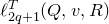 $\ell^T_{2q+1}(Q,v,R)$
. In the second version (which is a special case of the first), denoted by
$\ell^T_{2q+1}(Q,v,R)$
. In the second version (which is a special case of the first), denoted by $\ell_{2q+1}(Q,v)$
, the extended quadratic forms are free. The second version is more suitable for computations, as it has a natural monoid structure given by a direct sum (see Proposition 4.21). However, the surgery obstruction that we will define in § 6 lives in an
$\ell_{2q+1}(Q,v)$
, the extended quadratic forms are free. The second version is more suitable for computations, as it has a natural monoid structure given by a direct sum (see Proposition 4.21). However, the surgery obstruction that we will define in § 6 lives in an $\ell$
-monoid of the first type. We will prove that the two versions are equivalent, that is, there is a natural bijection between them (see Proposition 4.14); this will allow us to perform computations with the surgery obstruction.
$\ell$
-monoid of the first type. We will prove that the two versions are equivalent, that is, there is a natural bijection between them (see Proposition 4.14); this will allow us to perform computations with the surgery obstruction.
Next we prove the important identity of Theorem 4.26. Then we define the group $L_{2q+1}(Q,v)$
, which is a generalisation of the classical L-group
$L_{2q+1}(Q,v)$
, which is a generalisation of the classical L-group $L_{2q+1}$
. This is the group of invertible elements of
$L_{2q+1}$
. This is the group of invertible elements of $\ell_{2q+1}(Q,v)$
, and we show (using the fact that
$\ell_{2q+1}(Q,v)$
, and we show (using the fact that $L_{2q+1} \cong 0$
) that if Q is free, then
$L_{2q+1} \cong 0$
) that if Q is free, then $L_{2q+1}(Q,v) \cong 0$
. We will end the section by defining the
$L_{2q+1}(Q,v) \cong 0$
. We will end the section by defining the $\ell$
-monoid associated to a space B with a stable bundle
$\ell$
-monoid associated to a space B with a stable bundle $\xi$
over it.
$\xi$
over it.
4.1 Definitions
Definition 4.1. A quasi-formation over an abelian group Q is a triple
 \[(\underline{M}; L, V) \]
where
-
–
$\underline{M} = (M, \lambda, \mu)$
is a metabolic extended quadratic form over Q, -
–
$L \leqslant M$
is a T-Lagrangian, -
–
$V \leqslant M$
is a free half-rank direct summand.



Definition 4.2. A quasi-formation $(\underline{M}; L, V)$
is called elementary if
$(\underline{M}; L, V)$
is called elementary if $M = L \oplus V$
(as an internal direct sum).
$M = L \oplus V$
(as an internal direct sum).
Definition 4.3. The standard rank-2k elementary hyperbolic quasi-formation is $\mathcal{H}_{2k} = (\underline{H}_{2k}; \{ 0 \} \times \mathbb{Z}^k, \mathbb{Z}^k \times \{ 0 \})$
.
$\mathcal{H}_{2k} = (\underline{H}_{2k}; \{ 0 \} \times \mathbb{Z}^k, \mathbb{Z}^k \times \{ 0 \})$
.
Definition 4.4. Let $(\underline{M}; L, V)$
and
$(\underline{M}; L, V)$
and $(\underline{M}{}'; L', V')$
be quasi-formations over an abelian group Q. They are isomorphic if there is an isomorphism
$(\underline{M}{}'; L', V')$
be quasi-formations over an abelian group Q. They are isomorphic if there is an isomorphism $h : \underline{M} \rightarrow \underline{M}{}'$
such that
$h : \underline{M} \rightarrow \underline{M}{}'$
such that $L' = h(L)$
and
$L' = h(L)$
and $V' = h(V)$
.
$V' = h(V)$
.
Definition 4.5. Let $(\underline{M}; L, V)$
and
$(\underline{M}; L, V)$
and $(\underline{M}{}'; L', V')$
be quasi-formations over an abelian group Q. Their direct sum is
$(\underline{M}{}'; L', V')$
be quasi-formations over an abelian group Q. Their direct sum is $(\underline{M}; L, V) \oplus (\underline{M}{}'; L', V') = (\underline{M} \oplus \underline{M}{}'; L \oplus L', V \oplus V')$
.
$(\underline{M}; L, V) \oplus (\underline{M}{}'; L', V') = (\underline{M} \oplus \underline{M}{}'; L \oplus L', V \oplus V')$
.
Definition 4.6. Let $(\underline{M}; L, V)$
and
$(\underline{M}; L, V)$
and $(\underline{M}{}'; L', V')$
be quasi-formations over an abelian group Q. They are stably isomorphic if there are integers
$(\underline{M}{}'; L', V')$
be quasi-formations over an abelian group Q. They are stably isomorphic if there are integers $k,l \geqslant 0$
such that
$k,l \geqslant 0$
such that $(\underline{M}; L, V) \oplus \mathcal{H}_{2k} \cong (\underline{M}{}'; L', V') \oplus \mathcal{H}_{2l}$
. Stable isomorphism will be denoted by
$(\underline{M}; L, V) \oplus \mathcal{H}_{2k} \cong (\underline{M}{}'; L', V') \oplus \mathcal{H}_{2l}$
. Stable isomorphism will be denoted by ${} \mathrel{\underset{^{\scriptstyle{s}}}{\cong}} {}$
.
${} \mathrel{\underset{^{\scriptstyle{s}}}{\cong}} {}$
.
Definition 4.7. For an abelian group Q with a homomorphism $v : Q \rightarrow \mathbb{Z}_2$
, a torsion abelian group R and an even integer
$v : Q \rightarrow \mathbb{Z}_2$
, a torsion abelian group R and an even integer $q \geqslant 0$
, let
$q \geqslant 0$
, let
 \[\mathfrak{g}^T_{2q+1}(Q,v,R) \]
denote the class of quasi-formations $(\underline{M}; L, V)$
over Q such that
$(\underline{M}; L, V)$
over Q such that $\underline{M} = (M, \lambda, \mu)$
is geometric (with respect to v), full and
$\underline{M} = (M, \lambda, \mu)$
is geometric (with respect to v), full and $\mathop{\mathrm{Tor}}\nolimits M \cong R$
.
$\mathop{\mathrm{Tor}}\nolimits M \cong R$
.
Note that the class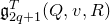 $\mathfrak{g}^T_{2q+1}(Q,v,R)$
does not depend on the choice of q.
$\mathfrak{g}^T_{2q+1}(Q,v,R)$
does not depend on the choice of q.
Definition 4.8. For an abelian group Q with a homomorphism $v : Q \rightarrow \mathbb{Z}_2$
, a torsion abelian group R and an even integer
$v : Q \rightarrow \mathbb{Z}_2$
, a torsion abelian group R and an even integer $q \geqslant 0$
, let
$q \geqslant 0$
, let
 \[\mathscr{g}^T_{2q+1}(Q,v,R) = \mathfrak{g}^T_{2q+1}(Q,v,R) / {\cong} \]
denote the set of isomorphism classes of quasi-formations $(\underline{M}; L, V)$
over Q such that
$(\underline{M}; L, V)$
over Q such that $\underline{M} = (M, \lambda, \mu)$
is geometric (with respect to v), full and
$\underline{M} = (M, \lambda, \mu)$
is geometric (with respect to v), full and $\mathop{\mathrm{Tor}}\nolimits M \cong R$
.
$\mathop{\mathrm{Tor}}\nolimits M \cong R$
.
Definition 4.9. For an abelian group Q with a homomorphism $v : Q \rightarrow \mathbb{Z}_2$
, a torsion abelian group R and an even integer
$v : Q \rightarrow \mathbb{Z}_2$
, a torsion abelian group R and an even integer $q \geqslant 0$
, let
$q \geqslant 0$
, let
 \[\mathscr{s}^T_{2q+1}(Q,v,R) = \mathfrak{g}^T_{2q+1}(Q,v,R) / {\mathrel{\underset{^{\scriptstyle{s}}}{\cong}}} \]
denote the set of stable isomorphism classes of quasi-formations $(\underline{M}; L, V)$
over Q such that
$(\underline{M}; L, V)$
over Q such that $\underline{M} = (M, \lambda, \mu)$
is geometric (with respect to v), full and
$\underline{M} = (M, \lambda, \mu)$
is geometric (with respect to v), full and $\mathop{\mathrm{Tor}}\nolimits M \cong R$
.
$\mathop{\mathrm{Tor}}\nolimits M \cong R$
.
Definition 4.10. For an abelian group Q with a homomorphism $v : Q \rightarrow \mathbb{Z}_2$
, a torsion abelian group R and an even integer
$v : Q \rightarrow \mathbb{Z}_2$
, a torsion abelian group R and an even integer $q \geqslant 0$
, let
$q \geqslant 0$
, let
 \[\ell^T_{2q+1}(Q,v,R) = \mathfrak{g}^T_{2q+1}(Q,v,R) / {\sim} \]
be the set of quasi-formations $(\underline{M}; L, V)$
over Q such that
$(\underline{M}; L, V)$
over Q such that $\underline{M} = (M, \lambda, \mu)$
is geometric (with respect to v), full and
$\underline{M} = (M, \lambda, \mu)$
is geometric (with respect to v), full and $\mathop{\mathrm{Tor}}\nolimits M \cong R$
up to the equivalence relation
$\mathop{\mathrm{Tor}}\nolimits M \cong R$
up to the equivalence relation $\sim$
, which is generated by the following elementary equivalences:
$\sim$
, which is generated by the following elementary equivalences:
-
–
$(\underline{M}; L, V) \sim (\underline{M}{}'; L', V')$
if
$(\underline{M}; L, V) \mathrel{\underset{^{\scriptstyle{s}}}{\cong}} (\underline{M}{}'; L', V')$
; -
–
$(\underline{M} \oplus \underline{H}_2; L \oplus (\{ 0 \} \times \mathbb{Z}), V) \sim (\underline{M} \oplus \underline{H}_2; L \oplus (\mathbb{Z} \times \{ 0 \}), V)$
, where L is a T-Lagrangian in
$\underline{M}$
and V is a free half-rank direct summand in
$\underline{M} \oplus \underline{H}_2$
.





The equivalence class of $(\underline{M}; L, V)$
will be denoted by
$(\underline{M}; L, V)$
will be denoted by $[\underline{M}; L, V]$
.
$[\underline{M}; L, V]$
.
Remark 4.11. Notice that the equivalence relation $\sim$
depends ‘naturally’ on (Q,v). To be able to state this precisely, we define the class
$\sim$
depends ‘naturally’ on (Q,v). To be able to state this precisely, we define the class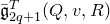 $\bar{\mathfrak{g}}^T_{2q+1}(Q,v,R)$
of quasi-formations
$\bar{\mathfrak{g}}^T_{2q+1}(Q,v,R)$
of quasi-formations $(\underline{M}; L, V)$
in the same way as
$(\underline{M}; L, V)$
in the same way as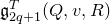 $\mathfrak{g}^T_{2q+1}(Q,v,R)$
, except that
$\mathfrak{g}^T_{2q+1}(Q,v,R)$
, except that $\underline{M}$
is not required to be full. Then
$\underline{M}$
is not required to be full. Then $\sim$
can also be defined on
$\sim$
can also be defined on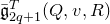 $\bar{\mathfrak{g}}^T_{2q+1}(Q,v,R)$
, and if
$\bar{\mathfrak{g}}^T_{2q+1}(Q,v,R)$
, and if $x,y \in \mathfrak{g}^T_{2q+1}(Q,v,R) \subseteq \bar{\mathfrak{g}}^T_{2q+1}(Q,v,R)$
, then
$x,y \in \mathfrak{g}^T_{2q+1}(Q,v,R) \subseteq \bar{\mathfrak{g}}^T_{2q+1}(Q,v,R)$
, then $x \sim y$
in
$x \sim y$
in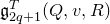 $\mathfrak{g}^T_{2q+1}(Q,v,R)$
if and only if
$\mathfrak{g}^T_{2q+1}(Q,v,R)$
if and only if $x \sim y$
in
$x \sim y$
in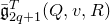 $\bar{\mathfrak{g}}^T_{2q+1}(Q,v,R)$
.
$\bar{\mathfrak{g}}^T_{2q+1}(Q,v,R)$
.
Pairs (Q,v) are the objects in the slice category of abelian groups over $\mathbb{Z}_2$
, where a morphism
$\mathbb{Z}_2$
, where a morphism $(Q,v) \rightarrow (Q',v')$
is a homomorphism
$(Q,v) \rightarrow (Q',v')$
is a homomorphism $f : Q \rightarrow Q'$
such that
$f : Q \rightarrow Q'$
such that $v' \circ f = v$
. Post-composition with such an f turns an extended quadratic form over Q into one over Q’, and determines a map
$v' \circ f = v$
. Post-composition with such an f turns an extended quadratic form over Q into one over Q’, and determines a map $f_* : \bar{\mathfrak{g}}^T_{2q+1}(Q,v,R) \rightarrow \bar{\mathfrak{g}}^T_{2q+1}(Q',v',R)$
. Then
$f_* : \bar{\mathfrak{g}}^T_{2q+1}(Q,v,R) \rightarrow \bar{\mathfrak{g}}^T_{2q+1}(Q',v',R)$
. Then $\sim$
is natural in the sense that if
$\sim$
is natural in the sense that if $x \sim y \in \bar{\mathfrak{g}}^T_{2q+1}(Q,v,R)$
, then
$x \sim y \in \bar{\mathfrak{g}}^T_{2q+1}(Q,v,R)$
, then $f_*(x) \sim f_*(y) \in \bar{\mathfrak{g}}^T_{2q+1}(Q',v',R)$
.
$f_*(x) \sim f_*(y) \in \bar{\mathfrak{g}}^T_{2q+1}(Q',v',R)$
.
Definition 4.12. For an abelian group Q with a homomorphism $v : Q \rightarrow \mathbb{Z}_2$
and an even integer
$v : Q \rightarrow \mathbb{Z}_2$
and an even integer $q \geqslant 0$
, let
$q \geqslant 0$
, let
 \[\begin{aligned}\mathfrak{g}_{2q+1}(Q,v) &= \mathfrak{g}^T_{2q+1}(Q,v,0) \text{,} \\ \mathscr{g}_{2q+1}(Q,v) &= \mathscr{g}^T_{2q+1}(Q,v,0) \text{,} \\ \mathscr{s}_{2q+1}(Q,v) &= \mathscr{s}^T_{2q+1}(Q,v,0) \text{,} \\ \ell_{2q+1}(Q,v) &= \ell^T_{2q+1}(Q,v,0) .\end{aligned} \]
To prove the equivalence of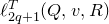 $\ell^T_{2q+1}(Q,v,R)$
and
$\ell^T_{2q+1}(Q,v,R)$
and $\ell_{2q+1}(Q,v)$
we will need the following notation.
$\ell_{2q+1}(Q,v)$
we will need the following notation.
Definition 4.13. Suppose that $\underline{N} = (N, \lambda_N, \mu_N)$
is an extended quadratic form over an abelian group Q such that
$\underline{N} = (N, \lambda_N, \mu_N)$
is an extended quadratic form over an abelian group Q such that $\mu_N \big| _{\mathop{\mathrm{Tor}}\nolimits N} = 0$
(note that this condition automatically holds if Q is free). Let
$\mu_N \big| _{\mathop{\mathrm{Tor}}\nolimits N} = 0$
(note that this condition automatically holds if Q is free). Let $\bar{N}$
denote
$\bar{N}$
denote $N / \mathop{\mathrm{Tor}}\nolimits N$
and
$N / \mathop{\mathrm{Tor}}\nolimits N$
and $\pi_N : N \rightarrow N / \mathop{\mathrm{Tor}}\nolimits N$
the quotient map. Let
$\pi_N : N \rightarrow N / \mathop{\mathrm{Tor}}\nolimits N$
the quotient map. Let $\bar{\lambda}_N$
and
$\bar{\lambda}_N$
and $\bar{\mu}_N$
denote the induced bilinear function and homomorphism on
$\bar{\mu}_N$
denote the induced bilinear function and homomorphism on $\bar{N}$
, and let
$\bar{N}$
, and let $\underline{\bar{N}} = (\bar{N}, \bar{\lambda}_N, \bar{\mu}_N)$
. If
$\underline{\bar{N}} = (\bar{N}, \bar{\lambda}_N, \bar{\mu}_N)$
. If $X \leqslant N$
is a subgroup, then
$X \leqslant N$
is a subgroup, then $\bar{X}$
will denote the subgroup
$\bar{X}$
will denote the subgroup $\pi_N(X) \leqslant N / \mathop{\mathrm{Tor}}\nolimits N$
.
$\pi_N(X) \leqslant N / \mathop{\mathrm{Tor}}\nolimits N$
.
Note that $\pi_N : \underline{N} \rightarrow \underline{\bar{N}}$
is a morphism of extended quadratic forms. If
$\pi_N : \underline{N} \rightarrow \underline{\bar{N}}$
is a morphism of extended quadratic forms. If $\underline{N}$
is non-singular, metabolic, full or geometric (with respect to some homomorphism), then the same property also holds for
$\underline{N}$
is non-singular, metabolic, full or geometric (with respect to some homomorphism), then the same property also holds for $\underline{\bar{N}}$
.
$\underline{\bar{N}}$
.
Proposition 4.14. For any abelian group Q with a homomorphism $v : Q \rightarrow \mathbb{Z}_2$
, torsion abelian group R and even integer
$v : Q \rightarrow \mathbb{Z}_2$
, torsion abelian group R and even integer $q \geqslant 0$
, there is a canonical bijection between
$q \geqslant 0$
, there is a canonical bijection between $\ell_{2q+1}(Q,v)$
and
$\ell_{2q+1}(Q,v)$
and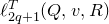 $\ell^T_{2q+1}(Q,v,R)$
.
$\ell^T_{2q+1}(Q,v,R)$
.
Proof. First we define a function $F : \ell_{2q+1}(Q,v) \rightarrow \ell^T_{2q+1}(Q,v,R)$
. Let
$F : \ell_{2q+1}(Q,v) \rightarrow \ell^T_{2q+1}(Q,v,R)$
. Let $\underline{R} = (R, 0, 0)$
; this is a metabolic extended quadratic form of rank 0 over any group, geometric with respect to any homomorphism. If
$\underline{R} = (R, 0, 0)$
; this is a metabolic extended quadratic form of rank 0 over any group, geometric with respect to any homomorphism. If $(\underline{M}; L, V) \in \mathfrak{g}_{2q+1}(Q,v)$
, then
$(\underline{M}; L, V) \in \mathfrak{g}_{2q+1}(Q,v)$
, then $(\underline{M}; L, V) \oplus (\underline{R}; R, 0) \in \mathfrak{g}^T_{2q+1}(Q,v,R)$
, and let
$(\underline{M}; L, V) \oplus (\underline{R}; R, 0) \in \mathfrak{g}^T_{2q+1}(Q,v,R)$
, and let $F([\underline{M}; L, V]) = [\underline{M} \oplus \underline{R}; L \oplus R, V \oplus 0]$
.
$F([\underline{M}; L, V]) = [\underline{M} \oplus \underline{R}; L \oplus R, V \oplus 0]$
.
Next we define a function $G : \ell^T_{2q+1}(Q,v,R) \rightarrow \ell_{2q+1}(Q,v)$
. Suppose that
$G : \ell^T_{2q+1}(Q,v,R) \rightarrow \ell_{2q+1}(Q,v)$
. Suppose that $(\underline{N}; K, W) \in \mathfrak{g}^T_{2q+1}(Q,v,R)$
, where
$(\underline{N}; K, W) \in \mathfrak{g}^T_{2q+1}(Q,v,R)$
, where $\underline{N} = (N, \lambda, \mu)$
. Since
$\underline{N} = (N, \lambda, \mu)$
. Since $\mu \big| _{\mathop{\mathrm{Tor}}\nolimits N} = 0$
(because
$\mu \big| _{\mathop{\mathrm{Tor}}\nolimits N} = 0$
(because $\underline{N}$
has a T-Lagrangian), we can define
$\underline{N}$
has a T-Lagrangian), we can define $\underline{\bar{N}}$
. Moreover,
$\underline{\bar{N}}$
. Moreover, $\bar{K} = K / \mathop{\mathrm{Tor}}\nolimits N$
is a Lagrangian in
$\bar{K} = K / \mathop{\mathrm{Tor}}\nolimits N$
is a Lagrangian in $\underline{\bar{N}}$
, and
$\underline{\bar{N}}$
, and $\bar{W} = (W \oplus \mathop{\mathrm{Tor}}\nolimits N) / \mathop{\mathrm{Tor}}\nolimits N$
is a half-rank direct summand, hence
$\bar{W} = (W \oplus \mathop{\mathrm{Tor}}\nolimits N) / \mathop{\mathrm{Tor}}\nolimits N$
is a half-rank direct summand, hence $(\underline{\bar{N}}; \bar{K}, \bar{W}) \in \mathfrak{g}_{2q+1}(Q,v)$
. Let
$(\underline{\bar{N}}; \bar{K}, \bar{W}) \in \mathfrak{g}_{2q+1}(Q,v)$
. Let $G([\underline{N}; K, W])=[\underline{\bar{N}}; \bar{K}, \bar{W}]$
.
$G([\underline{N}; K, W])=[\underline{\bar{N}}; \bar{K}, \bar{W}]$
.
It is immediate from the definitions that $G \circ F = \mathop{\mathrm{id}}\nolimits_{\ell_{2q+1}(Q,v)}$
. For the other composition, let
$G \circ F = \mathop{\mathrm{id}}\nolimits_{\ell_{2q+1}(Q,v)}$
. For the other composition, let $[\underline{N}; K, W] \in \ell^T_{2q+1}(Q,v,R)$
; then
$[\underline{N}; K, W] \in \ell^T_{2q+1}(Q,v,R)$
; then $F \circ G([\underline{N}; K, W]) = [\underline{\bar{N}} \oplus \underline{R}; \bar{K} \oplus R, \bar{W} \oplus 0]$
. Since W is a free direct summand,
$F \circ G([\underline{N}; K, W]) = [\underline{\bar{N}} \oplus \underline{R}; \bar{K} \oplus R, \bar{W} \oplus 0]$
. Since W is a free direct summand, $\pi_N$
has a right inverse
$\pi_N$
has a right inverse $I_0 : \bar{N} \rightarrow N$
such that
$I_0 : \bar{N} \rightarrow N$
such that $W \leqslant \mathop{\mathrm{Im}}\nolimits I_0$
. By choosing an isomorphism
$W \leqslant \mathop{\mathrm{Im}}\nolimits I_0$
. By choosing an isomorphism $\mathop{\mathrm{Tor}}\nolimits N \cong R$
we can extend
$\mathop{\mathrm{Tor}}\nolimits N \cong R$
we can extend $I_0$
to an isomorphism
$I_0$
to an isomorphism $I : \bar{N} \oplus R \rightarrow N$
. This is also an isomorphism
$I : \bar{N} \oplus R \rightarrow N$
. This is also an isomorphism $\underline{\bar{N}} \oplus \underline{R} \cong \underline{N}$
of extended quadratic forms, and by construction
$\underline{\bar{N}} \oplus \underline{R} \cong \underline{N}$
of extended quadratic forms, and by construction $I(\bar{W} \oplus 0) = I_0(\bar{W})=W$
. Since K is a T-Lagrangian, we have
$I(\bar{W} \oplus 0) = I_0(\bar{W})=W$
. Since K is a T-Lagrangian, we have $K = (K \cap \mathop{\mathrm{Im}}\nolimits I_0) \oplus \mathop{\mathrm{Tor}}\nolimits N$
, so
$K = (K \cap \mathop{\mathrm{Im}}\nolimits I_0) \oplus \mathop{\mathrm{Tor}}\nolimits N$
, so $I(\bar{K} \oplus R) = I_0(\bar{K}) \oplus \mathop{\mathrm{Tor}}\nolimits N = (K \cap \mathop{\mathrm{Im}}\nolimits I_0) \oplus \mathop{\mathrm{Tor}}\nolimits N = K$
. This shows that
$I(\bar{K} \oplus R) = I_0(\bar{K}) \oplus \mathop{\mathrm{Tor}}\nolimits N = (K \cap \mathop{\mathrm{Im}}\nolimits I_0) \oplus \mathop{\mathrm{Tor}}\nolimits N = K$
. This shows that $[\underline{\bar{N}} \oplus \underline{R}; \bar{K} \oplus R, \bar{W} \oplus 0] = [\underline{N}; K, W]$
, hence
$[\underline{\bar{N}} \oplus \underline{R}; \bar{K} \oplus R, \bar{W} \oplus 0] = [\underline{N}; K, W]$
, hence $F \circ G = \mathop{\mathrm{id}}\nolimits_{\ell^T_{2q+1}(Q,v,R)}$
.
$F \circ G = \mathop{\mathrm{id}}\nolimits_{\ell^T_{2q+1}(Q,v,R)}$
.
Remark 4.15. The same proof shows that there are canonical bijections between $\mathscr{g}_{2q+1}(Q,v)$
and
$\mathscr{g}_{2q+1}(Q,v)$
and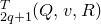 $\mathscr{g}^T_{2q+1}(Q,v,R)$
and between
$\mathscr{g}^T_{2q+1}(Q,v,R)$
and between $\mathscr{s}_{2q+1}(Q,v)$
and
$\mathscr{s}_{2q+1}(Q,v)$
and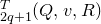 $\mathscr{s}^T_{2q+1}(Q,v,R)$
.
$\mathscr{s}^T_{2q+1}(Q,v,R)$
.
Recall that a quasi-formation $(\underline{M}; L, V)$
is called elementary if
$(\underline{M}; L, V)$
is called elementary if $M = L \oplus V$
. This property is invariant under stable isomorphism (because
$M = L \oplus V$
. This property is invariant under stable isomorphism (because $(\underline{M}; L, V)$
is elementary if and only if
$(\underline{M}; L, V)$
is elementary if and only if $(\underline{M}; L, V) \oplus \mathcal{H}_{2k}$
is elementary, for any k). Therefore, an element of
$(\underline{M}; L, V) \oplus \mathcal{H}_{2k}$
is elementary, for any k). Therefore, an element of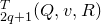 $\mathscr{g}^T_{2q+1}(Q,v,R)$
or
$\mathscr{g}^T_{2q+1}(Q,v,R)$
or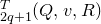 $\mathscr{s}^T_{2q+1}(Q,v,R)$
has an elementary representative if and only if all of its representatives are elementary.
$\mathscr{s}^T_{2q+1}(Q,v,R)$
has an elementary representative if and only if all of its representatives are elementary.
Definition 4.16. An element of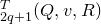 $\mathscr{g}^T_{2q+1}(Q,v,R)$
or
$\mathscr{g}^T_{2q+1}(Q,v,R)$
or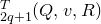 $\mathscr{s}^T_{2q+1}(Q,v,R)$
is called elementary if its representatives are elementary.
$\mathscr{s}^T_{2q+1}(Q,v,R)$
is called elementary if its representatives are elementary.
In contrast to the above, an elementary quasi-formation may be equivalent to a non-elementary one under the equivalence relation $\sim$
.
$\sim$
.
Definition 4.17. An element of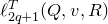 $\ell^T_{2q+1}(Q,v,R)$
is called elementary if it has an elementary representative.
$\ell^T_{2q+1}(Q,v,R)$
is called elementary if it has an elementary representative.
Remark 4.18. Under the bijection of Proposition 4.14, elementary elements of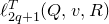 $\ell^T_{2q+1}(Q,v,R)$
correspond to elementary elements of
$\ell^T_{2q+1}(Q,v,R)$
correspond to elementary elements of $\ell_{2q+1}(Q,v) = \ell^T_{2q+1}(Q,v,0)$
.
$\ell_{2q+1}(Q,v) = \ell^T_{2q+1}(Q,v,0)$
.
4.2 The monoid
$\ell_{2q+1}(Q,v)$

From now on we will focus on the free version $\ell_{2q+1}(Q,v)$
. We show that it has a natural monoid structure and, using the results on
$\ell_{2q+1}(Q,v)$
. We show that it has a natural monoid structure and, using the results on $\mathop{\mathrm{RU}}\nolimits_{\mathrm{st}}(\underline{M},L)$
from § 3, we prove Theorem 4.26.
$\mathop{\mathrm{RU}}\nolimits_{\mathrm{st}}(\underline{M},L)$
from § 3, we prove Theorem 4.26.
Lemma 4.19
Suppose that $(\underline{M}; L, V) \in \mathfrak{g}_{2q+1}(Q,v)$
. If
$(\underline{M}; L, V) \in \mathfrak{g}_{2q+1}(Q,v)$
. If $\Psi \in \mathop{\mathrm{RU}}\nolimits(\underline{M},L)$
, then we have
$\Psi \in \mathop{\mathrm{RU}}\nolimits(\underline{M},L)$
, then we have $(\underline{M}; L, V) \sim (\underline{M}; L, \Psi(V))$
.
$(\underline{M}; L, V) \sim (\underline{M}; L, \Psi(V))$
.
Proof. It is enough to prove the statement when $\Psi$
is a generator of
$\Psi$
is a generator of $\mathop{\mathrm{RU}}\nolimits(\underline{M},L)$
.
$\mathop{\mathrm{RU}}\nolimits(\underline{M},L)$
.
If $\Psi(L) = L$
, then
$\Psi(L) = L$
, then $\Psi$
is an isomorphism between
$\Psi$
is an isomorphism between $(\underline{M}; L, V)$
and
$(\underline{M}; L, V)$
and $(\underline{M}; L, \Psi(V))$
.
$(\underline{M}; L, \Psi(V))$
.
If there is an isomorphism $I : \underline{M} \rightarrow \underline{H}_2 \oplus \underline{M}{}'$
such that
$I : \underline{M} \rightarrow \underline{H}_2 \oplus \underline{M}{}'$
such that $I(L) = ( \{0 \} \times \mathbb{Z}) \oplus L'$
for some Lagrangian L’ in
$I(L) = ( \{0 \} \times \mathbb{Z}) \oplus L'$
for some Lagrangian L’ in $\underline{M}{}'$
and
$\underline{M}{}'$
and $\Psi = I^{-1} \circ (\sigma \oplus \mathop{\mathrm{id}}\nolimits_{M'}) \circ I$
, then
$\Psi = I^{-1} \circ (\sigma \oplus \mathop{\mathrm{id}}\nolimits_{M'}) \circ I$
, then $I \circ \Psi(L) = (\sigma \oplus \mathop{\mathrm{id}}\nolimits_{M'}) \circ I(L) = (\sigma \oplus \mathop{\mathrm{id}}\nolimits_{M'})(( \{0 \} \times \mathbb{Z}) \oplus L') = (\mathbb{Z} \times \{0 \} ) \oplus L'$
. So
$I \circ \Psi(L) = (\sigma \oplus \mathop{\mathrm{id}}\nolimits_{M'}) \circ I(L) = (\sigma \oplus \mathop{\mathrm{id}}\nolimits_{M'})(( \{0 \} \times \mathbb{Z}) \oplus L') = (\mathbb{Z} \times \{0 \} ) \oplus L'$
. So
 \[\begin{aligned}(\underline{M}; L, V) &\cong (\underline{H}_2 \oplus \underline{M}{}'; I \circ \Psi(L), I \circ \Psi(V)) \\ &= (\underline{H}_2 \oplus \underline{M}{}'; (\mathbb{Z} \times \{0 \} ) \oplus L', I \circ \Psi(V)) \\ &\sim (\underline{H}_2 \oplus \underline{M}{}'; ( \{0 \} \times \mathbb{Z}) \oplus L', I \circ \Psi(V)) \\ &= (\underline{H}_2 \oplus \underline{M}{}'; I(L), I \circ \Psi(V)) \\ &\cong (\underline{M}; L, \Psi(V))\end{aligned} \]
where we used the isomorphisms $I \circ \Psi$
and I. Therefore, the statement holds for every generator of
$I \circ \Psi$
and I. Therefore, the statement holds for every generator of $\mathop{\mathrm{RU}}\nolimits(\underline{M},L)$
.
$\mathop{\mathrm{RU}}\nolimits(\underline{M},L)$
.
Lemma 4.20.
If $(\underline{M}; L, V) \in \mathfrak{g}_{2q+1}(Q,v)$
and
$(\underline{M}; L, V) \in \mathfrak{g}_{2q+1}(Q,v)$
and $k \geqslant 0$
, then we have
$k \geqslant 0$
, then we have $(\underline{M}; L, V) \sim (\underline{M}; L, V) \oplus (\underline{H}_{2k}; \{ 0 \} \times \mathbb{Z}^k, \{ 0 \} \times \mathbb{Z}^k)$
.
$(\underline{M}; L, V) \sim (\underline{M}; L, V) \oplus (\underline{H}_{2k}; \{ 0 \} \times \mathbb{Z}^k, \{ 0 \} \times \mathbb{Z}^k)$
.
Proof. As in Proposition 3.6, if $\Sigma$
denotes the flip map, then
$\Sigma$
denotes the flip map, then $\mathop{\mathrm{id}}\nolimits_M \oplus \Sigma \in \mathop{\mathrm{RU}}\nolimits(\underline{M} \oplus \underline{H}_{2k}, L \oplus (\{0\} \times \mathbb{Z}^k))$
and
$\mathop{\mathrm{id}}\nolimits_M \oplus \Sigma \in \mathop{\mathrm{RU}}\nolimits(\underline{M} \oplus \underline{H}_{2k}, L \oplus (\{0\} \times \mathbb{Z}^k))$
and $(\mathop{\mathrm{id}}\nolimits_M \oplus \Sigma)(V \oplus (\mathbb{Z}^k \times \{0\})) = V \oplus (\{0\} \times \mathbb{Z}^k)$
. Hence, by Lemma 4.19, we have
$(\mathop{\mathrm{id}}\nolimits_M \oplus \Sigma)(V \oplus (\mathbb{Z}^k \times \{0\})) = V \oplus (\{0\} \times \mathbb{Z}^k)$
. Hence, by Lemma 4.19, we have $(\underline{M}; L, V) \sim (\underline{M}; L, V) \oplus (\underline{H}_{2k}; \{ 0 \} \times \mathbb{Z}^k, \mathbb{Z}^k \times \{ 0 \}) \sim (\underline{M}; L, V) \oplus (\underline{H}_{2k}; \{ 0 \} \times \mathbb{Z}^k, \{ 0 \} \times \mathbb{Z}^k)$
.
$(\underline{M}; L, V) \sim (\underline{M}; L, V) \oplus (\underline{H}_{2k}; \{ 0 \} \times \mathbb{Z}^k, \mathbb{Z}^k \times \{ 0 \}) \sim (\underline{M}; L, V) \oplus (\underline{H}_{2k}; \{ 0 \} \times \mathbb{Z}^k, \{ 0 \} \times \mathbb{Z}^k)$
.
Proposition 4.21.
-
(a) The direct sum of quasi-formations induces an operation
$\oplus$
on
$\ell_{2q+1}(Q,v)$
, and
$(\ell_{2q+1}(Q,v), \oplus)$
is a commutative monoid.
-
(b) If
$(\underline{M}; L, L) \in \mathfrak{g}_{2q+1}(Q,v)$
, then
$[\underline{M}; L, L]$
is the zero element in
$\ell_{2q+1}(Q,v)$
.






Proof. It is clear that there is a well-defined induced operation $\oplus$
on
$\oplus$
on $\ell_{2q+1}(Q,v)$
, which is associative and commutative (cf. [Nagy21, Proposition 4.2.18]). We need to show that it has a zero element. (Note that
$\ell_{2q+1}(Q,v)$
, which is associative and commutative (cf. [Nagy21, Proposition 4.2.18]). We need to show that it has a zero element. (Note that $\underline{H}_{2k}$
is not full if
$\underline{H}_{2k}$
is not full if $Q \neq 0$
, so
$Q \neq 0$
, so $\mathcal{H}_{2k} \not \in \mathfrak{g}_{2q+1}(Q,v)$
.) We will do this in three steps.
$\mathcal{H}_{2k} \not \in \mathfrak{g}_{2q+1}(Q,v)$
.) We will do this in three steps.
First, we show that there is a quasi-formation of the form $(\underline{M}; L, L)$
in the class
$(\underline{M}; L, L)$
in the class $\mathfrak{g}_{2q+1}(Q,v)$
(in particular,
$\mathfrak{g}_{2q+1}(Q,v)$
(in particular, $\mathfrak{g}_{2q+1}(Q,v)$
and
$\mathfrak{g}_{2q+1}(Q,v)$
and $\ell_{2q+1}(Q,v)$
are non-empty). Let
$\ell_{2q+1}(Q,v)$
are non-empty). Let $\mu_0 : A \rightarrow Q$
be a surjective homomorphism from some free abelian group A to Q. Let
$\mu_0 : A \rightarrow Q$
be a surjective homomorphism from some free abelian group A to Q. Let $k = \mathop{\mathrm{rk}}\nolimits A$
, and let
$k = \mathop{\mathrm{rk}}\nolimits A$
, and let $f_1, f_2, \ldots , f_k$
be a basis of A. Let L be another rank-k free abelian group with basis
$f_1, f_2, \ldots , f_k$
be a basis of A. Let L be another rank-k free abelian group with basis $e_1, e_2, \ldots , e_k$
. Let
$e_1, e_2, \ldots , e_k$
. Let $M = L \oplus A$
. Let
$M = L \oplus A$
. Let $\lambda : M \times M \rightarrow \mathbb{Z}$
be the bilinear function given by the block matrix
$\lambda : M \times M \rightarrow \mathbb{Z}$
be the bilinear function given by the block matrix
 \[\begin{bmatrix}0 & I_k \\I_k & D\end{bmatrix} \]
(in the basis $e_1, e_2, \ldots , e_k, f_1, f_2, \ldots , f_k$
), where D is a diagonal matrix such that the diagonal entry corresponding to
$e_1, e_2, \ldots , e_k, f_1, f_2, \ldots , f_k$
), where D is a diagonal matrix such that the diagonal entry corresponding to $f_i$
is 0 if
$f_i$
is 0 if $v \circ \mu_0(f_i)=0$
and 1 if
$v \circ \mu_0(f_i)=0$
and 1 if $v \circ \mu_0(f_i)=1$
(hence,
$v \circ \mu_0(f_i)=1$
(hence, $\varrho_2 \circ \lambda(f_i,f_i) = v \circ \mu_0(f_i)$
). Let
$\varrho_2 \circ \lambda(f_i,f_i) = v \circ \mu_0(f_i)$
). Let $\mu : M \rightarrow Q$
be the homomorphism such that
$\mu : M \rightarrow Q$
be the homomorphism such that $\mu \big| _L = 0$
and
$\mu \big| _L = 0$
and $\mu \big| _A = \mu_0$
. Then
$\mu \big| _A = \mu_0$
. Then $\underline{M} = (M, \lambda, \mu)$
is an extended quadratic form over Q, and it is free and full. It is also geometric, because for any
$\underline{M} = (M, \lambda, \mu)$
is an extended quadratic form over Q, and it is free and full. It is also geometric, because for any $x = \sum_{i=1}^k r_ie_i + \sum_{i=1}^k s_if_i \in M$
we have
$x = \sum_{i=1}^k r_ie_i + \sum_{i=1}^k s_if_i \in M$
we have
 \begin{align*}\varrho_2 \circ \lambda(x,x) &= \varrho_2 \bigg(2\sum_{i=1}^k r_is_i+ \sum_{i=1}^k s_i^2 \lambda(f_i,f_i) \bigg) = \sum_{i=1}^k \varrho_2(s_i^2) \varrho_2 \circ \lambda(f_i,f_i) \\&= \sum_{i=1}^k \varrho_2(s_i) \varrho_2 \circ \lambda(f_i,f_i) = \sum_{i=1}^k \varrho_2(s_i) v \circ \mu_0(f_i) = \sum_{i=1}^k v(s_i\mu_0(f_i)) = v \circ \mu(x).\end{align*}
Furthermore, L is a Lagrangian in M, therefore $(\underline{M}; L, L) \in \mathfrak{g}_{2q+1}(Q,v)$
.
$(\underline{M}; L, L) \in \mathfrak{g}_{2q+1}(Q,v)$
.
Second, we show that if $(\underline{M}; L, L), (\underline{M}{}'; L', L') \in \mathfrak{g}_{2q+1}(Q,v)$
, then
$(\underline{M}; L, L), (\underline{M}{}'; L', L') \in \mathfrak{g}_{2q+1}(Q,v)$
, then $(\underline{M}; L, L) \sim (\underline{M}{}'; L', L')$
. By Theorem 2.27(a) there is an isomorphism
$(\underline{M}; L, L) \sim (\underline{M}{}'; L', L')$
. By Theorem 2.27(a) there is an isomorphism $I : \underline{M} \oplus \underline{H}_{2k} \rightarrow \underline{M}{}' \oplus \underline{H}_{2l}$
such that
$I : \underline{M} \oplus \underline{H}_{2k} \rightarrow \underline{M}{}' \oplus \underline{H}_{2l}$
such that $I(L \oplus (\{ 0 \} \times \mathbb{Z}^k)) = L' \oplus (\{ 0 \} \times \mathbb{Z}^l)$
for some
$I(L \oplus (\{ 0 \} \times \mathbb{Z}^k)) = L' \oplus (\{ 0 \} \times \mathbb{Z}^l)$
for some $k,l \geqslant 0$
. So we have
$k,l \geqslant 0$
. So we have
 \[\begin{aligned}(\underline{M}; L, L) &\sim (\underline{M}; L, L) \oplus (\underline{H}_{2k}; \{ 0 \} \times \mathbb{Z}^k, \{ 0 \} \times \mathbb{Z}^k) \\ &= (\underline{M} \oplus \underline{H}_{2k}; L \oplus (\{ 0 \} \times \mathbb{Z}^k), L \oplus (\{ 0 \} \times \mathbb{Z}^k)) \\ &\cong (\underline{M}{}' \oplus \underline{H}_{2l}; L' \oplus (\{ 0 \} \times \mathbb{Z}^l), L' \oplus (\{ 0 \} \times \mathbb{Z}^l)) \\ &= (\underline{M}{}'; L', L') \oplus (\underline{H}_{2l}; \{ 0 \} \times \mathbb{Z}^l, \{ 0 \} \times \mathbb{Z}^l)\\ &\sim (\underline{M}{}'; L', L'),\end{aligned} \]
using Lemma 4.20 and the isomorphism I. Therefore, all quasi-formations of the form $(\underline{M}; L, L)$
are in the same equivalence class, which we will denote by
$(\underline{M}; L, L)$
are in the same equivalence class, which we will denote by $\alpha \in \ell_{2q+1}(Q,v)$
.
$\alpha \in \ell_{2q+1}(Q,v)$
.
Third, we show that $\alpha$
is a zero element in
$\alpha$
is a zero element in $\ell_{2q+1}(Q,v)$
. Suppose that
$\ell_{2q+1}(Q,v)$
. Suppose that $(\underline{M}; L, V) \in \mathfrak{g}_{2q+1}(Q,v)$
; then
$(\underline{M}; L, V) \in \mathfrak{g}_{2q+1}(Q,v)$
; then $(\underline{M}; L, L) \in \mathfrak{g}_{2q+1}(Q,v)$
and
$(\underline{M}; L, L) \in \mathfrak{g}_{2q+1}(Q,v)$
and $[\underline{M}; L, L] = \alpha$
. Let
$[\underline{M}; L, L] = \alpha$
. Let $I : \underline{M} \oplus \underline{M} \rightarrow \underline{M} \oplus \underline{H}_{2k}$
be the isomorphism constructed in the proof of Lemma 2.21, satisfying
$I : \underline{M} \oplus \underline{M} \rightarrow \underline{M} \oplus \underline{H}_{2k}$
be the isomorphism constructed in the proof of Lemma 2.21, satisfying $I(L \oplus L) = L \oplus (\{ 0 \} \times \mathbb{Z}^k)$
. We also define the basis elements
$I(L \oplus L) = L \oplus (\{ 0 \} \times \mathbb{Z}^k)$
. We also define the basis elements $e_i,f_i,\bar{e}_i,\bar{f}_i,a_i,b_i$
and the integers
$e_i,f_i,\bar{e}_i,\bar{f}_i,a_i,b_i$
and the integers $d_i$
as in Lemma 2.21. Let
$d_i$
as in Lemma 2.21. Let $v_1, v_2, \ldots , v_k$
be a basis of V; then
$v_1, v_2, \ldots , v_k$
be a basis of V; then $v_i = \sum_{j=1}^k (p_{ij}e_j + q_{ij}f_j)$
for some
$v_i = \sum_{j=1}^k (p_{ij}e_j + q_{ij}f_j)$
for some $p_{ij}, q_{ij} \in \mathbb{Z}$
. We have
$p_{ij}, q_{ij} \in \mathbb{Z}$
. We have $I(v_i) = \sum_{j=1}^k (p_{ij}I(e_j) + q_{ij}I(f_j)) = \sum_{j=1}^k (p_{ij}(e_j+b_j) + q_{ij}(f_j+d_jb_j)) = \sum_{j=1}^k (p_{ij}e_j + q_{ij}f_j) + \sum_{j=1}^k (p_{ij} + q_{ij}d_j)b_j = v_i + \sum_{j=1}^k (p_{ij} + q_{ij}d_j)b_j$
and
$I(v_i) = \sum_{j=1}^k (p_{ij}I(e_j) + q_{ij}I(f_j)) = \sum_{j=1}^k (p_{ij}(e_j+b_j) + q_{ij}(f_j+d_jb_j)) = \sum_{j=1}^k (p_{ij}e_j + q_{ij}f_j) + \sum_{j=1}^k (p_{ij} + q_{ij}d_j)b_j = v_i + \sum_{j=1}^k (p_{ij} + q_{ij}d_j)b_j$
and $I(\bar{e}_i)=-b_i$
. Thus,
$I(\bar{e}_i)=-b_i$
. Thus,
 \begin{align*}I(V \oplus L) &= I(\left< v_1, \ldots , v_k, \bar{e}_1, \ldots , \bar{e}_k \right\rangle) \\&= \bigg\langle v_1 + \sum_{j=1}^k (p_{1j} + q_{1j}d_j)b_j, \ldots ,v_k + \sum_{j=1}^k (p_{kj} + q_{kj}d_j)b_j, -b_1, \ldots , -b_k \bigg\rangle \\&= \left< v_1, \ldots , v_k, b_1, \ldots , b_k \right\rangle = V \oplus (\{ 0 \} \times \mathbb{Z}^k) .\end{align*}
Using the isomorphism I and Lemma 4.20, we get
 \begin{align*}(\underline{M}; L, V) \oplus (\underline{M}; L, L) &= (\underline{M} \oplus \underline{M}; L \oplus L, V \oplus L) \\ &\cong (\underline{M} \oplus \underline{H}_{2k}; L \oplus (\{ 0 \} \times \mathbb{Z}^k), V \oplus (\{ 0 \} \times \mathbb{Z}^k)) \\ &= (\underline{M}; L, V) \oplus (\underline{H}_{2k}; \{ 0 \} \times \mathbb{Z}^k, \{ 0 \} \times \mathbb{Z}^k) \\ &\sim (\underline{M}; L, V).\end{align*}
This means that $[\underline{M}; L, V] \oplus \alpha = [\underline{M}; L, V]$
. Since this is true for any
$[\underline{M}; L, V] \oplus \alpha = [\underline{M}; L, V]$
. Since this is true for any $[\underline{M}; L, V] \in \ell_{2q+1}(Q,v)$
,
$[\underline{M}; L, V] \in \ell_{2q+1}(Q,v)$
, $\alpha$
is a zero element (hence the zero element) in
$\alpha$
is a zero element (hence the zero element) in $\ell_{2q+1}(Q,v)$
.
$\ell_{2q+1}(Q,v)$
.
Remark 4.22. The direct sum of elementary quasi-formations is obviously elementary, hence the elementary elements of the monoid $\ell_{2q+1}(Q,v)$
form a subsemigroup, which we denote by
$\ell_{2q+1}(Q,v)$
form a subsemigroup, which we denote by $\varepsilon\ell_{2q+1}(Q,v)$
, following Crowley and Sixt [Reference Crowley and SixtCS11]. In general,
$\varepsilon\ell_{2q+1}(Q,v)$
, following Crowley and Sixt [Reference Crowley and SixtCS11]. In general, $\varepsilon\ell_{2q+1}(Q,v)$
is not a submonoid of
$\varepsilon\ell_{2q+1}(Q,v)$
is not a submonoid of $\ell_{2q+1}(Q,v)$
, because if
$\ell_{2q+1}(Q,v)$
, because if $(\underline{M}; L, V)$
is equivalent to an elementary quasi-formation, then
$(\underline{M}; L, V)$
is equivalent to an elementary quasi-formation, then $\mu(V) = Q$
, therefore
$\mu(V) = Q$
, therefore $[\underline{M}; L, L] \not \in \varepsilon\ell_{2q+1}(Q,v)$
if
$[\underline{M}; L, L] \not \in \varepsilon\ell_{2q+1}(Q,v)$
if $Q \neq 0$
.
$Q \neq 0$
.
Remark 4.23. Using Remark 4.11, we can see that $\ell_{2q+1}$
is a functor from the slice category of abelian groups over
$\ell_{2q+1}$
is a functor from the slice category of abelian groups over $\mathbb{Z}_2$
to commutative monoids. First, we define the monoid
$\mathbb{Z}_2$
to commutative monoids. First, we define the monoid $\bar{\ell}_{2q+1}(Q,v) = \bar{\mathfrak{g}}_{2q+1}(Q,v) / \sim$
, the analogue of
$\bar{\ell}_{2q+1}(Q,v) = \bar{\mathfrak{g}}_{2q+1}(Q,v) / \sim$
, the analogue of $\ell_{2q+1}(Q,v)$
allowing not necessarily full forms, which has zero element
$\ell_{2q+1}(Q,v)$
allowing not necessarily full forms, which has zero element $[\mathcal{H}_{2k}]$
. Then
$[\mathcal{H}_{2k}]$
. Then $\ell_{2q+1}(Q,v)$
is a subsemigroup of
$\ell_{2q+1}(Q,v)$
is a subsemigroup of $\bar{\ell}_{2q+1}(Q,v)$
. Its inclusion has a canonical left inverse
$\bar{\ell}_{2q+1}(Q,v)$
. Its inclusion has a canonical left inverse $\bar{\ell}_{2q+1}(Q,v) \rightarrow \ell_{2q+1}(Q,v)$
given by
$\bar{\ell}_{2q+1}(Q,v) \rightarrow \ell_{2q+1}(Q,v)$
given by $[\underline{N}; K, V] \mapsto [(\underline{N}; K, V) \oplus (\underline{M}; L, L)]$
for any representative
$[\underline{N}; K, V] \mapsto [(\underline{N}; K, V) \oplus (\underline{M}; L, L)]$
for any representative $(\underline{M}; L, L)$
of the zero element of
$(\underline{M}; L, L)$
of the zero element of $\ell_{2q+1}(Q,v)$
(where
$\ell_{2q+1}(Q,v)$
(where $\underline{N} \oplus \underline{M}$
is full, because
$\underline{N} \oplus \underline{M}$
is full, because $\underline{M}$
is full), which is a monoid morphism.
$\underline{M}$
is full), which is a monoid morphism.
If $f : Q \rightarrow Q'$
is a morphism
$f : Q \rightarrow Q'$
is a morphism $(Q,v) \rightarrow (Q',v')$
in the slice category, then, by the naturality of
$(Q,v) \rightarrow (Q',v')$
in the slice category, then, by the naturality of $\sim$
, the map
$\sim$
, the map $f_* : \bar{\mathfrak{g}}_{2q+1}(Q,v) \rightarrow \bar{\mathfrak{g}}_{2q+1}(Q',v')$
induces a map
$f_* : \bar{\mathfrak{g}}_{2q+1}(Q,v) \rightarrow \bar{\mathfrak{g}}_{2q+1}(Q',v')$
induces a map $\bar{\ell}_{2q+1}(Q,v) \rightarrow \bar{\ell}_{2q+1}(Q',v')$
between the quotients. By pre-composing this map with the inclusion
$\bar{\ell}_{2q+1}(Q,v) \rightarrow \bar{\ell}_{2q+1}(Q',v')$
between the quotients. By pre-composing this map with the inclusion $\ell_{2q+1}(Q,v) \rightarrow \bar{\ell}_{2q+1}(Q,v)$
and post-composing with
$\ell_{2q+1}(Q,v) \rightarrow \bar{\ell}_{2q+1}(Q,v)$
and post-composing with $\bar{\ell}_{2q+1}(Q',v') \rightarrow \ell_{2q+1}(Q',v')$
, we get the morphism
$\bar{\ell}_{2q+1}(Q',v') \rightarrow \ell_{2q+1}(Q',v')$
, we get the morphism $f_* : \ell_{2q+1}(Q,v) \rightarrow \ell_{2q+1}(Q',v')$
of
$f_* : \ell_{2q+1}(Q,v) \rightarrow \ell_{2q+1}(Q',v')$
of $\ell$
-monoids induced by f.
$\ell$
-monoids induced by f.
The next lemma expands on Lemma 4.20 and Proposition 4.21 by showing that every quasi-formation of the form $(\underline{N}; K, K)$
has a trivial effect on
$(\underline{N}; K, K)$
has a trivial effect on $\ell_{2q+1}(Q,v)$
, even if
$\ell_{2q+1}(Q,v)$
, even if $\underline{N}$
is not full (so
$\underline{N}$
is not full (so $(\underline{N}; K, K)$
does not represent an element of
$(\underline{N}; K, K)$
does not represent an element of $\ell_{2q+1}(Q,v)$
).
$\ell_{2q+1}(Q,v)$
).
Lemma 4.24.
Suppose that $(\underline{M}; L, V) \in \mathfrak{g}_{2q+1}(Q,v)$
,
$(\underline{M}; L, V) \in \mathfrak{g}_{2q+1}(Q,v)$
, $\underline{N}$
is a free geometric (with respect to v) metabolic form over Q and K is a Lagrangian in
$\underline{N}$
is a free geometric (with respect to v) metabolic form over Q and K is a Lagrangian in $\underline{N}$
(so that
$\underline{N}$
(so that $(\underline{M}; L, V) \oplus (\underline{N}; K, K) \in \mathfrak{g}_{2q+1}(Q,v)$
). Then
$(\underline{M}; L, V) \oplus (\underline{N}; K, K) \in \mathfrak{g}_{2q+1}(Q,v)$
). Then $(\underline{M}; L, V) \sim (\underline{M}; L, V) \oplus (\underline{N}; K, K)$
.
$(\underline{M}; L, V) \sim (\underline{M}; L, V) \oplus (\underline{N}; K, K)$
.
Proof. We have $(\underline{M}; L, L) \in \mathfrak{g}_{2q+1}(Q,v)$
, and by Proposition 4.21(b) it represents the zero element in
$(\underline{M}; L, L) \in \mathfrak{g}_{2q+1}(Q,v)$
, and by Proposition 4.21(b) it represents the zero element in $\ell_{2q+1}(Q,v)$
. The same is true for
$\ell_{2q+1}(Q,v)$
. The same is true for $(\underline{M} \oplus \underline{N}; L \oplus K, L \oplus K) = (\underline{M}; L, L) \oplus (\underline{N}; K, K)$
. Therefore, we have
$(\underline{M} \oplus \underline{N}; L \oplus K, L \oplus K) = (\underline{M}; L, L) \oplus (\underline{N}; K, K)$
. Therefore, we have $(\underline{M}; L, V) \sim (\underline{M}; L, V) \oplus ((\underline{M}; L, L) \oplus (\underline{N}; K, K)) \cong ((\underline{M}; L, V) \oplus (\underline{N}; K, K)) \oplus (\underline{M}; L, L) \sim (\underline{M}; L, V) \oplus (\underline{N}; K, K)$
.
$(\underline{M}; L, V) \sim (\underline{M}; L, V) \oplus ((\underline{M}; L, L) \oplus (\underline{N}; K, K)) \cong ((\underline{M}; L, V) \oplus (\underline{N}; K, K)) \oplus (\underline{M}; L, L) \sim (\underline{M}; L, V) \oplus (\underline{N}; K, K)$
.
We can now prove the stable version of Lemma 4.19.
Lemma 4.25.
Suppose that $(\underline{M}; L, V) \in \mathfrak{g}_{2q+1}(Q,v)$
. If
$(\underline{M}; L, V) \in \mathfrak{g}_{2q+1}(Q,v)$
. If $\Psi \in \mathop{\mathrm{RU}}\nolimits_{\mathrm{st}}(\underline{M},L)$
, then
$\Psi \in \mathop{\mathrm{RU}}\nolimits_{\mathrm{st}}(\underline{M},L)$
, then
 \[(\underline{M}; L, V) \sim (\underline{M}; L, \Psi(V)) . \]
Proof. By Definition 3.2 there is a metabolic form $\underline{N}$
with a Lagrangian K such that
$\underline{N}$
with a Lagrangian K such that $\Psi \oplus \mathop{\mathrm{id}}\nolimits_N \in \mathop{\mathrm{RU}}\nolimits(\underline{M} \oplus \underline{N}, L \oplus K)$
. By Lemma 4.24 it is enough to show that
$\Psi \oplus \mathop{\mathrm{id}}\nolimits_N \in \mathop{\mathrm{RU}}\nolimits(\underline{M} \oplus \underline{N}, L \oplus K)$
. By Lemma 4.24 it is enough to show that $(\underline{M} \oplus \underline{N}; L \oplus K, V \oplus K) \sim (\underline{M} \oplus \underline{N}; L \oplus K, \Psi(V) \oplus K)$
, which holds by Lemma 4.19.
$(\underline{M} \oplus \underline{N}; L \oplus K, V \oplus K) \sim (\underline{M} \oplus \underline{N}; L \oplus K, \Psi(V) \oplus K)$
, which holds by Lemma 4.19.
Theorem 4.26.
Suppose that $(\underline{M}; L, V) \in \mathfrak{g}_{2q+1}(Q,v)$
, and let K be a Lagrangian in
$(\underline{M}; L, V) \in \mathfrak{g}_{2q+1}(Q,v)$
, and let K be a Lagrangian in $\underline{M}$
(so
$\underline{M}$
(so $(\underline{M}; K, L), (\underline{M}; K, V) \in \mathfrak{g}_{2q+1}(Q,v)$
). Then
$(\underline{M}; K, L), (\underline{M}; K, V) \in \mathfrak{g}_{2q+1}(Q,v)$
). Then
 \[[\underline{M}; K, L] \oplus [\underline{M}; L, V] = [\underline{M}; K, V] \in \ell_{2q+1}(Q,v) . \]
Proof. By Theorem 2.27(a) there is an isomorphism $\Phi : \underline{M} \oplus \underline{H}_{2k} \rightarrow \underline{M} \oplus \underline{H}_{2k}$
such that
$\Phi : \underline{M} \oplus \underline{H}_{2k} \rightarrow \underline{M} \oplus \underline{H}_{2k}$
such that $\Phi(L \oplus (\{ 0 \} \times \mathbb{Z}^k)) = K \oplus (\{ 0 \} \times \mathbb{Z}^k)$
for some
$\Phi(L \oplus (\{ 0 \} \times \mathbb{Z}^k)) = K \oplus (\{ 0 \} \times \mathbb{Z}^k)$
for some $k \geqslant 0$
. Let
$k \geqslant 0$
. Let $\underline{\tilde{M}} = \underline{M} \oplus \underline{H}_{2k}$
,
$\underline{\tilde{M}} = \underline{M} \oplus \underline{H}_{2k}$
, $\tilde{L} = L \oplus (\{ 0 \} \times \mathbb{Z}^k)$
,
$\tilde{L} = L \oplus (\{ 0 \} \times \mathbb{Z}^k)$
, $\tilde{K} = K \oplus (\{ 0 \} \times \mathbb{Z}^k)$
and
$\tilde{K} = K \oplus (\{ 0 \} \times \mathbb{Z}^k)$
and $\tilde{V} = V \oplus (\mathbb{Z}^k \times \{ 0 \})$
; then
$\tilde{V} = V \oplus (\mathbb{Z}^k \times \{ 0 \})$
; then $[\underline{M}; L, V] = [\underline{\tilde{M}}; \tilde{L}, \tilde{V}]$
,
$[\underline{M}; L, V] = [\underline{\tilde{M}}; \tilde{L}, \tilde{V}]$
, $[\underline{M}; K, V] = [\underline{\tilde{M}}; \tilde{K}, \tilde{V}]$
and (by Lemma 4.20)
$[\underline{M}; K, V] = [\underline{\tilde{M}}; \tilde{K}, \tilde{V}]$
and (by Lemma 4.20) $[\underline{M}; K, L] = [\underline{\tilde{M}}; \tilde{K}, \tilde{L}]$
.
$[\underline{M}; K, L] = [\underline{\tilde{M}}; \tilde{K}, \tilde{L}]$
.
By Theorem 3.7 $\Phi \oplus \Phi^{-1} \in \mathop{\mathrm{RU}}\nolimits_{\mathrm{st}}(\underline{\tilde{M}} \oplus \underline{\tilde{M}}, \tilde{K} \oplus \tilde{K})$
. Therefore, we have
$\Phi \oplus \Phi^{-1} \in \mathop{\mathrm{RU}}\nolimits_{\mathrm{st}}(\underline{\tilde{M}} \oplus \underline{\tilde{M}}, \tilde{K} \oplus \tilde{K})$
. Therefore, we have
 \[\begin{aligned}(\underline{\tilde{M}}; \tilde{K}, \tilde{L}) \oplus (\underline{\tilde{M}}; \tilde{L}, \tilde{V}) &\cong (\underline{\tilde{M}}; \tilde{K}, \tilde{L}) \oplus (\underline{\tilde{M}}; \tilde{K}, \Phi(\tilde{V})) \\ &= (\underline{\tilde{M}} \oplus \underline{\tilde{M}}; \tilde{K} \oplus \tilde{K}, \tilde{L} \oplus \Phi(\tilde{V})) \\ &\sim (\underline{\tilde{M}} \oplus \underline{\tilde{M}}; \tilde{K} \oplus \tilde{K}, \tilde{K} \oplus \tilde{V}) \\ &= (\underline{\tilde{M}}; \tilde{K}, \tilde{K}) \oplus (\underline{\tilde{M}}; \tilde{K}, \tilde{V}) \\ &\sim (\underline{\tilde{M}}; \tilde{K}, \tilde{V});\end{aligned} \]
using the isomorphism $\Phi$
and Lemmas 4.25 and 4.24.
$\Phi$
and Lemmas 4.25 and 4.24.
These results generalise the relations that were used to define the classical L-groups and Kreck’s monoid $l_{2q+1}(e)$
. In [Reference KreckKre99, § 6] the equivalence relation on pairs
$l_{2q+1}(e)$
. In [Reference KreckKre99, § 6] the equivalence relation on pairs $(\underline{H}_{2k}, V)$
is given by the group
$(\underline{H}_{2k}, V)$
is given by the group $\mathop{\mathrm{RU}}\nolimits^+(\mathbb{Z})$
, which is analogous to the relation in Lemma 4.25 (see Proposition 4.29 below for the correspondence between pairs and quasi-formations). The analogue of the identity of Theorem 4.26 has been used to reformulate the definitions of the classical L-groups and the l-monoids in terms of (quasi-)formations (see, for example, [Reference RanickiRan80, Reference Crowley and SixtCS11]).
$\mathop{\mathrm{RU}}\nolimits^+(\mathbb{Z})$
, which is analogous to the relation in Lemma 4.25 (see Proposition 4.29 below for the correspondence between pairs and quasi-formations). The analogue of the identity of Theorem 4.26 has been used to reformulate the definitions of the classical L-groups and the l-monoids in terms of (quasi-)formations (see, for example, [Reference RanickiRan80, Reference Crowley and SixtCS11]).
4.3 The group
$L_{2q+1}(Q,v)$

In this section we consider the extended version of the L-groups.
Definition 4.27. For an abelian group Q with a homomorphism $v : Q \rightarrow \mathbb{Z}_2$
, a torsion abelian group R and an even integer
$v : Q \rightarrow \mathbb{Z}_2$
, a torsion abelian group R and an even integer $q \geqslant 0$
, let
$q \geqslant 0$
, let
 \[L^T_{2q+1}(Q,v,R) = \{ [\underline{M}; L, K] \in \ell^T_{2q+1}(Q,v,R) \mid {\textit{K}} \text{is a free Lagrangian in $\underline{M}$} \} \]
and
 \[L_{2q+1}(Q,v) = L^T_{2q+1}(Q,v,0). \]
The first important application of Theorem 4.26 shows that the elements of $L_{2q+1}(Q,v)$
are invertible, hence that it is a group.
$L_{2q+1}(Q,v)$
are invertible, hence that it is a group.
Proposition 4.28. $L_{2q+1}(Q,v)$
is the group of invertible elements of
$L_{2q+1}(Q,v)$
is the group of invertible elements of $\ell_{2q+1}(Q,v)$
.
$\ell_{2q+1}(Q,v)$
.
Proof. First, we show that every element of $L_{2q+1}(Q,v)$
has an inverse. If
$L_{2q+1}(Q,v)$
has an inverse. If $[\underline{M}; L, K] \in L_{2q+1}(Q,v)$
, then K is a Lagrangian in
$[\underline{M}; L, K] \in L_{2q+1}(Q,v)$
, then K is a Lagrangian in $\underline{M}$
, so
$\underline{M}$
, so $(\underline{M}; K, L) \in \mathfrak{g}_{2q+1}(Q,v)$
. By Theorem 4.26
$(\underline{M}; K, L) \in \mathfrak{g}_{2q+1}(Q,v)$
. By Theorem 4.26 $[\underline{M}; L, K] \oplus [\underline{M}; K, L] = [\underline{M}; L, L]$
, which is the zero element, therefore
$[\underline{M}; L, K] \oplus [\underline{M}; K, L] = [\underline{M}; L, L]$
, which is the zero element, therefore $[\underline{M}; K, L]$
is the inverse of
$[\underline{M}; K, L]$
is the inverse of $[\underline{M}; L, K]$
.
$[\underline{M}; L, K]$
.
Next, we show that every invertible element is contained in $L_{2q+1}(Q,v)$
. For an
$L_{2q+1}(Q,v)$
. For an $(\underline{M}; L, V) \in \mathfrak{g}_{2q+1}(Q,v)$
let
$(\underline{M}; L, V) \in \mathfrak{g}_{2q+1}(Q,v)$
let $\alpha(\underline{M}; L, V)$
denote the subgroup
$\alpha(\underline{M}; L, V)$
denote the subgroup $\mu(V) \leqslant Q$
(where
$\mu(V) \leqslant Q$
(where $\underline{M} = (M, \lambda, \mu)$
). Then
$\underline{M} = (M, \lambda, \mu)$
). Then $\alpha(\underline{M}; L, V)$
is invariant under the elementary equivalences that define
$\alpha(\underline{M}; L, V)$
is invariant under the elementary equivalences that define $\sim$
, so it induces a well-defined function on
$\sim$
, so it induces a well-defined function on $\ell_{2q+1}(Q,v)$
. Moreover, we have
$\ell_{2q+1}(Q,v)$
. Moreover, we have $\alpha([\underline{M}; L, V] \oplus [\underline{M}{}'; L', V']) = \alpha([\underline{M}; L, V]) + \alpha([\underline{M}{}'; L', V'])$
and
$\alpha([\underline{M}; L, V] \oplus [\underline{M}{}'; L', V']) = \alpha([\underline{M}; L, V]) + \alpha([\underline{M}{}'; L', V'])$
and $\alpha([\underline{M}; L, L]) = 0 \leqslant Q$
. This implies that if
$\alpha([\underline{M}; L, L]) = 0 \leqslant Q$
. This implies that if $[\underline{M}; L, V]$
is invertible, then
$[\underline{M}; L, V]$
is invertible, then $\alpha([\underline{M}; L, V]) = 0$
, that is,
$\alpha([\underline{M}; L, V]) = 0$
, that is, $\mu \big| _V = 0$
. Similarly, let
$\mu \big| _V = 0$
. Similarly, let $\beta(\underline{M}; L, V) \leqslant \mathbb{Z}$
denote the image of the homomorphism
$\beta(\underline{M}; L, V) \leqslant \mathbb{Z}$
denote the image of the homomorphism $V \otimes V \rightarrow \mathbb{Z}$
corresponding to the bilinear function
$V \otimes V \rightarrow \mathbb{Z}$
corresponding to the bilinear function $\lambda \big| _{V \times V} : V \times V \rightarrow \mathbb{Z}$
. Then
$\lambda \big| _{V \times V} : V \times V \rightarrow \mathbb{Z}$
. Then $\beta$
also induces a well-defined function on
$\beta$
also induces a well-defined function on $\ell_{2q+1}(Q,v)$
, and we have
$\ell_{2q+1}(Q,v)$
, and we have $\beta([\underline{M}; L, V] \oplus [\underline{M}{}'; L', V']) = \beta([\underline{M}; L, V]) + \beta([\underline{M}{}'; L', V'])$
and
$\beta([\underline{M}; L, V] \oplus [\underline{M}{}'; L', V']) = \beta([\underline{M}; L, V]) + \beta([\underline{M}{}'; L', V'])$
and $\beta([\underline{M}; L, L]) = 0 \leqslant \mathbb{Z}$
. So if
$\beta([\underline{M}; L, L]) = 0 \leqslant \mathbb{Z}$
. So if $[\underline{M}; L, V]$
is invertible, then
$[\underline{M}; L, V]$
is invertible, then $\beta([\underline{M}; L, V]) = 0$
, that is,
$\beta([\underline{M}; L, V]) = 0$
, that is, $\lambda \big| _{V \times V} = 0$
. This means that if
$\lambda \big| _{V \times V} = 0$
. This means that if $[\underline{M}; L, V]$
is invertible, then V is a Lagrangian, therefore
$[\underline{M}; L, V]$
is invertible, then V is a Lagrangian, therefore $[\underline{M}; L, V] \in L_{2q+1}(Q,v)$
.
$[\underline{M}; L, V] \in L_{2q+1}(Q,v)$
.
We will now prove that if Q is free, then $L_{2q+1}(Q,v) \cong 0$
(Theorem 4.33). The first step towards that is the following proposition.
$L_{2q+1}(Q,v) \cong 0$
(Theorem 4.33). The first step towards that is the following proposition.
Proposition 4.29. There is a canonical isomorphism of monoids $\ell_{2q+1}(0,0) \cong l_{2q+1}(e)$
, where
$\ell_{2q+1}(0,0) \cong l_{2q+1}(e)$
, where $l_{2q+1}(e)$
is Kreck’s l-monoid associated to the trivial group. It restricts to an isomorphism
$l_{2q+1}(e)$
is Kreck’s l-monoid associated to the trivial group. It restricts to an isomorphism $L_{2q+1}(0,0) \cong L_{2q+1}$
, where
$L_{2q+1}(0,0) \cong L_{2q+1}$
, where $L_{2q+1}$
denotes the classical L-group used in simply-connected surgery.
$L_{2q+1}$
denotes the classical L-group used in simply-connected surgery.
Proof. Kreck [Reference KreckKre99, § 6] defines $l_{2q+1}(e)$
as follows: an element of
$l_{2q+1}(e)$
as follows: an element of $l_{2q+1}(e)$
is represented by a pair
$l_{2q+1}(e)$
is represented by a pair $(\underline{H}_{2k}, V)$
for some
$(\underline{H}_{2k}, V)$
for some $k \geqslant 0$
, where V is a half-rank summand in
$k \geqslant 0$
, where V is a half-rank summand in $\underline{H}_{2k}$
. The equivalence relation on such pairs is generated by the elementary equivalences
$\underline{H}_{2k}$
. The equivalence relation on such pairs is generated by the elementary equivalences $(\underline{H}_{2k}, V) \sim (\underline{H}_{2k} \oplus \underline{H}_2, V \oplus (\mathbb{Z} \times \{0 \} ))$
and
$(\underline{H}_{2k}, V) \sim (\underline{H}_{2k} \oplus \underline{H}_2, V \oplus (\mathbb{Z} \times \{0 \} ))$
and $(\underline{H}_{2k}, V) \sim (\underline{H}_{2k}, \Phi(V))$
for
$(\underline{H}_{2k}, V) \sim (\underline{H}_{2k}, \Phi(V))$
for $\Phi \in RU(\underline{H}_{2k}, \{ 0 \} \times \mathbb{Z}^k)$
.
$\Phi \in RU(\underline{H}_{2k}, \{ 0 \} \times \mathbb{Z}^k)$
.
We define $F : l_{2q+1}(e) \rightarrow \ell_{2q+1}(0,0)$
by
$F : l_{2q+1}(e) \rightarrow \ell_{2q+1}(0,0)$
by $F([\underline{H}_{2k}, V]) = [\underline{H}_{2k}; \{0 \} \times \mathbb{Z}^k, V]$
; this map is well-defined by Lemma 4.19.
$F([\underline{H}_{2k}, V]) = [\underline{H}_{2k}; \{0 \} \times \mathbb{Z}^k, V]$
; this map is well-defined by Lemma 4.19.
To define $G : \ell_{2q+1}(0,0) \rightarrow l_{2q+1}(e)$
, note that if
$G : \ell_{2q+1}(0,0) \rightarrow l_{2q+1}(e)$
, note that if $[\underline{H}; L, V] \in \ell_{2q+1}(0,0)$
, then
$[\underline{H}; L, V] \in \ell_{2q+1}(0,0)$
, then $\underline{H}$
is hyperbolic (see Lemma 2.13), so by Corollary 2.25 there exist a
$\underline{H}$
is hyperbolic (see Lemma 2.13), so by Corollary 2.25 there exist a $k \geqslant 0$
and an isomorphism
$k \geqslant 0$
and an isomorphism $I : \underline{H} \rightarrow \underline{H}_{2k}$
such that
$I : \underline{H} \rightarrow \underline{H}_{2k}$
such that $I(L) = \{0 \} \times \mathbb{Z}^k$
. Let
$I(L) = \{0 \} \times \mathbb{Z}^k$
. Let $G([\underline{H}; L, V]) = [\underline{H}_{2k}, I(V)]$
; we will check that this is well-defined. If
$G([\underline{H}; L, V]) = [\underline{H}_{2k}, I(V)]$
; we will check that this is well-defined. If $I : \underline{H} \rightarrow \underline{H}_{2k}$
and
$I : \underline{H} \rightarrow \underline{H}_{2k}$
and $I' : \underline{H} \rightarrow \underline{H}_{2k}$
are two isomorphisms as above, then
$I' : \underline{H} \rightarrow \underline{H}_{2k}$
are two isomorphisms as above, then $I' \circ I^{-1}(\{0 \} \times \mathbb{Z}^k) = \{0 \} \times \mathbb{Z}^k$
, so
$I' \circ I^{-1}(\{0 \} \times \mathbb{Z}^k) = \{0 \} \times \mathbb{Z}^k$
, so $I' \circ I^{-1} \in RU(\underline{H}_{2k}, \{ 0 \} \times \mathbb{Z}^k)$
and
$I' \circ I^{-1} \in RU(\underline{H}_{2k}, \{ 0 \} \times \mathbb{Z}^k)$
and $[\underline{H}_{2k}, I(V)] = [\underline{H}_{2k}, I'(V)]$
. If
$[\underline{H}_{2k}, I(V)] = [\underline{H}_{2k}, I'(V)]$
. If $(\underline{H}; L, V) \cong (\underline{H}{}'; L', V')$
, then
$(\underline{H}; L, V) \cong (\underline{H}{}'; L', V')$
, then $I' : \underline{H}{}' \rightarrow \underline{H}_{2k}$
can be chosen to be the isomorphism
$I' : \underline{H}{}' \rightarrow \underline{H}_{2k}$
can be chosen to be the isomorphism $\underline{H}{}' \rightarrow \underline{H}$
composed with
$\underline{H}{}' \rightarrow \underline{H}$
composed with $I : \underline{H} \rightarrow \underline{H}_{2k}$
, so that
$I : \underline{H} \rightarrow \underline{H}_{2k}$
, so that $(\underline{H}_{2k}, I(V)) = (\underline{H}_{2k}, I'(V'))$
. If
$(\underline{H}_{2k}, I(V)) = (\underline{H}_{2k}, I'(V'))$
. If $(\underline{H}{}'; L', V') = (\underline{H}; L, V) \oplus \mathcal{H}_2$
, then we can choose
$(\underline{H}{}'; L', V') = (\underline{H}; L, V) \oplus \mathcal{H}_2$
, then we can choose $I' = I \oplus \mathop{\mathrm{id}}\nolimits_{\mathbb{Z}^2}$
, so that
$I' = I \oplus \mathop{\mathrm{id}}\nolimits_{\mathbb{Z}^2}$
, so that $(\underline{H}_{2k+2}, I'(V')) = (\underline{H}_{2k} \oplus \underline{H}_2, I(V) \oplus (\mathbb{Z} \times \{0 \} )) \sim (\underline{H}_{2k}, I(V))$
. Finally, consider the equivalence
$(\underline{H}_{2k+2}, I'(V')) = (\underline{H}_{2k} \oplus \underline{H}_2, I(V) \oplus (\mathbb{Z} \times \{0 \} )) \sim (\underline{H}_{2k}, I(V))$
. Finally, consider the equivalence $(\underline{H}{}' \oplus \underline{H}_2; L \oplus (\{ 0 \} \times \mathbb{Z}), V) \sim (\underline{H}{}' \oplus \underline{H}_2; L \oplus (\mathbb{Z} \times \{ 0 \}), V)$
. If
$(\underline{H}{}' \oplus \underline{H}_2; L \oplus (\{ 0 \} \times \mathbb{Z}), V) \sim (\underline{H}{}' \oplus \underline{H}_2; L \oplus (\mathbb{Z} \times \{ 0 \}), V)$
. If $I : \underline{H}{}' \oplus \underline{H}_2 \rightarrow \underline{H}_{2k}$
is an isomorphism such that
$I : \underline{H}{}' \oplus \underline{H}_2 \rightarrow \underline{H}_{2k}$
is an isomorphism such that $I(L \oplus (\{ 0 \} \times \mathbb{Z})) = \{0 \} \times \mathbb{Z}^k$
, then
$I(L \oplus (\{ 0 \} \times \mathbb{Z})) = \{0 \} \times \mathbb{Z}^k$
, then $I \circ (\mathop{\mathrm{id}}\nolimits_{H'} \oplus \sigma)(L \oplus (\mathbb{Z} \times \{ 0 \})) = \{0 \} \times \mathbb{Z}^k$
and
$I \circ (\mathop{\mathrm{id}}\nolimits_{H'} \oplus \sigma)(L \oplus (\mathbb{Z} \times \{ 0 \})) = \{0 \} \times \mathbb{Z}^k$
and $I \circ (\mathop{\mathrm{id}}\nolimits_{H'} \oplus \sigma) \circ I^{-1} \in RU(\underline{H}_{2k}, \{ 0 \} \times \mathbb{Z}^k)$
, therefore
$I \circ (\mathop{\mathrm{id}}\nolimits_{H'} \oplus \sigma) \circ I^{-1} \in RU(\underline{H}_{2k}, \{ 0 \} \times \mathbb{Z}^k)$
, therefore $[\underline{H}_{2k}, I(V)] = [\underline{H}_{2k}, I \circ (\mathop{\mathrm{id}}\nolimits_{H'} \oplus \sigma)(V)]$
.
$[\underline{H}_{2k}, I(V)] = [\underline{H}_{2k}, I \circ (\mathop{\mathrm{id}}\nolimits_{H'} \oplus \sigma)(V)]$
.
F and G are obviously inverses of each other, and they preserve direct sums, therefore they are isomorphisms.
The pair $(\underline{H}_{2k}, V)$
represents an element in
$(\underline{H}_{2k}, V)$
represents an element in $L_{2q+1}$
if and only if V is a Lagrangian in
$L_{2q+1}$
if and only if V is a Lagrangian in $\underline{H}_{2k}$
, which holds if and only if
$\underline{H}_{2k}$
, which holds if and only if $[\underline{H}_{2k}; \{0 \} \times \mathbb{Z}^k, V] \in L_{2q+1}(0,0)$
, showing that F restricts to an isomorphism
$[\underline{H}_{2k}; \{0 \} \times \mathbb{Z}^k, V] \in L_{2q+1}(0,0)$
, showing that F restricts to an isomorphism $L_{2q+1} \rightarrow L_{2q+1}(0,0)$
. (Alternatively, note that
$L_{2q+1} \rightarrow L_{2q+1}(0,0)$
. (Alternatively, note that $L_{2q+1}(0,0)$
and
$L_{2q+1}(0,0)$
and $L_{2q+1}$
are both equal to the group of invertible elements in the corresponding monoid.)
$L_{2q+1}$
are both equal to the group of invertible elements in the corresponding monoid.)
Remark 4.30. The classical L-group $L_{2q+1}$
is known to vanish; this follows from the results of Kervaire and Milnor [Reference Kervaire and MilnorKM63], which show that the surgery process can always be completed for simply-connected odd-dimensional manifolds. In particular, this implies that
$L_{2q+1}$
is known to vanish; this follows from the results of Kervaire and Milnor [Reference Kervaire and MilnorKM63], which show that the surgery process can always be completed for simply-connected odd-dimensional manifolds. In particular, this implies that $L_{2q+1}(0,0) \cong 0$
.
$L_{2q+1}(0,0) \cong 0$
.
Remark 4.31. Notice that Proposition 4.28 generalises Kreck’s construction of the inverse of an element of $L_{2q+1} \subset l_{2q+1}(e)$
(see [Reference KreckKre99, p.733]). Such an element is represented by a pair
$L_{2q+1} \subset l_{2q+1}(e)$
(see [Reference KreckKre99, p.733]). Such an element is represented by a pair $(\underline{H}_{2k}, L)$
, with L a Lagrangian in
$(\underline{H}_{2k}, L)$
, with L a Lagrangian in $\underline{H}_{2k}$
, so there is an
$\underline{H}_{2k}$
, so there is an $A \in \mathop{\mathrm{Aut}}\nolimits(\underline{H}_{2k})$
such that
$A \in \mathop{\mathrm{Aut}}\nolimits(\underline{H}_{2k})$
such that $L = A(\{0 \} \times \mathbb{Z}^k)$
(see Corollary 2.25). Then [Reference WallWal99, Lemma 6.2] is used to show that
$L = A(\{0 \} \times \mathbb{Z}^k)$
(see Corollary 2.25). Then [Reference WallWal99, Lemma 6.2] is used to show that $[\underline{H}_{2k}, A^{-1}(\{0 \} \times \mathbb{Z}^k)]$
is the inverse of this element. Under the map
$[\underline{H}_{2k}, A^{-1}(\{0 \} \times \mathbb{Z}^k)]$
is the inverse of this element. Under the map $F : l_{2q+1}(e) \rightarrow \ell_{2q+1}(0,0)$
the element and its inverse correspond to
$F : l_{2q+1}(e) \rightarrow \ell_{2q+1}(0,0)$
the element and its inverse correspond to $[\underline{H}_{2k}; \{0 \} \times \mathbb{Z}^k, L]$
and
$[\underline{H}_{2k}; \{0 \} \times \mathbb{Z}^k, L]$
and $[\underline{H}_{2k}; \{0 \} \times \mathbb{Z}^k, A^{-1}(\{0 \} \times \mathbb{Z}^k)]$
, respectively. We have
$[\underline{H}_{2k}; \{0 \} \times \mathbb{Z}^k, A^{-1}(\{0 \} \times \mathbb{Z}^k)]$
, respectively. We have $(\underline{H}_{2k}; \{0 \} \times \mathbb{Z}^k, A^{-1}(\{0 \} \times \mathbb{Z}^k)) \cong (\underline{H}_{2k}; A(\{0 \} \times \mathbb{Z}^k), A \circ A^{-1}(\{0 \} \times \mathbb{Z}^k)) = (\underline{H}_{2k}; L, \{0 \} \times \mathbb{Z}^k)$
(using the automorphism A), coinciding with the inverse defined in Proposition 4.28.
$(\underline{H}_{2k}; \{0 \} \times \mathbb{Z}^k, A^{-1}(\{0 \} \times \mathbb{Z}^k)) \cong (\underline{H}_{2k}; A(\{0 \} \times \mathbb{Z}^k), A \circ A^{-1}(\{0 \} \times \mathbb{Z}^k)) = (\underline{H}_{2k}; L, \{0 \} \times \mathbb{Z}^k)$
(using the automorphism A), coinciding with the inverse defined in Proposition 4.28.
Lemma 4.32.
Suppose that $(\underline{M}; L, V) \in \mathfrak{g}_{2q+1}(Q,v)$
. If
$(\underline{M}; L, V) \in \mathfrak{g}_{2q+1}(Q,v)$
. If $\underline{H}$
is a hyperbolic form and K and J are Lagrangians in
$\underline{H}$
is a hyperbolic form and K and J are Lagrangians in $\underline{H}$
, then
$\underline{H}$
, then $(\underline{M}; L, V) \oplus (\underline{H}; K, J) \sim (\underline{M}; L, V)$
.
$(\underline{M}; L, V) \oplus (\underline{H}; K, J) \sim (\underline{M}; L, V)$
.
Proof. The quasi-formation $(\underline{H}; K, J)$
represents an element of
$(\underline{H}; K, J)$
represents an element of $L_{2q+1}(0,0)$
. By Proposition 4.29 and Remark 4.30,
$L_{2q+1}(0,0)$
. By Proposition 4.29 and Remark 4.30, $L_{2q+1}(0,0) \cong 0$
, so
$L_{2q+1}(0,0) \cong 0$
, so $(\underline{H}; K, J) \sim (\underline{H}; K, K)$
in
$(\underline{H}; K, J) \sim (\underline{H}; K, K)$
in $\mathfrak{g}_{2q+1}(0,0)$
. These elements are also equivalent in
$\mathfrak{g}_{2q+1}(0,0)$
. These elements are also equivalent in $\bar{\mathfrak{g}}_{2q+1}(0,0)$
, and hence in
$\bar{\mathfrak{g}}_{2q+1}(0,0)$
, and hence in $\bar{\mathfrak{g}}_{2q+1}(Q,v)$
, by our observations in Remark 4.11 (in particular, the naturality of
$\bar{\mathfrak{g}}_{2q+1}(Q,v)$
, by our observations in Remark 4.11 (in particular, the naturality of $\sim$
under the unique morphism
$\sim$
under the unique morphism $(0,0) \rightarrow (Q,v)$
in the slice category). Since
$(0,0) \rightarrow (Q,v)$
in the slice category). Since $\sim$
respects direct sums,
$\sim$
respects direct sums, $(\underline{M}; L, V) \oplus (\underline{H}; K, J) \sim (\underline{M}; L, V) \oplus (\underline{H}; K, K)$
in
$(\underline{M}; L, V) \oplus (\underline{H}; K, J) \sim (\underline{M}; L, V) \oplus (\underline{H}; K, K)$
in $\bar{\mathfrak{g}}_{2q+1}(Q,v)$
and hence in
$\bar{\mathfrak{g}}_{2q+1}(Q,v)$
and hence in $\mathfrak{g}_{2q+1}(Q,v)$
. By applying Lemma 4.24 we get that
$\mathfrak{g}_{2q+1}(Q,v)$
. By applying Lemma 4.24 we get that $(\underline{M}; L, V) \oplus (\underline{H}; K, J) \sim (\underline{M}; L, V)$
.
$(\underline{M}; L, V) \oplus (\underline{H}; K, J) \sim (\underline{M}; L, V)$
.
Theorem 4.33.
If Q is free, then $L_{2q+1}(Q,v) \cong 0$
.
$L_{2q+1}(Q,v) \cong 0$
.
Proof. Let $[\underline{M}; L, K]$
be an arbitrary element in
$[\underline{M}; L, K]$
be an arbitrary element in $L_{2q+1}(Q,v)$
.
$L_{2q+1}(Q,v)$
.
Let $J = K \cap L$
. Since K and L are direct summands in M, the same holds for J (see Lemma 2.4). Let X be a direct complement to J in M,
$J = K \cap L$
. Since K and L are direct summands in M, the same holds for J (see Lemma 2.4). Let X be a direct complement to J in M, $K' = K \cap X$
and
$K' = K \cap X$
and $L' = L \cap X$
. Then
$L' = L \cap X$
. Then $K = J \oplus K'$
and
$K = J \oplus K'$
and $L = J \oplus L'$
.
$L = J \oplus L'$
.
Let $M' = J \oplus X^{\perp}$
. It follows from Lemma 2.7 that this is a subgroup of M and
$M' = J \oplus X^{\perp}$
. It follows from Lemma 2.7 that this is a subgroup of M and $\lambda \big| _{M' \times M'}$
is non-singular. Let
$\lambda \big| _{M' \times M'}$
is non-singular. Let $H = (M')^{\perp}$
. By Lemma 2.6,
$H = (M')^{\perp}$
. By Lemma 2.6, $M = M' \oplus H$
. Let
$M = M' \oplus H$
. Let $\underline{M}{}' = (M', \lambda \big| _{M' \times M'}, \mu \big| _{M'})$
and
$\underline{M}{}' = (M', \lambda \big| _{M' \times M'}, \mu \big| _{M'})$
and $\underline{H} = (H, \lambda \big| _{H \times H}, \mu \big| _H)$
. Then
$\underline{H} = (H, \lambda \big| _{H \times H}, \mu \big| _H)$
. Then $\underline{M} = \underline{M}{}' \oplus \underline{H}$
, and since
$\underline{M} = \underline{M}{}' \oplus \underline{H}$
, and since $\underline{M}$
is non-singular,
$\underline{M}$
is non-singular, $\underline{H}$
is non-singular too.
$\underline{H}$
is non-singular too.
Next we show that J is a Lagrangian in $\underline{M}{}'$
. It is a direct summand in M’ by the latter’s definition. We have
$\underline{M}{}'$
. It is a direct summand in M’ by the latter’s definition. We have $\lambda \big| _{J \times J} = 0$
and
$\lambda \big| _{J \times J} = 0$
and $\mu \big| _J = 0$
, because
$\mu \big| _J = 0$
, because $J \leqslant L$
. Finally,
$J \leqslant L$
. Finally, $\mathop{\mathrm{rk}}\nolimits M' = \mathop{\mathrm{rk}}\nolimits J + \mathop{\mathrm{rk}}\nolimits X^{\perp} = \mathop{\mathrm{rk}}\nolimits J + (\mathop{\mathrm{rk}}\nolimits M - \mathop{\mathrm{rk}}\nolimits X) = \mathop{\mathrm{rk}}\nolimits J + \mathop{\mathrm{rk}}\nolimits J = 2 \mathop{\mathrm{rk}}\nolimits J$
. So J is a Lagrangian in
$\mathop{\mathrm{rk}}\nolimits M' = \mathop{\mathrm{rk}}\nolimits J + \mathop{\mathrm{rk}}\nolimits X^{\perp} = \mathop{\mathrm{rk}}\nolimits J + (\mathop{\mathrm{rk}}\nolimits M - \mathop{\mathrm{rk}}\nolimits X) = \mathop{\mathrm{rk}}\nolimits J + \mathop{\mathrm{rk}}\nolimits J = 2 \mathop{\mathrm{rk}}\nolimits J$
. So J is a Lagrangian in $\underline{M}{}'$
, and this means that
$\underline{M}{}'$
, and this means that $\underline{M}{}'$
is metabolic.
$\underline{M}{}'$
is metabolic.
Next we show that L’ is a Lagrangian in $\underline{H}$
. We have
$\underline{H}$
. We have $L' = L \cap X = L^{\perp} \cap X \leqslant J^{\perp} \cap X = (J \oplus X^{\perp})^{\perp} = H$
. By construction L’ is a direct summand in L, hence in M, hence in H. We have
$L' = L \cap X = L^{\perp} \cap X \leqslant J^{\perp} \cap X = (J \oplus X^{\perp})^{\perp} = H$
. By construction L’ is a direct summand in L, hence in M, hence in H. We have $\lambda \big| _{L' \times L'} = 0$
and
$\lambda \big| _{L' \times L'} = 0$
and $\mu \big| _{L'} = 0$
, because
$\mu \big| _{L'} = 0$
, because $L' \leqslant L$
. Finally,
$L' \leqslant L$
. Finally, $\mathop{\mathrm{rk}}\nolimits L' = \mathop{\mathrm{rk}}\nolimits L - \mathop{\mathrm{rk}}\nolimits J = \frac{1}{2} \mathop{\mathrm{rk}}\nolimits M - \frac{1}{2} \mathop{\mathrm{rk}}\nolimits M' = \frac{1}{2}(\mathop{\mathrm{rk}}\nolimits M - \mathop{\mathrm{rk}}\nolimits M') = \frac{1}{2} \mathop{\mathrm{rk}}\nolimits H$
. Therefore, L’ is a Lagrangian in
$\mathop{\mathrm{rk}}\nolimits L' = \mathop{\mathrm{rk}}\nolimits L - \mathop{\mathrm{rk}}\nolimits J = \frac{1}{2} \mathop{\mathrm{rk}}\nolimits M - \frac{1}{2} \mathop{\mathrm{rk}}\nolimits M' = \frac{1}{2}(\mathop{\mathrm{rk}}\nolimits M - \mathop{\mathrm{rk}}\nolimits M') = \frac{1}{2} \mathop{\mathrm{rk}}\nolimits H$
. Therefore, L’ is a Lagrangian in $\underline{H}$
, and since
$\underline{H}$
, and since $\underline{H}$
is non-singular, it is metabolic. We can show similarly that K’ is also a Lagrangian in
$\underline{H}$
is non-singular, it is metabolic. We can show similarly that K’ is also a Lagrangian in $\underline{H}$
.
$\underline{H}$
.
Consider the subgroup $K' \oplus L' \leqslant H$
(note that
$K' \oplus L' \leqslant H$
(note that $K' \cap L' = \{ 0 \}$
). Since K’ and L’ are Lagrangians in H, we have
$K' \cap L' = \{ 0 \}$
). Since K’ and L’ are Lagrangians in H, we have $\mathop{\mathrm{rk}}\nolimits (K' \oplus L') = \mathop{\mathrm{rk}}\nolimits H$
, therefore
$\mathop{\mathrm{rk}}\nolimits (K' \oplus L') = \mathop{\mathrm{rk}}\nolimits H$
, therefore $H / (K' \oplus L')$
is a torsion group. The homomorphism
$H / (K' \oplus L')$
is a torsion group. The homomorphism $\mu \big| _H : H \rightarrow Q$
induces a homomorphism
$\mu \big| _H : H \rightarrow Q$
induces a homomorphism $H / (K' \oplus L') \rightarrow Q$
, because
$H / (K' \oplus L') \rightarrow Q$
, because $\mu \big| _{K' \oplus L'} = 0$
. Since Q is assumed to be free, this induced homomorphism is trivial, therefore
$\mu \big| _{K' \oplus L'} = 0$
. Since Q is assumed to be free, this induced homomorphism is trivial, therefore $\mu \big| _H = 0$
. This implies that
$\mu \big| _H = 0$
. This implies that $\underline{M}{}'$
is full (because
$\underline{M}{}'$
is full (because $\underline{M}$
is full). Moreover, since
$\underline{M}$
is full). Moreover, since $\underline{M}$
is geometric (with respect to v), the same holds for
$\underline{M}$
is geometric (with respect to v), the same holds for $\underline{H}$
, so
$\underline{H}$
, so $\underline{H}$
is even. By applying Lemma 2.13, we get that
$\underline{H}$
is even. By applying Lemma 2.13, we get that $\underline{H}$
is hyperbolic.
$\underline{H}$
is hyperbolic.
Then we have $(\underline{M}; L, K) = (\underline{M}{}' \oplus \underline{H}; J \oplus L', J \oplus K') = (\underline{M}{}'; J, J) \oplus (\underline{H}; L', K') \sim (\underline{M}{}'; J, J)$
by Lemma 4.32. By Proposition 4.21(b),
$(\underline{M}; L, K) = (\underline{M}{}' \oplus \underline{H}; J \oplus L', J \oplus K') = (\underline{M}{}'; J, J) \oplus (\underline{H}; L', K') \sim (\underline{M}{}'; J, J)$
by Lemma 4.32. By Proposition 4.21(b), $(\underline{M}{}'; J, J)$
represents the zero element in
$(\underline{M}{}'; J, J)$
represents the zero element in $\ell_{2q+1}(Q,v)$
, and hence in
$\ell_{2q+1}(Q,v)$
, and hence in $L_{2q+1}(Q,v)$
. Therefore,
$L_{2q+1}(Q,v)$
. Therefore, $[\underline{M}; L, K]$
is the zero element in
$[\underline{M}; L, K]$
is the zero element in $L_{2q+1}(Q,v)$
, showing that
$L_{2q+1}(Q,v)$
, showing that $L_{2q+1}(Q,v) \cong 0$
.
$L_{2q+1}(Q,v) \cong 0$
.
4.4 The
$\ell$
-monoid associated to a space

Definition 4.34. For a stable bundle $\xi$
over a space B and an integer
$\xi$
over a space B and an integer $q \geqslant 0$
, let
$q \geqslant 0$
, let $\hat{v}_q(\xi) : H_q(B) \rightarrow \mathbb{Z}_2$
denote the homomorphism determined by the Wu class
$\hat{v}_q(\xi) : H_q(B) \rightarrow \mathbb{Z}_2$
denote the homomorphism determined by the Wu class $v_q(\xi) \in H^q(B;\mathbb{Z}_2)$
of
$v_q(\xi) \in H^q(B;\mathbb{Z}_2)$
of $\xi$
.
$\xi$
.
Definition 4.35. For a simply-connected space B, a stable bundle $\xi$
over it and an even integer
$\xi$
over it and an even integer $q \geqslant 0$
, let
$q \geqslant 0$
, let
 \[\begin{aligned}\mathfrak{g}_{2q+1}(B,\xi) &= \mathfrak{g}_{2q+1}(H_q(B),\hat{v}_q(\xi)) \text{,} \\ \mathscr{g}_{2q+1}(B,\xi) &= \mathscr{g}_{2q+1}(H_q(B),\hat{v}_q(\xi)) \text{,} \\ \mathscr{s}_{2q+1}(B,\xi) &= \mathscr{s}_{2q+1}(H_q(B),\hat{v}_q(\xi)) \text{,} \\ \ell_{2q+1}(B,\xi) &= \ell_{2q+1}(H_q(B),\hat{v}_q(\xi)) \text{,} \\L_{2q+1}(B,\xi) &= L_{2q+1}(H_q(B),\hat{v}_q(\xi)) \text{,}\end{aligned} \]
and
 \[\begin{aligned}\mathfrak{g}^T_{2q+1}(B,\xi) &= \mathfrak{g}^T_{2q+1}(H_q(B),\hat{v}_q(\xi),\mathop{\mathrm{Tor}}\nolimits H_{q-1}(B)) \text{,} \\ \mathscr{g}^T_{2q+1}(B,\xi) &= \mathscr{g}^T_{2q+1}(H_q(B),\hat{v}_q(\xi),\mathop{\mathrm{Tor}}\nolimits H_{q-1}(B)) \text{,} \\ \mathscr{s}_{2q+1}^T(B,\xi) &= \mathscr{s}^T_{2q+1}(H_q(B),\hat{v}_q(\xi),\mathop{\mathrm{Tor}}\nolimits H_{q-1}(B)) \text{,} \\ \ell^T_{2q+1}(B,\xi) &= \ell^T_{2q+1}(H_q(B),\hat{v}_q(\xi),\mathop{\mathrm{Tor}}\nolimits H_{q-1}(B)) \text{,} \\L_{2q+1}^T(B,\xi) &= L^T_{2q+1}(H_q(B),\hat{v}_q(\xi),\mathop{\mathrm{Tor}}\nolimits H_{q-1}(B)) .\end{aligned} \]
5. Normal maps and Q-forms
5.1. Normal maps
We recall the terminology related to normal maps and normal smoothings; see [Reference KreckKre99]. Suppose that B is a space with a stable vector bundle $\xi$
over it (equivalently, with a map
$\xi$
over it (equivalently, with a map $B \rightarrow BO$
).
$B \rightarrow BO$
).
Definition 5.1. Let M be a manifold. A normal map over $(B,\xi)$
is a pair
$(B,\xi)$
is a pair $(f, \bar{f})$
, where
$(f, \bar{f})$
, where $f : M \rightarrow B$
is a continuous map and
$f : M \rightarrow B$
is a continuous map and $\bar{f} : \nu_M \rightarrow \xi$
is a bundle map from the stable normal bundle
$\bar{f} : \nu_M \rightarrow \xi$
is a bundle map from the stable normal bundle $\nu_M$
of M to
$\nu_M$
of M to $\xi$
covering f. We will usually suppress
$\xi$
covering f. We will usually suppress $\bar{f}$
from the notation and say that f is a normal map.
$\bar{f}$
from the notation and say that f is a normal map.
Definition 5.2. Let $M_i$
be a closed manifold and
$M_i$
be a closed manifold and $f_i : M_i \rightarrow B$
be a normal map over
$f_i : M_i \rightarrow B$
be a normal map over $(B,\xi)$
(
$(B,\xi)$
( $i=0,1$
). A normal bordism between
$i=0,1$
). A normal bordism between $f_0$
and
$f_0$
and $f_1$
is a normal map
$f_1$
is a normal map $F : Y \rightarrow B$
such that Y is a cobordism between
$F : Y \rightarrow B$
such that Y is a cobordism between $M_0$
and
$M_0$
and $M_1$
, and
$M_1$
, and $F \big| _{M_i} = f_i$
(and
$F \big| _{M_i} = f_i$
(and $\bar{F} \big| _{\nu_{M_i}} = \bar{f}_i$
).
$\bar{F} \big| _{\nu_{M_i}} = \bar{f}_i$
).
If the manifolds $M_i$
have boundaries and there is an identification
$M_i$
have boundaries and there is an identification $\partial M_0 \approx \partial M_1$
such that the normal maps
$\partial M_0 \approx \partial M_1$
such that the normal maps $f_i \big| _{\partial M_i}$
coincide, then normal bordism rel boundary can be defined analogously, with the additional condition that F restricts to the trivial normal bordism between the boundaries.
$f_i \big| _{\partial M_i}$
coincide, then normal bordism rel boundary can be defined analogously, with the additional condition that F restricts to the trivial normal bordism between the boundaries.
Definition 5.3. Let $j \geqslant 0$
be an integer. A normal map
$j \geqslant 0$
be an integer. A normal map $f : M \rightarrow B$
over
$f : M \rightarrow B$
over $(B,\xi)$
is called a normal j-smoothing if it is
$(B,\xi)$
is called a normal j-smoothing if it is $(j+1)$
-connected (that is,
$(j+1)$
-connected (that is, $\pi_i(f) : \pi_i(M) \rightarrow \pi_i(B)$
is an isomorphism for
$\pi_i(f) : \pi_i(M) \rightarrow \pi_i(B)$
is an isomorphism for $i \leqslant j$
and
$i \leqslant j$
and $\pi_{j+1}(f)$
is surjective).
$\pi_{j+1}(f)$
is surjective).
Definition 5.4. Let $j \geqslant 0$
be an integer. We say that
$j \geqslant 0$
be an integer. We say that $(B,\xi)$
is the normal j-type of a manifold M, if M admits a normal j-smoothing over
$(B,\xi)$
is the normal j-type of a manifold M, if M admits a normal j-smoothing over $(B,\xi)$
, and the classifying map
$(B,\xi)$
, and the classifying map $g : B \rightarrow BO$
of
$g : B \rightarrow BO$
of $\xi$
is
$\xi$
is $(j+1)$
-co-connected (that is,
$(j+1)$
-co-connected (that is, $\pi_i(g) : \pi_i(B) \rightarrow \pi_i(BO)$
is an isomorphism for
$\pi_i(g) : \pi_i(B) \rightarrow \pi_i(BO)$
is an isomorphism for $i \gt j+1$
and
$i \gt j+1$
and $\pi_{j+1}(g)$
is injective).
$\pi_{j+1}(g)$
is injective).
Equivalently, $(B,\xi)$
is the normal j-type of M, if B is the
$(B,\xi)$
is the normal j-type of M, if B is the $(j+1)$
th stage of the Moore–Postnikov tower of the classifying map
$(j+1)$
th stage of the Moore–Postnikov tower of the classifying map $M \rightarrow BO$
of
$M \rightarrow BO$
of $\nu_M$
, and
$\nu_M$
, and $\xi$
is the pullback of the universal bundle to B. In particular, the normal j-type of M always exists, and it is unique up to homotopy equivalence that commutes with the maps
$\xi$
is the pullback of the universal bundle to B. In particular, the normal j-type of M always exists, and it is unique up to homotopy equivalence that commutes with the maps $M \rightarrow B$
and
$M \rightarrow B$
and $B \rightarrow BO$
(see Baues [Reference BauesBau77, § 5.3]). Consequently, if the normal j-type
$B \rightarrow BO$
(see Baues [Reference BauesBau77, § 5.3]). Consequently, if the normal j-type $(B,\xi)$
is fixed, then any two normal j-smoothings
$(B,\xi)$
is fixed, then any two normal j-smoothings $M \rightarrow B$
differ by an automorphism of
$M \rightarrow B$
differ by an automorphism of $(B,\xi)$
.
$(B,\xi)$
.
5.2 The Q-form of a map
Next we define the Q-form of a map, and prove some of its basic properties. Fix a topological space B and let $q \geqslant 2$
be an even integer. Let M be a closed oriented 2q-manifold with a map
$q \geqslant 2$
be an even integer. Let M be a closed oriented 2q-manifold with a map $f : M \rightarrow B$
.
$f : M \rightarrow B$
.
Definition 5.5. The Q-form of f is the extended quadratic form
 \[E_q(M,f) = (H_q(M), \lambda, \mu) \]
over $H_q(B)$
, where
$H_q(B)$
, where $\lambda : H_q(M) \times H_q(M) \rightarrow \mathbb{Z}$
is the intersection form of M and
$\lambda : H_q(M) \times H_q(M) \rightarrow \mathbb{Z}$
is the intersection form of M and $\mu = H_q(f) : H_q(M) \rightarrow H_q(B)$
. (The bilinear function
$\mu = H_q(f) : H_q(M) \rightarrow H_q(B)$
. (The bilinear function $\lambda$
is symmetric, because q is even.)
$\lambda$
is symmetric, because q is even.)
It follows from Poincaré duality that $E_q(M,f)$
is non-singular.
$E_q(M,f)$
is non-singular.
From the definitions we easily get the following lemmas.
Lemma 5.6.
If $t : S^q \times S^q \rightarrow B$
is nullhomotopic, then
$t : S^q \times S^q \rightarrow B$
is nullhomotopic, then $E_q(S^q \times S^q,t) \cong \underline{H}_2$
.
$E_q(S^q \times S^q,t) \cong \underline{H}_2$
.
Lemma 5.7.
If N is another closed oriented 2q-manifold with a map $g : N \rightarrow B$
, then
$g : N \rightarrow B$
, then $E_q(M \sqcup N,f \sqcup g) = E_q(M \# N,f \# g) = E_q(M,f) \oplus E_q(N,g)$
.
$E_q(M \sqcup N,f \sqcup g) = E_q(M \# N,f \# g) = E_q(M,f) \oplus E_q(N,g)$
.
Lemma 5.8.
If $-M$
denotes the same manifold M with opposite orientation, then
$-M$
denotes the same manifold M with opposite orientation, then $E_q(-M,f) = -E_q(M,f)^*$
.
$E_q(-M,f) = -E_q(M,f)^*$
.
Proof. Changing the orientation of M changes the sign of the intersection form $\lambda$
, therefore
$\lambda$
, therefore $E_q(-M,f) = (H_q(M), -\lambda, \mu)= -E_q(M,f)^*$
.
$E_q(-M,f) = (H_q(M), -\lambda, \mu)= -E_q(M,f)^*$
.
Lemma 5.9.
If f is q-connected, then $E_q(M,f)$
is full.
$E_q(M,f)$
is full.
Now let $\xi$
be a stable bundle over B, and recall that
$\xi$
be a stable bundle over B, and recall that $\hat{v}_q(\xi) : H_q(B) \rightarrow \mathbb{Z}_2$
denotes the homomorphism determined by the Wu class
$\hat{v}_q(\xi) : H_q(B) \rightarrow \mathbb{Z}_2$
denotes the homomorphism determined by the Wu class $v_q(\xi) \in H^q(B;\mathbb{Z}_2)$
of
$v_q(\xi) \in H^q(B;\mathbb{Z}_2)$
of $\xi$
.
$\xi$
.
Lemma 5.10.
If $f^*(\xi) \cong \nu_M$
, then
$f^*(\xi) \cong \nu_M$
, then $E_q(M,f)$
is geometric with respect to
$E_q(M,f)$
is geometric with respect to $\hat{v}_q(\xi)$
.
$\hat{v}_q(\xi)$
.
Proof. By the assumption, $f^*(v_q(\xi)) = v_q(f^*(\xi)) = v_q(\nu_M) = v_q(M) \in H^q(M; \mathbb{Z}_2)$
.
$f^*(v_q(\xi)) = v_q(f^*(\xi)) = v_q(\nu_M) = v_q(M) \in H^q(M; \mathbb{Z}_2)$
.
Let $x \in H_q(M)$
be an arbitrary element, let
$x \in H_q(M)$
be an arbitrary element, let $\alpha \in H^q(M)$
be its Poincaré dual, and let
$\alpha \in H^q(M)$
be its Poincaré dual, and let $\alpha_2 \in H^q(M; \mathbb{Z}_2)$
be the mod 2 reduction of
$\alpha_2 \in H^q(M; \mathbb{Z}_2)$
be the mod 2 reduction of $\alpha$
. Since
$\alpha$
. Since $\lambda(x,x) = \left\langle [M], \alpha \cup \alpha \right\rangle = \left\langle [M], \alpha^2 \right\rangle$
and
$\lambda(x,x) = \left\langle [M], \alpha \cup \alpha \right\rangle = \left\langle [M], \alpha^2 \right\rangle$
and $\alpha_2^2 = Sq^q(\alpha_2) = \alpha_2 \cup v_q(M)$
, we have
$\alpha_2^2 = Sq^q(\alpha_2) = \alpha_2 \cup v_q(M)$
, we have
 \begin{align*}\varrho_2 \circ \lambda(x,x) &= \varrho_2(\left< [M], \alpha^2 \right\rangle) = \left< [M], \alpha_2^2 \right\rangle = \left< [M], \alpha_2 \cup v_q(M) \right\rangle = \left< x, v_q(M) \right\rangle \\&= \left< f_*(x), v_q(\xi) \right\rangle = \left< \mu(x), v_q(\xi) \right\rangle = \hat{v}_q(\xi) \circ \mu(x) .\end{align*}
Therefore, $E_q(M,f)$
is geometric with respect to
$E_q(M,f)$
is geometric with respect to $\hat{v}_q(\xi)$
.
$\hat{v}_q(\xi)$
.
Lemma 5.11. Suppose that M is the boundary of some oriented manifold W and there is a map $F : W \rightarrow B$
such that
$F : W \rightarrow B$
such that $F \big| _M = f$
. If
$F \big| _M = f$
. If $X = \mathop{\mathrm{Im}}\nolimits(H_{q+1}(W, M) \rightarrow H_q(M))$
denotes the image of the boundary homomorphism, then
$X = \mathop{\mathrm{Im}}\nolimits(H_{q+1}(W, M) \rightarrow H_q(M))$
denotes the image of the boundary homomorphism, then
-
(a)
$\mathop{\mathrm{rk}}\nolimits X = \frac{1}{2} \mathop{\mathrm{rk}}\nolimits H_q(M)$
, -
(b)
$\lambda \big| _{X \times X} = 0$
, -
(c)
$\mu \big| _X = 0$
.



Proof. (a) and (b) are well known; see, for example, [Reference HirzebruchHir95, § 8].
(c) Regarding F as a map of pairs $(W, M) \rightarrow (B,B)$
, we get a morphism between the homological long exact sequences, and a commutative diagram.
$(W, M) \rightarrow (B,B)$
, we get a morphism between the homological long exact sequences, and a commutative diagram.

Since $H_{q+1}(B, B) \cong 0$
, the composition
$H_{q+1}(B, B) \cong 0$
, the composition $H_{q+1}(W, M) \rightarrow H_q(M) \stackrel{\mu}{\rightarrow} H_q(B)$
is trivial.
$H_{q+1}(W, M) \rightarrow H_q(M) \stackrel{\mu}{\rightarrow} H_q(B)$
is trivial.
Lemma 5.12.
Suppose that $H_q(B)$
is free. If M is the boundary of some oriented manifold W and there is a map
$H_q(B)$
is free. If M is the boundary of some oriented manifold W and there is a map $F : W \rightarrow B$
such that
$F : W \rightarrow B$
such that $F \big| _M = f$
, then
$F \big| _M = f$
, then $E_q(M,f)$
is metabolic.
$E_q(M,f)$
is metabolic.
Proof. Let $X = \mathop{\mathrm{Im}}\nolimits(H_{q+1}(W, M) \rightarrow H_q(M))$
. Then
$X = \mathop{\mathrm{Im}}\nolimits(H_{q+1}(W, M) \rightarrow H_q(M))$
. Then $\mathop{\mathrm{rk}}\nolimits X = \frac{1}{2} \mathop{\mathrm{rk}}\nolimits H_q(M)$
,
$\mathop{\mathrm{rk}}\nolimits X = \frac{1}{2} \mathop{\mathrm{rk}}\nolimits H_q(M)$
, $\lambda \big| _{X \times X} = 0$
and
$\lambda \big| _{X \times X} = 0$
and $\mu \big| _X = 0$
by Lemma 5.11.
$\mu \big| _X = 0$
by Lemma 5.11.
Let $Y = \{ y \in H_q(M) \mid ky \in X \text{ for some k} \in \mathbb{Z} \setminus \{ 0 \} \}$
. Then Y is a direct summand in
$Y = \{ y \in H_q(M) \mid ky \in X \text{ for some k} \in \mathbb{Z} \setminus \{ 0 \} \}$
. Then Y is a direct summand in $H_q(M)$
and
$H_q(M)$
and $\mathop{\mathrm{Tor}}\nolimits H_q(M) \leqslant Y$
by Lemma 2.4. Since
$\mathop{\mathrm{Tor}}\nolimits H_q(M) \leqslant Y$
by Lemma 2.4. Since $X \leqslant Y$
and
$X \leqslant Y$
and $Y/X$
is a torsion group,
$Y/X$
is a torsion group, $\mathop{\mathrm{rk}}\nolimits Y = \mathop{\mathrm{rk}}\nolimits X$
. We have
$\mathop{\mathrm{rk}}\nolimits Y = \mathop{\mathrm{rk}}\nolimits X$
. We have $\lambda \big| _{Y \times Y} = 0$
, because for any
$\lambda \big| _{Y \times Y} = 0$
, because for any $y_1, y_2 \in Y$
there is
$y_1, y_2 \in Y$
there is $k_1, k_2 \in \mathbb{Z} \setminus \{ 0 \}$
such that
$k_1, k_2 \in \mathbb{Z} \setminus \{ 0 \}$
such that $k_1y_1, k_2y_2\in X$
, so
$k_1y_1, k_2y_2\in X$
, so $\lambda(k_1y_1, k_2y_2) = 0$
.
$\lambda(k_1y_1, k_2y_2) = 0$
.
The homomorphism $\mu \big| _Y : Y \rightarrow H_q(B)$
induces a homomorphism
$\mu \big| _Y : Y \rightarrow H_q(B)$
induces a homomorphism $Y/X \rightarrow H_q(B)$
, because
$Y/X \rightarrow H_q(B)$
, because $\mu \big| _X = 0$
. Since
$\mu \big| _X = 0$
. Since $Y/X$
is a torsion group and
$Y/X$
is a torsion group and $H_q(B)$
is free, this induced homomorphism is trivial, therefore
$H_q(B)$
is free, this induced homomorphism is trivial, therefore $\mu \big| _Y = 0$
.
$\mu \big| _Y = 0$
.
Therefore, Y is a T-Lagrangian in $E_q(M,f)$
. Since
$E_q(M,f)$
. Since $E_q(M,f)$
is non-singular, this means that it is metabolic.
$E_q(M,f)$
is non-singular, this means that it is metabolic.
6. The extended surgery obstruction
$\theta_{W,F}$

The following setting will be used throughout this section. Let B be a simply-connected space, $\xi$
a stable vector bundle over B and
$\xi$
a stable vector bundle over B and $q \geqslant 2$
an even integer. Let
$q \geqslant 2$
an even integer. Let $M_0$
and
$M_0$
and $M_1$
be closed oriented 2q-manifolds, and let W be an oriented cobordism between
$M_1$
be closed oriented 2q-manifolds, and let W be an oriented cobordism between $M_0$
and
$M_0$
and $M_1$
, that is,
$M_1$
, that is, $\partial W = M_0 \sqcup (-M_1)$
. Let
$\partial W = M_0 \sqcup (-M_1)$
. Let $f_0 : M_0 \rightarrow B$
and
$f_0 : M_0 \rightarrow B$
and $f_1 : M_1 \rightarrow B$
be normal
$f_1 : M_1 \rightarrow B$
be normal $(q{-}1)$
-smoothings over
$(q{-}1)$
-smoothings over $(B,\xi)$
(note that we suppress the bundle maps from the notation; see § 5.1). Let
$(B,\xi)$
(note that we suppress the bundle maps from the notation; see § 5.1). Let $F : W \rightarrow B$
be a normal bordism between
$F : W \rightarrow B$
be a normal bordism between $f_0$
and
$f_0$
and $f_1$
, and assume that F is also a normal
$f_1$
, and assume that F is also a normal $(q{-}1)$
-smoothing (that is, it is q-connected). Assume also that
$(q{-}1)$
-smoothing (that is, it is q-connected). Assume also that $\chi(M_0)=\chi(M_1)$
.
$\chi(M_0)=\chi(M_1)$
.
We will define an invariant $\theta_{W,F} \in \mathscr{s}^T_{2q+1}(B,\xi)$
. This invariant and its equivalence class
$\theta_{W,F} \in \mathscr{s}^T_{2q+1}(B,\xi)$
. This invariant and its equivalence class $[\theta_{W,F}] \in \ell^T_{2q+1}(B,\xi)$
is the extended surgery obstruction associated to the normal bordism
$[\theta_{W,F}] \in \ell^T_{2q+1}(B,\xi)$
is the extended surgery obstruction associated to the normal bordism $F : W \rightarrow B$
.
$F : W \rightarrow B$
.
To define $\theta_{W,F}$
we need to make two choices (and then we will show that
$\theta_{W,F}$
we need to make two choices (and then we will show that $\theta_{W,F}$
is independent of these choices). First, we choose a CW decomposition c of W (that is, a homeomorphism between a CW complex and W). Let
$\theta_{W,F}$
is independent of these choices). First, we choose a CW decomposition c of W (that is, a homeomorphism between a CW complex and W). Let $\mathop{\mathrm{sk}}\nolimits_q W$
denote the q-skeleton of W with respect to the CW decomposition c. The inclusion
$\mathop{\mathrm{sk}}\nolimits_q W$
denote the q-skeleton of W with respect to the CW decomposition c. The inclusion $\mathop{\mathrm{sk}}\nolimits_q W \rightarrow W$
is isotopic to some embedding
$\mathop{\mathrm{sk}}\nolimits_q W \rightarrow W$
is isotopic to some embedding $\mathop{\mathrm{sk}}\nolimits_q W \rightarrow \mathop{\mathrm{int}}\nolimits W$
into the interior of W. Our second choice is a closed regular neighbourhood
$\mathop{\mathrm{sk}}\nolimits_q W \rightarrow \mathop{\mathrm{int}}\nolimits W$
into the interior of W. Our second choice is a closed regular neighbourhood $U \subset \mathop{\mathrm{int}}\nolimits W$
of such an embedding.
$U \subset \mathop{\mathrm{int}}\nolimits W$
of such an embedding.
After making these two choices, we will define a quasi-formation $\theta_{U,F} \in \mathfrak{g}^T_{2q+1}(B,\xi)$
. Then we define
$\theta_{U,F} \in \mathfrak{g}^T_{2q+1}(B,\xi)$
. Then we define $\theta_{c,F} \in \mathscr{g}^T_{2q+1}(B,\xi)$
to be the isomorphism class of
$\theta_{c,F} \in \mathscr{g}^T_{2q+1}(B,\xi)$
to be the isomorphism class of $\theta_{U,F}$
and we show that it only depends on the choice of c, but not on the choice of U. Next we define
$\theta_{U,F}$
and we show that it only depends on the choice of c, but not on the choice of U. Next we define $\theta_{W,F}$
to be the stable isomorphism class represented by
$\theta_{W,F}$
to be the stable isomorphism class represented by $\theta_{c,F}$
and show that it does not depend on the choice of c. Finally, we consider
$\theta_{c,F}$
and show that it does not depend on the choice of c. Finally, we consider $[\theta_{W,F}]$
and show that it depends only on the normal bordism class (rel boundary) of
$[\theta_{W,F}]$
and show that it depends only on the normal bordism class (rel boundary) of $F : W \rightarrow B$
.
$F : W \rightarrow B$
.
To sum up, we will consider the following invariants:
 \[\begin{aligned}\theta_{U,F} &\in \mathfrak{g}^T_{2q+1}(B,\xi), \\ \theta_{c,F} &\in \mathscr{g}^T_{2q+1}(B,\xi), \\ \theta_{W,F} &\in \mathscr{s}_{2q+1}^T(B,\xi), \\ [\theta_{W,F}] &\in \ell^T_{2q+1}(B,\xi).\end{aligned} \]
We will prove that W is an h-cobordism if and only if $\theta_{W,F}$
is elementary, and F is normally bordant (rel boundary) to an
$\theta_{W,F}$
is elementary, and F is normally bordant (rel boundary) to an $F' : W' \rightarrow B$
with W’ an h-cobordism if and only if
$F' : W' \rightarrow B$
with W’ an h-cobordism if and only if $[\theta_{W,F}]$
is elementary, justifying the name ‘obstruction’ for the invariants
$[\theta_{W,F}]$
is elementary, justifying the name ‘obstruction’ for the invariants $\theta_{W,F}$
and
$\theta_{W,F}$
and $[\theta_{W,F}]$
.
$[\theta_{W,F}]$
.
Our construction of the extended surgery obstruction is based on Kreck’s modified surgery obstruction [Reference KreckKre99, § 6], with changes that give it nicer algebraic properties. As a result, under some assumptions, we can completely determine the obstruction in terms of the Q-forms of $f_0$
and
$f_0$
and $f_1$
(see Theorem 7.6 and Remark 7.7). This comes at the cost of added technical difficulties in proving the well-definedness and completeness of the obstruction (see §§ 6.3 and 6.5). We summarise the two constructions and the main similarities and differences below.
$f_1$
(see Theorem 7.6 and Remark 7.7). This comes at the cost of added technical difficulties in proving the well-definedness and completeness of the obstruction (see §§ 6.3 and 6.5). We summarise the two constructions and the main similarities and differences below.
The definition of the modified surgery obstruction $\theta(W,\bar{\nu}) \in l_{2q+1}(e)$
starts with the choice of an embedding
$\theta(W,\bar{\nu}) \in l_{2q+1}(e)$
starts with the choice of an embedding $\bigsqcup^k S^q \times D^{q+1} \rightarrow W$
representing a generating set of
$\bigsqcup^k S^q \times D^{q+1} \rightarrow W$
representing a generating set of $\mathop{\mathrm{Ker}}\nolimits(\pi_q(F) : \pi_q(W) \rightarrow \pi_q(B))$
, and
$\mathop{\mathrm{Ker}}\nolimits(\pi_q(F) : \pi_q(W) \rightarrow \pi_q(B))$
, and $U \subset W$
is taken to be its image. The embedding identifies the intersection form of
$U \subset W$
is taken to be its image. The embedding identifies the intersection form of $\partial U$
with that of
$\partial U$
with that of $\bigsqcup^k S^q \times S^q$
(the standard hyperbolic form) such that
$\bigsqcup^k S^q \times S^q$
(the standard hyperbolic form) such that $\mathop{\mathrm{Im}}\nolimits(H_{q+1}(U, \partial U) \rightarrow H_q(\partial U))$
corresponds to one of the standard Lagrangians, and the obstruction is given by the half-rank direct summand
$\mathop{\mathrm{Im}}\nolimits(H_{q+1}(U, \partial U) \rightarrow H_q(\partial U))$
corresponds to one of the standard Lagrangians, and the obstruction is given by the half-rank direct summand $V \leqslant \mathbb{Z}^{2k}$
corresponding to
$V \leqslant \mathbb{Z}^{2k}$
corresponding to $\mathop{\mathrm{Im}}\nolimits(H_{q+1}(W \setminus \mathop{\mathrm{int}}\nolimits U, \partial U \sqcup M_0) \rightarrow H_q(\partial U))$
.
$\mathop{\mathrm{Im}}\nolimits(H_{q+1}(W \setminus \mathop{\mathrm{int}}\nolimits U, \partial U \sqcup M_0) \rightarrow H_q(\partial U))$
.
We define $\theta_{U,F} \in \mathfrak{g}^T_{2q+1}(B,\xi)$
as a quasi-formation on
$\theta_{U,F} \in \mathfrak{g}^T_{2q+1}(B,\xi)$
as a quasi-formation on $E_q(\partial U, F \big| _{\partial U})$
for U a neighbourhood of a q-skeleton of W (see Definitions 6.2 and 6.13). While the submanifold U is different, the Lagrangian L and half-rank summand V are defined using the same formulas (see Definitions 6.4 and 6.7). Because of the choice of a more complicated U, the form
$E_q(\partial U, F \big| _{\partial U})$
for U a neighbourhood of a q-skeleton of W (see Definitions 6.2 and 6.13). While the submanifold U is different, the Lagrangian L and half-rank summand V are defined using the same formulas (see Definitions 6.4 and 6.7). Because of the choice of a more complicated U, the form $E_q(\partial U, F \big| _{\partial U})$
is only metabolic, and the obstruction
$E_q(\partial U, F \big| _{\partial U})$
is only metabolic, and the obstruction $[\theta_{W,F}]$
lives in the extended
$[\theta_{W,F}]$
lives in the extended $\ell$
-monoid
$\ell$
-monoid $\ell^T_{2q+1}(B,\xi)$
, rather than
$\ell^T_{2q+1}(B,\xi)$
, rather than $l_{2q+1}(e)$
.
$l_{2q+1}(e)$
.
After representatives are defined, the obstructions are shown to be well-defined for a given W. In the case of $\theta(W,\bar{\nu})$
this is done by examining the steps needed to transform one generating set of
$\theta(W,\bar{\nu})$
this is done by examining the steps needed to transform one generating set of $\mathop{\mathrm{Ker}}\nolimits(\pi_q(F))$
to another. As that method relies on the special form of
$\mathop{\mathrm{Ker}}\nolimits(\pi_q(F))$
to another. As that method relies on the special form of $U \approx \bigsqcup^k S^q \times D^{q+1}$
, a new approach is needed in the extended setting (see Theorem 6.20). We will prove that the q-skeleton of W is unique up to homotopy equivalence and stabilisation (see Lemma 6.23), and check that the stable isomorphism class of
$U \approx \bigsqcup^k S^q \times D^{q+1}$
, a new approach is needed in the extended setting (see Theorem 6.20). We will prove that the q-skeleton of W is unique up to homotopy equivalence and stabilisation (see Lemma 6.23), and check that the stable isomorphism class of $\theta_{U,F}$
is preserved, to get an invariant
$\theta_{U,F}$
is preserved, to get an invariant $\theta_{W,F} \in \mathscr{s}_{2q+1}^T(B,\xi)$
. A similar refinement of
$\theta_{W,F} \in \mathscr{s}_{2q+1}^T(B,\xi)$
. A similar refinement of $\theta(W,\bar{\nu})$
that depends on W (rather than its normal bordism class) was not defined in [Reference KreckKre99], but it would live in the set of equivalence classes of pairs
$\theta(W,\bar{\nu})$
that depends on W (rather than its normal bordism class) was not defined in [Reference KreckKre99], but it would live in the set of equivalence classes of pairs $(\underline{H}_{2k},V)$
taken up to stabilisation and automorphisms of
$(\underline{H}_{2k},V)$
taken up to stabilisation and automorphisms of $\underline{H}_{2k}$
preserving the standard Lagrangian.
$\underline{H}_{2k}$
preserving the standard Lagrangian.
The next step shows that the obstructions are invariant under normal bordism (equivalently, surgeries) of W. In the case of $\theta(W,\bar{\nu})$
we can assume that the surgery is done along one of the chosen embeddings
$\theta(W,\bar{\nu})$
we can assume that the surgery is done along one of the chosen embeddings $S^q \times D^{q+1} \rightarrow W$
, and then its effect on the obstruction is given by a transposition, a generator of
$S^q \times D^{q+1} \rightarrow W$
, and then its effect on the obstruction is given by a transposition, a generator of $\mathop{\mathrm{RU}}\nolimits^+(\mathbb{Z})$
. For
$\mathop{\mathrm{RU}}\nolimits^+(\mathbb{Z})$
. For $[\theta_{W,F}]$
we construct compatible CW decompositions on W and on the result of the surgery such that the surgery is performed along a cell
$[\theta_{W,F}]$
we construct compatible CW decompositions on W and on the result of the surgery such that the surgery is performed along a cell $S^q \subset \mathop{\mathrm{sk}}\nolimits_q W$
, and show that the obstruction changes by an elementary equivalence of
$S^q \subset \mathop{\mathrm{sk}}\nolimits_q W$
, and show that the obstruction changes by an elementary equivalence of $\sim$
(see Theorem 6.26).
$\sim$
(see Theorem 6.26).
Finally, the obstructions are complete. For $[\theta_{W,F}]$
we divide the proof into two parts. First, we prove that W is an h-cobordism if and only if
$[\theta_{W,F}]$
we divide the proof into two parts. First, we prove that W is an h-cobordism if and only if $\theta_{W,F}$
is elementary (see Proposition 6.29) using the exact sequence of the triple
$\theta_{W,F}$
is elementary (see Proposition 6.29) using the exact sequence of the triple $(W, W \setminus \mathop{\mathrm{int}}\nolimits U, M_0)$
, similarly to the analogous part of the argument for
$(W, W \setminus \mathop{\mathrm{int}}\nolimits U, M_0)$
, similarly to the analogous part of the argument for $\theta(W,\bar{\nu})$
. The main difference is in the second part, showing that if
$\theta(W,\bar{\nu})$
. The main difference is in the second part, showing that if $\theta_{W,F}$
is equivalent to an elementary quasi-formation (that is,
$\theta_{W,F}$
is equivalent to an elementary quasi-formation (that is, $[\theta_{W,F}]$
is elementary), then
$[\theta_{W,F}]$
is elementary), then $F :W \rightarrow B$
is normally bordant to an h-cobordism. This requires realising an equivalence
$F :W \rightarrow B$
is normally bordant to an h-cobordism. This requires realising an equivalence $\theta_{W,F} \sim x$
of quasi-formations geometrically, that is, finding an
$\theta_{W,F} \sim x$
of quasi-formations geometrically, that is, finding an $F' : W' \rightarrow B$
with
$F' : W' \rightarrow B$
with $\theta_{W',F'} \mathrel{\underset{^{\scriptstyle{s}}}{\cong}} x$
(see Theorem 6.27). In the case of
$\theta_{W',F'} \mathrel{\underset{^{\scriptstyle{s}}}{\cong}} x$
(see Theorem 6.27). In the case of $\theta(W,\bar{\nu})$
, the transposition in
$\theta(W,\bar{\nu})$
, the transposition in $\mathop{\mathrm{RU}}\nolimits^+(\mathbb{Z})$
can be readily realised by a surgery along one of the chosen embeddings
$\mathop{\mathrm{RU}}\nolimits^+(\mathbb{Z})$
can be readily realised by a surgery along one of the chosen embeddings $S^q \times D^{q+1} \rightarrow W$
. For
$S^q \times D^{q+1} \rightarrow W$
. For $[\theta_{W,F}]$
, to realise an elementary equivalence of
$[\theta_{W,F}]$
, to realise an elementary equivalence of $\sim$
, we first need to find an embedding
$\sim$
, we first need to find an embedding $S^q \times D^{q+1} \rightarrow W$
to do surgery, and then the larger part of the proof is concerned with checking that this has the expected effect on the obstruction (see Lemma 6.28).
$S^q \times D^{q+1} \rightarrow W$
to do surgery, and then the larger part of the proof is concerned with checking that this has the expected effect on the obstruction (see Lemma 6.28).
6.1 The definition of
$\theta_{U,F}$

Let c be a CW decomposition of W and $U \subset \mathop{\mathrm{int}}\nolimits W$
be a neighbourhood of an embedding
$U \subset \mathop{\mathrm{int}}\nolimits W$
be a neighbourhood of an embedding $\mathop{\mathrm{sk}}\nolimits_q W \rightarrow \mathop{\mathrm{int}}\nolimits W$
isotopic to the inclusion. We will define a quasi-formation
$\mathop{\mathrm{sk}}\nolimits_q W \rightarrow \mathop{\mathrm{int}}\nolimits W$
isotopic to the inclusion. We will define a quasi-formation $\theta_{U,F} \in \mathfrak{g}^T_{2q+1}(B,\xi)$
. We start with some basic observations.
$\theta_{U,F} \in \mathfrak{g}^T_{2q+1}(B,\xi)$
. We start with some basic observations.
Proposition 6.1
-
(a) The spaces W,
$M_0$
,
$M_1$
,
$\mathop{\mathrm{sk}}\nolimits_q W$
, U,
$\partial U$
and
$W \setminus \mathop{\mathrm{int}}\nolimits U$
are all simply-connected.
-
(b) If
$i \leqslant q-1$
, then
$H_i(B) \cong H_i(W) \cong H_i(M_0) \cong H_i(M_1) \cong H_i(\mathop{\mathrm{sk}}\nolimits_q W) \cong H_i(U) \cong H_i(\partial U) \cong H_i(W \setminus \mathop{\mathrm{int}}\nolimits U)$
. The isomorphisms are induced by the natural inclusions between these spaces and (the restrictions of) F.
-
(c) If
$i \leqslant q$
, then
$H_i(W, U) \cong H_i(W \setminus \mathop{\mathrm{int}}\nolimits U, \partial U) \cong 0$
. -
(d) If
$i \leqslant q$
, then
$H_i(W, W \setminus \mathop{\mathrm{int}}\nolimits U) \cong H_i(U, \partial U) \cong 0$
. -
(e) If
$i \leqslant q-1$
, then
$H_i(W, M_0) \cong H_i(W, M_1) \cong H_i(W \setminus \mathop{\mathrm{int}}\nolimits U, M_0) \cong H_i(W \setminus \mathop{\mathrm{int}}\nolimits U, M_1) \cong 0$
.









Proof. Use the fact that the maps F, $f_0$
and
$f_0$
and $f_1$
, as well as the inclusion
$f_1$
, as well as the inclusion $\mathop{\mathrm{sk}}\nolimits_q W \simeq U \rightarrow W$
, are q-connected, B is simply-connected, and
$\mathop{\mathrm{sk}}\nolimits_q W \simeq U \rightarrow W$
, are q-connected, B is simply-connected, and $q \geqslant 2$
. Moreover, since
$q \geqslant 2$
. Moreover, since $\mathop{\mathrm{sk}}\nolimits_q W$
is a codimension-
$\mathop{\mathrm{sk}}\nolimits_q W$
is a codimension- $(q+1)$
subcomplex in U and W, the inclusions
$(q+1)$
subcomplex in U and W, the inclusions $\partial U \simeq U \setminus \mathop{\mathrm{sk}}\nolimits_q W \rightarrow U$
and
$\partial U \simeq U \setminus \mathop{\mathrm{sk}}\nolimits_q W \rightarrow U$
and $W \setminus \mathop{\mathrm{int}}\nolimits U \simeq W \setminus \mathop{\mathrm{sk}}\nolimits_q W \rightarrow W$
are q-connected too. (For more details see [Nagy21, Proposition 4.4.1].)
$W \setminus \mathop{\mathrm{int}}\nolimits U \simeq W \setminus \mathop{\mathrm{sk}}\nolimits_q W \rightarrow W$
are q-connected too. (For more details see [Nagy21, Proposition 4.4.1].)
Since W is oriented, the codimension-0 submanifold U and its boundary $\partial U$
are oriented too.
$\partial U$
are oriented too.
Definition 6.2. Let $\underline{M} = E_q(\partial U, F \big| _{\partial U})$
(see Definition 5.5), that is,
$\underline{M} = E_q(\partial U, F \big| _{\partial U})$
(see Definition 5.5), that is,
 \[\underline{M} = (H_q(\partial U), \lambda, \mu) \]
where $\lambda : H_q(\partial U) \times H_q(\partial U) \rightarrow \mathbb{Z}$
is the intersection form of
$\lambda : H_q(\partial U) \times H_q(\partial U) \rightarrow \mathbb{Z}$
is the intersection form of $\partial U$
and
$\partial U$
and $\mu = H_q(F \big| _{\partial U}) : H_q(\partial U) \rightarrow H_q(B)$
. This is an extended quadratic form over
$\mu = H_q(F \big| _{\partial U}) : H_q(\partial U) \rightarrow H_q(B)$
. This is an extended quadratic form over $H_q(B)$
.
$H_q(B)$
.
In the following we will define subgroups L and V in $H_q(\partial U)$
, and show that L is a T-Lagrangian and V is a free half-rank direct summand, so that
$H_q(\partial U)$
, and show that L is a T-Lagrangian and V is a free half-rank direct summand, so that $(\underline{M}; L, V)$
is a quasi-formation over
$(\underline{M}; L, V)$
is a quasi-formation over $H_q(B)$
. This will be
$H_q(B)$
. This will be $\theta_{U,F}$
. We will also verify that
$\theta_{U,F}$
. We will also verify that $\theta_{U,F}$
is in the class
$\theta_{U,F}$
is in the class $\mathfrak{g}^T_{2q+1}(B,\xi) = \mathfrak{g}^T_{2q+1}(H_q(B),\hat{v}_q(\xi),\mathop{\mathrm{Tor}}\nolimits H_{q-1}(B))$
, that is, that
$\mathfrak{g}^T_{2q+1}(B,\xi) = \mathfrak{g}^T_{2q+1}(H_q(B),\hat{v}_q(\xi),\mathop{\mathrm{Tor}}\nolimits H_{q-1}(B))$
, that is, that $\underline{M}$
is geometric (with respect to
$\underline{M}$
is geometric (with respect to $\hat{v}_q(\xi)$
), full and
$\hat{v}_q(\xi)$
), full and $\mathop{\mathrm{Tor}}\nolimits H_q(\partial U) \cong \mathop{\mathrm{Tor}}\nolimits H_{q-1}(B)$
(see Definitions 4.7 and 4.35).
$\mathop{\mathrm{Tor}}\nolimits H_q(\partial U) \cong \mathop{\mathrm{Tor}}\nolimits H_{q-1}(B)$
(see Definitions 4.7 and 4.35).
Lemma 6.3.
We have $\mathop{\mathrm{Tor}}\nolimits H_q(\partial U) \cong\mathop{\mathrm{Tor}}\nolimits H_{q-1}(B)$
.
$\mathop{\mathrm{Tor}}\nolimits H_q(\partial U) \cong\mathop{\mathrm{Tor}}\nolimits H_{q-1}(B)$
.
Proof. Since $U \simeq \mathop{\mathrm{sk}}\nolimits_q W$
and
$U \simeq \mathop{\mathrm{sk}}\nolimits_q W$
and $\mathop{\mathrm{sk}}\nolimits_q W$
is q-dimensional,
$\mathop{\mathrm{sk}}\nolimits_q W$
is q-dimensional, $H_q(U)$
is free and
$H_q(U)$
is free and $H_{q+1}(U) \cong 0$
. Using the exact sequence of the pair
$H_{q+1}(U) \cong 0$
. Using the exact sequence of the pair $(U, \partial U)$
, we get
$(U, \partial U)$
, we get $\mathop{\mathrm{Tor}}\nolimits H_q(\partial U) \cong \mathop{\mathrm{Tor}}\nolimits H_{q+1}(U, \partial U)$
. By the universal coefficient formula we have
$\mathop{\mathrm{Tor}}\nolimits H_q(\partial U) \cong \mathop{\mathrm{Tor}}\nolimits H_{q+1}(U, \partial U)$
. By the universal coefficient formula we have $\mathop{\mathrm{Tor}}\nolimits H_{q+1}(U, \partial U) \cong \mathop{\mathrm{Tor}}\nolimits H^{q+2}(U, \partial U)$
. By Poincaré duality and Proposition 6.1(b),
$\mathop{\mathrm{Tor}}\nolimits H_{q+1}(U, \partial U) \cong \mathop{\mathrm{Tor}}\nolimits H^{q+2}(U, \partial U)$
. By Poincaré duality and Proposition 6.1(b), $H^{q+2}(U, \partial U) \cong H_{q-1}(U) \cong H_{q-1}(B)$
.
$H^{q+2}(U, \partial U) \cong H_{q-1}(U) \cong H_{q-1}(B)$
.
Definition 6.4. We define the subgroup $L \leqslant H_q(\partial U)$
to be the image of the boundary homomorphism
$L \leqslant H_q(\partial U)$
to be the image of the boundary homomorphism $H_{q+1}(U, \partial U) \rightarrow H_q(\partial U)$
.
$H_{q+1}(U, \partial U) \rightarrow H_q(\partial U)$
.
Proposition 6.5.
The subgroup is a T-Lagrangian in $\underline{M}$
.
$\underline{M}$
.
Proof. Again, we have that $H_q(U)$
is free, so
$H_q(U)$
is free, so $\mathop{\mathrm{Coker}}\nolimits(H_{q+1}(U, \partial U) \rightarrow H_q(\partial U)) \cong \mathop{\mathrm{Im}}\nolimits(H_q(\partial U) \rightarrow H_q(U)) \leqslant H_q(U)$
is free too. By Lemma 2.4,
$\mathop{\mathrm{Coker}}\nolimits(H_{q+1}(U, \partial U) \rightarrow H_q(\partial U)) \cong \mathop{\mathrm{Im}}\nolimits(H_q(\partial U) \rightarrow H_q(U)) \leqslant H_q(U)$
is free too. By Lemma 2.4, $L = \mathop{\mathrm{Im}}\nolimits(H_{q+1}(U, \partial U) \rightarrow H_q(\partial U))$
is a direct summand in
$L = \mathop{\mathrm{Im}}\nolimits(H_{q+1}(U, \partial U) \rightarrow H_q(\partial U))$
is a direct summand in $H_q(\partial U)$
, and it contains
$H_q(\partial U)$
, and it contains $\mathop{\mathrm{Tor}}\nolimits H_q(\partial U)$
. By applying Lemma 5.11 we also get
$\mathop{\mathrm{Tor}}\nolimits H_q(\partial U)$
. By applying Lemma 5.11 we also get $\mathop{\mathrm{rk}}\nolimits L = \frac{1}{2} \mathop{\mathrm{rk}}\nolimits H_q(\partial U)$
,
$\mathop{\mathrm{rk}}\nolimits L = \frac{1}{2} \mathop{\mathrm{rk}}\nolimits H_q(\partial U)$
, $\lambda \big| _{L \times L} = 0$
and
$\lambda \big| _{L \times L} = 0$
and $\mu \big| _L = 0$
.
$\mu \big| _L = 0$
.
Lemma 6.6.
We have $H_q(\mathop{\mathrm{sk}}\nolimits_q W) \cong H_q(\partial U) / L$
, and the quotient homomorphism
$H_q(\mathop{\mathrm{sk}}\nolimits_q W) \cong H_q(\partial U) / L$
, and the quotient homomorphism $H_q(\partial U) \rightarrow H_q(\partial U) / L \cong H_q(\mathop{\mathrm{sk}}\nolimits_q W)$
is induced by the inclusion
$H_q(\partial U) \rightarrow H_q(\partial U) / L \cong H_q(\mathop{\mathrm{sk}}\nolimits_q W)$
is induced by the inclusion $\partial U \rightarrow U \simeq \mathop{\mathrm{sk}}\nolimits_q W$
.
$\partial U \rightarrow U \simeq \mathop{\mathrm{sk}}\nolimits_q W$
.
Proof. The homomorphism $H_{q}(\partial U) \rightarrow H_{q}(U)$
is surjective, because
$H_{q}(\partial U) \rightarrow H_{q}(U)$
is surjective, because $H_q(U, \partial U) \cong 0$
(see Proposition 6.1(d)). Hence,
$H_q(U, \partial U) \cong 0$
(see Proposition 6.1(d)). Hence, $H_q(\mathop{\mathrm{sk}}\nolimits_q W) \cong H_q(U) \cong{\mathrm{Im}}(H_q(\partial U) \rightarrow H_q(U))\cong H_q(\partial U) / {\mathrm{Ker}}(H_q(\partial U) \rightarrow H_q(U)) \cong H_q(\partial U) / {\mathrm{Im}}(H_{q+1}(U, \partial U) \rightarrow H_q(\partial U))$
.
$H_q(\mathop{\mathrm{sk}}\nolimits_q W) \cong H_q(U) \cong{\mathrm{Im}}(H_q(\partial U) \rightarrow H_q(U))\cong H_q(\partial U) / {\mathrm{Ker}}(H_q(\partial U) \rightarrow H_q(U)) \cong H_q(\partial U) / {\mathrm{Im}}(H_{q+1}(U, \partial U) \rightarrow H_q(\partial U))$
.
Consider the long exact sequence of the triple $(W \setminus \mathop{\mathrm{int}}\nolimits U, \partial U \sqcup M_0, M_0)$
:
$(W \setminus \mathop{\mathrm{int}}\nolimits U, \partial U \sqcup M_0, M_0)$
:

Definition 6.7. We define the subgroup $V \leqslant H_q(\partial U)$
to be the image of the boundary homomorphism
$V \leqslant H_q(\partial U)$
to be the image of the boundary homomorphism $H_{q+1}(W \setminus \mathop{\mathrm{int}}\nolimits U, \partial U \sqcup M_0) \rightarrow H_q(\partial U \sqcup M_0, M_0) \cong H_q(\partial U)$
.
$H_{q+1}(W \setminus \mathop{\mathrm{int}}\nolimits U, \partial U \sqcup M_0) \rightarrow H_q(\partial U \sqcup M_0, M_0) \cong H_q(\partial U)$
.
Next we will show that the relevant part of the above sequence is in fact a short exact sequence.
Lemma 6.8.
The homomorphism $H_q(W \setminus \mathop{\mathrm{int}}\nolimits U, M_0) \rightarrow H_q(W \setminus \mathop{\mathrm{int}}\nolimits U, \partial U \sqcup M_0)$
is trivial.
$H_q(W \setminus \mathop{\mathrm{int}}\nolimits U, M_0) \rightarrow H_q(W \setminus \mathop{\mathrm{int}}\nolimits U, \partial U \sqcup M_0)$
is trivial.
Proof. It follows from Proposition 6.1 (b) that the boundary map $H_q(W, M_0) \rightarrow H_{q-1}(M_0)$
is trivial.
$H_q(W, M_0) \rightarrow H_{q-1}(M_0)$
is trivial.
By Proposition 6.1(c), $H_i(W, U) \cong 0$
for
$H_i(W, U) \cong 0$
for $i \leqslant q$
, so the boundary homomorphism
$i \leqslant q$
, so the boundary homomorphism $H_q(W, U \sqcup M_0) \rightarrow H_{q-1}(U \sqcup M_0, U)$
in the exact sequence of the triple
$H_q(W, U \sqcup M_0) \rightarrow H_{q-1}(U \sqcup M_0, U)$
in the exact sequence of the triple $(W, U \sqcup M_0, U)$
is an isomorphism. By excision we get the isomorphism in the commutative diagram
$(W, U \sqcup M_0, U)$
is an isomorphism. By excision we get the isomorphism in the commutative diagram

showing that the map $H_q(W \setminus \mathop{\mathrm{int}}\nolimits U, M_0) \rightarrow H_q(W \setminus \mathop{\mathrm{int}}\nolimits U, \partial U \sqcup M_0)$
is trivial.
$H_q(W \setminus \mathop{\mathrm{int}}\nolimits U, M_0) \rightarrow H_q(W \setminus \mathop{\mathrm{int}}\nolimits U, \partial U \sqcup M_0)$
is trivial.
Lemma 6.9.
The homomorphism $H_{q+1}(W \setminus \mathop{\mathrm{int}}\nolimits U, M_0) \rightarrow H_{q+1}(W \setminus \mathop{\mathrm{int}}\nolimits U, \partial U \sqcup M_0)$
is trivial.
$H_{q+1}(W \setminus \mathop{\mathrm{int}}\nolimits U, M_0) \rightarrow H_{q+1}(W \setminus \mathop{\mathrm{int}}\nolimits U, \partial U \sqcup M_0)$
is trivial.
Proof. By Poincaré duality it is enough to prove that the homomorphism $H^q(W \setminus \mathop{\mathrm{int}}\nolimits U, \partial U \sqcup M_1) \rightarrow H^q(W \setminus \mathop{\mathrm{int}}\nolimits U, M_1)$
is trivial.
$H^q(W \setminus \mathop{\mathrm{int}}\nolimits U, \partial U \sqcup M_1) \rightarrow H^q(W \setminus \mathop{\mathrm{int}}\nolimits U, M_1)$
is trivial.
Since F and $f_1$
are q-connected, the inclusion
$f_1$
are q-connected, the inclusion $M_1 \rightarrow W$
induces an isomorphism on
$M_1 \rightarrow W$
induces an isomorphism on $H^i$
for
$H^i$
for $i \leqslant q-1$
, so the boundary map
$i \leqslant q-1$
, so the boundary map $H^{q-1}(M_1) \rightarrow H^q(W, M_1)$
is trivial.
$H^{q-1}(M_1) \rightarrow H^q(W, M_1)$
is trivial.
Since $U \simeq \mathop{\mathrm{sk}}\nolimits_q W$
, we have
$U \simeq \mathop{\mathrm{sk}}\nolimits_q W$
, we have $H^i(W, U) \cong 0$
for
$H^i(W, U) \cong 0$
for $i \leqslant q$
, therefore the boundary homomorphism
$i \leqslant q$
, therefore the boundary homomorphism $H^{q-1}(U \sqcup M_1, U) \rightarrow H^q(W, U \sqcup M_1)$
in the exact sequence of the triple
$H^{q-1}(U \sqcup M_1, U) \rightarrow H^q(W, U \sqcup M_1)$
in the exact sequence of the triple $(W, U \sqcup M_1, U)$
is an isomorphism. By excision we get the isomorphism in the commutative diagram
$(W, U \sqcup M_1, U)$
is an isomorphism. By excision we get the isomorphism in the commutative diagram

showing that the map $H^q(W \setminus \mathop{\mathrm{int}}\nolimits U, \partial U \sqcup M_1) \rightarrow H^q(W \setminus \mathop{\mathrm{int}}\nolimits U, M_1)$
is trivial.
$H^q(W \setminus \mathop{\mathrm{int}}\nolimits U, \partial U \sqcup M_1) \rightarrow H^q(W \setminus \mathop{\mathrm{int}}\nolimits U, M_1)$
is trivial.
By combining Lemmas 6.8 and 6.9 we get the following result.
Theorem 6.10. There is a short exact sequence

The following two lemmas will imply that V is a free half-rank direct summand.
Lemma 6.11.
The restriction of the homomorphism $H_q(\partial U) \rightarrow H_q(W \setminus \mathop{\mathrm{int}}\nolimits U, M_0)$
is an isomorphism
$H_q(\partial U) \rightarrow H_q(W \setminus \mathop{\mathrm{int}}\nolimits U, M_0)$
is an isomorphism $\mathop{\mathrm{Tor}}\nolimits H_q(\partial U) \cong \mathop{\mathrm{Tor}}\nolimits H_q(W \setminus \mathop{\mathrm{int}}\nolimits U, M_0)$
.
$\mathop{\mathrm{Tor}}\nolimits H_q(\partial U) \cong \mathop{\mathrm{Tor}}\nolimits H_q(W \setminus \mathop{\mathrm{int}}\nolimits U, M_0)$
.
Proof. The universal coefficient formula, applied dually to compute the integral homology of a space X (with finitely generated cohomology groups) from its cohomology, gives a natural isomorphism $\mathop{\mathrm{Ext}}\nolimits(H^{i+1}(X),\mathbb{Z}) \stackrel{\cong}{\rightarrow} \mathop{\mathrm{Tor}}\nolimits H_i(X)$
for every i. Therefore, it is enough to prove that the homomorphism
$\mathop{\mathrm{Ext}}\nolimits(H^{i+1}(X),\mathbb{Z}) \stackrel{\cong}{\rightarrow} \mathop{\mathrm{Tor}}\nolimits H_i(X)$
for every i. Therefore, it is enough to prove that the homomorphism $H^{q+1}(W \setminus \mathop{\mathrm{int}}\nolimits U, M_0) \rightarrow H^{q+1}(\partial U)$
is an isomorphism.
$H^{q+1}(W \setminus \mathop{\mathrm{int}}\nolimits U, M_0) \rightarrow H^{q+1}(\partial U)$
is an isomorphism.
Consider the following diagram.

By Poincaré duality the first square commutates and the horizontal arrows in it are isomorphisms. The second square also commutates, because it is induced by a map $(W \setminus \mathop{\mathrm{int}}\nolimits U, \partial U \sqcup M_1, M_1) \rightarrow (W, U \sqcup M_1, M_1)$
of triples, and its horizontal arrows are isomorphisms by excision and Proposition 6.1(b).
$(W \setminus \mathop{\mathrm{int}}\nolimits U, \partial U \sqcup M_1, M_1) \rightarrow (W, U \sqcup M_1, M_1)$
of triples, and its horizontal arrows are isomorphisms by excision and Proposition 6.1(b).
It is now enough to prove that the map $H_q(W, U \sqcup M_1) \rightarrow H_{q-1}(U)$
is an isomorphism. We use the exact sequence of the triple
$H_q(W, U \sqcup M_1) \rightarrow H_{q-1}(U)$
is an isomorphism. We use the exact sequence of the triple $(W, U \sqcup M_1, M_1)$
. We have
$(W, U \sqcup M_1, M_1)$
. We have $H_{q-1}(W, M_1) \cong 0$
by Proposition 6.1(e). The map
$H_{q-1}(W, M_1) \cong 0$
by Proposition 6.1(e). The map $H_q(W, M_1) \rightarrow H_q(W, U \sqcup M_1)$
is trivial, because
$H_q(W, M_1) \rightarrow H_q(W, U \sqcup M_1)$
is trivial, because $H_q(W, U \sqcup M_1) \cong H_{q-1}(M_1)$
(similarly to the isomorphism
$H_q(W, U \sqcup M_1) \cong H_{q-1}(M_1)$
(similarly to the isomorphism $H_q(W, U \sqcup M_0) \cong H_{q-1}(M_0)$
in the proof of Lemma 6.8) and the composition
$H_q(W, U \sqcup M_0) \cong H_{q-1}(M_0)$
in the proof of Lemma 6.8) and the composition $H_q(W, M_1) \rightarrow H_{q-1}(M_1)$
vanishes by Proposition 6.1(b).
$H_q(W, M_1) \rightarrow H_{q-1}(M_1)$
vanishes by Proposition 6.1(b).
It is now enough to prove that the map $H_q(W, U \sqcup M_1) \rightarrow H_{q-1}(U)$
is an isomorphism. This holds because in the exact sequence of the triple
$H_q(W, U \sqcup M_1) \rightarrow H_{q-1}(U)$
is an isomorphism. This holds because in the exact sequence of the triple $(W, U \sqcup M_1, M_1)$
we have
$(W, U \sqcup M_1, M_1)$
we have $H_{q-1}(W, M_1) \cong 0$
and the map
$H_{q-1}(W, M_1) \cong 0$
and the map $H_q(W, M_1) \rightarrow H_q(W, U \sqcup M_1) \cong H_{q-1}(M_1)$
is trivial by Proposition 6.1(e) and (b), respectively (where we used the isomorphism from the proof of Lemma 6.8).
$H_q(W, M_1) \rightarrow H_q(W, U \sqcup M_1) \cong H_{q-1}(M_1)$
is trivial by Proposition 6.1(e) and (b), respectively (where we used the isomorphism from the proof of Lemma 6.8).
Lemma 6.12.
We have $\mathop{\mathrm{rk}}\nolimits H_{q+1}(W \setminus \mathop{\mathrm{int}}\nolimits U, \partial U \sqcup M_0) = \mathop{\mathrm{rk}}\nolimits H_q(W \setminus \mathop{\mathrm{int}}\nolimits U, M_0)$
.
$\mathop{\mathrm{rk}}\nolimits H_{q+1}(W \setminus \mathop{\mathrm{int}}\nolimits U, \partial U \sqcup M_0) = \mathop{\mathrm{rk}}\nolimits H_q(W \setminus \mathop{\mathrm{int}}\nolimits U, M_0)$
.
Proof. It follows from Poincaré duality and the universal coefficient formula that for every i we have $\mathop{\mathrm{rk}}\nolimits H_i(W \setminus \mathop{\mathrm{int}}\nolimits U, \partial U \sqcup M_0) = \mathop{\mathrm{rk}}\nolimits H^{2q+1-i}(W \setminus \mathop{\mathrm{int}}\nolimits U, M_1) = \mathop{\mathrm{rk}}\nolimits H_{2q+1-i}(W \setminus \mathop{\mathrm{int}}\nolimits U, M_1)$
, in particular
$\mathop{\mathrm{rk}}\nolimits H_i(W \setminus \mathop{\mathrm{int}}\nolimits U, \partial U \sqcup M_0) = \mathop{\mathrm{rk}}\nolimits H^{2q+1-i}(W \setminus \mathop{\mathrm{int}}\nolimits U, M_1) = \mathop{\mathrm{rk}}\nolimits H_{2q+1-i}(W \setminus \mathop{\mathrm{int}}\nolimits U, M_1)$
, in particular $\mathop{\mathrm{rk}}\nolimits H_{q+1}(W \setminus \mathop{\mathrm{int}}\nolimits U, \partial U \sqcup M_0) = \mathop{\mathrm{rk}}\nolimits H_q(W \setminus \mathop{\mathrm{int}}\nolimits U, M_1)$
.
$\mathop{\mathrm{rk}}\nolimits H_{q+1}(W \setminus \mathop{\mathrm{int}}\nolimits U, \partial U \sqcup M_0) = \mathop{\mathrm{rk}}\nolimits H_q(W \setminus \mathop{\mathrm{int}}\nolimits U, M_1)$
.
Since $\chi(M_0) = \chi(M_1)$
, we have
$\chi(M_0) = \chi(M_1)$
, we have $\chi(W \setminus \mathop{\mathrm{int}}\nolimits U, M_0) = \chi(W \setminus \mathop{\mathrm{int}}\nolimits U, M_1)$
, that is,
$\chi(W \setminus \mathop{\mathrm{int}}\nolimits U, M_0) = \chi(W \setminus \mathop{\mathrm{int}}\nolimits U, M_1)$
, that is,
 \[\sum_{i=0}^{2q+1} (-1)^i \mathop{\mathrm{rk}}\nolimits H_i(W \setminus \mathop{\mathrm{int}}\nolimits U, M_0) = \sum_{i=0}^{2q+1} (-1)^i \mathop{\mathrm{rk}}\nolimits H_i(W \setminus \mathop{\mathrm{int}}\nolimits U, M_1). \]
Hence,
 \begin{align*}&\mathop{\mathrm{rk}}\nolimits H_q(W \setminus \mathop{\mathrm{int}}\nolimits U, M_0) - \mathop{\mathrm{rk}}\nolimits H_q(W \setminus \mathop{\mathrm{int}}\nolimits U, M_1) \\&\quad = \sum_{i \neq q} (-1)^{i+q+1} (\mathop{\mathrm{rk}}\nolimits H_i(W \setminus \mathop{\mathrm{int}}\nolimits U, M_0) - \mathop{\mathrm{rk}}\nolimits H_i(W \setminus \mathop{\mathrm{int}}\nolimits U, M_1)).\end{align*}
If $i \leqslant q-1$
, then
$i \leqslant q-1$
, then $H_i(W \setminus \mathop{\mathrm{int}}\nolimits U, M_0) \cong H_i(W \setminus \mathop{\mathrm{int}}\nolimits U, M_1) \cong 0$
by Proposition 6.1(e).
$H_i(W \setminus \mathop{\mathrm{int}}\nolimits U, M_0) \cong H_i(W \setminus \mathop{\mathrm{int}}\nolimits U, M_1) \cong 0$
by Proposition 6.1(e).
If $i \geqslant q+1$
, then
$i \geqslant q+1$
, then $\mathop{\mathrm{rk}}\nolimits H_i(W \setminus \mathop{\mathrm{int}}\nolimits U, M_1) = \mathop{\mathrm{rk}}\nolimits H_{2q+1-i}(W \setminus \mathop{\mathrm{int}}\nolimits U, \partial U \sqcup M_0) = \mathop{\mathrm{rk}}\nolimits H_{2q-i}(M_0) = \mathop{\mathrm{rk}}\nolimits H_{2q-i}(B)$
(the second equality follows from the proof of Lemma 6.8 and the third from Proposition 6.1(b)). Similarly,
$\mathop{\mathrm{rk}}\nolimits H_i(W \setminus \mathop{\mathrm{int}}\nolimits U, M_1) = \mathop{\mathrm{rk}}\nolimits H_{2q+1-i}(W \setminus \mathop{\mathrm{int}}\nolimits U, \partial U \sqcup M_0) = \mathop{\mathrm{rk}}\nolimits H_{2q-i}(M_0) = \mathop{\mathrm{rk}}\nolimits H_{2q-i}(B)$
(the second equality follows from the proof of Lemma 6.8 and the third from Proposition 6.1(b)). Similarly, $\mathop{\mathrm{rk}}\nolimits H_i(W \setminus \mathop{\mathrm{int}}\nolimits U, M_0) = \mathop{\mathrm{rk}}\nolimits H_{2q-i}(B)$
, therefore
$\mathop{\mathrm{rk}}\nolimits H_i(W \setminus \mathop{\mathrm{int}}\nolimits U, M_0) = \mathop{\mathrm{rk}}\nolimits H_{2q-i}(B)$
, therefore $\mathop{\mathrm{rk}}\nolimits H_i(W \setminus \mathop{\mathrm{int}}\nolimits U, M_0) - \mathop{\mathrm{rk}}\nolimits H_i(W \setminus \mathop{\mathrm{int}}\nolimits U, M_1) = 0$
.
$\mathop{\mathrm{rk}}\nolimits H_i(W \setminus \mathop{\mathrm{int}}\nolimits U, M_0) - \mathop{\mathrm{rk}}\nolimits H_i(W \setminus \mathop{\mathrm{int}}\nolimits U, M_1) = 0$
.
It follows that $\mathop{\mathrm{rk}}\nolimits H_q(W \setminus \mathop{\mathrm{int}}\nolimits U, M_0) - \mathop{\mathrm{rk}}\nolimits H_q(W \setminus \mathop{\mathrm{int}}\nolimits U, M_1) = 0$
.
$\mathop{\mathrm{rk}}\nolimits H_q(W \setminus \mathop{\mathrm{int}}\nolimits U, M_0) - \mathop{\mathrm{rk}}\nolimits H_q(W \setminus \mathop{\mathrm{int}}\nolimits U, M_1) = 0$
.
Definition 6.13. Let $\theta_{U,F}$
denote the triple
$\theta_{U,F}$
denote the triple $(\underline{M}; L, V)$
(see Definitions 6.2, 6.4 and 6.7).
$(\underline{M}; L, V)$
(see Definitions 6.2, 6.4 and 6.7).
Proposition 6.14.
The triple $\theta_{U,F}$
is a quasi-formation over
$\theta_{U,F}$
is a quasi-formation over $H_q(B)$
and
$H_q(B)$
and $\theta_{U,F} \in \mathfrak{g}^T_{2q+1}(B,\xi)$
.
$\theta_{U,F} \in \mathfrak{g}^T_{2q+1}(B,\xi)$
.
Proof. $\underline{M} = E_q(\partial U, F \big| _{\partial U})$
is an extended quadratic form over
$\underline{M} = E_q(\partial U, F \big| _{\partial U})$
is an extended quadratic form over $H_q(B)$
. It is metabolic because the intersection form
$H_q(B)$
. It is metabolic because the intersection form $\lambda$
is non-singular, and L is a T-Lagrangian (Proposition 6.5). It follows from Theorem 6.10 and Lemmas 6.11 and 6.12 that V is a free half-rank direct summand. Therefore,
$\lambda$
is non-singular, and L is a T-Lagrangian (Proposition 6.5). It follows from Theorem 6.10 and Lemmas 6.11 and 6.12 that V is a free half-rank direct summand. Therefore, $\theta_{U,F}$
is a quasi-formation over
$\theta_{U,F}$
is a quasi-formation over $H_q(B)$
.
$H_q(B)$
.
Since F is a normal $(q{-}1)$
-smoothing,
$(q{-}1)$
-smoothing, $F^*(\xi) \cong \nu_W$
and hence
$F^*(\xi) \cong \nu_W$
and hence $(F \big| _{\partial U})^*(\xi) \cong \nu_{\partial U}$
. By Lemma 5.10 this implies that
$(F \big| _{\partial U})^*(\xi) \cong \nu_{\partial U}$
. By Lemma 5.10 this implies that $\underline{M}$
is geometric with respect to
$\underline{M}$
is geometric with respect to $\hat{v}_q(\xi)$
. It is also full, because
$\hat{v}_q(\xi)$
. It is also full, because $F \big| _{\partial U}$
is the composition
$F \big| _{\partial U}$
is the composition $\partial U \rightarrow U \rightarrow W \stackrel{F}{\rightarrow} B$
of three q-connected maps (using Proposition 6.1(d)), the homotopy equivalence
$\partial U \rightarrow U \rightarrow W \stackrel{F}{\rightarrow} B$
of three q-connected maps (using Proposition 6.1(d)), the homotopy equivalence $U \simeq \mathop{\mathrm{sk}}\nolimits_q W$
and the assumption on F). By Lemma 6.3,
$U \simeq \mathop{\mathrm{sk}}\nolimits_q W$
and the assumption on F). By Lemma 6.3, $\mathop{\mathrm{Tor}}\nolimits H_q(\partial U) \cong \mathop{\mathrm{Tor}}\nolimits H_{q-1}(B)$
. Therefore,
$\mathop{\mathrm{Tor}}\nolimits H_q(\partial U) \cong \mathop{\mathrm{Tor}}\nolimits H_{q-1}(B)$
. Therefore, $\theta_{U,F}$
is in the class
$\theta_{U,F}$
is in the class $\mathfrak{g}^T_{2q+1}(B,\xi) = \mathfrak{g}^T_{2q+1}(H_q(B),\hat{v}_q(\xi),\mathop{\mathrm{Tor}}\nolimits H_{q-1}(B))$
.
$\mathfrak{g}^T_{2q+1}(B,\xi) = \mathfrak{g}^T_{2q+1}(H_q(B),\hat{v}_q(\xi),\mathop{\mathrm{Tor}}\nolimits H_{q-1}(B))$
.
6.2 The definition of
$\theta_{c,F}$

Now suppose that only a CW decomposition c of W is chosen, without a fixed regular neighbourhood U of $\mathop{\mathrm{sk}}\nolimits_q W$
.
$\mathop{\mathrm{sk}}\nolimits_q W$
.
Definition 6.15. Let $\theta_{c,F} \in \mathscr{g}^T_{2q+1}(B,\xi)$
denote the isomorphism class of
$\theta_{c,F} \in \mathscr{g}^T_{2q+1}(B,\xi)$
denote the isomorphism class of $\theta_{U,F}$
for any regular neighbourhood U of any embedding
$\theta_{U,F}$
for any regular neighbourhood U of any embedding $\mathop{\mathrm{sk}}\nolimits_q W \rightarrow \mathop{\mathrm{int}}\nolimits W$
isotopic to the inclusion
$\mathop{\mathrm{sk}}\nolimits_q W \rightarrow \mathop{\mathrm{int}}\nolimits W$
isotopic to the inclusion $\mathop{\mathrm{sk}}\nolimits_q W \rightarrow W$
.
$\mathop{\mathrm{sk}}\nolimits_q W \rightarrow W$
.
The $c_1=c_2=c$
special case of the following lemma shows that
$c_1=c_2=c$
special case of the following lemma shows that $\theta_{c,F}$
is well-defined.
$\theta_{c,F}$
is well-defined.
Lemma 6.16.
Let $c_1$
and
$c_1$
and $c_2$
be two CW decompositions of W, and let
$c_2$
be two CW decompositions of W, and let $K_i \subset W$
denote the q-skeleton of W with respect to
$K_i \subset W$
denote the q-skeleton of W with respect to $c_i$
, for
$c_i$
, for $i=1,2$
. Let
$i=1,2$
. Let $U_i$
be a regular neighbourhood of an embedding
$U_i$
be a regular neighbourhood of an embedding $K_i \rightarrow \mathop{\mathrm{int}}\nolimits W$
isotopic to the inclusion
$K_i \rightarrow \mathop{\mathrm{int}}\nolimits W$
isotopic to the inclusion $K_i \rightarrow W$
. Suppose that there is a homotopy equivalence
$K_i \rightarrow W$
. Suppose that there is a homotopy equivalence $j : K_1 \rightarrow K_2$
such that the diagram
$j : K_1 \rightarrow K_2$
such that the diagram

commutes up to homotopy (where the maps $K_i \rightarrow W$
are the inclusions).
$K_i \rightarrow W$
are the inclusions).
Then $\theta_{U_1,F} \cong \theta_{U_2,F}$
, via an isomorphism
$\theta_{U_1,F} \cong \theta_{U_2,F}$
, via an isomorphism $I : H_q(\partial U_1) \rightarrow H_q(\partial U_2)$
that fits into the commutative diagram
$I : H_q(\partial U_1) \rightarrow H_q(\partial U_2)$
that fits into the commutative diagram

where the isomorphisms $H_q(K_i) \rightarrow H_q(U_i)$
are induced by the embeddings of
$H_q(K_i) \rightarrow H_q(U_i)$
are induced by the embeddings of $K_i$
, the isomorphism
$K_i$
, the isomorphism $H_q(U_1) \rightarrow H_q(U_2)$
is the unique map that makes the left square commute, and the homomorphisms
$H_q(U_1) \rightarrow H_q(U_2)$
is the unique map that makes the left square commute, and the homomorphisms $H_q(\partial U_i) \rightarrow H_q(U_i)$
are induced by the inclusions.
$H_q(\partial U_i) \rightarrow H_q(U_i)$
are induced by the inclusions.
Proof. By Theorem 6.18(a) (applied to the composition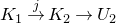 $K_1 \stackrel{j}{\rightarrow} K_2 \rightarrow U_2$
), there is a compact codimension-0 submanifold
$K_1 \stackrel{j}{\rightarrow} K_2 \rightarrow U_2$
), there is a compact codimension-0 submanifold $U_2' \subset U_2$
with simply-connected boundary and a homotopy equivalence
$U_2' \subset U_2$
with simply-connected boundary and a homotopy equivalence $K_1 \rightarrow U_2'$
such that the diagram
$K_1 \rightarrow U_2'$
such that the diagram

commutes up to homotopy. Since j is a homotopy equivalence, the inclusion $U_2' \rightarrow U_2$
is a homotopy equivalence too. The compositions
$U_2' \rightarrow U_2$
is a homotopy equivalence too. The compositions $K_1 \rightarrow U_1 \rightarrow W$
and
$K_1 \rightarrow U_1 \rightarrow W$
and $K_1 \rightarrow U_2' \rightarrow U_2 \rightarrow W$
are homotopic, so Theorem 6.18(b) can be applied to the homotopy equivalences
$K_1 \rightarrow U_2' \rightarrow U_2 \rightarrow W$
are homotopic, so Theorem 6.18(b) can be applied to the homotopy equivalences $K_1 \rightarrow U_1$
and
$K_1 \rightarrow U_1$
and $K_1 \rightarrow U_2'$
. We get that there is a diffeomorphism
$K_1 \rightarrow U_2'$
. We get that there is a diffeomorphism $g : U_1 \rightarrow U_2'$
such that the inclusion
$g : U_1 \rightarrow U_2'$
such that the inclusion $U_1 \rightarrow W$
and the composition
$U_1 \rightarrow W$
and the composition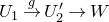 $U_1 \stackrel{g}{\rightarrow} U_2' \rightarrow W$
are isotopic, and the diagram
$U_1 \stackrel{g}{\rightarrow} U_2' \rightarrow W$
are isotopic, and the diagram

commutes up to homotopy. In particular, $U_2'$
is a regular neighbourhood of an embedding
$U_2'$
is a regular neighbourhood of an embedding $K_1 \rightarrow \mathop{\mathrm{int}}\nolimits W$
isotopic to the inclusion
$K_1 \rightarrow \mathop{\mathrm{int}}\nolimits W$
isotopic to the inclusion $K_1 \rightarrow W$
, so
$K_1 \rightarrow W$
, so $\theta_{U_2',F}$
is defined.
$\theta_{U_2',F}$
is defined.
We will show that $\theta_{U_1,F} \cong \theta_{U_2',F}$
and
$\theta_{U_1,F} \cong \theta_{U_2',F}$
and $\theta_{U_2',F} \cong \theta_{U_2,F}$
. We introduce the notation
$\theta_{U_2',F} \cong \theta_{U_2,F}$
. We introduce the notation $(\underline{M}; L, V) = \theta_{U_1,F}$
,
$(\underline{M}; L, V) = \theta_{U_1,F}$
, $(\underline{M}{}'; L', V') = \theta_{U_2',F}$
and
$(\underline{M}{}'; L', V') = \theta_{U_2',F}$
and $(\underline{M}{}''; L'', V'') = \theta_{U_2,F}$
.
$(\underline{M}{}''; L'', V'') = \theta_{U_2,F}$
.
First we consider $\theta_{U_1,F}$
and
$\theta_{U_1,F}$
and $\theta_{U_2',F}$
. It follows from the isotopy extension theorem that there is a diffeomorphism
$\theta_{U_2',F}$
. It follows from the isotopy extension theorem that there is a diffeomorphism $G: W \rightarrow W$
(isotopic to the identity) such that
$G: W \rightarrow W$
(isotopic to the identity) such that $G \big|_{U_1} = g$
(hence,
$G \big|_{U_1} = g$
(hence, $G(U_1)=U_2'$
). Then
$G(U_1)=U_2'$
). Then $H_q(G \big| _{\partial U_1}) = H_q(g \big| _{\partial U_1}) : H_q(\partial U_1) \rightarrow H_q(\partial U_2')$
is an isomorphism between
$H_q(G \big| _{\partial U_1}) = H_q(g \big| _{\partial U_1}) : H_q(\partial U_1) \rightarrow H_q(\partial U_2')$
is an isomorphism between $\underline{M}$
and
$\underline{M}$
and $\underline{M}{}'$
. Moreover, G induces the following commutative diagrams.
$\underline{M}{}'$
. Moreover, G induces the following commutative diagrams.


Hence, $H_q(G \big| _{\partial U_1})$
sends L to L’ and V to V’. Therefore,
$H_q(G \big| _{\partial U_1})$
sends L to L’ and V to V’. Therefore, $(\underline{M}; L, V) \cong (\underline{M}{}'; L', V')$
, via the isomorphism
$(\underline{M}; L, V) \cong (\underline{M}{}'; L', V')$
, via the isomorphism $H_q(g \big| _{\partial U_1})$
.
$H_q(g \big| _{\partial U_1})$
.
Next we consider $\theta_{U_2',F}$
and
$\theta_{U_2',F}$
and $\theta_{U_2,F}$
. Let
$\theta_{U_2,F}$
. Let $C = U_2\setminus \mathop{\mathrm{int}}\nolimits U_2'$
. It follows from the assumptions and the Van Kampen theorem that
$C = U_2\setminus \mathop{\mathrm{int}}\nolimits U_2'$
. It follows from the assumptions and the Van Kampen theorem that $\partial U_2'$
,
$\partial U_2'$
, $\partial U_2$
and C are all simply-connected. Since the inclusion
$\partial U_2$
and C are all simply-connected. Since the inclusion $U_2' \rightarrow U_2$
is a homotopy equivalence,
$U_2' \rightarrow U_2$
is a homotopy equivalence, $H_*(C, \partial U_2') \cong H_*(U_2, U_2') \cong 0$
, so the inclusion
$H_*(C, \partial U_2') \cong H_*(U_2, U_2') \cong 0$
, so the inclusion $\partial U_2' \rightarrow C$
is also a homotopy equivalence. It follows from Poincaré duality that the same is true for the inclusion
$\partial U_2' \rightarrow C$
is also a homotopy equivalence. It follows from Poincaré duality that the same is true for the inclusion $\partial U_2 \rightarrow C$
, so C is an h-cobordism. This (together with excision) implies that the vertical arrows are isomorphisms in the following diagrams, induced by the inclusions.
$\partial U_2 \rightarrow C$
, so C is an h-cobordism. This (together with excision) implies that the vertical arrows are isomorphisms in the following diagrams, induced by the inclusions.


Thus, the composition of the isomorphism $H_q(\partial U_2') \rightarrow H_q(C)$
and the inverse of
$H_q(\partial U_2') \rightarrow H_q(C)$
and the inverse of $H_q(\partial U_2) \rightarrow H_q(C)$
is an isomorphism
$H_q(\partial U_2) \rightarrow H_q(C)$
is an isomorphism $H_q(\partial U_2') \rightarrow H_q(\partial U_2)$
that sends L’ to L” and V’ to V”. Moreover, it is an isomorphism between the extended quadratic forms
$H_q(\partial U_2') \rightarrow H_q(\partial U_2)$
that sends L’ to L” and V’ to V”. Moreover, it is an isomorphism between the extended quadratic forms $\underline{M}{}'$
and
$\underline{M}{}'$
and $\underline{M}{}''$
, because the inclusions induce isomorphisms of cohomology rings
$\underline{M}{}''$
, because the inclusions induce isomorphisms of cohomology rings $H^*(\partial U_2') \cong H^*(C) \cong H^*(\partial U_2)$
, and they commute with the homomorphisms
$H^*(\partial U_2') \cong H^*(C) \cong H^*(\partial U_2)$
, and they commute with the homomorphisms $H_q(F \big| _{\partial U_2'})$
,
$H_q(F \big| _{\partial U_2'})$
, $H_q(F \big| _C)$
and
$H_q(F \big| _C)$
and $H_q(F \big| _{\partial U_2})$
. Therefore,
$H_q(F \big| _{\partial U_2})$
. Therefore, $(\underline{M}{}'; L', V') \cong (\underline{M}{}''; L'', V'')$
.
$(\underline{M}{}'; L', V') \cong (\underline{M}{}''; L'', V'')$
.
We take I to be the composition of the above isomorphisms $H_q(\partial U_1) \rightarrow H_q(\partial U_2') \rightarrow H_q(\partial U_2)$
. To complete the proof, we verify the commutativity of the following diagram.
$H_q(\partial U_1) \rightarrow H_q(\partial U_2') \rightarrow H_q(\partial U_2)$
. To complete the proof, we verify the commutativity of the following diagram.

The squares on the left are obtained by applying $H_q$
to the earlier homotopy commutative diagrams. The top right square is induced by g and the inclusions. Finally, the bottom right square commutes because both compositions are equal to the composition
$H_q$
to the earlier homotopy commutative diagrams. The top right square is induced by g and the inclusions. Finally, the bottom right square commutes because both compositions are equal to the composition $H_q(\partial U_2') \rightarrow H_q(C) \rightarrow H_q(U_2)$
induced by the inclusions.
$H_q(\partial U_2') \rightarrow H_q(C) \rightarrow H_q(U_2)$
induced by the inclusions.
Remark 6.17. The proof can be simplified by taking $U_2' = U_2$
if either
$U_2' = U_2$
if either $q \gt 2$
or
$q \gt 2$
or $c_1=c_2$
. In the former case
$c_1=c_2$
. In the former case $C \approx \partial U_2' \times I$
by the h-cobordism theorem, while in the latter case Theorem 6.18(b) can be applied to the homotopy equivalences
$C \approx \partial U_2' \times I$
by the h-cobordism theorem, while in the latter case Theorem 6.18(b) can be applied to the homotopy equivalences $K_1 \rightarrow U_1$
and
$K_1 \rightarrow U_1$
and $K_1 = K_2 \rightarrow U_2$
.
$K_1 = K_2 \rightarrow U_2$
.
We used the following theorem.
Theorem 6.18 (Wall [Reference WallWal66] and Hudson [Reference HudsonHud70]).
-
(a) Suppose that K is a simply-connected finite CW complex of dimension k, and M is a simply-connected d-manifold for some
$d \geqslant \max(2k+1,k+3)$
. Let
$f : K\rightarrow M$
be a continuous map. Then there is a compact codimension-0 submanifold
$N \subset M$
with simply-connected boundary and a homotopy equivalence
$h : K \rightarrow N$
such that the composition
$K \stackrel{h}{\rightarrow} N \rightarrow M$
is homotopic to f. Moreover, N has a handlebody decomposition that corresponds to the cell decomposition of K in the sense of [Reference WallWal66] (in particular, every handle has index at most k).
-
(b) If
$h : K \rightarrow N$
and
$h' : K \rightarrow N'$
are two homotopy equivalences as above, then there is a diffeomorphism
$g : N \rightarrow N'$
such that
$g \circ h \simeq h' : K \rightarrow N'$
and
$N \stackrel{g}{\rightarrow} N' \rightarrow M$
is isotopic to the embedding
$N \rightarrow M$
.


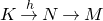




Proof. Part (a) is a special case of Wall’s embedding theorem [Reference WallWal66]. Part (b) follows from the uniqueness part of the embedding theorem combined with results of Hudson [Reference HudsonHud70, Theorem 2.1 and Addendum 2.1.2].
A stabilisation of the standard CW decomposition of $D^3$
(consisting of one 0-cell, one 2-cell and one 3-cell) adds a 1-cell and a 2-cell, and modifies the 3-cell.
$D^3$
(consisting of one 0-cell, one 2-cell and one 3-cell) adds a 1-cell and a 2-cell, and modifies the 3-cell.

6.3 The definition of
$\theta_{W,F}$

We will now consider W without a fixed CW decomposition c.
Definition 6.19. Let $\theta_{W,F} \in \mathscr{s}^T_{2q+1}(B,\xi)$
be the stable isomorphism class of
$\theta_{W,F} \in \mathscr{s}^T_{2q+1}(B,\xi)$
be the stable isomorphism class of $\theta_{c,F}$
for any CW decomposition c of W.
$\theta_{c,F}$
for any CW decomposition c of W.
Theorem 6.20. The stable isomorphism class $\theta_{W,F}$
is well-defined.
$\theta_{W,F}$
is well-defined.
Proof. Let $c_1$
and
$c_1$
and $c_2$
be arbitrary CW decompositions of W. Then they have stabilisations (see Definition 6.21)
$c_2$
be arbitrary CW decompositions of W. Then they have stabilisations (see Definition 6.21) $c_1'$
and
$c_1'$
and $c_2'$
that satisfy the conditions of Lemma 6.23. By Lemmas 6.22 and 6.16 we have
$c_2'$
that satisfy the conditions of Lemma 6.23. By Lemmas 6.22 and 6.16 we have $\theta_{c_1,F} \mathrel{\underset{^{\scriptstyle{s}}}{\cong}} \theta_{c_1',F} \cong \theta_{c_2',F} \mathrel{\underset{^{\scriptstyle{s}}}{\cong}} \theta_{c_2,F}$
. Therefore, the stable isomorphism class of
$\theta_{c_1,F} \mathrel{\underset{^{\scriptstyle{s}}}{\cong}} \theta_{c_1',F} \cong \theta_{c_2',F} \mathrel{\underset{^{\scriptstyle{s}}}{\cong}} \theta_{c_2,F}$
. Therefore, the stable isomorphism class of $\theta_{c,F}$
is independent of the choice of c.
$\theta_{c,F}$
is independent of the choice of c.
Definition 6.21. We define stabilisation, an operation on CW decompositions of W, as follows. Let c be a CW decomposition of W. Let x be a 0-cell. Since W is a $(2q+1)$
-manifold, x is in the boundary of some
$(2q+1)$
-manifold, x is in the boundary of some $(2q+1)$
-cell
$(2q+1)$
-cell $e^{2q+1}$
. Consider
$e^{2q+1}$
. Consider $D^{q+1}$
with its decomposition into three cells (of dimensions 0, q and
$D^{q+1}$
with its decomposition into three cells (of dimensions 0, q and $q+1$
), and an embedding of
$q+1$
), and an embedding of $D^{q+1}$
into
$D^{q+1}$
into $x \cup\mathop{\mathrm{int}}\nolimits e^{2q+1}$
such that the 0-cell goes to x. The new CW decomposition c’ is constructed from c by adding the q-cell and
$x \cup\mathop{\mathrm{int}}\nolimits e^{2q+1}$
such that the 0-cell goes to x. The new CW decomposition c’ is constructed from c by adding the q-cell and $(q+1)$
-cell of the embedded
$(q+1)$
-cell of the embedded $D^{q+1}$
and modifying the gluing map of the
$D^{q+1}$
and modifying the gluing map of the $(2q+1)$
-cell
$(2q+1)$
-cell $e^{2q+1}$
(see Figure 1). Note that the stabilisation operation is not unique.
$e^{2q+1}$
(see Figure 1). Note that the stabilisation operation is not unique.
We say that c’ is a (k-fold) stabilisation of c if it can be obtained from c by a sequence of (k) stabilisation steps.
The following three lemmas are needed for the proof of Theorem 6.20.
Lemma 6.22. Let c and c’ be CW decompositions of W. If c’ is a k-fold stabilisation of c, then $\theta_{c',F} \cong \theta_{c,F} \oplus \mathcal{H}_{2k}$
. In particular,
$\theta_{c',F} \cong \theta_{c,F} \oplus \mathcal{H}_{2k}$
. In particular, $\theta_{c',F} \mathrel{\underset{^{\scriptstyle{s}}}{\cong}} \theta_{c,F}$
for any stabilisation c’ of c.
$\theta_{c',F} \mathrel{\underset{^{\scriptstyle{s}}}{\cong}} \theta_{c,F}$
for any stabilisation c’ of c.
Proof. It is enough to prove this when c’ is obtained from c by a single stabilisation step.
Let K and K’ denote the q-skeletons of W with respect to c and c’; then $K' = K \vee S^q$
. Let U and U’ be regular neighbourhoods of K and K’; we can choose these such that
$K' = K \vee S^q$
. Let U and U’ be regular neighbourhoods of K and K’; we can choose these such that $U' \approx U \natural (S^q \times D^{q+1})$
. Let
$U' \approx U \natural (S^q \times D^{q+1})$
. Let $(\underline{M}; L, V) = \theta_{U,F}$
and
$(\underline{M}; L, V) = \theta_{U,F}$
and $(\underline{M}{}'; L', V') = \theta_{U',F}$
.
$(\underline{M}{}'; L', V') = \theta_{U',F}$
.
Since $\partial U' \approx U \# (S^q \times S^q)$
, we have
$\partial U' \approx U \# (S^q \times S^q)$
, we have $H_q(\partial U') \cong H_q(\partial U) \oplus \mathbb{Z}^2$
and
$H_q(\partial U') \cong H_q(\partial U) \oplus \mathbb{Z}^2$
and $\underline{M}{}' \cong \underline{M} \oplus \underline{H}_2$
. We will use these canonical isomorphisms to identify these groups and extended quadratic forms. The inclusion
$\underline{M}{}' \cong \underline{M} \oplus \underline{H}_2$
. We will use these canonical isomorphisms to identify these groups and extended quadratic forms. The inclusion $H_q(\partial U) \rightarrow H_q(\partial U')$
under this identification is in fact the composition
$H_q(\partial U) \rightarrow H_q(\partial U')$
under this identification is in fact the composition $H_q(\partial U) \cong H_q(\partial U \setminus \mathop{\mathrm{int}}\nolimits D^{2q}) \rightarrow H_q(\partial U')$
, where the homomorphism
$H_q(\partial U) \cong H_q(\partial U \setminus \mathop{\mathrm{int}}\nolimits D^{2q}) \rightarrow H_q(\partial U')$
, where the homomorphism $H_q(\partial U \setminus \mathop{\mathrm{int}}\nolimits D^{2q}) \rightarrow H_q(\partial U')$
is induced by the inclusion of spaces. Thus, the inclusion
$H_q(\partial U \setminus \mathop{\mathrm{int}}\nolimits D^{2q}) \rightarrow H_q(\partial U')$
is induced by the inclusion of spaces. Thus, the inclusion $U \rightarrow U'$
induces commutative diagrams
$U \rightarrow U'$
induces commutative diagrams


and hence $L \leqslant L'$
and
$L \leqslant L'$
and $V \leqslant V'$
.
$V \leqslant V'$
.
If we fix some basepoint $x \in S^q$
, the submanifold
$x \in S^q$
, the submanifold $\{ x \} \times D^{q+1} \subset S^q \times D^{q+1} \subseteq U'$
represents an element of
$\{ x \} \times D^{q+1} \subset S^q \times D^{q+1} \subseteq U'$
represents an element of $H_{q+1}(U', \partial U')$
, and its boundary is represented by the submanifold
$H_{q+1}(U', \partial U')$
, and its boundary is represented by the submanifold $\{ x \} \times S^q \subset S^q \times S^q \subseteq \partial U'$
. This shows that
$\{ x \} \times S^q \subset S^q \times S^q \subseteq \partial U'$
. This shows that $(0,(0,1)) \in L' \leqslant H_q(\partial U') \cong H_q(\partial U) \oplus \mathbb{Z}^2$
, therefore
$(0,(0,1)) \in L' \leqslant H_q(\partial U') \cong H_q(\partial U) \oplus \mathbb{Z}^2$
, therefore $L \oplus (\{ 0 \} \times \mathbb{Z}) \leqslant L'$
. Since L’ and
$L \oplus (\{ 0 \} \times \mathbb{Z}) \leqslant L'$
. Since L’ and $L \oplus (\{ 0 \} \times \mathbb{Z})$
are both T-Lagrangians in
$L \oplus (\{ 0 \} \times \mathbb{Z})$
are both T-Lagrangians in $\underline{M}{}'$
, we get that
$\underline{M}{}'$
, we get that $L \oplus (\{ 0 \} \times \mathbb{Z})$
is a direct summand in L’, and they have the same torsion subgroup and the same rank, and this implies that
$L \oplus (\{ 0 \} \times \mathbb{Z})$
is a direct summand in L’, and they have the same torsion subgroup and the same rank, and this implies that $L' = L \oplus (\{ 0 \} \times \mathbb{Z})$
.
$L' = L \oplus (\{ 0 \} \times \mathbb{Z})$
.
Similarly, the embedded $D^{q+1}$
that we used to construct the stabilisation c’ from c represents an element of
$D^{q+1}$
that we used to construct the stabilisation c’ from c represents an element of $H_{q+1}(W, U' \sqcup M_0) \cong H_{q+1}(W \setminus \mathop{\mathrm{int}}\nolimits U', \partial U' \sqcup M_0)$
, and its boundary is represented by
$H_{q+1}(W, U' \sqcup M_0) \cong H_{q+1}(W \setminus \mathop{\mathrm{int}}\nolimits U', \partial U' \sqcup M_0)$
, and its boundary is represented by $S^q \times \{ x \} \subset S^q \times S^q \subseteq \partial U'$
, therefore
$S^q \times \{ x \} \subset S^q \times S^q \subseteq \partial U'$
, therefore $V \oplus (\mathbb{Z} \times \{ 0 \}) \leqslant V'$
. Since V’ and
$V \oplus (\mathbb{Z} \times \{ 0 \}) \leqslant V'$
. Since V’ and $V \oplus (\mathbb{Z} \times \{ 0 \})$
are both free half-rank direct summands in
$V \oplus (\mathbb{Z} \times \{ 0 \})$
are both free half-rank direct summands in $\underline{M}{}'$
, this implies that
$\underline{M}{}'$
, this implies that $V' = V \oplus (\mathbb{Z} \times \{ 0 \})$
.
$V' = V \oplus (\mathbb{Z} \times \{ 0 \})$
.
Therefore, $(\underline{M}{}'; L', V') \cong (\underline{M} \oplus\underline{H}_2; L \oplus (\{ 0 \} \times \mathbb{Z}), V \oplus(\mathbb{Z} \times \{ 0 \})) = (\underline{M}; L, V) \oplus\mathcal{H}_2$
. Since
$(\underline{M}{}'; L', V') \cong (\underline{M} \oplus\underline{H}_2; L \oplus (\{ 0 \} \times \mathbb{Z}), V \oplus(\mathbb{Z} \times \{ 0 \})) = (\underline{M}; L, V) \oplus\mathcal{H}_2$
. Since $\theta_{c,F}$
and
$\theta_{c,F}$
and $\theta_{c',F}$
are the isomorphism classes of
$\theta_{c',F}$
are the isomorphism classes of $\theta_{U,F}$
and
$\theta_{U,F}$
and $\theta_{U',F}$
respectively, this means that
$\theta_{U',F}$
respectively, this means that $\theta_{c',F} \cong \theta_{c,F} \oplus \mathcal{H}_2$
.
$\theta_{c',F} \cong \theta_{c,F} \oplus \mathcal{H}_2$
.
Lemma 6.23.
Let $c_1$
and
$c_1$
and $c_2$
be any CW decompositions of W. Then there is a stabilisation
$c_2$
be any CW decompositions of W. Then there is a stabilisation $c_i'$
of
$c_i'$
of $c_i$
(
$c_i$
( $i=1,2$
) such that if
$i=1,2$
) such that if $K_i' \subset W$
denotes the q-skeleton of W with respect to
$K_i' \subset W$
denotes the q-skeleton of W with respect to $c_i'$
, then there is a homotopy equivalence
$c_i'$
, then there is a homotopy equivalence $j : K_1' \rightarrow K_2'$
such that the diagram
$j : K_1' \rightarrow K_2'$
such that the diagram

commutes up to homotopy.
Proof. Let $K_i$
denote the q-skeleton of W with respect to
$K_i$
denote the q-skeleton of W with respect to $c_i$
and let
$c_i$
and let $g_i : K_i \rightarrow W$
denote the inclusion. Then the homomorphisms
$g_i : K_i \rightarrow W$
denote the inclusion. Then the homomorphisms $H_q(g_i) : H_q(K_i) \rightarrow H_q(W)$
are surjective, so by Lemma 2.26(a) there are free abelian groups
$H_q(g_i) : H_q(K_i) \rightarrow H_q(W)$
are surjective, so by Lemma 2.26(a) there are free abelian groups $A_i$
and an isomorphism
$A_i$
and an isomorphism $J : H_q(K_1) \oplus A_1 \rightarrow H_q(K_2) \oplus A_2$
such that
$J : H_q(K_1) \oplus A_1 \rightarrow H_q(K_2) \oplus A_2$
such that $(H_q(g_1)+0) = (H_q(g_2)+0) \circ J : H_q(K_1) \oplus A_1 \rightarrow H_q(W)$
.
$(H_q(g_1)+0) = (H_q(g_2)+0) \circ J : H_q(K_1) \oplus A_1 \rightarrow H_q(W)$
.
Let $k_i = \mathop{\mathrm{rk}}\nolimits A_i$
and let
$k_i = \mathop{\mathrm{rk}}\nolimits A_i$
and let $c_i'$
be a
$c_i'$
be a $k_i$
-fold stabilisation of
$k_i$
-fold stabilisation of $c_i$
. Then
$c_i$
. Then $K_i' \approx K_i \vee \bigvee^{k_i} S^q$
, so
$K_i' \approx K_i \vee \bigvee^{k_i} S^q$
, so $H_q(K_i') \cong H_q(K_i) \oplus A_i$
, and J can be regarded as an isomorphism
$H_q(K_i') \cong H_q(K_i) \oplus A_i$
, and J can be regarded as an isomorphism $J : H_q(K_1') \rightarrow H_q(K_2')$
such that
$J : H_q(K_1') \rightarrow H_q(K_2')$
such that $H_q(g_1') = H_q(g_2') \circ J : H_q(K_1') \rightarrow H_q(W)$
, where
$H_q(g_1') = H_q(g_2') \circ J : H_q(K_1') \rightarrow H_q(W)$
, where $g_i' : K_i' \rightarrow W$
is the inclusion.
$g_i' : K_i' \rightarrow W$
is the inclusion.
By Lemma 6.24 there is a map $j : K_1' \rightarrow K_2'$
such that
$j : K_1' \rightarrow K_2'$
such that $g_1' \simeq g_2' \circ j : K_1' \rightarrow W$
and
$g_1' \simeq g_2' \circ j : K_1' \rightarrow W$
and $H_q(j) = J$
. Since
$H_q(j) = J$
. Since $H_h(g_1') = H_h(g_2') \circ H_h(j)$
and
$H_h(g_1') = H_h(g_2') \circ H_h(j)$
and $H_h(g_1')$
and
$H_h(g_1')$
and $H_h(g_2')$
are isomorphisms if
$H_h(g_2')$
are isomorphisms if $h \leqslant q-1$
, the same is true for
$h \leqslant q-1$
, the same is true for $H_h(j)$
. As
$H_h(j)$
. As $H_q(j) = J$
is also an isomorphism, and
$H_q(j) = J$
is also an isomorphism, and $K_1'$
and
$K_1'$
and $K_2'$
are simply-connected and q-dimensional, j is a homotopy equivalence.
$K_2'$
are simply-connected and q-dimensional, j is a homotopy equivalence.
Lemma 6.24. Let X be a simply-connected topological space and R and S be CW complexes with maps $f : R \rightarrow X$
and
$f : R \rightarrow X$
and $g : S \rightarrow X$
. Assume that R is q-dimensional, g is q-connected and
$g : S \rightarrow X$
. Assume that R is q-dimensional, g is q-connected and $J : H_q(R) \rightarrow H_q(S)$
is a homomorphism such that
$J : H_q(R) \rightarrow H_q(S)$
is a homomorphism such that $H_q(g) \circ J = H_q(f)$
. Then there is a map
$H_q(g) \circ J = H_q(f)$
. Then there is a map $j : R \rightarrow S$
such that
$j : R \rightarrow S$
such that $g \circ j \simeq f$
and
$g \circ j \simeq f$
and $H_q(j) = J$
.
$H_q(j) = J$
.
Proof. The map $f : R \rightarrow X$
has a lift
$f : R \rightarrow X$
has a lift $\tilde{f} : R \rightarrow S$
such that
$\tilde{f} : R \rightarrow S$
such that $g \circ \tilde{f} \simeq f$
, because the obstructions to the existence of such a lift are in the groups
$g \circ \tilde{f} \simeq f$
, because the obstructions to the existence of such a lift are in the groups $H^i(R;\pi_{i-1}(\mathop{\mathrm{hofib}}\nolimits(g)))$
, which are trivial, because g is q-connected and R is q-dimensional. Let
$H^i(R;\pi_{i-1}(\mathop{\mathrm{hofib}}\nolimits(g)))$
, which are trivial, because g is q-connected and R is q-dimensional. Let $J_0 = J - H_q(\tilde{f}) : H_q(R) \rightarrow H_q(S)$
.
$J_0 = J - H_q(\tilde{f}) : H_q(R) \rightarrow H_q(S)$
.
The pair (X, S) is q-connected (where S is regarded as a subspace of X via g), so $\pi_{q+1}(X, S) \cong H_{q+1}(X, S)$
. The Hurewicz homomorphisms induce the following commutative diagram.
$\pi_{q+1}(X, S) \cong H_{q+1}(X, S)$
. The Hurewicz homomorphisms induce the following commutative diagram.

We have that $H_q(g) \circ J_0 = H_q(g) \circ (J - H_q(\tilde{f})) = H_q(g) \circ J - H_q(g) \circ H_q(\tilde{f}) = H_q(f) - H_q(f) = 0$
and
$H_q(g) \circ J_0 = H_q(g) \circ (J - H_q(\tilde{f})) = H_q(g) \circ J - H_q(g) \circ H_q(\tilde{f}) = H_q(f) - H_q(f) = 0$
and $H_q(R)$
is free, so
$H_q(R)$
is free, so $J_0$
can be lifted to a homomorphism
$J_0$
can be lifted to a homomorphism $H_q(R) \rightarrow H_{q+1}(X, S)$
. By composing this homomorphism with the inverse of the isomorphism
$H_q(R) \rightarrow H_{q+1}(X, S)$
. By composing this homomorphism with the inverse of the isomorphism $\pi_{q+1}(X, S) \rightarrow H_{q+1}(X, S)$
and the boundary map, we get a homomorphism
$\pi_{q+1}(X, S) \rightarrow H_{q+1}(X, S)$
and the boundary map, we get a homomorphism $\hat{J}_0 : H_q(R) \rightarrow \pi_q(S)$
such that
$\hat{J}_0 : H_q(R) \rightarrow \pi_q(S)$
such that $h \circ \hat{J}_0 = J_0$
. Moreover, it follows from the construction of
$h \circ \hat{J}_0 = J_0$
. Moreover, it follows from the construction of $\hat{J}_0$
that
$\hat{J}_0$
that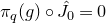 $\pi_q(g) \circ \hat{J}_0 = 0$
, that is
$\pi_q(g) \circ \hat{J}_0 = 0$
, that is $\mathop{\mathrm{Im}}\nolimits(\hat{J}_0) \leqslant \mathop{\mathrm{Ker}}\nolimits(\pi_q(g))$
.
$\mathop{\mathrm{Im}}\nolimits(\hat{J}_0) \leqslant \mathop{\mathrm{Ker}}\nolimits(\pi_q(g))$
.
Let $(C_*(R), \partial_*)$
be the cellular chain complex of R. Since
$(C_*(R), \partial_*)$
be the cellular chain complex of R. Since $\mathop{\mathrm{Im}}\nolimits(\partial_q) \cong C_q(R) / \mathop{\mathrm{Ker}}\nolimits(\partial_q)$
is a subgroup of
$\mathop{\mathrm{Im}}\nolimits(\partial_q) \cong C_q(R) / \mathop{\mathrm{Ker}}\nolimits(\partial_q)$
is a subgroup of $C_{q-1}(R)$
, it is free, hence
$C_{q-1}(R)$
, it is free, hence $H_q(R) = \mathop{\mathrm{Ker}}\nolimits(\partial_q)$
is a direct summand in
$H_q(R) = \mathop{\mathrm{Ker}}\nolimits(\partial_q)$
is a direct summand in $C_q(R)$
. Therefore,
$C_q(R)$
. Therefore, $\hat{J}_0 : H_q(R) \rightarrow \mathop{\mathrm{Ker}}\nolimits(\pi_q(g))$
can be extended (arbitrarily) to a homomorphism
$\hat{J}_0 : H_q(R) \rightarrow \mathop{\mathrm{Ker}}\nolimits(\pi_q(g))$
can be extended (arbitrarily) to a homomorphism $\bar{J}_0 : C_q(R) \rightarrow \mathop{\mathrm{Ker}}\nolimits(\pi_q(g)) \leqslant \pi_q(S)$
.
$\bar{J}_0 : C_q(R) \rightarrow \mathop{\mathrm{Ker}}\nolimits(\pi_q(g)) \leqslant \pi_q(S)$
.
Given a q-cell $e^q$
of R and an element
$e^q$
of R and an element $[a] \in \pi_q(S)$
, we can modify the map
$[a] \in \pi_q(S)$
, we can modify the map $\tilde{f}$
by adding [a] to
$\tilde{f}$
by adding [a] to $\tilde{f} \big| _{e^q}$
, that is, by replacing
$\tilde{f} \big| _{e^q}$
, that is, by replacing $\tilde{f} \big| _{e^q}$
with the composition
$\tilde{f} \big| _{e^q}$
with the composition $e^q \rightarrow e^q \vee S^q \stackrel{\tilde{f} \vee a}{\longrightarrow} S$
. This operation changes the homomorphism
$e^q \rightarrow e^q \vee S^q \stackrel{\tilde{f} \vee a}{\longrightarrow} S$
. This operation changes the homomorphism $H_q(\tilde{f}) : H_q(R, \mathop{\mathrm{sk}}\nolimits_{q-1} R) \rightarrow H_q(S, \mathop{\mathrm{sk}}\nolimits_{q-1} S)$
by adding the image of
$H_q(\tilde{f}) : H_q(R, \mathop{\mathrm{sk}}\nolimits_{q-1} R) \rightarrow H_q(S, \mathop{\mathrm{sk}}\nolimits_{q-1} S)$
by adding the image of $h([a]) \in H_q(S)$
in
$h([a]) \in H_q(S)$
in $H_q(S, \mathop{\mathrm{sk}}\nolimits_{q-1} S)$
to the image of the generator
$H_q(S, \mathop{\mathrm{sk}}\nolimits_{q-1} S)$
to the image of the generator $[e^q] \in H_q(R, \mathop{\mathrm{sk}}\nolimits_{q-1} R) \cong C_q(R)$
. Moreover, if
$[e^q] \in H_q(R, \mathop{\mathrm{sk}}\nolimits_{q-1} R) \cong C_q(R)$
. Moreover, if $[a] \in \mathop{\mathrm{Ker}}\nolimits(\pi_q(g))$
, then the homotopy class of
$[a] \in \mathop{\mathrm{Ker}}\nolimits(\pi_q(g))$
, then the homotopy class of $g \circ \tilde{f}$
does not change, because
$g \circ \tilde{f}$
does not change, because $g \circ a$
is nullhomotopic, so the composition
$g \circ a$
is nullhomotopic, so the composition $e^q \rightarrow e^q \vee S^q \stackrel{\tilde{f} \vee a}{\longrightarrow} S \stackrel{g}{\rightarrow} X$
is homotopic to
$e^q \rightarrow e^q \vee S^q \stackrel{\tilde{f} \vee a}{\longrightarrow} S \stackrel{g}{\rightarrow} X$
is homotopic to $g \circ \tilde{f} \big| _{e^q}$
(rel boundary).
$g \circ \tilde{f} \big| _{e^q}$
(rel boundary).
Let $j : R \rightarrow S$
be the map obtained from
$j : R \rightarrow S$
be the map obtained from $\tilde{f}$
by adding
$\tilde{f}$
by adding $\bar{J}_0([e^q_i]) \in \pi_q(S)$
to
$\bar{J}_0([e^q_i]) \in \pi_q(S)$
to $\tilde{f} \big| _{e^q_i}$
for every q-cell
$\tilde{f} \big| _{e^q_i}$
for every q-cell $e^q_i$
of R. This changes
$e^q_i$
of R. This changes $H_q(\tilde{f}) : H_q(R, \mathop{\mathrm{sk}}\nolimits_{q-1} R) \cong C_q(R) \rightarrow H_q(S, \mathop{\mathrm{sk}}\nolimits_{q-1} S)$
by adding the composition
$H_q(\tilde{f}) : H_q(R, \mathop{\mathrm{sk}}\nolimits_{q-1} R) \cong C_q(R) \rightarrow H_q(S, \mathop{\mathrm{sk}}\nolimits_{q-1} S)$
by adding the composition $C_q(R) \stackrel{\bar{J}_0}{\rightarrow} \pi_q(S) \stackrel{h}{\rightarrow} H_q(S) \rightarrow H_q(S, \mathop{\mathrm{sk}}\nolimits_{q-1} S)$
. Therefore,
$C_q(R) \stackrel{\bar{J}_0}{\rightarrow} \pi_q(S) \stackrel{h}{\rightarrow} H_q(S) \rightarrow H_q(S, \mathop{\mathrm{sk}}\nolimits_{q-1} S)$
. Therefore, $H_q(j) = H_q(\tilde{f}) + h \circ \bar{J}_0 \big| _{H_q(R)} : H_q(R) \rightarrow H_q(S)$
. Hence,
$H_q(j) = H_q(\tilde{f}) + h \circ \bar{J}_0 \big| _{H_q(R)} : H_q(R) \rightarrow H_q(S)$
. Hence,
 \[H_q(j) = H_q(\tilde{f}) + h \circ \bar{J}_0 \big| _{H_q(R)} = H_q(\tilde{f}) + h \circ \hat{J}_0 = H_q(\tilde{f}) + J_0 = H_q(\tilde{f}) + J - H_q(\tilde{f}) = J . \]
Moreover, since $\mathop{\mathrm{Im}}\nolimits(\bar{J}_0) \leqslant \mathop{\mathrm{Ker}}\nolimits(\pi_q(g))$
, we have
$\mathop{\mathrm{Im}}\nolimits(\bar{J}_0) \leqslant \mathop{\mathrm{Ker}}\nolimits(\pi_q(g))$
, we have $g \circ j \simeq g \circ \tilde{f} \simeq f$
, therefore j satisfies both conditions.
$g \circ j \simeq g \circ \tilde{f} \simeq f$
, therefore j satisfies both conditions.
We end this subsection with a consequence of the above results, which we will use later. Namely, any sufficiently stabilised isomorphism class in the stable isomorphism class $\theta_{W,F}$
can be realised as
$\theta_{W,F}$
can be realised as $\theta_{c,F}$
for some CW decomposition c of W,
$\theta_{c,F}$
for some CW decomposition c of W,
Proposition 6.25.
If $\theta_{W,F} \mathrel{\underset{^{\scriptstyle{s}}}{\cong}} x$
for some
$\theta_{W,F} \mathrel{\underset{^{\scriptstyle{s}}}{\cong}} x$
for some $x \in \mathscr{g}^T_{2q+1}(B,\xi)$
, then there is a CW decomposition c of W and an integer
$x \in \mathscr{g}^T_{2q+1}(B,\xi)$
, then there is a CW decomposition c of W and an integer $k \geqslant 0$
such that
$k \geqslant 0$
such that $\theta_{c,F} \cong x \oplus \mathcal{H}_{2k}$
.
$\theta_{c,F} \cong x \oplus \mathcal{H}_{2k}$
.
Proof. Let $c_0$
be an arbitrary CW decomposition of W. Then
$c_0$
be an arbitrary CW decomposition of W. Then $\theta_{W,F}$
is the stable isomorphism class of
$\theta_{W,F}$
is the stable isomorphism class of $\theta_{c_0,F}$
, so
$\theta_{c_0,F}$
, so $\theta_{W,F} \mathrel{\underset{^{\scriptstyle{s}}}{\cong}} x$
means that there are integers
$\theta_{W,F} \mathrel{\underset{^{\scriptstyle{s}}}{\cong}} x$
means that there are integers $k,l \geqslant 0$
such that
$k,l \geqslant 0$
such that $x \oplus \mathcal{H}_{2k} \cong \theta_{c_0,F} \oplus \mathcal{H}_{2l}$
. Let c be an l-fold stabilisation of
$x \oplus \mathcal{H}_{2k} \cong \theta_{c_0,F} \oplus \mathcal{H}_{2l}$
. Let c be an l-fold stabilisation of $c_0$
. Then by Lemma 6.22
$c_0$
. Then by Lemma 6.22 $\theta_{c,F} \cong \theta_{c_0,F} \oplus \mathcal{H}_{2l} \cong x \oplus \mathcal{H}_{2k}$
.
$\theta_{c,F} \cong \theta_{c_0,F} \oplus \mathcal{H}_{2l} \cong x \oplus \mathcal{H}_{2k}$
.
6.4. The invariance of
$[\theta_{W,F}]$

We now consider the equivalence class $[\theta_{W,F}] \in \ell^T_{2q+1}(B,\xi)$
of
$[\theta_{W,F}] \in \ell^T_{2q+1}(B,\xi)$
of $\theta_{W,F}$
and show that it is a normal bordism invariant.
$\theta_{W,F}$
and show that it is a normal bordism invariant.
Theorem 6.26.
Suppose that $F' : W' \rightarrow B$
is another q-connected normal bordism between
$F' : W' \rightarrow B$
is another q-connected normal bordism between $f_0$
and
$f_0$
and $f_1$
over
$f_1$
over $(B,\xi)$
. If F’ is normally bordant to F (rel boundary), then
$(B,\xi)$
. If F’ is normally bordant to F (rel boundary), then $[\theta_{W,F}] = [\theta_{W',F'}] \in \ell^T_{2q+1}(B,\xi)$
.
$[\theta_{W,F}] = [\theta_{W',F'}] \in \ell^T_{2q+1}(B,\xi)$
.
Proof. Let $G : X \rightarrow B$
be a normal bordism between F and F’. By applying surgery below the middle dimension (see, for example, [Reference KreckKre99, Proposition 4]), we can assume that G is
$G : X \rightarrow B$
be a normal bordism between F and F’. By applying surgery below the middle dimension (see, for example, [Reference KreckKre99, Proposition 4]), we can assume that G is $(q+1)$
-connected. Since the compositions
$(q+1)$
-connected. Since the compositions $W \rightarrow X \rightarrow B$
and
$W \rightarrow X \rightarrow B$
and $W' \rightarrow X \rightarrow B$
are q-connected, this implies that the inclusions
$W' \rightarrow X \rightarrow B$
are q-connected, this implies that the inclusions $W \rightarrow X$
and
$W \rightarrow X$
and $W' \rightarrow X$
are q-connected too. Then there is a Morse function on the triad (X, W, W’) having only critical points of index
$W' \rightarrow X$
are q-connected too. Then there is a Morse function on the triad (X, W, W’) having only critical points of index $q+1$
(see [Reference MilnorMil65, Theorem 8.1 and the proof of Theorem 7.8]). This means that W’ can be obtained from W by a sequence of q-surgeries over
$q+1$
(see [Reference MilnorMil65, Theorem 8.1 and the proof of Theorem 7.8]). This means that W’ can be obtained from W by a sequence of q-surgeries over $(B,\xi)$
(with trace X), so it is enough to prove the statement when W’ is obtained by a single q-surgery.
$(B,\xi)$
(with trace X), so it is enough to prove the statement when W’ is obtained by a single q-surgery.
Fix an embedding $S^q \times D^{q+1} \rightarrow W$
where the surgery is done, and let
$S^q \times D^{q+1} \rightarrow W$
where the surgery is done, and let $W_0 = W \setminus \mathop{\mathrm{int}}\nolimits(S^q \times D^{q+1})$
. Then
$W_0 = W \setminus \mathop{\mathrm{int}}\nolimits(S^q \times D^{q+1})$
. Then $W' = W_0 \cup_{S^q \times S^q} D^{q+1} \times S^q$
. Take the standard CW decomposition of
$W' = W_0 \cup_{S^q \times S^q} D^{q+1} \times S^q$
. Take the standard CW decomposition of $S^q \times S^q$
into four cells (coming from the product structure) and extend it to a CW decomposition
$S^q \times S^q$
into four cells (coming from the product structure) and extend it to a CW decomposition $c_0$
of
$c_0$
of $W_0$
. Define the equivalence relation
$W_0$
. Define the equivalence relation $\underset{W}{\sim}$
on
$\underset{W}{\sim}$
on $S^q \times S^q$
by
$S^q \times S^q$
by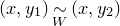 $(x,y_1) \underset{W}{\sim} (x,y_2)$
for any
$(x,y_1) \underset{W}{\sim} (x,y_2)$
for any $x,y_1,y_2 \in S^q$
. Then
$x,y_1,y_2 \in S^q$
. Then ${W_0} / {\underset{W}{\sim}}$
is diffeomorphic to W (because a neighbourhood of
${W_0} / {\underset{W}{\sim}}$
is diffeomorphic to W (because a neighbourhood of $S^q \times D^{q+1}$
in W can be identified with
$S^q \times D^{q+1}$
in W can be identified with $S^q \times \mathbb{R}^{q+1}$
, and
$S^q \times \mathbb{R}^{q+1}$
, and $(\mathbb{R}^{q+1} \setminus \mathop{\mathrm{int}}\nolimits D^{q+1}) / S^q \approx \mathbb{R}^{q+1}$
). Moreover,
$(\mathbb{R}^{q+1} \setminus \mathop{\mathrm{int}}\nolimits D^{q+1}) / S^q \approx \mathbb{R}^{q+1}$
). Moreover, $c_0$
induces a CW decomposition c on
$c_0$
induces a CW decomposition c on ${W_0} / {\underset{W}{\sim}} \approx W$
, namely we have the standard decomposition of
${W_0} / {\underset{W}{\sim}} \approx W$
, namely we have the standard decomposition of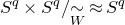 ${S^q \times S^q} / {\underset{W}{\sim}} \approx S^q$
into two cells, and all other cells remain the same, with adjusted gluing maps. If we fix these CW decompositions, then
${S^q \times S^q} / {\underset{W}{\sim}} \approx S^q$
into two cells, and all other cells remain the same, with adjusted gluing maps. If we fix these CW decompositions, then $\mathop{\mathrm{sk}}\nolimits_q W$
is of the form
$\mathop{\mathrm{sk}}\nolimits_q W$
is of the form $K_0 \vee S^q$
, where
$K_0 \vee S^q$
, where $K_0$
is the q-skeleton of
$K_0$
is the q-skeleton of $W_0$
without the two q-cells of
$W_0$
without the two q-cells of $S^q \times S^q$
. Then a regular neighbourhood U of
$S^q \times S^q$
. Then a regular neighbourhood U of $\mathop{\mathrm{sk}}\nolimits_q W$
is of the form
$\mathop{\mathrm{sk}}\nolimits_q W$
is of the form $U_0 \natural (S^q \times D^{q+1})$
, where
$U_0 \natural (S^q \times D^{q+1})$
, where $U_0$
is a regular neighbourhood of
$U_0$
is a regular neighbourhood of $K_0$
and we can assume that the embedding
$K_0$
and we can assume that the embedding $S^q \times D^{q+1} \rightarrow U \rightarrow W$
coincides with the embedding previously fixed for surgery (and hence
$S^q \times D^{q+1} \rightarrow U \rightarrow W$
coincides with the embedding previously fixed for surgery (and hence $F \big| _{S^q \times D^{q+1}}$
is nullhomotopic). This means that
$F \big| _{S^q \times D^{q+1}}$
is nullhomotopic). This means that $\partial U \approx \partial U_0 \# (S^q \times S^q)$
and
$\partial U \approx \partial U_0 \# (S^q \times S^q)$
and $F \big| _{S^q \times S^q}$
is nullhomotopic. Let
$F \big| _{S^q \times S^q}$
is nullhomotopic. Let $(\underline{M}; L, V) = \theta_{U,F}$
. By Lemmas 5.6 and 5.7 we have
$(\underline{M}; L, V) = \theta_{U,F}$
. By Lemmas 5.6 and 5.7 we have $\underline{M} \cong \underline{M}_0 \oplus \underline{H}_2$
, where
$\underline{M} \cong \underline{M}_0 \oplus \underline{H}_2$
, where $\underline{M}_0 = (H_q(\partial U_0), \lambda_0, \mu_0)$
,
$\underline{M}_0 = (H_q(\partial U_0), \lambda_0, \mu_0)$
, $\lambda_0$
is the intersection form of
$\lambda_0$
is the intersection form of $\partial U_0$
and
$\partial U_0$
and $\mu_0 = H_q(F \big| _{\partial U_0})$
. Moreover,
$\mu_0 = H_q(F \big| _{\partial U_0})$
. Moreover, $L \cong L_0 \oplus (\{ 0 \} \times \mathbb{Z})$
, where
$L \cong L_0 \oplus (\{ 0 \} \times \mathbb{Z})$
, where $L_0 = \mathop{\mathrm{Im}}\nolimits(H_{q+1}(U_0, \partial U_0) \rightarrow H_q(\partial U_0))$
.
$L_0 = \mathop{\mathrm{Im}}\nolimits(H_{q+1}(U_0, \partial U_0) \rightarrow H_q(\partial U_0))$
.
Similarly, we define the equivalence relation $\underset{W'}{\sim}$
on
$\underset{W'}{\sim}$
on $S^q \times S^q$
by
$S^q \times S^q$
by $(x_1,y) \underset{W'}{\sim} (x_2,y)$
for any
$(x_1,y) \underset{W'}{\sim} (x_2,y)$
for any $x_1,x_2,y \in S^q$
; then
$x_1,x_2,y \in S^q$
; then ${W_0} / {\underset{W'}{\sim}} \approx W'$
. We get a CW decomposition c’ of W’ such that
${W_0} / {\underset{W'}{\sim}} \approx W'$
. We get a CW decomposition c’ of W’ such that $\mathop{\mathrm{sk}}\nolimits_q W' \approx K_0 \vee S^q$
, and
$\mathop{\mathrm{sk}}\nolimits_q W' \approx K_0 \vee S^q$
, and $\mathop{\mathrm{sk}}\nolimits_q W'$
has a regular neighbourhood
$\mathop{\mathrm{sk}}\nolimits_q W'$
has a regular neighbourhood $U' \approx U_0 \natural (D^{q+1} \times S^q)$
, where
$U' \approx U_0 \natural (D^{q+1} \times S^q)$
, where $U_0$
is the same regular neighbourhood of
$U_0$
is the same regular neighbourhood of $K_0$
that we used earlier. We can assume that the image of the embedding
$K_0$
that we used earlier. We can assume that the image of the embedding $D^{q+1} \times S^q \rightarrow U' \rightarrow W'$
is
$D^{q+1} \times S^q \rightarrow U' \rightarrow W'$
is $\overline{W' \setminus W_0}$
, and the restriction of this embedding to
$\overline{W' \setminus W_0}$
, and the restriction of this embedding to $S^q \times S^q$
coincides with the previously fixed embedding
$S^q \times S^q$
coincides with the previously fixed embedding $S^q \times S^q \rightarrow W_0$
. Let
$S^q \times S^q \rightarrow W_0$
. Let $(\underline{M}{}'; L', V') = \theta_{U',F'}$
. We have
$(\underline{M}{}'; L', V') = \theta_{U',F'}$
. We have $\partial U' = \partial U \approx \partial U_0 \# (S^q \times S^q)$
, therefore
$\partial U' = \partial U \approx \partial U_0 \# (S^q \times S^q)$
, therefore $\underline{M}{}' = \underline{M} \cong \underline{M}_0 \oplus \underline{H}_2$
and
$\underline{M}{}' = \underline{M} \cong \underline{M}_0 \oplus \underline{H}_2$
and $L' \cong L_0 \oplus (\mathbb{Z} \times \{ 0 \})$
. Moreover,
$L' \cong L_0 \oplus (\mathbb{Z} \times \{ 0 \})$
. Moreover, $W \setminus \mathop{\mathrm{int}}\nolimits U = W_0 \setminus \mathop{\mathrm{int}}\nolimits U_0 = W' \setminus \mathop{\mathrm{int}}\nolimits U'$
, so
$W \setminus \mathop{\mathrm{int}}\nolimits U = W_0 \setminus \mathop{\mathrm{int}}\nolimits U_0 = W' \setminus \mathop{\mathrm{int}}\nolimits U'$
, so $V = \mathop{\mathrm{Im}}\nolimits(H_{q+1}(W \setminus \mathop{\mathrm{int}}\nolimits U, \partial U \sqcup M_0) \rightarrow H_q(\partial U)) = \mathop{\mathrm{Im}}\nolimits(H_{q+1}(W' \setminus \mathop{\mathrm{int}}\nolimits U', \partial U' \sqcup M_0) \rightarrow H_q(\partial U')) = V'$
. By the definition of the equivalence relation
$V = \mathop{\mathrm{Im}}\nolimits(H_{q+1}(W \setminus \mathop{\mathrm{int}}\nolimits U, \partial U \sqcup M_0) \rightarrow H_q(\partial U)) = \mathop{\mathrm{Im}}\nolimits(H_{q+1}(W' \setminus \mathop{\mathrm{int}}\nolimits U', \partial U' \sqcup M_0) \rightarrow H_q(\partial U')) = V'$
. By the definition of the equivalence relation $\sim$
(see Definition 4.10), we have
$\sim$
(see Definition 4.10), we have $\theta_{U,F} \cong (\underline{M}_0 \oplus \underline{H}_2; L_0 \oplus (\{ 0 \} \times \mathbb{Z}), V) \sim (\underline{M}_0 \oplus \underline{H}_2; L_0 \oplus (\mathbb{Z} \times \{ 0 \}), V) \cong \theta_{U',F'}$
. Therefore,
$\theta_{U,F} \cong (\underline{M}_0 \oplus \underline{H}_2; L_0 \oplus (\{ 0 \} \times \mathbb{Z}), V) \sim (\underline{M}_0 \oplus \underline{H}_2; L_0 \oplus (\mathbb{Z} \times \{ 0 \}), V) \cong \theta_{U',F'}$
. Therefore, $\theta_{W,F} \sim \theta_{W',F'}$
.
$\theta_{W,F} \sim \theta_{W',F'}$
.
6.5 Realising stable isomorphism classes
Next we show that every stable isomorphism class in the equivalence class $[\theta_{W,F}]$
can be realised by a normal bordism. This will be the key input to showing that
$[\theta_{W,F}]$
can be realised by a normal bordism. This will be the key input to showing that $[\theta_{W,F}]$
is a complete obstruction; see Proposition 6.30.
$[\theta_{W,F}]$
is a complete obstruction; see Proposition 6.30.
Theorem 6.27.
If $\theta_{W,F} \sim x$
for some
$\theta_{W,F} \sim x$
for some $x \in \mathscr{s}^T_{2q+1}(B,\xi)$
, then there is a q-connected normal bordism
$x \in \mathscr{s}^T_{2q+1}(B,\xi)$
, then there is a q-connected normal bordism $F' : W' \rightarrow B$
that is normally bordant to F (rel boundary) such that
$F' : W' \rightarrow B$
that is normally bordant to F (rel boundary) such that $\theta_{W',F'} \mathrel{\underset{^{\scriptstyle{s}}}{\cong}} x$
.
$\theta_{W',F'} \mathrel{\underset{^{\scriptstyle{s}}}{\cong}} x$
.
Proof. If $\theta_{W,F} \mathrel{\underset{^{\scriptstyle{s}}}{\cong}} (\underline{M} \oplus \underline{H}_2; L \oplus ( \{0 \} \times \mathbb{Z}), V)$
and
$\theta_{W,F} \mathrel{\underset{^{\scriptstyle{s}}}{\cong}} (\underline{M} \oplus \underline{H}_2; L \oplus ( \{0 \} \times \mathbb{Z}), V)$
and $x \mathrel{\underset{^{\scriptstyle{s}}}{\cong}} (\underline{M} \oplus \underline{H}_2; L \oplus (\mathbb{Z} \times \{ 0 \}), V)$
for some
$x \mathrel{\underset{^{\scriptstyle{s}}}{\cong}} (\underline{M} \oplus \underline{H}_2; L \oplus (\mathbb{Z} \times \{ 0 \}), V)$
for some $\underline{M}$
, L and V, then we can apply Lemma 6.28 below to get a suitable F’.
$\underline{M}$
, L and V, then we can apply Lemma 6.28 below to get a suitable F’.
The case $\theta_{W,F} \mathrel{\underset{^{\scriptstyle{s}}}{\cong}} (\underline{M} \oplus \underline{H}_2; L \oplus (\mathbb{Z} \times \{ 0 \}), V)$
,
$\theta_{W,F} \mathrel{\underset{^{\scriptstyle{s}}}{\cong}} (\underline{M} \oplus \underline{H}_2; L \oplus (\mathbb{Z} \times \{ 0 \}), V)$
, $x \mathrel{\underset{^{\scriptstyle{s}}}{\cong}} (\underline{M} \oplus \underline{H}_2; L \oplus ( \{0 \} \times \mathbb{Z}), V)$
can be reduced to the previous one by applying the automorphism
$x \mathrel{\underset{^{\scriptstyle{s}}}{\cong}} (\underline{M} \oplus \underline{H}_2; L \oplus ( \{0 \} \times \mathbb{Z}), V)$
can be reduced to the previous one by applying the automorphism $\mathop{\mathrm{id}}\nolimits_M \oplus \sigma$
of
$\mathop{\mathrm{id}}\nolimits_M \oplus \sigma$
of $\underline{M} \oplus \underline{H}_2$
(where
$\underline{M} \oplus \underline{H}_2$
(where $\sigma : \mathbb{Z}^2 \rightarrow \mathbb{Z}^2$
is the flip map).
$\sigma : \mathbb{Z}^2 \rightarrow \mathbb{Z}^2$
is the flip map).
In general, $\theta_{W,F}$
is related to x by a sequence of the above elementary equivalences, so we can get an
$\theta_{W,F}$
is related to x by a sequence of the above elementary equivalences, so we can get an $F' : W' \rightarrow B$
by a repeated application of Lemma 6.28.
$F' : W' \rightarrow B$
by a repeated application of Lemma 6.28.
Lemma 6.28.
Suppose that $\theta_{W,F} \mathrel{\underset{^{\scriptstyle{s}}}{\cong}} (\underline{M}_0 \oplus \underline{H}_2; L_0 \oplus ( \{0 \} \times \mathbb{Z}), V)$
for some
$\theta_{W,F} \mathrel{\underset{^{\scriptstyle{s}}}{\cong}} (\underline{M}_0 \oplus \underline{H}_2; L_0 \oplus ( \{0 \} \times \mathbb{Z}), V)$
for some $\underline{M}_0$
,
$\underline{M}_0$
, $L_0$
and V. Then there is a q-connected normal bordism
$L_0$
and V. Then there is a q-connected normal bordism $F'' : W'' \rightarrow B$
which is normally bordant to F such that
$F'' : W'' \rightarrow B$
which is normally bordant to F such that $\theta_{W'',F''} \mathrel{\underset{^{\scriptstyle{s}}}{\cong}} (\underline{M}_0 \oplus \underline{H}_2; L_0 \oplus (\mathbb{Z} \times \{0 \} ), V)$
.
$\theta_{W'',F''} \mathrel{\underset{^{\scriptstyle{s}}}{\cong}} (\underline{M}_0 \oplus \underline{H}_2; L_0 \oplus (\mathbb{Z} \times \{0 \} ), V)$
.
Proof. First we construct a normal bordism F” by applying surgery to F.
By Proposition 6.25 there exist a CW decomposition c of W and an integer $k \geqslant 0$
such that
$k \geqslant 0$
such that $\theta_{c,F} \cong \mathcal{H}_{2k} \oplus (\underline{M}_0 \oplus \underline{H}_2; L_0 \oplus ( \{0 \} \times \mathbb{Z}), V)$
. To simplify notation let
$\theta_{c,F} \cong \mathcal{H}_{2k} \oplus (\underline{M}_0 \oplus \underline{H}_2; L_0 \oplus ( \{0 \} \times \mathbb{Z}), V)$
. To simplify notation let $\underline{\bar{M}}_0 = \underline{H}_{2k} \oplus \underline{M}_0$
,
$\underline{\bar{M}}_0 = \underline{H}_{2k} \oplus \underline{M}_0$
, $\bar{L}_0 = ( \{0 \} \times \mathbb{Z}^k) \oplus L_0$
and
$\bar{L}_0 = ( \{0 \} \times \mathbb{Z}^k) \oplus L_0$
and $\bar{V} = (\mathbb{Z}^k \times \{0 \} ) \oplus V$
. Let
$\bar{V} = (\mathbb{Z}^k \times \{0 \} ) \oplus V$
. Let $\bar{M}_0$
denote the underlying group of
$\bar{M}_0$
denote the underlying group of $\underline{\bar{M}}_0$
. Let K denote the q-skeleton of W with respect to c and let U be a regular neighbourhood of K. Then by definition
$\underline{\bar{M}}_0$
. Let K denote the q-skeleton of W with respect to c and let U be a regular neighbourhood of K. Then by definition $\theta_{c,F}$
is the isomorphism class of
$\theta_{c,F}$
is the isomorphism class of $\theta_{U,F}$
. We fix an isomorphism between
$\theta_{U,F}$
. We fix an isomorphism between $\theta_{U,F}$
and
$\theta_{U,F}$
and $(\underline{\bar{M}}_0 \oplus \underline{H}_2; \bar{L}_0 \oplus ( \{0 \} \times \mathbb{Z}), \bar{V})$
.
$(\underline{\bar{M}}_0 \oplus \underline{H}_2; \bar{L}_0 \oplus ( \{0 \} \times \mathbb{Z}), \bar{V})$
.
Let $\alpha \in H_q(W)$
be the image of
$\alpha \in H_q(W)$
be the image of $(0,(1,0)) \in \bar{M}_0 \oplus \mathbb{Z}^2$
under the homomorphism
$(0,(1,0)) \in \bar{M}_0 \oplus \mathbb{Z}^2$
under the homomorphism $H_q(\partial U) \rightarrow H_q(W)$
induced by the inclusion. Since (0,(1,0)) is in the hyperbolic component of
$H_q(\partial U) \rightarrow H_q(W)$
induced by the inclusion. Since (0,(1,0)) is in the hyperbolic component of $H_q(\partial U)$
, we have
$H_q(\partial U)$
, we have $H_q(F \big| _{\partial U})(0,(1,0)) = 0$
and hence
$H_q(F \big| _{\partial U})(0,(1,0)) = 0$
and hence $H_q(F)(\alpha) = 0$
.
$H_q(F)(\alpha) = 0$
.
Consider the commutative diagram

induced by the Hurewicz homomorphisms (where we regard W as a subspace of B via F). The pair (B,W) is q-connected, hence $\pi_{q+1}(B, W) \cong H_{q+1}(B, W)$
.
$\pi_{q+1}(B, W) \cong H_{q+1}(B, W)$
.
Since $H_q(F)(\alpha) = 0$
,
$H_q(F)(\alpha) = 0$
, $\alpha$
is the image of some element in
$\alpha$
is the image of some element in $H_{q+1}(B, W)$
. The image of the corresponding relative homotopy class in
$H_{q+1}(B, W)$
. The image of the corresponding relative homotopy class in $\pi_{q+1}(B, W)$
under the boundary homomorphism is an element
$\pi_{q+1}(B, W)$
under the boundary homomorphism is an element $\hat{\alpha} \in \pi_q(W)$
, which is mapped to
$\hat{\alpha} \in \pi_q(W)$
, which is mapped to $\alpha$
by the Hurewicz homomorphism, and it follows from the exactness of the sequence that
$\alpha$
by the Hurewicz homomorphism, and it follows from the exactness of the sequence that $\pi_q(F)(\hat{\alpha}) = 0$
.
$\pi_q(F)(\hat{\alpha}) = 0$
.
Since $q < \frac{1}{2} \dim W$
,
$q < \frac{1}{2} \dim W$
, $\hat{\alpha}$
can be represented by an embedding
$\hat{\alpha}$
can be represented by an embedding $S^q \times D^{q+1} \rightarrow W$
along which we can perform surgery over
$S^q \times D^{q+1} \rightarrow W$
along which we can perform surgery over $(B, \xi)$
(see [Reference KreckKre99, Lemma 2]). Let
$(B, \xi)$
(see [Reference KreckKre99, Lemma 2]). Let $F'' : W'' \rightarrow B$
be the result of this surgery; it is a normal bordism between
$F'' : W'' \rightarrow B$
be the result of this surgery; it is a normal bordism between $f_0$
and
$f_0$
and $f_1$
which is normally bordant to F by construction. Since F is q-connected and we did surgery along a q-sphere, F” is q-connected too ([Reference KreckKre99, Lemma 1]).
$f_1$
which is normally bordant to F by construction. Since F is q-connected and we did surgery along a q-sphere, F” is q-connected too ([Reference KreckKre99, Lemma 1]).
In the rest of the proof we will show that the obstruction $\theta_{W'',F''}$
is stably isomorphic to
$\theta_{W'',F''}$
is stably isomorphic to $(\underline{\bar{M}}_0 \oplus \underline{H}_2; \bar{L}_0 \oplus (\mathbb{Z} \times \{0 \} ), \bar{V})$
, and hence to
$(\underline{\bar{M}}_0 \oplus \underline{H}_2; \bar{L}_0 \oplus (\mathbb{Z} \times \{0 \} ), \bar{V})$
, and hence to $(\underline{M}_0 \oplus \underline{H}_2; L_0 \oplus (\mathbb{Z} \times \{0 \} ), V)$
. We start by applying Theorem 6.26, which describes the relationship between
$(\underline{M}_0 \oplus \underline{H}_2; L_0 \oplus (\mathbb{Z} \times \{0 \} ), V)$
. We start by applying Theorem 6.26, which describes the relationship between $\theta_{W'',F''}$
and
$\theta_{W'',F''}$
and $\theta_{W,F}$
(more precisely, between certain representatives thereof, which are obtained using specific CW decompositions).
$\theta_{W,F}$
(more precisely, between certain representatives thereof, which are obtained using specific CW decompositions).
We construct CW decompositions c’ and c” of W and W” respectively from a CW decomposition of $W \setminus \mathop{\mathrm{int}}\nolimits(S^q \times D^{q+1})$
as in the proof of Theorem 6.26. Let K’ denote the q-skeleton of W with respect to c’; then
$W \setminus \mathop{\mathrm{int}}\nolimits(S^q \times D^{q+1})$
as in the proof of Theorem 6.26. Let K’ denote the q-skeleton of W with respect to c’; then $K' \approx K'_0 \vee S^q$
for some
$K' \approx K'_0 \vee S^q$
for some $K'_0$
, so
$K'_0$
, so $H_q(K') \cong H_q(K'_0) \oplus \mathbb{Z}$
. Since
$H_q(K') \cong H_q(K'_0) \oplus \mathbb{Z}$
. Since $S^q \subseteq K'$
represents the sphere along which we do surgery, the inclusion
$S^q \subseteq K'$
represents the sphere along which we do surgery, the inclusion $K' \rightarrow W$
induces a homomorphism that sends
$K' \rightarrow W$
induces a homomorphism that sends $(0,1) \in H_q(K') \cong H_q(K'_0) \oplus \mathbb{Z}$
to
$(0,1) \in H_q(K') \cong H_q(K'_0) \oplus \mathbb{Z}$
to $\alpha \in H_q(W)$
. Let U’ be a regular neighbourhood of K’; then U’ is of the form
$\alpha \in H_q(W)$
. Let U’ be a regular neighbourhood of K’; then U’ is of the form $U'_0 \natural (S^q \times D^{q+1})$
, and we can assume that the composition
$U'_0 \natural (S^q \times D^{q+1})$
, and we can assume that the composition $S^q \times D^{q+1} \rightarrow U' \rightarrow W$
coincides with the embedding used for the surgery. Therefore,
$S^q \times D^{q+1} \rightarrow U' \rightarrow W$
coincides with the embedding used for the surgery. Therefore, $\theta_{U',F} \cong (\underline{M}{}'_0 \oplus \underline{H}_2; L'_0 \oplus (\{ 0 \} \times \mathbb{Z}), V')$
, where
$\theta_{U',F} \cong (\underline{M}{}'_0 \oplus \underline{H}_2; L'_0 \oplus (\{ 0 \} \times \mathbb{Z}), V')$
, where $\underline{M}{}'_0 = (H_q(\partial U'_0), \lambda'_0, \mu'_0)$
,
$\underline{M}{}'_0 = (H_q(\partial U'_0), \lambda'_0, \mu'_0)$
, $\lambda'_0$
is the intersection form of
$\lambda'_0$
is the intersection form of $\partial U'_0$
,
$\partial U'_0$
, $\mu'_0 = H_q(F \big| _{\partial U'_0})$
and
$\mu'_0 = H_q(F \big| _{\partial U'_0})$
and $L'_0 = \mathop{\mathrm{Im}}\nolimits(H_{q+1}(U'_0, \partial U'_0) \rightarrow H_q(\partial U'_0))$
. We also have
$L'_0 = \mathop{\mathrm{Im}}\nolimits(H_{q+1}(U'_0, \partial U'_0) \rightarrow H_q(\partial U'_0))$
. We also have $\theta_{c'',F''} \cong (\underline{M}{}'_0 \oplus \underline{H}_2; L'_0 \oplus ( \mathbb{Z} \times \{0 \}), V')$
, as we saw in the proof of Theorem 6.26.
$\theta_{c'',F''} \cong (\underline{M}{}'_0 \oplus \underline{H}_2; L'_0 \oplus ( \mathbb{Z} \times \{0 \}), V')$
, as we saw in the proof of Theorem 6.26.
Now consider the following diagram.

The top row summarises the information we just got from Theorem 6.26. The bottom row contains the data appearing in the statement of the lemma (stabilised by adding $\mathcal{H}_{2k}$
). The stable isomorphism in the left column follows from the well-definedness of
$\mathcal{H}_{2k}$
). The stable isomorphism in the left column follows from the well-definedness of $\theta_{W,F}$
(Theorem 6.20). Our goal is to prove that
$\theta_{W,F}$
(Theorem 6.20). Our goal is to prove that $(\underline{M}{}'_0 \oplus \underline{H}_2; L'_0 \oplus ( \mathbb{Z} \times \{0 \}), V') \mathrel{\underset{^{\scriptstyle{s}}}{\cong}} (\underline{\bar{M}}_0 \oplus \underline{H}_2; \bar{L}_0 \oplus (\mathbb{Z} \times \{0 \} ), \bar{V})$
.
$(\underline{M}{}'_0 \oplus \underline{H}_2; L'_0 \oplus ( \mathbb{Z} \times \{0 \}), V') \mathrel{\underset{^{\scriptstyle{s}}}{\cong}} (\underline{\bar{M}}_0 \oplus \underline{H}_2; \bar{L}_0 \oplus (\mathbb{Z} \times \{0 \} ), \bar{V})$
.
The stable isomorphism between $(\underline{M}{}'_0 \oplus\underline{H}_2; L'_0 \oplus (\{ 0 \} \times \mathbb{Z}), V')$
and
$(\underline{M}{}'_0 \oplus\underline{H}_2; L'_0 \oplus (\{ 0 \} \times \mathbb{Z}), V')$
and $(\underline{\bar{M}}_0 \oplus \underline{H}_2; \bar{L}_0 \oplus (\{0 \} \times \mathbb{Z}), \bar{V})$
is given by an isomorphism
$(\underline{\bar{M}}_0 \oplus \underline{H}_2; \bar{L}_0 \oplus (\{0 \} \times \mathbb{Z}), \bar{V})$
is given by an isomorphism $I :\underline{H}_{2l} \oplus \underline{M}{}'_0 \oplus \underline{H}_2\rightarrow \underline{H}_{2m} \oplus \underline{\bar{M}}_0 \oplus\underline{H}_2$
for some l,m that is compatible with the (stabilised) quasi-formations. We will prove that there exists an I that also determines a stable isomorphism between
$I :\underline{H}_{2l} \oplus \underline{M}{}'_0 \oplus \underline{H}_2\rightarrow \underline{H}_{2m} \oplus \underline{\bar{M}}_0 \oplus\underline{H}_2$
for some l,m that is compatible with the (stabilised) quasi-formations. We will prove that there exists an I that also determines a stable isomorphism between $(\underline{M}{}'_0 \oplus \underline{H}_2; L'_0 \oplus ( \mathbb{Z} \times \{0 \}), V')$
and
$(\underline{M}{}'_0 \oplus \underline{H}_2; L'_0 \oplus ( \mathbb{Z} \times \{0 \}), V')$
and $(\underline{\bar{M}}_0 \oplus \underline{H}_2; \bar{L}_0 \oplus (\mathbb{Z} \times \{0 \} ), \bar{V})$
. The key to this is the observation that we have some control over the stable isomorphism produced by Theorem 6.20. This is due to the freedom in the choice of the isomorphism J in Lemma 6.23, which is used in Lemma 6.24 to construct a j with
$(\underline{\bar{M}}_0 \oplus \underline{H}_2; \bar{L}_0 \oplus (\mathbb{Z} \times \{0 \} ), \bar{V})$
. The key to this is the observation that we have some control over the stable isomorphism produced by Theorem 6.20. This is due to the freedom in the choice of the isomorphism J in Lemma 6.23, which is used in Lemma 6.24 to construct a j with $H_q(j)=J$
, and related to I via the diagram in Lemma 6.16. So we will construct a suitable I by going through the proof of Theorem 6.20 again, this time choosing the isomorphism J more carefully.
$H_q(j)=J$
, and related to I via the diagram in Lemma 6.16. So we will construct a suitable I by going through the proof of Theorem 6.20 again, this time choosing the isomorphism J more carefully.
The homomorphism $H_q(K) \cong (\bar{M}_0 \oplus \mathbb{Z}^2) / (\bar{L}_0 \oplus ( \{0 \} \times \mathbb{Z})) \rightarrow H_q(W)$
is surjective, because K is a q-skeleton of W (and we used Lemma 6.6 for the isomorphism), and the image of (the coset of) (0,(1,0)) is by definition
$H_q(K) \cong (\bar{M}_0 \oplus \mathbb{Z}^2) / (\bar{L}_0 \oplus ( \{0 \} \times \mathbb{Z})) \rightarrow H_q(W)$
is surjective, because K is a q-skeleton of W (and we used Lemma 6.6 for the isomorphism), and the image of (the coset of) (0,(1,0)) is by definition $\alpha$
, so there is an induced homomorphism
$\alpha$
, so there is an induced homomorphism $H_q(K) / \left\langle [0,(1,0)] \right\rangle \cong \bar{M}_0/\bar{L}_0 \rightarrow H_q(W) / \left\langle \alpha \right\rangle$
, which is also surjective.
$H_q(K) / \left\langle [0,(1,0)] \right\rangle \cong \bar{M}_0/\bar{L}_0 \rightarrow H_q(W) / \left\langle \alpha \right\rangle$
, which is also surjective.
The homomorphism $H_q(K') \cong H_q(K'_0) \oplus \mathbb{Z} \rightarrow H_q(W)$
is surjective too, and the image of (0,1) is
$H_q(K') \cong H_q(K'_0) \oplus \mathbb{Z} \rightarrow H_q(W)$
is surjective too, and the image of (0,1) is $\alpha$
, so there is an induced homomorphism
$\alpha$
, so there is an induced homomorphism $H_q(K'_0) \rightarrow H_q(W) / \left\langle \alpha \right\rangle$
, which is also surjective.
$H_q(K'_0) \rightarrow H_q(W) / \left\langle \alpha \right\rangle$
, which is also surjective.
By Lemma 2.26(a) there are integers $l, m \geqslant 0$
and an isomorphism
$l, m \geqslant 0$
and an isomorphism $\mathbb{Z}^l \oplus H_q(K'_0) \rightarrow \mathbb{Z}^m \oplus \bar{M}_0/\bar{L}_0$
which commutes with the maps to
$\mathbb{Z}^l \oplus H_q(K'_0) \rightarrow \mathbb{Z}^m \oplus \bar{M}_0/\bar{L}_0$
which commutes with the maps to $H_q(W) / \left\langle \alpha \right\rangle$
(where the
$H_q(W) / \left\langle \alpha \right\rangle$
(where the $\mathbb{Z}^l$
and
$\mathbb{Z}^l$
and $\mathbb{Z}^m$
components are mapped to 0). We fix such an isomorphism.
$\mathbb{Z}^m$
components are mapped to 0). We fix such an isomorphism.
Consider the homomorphisms $\mathbb{Z}^l \oplus H_q(K'_0) \rightarrow H_q(W)$
and
$\mathbb{Z}^l \oplus H_q(K'_0) \rightarrow H_q(W)$
and $\mathbb{Z}^l \oplus H_q(K'_0) \cong \mathbb{Z}^m \oplus \bar{M}_0/\bar{L}_0 \rightarrow H_q(W)$
(where the
$\mathbb{Z}^l \oplus H_q(K'_0) \cong \mathbb{Z}^m \oplus \bar{M}_0/\bar{L}_0 \rightarrow H_q(W)$
(where the $\mathbb{Z}^l$
and
$\mathbb{Z}^l$
and $\mathbb{Z}^m$
components are again mapped to 0). After composing with the projection
$\mathbb{Z}^m$
components are again mapped to 0). After composing with the projection $H_q(W) \rightarrow H_q(W) / \left\langle \alpha \right\rangle$
, these two homomorphisms become equal, therefore their difference is a homomorphism
$H_q(W) \rightarrow H_q(W) / \left\langle \alpha \right\rangle$
, these two homomorphisms become equal, therefore their difference is a homomorphism $\mathbb{Z}^l \oplus H_q(K'_0) \rightarrow \left\langle \alpha \right\rangle$
. Since
$\mathbb{Z}^l \oplus H_q(K'_0) \rightarrow \left\langle \alpha \right\rangle$
. Since $\left\langle \alpha \right\rangle$
is cyclic and
$\left\langle \alpha \right\rangle$
is cyclic and $\mathbb{Z}^l \oplus H_q(K'_0)$
is free, this homomorphism factors as a composition
$\mathbb{Z}^l \oplus H_q(K'_0)$
is free, this homomorphism factors as a composition $\mathbb{Z}^l \oplus H_q(K'_0) \rightarrow \mathbb{Z} \rightarrow \left\langle \alpha \right\rangle$
, where the second homomorphism maps 1 to
$\mathbb{Z}^l \oplus H_q(K'_0) \rightarrow \mathbb{Z} \rightarrow \left\langle \alpha \right\rangle$
, where the second homomorphism maps 1 to $\alpha$
. By adding the first homomorphism of this composition to the previously fixed isomorphism, we get a homomorphism
$\alpha$
. By adding the first homomorphism of this composition to the previously fixed isomorphism, we get a homomorphism $\mathbb{Z}^l \oplus H_q(K'_0) \rightarrow \mathbb{Z}^m \oplus \bar{M}_0/\bar{L}_0 \oplus \mathbb{Z} \cong \mathbb{Z}^m \oplus H_q(K)$
which commutes with the maps to
$\mathbb{Z}^l \oplus H_q(K'_0) \rightarrow \mathbb{Z}^m \oplus \bar{M}_0/\bar{L}_0 \oplus \mathbb{Z} \cong \mathbb{Z}^m \oplus H_q(K)$
which commutes with the maps to $H_q(W)$
. We can extend this to an isomorphism
$H_q(W)$
. We can extend this to an isomorphism $J : \mathbb{Z}^l \oplus H_q(K') \cong \mathbb{Z}^l \oplus H_q(K'_0) \oplus \mathbb{Z} \rightarrow \mathbb{Z}^m \oplus H_q(K) \cong \mathbb{Z}^m \oplus \bar{M}_0/\bar{L}_0 \oplus \mathbb{Z}$
by sending (0,0,1) to (0,0,1). This isomorphism J again commutes with the maps to
$J : \mathbb{Z}^l \oplus H_q(K') \cong \mathbb{Z}^l \oplus H_q(K'_0) \oplus \mathbb{Z} \rightarrow \mathbb{Z}^m \oplus H_q(K) \cong \mathbb{Z}^m \oplus \bar{M}_0/\bar{L}_0 \oplus \mathbb{Z}$
by sending (0,0,1) to (0,0,1). This isomorphism J again commutes with the maps to $H_q(W)$
.
$H_q(W)$
.
Let $\tilde{c}$
be an m-fold stabilisation of c and
$\tilde{c}$
be an m-fold stabilisation of c and $\tilde{c}'$
be an l-fold stabilisation of c’. Let
$\tilde{c}'$
be an l-fold stabilisation of c’. Let $\tilde{K}$
and
$\tilde{K}$
and $\tilde{K}'$
denote the q-skeletons of W with respect to
$\tilde{K}'$
denote the q-skeletons of W with respect to $\tilde{c}$
and
$\tilde{c}$
and $\tilde{c}'$
. Then
$\tilde{c}'$
. Then $H_q(\tilde{K}) \cong \mathbb{Z}^m \oplus H_q(K)$
and
$H_q(\tilde{K}) \cong \mathbb{Z}^m \oplus H_q(K)$
and $H_q(\tilde{K}') \cong \mathbb{Z}^l \oplus H_q(K')$
. Moreover,
$H_q(\tilde{K}') \cong \mathbb{Z}^l \oplus H_q(K')$
. Moreover, $J : H_q(\tilde{K}') \cong \mathbb{Z}^l \oplus H_q(K') \rightarrow H_q(\tilde{K}) \cong \mathbb{Z}^m \oplus H_q(K)$
is an isomorphism which commutes with the homomorphisms to
$J : H_q(\tilde{K}') \cong \mathbb{Z}^l \oplus H_q(K') \rightarrow H_q(\tilde{K}) \cong \mathbb{Z}^m \oplus H_q(K)$
is an isomorphism which commutes with the homomorphisms to $H_q(W)$
. By applying Lemma 6.24 as in the proof of Lemma 6.23, we get a homotopy equivalence
$H_q(W)$
. By applying Lemma 6.24 as in the proof of Lemma 6.23, we get a homotopy equivalence $j : \tilde{K}' \rightarrow \tilde{K}$
that commutes with the inclusions in W (up to homotopy) such that
$j : \tilde{K}' \rightarrow \tilde{K}$
that commutes with the inclusions in W (up to homotopy) such that $H_q(j)=J$
.
$H_q(j)=J$
.
Let $\tilde{U}$
and
$\tilde{U}$
and $\tilde{U}'$
be regular neighbourhoods of
$\tilde{U}'$
be regular neighbourhoods of $\tilde{K}$
and
$\tilde{K}$
and $\tilde{K}'$
, respectively. Since
$\tilde{K}'$
, respectively. Since $\tilde{c}$
and
$\tilde{c}$
and $\tilde{c}'$
are stabilisations of c and c’, we have
$\tilde{c}'$
are stabilisations of c and c’, we have $\theta_{\tilde{U},F} \cong \mathcal{H}_{2m} \oplus \theta_{U,F}$
and
$\theta_{\tilde{U},F} \cong \mathcal{H}_{2m} \oplus \theta_{U,F}$
and $\theta_{\tilde{U}',F} \cong \mathcal{H}_{2l} \oplus \theta_{U',F}$
by Lemma 6.22. Let
$\theta_{\tilde{U}',F} \cong \mathcal{H}_{2l} \oplus \theta_{U',F}$
by Lemma 6.22. Let $\underline{\tilde{M}}_0 = \underline{H}_{2m} \oplus \underline{\bar{M}}_0$
,
$\underline{\tilde{M}}_0 = \underline{H}_{2m} \oplus \underline{\bar{M}}_0$
, $\tilde{L}_0 = ( \{0 \} \times \mathbb{Z}^m) \oplus \bar{L}_0$
and
$\tilde{L}_0 = ( \{0 \} \times \mathbb{Z}^m) \oplus \bar{L}_0$
and $\tilde{V} = (\mathbb{Z}^m \times \{0 \} ) \oplus \bar{V}$
. Then
$\tilde{V} = (\mathbb{Z}^m \times \{0 \} ) \oplus \bar{V}$
. Then $\theta_{\tilde{U},F} \cong (\underline{\tilde{M}}_0 \oplus \underline{H}_2; \tilde{L}_0 \oplus ( \{0 \} \times \mathbb{Z}), \tilde{V})$
. Similarly, let
$\theta_{\tilde{U},F} \cong (\underline{\tilde{M}}_0 \oplus \underline{H}_2; \tilde{L}_0 \oplus ( \{0 \} \times \mathbb{Z}), \tilde{V})$
. Similarly, let $\underline{\tilde{M}}{}'_0 = \underline{H}_{2l} \oplus \underline{M}{}'_0$
,
$\underline{\tilde{M}}{}'_0 = \underline{H}_{2l} \oplus \underline{M}{}'_0$
, $\tilde{L}'_0 = ( \{0 \} \times \mathbb{Z}^l) \oplus L'_0$
and
$\tilde{L}'_0 = ( \{0 \} \times \mathbb{Z}^l) \oplus L'_0$
and $\tilde{V}' = (\mathbb{Z}^l \times \{0 \} ) \oplus V'$
. Then
$\tilde{V}' = (\mathbb{Z}^l \times \{0 \} ) \oplus V'$
. Then $\theta_{\tilde{U}',F} \cong (\underline{\tilde{M}}{}'_0 \oplus \underline{H}_2; \tilde{L}'_0 \oplus ( \{0 \} \times \mathbb{Z}), \tilde{V}')$
.
$\theta_{\tilde{U}',F} \cong (\underline{\tilde{M}}{}'_0 \oplus \underline{H}_2; \tilde{L}'_0 \oplus ( \{0 \} \times \mathbb{Z}), \tilde{V}')$
.
We introduce the notation $(\tilde{M}_0, \tilde{\lambda}_0, \tilde{\mu}_0) = \underline{\tilde{M}}_0$
and
$(\tilde{M}_0, \tilde{\lambda}_0, \tilde{\mu}_0) = \underline{\tilde{M}}_0$
and $(\tilde{M}'_0, \tilde{\lambda}'_0, \tilde{\mu}'_0) = \underline{\tilde{M}}{}'_0$
, and let
$(\tilde{M}'_0, \tilde{\lambda}'_0, \tilde{\mu}'_0) = \underline{\tilde{M}}{}'_0$
, and let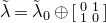 $\tilde{\lambda} = \tilde{\lambda}_0 \oplus \bigl[ \begin{smallmatrix} 0 & 1 \\ 1 & 0 \end{smallmatrix} \bigr]$
and
$\tilde{\lambda} = \tilde{\lambda}_0 \oplus \bigl[ \begin{smallmatrix} 0 & 1 \\ 1 & 0 \end{smallmatrix} \bigr]$
and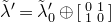 $\tilde{\lambda}' = \tilde{\lambda}'_0 \oplus \bigl[ \begin{smallmatrix} 0 & 1 \\ 1 & 0 \end{smallmatrix} \bigr]$
be the bilinear functions in
$\tilde{\lambda}' = \tilde{\lambda}'_0 \oplus \bigl[ \begin{smallmatrix} 0 & 1 \\ 1 & 0 \end{smallmatrix} \bigr]$
be the bilinear functions in $\underline{\tilde{M}}_0 \oplus \underline{H}_2$
and
$\underline{\tilde{M}}_0 \oplus \underline{H}_2$
and $\underline{\tilde{M}}{}'_0 \oplus \underline{H}_2$
, respectively. By Lemma 6.6 we have
$\underline{\tilde{M}}{}'_0 \oplus \underline{H}_2$
, respectively. By Lemma 6.6 we have $H_q(\tilde{U}) \cong (\tilde{M}_0 \oplus \mathbb{Z}^2) / (\tilde{L}_0 \oplus ( \{0 \} \times \mathbb{Z}))$
and
$H_q(\tilde{U}) \cong (\tilde{M}_0 \oplus \mathbb{Z}^2) / (\tilde{L}_0 \oplus ( \{0 \} \times \mathbb{Z}))$
and $H_q(\tilde{U}') \cong (\tilde{M}'_0 \oplus \mathbb{Z}^2) / (\tilde{L}'_0 \oplus ( \{0 \} \times \mathbb{Z}))$
, and the quotient homomorphisms
$H_q(\tilde{U}') \cong (\tilde{M}'_0 \oplus \mathbb{Z}^2) / (\tilde{L}'_0 \oplus ( \{0 \} \times \mathbb{Z}))$
, and the quotient homomorphisms $Q : \tilde{M}_0 \oplus \mathbb{Z}^2 \rightarrow (\tilde{M}_0 \oplus \mathbb{Z}^2) / (\tilde{L}_0 \oplus ( \{0 \} \times \mathbb{Z}))$
and
$Q : \tilde{M}_0 \oplus \mathbb{Z}^2 \rightarrow (\tilde{M}_0 \oplus \mathbb{Z}^2) / (\tilde{L}_0 \oplus ( \{0 \} \times \mathbb{Z}))$
and $Q' : \tilde{M}'_0 \oplus \mathbb{Z}^2 \rightarrow (\tilde{M}'_0 \oplus \mathbb{Z}^2) / (\tilde{L}'_0 \oplus ( \{0 \} \times \mathbb{Z}))$
are induced by the inclusions
$Q' : \tilde{M}'_0 \oplus \mathbb{Z}^2 \rightarrow (\tilde{M}'_0 \oplus \mathbb{Z}^2) / (\tilde{L}'_0 \oplus ( \{0 \} \times \mathbb{Z}))$
are induced by the inclusions $\partial \tilde{U} \rightarrow \tilde{U}$
and
$\partial \tilde{U} \rightarrow \tilde{U}$
and $\partial \tilde{U}' \rightarrow \tilde{U}'$
.
$\partial \tilde{U}' \rightarrow \tilde{U}'$
.
By applying Lemma 6.16 to the homotopy equivalence $j : \tilde{K}' \rightarrow \tilde{K}$
, we get that
$j : \tilde{K}' \rightarrow \tilde{K}$
, we get that $\theta_{\tilde{U}',F} \cong \theta_{\tilde{U},F}$
, via an isomorphism I that fits into the following commutative diagram.
$\theta_{\tilde{U}',F} \cong \theta_{\tilde{U},F}$
, via an isomorphism I that fits into the following commutative diagram.

In particular, I is an isomorphism $I : \underline{\tilde{M}}{}'_0 \oplus \underline{H}_2 \rightarrow \underline{\tilde{M}}_0 \oplus \underline{H}_2$
such that
$I : \underline{\tilde{M}}{}'_0 \oplus \underline{H}_2 \rightarrow \underline{\tilde{M}}_0 \oplus \underline{H}_2$
such that $I(\tilde{L}'_0 \oplus ( \{0 \} \times \mathbb{Z})) = \tilde{L}_0 \oplus ( \{0 \} \times \mathbb{Z})$
and
$I(\tilde{L}'_0 \oplus ( \{0 \} \times \mathbb{Z})) = \tilde{L}_0 \oplus ( \{0 \} \times \mathbb{Z})$
and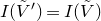 $I(\tilde{V}') = I(\tilde{V})$
.
$I(\tilde{V}') = I(\tilde{V})$
.
It remains to prove that $I(\tilde{L}'_0 \oplus ( \mathbb{Z} \times \{0 \})) = \tilde{L}_0 \oplus (\mathbb{Z} \times \{0 \} )$
, implying that I determines an isomorphism between
$I(\tilde{L}'_0 \oplus ( \mathbb{Z} \times \{0 \})) = \tilde{L}_0 \oplus (\mathbb{Z} \times \{0 \} )$
, implying that I determines an isomorphism between $(\underline{\tilde{M}}{}'_0 \oplus \underline{H}_2; \tilde{L}'_0 \oplus ( \mathbb{Z} \times \{0 \}), \tilde{V}')$
and
$(\underline{\tilde{M}}{}'_0 \oplus \underline{H}_2; \tilde{L}'_0 \oplus ( \mathbb{Z} \times \{0 \}), \tilde{V}')$
and $(\underline{\tilde{M}}_0 \oplus \underline{H}_2; \tilde{L}_0 \oplus (\mathbb{Z} \times \{0 \} ), \tilde{V})$
, and hence a stable isomorphism between
$(\underline{\tilde{M}}_0 \oplus \underline{H}_2; \tilde{L}_0 \oplus (\mathbb{Z} \times \{0 \} ), \tilde{V})$
, and hence a stable isomorphism between $(\underline{M}{}'_0 \oplus \underline{H}_2; L'_0 \oplus ( \mathbb{Z} \times \{0 \}), V')$
and
$(\underline{M}{}'_0 \oplus \underline{H}_2; L'_0 \oplus ( \mathbb{Z} \times \{0 \}), V')$
and $(\underline{\bar{M}}_0 \oplus \underline{H}_2; \bar{L}_0 \oplus (\mathbb{Z} \times \{0 \} ), \bar{V})$
.
$(\underline{\bar{M}}_0 \oplus \underline{H}_2; \bar{L}_0 \oplus (\mathbb{Z} \times \{0 \} ), \bar{V})$
.
Under the identifications $H_q(\tilde{U}') \cong H_q(\tilde{K}')$
and
$H_q(\tilde{U}') \cong H_q(\tilde{K}')$
and $H_q(\tilde{U}) \cong H_q(\tilde{K})$
, the isomorphism J maps [0,(1,0)], the coset of
$H_q(\tilde{U}) \cong H_q(\tilde{K})$
, the isomorphism J maps [0,(1,0)], the coset of $(0,(1,0)) \in \tilde{M}'_0 \oplus \mathbb{Z}^2$
(which corresponds to
$(0,(1,0)) \in \tilde{M}'_0 \oplus \mathbb{Z}^2$
(which corresponds to $(0,0,1) \in \mathbb{Z}^l \oplus H_q(K'_0) \oplus \mathbb{Z}$
), to [0,(1,0)], the coset of
$(0,0,1) \in \mathbb{Z}^l \oplus H_q(K'_0) \oplus \mathbb{Z}$
), to [0,(1,0)], the coset of $(0,(1,0)) \in \tilde{M}_0 \oplus \mathbb{Z}^2$
(that is,
$(0,(1,0)) \in \tilde{M}_0 \oplus \mathbb{Z}^2$
(that is, $(0,0,1) \in \mathbb{Z}^m \oplus \bar{M}_0/\bar{L}_0 \oplus \mathbb{Z}$
) by construction. Hence,
$(0,0,1) \in \mathbb{Z}^m \oplus \bar{M}_0/\bar{L}_0 \oplus \mathbb{Z}$
) by construction. Hence, $Q \circ I(0,(1,0)) = J \circ Q'(0,(1,0)) = J([0,(1,0)]) = [0,(1,0)]$
, so
$Q \circ I(0,(1,0)) = J \circ Q'(0,(1,0)) = J([0,(1,0)]) = [0,(1,0)]$
, so $I(0,(1,0)) \in Q^{-1}([0,(1,0)])$
, therefore
$I(0,(1,0)) \in Q^{-1}([0,(1,0)])$
, therefore $I(0,(1,0)) = (a,(1,b))$
for some
$I(0,(1,0)) = (a,(1,b))$
for some $a \in \tilde{L}_0$
and
$a \in \tilde{L}_0$
and $b \in \mathbb{Z}$
.
$b \in \mathbb{Z}$
.
Since I is an isomorphism of extended quadratic forms, we have $0 = \tilde{\lambda}'((0,(1,0)),(0,(1,0))) = \tilde{\lambda}((a,(1,b))(a,(1,b))) = \tilde{\lambda}_0(a,a)+2b = 2b$
(because
$0 = \tilde{\lambda}'((0,(1,0)),(0,(1,0))) = \tilde{\lambda}((a,(1,b))(a,(1,b))) = \tilde{\lambda}_0(a,a)+2b = 2b$
(because $a \in \tilde{L}_0$
and
$a \in \tilde{L}_0$
and $\tilde{L}_0$
is a T-Lagrangian in
$\tilde{L}_0$
is a T-Lagrangian in $\underline{\tilde{M}}_0$
), hence
$\underline{\tilde{M}}_0$
), hence $b=0$
. Therefore,
$b=0$
. Therefore, $I(0,(1,0)) = (a,(1,0))$
for some
$I(0,(1,0)) = (a,(1,0))$
for some $a \in \tilde{L}_0$
.
$a \in \tilde{L}_0$
.
In $\underline{\tilde{M}}{}'_0 \oplus \underline{H}_2$
we have
$\underline{\tilde{M}}{}'_0 \oplus \underline{H}_2$
we have $(\mathbb{Z} \times \{0 \})^{\perp} = \tilde{M}'_0 \oplus (\mathbb{Z} \times \{0 \})$
, so
$(\mathbb{Z} \times \{0 \})^{\perp} = \tilde{M}'_0 \oplus (\mathbb{Z} \times \{0 \})$
, so $\tilde{L}'_0 = (\tilde{L}'_0 \oplus ( \{0 \} \times \mathbb{Z})) \cap (\mathbb{Z} \times \{0 \})^{\perp}$
. Hence, its image under the isomorphism I is
$\tilde{L}'_0 = (\tilde{L}'_0 \oplus ( \{0 \} \times \mathbb{Z})) \cap (\mathbb{Z} \times \{0 \})^{\perp}$
. Hence, its image under the isomorphism I is $I(\tilde{L}'_0) = I(\tilde{L}'_0 \oplus ( \{0 \} \times \mathbb{Z})) \cap I((\mathbb{Z} \times \{0 \})^{\perp}) = (\tilde{L}_0 \oplus ( \{0 \} \times \mathbb{Z})) \cap (I(\mathbb{Z} \times \{0 \}))^{\perp} = (\tilde{L}_0 \oplus ( \{0 \} \times \mathbb{Z})) \cap \left\langle (a,(1,0)) \right\rangle ^{\perp}$
. For
$I(\tilde{L}'_0) = I(\tilde{L}'_0 \oplus ( \{0 \} \times \mathbb{Z})) \cap I((\mathbb{Z} \times \{0 \})^{\perp}) = (\tilde{L}_0 \oplus ( \{0 \} \times \mathbb{Z})) \cap (I(\mathbb{Z} \times \{0 \}))^{\perp} = (\tilde{L}_0 \oplus ( \{0 \} \times \mathbb{Z})) \cap \left\langle (a,(1,0)) \right\rangle ^{\perp}$
. For $(x,(0,y)) \in \tilde{L}_0 \oplus ( \{0 \} \times \mathbb{Z})$
we have
$(x,(0,y)) \in \tilde{L}_0 \oplus ( \{0 \} \times \mathbb{Z})$
we have $\tilde{\lambda}((a,(1,0))(x,(0,y))) = \tilde{\lambda}_0(a,x)+y = y$
, so
$\tilde{\lambda}((a,(1,0))(x,(0,y))) = \tilde{\lambda}_0(a,x)+y = y$
, so $(\tilde{L}_0 \oplus ( \{0 \} \times \mathbb{Z})) \cap \left\langle (a,(1,0)) \right\rangle ^{\perp} = \tilde{L}_0$
. Therefore,
$(\tilde{L}_0 \oplus ( \{0 \} \times \mathbb{Z})) \cap \left\langle (a,(1,0)) \right\rangle ^{\perp} = \tilde{L}_0$
. Therefore, $I(\tilde{L}'_0) = \tilde{L}_0$
.
$I(\tilde{L}'_0) = \tilde{L}_0$
.
This implies that $I(\tilde{L}'_0 \oplus ( \mathbb{Z} \times \{0 \})) = \tilde{L}_0 \oplus (\mathbb{Z} \times \{0 \} )$
, as required.
$I(\tilde{L}'_0 \oplus ( \mathbb{Z} \times \{0 \})) = \tilde{L}_0 \oplus (\mathbb{Z} \times \{0 \} )$
, as required.
6.6 Elementary obstructions and h-cobordisms
Proposition 6.29. The cobordism W is an h-cobordism if and only if $\theta_{W,F} \in \mathscr{s}^T_{2q+1}(B,\xi)$
is elementary.
$\theta_{W,F} \in \mathscr{s}^T_{2q+1}(B,\xi)$
is elementary.
Proof. Choose an arbitrary c and U. We will prove that W is an h-cobordism if and only if $\theta_{U,F}$
is elementary.
$\theta_{U,F}$
is elementary.
By Proposition 6.1(e) we have $H_i(W, M_0) \cong 0$
for
$H_i(W, M_0) \cong 0$
for $i \leqslant q-1$
, and it also follows that if
$i \leqslant q-1$
, and it also follows that if $i \geqslant q+2$
, then
$i \geqslant q+2$
, then $H_i(W, M_0) \cong H^{2q+1-i}(W, M_1) \cong 0$
(by Poincaré duality and the universal coefficient formula). Since W,
$H_i(W, M_0) \cong H^{2q+1-i}(W, M_1) \cong 0$
(by Poincaré duality and the universal coefficient formula). Since W, $M_0$
and
$M_0$
and $M_1$
are all simply-connected, this means that W is an h-cobordism if and only if
$M_1$
are all simply-connected, this means that W is an h-cobordism if and only if $H_q(W, M_0) \cong H_{q+1}(W, M_0) \cong 0$
.
$H_q(W, M_0) \cong H_{q+1}(W, M_0) \cong 0$
.
Consider the homological long exact sequence of the triple $(W, W \setminus \mathop{\mathrm{int}}\nolimits U, M_0)$
. By Proposition 6.1(d) we have
$(W, W \setminus \mathop{\mathrm{int}}\nolimits U, M_0)$
. By Proposition 6.1(d) we have $H_q(W, W \setminus \mathop{\mathrm{int}}\nolimits U) \cong 0$
. From the proof of Lemma 6.9 we get a commutative diagram
$H_q(W, W \setminus \mathop{\mathrm{int}}\nolimits U) \cong 0$
. From the proof of Lemma 6.9 we get a commutative diagram

so the homomorphism $H^q(W \setminus \mathop{\mathrm{int}}\nolimits U, \partial U \sqcup M_1) \cong H^q(W, U \sqcup M_1) \rightarrow H^q(W, M_1)$
is trivial. By Poincaré duality, the homomorphism
$H^q(W \setminus \mathop{\mathrm{int}}\nolimits U, \partial U \sqcup M_1) \cong H^q(W, U \sqcup M_1) \rightarrow H^q(W, M_1)$
is trivial. By Poincaré duality, the homomorphism $H_{q+1}(W \setminus \mathop{\mathrm{int}}\nolimits U, M_0) \rightarrow H_{q+1}(W, M_0)$
is trivial too. So we have the following exact sequence (note that this sequence is a copy of the horizontal exact sequence in [Reference KreckKre99, Figure 1], but U is defined differently):
$H_{q+1}(W \setminus \mathop{\mathrm{int}}\nolimits U, M_0) \rightarrow H_{q+1}(W, M_0)$
is trivial too. So we have the following exact sequence (note that this sequence is a copy of the horizontal exact sequence in [Reference KreckKre99, Figure 1], but U is defined differently):
 \[0 \rightarrow H_{q+1}(W, M_0) \rightarrow H_{q+1}(W, W \setminus \mathop{\mathrm{int}}\nolimits U) \rightarrow H_q(W \setminus \mathop{\mathrm{int}}\nolimits U, M_0) \rightarrow H_q(W, M_0) \rightarrow 0. \]
It follows that W is an h-cobordism if and only if the map $H_{q+1}(W, W \setminus \mathop{\mathrm{int}}\nolimits U) \rightarrow H_q(W \setminus \mathop{\mathrm{int}}\nolimits U, M_0)$
is an isomorphism.
$H_{q+1}(W, W \setminus \mathop{\mathrm{int}}\nolimits U) \rightarrow H_q(W \setminus \mathop{\mathrm{int}}\nolimits U, M_0)$
is an isomorphism.
This map can be written as a composition $H_{q+1}(W, W \setminus \mathop{\mathrm{int}}\nolimits U) \cong H_{q+1}(U, \partial U) \rightarrow H_q(\partial U) \rightarrow H_q(W \setminus \mathop{\mathrm{int}}\nolimits U, M_0)$
. Since
$H_{q+1}(W, W \setminus \mathop{\mathrm{int}}\nolimits U) \cong H_{q+1}(U, \partial U) \rightarrow H_q(\partial U) \rightarrow H_q(W \setminus \mathop{\mathrm{int}}\nolimits U, M_0)$
. Since $H_{q+1}(U) \cong H_{q+1}(\mathop{\mathrm{sk}}\nolimits_q W) \cong 0$
, the map
$H_{q+1}(U) \cong H_{q+1}(\mathop{\mathrm{sk}}\nolimits_q W) \cong 0$
, the map $H_{q+1}(U, \partial U) \rightarrow H_q(\partial U)$
is injective, and its image is by definition L. By the exact sequence
$H_{q+1}(U, \partial U) \rightarrow H_q(\partial U)$
is injective, and its image is by definition L. By the exact sequence

of Theorem 6.10 and the definition of V, the restriction of the map $H_q(\partial U) \rightarrow H_q(W \setminus \mathop{\mathrm{int}}\nolimits U, M_0)$
to L is an isomorphism if and only if
$H_q(\partial U) \rightarrow H_q(W \setminus \mathop{\mathrm{int}}\nolimits U, M_0)$
to L is an isomorphism if and only if $H_q(\partial U) \cong L \oplus V$
.
$H_q(\partial U) \cong L \oplus V$
.
Therefore, W is an h-cobordism if and only if $\theta_{U,F}$
is elementary.
$\theta_{U,F}$
is elementary.
Proposition 6.30. The normal bordism F is normally bordant (rel boundary) to some normal bordism $F' : W' \rightarrow B$
such that W’ is an h-cobordism if and only if
$F' : W' \rightarrow B$
such that W’ is an h-cobordism if and only if $[\theta_{W,F}] \in \ell^T_{2q+1}(B,\xi)$
is elementary.
$[\theta_{W,F}] \in \ell^T_{2q+1}(B,\xi)$
is elementary.
Proof. First suppose that F is normally bordant to an $F' : W' \rightarrow B$
such that W’ is an h-cobordism. In this case F’ is q-connected (because the inclusion
$F' : W' \rightarrow B$
such that W’ is an h-cobordism. In this case F’ is q-connected (because the inclusion $M_0 \rightarrow W'$
is a homotopy equivalence, and the composition
$M_0 \rightarrow W'$
is a homotopy equivalence, and the composition $M_0 \rightarrow W' \stackrel{F'}{\rightarrow} B$
is equal to
$M_0 \rightarrow W' \stackrel{F'}{\rightarrow} B$
is equal to $f_0$
, which is q-connected), so
$f_0$
, which is q-connected), so $\theta_{W',F'}$
is defined. It follows from Proposition 6.29 that
$\theta_{W',F'}$
is defined. It follows from Proposition 6.29 that $\theta_{W',F'}$
is elementary, hence
$\theta_{W',F'}$
is elementary, hence $[\theta_{W',F'}]$
is elementary, and by Theorem 6.26,
$[\theta_{W',F'}]$
is elementary, and by Theorem 6.26, $[\theta_{W,F}] = [\theta_{W',F'}]$
.
$[\theta_{W,F}] = [\theta_{W',F'}]$
.
Now suppose that $[\theta_{W,F}]$
is elementary. This means that there is an elementary quasi-formation
$[\theta_{W,F}]$
is elementary. This means that there is an elementary quasi-formation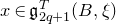 $x \in \mathfrak{g}^T_{2q+1}(B,\xi)$
such that
$x \in \mathfrak{g}^T_{2q+1}(B,\xi)$
such that $\theta_{W,F} \sim x$
. By Theorem 6.27 there is a q-connected normal bordism
$\theta_{W,F} \sim x$
. By Theorem 6.27 there is a q-connected normal bordism $F' : W' \rightarrow B$
which is normally bordant to F such that
$F' : W' \rightarrow B$
which is normally bordant to F such that $\theta_{W',F'} \mathrel{\underset{^{\scriptstyle{s}}}{\cong}} x$
. Then
$\theta_{W',F'} \mathrel{\underset{^{\scriptstyle{s}}}{\cong}} x$
. Then $\theta_{W',F'}$
is elementary, so W’ is an h-cobordism by Proposition 6.29.
$\theta_{W',F'}$
is elementary, so W’ is an h-cobordism by Proposition 6.29.
7. The computation of
$[\theta_{W,F}]$

We use the same setting as in § 6. The goal of this section is to compute the obstruction $[\theta_{W,F}]$
in terms of the Q-forms of
$[\theta_{W,F}]$
in terms of the Q-forms of $f_0$
and
$f_0$
and $f_1$
.
$f_1$
.
Definition 7.1 For $i=0,1$
, let
$i=0,1$
, let $\underline{E}_i = (H_q(M_i), \lambda_i, \mu_i) = E_q(M_i, f_i)$
. This is an extended quadratic form over
$\underline{E}_i = (H_q(M_i), \lambda_i, \mu_i) = E_q(M_i, f_i)$
. This is an extended quadratic form over $H_q(B)$
.
$H_q(B)$
.
Note that $\underline{E}_i$
is geometric (with respect to
$\underline{E}_i$
is geometric (with respect to $\hat{v}_q(\xi)$
) and full, because
$\hat{v}_q(\xi)$
) and full, because $f_i$
is a normal
$f_i$
is a normal $(q{-}1)$
-smoothing (see Lemmas 5.10 and 5.9).
$(q{-}1)$
-smoothing (see Lemmas 5.10 and 5.9).
We choose a CW decomposition c of W and a regular neighbourhood U of $\mathop{\mathrm{sk}}\nolimits_q W$
as before. These will be fixed for the rest of this section.
$\mathop{\mathrm{sk}}\nolimits_q W$
as before. These will be fixed for the rest of this section.
Definition 7.2. Let $(\underline{M}; L, V) = \theta_{U,F}$
, where
$(\underline{M}; L, V) = \theta_{U,F}$
, where $\underline{M} = (H_q(\partial U), \lambda, \mu)$
, and let
$\underline{M} = (H_q(\partial U), \lambda, \mu)$
, and let $\underline{V} = (V, \lambda \big| _{V \times V}, \mu \big| _V)$
. This is an extended quadratic form over
$\underline{V} = (V, \lambda \big| _{V \times V}, \mu \big| _V)$
. This is an extended quadratic form over $H_q(B)$
, geometric (with respect to
$H_q(B)$
, geometric (with respect to $\hat{v}_q(\xi)$
) and free.
$\hat{v}_q(\xi)$
) and free.
Recall that we made the following orientation conventions: W, $M_0$
and
$M_0$
and $M_1$
are oriented manifolds such that W is an oriented cobordism between
$M_1$
are oriented manifolds such that W is an oriented cobordism between $M_0$
and
$M_0$
and $M_1$
, that is, W induces the positive orientation on
$M_1$
, that is, W induces the positive orientation on $M_0$
and the negative orientation on
$M_0$
and the negative orientation on $M_1$
. The regular neighbourhood U is a codimension-0 submanifold in W, and its orientation is the restriction of that of W. We orient
$M_1$
. The regular neighbourhood U is a codimension-0 submanifold in W, and its orientation is the restriction of that of W. We orient $\partial U$
as the boundary of U. Thus,
$\partial U$
as the boundary of U. Thus, $W \setminus \mathop{\mathrm{int}}\nolimits U$
induces the negative orientation on
$W \setminus \mathop{\mathrm{int}}\nolimits U$
induces the negative orientation on $\partial U$
.
$\partial U$
.
We will need the following lemma, which is an analogue of [Reference KreckKre99, Proposition 8. i)].
Lemma 7.3. There is a morphism of extended quadratic forms $p : \underline{V} \rightarrow \underline{E}_0$
such that the underlying homomorphism
$p : \underline{V} \rightarrow \underline{E}_0$
such that the underlying homomorphism $p : V \rightarrow H_q(M_0)$
is surjective.
$p : V \rightarrow H_q(M_0)$
is surjective.
Proof. Let $d_1 : H_{q+1}(W \setminus \mathop{\mathrm{int}}\nolimits U, \partial U \sqcup M_0) \rightarrow H_q(\partial U)$
and
$d_1 : H_{q+1}(W \setminus \mathop{\mathrm{int}}\nolimits U, \partial U \sqcup M_0) \rightarrow H_q(\partial U)$
and $d_2 : H_{q+1}(W \setminus \mathop{\mathrm{int}}\nolimits U, \partial U \sqcup M_0) \rightarrow H_q(M_0)$
denote the components of the boundary homomorphism
$d_2 : H_{q+1}(W \setminus \mathop{\mathrm{int}}\nolimits U, \partial U \sqcup M_0) \rightarrow H_q(M_0)$
denote the components of the boundary homomorphism $d : H_{q+1}(W \setminus \mathop{\mathrm{int}}\nolimits U, \partial U \sqcup M_0) \rightarrow H_q(\partial U \sqcup M_0) \cong H_q(\partial U) \oplus H_q(M_0)$
.
$d : H_{q+1}(W \setminus \mathop{\mathrm{int}}\nolimits U, \partial U \sqcup M_0) \rightarrow H_q(\partial U \sqcup M_0) \cong H_q(\partial U) \oplus H_q(M_0)$
.
By Theorem 6.10, $d_1$
is injective and its image is V. In the homological long exact sequence of the triple
$d_1$
is injective and its image is V. In the homological long exact sequence of the triple $(W, U \sqcup M_0, U)$
we have
$(W, U \sqcup M_0, U)$
we have $H_q(W, U) \cong 0$
(see Proposition 6.1(c)), therefore
$H_q(W, U) \cong 0$
(see Proposition 6.1(c)), therefore $d_2$
is surjective. Let
$d_2$
is surjective. Let $p = - d_2 \circ d_1^{-1} : V \rightarrow H_q(M_0)$
; this is a surjective homomorphism.
$p = - d_2 \circ d_1^{-1} : V \rightarrow H_q(M_0)$
; this is a surjective homomorphism.
Let X denote the image of $\partial : H_{q+1}(W \setminus \mathop{\mathrm{int}}\nolimits U, \partial U \sqcup M_0 \sqcup M_1) \rightarrow H_q(\partial U \sqcup M_0 \sqcup M_1)$
. Since
$\partial : H_{q+1}(W \setminus \mathop{\mathrm{int}}\nolimits U, \partial U \sqcup M_0 \sqcup M_1) \rightarrow H_q(\partial U \sqcup M_0 \sqcup M_1)$
. Since $\mathop{\mathrm{Im}}\nolimits d \leqslant X$
, we have
$\mathop{\mathrm{Im}}\nolimits d \leqslant X$
, we have $((-\lambda) \oplus \lambda_0) \big| _{\mathop{\mathrm{Im}}\nolimits d \times \mathop{\mathrm{Im}}\nolimits d} = 0$
and
$((-\lambda) \oplus \lambda_0) \big| _{\mathop{\mathrm{Im}}\nolimits d \times \mathop{\mathrm{Im}}\nolimits d} = 0$
and $(\mu \oplus \mu_0) \big| _{\mathop{\mathrm{Im}}\nolimits d} = 0$
by Lemma 5.11, and this implies that p is a morphism of extended quadratic forms. (For more details see [Nagy21, Lemma 4.5.3].)
$(\mu \oplus \mu_0) \big| _{\mathop{\mathrm{Im}}\nolimits d} = 0$
by Lemma 5.11, and this implies that p is a morphism of extended quadratic forms. (For more details see [Nagy21, Lemma 4.5.3].)
To be able to make computations, we will pass from the set $\ell^T_{2q+1}(B,\xi)$
to the monoid
$\ell^T_{2q+1}(B,\xi)$
to the monoid $\ell_{2q+1}(B,\xi)$
using the bijection of Proposition 4.14. Recall the notation from Definition 4.13.
$\ell_{2q+1}(B,\xi)$
using the bijection of Proposition 4.14. Recall the notation from Definition 4.13.
Definition 7.4 Let $\bar{M} = H_q(\partial U) / \mathop{\mathrm{Tor}}\nolimits H_q(\partial U)$
. Since L is a T-Lagrangian in
$\bar{M} = H_q(\partial U) / \mathop{\mathrm{Tor}}\nolimits H_q(\partial U)$
. Since L is a T-Lagrangian in $\underline{M}$
, we always have
$\underline{M}$
, we always have $\mu \big| _{\mathop{\mathrm{Tor}}\nolimits H_q(\partial U)} = 0$
, hence we can define
$\mu \big| _{\mathop{\mathrm{Tor}}\nolimits H_q(\partial U)} = 0$
, hence we can define $\underline{\bar{M}} = (\bar{M}, \bar{\lambda}, \bar{\mu})$
. Let
$\underline{\bar{M}} = (\bar{M}, \bar{\lambda}, \bar{\mu})$
. Let $\pi : H_q(\partial U) \rightarrow \bar{M}$
denote the quotient homomorphism.
$\pi : H_q(\partial U) \rightarrow \bar{M}$
denote the quotient homomorphism.
Let $\bar{\theta}_{U,F} = (\underline{\bar{M}}; \bar{L}, \bar{V}) \in \mathfrak{g}_{2q+1}(B,\xi)$
. Let
$\bar{\theta}_{U,F} = (\underline{\bar{M}}; \bar{L}, \bar{V}) \in \mathfrak{g}_{2q+1}(B,\xi)$
. Let $\bar{\theta}_{c,F} \in \mathscr{g}_{2q+1}(B,\xi)$
and
$\bar{\theta}_{c,F} \in \mathscr{g}_{2q+1}(B,\xi)$
and $\bar{\theta}_{W,F} \in \mathscr{s}_{2q+1}(B,\xi)$
be the elements represented by
$\bar{\theta}_{W,F} \in \mathscr{s}_{2q+1}(B,\xi)$
be the elements represented by $\bar{\theta}_{U,F}$
.
$\bar{\theta}_{U,F}$
.
Then $[\bar{\theta}_{W,F}] \in \ell_{2q+1}(B,\xi)$
is the element corresponding to
$[\bar{\theta}_{W,F}] \in \ell_{2q+1}(B,\xi)$
is the element corresponding to $[\theta_{W,F}] \in \ell^T_{2q+1}(B,\xi)$
under the bijection of Proposition 4.14.
$[\theta_{W,F}] \in \ell^T_{2q+1}(B,\xi)$
under the bijection of Proposition 4.14.
Definition 7.5. Let $\bar{E}_i = H_q(M_i) / \mathop{\mathrm{Tor}}\nolimits H_q(M_i)$
. If
$\bar{E}_i = H_q(M_i) / \mathop{\mathrm{Tor}}\nolimits H_q(M_i)$
. If $\mu_i(\mathop{\mathrm{Tor}}\nolimits H_q(M_i))=0$
, then we can also define
$\mu_i(\mathop{\mathrm{Tor}}\nolimits H_q(M_i))=0$
, then we can also define $\underline{\bar{E}}_i = (\bar{E}_i, \bar{\lambda}_i, \bar{\mu}_i)$
.
$\underline{\bar{E}}_i = (\bar{E}_i, \bar{\lambda}_i, \bar{\mu}_i)$
.
Theorem 7.6
Assume that $\mu_i(\mathop{\mathrm{Tor}}\nolimits H_q(M_i))=0$
for
$\mu_i(\mathop{\mathrm{Tor}}\nolimits H_q(M_i))=0$
for $i=0,1$
and that
$i=0,1$
and that $\underline{\bar{E}}_0 \oplus (-\underline{\bar{E}}{}^*_1)$
is metabolic. Then for every Lagrangian
$\underline{\bar{E}}_0 \oplus (-\underline{\bar{E}}{}^*_1)$
is metabolic. Then for every Lagrangian $\bar{K}$
in
$\bar{K}$
in $\underline{\bar{E}}_0 \oplus (-\underline{\bar{E}}{}^*_1)$
there is an
$\underline{\bar{E}}_0 \oplus (-\underline{\bar{E}}{}^*_1)$
there is an $x \in L_{2q+1}(B,\xi)$
such that
$x \in L_{2q+1}(B,\xi)$
such that
 \[[\bar{\theta}_{W,F}] = [\underline{\bar{E}}_0 \oplus (-\underline{\bar{E}}{}^*_1); \bar{K}, \bar{E}_0] \oplus x \in \ell_{2q+1}(B,\xi) . \]
Remark 7.7. The boundary of W is $M_0 \sqcup (-M_1)$
, and by Lemmas 5.7 and 5.8 we have
$M_0 \sqcup (-M_1)$
, and by Lemmas 5.7 and 5.8 we have $E_q(M_0 \sqcup (-M_1), f_0 \sqcup f_1) = \underline{E}_0 \oplus (-\underline{E}{}^*_1)$
. Thus, by Lemma 5.12, if
$E_q(M_0 \sqcup (-M_1), f_0 \sqcup f_1) = \underline{E}_0 \oplus (-\underline{E}{}^*_1)$
. Thus, by Lemma 5.12, if $H_q(B)$
is free, then
$H_q(B)$
is free, then $\underline{E}_0 \oplus (-\underline{E}{}^*_1)$
is metabolic. The freeness of
$\underline{E}_0 \oplus (-\underline{E}{}^*_1)$
is metabolic. The freeness of $H_q(B)$
also implies that
$H_q(B)$
also implies that $\mu_i(\mathop{\mathrm{Tor}}\nolimits H_q(M_i))=0$
, so
$\mu_i(\mathop{\mathrm{Tor}}\nolimits H_q(M_i))=0$
, so $\underline{\bar{E}}_0 \oplus (-\underline{\bar{E}}{}^*_1)$
is defined and it is also metabolic, hence both assumptions hold. Moreover,
$\underline{\bar{E}}_0 \oplus (-\underline{\bar{E}}{}^*_1)$
is defined and it is also metabolic, hence both assumptions hold. Moreover, $L_{2q+1}(B,\xi) \cong 0$
by Theorem 4.33, so in this case Theorem 7.6 completely determines
$L_{2q+1}(B,\xi) \cong 0$
by Theorem 4.33, so in this case Theorem 7.6 completely determines $[\bar{\theta}_{W,F}]$
.
$[\bar{\theta}_{W,F}]$
.
Proof. We have $[\bar{\theta}_{W,F}] = [\underline{\bar{M}}; \bar{L}, \bar{V}]$
by definition. To compute it, first we will define a subgroup
$[\bar{\theta}_{W,F}] = [\underline{\bar{M}}; \bar{L}, \bar{V}]$
by definition. To compute it, first we will define a subgroup $V' \leqslant M$
such that in
$V' \leqslant M$
such that in $\underline{\bar{M}}$
we have
$\underline{\bar{M}}$
we have $\bar{V}' = \bar{V}^{\perp}$
. Then we will use the morphism
$\bar{V}' = \bar{V}^{\perp}$
. Then we will use the morphism $\bar{p} : \underline{\bar{V}} \rightarrow \underline{\bar{E}}_0$
induced by the morphism
$\bar{p} : \underline{\bar{V}} \rightarrow \underline{\bar{E}}_0$
induced by the morphism $p : \underline{V} \rightarrow \underline{E}_0$
from Lemma 7.3 and an analogous morphism
$p : \underline{V} \rightarrow \underline{E}_0$
from Lemma 7.3 and an analogous morphism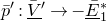 $\bar{p}' : \underline{\bar{V}}{}' \rightarrow -\underline{\bar{E}}{}^*_1$
to relate
$\bar{p}' : \underline{\bar{V}}{}' \rightarrow -\underline{\bar{E}}{}^*_1$
to relate $\underline{\bar{M}}$
to
$\underline{\bar{M}}$
to $\underline{\bar{E}}_0 \oplus (-\underline{\bar{E}}{}^*_1)$
.
$\underline{\bar{E}}_0 \oplus (-\underline{\bar{E}}{}^*_1)$
.
First we consider $-W$
, that is, W with the opposite orientation; this is an oriented cobordism between
$-W$
, that is, W with the opposite orientation; this is an oriented cobordism between $M_1$
and
$M_1$
and $M_0$
, that is,
$M_0$
, that is, $\partial(-W) = M_1 \sqcup (-M_0)$
. After changing the orientations F,
$\partial(-W) = M_1 \sqcup (-M_0)$
. After changing the orientations F, $f_0$
and
$f_0$
and $f_1$
are still normal
$f_1$
are still normal $(q{-}1)$
-smoothings over
$(q{-}1)$
-smoothings over $(B,\xi)$
, and the obstruction
$(B,\xi)$
, and the obstruction $\theta_{-W,F}$
can be defined as before. The CW decomposition c of W that we fixed earlier is also a CW decomposition of
$\theta_{-W,F}$
can be defined as before. The CW decomposition c of W that we fixed earlier is also a CW decomposition of $-W$
, and we can choose the same regular neighbourhood U of the q-skeleton, but the orientation of
$-W$
, and we can choose the same regular neighbourhood U of the q-skeleton, but the orientation of $-W$
restricts to the negative orientation of U. We will denote by
$-W$
restricts to the negative orientation of U. We will denote by $\theta_{-U,F}$
the quasi-formation determined by
$\theta_{-U,F}$
the quasi-formation determined by $-U$
(U with the opposite orientation) that represents
$-U$
(U with the opposite orientation) that represents $\theta_{-W,F}$
.
$\theta_{-W,F}$
.
Let $(\underline{M}{}'; L', V') = \theta_{-U,F}$
. Then
$(\underline{M}{}'; L', V') = \theta_{-U,F}$
. Then $\underline{M}{}' = E_q(-\partial U, F \big| _{\partial U}) = -\underline{M}{}^* = (H_q(\partial U), -\lambda, \mu)$
by Lemma 5.8. By definition we have
$\underline{M}{}' = E_q(-\partial U, F \big| _{\partial U}) = -\underline{M}{}^* = (H_q(\partial U), -\lambda, \mu)$
by Lemma 5.8. By definition we have $L' = \mathop{\mathrm{Im}}\nolimits(H_{q+1}(-U, -\partial U) \rightarrow H_q(-\partial U)) = \mathop{\mathrm{Im}}\nolimits(H_{q+1}(U, \partial U) \rightarrow H_q(\partial U)) = L$
and
$L' = \mathop{\mathrm{Im}}\nolimits(H_{q+1}(-U, -\partial U) \rightarrow H_q(-\partial U)) = \mathop{\mathrm{Im}}\nolimits(H_{q+1}(U, \partial U) \rightarrow H_q(\partial U)) = L$
and $V' = \mathop{\mathrm{Im}}\nolimits(H_{q+1}(-W \setminus \mathop{\mathrm{int}}\nolimits(-U), -\partial U \sqcup M_1) \rightarrow H_q(-\partial U)) = \mathop{\mathrm{Im}}\nolimits(H_{q+1}(W \setminus \mathop{\mathrm{int}}\nolimits U, \partial U \sqcup M_1) \rightarrow H_q(\partial U))$
. Note that
$V' = \mathop{\mathrm{Im}}\nolimits(H_{q+1}(-W \setminus \mathop{\mathrm{int}}\nolimits(-U), -\partial U \sqcup M_1) \rightarrow H_q(-\partial U)) = \mathop{\mathrm{Im}}\nolimits(H_{q+1}(W \setminus \mathop{\mathrm{int}}\nolimits U, \partial U \sqcup M_1) \rightarrow H_q(\partial U))$
. Note that $M_1$
takes the place of
$M_1$
takes the place of $M_0$
, because V was defined using the positive boundary component of W (that is,
$M_0$
, because V was defined using the positive boundary component of W (that is, $M_0$
) and the positive boundary component of
$M_0$
) and the positive boundary component of $-W$
is
$-W$
is $M_1$
.
$M_1$
.
Let $\underline{\tilde{V}}{}' = (V', -\lambda \big| _{V' \times V'}, \mu \big| _{V'})$
. By Lemma 7.3 there is a morphism of extended quadratic forms
$\underline{\tilde{V}}{}' = (V', -\lambda \big| _{V' \times V'}, \mu \big| _{V'})$
. By Lemma 7.3 there is a morphism of extended quadratic forms $p' : \underline{\tilde{V}}{}' \rightarrow \underline{E}_1$
such that the underlying homomorphism
$p' : \underline{\tilde{V}}{}' \rightarrow \underline{E}_1$
such that the underlying homomorphism $p' : V' \rightarrow H_q(M_1)$
is surjective. Let
$p' : V' \rightarrow H_q(M_1)$
is surjective. Let $\underline{V}{}' = (V', \lambda \big| _{V' \times V'}, \mu \big| _V') = -(\underline{\tilde{V}}{}')^*$
. Then p’ is also a morphism
$\underline{V}{}' = (V', \lambda \big| _{V' \times V'}, \mu \big| _V') = -(\underline{\tilde{V}}{}')^*$
. Then p’ is also a morphism $p' : \underline{V}{}' = -(\underline{\tilde{V}}{}')^* \rightarrow -\underline{E}{}^*_1$
.
$p' : \underline{V}{}' = -(\underline{\tilde{V}}{}')^* \rightarrow -\underline{E}{}^*_1$
.
We have $p' = - d'_2 \circ (d'_1)^{-1}$
, where
$p' = - d'_2 \circ (d'_1)^{-1}$
, where $d'_1$
and
$d'_1$
and $d'_2$
denote the components of the boundary homomorphism
$d'_2$
denote the components of the boundary homomorphism $d' : H_{q+1}(W \setminus \mathop{\mathrm{int}}\nolimits U, \partial U \sqcup M_1) \rightarrow H_q(\partial U \sqcup M_1)$
as in the proof of Lemma 7.3. We also get that
$d' : H_{q+1}(W \setminus \mathop{\mathrm{int}}\nolimits U, \partial U \sqcup M_1) \rightarrow H_q(\partial U \sqcup M_1)$
as in the proof of Lemma 7.3. We also get that $\mathop{\mathrm{Im}}\nolimits d' \leqslant X$
, hence
$\mathop{\mathrm{Im}}\nolimits d' \leqslant X$
, hence $((-\lambda) \oplus \lambda_0 \oplus \lambda_1) \big| _{\mathop{\mathrm{Im}}\nolimits d \times \mathop{\mathrm{Im}}\nolimits d'} = 0$
. This implies that
$((-\lambda) \oplus \lambda_0 \oplus \lambda_1) \big| _{\mathop{\mathrm{Im}}\nolimits d \times \mathop{\mathrm{Im}}\nolimits d'} = 0$
. This implies that $\lambda(x,y) = 0$
for every
$\lambda(x,y) = 0$
for every $x \in V$
,
$x \in V$
, $y \in V'$
.
$y \in V'$
.
We now consider $\underline{\bar{M}}$
. Since V is free, we have
$\underline{\bar{M}}$
. Since V is free, we have $\underline{\bar{V}} = \underline{V}$
by definition, and
$\underline{\bar{V}} = \underline{V}$
by definition, and $\bar{V} = \pi(V) \cong V$
, therefore
$\bar{V} = \pi(V) \cong V$
, therefore $\underline{\bar{V}} \cong (\bar{V}, \bar{\lambda} \big| _{\bar{V} \times \bar{V}}, \bar{\mu} \big| _{\bar{V}})$
. We will in fact identify these two extended quadratic forms, that is, we will regard
$\underline{\bar{V}} \cong (\bar{V}, \bar{\lambda} \big| _{\bar{V} \times \bar{V}}, \bar{\mu} \big| _{\bar{V}})$
. We will in fact identify these two extended quadratic forms, that is, we will regard $\bar{V} \leqslant \bar{M}$
as the underlying group of
$\bar{V} \leqslant \bar{M}$
as the underlying group of $\underline{\bar{V}}$
(instead of V). Similarly, we have
$\underline{\bar{V}}$
(instead of V). Similarly, we have $\underline{\bar{V}}{}' \cong (\bar{V}', \bar{\lambda} \big| _{\bar{V}' \times \bar{V}'}, \bar{\mu} \big| _{\bar{V}'})$
.
$\underline{\bar{V}}{}' \cong (\bar{V}', \bar{\lambda} \big| _{\bar{V}' \times \bar{V}'}, \bar{\mu} \big| _{\bar{V}'})$
.
The surjective morphism $p : \underline{V} \rightarrow \underline{E}_0$
induces a surjective morphism
$p : \underline{V} \rightarrow \underline{E}_0$
induces a surjective morphism $\bar{p} : \underline{\bar{V}} \rightarrow \underline{\bar{E}}_0$
. Since
$\bar{p} : \underline{\bar{V}} \rightarrow \underline{\bar{E}}_0$
. Since $\bar{E}_0$
is free, there is a homomorphism
$\bar{E}_0$
is free, there is a homomorphism $\bar{i} : \bar{E}_0 \rightarrow \bar{V}$
such that
$\bar{i} : \bar{E}_0 \rightarrow \bar{V}$
such that $\bar{p} \circ \bar{i} = \mathop{\mathrm{id}}\nolimits_{\bar{E}_0}$
. This is a morphism of extended quadratic forms
$\bar{p} \circ \bar{i} = \mathop{\mathrm{id}}\nolimits_{\bar{E}_0}$
. This is a morphism of extended quadratic forms $\bar{i} : \underline{\bar{E}}_0 \rightarrow \underline{\bar{V}}$
, because
$\bar{i} : \underline{\bar{E}}_0 \rightarrow \underline{\bar{V}}$
, because $\bar{p}$
is a morphism of extended quadratic forms. Similarly,
$\bar{p}$
is a morphism of extended quadratic forms. Similarly, $p' : \underline{V}{}' \rightarrow -\underline{E}{}^*_1$
induces a surjective morphism
$p' : \underline{V}{}' \rightarrow -\underline{E}{}^*_1$
induces a surjective morphism $\bar{p}' : \underline{\bar{V}}{}' \rightarrow -\underline{\bar{E}}{}^*_1$
, which has a right inverse
$\bar{p}' : \underline{\bar{V}}{}' \rightarrow -\underline{\bar{E}}{}^*_1$
, which has a right inverse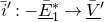 $\bar{i}' : -\underline{\bar{E}}{}^*_1 \rightarrow \underline{\bar{V}}{}'$
.
$\bar{i}' : -\underline{\bar{E}}{}^*_1 \rightarrow \underline{\bar{V}}{}'$
.
Let $Z = p^{-1}(\mathop{\mathrm{Tor}}\nolimits H_q(M_0)) \leqslant V$
; then
$Z = p^{-1}(\mathop{\mathrm{Tor}}\nolimits H_q(M_0)) \leqslant V$
; then $\bar{Z} = \mathop{\mathrm{Ker}}\nolimits \bar{p} \leqslant \bar{V}$
. Let
$\bar{Z} = \mathop{\mathrm{Ker}}\nolimits \bar{p} \leqslant \bar{V}$
. Let $\bar{Y} = \mathop{\mathrm{Im}}\nolimits \bar{i}$
; then
$\bar{Y} = \mathop{\mathrm{Im}}\nolimits \bar{i}$
; then $\bar{V} = \bar{Y} \oplus \bar{Z}$
. We have
$\bar{V} = \bar{Y} \oplus \bar{Z}$
. We have $\bar{\mu}(x) = \bar{\mu}_0(\bar{p}(x)) = \bar{\mu}_0(0) = 0$
and
$\bar{\mu}(x) = \bar{\mu}_0(\bar{p}(x)) = \bar{\mu}_0(0) = 0$
and $\bar{\lambda}(x,y) = \bar{\lambda}_0(\bar{p}(x), \bar{p}(y)) = 0$
for every
$\bar{\lambda}(x,y) = \bar{\lambda}_0(\bar{p}(x), \bar{p}(y)) = 0$
for every $x \in \bar{Z}$
,
$x \in \bar{Z}$
, $y \in \bar{V}$
. Therefore,
$y \in \bar{V}$
. Therefore, $\bar{\lambda} \big| _{\bar{Z} \times \bar{Z}} = 0$
and
$\bar{\lambda} \big| _{\bar{Z} \times \bar{Z}} = 0$
and $\bar{\mu} \big| _{\bar{Z}} = 0$
, and
$\bar{\mu} \big| _{\bar{Z}} = 0$
, and $\underline{\bar{V}} = \underline{\bar{Y}} \oplus \underline{\bar{Z}}$
, where
$\underline{\bar{V}} = \underline{\bar{Y}} \oplus \underline{\bar{Z}}$
, where $\underline{\bar{Y}} = (\bar{Y}, \bar{\lambda} \big| _{\bar{Y} \times \bar{Y}}, \bar{\mu} \big| _{\bar{Y}})$
and
$\underline{\bar{Y}} = (\bar{Y}, \bar{\lambda} \big| _{\bar{Y} \times \bar{Y}}, \bar{\mu} \big| _{\bar{Y}})$
and $\underline{\bar{Z}} = (\bar{Z},0,0)$
. Moreover,
$\underline{\bar{Z}} = (\bar{Z},0,0)$
. Moreover, $\bar{i} : \underline{\bar{E}}_0 \rightarrow \underline{\bar{Y}}$
is an isomorphism of extended quadratic forms.
$\bar{i} : \underline{\bar{E}}_0 \rightarrow \underline{\bar{Y}}$
is an isomorphism of extended quadratic forms.
Similarly, let $Z' = (p')^{-1}(\mathop{\mathrm{Tor}}\nolimits H_q(M_1)) \leqslant V'$
so that
$Z' = (p')^{-1}(\mathop{\mathrm{Tor}}\nolimits H_q(M_1)) \leqslant V'$
so that $\bar{Z}' = \mathop{\mathrm{Ker}}\nolimits \bar{p}'$
, and let
$\bar{Z}' = \mathop{\mathrm{Ker}}\nolimits \bar{p}'$
, and let $\bar{Y}' = \mathop{\mathrm{Im}}\nolimits \bar{i}'$
. If
$\bar{Y}' = \mathop{\mathrm{Im}}\nolimits \bar{i}'$
. If $\underline{\bar{Y}}{}' = (\bar{Y}', \bar{\lambda} \big| _{\bar{Y}' \times \bar{Y}'}, \bar{\mu} \big| _{\bar{Y}'})$
and
$\underline{\bar{Y}}{}' = (\bar{Y}', \bar{\lambda} \big| _{\bar{Y}' \times \bar{Y}'}, \bar{\mu} \big| _{\bar{Y}'})$
and $\underline{\bar{Z}}{}' = (\bar{Z}',0,0)$
, then
$\underline{\bar{Z}}{}' = (\bar{Z}',0,0)$
, then $\underline{\bar{V}}{}' = \underline{\bar{Y}}{}' \oplus \underline{\bar{Z}}{}'$
and
$\underline{\bar{V}}{}' = \underline{\bar{Y}}{}' \oplus \underline{\bar{Z}}{}'$
and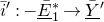 $\bar{i}' : -\underline{\bar{E}}{}^*_1 \rightarrow \underline{\bar{Y}}{}'$
is an isomorphism of extended quadratic forms.
$\bar{i}' : -\underline{\bar{E}}{}^*_1 \rightarrow \underline{\bar{Y}}{}'$
is an isomorphism of extended quadratic forms.
Since $\lambda(x,y) = 0$
for every
$\lambda(x,y) = 0$
for every $x \in V$
,
$x \in V$
, $y \in V'$
, we get that
$y \in V'$
, we get that $\bar{\lambda}(x,y) = 0$
for every
$\bar{\lambda}(x,y) = 0$
for every $x \in \bar{V}$
,
$x \in \bar{V}$
, $y \in \bar{V}'$
, in particular
$y \in \bar{V}'$
, in particular $\bar{V}' \leqslant \bar{V}^{\perp}$
. Since
$\bar{V}' \leqslant \bar{V}^{\perp}$
. Since $\bar{V}'$
is a direct summand in
$\bar{V}'$
is a direct summand in $\bar{M}$
and
$\bar{M}$
and $\mathop{\mathrm{rk}}\nolimits \bar{V}' = \frac{1}{2} \mathop{\mathrm{rk}}\nolimits \underline{M} = \mathop{\mathrm{rk}}\nolimits \bar{V}^{\perp}$
, this implies that
$\mathop{\mathrm{rk}}\nolimits \bar{V}' = \frac{1}{2} \mathop{\mathrm{rk}}\nolimits \underline{M} = \mathop{\mathrm{rk}}\nolimits \bar{V}^{\perp}$
, this implies that $\bar{V}' = \bar{V}^{\perp}$
. Similarly,
$\bar{V}' = \bar{V}^{\perp}$
. Similarly, $\bar{V} = (\bar{V}')^{\perp}$
.
$\bar{V} = (\bar{V}')^{\perp}$
.
Since $\underline{\bar{V}} = \underline{\bar{Y}} \oplus \underline{\bar{Z}}$
and
$\underline{\bar{V}} = \underline{\bar{Y}} \oplus \underline{\bar{Z}}$
and $\bar{\lambda}(x,y) = 0$
for every
$\bar{\lambda}(x,y) = 0$
for every $x \in \bar{Z}$
,
$x \in \bar{Z}$
, $y \in \bar{V}$
, we have
$y \in \bar{V}$
, we have $\bar{Z} \leqslant \bar{V} \cap \bar{V}^{\perp}$
. On the other hand,
$\bar{Z} \leqslant \bar{V} \cap \bar{V}^{\perp}$
. On the other hand, $\underline{\bar{Y}} \cong \underline{\bar{E}}_0$
is non-singular, so
$\underline{\bar{Y}} \cong \underline{\bar{E}}_0$
is non-singular, so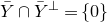 $\bar{Y} \cap \bar{Y}^{\perp} = \{ 0 \}$
, hence
$\bar{Y} \cap \bar{Y}^{\perp} = \{ 0 \}$
, hence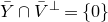 $\bar{Y} \cap \bar{V}^{\perp} = \{ 0 \}$
. Therefore,
$\bar{Y} \cap \bar{V}^{\perp} = \{ 0 \}$
. Therefore, $\bar{V} \cap \bar{V}^{\perp} = \bar{Z}$
. Similarly,
$\bar{V} \cap \bar{V}^{\perp} = \bar{Z}$
. Similarly, $\bar{V}' \cap (\bar{V}')^{\perp} = \bar{Z}'$
. Together with our earlier observations, this means that
$\bar{V}' \cap (\bar{V}')^{\perp} = \bar{Z}'$
. Together with our earlier observations, this means that $\bar{Z} = \bar{V} \cap \bar{V}' = \bar{Z}'$
. So we have
$\bar{Z} = \bar{V} \cap \bar{V}' = \bar{Z}'$
. So we have $\bar{V} = \bar{Y} \oplus \bar{Z}$
,
$\bar{V} = \bar{Y} \oplus \bar{Z}$
, $\bar{V}' = \bar{Y}' \oplus \bar{Z}$
and
$\bar{V}' = \bar{Y}' \oplus \bar{Z}$
and $\bar{V} \cap \bar{V}' = \bar{Z}$
, which implies that
$\bar{V} \cap \bar{V}' = \bar{Z}$
, which implies that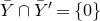 $\bar{Y} \cap \bar{Y}' = \{ 0 \}$
.
$\bar{Y} \cap \bar{Y}' = \{ 0 \}$
.
Let $\bar{N} = \bar{Y} \oplus \bar{Y}'$
and
$\bar{N} = \bar{Y} \oplus \bar{Y}'$
and $\underline{\bar{N}} = (\bar{N}, \bar{\lambda} \big| _{\bar{N} \times \bar{N}}, \bar{\mu} \big| _{\bar{N}}) = \underline{\bar{Y}} \oplus \underline{\bar{Y}}{}'$
. Then
$\underline{\bar{N}} = (\bar{N}, \bar{\lambda} \big| _{\bar{N} \times \bar{N}}, \bar{\mu} \big| _{\bar{N}}) = \underline{\bar{Y}} \oplus \underline{\bar{Y}}{}'$
. Then $\bar{i} \oplus \bar{i}' : \underline{\bar{E}}_0 \oplus (-\underline{\bar{E}}{}^*_1) \rightarrow \underline{\bar{N}}$
is an isomorphism, so
$\bar{i} \oplus \bar{i}' : \underline{\bar{E}}_0 \oplus (-\underline{\bar{E}}{}^*_1) \rightarrow \underline{\bar{N}}$
is an isomorphism, so $\underline{\bar{N}}$
is non-singular, hence by Lemma 2.6 we have
$\underline{\bar{N}}$
is non-singular, hence by Lemma 2.6 we have $\bar{M} = \bar{N} \oplus \bar{N}^{\perp}$
. Let
$\bar{M} = \bar{N} \oplus \bar{N}^{\perp}$
. Let $\bar{N}' = \bar{N}^{\perp}$
and
$\bar{N}' = \bar{N}^{\perp}$
and $\underline{\bar{N}}{}' = (\bar{N}', \bar{\lambda} \big| _{\bar{N}' \times \bar{N}'}, \bar{\mu} \big| _{\bar{N}'})$
; then
$\underline{\bar{N}}{}' = (\bar{N}', \bar{\lambda} \big| _{\bar{N}' \times \bar{N}'}, \bar{\mu} \big| _{\bar{N}'})$
; then $\underline{\bar{M}} = \underline{\bar{N}} \oplus \underline{\bar{N}}{}'$
.
$\underline{\bar{M}} = \underline{\bar{N}} \oplus \underline{\bar{N}}{}'$
.
We already saw that $\bar{\lambda} \big| _{\bar{Z} \times \bar{Z}} = 0$
and
$\bar{\lambda} \big| _{\bar{Z} \times \bar{Z}} = 0$
and $\bar{\mu} \big| _{\bar{Z}} = 0$
. Also,
$\bar{\mu} \big| _{\bar{Z}} = 0$
. Also, $\bar{Z}$
is a direct summand in
$\bar{Z}$
is a direct summand in $\bar{V}$
, hence in
$\bar{V}$
, hence in $\bar{M}$
, hence in
$\bar{M}$
, hence in $\bar{N}'$
. Finally,
$\bar{N}'$
. Finally, $\mathop{\mathrm{rk}}\nolimits \bar{Z} = \mathop{\mathrm{rk}}\nolimits \bar{V} - \mathop{\mathrm{rk}}\nolimits \bar{Y} = \frac{1}{2}(\mathop{\mathrm{rk}}\nolimits \underline{\bar{M}} - \mathop{\mathrm{rk}}\nolimits \underline{\bar{N}}) = \frac{1}{2} \mathop{\mathrm{rk}}\nolimits \underline{\bar{N}}{}'$
. Therefore,
$\mathop{\mathrm{rk}}\nolimits \bar{Z} = \mathop{\mathrm{rk}}\nolimits \bar{V} - \mathop{\mathrm{rk}}\nolimits \bar{Y} = \frac{1}{2}(\mathop{\mathrm{rk}}\nolimits \underline{\bar{M}} - \mathop{\mathrm{rk}}\nolimits \underline{\bar{N}}) = \frac{1}{2} \mathop{\mathrm{rk}}\nolimits \underline{\bar{N}}{}'$
. Therefore, $\bar{Z}$
is a Lagrangian in
$\bar{Z}$
is a Lagrangian in $\underline{\bar{N}}{}'$
.
$\underline{\bar{N}}{}'$
.
By assumption $\bar{K}$
is a Lagrangian in
$\bar{K}$
is a Lagrangian in $\underline{\bar{E}}_0 \oplus (-\underline{\bar{E}}{}^*_1)$
, so
$\underline{\bar{E}}_0 \oplus (-\underline{\bar{E}}{}^*_1)$
, so $(\bar{i} \oplus \bar{i}')(\bar{K})$
is a Lagrangian in
$(\bar{i} \oplus \bar{i}')(\bar{K})$
is a Lagrangian in $\underline{\bar{N}}$
. Therefore,
$\underline{\bar{N}}$
. Therefore, $(\bar{i} \oplus \bar{i}')(\bar{K}) \oplus \bar{Z}$
is a Lagrangian in
$(\bar{i} \oplus \bar{i}')(\bar{K}) \oplus \bar{Z}$
is a Lagrangian in $\underline{\bar{N}} \oplus \underline{\bar{N}}{}' = \underline{\bar{M}}$
.
$\underline{\bar{N}} \oplus \underline{\bar{N}}{}' = \underline{\bar{M}}$
.
We can now compute $[\bar{\theta}_{W,F}]$
:
$[\bar{\theta}_{W,F}]$
:
 \[\begin{aligned}\bar{\theta}_{W,F} &\mathrel{\underset{^{\scriptstyle{s}}}{\cong}} (\underline{\bar{M}}; \bar{L}, \bar{V}) \\ &\sim (\underline{\bar{M}}; \bar{L}, (\bar{i} \oplus \bar{i}')(\bar{K}) \oplus \bar{Z}) \oplus (\underline{\bar{M}}; (\bar{i} \oplus \bar{i}')(\bar{K}) \oplus \bar{Z}, \bar{V}) \\ &= (\underline{\bar{M}}; \bar{L}, (\bar{i} \oplus \bar{i}')(\bar{K}) \oplus \bar{Z}) \oplus (\underline{\bar{N}} \oplus \underline{\bar{N}}{}'; (\bar{i} \oplus \bar{i}')(\bar{K}) \oplus \bar{Z}, \bar{Y} \oplus \bar{Z}) \\ &= (\underline{\bar{M}}; \bar{L}, (\bar{i} \oplus \bar{i}')(\bar{K}) \oplus \bar{Z}) \oplus (\underline{\bar{N}}; (\bar{i} \oplus \bar{i}')(\bar{K}), \bar{Y}) \oplus (\underline{\bar{N}}{}'; \bar{Z}, \bar{Z}) \\ &\sim (\underline{\bar{M}}; \bar{L}, (\bar{i} \oplus \bar{i}')(\bar{K}) \oplus \bar{Z}) \oplus (\underline{\bar{N}}; (\bar{i} \oplus \bar{i}')(\bar{K}), \bar{Y}) \\ &\cong (\underline{\bar{M}}; \bar{L}, (\bar{i} \oplus \bar{i}')(\bar{K}) \oplus \bar{Z}) \oplus (\underline{\bar{E}}_0 \oplus (-\underline{\bar{E}}{}^*_1); \bar{K}, \bar{E}_0),\end{aligned} \]
where we used Theorem 4.26, Lemma 4.24 and the isomorphism $\bar{i} \oplus \bar{i}'$
. Let
$\bar{i} \oplus \bar{i}'$
. Let $x = [\underline{\bar{M}}; \bar{L}, (\bar{i} \oplus \bar{i}')(\bar{K}) \oplus \bar{Z}] \in L_{2q+1}(B,\xi)$
; then
$x = [\underline{\bar{M}}; \bar{L}, (\bar{i} \oplus \bar{i}')(\bar{K}) \oplus \bar{Z}] \in L_{2q+1}(B,\xi)$
; then $[\bar{\theta}_{W,F}] = x \oplus [\underline{\bar{E}}_0 \oplus (-\underline{\bar{E}}{}^*_1); \bar{K}, \bar{E}_0]$
.
$[\bar{\theta}_{W,F}] = x \oplus [\underline{\bar{E}}_0 \oplus (-\underline{\bar{E}}{}^*_1); \bar{K}, \bar{E}_0]$
.
8. Proof of the Q-form conjecture when
$H_q(B)$
is free

Proof of Theorem 1.2. First we apply surgery below the middle dimension to get a q-connected normal bordism $F : W \rightarrow B$
which is normally bordant to
$F : W \rightarrow B$
which is normally bordant to $F_0$
(see [Reference KreckKre99, Proposition 4]). We have
$F_0$
(see [Reference KreckKre99, Proposition 4]). We have $H_i(M_0) \cong H_i(M_1)$
for every i (by the assumptions that
$H_i(M_0) \cong H_i(M_1)$
for every i (by the assumptions that $f_0$
and
$f_0$
and $f_1$
are q-connected and
$f_1$
are q-connected and $E_q(M_0,f_0) \cong E_q(M_1,f_1)$
, and Poincaré duality), hence
$E_q(M_0,f_0) \cong E_q(M_1,f_1)$
, and Poincaré duality), hence $\chi(M_0)=\chi(M_1)$
. In this setting the surgery obstruction
$\chi(M_0)=\chi(M_1)$
. In this setting the surgery obstruction $\theta_{W,F} \in \mathscr{s}^T_{2q+1}(B,\xi)$
is defined. Let
$\theta_{W,F} \in \mathscr{s}^T_{2q+1}(B,\xi)$
is defined. Let $[\bar{\theta}_{W,F}] \in \ell_{2q+1}(B,\xi)$
denote the element corresponding to
$[\bar{\theta}_{W,F}] \in \ell_{2q+1}(B,\xi)$
denote the element corresponding to $[\theta_{W,F}] \in \ell^T_{2q+1}(B,\xi)$
under the bijection of Proposition 4.14.
$[\theta_{W,F}] \in \ell^T_{2q+1}(B,\xi)$
under the bijection of Proposition 4.14.
We define $\underline{E}_i$
,
$\underline{E}_i$
, $\bar{E}_i$
and
$\bar{E}_i$
and $\underline{\bar{E}}_i$
as before (using that
$\underline{\bar{E}}_i$
as before (using that $H_q(B)$
is free). By assumption there is an isomorphism
$H_q(B)$
is free). By assumption there is an isomorphism $I : \underline{E}_0 \rightarrow \underline{E}_1$
that induces an isomorphism
$I : \underline{E}_0 \rightarrow \underline{E}_1$
that induces an isomorphism $\bar{I} : \underline{\bar{E}}_0 \rightarrow \underline{\bar{E}}_1$
. By Lemma 2.18(b),
$\bar{I} : \underline{\bar{E}}_0 \rightarrow \underline{\bar{E}}_1$
. By Lemma 2.18(b),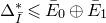 $\Delta^*_{\bar{I}} \leqslant \bar{E}_0 \oplus \bar{E}_1$
is a Lagrangian in
$\Delta^*_{\bar{I}} \leqslant \bar{E}_0 \oplus \bar{E}_1$
is a Lagrangian in $\underline{\bar{E}}_0 \oplus (-\underline{\bar{E}}{}^*_1)$
. By Theorem 7.6 and Remark 7.7 we have
$\underline{\bar{E}}_0 \oplus (-\underline{\bar{E}}{}^*_1)$
. By Theorem 7.6 and Remark 7.7 we have $[\bar{\theta}_{W,F}] = [\underline{\bar{E}}_0 \oplus (-\underline{\bar{E}}{}^*_1); \Delta^*_{\bar{I}}, \bar{E}_0]$
.
$[\bar{\theta}_{W,F}] = [\underline{\bar{E}}_0 \oplus (-\underline{\bar{E}}{}^*_1); \Delta^*_{\bar{I}}, \bar{E}_0]$
.
We have $\Delta^*_{\bar{I}} \oplus \bar{E}_0 = \bar{E}_0 \oplus \bar{E}_1$
, because
$\Delta^*_{\bar{I}} \oplus \bar{E}_0 = \bar{E}_0 \oplus \bar{E}_1$
, because $\Delta^*_{\bar{I}}$
is the anti-diagonal in
$\Delta^*_{\bar{I}}$
is the anti-diagonal in $\bar{E}_0 \oplus \bar{E}_1$
(with respect to the isomorphism
$\bar{E}_0 \oplus \bar{E}_1$
(with respect to the isomorphism $\bar{I}$
). This means that
$\bar{I}$
). This means that $[\underline{\bar{E}}_0 \oplus (-\underline{\bar{E}}{}^*_1); \Delta^*_{\bar{I}}, \bar{E}_0]$
, and hence
$[\underline{\bar{E}}_0 \oplus (-\underline{\bar{E}}{}^*_1); \Delta^*_{\bar{I}}, \bar{E}_0]$
, and hence $[\bar{\theta}_{W,F}]$
is elementary. Therefore,
$[\bar{\theta}_{W,F}]$
is elementary. Therefore, $[\theta_{W,F}]$
, the corresponding element of
$[\theta_{W,F}]$
, the corresponding element of $\ell^T_{2q+1}(B,\xi)$
, is elementary too (see Remark 4.18). Then, by Proposition 6.30, F is normally bordant to a normal bordism
$\ell^T_{2q+1}(B,\xi)$
, is elementary too (see Remark 4.18). Then, by Proposition 6.30, F is normally bordant to a normal bordism $F' : W' \rightarrow B$
such that W’ is an h-cobordism.
$F' : W' \rightarrow B$
such that W’ is an h-cobordism.
9. Inertia groups
In this section we prove Theorem 1.8. The proof is a simplified version of the argument given in [Nagy21, § 5.2.3], which identifies the extended inertia group of a polarised 8-dimensional E-manifold with the kernel of a bordism map (noting that in the case of a 3-connected 8-manifold the polarisation is trivial). As explained in § 1.4, the $I(M) \leqslant \mathop{\mathrm{Ker}}\nolimits(\eta_{2q}^A)$
direction of Theorem 1.8 follows from a classical argument, and the
$I(M) \leqslant \mathop{\mathrm{Ker}}\nolimits(\eta_{2q}^A)$
direction of Theorem 1.8 follows from a classical argument, and the $I(M) \geqslant \mathop{\mathrm{Ker}}\nolimits(\eta_{2q}^A)$
direction uses the special case of the Q-form conjecture.
$I(M) \geqslant \mathop{\mathrm{Ker}}\nolimits(\eta_{2q}^A)$
direction uses the special case of the Q-form conjecture.
Recall that $\nu_M$
denotes the stable normal bundle of a manifold M, as well as its classifying map
$\nu_M$
denotes the stable normal bundle of a manifold M, as well as its classifying map $\nu_M : M \rightarrow BSO$
.
$\nu_M : M \rightarrow BSO$
.
Definition 9.1. For a positive integer q and a subgroup $A \leqslant \pi_q(BSO)$
let
$A \leqslant \pi_q(BSO)$
let $g : BSO\langle q, A\rangle \rightarrow BSO$
be a fibration such that
$g : BSO\langle q, A\rangle \rightarrow BSO$
be a fibration such that $\pi_i(BSO\langle q, A\rangle) \cong 0$
for
$\pi_i(BSO\langle q, A\rangle) \cong 0$
for $i < q$
,
$i < q$
, $\pi_q(g) : \pi_q(BSO\langle q, A\rangle) \rightarrow \pi_q(BSO)$
is an injective map with image A and
$\pi_q(g) : \pi_q(BSO\langle q, A\rangle) \rightarrow \pi_q(BSO)$
is an injective map with image A and $\pi_i(g)$
is an isomorphism for
$\pi_i(g)$
is an isomorphism for $i \gt q$
. Let
$i \gt q$
. Let $\xi_{q,A} = g^*(\gamma) \rightarrow BSO\langle q, A\rangle$
be the pullback of the universal oriented vector bundle
$\xi_{q,A} = g^*(\gamma) \rightarrow BSO\langle q, A\rangle$
be the pullback of the universal oriented vector bundle $\gamma \rightarrow BSO$
.
$\gamma \rightarrow BSO$
.
The conditions of Definition 9.1 determine $BSO\langle q, A\rangle$
up to homotopy equivalence (compatible with g). To see that a fibration satisfying the conditions exists, we can take
$BSO\langle q, A\rangle$
up to homotopy equivalence (compatible with g). To see that a fibration satisfying the conditions exists, we can take $BSO\langle q, A\rangle$
to be, for example, the homotopy fibre of the map
$BSO\langle q, A\rangle$
to be, for example, the homotopy fibre of the map $BSO\left\langle q \right\rangle \rightarrow K(\pi_q(BSO) / A, q)$
inducing the quotient homomorphism
$BSO\left\langle q \right\rangle \rightarrow K(\pi_q(BSO) / A, q)$
inducing the quotient homomorphism $\pi_q(BSO) \rightarrow \pi_q(BSO) / A$
on
$\pi_q(BSO) \rightarrow \pi_q(BSO) / A$
on $\pi_q$
(where
$\pi_q$
(where $BSO\left\langle q \right\rangle$
is the
$BSO\left\langle q \right\rangle$
is the $(q{-}1)$
-connected cover of BSO), with g the composition
$(q{-}1)$
-connected cover of BSO), with g the composition $BSO\langle q, A\rangle \rightarrow BSO\left\langle q \right\rangle \rightarrow BSO$
.
$BSO\langle q, A\rangle \rightarrow BSO\left\langle q \right\rangle \rightarrow BSO$
.
Proposition 9.2. Suppose that M is a $(q{-}1)$
-connected manifold (of any dimension, possibly with boundary), and let
$(q{-}1)$
-connected manifold (of any dimension, possibly with boundary), and let $A \leqslant \pi_q(BSO)$
be a subgroup such that
$A \leqslant \pi_q(BSO)$
be a subgroup such that $\mathop{\mathrm{Im}}\nolimits(\pi_q(\nu_M)) \leqslant A$
. Then up to homotopy there is a unique normal map.
$\mathop{\mathrm{Im}}\nolimits(\pi_q(\nu_M)) \leqslant A$
. Then up to homotopy there is a unique normal map.

Moreover, if $A = \mathop{\mathrm{Im}}\nolimits(\pi_q(\nu_M))$
, then this normal map is a normal
$A = \mathop{\mathrm{Im}}\nolimits(\pi_q(\nu_M))$
, then this normal map is a normal $(q{-}1)$
-smoothing.
$(q{-}1)$
-smoothing.
In particular, if $A = \mathop{\mathrm{Im}}\nolimits(\pi_q(\nu_M))$
, then
$A = \mathop{\mathrm{Im}}\nolimits(\pi_q(\nu_M))$
, then $(BSO\langle q, A\rangle,\xi_{q,A})$
is the normal
$(BSO\langle q, A\rangle,\xi_{q,A})$
is the normal $(q{-}1)$
-type of M.
$(q{-}1)$
-type of M.
Proof. For the existence of such a normal map we need to show that $\nu_M : M \rightarrow BSO$
can be lifted to a map
$\nu_M : M \rightarrow BSO$
can be lifted to a map $f : M \rightarrow BSO\langle q, A\rangle$
. Since M is
$f : M \rightarrow BSO\langle q, A\rangle$
. Since M is $(q{-}1)$
-connected, it is homotopy equivalent to a CW complex whose q-skeleton is a wedge of q-spheres. So the restriction of
$(q{-}1)$
-connected, it is homotopy equivalent to a CW complex whose q-skeleton is a wedge of q-spheres. So the restriction of $\nu_M$
to the q-skeleton amounts to a choice of some elements in
$\nu_M$
to the q-skeleton amounts to a choice of some elements in $\pi_q(BSO)$
, which are in
$\pi_q(BSO)$
, which are in $\mathop{\mathrm{Im}}\nolimits(\pi_q(\nu_M))$
. Since
$\mathop{\mathrm{Im}}\nolimits(\pi_q(\nu_M))$
. Since $\mathop{\mathrm{Im}}\nolimits(\pi_q(\nu_M))$
is contained in
$\mathop{\mathrm{Im}}\nolimits(\pi_q(\nu_M))$
is contained in $A = \mathop{\mathrm{Im}}\nolimits(\pi_q(g) : \pi_q(BSO\langle q, A\rangle) \rightarrow \pi_q(BSO))$
, this restriction can be lifted to
$A = \mathop{\mathrm{Im}}\nolimits(\pi_q(g) : \pi_q(BSO\langle q, A\rangle) \rightarrow \pi_q(BSO))$
, this restriction can be lifted to $BSO\langle q, A\rangle$
. The obstructions to lifting the map on the higher-dimensional cells are in the groups
$BSO\langle q, A\rangle$
. The obstructions to lifting the map on the higher-dimensional cells are in the groups $H^i(M;\pi_{i-1}(F))$
for
$H^i(M;\pi_{i-1}(F))$
for $i \gt q$
, where F denotes the fibre of
$i \gt q$
, where F denotes the fibre of $g : BSO\langle q, A\rangle \rightarrow BSO$
. By the definition of
$g : BSO\langle q, A\rangle \rightarrow BSO$
. By the definition of $BSO\langle q, A\rangle$
we have
$BSO\langle q, A\rangle$
we have $\pi_i(F) \cong 0$
for
$\pi_i(F) \cong 0$
for $i \geqslant q$
, so all of the obstructions vanish. Therefore, there is a map
$i \geqslant q$
, so all of the obstructions vanish. Therefore, there is a map $f : M \rightarrow BSO\langle q, A\rangle$
which lifts
$f : M \rightarrow BSO\langle q, A\rangle$
which lifts $\nu_M$
(and hence is covered by a bundle map). Moreover,
$\nu_M$
(and hence is covered by a bundle map). Moreover, $\pi_i(M) \cong \pi_i(BSO\langle q, A\rangle) \cong 0$
for
$\pi_i(M) \cong \pi_i(BSO\langle q, A\rangle) \cong 0$
for $i < q$
, and if
$i < q$
, and if $A = \mathop{\mathrm{Im}}\nolimits(\pi_q(\nu_M))$
, then
$A = \mathop{\mathrm{Im}}\nolimits(\pi_q(\nu_M))$
, then $\pi_q(f)$
is surjective (because
$\pi_q(f)$
is surjective (because $\mathop{\mathrm{Im}}\nolimits(\pi_q(g) \circ \pi_q(f)) = \mathop{\mathrm{Im}}\nolimits(\pi_q(\nu_M)) = A$
and
$\mathop{\mathrm{Im}}\nolimits(\pi_q(g) \circ \pi_q(f)) = \mathop{\mathrm{Im}}\nolimits(\pi_q(\nu_M)) = A$
and $\pi_q(g) : \pi_q(BSO\langle q, A\rangle) \rightarrow A$
is an isomorphism), so f is q-connected.
$\pi_q(g) : \pi_q(BSO\langle q, A\rangle) \rightarrow A$
is an isomorphism), so f is q-connected.
For the uniqueness we need to show that the space of normal maps $\nu_M \rightarrow \xi_{q,A}$
is path-connected. This space is homeomorphic to the space of bundle maps
$\nu_M \rightarrow \xi_{q,A}$
is path-connected. This space is homeomorphic to the space of bundle maps $F(\nu_M) \rightarrow F(\xi_{q,A})$
, where
$F(\nu_M) \rightarrow F(\xi_{q,A})$
, where $F(\nu_M)$
and
$F(\nu_M)$
and $F(\xi_{q,A})$
denote the oriented frame bundles of
$F(\xi_{q,A})$
denote the oriented frame bundles of $\nu_M$
and
$\nu_M$
and $\xi_{q,A}$
, respectively. Since
$\xi_{q,A}$
, respectively. Since $F(\nu_M)$
and
$F(\nu_M)$
and $F(\xi_{q,A})$
are principal SO-bundles, a continuous map
$F(\xi_{q,A})$
are principal SO-bundles, a continuous map $F(\nu_M) \rightarrow F(\xi_{q,A})$
is a bundle map if and only if it is SO-equivariant.
$F(\nu_M) \rightarrow F(\xi_{q,A})$
is a bundle map if and only if it is SO-equivariant.
By [Reference HusemollerHus94, Theorem 4 (8.1)] the space of SO-equivariant maps has the following equivalent description. There is a well-defined map $F(\nu_M) \times_{SO} F(\xi_{q,A}) \rightarrow F(\nu_M) / SO$
given by
$F(\nu_M) \times_{SO} F(\xi_{q,A}) \rightarrow F(\nu_M) / SO$
given by $[x,y] \mapsto [x]$
, and it is the projection of a locally trivial bundle over
$[x,y] \mapsto [x]$
, and it is the projection of a locally trivial bundle over $F(\nu_M) / SO = M$
with fibre
$F(\nu_M) / SO = M$
with fibre $F(\xi_{q,A})$
(which is associated to the principal SO-bundle
$F(\xi_{q,A})$
(which is associated to the principal SO-bundle $F(\nu_M)$
). A section
$F(\nu_M)$
). A section $s : M \rightarrow F(\nu_M) \times_{SO} F(\xi_{q,A})$
determines a well-defined SO-equivariant map
$s : M \rightarrow F(\nu_M) \times_{SO} F(\xi_{q,A})$
determines a well-defined SO-equivariant map $\bar{f}_s : F(\nu_M) \rightarrow F(\xi_{q,A})$
given by
$\bar{f}_s : F(\nu_M) \rightarrow F(\xi_{q,A})$
given by $\bar{f}_s(x)=y$
whenever
$\bar{f}_s(x)=y$
whenever $[x,y] \in \mathop{\mathrm{Im}}\nolimits(s)$
. This correspondence is a homeomorphism between the space of sections of
$[x,y] \in \mathop{\mathrm{Im}}\nolimits(s)$
. This correspondence is a homeomorphism between the space of sections of $F(\nu_M) \times_{SO} F(\xi_{q,A})$
and the space of SO-equivariant maps
$F(\nu_M) \times_{SO} F(\xi_{q,A})$
and the space of SO-equivariant maps $F(\nu_M) \rightarrow F(\xi_{q,A})$
.
$F(\nu_M) \rightarrow F(\xi_{q,A})$
.
So it is enough to show that the space of sections of $F(\nu_M) \times_{SO} F(\xi_{q,A})$
is path-connected. Given any two sections, the obstructions to the existence of a homotopy between them are in the groups
$F(\nu_M) \times_{SO} F(\xi_{q,A})$
is path-connected. Given any two sections, the obstructions to the existence of a homotopy between them are in the groups $H^i(\Sigma M;\pi_{i-1}(F(\xi_{q,A}))) \cong H^{i-1}(M;\pi_{i-1}(F(\xi_{q,A})))$
. Since M is
$H^i(\Sigma M;\pi_{i-1}(F(\xi_{q,A}))) \cong H^{i-1}(M;\pi_{i-1}(F(\xi_{q,A})))$
. Since M is $(q{-}1)$
-connected, these groups vanish if
$(q{-}1)$
-connected, these groups vanish if $i \leqslant q$
. Hence, it is enough to show that
$i \leqslant q$
. Hence, it is enough to show that $\pi_i(F(\xi_{q,A})) \cong 0$
for
$\pi_i(F(\xi_{q,A})) \cong 0$
for $i \geqslant q$
.
$i \geqslant q$
.
Since $\xi_{q,A}$
is the pullback of the universal oriented vector bundle
$\xi_{q,A}$
is the pullback of the universal oriented vector bundle $\gamma \rightarrow BSO$
, there is a commutative diagram between the homotopical long exact sequences of the associated principal SO-bundles.
$\gamma \rightarrow BSO$
, there is a commutative diagram between the homotopical long exact sequences of the associated principal SO-bundles.

Here $F(\gamma)=ESO$
is contractible, and by the definition of
$F(\gamma)=ESO$
is contractible, and by the definition of $BSO\langle q, A\rangle$
the map
$BSO\langle q, A\rangle$
the map $\pi_i(BSO\langle q, A\rangle) \rightarrow \pi_i(BSO)$
is an isomorphism for
$\pi_i(BSO\langle q, A\rangle) \rightarrow \pi_i(BSO)$
is an isomorphism for $i \gt q$
and injective for
$i \gt q$
and injective for $i=q$
. Therefore, by the 4-lemma we have
$i=q$
. Therefore, by the 4-lemma we have $\pi_i(F(\xi_{q,A})) \cong 0$
for
$\pi_i(F(\xi_{q,A})) \cong 0$
for $i \geqslant q$
.
$i \geqslant q$
.
Definition 9.3. Suppose that V is a $(q{-}1)$
-connected 2q-manifold with
$(q{-}1)$
-connected 2q-manifold with $\partial V \approx S^{2q-1}$
. Let
$\partial V \approx S^{2q-1}$
. Let $C^{2q}_V$
be the set of diffeomorphism classes of 2q-manifolds M such that
$C^{2q}_V$
be the set of diffeomorphism classes of 2q-manifolds M such that $M \setminus \mathop{\mathrm{int}}\nolimits D^{2q} \approx V$
.
$M \setminus \mathop{\mathrm{int}}\nolimits D^{2q} \approx V$
.
The group $\Theta_{2q}$
acts transitively on
$\Theta_{2q}$
acts transitively on $C^{2q}_V$
via connected sum. If
$C^{2q}_V$
via connected sum. If $M \in C^{2q}_V$
, then M is
$M \in C^{2q}_V$
, then M is $(q{-}1)$
-connected,
$(q{-}1)$
-connected, $\pi_q(M) \cong \pi_q(V)$
and
$\pi_q(M) \cong \pi_q(V)$
and $\mathop{\mathrm{Im}}\nolimits(\pi_q(\nu_M)) = \mathop{\mathrm{Im}}\nolimits(\pi_q(\nu_V)) \leqslant \pi_q(BSO)$
.
$\mathop{\mathrm{Im}}\nolimits(\pi_q(\nu_M)) = \mathop{\mathrm{Im}}\nolimits(\pi_q(\nu_V)) \leqslant \pi_q(BSO)$
.
Definition 9.4. Suppose that V is a $(q{-}1)$
-connected 2q-manifold with
$(q{-}1)$
-connected 2q-manifold with $\partial V \approx S^{2q-1}$
and
$\partial V \approx S^{2q-1}$
and $A = \mathop{\mathrm{Im}}\nolimits(\pi_q(\nu_V))$
. Let
$A = \mathop{\mathrm{Im}}\nolimits(\pi_q(\nu_V))$
. Let $\eta_V : C^{2q}_V \rightarrow \Omega_{2q}(BSO\langle q, A\rangle; \xi_{q,A})$
denote the map which sends a manifold M to the bordism class of the normal map
$\eta_V : C^{2q}_V \rightarrow \Omega_{2q}(BSO\langle q, A\rangle; \xi_{q,A})$
denote the map which sends a manifold M to the bordism class of the normal map $M \rightarrow BSO\langle q, A\rangle$
.
$M \rightarrow BSO\langle q, A\rangle$
.
By Proposition 9.2 $\eta_V$
is well-defined. In the special case
$\eta_V$
is well-defined. In the special case $V = D^{2q}$
we have
$V = D^{2q}$
we have $C^{2q}_{D^{2q}} = \Theta_{2q}$
, so we get a map
$C^{2q}_{D^{2q}} = \Theta_{2q}$
, so we get a map $\eta_{D^{2q}} : \Theta_{2q} \rightarrow\Omega_{2q}(BSO\langle q, 0\rangle; \xi_{q,0})$
. This map is equal to
$\eta_{D^{2q}} : \Theta_{2q} \rightarrow\Omega_{2q}(BSO\langle q, 0\rangle; \xi_{q,0})$
. This map is equal to $\eta_{2q}^0$
from Definition 1.6, and in general
$\eta_{2q}^0$
from Definition 1.6, and in general $\eta_{2q}^A$
can be equivalently defined as the composition of
$\eta_{2q}^A$
can be equivalently defined as the composition of $\eta_{D^{2q}}$
and the homomorphism
$\eta_{D^{2q}}$
and the homomorphism $\Omega_{2q}(BSO\langle q,0\rangle; \xi_{q,0}) \rightarrow \Omega_{2q}(BSO\langle q, A\rangle; \xi_{q,A})$
induced by the fibration
$\Omega_{2q}(BSO\langle q,0\rangle; \xi_{q,0}) \rightarrow \Omega_{2q}(BSO\langle q, A\rangle; \xi_{q,A})$
induced by the fibration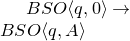 $BSO\langle q, 0\rangle \rightarrow BSO\langle q, A\rangle$
.
$BSO\langle q, 0\rangle \rightarrow BSO\langle q, A\rangle$
.
Proposition 9.5.
Suppose that V is a $(q{-}1)$
-connected 2q-manifold with
$(q{-}1)$
-connected 2q-manifold with $\partial V \approx S^{2q-1}$
and
$\partial V \approx S^{2q-1}$
and $A = \mathop{\mathrm{Im}}\nolimits(\pi_q(\nu_V))$
. If
$A = \mathop{\mathrm{Im}}\nolimits(\pi_q(\nu_V))$
. If $M \in C^{2q}_V$
and
$M \in C^{2q}_V$
and $\Sigma \in \Theta_{2q}$
, then
$\Sigma \in \Theta_{2q}$
, then $\eta_V(M \# \Sigma) = \eta_V(M) + \eta_{2q}^A(\Sigma) \in \Omega_{2q}(BSO\langle q, A\rangle; \xi_{q,A})$
.
$\eta_V(M \# \Sigma) = \eta_V(M) + \eta_{2q}^A(\Sigma) \in \Omega_{2q}(BSO\langle q, A\rangle; \xi_{q,A})$
.
Proof. The bordism class $\eta_V(M)$
is represented by a normal map
$\eta_V(M)$
is represented by a normal map $f : M \rightarrow BSO\langle q, A\rangle$
and
$f : M \rightarrow BSO\langle q, A\rangle$
and $\eta_{2q}^A(\Sigma)$
is represented by a normal map
$\eta_{2q}^A(\Sigma)$
is represented by a normal map $f_0 : \Sigma \rightarrow BSO\langle q, A\rangle$
. The connected sum
$f_0 : \Sigma \rightarrow BSO\langle q, A\rangle$
. The connected sum $M' := M \# \Sigma$
is formed using embeddings
$M' := M \# \Sigma$
is formed using embeddings $D^{2q} \rightarrow M$
and
$D^{2q} \rightarrow M$
and $D^{2q} \rightarrow \Sigma$
. When composed with f and
$D^{2q} \rightarrow \Sigma$
. When composed with f and $f_0$
respectively, these embeddings give homotopic maps
$f_0$
respectively, these embeddings give homotopic maps $D^{2q} \rightarrow BSO\langle q, A\rangle$
(covered by bundle maps). The homotopy
$D^{2q} \rightarrow BSO\langle q, A\rangle$
(covered by bundle maps). The homotopy $D^{2q} \times I \rightarrow BSO\langle q, A\rangle$
, together with the maps
$D^{2q} \times I \rightarrow BSO\langle q, A\rangle$
, together with the maps $f \circ \pi_1 : M \times I \rightarrow BSO\langle q, A\rangle$
and
$f \circ \pi_1 : M \times I \rightarrow BSO\langle q, A\rangle$
and $f_0 \circ \pi_1 : \Sigma \times I \rightarrow BSO\langle q, A\rangle$
(where
$f_0 \circ \pi_1 : \Sigma \times I \rightarrow BSO\langle q, A\rangle$
(where $\pi_1$
denotes the projection to the first component), defines a normal bordism
$\pi_1$
denotes the projection to the first component), defines a normal bordism $W := ((M \sqcup \Sigma) \times I) \cup (D^{2q} \times I) \rightarrow BSO\langle q, A\rangle$
between
$W := ((M \sqcup \Sigma) \times I) \cup (D^{2q} \times I) \rightarrow BSO\langle q, A\rangle$
between $f \sqcup f_0 : M \sqcup \Sigma \rightarrow BSO\langle q, A\rangle$
and
$f \sqcup f_0 : M \sqcup \Sigma \rightarrow BSO\langle q, A\rangle$
and $f' := f \# f_0 : M' \rightarrow BSO\langle q, A\rangle$
. This shows that f’ represents
$f' := f \# f_0 : M' \rightarrow BSO\langle q, A\rangle$
. This shows that f’ represents $\eta_V(M) + \eta_{2q}^A(\Sigma)$
. By Proposition 9.2, f’ also represents
$\eta_V(M) + \eta_{2q}^A(\Sigma)$
. By Proposition 9.2, f’ also represents $\eta_V(M')$
, therefore
$\eta_V(M')$
, therefore $\eta_V(M \# \Sigma) = \eta_V(M) + \eta_{2q}^A(\Sigma)$
.
$\eta_V(M \# \Sigma) = \eta_V(M) + \eta_{2q}^A(\Sigma)$
.
In the special case $V = D^{2q}$
we get that
$V = D^{2q}$
we get that $\eta_{D^{2q}}$
is a homomorphism, and hence the same is true for
$\eta_{D^{2q}}$
is a homomorphism, and hence the same is true for $\eta_{2q}^A$
. So we can use it to define an action of
$\eta_{2q}^A$
. So we can use it to define an action of $\Theta_{2q}$
on
$\Theta_{2q}$
on $\Omega_{2q}(BSO\langle q, A\rangle; \xi_{q,A})$
by
$\Omega_{2q}(BSO\langle q, A\rangle; \xi_{q,A})$
by $x^{\Sigma} = x + \eta_{2q}^A(\Sigma)$
, where
$x^{\Sigma} = x + \eta_{2q}^A(\Sigma)$
, where $x \in \Omega_{2q}(BSO\langle q, A\rangle; \xi_{q,A})$
and
$x \in \Omega_{2q}(BSO\langle q, A\rangle; \xi_{q,A})$
and $\Sigma \in \Theta_{2q}$
. Then Proposition 9.5 means that
$\Sigma \in \Theta_{2q}$
. Then Proposition 9.5 means that $\eta_V : C^{2q}_V \rightarrow \Omega_{2q}(BSO\langle q, A\rangle; \xi_{q,A})$
is
$\eta_V : C^{2q}_V \rightarrow \Omega_{2q}(BSO\langle q, A\rangle; \xi_{q,A})$
is $\Theta_{2q}$
-equivariant.
$\Theta_{2q}$
-equivariant.
Proposition 9.6.
Suppose that $q \geqslant 3$
, M is a
$q \geqslant 3$
, M is a $(q{-}1)$
-connected 2q-manifold and
$(q{-}1)$
-connected 2q-manifold and $A = \mathop{\mathrm{Im}}\nolimits(\pi_q(\nu_M))$
. Then
$A = \mathop{\mathrm{Im}}\nolimits(\pi_q(\nu_M))$
. Then $I(M) \leqslant \mathop{\mathrm{Ker}}\nolimits(\eta_{2q}^A : \Theta_{2q} \rightarrow \Omega_{2q}(BSO\langle q, A\rangle; \xi_{q,A}))$
.
$I(M) \leqslant \mathop{\mathrm{Ker}}\nolimits(\eta_{2q}^A : \Theta_{2q} \rightarrow \Omega_{2q}(BSO\langle q, A\rangle; \xi_{q,A}))$
.
Proof. Let $V = M \setminus \mathop{\mathrm{int}}\nolimits D^{2q}$
and suppose that
$V = M \setminus \mathop{\mathrm{int}}\nolimits D^{2q}$
and suppose that $\Sigma \in I(M)$
. Then
$\Sigma \in I(M)$
. Then $M \# \Sigma \approx M$
, so
$M \# \Sigma \approx M$
, so $\eta_V(M \# \Sigma) = \eta_V(M)$
. By Proposition 9.5,
$\eta_V(M \# \Sigma) = \eta_V(M)$
. By Proposition 9.5, $\eta_V(M \# \Sigma) = \eta_V(M) + \eta_{2q}^A(\Sigma)$
, hence
$\eta_V(M \# \Sigma) = \eta_V(M) + \eta_{2q}^A(\Sigma)$
, hence $\eta_{2q}^A(\Sigma)=0$
.
$\eta_{2q}^A(\Sigma)=0$
.
The following proposition is the key to computing inertia groups. Part (b) uses the special case of the Q-form conjecture (Theorem 1.2) to show that two manifolds M and M’ are diffeomorphic (while part (a) uses [Reference KreckKre99] and has been known in equivalent forms). This will be applied in Theorem 9.8 for $\Sigma \in \Theta_{2q}$
and
$\Sigma \in \Theta_{2q}$
and $M' = M \# \Sigma$
.
$M' = M \# \Sigma$
.
Proposition 9.7
Suppose that $q \geqslant 3$
, V is a
$q \geqslant 3$
, V is a $(q{-}1)$
-connected 2q-manifold with
$(q{-}1)$
-connected 2q-manifold with $\partial V \approx S^{2q-1}$
and
$\partial V \approx S^{2q-1}$
and $A = \mathop{\mathrm{Im}}\nolimits(\pi_q(\nu_V))$
. If either [ (a)] q is odd, or
$A = \mathop{\mathrm{Im}}\nolimits(\pi_q(\nu_V))$
. If either [ (a)] q is odd, or
[(b)] $q \equiv 0$
, 4 or 6 mod 8, then
$q \equiv 0$
, 4 or 6 mod 8, then $\eta_V : C^{2q}_V \rightarrow \Omega_{2q}(BSO\langle q, A\rangle; \xi_{q,A})$
is injective.
$\eta_V : C^{2q}_V \rightarrow \Omega_{2q}(BSO\langle q, A\rangle; \xi_{q,A})$
is injective.
Proof. Suppose that $M,M' \in C^{2q}_V$
and
$M,M' \in C^{2q}_V$
and $\eta_V(M)=\eta_V(M')$
. This means that the unique normal maps
$\eta_V(M)=\eta_V(M')$
. This means that the unique normal maps $f : M \rightarrow BSO\langle q, A\rangle$
and
$f : M \rightarrow BSO\langle q, A\rangle$
and $f' : M' \rightarrow BSO\langle q, A\rangle$
are normally bordant. By Proposition 9.2 these maps are normal
$f' : M' \rightarrow BSO\langle q, A\rangle$
are normally bordant. By Proposition 9.2 these maps are normal $(q{-}1)$
-smoothings. Since
$(q{-}1)$
-smoothings. Since $M,M' \in C^{2q}_V$
, there are diffeomorphisms
$M,M' \in C^{2q}_V$
, there are diffeomorphisms $j : V \rightarrow M \setminus \mathop{\mathrm{int}}\nolimits D^{2q}$
and
$j : V \rightarrow M \setminus \mathop{\mathrm{int}}\nolimits D^{2q}$
and $j' : V \rightarrow M' \setminus \mathop{\mathrm{int}}\nolimits D^{2q}$
.
$j' : V \rightarrow M' \setminus \mathop{\mathrm{int}}\nolimits D^{2q}$
.
-
(a) Since
$M \setminus \mathop{\mathrm{int}}\nolimits D^{2q} \approx V \approx M' \setminus \mathop{\mathrm{int}}\nolimits D^{2q}$
, we have
$\chi(M)=\chi(M')$
. So all conditions of [Reference KreckKre99, Theorem D] are satisfied, which implies that
$M \approx M'$
. -
(b) By excision j and j’, regarded as embeddings
$j : V \rightarrow M$
and
$j' : V \rightarrow M'$
, are
$(2q-1)$
-connected. In particular,
$H_q(j)$
and
$H_q(j')$
are isomorphisms. Since
$\partial V \approx S^{2q-1}$
, the map
$H_q(V) \rightarrow H_q(V, \partial V)$
is an isomorphism, so there is an intersection form
$H_q(V) \times H_q(V) \rightarrow \mathbb{Z}$
. The isomorphism
$H_q(j) : H_q(V) \rightarrow H_q(M)$
preserves the intersection form, because every homology class in
$H_q(M)$
has a representative in
$j(V) \subset M$
. We get similarly that
$H_q(j') : H_q(V) \rightarrow H_q(M')$
also preserves the intersection form. Moreover,
$f \circ j$
and
$f' \circ j'$
are both normal maps
$V \rightarrow BSO\langle q, A\rangle$
, so by Proposition 9.2 they are homotopic. This implies that
$H_q(f \circ j) = H_q(f' \circ j')$
, hence
$H_q(f) = H_q(f') \circ H_q(j') \circ H_q(j)^{-1}$
. Therefore,
$H_q(j') \circ H_q(j)^{-1} : H_q(M) \rightarrow H_q(M')$
is an isomorphism between the Q-forms
$E_q(f)$
and
$E_q(f')$
.


















We have $H_q(BSO\langle q, A\rangle) \cong \pi_q(BSO\langle q, A\rangle) \cong A \leqslant \pi_q(BSO)$
. If
$H_q(BSO\langle q, A\rangle) \cong \pi_q(BSO\langle q, A\rangle) \cong A \leqslant \pi_q(BSO)$
. If $q \equiv 0$
, 4 or 6 mod 8, then
$q \equiv 0$
, 4 or 6 mod 8, then $\pi_q(BSO)$
is free, so
$\pi_q(BSO)$
is free, so $H_q(BSO\langle q, A\rangle)$
is also free. So in these cases all conditions of Theorem 1.2 are satisfied, therefore
$H_q(BSO\langle q, A\rangle)$
is also free. So in these cases all conditions of Theorem 1.2 are satisfied, therefore $M \approx M'$
.
$M \approx M'$
.
Theorem 9.8.
Suppose that $q \geqslant 3$
, M is a
$q \geqslant 3$
, M is a $(q{-}1)$
-connected 2q-manifold and
$(q{-}1)$
-connected 2q-manifold and $A = \mathop{\mathrm{Im}}\nolimits(\pi_q(\nu_M))$
. If either
$A = \mathop{\mathrm{Im}}\nolimits(\pi_q(\nu_M))$
. If either
-
(a) q is odd, or
-
(b)
$q \equiv 0$
, 4 or 6 mod 8, then
$I(M) \geqslant \mathop{\mathrm{Ker}}\nolimits(\eta_{2q}^A : \Theta_{2q} \rightarrow \Omega_{2q}(BSO\langle q, A\rangle; \xi_{q,A}))$
.


Proof. Let $V = M \setminus \mathop{\mathrm{int}}\nolimits D^{2q}$
and suppose that
$V = M \setminus \mathop{\mathrm{int}}\nolimits D^{2q}$
and suppose that $\Sigma \in \mathop{\mathrm{Ker}}\nolimits(\eta_{2q}^A)$
. Then
$\Sigma \in \mathop{\mathrm{Ker}}\nolimits(\eta_{2q}^A)$
. Then $\eta_V(M) = \eta_V(M) + \eta_{2q}^A(\Sigma) = \eta_V(M \# \Sigma)$
by Proposition 9.5. By Proposition 9.7(a) or (b) this implies that
$\eta_V(M) = \eta_V(M) + \eta_{2q}^A(\Sigma) = \eta_V(M \# \Sigma)$
by Proposition 9.5. By Proposition 9.7(a) or (b) this implies that $M \approx M \# \Sigma$
.
$M \approx M \# \Sigma$
.
Proof of Theorem 1.8. We have $I(M) \leqslant \mathop{\mathrm{Ker}}\nolimits(\eta_{2q}^A)$
by Proposition 9.6 and
$I(M) \leqslant \mathop{\mathrm{Ker}}\nolimits(\eta_{2q}^A)$
by Proposition 9.6 and $I(M) \geqslant \mathop{\mathrm{Ker}}\nolimits(\eta_{2q}^A)$
by Theorem 9.8(b).
$I(M) \geqslant \mathop{\mathrm{Ker}}\nolimits(\eta_{2q}^A)$
by Theorem 9.8(b).
Proof of Theorem 1.4. Suppose that $q = 4$
or 8, and let M be a
$q = 4$
or 8, and let M be a $(q{-}1)$
-connected 2q-manifold. Let
$(q{-}1)$
-connected 2q-manifold. Let $A = \mathop{\mathrm{Im}}\nolimits(\pi_q(\nu_M): \pi_q(M) \rightarrow \pi_q(BSO)) \leqslant \pi_q(BSO) \cong \mathbb{Z}$
; then
$A = \mathop{\mathrm{Im}}\nolimits(\pi_q(\nu_M): \pi_q(M) \rightarrow \pi_q(BSO)) \leqslant \pi_q(BSO) \cong \mathbb{Z}$
; then $A = \alpha_M\mathbb{Z}$
for a unique non-negative integer
$A = \alpha_M\mathbb{Z}$
for a unique non-negative integer $\alpha_M$
. By Theorems 1.8 and 1.7,
$\alpha_M$
. By Theorems 1.8 and 1.7, $I(M) = \mathop{\mathrm{Ker}}\nolimits(\eta_{2q}^A)$
, which is 0 if
$I(M) = \mathop{\mathrm{Ker}}\nolimits(\eta_{2q}^A)$
, which is 0 if $4 | \alpha_M$
and
$4 | \alpha_M$
and $\Theta_{2q}$
otherwise.
$\Theta_{2q}$
otherwise.
Let $j = {q}/{4}$
and let
$j = {q}/{4}$
and let $d_M$
denote the divisibility of the Pontryagin class
$d_M$
denote the divisibility of the Pontryagin class $p_j(M) \in H^{4j}(M)$
. By Bott and Milnor [Reference Bott and MilnorBM58] we have (for any
$p_j(M) \in H^{4j}(M)$
. By Bott and Milnor [Reference Bott and MilnorBM58] we have (for any $(4j{-}1)$
-connected manifold) that
$(4j{-}1)$
-connected manifold) that $d_M = a_j(2j{-}1)!\alpha_M$
, where
$d_M = a_j(2j{-}1)!\alpha_M$
, where $a_j=1$
if j is even and
$a_j=1$
if j is even and $a_j=2$
if j is odd. Therefore,
$a_j=2$
if j is odd. Therefore, $4 | \alpha_M$
if and only if
$4 | \alpha_M$
if and only if $8 | d_M$
(for
$8 | d_M$
(for $q=4$
) or
$q=4$
) or $24 | d_M$
(for
$24 | d_M$
(for $q=8$
).
$q=8$
).
10. The stable smoothing set and stable class
We now consider the stable smoothing set and stable class for simply-connected 4k-manifolds. We will prove Theorem 1.11 in § 10.1. Then in § 10.2 we compute the set $\mathcal{S}^{\mathrm{st}}(E_q(M,f))$
and the action of
$\mathcal{S}^{\mathrm{st}}(E_q(M,f))$
and the action of $A^{(B,\xi)}_{[M,f]}$
on it for manifolds M with rank-2 hyperbolic intersection form, thereby proving Theorem 1.5.
$A^{(B,\xi)}_{[M,f]}$
on it for manifolds M with rank-2 hyperbolic intersection form, thereby proving Theorem 1.5.
10.1 Algebraic description of the stable class
First we prove Theorem 1.11, which reduces the problem of determining the stable smoothing set and stable class of a manifold to algebra.
Proof of Theorem 1.11. (a) First suppose that $g : N \rightarrow B$
represents an element of
$g : N \rightarrow B$
represents an element of $\mathcal{S}^{\mathrm{st}}(M,f)$
. Then there is a normal bordism between f and g, and the proof of [Reference KreckKre99, Theorem 2] shows that it can be turned into an s-cobordism by the compatible subtraction of some tori (and, since
$\mathcal{S}^{\mathrm{st}}(M,f)$
. Then there is a normal bordism between f and g, and the proof of [Reference KreckKre99, Theorem 2] shows that it can be turned into an s-cobordism by the compatible subtraction of some tori (and, since $\chi(N)=\chi(M)$
, the same number of tori are subtracted at both ends). The subtraction of one torus changes the Q-form of f or g by adding the hyperbolic form
$\chi(N)=\chi(M)$
, the same number of tori are subtracted at both ends). The subtraction of one torus changes the Q-form of f or g by adding the hyperbolic form $\underline{H}_2$
, so by Remark 1.3 we have
$\underline{H}_2$
, so by Remark 1.3 we have $E_q(N,g) \oplus \underline{H}_{2k} \cong E_q(M,f) \oplus \underline{H}_{2k}$
for some
$E_q(N,g) \oplus \underline{H}_{2k} \cong E_q(M,f) \oplus \underline{H}_{2k}$
for some $k \geqslant 0$
, that is,
$k \geqslant 0$
, that is, $E_q(N,g)$
represents an element of
$E_q(N,g)$
represents an element of $\mathcal{S}^{\mathrm{st}}(E_q(M,f))$
. It also follows from Remark 1.3 that the isomorphism class of
$\mathcal{S}^{\mathrm{st}}(E_q(M,f))$
. It also follows from Remark 1.3 that the isomorphism class of $E_q(N,g)$
is independent of the choice of the representative
$E_q(N,g)$
is independent of the choice of the representative $g : N \rightarrow B$
, so taking the Q-form induces a well-defined map
$g : N \rightarrow B$
, so taking the Q-form induces a well-defined map $E_q : \mathcal{S}^{\mathrm{st}}(M,f) \rightarrow \mathcal{S}^{\mathrm{st}}(E_q(M,f))$
.
$E_q : \mathcal{S}^{\mathrm{st}}(M,f) \rightarrow \mathcal{S}^{\mathrm{st}}(E_q(M,f))$
.
The argument from the proof of [Reference Conway, Crowley, Powell and SixtCCP+21, Theorem 10.2] shows that this map is surjective. Namely, suppose that $\underline{E}$
represents an element of
$\underline{E}$
represents an element of $\mathcal{S}^{\mathrm{st}}(E_q(M,f))$
, that is,
$\mathcal{S}^{\mathrm{st}}(E_q(M,f))$
, that is, $\underline{E} \oplus \underline{H}_{2k} \cong E_q(M,f) \oplus \underline{H}_{2k}$
for some
$\underline{E} \oplus \underline{H}_{2k} \cong E_q(M,f) \oplus \underline{H}_{2k}$
for some $k \geqslant 0$
. By performing k trivial
$k \geqslant 0$
. By performing k trivial $(q{-}1)$
-surgeries on f we get a normal
$(q{-}1)$
-surgeries on f we get a normal $(q{-}1)$
-smoothing with Q-form
$(q{-}1)$
-smoothing with Q-form $E_q(M,f) \oplus \underline{H}_{2k}$
, and after performing k further q-surgeries along a basis of a Lagrangian in the
$E_q(M,f) \oplus \underline{H}_{2k}$
, and after performing k further q-surgeries along a basis of a Lagrangian in the $\underline{H}_{2k}$
component of
$\underline{H}_{2k}$
component of $\underline{E} \oplus \underline{H}_{2k}$
(which has been identified with
$\underline{E} \oplus \underline{H}_{2k}$
(which has been identified with $E_q(M,f) \oplus \underline{H}_{2k}$
), we get a
$E_q(M,f) \oplus \underline{H}_{2k}$
), we get a $g : N \rightarrow B$
representing an element of
$g : N \rightarrow B$
representing an element of $\mathcal{S}^{\mathrm{st}}(M,f)$
, with
$\mathcal{S}^{\mathrm{st}}(M,f)$
, with $E_q(N,g) \cong \underline{E}$
.
$E_q(N,g) \cong \underline{E}$
.
Finally, suppose that $H_q(B)$
is free. If
$H_q(B)$
is free. If $g : N \rightarrow B$
and
$g : N \rightarrow B$
and $g' : N' \rightarrow B$
represent elements of
$g' : N' \rightarrow B$
represent elements of $\mathcal{S}^{\mathrm{st}}(M,f)$
, then they are normally bordant. So by Theorem 1.2, if
$\mathcal{S}^{\mathrm{st}}(M,f)$
, then they are normally bordant. So by Theorem 1.2, if $E_q(N,g) \cong E_q(N',g')$
, then g and g’ represent the same element. This means that the map
$E_q(N,g) \cong E_q(N',g')$
, then g and g’ represent the same element. This means that the map $E_q : \mathcal{S}^{\mathrm{st}}(M,f) \rightarrow \mathcal{S}^{\mathrm{st}}(E_q(M,f))$
is also injective.
$E_q : \mathcal{S}^{\mathrm{st}}(M,f) \rightarrow \mathcal{S}^{\mathrm{st}}(E_q(M,f))$
is also injective.
(b) Suppose that $h \in A^{(B,\xi)}_{[M,f]}$
and
$h \in A^{(B,\xi)}_{[M,f]}$
and $(X,\lambda,\mu)$
represents an element of
$(X,\lambda,\mu)$
represents an element of $\mathcal{S}^{\mathrm{st}}(E_q(M,f))$
. We define the action of h on
$\mathcal{S}^{\mathrm{st}}(E_q(M,f))$
. We define the action of h on $(X,\lambda,\mu)$
to be given by
$(X,\lambda,\mu)$
to be given by $(X,\lambda,h \circ \mu)$
. The isomorphism class of
$(X,\lambda,h \circ \mu)$
. The isomorphism class of $(X,\lambda,h \circ \mu)$
is determined by that of
$(X,\lambda,h \circ \mu)$
is determined by that of $(X,\lambda,\mu)$
, so we only need to check that it is in
$(X,\lambda,\mu)$
, so we only need to check that it is in $\mathcal{S}^{\mathrm{st}}(E_q(M,f))$
. By the definition of
$\mathcal{S}^{\mathrm{st}}(E_q(M,f))$
. By the definition of $A^{(B,\xi)}_{[M,f]}$
, the automorphism h of
$A^{(B,\xi)}_{[M,f]}$
, the automorphism h of $H_q(B)$
is induced by some
$H_q(B)$
is induced by some $\bar{h} \in \mathop{\mathrm{Aut}}\nolimits(B,\xi)_{[M,f]}$
. By the surjectivity of
$\bar{h} \in \mathop{\mathrm{Aut}}\nolimits(B,\xi)_{[M,f]}$
. By the surjectivity of $E_q$
, we have
$E_q$
, we have $(X,\lambda,\mu) \cong E_q(N,g)$
for some
$(X,\lambda,\mu) \cong E_q(N,g)$
for some $g : N \rightarrow B$
representing an element of
$g : N \rightarrow B$
representing an element of $\mathcal{S}^{\mathrm{st}}(M,f)$
. Recall that
$\mathcal{S}^{\mathrm{st}}(M,f)$
. Recall that $\mathop{\mathrm{Aut}}\nolimits(B,\xi)_{[M,f]}$
acts on
$\mathop{\mathrm{Aut}}\nolimits(B,\xi)_{[M,f]}$
acts on $\mathcal{S}^{\mathrm{st}}(M,f)$
; in particular,
$\mathcal{S}^{\mathrm{st}}(M,f)$
; in particular, $\bar{h}$
sends g to
$\bar{h}$
sends g to $\bar{h} \circ g : N \rightarrow B$
. Therefore,
$\bar{h} \circ g : N \rightarrow B$
. Therefore, $(X,\lambda,h \circ \mu) \cong E_q(N,\bar{h} \circ g)$
represents an element of
$(X,\lambda,h \circ \mu) \cong E_q(N,\bar{h} \circ g)$
represents an element of $\mathcal{S}^{\mathrm{st}}(E_q(M,f))$
, as required.
$\mathcal{S}^{\mathrm{st}}(E_q(M,f))$
, as required.
In fact, we can define an action of $\mathop{\mathrm{Aut}}\nolimits(B,\xi)_{[M,f]}$
on
$\mathop{\mathrm{Aut}}\nolimits(B,\xi)_{[M,f]}$
on $\mathcal{S}^{\mathrm{st}}(E_q(M,f))$
, where an element
$\mathcal{S}^{\mathrm{st}}(E_q(M,f))$
, where an element $\bar{h} \in \mathop{\mathrm{Aut}}\nolimits(B,\xi)_{[M,f]}$
acts via the action of its induced automorphism
$\bar{h} \in \mathop{\mathrm{Aut}}\nolimits(B,\xi)_{[M,f]}$
acts via the action of its induced automorphism $h \in A^{(B,\xi)}_{[M,f]}$
. Then we have
$h \in A^{(B,\xi)}_{[M,f]}$
. Then we have $\mathcal{S}^{\mathrm{st}}(E_q(M,f)) / \mathop{\mathrm{Aut}}\nolimits(B,\xi)_{[M,f]} = \mathcal{S}^{\mathrm{st}}(E_q(M,f)) / A^{(B,\xi)}_{[M,f]}$
. Moreover,
$\mathcal{S}^{\mathrm{st}}(E_q(M,f)) / \mathop{\mathrm{Aut}}\nolimits(B,\xi)_{[M,f]} = \mathcal{S}^{\mathrm{st}}(E_q(M,f)) / A^{(B,\xi)}_{[M,f]}$
. Moreover, $E_q : \mathcal{S}^{\mathrm{st}}(M,f) \rightarrow \mathcal{S}^{\mathrm{st}}(E_q(M,f))$
is
$E_q : \mathcal{S}^{\mathrm{st}}(M,f) \rightarrow \mathcal{S}^{\mathrm{st}}(E_q(M,f))$
is $\mathop{\mathrm{Aut}}\nolimits(B,\xi)_{[M,f]}$
-equivariant. Hence, it induces a map
$\mathop{\mathrm{Aut}}\nolimits(B,\xi)_{[M,f]}$
-equivariant. Hence, it induces a map
 \[\mathcal{S}^{\mathrm{st}}(M,f) / \mathop{\mathrm{Aut}}\nolimits(B,\xi)_{[M,f]} \cong \mathcal{S}^{\mathrm{st}}(M) \rightarrow \mathcal{S}^{\mathrm{st}}(E_q(M,f)) / \mathop{\mathrm{Aut}}\nolimits(B,\xi)_{[M,f]} = \mathcal{S}^{\mathrm{st}}(E_q(M,f)) / A^{(B,\xi)}_{[M,f]}. \]
Since $E_q$
is surjective in general, and bijective if
$E_q$
is surjective in general, and bijective if $H_q(B)$
is free, the same is true for the induced map.
$H_q(B)$
is free, the same is true for the induced map.
10.2 The computation of
$\mathcal{S}^{\mathrm{st}}(\underline{M})$
for certain
$\underline{M}$


In this section we prove Theorem 1.5. By Theorem 1.11 this is now a purely algebraic problem. First we need to compute $\mathcal{S}^{\mathrm{st}}(\underline{M})$
for those extended quadratic forms
$\mathcal{S}^{\mathrm{st}}(\underline{M})$
for those extended quadratic forms $\underline{M}$
that can occur as Q-forms of the manifolds in Theorem 1.5, or equivalently whose underlying bilinear function is hyperbolic of rank 2. We will do this in Theorem 10.13. Then we prove that for these
$\underline{M}$
that can occur as Q-forms of the manifolds in Theorem 1.5, or equivalently whose underlying bilinear function is hyperbolic of rank 2. We will do this in Theorem 10.13. Then we prove that for these $\underline{M}$
no automorphism of the abelian group Q (which corresponds to
$\underline{M}$
no automorphism of the abelian group Q (which corresponds to $H_q(B)$
in the geometric setting) can act non-trivially on
$H_q(B)$
in the geometric setting) can act non-trivially on $\mathcal{S}^{\mathrm{st}}(\underline{M})$
; see Proposition 10.14.
$\mathcal{S}^{\mathrm{st}}(\underline{M})$
; see Proposition 10.14.
By the assumptions of Theorem 1.5 the groups Q we have to consider are free and have rank at most 2 (as a normal $(q{-}1)$
-smoothing induces a surjection on
$(q{-}1)$
-smoothing induces a surjection on $H_q$
). The main part of the proof concerns the
$H_q$
). The main part of the proof concerns the $\mathop{\mathrm{rk}}\nolimits Q = 1$
(that is,
$\mathop{\mathrm{rk}}\nolimits Q = 1$
(that is, $Q \cong \mathbb{Z}$
) case. Up to isomorphism every free extended quadratic form over
$Q \cong \mathbb{Z}$
) case. Up to isomorphism every free extended quadratic form over $\mathbb{Z}$
with rank-2 hyperbolic bilinear function is of the form
$\mathbb{Z}$
with rank-2 hyperbolic bilinear function is of the form $\underline{E}_{a,b}$
(see Definition 10.3 below), and we will determine the size of
$\underline{E}_{a,b}$
(see Definition 10.3 below), and we will determine the size of $\mathcal{S}^{\mathrm{st}}(\underline{E}_{a,b})$
in Proposition 10.8. The remaining cases will be taken care of by Lemmas 10.10–10.12.
$\mathcal{S}^{\mathrm{st}}(\underline{E}_{a,b})$
in Proposition 10.8. The remaining cases will be taken care of by Lemmas 10.10–10.12.
Note that the $\mathop{\mathrm{rk}}\nolimits H_q(B) = 0$
and 2 cases of Theorem 1.5 could alternatively be proved using [Reference KreckKre99, Corollary 4] and [Reference KreckKre99, Proposition 8], respectively.
$\mathop{\mathrm{rk}}\nolimits H_q(B) = 0$
and 2 cases of Theorem 1.5 could alternatively be proved using [Reference KreckKre99, Corollary 4] and [Reference KreckKre99, Proposition 8], respectively.
We start by defining an invariant $\kappa$
.
$\kappa$
.
Definition 10.1. For an extended quadratic form $\underline{M} = (M, \lambda, \mu)$
over an abelian group Q we define
$\underline{M} = (M, \lambda, \mu)$
over an abelian group Q we define $\kappa(\underline{M}) = (N, \lambda \big| _{N \times N}, \mu \big| _N)$
, where
$\kappa(\underline{M}) = (N, \lambda \big| _{N \times N}, \mu \big| _N)$
, where $N = (\mathop{\mathrm{Ker}}\nolimits \mu)^{\perp} \leqslant M$
.
$N = (\mathop{\mathrm{Ker}}\nolimits \mu)^{\perp} \leqslant M$
.
Lemma 10.2 Suppose that $\underline{M} = (M, \lambda, \mu)$
and
$\underline{M} = (M, \lambda, \mu)$
and $\underline{M}{}' = (M', \lambda', \mu')$
are extended quadratic forms over an abelian group Q.
$\underline{M}{}' = (M', \lambda', \mu')$
are extended quadratic forms over an abelian group Q.
-
(a) If
$\mu$
is injective, then
$\kappa(\underline{M}) = \underline{M}$
. -
(b) If
$\underline{M} \cong \underline{M}{}'$
, then
$\kappa(\underline{M}) \cong \kappa(\underline{M}{}')$
. -
(c) If
$\underline{M}{}'$
is non-singular and
$\mu' = 0$
, then
$\kappa(\underline{M} \oplus \underline{M}{}') \cong \kappa(\underline{M})$
. -
(d) If
$\underline{M} \oplus \underline{H}_{2k} \cong \underline{M}{}' \oplus \underline{H}_{2l}$
for some
$k,l \geqslant 0$
, then
$\kappa(\underline{M}) \cong \kappa(\underline{M}{}')$
.








Proof.
-
(a) In this case
$\mathop{\mathrm{Ker}}\nolimits \mu = 0$
and
$0^{\perp}=M$
. -
(b) Any isomorphism
$\underline{M} \rightarrow \underline{M}{}'$
restricts to an isomorphism
$\mathop{\mathrm{Ker}}\nolimits \mu \rightarrow \mathop{\mathrm{Ker}}\nolimits \mu'$
, and hence an isomorphism
$(\mathop{\mathrm{Ker}}\nolimits \mu)^{\perp} \rightarrow (\mathop{\mathrm{Ker}}\nolimits \mu')^{\perp}$
, which preserves the restrictions of
$\lambda$
and
$\mu$
. -
(c) Since
$\mu' = 0$
, we have
$\mathop{\mathrm{Ker}}\nolimits(\mu\oplus \mu') = (\mathop{\mathrm{Ker}}\nolimits \mu) \oplus~M'$
, and since
$\underline{M}{}'$
is non-singular,
$((\mathop{\mathrm{Ker}}\nolimits \mu) \oplus M')^{\perp} =(\!(\mathop{\mathrm{Ker}}\nolimits \mu) \oplus 0)^{\perp} \cap (0\oplus M')^{\perp} = (\!(\mathop{\mathrm{Ker}}\nolimits \mu) \oplus0)^{\perp} {\kern-1pt}\cap{\kern-1pt} (M \oplus 0){\kern-1pt} ={\kern-1pt} (\mathop{\mathrm{Ker}}\nolimits\mu)^{\perp}\oplus 0 \leqslant M \oplus 0 \leqslant M \oplus M'$
. -
(d) This follows immediately from (b) and (c).









Next we will consider free extended quadratic forms over $\mathbb{Z}$
with rank-2 hyperbolic bilinear function.
$\mathbb{Z}$
with rank-2 hyperbolic bilinear function.
Definition 10.3. For $a,b \in \mathbb{Z}$
let
$a,b \in \mathbb{Z}$
let $\underline{E}_{a,b}$
denote the extended quadratic form
$\underline{E}_{a,b}$
denote the extended quadratic form $(\mathbb{Z}^2, \bigl[ \begin{smallmatrix} 0 & 1 \\ 1 & 0 \end{smallmatrix} \bigr], [a,b] )$
.
$(\mathbb{Z}^2, \bigl[ \begin{smallmatrix} 0 & 1 \\ 1 & 0 \end{smallmatrix} \bigr], [a,b] )$
.
For example, $\underline{E}_{0,0} = \underline{H}_2$
. Our goal is to determine the size of
$\underline{E}_{0,0} = \underline{H}_2$
. Our goal is to determine the size of $\mathcal{S}^{\mathrm{st}}(\underline{E}_{a,b})$
; see Proposition 10.8. First we will characterise the extended quadratic forms
$\mathcal{S}^{\mathrm{st}}(\underline{E}_{a,b})$
; see Proposition 10.8. First we will characterise the extended quadratic forms $\underline{E}$
that satisfy
$\underline{E}$
that satisfy $\underline{E} \oplus \underline{H}_{2k} \cong \underline{E}_{a,b} \oplus \underline{H}_{2k}$
for some k in Proposition 10.4. Then we will use Proposition 10.7 to classify them up to isomorphism.
$\underline{E} \oplus \underline{H}_{2k} \cong \underline{E}_{a,b} \oplus \underline{H}_{2k}$
for some k in Proposition 10.4. Then we will use Proposition 10.7 to classify them up to isomorphism.
Proposition 10.4.
Let $a,b \in \mathbb{Z}$
, and let
$a,b \in \mathbb{Z}$
, and let $\underline{E}$
be an extended quadratic form over
$\underline{E}$
be an extended quadratic form over $\mathbb{Z}$
. There is a
$\mathbb{Z}$
. There is a $k \geqslant 0$
such that
$k \geqslant 0$
such that $\underline{E} \oplus \underline{H}_{2k} \cong \underline{E}_{a,b} \oplus \underline{H}_{2k}$
if and only if
$\underline{E} \oplus \underline{H}_{2k} \cong \underline{E}_{a,b} \oplus \underline{H}_{2k}$
if and only if $\underline{E} \cong \underline{E}_{c,d}$
for some
$\underline{E} \cong \underline{E}_{c,d}$
for some $c,d \in \mathbb{Z}$
such that
$c,d \in \mathbb{Z}$
such that $\gcd(a,b)=\gcd(c,d)$
and
$\gcd(a,b)=\gcd(c,d)$
and $ab=cd$
.
$ab=cd$
.
Note that for $a,b \in \mathbb{Z}$
we define
$a,b \in \mathbb{Z}$
we define $\gcd(a,b)$
to be the unique non-negative integer such that
$\gcd(a,b)$
to be the unique non-negative integer such that $a\mathbb{Z} + b\mathbb{Z} = \gcd(a,b)\mathbb{Z}$
as subgroups of
$a\mathbb{Z} + b\mathbb{Z} = \gcd(a,b)\mathbb{Z}$
as subgroups of $\mathbb{Z}$
. In particular,
$\mathbb{Z}$
. In particular, $\gcd(a,b)=0$
if and only if
$\gcd(a,b)=0$
if and only if $a=b=0$
. Similarly,
$a=b=0$
. Similarly, $\mathop{\mathrm{lcm}}\nolimits(a,b)$
is the unique integer such that
$\mathop{\mathrm{lcm}}\nolimits(a,b)$
is the unique integer such that $a\mathbb{Z} \cap b\mathbb{Z} = \mathop{\mathrm{lcm}}\nolimits(a,b)\mathbb{Z}$
and
$a\mathbb{Z} \cap b\mathbb{Z} = \mathop{\mathrm{lcm}}\nolimits(a,b)\mathbb{Z}$
and $\mathop{\mathrm{lcm}}\nolimits(a,b)$
has the same sign as ab (hence,
$\mathop{\mathrm{lcm}}\nolimits(a,b)$
has the same sign as ab (hence, $ab=\mathop{\mathrm{lcm}}\nolimits(a,b)\gcd(a,b)$
).
$ab=\mathop{\mathrm{lcm}}\nolimits(a,b)\gcd(a,b)$
).
Proof. If $a=b=0$
, then let
$a=b=0$
, then let $\bar{a}=\bar{b}=1$
, otherwise define
$\bar{a}=\bar{b}=1$
, otherwise define $\bar{a} = {a}/{\gcd(a,b)}$
and
$\bar{a} = {a}/{\gcd(a,b)}$
and $\bar{b} = {b}/{\gcd(a,b)}$
. Then in all cases
$\bar{b} = {b}/{\gcd(a,b)}$
. Then in all cases $a = \bar{a} \gcd(a,b)$
,
$a = \bar{a} \gcd(a,b)$
, $b = \bar{b} \gcd(a,b)$
,
$b = \bar{b} \gcd(a,b)$
, $a\bar{b} = \bar{a}b = \mathop{\mathrm{lcm}}\nolimits(a,b)$
and
$a\bar{b} = \bar{a}b = \mathop{\mathrm{lcm}}\nolimits(a,b)$
and $\gcd(\bar{a},\bar{b}) = 1$
.
$\gcd(\bar{a},\bar{b}) = 1$
.
If $\underline{E} \oplus \underline{H}_{2k} \cong \underline{E}_{a,b}\oplus \underline{H}_{2k}$
for some
$\underline{E} \oplus \underline{H}_{2k} \cong \underline{E}_{a,b}\oplus \underline{H}_{2k}$
for some $k \geqslant 0$
, then
$k \geqslant 0$
, then $\underline{E}$
has rank 2, and its bilinear function has signature 0, hence it is indefinite. Moreover, it is even, so by the classification of indefinite forms (see [Reference Milnor and HusemollerMH73, chapter II,Theorem (5.3)]), it is isomorphic to
$\underline{E}$
has rank 2, and its bilinear function has signature 0, hence it is indefinite. Moreover, it is even, so by the classification of indefinite forms (see [Reference Milnor and HusemollerMH73, chapter II,Theorem (5.3)]), it is isomorphic to $\bigl[ \begin{smallmatrix} 0 & 1 \\ 1 & 0 \end{smallmatrix} \bigr]$
. Therefore,
$\bigl[ \begin{smallmatrix} 0 & 1 \\ 1 & 0 \end{smallmatrix} \bigr]$
. Therefore, $\underline{E} \cong \underline{E}_{c,d}$
for some
$\underline{E} \cong \underline{E}_{c,d}$
for some $c,d \in \mathbb{Z}$
.
$c,d \in \mathbb{Z}$
.
For any pair of extended quadratic forms $(M,\lambda,\mu)$
and
$(M,\lambda,\mu)$
and $(M',\lambda',\mu')$
over an abelian group Q, if
$(M',\lambda',\mu')$
over an abelian group Q, if $(M,\lambda,\mu) \oplus \underline{H}_{2k} \cong (M',\lambda',\mu') \oplus \underline{H}_{2k}$
for some
$(M,\lambda,\mu) \oplus \underline{H}_{2k} \cong (M',\lambda',\mu') \oplus \underline{H}_{2k}$
for some $k \geqslant 0$
, then
$k \geqslant 0$
, then $\mathop{\mathrm{Im}}\nolimits(\mu)=\mathop{\mathrm{Im}}\nolimits(\mu') \leqslant Q$
. In the case of
$\mathop{\mathrm{Im}}\nolimits(\mu)=\mathop{\mathrm{Im}}\nolimits(\mu') \leqslant Q$
. In the case of $\underline{E}_{a,b}$
we have
$\underline{E}_{a,b}$
we have $\mathop{\mathrm{Im}}\nolimits [a,b] = a\mathbb{Z} + b\mathbb{Z} = \gcd(a,b)\mathbb{Z} \leqslant \mathbb{Z}$
, so we get that
$\mathop{\mathrm{Im}}\nolimits [a,b] = a\mathbb{Z} + b\mathbb{Z} = \gcd(a,b)\mathbb{Z} \leqslant \mathbb{Z}$
, so we get that $\gcd(a,b)=\gcd(c,d)$
.
$\gcd(a,b)=\gcd(c,d)$
.
By Lemma 10.2(d) we have $\kappa(\underline{E}_{a,b}) \cong \kappa(\underline{E}_{c,d})$
. By Lemma 10.5 below,
$\kappa(\underline{E}_{a,b}) \cong \kappa(\underline{E}_{c,d})$
. By Lemma 10.5 below, $a=b=0 \Leftrightarrow \kappa(\underline{E}_{a,b}) \cong (0,0,0) \Leftrightarrow \kappa(\underline{E}_{c,d}) \cong (0,0,0) \Leftrightarrow c=d=0$
, and in this case
$a=b=0 \Leftrightarrow \kappa(\underline{E}_{a,b}) \cong (0,0,0) \Leftrightarrow \kappa(\underline{E}_{c,d}) \cong (0,0,0) \Leftrightarrow c=d=0$
, and in this case $ab=0=cd$
. Otherwise
$ab=0=cd$
. Otherwise $\kappa(\underline{E}_{a,b}) \cong (\mathbb{Z},2\bar{a}\bar{b},2\mathop{\mathrm{lcm}}\nolimits(a,b))$
and
$\kappa(\underline{E}_{a,b}) \cong (\mathbb{Z},2\bar{a}\bar{b},2\mathop{\mathrm{lcm}}\nolimits(a,b))$
and $\kappa(\underline{E}_{c,d}) \cong (\mathbb{Z},2\bar{c}\bar{d},2\mathop{\mathrm{lcm}}\nolimits(c,d))$
(where
$\kappa(\underline{E}_{c,d}) \cong (\mathbb{Z},2\bar{c}\bar{d},2\mathop{\mathrm{lcm}}\nolimits(c,d))$
(where $\bar{c}$
and
$\bar{c}$
and $\bar{d}$
are defined analogously to
$\bar{d}$
are defined analogously to $\bar{a}$
and
$\bar{a}$
and $\bar{b}$
). An isomorphism between
$\bar{b}$
). An isomorphism between $(\mathbb{Z},2\bar{a}\bar{b},2\mathop{\mathrm{lcm}}\nolimits(a,b))$
and
$(\mathbb{Z},2\bar{a}\bar{b},2\mathop{\mathrm{lcm}}\nolimits(a,b))$
and $(\mathbb{Z},2\bar{c}\bar{d},2\mathop{\mathrm{lcm}}\nolimits(c,d))$
sends 1 to either 1 or
$(\mathbb{Z},2\bar{c}\bar{d},2\mathop{\mathrm{lcm}}\nolimits(c,d))$
sends 1 to either 1 or $-1$
, and since it preserves the bilinear function, we get that in both cases
$-1$
, and since it preserves the bilinear function, we get that in both cases $2\bar{a}\bar{b} = 2\bar{c}\bar{d}$
. This implies that
$2\bar{a}\bar{b} = 2\bar{c}\bar{d}$
. This implies that $2ab = 2\bar{a}\bar{b}\gcd(a,b)^2 = 2\bar{c}\bar{d}\gcd(c,d)^2 = 2cd$
, hence
$2ab = 2\bar{a}\bar{b}\gcd(a,b)^2 = 2\bar{c}\bar{d}\gcd(c,d)^2 = 2cd$
, hence $ab=cd$
.
$ab=cd$
.
In the other direction, if c and d are integers such that $\gcd(a,b)=\gcd(c,d)$
and
$\gcd(a,b)=\gcd(c,d)$
and $ab=cd$
, then also
$ab=cd$
, then also $\mathop{\mathrm{lcm}}\nolimits(a,b) = \mathop{\mathrm{lcm}}\nolimits(c,d)$
. Therefore, it is enough to show that
$\mathop{\mathrm{lcm}}\nolimits(a,b) = \mathop{\mathrm{lcm}}\nolimits(c,d)$
. Therefore, it is enough to show that $\underline{E}_{a,b} \oplus \underline{H}_2 \cong \underline{E}_{\mathop{\mathrm{lcm}}\nolimits(a,b),\gcd(a,b)} \oplus \underline{H}_2$
.
$\underline{E}_{a,b} \oplus \underline{H}_2 \cong \underline{E}_{\mathop{\mathrm{lcm}}\nolimits(a,b),\gcd(a,b)} \oplus \underline{H}_2$
.
Since $\gcd(\bar{a},\bar{b}) = 1$
, there are
$\gcd(\bar{a},\bar{b}) = 1$
, there are $\alpha, \beta \in \mathbb{Z}$
such that
$\alpha, \beta \in \mathbb{Z}$
such that $\alpha\bar{a} + \beta\bar{b} = 1$
. Note that
$\alpha\bar{a} + \beta\bar{b} = 1$
. Note that
 \[\begin{bmatrix}\beta\bar{b}^2\;\;\;\; & \alpha\bar{a}^2\;\;\;\; & -\alpha\beta\bar{a}\bar{b}\;\;\;\; & \bar{a}\bar{b} \\ \alpha\;\;\;\; & \beta\;\;\;\; & \alpha\beta\;\;\;\; & -1 \\ \beta\bar{b}\;\;\;\; & -\beta\bar{a}\;\;\;\; & \beta^2\bar{b}\;\;\;\; & \bar{a} \\-\alpha\bar{b}\;\;\;\; & \alpha\bar{a}\;\;\;\; & \alpha^2\bar{a}\;\;\;\; & \bar{b}\end{bmatrix}\begin{bmatrix}0\;\;\;\; & 1\;\;\;\; & 0\;\;\;\; & 0 \\1\;\;\;\; & 0\;\;\;\; & 0\;\;\;\; & 0 \\0\;\;\;\; & 0\;\;\;\; & 0\;\;\;\; & 1 \\0\;\;\;\; & 0\;\;\;\; & 1\;\;\;\; & 0\end{bmatrix}\begin{bmatrix}\beta\bar{b}^2\;\;\;\; & \alpha\;\;\;\; & \beta\bar{b}\;\;\;\; & -\alpha\bar{b} \\ \alpha\bar{a}^2\;\;\;\; & \beta\;\;\;\; & -\beta\bar{a}\;\;\;\; & \alpha\bar{a} \\-\alpha\beta\bar{a}\bar{b}\;\;\;\; & \alpha\beta\;\;\;\; & \beta^2\bar{b}\;\;\;\; & \alpha^2\bar{a} \\ \bar{a}\bar{b}\;\;\;\; & -1\;\;\;\; & \bar{a}\;\;\;\; & \bar{b}\end{bmatrix}=\begin{bmatrix}0\;\;\;\; & 1\;\;\;\; & 0\;\;\;\; & 0 \\1\;\;\;\; & 0\;\;\;\; & 0\;\;\;\; & 0 \\0\;\;\;\; & 0\;\;\;\; & 0\;\;\;\; & 1 \\0\;\;\;\; & 0\;\;\;\; & 1\;\;\;\; & 0\end{bmatrix} \]
and
 \[[a,b,0,0]\begin{bmatrix}\beta\bar{b}^2\;\;\;\; & \alpha\;\;\;\; & \beta\bar{b}\;\;\;\; & -\alpha\bar{b} \\ \alpha\bar{a}^2\;\;\;\; & \beta\;\;\;\; & -\beta\bar{a}\;\;\;\; & \alpha\bar{a} \\-\alpha\beta\bar{a}\bar{b}\;\;\;\; & \alpha\beta\;\;\;\; & \beta^2\bar{b}\;\;\;\; & \alpha^2\bar{a} \\ \bar{a}\bar{b}\;\;\;\; & -1\;\;\;\; & \bar{a}\;\;\;\; & \bar{b}\end{bmatrix}=[\mathop{\mathrm{lcm}}\nolimits(a,b),\gcd(a,b),0,0]. \]
So if $I : \mathbb{Z}^4 \rightarrow \mathbb{Z}^4$
is the homomorphism determined by the square matrix in the second equality, then I is a morphism
$I : \mathbb{Z}^4 \rightarrow \mathbb{Z}^4$
is the homomorphism determined by the square matrix in the second equality, then I is a morphism $\underline{E}_{\mathop{\mathrm{lcm}}\nolimits(a,b),\gcd(a,b)} \oplus \underline{H}_2 \rightarrow \underline{E}_{a,b} \oplus \underline{H}_2$
. Moreover, since
$\underline{E}_{\mathop{\mathrm{lcm}}\nolimits(a,b),\gcd(a,b)} \oplus \underline{H}_2 \rightarrow \underline{E}_{a,b} \oplus \underline{H}_2$
. Moreover, since $I^*(\underline{E}_{a,b} \oplus \underline{H}_2) = \underline{E}_{\mathop{\mathrm{lcm}}\nolimits(a,b),\gcd(a,b)} \oplus \underline{H}_2$
is non-singular (and
$I^*(\underline{E}_{a,b} \oplus \underline{H}_2) = \underline{E}_{\mathop{\mathrm{lcm}}\nolimits(a,b),\gcd(a,b)} \oplus \underline{H}_2$
is non-singular (and $\mathop{\mathrm{rk}}\nolimits \underline{E}_{\mathop{\mathrm{lcm}}\nolimits(a,b),\gcd(a,b)} \oplus \underline{H}_2 = \mathop{\mathrm{rk}}\nolimits \underline{E}_{a,b} \oplus \underline{H}_2$
), I is an isomorphism. Therefore,
$\mathop{\mathrm{rk}}\nolimits \underline{E}_{\mathop{\mathrm{lcm}}\nolimits(a,b),\gcd(a,b)} \oplus \underline{H}_2 = \mathop{\mathrm{rk}}\nolimits \underline{E}_{a,b} \oplus \underline{H}_2$
), I is an isomorphism. Therefore, $\underline{E}_{a,b} \oplus \underline{H}_2 \cong \underline{E}_{\mathop{\mathrm{lcm}}\nolimits(a,b),\gcd(a,b)} \oplus \underline{H}_2$
, as required.
$\underline{E}_{a,b} \oplus \underline{H}_2 \cong \underline{E}_{\mathop{\mathrm{lcm}}\nolimits(a,b),\gcd(a,b)} \oplus \underline{H}_2$
, as required.
We used the following lemma.
Lemma 10.5.
If $a=b=0$
, then
$a=b=0$
, then $\kappa(\underline{E}_{a,b}) \cong (0,0,0)$
, otherwise
$\kappa(\underline{E}_{a,b}) \cong (0,0,0)$
, otherwise $\kappa(\underline{E}_{a,b}) \cong (\mathbb{Z},2\bar{a}\bar{b},2\mathop{\mathrm{lcm}}\nolimits(a,b))$
.
$\kappa(\underline{E}_{a,b}) \cong (\mathbb{Z},2\bar{a}\bar{b},2\mathop{\mathrm{lcm}}\nolimits(a,b))$
.
Proof. If $a=b=0$
, then we have
$a=b=0$
, then we have $\mathop{\mathrm{Ker}}\nolimits [0,0] = \mathbb{Z}^2$
and
$\mathop{\mathrm{Ker}}\nolimits [0,0] = \mathbb{Z}^2$
and $(\mathbb{Z}^2)^{\perp} = 0$
. Otherwise,
$(\mathbb{Z}^2)^{\perp} = 0$
. Otherwise, $\mathop{\mathrm{Ker}}\nolimits [a,b] \cong \mathbb{Z}$
, generated by
$\mathop{\mathrm{Ker}}\nolimits [a,b] \cong \mathbb{Z}$
, generated by $\bigl( \begin{smallmatrix} \bar{b} \\ -\bar{a} \end{smallmatrix} \bigr)$
, and
$\bigl( \begin{smallmatrix} \bar{b} \\ -\bar{a} \end{smallmatrix} \bigr)$
, and $(\mathop{\mathrm{Ker}}\nolimits [a,b])^{\perp} \cong \mathbb{Z}$
, generated by
$(\mathop{\mathrm{Ker}}\nolimits [a,b])^{\perp} \cong \mathbb{Z}$
, generated by $\bigl( \begin{smallmatrix} \bar{b} \\ \bar{a} \end{smallmatrix} \bigr)$
. Choosing this as the single basis element of
$\bigl( \begin{smallmatrix} \bar{b} \\ \bar{a} \end{smallmatrix} \bigr)$
. Choosing this as the single basis element of $(\mathop{\mathrm{Ker}}\nolimits [a,b])^{\perp}$
, the restriction of
$(\mathop{\mathrm{Ker}}\nolimits [a,b])^{\perp}$
, the restriction of $\bigl[ \begin{smallmatrix} 0 & 1 \\ 1 & 0 \end{smallmatrix} \bigr]$
is given by
$\bigl[ \begin{smallmatrix} 0 & 1 \\ 1 & 0 \end{smallmatrix} \bigr]$
is given by $2\bar{a}\bar{b}$
, and the restriction of [a,b] is given by
$2\bar{a}\bar{b}$
, and the restriction of [a,b] is given by $\bar{b}a + \bar{a}b = 2\mathop{\mathrm{lcm}}\nolimits(a,b)$
.
$\bar{b}a + \bar{a}b = 2\mathop{\mathrm{lcm}}\nolimits(a,b)$
.
Lemma 10.6.
We have $\mathop{\mathrm{Aut}}\nolimits(\underline{H}_2) = \left\{ \bigl[ \begin{smallmatrix} 1 & 0 \\ 0 & 1 \end{smallmatrix} \bigr], \bigl[ \begin{smallmatrix} 0 & 1 \\ 1 & 0 \end{smallmatrix} \bigr], \bigl[ \begin{smallmatrix} -1 & 0 \\ 0 & -1 \end{smallmatrix} \bigr], \bigl[ \begin{smallmatrix} 0 & -1 \\ -1 & 0 \end{smallmatrix} \bigr] \right\} \cong \mathbb{Z}_2 \oplus \mathbb{Z}_2$
.
$\mathop{\mathrm{Aut}}\nolimits(\underline{H}_2) = \left\{ \bigl[ \begin{smallmatrix} 1 & 0 \\ 0 & 1 \end{smallmatrix} \bigr], \bigl[ \begin{smallmatrix} 0 & 1 \\ 1 & 0 \end{smallmatrix} \bigr], \bigl[ \begin{smallmatrix} -1 & 0 \\ 0 & -1 \end{smallmatrix} \bigr], \bigl[ \begin{smallmatrix} 0 & -1 \\ -1 & 0 \end{smallmatrix} \bigr] \right\} \cong \mathbb{Z}_2 \oplus \mathbb{Z}_2$
.
Proof. The hyperbolic form $\underline{H}_2$
has only two Lagrangians,
$\underline{H}_2$
has only two Lagrangians, $\mathbb{Z} \times \{ 0 \}$
and
$\mathbb{Z} \times \{ 0 \}$
and $\{ 0 \} \times \mathbb{Z}$
, so for any
$\{ 0 \} \times \mathbb{Z}$
, so for any $I \in \mathop{\mathrm{Aut}}\nolimits(\underline{H}_2)$
we have
$I \in \mathop{\mathrm{Aut}}\nolimits(\underline{H}_2)$
we have $I\bigl( \begin{smallmatrix} 1 \\ 0 \end{smallmatrix} \bigr), I\bigl( \begin{smallmatrix} 0 \\ 1 \end{smallmatrix} \bigr) \in \{ \bigl( \begin{smallmatrix} 1 \\ 0 \end{smallmatrix} \bigr),\bigl( \begin{smallmatrix} 0 \\ 1 \end{smallmatrix} \bigr),\bigl( \begin{smallmatrix} -1 \\ 0 \end{smallmatrix} \bigr),\bigl( \begin{smallmatrix} 0 \\ -1 \end{smallmatrix} \bigr)\}$
. For each possible value of
$I\bigl( \begin{smallmatrix} 1 \\ 0 \end{smallmatrix} \bigr), I\bigl( \begin{smallmatrix} 0 \\ 1 \end{smallmatrix} \bigr) \in \{ \bigl( \begin{smallmatrix} 1 \\ 0 \end{smallmatrix} \bigr),\bigl( \begin{smallmatrix} 0 \\ 1 \end{smallmatrix} \bigr),\bigl( \begin{smallmatrix} -1 \\ 0 \end{smallmatrix} \bigr),\bigl( \begin{smallmatrix} 0 \\ -1 \end{smallmatrix} \bigr)\}$
. For each possible value of $I\bigl( \begin{smallmatrix} 1 \\ 0 \end{smallmatrix} \bigr)$
there is a unique choice of
$I\bigl( \begin{smallmatrix} 1 \\ 0 \end{smallmatrix} \bigr)$
there is a unique choice of $I\bigl( \begin{smallmatrix} 0 \\ 1 \end{smallmatrix} \bigr)$
such that I preserves the bilinear function of
$I\bigl( \begin{smallmatrix} 0 \\ 1 \end{smallmatrix} \bigr)$
such that I preserves the bilinear function of $\underline{H}_2$
.
$\underline{H}_2$
.
We will use the action of $\mathop{\mathrm{Aut}}\nolimits(\underline{H}_2)$
on
$\mathop{\mathrm{Aut}}\nolimits(\underline{H}_2)$
on $\mathbb{Z}^2$
via the inclusion
$\mathbb{Z}^2$
via the inclusion $\mathop{\mathrm{Aut}}\nolimits(\underline{H}_2) \rightarrow \mathop{\mathrm{Aut}}\nolimits(\mathbb{Z}^2)$
.
$\mathop{\mathrm{Aut}}\nolimits(\underline{H}_2) \rightarrow \mathop{\mathrm{Aut}}\nolimits(\mathbb{Z}^2)$
.
Proposition 10.7.
Let $a,b,c,d \in \mathbb{Z}$
. Then
$a,b,c,d \in \mathbb{Z}$
. Then $\underline{E}_{a,b} \cong \underline{E}_{c,d}$
if and only if
$\underline{E}_{a,b} \cong \underline{E}_{c,d}$
if and only if $\bigl( \begin{smallmatrix} a \\ b \end{smallmatrix} \bigr)$
and
$\bigl( \begin{smallmatrix} a \\ b \end{smallmatrix} \bigr)$
and $\bigl( \begin{smallmatrix} c \\ d \end{smallmatrix} \bigr)$
are in the same orbit of the action of
$\bigl( \begin{smallmatrix} c \\ d \end{smallmatrix} \bigr)$
are in the same orbit of the action of $\mathop{\mathrm{Aut}}\nolimits(\underline{H}_2)$
(equivalently, if
$\mathop{\mathrm{Aut}}\nolimits(\underline{H}_2)$
(equivalently, if $\bigl( \begin{smallmatrix} c \\ d \end{smallmatrix} \bigr) \in \{ \bigl( \begin{smallmatrix} a \\ b \end{smallmatrix} \bigr), \bigl( \begin{smallmatrix} b \\ a \end{smallmatrix} \bigr), \bigl( \begin{smallmatrix} -a \\ -b \end{smallmatrix} \bigr), \bigl( \begin{smallmatrix} -b \\ -a \end{smallmatrix} \bigr) \}$
).
$\bigl( \begin{smallmatrix} c \\ d \end{smallmatrix} \bigr) \in \{ \bigl( \begin{smallmatrix} a \\ b \end{smallmatrix} \bigr), \bigl( \begin{smallmatrix} b \\ a \end{smallmatrix} \bigr), \bigl( \begin{smallmatrix} -a \\ -b \end{smallmatrix} \bigr), \bigl( \begin{smallmatrix} -b \\ -a \end{smallmatrix} \bigr) \}$
).
Proof. An automorphism $I \in \mathop{\mathrm{Aut}}\nolimits(\mathbb{Z}^2)$
is an isomorphism
$I \in \mathop{\mathrm{Aut}}\nolimits(\mathbb{Z}^2)$
is an isomorphism $\underline{E}_{c,d} \rightarrow \underline{E}_{a,b}$
if and only if it preserves the bilinear function
$\underline{E}_{c,d} \rightarrow \underline{E}_{a,b}$
if and only if it preserves the bilinear function $\bigl[ \begin{smallmatrix} 0 & 1 \\ 1 & 0 \end{smallmatrix} \bigr]$
(equivalently,
$\bigl[ \begin{smallmatrix} 0 & 1 \\ 1 & 0 \end{smallmatrix} \bigr]$
(equivalently, $I \in \mathop{\mathrm{Aut}}\nolimits(\underline{H}_2)$
) and
$I \in \mathop{\mathrm{Aut}}\nolimits(\underline{H}_2)$
) and $[c,d]=I^*([a,b])$
(that is,
$[c,d]=I^*([a,b])$
(that is, $[c,d] = [a,b] \circ I$
). Since every element of
$[c,d] = [a,b] \circ I$
). Since every element of $\mathop{\mathrm{Aut}}\nolimits(\underline{H}_2)$
is symmetric, the second condition can be replaced by
$\mathop{\mathrm{Aut}}\nolimits(\underline{H}_2)$
is symmetric, the second condition can be replaced by $\bigl( \begin{smallmatrix} c \\ d \end{smallmatrix} \bigr) = I \bigl( \begin{smallmatrix} a \\ b \end{smallmatrix} \bigr)$
, that is,
$\bigl( \begin{smallmatrix} c \\ d \end{smallmatrix} \bigr) = I \bigl( \begin{smallmatrix} a \\ b \end{smallmatrix} \bigr)$
, that is, $\bigl( \begin{smallmatrix} c \\ d \end{smallmatrix} \bigr)$
is the image of
$\bigl( \begin{smallmatrix} c \\ d \end{smallmatrix} \bigr)$
is the image of $\bigl( \begin{smallmatrix} a \\ b \end{smallmatrix} \bigr)$
under the action of I.
$\bigl( \begin{smallmatrix} a \\ b \end{smallmatrix} \bigr)$
under the action of I.
Proposition 10.8.
Let $a,b \in \mathbb{Z}$
. Then
$a,b \in \mathbb{Z}$
. Then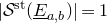 $|\mathcal{S}^{\mathrm{st}}(\underline{E}_{a,b})|=1$
if
$|\mathcal{S}^{\mathrm{st}}(\underline{E}_{a,b})|=1$
if $ab=0$
or
$ab=0$
or $|a|=|b|$
, and
$|a|=|b|$
, and $|\mathcal{S}^{\mathrm{st}}(\underline{E}_{a,b})|=2^{r-1}$
otherwise, where r is the number of primes dividing
$|\mathcal{S}^{\mathrm{st}}(\underline{E}_{a,b})|=2^{r-1}$
otherwise, where r is the number of primes dividing ${|ab|}/{\gcd(a,b)^2}$
.
${|ab|}/{\gcd(a,b)^2}$
.
Proof. First suppose that $a=0$
. If
$a=0$
. If $c,d \in \mathbb{Z}$
, then
$c,d \in \mathbb{Z}$
, then $\gcd(c,d)=\gcd(a,b)=b$
and
$\gcd(c,d)=\gcd(a,b)=b$
and $cd=ab=0$
if and only if
$cd=ab=0$
if and only if $\bigl( \begin{smallmatrix} c \\ d \end{smallmatrix} \bigr) \in \{ \bigl( \begin{smallmatrix} 0 \\ b \end{smallmatrix} \bigr), \bigl( \begin{smallmatrix} b \\ 0 \end{smallmatrix} \bigr), \bigl( \begin{smallmatrix} 0 \\ -b \end{smallmatrix} \bigr), \bigl( \begin{smallmatrix} -b \\ 0 \end{smallmatrix} \bigr) \}$
. By Propositions 10.4 and 10.7,
$\bigl( \begin{smallmatrix} c \\ d \end{smallmatrix} \bigr) \in \{ \bigl( \begin{smallmatrix} 0 \\ b \end{smallmatrix} \bigr), \bigl( \begin{smallmatrix} b \\ 0 \end{smallmatrix} \bigr), \bigl( \begin{smallmatrix} 0 \\ -b \end{smallmatrix} \bigr), \bigl( \begin{smallmatrix} -b \\ 0 \end{smallmatrix} \bigr) \}$
. By Propositions 10.4 and 10.7, $\underline{E} \oplus \underline{H}_{2k} \cong \underline{E}_{0,b} \oplus \underline{H}_{2k}$
for some
$\underline{E} \oplus \underline{H}_{2k} \cong \underline{E}_{0,b} \oplus \underline{H}_{2k}$
for some $k \geqslant 0$
if and only if
$k \geqslant 0$
if and only if $\underline{E} \cong \underline{E}_{0,b}$
. Therefore,
$\underline{E} \cong \underline{E}_{0,b}$
. Therefore,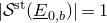 $|\mathcal{S}^{\mathrm{st}}(\underline{E}_{0,b})|=1$
. Similarly,
$|\mathcal{S}^{\mathrm{st}}(\underline{E}_{0,b})|=1$
. Similarly,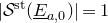 $|\mathcal{S}^{\mathrm{st}}(\underline{E}_{a,0})|=1$
.
$|\mathcal{S}^{\mathrm{st}}(\underline{E}_{a,0})|=1$
.
Next note that for $c,d \in \mathbb{Z}$
we have
$c,d \in \mathbb{Z}$
we have $|cd|=\gcd(c,d)^2$
if and only if
$|cd|=\gcd(c,d)^2$
if and only if $|c|=|d|=\gcd(c,d)$
. So if
$|c|=|d|=\gcd(c,d)$
. So if $|a|=|b|$
, then by Proposition 10.4,
$|a|=|b|$
, then by Proposition 10.4, $\underline{E} \oplus \underline{H}_{2k} \cong \underline{E}_{a,b} \oplus \underline{H}_{2k}$
for some
$\underline{E} \oplus \underline{H}_{2k} \cong \underline{E}_{a,b} \oplus \underline{H}_{2k}$
for some $k \geqslant 0$
if and only if
$k \geqslant 0$
if and only if $\underline{E} \cong \underline{E}_{a,b}$
or
$\underline{E} \cong \underline{E}_{a,b}$
or $\underline{E} \cong \underline{E}_{-a,-b}$
. In both cases
$\underline{E} \cong \underline{E}_{-a,-b}$
. In both cases $\underline{E} \cong \underline{E}_{a,b}$
by Proposition 10.7, showing that
$\underline{E} \cong \underline{E}_{a,b}$
by Proposition 10.7, showing that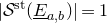 $|\mathcal{S}^{\mathrm{st}}(\underline{E}_{a,b})|=1$
.
$|\mathcal{S}^{\mathrm{st}}(\underline{E}_{a,b})|=1$
.
If $ab \neq 0$
and
$ab \neq 0$
and $|a| \neq |b|$
, then define
$|a| \neq |b|$
, then define $\bar{a} = {a}/{\gcd(a,b)}$
and
$\bar{a} = {a}/{\gcd(a,b)}$
and $\bar{b} = {b}/{\gcd(a,b)}$
. By Proposition 10.4,
$\bar{b} = {b}/{\gcd(a,b)}$
. By Proposition 10.4, $\underline{E} \oplus \underline{H}_{2k} \cong \underline{E}_{a,b} \oplus \underline{H}_{2k}$
for some
$\underline{E} \oplus \underline{H}_{2k} \cong \underline{E}_{a,b} \oplus \underline{H}_{2k}$
for some $k \geqslant 0$
if and only if
$k \geqslant 0$
if and only if $\underline{E} \cong \underline{E}_{\bar{c}\gcd(a,b),\bar{d}\gcd(a,b)}$
for some
$\underline{E} \cong \underline{E}_{\bar{c}\gcd(a,b),\bar{d}\gcd(a,b)}$
for some $\bar{c}, \bar{d} \in \mathbb{Z}$
such that
$\bar{c}, \bar{d} \in \mathbb{Z}$
such that $\gcd(\bar{c},\bar{d})=1$
and
$\gcd(\bar{c},\bar{d})=1$
and $\bar{c}\bar{d} = \bar{a}\bar{b}$
. Equivalently,
$\bar{c}\bar{d} = \bar{a}\bar{b}$
. Equivalently, $\underline{E} \cong \underline{E}_{\bar{c}\gcd(a,b),\mathop{\mathrm{lcm}}\nolimits(a,b)/\bar{c}}$
for some
$\underline{E} \cong \underline{E}_{\bar{c}\gcd(a,b),\mathop{\mathrm{lcm}}\nolimits(a,b)/\bar{c}}$
for some $\bar{c} \in \mathbb{Z} \setminus \{ 0 \}$
such that
$\bar{c} \in \mathbb{Z} \setminus \{ 0 \}$
such that $\bar{c}$
divides
$\bar{c}$
divides $\bar{a}\bar{b}$
and
$\bar{a}\bar{b}$
and $\gcd(\bar{c},{\bar{a}\bar{b}}/{\bar{c}})=1$
. If the prime factorisation of
$\gcd(\bar{c},{\bar{a}\bar{b}}/{\bar{c}})=1$
. If the prime factorisation of $|\bar{a}\bar{b}| = {|ab|}/{\gcd(a,b)^2}$
is
$|\bar{a}\bar{b}| = {|ab|}/{\gcd(a,b)^2}$
is $|\bar{a}\bar{b}|=p_1^{k_1} \ldots p_r^{k_r}$
, then
$|\bar{a}\bar{b}|=p_1^{k_1} \ldots p_r^{k_r}$
, then $\bar{c}$
satisfies the conditions if and only if
$\bar{c}$
satisfies the conditions if and only if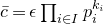 $\bar{c} = \epsilon \prod_{i \in I} p_i^{k_i}$
for some
$\bar{c} = \epsilon \prod_{i \in I} p_i^{k_i}$
for some $\epsilon \in \{ \pm 1 \}$
and
$\epsilon \in \{ \pm 1 \}$
and $I \subseteq \{ 1, \ldots , r \}$
. So there are
$I \subseteq \{ 1, \ldots , r \}$
. So there are $2^{r+1}$
possible values of
$2^{r+1}$
possible values of $\bar{c}$
. By our assumptions
$\bar{c}$
. By our assumptions $|\bar{a}\bar{b}| \gt 1$
, so
$|\bar{a}\bar{b}| \gt 1$
, so $|\bar{c}| \neq \left| {\bar{a}\bar{b}}/{\bar{c}} \right|$
if
$|\bar{c}| \neq \left| {\bar{a}\bar{b}}/{\bar{c}} \right|$
if $\bar{c}$
satisfies the conditions, hence
$\bar{c}$
satisfies the conditions, hence $|\bar{c}\gcd(a,b)| \neq \left| {\mathop{\mathrm{lcm}}\nolimits(a,b)}/{\bar{c}} \right|$
. Therefore,
$|\bar{c}\gcd(a,b)| \neq \left| {\mathop{\mathrm{lcm}}\nolimits(a,b)}/{\bar{c}} \right|$
. Therefore, $\mathop{\mathrm{Aut}}\nolimits(\underline{H}_2)$
acts freely on the set of possible pairs
$\mathop{\mathrm{Aut}}\nolimits(\underline{H}_2)$
acts freely on the set of possible pairs $\bigl( \begin{smallmatrix} \bar{c}\gcd(a,b) \\ \mathop{\mathrm{lcm}}\nolimits(a,b)/\bar{c} \end{smallmatrix} \bigr)$
. So it follows from Proposition 10.7 that
$\bigl( \begin{smallmatrix} \bar{c}\gcd(a,b) \\ \mathop{\mathrm{lcm}}\nolimits(a,b)/\bar{c} \end{smallmatrix} \bigr)$
. So it follows from Proposition 10.7 that $|\mathcal{S}^{\mathrm{st}}(\underline{E}_{a,b})|={2^{r+1}}/{|\mathop{\mathrm{Aut}}\nolimits(\underline{H}_2)|} = 2^{r-1}$
.
$|\mathcal{S}^{\mathrm{st}}(\underline{E}_{a,b})|={2^{r+1}}/{|\mathop{\mathrm{Aut}}\nolimits(\underline{H}_2)|} = 2^{r-1}$
.
Remark 10.9. Conway et al. [Reference Conway, Crowley, Powell and SixtCCP+23] constructed two families of manifolds, $N_{a,b}$
and
$N_{a,b}$
and $M_{a,b}$
, for certain pairs of positive integers a,b. Both
$M_{a,b}$
, for certain pairs of positive integers a,b. Both $N_{a,b}$
and
$N_{a,b}$
and $M_{a,b}$
admit normal smoothings over a suitable base space such that their Q-forms are isomorphic to
$M_{a,b}$
admit normal smoothings over a suitable base space such that their Q-forms are isomorphic to $\underline{E}_{a,b}$
, and this was used to estimate the size of their stable classes; see [Reference Conway, Crowley, Powell and SixtCCP+23, Proposition 2.2, Theorem 3.3]. Proposition 10.8 can be regarded as an algebraic analogue of those results.
$\underline{E}_{a,b}$
, and this was used to estimate the size of their stable classes; see [Reference Conway, Crowley, Powell and SixtCCP+23, Proposition 2.2, Theorem 3.3]. Proposition 10.8 can be regarded as an algebraic analogue of those results.
To prove Theorem 10.13 about $\mathcal{S}^{\mathrm{st}}(\underline{M})$
for the types of extended quadratic forms
$\mathcal{S}^{\mathrm{st}}(\underline{M})$
for the types of extended quadratic forms $\underline{M} = (M, \lambda, \mu)$
not covered in Proposition 10.8, we will need the next three lemmas. First, we show that allowing M to contain torsion makes no difference. Next, when
$\underline{M} = (M, \lambda, \mu)$
not covered in Proposition 10.8, we will need the next three lemmas. First, we show that allowing M to contain torsion makes no difference. Next, when $\mathop{\mathrm{rk}}\nolimits Q = 0$
, an extended quadratic form over
$\mathop{\mathrm{rk}}\nolimits Q = 0$
, an extended quadratic form over $Q \cong 0$
can be regarded as a form over
$Q \cong 0$
can be regarded as a form over $\mathbb{Z}$
via the inclusion
$\mathbb{Z}$
via the inclusion $0 \rightarrow \mathbb{Z}$
, and applying this (or any) inclusion of groups has no effect on
$0 \rightarrow \mathbb{Z}$
, and applying this (or any) inclusion of groups has no effect on $\mathcal{S}^{\mathrm{st}}(\underline{M})$
. Finally, if
$\mathcal{S}^{\mathrm{st}}(\underline{M})$
. Finally, if $\mathop{\mathrm{rk}}\nolimits Q = 2$
and
$\mathop{\mathrm{rk}}\nolimits Q = 2$
and $\underline{M}$
is free, full and has rank 2, then
$\underline{M}$
is free, full and has rank 2, then $\mu$
is injective, and we will prove that this implies that
$\mu$
is injective, and we will prove that this implies that $\mathcal{S}^{\mathrm{st}}(\underline{M})$
is trivial.
$\mathcal{S}^{\mathrm{st}}(\underline{M})$
is trivial.
Lemma 10.10.
Suppose that $\underline{M} = (M, \lambda, \mu)$
is an extended quadratic form over an abelian group Q such that
$\underline{M} = (M, \lambda, \mu)$
is an extended quadratic form over an abelian group Q such that $\mu \big| _{\mathop{\mathrm{Tor}}\nolimits M} = 0$
(hence,
$\mu \big| _{\mathop{\mathrm{Tor}}\nolimits M} = 0$
(hence, $\underline{\bar{M}}$
is defined; see Definition 4.13). Then
$\underline{\bar{M}}$
is defined; see Definition 4.13). Then $\mathcal{S}^{\mathrm{st}}(\underline{M}) \cong \mathcal{S}^{\mathrm{st}}(\underline{\bar{M}})$
.
$\mathcal{S}^{\mathrm{st}}(\underline{M}) \cong \mathcal{S}^{\mathrm{st}}(\underline{\bar{M}})$
.
Proof. Let $R = \mathop{\mathrm{Tor}}\nolimits M$
and
$R = \mathop{\mathrm{Tor}}\nolimits M$
and $\underline{R} = (R, 0, 0)$
; then
$\underline{R} = (R, 0, 0)$
; then $\underline{M} \cong \underline{\bar{M}} \oplus \underline{R}$
. If
$\underline{M} \cong \underline{\bar{M}} \oplus \underline{R}$
. If $\underline{M}{}' \oplus \underline{H}_{2k} \cong \underline{\bar{M}} \oplus \underline{H}_{2k}$
for some
$\underline{M}{}' \oplus \underline{H}_{2k} \cong \underline{\bar{M}} \oplus \underline{H}_{2k}$
for some $k \geqslant 0$
, then
$k \geqslant 0$
, then $(\underline{M}{}' \oplus \underline{R}) \oplus \underline{H}_{2k} \cong \underline{M} \oplus \underline{H}_{2k}$
, and if
$(\underline{M}{}' \oplus \underline{R}) \oplus \underline{H}_{2k} \cong \underline{M} \oplus \underline{H}_{2k}$
, and if $\underline{M}{}' \cong \underline{M}{}''$
, then
$\underline{M}{}' \cong \underline{M}{}''$
, then $\underline{M}{}' \oplus \underline{R} \cong \underline{M}{}'' \oplus \underline{R}$
. Therefore, the assignment
$\underline{M}{}' \oplus \underline{R} \cong \underline{M}{}'' \oplus \underline{R}$
. Therefore, the assignment $\underline{M}{}' \mapsto \underline{M}{}' \oplus \underline{R}$
induces a well-defined map
$\underline{M}{}' \mapsto \underline{M}{}' \oplus \underline{R}$
induces a well-defined map $F : \mathcal{S}^{\mathrm{st}}(\underline{\bar{M}}) \rightarrow \mathcal{S}^{\mathrm{st}}(\underline{M})$
.
$F : \mathcal{S}^{\mathrm{st}}(\underline{\bar{M}}) \rightarrow \mathcal{S}^{\mathrm{st}}(\underline{M})$
.
Next consider an isomorphism $\underline{M}{}' \oplus \underline{H}_{2k} \cong \underline{M} \oplus \underline{H}_{2k}$
for some
$\underline{M}{}' \oplus \underline{H}_{2k} \cong \underline{M} \oplus \underline{H}_{2k}$
for some $k \geqslant 0$
and
$k \geqslant 0$
and $\underline{M}{}' = (M', \lambda', \mu')$
. This restricts to an isomorphism
$\underline{M}{}' = (M', \lambda', \mu')$
. This restricts to an isomorphism $\mathop{\mathrm{Tor}}\nolimits(M' \oplus \mathbb{Z}^{2k}) \cong \mathop{\mathrm{Tor}}\nolimits M' \rightarrow \mathop{\mathrm{Tor}}\nolimits(M \oplus \mathbb{Z}^{2k}) \cong R$
, and since it is a morphism of extended quadratic forms,
$\mathop{\mathrm{Tor}}\nolimits(M' \oplus \mathbb{Z}^{2k}) \cong \mathop{\mathrm{Tor}}\nolimits M' \rightarrow \mathop{\mathrm{Tor}}\nolimits(M \oplus \mathbb{Z}^{2k}) \cong R$
, and since it is a morphism of extended quadratic forms, $\mu' \big| _{\mathop{\mathrm{Tor}}\nolimits M'} = 0$
. So
$\mu' \big| _{\mathop{\mathrm{Tor}}\nolimits M'} = 0$
. So $\underline{\bar{M}}{}'$
is defined,
$\underline{\bar{M}}{}'$
is defined, $\underline{M}{}' \cong \underline{\bar{M}}{}' \oplus \underline{R}$
, and there is an induced isomorphism
$\underline{M}{}' \cong \underline{\bar{M}}{}' \oplus \underline{R}$
, and there is an induced isomorphism $\underline{\bar{M}}{}' \oplus \underline{H}_{2k} \cong \underline{\bar{M}} \oplus \underline{H}_{2k}$
. If
$\underline{\bar{M}}{}' \oplus \underline{H}_{2k} \cong \underline{\bar{M}} \oplus \underline{H}_{2k}$
. If $\underline{M}{}' \cong \underline{M}{}''$
, then
$\underline{M}{}' \cong \underline{M}{}''$
, then $\underline{\bar{M}}{}' \cong \underline{\bar{M}}{}''$
, so the assignment
$\underline{\bar{M}}{}' \cong \underline{\bar{M}}{}''$
, so the assignment $\underline{M}{}' \mapsto \underline{\bar{M}}{}'$
induces a well-defined map
$\underline{M}{}' \mapsto \underline{\bar{M}}{}'$
induces a well-defined map $G : \mathcal{S}^{\mathrm{st}}(\underline{M}) \rightarrow \mathcal{S}^{\mathrm{st}}(\underline{\bar{M}})$
, which is the inverse of F.
$G : \mathcal{S}^{\mathrm{st}}(\underline{M}) \rightarrow \mathcal{S}^{\mathrm{st}}(\underline{\bar{M}})$
, which is the inverse of F.
Lemma 10.11.
Let $\iota : Q_1 \rightarrow Q_2$
be a homomorphism between abelian groups, and let
$\iota : Q_1 \rightarrow Q_2$
be a homomorphism between abelian groups, and let $(M,\lambda,\mu)$
be an extended quadratic form over
$(M,\lambda,\mu)$
be an extended quadratic form over $Q_1$
, so that
$Q_1$
, so that $(M,\lambda,\iota \circ \mu)$
is an extended quadratic form over
$(M,\lambda,\iota \circ \mu)$
is an extended quadratic form over $Q_2$
. If
$Q_2$
. If $\iota$
is injective, then it induces a bijection
$\iota$
is injective, then it induces a bijection $\mathcal{S}^{\mathrm{st}}(M,\lambda,\mu) \cong \mathcal{S}^{\mathrm{st}}(M,\lambda,\iota \circ \mu)$
.
$\mathcal{S}^{\mathrm{st}}(M,\lambda,\mu) \cong \mathcal{S}^{\mathrm{st}}(M,\lambda,\iota \circ \mu)$
.
Proof. If $(M',\lambda',\mu') \oplus \underline{H}_{2k} \cong (M,\lambda,\mu) \oplus \underline{H}_{2k}$
for some
$(M',\lambda',\mu') \oplus \underline{H}_{2k} \cong (M,\lambda,\mu) \oplus \underline{H}_{2k}$
for some $k \geqslant 0$
, then
$k \geqslant 0$
, then $(M',\lambda',\iota \circ \mu') \oplus \underline{H}_{2k} \cong (M,\lambda,\iota \circ \mu) \oplus \underline{H}_{2k}$
, and if
$(M',\lambda',\iota \circ \mu') \oplus \underline{H}_{2k} \cong (M,\lambda,\iota \circ \mu) \oplus \underline{H}_{2k}$
, and if $(M',\lambda',\mu') \cong (M'',\lambda'',\mu'')$
, then
$(M',\lambda',\mu') \cong (M'',\lambda'',\mu'')$
, then $(M',\lambda',\iota \circ \mu') \cong (M'',\lambda'',\iota \circ \mu'')$
. Therefore, the assignment
$(M',\lambda',\iota \circ \mu') \cong (M'',\lambda'',\iota \circ \mu'')$
. Therefore, the assignment $(M',\lambda',\mu') \mapsto (M',\lambda',\iota \circ \mu')$
induces a well-defined map
$(M',\lambda',\mu') \mapsto (M',\lambda',\iota \circ \mu')$
induces a well-defined map $\iota_* : \mathcal{S}^{\mathrm{st}}(M,\lambda,\mu) \rightarrow \mathcal{S}^{\mathrm{st}}(M,\lambda,\iota \circ \mu)$
.
$\iota_* : \mathcal{S}^{\mathrm{st}}(M,\lambda,\mu) \rightarrow \mathcal{S}^{\mathrm{st}}(M,\lambda,\iota \circ \mu)$
.
If $(M',\lambda',\mu') \oplus \underline{H}_{2k} \cong (M,\lambda,\iota \circ \mu) \oplus \underline{H}_{2k}$
for some
$(M',\lambda',\mu') \oplus \underline{H}_{2k} \cong (M,\lambda,\iota \circ \mu) \oplus \underline{H}_{2k}$
for some $k \geqslant 0$
, then
$k \geqslant 0$
, then $\mathop{\mathrm{Im}}\nolimits(\mu') = \mathop{\mathrm{Im}}\nolimits(\iota \circ \mu) \leqslant \mathop{\mathrm{Im}}\nolimits(\iota) \leqslant Q_2$
. So if
$\mathop{\mathrm{Im}}\nolimits(\mu') = \mathop{\mathrm{Im}}\nolimits(\iota \circ \mu) \leqslant \mathop{\mathrm{Im}}\nolimits(\iota) \leqslant Q_2$
. So if $\iota$
is injective and
$\iota$
is injective and $\iota^{-1} : \mathop{\mathrm{Im}}\nolimits(\iota) \rightarrow Q_1$
denotes its inverse, then
$\iota^{-1} : \mathop{\mathrm{Im}}\nolimits(\iota) \rightarrow Q_1$
denotes its inverse, then $(M',\lambda',\mu') = (M',\lambda',\iota \circ \iota^{-1} \circ \mu')$
, showing that
$(M',\lambda',\mu') = (M',\lambda',\iota \circ \iota^{-1} \circ \mu')$
, showing that $\iota_*$
is surjective. And if
$\iota_*$
is surjective. And if $(M',\lambda',\iota \circ \mu') \cong (M'',\lambda'',\iota \circ \mu'')$
, then
$(M',\lambda',\iota \circ \mu') \cong (M'',\lambda'',\iota \circ \mu'')$
, then $(M',\lambda',\mu') = (M',\lambda',\iota^{-1} \circ \iota \circ \mu') \cong (M'',\lambda'',\iota^{-1} \circ \iota \circ \mu'') = (M'',\lambda'',\mu'')$
, so
$(M',\lambda',\mu') = (M',\lambda',\iota^{-1} \circ \iota \circ \mu') \cong (M'',\lambda'',\iota^{-1} \circ \iota \circ \mu'') = (M'',\lambda'',\mu'')$
, so $\iota_*$
is injective.
$\iota_*$
is injective.
Lemma 10.12.
Suppose that $\underline{M} = (M, \lambda, \mu)$
is an extended quadratic form over an abelian group Q. If
$\underline{M} = (M, \lambda, \mu)$
is an extended quadratic form over an abelian group Q. If $\mu$
is injective, then
$\mu$
is injective, then $|\mathcal{S}^{\mathrm{st}}(\underline{M})|=1$
.
$|\mathcal{S}^{\mathrm{st}}(\underline{M})|=1$
.
Proof. We need to show that if $\underline{M} \oplus \underline{H}_{2k} \cong \underline{M}{}' \oplus \underline{H}_{2k}$
for some
$\underline{M} \oplus \underline{H}_{2k} \cong \underline{M}{}' \oplus \underline{H}_{2k}$
for some $\underline{M}{}' = (M', \lambda', \mu')$
and
$\underline{M}{}' = (M', \lambda', \mu')$
and $k \geqslant 0$
, then
$k \geqslant 0$
, then $\underline{M} \cong \underline{M}{}'$
. The isomorphism
$\underline{M} \cong \underline{M}{}'$
. The isomorphism $\underline{M} \oplus \underline{H}_{2k} \cong \underline{M}{}' \oplus \underline{H}_{2k}$
restricts to an isomorphism between
$\underline{M} \oplus \underline{H}_{2k} \cong \underline{M}{}' \oplus \underline{H}_{2k}$
restricts to an isomorphism between $\mathop{\mathrm{Ker}}\nolimits (\mu \oplus 0) = 0 \oplus \mathbb{Z}^{2k}$
and
$\mathop{\mathrm{Ker}}\nolimits (\mu \oplus 0) = 0 \oplus \mathbb{Z}^{2k}$
and $\mathop{\mathrm{Ker}}\nolimits (\mu' \oplus 0) = (\mathop{\mathrm{Ker}}\nolimits \mu') \oplus \mathbb{Z}^{2k}$
, which is only possible if
$\mathop{\mathrm{Ker}}\nolimits (\mu' \oplus 0) = (\mathop{\mathrm{Ker}}\nolimits \mu') \oplus \mathbb{Z}^{2k}$
, which is only possible if $\mathop{\mathrm{Ker}}\nolimits \mu' \cong 0$
, that is,
$\mathop{\mathrm{Ker}}\nolimits \mu' \cong 0$
, that is, $\mu'$
is injective. Then by Lemma 10.2(a) and (d) we have
$\mu'$
is injective. Then by Lemma 10.2(a) and (d) we have $\underline{M} \cong \kappa(\underline{M}) \cong \kappa(\underline{M}{}') \cong \underline{M}{}'$
.
$\underline{M} \cong \kappa(\underline{M}) \cong \kappa(\underline{M}{}') \cong \underline{M}{}'$
.
Theorem 10.13. Let $\underline{M} = (M, \lambda, \mu)$
be an extended quadratic form over a free abelian group Q. Suppose that
$\underline{M} = (M, \lambda, \mu)$
be an extended quadratic form over a free abelian group Q. Suppose that $\mu$
is surjective,
$\mu$
is surjective, $\mathop{\mathrm{rk}}\nolimits \underline{M}=2$
and the induced bilinear function on
$\mathop{\mathrm{rk}}\nolimits \underline{M}=2$
and the induced bilinear function on $M / \mathop{\mathrm{Tor}}\nolimits(M) \cong \mathbb{Z}^2$
is isomorphic to
$M / \mathop{\mathrm{Tor}}\nolimits(M) \cong \mathbb{Z}^2$
is isomorphic to $\bigl[ \begin{smallmatrix} 0 & 1 \\ 1 & 0 \end{smallmatrix} \bigr]$
. Then
$\bigl[ \begin{smallmatrix} 0 & 1 \\ 1 & 0 \end{smallmatrix} \bigr]$
. Then
 \[|\mathcal{S}^{\mathrm{st}}(\underline{M})| =\begin{cases}1 & \text{if $\mathop{\mathrm{rk}}\nolimits Q=0$ or 2}, \\1 & \text{if $\mathop{\mathrm{rk}}\nolimits Q=1$ and $|ab| \leqslant 1$}, \\2^{r-1} & \text{if $\mathop{\mathrm{rk}}\nolimits Q=1$ and $|ab| \geqslant 2$},\end{cases} \]
where in the $\mathop{\mathrm{rk}}\nolimits Q=1$
case we fix an identification
$\mathop{\mathrm{rk}}\nolimits Q=1$
case we fix an identification $Q \cong \mathbb{Z}$
and elements
$Q \cong \mathbb{Z}$
and elements $x,y \in M$
such that [x],[y] is a basis of
$x,y \in M$
such that [x],[y] is a basis of $M / \mathop{\mathrm{Tor}}\nolimits M$
in which the induced bilinear function is given by the matrix
$M / \mathop{\mathrm{Tor}}\nolimits M$
in which the induced bilinear function is given by the matrix $\bigl[ \begin{smallmatrix} 0 & 1 \\ 1 & 0 \end{smallmatrix} \bigr]$
, we define
$\bigl[ \begin{smallmatrix} 0 & 1 \\ 1 & 0 \end{smallmatrix} \bigr]$
, we define $a = \mu(x), b=\mu(y) \in Q \cong \mathbb{Z}$
, and r is the number of primes dividing
$a = \mu(x), b=\mu(y) \in Q \cong \mathbb{Z}$
, and r is the number of primes dividing $|ab|$
.
$|ab|$
.
Proof. Since Q is free, we have $\mu \big| _{\mathop{\mathrm{Tor}}\nolimits M} = 0$
, and by Lemma 10.10,
$\mu \big| _{\mathop{\mathrm{Tor}}\nolimits M} = 0$
, and by Lemma 10.10, $|\mathcal{S}^{\mathrm{st}}(\underline{M})| = |\mathcal{S}^{\mathrm{st}}(\underline{\bar{M}})|$
(where
$|\mathcal{S}^{\mathrm{st}}(\underline{M})| = |\mathcal{S}^{\mathrm{st}}(\underline{\bar{M}})|$
(where $\underline{\bar{M}} = (\bar{M}, \bar{\lambda}, \bar{\mu})$
is defined as in Definition 4.13), so we need to prove the corresponding statement for
$\underline{\bar{M}} = (\bar{M}, \bar{\lambda}, \bar{\mu})$
is defined as in Definition 4.13), so we need to prove the corresponding statement for $|\mathcal{S}^{\mathrm{st}}(\underline{\bar{M}})|$
. By assumption there is an isomorphism
$|\mathcal{S}^{\mathrm{st}}(\underline{\bar{M}})|$
. By assumption there is an isomorphism $\bar{M} \cong \mathbb{Z}^2$
under which
$\bar{M} \cong \mathbb{Z}^2$
under which $\bar{\lambda}$
corresponds to
$\bar{\lambda}$
corresponds to $\bigl[ \begin{smallmatrix} 0 & 1 \\ 1 & 0 \end{smallmatrix} \bigr]$
, and
$\bigl[ \begin{smallmatrix} 0 & 1 \\ 1 & 0 \end{smallmatrix} \bigr]$
, and $\bar{\mu}$
is surjective (hence,
$\bar{\mu}$
is surjective (hence, $\mathop{\mathrm{rk}}\nolimits Q \leqslant 2$
).
$\mathop{\mathrm{rk}}\nolimits Q \leqslant 2$
).
If $Q \cong 0$
, then
$Q \cong 0$
, then $\underline{\bar{M}} \cong (\mathbb{Z}^2, \bigl[ \begin{smallmatrix} 0 & 1 \\ 1 & 0 \end{smallmatrix} \bigr], 0 )$
. By applying Lemma 10.11 to the inclusion
$\underline{\bar{M}} \cong (\mathbb{Z}^2, \bigl[ \begin{smallmatrix} 0 & 1 \\ 1 & 0 \end{smallmatrix} \bigr], 0 )$
. By applying Lemma 10.11 to the inclusion $0 \rightarrow \mathbb{Z}$
and Proposition 10.8, we have
$0 \rightarrow \mathbb{Z}$
and Proposition 10.8, we have $|\mathcal{S}^{\mathrm{st}}(\underline{\bar{M}})| = |\mathcal{S}^{\mathrm{st}}(\underline{E}_{0,0})| = 1$
.
$|\mathcal{S}^{\mathrm{st}}(\underline{\bar{M}})| = |\mathcal{S}^{\mathrm{st}}(\underline{E}_{0,0})| = 1$
.
If $Q \cong \mathbb{Z}^2$
, then since
$Q \cong \mathbb{Z}^2$
, then since $\bar{\mu}$
is surjective, it is also injective, so by Lemma 10.12,
$\bar{\mu}$
is surjective, it is also injective, so by Lemma 10.12, $|\mathcal{S}^{\mathrm{st}}(\underline{\bar{M}})| = 1$
.
$|\mathcal{S}^{\mathrm{st}}(\underline{\bar{M}})| = 1$
.
If $Q \cong \mathbb{Z}$
, then the basis [x],[y] determines an isomorphism
$Q \cong \mathbb{Z}$
, then the basis [x],[y] determines an isomorphism $\underline{\bar{M}} \cong \underline{E}_{a,b}$
. Since
$\underline{\bar{M}} \cong \underline{E}_{a,b}$
. Since $\bar{\mu}$
is surjective,
$\bar{\mu}$
is surjective, $\gcd(a,b)=1$
, which also implies that
$\gcd(a,b)=1$
, which also implies that $|a|=|b|$
holds if and only if
$|a|=|b|$
holds if and only if $|ab|=1$
. Therefore, the remaining cases follow from the corresponding parts of Proposition 10.8.
$|ab|=1$
. Therefore, the remaining cases follow from the corresponding parts of Proposition 10.8.
Proposition 10.14.
Let $\underline{M} = (M, \lambda, \mu)$
and Q be as in Theorem 10.13. Suppose that
$\underline{M} = (M, \lambda, \mu)$
and Q be as in Theorem 10.13. Suppose that $\underline{N} = (N, \lambda_N, \mu_N)$
represents an element of
$\underline{N} = (N, \lambda_N, \mu_N)$
represents an element of $\mathcal{S}^{\mathrm{st}}(\underline{M})$
. If h is an automorphism of Q such that
$\mathcal{S}^{\mathrm{st}}(\underline{M})$
. If h is an automorphism of Q such that $(N, \lambda_N, h \circ \mu_N)$
also represents an element of
$(N, \lambda_N, h \circ \mu_N)$
also represents an element of $\mathcal{S}^{\mathrm{st}}(\underline{M})$
, then
$\mathcal{S}^{\mathrm{st}}(\underline{M})$
, then $(N, \lambda_N, h \circ \mu_N) \cong \underline{N}$
.
$(N, \lambda_N, h \circ \mu_N) \cong \underline{N}$
.
Proof. Since $\mu \big| _{\mathop{\mathrm{Tor}}\nolimits M} = 0$
, by the proof of Lemma 10.10 it is enough to consider the case when
$\mu \big| _{\mathop{\mathrm{Tor}}\nolimits M} = 0$
, by the proof of Lemma 10.10 it is enough to consider the case when $\underline{M}$
is free. If
$\underline{M}$
is free. If $|\mathcal{S}^{\mathrm{st}}(\underline{M})|=1$
, then any extended quadratic form that represents an element of
$|\mathcal{S}^{\mathrm{st}}(\underline{M})|=1$
, then any extended quadratic form that represents an element of $\mathcal{S}^{\mathrm{st}}(\underline{M})$
is isomorphic to
$\mathcal{S}^{\mathrm{st}}(\underline{M})$
is isomorphic to $\underline{N}$
. Otherwise
$\underline{N}$
. Otherwise $\mathop{\mathrm{rk}}\nolimits Q = 1$
, and if Q is identified with
$\mathop{\mathrm{rk}}\nolimits Q = 1$
, and if Q is identified with $\mathbb{Z}$
, then
$\mathbb{Z}$
, then $\underline{M} \cong \underline{E}_{a,b}$
for some
$\underline{M} \cong \underline{E}_{a,b}$
for some $a,b \in \mathbb{Z}$
. By Proposition 10.4,
$a,b \in \mathbb{Z}$
. By Proposition 10.4, $\underline{N} \cong \underline{E}_{c,d}$
for some
$\underline{N} \cong \underline{E}_{c,d}$
for some $c,d \in \mathbb{Z}$
. The only non-trivial automorphism of
$c,d \in \mathbb{Z}$
. The only non-trivial automorphism of $\mathbb{Z}$
is
$\mathbb{Z}$
is $-\mathop{\mathrm{id}}\nolimits_{\mathbb{Z}}$
, and if
$-\mathop{\mathrm{id}}\nolimits_{\mathbb{Z}}$
, and if $h = -\mathop{\mathrm{id}}\nolimits_{\mathbb{Z}}$
, then
$h = -\mathop{\mathrm{id}}\nolimits_{\mathbb{Z}}$
, then $(N, \lambda_N, h \circ \mu_N) \cong \underline{E}_{-c,-d}$
. By Proposition 10.7,
$(N, \lambda_N, h \circ \mu_N) \cong \underline{E}_{-c,-d}$
. By Proposition 10.7, $\underline{E}_{-c,-d} \cong \underline{E}_{c,d}$
.
$\underline{E}_{-c,-d} \cong \underline{E}_{c,d}$
.
Proof of Theorem 1.5. By Theorem 1.11, $|\mathcal{S}^{\mathrm{st}}(M)| = |\mathcal{S}^{\mathrm{st}}(E_q(M,f)) / A^{(B,\xi)}_{[M,f]}|$
. By Proposition 10.14 any automorphism of
$|\mathcal{S}^{\mathrm{st}}(M)| = |\mathcal{S}^{\mathrm{st}}(E_q(M,f)) / A^{(B,\xi)}_{[M,f]}|$
. By Proposition 10.14 any automorphism of $H_q(B)$
that acts on
$H_q(B)$
that acts on $\mathcal{S}^{\mathrm{st}}(E_q(M,f))$
, in particular any element of
$\mathcal{S}^{\mathrm{st}}(E_q(M,f))$
, in particular any element of $A^{(B,\xi)}_{[M,f]}$
, acts trivially. Therefore,
$A^{(B,\xi)}_{[M,f]}$
, acts trivially. Therefore, $|\mathcal{S}^{\mathrm{st}}(M)| = |\mathcal{S}^{\mathrm{st}}(E_q(M,f))|$
, which was determined in Theorem 10.13.
$|\mathcal{S}^{\mathrm{st}}(M)| = |\mathcal{S}^{\mathrm{st}}(E_q(M,f))|$
, which was determined in Theorem 10.13.
Acknowledgements
I would like to thank my PhD supervisor, Diarmuid Crowley, for his ongoing support and helpful comments on the paper. I am also grateful to Mark Powell for discussions on the groups $\mathop{\mathrm{RU}}\nolimits_{\mathrm{st}}(\underline{M},L)$
. I thank the anonymous referee for the many helpful suggestions.
$\mathop{\mathrm{RU}}\nolimits_{\mathrm{st}}(\underline{M},L)$
. I thank the anonymous referee for the many helpful suggestions.
Conflicts of interest
None.
Financial support
I was supported by the Melbourne Research Scholarship and the EPSRC New Investigator grant EP/T028335/2.
Journal information
Compositio Mathematica is owned by the Foundation Compositio Mathematica and published by the London Mathematical Society in partnership with Cambridge University Press. All surplus income from the publication of Compositio Mathematica is returned to mathematics and higher education through the charitable activities of the Foundation, the London Mathematical Society and Cambridge University Press.


 D3
D3
 Open access

