

“I must admit that in a country like ours, where archaeologists spend a large part of their working time, and even their leisure time, criticizing—quite rightly—the inadequate legal framework we possess, only 20% of those surveyed found it useful to respond with a concrete proposal. I don’t know if this is due to a widespread apathy, a lack of responsibility, legislative incapacity, distrust in future possibilities, or, what would be even worse, a sudden acceptance of the devil we know” [Fernández Miranda Reference Fernández Miranda1980:18].
When Fernández Miranda (Reference Fernández Miranda1980) wrote these words, development-led archaeology as we know it today did not yet exist. A handful of new “independent” professionals (not linked to a university or a museum) was starting to operate, and the competencies in the management of archaeological heritage had not yet been transferred to the regions. Most archaeology happened within universities and museums. In a decade, the landscape would change completely and Xavier Dupré (Reference Dupré1991) would again highlight the same disdain in the profession regarding a recent strike of archaeologists in France (Petit Reference Petit1991). Since then, it has been a recurring comment in many gatherings, because it seems the structural problems of the sector are never solved—or maybe even addressed. The relation frustration/vocation is dramatic in the archaeological sector (Almansa-Sánchez Reference Almansa-Sánchez2020), as happens with other creative professions (Zafra Reference Zafra2017).
Far from inaction, the complexity of the labor market and the deep interconnection of archaeology with other sectors, as well as the structural problems of labor, crossed by power/class dynamics, just make it very difficult to find and implement easy solutions to these problems. Nevertheless, some lines of action seem clear and continue to be pursued by different stakeholders in the sector. This article aims to review the recent history of archaeology in Spain, with a focus on professional representation and the steps taken toward the improvement of working conditions. On the horizon is the mitigation of temporary contracts, an improvement in salaries, the recognition of archaeology as a profession within the social security and revenue administrations, or issues such as health and safety or harassment, which remain unsolved after many protocols and legislative changes. Some actions had positive results, and others failed, but hope remains.
On the Current Management Models and the Birth of the Profession
The first two decades of democracy in Spain are probably the most important to understand the configuration of the current models, although they are still understudied. Historiographic interest has mostly focused on archaeology under the Francoist regime, a period that consolidated a centralized control and administration of archaeology with a strong political influence (Díaz-Andreu and Ramírez Reference Díaz-Andreu and Ramírez2001; Gracia Reference Gracia2009). Only after 1955 did the situation change slightly, with a higher professionalization and decentralization of management, as well as the first glimpses of urban archaeology, along with the great urban developments that started in the late 1960s and affected historical (Roman) towns such as Cartagena, Tarragona, or Mérida (Rodríguez-Temiño Reference Rodríguez Temiño2004). Indeed, one of the latest actions of the regime was the ratification in 1975 of the London Convention. Nevertheless, the death of the dictator marked a deep change in the organization of the country way beyond democracy, with a new decentralized structure that strongly affected the management of archaeological heritage.
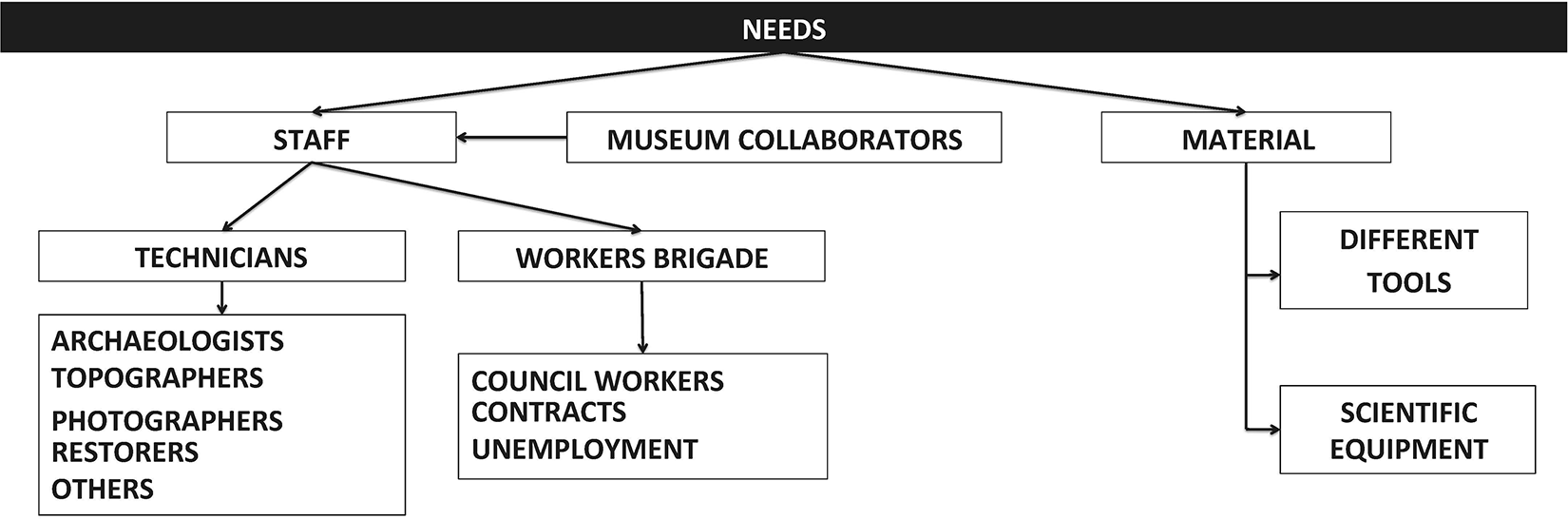
The decentralization of the administration is the main factor to be considered, with the creation of 17 autonomous regions that had to build their administrative structure from scratch on top of the provincial system (the 50 existing provinces), which included taking responsibility of the cultural heritage management since the early 1980s. There were interesting proposals (e.g., Beltrán Reference Beltrán1980) that aimed at designing public models that tackled the urgency of the new challenges, were the previous structures (mainly provincial museums) could support a new body of workers, well equipped to conduct an incipient preventive (or rescue) archaeology (Figure 1). However, reality fostered a more complex panorama, in which each region took a slightly different path and a group of incipient self-employed professionals navigated what was to become a new market for archaeology.
Chart of needs to tackle rescue archaeology, according to Beltrán (Reference Beltrán1980:60).

Some regions tried to adopt specific management models (Rodríguez-Temiño Reference Rodríguez Temiño2004). For example, Valencia established municipal units that oversaw preventive and rescue interventions, although the implementation was not fully successful (Barrachina and Selma Reference Barrachina and Selma2014; Bonet Reference Bonet2002), whereas Madrid proposed the definition of large protection areas that aimed at coming ahead of future threats to archaeology (Velasco et al. Reference Velasco, Mena and Méndez1987), favoring the work of an incipient private sector from the beginning. However, the process of decentralization was not easy. For example, in Madrid, “the documentation transferred from the Ministry of Culture was reduced to a folder” (Mena and Méndez Reference Mena and Méndez2002:205), and the human resources allocated to the new units were generally scarce. Maybe this is why the proliferation of independent professionals was soon seen as the easiest solution. The surge of RESCUE in the United Kingdom (Rahtz Reference Rahtz1974; RESCUE and Council for British Archaeology [CBA] 1974) and the liberal turn of the conservative government of Margaret Thatcher that configured the British model over the 1980s (Everill Reference Everill2009; Hobbley Reference Hobbley, Joyce, Newbury and Stone1987) were probably a mirror for some of the new administrations.
In 1984, the Professional Association of Spanish Archaeologists (APAE)—primarily academic in nature—was founded, as well as the archaeology commission of the Barcelona Guild of Graduates and Doctors (CDL), which is no longer active. In 1990, the Guilds of Madrid and Aragón opened their own archaeology sections (Martínez and Querol Reference Martínez and Ángeles Querol1996), followed by another dozen sections—some, such as Barcelona, eventually closed—until a wide but not complete map of collective representation of graduated professionals was established, gradually gaining strength given the circumstances (e.g., low numbers of associates, regional rupture, lack of communication). Still, these professional associations became one of the pillars of the profession. However, some form of disdain or apathy has followed the profession over the years, with a very low participation, even in times of crisis (69.3% of respondents to the first survey of archaeology companies thought associationism was low; Parga-Dans Reference Parga-Dans2009). The national group of archaeology sections started meeting in 1998 and was not formally recognized by the General Council of CDLs (the national body that congregates all regional guilds) until 2009, approving the first Code of practice in 2014 (Lorenzo-Lizalde Reference Lorenzo-Lizalde2018). Meanwhile, other (regional) professional associations were created aside from the guilds, such as the Association of Archaeologists in Catalonia (Ad’AC) in 2000, which aimed at an independent guild in the region (Huertas Reference Huertas2005); the Association of Archaeology Workers in Madrid (AMTTA) in 2007, established to face the precarity of the sector (AMTTA 2008), which the Archaeologists Association of Castille and León (ArqueoCyL) did since 2008 (Junta Directiva de ArqueoCyL 2012); the Association of Professionals of Historical-Archaeological Heritage in Cadiz (ASPHA) in 2008, which works in parallel to the guild (Mata Almonte and Montañés Caballero Reference Mata Almonte and Montañés Caballero2018); or the Professional Association of Archaeology and Heritage in Castille La Mancha (APAP-CLM) in 2011, created after the ineffectiveness of the regional guild (Benítez de Lugo et al. 2012); and the Independent Association of Professional Archaeologists from Asturias (APIAA), founded in 2012 to fill a void in the region to face the same challenges (APIAA 2012). Note that this surge in new professional associations came at the peak of a bubble (2007–2008) and the blow of the subsequent global crisis that immediately followed.
Although since the early years of the new reality, some of the structural problems were already clear, few actions were undertaken, including extremely limited union action (CNT-Córdoba 2012). The APAE (Querol et al. Reference Querol, Isabel Martínez-Navarrete, Hernández, Cerdeño and Antona1995) had already identified some challenges, seen from the perspective of the Academia; the need for adequate policies; the lack of proper training—and properly trained staff—including the absence of an archaeology degree (until 2010), the need for a scientific orientation of the rescue excavations, the need for social participation, and the scourge of looting. Furthermore, early professionals were already experiencing the main problem of the new model: an overly close relationship with developers (e.g., Domínguez et al. Reference Domínguez, Fernández, Herce, Menasanch and María Presas1994), even before the acceptance of the polluter-pays-principle in archaeology (formally introduced in Europe by Recommendation No R (89) 5 in 1989) and becoming a trap for preventive archaeology (Olivier Reference Olivier and Resco2016). Indeed, it is interesting how the current national law (Ley 16/1985, de 16 de junio, del Patrimonio Histórico Español) does not at all consider the new scenario that opened with rescue and, later, preventive archaeology, setting a framework for the protection of archaeological heritage, but not that much for its daily management. Interestingly, the proposal presented some years before did include an explicit reference to this scenario (Fernández-Miranda Reference Fernández Miranda1980:21), but it never made it to the final law approved in Congress. Contrary to what is stated in some publications, the Law 16/85 was not the framework for the configuration of the—then incipient—new model, as it looked backward to the previous reality. It is one year later (1986), with the access of Spain to the European Economic Community (now the European Union), when everything settled, thanks to the entry into force of Directive 85/377/CEE of June 27 on the Environmental Impact Assessment (adopted by Spain with Real Decreto Legislativo 1302/1986 de 28 de junio, de Evaluación de Impacto Ambiental), where cultural heritage was already mentioned as a topic to consider. Then, the developmentalist policies that were promoted to foster the articulation of the “new” Spain (González and Benedicto Reference González and Ángel Benedicto2006) and that were mostly funded by European money configured the growth of professional archaeology and the birth of a new market around archaeological heritage that also started the confrontation “research/management” in Spanish archaeology (Baena Reference Baena2007; Criado Boado Reference Criado Boado1988; Martínez Navarrete Reference Martínez Navarrete1988; Ruiz Rodríguez Reference Ruiz Rodríguez1989; Ruiz Rodríguez et al. Reference Ruiz Rodríguez, Molinos and Hornos1986), in which the main victim was archaeology and its lack of social recognition (Querol Reference Querol2000) and an “invisible” increasing professional workforce in development-led archaeology (Ruiz Zapatero Reference Ruiz Zapatero2005). Although some of the challenges of the profession were already envisioned during these years, they focused mainly on archaeologists outside of the commercial ecosystem (administration, museums, research institutions, and universities). Other field workers—those whose role had not changed since the first archaeological excavations decades before—did not even appear in the debate yet.
On Crisis and Bubbles—or the Structural Precarity of Professional Archaeology and the First Efforts to Overcome It
The 1990s saw the consolidation of the professional sector, the first crisis, and the beginning of the first bubble. Deeply linked to construction, development-led archaeology grew and shrunk at a similar pace with a peak of new companies in the late 1990s and early 2000s (Parga-Dans Reference Parga-Dans2010:8). However, the concept of “company” needs to be taken with caution. Irrespective of the legal form they took, most companies fell under the definition of “micro-enterprise” (under 10 employees and 2M€ in revenue), and the number of self-employed archaeologists competing in the market was (and still is) large. Indeed, the materialist analysis of the sector by Díaz del Río (Reference Díaz del Río2000) concluded, following the typologies defined by Roemer (Reference Roemer1982), that professional archaeologists had “one foot in the bourgeoisie and the other in the proletariat.” An archaeologist had become a professional who, due to market conditions, was forced to sell their labor power, although they may occasionally buy external labor power to support them, and lived in a constant dynamic of self-exploitation (Almansa-Sánchez Reference Almansa-Sánchez2017a). If the conditions to flourish were so good, why did the sector fall under this structural precarity?
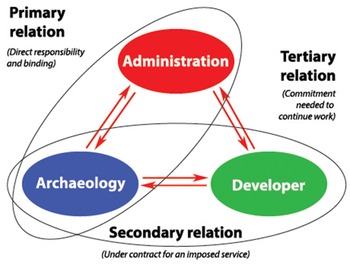
The answer might be in a deeper sociological analysis of the archaeological ecosystem and its development, which, again, is still missing. However, the relationship between the different actors in development-led archaeology (Figure 2) offers an interesting insight (López Martínez and Martín Alonso Reference López Martínez and Martín Alonso2018). One of the advances of the new legislation in Spain was the recognition of archaeological remains as “public domain” (belonging to the Spanish people, protected by the state), by which all interventions were subject to authorization by the regional administration. This involves an administrative process that takes a long time, both before and after the intervention (project, preliminary reports, processing of materials, scientific report), and makes archaeologists personally responsible and fully dependent from the authorizing body. Even though Spain did not ratify the Valletta Convention until 2011, practice was consolidated. Nevertheless, as is the case in most countries nowadays, the archaeologist’s actual client is the constructor or developer (which might also be an administration), setting a scenario of conflicting interests that became difficult to navigate. Against the expected benefits of public tenders (Aitchison Reference Aitchison2013), the only competitive advantage found in an otherwise unregulated market were salaries, fostering precarity.
Relationship between administration, developers, and archaeology in Spanish management models (from Almansa-Sánchez Reference Almansa-Sánchez2011a).

Archaeologists from AMTTA heading to the demonstration during the general strike of 2012. (Courtesy of AMTTA).

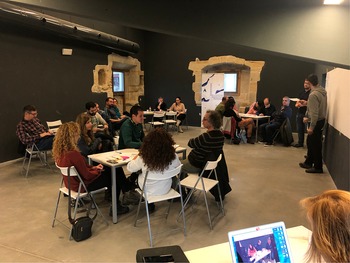
Working groups during the meeting in Santander (2019). (Photo taken by the authors).

Presentation of the Madrid Manifesto at the National Archaeological Museum in Madrid (September 26, 2025). (Photo taken by the authors).

In this context, guilds were not able to intervene effectively, being blocked from setting minimum wages by European legislation. Furthermore, the lack of trade unions in the sector and a reluctance of company owners to start any trade association (the bourgeoise/proletariat syndrome) made it impossible to negotiate a collective bargaining agreement (CBA). The late 1990s saw the beginning of a “pyrite age,” in which the growth of the sector was not in hand with the improvement in working conditions. On the contrary, salaries were low (it was common that other unqualified workers at a construction site made more than archaeologists), and health and safety were scarce (Almansa-Sánchez and Díaz de Liaño Reference Almansa-Sánchez and de Liaño2019), among other problems (Bouzas Reference Bouzas2014; González Álvarez Reference González Álvarez, Cascalheira and Gonçalves2012; Moya Maleno Reference Moya Maleno2010). Although some small companies and cooperatives tried to carry out work under honest conditions, other companies began to grow with ethically questionable practices that affected workers and archaeological heritage. It was during the peak of the early 2000s bubble that things started to change (Polo Reference Polo2007).
The peak of the bubble aggravated the perception of precarity, boosting displeasure in the sector and fostering new, more activist associations (see above). For the first time in archaeology, in 2006, CNT Barcelona called a strike in a Catalan company (Codex), which led to the first CBA in the region (convenio 7902595) and in the country. CNT is an anarchist union with minoritarian representation in Spain that has been housing archaeology sections since then in different companies and regions and is still very active in union activity. However, it never officially took part in a CBA negotiation. The Catalan CBA barely set the minimum wage and some basic labor standards, leaving dissatisfaction in part of the sector (CNT-Barcelona 2012; García Casas Reference García Casas2007; Grup de Treball CCOO 2005), but it was already a step forward in the struggle that was starting for better conditions. Still, only Galicia (in 2009, the only one in force today), Castille and León (in 2010), and Valencia (in 2013) followed. Although it does not have an archaeology section, Comisiones Obreras (CCOO), one of the majoritarian nationwide unions, played a fundamental role in the approval of the CBAs of Catalonia, Castille and Leon (together with the second majoritarian union, UGT), and Valencia. Galicia used the CIG (Inter-Union Confederation of Galicia), a historical union in the region linked to the Galician nationalistic struggle, which has had an archaeology section since then. In all these regions, a management counterpart was created expressly for this process: AEAC in Catalonia (which negotiated with the regional SME association and has been inactive for some years), AEGA in Galicia (only one with visible activity today), ASEMARQ in Valencia (which occasionally posts in social media), and an association in Castille and León whose only reference is on the CBA.
Although Madrid started moving forward in 2006 and sparked the creation of AMTTA in 2007 (a horizontal assembly in which workers participate), the approval of the post-crisis labor reform in 2012 and the announcement of a new heritage law in the region (AMTTA 2012a; 2012b; Almansa-Sánchez Reference Almansa-Sánchez2017b) ended the negotiations for a good document (see draft in AMTTA 2011).
The 2008 global financial crisis arrived at the worst possible moment for the sector (Schlanger and Aitchison Reference Schlanger and Aitchison2010), affecting every aspect of archaeology (including public institutions and universities), and especially the commercial sector, where almost half of the companies (42%) and most of the jobs (66%) disappear (Parga-Dans and Varela Pousa Reference Parga-Dans and Varela Pousa2014). Furthermore, 39% of workers (archaeologists, most with temporary contracts) earn below the average of the sector, and 32% earn below the national average. Given that archaeologists are highly qualified (most at least with a master’s degree), the situation was unsustainable. Nonetheless, this was easily explained by the early precarity of the sector since university years (González Álvarez Reference González Álvarez2013; Hernando and Tejerizo Reference Hernando and Tejerizo2013)—where free labor was the norm—and a “Cainite” tendency in the profession (González Ruibal Reference González Ruibal and Almansa-Sánchez2011) that seemed to stop any advance, even in moments adequate for transformation, such as the crisis (Almansa-Sánchez Reference Almansa-Sánchez2014; Vigil-Escalera Reference Vigil-Escalera2011).
Fortunately, the years after the financial crisis of 2008 started to bring some hope on most fronts (see Almansa-Sánchez Reference Almansa-Sánchez2011; Reference Almansa-Sánchez2021a). First, a new bachelor’s degree in archaeology began to operate in 2009–2010. Until then, archaeology was merely a specialization within the licenciatura in history (pre-Bolonia’s five-year degree) with some (summer) courses specializing in archaeological sites (see Arévalo et al. Reference Arévalo, Bernal and Muñoz2012). In the transition years after the approval of the Bolonia Process (the adaptation to the common European Higher Education Area in the first decade of the twenty-first century), some universities offered master’s degrees that led to the current structure (Hernando and Tejerizo Reference Hernando and Tejerizo2011; Reference Hernando and Tejerizo2013). This was an important step in recognizing the profession after decades of struggle (Junyent et al. Reference Junyent, Lull, Ripollès and Martín-Bueno1993; Querol Reference Querol2005; Ruiz Zapatero Reference Ruiz Zapatero2005).
Archaeology was changing profoundly in those years, with diverse professional paths that offered a precarious alternative for young professionals while they pursued an academic career, public examinations (to access museums and administrations), or a future in development-led archaeology, which for most was merely a temporary step. Interesting initiatives surged, such as the JIA (Jornadas de Jóvenes en Investigación Arqueológica, a predoctoral conference that is still running), in the framework of cooperative strategies of care within students, and a will to expand traditional topics and debates in a safe space (Canosa-Betés Reference Canosa-Betés2019; OrJIA 2008). Still, research (mainly predoctoral) remained a toxic environment for many (e.g., Canosa-Betés and Díaz de Liaño Reference Canosa-Betés and de Liaño2020; Gassiot Reference Gassiot2022; Sánchez-Martínez et al. Reference Sánchez-Martínez, González Medina, Ibañez Encinas and María López Paredes2025). The increase in the number of scholarships and general funding for research was a mirage in the structural precarity that the new Law of Science (Ley 14/2011 de 1 de junio, de la Ciencia, la Tecnología y la Innovación) maintained, and only in recent years has the situation started to improve due to the new reforms (CCOO 2021).
As in other countries, the response to the financial crisis of 2008 in Spain was austerity and neoliberalism (Cleary et al. Reference Cleary, Frolík, Krekovič, Parga-Dans and Prokopiou2014; Torija Reference Torija and Aparicio2016), and foreign investment in construction was originally sought to reactivate the economy. This decision followed the precrisis drift, and it was widely contested for_____and for its impact in archaeology (see an analysis from cultural studies in Martínez Reference Martínez2021). However, the most important consequence was the breakup of consensus in the legislation regarding cultural heritage in Spain that started with the reform of the law in Madrid (Díaz del Pozo et al. Reference Díaz del Pozo, Torija and Zarco2014). The new law lightened proceedings, which raised suspicions of unprotective measures (Berlinches and Torija Reference Berlinches and Torija2013; Yañez Vega Reference Yáñez Vega2013), to the point that there was a ruling in favor of the appeal to the Constitutional court that had been promoted by AMTTA and the archaeology section of the guild in Madrid (García Fernández Reference García Fernández2013; MCyP 2014). Despite this, other regions have followed a similar path since then, such as Castille La Mancha in 2013 (Benitez de Lugo Reference Benítez de Lugo Enrich2013) or Galicia in 2016 (Barreiro and Varela-Pousa Reference Barreiro and Varela-Pousa2017), with a recent reform that has raised big concerns (Consello da Cultura Galega 2025; Muñoz Reference Muñoz2025). Regional governments (mostly on the right of the political spectrum and with neoliberal agendas) started to bypass their own officers. Still, the zero-replacement rate during the worst years of the crisis (no new openings in public administrations besides the massive retirement of the generation that took over public service in the early years of democracy), was overcome with dozens of opportunities in different administrations and museums (depending on those administrations).
Linked as it was to construction, the crisis of development-led archaeology was profound (Parga-Dans Reference Parga-Dans2019; Viana Reference Viana2013a), and the recovery was partial. While those who survived the crisis were able to maintain relative stability, precarity was still extended among workers (Aranburu-Mendizabal et al. Reference Aranburu-Mendizabal, Camarero, García-Rojas, Gómez-Díez, González-García, Hernández, Perez-Arzak, Pérez-Fernández, Prieto and Sigari2019; CNT Comarcal Sur Madrid 2024; Soler Rocha Reference Soler Rocha and Aparicio2016). Despite the problems being diagnosed and brought to light, once the situation was more stable, it was business as usual.
Perhaps the reactivation of professional associations was more meaningful. To the surge of new associations across the country mentioned above, the guilds came along with more activities, pushed by the archaeology section of the guild in Madrid (e.g., Guerra Reference Guerra2018; Junta Directiva 2018), which probably had its turning point in 2015 with the activities that framed the celebration of its twenty-fifth anniversary (Almansa-Sánchez Reference Almansa-Sánchez2017a). Ten years have passed since then. Many structural problems remain (Caballero et al. Reference Caballero, López Martínez, Agustí, Cuesta and Manuel Illán2022), but the hope of those months led to some changes in the profession.
On Dreams That Might Come True and the Regulation of Archaeological Practice
Among the objectives of the General Council of CDLs (the state assembly of regional guilds) was the organization of a national conference of professional archaeology, which finally happened in 2017 (Lorenzo-Lizalde Reference Lorenzo-Lizalde2018). The problems of the profession were barely discussed, being most contributions about scientific results from interventions and outreach projects. Furthermore, the disagreements between different regional sections became clear, led by Madrid, which, besides being the largest and most active, did not have a working representation in the General Council of CDLs due to the control of the education section. Furthermore, it was not perceived as operational or ambitious enough to chase advances in the professional recognition of archaeology. The discussions held over the previous years on the structural precarity of the sector (e.g., Almansa-Sánchez, ed. Reference Almansa-Sánchez2011; AMTTA 2008; CNT-Córdoba 2010, 2011) and the possible solutions for the collective were not offering satisfactory answers, or they were perceived as too radical to be implemented (e.g., Morín de Pablos and Barroso Cabrera Reference Morín de Pablos and Cabrera2014; Rodríguez Temiño and Afonso Marrero Reference Rodríguez-Temiño and Andrés Afonso Marrero2019). During a session at the first Iberian Theoretical Archaeology Group conference (TAG ibérico Carmona, February 2018) an idea arose: why not have a gathering for an actual national conference about the profession and its challenges?
November 2018 was the moment chosen for this conference (I Encuentro Estatal de Arqueología Profesional), which took place in Cádiz and gathered over 100 professionals who debated about the sector, the management models, and the future of the profession (León Reference León2018). This future envisioned the creation of a national platform of professional archaeology that overcame the limitations of the General Council of CDLs and established the next steps for a new meeting in Madrid in April 2019. It is important to highlight that all these meetings were open to any professional interested, no matter their position or location. The support of professional mediation was considered helpful for the smoothness of the discussions in Madrid (overcoming complaints and thinking about solutions). Four working groups started to address (1) working conditions, (2) legal aspects, (3) social impact, and (4) organization. Thanks to the mediation, for the first time, it was possible to overcome the small differences that usually kept the collective stuck in plain criticism and to focus on the structural problems in the profession and what the collective could do about them—now that Spain had just ratified the Faro Convention. The gears were moving, and the project Innovating from the Archaeological Professional Ecosystem, backed by the Ministry of Culture and some archaeology sections, represented the final push needed to move forward (Caballero et al. Reference Caballero, López Martínez, Manuel Illán, Agustí and Cuesta2021; Kultiba 2019).
The first meetings of the project in Santander (November 2019) and Jaén (February 2020) advanced in the previous line of work. Santander focused on imagining the future we wanted as a collective and the actions needed to achieve it (Kultiba 2019). Jaén came back to the practical steps needed to create a national platform and the most urgent tasks to start working on (PEPA 2020a). The global pandemic of COVID-19 hit the sector and the project hard with a sudden interruption, but by December 2020, the third and last meeting in Madrid took place, along with the announcement of the new national platform that aimed at coordinating a common response to the challenges of the sector, and that represented around 2,500 professionals with the support of eight regional sections of the guild (PEPA 2020b). Although the formal registration of the platform did not take place until 2021, it had been de facto working since the beginning of the project, especially after the meeting in Jaén. Pushed by the regional sections of the guild involved in the project and other supporting colleagues, PEPA reaches 14 autonomous regions (pending Asturias, the Balearic Islands, and La Rioja) and all sectors of the archaeological ecosystem (workers, self-employed professionals, company owners, administration officers, museum curators, and researchers). Although it relied on the active participation of guild representatives during its first years, the next General Assembly will pursue an amendment of the Statutes to include the direct participation of institutional members that formalize representation (in light of the forthcoming European platform; see below).
Activity did not stop during the pandemic. A study about the impact of COVID-19 in Spanish archaeology was conducted (PEPA 2020c). With a projected loss of over 35 million euros by April 2020 and 55% of professionals completely out of work during the confinement, this study was a milestone for the claims of the collective, even within the cultural sector, given that the latest figures available came from the DISCO project almost 10 years before (Parga-Dans and Varela Pousa Reference Parga-Dans and Varela Pousa2014). Indeed, due to the relative lack of quantitative data about the sector, the Observatorio de la Arqueología en España (an initiative to compile and research data) was just born under the coordination of the platform.
Since the very beginning, the PEPA (Plataforma Estatal de Profesionales de la Arqueología) started to be involved in public debates on looting cases, new legislative projects, or professional issues—such as the formal classification of the sector for the tax administration, or the use of free labor in archaeology dressed as practicum. Other initiatives such as the celebration of the International Day of Archaeology (August 18) brought some social impact too, with a change.org campaign in 2022 and the first week of archaeology celebrated in 2024 (Menéndez-Menéndez Reference Menéndez-Menéndez2024). PEPA started to build a name and became a representative of the sector for some administrations, especially with its involvement in the development of the new Statute for Artists and Workers of Culture (2018). This new initiative started a long-term legislative action to adapt working and fiscal requirements to the cultural sector, and PEPA is representing archaeology in the permanent interministerial committee that discusses them.
The Statute of the Artist and Workers of Culture is a milestone for the muffling of precarity in the cultural sector. Although archaeology has traditionally stood by the scientific component of the discipline, the cultural dimension of our work is inarguable. The similarities in working conditions between other cultural sectors and archaeology (conducted from the private sector) place our collective there. Whereas professionals from academia and other public institutions (museums and administration) have clear regulations, private practice remains unframed. This does not mean many problems— from bureaucratic violence (see Graeber Reference Graeber2015) to recognition (see Honneth Reference Honneth1992)—are shared, but the approach to labor conflicts affects different spheres. Resulting from the Statute, the Plan de Derechos Culturales (Cultural Rights Plan [MCU 2025]) explicitly mentions the improvement of labor conditions in the cultural sector, addressing professional recognition, normative adaptation, administrative barriers, and social protection. Archaeology by itself will hardly achieve any advances in these areas, but the Statute and the Plan can fast-track certain solutions to historical claims (specific tax groups and deductions, protection from temporality, etc.).
In 2024, a new project backed by the Ministry of Culture—Building European Networks of Professional Archaeology—aimed at fostering collaborative networks to face the challenges of the sector, with the clear vision of a common European approach (Illán et al. Reference Illán, Menéndez, Astorqui, Caballero and Varón2025). Over the period of a year, different activities brought up some of the main challenges defined during the last few years—that they were structural for many other countries, and that there was a need to organize to overcome them (PEPA 2025a). Internally, the project started with news about a new Plan Nacional de Arqueología (National Plan for Archaeology), whose final text is not public at the time of completing this article, but whose preliminary drafts were present across different sessions throughout 2025. Across 10 priority lines, which include important aspects for professional practice, the Plan tries to structure archaeological practice from the perspective of the administration. It is a road map for the future of archaeological practice in Spain, and PEPA will be an active part of its implementation.
Internationally, the dialogue with colleagues from Portugal (Starq – Sindicato dos Trabalhadores de Arqueología), France (FEMAP – Fédération des Métiers de l’Archéologie Préventive), Italy (CIA – Confederazione Italiana Archaeologi) and Germany (CIfA Deutschland) resulted in both the presentation of the Madrid Manifesto (Manifesto for Archaeology Professionals and Its Recognition in Europe) during the last event of the project in September 2025 (PEPA 2025b) and the commitment to work together toward a European federation of professional associations in archaeology. This was an old idea of the now dissolved Committee of Professional Associations at the European Association of Archaeologists (EAA), which operated for over a decade, struggling to maintain stable and fluent communication, given that it depended on delegates attending the conferences of the EAA and registering as members, with constant overlaps with other meetings in addition to changes of representatives and associations present.
In this broad picture, we barely mentioned the first professionals of the sector explicitly—those paid workers, mostly “unskilled” (not trained in archaeology), that have been present since the beginning. This collective has been an important working force in the sector in different ways (rural employment schemes, supporting roles in development-led projects, etc.). Curiously, their situation has been stable over the years, because they usually operated under regulated contracts. There have been strong regional differences with the participation of nonarchaeologists in archaeology. Whereas in some regions they became an exception, in others, they were an important part of the working team. In any case, they usually remained silent (Mickel Reference Mickel2021).
The last 10 years were a rollercoaster of mixed feelings about the collective and the profession. The activity from PEPA fostered a reaction in the General Council of CDLs that might help to advance on certain topics, including joint meetings with the Ministry of Culture that brought the problems of archaeology to the actions of the State for cultural workers. Also, there has been a rise in union actions, mainly from local sections of CNT across the country. For example, CNT Comarcal Sur Madrid started operating in 2021 with a very active agenda in different companies and the general sector (CNT Comarcal Sur Madrid 2024), including a necessary confrontation with the guilds (e.g., CNT Comarcal Sur Madrid 2022) and a new attempt to draft and negotiate a CBA (CNT Comarcal Sur Madrid 2025a). Even though few things had changed about the structural precarity of archaeology in Spain, now there was hope.
On the Future of Spanish Archaeology (a Discussion)
If we look beyond the sector and into the broader flaws of the market, we can see a clear example of information asymmetry (Akerlof Reference Akerlof1970). Archaeology as a product traded in development-led practice can only compete in price or quality of the service provided. Quality is usually perceived as an extra expense in time or cost and is not seen as a competitive advantage, given that there is no proper control system in place (administrations can barely check the basics). Consequently, developers usually decide on price, because the value of quality work is neither communicated properly nor expected. Competing on price, and in the absence of a common baseline (CBAs and/or administratively imposed standards), the result is precarity in working conditions.
Over the last few years, the collective of archaeology professionals has been able to identify multiple structural challenges that can be summarized as (1) professional recognition and (2) social recognition. But, most importantly, it has been able to accept that certain solutions will never come from limited actions based on individual problems.
Professional recognition is the basis on which to address the structural precarity of the sector, and it needs a strong collective able to work for the greater good. It is not clear yet which path will be more effective to advance in this venture, given that there are many options that look like a chaotic game of dominoes. A good CBA can solve certain problems. The example of Galicia offers some stability in the labor market, with defined parties that communicate (trade association and union), but it only affects that region. PEPA has placed archaeology in the Statute for Artists and Workers of Culture, which might have some impact on certain social benefits that apply well to the structure of the professional market (e.g., taxation, benefits, working conditions). The new National Plan of Archaeology might set the basis for a new phase of legislative action that should include advances for the sector, although the late liberal tendency of the past years makes this assumption unlikely, and the impact of regulations is not usually that relevant (Almansa-Sánchez Reference Almansa-Sánchez2021b). The new European federation may be the one that can make a significative impact on the sector by means of advocacy work at the European level. But we need to keep in mind that, so far, the work described in this article (and other actions that are not explained here) comes from time volunteered by professionals who need to continue with their main jobs, making funding an essential matter to ensure that our dreams come true sooner than later.
Social recognition should come hand in hand with the implementation of the Faro Convention but, again, this is a matter of communication. To some general analysis of the public perception of archaeology in Spain (e.g., Almansa-Sánchez Reference Almansa-Sánchez2017a; Ruiz Zapatero Reference Ruiz Zapatero, García and Sánchez2012) and a few works about the image portrayed in the media (e.g., Almansa-Sánchez and del Mazo Reference Almansa-Sánchez and del Mazo2012; Viana Reference Viana and Almansa-Sánchez2013b), we can just add some general surveys about public attitudes toward cultural heritage that barely focus on archaeology (e.g., Laporte and Bobes Reference Laporte and Bobes2022, for Madrid). There is no robust data about the current situation, but reading headlines in newspapers confirms the fear of misconception that overflies the sector. Archaeology is still seen as a summer hobby or an obstacle for development, and this image affects not only the “general” public but also important stakeholders—from developers or politicians to our interlocutors in different administrations. A good example was PEPA’s involvement in the writing of the latest Cultural Rights Plan of the Spanish Government (MCU 2025), which included archaeology and heritage within the broader cultural sector.
Overcoming this situation involves time and resources that are scarce and that affect every actor in the archaeological ecosystem, who shares in the responsibility. Fostering an open archaeology in closer contact with society has been and still is an objective to feed professional recognition too.
For the future, we envision a stronger collective, robust data for strategic planning and action, and an archaeological practice that leaves precarity behind. It is not easy, but we are slowly building the foundations to get there. If we could not envision such future, there would be no point in carrying on.
Lessons (Not?) Learned and Steps Forward (a Conclusion)
But beyond dialogue and debate on the realities and abuses suffered by those of us who work professionally in archaeology, the day also served to call for action and unionization, because to achieve the improvements we long for, mutual support and organization within companies in the sector are essential [CNT Comarcal Sur Madrid 2025b].
The turning point experienced at the beginning of the century allowed us to transition from a passive collective that only complained in the bar to active groups that started to confront the system and that slowly grew and organized. Although unionization has been very limited, the first actions of CNT in Catalonia led to many movements that challenged our reality in different places and at different moments. Each group involved in this process (unions, guilds, associations) shares the fundamental challenges of the profession, and their work slowly converges in better conditions. The situation of an archaeology worker in the 1990s was generally worse than that of an archaeology worker today, although temporality and low salaries are still a major problem, occasionally more serious due to the current inflation levels.
The importance of CBAs to overcome this issue is crucial but insufficient. The experience with the CBA of Galicia is positive and involves commitment and hard work from all the actors. Every step comes at a cost. Bringing back to the debate the need to unionize and approve new CBAs (even to try a nationwide one) is already a victory after the collapse of hope with the reforms after the financial crisis of 2008. However, they are not enough for part of the sector (e.g., self-employed professionals or early career researchers), and other reforms need to be made. Here, the work of the guilds (originally) and the PEPA (now) has made great strides in advancing negotiations for the recognition of the profession within the social security and revenue administrations (through the Statute of the Artist and Workers of Culture, and the Cultural Rights Plan). Furthermore, early career researchers continue organizing to fight for better conditions, in a career path that became more fluid between the different actors of the archaeological ecosystem. In addition, the commitment to creating a European platform of professional associations is a major step forward to influence policy at a transnational level in Europe, and 2026 will be the year it becomes a reality.
These steps do not take us to the end of the path but, for the first time, place us at the brink of actual and positive change. Although conflicts within the sector remain and new concerns brew (e.g., legislative changes that endanger heritage), we already have tools (although not always effective) to enforce health and safety and to fight harassment and irregular conditions in the workplace. Some of these tools have come from wider labor reforms, but their implementation in archaeology has involved a change in the work culture, fostered by activism.
Solving the structural precarity of archaeological practice is not a task that an individual—or even a small collective—can achieve easily. This is mainly because it is embedded in larger structural problems of our society and the neoliberal drift of capitalism. Still, there are small lessons that we were able to learn over the last two decades. Organization is essential. From the apathy of the introductory quote of this article to the activism of the one that opens this last section, dozens of colleagues have spent thousands of hours working together for improvements in Spanish archaeology at many levels—and they will continue working with a clearer horizon ahead.
Acknowledgments
This work has been possible thanks to the collective work of many Spanish professionals over the past decades. We also want to thank the editors and reviewers for their valuable feedback, which helped to improve the final version of this text. Permits were not required for this research.
Funding Statement
No funding was granted for this research.
Data Availability Statement
This article did not use any original data. Sources mentioned throughout the text are in the bibliography.
Competing Interests
Although other voices have been acknowledged in the text, this article is an account of events from the perspective of the authors, who are associated with PEPA and their regional guilds (active actors in some of the events).



 Open access

