




1. Introduction
High-immersion virtual reality (HiVR) is a technology that immerses users in a three-dimensional (3D) virtual environment through a head-mounted display device equipped with a built-in screen (Peixoto, Pinto, Melo, Cabral & Bessa, Reference Peixoto, Pinto, Melo, Cabral and Bessa2021). HiVR has the potential to provide language learners with an authentic environment to use the target language in simulated or imagined settings (Qiu, Shan, Yao & Fu, Reference Qiu, Shan, Yao and Fu2024). Researchers have increasingly investigated the use of HiVR in language learning in recent years due to the cost reduction and technological development of this technology. Most studies examined the effects of HiVR on linguistic knowledge learning, such as vocabulary (Xie, Chen & Ryder, Reference Xie, Chen and Ryder2021), listening comprehension (Tai, Reference Tai2022), writing skills (Mohamed, Saleh, Ahmad & Al-Tonsi, Reference Mohamed, Saleh, Ahmad and Al-Tonsi2022), and communicative abilities (Yang, Lo, Hsieh & Wu, Reference Yang, Lo, Hsieh and Wu2020). Nevertheless, little is known about the impact of HiVR on emotions in language learning.
Foreign language speaking anxiety (FLSA) is one of the most common emotions experienced by foreign language learners (Gass, Behney & Plonsky, Reference Gass, Behney and Plonsky2020). It was generally revealed that FLSA has detrimental effects on students’ oral performance (Hewitt & Stephenson, Reference Hewitt and Stephenson2012; Pérez Castillejo, Reference Pérez Castillejo2019; Phillips, Reference Phillips1992). Horwitz (Reference Horwitz2010) contended that anxious language learners were fearful of not meeting the expectations of their peers or significant others. Thus, they were relatively silent when they had to communicate with others or simply speak a foreign language (Liu & Jackson, Reference Liu and Jackson2008). Early studies (Matsuda & Gobel, Reference Matsuda and Gobel2004; Onwuegbuzie, Bailey & Daley, Reference Onwuegbuzie, Bailey and Daley1999) found that the more time a person spent in a target language speaking country, the less anxious they felt. However, it is not possible for all foreign language learners to be exposed to a target language speaking country because of cost and time constraints, but HiVR technology seems to provide an alternative to this.
In spite of Merchant, Goetz, Cifuentes, Keeney-Kennicutt and Davis (Reference Merchant, Goetz, Cifuentes, Keeney-Kennicutt and Davis2014) emphasising the need to take into account learning design principles when creating HiVR-based instruction, most studies (e.g. Kaplan-Rakowski & Gruber, Reference Kaplan-Rakowski and Gruber2022; Thrasher, Reference Thrasher2022) utilised HiVR only as a medium for various interpersonal conversation tasks when investigating the effects of HiVR on language anxiety. This study, therefore, aimed to investigate whether using HiVR with different learning design principles may affect foreign language learning from affective dimensions.
2. Literature review
2.1 Sources of FLSA
FLSA refers to “an individual’s fear or nervousness associated with either real or anticipated oral communication in a foreign language with another person or persons” (He, Reference He2018: 4). From an individual perspective, anxious learners often underestimate their speaking proficiency. Their main concerns pertain to pronunciation, vocabulary and grammatical knowledge (MacIntyre, Reference MacIntyre2017). Considering the social environment involved in students’ language learning process, poor prior experience, such as failing to communicate effectively or making errors in utterances, would result in FLSA (Gkonou, Daubney & Dewaele, Reference Gkonou, Daubney and Dewaele2017). Another important source of FLSA is lack of experience in or low frequency of language use, which is due to the lack of exposure and practice platforms of the target-language environment in language learning process and daily lives (Alnahidh & Altalhab, Reference Alnahidh and Altalhab2020).
2.2 Potential of HiVR in alleviating FLSA
The potential of HiVR for enhancing foreign language learning and alleviating FLSA was observed in previous research (e.g. Taguchi, Reference Taguchi2022; Xie, Ryder & Chen, Reference Xie, Ryder and Chen2019), as will be described as follows.
2.2.1 Presence and agency
HiVR technology has distinct affordances that may benefit foreign language learning and the alleviation of FLSA. A higher level of sense of presence was found in HiVR compared with other virtual environments (Petersen, Petkakis & Makransky, Reference Petersen, Petkakis and Makransky2022). The immersive feature of HiVR allows users to perceive the virtual environment from a first-person perspective and receive sounds or other stimuli without distraction from the outside world (Dhimolea, Kaplan-Rakowski & Lin, Reference Dhimolea, Kaplan-Rakowski and Lin2022). In addition, more realistic and natural interactivity in HiVR technology contributes to a higher sense of agency. Users are able to determine their course of action through interacting with the virtual environment directly through the use of sensor controllers or gloves in HiVR (Velev & Zlateva, Reference Velev and Zlateva2017). The location, the looking point, and the time to perform each action are all controlled by the users themselves (Taguchi, Reference Taguchi2022).
2.2.2 Environment
The simulation of real-life locations in HiVR creates an environment for foreign language learners to observe and participate in authentic communications (Peixoto et al., Reference Peixoto, Pinto, Melo, Cabral and Bessa2021). It helps to increase foreign language learners’ frequency of speaking the target language (Grant, Huang & Pasfield-Neofitou, Reference Grant, Huang and Pasfield-Neofitou2014). Onwuegbuzie et al. (Reference Onwuegbuzie, Bailey and Daley1999) stated that exposure to the target-language environment is an ideal means of improving foreign language learners’ confidence in speaking the foreign language. However, it is unclear whether the increase in experience in speaking the target language in HiVR can make a difference to the FLSA levels as real-life immersion does.
2.2.3 Engagement
Learning engagement, which refers to students’ voluntary participation in learning activities, may be enhanced by using HiVR (Kaplan-Rakowski & Wojdynski, Reference Kaplan-Rakowski, Wojdynski, Taalas, Jalkanen, Bradley and Thouësny2018; Wu & Hung, Reference Wu and Hung2022). As found by Xie et al. (Reference Xie, Ryder and Chen2019), when using HiVR, students’ attention was not solely focused on their utterances but could shift to other things in the virtual environment, and extra time and space to relax during speech was allowed. Therefore, language learners switched their focus from worrying about their speaking competence to the learning tasks at hand.
2.2.4 Enjoyment
Moreover, language learners often found the HiVR environment relaxing and safe, which encouraged more risk-taking (Enkin, Reference Enkin2022). Several studies (Chen, Smith, York & Mayall, Reference Chen, Smith, York and Mayall2020; Wu & Hung, Reference Wu and Hung2022) indicated that students became more interested in learning English when offered HiVR, although some suffered varying degrees of cybersickness and dizziness while using the head-mounted displays (Wu & Hung, Reference Wu and Hung2022; Xie et al., Reference Xie, Ryder and Chen2019).
2.2.5 Perceived proficiency
Additionally, different results were revealed about the effects of HiVR on objective oral proficiency, such as improvement in vocabulary, but no improvement in grammatical knowledge (Wu & Hung, Reference Wu and Hung2022; Xie et al., Reference Xie, Chen and Ryder2021). However, language learners’ perceived oral proficiency, which is their own judgement of their language proficiency, seemed to improve after using HiVR (Liaw, Reference Liaw2019; Soto, Ocampo, Colón & Oropesa, Reference Soto, Ocampo, Colón and Oropesa2020). An enhancement of perceived linguistic skills or speaking abilities can relieve students’ concerns about their language deficiencies (Alnahidh & Altalhab, Reference Alnahidh and Altalhab2020), thereby alleviating the FLSA.
2.3 Empirical studies on HiVR and FLSA
Existing studies on HiVR and FLSA produced inconclusive quantitative results. Most of the studies (Gruber & Kaplan-Rakowski, Reference Gruber and Kaplan-Rakowski2020; Kaplan-Rakowski & Gruber, Reference Kaplan-Rakowski and Gruber2021, Reference Kaplan-Rakowski and Gruber2022; Thrasher, Reference Thrasher2022; York, Shibata, Tokutake & Nakayama, Reference York, Shibata, Tokutake and Nakayama2021) found significant decreases in students’ anxiety levels after using HiVR. However, the investigation into comparing HiVR’s effects on FLSA with other technologies revealed different results. A lower level of FLSA in the HiVR group was found by comparing it to a Zoom group (Kaplan-Rakowski & Gruber, Reference Kaplan-Rakowski and Gruber2022), a mobile group (Jeong & Jeong, Reference Jeong and Jeong2021), and a classroom group (Thrasher, Reference Thrasher2022), but no difference in FLSA levels was shown when compared with voice and video computer-mediated communication (York et al., Reference York, Shibata, Tokutake and Nakayama2021).
Students’ perceptions of the impact of HiVR on FLSA also varied. HiVR was perceived positively in alleviating FLSA in some studies, such as students feeling more confident in producing English after using HiVR (Chen, Hung & Yeh, Reference Chen, Hung and Yeh2021), HiVR brings them ease of speaking the target language (Gruber & Kaplan-Rakowski, Reference Gruber and Kaplan-Rakowski2020; York et al., Reference York, Shibata, Tokutake and Nakayama2021), and HiVR provides them with more opportunities for vocabulary learning, grammar practice and negotiation of meaning (Kaplan-Rakowski & Gruber, Reference Kaplan-Rakowski and Gruber2021). The main negative perceptions of using HiVR in alleviating FLSA are concerned with the distractions and realism of the virtual environment in HiVR and the overheating of head-mounted displays (Gruber & Kaplan-Rakowski, Reference Gruber and Kaplan-Rakowski2020; Kaplan-Rakowski & Gruber, Reference Kaplan-Rakowski and Gruber2021; York et al., Reference York, Shibata, Tokutake and Nakayama2021). The effects of anonymity in HiVR on FLSA are inconclusive. Most students felt less anxious during conversations while using HiVR because their personal information would be hidden when using avatars (Enkin, Reference Enkin2022), but the lack of body language, facial expressions and lip-reading within the avatars generated obstacles for conversation (Kaplan-Rakowski & Gruber, Reference Kaplan-Rakowski and Gruber2021).
2.4 HiVR, situated learning, and FLSA
Situated learning can be combined with the use of HiVR and this may contribute to FLSA alleviation. In terms of pedagogy, situated learning engages students in experiential language learning tasks within realistic contexts and authentic settings (Felix, Reference Felix2002). Sharma (Reference Sharma2016) found a decrease in mathematics anxiety levels in the situated learning group compared to the traditional method group. Several studies (Edwards, Nash, Sacre, Courtney & Abbey, Reference Edwards, Nash, Sacre, Courtney and Abbey2008; Ketelhut, Dede, Clarke, Nelson & Bowman, Reference Ketelhut, Dede, Clarke, Nelson, Bowman, Baker, Dickieson, Wulfeck and O’Neil2007; Kneebone, Scott, Darzi & Horrocks, Reference Kneebone, Scott, Darzi and Horrocks2004) revealed that situated learning could improve students’ motivation and interest in learning. The improvement in motivation for or interest in learning may contribute to a more pleasant experience for foreign language learners, which has the potential to alleviate FLSA. Therefore, it was hypothesised that an HiVR environment designed by using situated learning theory may reduce language anxiety levels.
The present study aimed to contribute to the literature by examining the effects of HiVR on FLSA through comparing different learning environments and learning design principles. Both quantitative and qualitative data on participants’ FLSA change were collected to gain insights into the potential impact through different lenses. Considering the research context of the present study, teacher-centred learning, the widely used English teaching method in China, was compared with situated learning for their effectiveness in alleviating FLSA. Teacher-centred learning refers to a teaching method in which teachers are the authority of the class and control the teaching process (Jin & Cortazzi, Reference Jin and Cortazzi2006).
Specifically, this study addressed the following three research questions:
-
1. To what extent does the combination of two learning environments (HiVR and classroom) and two learning principles (situated learning and teacher-centred learning) influence EFL learners’ FLSA levels?
-
2. To what extent are quantitative results supported, explained or refuted by EFL learners’ perceptions of FLSA change after interventions in each group?
-
3. How do EFL learners perceive the effectiveness of HiVR in alleviating FLSA?
3. Method
3.1 Research design and participants
A mixed-method experimental design (Creswell, Reference Creswell2021) was employed in this study. The experiment applied a 2 × 2 factorial design, involving two independent variables under two different conditions: learning environments (HiVR and classroom) and learning principles (situated learning and teacher-centred learning). Following the 2 × 2 factorial design, 140 second-year English-major students (132 females, 8 males) from a Chinese university were enrolled in four groups of interventions: SVR (situated learning and HiVR), TVR (teacher-centred learning and HiVR), SC (situated learning and classrooms), and TC (teacher-centred learning and classrooms). To ensure homogeneity in each group, I employed a systematic random assignment process, utilising specific stratifying criteria, including gender, age, years of English learning, VR experience, and FLSA levels at the start of the experiment. The use of stratifying criteria aimed to control potential confounding variables and enhance the internal validity of the study. As measured by the Common European Framework of Reference for Languages (Council of Europe, 2020) self-assessment grid of speaking, students’ perceived levels of proficiency ranged from pre-intermediate (A2) to intermediate (B1).
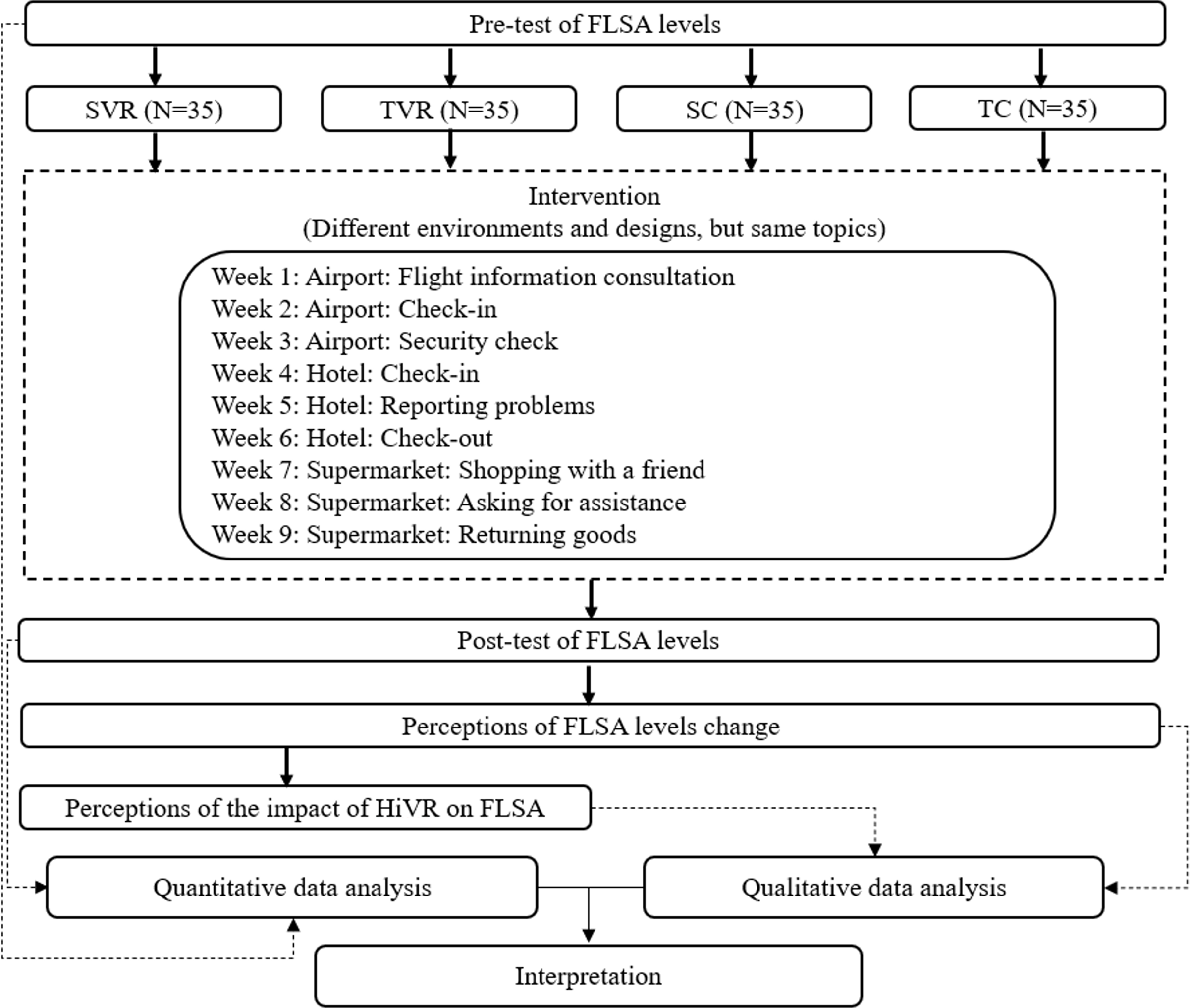
A pre- and post-test of FLSA levels gathered quantitative data. Qualitative data were collected through open-ended questionnaires after the experiment. The final interpretation of data analysis was based on integrating quantitative and qualitative datasets. Figure 1 presents the research design and data collection and analysis procedures.
Research design and implementation procedures.
Note. FLSA = foreign language speaking anxiety; SVR = situated learning and HiVR; TVR = teacher-centred learning and HiVR; SC = situated learning and classrooms; TC = teacher-centred learning and classrooms; HiVR = high-immersion virtual reality.
3.2 HiVR content development
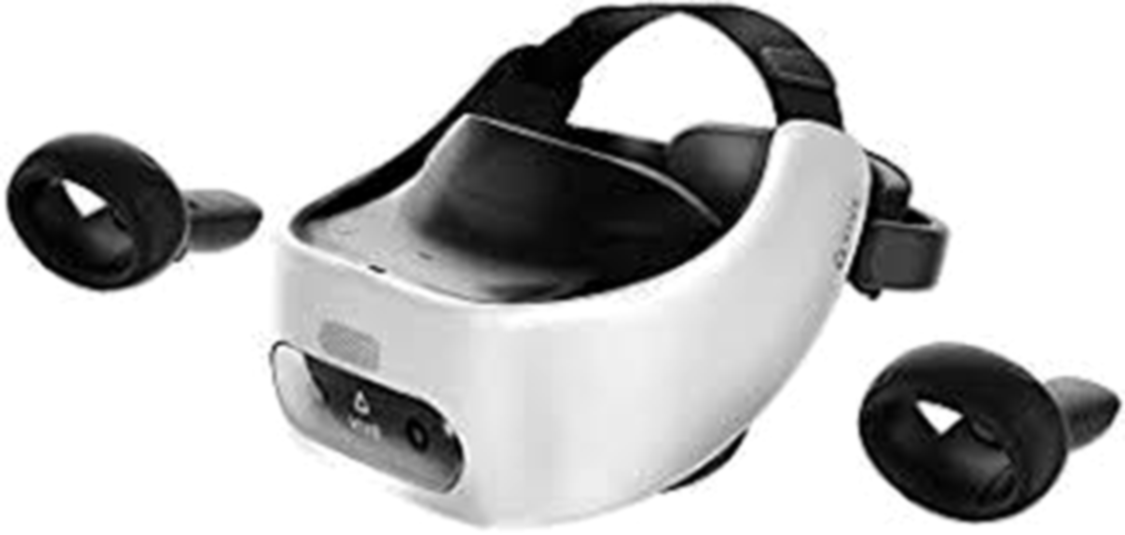
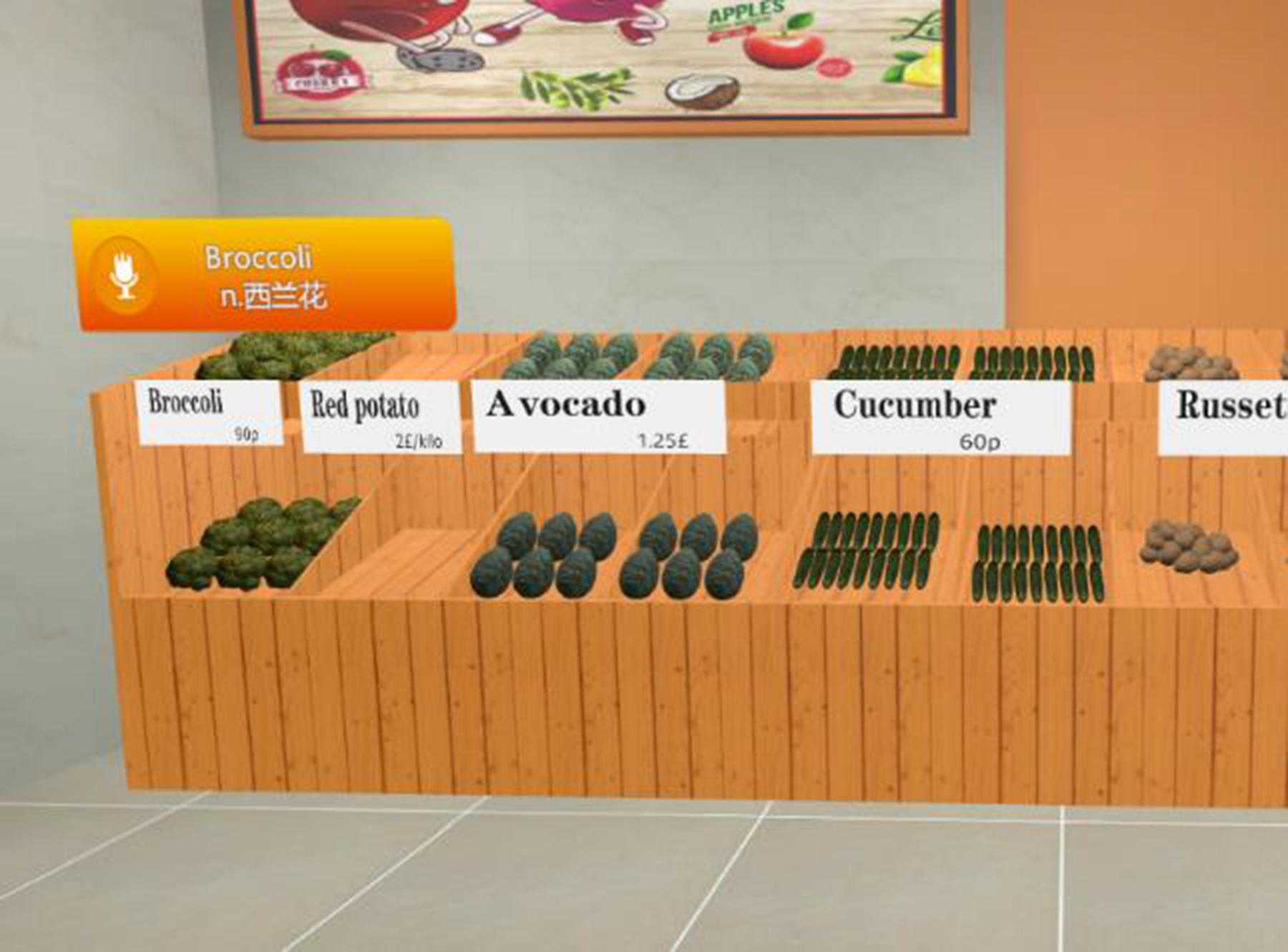
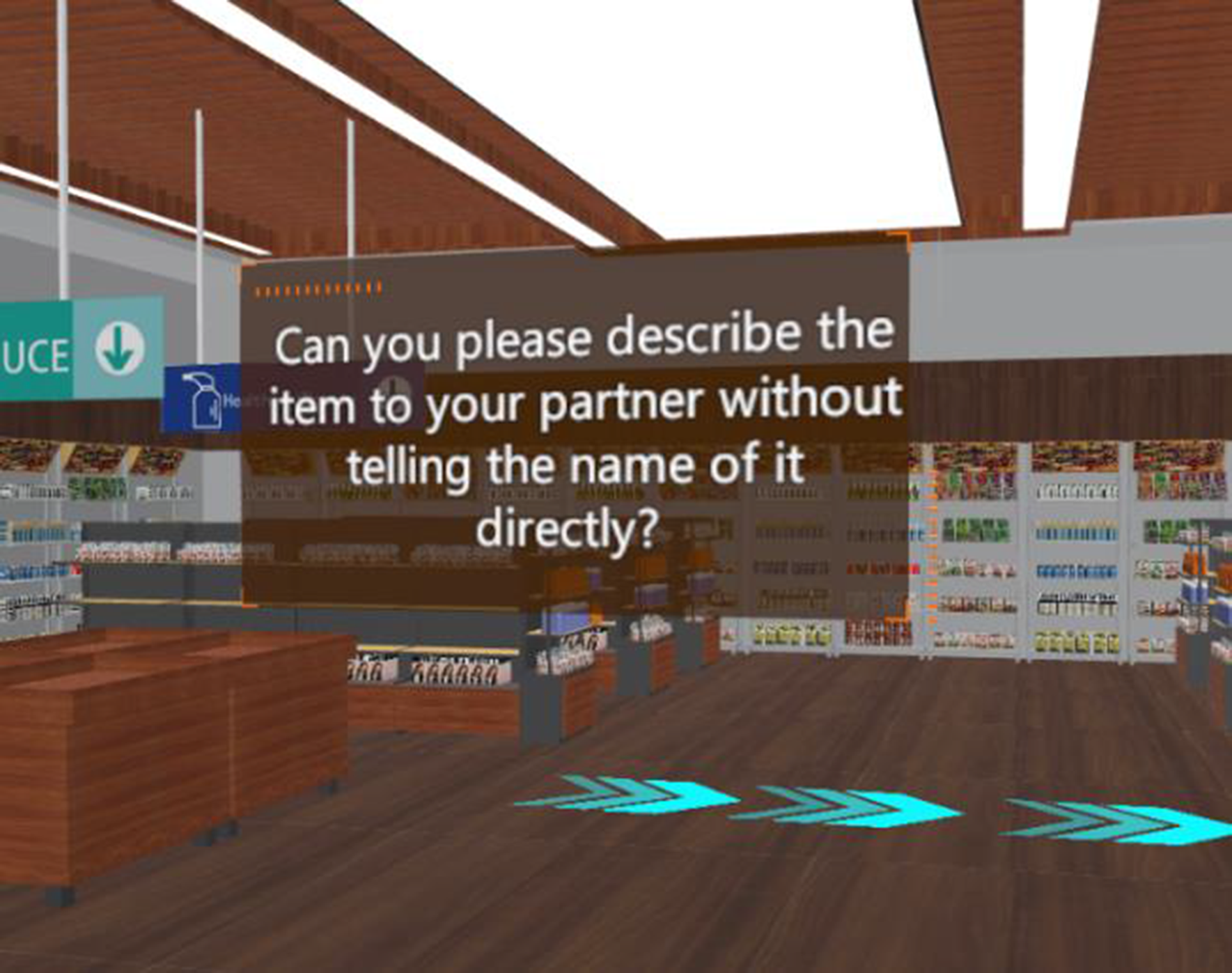
HiVR content, including realistic surroundings, virtual objects, and avatars, was built through Unity and 3Ds Max. HiVR learning content was used with a stand-alone VR headset, the HTC Vive Focus Plus (see Figure 2). A facial and body animation was created so that the avatar would move its body, hands, head, mouth and eyes according to the designed movement (see Figure 3 for an example). The pronunciation of words (see Figure 4) and sentences for activity instructions (see Figure 5) as well as sample dialogues can be heard when clicking on the corresponding areas. The user’s movement in the virtual environment could be achieved by walking around and by clicking on the indication signs (blue arrows in Figure 5). Immediate feedback, such as badges and the sound of applause, would show up automatically when students completed each learning activity. There was no time limit for each session.
HTC Vive Focus Plus display and controllers.
The avatar of a supermarket assistant.

Vocabulary shown in orange with the sound of the pronunciation.
A sentence example for activity instruction and indication signs.
3.3 Intervention
A nine-session intermediate English course (30–45 minutes each) was applied to the intervention. Before starting the intervention, instruction on the HiVR learning platform was provided in both video and text versions to students in HiVR groups (SVR and TVR). To ensure equivalent conditions for all four groups and minimise extraneous factors, each group used the same learning content but with different learning methods (situated learning or teacher-centred learning) and environments (HiVR or classroom). Students attended sessions two by two in pairs for each group. Students in the classroom groups (SC and TC) were permitted to try the HiVR intervention after all data collection was completed.
Students in SVR and TVR groups were gathered in the classroom for intervention, but all learning took place in HiVR environments. The researcher was only an observer, ensuring students’ safety while using HiVR, helping if technical issues occurred, and explaining the task if students did not understand.
The SVR group’s intervention followed these steps:
-
1. Two students first decided which role they would take from two different characters (Player A and Player B) through discussion with each other when entering the virtual environment in HiVR. After clicking on different characters, a similar scenario with slightly different information would be presented to students in headsets.
-
2. Following the designed activity guidance shown in HiVR, students learned some vocabulary by clicking on the words or 3D objects while listening to their pronunciations and seeing the translations of their meanings.
-
3. Following the guidance for an information gap task (Pica, Kang & Sauro, Reference Pica, Kang and Sauro2006) shown in HiVR, students communicated with each other to find out the information required to complete a task.
-
4. Following the guidance for a role-play conversation task shown in HiVR, students had a two-way conversation accordingly, and they could talk about anything relevant to the task in English.
-
5. Students listened to and read aloud the sample dialogue sentence by sentence.
-
6. At the end, students could exchange their roles, but they were not required to go over the whole learning task again. Instead, students were encouraged to hold a conversation using the vocabulary and/or expressions shown on the screen in HiVR.
For the TVR group:
-
1. Two students entered the same virtual environment in HiVR. They first followed the guidance shown in HiVR to learn vocabulary and dialogue. Limited interaction with the virtual environment was involved.
-
2. A role-play conversation task guidance was provided in HiVR at the end for students to practise what they had learned.
Students in the SC group followed the procedure applied in the SVR group, but in a traditional classroom with the researcher explaining the task and giving out paper copies of the role-play activity materials.
For students in the TC group, the lessons were delivered as lectures where the students listened to the researcher introducing the vocabulary and explaining the sample dialogue. A role-play conversation task was given to students at the end of each session with vocabulary and/or expressions provided.
3.4 Instruments
3.4.1 Demographic questionnaire
At the beginning of the experiment, a demographic questionnaire was used to collect background information about participants. This included gender, age, English learning experience, HiVR use experience, and self-assessed oral English proficiency.
3.4.2 English Speaking Anxiety Scale (27 items)
Before and after the intervention, students’ FLSA levels were collected through a 27-item 5-point English Speaking Anxiety Scale (ESAS). The development of the ESAS applied research-based constructs, as no existing scale fitted the exact setting of the present study. First, factors related to Chinese EFL learners’ FLSA from previous literature (He, Reference He2011, Reference He2013; Liu, Reference Liu2006, Reference Liu2007; Mak, Reference Mak2011; Tien, Reference Tien2018) were examined. These factors were then grouped into four categories: low English proficiency, lack of self-confidence, lack of experience, and unwillingness to communicate. Statements in relevant measurements (Balemir, Reference Balemir2009; Burgoon, Reference Burgoon1976; Ely, Reference Ely1986; He, Reference He2011; Horwitz, Reference Horwitz1986; Li, Reference Li2016; Mahmoodzadeh, Reference Mahmoodzadeh2012) were adapted for each category to develop ESAS. A Chinese version of the ESAS was generated through back translation, collaborative translation, and piloting (Douglas & Craig, Reference Douglas and Craig2007). The questionnaire pilot was conducted at a different university with 19 English-major students (14 females and 5 males). Some changes were made on the basis of students’ responses. For example, “speaking English” was reworded as “speaking English with others” to make it more closely related to the setting of this study.
The link to the final Chinese version of the ESAS created on Microsoft Forms was delivered to all participants via QQ (a Chinese social media application) before and after the intervention. Students’ responses were automatically uploaded to Microsoft Forms confidentially.
3.4.3 Self-rating of FLSA levels in speaking tasks (eight items)
Before and after the intervention, each student took a two-way role-play conversation task with an examiner who is a native speaker of English and used to be an official examiner for IELTSFootnote 1 speaking tests. All 140 students’ performance in the speaking task was video-recorded. The speaking tasks were intermediate level and involved 10 role-play tasks adapted from the ACTFL-OPI.Footnote 2 For each student, the second speaking task was different from the first one, but all tasks were selected from the 10 adapted tasks. During the task, students had one minute to prepare for the conversation with a pen and paper provided. The conversation was limited to six minutes.
Within 24 hours of the speaking task, participants were asked to rate their anxiety levels impressionistically and subjectively. They would view video recordings of their task performance with the researcher playing and pausing the recordings online. Since everyone’s conversation duration varied, the first four minutes were selected for self-rating for equivalence. Students rated their anxiety levels from 1 (not anxious at all) to 10 (very anxious) every 30 seconds, which resulted in eight FLSA ratings. The ratings scale was created in Microsoft Forms and sent to each student via QQ.
3.4.4 Open-ended questionnaires (four questions)
After the experiment, 140 students’ descriptions of their FLSA before and after the intervention (Q1 and Q2) and comparisons of their FLSA in two speaking tasks (Q3) were collected via open-ended questionnaires. Only students in the HiVR groups (n = 70) were asked about their perceptions of HiVR on FLSA via Q4.
-
Q1. Please describe your anxiety about speaking English with others before the learning sessions.
-
Q2. Please describe your anxiety about speaking English with others after the learning sessions.
-
Q3. How did you feel in the second speaking task compared to the first one? What made you feel this way?
-
Q4. What do you think was the impact of immersive VR on your anxiety about speaking English?
3.5 Data analysis
In terms of quantitative data, the total scores of the 27 items in ESAS and the average of the self-rating of FLSA levels in the speaking tasks were regarded as two types of FLSA levels. Paired-samples t-tests and one-way between-group analysis of variance (ANOVA) were conducted to determine any difference in FLSA levels within and among the four groups after the intervention.
Content analysis was employed to analyse the qualitative data collected through the open-ended questionnaire. As for quantitative content analysis (Riff, Lacy & Fico, Reference Riff, Lacy and Fico2014), a coding scheme with descriptions of speaking anxiety was first developed for each question and then piloted to ensure its feasibility. After finalising the coding scheme, descriptions of speaking anxiety were coded accordingly, and the frequency of responses was calculated.
With regard to qualitative content analysis, the analytical process of Elo and Kyngäs (Reference Elo and Kyngäs2008) was followed: (1) selecting the unit of analysis; (2) making sense of the data and whole; (3) open coding; (4) coding sheets; (5) grouping; (6) categorisation; (7) abstraction; (8) model, conceptual system, conceptual map or categories. As only the researcher could access the collected data due to ethical issues, iterative coding, reviewing the text and coding several times were employed to ensure the validity of the content analysis. The qualitative data analysis was based on the Chinese version of the texts, which were translated to English for understanding in the article.
4. Results
4.1 Quantitative results (RQ1)
Descriptive statistics showed that ESAS scores in both the pre-test (skewness = −.251, kurtosis = −.234) and the post-test (skewness = −.439, kurtosis = 1.271) were normally distributed. The Cronbach’s alpha level for the ESAS was .933 and .947 respectively for the pre- and post-test. No acceptable model was found for factor analysis of the 27 items in ESAS. Thus, the ESAS was used as a single scale rather than breaking it down into several factors for analysis.
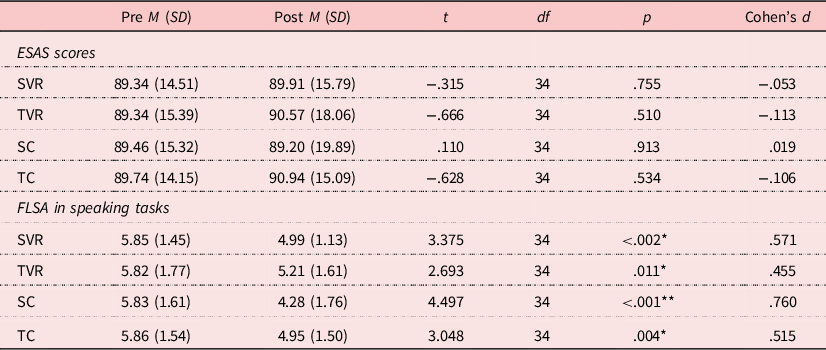
Paired-samples t-test results (see Table 1) revealed that no statistically significant differences in ESAS scores were found in the SVR (p = .755), TVR (p = .510), SC (p = .913), and TC (p = .534) groups before and after the intervention. However, students’ self-ratings of FLSA levels in the second speaking task were significantly lower than in the first one in each group: SVR group (p = .002), TVR group (p = .005), SC group (p < .001), and TC group (p = .004).
Paired-samples t-test results of students’ ESAS scores and FLSA levels in speaking tasks
Note. ESAS = English Speaking Anxiety Scale; FLSA = foreign language speaking anxiety; SVR = situated learning and HiVR; TVR = teacher-centred learning and HiVR; SC = situated learning and classrooms; TC = teacher-centred learning and classrooms.
*statistically significant at p < .05; **statistically significant at p < .001.
The results of one-way ANOVA showed no statistically significant difference in post-test ESAS scores, F(3, 136) = .069, p = .977, η2 = .002, and students’ self-ratings of FLSA levels in the second speaking task, F(3, 136) = 2.471, p = .065, η2 = .052, among four groups. These results indicated that after a nine-session intervention, neither the learning environments (HiVR and classroom) nor the learning approaches (situated learning and teacher-centred learning) resulted in statistically significant differences in students’ FLSA levels.
4.2 Integrating students’ descriptions of FLSA change with quantitative results (RQ2)
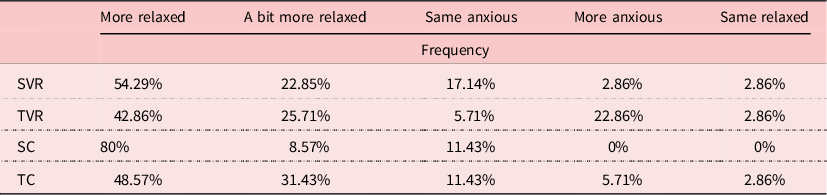
Based on the quantitative content analysis of Q1 and Q2 in the open-ended questionnaire, more than 28% of students in each group experienced no change in their FLSA, while the rest of the students reported lower anxiety after the intervention (see Table 2). According to the qualitative content analysis, the reasons why students perceived no change in FLSA were mainly due to no perceived improvement in oral English proficiency. Students were still concerned about their vocabulary, grammar, pronunciation, listening ability and fluency. Fear of failure (i.e. fear of making mistakes, fear of not being understood, and fear of not understanding others) was also mentioned by many participants as their concerns about speaking English. A few students attributed no change in their FLSA levels to the short intervention duration. For example, TVR20 mentioned that
generally speaking, I didn’t see any improvement in my oral proficiency. I am still concerned about my pronunciation and lack of vocabulary to express myself. I think no big change in anxiety is related to the duration of the course.
Students’ descriptions of FLSA change after the intervention in each group

Note. FLSA = foreign language speaking anxiety; SVR = situated learning and HiVR; TVR = teacher-centred learning and HiVR; SC = situated learning and classrooms; TC = teacher-centred learning and classrooms.
Table 3 shows the quantitative content analysis results of Q3. It showed that the SC group contained the most students (80%) who felt more relaxed in the second speaking task among the four groups, and it was the only group where no students felt more anxious than before the experiment. The TVR group had the smallest number of students (42.86%) who reported feeling more relaxed or a bit more relaxed, but the most students (22.86%) who reported being more anxious in the second speaking task. This is consistent with the quantitative results of paired-samples t-test that the TVR group witnessed the smallest effect size (Cohen’s d = .455), but the SC group gained the largest effect size (Cohen’s d = .760) (see Table 1).
Students’ perceptions of FLSA change in the second speaking task in each group
Note. FLSA = foreign language speaking anxiety; SVR = situated learning and HiVR; TVR = teacher-centred learning and HiVR; SC = situated learning and classrooms; TC = teacher-centred learning and classrooms.
In the qualitative content analysis of texts for Q3, HiVR technology was not directly mentioned by any participants in the SVR and TVR groups as contributing to their FLSA decrease in the speaking task. The majority of responses explaining lowered FLSA in the speaking task were related to learning content rather than the learning environment per se. Specifically, students mentioned that being familiar with the task, including the task type, task process and the interlocutors/examiners, was the main contributor to the decrease in their FLSA in speaking tasks. The following statements showed the general positive influence of task familiarity on students’ FLSA levels:
For the first speaking task, I did not know what would happen nor what the process would be, which made me nervous. After understanding the type of the task, I could prepare for the conversation better, so my anxiety levels reduced in the second one. (TVR8)
Additionally, students’ perceived that English proficiency improved after the intervention. SC17 stated that
I become less nervous because I know what to say, and my logic for speaking English becomes clearer after practising. I can follow the topic and continue the conversation … This alleviates my anxiety significantly.
Having more opportunities to practise the speaking task also contributed to students’ lower FLSA levels. The practice built up students’ self-confidence in speaking English. For example, TVR27 mentioned that
psychologically, I felt more relaxed during the speaking tasks. As I have practised many times in the course, I believe that I have the ability to communicate in English. So, I became more confident during the second speaking task.
4.3 Students’ perceptions of using HiVR to alleviate FLSA (RQ3)
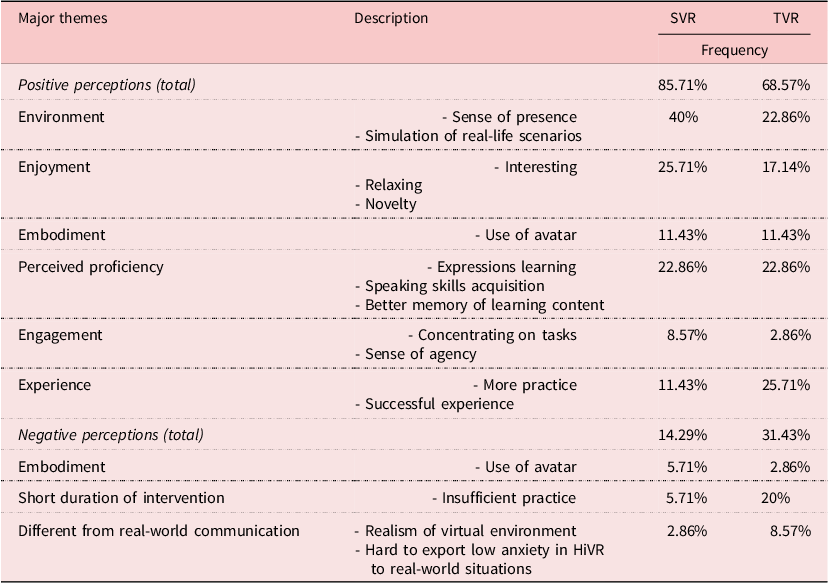
Sixty-nine responses were received for Q4 in the open-ended questionnaire. Table 4 displays the quantitative content analysis results for Q4. It showed that the majority of students perceived the use of HiVR in alleviating FLSA positively. HiVR sessions designed with situated learning principles received more positive reviews (85.71%) than those with the teacher-centred learning approach (68.57%). Six major themes – environment, enjoyment, embodiment, perceived proficiency, engagement, and experience – were extracted from students’ positive responses. The reasons for why students perceived HiVR negatively were mainly due to the short duration of the intervention, the use of avatars, and the difference between face-to-face and HiVR communication.
Summary of students’ perceptions of HiVR in alleviating FLSA
Note. HiVR = high-immersion virtual reality; FLSA = foreign language speaking anxiety; SVR = situated learning and HiVR; TVR = teacher-centred learning and HiVR.
Several students (see an example from SVR34) reported that they benefitted from being immersed in an environment that simulated real-world situations while using HiVR, which made them felt as though they were in a real-life scenario. This could be linked to the sense of presence, which refers to the feeling of being there while not being psychically present in the actual environment:
By utilising immersive VR, we are able to solve a major problem with speaking English outside of class, namely the environment. Immersive VR provides us with various authentic environments, and we can be immersed in them while using it, which helps to reduce my anxiety about speaking English. (SVR34)
The simulations offered students more opportunities to practise English speaking, which also resulted in improved perceived oral proficiency. TVR21 stated that
through immersive VR, I am able to connect English expressions to real-life scenarios, which enhances my ability to remember what I have learnt. Moreover, after applying what I know in the VR course via communicating with my partner to solve a real-life problem, I can remember more about the learning content.
Moreover, many students found the learning content in HiVR to be interesting and relaxing, the HiVR technology to be a novelty, and the design of the environment and avatars to be vivid. Students found speaking English in the HiVR setting more enjoyable than in the classroom. The following statements are some examples:
… HiVR increases the fun of learning, which then reduces my anxiety. (SVR1)
HiVR offers a wide range of locations and topics combined with several conversation samples. I enjoyed speaking English in immersive VR. (SVR9)
I don’t have to imagine the scenario while using HiVR for speaking. The virtual environment provides specific situations and objects, which enables me to communicate easily with partners. This makes me feel more relaxed. (TVR9)
In addition, students perceived HiVR learning sessions to be beneficial for engaging in the learning process. They were more concentrated on learning tasks and able to think about more expressions while using HiVR. For example, SVR1 and TVR15 articulated that
observing the immersive virtual environment enables me to focus on the learning tasks, which enhances my concentration on speaking rather than feeling anxious about looking at others’ eyes. (SVR1)
I was fully engaged in the virtual situation while using immersive VR and was able to find the words to communicate. My anxiety levels were reduced because of this. (TVR15)
Students’ perceptions of embodiment in HiVR – the use of avatars – in alleviating their FLSA were incompatible. Only seeing the virtual environment and avatars helped several students feel less stressed. However, there was no transformation of facial expressions and body behaviours in HiVR, which created obstacles for a few students in understanding the intention of the interlocutors’ utterances. SVR21 mentioned both the positive and negative effects of the use of avatars in HiVR:
Immersive VR is an advanced technology, in which we cannot see the face of the interlocutor, but only hear their voice. This reduced my anxiety about speaking English. However, sometimes it is a disadvantage that we cannot see the interlocutor because we cannot tell their facial expressions in order to understand the intention of their utterances.
Furthermore, a few students mentioned that it was difficult for them to apply the low anxious feelings in HiVR to the real-world communication. In other words, students felt less anxious while using HiVR to speak English, but when it was in real-life situations, they experienced anxiety again. Thus, some students did not perceive the benefits of HiVR oral English learning in alleviating their FLSA. The short duration of the intervention was also mentioned as a reason by a few students.
5. Discussion and implications
In response to the first research question, the quantitative results indicated that neither HiVR nor situated learning resulted in statistically significant differences in FLSA compared with classrooms and teacher-centred learning. These findings contradict those of previous studies (Gruber & Kaplan-Rakowski, Reference Gruber and Kaplan-Rakowski2020; Kaplan-Rakowski & Gruber, Reference Kaplan-Rakowski and Gruber2021; Thrasher, Reference Thrasher2022; York et al., Reference York, Shibata, Tokutake and Nakayama2021), which found a decrease in FLSA after using HiVR, and a lower FLSA level in the HiVR group compared to the classroom group (Thrasher, Reference Thrasher2022). The first reason for the differences in research findings may be to do with the measurement of FLSA. The retrospective measures of FLSA are not unified and can vary in different learning contexts and cultures (Horwitz, Reference Horwitz2010). The present study takes the Chinese EFL learning context into account when adapting the ESAS. However, previous studies did not consider the specific context when measuring the FLSA. Moreover, the retrospective method (i.e. self-reports) depends on respondents’ own evaluations of feelings, which are subject to various sources of inaccuracy (Paulhus & Vazire, Reference Paulhus, Vazire, Robins, Fraley and Krueger2007). The exploration of objective measures of FLSA is essential. Although Thrasher (Reference Thrasher2022) found the level of salivary cortisol was moderately correlated with FLSA, the sample size was small (N = 6) in her study.
The intervention design may also explain the different quantitative findings. Spot-the-difference task (York et al., Reference York, Shibata, Tokutake and Nakayama2021) and three-way interpersonal consensus-building task (Thrasher, Reference Thrasher2022) were employed in prior research, but the present study used role-play tasks. It needs to be further investigated whether the learning principles underlying HiVR learning content design can influence the learning effect of the technology. Moreover, the duration of the intervention may be a possible factor that influences the effects of the technology on learning. Nine sessions (30–45 minutes each) over a three-month duration were implemented in the present study. However, Qiu et al. (Reference Qiu, Shan, Yao and Fu2024) stated that a long duration of HiVR learning may cause fatigue and reduce language learning effects. The effects of different intervention durations on FLSA may be worth investigating in future studies.
With regard to the second research question, students’ descriptions of their FLSA change supported the quantitative results. Although many students did not perceive general FLSA change before and after the intervention, they felt more relaxed during the second speaking task. The main reason for the decrease of FLSA in speaking tasks was that students built up confidence through successful oral English communications during much practice in the intervention, no matter whether HiVR was used or not. It was also evident from the study by Amiryousefi (Reference Amiryousefi2016) that task repetition helps to reduce FLSA levels.
As for the third research question, HiVR was perceived by most participants as a helpful tool to alleviate their English speaking anxiety. Students’ perceptions were in line with prior research that revealed HiVR contributed to a high level of learning engagement (Enkin, Reference Enkin2022; Tseng & Geng, Reference Tseng and Geng2021) and a relaxing and interesting environment for language learning (Kaplan-Rakowski & Gruber, Reference Kaplan-Rakowski and Gruber2021; Wu & Hung, Reference Wu and Hung2022). It should be noted that these benefits are not an inherent quality of HiVR technology itself but are to do with the consciously designed virtual environment and learning content in HiVR. Therefore, HiVR should not just be seen as instructional technology and a medium for learning. It is essential to make the most of HiVR technology to enhance learning considering learning theories and technology affordances.
The embodiment feature of HiVR technology received different perceptions from participants. Students felt less stressed while using HiVR to speak English, which is consistent with some research (Arnold, Reference Arnold2007; Rosell-Aguilar, Reference Rosell-Aguilar2005). However, the use of avatars was an obstacle for some students to determine the intentions of the interlocutors. Kaplan-Rakowski and Gruber (Reference Kaplan-Rakowski and Gruber2021) also found the lack of paralinguistic cues (e.g. lip-reading and facial expressions) in HiVR hindered communication. It should be noted that although only animation was created in the present study, it was due to the technology limitations in late 2019 and early 2020 when the researcher developed the HiVR learning content. The most recent HiVR technology enables eye and facial tracking as well as synchronising body movements. These new functions of HiVR can be applied in the learning design in further research on HiVR and FLSA.
A further important point was that when students return to the real world, they encounter real people in circumstances where there are no clues and guidance for conversation as in HiVR, which raises students’ anxiety about speaking the foreign language again. This point may explain why no statistical changes in FLSA were found after the intervention, but students’ perceptions of HiVR and FLSA were mainly positive. Students felt less anxious while using HiVR to speak English, but this did not influence their actual FLSA levels in real-life situations. This finding contradicts claims by other scholars (Kampmann et al., Reference Kampmann, Emmelkamp, Hartanto, Brinkman, Zijlstra and Morina2016; Opriş et al., Reference Opriş, Pintea, García-Palacios, Botella, Szamosközi and David2012) that HiVR sessions have real-life impact that can influence behaviour in the real world.
6. Conclusion
This study utilised HiVR as a learning tool for a foreign language and investigated its effects on language speaking anxiety taking into account different learning design principles (situated learning and teacher-centred learning). The quantitative results were different from previous research on HiVR and FLSA, which illustrated no evidence for differences in FLSA between using and not using HiVR. Qualitative results were mostly consistent with previous studies but also revealed new perspectives on using HiVR for foreign language learning. It showed that most participants perceived HiVR technology positively in alleviating their FLSA, although this is more related to the situations when they were using HiVR. They expressed that HiVR could provide an authentic environment by simulating real-life situations for communication in the target language. With the interesting learning design and the freedom to control actions in HiVR, students were more engaged in learning. The use of avatars to represent real people was beneficial for lowering FLSA, but sometimes hindered communication.
Based on all the results, the use of HiVR in coping with FLSA is promising. However, it is worthwhile to investigate how to maximise the use of HiVR to enhance foreign language learning. In future studies, learning approaches other than situated learning can be utilised in the learning design in order to see if they result in differences in FLSA levels while using HiVR. The continuing development of HiVR technology, which allows more functions, should be considered in future research. It is also important to identify how language learning can take the most advantage of HiVR’s affordances. Furthermore, it is worth investigating how to export the low-anxiety experience in HiVR to real-world use of the target language.
Supplementary material
To view supplementary material referred to in this article, please visit https://doi.org/10.48316/pD8Qw-f6jnj and https://doi.org/10.48316/si6FQ-JMMAk
Acknowledgements
I am grateful to my supervisors, Prof Ellen Boeren, Dr Gabriella Rodolico and Dr Ide Haghi, for their encouragement and guidance during my PhD study.
Ethical statement and competing interests
Ethics approval of this study was obtained from the University of Glasgow. All participants were volunteers, and they completed a consent form after understanding the experiment, the storage and use of their data and their rights to withdraw. The author declares no competing interests and no use of generative AI.
About the author
Miaomiao Ding recently completed a PhD in education at the University of Glasgow. The research in this article is based on her doctoral thesis. Her research interests are technology-enhanced language learning, emotions in language learning, and mixed-method research in education.


 Open access

