

The railway has become a co-wife,
It has taken away my beloved;
It has taken away my beloved to Rangoon,
It has taken away my beloved to Bengal;
Neither the railways nor the steamships,
The real enemy is money;
It forces one to wander from one to another country,
The real enemy is money;
The country of Rangoon has a city of Yadavs,
It will seduce my beloved;
The country of Bengal is the city of enchantment,
It will entice away my beloved;
I feel no hunger, nor thirst,
I just feel a swelling affection;
When I see your face,
I just feel deep affection;
I will survive on a ser Footnote 1 of saag Footnote 2 the full year,
But I won’t let my beloved go away.
This is one of the most popular folksongs from the region of western Bihar and eastern Uttar Pradesh (UP), culturally and geographically referred to as the “Bhojpuri belt”. There are regional variations of the song; for instance, in one of the UP versions instead of saag, gehun (wheat) is used. Wheat is more popularly grown and consumed in UP than in Bihar, so these folksongs easily adapt to and reflect local cultural and environmental settings.Footnote 3 Obviously, the reference to railways and steamships also shows folksongs’ flexibility in terms of temporal novelty. Some of these folksongs are based on older narrative traditions that go back to the early modern period but the inclusion of objects and metaphors from the immediate past and contemporary times, primarily the nineteenth century, shows the elasticity of these songs and their ability to weave in issues related to immediate social concerns.Footnote 4
Through the use of Bhojpuri folksongs on marriage and migration, this article attempts to capture the social realities of labour migration by keeping the migrant’s wife in the centre of the narrative. Labour migration, predominantly male, from the mid-nineteenth century onwards (stimulated by the expansion of industrial employment, transport and communication, and the emergence of new print bazaar) recast the relations of family and gender in the labour-supplying, Bhojpuri belt. In this constellation of social, economic, and technological changes, the article looks at the idea of home, construction of womanhood and the interlaced lifecycles of migrant men and non-migrant women. Moving away from the predominant focus on migrant men, the article attempts to recreate the social world of non-migrant women left behind in the villages of northern and eastern India, whose lives were structured by double displacement engendered by marriage and migration.
THE SOURCE: THEMES AND HISTORICAL CONTEXTS
Folksongs are malleable social texts, many times defying any precise dating or authorship. They are elastic as they incorporate new elements and forms of expressing collective experiences, while following existing metres, genres and motifs. We will deal with the question of agency and representation as embedded in these folksongs in greater detail towards the end of the article but the methodological lens adopted here needs to be clearly specified at the beginning. Folksongs are usually treated as part of the region’s long-existing culture and tradition, but are not ahistorical. They might be, as many of the songs used in this essay are, written by one social group (male), but unknowingly document the experience of and social reality related to another (female). Smita Tewari Jassal has convincingly reminded us that the male authorship of these songs does not foreclose the option of reading women’s social reality into them. Their oral articulations in the light of limited or no access to the written word, when collected, authored, and published by male literati, still invoke women’s silenced perspectives.Footnote 5 A contextual reading of these songs, without presupposing any essentialised generalization, allows us to uncover both historical shifts as well as processual “structures of feeling”, particularly, when used for understanding social phenomena and identities.Footnote 6
One significant concern in these songs was (and is) migration, perhaps precisely because of its long historical tradition from this region. Be it the current stream of informal labour migration to metropolitan cities such as Delhi and Bombay (now Mumbai), the agrarian labour force that went to the Punjab in the 1960s, the workers who migrated to Bengal’s jute mills in the late nineteenth century, or the indentured emigrants to plantation economies of the Caribbean – this region has remained central to the history of migrant workers of South Asia. In the early modern and early colonial periods, it provided men to work in the armies of the Mughal Empire and the English East India Company.Footnote 7
Movement required means of transport and communication. In spite of the longer history of movement and migration from this region, there was an intensification of the phenomenon in the decades of the mid-nineteenth century.Footnote 8 With the abolition of slavery and the beginning of the indenture system in the 1830s, labour demand in plantation colonies of the British Empire grew exponentially. This decade, not so coincidentally, was also when steamboats and tugs started plying the Ganga. Two decades down the line, jute industry in Bengal and tea plantations in Assam emerged. Both required labour inflow. While the majority of the “coolies” that went to Assam were not from the Bhojpuri belt, the jute industry of Bengal relied heavily on Bhojpuri male migrants.Footnote 9 Once again, the decades of the 1850s and 1860s, which kicked off this industrial-plantation expansion, were also the period when the East Indian Railway linked Calcutta to upper parts of northern India and then to Assam. The colonial state and the railway companies were apprehensive of passenger travel, but they soon realized the opposite to be the case: travellers, including coolies in the third-class compartments, formed the bulk of passenger traffic.
In nationalist understanding, “railway imperialism” has been villainized, mainly from the viewpoint of commodities. Railways brought cheap raw materials from the interior to the port cities of India and, in return, imperial Britain flooded the colony with its cheap industrial finished products. But as the opening song of this article suggests, it was not just about commodities. These modern means of communication – steamships and railways – were also seen as enemies by those whose lives, marriages, and homes were broken due to migration. New transport technology became both the means to connect as well as separate. Certain genres of Bhojpuri folksongs that deal with migration, such as bidesiya and poorbi, capture this in the most expressive way.Footnote 10
This migration was overtly male in nature. According to one estimate, of the total number of emigrants to overseas indenture plantations, only twenty-five per cent were women.Footnote 11 The trend was similar for the internal migration that took place from the Bhojpuri belt to Bengal and elsewhere. Between 1921 and 1930, for instance, women comprised sixteen per cent of the total labour force in the jute industry of Bengal; in the following decade, this reduced to thirteen per cent.Footnote 12 Few historians have explored the gender implications of this migration pattern.Footnote 13 This is because, for a long time, the debate has remained concentrated on two aspects: first, on challenging the existing Eurocentrism in migration studies and, second, on the nature of the migration itself. To counter the overt focus on Atlantic migrations, studies on Asian or Indian Ocean migrations have become more prominent in the last decade or so.Footnote 14 Meanwhile, debate on the nature of migration has been focused primarily on the binaries of “free” and “unfree”, in which the specific natures of contract, debt, and coercion have been explored in recruitment strategies as well as on the actual work sites. The argument here is to challenge the received wisdom of “free will” that is assumed to be enshrined in the instrument of contract. So, Prabhu Mohapatra has argued that about ninety per cent of the total Indian migration of thirty million to South East Asia “functioned through systems of debt and advances, tying down labourers to particular employers through the mediation of the labour contractors”.Footnote 15
Study of South Asian labour history has now firmly shown that the contract did not represent free will, but rather was an instrument to close the exit route for workers. This was true for a variety of migrant workers, from indenture and plantation coolies to maritime lascars.Footnote 16 This argument is applicable to both overseas and internal migrations. There were some differences though: for male migrants to Calcutta, who worked in various professions ranging from domestic servants in households to coolies in mills and factories, it was more profitable not to completely immobilize them. Keeping a section of this labour force “floating”, as Sen has argued, was useful to employers.Footnote 17 The historiography on immobilization through contract has obfuscated our engagement with histories that might be hidden behind the term “floating”. Seen from the other side of the migration spectrum, the floating nature of the workforce meant the existence of the cyclical nature of migration, which is well reflected in the folksongs of this region. In folksongs, this cyclicity was crucial in ways the ideas of home and womanhood were formed.
CONCEPTUAL DEPARTURES: GENDER AND CIRCULATION
While focusing on the modes of recruitment, working conditions at work sites, and state-capital strategies of labour control, a predictable if not formulaic argument has emerged, which is that the binaries of “free” and “unfree” are misleading as they do not capture the historical reality of coexistence. The idea of a spectrum has become the way to understand this coexistence, with “free” and “unfree” not existing at two opposite ends, but sliding in and out of each other, creating a “continuum”.Footnote 18 The emphasis on “free” and “unfree” forms of labour together with a stress on understanding migration as a network has led to the prioritization of those historical subjects who migrated. As most migrations were largely male, these men have become the subject of study. Coolies and lascars have made a prime place for themselves in this new scholarship. Female subjects also received some attention; female migrants are part of this historiography, but only as migrants. Even then, the disparity is noticeable. While lascars have been independently studied both in monograph and essay forms, travelling ayahs still await a dedicated monograph. Still poorer is our focus on non-migrant women whose lives were nonetheless intrinsically affected and shaped by migration.Footnote 19
In order to overcome this historiographical bias, we need to closely interrogate our conceptual categories. Increasing theoretical sophistication has recently questioned the application of the term “migration” as simplistically symbolizing a one-way movement and instead suggested the concept of circulation or circular migration. In simple words, this means overcoming earlier analytical inadequacies in certain ways. First, migration did not capture the historical process of the return journey. To quote some pertinent figures, out of thirty million migrants who “left the shores of India between 1834 and 1937 no less than 24 million returned during the same period”.Footnote 20 Second, it did not capture the “incremental aspects” of mobility that transform things and people when they are in the act of movement.Footnote 21 The concept of circulation aims at broadening this by bringing into the fold those who were “on the move”.Footnote 22 Recently, G. Balachandran has suggested this to be the core definitional characteristic of the term coolie: “no matter how firmly locked into place, the coolie’s immanent condition was always one of apparently random mobility”.Footnote 23
Once again, this circulatory nature of labour movement also applied to many of the men who migrated from the Bhojpuri belt to work in Bengal. Chaudhury has shown that almost all migrant workers from UP to the rest of India (usually Bengal), except Assam, “regularly visited their villages, once in every one, two or three years”.Footnote 24 This is a distinctive feature of the Bhojpuri migration to purab (east, for which read Bengal). Ties were not as severely cut as was the case with overseas indenture or Assam tea plantations. Thus, the links between the rural and the urban were not simply metaphorical in the folksongs discussed here. Men did return with gifts and money. Women did actively desire to consume the objects and tales of Kalkatwa (Calcutta). Between them, the figure of batohi worked as a migrant-informer, who would pass on the news between the rural wife and the city-based husband, while being himself on the move. From being “purabiya peasants” employed in Mughal and East India Company armies to becoming industrial workers, menial servants, and footloose labourers in Calcutta, the region’s men created a world of circulation. They were on the move and with them moved language, objects, and emotions.
This new conceptual thinking on circulation is reflected in some leading migration scholars’ suggestion to enlarge the scope of inquiry to not only include varieties of movements, but also use new types of sources. Yet, in their call to link the study of social change and migration, it is the figure of the migrant and the space of the city that remains in the core of the conceptualization. They are aware of the importance of studying the effect of migration on the supply societies, but from the migrant’s migration perspective.Footnote 25 We get fleeting ideas on the recasting of home in the city, for instance, through the use of language spoken at home or an emphasis on maintaining the “core values” in the family while acclimatizing in the new city culture. But such insights from researchers and also filmmakers leave homes and families that stayed back outside the purview of the inquiry.Footnote 26
The question, then, is: can we even begin to think of writing the history of migration from the non-migrant’s perspective? In an interview, Amitav Ghosh reminds us of the importance and requirement of place, which does not fritter away with travels and movements.Footnote 27 Perhaps, the idea of home becomes even more gripping when mobility accelerates. How did non-migrants make sense of their place? What happened to their ideas of home and the web of relationships they were part of? Is this existing gap (less focus on non-migrants as part of the social history of migration) simply a matter of our research choices or a condition arising out of conceptual limitations? Has the concept of circulation now become an easy tool to map (only) the histories of movement of people and groups who were on the move? It seems that by privileging mobility as its core concern or angle of vision, the framework of circulation has ironically constricted the space to think about those who did not travel but were crucially implicated in the history of movement and circulation. The Bhojpuri women are one such significant group with which this article deals. This might be a provocative as well as speculative argument, but the applicability of the framework of circulation seems to have a gender bias in favour of men.
The dialectic of mobility–immobility has been traced through an investigation of “free will” along the axis of freedom–unfreedom in which male mobility appears as a conundrum.Footnote 28 This dialectic has been less traced along gendered (im)mobile divisions. We don’t know enough about how immobilized female labour living in villages and small towns experienced the world of mobility through tales, objects, emotions, and desires.
It is true that in the indenture regimes the term coolie was also applicable to women, yet the idea of home and family in such migration conditions that created separation is often left out of these accounts. “Family allotment” as a strategy of recruitment, resuscitation of patriarchy through active intervention of the law to control women and their labour at work sites, and the ideas of longing and belonging, together with community identity formation within diasporic migrant communities, have been explored. But family as a web of relationships between different members at the rural, small-town site where the non-migrant stayed back is still missing from these narratives.Footnote 29 If historical scholarship has prioritized the migrant subject, who were mostly male, the literary world has beautifully captured the experience of the journey, albeit still of the migrant. Through Deeti, Amitav Ghosh gave us a telling sketch of women who managed to migrate.Footnote 30
What has remained fairly neglected is the memory and history of hundreds and thousands of Deetis who were left behind in the villages. They did not travel and hence slipped out of the net of the analytical category of circulation. Through the use of folksongs, this article attempts to bring them back into the analytical fold of mobility by exploring the interconnectedness of spaces (rural and urban), gender (female and male), and physical conditions related to mobility and immobility. The triangulation of urban–male–mobility is much explored in the existing literature. This article, therefore, is avowedly tilted in favour of the other triangulation of rural, women, and immobility.
The need to stress the interconnected approach is precisely because of the strong presence of rupture in the sources. The gendered nature of migration – mobile men and immobile women – can be easily discerned in these folksongs. Men had inevitably to migrate in search of work; women were left behind and pleaded with them not to leave. This division has privileged the migrant’s pain; so, argues Tiwari, these songs “depict the ontology of pain of the migrants that is centred around migration”.Footnote 31 In this articulation, the non-migrant’s pain is thus either obliterated or subsumed within the migrant’s experience. The focus casts away on “indentured subjectivity”, leaving the subjectivity of the non-migrant unexplored, or worse, unacknowledged.
A comparative example can be illustrative of the uniqueness of adopting a non-migrant’s perspective. In both overseas and internal migration of coolies, longing is a common theme in songs. But in contrast to the experience of overseas coolies who yearn to return to their homeland, both the marriage and migration songs used in this article, do not reflect an overarching longing by men to return to their homes and villages in Bihar and UP.Footnote 32 The act of longing is performed by the non-migrant subject who remained rural. The woman is usually depicted as longing for two things: first, the return of her husband and, second, the inflow of city goods and tales. The sense of longing, therefore, remains the same in both types of migration, but its nature changes when seen from different perspectives. Overseas migrants (usually male) longed to go back to their homeland; the rural women longed to see their husbands return.
For lack of any better word, I characterize the women’s world as immobile (and also to make a stronger conceptual plea to integrate the histories of “immobility” in the social history of migration), otherwise this is not exactly a fair historical reality. Women’s world in villages was not static. When they pleaded with their men not to leave, they remained in the villages, but were caught in the web of mobility. Their immobility was not a physical reality, but a relational mode of existence when their men had migrated for work.
The second important qualification is the fact that marriage itself was a kind of mobility, both physical and emotional. Marriage songs, as used below, clearly show this. The male emigration did not lead to glorification of spinsterhood and denigration of marriage, as folksongs from some other societies, indicate.Footnote 33 Marriage remained an important social institution, largely because of the active regulative apparatus of the state. Circularity has been recently defined as the prime feature of marriage migration, and yet marriage, as the author herself shows, has historically remained a chief legal and social institution for women’s immobilization.Footnote 34 As mobility and migration continue to be widely studied, Joya Chatterji’s pointer to not forget about the factors such as transport, age, health, and obligations of care, which produce immobility, is refreshingly important.Footnote 35 Added to this could be the factor of law, inheritance, division of labour, and gendered notion of work and its value.Footnote 36 This article does not analyse the production of immobility, but uses folksongs to understand how mobility was perceived and used to fashion the immobile woman subjecthood. The social class of women these folksongs represent mostly stayed back in the villages in their marital house, but, before their unknown prospective husbands left in search for work, they themselves had moved from one village to another, from one house to another, as a bride.Footnote 37 Therefore, while obviously being aware of the mobility embedded in marriage, I try to give primacy to the “reimmobilized” non-migrant subject in the history of migration. In this regard, we need to critique and redesign the framework of circulation to include both immobility and small-scale circulations (from natal to marital, for instance) and to put the framework in dialogue with other aspects and institutions of social life, such as marriage. The framework of circulation needs to be made apt to allow histories of mobility and immobility, male and female, and villages and cities appear in the same analytical field.
This attempt should not be misconstrued as any replication of the binary of mobility and immobility or of city capitalism and rural traditionalism. In most cases, the state and the employers “created” the conditions for immobility, especially for women, by keeping wages of male migrants depressed. This made the cost of social reproduction expensive at the site of factories, offices, bazaars, and bungalows in the cities where men worked. The task of social reproduction was left to be fulfilled in the villages.Footnote 38 The metaphors and imageries of exile and longing, fear of the appearance of a second wife, and the excessive offering of physical intimacy on the part of wives to compensate for separated conjugality populate Bhojpuri folksongs. All these signify that social reproduction remained suspended until the periodic return of the male migrant to his village. One way of understanding the constructed dualism of mobility–immobility is through a careful examination of colonial records, as Mohapatra has astutely done.Footnote 39 Another can involve the analysis of social archives of these malleable folksongs to understand the dynamic relationship between mobility and immobility without necessarily tripping over the edges of the “spectrum”. Thus, this approach is not the negation of the state’s presence, but a challenge to the “state-centric” method identified by Kerr as one of the characteristics of migration studies.Footnote 40
THE PRINT BAZAAR
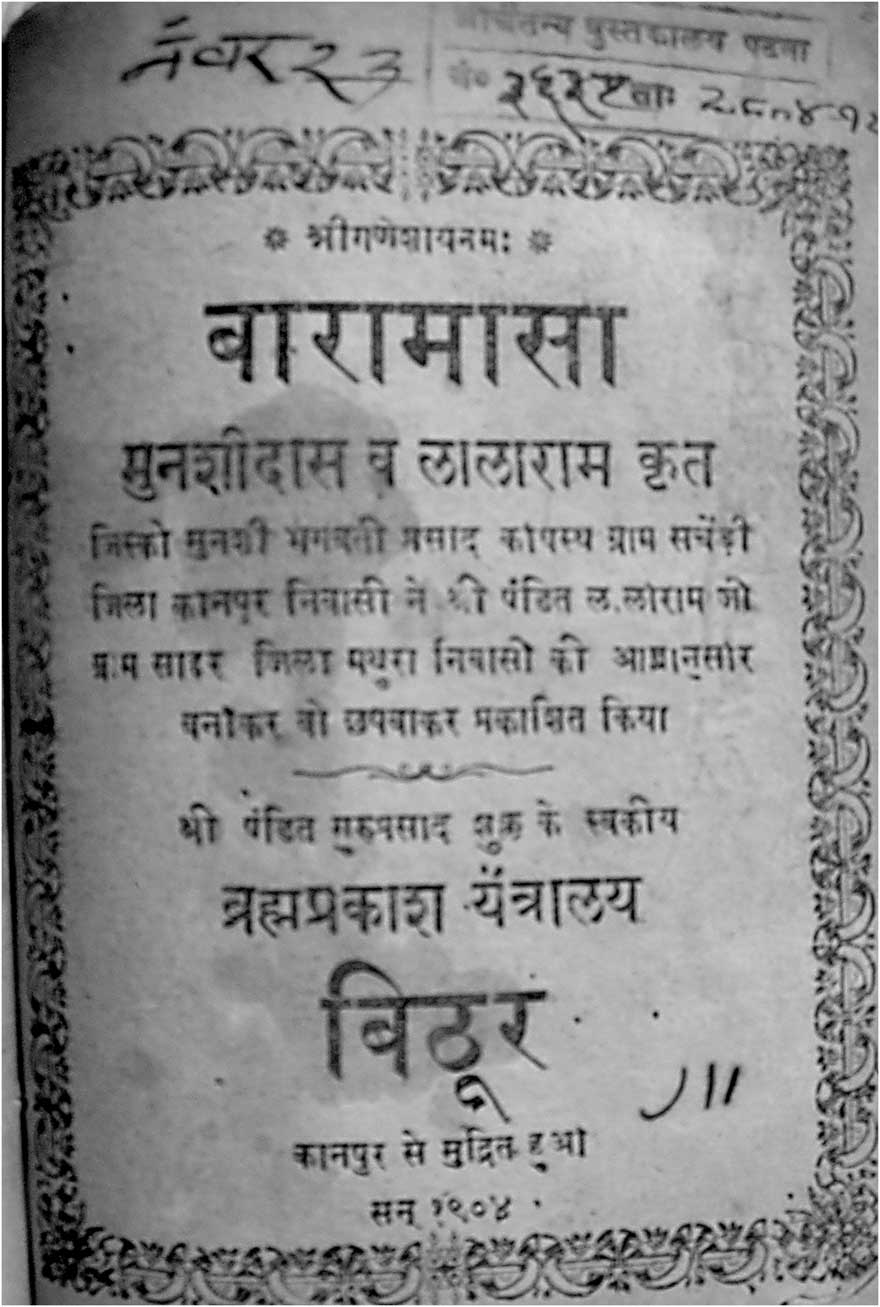
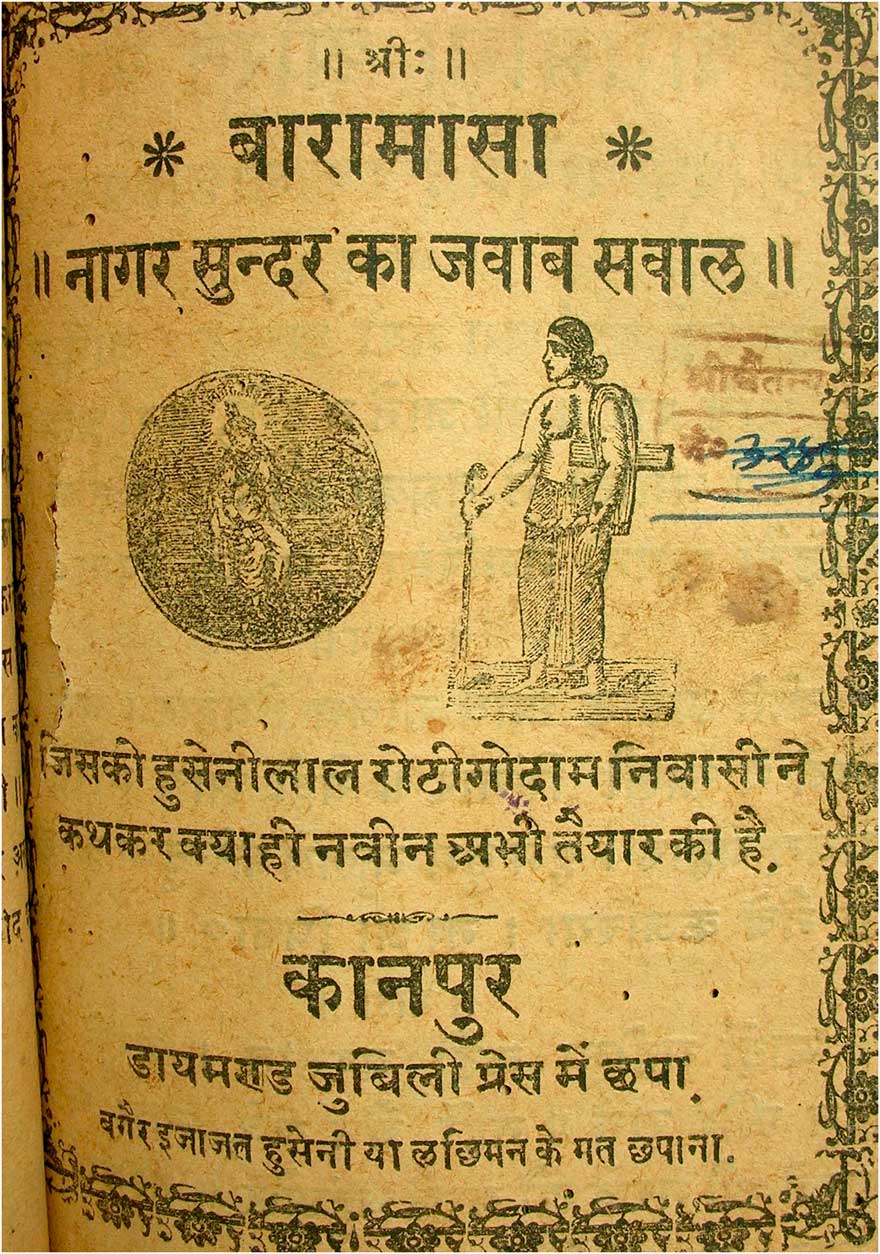
Moving beyond state-centrism and into the world of social representations through flexible texts of folksongs allows us to recognize the third important aspect of the historical juncture that was the mid-nineteenth century. This was, as Francesca Orsini has termed it, a commercial printing boom in northern India – a factor that is not frequently commented upon and analysed by those who study “labour politics”.Footnote 41 A variety of materials – religious, secular, satirical, entertainment, popular, educative, and didactic – were printed and circulated in the late nineteenth and early twentieth centuries. Most of these genres had overlapping boundaries. Orsini argues that the critical change in print culture after the 1860s was based on the expansion of a neo-literate class and their growing book consumption on the one hand, and the development of ideas of pleasure and entertainment on the other. The growth in print was accompanied by the increasing popularity of genres such as qissas (tales) and songbooks, which ensured wider readership. Many of the genres of folksongs such as bidesiya, poorbi, kajri, barahmasa, and jantsar, depicting the mood of separation, were part of this new print economy (see images below). The readership, as Orsini shows, had many characteristics: first, it was based on the deeper penetration of books and chapbooks in small towns and villages; second, it was also based upon and created chances for literary upward mobility; and third, the urban elite male availed himself of the opportunity to write popular books, thus creating a “hybridity of tastes” that narrowed the urban–rural divide.Footnote 42 Two groups, amongst others, that Orsini identifies as beneficiaries of this printing boom were the migrant workers and women.Footnote 43
It is extremely difficult to determine if families from which men migrated were actually reading these books. A small section of them who found jobs in offices at subordinate levels (railways, factories and police) and hotels in the city might have literate members. The issue, however, is not one of establishing direct readership, but using songs as texts of the social reality of mid-Gangetic region from which migration took place. They do not represent a simple historical process of middle-class male representation and construction of female subjecthood. With the coming of the print in small towns (qasbas and mofussil), neo-literate compilers, collectors, writers, and publishers picked up the themes that were part of the social milieu of these small places. Migration and separated conjugality were parts of the “structures of feeling” of this region.Footnote 44
In the late nineteenth and early twentieth centuries, new social and economic changes added newer elements to these songs. This was also the period (and a little later into the 1930s as well) when the collection of folksongs had a basis in linguistic politics. Within the larger rubric of “Hindi nationalism”, a respectable place for Bhojpuri literature, tied to the idea of “preserving” the region’s identity, motivated a many provincial neo-literati.Footnote 45 Just because the authors and collectors happened to be men, these songs cannot be dismissed as only bearing the marks of male projection. Their rich content allows us to explore the histories of emotions, such as love, enmity, and feud, on the one hand, and the graded social and intimate spaces on the other, in which both men and women existed. Many of the songs were, and continue to be, sung by women, as Jassal’s rich ethnography has shown. One leading collector of these songs, Krishnadev Upadhyaya, about whom we will hear more, had asked his mother and other village females to sing while he penned them down. His younger sister had also written down the songs memorized by their mother. As the framework of circulation is required to combine the apparent opposites (mobility–immobility, male–female, rural–city), so too a source base like folksongs requires us to not cast them into a simplistic determinism of either only (female) agency, or pure (male) representation.
THE BIRHANI WIFE IN “EXILE”
The whistle of the train,
reminds me of my beloved.
The direct reference to railways irrefutably suggests this popular tek (first opening lines of the song) to be from the late nineteenth or early twentieth century. Many of these songs of separation (birha) are based upon the well-established genre of the barahmasa, in which the mood of the wife/woman changes according to the twelve seasons of the year (barah meaning twelve, masa month). The female voices her “pining for and devotion to the absent lover”.Footnote 46 The sub-genres of barahmasa, such as chaumasa, depicting the mood of separation during the four months of the rainy season, did the same:
My friend, the rains have set in, nights are dark and my heart is perturbed,
My beloved is in pardesh (foreign lands), he has not sent any word.Footnote 47
Hey friend, the month of saawan has arrived,
I long for my beloved as the rain pours in,
All my friends are enjoying the swings,
But my beloved has completely forgotten me.Footnote 48
True to the circulatory nature of migration, in many of the folksongs the husband returns after twelve years. This is borrowed from the epics of Ramayana and Mahabharata. In the Ramayana, Sita accompanied Ram in exile for twelve years. But unlike Sita, the Bhojpuri women did not accompany their men. The men migrated to the city, but it was their wives who, ironically, experienced “exile” in the villages. “Homelessness” due to separated conjugality was experienced, paradoxically, by being stuck at home.
Munshi Lala Bhagwati Prasad, Munshidas and Lalaram, Baramasa (Bithur, printed in Kanpur, 1904).
Hussaini Lal, Barahmasa: Naagar Sundar ka Jawab Sawal (Kanpur, s.a.)
Interestingly, not only in purabiya and bidesiya varieties, but also in sohar songs, the woes of women are described.Footnote 49 A few lyrics from one song show this:
My delicate husband has gone to pardes,
He has not sent me a word.
Mother- and sister-in-law have turned into foes,
They inflict a lot of pain.
My brother-in-law speaks the language of birha,
His taunts pierce my heart.Footnote 50
The woman’s woes double up as she has no child. Further on in the same song, she again laments the unresponsive nature of her husband. She is convinced that the man has found a sawti (sawti or sawatiya means second wife). The song ends with a note of desperation – the end of exile requires the end of life itself:
I kept my patience,
And pondered.
I should have consumed poison,
It would have ended my birha.
Life in exile, as represented in these songs, required idealization of the figure of the wife. The show of unflinching love and unconditional dedication were two of the most important tropes in the construction of this image. Krishnadev Upadhyaya, an eminent Bhojpuri scholar, who was active in collecting and printing Bhojpuri songs and ballads since the 1930s, has argued that the motif of the ideal wife is very important. According to him:
The Bhojpuri husband migrates. In his new place, he falls in love with a beautiful girl. Let alone sending money, he even stops asking for her [his first wife’s] wellbeing. The wife ruefully passes her days in sorrow but never harbours the thought of leaving her evil husband. On the contrary, when the man returns after many years, she welcomes him with great love and affection.Footnote 51
In Upadhyaya’s reasoning, the trait of loyalty and devotion in women is present either due to the influence of the cultural and moral values that they have been brought up with, or due to their lack of financial independence. In one sense, both of these factors are rather structural and institutional in terms of explaining the fidelity of the wife. They gloss over the tension-ridden act of migration captured in some songs through conversation between wife and husband. The idealization presented in the songs is the final outcome of a process of mundane negotiations that happen between the husband and the wife, sometimes just before the man is supposed to depart. The wife, as expected, pleads with him not to leave. She conjures up all sorts of reasons and strategies to hold him back. In one of the songs, she dubs the water of the east venomous, and thus would kill her husband and leave her widowed (the literal meaning of the Bhojpuri word would be orphaned, highlighting the individually felt as well as socially sanctioned form of dependency).Footnote 52 Usually, women adopt three strategies to hold back their men. They cook food, offer Ganga water, and promise physical intimacy. The ancient cultural values of fidelity, as Upadhyaya suggests, get recast into desperate acts of enticement and allurement, all meant to detain the migrating husband. Rather than reading the wife’s fidelity as the expression of an age-old cultural value, these songs suggest why fidelity became such an important issue for the representation of women. This excessive focus on the wife’s fidelity, without much chastisement of migrant men’s sexual escapades in the city is clearly an outcome of the separated conjugality engendered through a new wave of late nineteenth-century migration.
Once again, the theme of separation is not only limited to migration, but present in marriage songs as well. The following song is of the jhumar variety, which is usually sung at marriages and has a happy content and rhythm – but here, too, the wife is scared of her husband migrating to the east. The presence of migration and separation as themes in different song genres shows the centrality of these issues in the lives of both migrants and non-migrants. It also reveals their pervasiveness in different aspects of social life; migration is socially remembered in the context of various acts, from pounding grains to celebrating marriage and childbirth.
I filled my pitcher with the Ganga water,
He doesn’t drink but sets out to leave for purab.
On hearing the word purab, I feel suspicious,
On hearing the word purab.
In purab, he will eat banana, coconut, will become negligent,
He will stop thinking about his home.
Of thousand flowers, I got the bed prepared,
He doesn’t sleep but sets out to leave for purab.
On hearing the word purab, I feel suspicious,
If you go to purab, my beloved, if you do.
Hold this handkerchief, and make a promise,
On hearing the word purab, I feel suspicious.Footnote 53
There are hardly any songs in which men agree to stay home.Footnote 54 There are a few that are conversational and in which we hear the male response. For instance, in three different stanzas of another song, the wife uses the above three reasons – water, food, and intimacy – to hold her husband back, but the man’s reply, which is interjected after every verse, remains the same: “all this is very sweet, my love; please wake me up at four in the morning/I have to leave by freight train”.Footnote 55
In the absence of letters and money, and under sufferance of not being asked about her well-being, the exiled home of the woman has the new prescription of conduct. She must discard sringaar (physical beauty and adoration), which is, in the cultural milieu of the region, tied to the idea of conjugal love and romance. As the husband is not present, sringaar is of no use to her. One folksong categorically says: “What worth is promise to those who lie?/What worth is adoration to those whose men are in foreign land??”Footnote 56
Her social identity blurs being a wife and a widow because practising sobriety in physical appearance is the normative state of widowhood. This aspect of idealization was premised upon women’s withdrawal from worldly pleasures.Footnote 57 For male poets, authors, and composers, it was important to depict her physical and sexual vulnerability to strengthen the imagery of idealization. Her sexuality was both an element of entertainment in the emerging print bazaar and an aspect to control, due to the new social condition of migration. Sita, from the epic Ramayana, had to undertake agni-pariksha (a test of fidelity) because she had migrated and then got separated from her husband, Ram. The Bhojpuri women had to undergo such fidelity tests without migrating.
The third aspect of this idealization is to present the longing wife in a constant state of jealousy and anxiety. The word “east” evoked suspicion. The formation of a dependent subjectivity is only fulfilled when she not only pleads with her husband not to leave, but also remains in a jealous state in his absence.Footnote 58 Jealousy displays her emotional concern as well as confirms her romantic longing.
I have been hearing about purab since ages,
Tell me how the people over there are, my beloved.
There are beautiful Bengali women in purab,
What do they cook to make you insensible, my beloved.
I have heard about purab for long now,
Tell me how the people over there are, my beloved.
By sleeping with you they make you insensible.Footnote 59
It is not just migration that casts gloom over conjugality but also the presence of the unseen Bengalin sawatiya (a co-wife, or mistress). In one folksong, the wife says:
I am the priceless charm of your life, my king,
Why did you bring a sawatiya.
Had I been barren,
you could have brought a sawatiya.
Had I been dark and ugly,
you could have brought a sawatiya.
My love, I have a young attractive body,
Why did you bring a sawatiya.Footnote 60
The logic seems to be circular here: the ideas of loyalty were tied to physical beauty (in order to remain loyal, abstinence from overt adoration was prescribed) and physical beauty itself became a tool to invoke loyalty, to deter men from migrating, albeit ineffectively. Unlike the colonial discourse on indenture migrants, in which men were often seen as “wife enticers”, these folksongs clearly place the agency for “enticement” upon women. The only difference is that in the Bhojpuri world the wife enticed the husband in order to save the marriage, home, and conjugality. This explains the wife’s generosity in letting her man have a co-wife; what is inexplicable to her is the neglect of her “young, attractive body”. Her physical beauty has failed to keep her husband loyal. And for this, she could only blame the beautiful Bengalin. It is important to note that at both locations, the rural and the urban, it is the female body and its charms that acquires a central position in describing the limits and possibilities of the (non-) migrant conjugal life: the Bhojpuri woman’s body is shown as the ultimate inducement to refrain from migration; the Bengali woman’s body as the reason why the otherwise innocent husband went adrift.Footnote 61
Most accounts dealing with migration, including this article, prioritize the wife-identity of the woman. If the entry point is post-marriage identity (wife), it becomes easier to talk about separated lives, pain of separation, and the hardships of migration. The married woman’s “structure of feeling”, however, is preceded by another structure, that of girlhood and carelessness. While at the individual level these remain the dominant tropes in a set of songs related to marriage, the social implication is of distress due to dowry and marriage-migration. As the course of the lifecycle changes from girl to wife, the “structure of feeling” also changes and gets reflected in living in the new home under new codes of conduct, in leaving the natal to settle in the marital home.
FROM NAIHAR TO SASURAL
Move steadily, O! my Lord, I am lost and defeated…
On the one hand, I part with my nose-ring,
On the other, O! Lord, I leave behind my mother. Move steadily…
On the one hand, I part with my necklace,
On the other, O! Lord, I leave behind my transparent saree. Move steadily…
On the one hand, I move away from my village and my habitat,
On the other, O! Lord, I leave behind my home and hearth. Move steadily…
On the one hand, I part from my brave brother,
On the other, O! Lord, I leave behind all my [female] friends. Move steadily…
On the one hand, I part with my garden and my fields,
On the other, O! Lord, I leave behind my beloved cow. Move steadily…Footnote 62
The above kajli encapsulates the pain of separation felt by young girls at the time of marriage, foreshadowing the agony of migration that would be experienced a few years later. The succession of one after the other was quite obvious as seen in one song: “I was eight when married, and nine when sent off to in-laws/ At twelve my husband left me to go to a foreign land”.Footnote 63
For understanding the women’s world, a focus on migration alone, without looking at how marriage-based separation was represented and felt, would be inadequate. Interestingly, the metaphor of bides (foreign lands) is not only used in migration songs, but also for depicting the young girls’ dislocation from naihar to sasural, natal to marital. This representation goes back many centuries, as seen in one of the famous compositions of the medieval litterateur Amir Khusrau. The song, which has many renditions by different artists, starts with the girl questioning her father as to why he has married her off to a foreign land.Footnote 64 In Khusrau’s song, as well as in the first song of this section, we see the girl complaining about missing her home – from the house to the fields, which bear the marks of her childhood and adolescence. She will miss her relationships with friends, family, and animals. Even jewellery that she wears is suffused with the emotion of home. New ornaments are given to her or are worn at the time of gawna (the time of actual departure from the natal home, which might be anything between few months to some years after the marriage), so she laments taking off her old nose ring and necklace that are full of memories of her parents and her natal lands.
The emotional lament is accompanied by the pinch of financial discrimination felt by married girls. While Khusrau’s girl protagonist complained to her father about him giving two-storeyed houses to her brothers while packing her off to a foreign land, in a Bhojpuri song, similar accusations are made: “To my brother you have given property/My fate you have sealed off to a far-off land”.Footnote 65
The pre-marriage construction of girlhood in these songs uses two tropes: one, of treating girls as paraya dhan (someone else’s wealth), and the other showing them bereft of any sahur (good conduct). There appears to be a contradiction in this construction: in spite of being discriminated against because of their “wrong” gender, the girl child is adored and pampered in her naihar. This contradiction becomes explicable if we recognize the centrality of marriage in such depictions of the female social world. The birth of a girl is regarded as inauspicious because it means trouble and dowry-debt for the family, and hence the sense of discrimination against girls. However, marriage also means separation; therefore, the sense of emotional lament is not absent. The father is crushed under the dowry-debt of having to marry off his “treasure” girl. The irony is very telling.
The movement from naihar to sasural engendered through marriage brings out the graded nature of both homes. Naihar is a place of carefree and careless freedom, where thresholds of courtyards mattered a little, but not so much. In the opening song of this article, the girl misses the whole environs of her home – signifying a rather unrestricted access to these places. It is because of this that the mother of the girl child scolds her for not learning any good conduct, as one day she will go to sasural and there encounter a different set of rules and expectations that will necessitate new modes of moral and physical conduct. The change of home will mean a shift in the very meaning of home.
At sasural, even the architecture of the home would acquire new meanings. Access to different parts of the home would be based on the boundaries of intimacy and permissibility. Broadly speaking, khet and khalihaan – together meaning the farm and the field – lying outside the house are male spaces. khalihaan also referred to the outer courtyard of the house, where grain and hay were stored. Married women seldom went there in the course of their everyday chores. Unmarried girls had greater access to these spaces.
Duwari and duwariya – both meaning the gate/threshold – separated the outer and inner courtyards. In houses with one courtyard, this was the boundary between the outer, public space and the inner quarters of the home. However, beyond its physical value, this gate or threshold also strongly marked the passage into intimacy. Crossing the gate/threshold into the anganwa (inner courtyard) was allowed only to the familiar and the intimate. In one folksong, even the divinities – Ram and Lakshman – had to stay back at the gate/threshold because they had arrived at the same time as the migrant husband, whose claim to enter the inner courtyard was far greater than theirs.Footnote 66 The inversion of this function of the gate/threshold is therefore noticeable in a teasing song in which the wife keeps back her younger brother-in-law at the threshold, but lets her lover come and sleep in the inner courtyard. Yet, for her, crossing the threshold or being at the gate on some occasions was a matter of shame and embarrassment:
Oh! Lord, I lost my earring at this place…
I searched the bed, I searched in the anganwa…
I blushed while searching at the duwari…Footnote 67
Compared to the natal, the marital home entailed less freedom of movement. Even the inner courtyard, which is largely a female space, sometimes becomes inaccessible due to male presence. In one song, when it rains, the girl complains that this space has become the realm of the male members of the family. The whole day is passed in touching the feet of her father-in-law and elder brother-in-law. How could she, she asks, sweep the floor of the courtyard while veiled, due to the elderly male presence?Footnote 68
The new home means new discipline and new rituals of everyday life. It is therefore obvious why, in many of the folksongs, the girl, who is now a wife in her new home, threatens to go back to naihar when confronted with arguments and displeasure from her husband and in-laws. Even after marriage, naihar retains the value of being an intimate space for many reasons.Footnote 69 Also, when the husband insists on migrating.
If you, my beloved, migrate, if you migrate;
Call my brother, I will go to naihar.
If you, my love, go to naihar, if you go to naihar;
First pay the money I have spent on you.
If you, my beloved, ask for money, if you ask for it;
First provide me the home as was my father’s.Footnote 70
While looking at migration and marriage together, we can better observe the depictions of two parallel but interconnected lifecycles. One is of the migrant male who works in the city and periodically returns to his rural home. He otherwise appears to be the centre of this migration cycle and one whose departure is lamented. This cycle tells us about the city and village, about husband and wife, and about longing and belonging. The other, equally important lifecycle is of the non-migrant subject, who, in these social texts of folksongs, is an inferior subject, whose birth is seen as a curse and a burden for the father, and whose marriage brings debt upon her family. While being unfavourably positioned in her natal home compared to her male siblings, her marriage is still a moment of lament, dislocation, and movement. Having arrived at her new house, she again goes through the trauma of separation, this time from her husband. This lifecycle, which is less known and less explored in South Asian migration studies, tells us about the complexities of home(s) and homemaking in the wake of the movement from natal to marital homes, about the double meaning of migration (first being married off in a foreign land and then seeing the husband leaving for the foreign land), and about the female subjecthood that first undergoes one kind of migration and movement (marriage) and then feels the pathos of the second kind while being “static”.Footnote 71 The contrasting and intertwining of these two lifecycles is captured in a conversational song between a husband and wife. The wife asks her husband how he spends his time in the foreign land. He answers that during the day he does his job and spends his nights with a Bengalin. On being asked how she spends her time in naihar, the wife replies that she is with her friends during the daytime and sleeps in her mother’s lap at night.Footnote 72
BEYOND IDEALIZATION: WORK, SEXUAL TRANSGRESSIONS AND MODERN DESIRES
Cultural idealizations are products of historical processes. If the absence of the husband created a form of ideal wife, then the anxiety inherent in the act of separation also created spaces of transgression. These folksongs reveal a range of emotions, and not just suffering and pain, which remain the more dominant aspects. Together with idealization, there is also a strong depiction of “moral depravity”. In the context of the long absence of her husband, the predominant form of relationship that exists between the wife and the female in-laws is feud and enmity. The flavour of their speech is particularly pertinent here as relationships evolve in the new house:
Tell me, how do the words of mother-in-law [saas] sound,
they sound like the piquant of red chillies,
Tell me, how do the words of sister-in-law [gotin] sound,
they sound like the burn of black peppers,
Tell me, how do the words of sister-in-law [nanad] sound,
they sound like the blaze of a glowing stove.Footnote 73
This enmity plays an important role in construction of the trope of moral depravity in these folksongs. It is often the mother- or sister-in-law who will “inform” the husband of the wife’s moral laxity and force him to ask for proof of her fidelity. Thus, we return to the cycle of exile in which the person who stayed behind had to take the test of moral and physical purity, rather than the one who had gone away.
However, it is not just the backhand reporting on the wife’s character that these songs allude to, but also to her very direct overtures on the matter of unfulfilled sexual desire. This is a recurrent theme in these songs. What is important to highlight is that the places in which such transgressions were possible ranged from railway platforms to the secure space of the inner courtyard. Men’s circulatory life, as we know, had added to the female workload – albeit in the low-paid sector.Footnote 74 In spite of the new norms of domesticity that propounded the idea of “home” as women’s natural habitat, men’s migration had forced women to go out and work. In fact, the circulatory work cycle of men was dependent on women’s labour back in the villages. In various folksongs, their presence at the railway station, in fields and on farms is noted.Footnote 75 In a powerful example, a domaniyaan (wife of dom, engaged in the occupation of waste clean-up and treated as social untouchables) pleads to leave her town; she asserts that she would find a rozgaar by making baskets and other things from bamboo.Footnote 76
I will also do rozgaar, O! my tawny groom,
I ask you, the groom, why have I become a domaniyaan.
Please, I plead you, do tell me, O! my tawny groom,
I will also come with you, O! my tawny groom.Footnote 77
It is not very clear whether she is pleading to her own husband to take her with him or to the groom who had come to marry the girl of the household where she probably worked. The reference that she belongs to the town of Mithila (the birthplace of Sita) could mean that the “tawny groom” is Ram, who had come to marry Sita. The female untouchable cleaner uses the opportunity of Sita’s marriage to escape her own caste-ordained hardships. For some women, migration through someone else’s marriage provided an opportunity to escape the “traditional” occupation and become a “modern” wage earner.
The diversification in potential work brought women out of the home. With this, their sexuality became a public matter and a theme of public print consumption.
I was preparing food on the Balia railway station,
And I was feeling restless in between;
First of all, I am fair, and second, young,
Third was the thrust of my youthfulness in your absence, my beloved.Footnote 78
It was not just in the public space, but also the household where a breach of morality could occur. Smita Jassal has written on the wife–devar (younger brother-in-law) relationship, which is one of the most popular ways in which this breach has been represented.Footnote 79 The possibilities of transgressions with other male in-laws also existed.
Wonder does the blouse spell on my youth [read breasts]. Wonder…
While going to the market the passerby hoots,
In the garden the gardener pounces. Wonder…
My beloved calls me to prepare the bed,
While cooking, the brother-in-law scoots [husband of sister-in-law]. Wonder…
While sweeping the anganwa my brother-in-law [brother of husband] calls,
Showing betel leaf my beloved darts. Wonder…Footnote 80
While choli, the blouse, plays a key role in song narratives, attracting the male gaze to the female body, many of these songs also depict women asking their husbands to get a particular kind of blouse material from distant cities. New migration created new desires and led to inflow of new objects and commodities. The demand for choli on the one hand confirmed the centrality of the physical aspect of conjugality as described above, on the other, of discipline and control as in many instances the mother-in-law grew suspicious of the wife’s conduct when she visited the tailor to get her blouse stitched.
For those who stayed back, the east was not only a place of aversion, but also of wonder and curiosity. The return of the circulating men was a moment of joy and reunion. The same railways and steamships that engendered fear of the second wife also brought back metropolitan goods in the form of sarees, blouses, and jewellery. These new trinkets and apparel made the women noticeable when they wore them to the local bazaar.
It was not only in terms of new goods that the journey back home became a moment of renewed expectation: the material constituents of Calcutta modernity were expected to bring back a “new man”. Migration created separation, but also a great deal of anticipation.
I would have exchanged my man, who has alighted from the train,
Had he been dark, I would have exchanged,
The fair dandy is too tempting to replace.
Had he been dhoti wearing, I would have exchanged,
The suit wearing is too tempting to replace.
Had he been with walking stick, I would have exchanged,
The watch wearing is too tempting to replace.
Had he been in floaters, I would have exchanged,
The one in boots is too tempting to replace.Footnote 81
Suit, boots, and watch – all symbolized the acquisition of new forms of modernity.Footnote 82 The image of the village wives presented here is not based on docility, but the overt expression of certain desires around what they wanted their men to be. They were also explicit in what they wanted for themselves: the petticoat from Arrah, sandals from Balia, and a blouse from Patna.Footnote 83 Intimacy was promised only when gifts and goods were given. Sometimes, women directly asked their men what they would bring on their return:
You will go to purab, my beloved, what will you bring for me?
For mother-in-law a nose ring, for sister-in-law gunjesri [a kind of an ornament]
For you my wife, I will get tikulee [an ornament worn on forehead].
And there is a sense of competition, too, as the wife claims in the end:
The nose ring will break and the gunjesri will crack,
But wonders will do the tikulee on my forehead.Footnote 84
In the real sense of the term, circulatory migration is not all about separation, but also reunion. The homecoming of the migrant man is an event through which the politics of gift and affect, of intimacy and jealousy, unfurl in the household. Migration has led to a split in the conjugal life. It has led to the creation of new anxieties, discipline, and jealousy between the husband and the wife, as well as between the wife and her in-laws. The reunion re-establishes the codes of these relationships, but only temporarily. Being jealous of the better gifts, the mother- and sister-in-law scorn the wife; the husband later consoles her in the bed, but, then, after a few days, he has to leave again. He would remind his wife to wake him up early in the morning to catch a freight train. In other instances, reunion could lead to questions of fidelity and even murder due to jealousy or revenge.
With every cycle of migration and reunion, something new happens to the home. With remittances, the migrant’s sister get married. The younger sister-in-law who enjoyed girlhood enters into her own lifecycle of being married. In a migrant’s house, it means one less member. Part of the remittance money is used to improve the house: to add an extra room, to build a pucca roof (changes from mud to brick walls or from a thatched to cemented roof is very popular in these songs), or to dig a well. These are quantifiable changes. There are changes that are emotional as well. One of the major concerns that emerges in these songs is related to the birth of a child. The suspicious husband is not sure if he is the father. The narrative once again comes full cycle: life in exile with its concomitant great possibility of moral depravity and sexual transgression naturally leads to the question of loyalty at home.
REFLECTIONS
The migrant man sleeps with the Bengali woman; he threatens to bring back a co-wife but questions are not raised about his moral conduct and loyalty.Footnote 85 In fact, in some folksongs it is the wife in exile who takes the blame, justifying in some sense the extra-marital liaison of her husband (who is presented as innocent and timid). She blames herself for not doing enough to prevent him from leaving.
As mentioned in the beginning, the themes of these songs, such as migration and pangs of separation, and the certain genres in which they were sung, such as barahmasa, were part of the long popular tradition of the region. Newer elements, such as the railways and the force of the nineteenth-century capitalist demand for labour got added to this existing repertoire of themes, which also led to the rise of new genres, such as poorbi and bidesiya.Footnote 86 The commercial expansion of print, which happened in the same period, created a new possibility in writing for and entertaining the public. The oral culture, as represented in folksongs and the printed word, did not conflict. The boom in print forged a dynamic relationship with different practices of orality – performance, theatre, communal and individual reading. These printed materials – particularly those that were meant to provide entertainment and pleasure – used the existing oral repertoire of folksongs, ballads, and plays of this region to talk about the two most noticeable groups that were tied to each other in a dialectical social relationship: the migrant man and the exiled wife.Footnote 87 Once printed, these songbooks re-entered the zone of orality through the same multiple sites of performance both at home and outside.
In this context of fluid movement between the oral and the printed, and between male authorship and female subjecthood, the questions of agency, representation, and social reality become tricky. Media, spaces of consumption and performance, and the nature of readership influence the question of agency. A perceptive point that emerges from ethnographic research on Bhojpuri films and television shows is that while the former caters to the male audience, privileging their point of view, the latter, watched within the confines of home, is produced by keeping women in mind, which they like.Footnote 88 Perhaps, for the period of the late nineteenth and early twentieth centuries, too, different acts related to songs might suggest a non-linear flow of agency and representation. The act of composing, collecting, and publishing might show the male perspective, the act of singing while pounding the grain might tell us about women’s agency. Here, I tend to agree with Jassal that, notwithstanding the plurality of voices and range of meanings embedded in these songs, they also invoke the perspective of women.
A certain degree of genuine impossibility will always remain in knowing with unflinching conviction whether these songs tell us more about the male anxiety or the female reality. Do they tell us about how women saw their lives spent in separation or how men imagined and desired their women to lead their lives? Who is in “exile” here: the one serving in the mills and factories of Calcutta or the one waiting in the village? And who breaches the line of loyalty? The man who is “lured” by Bengali women or the woman who finds it difficult to resist the sexual temptations? Many of these songs can be read against the grain, thereby suggesting that the male authorship created a hidden script of the migrant male subjecthood that betrayed its anxiety and hence resurrected an image of women that comprised two tropes: moral depravation and hyper-dedication.Footnote 89
Rather than losing steam in classifying the function of these songs in absolute terms, their value as historical sources lies in providing a different, if not alternative way, to look into the rich and complex social world of migration. This is a world that is not frozen in time, but is constantly relived by hundreds and thousands of individuals, even now. It is a world in which capital, technology, and the state are ever present, but whose pulsating reality is made up of relationships based on love, agony, separation, jealousy, and desire that forge strong personal and social ties.
Reading folksongs as fixed textual sources can become highly problematic. They are performed on a variety of occasions and within different social classes. Many of the songs are sung at social functions such as births and marriages. Moreover, many of these freshly minted songbooks were the bases of regular oral performances in places such as akharas (wrestling grounds). From being sung in all-female spaces to being recited in all-male spaces, these songs and their meanings defy any essentialized reading.
Additionally, there are songs that do not conform to a single pattern. For instance, the figure of younger brother-in-law could be villainous and lecherous on the one hand, and obedient and a confidante on the other. Similarly, the younger sister-in-law could be the best intimate friend as well as the most spiteful person.
The typologies of relationships are complex. Therefore, the poetic imagination, which is predominantly a male one, need not be an exact mirror of the social reality. It might represent a historical reality, but does not necessarily clone it. And then there are certain gaps where folksongs are relatively silent; gaps that could be filled, as works of other scholars have shown, by using different tools of inquiry. Did the references to Hindu epics of the Ramayana and Mahabharata also apply to Muslim migrants and households? Caste and its subdivisions governed marriage alliances. It also informed moral codes for women within the households. But what the exact nature of the relationship between caste and migration was for those who stayed back needs future research.Footnote 90 At the speculative level, it can be said that most of these songs definitely reflect the lower-caste lived realities, which is also attested by the way the theatrical form, bidesiya, was made by Bhikhari Thakur, by integrating lower-caste performance styles and genres.Footnote 91
What can be said with greater certainty is that in all their playfulness and subversion, woman is the central subject of these folksongs. Either in her idealized form or as her sexualized transgressive avatar, she comes across as the main subject through whom love and jealousy, feud and affection, separation and curiosity are represented. Both migration and marriage songs allow us to see the graded nature of homes and relationships, which might be inaccessible through colonial archives. The woes as a young girl, the sorrows of separation as a wife, her profanity and her licentiousness are subjects of description, control, discipline, ridicule, and entertainment. If she reflects her desire she is licentious; if she carries the male projections, then she is an element of control and entertainment.
Do folksongs help us ascertain a quantifiable amount of freedom that women might have experienced in the absence of husbands? Once again, the answer is opaque. Through works of other scholars, particularly Sen, we do know that both workload as well as cultural practices of segregation, through veil and purdah, were on the rise for these women. These homes, particularly the marital ones, were not nuclear households that would have given women the opportunity to become decision makers. As many folksongs suggest, these households ran under the authority figures of father- and mother-in-law. Through charges of adultery, the wife is reminded of the patriarchal and social control. So, while the workload increased, the patriarchal expectation of right conduct did not dissolve. The only freedom, which is rather discursive, that one can discern from the critical analysis of these songs, is the freedom to express loyalty for the husband and, conversely, in transgressing the morally sanctioned sexual boundaries. The “introduction” to many of the contemporary collections of these folksongs therefore reflect an unease and an attempt by the authors, who are usually personally invested in the propagation of “Bhojpuri culture”, to sanitize the erstwhile “flirtatious” representations through a presentation of loyal, dedicated wifehood.Footnote 92
The article makes a plea for the inclusion of two thematics in the history of migration. One, to tell the story of migration from the standpoint of those who did not migrate. Second, to acknowledge the role of social institutions and practices such as marriage that were intertwined with migration. The life of the non-migrant was centrally organized along the lines of departure and return. While examining this fact, the article has raised questions about the apparently uncomplicated use of the analytical category of circulation. Men’s circulation was tied to women’s immobility. Finally, this immobility of women is in itself a misleading shorthand, for the lack of any better term. In fact, marriage itself was premised upon one life-changing displacement from naihar to sasural, where the woman was given a new set of codes. Migration and marriage together help to understand the different but interlaced lifecycles of gendered (im)mobilities.


 Open access

