





Highlights
-
• Child HSs showed more subjunctive (SUBJ) optionality and differentiation across conditions.
-
• SUBJ use was greater in Volition than in Presupposition and Nonassertion.
-
• Children who mastered Volition used more SUBJ and fewer alternative forms in target conditions.
-
• Most child HSs lacked HL ability to develop SUBJ in target conditions.
-
• Persistent use of alternative forms may result in a distinct HS mood grammar.
1. Introduction
Heritage speakers (HSs) are children of immigrants raised in bilingual environments, often acquiring their L1 at home with limited community support (Benmamoun et al., Reference Benmamoun, Montrul and Polinsky2013). As they grow, reduced heritage language (HL) input and use typically lead to shifts in language dominance and may affect later-acquired grammar (Hurtado & Vega, Reference Hurtado and Vega2004; Treffers-Daller, Reference Treffers-Daller2019; Wong-Fillmore, Reference Wong-Fillmore1991). Consequently, HSs’ tense-aspect and mood systems are vulnerable. One clear example of this is how Spanish HSs show variability in subjunctive (SUBJ) use, especially in sentential complement contexts where mood selection is pragmatically conditioned (Silva-Corvalán, Reference Silva-Corvalán1994; Montrul, Reference Montrul2009, Reference Montrul2021; Pascual y Cabo et al., Reference Pascual y Cabo, Lingwall, Rothman, Biller, Chung and Kimball2012; Perez-Cortes, Reference Perez-Cortes2023; van Osch et al., Reference Van Osch, Sleeman, Aalberse, Bellamy, Child, Gonzalez, Muntendam and Couto2017; Van Osch & Sleeman, Reference Van Osch and Sleeman2018). These contexts are acquired late (ages 6–10) by monolinguals (Dracos et al., Reference Dracos, Requena and Miller2019) and are also more susceptible to incomplete acquisition or attrition – a pattern consistent with the Regression Hypothesis (Jakobson, Reference Jakobson2002; Montrul, Reference Montrul2009). Considering age of acquisition is critical for understanding HS grammar due to its known interaction with changes in child HSs’ experience with the HL. If acquisition of the SUBJ in certain contexts occurs at a time when HL input is reduced, children may not “fully learn all the uses and semantic/pragmatic nuances associated with subjunctive morphology” (Montrul & Perpiñán, Reference Montrul and Perpiñán2011, 123). However, no study has examined child HS acquisition of the Spanish SUBJ with sentential complements. Such evidence would be critical to understanding whether the patterns found among adult HSs result from the inherent complexity of sentential complements or from changes in experience with/command of the HL.
The current study addresses this gap by examining the acquisition of the Spanish SUBJ in sentential complements by child HSs. Results suggest that bilingual experience, rather than inherent difficulty with sentential complements, shapes SUBJ mastery and mood grammar development.
1.1. The Spanish SUBJ
While the Spanish subjunctive (SUBJ) is used in many contexts, it occurs less frequently than the indicative (IND) (Biber et al., Reference Biber, Davies, Jones and Tracy-Ventura2006) and typically appears in complex sentences with subordinate clauses selected under particular predicates or the scope of a modal verb or negation (Harrington & Pérez-Leroux, Reference Harrington and Pérez-Leroux2016). Uses of the Spanish SUBJ defy a unitary categorization, both syntactically (in terms of the operators and contexts where it is used), semantically (in terms of the modal meanings conveyed), and pragmatically (in terms of interpretations triggered by mood selection) (Fábregas, Reference Fábregas2014). For example, in volitional clauses (1), the SUBJ instantiates deontic modality, which expresses what is permissible, desirable, or necessary to do. In this context, the SUBJ is categorically selected.

In contrast, some contexts allow either SUBJ or IND depending on pragmatic interpretation, such as sentential complements to factive emotive predicates (2) or nonassertive predicates (3). Here, SUBJ often marks epistemological modality, evaluating propositions relative to the subject’s beliefs (Chung & Timberlake, Reference Chung, Timberlake and Shopen1985; Pérez-Leroux, Reference Pérez-Leroux1998).

Mood selection in (2) depends on whether the complement is presupposed (Fábregas, Reference Fábregas2014): previously asserted complements take SUBJ, while information considered not to be shared between interlocutors takes IND. While these “Presupposition” contexts reflect epistemological modality (Lozano, Reference Lozano1995; Palmer, Reference Palmer2001), factive emotive predicates entail aspects of epistemological and deontic modality. Where volition expresses a desire for some possible world to be the actual world, with factive emotive predicates, the speaker expresses whether such a desire has been satisfied (for a more in-depth explanation, see Dracos et al., Reference Dracos, Requena and Miller2019; Lozano, Reference Lozano1995). As such, this SUBJ context shows a semantic “family resemblance” with deontic modality too. Experimental and observational studies with monolingual adults suggest that the SUBJ occurs with about 90% or greater frequency with factive emotive predicates (Blake, Reference Blake1985; Dracos et al., Reference Dracos, Requena and Miller2019; Lynch, Reference Lynch1999; Viner, Reference Viner2018, Reference Viner2020).
In (3), if a speaker intends to remain neutral or agree with the subject of the sentence, then the SUBJ is used. If, instead, the speaker wants to contradict the subject and assert the complement clause (attributing positive truth value to the embedded proposition by asserting that the grandma is coming, in this case), then the IND is used (Harrington & Pérez-Leroux, Reference Harrington and Pérez-Leroux2016; Haverkate, Reference Haverkate2002). For this reason, we will use the label Nonassertion to refer to SUBJ use in this context. Rates of SUBJ use with particular nonassertive predicates vary. For instance, dudar “to doubt” selects the SUBJ at higher rates than no creer “not believe” (e.g., Blake, Reference Blake1983 [96% SUBJ versus 77% SUBJ, respectively]; Lozano, Reference Lozano1995). Therefore, mood selection in variable contexts involves not only a grasp of the interplay between grammar, semantics, and pragmatics (e.g., Pascual y Cabo et al., Reference Pascual y Cabo, Lingwall, Rothman, Biller, Chung and Kimball2012; Perez-Cortes, Reference Perez-Cortes2023; Van Osch & Sleeman, Reference Van Osch and Sleeman2018) but also knowledge of the lexically specific patterns that may influence mood selection with individual predicates.
1.2. The Spanish SUBJ in adult HSs
HS adults exhibit more optionality in the use of SUBJ than first-generation speakers (immigrant generation) (e.g., Silva-Corvalán, Reference Silva-Corvalán1994), especially in sentential complement contexts (Montrul, Reference Montrul2009; Pascual y Cabo et al., Reference Pascual y Cabo, Lingwall, Rothman, Biller, Chung and Kimball2012; Van Osch et al., Reference Van Osch, Sleeman, Aalberse, Bellamy, Child, Gonzalez, Muntendam and Couto2017, Van Osch & Sleeman, Reference Van Osch and Sleeman2018). Sentential complement clauses display less SUBJ use among HSs than among first-generation speakers (32% and 73% SUBJ, respectively, with nonassertion) (van Osch & Sleeman, Reference Van Osch and Sleeman2018; see also Montrul, Reference Montrul2009). The origin of the greater optionality in SUBJ use among adult HSs is still unclear.
Language-external factors related to the speaker and language-internal factors related to the particular contexts of SUBJ use have been identified as impacting mood selection in bilingual adults. On the one hand, proficiency and experience with the HL have been consistently shown to interact with SUBJ use. Low-proficiency adult HSs struggle with mood selection and overuse the IND (Montrul, Reference Montrul2009; Montrul & Perpiñán, Reference Montrul and Perpiñán2011; Perez-Cortes, Reference Perez-Cortes2023; Silva-Corvalán, Reference Silva-Corvalán1994). Speakers who are more proficient in Spanish as an HL, however, exhibit greater SUBJ use overall and entertain less optionality in categorical contexts (Giancaspro, Reference Giancaspro2019; Montrul, Reference Montrul, Potowski and Cameron2007, Reference Montrul2009; Van Osch & Sleeman, Reference Van Osch and Sleeman2018). On the other hand, some studies have proposed that contexts where the SUBJ is pragmatically conditioned may be more vulnerable to attrition, transfer, and reanalysis compared to categorical contexts (see Sorace, Reference Sorace2011, as well as Pascual y Cabo & Rothman, Reference Pascual y Cabo and Rothman2012; van Osch & Sleeman, Reference Van Osch and Sleeman2018). Research examining language-internal factors that may contribute to the vulnerability of SUBJ in these contexts suggests that modality (deontic, epistemic, epistemological) and type of selection (categorical versus variable) in sentential complements may delay the timing of acquisition to a period when HSs are typically less engaged with the HL (Perez-Cortes, Reference Perez-Cortes2023). See Supplementary Appendix S1 for an extended discussion of modality and type of selection.
Perez-Cortes (Reference Perez-Cortes2023) reviews studies of SUBJ use among HSs that investigated modality and type of selection (see Table 1 in her study). She concludes that previous studies have, for the most part, ignored the semantic import of these forms across contexts (i.e., modality). One exception is Lustres et al. (Reference Lustres, García-Tejada, Cuza, Pascual y Cabo and Elola2020), who examined SUBJ use in variable and categorical epistemic contexts (temporal and concessive). They found no significant difference in SUBJ use across types of selection. Acknowledging the importance of propositional modality, Perez-Cortes (Reference Perez-Cortes2023), therefore, tested SUBJ use in variable (reported commands) and categorical (volitional) deontic contexts. The results showed no differences in the probability of SUBJ use by type of selection.
In conclusion, these effects of modality over the type of selection have been observed only in contexts instantiating deontic and epistemic modality. Such modal meanings tend to be acquired before contexts instantiating epistemological modality, such as sentential complements. Therefore, we cannot totally discard a possible role of the type of selection in instantiating more complex modal meanings. In addition, the type of selection has been examined only by contrasting categorical contexts with variable contexts. But it is possible that within variable contexts, the type of selection is (probabilistically) associated with particular lexical items more than others. After all, lexically conditioned selection is associated with many SUBJ contexts. It is therefore possible that children also associate greater or lesser SUBJ use with particular operators even within variable contexts. Finally, if we assume no differences in processing costs between categorical and variable SUBJ contexts, could mastery of variable contexts acquired later by monolinguals (i.e., sentential complements to factive emotive and nonassertive predicates) be closely tied to mastery of categorical contexts? If so, we should expect that child HSs who master categorical contexts are also more likely to master variable contexts. Answering these questions about acquisition would shed light on the origin of the observed vulnerability with sentential complements in adult HS grammar.
1.3. Child acquisition of the Spanish SUBJ
Spanish SUBJ morphology emerges as early as age 2;0 in monolingual children (Aguirre, Reference Aguirre2000; Hernández-Pina, Reference Hernández-Pina1984; López Ornat, Reference López Ornat, López Ornat, Fernández, Gallo and Mariscal1994). Selection of the SUBJ, however, lags behind the IND (4) and develops across the contexts in a protracted manner (5) (Blake, Reference Blake1980; Dracos et al., Reference Dracos, Requena and Miller2019; Pérez-Leroux, Reference Pérez-Leroux1998).

Monolingual children aged 2;0 begin expressing their own and others’ desire for the world to be one way instead of another, but they do so through whatever grammatical means are available to them (see Deen, Reference Deen, Lidz, Snyder and Pater2016, for an overview). In Romance languages, including Spanish, very young children may express volition not only through SUBJ in volitional clauses but also through imperatives and innovations such as IND and root infinitives (e.g., Buesa García, Reference Buesa García and Belykova2007; Deen, Reference Deen, Lidz, Snyder and Pater2016; Salustri & Hyams, Reference Salustri and Hyams2006).
Most research on the acquisition of the SUBJ in monolingual children has employed sentence completion tasks designed to elicit responses in the SUBJ. In such tasks, “target” responses match the responses adults provide in type and frequency. If the non-SUBJ responses produced by the children consist of response types that adults may also provide, these responses are considered “felicitous alternatives” to SUBJ. In contrast, any responses that children produce which are neither SUBJ (target) nor felicitous SUBJ alternatives (i.e., also produced by adult speakers), are considered “infelicitous alternatives” (i.e., errors according to the grammar present in the input, but we still call them alternatives because they might become felicitous alternatives in the contact variety that HSs are developing).
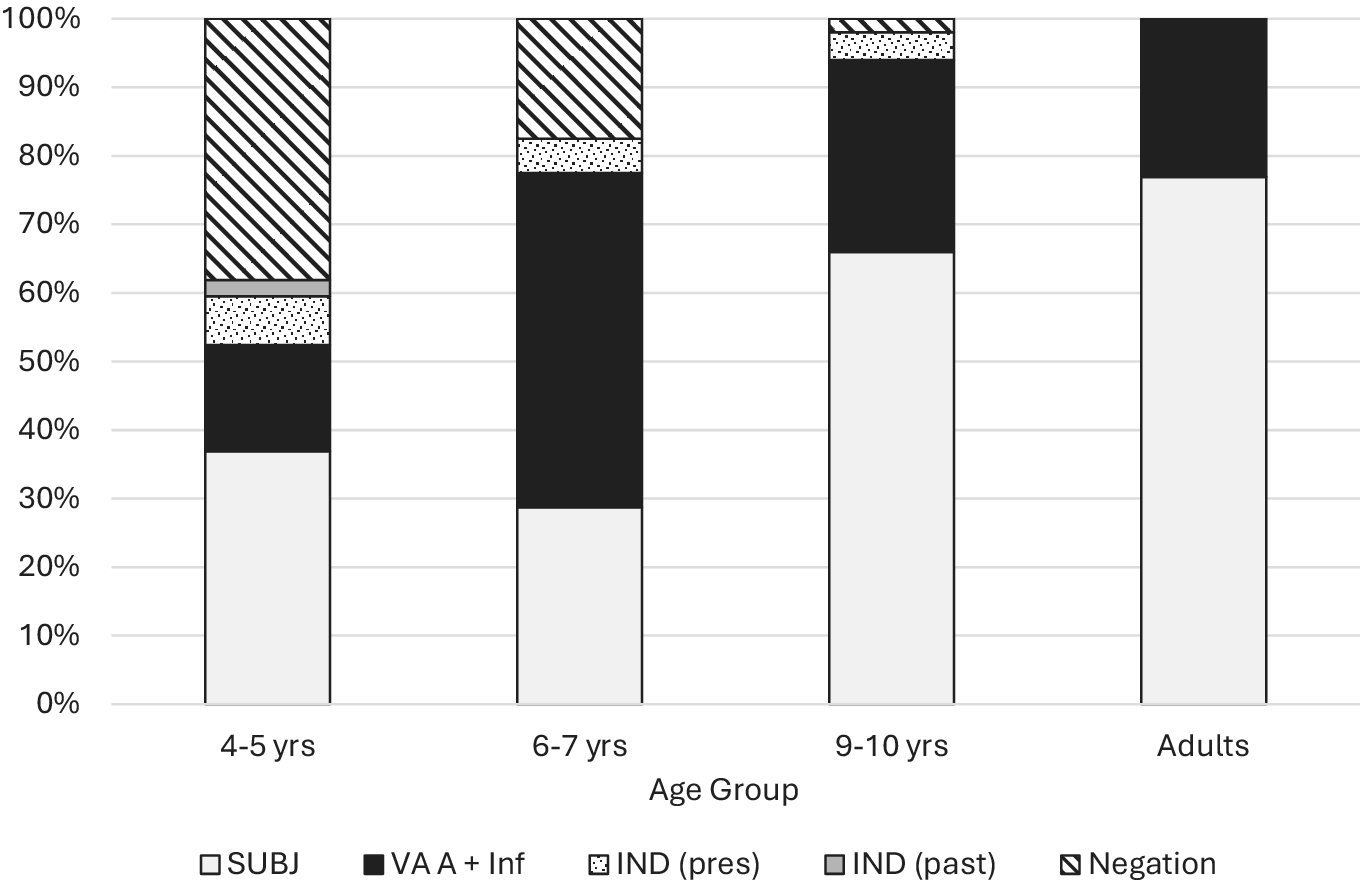
Sentence-completion data for SUBJ with Volitional clauses indicate target responses (i.e., categorical selection of SUBJ) by monolingual children ages 4–5 (Dracos et al., Reference Dracos, Requena and Miller2019; Blake, Reference Blake1980, Reference Blake1983). But SUBJ use in other sentential complement clauses can be challenging for monolingual children. Dracos et al. (Reference Dracos, Requena and Miller2019) showed that children entertain a mix of felicitous and infelicitous alternatives for a longer time, until they progressively move toward target responses (i.e., matching the adults in SUBJ use as well as in non-SUBJ felicitous responses). This happened by 6–7 years old with factive emotive predicates (Presupposition condition) and by 9–10 years old with nonassertive predicates (Nonassertion condition). This pattern with Nonassertion is shown in Figure 1, adapted from Dracos et al. (Reference Dracos, Requena and Miller2019). By 9–10 years old, children have almost discarded all infelicitous alternatives (IND past, IND present, and Negation) and have increased SUBJ responses as well as the other felicitous response produced by the adults (i.e., periphrastic future with va a + inf). This pattern of infelicitous response elimination was a clear developmental trajectory that emerged from that study.
Distribution of response types with no creer in Nonassertion Condition for monolingual Spanish-speaking children ages 4–10 (adapted from Dracos et al., Reference Dracos, Requena and Miller2019)
Note: Included under the classification “negation” here are any responses consisting of the negative adverb no followed by the IND or SUBJ verb form (as in (5])). Despite the mood the child used, these utterances create a double negative construction with a cognitive verb, which is not adult-like. This non-adult-like behavior in the younger groups has also been attested in monolingual children in Blake (Reference Blake1980) and Dracos et al. (Reference Dracos, Requena and Miller2019), who characterized it as a true developmental error.

Bilingual children exhibit optionality, delay, and individual variability, which have been linked to differences in HL exposure and/or use. In a naturalistic corpus study, Silva-Corvalán (Reference Silva-Corvalán2014) reported the first present SUBJ use in a categorical context by two bilingual brothers at age 2;6–3;5. While the older brother continued to develop SUBJ use, the younger brother displayed a decline in SUBJ use. Silva-Corvalán argued that decreased HL input weakened his online command of SUBJ.
Dominance, proficiency, and exposure/use have been found to impact SUBJ use in bilingual children. Dracos and Requena (Reference Dracos and Requena2023) examined child HSs ages 5–14 in contexts that require categorical SUBJ selection (volitional clauses and temporal clauses with futurity). The child HSs’ SUBJ use was significantly conditioned by exposure to and use of the HL and, much more strongly, by Spanish morphosyntactic proficiency. The authors concluded that, even for categorical SUBJ contexts that are mastered early by monolingual children, insufficient exposure to the HL and the resulting low proficiency may contribute to the persistence of infelicitous alternative uses in child HSs. Similar effects of proficiency and frequency of Spanish use accounted for variability between participants in Thane (Reference Thane2025), who tested volitional clauses in 5th and 7th/8th-grade HSs and also found that frequency of HL use, as well as morphosyntactic proficiency, modulated SUBJ use. In another study with younger child HSs (ages 6;5–12;8), Solano Escobar (Reference Solano Escobar2025) tested elicited production of SUBJ in querer “to want” (categorical condition) and decir “to say” (variable condition). The results of a sentence-completion task indicated relatively high SUBJ use by the child HSs across conditions and no difference in selection type (categorical versus variable). The analysis of speaker factors revealed that older children used more SUBJ than younger children, and that children with higher HL proficiency used more SUBJ than those with lower HL proficiency.
Research on bilingual children has mostly addressed the acquisition of contexts that emerge earlier among monolingual speakers. One exception is Flores et al. (Reference Flores, Santos, Jesus and Marques2017), who tested mood selection in European Portuguese. The study administered an elicited production task that included categorical IND and SUBJ conditions, and a condition in which both IND and SUBJ were possible depending on the degree of belief in the truth of the proposition (with acreditar “to believe”). In the variable condition, analogous to the sentential complement contexts in the present study, even the oldest HS children (ages 13–16) underused SUBJ compared to monolingual adultsFootnote 1 (61% versus 72%, respectively), and their rates resembled those of younger monolingual children (62% SUBJ by 8–9-year-olds in de Jesus [Reference de Jesus2014]). While those results point to delays and added difficulty in HL acquisition of SUBJ use with sentential complement contexts considered variable with respect to mood selection, such contexts require further exploration. Of the Spanish SUBJ contexts in (6), however, sentential complements to factive emotive and nonassertive predicates have not been explored in HL development.
2. Current study
We examine SUBJ use in sentential complements embedded under adjectives (Presupposition condition) (2) and sentential complements to nonassertive predicates (Nonassertion condition) (3). These contexts are both considered to be late-acquired by monolingual children (ages 6–7 and 9–10, respectively). With respect to modality, despite both contexts instantiating epistemological modality, Presupposition shares family resemblance with deontic modality. With respect to the type of selection, while both contexts are variable, the present task elicited SUBJ. In addition, Presupposition displays fewer felicitous alternatives among adults (i.e., greater use of SUBJ: 90% + SUBJ (Blake, Reference Blake1985; Dracos et al., Reference Dracos, Requena and Miller2019; Lynch, Reference Lynch1999; Viner, Reference Viner2018, Reference Viner2020), and Nonassertion is characterized by the presence of a non-SUBJ felicitous alternative response (future with va a + inf). Also, some nonassertion predicates seem to be associated more strongly with the SUBJ than others (96% SUBJ with dudar > 77% SUBJ with no creer (Blake, Reference Blake1983; Lozano, Reference Lozano1995).
The research questions that guide this study are:
RQ1: What is the developmental path and timing for SUBJ in sentential complements to factive emotive (Presupposition condition) and nonassertive (Nonassertion condition) predicates among child HSs of Spanish?
Hypothesis 1: Following previous research with bilingual children, it is predicted that the HS children will not approximate the rates of SUBJ use exhibited by the first-generation speakers in their community. Still, we expect that child HSs will use more SUBJ in Presupposition than in Nonassertion contexts, since the latter are mastered even later by monolingual children and could be more critically impacted by a reduction in HL exposure/use among HSs.
RQ2: What role do language-external factors (age, HL exposure/use, language dominance, mastery of SUBJ in categorical contexts) and language-internal factors (modality and type of selection) play in the acquisition of SUBJ selection with sentential complements (Presupposition and Nonassertion)?
Hypothesis 2: Despite any delays (as in Flores et al., Reference Flores, Santos, Jesus and Marques2017), we predict that the older children in the sample would begin to show signs of increased SUBJ use with Presupposition and Nonassertion. We also expect HL exposure/use, dominance, and mastery of SUBJ with Volitional clauses to be associated with SUBJ use in sentential complements. These measures represent three different levels at which experience with, and command of the HL, may be operationalized. In addition, following previous research in the same community (Dracos & Requena, Reference Dracos and Requena2023), we hypothesize that dominance (understood as a measure of relative morphosyntactic proficiency) may be a better predictor of SUBJ use in the contexts of interest for the present study than HL exposure and use. If modality-related factors are behind the vulnerability in SUBJ use (Perez-Cortes, Reference Perez-Cortes2023), then we expect more optionality in the Nonassertion condition than in the Presupposition condition, since the latter entails aspects of deontic modality. If the effect of the type of selection is lexically conditioned (and probabilistic, instead of an all-or-nothing phenomenon), we predict child HSs will use more SUBJ with the matrix predicate dudar “doubt” than with no creer “not believe” since the former seems to select SUBJ near categorically.
3. Methods
3.1. Participants
Seventy-eight typically developing Spanish-English bilingual children participated in this study. Child participants (ages 5;1–15;0; M = 8;3, SD = 2;8) were recruited from a large Hispanic community in central Texas through social networking (tested in homes) (n = 34) and through a local school (tested in school library) (n = 44). They were all born in the United States or migrated there before age three. At least one parent (usually both) was born in Latin America (97% in Mexico and 3% in Honduras).Footnote 2
Whereas language dominance in bilingual speakers can be understood broadly (Montrul, Reference Montrul2016; Treffers-Daller, Reference Treffers-Daller2019), for this study, we interpret dominance as relative proficiency in the two languages (Unsworth, Reference Unsworth, Nicoladis and Montanari2016). In particular, we consider morphosyntactic proficiency a critical dimension of dominance. Given that the construct of interest is grammatical (mood selection in sentential complements), child participants were administered a proficiency test assessing English and Spanish morphosyntax (Bedore et al., Reference Bedore, Peña, Summers, Boerger, Resendiz, Greene and Gillam2012). We administered the morphosyntactic subtests from either the Bilingual English-Spanish Assessment “BESA” (with participants up to age 6;11) (Peña et al., Reference Peña, Gutiérrez-Clellen, Iglesias, Goldstein and Bedore2014) or the Bilingual English-Spanish Assessment – Middle Extension “BESA-ME” (with participants ages seven and up) (Peña et al., Reference Peña, Bedore, Iglesias, Gutiérrez-Clellen and Goldstein2016). We subtracted each participant’s Spanish standard score from their English standard score. If these scores differed by ≤10 points, a participant was classified as Balanced, participants were considered Spanish- or English-Dominant. Only eight children comprised the Spanish-dominant group (consistent with the observation by Hoff et al., Reference Hoff, Tulloch and Core2021). Thus, we excluded Spanish-dominant children from analyses of dominance because this group was underrepresented in the sample. However, we included all children for analyses that looked at associations between mastery of SUBJ in Volition and SUBJ use in Presupposition and Nonassertion.
Exposure to and use of English and Spanish outside school were assessed via a parental questionnaire. Parents used a Likert scale to estimate the percentage of time that their child spent hearing and speaking each language on weekdays and weekends outside of school. The Exposure scores and the Use scores were strongly correlated (r(75) = .73, p < .0001),Footnote 3 so these were combined into a Mean Spanish exposure/use (outside school) score (as in Shin et al., Reference Shin, Rodríguez, Armijo and Perara-Lunde2019). Overall, Spanish was used more than English in the child participants’ homes. Information on the language(s) (Spanish, English, or both) spoken with close family and friends with whom the child interacts regularly was also collected in the questionnaire and converted into a Likert scale. In addition, the Mean score for Spanish exposure/use in school (during the last academic year) indicates that the average child was exposed to Spanish for half of the school day (see Supplementary Table S1).
We also tested 31 first-generation adults from the same bilingual community as the children. Except for two adults born in Honduras, the first-generation adults were born in Mexico. All adults had migrated to the United States after age 15 and had lived in the United States for an average of 15 years. This adult group was selected as the baseline because they represent the input to which second-generation HS children are exposed, following recommendations by Serratrice (Reference Serratrice2020). Self-reported measures of exposure/use and proficiency were obtained from the adult group via the Language Experience and Proficiency Questionnaire (LEAP-Q) (Marian et al., Reference Marian, Blumenfeld, Kaushanskaya, Rojas and Iglesias2007). Additional proficiency measures included a version of DELE, a Spanish proficiency test designed by the Spanish Ministerio de Educación, Cultura y Deporte (http://diplomas.cervantes.es/en), and a version of MELICET, an English proficiency test designed by the University of Michigan English Language Institute (http://www.michigan-proficiency-exams.com/melicet.html). Based on these measures, first-generation adults were clearly Spanish-dominant (see Table 1).
Summary of participants’ information

Note: The proficiency scores are mean standardized proficiency scores expressed in terms of standard deviations.
a One bilingual child participant was born in Mexico, but she moved to the US before age 2, and had resided in the US for almost 8 years at the time of testing.
b Data from one participant are missing.
3.2. Materials
We used a sentence-completion task (adapted from Dracos et al., Reference Dracos, Requena and Miller2019) to examine mood selection in contexts we have called Presupposition (estar “be” + adjective + that…) and Nonassertion (no creer “not believe” + that…). Four trials pointing to a SUBJ continuation per condition were created. In the case of Presupposition, the fact that the experimenter read the prompt to participants (e.g., about a child doing something that makes their parent happy) reduced the likelihood that the participants’ subordinate-clause proposition could be construed as unknown to the experimenter. This presupposition is the pragmatic interpretation driving SUBJ use. In the case of Nonassertion, after presenting in the prompt a situation that posed a challenge to the characters, the experimenter asked the child whether an action would take place (e.g., after narrating how a child badly injured his ankle, the experimenter asked: “Is he going to play the game?”) followed by a claim that the other character in the situation (e.g., the coach) does not believe so. This led participants to see how the action was unlikely to occur. Thus, when the narration continued, and the experimenter started the sentence with the subject of the main clause (e.g., the coach who does not think the child will play), the SUBJ would be expected since the situation prompted agreement with the coach’s belief. Therefore, both experimental conditions of interest were designed to elicit SUBJ. Four trials testing the use of SUBJ with categorical, modally simple, and typically early acquired Volition (querer “to want”) were also included. Two additional trials tested children’s use of the IND mood following the strongly assertive predicate (saber “to know”). A sample trial for each condition appears in Supplementary Table S2. In addition, a subset of the HL children (n = 50) and the first-generation adults (n = 23) completed two additional trials using the verb dudar “to doubt.” This other nonassertion operator was chosen because it conveys a similar meaning to no creer, but it differs from no creer in that it does not include negation and may select SUBJ more than no creer.
3.3. Procedure
The testing session began with an unstructured conversation, and for children ages nine and under, this included playing with cartoon character figures. All trials began with the experimenter showing the participant a large color drawing depicting a situation (see Table S2 of the Supplementary materials for sample images). Two practice trials not involving mood selection were administered first. In each experimental trial, the experimenter asked participants to complete a sentence with a subordinate clause. Within each condition, trials were presented in a pseudo-random order.
4. Results
4.1. Descriptive results: HS children compared to first-generation adults across Conditions
The mean rate of SUBJ use for the HS children overall (n = 78) and for the first-generation adults (n = 31) from the same community in each condition is presented in Table 2.
Mean rate of SUBJ use for HL children and first-generation adults with each operator

a As explained in Section 3.1, a subset of the HL children (n = 50) and first-generation adults (n = 23) completed two trials with Dudar. The rates of SUBJ use, as well as the other response types produced, were very similar for No creer and Dudar amongst the children and amongst the first-generation adult group. This was also the case when we examined just the subset of HS children who used SUBJ categorically in Volition (as in the analysis in Section 4.3 below). Thus, in the statistical and follow-up analyses reported below, we only included the four trials with No creer that all participants completed for the Nonassertion condition.
Like monolingual adults tested using the same task (see Supplementary Figures S1 and S2), the first-generation adults produced SUBJ categorically in the Volition condition and IND categorically in the Control condition. They strongly preferred SUBJ in the Presupposition and Nonassertion conditions. When the first-generation adults did not use SUBJ, however, they used only one felicitous alternative in each condition. With Presupposition adults used the Present IND on 10% of the responses (6), while with Nonassertion adults used the future va a + infinitive construction in 14% of the responses (7). We consider SUBJ and these other response types used by adult speakers to be the baseline since these speakers represent the input that child HSs receive in the home.
Prompt: Siempre, la maestra está feliz de que la niña… “Always, the teacher is happy that the girl.”

Prompt: La mamá no cree que la hija… “The mother does not believe that the daughter.”

The HS children nearly mirrored the first-generation adults in the Control condition, exhibiting their ability to use Present IND appropriately 92% of the time (with 3% SUBJ; 5% other) following saber. Unlike the first-generation adults, the HS children produced SUBJ at much lower rates across all conditions, especially with Presupposition and Nonassertion. The standard deviations are also large, indicating substantial variation among the HS children (see Table 2).
When the HS children did not produce SUBJ, they produced an array of response types. The two felicitous alternative response types found among the adults in Presupposition and Nonassertion conditions (6 and 7) were also the most frequently used by the children. IND Pres was the most frequent alternative response children gave in the Volition (83/276) and in the Presupposition conditions (117/279). The future va + a construction, however, was the most frequent alternative response children produced in Nonassertion (112Footnote 4/279). Interestingly, in Presupposition and Nonassertion, these felicitous alternatives exceeded the number of SUBJ responses (109/279 and 55/279, respectively).
In addition to the alternative responses attested among adults, children also resorted to infelicitous ones. In the Volition condition, where non-SUBJ responses are ungrammatical, children produced Infinitives (8), responses in English (9), and Verb omission (10). With Presupposition, children also produced Present Progressive (11), which they did not produce in Nonassertion. In Presupposition and Nonassertion, children produced Past IND (12) and Negation (13), the latter being one of the preferred non-SUBJ responses in Nonassertion.
Prompt: El papá quiere que el hijo… “The father wants the son…”

Prompt: Siempre el papá está contento de que el hijo… “The dad is always happy that the son….”

Prompt: La maestra duda que la niña… “The teacher doubts that the girl….”

4.2. Best-fit model results: The effects of Condition and speaker factors on SUBJ use by the HS children
To assess the effects of speaker factors as well as Condition on SUBJ use by the child HSs, we ran generalized linear mixed models (GLMMs) with a logit link and a binomial error distribution in IBM SPSS Statistics version 27 (with graphs output by Stata/SE version 17.0). We entered Condition (Volition, Presupposition, and Nonassertion) as well as the following predictor variables and viable interactions into an initial model: age in months, language exposure and use outside of school, language spoken with family, and dominance (Balanced versus English-dominant) (see 3.1 regarding eight Spanish-dominant children). The random effect structure included a random intercept for Participant and a cross-random effect for Trial. Random slopes were initially included but subsequently removed because the models would not converge. To determine the best-fit model, we removed nonsignificant fixed effects from the initial model one by one (starting with the largest p-value) and evaluated model fit by comparing AIC/BIC values. The best-fit model included Condition, Age, Spanish Exposure/Use, Dominance, and the following two interactions: Condition × Age and Condition × Exposure/Use.
The results of the best-fit model (see Supplementary Table S3) revealed significant main effects of Condition (F(2,824) = 4.47, p = .012), Age (F(1,51) = 9.91, p = .003), and Dominance (F(1,51) = 18.08, p < .001), as well as a significant interaction between Condition and Exposure/Use (F(2,824) = 7.92, p < .001). The interaction between Condition and Age approached significance (F (2,824) = 2.54, p = .080). The contribution of each predictor will be explained in turn below.
4.2.1. The effect of Dominance
The model revealed a main effect for Dominance, with no interactions between Dominance and any other predictor. The Balanced group produced significantly more SUBJ than the English-dominant group, regardless of Condition. Specifically, the estimated odds ratio (OR) is 6.9, indicating that the Balanced group was about seven times more likely to produce the SUBJ overall than children in the English-dominant group. This is a large effect size for Dominance.
To further clarify the role of Dominance and illustrate its effect across the conditions, Figure 2 presents the distribution of response types for the Balanced versus English-Dominant groups. In Volition and Presupposition, while not matching the high rate of SUBJ used by the first-generation baseline, the Balanced group produced notably more SUBJ and considerably fewer nonfelicitous alternatives (e.g., Infinitive, English verb forms, no verb) than the English-dominant group. In Nonassertion, just like the monolingual adults in Dracos et al. (Reference Dracos, Requena and Miller2019) (see Supplementary Figure S2), the first-generation adults primarily produced SUBJ, and the only alternative response used by some adults was va a + infinitive. On the other hand, the English-dominant children used very little SUBJ. Instead, they produced IND and other infelicitous alternative responses (namely, Infinitive, Negation, and English verb forms) 50% of the time. While the Balanced group used only slightly more SUBJ with Nonassertion, they also relied more on the felicitous alternative va a + infinitive, and therefore looked more like the first generation. Hence, achieving relatively balanced bilingualism is associated with greater SUBJ use and fewer nonfelicitous responses across all three conditions. To visualize individual tendencies within the dominance groups, see Supplementary Figure S3, which shows a similar pattern of individual responses across Presupposition and Nonassertion.
Percentage of response types by Condition based on Dominance group
Note: Included under the classification “negation” here are any responses consisting of the negative adverb no followed by the IND or SUBJ verb form (as in (13)). Despite the mood the child used, these utterances create a double negative construction with a cognitive verb, which is not adult-like. This non-adult-like behavior in the younger groups has also been attested in monolingual children in Blake (Reference Blake1980) and Dracos et al. (Reference Dracos, Requena and Miller2019), who characterized it as a true developmental error.

4.2.2. The effect of Condition
The model showed that Condition (Volition, Presupposition, Nonassertion) significantly influenced SUBJ production. Pairwise comparisons using the Bonferroni adjustment indicated that the child HSs showed a greater probability of producing SUBJ in the Volition condition compared to both the Presupposition condition (Contrast estimate = .34, SE = .07, p = .001, 95% CI = .18, .51) and the Nonassertion condition (Contrast estimate = .58, SE = .06, p < .001, 95% CI = .45, .71). They also displayed a greater probability of producing SUBJ with Presupposition as compared to Nonassertion (Contrast estimate = .23, SE = .06, p = .003, 95% CI = .09, .37). Nonetheless, the model also revealed interactions involving Condition that need to be interpreted to clearly understand the role of Condition as a predictor. These interactions will be explained in 4.2.3 and 4.2.4.
4.2.3. The effect of age by Condition
The model revealed a significant main effect for Age and an Age-by-Condition interaction that approached significance. These effects arose because increased Age was associated with higher overall SUBJ use, but subtle differences in this association emerged across conditions. Specifically, the ORs indicated that for each unit (month) increase in Age, the probability of SUBJ use increases by 3% in the Volition condition, by 2% in the Presupposition condition, and by 1% in the Nonassertion condition.
4.2.4. The effect of Exposure/use by Condition
The model revealed a significant interaction between Exposure/Use and Condition (see Figure 3). For Volition and Presupposition, the probability of SUBJ use increases with increased Exposure to and use of Spanish. On the other hand, for Nonassertion, the probability of SUBJ production decreases with increased Spanish Exposure/Use. To gain further insight into this seemingly counterintuitive finding, we examined alternative response types across categorical Exposure/Use groups (see Supplementary Figure S4). While children classified as mid- or high-exposure/use did not produce more SUBJ with Nonassertion as compared to the low-exposure/use group, the mid- and high-exposure/use groups used fewer infelicitous responses, relying more instead on the only felicitous alternative (va a + infinitive) used by the first-generation adults.
Predicted probability of SUBJ use by Condition and Exposure/Use, illustrating the significant Condition x Spanish Exposure/Use interaction for child HS speakers.

The analysis presented so far included not only the target (variable and late-acquired) conditions of Presupposition and Nonassertion, but also a Control condition (that categorically selects IND) and a Volition condition (which categorically selects SUBJ). This has allowed us to address how dominance, age, condition, and exposure/use impact SUBJ use in child HSs. In research question 2, however, we also asked whether mastery of SUBJ use in the early acquired, categorical context of Volition could be associated with SUBJ use in more difficult contexts. Therefore, in Section 4.3, we use performance in the Volition condition as an independent variable to identify those participants who show evidence of mastering SUBJ use in that simple context.
4.3. SUBJ use with presuppositional and nonassertive contexts among HS children who mastered volition
The main model reported above indicated a significant difference in SUBJ use among HS children across conditions, with the greatest SUBJ use in the simplest Volition condition, as predicted. Given that the factors shown to impact SUBJ use in the Volitional context (see 2.2) are presumably at play in all SUBJ contexts, we would expect that children who have not mastered SUBJ use with Volition to do no better with mood selection in more complex conditions. Therefore, we examined the subset of 32 HL children who produced SUBJ categorically with Volition (i.e., mastered Volition), as we expected those children to proceed to acquire more complex uses. Most of these children who mastered Volition were exposed to and used Spanish at least 50% of the time (based on parental reports) and had achieved sufficient morphosyntactic proficiency in Spanish to be classified as balanced or Spanish-dominant (see Supplementary Table S4). Descriptive results indicate that 29/32 of these children who had mastered Volition used SUBJ with Presupposition (and 20/32 used SUBJ in 75% or more of the Presupposition trials). However, only 15/32 of these children used SUBJ with Nonassertion (and only 11/32 used SUBJ in 75% or more of the Nonassertion trials). We ran additional linear mixed models using this subset of HS children who mastered SUBJ with Volition. The first examines their SUBJ use across the Presupposition and Nonassertion contexts and explores the potential effects of age or Spanish exposure/use within this group. The second model compared their SUBJ use in these two conditions to that of the first-generation adults from their community.
4.3.1. The effects of Condition and Age in HS children who mastered volition
We followed the same procedure as above to find the best-fit model, which included Age in months, Condition (Presupposition versus Nonassertion), and their interaction (Age × Condition). Dominance was not included because most participants in this subset were balanced. Results revealed a significant main effect of Condition (F(1,250) = 11.46, p = .001) and a significant interaction between Age and Condition (F(1,250) = 4.43, p = .036) (see Supplementary Table S5). HS children who produced SUBJ categorically with Volition were substantially more likely to use SUBJ with Presupposition (estimated probability = 78%) than with Nonassertion (estimated probability = 34%)Footnote 5. The Age by Condition interaction (see Figure S5) showed that although the probability of SUBJ use with Nonassertion increases with age (by 2% per month), SUBJ use with Presupposition remains relatively stable across the age span tested. To better understand this interaction, we next examine how children performed across conditions.
In Presupposition, the absence of an age effect was not due to homogeneous performance among the children who mastered Volition (see Supplementary Figure S6). Instead, substantial individual differences emerged. At younger ages (5–7), when monolinguals tend to reach target-like rates, most of these HS children used SUBJ categorically, or ~75%, but a minority used it only 25% of the time or not at all. This polarized distribution persisted across the entire age range, yielding no developmental change with age. For Nonassertion, up until age 7;11 (the age at which monolinguals begin to develop rapidly in this condition), very few of these HS children use SUBJ at all (the two who do so also used SUBJ categorically in Presupposition). Starting at age 8, we see some progress in this group, and thus the age effect, but we again see a polarized distribution. Most of these older children aged 8 and up used SUBJ either categorically (n = 8) or not at all (n = 10), with few using it variably (n = 3). Therefore, the interaction with age may be due to different starting points, with SUBJ being virtually absent in Nonassertion at the earliest ages, indicating a delay (see Flores et al., Reference Flores, Santos, Jesus and Marques2017).
In contrast, for Nonassertion, very few HS children produced SUBJ before age 7;11 – the point at which monolinguals begin to show rapid development – apart from the two children who also used SUBJ categorically in Presupposition. Beginning around age 8, some children showed progress, producing the observed age effect; however, the distribution again remained polarized. Among children eight and older, most used SUBJ either categorically (n = 8) or not at all (n = 10), with only a few showing variable use (n = 3). Thus, the interaction with age appears to stem from different starting points across conditions: at the earliest ages, SUBJ is virtually absent in Nonassertion, indicating a delay in this condition (see Flores et al., Reference Flores, Santos, Jesus and Marques2017).
4.3.2. Comparison between HS children categorical in volition and first-generation adults
We compared the same subset of HS children who mastered SUBJ in Volition to the first-generation adults in a model that included Condition (Presupposition versus Nonassertion) and Group (32 HS children categorical in Volition versus the 31 first-generation adults). The model revealed a significant main effect for Condition (F(1,7) = 15.23, p = .005) and for Group (F(1,56) = 19.45, p < .001), as well as a significant Condition × Group interaction (F(1,498) = 5.11, p = .024) illustrated in Figure 4 (see Supplementary Table S6). While pairwise comparisons using the Bonferroni adjustment indicated that the first-generation adults showed a greater probability of SUBJ use than these HS children in both conditions (Presupposition: Contrast estimate = .18, SE = .07, p = .015, 95% CI = .04, .32; Nonassertion: .55, SE = .09, p < .001, 95% CI = .37, .73), the children were notably closer to approximating adult rates of SUBJ use in the Presupposition condition. The interaction is therefore the result of adults using SUBJ at comparably similar rates across the two conditions, whereas the HS children used considerably more SUBJ in the Presupposition condition than in the Nonassertion condition.
Significant interaction between Condition (Presupposition versus Nonassertion) and Group (HS children categorical in Volition versus First-generation adults).

Figure 4 highlights that the subset of the HSs who categorically used SUBJ with Volition strongly preferred SUBJ with Presupposition, like the first-generation adults, even if they did not quite approximate the first-generation rate of use. On the other hand, even these children who mastered SUBJ with Volition produced low rates of SUBJ with Nonassertion, exhibiting no preference for SUBJ in this context (unlike the first-generation adults).
The underuse of SUBJ in Nonassertion by children who otherwise seem to successfully acquire SUBJ in Volition and Presupposition calls for deeper analysis of Nonassertion responses. For this condition, the subset of children who mastered Volition did not produce many infelicitous responses. While their SUBJ rate is low (38%), 50% of their responses used the felicitous va a + infinitive alternative. Focusing just on the children in this group who are age 9 and older (n = 18), their responses show a higher rate of SUBJ (48%) and an equally high rate of va a + infinitive use (46%). While first-generation adults used this felicitous alternative response less than 15% of the time in Nonassertion, children who had mastered Volition resorted to it almost as often as they used SUBJ. This differs from the response types of the rest of the children (i.e., those who did not use SUBJ categorically or at all with Volition in this study) (see Supplementary Figure S7). SUBJ use was almost nonexistent among those other children, and they instead relied predominantly on infelicitous and felicitous alternatives, including the target-like va a + infinitive construction 30–40% of the time. Even when we focus just on the HSs in this group who are 9 and older (n = 17), the age at which monolingual children look adultlike in this context, we find almost no SUBJ use. However, we do see an increase in reliance on the felicitous va a + infinitive alternative to 50%. In summary, an analysis of response type within Nonassertion indicates that those children who had mastered Volition used SUBJ and va a + infinitive almost to the same degree. The rest of the children who had not mastered categorical SUBJ with Volition, however, severely underused or did not use SUBJ at all, and by ages 9 and higher, they relied on the felicitous va a + infinitive construction half the time.
5. Discussion
This study examined school-aged HS children’s mood selection in two sentential complement contexts: factive emotive (Presupposition) and nonassertive (Nonassertion). Based on prior research primarily with adult HSs, we expected that child HSs would exhibit notably higher optionality with both target sentential complements than with Volition, albeit likely more so in Nonassertion than in Presupposition. This hypothesis followed from linguistic factors endemic to these contexts: their modality (epistemological modality) may delay the timing of acquisition to a period in which child HSs are typically less engaged with the HL (Perez-Cortes, Reference Perez-Cortes2023) or the pragmatically constrained mood selection (variable type of selection) in them may require more exposure to the HL than categorical contexts (Pascual y Cabo et al., Reference Pascual y Cabo, Lingwall, Rothman, Biller, Chung and Kimball2012; Van Osch et al., Reference Van Osch, Sleeman, Aalberse, Bellamy, Child, Gonzalez, Muntendam and Couto2017; Van Osch & Sleeman, Reference Van Osch and Sleeman2018).
The results of this study conform to expectations when considering the developmental path and timing of acquisition across all HSs examined here (RQ1). To first consider the baseline representing input to the HS children, the first-generation adults’ SUBJ use was categorical in Volition and very high in both the Presupposition and Nonassertion conditions (90% and 86% SUBJ, respectively), mirroring monolinguals tested with the same task (Dracos et al., Reference Dracos, Requena and Miller2019). The HS children, however, showed more optionality and greater differentiation between conditions than the adults overall: 63% SUBJ in Volition, 42% in Presupposition, and 20% in Nonassertion. Further, there was evidence of development in SUBJ use with age across conditions, with greater gains in Volition than in Presupposition and more gains in Presupposition than in Nonassertion. However, as in Flores et al. (Reference Flores, Santos, Jesus and Marques2017), even the older children did not match first-generation adults’ SUBJ use with sentential complements, especially with Nonassertion.
These general findings, however, mask considerable individual variation in HL exposure and use, dominance, as measured by relative morphosyntactic proficiency, and ability with typically early acquired SUBJ contexts (i.e., SUBJ with Volition) (RQ2). As we see it, while each of these speaker factors represents engagement with and ability in the HL, they also exhibit a continuum of ability with the SUBJ in sentential complements. Greater overall HL exposure/use increases exposure to SUBJ and results in higher Spanish morphosyntactic knowledge, which in turn increases the likelihood of acquiring SUBJ with Volition (see Dracos & Requena, Reference Dracos and Requena2023).
We found two effects of age. When all children were analyzed together, increases in age corresponded to greater SUBJ use, and this effect was mediated by condition, with the greatest increases in SUBJ in Volition > Presupposition > Nonassertion. When we examined SUBJ use in the two target conditions among the children who had mastered SUBJ with Volition, we also found an interaction with condition. With increases in age, these children used more SUBJ with Presupposition than Nonassertion. These results point to some development with age, albeit most children in our sample are not reaching the target in the ages tested.
Much more so than age, however, this study suggests that HL exposure and use (see Flores et al., Reference Flores, Santos, Jesus and Marques2017), overall Spanish morphosyntactic proficiency, and ability with SUBJ in the Volition context show a strengthening association with decreased IND and increased SUBJ usage in the Presupposition condition. Similarly, these factors are associated with decreased IND and increased SUBJ or the target-like va a + infinitive alternative in the Nonassertion condition. Therefore, we conclude that the large variance across HS children regarding their engagement with and ability in the HL corresponds strongly to their development in SUBJ use with sentential complements.
The differences between the child HSs who mastered Volition and those who did not are especially instructive. Most HS participants have not mastered the typically early acquired and most simple Volition context, and they do not seem to be developing within sentential complements either. The mean SUBJ use for this group that did not master Volition was 37% in this condition, and this rate falls to and hovers around 18% and 8% for Presupposition and Nonassertion, respectively. In stark contrast, the child HSs who mastered SUBJ with the categorical and modally simple Volition context show profound development in Presupposition and Nonassertion. The HSs in this group are not only highly likely to develop target-like SUBJ usage in Presupposition, but also to do so by ages 6–7, just like the monolinguals who completed the same experimental task (Dracos et al., Reference Dracos, Requena and Miller2019). The child HSs who mastered Volition also develop the expression of modality with Nonassertion in strikingly similar ways as monolinguals (Dracos et al., Reference Dracos, Requena and Miller2019). They begin developing SUBJ selection at ages 6–7, and by ages 9–10, they have steadily eliminated almost all infelicitous responses. Yet, these older HSs’ SUBJ rate in Nonassertion (48%) falls short of the target (86%). Instead, they often use a felicitous alternative va a + infinitive (46%). In fact, even the HS children who have not mastered Volition (and whose SUBJ use is almost nonexistent) develop a preference for this alternative (50%) with Nonassertion, making an alternative to the SUBJ the most common response in this study. The present results suggest that the acquisition of SUBJ with Volition could constitute a milestone, opening up a pathway to the acquisition of other SUBJ contexts.
This study’s central findings challenge prevailing views on HS development of SUBJ, which claim that SUBJ with sentential complements to factive emotive or nonassertive predicates is uniquely difficult. Our results suggest that any potential effect of language-internal factors, such as type of selection and modality, is far less than expected. The HSs in this study with sufficient exposure to and capacity with the HL to master the typically early acquired, categorical, and modally simple Volition context are highly likely to achieve target-like usage in Presupposition and to eliminate nontarget-like responses in Nonassertion. Indeed, according to our study, the large preponderance of infelicitous responses derives from HSs who do not appear to be developing in the SUBJ at all. Therefore, we propose that the most critical factors constraining HL development of SUBJ with the two types of sentential complements examined here are the same as those affecting Volition (Dracos & Requena, Reference Dracos and Requena2023), namely, language-external factors related to experience with the HL. Regardless of context, HSs’ development of the Spanish SUBJ depends largely on sufficient engagement and capacity with the HL to master more frequent, relatively less complex structures/constructions that serve as stepping stones to acquire more complex ones.
A couple of observations are noteworthy regarding the role of language-internal factors in the two sentential complement contexts tested. First, among the HSs who mastered Volition, Presupposition develops much earlier than Nonassertion, as in monolinguals. Second, the HSs who mastered Volition are less likely to achieve target-like SUBJ rates in Nonassertion than in Presupposition, and regardless of whether they mastered Volition, the HSs tested developed a preference for a felicitous alternative to the Nonassertion SUBJ. Since both sentential complement contexts tested here are variable, the acquisitional differences between the two cannot be explained by a brute appeal to the type of selection (see Requena, Reference Requena2023a, Reference Requena2023b for work on the role of variation in other constructions). Further, within the Nonassertion condition, we found no difference in SUBJ development between dudar que and no creer que, even though the former is assumed to take the SUBJ more frequently. The timing of monolingual and HS development within sentential complements, however, suggests a significant role for modality. As argued by Dracos et al. (Reference Dracos, Requena and Miller2019), Presupposition is likely acquired earlier and closer to Volition than Nonassertion because it foregrounds a cognitively simple model present in Volition (see Section 1.1), whereas Nonassertion introduces the cognitively taxing epistemological modality. Therefore, where Perez-Cortes (Reference Perez-Cortes2023) notes no significant difference in mood selection between obligatory and variable structures with a common deontic modality, our study suggests that the HSs’ difference in SUBJ rates between the two sentential complement contexts targeted by the present study may derive, at least in part, from modal differences. Specifically, we reason that HSs who mastered Volition are more likely to develop target-like SUBJ usage in Presupposition because both contexts share a modal family resemblance (see Section 1.1). Instead, the modal complexity of Nonassertion pushes acquisition to an age in which the HSs typically receive less input in the HL or are more likely to receive HL input from non-first-generation-like varieties (Serratrice, Reference Serratrice2020).
However, modality is insufficient to explain why child HSs developed a strong attraction to a felicitous alternative (va a + infinitive) in the Nonassertion condition. Doing so, we propose, requires a more nuanced take on the type of selection. First, whereas both sentential complement contexts allow for SUBJ~IND alternation based on pragmatics, Nonassertion has an additional felicitous periphrastic alternative (va a + infinitive) which, albeit consisting of an IND verb, expresses a meaning typically conveyed by the SUBJ, namely futurity (see Fabregas, Reference Fabregas2014). Therefore, it is not surprising that speakers develop an attraction to this form in contexts that require SUBJ. This has been attested in monolingual adults and children (Dracos et al., Reference Dracos, Requena and Miller2019). We propose that many HSs develop and persist with a preference for this alternative in the Nonassertion condition because it is felicitous, relatively common, and within their existing grammatical means. Further, as Perez-Cortes (Reference Perez-Cortes2021a) claims, the ability to use felicitous alternatives over the SUBJ to express modality implies considerable knowledge of the HL, and we argue that this strategy may be a general feature of HS development of mood selection. To explore these issues in greater depth, future variationist research should expand to examine the availability of alternative ways to express modality across additional SUBJ contexts and investigate whether – and to what degree – HSs employ such alternatives beyond the contexts tested here, as well as how they develop preferences for them. Our findings suggest that HS children in Central Texas may be developing a distinct HL grammar for modality, a possibility that deeper investigation could clarify while potentially offering a more complete and positive understanding of how HSs express modality in ways that may differ from monolingual varieties.
6. Conclusions
This study investigated HL acquisition of Spanish SUBJ in sentential complements to factive emotive and nonassertive predicates. We found that the developmental trajectory of HSs’ use of the SUBJ in these contexts is strikingly similar to that in other SUBJ contexts, such as Volitional and Adverbial clauses (Dracos & Requena, Reference Dracos and Requena2023), and reflects basic properties of how modality is expressed and acquired in Spanish. Regardless of SUBJ context, monolingual and HS children alike initially employ a diverse admixture of infelicitous as well as felicitous alternatives consisting of earlier acquired and more frequent forms or constructions. The infelicitous alternatives are progressively eliminated to match the type (and in some cases the distribution) found in the input. The extent to which child HSs conform to the first-generation baseline depends on whether HSs’ engagement with and ability in the HL are sufficient to overcome the SUBJ contexts’ complexity and low availability in the input. As Montrul (Reference Montrul2022) argues, “[f]requency of language use, as in the variational account of L1 acquisition (Yang, Reference Yang2000), will determine which linguistic representation wins out and is adopted.” (p. 252). In virtue of their engagement with and capacity in the HL, only a minority of the child HSs in central Texas conform to baseline in SUBJ use with sentential complements of Presupposition and Nonassertion. Most of the children tested, however, exhibit limited command of Spanish morphosyntax (including earlier-acquired SUBJ contexts) and receive reduced input with the target structures. Therefore, amongst this majority, non-SUBJ felicitous and infelicitous responses become alternative or innovative ways of expressing modal meanings that encroach on SUBJ use. A lack of further development beyond the school-age years would result in an increasingly different mood grammar attested within one generation, explaining the patterns of mood selection among adult HSs. Since we have not yet directly tested children’s ability to perceive and express the pragmatic distinction, future research should examine how HSs deploy alternative means to achieve the subtle pragmatic distinctions that result from mood distinctions in first-generation and monolingual speakers.
Supplementary material
The supplementary material for this article can be found at http://doi.org/10.1017/S1366728926101114.
Data availability statement
The data that support the findings of this study are available upon request to the corresponding author.
Acknowledgments
We express our sincere thanks to all participants, parents, and school administrators for their participation and support. We are also very thankful to Raquel Nuñez, Russell Miller, Dustin Lyles, Mackenzie Chandler, and Alex Baadsgaard for their help with data collection and transcription. We are grateful to the editor and anonymous reviewers for their insightful comments on earlier versions of this article. Of course, any remaining errors are exclusively ours.
Competing interests
The authors declare none.


 Open access

