




Introduction
Research in agroecology is at the heart of significant sustainability issues linked to natural resource management, climate change, and socioeconomic fairness. These challenges underscore the limitations of specialized knowledge in understanding and managing complex, dynamic production systems. In response, the last half-century has seen an increase in interdisciplinary, systemic, and clinical approaches to the understanding of the multitude of interactions and feedback effects that comprise system complexity. Furthermore, the management of farming systems requires practitioner experience and situational knowledge of heterogeneous and local conditions; thus, transdisciplinarity becomes an essential approach for the development of science that is both grounded and goal-oriented. Here, we use Cardona et al.’s (Reference Cardona, Angeon, Bellon, Casagrande, Dufils, Lopez-Merino, Navarrete, Ollivier and Penvern2024) definition of transdisciplinarity as ‘a process of integrating plural knowledge from academic and non-academic stakeholders’. This process links interests, values, and knowledge to produce ‘socially robust’ knowledge (Gibbons and Nowotny, Reference Gibbons, Nowotny, Klein, Häberli, Scholz, Grossenbacher-Mansuy, Bill and Welti2001) and solve complex, tangible problems. For scientific research aiming to drive or support agroecological transitions on farms, transdisciplinarity with farmers is an essential part of the co-creation of knowledge, understood as ‘a collaborative process involving two or more actors, who are intentionally integrating their knowledge and learning, resulting in the development of insights and solutions that would not otherwise be reached independently’ (Utter et al., Reference Utter, White, Méndez and Morris2021). Transdisciplinarity is seen as a methodological emergence and necessity to improve the ecological and social sustainability of agricultural production systems (Barrios et al., Reference Barrios, Gemmill-Herren, Bicksler, Siliprandi, Brathwaite, Moller, Batello and Tittonell2020; López-García et al., Reference López-García, Cuéllar-Padilla, de Azevedo Olival, Laranjeira, Méndez, Peredo y Parada, Barbosa, Barrera Salas, Caswell, Cohen, Correro-Humanes, García-García, Gliessman, Pomar-León, Sastre-Morató and Tendero-Acín2021; Méndez et al., Reference Méndez, Caswell, Gliessman and Cohen2017).
In farming systems, solutions to identified and shared problems require the design of a set of actions, all of which employ specific means and techniques, organized in space and time. The use of a transdisciplinary approach to this design process entails the undertaking of ‘collaborative design activities’ or ‘co-design’ (Zamenopoulos and Alexiou, Reference Zamenopoulos and Alexiou2018). With roots in design sciences (Hatchuel and Weil, Reference Hatchuel and Weil2009; Le Masson et al., Reference Le Masson, Weil and Hatchuel2017; Meynard et al., Reference Meynard, Dedieu, Bos, Darnhofer, Gibbon and Dedieu2012), co-design aims at ‘ensuring that those with the life experiences, expertise and knowledge are actively involved in these making new tools, products and services’ (Zamenopoulos and Alexiou, Reference Zamenopoulos and Alexiou2018). In farming situations, it calls for farmers’ participation and expertise in the design of various objects, such as living entities (e.g., plant varieties, animal breeds), landscapes (e.g., arrangements of crops, grasslands, and semi-natural elements), practices, inputs, decision support systems, and evaluation tools (Lacombe et al., Reference Lacombe, Couix and Hazard2018; Prost et al., Reference Prost, Berthet, Cerf, Jeuffroy, Labatut and Meynard2017).
The co-design approach strongly links theory and practice (Béguin and Cerf, Reference Béguin and Cerf2009). Practice brings up problems, intentions, and hypothesis verifications, and research activities transform the flow of experience and interpretations into scientific statements. As the co-design process moves forward, the knowledge is debated and improved with the aim of reaching minimum levels of consensus and reliability. However, the strong connection between theory and practice means that knowledge is assessed more according to its ‘feasibility’ and ‘relevance’ in a farming context than according to its ability to convey an objective, universal truth. ‘Relevance’ refers to the degree to which the produced knowledge meets the expressed needs of farms and society, and ‘feasibility’ refers to the possibility of practical use and application. Thus, co-design is linked to the concepts of ‘transformative’ and ‘engaged’ sciences; it is a process that goes beyond merely advancing scientific understanding or theory and seeks actionable knowledge (Moser, Reference Moser2016; Rossing et al., Reference Rossing, Colombo, Koole and Messéan2022).
Different methods are used to foster participants’ creativity, organize and converge ideas, and develop particular designs for testing. Prototyping, knowledge-concept-practice and design workshops, modeling, surveys, serious games, and scenario narratives are among the best-known and most commonly used methodologies (Dernat et al., Reference Dernat, Grillot, Andreotti and Martel2025; Ditzler et al., Reference Ditzler, Klerkx, Chan-Dentoni, Posthumus, Krupnik, Ridaura, Andersson, Baudron and Groot2018; Jeuffroy et al., Reference Jeuffroy, Loyce, Lefeuvre, Valantin-Morison, Colnenne-David, Gauffreteau, Médiène, Pelzer, Reau, Salembier and Meynard2022; Le Gal et al., Reference Le Gal, Dugué, Faure and Novak2011). Each participant has specific expectations and constraints; the identification of shared intentions is a prerequisite for the building of a coherent, legitimate project in which everyone can act in the group’s best interest while staying true to themselves (Leeuwis, Reference Leeuwis2000). However, stakeholder participation in co-design has been predominantly discussed in terms of generating ideas and innovative designs. Experimentation and implementation in farming systems are often disregarded (Prost et al., Reference Prost, Reau, Paravano, Cerf and Jeuffroy2018).
Achieving greater sustainability through changes in farming systems depends on the linking of design processes with transition pathways (Rossing et al., Reference Rossing, Dogliotti and Martin2023). Farming situations are complex socioecological systems that are subjected to multiple strong stresses, as well as significant risks and uncertainties, making their futures difficult to predict. Thus, co-design endeavors must involve the embracing of open and indeterminate design processes and should leverage incremental learning fueled by action, evaluation, and feedback loops (Meynard et al., Reference Meynard, Cerf, Coquil, Durant, Le Bail, Lefèvre, Navarrete, Pernel, Périnelle, Perrin, Prost, Reau, Salembier, Scopel, Toffolini and Jeuffroy2023; Rossing et al., Reference Rossing, Albicette, Aguerre, Leoni, Ruggia and Dogliotti2021). Whereas the design process targets something desirable, the formulation, exploration, and experimentation processes progressively reveal the nature, shape, and attributes of the new object. The necessary knowledge and expectations regarding the designed object cannot be defined fully before the design process begins. Thus, ‘step-by-step design’ has been formulated to acknowledge and describe the ‘strong and dynamic links between the motivation to change, formalized in an evolutionary target, and the way of changing, relying on a dialogue between the exploration of new techniques and the learnings derived from their implementation’ (Meynard et al., Reference Meynard, Cerf, Coquil, Durant, Le Bail, Lefèvre, Navarrete, Pernel, Périnelle, Perrin, Prost, Reau, Salembier, Scopel, Toffolini and Jeuffroy2023). In the farming context design, this means that on-farm experimentation is the hinge between ideas and learning for change.
The overarching intention of this study was to further enlighten the role and aspects of ‘collaborative’ on-farm experimentation, that is, on-farm experiments embedded in a co-design process, by investigating the projects conducted by the co-authors. The co-authors are affiliated with a research unit that is part of a French agronomic engineering school and has historically conducted research through on-farm experiments. The research aims to develop expertise related to the feasibility and performance of ‘agroecological practices’ (Wezel et al., Reference Wezel, Casagrande, Celette, Vian, Ferrer and Peigné2014) in diverse and low-input farming situations. The progressive use of co-design over the last decade has further opened up the unit’s scientific work to non-academic stakeholders. This corresponded to the desire to promote the relevance and transformative capacity of research in the field. However, this participatory openness in the research unit has exacerbated the challenges associated with the roles and postures of researchers and their work. Notably, it has intensified the inherent tensions in the daily pursuit of effective and recognized scientific activity that seeks to be useful for agriculture and its practitioners while also being compliant with the academic and institutional frameworks in which it is embedded. The adaptation and evolution of experimental and analytical procedures—hallmarks of the scientific and engineering-based approaches to the understanding of biophysical systems—particularly reflect these tensions, challenging researchers’ epistemological and methodological canons. These developments and challenges are not confined to a few situations; they reflect a general situation in agricultural research and are a resounding call for researchers to reflect on their stance (Hazard et al., Reference Hazard, Cerf, Lamine, Magda and Steyaert2019; Rossing et al., Reference Rossing, Dogliotti and Martin2023). A research stance is understood as ‘the strategy used to deal with an indeterminate situation, and influences choices at all steps in knowledge production, such as defining a problem in scientific terms or selecting methods’ (Hazard et al., Reference Hazard, Cerf, Lamine, Magda and Steyaert2019).
To shed light on this situation and make better use of it, this paper describes a comparative and reflective analysis of five projects carried out by the co-authors and, more broadly, our research unit. Focusing on epistemological and methodological dimensions, the co-authors aimed to use situated experiences to characterize key aspects of the problematicity of co-design as it appears in the flow of on-farm experimentation and partnerships with farmers. First, we conducted an analysis to determine the outlines and forms of the project associated with collaborative on-farm experimentation. Then, we assessed how the co-design approaches supported or renewed the role of on-farm experimentation for scientific demonstration and examined the transformative capacity of these types of projects. The projects examined involved mainly agronomists and ecologists and addressed cropping and fish pond farming systems in France; they were implemented between 2013 and 2024.
Material and methods
Case selection and description
Before case selection, nine semi-structured interviews (lasting 20–60 minutes) were conducted with researchers involved in agroecological projects addressing cropping and fish pond farming systems that involved co-design and on-farm experimentation practices. These exploratory interviews were conducted to gather information on: i) researchers’ perceptions of the definition, context, and objectives of co-design; ii) the history and context of the projects that have involved co-design methods in our research unit; iii) the advantages, limits, and barriers associated with the use of co-design in on-farm experimentation; and iv) the relevance of co-design to the projects’ objectives and the outcomes achieved. This information was used to create an overview and shared understanding among the research team members regarding the co-design approach, the questions that it raises, and the perspectives that it conveys.
Then, five research projects were selected as case studies (Table 1). They were conducted in our unit over the past 10 years and involved on-farm experimentation and approaches that the researchers in charge identified as co-design. All of the projects focused on agroecological practices, which are understood as undertaken in the attempt to secure the production and profitability of farming systems while fostering beneficial ecological processes and preventing environmental degradation. The contents of these projects and the researchers involved in their implementation informed the analytical and reflective work that is presented here.
Overview of the research projects examined

Project selection did not take into account whether the initial agronomic objective was achieved, to enable reporting not only on successes, but also on challenges and barriers. They directly targeted the redesign of farming activities and practices and aimed to alleviate the negative environmental and socioeconomic externalities of the prevailing practices used in these systems. In the cropping systems category, the TERRAE project focused on the improvement of soil fertility through a combination of management practices and crop rotation, the CASTOR project was undertaken to reduce fertilizer and herbicide/weeding use through the introduction of cover crops in relay cropping, and the CERPET project focused on the diversification of rotation with a proto-perennial grain crop. In the fish pond farming category, the CARASSO project aimed to achieve better management of feed supplementation and pond fertilization and liming, and the SEPURE project was undertaken to test and promote polyculture fish assemblages in ponds with various underutilized fish species.
Cross-case analysis
The authors of the present paper are the leaders of the projects analyzed, and thus the suppliers of the data for the cross-case analysis. Discussions among authors were instrumental for the identification of points of convergence and divergence between projects and the dimensions to be studied, for agreement on the terms used, and for the re-evaluation of initial perceptions and findings in light of other project leaders’ experiences and feedback.
As a first step, the co-authors collectively designed a descriptive grid for detailing the project contexts, objectives, stakeholders, activities, and outcomes. The grid encompassed 23 items in four dimensions. The first dimension was the overall project description: context and stakes, duration, type of system (cropping or fish pond farming), scale of study, object of design, stakeholders involved, and how the group was formed. The second dimension pertained to project activities: formalization of the issue, diagnosis of the situation, farmer interviews, formalization of the design object, knowledge sharing, design workshopping, experimentation, scientific data analysis, feedback, redesign, and adaptation of the objects and methods. The activity descriptions included details of the individuals responsible and the project stage during which they were undertaken. In the third dimension, the outcomes of the individual and collective phases of the projects were described, together with their links and interactions. Finally, the fourth dimension was dedicated to project evaluation. Expected and achieved outcomes, preliminary evaluations conducted by researchers, and the criteria on which the evaluations were based were delineated.
The project leaders individually entered data into the descriptive grid based on written documents (e.g., deliverables, working documents, notes), as well as their perceptions and initial reflective efforts for the projects in which they had experience. During the restitution phase, each project leader presented their project to the others and clarified any points requested.
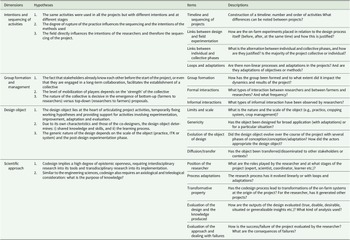
Based on the descriptive grid data, a content analysis was conducted. A comparative approach was then taken to characterize the similarities and differences among the projects. Following collective discussion and the definition of analytical criteria, this comparative analysis was applied to 18 items in 4 dimensions (Table 2): i) the intentions and sequencing of project activities, ii) group formation and management, iii) the design objects, and iv) the scientific approach. Two or three hypotheses per dimension were formulated to guide the analysis, and each item was further described to ensure that all authors were discussing the same concepts (Table 2). The authors then divided up the comparative analysis work according to the four main dimensions identified. Results were shared during a session attended by all co-authors, which allowed for the identification and ranking of the major points for discussion.
Analytical dimensions and criteria used for the cross-case analysis

Results and discussion
The analysis yielded three major themes: the adaptable, contingent, and transdisciplinary nature of the examined projects; the different experimental approaches used and their relationships to scientific demonstration; and the transformative capacity of research projects. Each theme brings together findings and lessons arising from the comparative and reflective analysis.
The adaptable, contingent, and transdisciplinary nature of the examined projects
Diagnosis-design-implementation-evaluation: complementary and transitive phases that are fulfilled in different ways
Meynard et al. (Reference Meynard, Cerf, Coquil, Durant, Le Bail, Lefèvre, Navarrete, Pernel, Périnelle, Perrin, Prost, Reau, Salembier, Scopel, Toffolini and Jeuffroy2023) indicated that the design of and transition toward new farming systems are structured by an open and iterative process intertwining individual and collective dimensions, and involving a series of phases: the diagnosis of the situation and its problems, the exploration of ideas and design of possible solutions, the implementation of a designed solution, and evaluation of the solution’s performance and success in the field. The cases examined confirmed the presence of all of these phases, their complementary and transitive roles, and the flexibility with which they are performed in terms of methods, duration, and the participation of non-academic stakeholders (Figure 1). This flexibility reflects the deeply adaptable nature of co-design (Cardona et al., Reference Cardona, Angeon, Bellon, Casagrande, Dufils, Lopez-Merino, Navarrete, Ollivier and Penvern2024), which emerges from the need to accommodate the specific configurations of networks and power dynamics among stakeholders (Fritz and Meinherz, Reference Fritz and Meinherz2020). In all of the projects considered in this work, the administrative and academic frameworks conveyed by the researchers notably determined the timing of activities and the need to collect sufficient and commensurable data within the project timeframes. The research objects were determined by the natural extension of the researchers’ activities, as well as the demand and interest expressed by farmers.
Description of the projects’ phases and main methods. The ‘A’, ‘B’, and ‘C’ letters refer, respectively, to the practice-centered, ecosystem services, and product-centered experimental approaches that have been identified in Section “Different experimental approaches and their relationships to scientific demonstration”.

The TERRAE and CARASSO projects followed a preliminary field/pond diagnosis phase, whereas the three others based their initial diagnosis on individual farmer surveys (Figure 1). All these diagnoses resulted in the formalization of design objectives and, in some cases, the creation of a design draft. Unlike the building of a collective diagnosis, this method was favored due to its organizational flexibility and because it enabled privileged interaction with each farmer. It allowed initial contact to be established and relationships of trust, reciprocity, and symmetry in exchanges to be formed. This approach also encouraged the description of the particularities of each situation. However, the use of the individual survey method delayed the formation of groups with shared intentions and the recognition of themselves as such. This disadvantage could be mitigated in cases of pre-existing groups of farmers who knew each other and already shared situations and ideas.
In two projects (CASTOR and SEPURE), the design phase was performed without the direct presence of farmers. However, the work conducted during this phase in these projects was based on information gathered during surveys and tracking on-farm innovations, and the resulting designs were submitted to farmers. The designs were then refined according to the feedback obtained. In the other projects, various methods (e.g., concept–knowledge methodology, prototyping, design workshops) were employed, depending on the objectives, the innovations under consideration, the moderators’ habits, the number of participants, and the time available for this phase. The design phase was used to develop specific practices and combinations thereof prior to implementation. One notable feature of the CARASSO project was that the design phase took place over several sessions, which enabled the dedication of more time to the exploration of ideas and fostering of creativity before the refinement and finalization of the design to be tested in the final session.
Whereas the other phases were brief and punctual, the implementation phase, consisting of on-farm experimentation and central to the projects, was generally the longest. It involved primarily individual farmers’ performance and observation of experiments, with researchers visiting and monitoring the experiments in progress. The TERRAE project was special, as it involved a collective approach to experimentation. Not all farmers were experimenters, but they would get together to observe and discuss the experiments conducted by only some of them. All projects showed that on-farm experimentation was not just about doing the ‘implementation phase’. It was also about discussing and gaining experience, which helped with the continued refinement of diagnosis, adapting techniques, and evaluating them, outside of specific, formalized times dedicated to these phases.
The CERPET project was unique in its revelation of a methodological heterodoxy, as the on-farm experimentation was an integral part of the diagnosis phase rather than the implementation of a co-designed solution (Figure 1). This approach was taken due to the highly disruptive nature of the innovation involved: the cultivation of an unknown, partially domesticated, perennial grain. The experimentation was thus an ‘acculturation’ phase, for both researchers and farmers, and involved the cultivation of the plant according to each farmer’s wishes and methods, with the aim of producing as much varied knowledge and as many diverse observations as possible. The knowledge and observations allowed for an initial diagnosis of the crop’s difficulties and interests. These were then considered in subsequent workshops to inform the design of the best possible uses and practices. In practice, this acculturation phase took a lot of time, so the implementation and evaluation phases could not be completed within the project’s timeframe. In the other cases studied, the acculturation phase was unnecessary because farmers were experimenting to improve or adapt systems that they already managed in their daily practices.
The reporting of results from measurements and analyses by researchers was typically a collective moment that formed a co-evaluation phase. In the CASTOR project, however, feedback and discussion sessions were held with individual farmers (Figure 1). This approach allowed for the occurrence of more in-depth and extended exchanges, which limited the overrepresentation of extroverted individuals’ perspectives in group settings and enabled a deeper understanding of individual cases. However, it limited confrontation among different points of view and experiences, and consequently, creative output. The CASTOR project best illustrates the existence of a ‘collective’ only indirectly, through links with and information shared by researchers. This type of project organization involves the adoption of more individualized interactive approaches across all phases. This situation has been described in the literature among all possible collective configurations (de Sainte Agathe et al., Reference de Sainte Agathe, Loyce, Prost and Toffolini2026). It implies that researchers taking this approach occupy central positions and give ample consideration to their own questions and methods, favoring efficiency in the addressing of specific questions. The co-design nature of such projects stems from the emphasis placed on farmers’ contributions during all interactive activities (e.g., surveys, experiments) and the encouragement, rather than control, of their initiatives.
Group formation and continuity of exchange
In all five cases examined, researchers gathered groups of farmers, generally with the support of local extension agents. They identified farmers who were interested in the research themes and general intentions, had previous experience with innovation and collective action, and were willing to share their knowledge and expertise. In all but one case, the farmers were localized in restricted areas defined by specific farming orientations (e.g., pond aquaculture in the Dombes region in the CARASSO and SEPURE projects) or belonging to given territories or networks of exchange or logistics (i.e., in the CASTOR and TERRAE projects). These projects thus benefited from long-term collaborations and/or territorial anchoring. Farmers were often familiar with some of the researchers, sometimes knew each other, and usually faced similar sociotechnical issues. These pre-existing networks and territorial anchoring fostered good understanding among farmers, more confidence in researchers, reliable dynamics, and trust in the collective. The CERPET project is a notable exception, as it involved a group of farmers dispersed throughout mainland France that was established ex nihilo. The farmers were identified based on their spontaneous decisions to contact the researchers and experiment with perennial grains. In this case, the critical tasks of group formation and management were much more difficult and time-consuming.
In all cases, proximity between researchers and farmers and continuous exchange throughout project implementation were critical elements ensuring group cohesion, individuals’ involvement, and the relevance of tasks and project dynamics. In the TERRAE project, the lack of regular exchange with non-experimenting farmers resulted in some attrition, which negatively impacted the collective approach. In the CERPET project, the difficulty of maintaining frequent exchange, particularly in person, favored individual farmer dynamics, which sometimes moved away from the initial intentions and the field observation protocol. In both cases, the deterioration of collective dynamics strengthened the application of a ‘top-down’ research process, moving away from the original ‘bottom-up’ aim. Conversely, as reported by Cardona et al. (Reference Cardona, Angeon, Bellon, Casagrande, Dufils, Lopez-Merino, Navarrete, Ollivier and Penvern2024), projects that maximize exchange and proximity favor ‘the readjustment of the scripted method in case of drift’ and reorientation ‘in order to finalize the scenario and achieve the initial objectives’. The importance of interpersonal relationships and skills has thus been highlighted for ensuring a successful process of knowledge co-creation (Utter et al. Reference Utter, White, Méndez and Morris2021).
On-farm experimentation played a crucial role in the sustainment of exchanges with farmers in all of the studied projects. Collective sessions and individual surveys provided formalized opportunities for exchange, but researchers’ monitoring visits during experiment implementation systematically provided additional opportunities for spontaneous, informal exchanges with the farmer-experimenters. It strengthened discussions about experimental protocols and allowed better use of empirical observations that extended beyond the formalized indicators and measurements. Importantly, it helped ease power asymmetries and build shared representations of the agroecosystem between academics and non-academics. This was considered crucial since sharing representations is necessary for all project participants to develop common assumptions and statements when interpreting observations and results (Barreteau et al., Reference Barreteau, Bousquet, Étienne, Souchère, d’Aquino and Étienne2014; Étienne, Reference Étienne2014). The importance and frequency of individual exchanges throughout the experimental process confirmed Meynard et al.’s (Reference Meynard, Cerf, Coquil, Durant, Le Bail, Lefèvre, Navarrete, Pernel, Périnelle, Perrin, Prost, Reau, Salembier, Scopel, Toffolini and Jeuffroy2023) description of the ‘step-by-step design’, which recognizes that ‘the design dynamics derive from an articulation between self-centered individual work and collective work’.
The researchers: embodiment of versatility, project accountability, and openness to the collective production of scientific statements
As observed more broadly in the agricultural sciences during the transition of farming systems toward sustainability (Salembier et al., Reference Salembier, Segrestin, Berthet, Weil and Meynard2018), the researchers involved in the projects assumed multiple roles. In addition to being experts in their fields, they took on roles as co-designers, facilitators, and learners. They were also systematically made responsible for the entire projects, including their organization, progress, and results. During the collective discussion and design phases, the researchers’ facilitator and expert roles often overlapped, as the projects were initially based on their own research perimeters and activities. Conversely, they adopted the learner role during the survey and design phases, seeking and capitalizing on the knowledge and ideas provided by farmers about choices, technical feasibility, and the socioeconomic relevance of practices. This illustrates the horizontal learning and knowledge exchange between farmers and researchers in the process of knowledge co-creation (Frank et al., Reference Frank, Amoroso, Propedo and Kaufmann2022). This expansion of researchers’ roles requires thorough preparation and the ability to adapt to changing needs throughout project implementation, balancing the requirements of collective direction to achieve predefined research objectives (e.g., formalization of questions, diagnosis, design, and production of results) with the need for freedom of thought and action, creativity, and spontaneity to leverage collective intelligence, skills, knowledge, and experiences (Quinio et al., Reference Quinio, Jeuffroy, Guichard, Salazar and Détienne2022).
Overall, collaborative practices and multi-site on-farm experimentation required the researchers to work with and give common meaning to heterogeneous data and perspectives. In all of the cases analyzed, the researchers were the guarantors and operators of the ‘demonstrative heart’ of the scientific process (the production and impartiality of proof), and the integration of knowledge into broader, coherent theoretical frameworks remained their prerogative. However, the stages before and after demonstration (e.g., the definition of the design object, research question, and hypotheses; interpretation; diagnosis; contextualization; and adjustment) were no longer exclusively theirs. Besides serving as co-designers (directly or indirectly through the survey phase), farmers contributed in three ways. First, they contributed to the understanding of agroecosystem functioning and the interpretation of results in their situations, as farmers have long histories of relationships with their production systems. Second, they helped to select the criteria or references used to develop and evaluate the designs, ensuring that the research processes were relevant to farming activities and improving the feasibility and performance of the solutions tested for their specific situations. Finally, farmers played a crucial role in discussing the innovations’ technical and economic feasibility, as they naturally and systematically generated creative and reflexive work on their long-term applicability. Whether or not the researchers had initially considered this dimension, they certainly addressed it.
Different experimental approaches and their relationships to scientific demonstration
The analyzed cases reveal the diversity of on-farm experimental approaches, in contrast to the normative view of repeated experimentation based on factorial designs. In the cases studied, experimentation was considered to be a stage that produced quantitative data, providing a foundation for impartial agro-environmental assessment. However, the results generated were not necessarily standardized or comparable. As de Saint-Agathe (Reference de Sainte Agathe, Loyce, Prost and Toffolini2026) noted, the diversity of methods for the realization of collective experiments and production of results is linked to differences in experiments’ objectives and collectives’ consultation methods and organization. In this cross-case analysis, we identified three experimental approaches that distinguish and clarify the ambitions and limitations of the scientific demonstration procedure: practice-centered, ecosystem services-centered, and product-centered approaches (Figure 2). These three approaches represent increasing levels of agrifood system integration and reflect farmers’ shift from operational to strategic questioning (Cowan et al., Reference Cowan, Kaine and Wright2013). Their objects and levels of innovation echo those of other typologies described in the literature, such as that distinguishing ‘co-innovation’ and ‘niche innovation’ (Lacombe et al., Reference Lacombe, Couix and Hazard2018). The former approach aims to produce ‘practice-led innovations through participatory action research’, and the latter produces ‘niche innovation products at the farm or market level’. Nevertheless, our typology is narrower and focuses strictly on differences in experimental approaches and analytical demonstrations, providing a dedicated view of the epistemological and methodological issues involved in research based on on-farm experimentation. However, it does not characterize the diversity of design objects, methods, and scales.
Main features of on-farm experimental approaches in terms of the level at which farmers make decisions, the type of knowledge they aspire to have (generic versus situational), and flagship methods.

The following sections describe the three experimental approaches in terms of the knowledge they convey and their respective strengths and weaknesses in relation to their specific analytical methods and the diagnostic and evaluation purposes they seek to fulfill. These approaches are not mutually exclusive or hierarchically ordered. They can be combined sequentially or jointly. However, their distinctiveness in our study reflects the reality that, given the (human, technical, and time) resources allocated to this type of project, only a limited number of aspects can be methodologically addressed.
Practice-centered approach
The practice-centered approach was used in the CARASSO and CASTOR projects. These projects aimed to characterize the effects of specific management practices that are known to be linked to functions and services in agroecosystems, although the nature, conditions, and intensity of these links remain unclear. In both projects, co-designed management practices were implemented in fields (cover cropping) and ponds (fertilization, liming, and feeding), with only minor adjustments to the designs to suit the equipment and capabilities of each farmer. These multi-local experiments served as a direct continuation of the historical factorial (reductionist) on-farm experimental method. However, randomization and replication-based designs were not imposed on farmers, although they are possible and used in other collective on-farm experimentation (de Sainte Agathe et al., Reference de Sainte Agathe, Loyce, Prost and Toffolini2026). This allows us to get as close as possible to the management practices that farmers use and to encourage experimentation by limiting the associated technical constraints. Each field or pond served as a blocking factor (random effects), and when several measurement points were realized within one experimental practice, they were considered pseudo-replicates, which were subject to spatial autocorrelation (Alesso et al., Reference Alesso, Cipriotti, Bollero and Martin2019). This was addressed by analyzing the average value or integrating residual spatial structure into the statistical model. When possible, incorporating sources of variation (e.g., soil gradients) into the statistical model also helps analyze pseudo-replicates (Alesso et al., Reference Alesso, Cipriotti, Bollero and Martin2019).
In the CASTOR fields, a strip-plot design was used. As part of the collaborative research process, farmers could decide to implement additional experimental practices, such as different cover crops, in addition to the systematic practices common to all field experiments. Testing simultaneously different practices was not possible in ponds (CARASSO), which could not be divided into subunits. But farmers could experiment with different practices over the years.
The resulting experimental designs are often unbalanced because not all farmers or years of experimentation provide all treatments, and some treatments are unsuccessful. Additionally, the diversity of application conditions increases the amplitude and heteroscedasticity of the observed variance. For these reasons, the use of mixed and generalized statistical models (Gbur et al., Reference Gbur, Stroup, McCarter, Durham, Young, Christman, West and Kramer2020), nonparametric tests, and model assumption checks with residual diagnostics (Hartig and Hartig, Reference Hartig and Hartig2017) is inseparable from these experimental methods and has become a routine statistical procedure. Figure 3 shows an example of a variance analysis graph from the CARASSO project. This graph combines a set of pond situations and several years of experiments. The statistical populations analyzed were rarely homogeneous, and large numbers of observations were required for each modality to express informative variance.
Analysis of the influence of combinations of feeding practices (FD), fertilization (FT), and liming (LI) on the specific diversity of aquatic plants (right panel), fish productivity (center panel), and algal biomass [chlorophyll-a (CHL) proxy, left panel] in the CARASSO project. n, number of ponds involved. From Vanacker (Reference Vanacker2016).

This practice-centered approach allowed researchers to identify consistent (neutral, positive, or negative) effects of practices across experimental situations and to determine the degree of generalizability. When using this approach, the challenge is to find situations with sufficient similarities (i.e., that allow comparison) for the detection of the average effect of the tested practices despite the influence of uncontrolled use conditions. Conversely, farmers benefit from the insightful comparison of their specific practices, contexts, and production systems with those of their peers, without having to manage a complex experimental plan that would remain embedded in a particular site-year context.
As Compagnone et al. (Reference Compagnone, Lamine and Dupré2018) explained, the generalization of results struggles due to the fact that a given practice is ‘practical’ because of the experience associated with its use. The practice’s success often stems from the specificities of each case and the small adjustments performed in it, which are impossible to express in the form of principles or technical standards. Thus, the practice-centered approach places situated and systemic views beyond the analytical core of scientific demonstration. These views were taken up during post-analysis and in interpretive discussions, and relied on the ability to diagnose and learn about the conditions under which the studied practices were applied and effective. Despite its shortcomings in demonstrating the mechanistic functioning of biophysical processes, this approach fostered ‘communities of practice’ (Wenger, Reference Wenger1999) among farmers in the projects in which it was applied. These communities can influence the acceptance and desirability of practices and promote the exchange of knowledge and experience.
In the CASTOR project, when farmers considered cover cropping not just as one management option for dealing with weeds or soil fertility, but as an integral part of their cropping systems that needed to be managed and secured like other cash crops, the experimental approach shifted from practice-centered to product-centered (see Section “Product-centered approach”). This shift illustrates the connection between the farmer’s decision-making level, ranging from operational (e.g., regarding the use of cover cropping in a given cropping system) to strategic (regarding the adaptation of a cropping system to cultivate cover crops), and the chosen experimental approach.
Ecosystem services-centered approach
In the case of the TERRAE project, we identified an experimental approach focused on ecosystem services. The issue of soil functioning and properties (e.g., fertility and water reserves) was central in this project (Table 1). As many processes and practices influence soil functioning and properties over different time scales, factorial and reductionist approaches were abandoned in favor of ‘system’ experiments. Innovative combinations of practices and entire crop rotations were evaluated over time through strip-plot designs. On each participating farm, the existing cropping system (‘reference system’) was compared with a particular co-designed (i.e., adapted to the farm’s economic, technical, soil, and climate conditions) cropping system, identified as the ‘innovative system’. Thus, the tested cropping systems were not identical across farms, but shared specific features and management strategies, such as the diversification of rotation, use of cover cropping, reduction of tillage, and biomass non-export.
This ecosystem services-centered approach entailed evaluating cropping systems (innovative or reference) based on various predefined criteria. The systems were compared point-by-point, without analyzing variance. In the case of simple and accessible indicators (i.e., soil N content), the use of pseudo-replicates allowed for the verification of the indicators’ consistency within field strips. The selection of the system’s assessment criteria was based on prior knowledge of the biophysical processes involved and the feasibility of the measurements. It was also based on the different stakeholders’ requests and visions regarding soil quality, and the constant need to compare ‘ecological’ indicators with socio-economic indicators. In the TERRAE project, questions about soil fertility led to the use of indicators of soil physical, chemical, and biological properties and functioning (clay and organic matter contents; communities of microorganisms, nematodes, and earthworms; and carbon and nitrogen mineralization potential). Crop system modeling is also frequently employed to obtain variables and indicators that are challenging to acquire in the field. In this regard, models play a pivotal role, as they guide the selection of indicators based on their capabilities and limitations. In the TERRAE project, for instance, the ‘SYSTERRE’ model (Estienne et al., Reference Estienne, Casal, Cadoux and Clotilde2021) was employed to estimate the GES emission of various crop systems, as well as operating expenses.
Figure 4 is an example of a graph used during a collective presentation in the TERRAE project. It illustrates how an individual indicator, deemed too costly to have pseudo-replicates, was used to compare cropping systems (innovative and reference) and experimental situations (farms). In a pluri-criteria approach, criteria can be aggregated in multi-criteria decision-aid tools (Sadok et al., Reference Sadok, Angevin, Bergez, Bockstaller, Colomb, Guichard, Reau and Doré2008) based on scientific relevance of aggregation choices and indicators used, as well as socio-political elements that drive choices in terms of the choice of assessment focus and for what ambitions. Multivariate ordination and clustering analyses can be performed on sufficiently large datasets with adequate replications to assess the covariances and relationships between variables. Such analysis enhances system functionality comprehension without incorporating normative or value-based appraisals.
Figure used in the TERRAE project during a collective presentation held in 2023. It shows a comparative analysis of ‘reference’ and ‘innovative’ cropping systems (first and second year of use) tested by each farmer, based on the potential for carbon mineralization in the soil. The graph supported the discussion and interpretation of the researcher and farmer regarding how different practices impacted soil quality and processes.

The choice of indicators and the selection of measurement protocols leveraged researchers’ knowledge of ‘universal’ biophysical processes in agricultural systems (e.g., cycle and dynamics of organic matter) and the different ways of monitoring and reporting them. This enabled the construction of a common framework for assessing and comparing the cropping systems, despite their differences. This allows researchers to maintain an approach compatible with the positivist frameworks of the natural sciences, which aim to develop a general, objective understanding of how nature functions. However, this stance was part of a dialectic with a complementary, clinical stance (Kockmann et al., Reference Kockmann, Pouzet, Omon, Paravano and Cerf2019). The result’s interpretation was made by combining the knowledge of researchers and farmers, including comparisons with past or parallel experiences in similar farming contexts. This approach led to the characterization of socio-ecological system states, functioning, and trade-offs in the most informative and plausible way possible.
Consistency of the measures and convergent meaning of the various available indicators were crucial to ensuring confidence in the interpretation of the influences of innovative cropping systems on desired ecosystem services. For instance, in TERRAE, reduced tillage and increased organic matter contents generally corresponded with greater earthworm abundance and activity, but clayey and carbonate soils exhibited more erratic indicator behavior. Interestingly, this interpretative uncertainty was heuristically valuable since it generates new efforts of understanding and hypotheses (Ison et al., Reference Ison, Blackmore and Iaquinto2013).
Another distinctive feature of the ecosystem services-centered approach is its emphasis on diachronic assessments covering time frames longer than 1 or 2 years. These longer time frames are necessary due to the significant inertia of certain processes and to increase the reliability of the assessments by relying on repetition over time rather than in space, as in factorial experiments. In this regard, the TERRAE project was the longest-running, with an experimental period of 6 years, compared to a maximum of 2 or 3 years in other projects.
Product-centered approach
For the CERPET and SEPURE projects, we identified an experimental approach focused on product (commodity) selection. Both projects involved experimenting with production based on non-standard unspecialized plant or animal species to promote and diversify species with functional traits that are beneficial for biophysical regulation in production systems. Although choosing one species over another can be considered a ‘practice’, we distinguish it here from the management practices discussed above. Selecting an alternative crop or fish for production requires adapting the entire management strategy and commercial outlet. This distinction is indicative of a shift in the level of farmers’ decision-making because it involves the strategic level of farming systems (i.e., farm product selection) (Cowan et al., Reference Cowan, Kaine and Wright2013; Robert et al., Reference Robert, Thomas and Bergez2016). At the operational and tactical levels (i.e., one or more management practices undertaken over space and time), farmers act within a given ‘frame of reference’ (Flichy, Reference Flichy2007; that is, a production type). At the strategic level, however, they modify the frame of reference and make new tactical and operational choices within it.
In the projects analyzed, the researchers were bearers of specialized and general knowledge about the new species under consideration for production. They used on-farm experimentation to verify or improve this knowledge. Analysis of variance or multi-criteria frameworks were typically used to consider several aspects of the incorporation of the new species in production. However, the product-centered approach differs from the others because experimentation yielded results that were primarily used to discuss barriers, conditions, production success frequency, and the risks and opportunities associated with novel economic outlets. Although the production processes had possible (social, economic, and ecological) advantages, their uncertainty was the stumbling block. This is clearly illustrated in a technical article about the CERPET project, in which the first and most important result reported was: ‘In more than half of the cases, either the crop disappeared (or almost) during the spring, or it required several mowing to remove weeds and was therefore unable to produce grain. These situations show how the crop is vulnerable during establishment’ (Bathellier et al., Reference Bathellier, Duchene, Celette and David2022). Similarly, one of the main results of the SEPURE project was the identification of four convincing, multi-species fish stocking scenarios with limited logistical (suppliers) and economic (production and outlets) constraints out of the 10 initially co-designed.
In this product-centered approach, the role of researchers requires significant openness to the social sciences, not at the periphery but within the scientific demonstration procedure. Researchers needed to gain a deeper understanding of the dynamics of systemic innovation (Midgley and Lindhult, Reference Midgley and Lindhult2017), also characterized as ‘coupled innovation’ (Meynard et al., Reference Meynard, Jeuffroy, Le Bail, Lefèvre, Magrini and Michon2017), agrifood systems and commodification processes, and to diagnose the lock-ins to and enablers of change (Meynard et al., Reference Meynard, Charrier, Fares, Le Bail, Magrini, Charlier and Messéan2018). Their stance was closer to that of a ‘sociotechnical inquiry’ (Casagrande et al., Reference Casagrande, Navarrete, Belmin, Boulestreau, Magrini and Meynard2024), and more emphasis was placed on qualitative analyses and the discussion of farmers’ decision-making processes (see, e.g., Ginot et al. (Reference Ginot, Bathellier, David, Rossing, Celette and Duchene2024) on the CERPET project).
Transformative capacity of research projects
From adoption…
Although management practices are the primary levers of action for farmers, they are situated at the lowest level in the decision-making process and are thus strongly influenced by upper-level decisions (Cowan et al., Reference Cowan, Kaine and Wright2013). In the projects analyzed, transformative capacity was associated essentially with three variables linked to these decision-making levels and each other: 1) the balance between the technical feasibility and the expected economic or non-economic benefits of a change, 2) the systemic impacts of the novel practice on the cropping/fish pond farming system as a whole, and 3) the perceived risks. These variables affect cropping and fish pond farming systems differently since the former involves a greater number and variety of management operations over time and across space, while the latter involves developing higher trophic levels in lentic environments with fewer management operations.
The balance between feasibility and benefits is a well-known and long-standing variable in the literature on innovation adoption, based on the diffusion of innovations model (Rogers, Reference Rogers1962). The projects analyzed here confirmed that technical feasibility and expected benefits were important factors for farmers’ adoption. The availability of equipment (CASTOR and CERPET), the expected plant or fish supplier (SEPURE and CERPET), and the value chain (SEPURE and CERPET) were all key drivers of adoption behavior. Furthermore, farmers perceive modifications to their practices as risky if they substantially alter the outlets of their farming systems (SEPURE and CERPET projects) or engender uncertainty through reliance on biological processes, consequently diminishing their sense of control (CASTOR and TERRAE projects). They also perceive modifications that increase production costs without ensuring additional economic benefits as risky and difficult to evaluate (CASTOR and TERRAE projects).
The CARASSO and SEPURE projects are particularly eloquent examples, as they both addressed fish pond farming in the Dombes region of France, but they demonstrated contrasting transformative capacities within their timeframes. The CARASSO project exemplified a ‘co-innovation’ (Dogliotti et al., Reference Dogliotti, García, Peluffo, Dieste, Pedemonte, Bacigalupe, Scarlato, Alliaume, Alvarez, Chiappe and Rossing2014; Rossing et al., Reference Rossing, Dogliotti, Bacigalupe, Cittadini, Mundet, Aguayo, Douthwaite, Álvarez, Cordoba, Lundy, Tehelen and Almekinders2010) process, involving the governance of a collective to support and coordinate common and simultaneous changes among several stakeholders. By the end of the project, all participants had changed their fertilization practices. This new fertilization method simplified management and reduced labor, providing promising and convincing benefits while not endangering existing pond management practices. This achievement has been made possible by the presence and long-term commitment of researchers to forming a congruent network of stakeholders who manage specific fish pond farming systems and who may share very similar issues and modes of action. In contrast, the SEPURE project profoundly challenged the prevailing fish farming model by changing the fish stock species composition, which required systemic innovation and the comprehensive realignment of management practices. It introduced uncertainties due to limited knowledge and expertise regarding these species and their economic value. Consequently, farmers perceived it as very risky and more complex to implement, and not all of them were ready to experiment.
…to learning and appropriation
Despite the challenges observed in all projects concerning the modification of cropping/fish farming systems, whether at the operational or strategic level, farmers showed interest in and commitment to the project dynamics. Regardless of the desire for and effectiveness of change, the projects and experimental approaches engaged stakeholders in learning about cropping/fish farming systems. The researchers regarded the development of knowledge and skills and the establishment of learning communities as more significant achievements than the agronomic success of the experiments.
As explained by Toffolini (Reference Toffoloni2016) for farming transitions, ‘a farmer who redesigns his/her cropping system acquires knowledge about the world in a way that is inextricably linked to how he/she transforms it’. This is in line with the general findings in the systems literature, where experimental management is depicted as a technique to examine the system, disrupting it slightly to trigger a slight, harmless reaction that offers insight into the system’s functioning (Walters, Reference Walters1986). Such a learning process empowers stakeholders and is inextricably linked to the production of actionable knowledge (Rossing et al., Reference Rossing, Colombo, Koole and Messéan2022).
This learning process is foundational in the ‘step-by-step design’ framework. The step-by-step design process differs from the innovation diffusion model (Geels, Reference Geels2002; Rogers, Reference Rogers1962) in that design is brought closer to use, and the iterative loops between the two, fostered by learning, are highlighted (Meynard et al., Reference Meynard, Cerf, Coquil, Durant, Le Bail, Lefèvre, Navarrete, Pernel, Périnelle, Perrin, Prost, Reau, Salembier, Scopel, Toffolini and Jeuffroy2023). The techniques selected and evaluated during this process are initially unknown and unpredictable; subsequently, improved versions of farming systems cannot be predicted. Users constantly reinterpret, reuse, divert, and/or transform techniques in practice as ‘action will meet resistances, setting the initial ideas in motion’ (Béguin, Reference Béguin2007). However, the iterative loops that accumulate and exploit the learning process form over a long timeframe, which was not taken into account or embraced in the projects that we examined.
As a result, the assessment of projects’ transformative capacity was difficult in the cases studied, except for the CARASSO project (see previous section). However, interactions with farmers several years after the research project conclusion revealed that they had engaged in ongoing learning and experimentation until they had perfected satisfying practices. For example, a farmer involved in the CASTOR project introduced relay cover crops into his cereal cropping system 3 years after the project had ended. He continued experimentation to determine the cover species and wheat sowing density that maximized the practice’s success and benefits for his farm. Rather than a process of ‘adoption’, in the sense of passive acceptance of innovation, we have termed this process of learning and local adaptation, leading to regular and autonomous use, ‘appropriation’. However, changes in farming practices that extend well beyond the project’s duration are inadequately documented in our cases. This should be improved in future projects, so as to report research activities’ impact on farms and to foster comparison between what was initially intended and what actually happens. This echoes Prost et al. (Reference Prost, Reau, Paravano, Cerf and Jeuffroy2018)’s insight: ‘Allowing a conversation with the situation in the long run has implications in terms of the inputs the research agronomists should produce to equip those who engage in design processes’.
Conclusion
The reflective and comparative case analysis described here indicates that researchers must understand the epistemological and methodological challenges of their experimental approaches to accommodate and guide the highly adaptable co-design process. We identified significant tension between the evaluation of knowledge based on repeatability and generalizability criteria, and the fact that knowledge is produced in unique and singular situations. Those who genuinely want to promote the agroecological agenda and transform farming systems must fully grasp the situational nature of knowledge in action. It encourages the production of testimonials and qualitative analytical results, especially to identify, record, and leverage the crafted solutions that emerge over time in specific action situations. However, this does not imply the isolation and compartmentalization of knowledge. Researchers remain the primary examiners of how the empirical accounts and processes governing situations share common cogs and can serve theoretical frameworks.
This study was conducted by researchers who form a ‘community of practice’ within the same lab and wish to clarify and improve their methods. Complementary and critical studies by other research groups are therefore necessary and welcome. The satisfaction of non-academic stakeholders was not formally addressed in any of the projects we examined. This factor should be systematized during or after projects. Additionally, researchers oversaw all of the projects examined; we intend to better explore farmer-led projects when opportunities arise. Many collective projects are led and driven by farmers, and it would be beneficial for researchers to ascertain how they can contribute to these collectives.
Data availability statement
Data will be made available upon reasonable request.
Acknowledgements
The study did not receive any external funding, but the research projects we analyzed were funded by different sources. The CARASSO project was funded by the Daniel and Nina Carasso Foundation. The SEPURE project received support from the European Aquaculture and Fisheries Fund (FEAMP) via France Agrimer. The Castor project was funded by the TERRA ISARA endowment fund and the CNR. The TERRAE project was funded by the TERRA ISARA fund and Auvergne-Rhone Alpes region (PEPIT program Risc’Inn). The CERPET project was funded by a CASDAR French grant.
Author contribution
Following the initial exploratory interviews conducted by Jacques-Aristide Perrin, all co-authors contributed to the conceptualization and comparative analysis of the projects. Olivier Duchene led the writing process, and all co-authors contributed to the editing.
Competing interests
The authors declare none.
AI use declaration
We did not use artificial intelligence (AI) tools in the research or writing process.



 Open access

