





Introduction
Children, their caregivers, and other members of the family unit form dynamic systems of mutual influence. Though contemporary thought in developmental psychology posits that children and their behavior can influence family dynamics, for decades the overwhelming assumption of studies of child development was that families, particularly caregivers, influence children’s development unidirectionally. While this assumption has been challenged many times, only in recent years have statistical analyses advanced to the point of being able to model such potential bidirectional effects. Several recent studies have furthered our understanding of dynamic development through such analytic techniques, including research showing reciprocal influences between family conflict and children’s externalizing behavior in middle childhood (Morelli et al., Reference Morelli, Hong, Elzie, Garcia, Evans, Duong and Villodas2022), co-parenting conflict in non-intact families and young children’s problem behaviors (Choi et al., Reference Choi, Parra and Jiang2019), and authoritative parenting and adolescent prosocial behavior (Fu et al., Reference Fu, Padilla-Walker and Brown2017).
The transition from childhood to adolescence (roughly ages 9 to 12 years, referred to herein as “emerging adolescence”; EA; Brislin et al., Reference Brislin, Martz, Joshi, Duval, Gard, Clark, Hyde, Hicks, Taxali, Angstadt, Rutherford, Heitzeg and Sripada2022) is a developmental period that may be particularly ripe for examination of such bidirectional influences. This time has been noted by parents and researchers alike as a shift from a relatively harmonious period in the family to one in which youth seek greater autonomy and challenge parental boundaries and hierarchal power (Branje, Reference Branje2018; Steinberg, Reference Steinberg2001). This transition also represents a period of psychiatric vulnerability for youth; while rates of diagnoses are low in this age range, clinically significant symptoms of anxiety, depression, and disruptive disorders often emerge during EA (Sentse et al., Reference Sentse, Kretschmer, de Haan and Prinzie2017), signaling potential future risk for full blown psychopathology (Kessler et al., Reference Kessler, Berglund, Demler, Jin, Merikangas and Walters2005).
The current study used four annual waves of data, collected when youth were between the ages of 9 and 12, to examine trajectories of family conflict and problem behavior symptoms over time. Furthermore, we used latent growth curve models with structured residuals (LCM-SR; Curran et al., Reference Curran, Howard, Bainter, Lane and McGinley2014) to determine whether the relation between family conflict and youth problem behaviors over time is unidirectional or bidirectional. A unidirectional effect would suggest that family conflict leads to greater child maladjustment over time (or conversely, that maladjustment leads to family conflict), whereas a bidirectional effect would suggest that increases in either family conflict or child problem behaviors would lead to an increase in the other construct over time.
Family conflict
As youth transition into adolescence, the role of the family changes dramatically (Silverberg & Steinberg, Reference Silverberg and Steinberg1990). In childhood, the family is one of the most proximal influences on children’s socioemotional development (Bronfenbrenner & Morris, Reference Bronfenbrenner, Morris, Damon and Lerner1998). The family continues to exert influence through adolescence but becomes relatively less influential as peer relations become more central (Scalici & Schulz, Reference Scalici and Schulz2014; Steinberg et al., Reference Steinberg, Lamborn, Dornbusch and Darling1992). The family’s declining influence over youth has been posited as one of several reasons for increased conflict (Branje, Reference Branje2018). Further, in Western culture, adolescents are expected to develop behavioral and emotional autonomy (Greenfield et al., Reference Greenfield, Keller, Fuligni and Maynard2003). However, both parents and youth report conflict in the family around the increased need for autonomy by youth (Laursen et al., Reference Laursen, Coy and Collins1998). The general developmental view is that such increased conflict is both normative and necessary as a means to negotiate change in the family dynamic, conditioned on the fact that it is minimally disruptive and not indicative of long-term, intense patterns of family dynamics (Branje, 2108; Smetana, Reference Smetana, Amsel and Smetana2011). Indeed, such mild “bickering” is thought to be functional in development, as it provides youth a safe space in which to practice the give-and-take style of more mature interpersonal relationships (Branje, Reference Branje2018; Laursen & Collins, Reference Laursen and Collins1994).
While most parents and youth report mild- to moderate-intensity conflict over topics such as dress, music, and school (Collins, Reference Collins, Montemayor, Adams and Gullotta1990; Smetana, Reference Smetana1988), too much conflict can pose problems. Studies have found that aspects of family conflict, such as parental divorce, marital hostility, or domestic abuse, are associated with greater maladjustment in childhood, adolescence, and adulthood (Bakhtiari & Plunkett, Reference Bakhtiari and Plunkett2023; Capaldi et al., Reference Capaldi, Tiberio, Shortt, Low and Owen2020; Zhou & Buehler, Reference Zhou and Buehler2019). Adults who reported conflict with their parents in childhood experience poorer physical and psychological health (Lei et al., Reference Lei, Berg, Simons and Beach2023; Roustit et al., Reference Roustit, Campoy, Renahy, King, Parizot and Chauvin2011), while families in which children are exposed to interparental violence produce youth who engage in more aggressive behaviors (White & Widom, Reference White and Widom2003).
During adolescence, family conflict may have a particularly potent impact. In a study of teen boys, family conflict increased the likelihood of them engaging in peer violence as the instigator (Paschall et al., Reference Paschall, Ennett and Flewelling1996). Furthermore, parent-reports of family conflict have predicted teen depressive symptoms (Sela et al., Reference Sela, Zach, Amichay-Hamburger, Mishali and Omer2020). As Steinberg (Reference Steinberg2001) warned, however, levels of family conflict depend on who you ask, as particular aspects of conflict in the family may be more salient to teens than to parents. In support of this, Telzer and Fuligni (Reference Telzer and Fuligni2013), for example, found that teens who reported negative daily family interactions over a two-week period were more likely to report depressive symptoms, particularly if they were girls. Further, teen-reported family functioning—but not parent-reported family functioning—predicted later depressive symptoms and aggressive behavior in teens (Lorenzo-Blanco et al., Reference Lorenzo-Blanco, Meca, Unger, Romero, Szapocznik, Piña-Watson, Cano, Zamboanga, Baezconde-Garbanati, Des Rosiers, Soto, Villamar, Lizzi, Pattarroyo and Schwartz2017).
Limited research to date has empirically examined the effects of family conflict on internalizing versus externalizing behaviors in youth. The vast majority of published work has focused on specific externalizing behaviors, such as aggression (Choe et al., Reference Choe, Stoddard and Zimmerman2014; Morelli et al., Reference Morelli, Hong, Elzie, Garcia, Evans, Duong and Villodas2022; Paschall et al., Reference Paschall, Ennett and Flewelling1996; Streit et al., Reference Streit, Carlo, Ispa and Palermo2021), rule-breaking (Morelli et al., Reference Morelli, Hong, Elzie, Garcia, Evans, Duong and Villodas2022), or alcohol use (Marsiglia et al., Reference Marsiglia, Kulis, Parsai, Villar and Garcia2009). Less work has focused on internalizing, with the existing work considering either broad internalizing symptoms (Raposo & Francisco, Reference Raposo and Francisco2022), depression symptoms (Choe et al., Reference Choe, Stoddard and Zimmerman2014; Rice et al., Reference Rice, Harold, Shelton and Thapar2006), or anxiety symptoms (Choe et al., Reference Choe, Stoddard and Zimmerman2014). To date, however, no prior work has considered the impact of global family conflict on both internalizing and externalizing problem behaviors simultaneously (without collapsing into total problem behaviors, such as Xerxa et al., Reference Xerxa, Rescorla, Serdarevic, Van IJzendorn, Jaddoe, Verhulst, Luijk and Tiemeier2020).
Directional considerations
Historically, the study of child development within the context of the family has been unidirectional - children’s later adjustment is preceded and predicted by family-level factors, such as parenting. As such, much research has focused on how the “input” that children receive from the environment (e.g., parenting, family dynamics) influences the “output” measured later (e.g., adjustment). Indeed, early research into child development was focused on the outcomes of child rearing (see Reiss et al., Reference Reiss, Ganiban, Leve, Neiderhiser, Shaw and Natsuaki2022) and little empirical attention was given to the processes through which these outcomes occur (see Baumrind, Reference Baumrind1966; Bing, Reference Bing1963; Patterson et al., Reference Patterson, Dishion and Bank1984).
Only relatively recently have researchers begun to empirically test if the direction of assumed causality may be reversed—that is, how children’s behavior influences and changes caregivers and families. Accordingly, more recent work has shown that children’s adjustment problems may be both be the consequence of and/or the reason for increased family conflict during adolescence. The majority of bidirectional studies of family conflict have focused on children’s externalizing behaviors, showing a reciprocal relation between family conflict and delinquency and aggressive behavior (Morelli et al., Reference Morelli, Hong, Elzie, Garcia, Evans, Duong and Villodas2022), peer conflict (Chung et al., Reference Chung, Flook and Fuligni2011), and risk-taking behavior (Riina et al., Reference Riina, Lee and Feinberg2020), as well as broadband externalizing problems (Burt et al., Reference Burt, McGue, Krueger and Iacono2005; Chiang & Bai, Reference Chiang and Bai2023). The overwhelming evidence is that while families with more conflict have children who later show more externalizing behavior, but that these acting-out behaviors also lead to more family conflict. As for internalizing behaviors, we see similar reciprocal patterns with family conflict and withdrawn and depressed behaviors (Morelli et al., Reference Morelli, Hong, Garcia, Elzie, Alvarez and Villodas2023), anxiety (Leung, Reference Leung2021), and social anxiety and hostility (Riina et al., Reference Riina, Lee and Feinberg2020).
Clearly, children’s maladjustment influences and changes family dynamics as much as the reverse. A major limitation with these studies, however, is that they fail to account for past behavior when considering future behavior. The above cited studies, for example, modeled direct predictive paths between manifest variables, leaving open the possibility that families and youth with heightened scores at baseline may be driving these effects over time. Further, cross-lagged models and basic latent growth curve models, as used in the above cited studies, do not differentiate between-person and within-person effects.
The current study
In order to fill these gaps in the literature, the present study used the latent growth curve model with structured residuals (LCM-SR; Curran et al., Reference Curran, Howard, Bainter, Lane and McGinley2014), which models the residuals of the constructs of interest and the relations between these residuals, rather than the manifest variables. We used LCM-SR to examine a series of research questions. First, how do youths’ perceptions of family conflict change over emerging adolescence? By structuring the residuals of the levels of family conflict and thus model deviation from expected values, we can see how higher initial levels of family conflict may lead to greater deviations in such conflict over time. Second, how do youths’ problem behaviors change over the same time span? Similarly, the LCM-SR allows us to model the deviations from expected internalizing and externalizing behaviors. Finally, are the changes in family conflict and children’s problem behaviors related, and if so, are these relations unidirectional or bidirectional? We tested this research question using bivariate LCMs-SR that simultaneously model deviations from expected levels of family conflict and problem behaviors over time. The present study is set up to remove several barriers to our understanding of family dynamics and children’s adjustment, by using multiple reporters (youth reports of family conflict and parents reports of problem behaviors), examining both internalizing and externalizing behaviors separately, and by clearly separating between-person (i.e., differences in how people change over time) and within-person (i.e., stability or change per person) effects.
Method
Population and sample
The present study used four waves of the Adolescent Brain & Cognitive Development (ABCD) longitudinal study, which follows a sample of 11,868 youth (M age at Time 1 = 9.48, SD = 0.51 years) and one of their parents (M age at Time 1 = 39.96, SD = 6.84 years; 85.3% biological mothers) annually. The ABCD sample recruitment strategy had an aim of a nationally-representative sample and approximates the diversity in race/ethnicity, child sex, and socioeconomic status of the US population across 21 sites (Compton et al., Reference Compton, Dowling and Garavan2019). Nearly half of the youth sample was female (47.9%) and identified as White (49.5%), with 20.3% identifying as Hispanic/Latinx and 15.0% identifying as Black. Retention is high, with less than 15% of the original sample missing a single assessment through the first three years (Dai et al., Reference Dai, Doucet, Wang, Puga, Samson, Xiao and Khan2022; Feldstein Ewing et al., Reference Feldstein Ewing, Bjork and Luciana2018). Further information on the ABCD study can be found in Hoffman et al. (Reference Hoffman, LeBlanc, Weiss and Dowling2022).
Measures
Family environment scale-family conflict subscale (FES-conflict)
Children completed the Family Conflict subscale of the Family Environment Scale (FES-Conflict; Moos & Moos, Reference Moos and Moos1976). This nine-item subscale assesses level of within-family conflict with items such as, “We fight a lot in our family,” “Family members often criticize each other,” and “Family members often try to one-up or out-do each other.” Each item is answered in True/False format (0 = false, 1 = true) and was completed at all four waves of data collection. Reliability was adequate across all four waves (Cronbach’s a = .65–.69), reflecting the reliability found in past studies.
Child behavior checklist (CBCL)
At each timepoint, parents completed the Child Behavior Checklist (CBCL), a 120-item, standardized instrument which asks caregivers of 6-to-18-year-old youth to report on a variety of behaviors (Achenbach & Rescorla, Reference Achenbach and Rescorla2014). Each item is answered on a 3-point scale, with 0 indicating the item is not true for the caregiver’s child, 1 indicating it is sometimes true, and 2 indicating it is often true. These items are used as two latent factor scores, one each for internalizing behaviors (33 items; e.g., worrying, depressive states, withdrawal) and for externalizing behaviors (35 items; e.g., rule-breaking, aggression). Reliability at all time points for both subscales were high (Cronbach’s a = .87–.90).
Procedure
Families were recruited from households in defined catchment areas in 21 study sites between 2016 and 2018 with the intent of creating a population-representative, diverse sample (Garavan et al., Reference Garavan, Bartsch, Conway, Decastro, Goldstein, Heeringa, Jernigan, Potter, Thompson and Zahs2018). Families were excluded for the following reasons: lack of English proficiency in youth, presence of severe medical, neurological, intellectual, or sensory limitations that may affect the youth’s ability to comply with protocol, and inability or unwillingness to complete an MRI scan at baseline. Study protocols for the ABCD Study were approved by the University of California, San Diego Institutional Review Board (IRB) (IRB #160091), all ABCD Study data collection sites were approved by their respective IRBs, and parent written consent and child assent were obtained from each participant. The authors’ institutional review board deemed the present study as secondary analysis of deidentified data and therefore not subject to review.
Data retrieval
Data were collected across 21 sites across the United States beginning in 2016. The present study used the first four waves of data collection, ending in 2022. All data presented herein were processed and cleaned by ABCD study staff and were accessed on December 16, 2021 from the ABCD Annual Curated Release 5.0 [http://dx.doi.org/10.15154/1523041] by the first author.
Analytic plan
All analyses were conducted in Mplus version 8.0 (Muthén & Muthén, Reference Muthén and Muthén1998-2017). Missing data were handled via a full information maximum likelihood estimation approach.
Prior to assessing change over time in our three study variables, it was essential for us to show measurement invariance (or equivalence) over time of each variable. Longitudinal measurement invariance (LMI) compares models with and without constraints on parameters in the model to test equivalence of the latent factors over time. If sufficient LMI is not met (see Grimm et al., Reference Grimm, Ram and Estabrook2016), it is inappropriate to consider model differences in the factor over time and label it change. Details regarding the steps to test longitudinal measurement invariance of each study variable are available in Appendix A.
Once scalar or strict longitudinal invariance was confirmed, we built three univariate LCMs-SR in the same fashion in order to evaluate the fit of the data to second-order growth models. First the data were fit to an intercept-only model (using the scalar or strict invariance models built earlier) and fit was assessed. Then, we added a linear slope to the first model and compared fit to the original, intercept-only model. If the model with the linear slope fit the data better than the intercept-only model, the linear slope was retained. We then added auto-regressive paths to the model, first with the paths constrained to be equal over time and then estimated freely. All four models were examined for overall model fit across multiple indices as well as model parsimony.
Once univariate LCMs-SR are constructed, we built two bivariate LCMs-SR to evaluate the bidirectional effects across study variables (see Curran et al., Reference Curran, Howard, Bainter, Lane and McGinley2014). First, a model in which the two constructs were allowed to covary freely within-timepoint but with no cross-construct, cross-timepoint paths predicting one construct from the other at a prior time. We then added cross-construct paths (e.g., from externalizing at Time 1 to family conflict at Time 2), first constrained to be equal and then freely estimated. The model fit to the data was examined and we retained the cross-lagged model that best fit the data. This process was repeated for the other set of cross-lagged paths. Finally, we entered both constructs with all cross-lagged paths in the model and examined the model fit for degradation.
Results
Building the univariate LCMs-SR
Family conflict
The model building process and longitudinal invariance testing of family conflict is described in detail in Appendix A. The retained model consisted of nine indicators, fit the model well (RMSEA = .028, CFI = .978, TLI = .960, SRMR = .016), and showed scalar longitudinal invariance (RMSEA = .024, CFI = .923, TLI = .913, SRMR = .030).
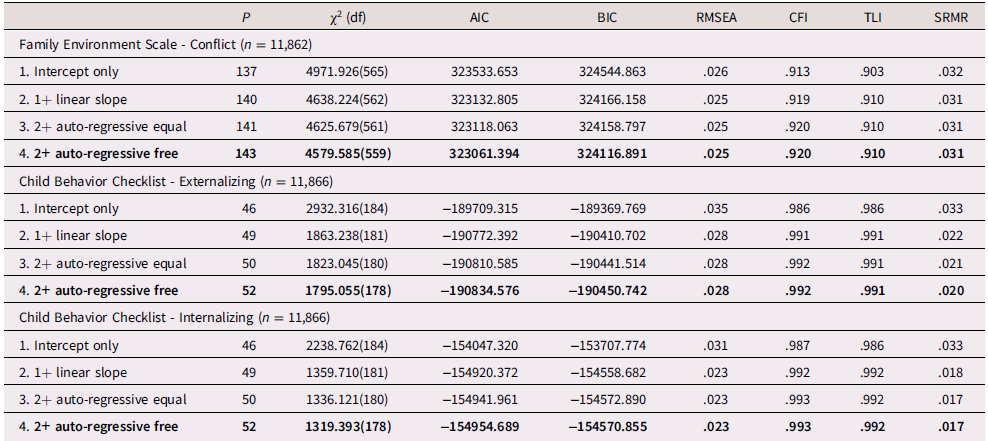
The LCM-SR building process and fit indices for family conflict are shown in Table 1. Model fit increased with the addition of the linear slope and the freely estimated auto-regressive paths (RMSEA = .025, CFI = .920, TLI = .910, SRMR = .031). The final model for family conflict is shown in Figure 1. Youth reported family conflict decreasing over time (b = −0.123, p < .001) and youth who reported deviance from the group (i.e., more or less conflict than peers) at ages 10–11 continued to deviate over time, though earlier deviance from the expected level of family conflict at Time 1 did not predict further deviance from expected levels at Time 2.
Univariate latent growth curve model with structured residuals for Family Conflict over Four Years. Note. Family conflict measured by youth report on the Family Environment Scale – Conflict. ** p < .01. *** p < .001. Solid lines represent statistically significant paths; dashed lines indicate the path did not reach statistical significance. n = 11,862. All paths are standardized.

Univariate latent growth curve model with structured residuals building for study variables

Note. All listed chi-square values are statistically significant at p < .05. P = parameters. df = degrees of freedom. AIC = Akaike Information Criteria. BIC = Bayesian Information Criteria. RMSEA = root mean square error of approximation. CFI = confirmatory fit index. TLI = Tucker-Lewis index. SRMR = standardized root mean residual. Retained univariate models in bold. Family Environment Scale – Conflict completed by parents. Child Behavior Checklist completed by youth.
Externalizing behavior
The model building process and longitudinal invariance testing of youth externalizing behavior is described in detail in Appendix A. The retained model consisted of five parcels of 31 items, fit the model well (RMSEA = .030, CFI = .998, TLI = .996, SRMR = .007), and showed strict longitudinal invariance (RMSEA = .020, CFI = .993, TLI = .992, SRMR = .019).
The model building process and fit indices for youth externalizing behavior are shown in Table 1. Model fit increased with the addition of the linear slope and the freely estimated auto-regressive paths (RMSEA = .028, FCI = .992, TLI = .991, SRMR = .020). The final model for family conflict is shown in Figure 2. Parents reported externalizing behavior decreasing over time (b = −0.330, p < .001) and youth who engaged in more or less externalizing behavior from the group mean continued to deviate over time.
Univariate latent growth curve model with structured residuals for externalizing behavior over four years. Note. externalizing behavior measured by parent report on the child behavior checklist – externalizing subscale. *** p < .001. Solid lines represent statistically significant paths; dashed lines indicate the path did not reach statistical significance. n = 11,866. All paths are standardized.

Internalizing behavior
The model building process and longitudinal invariance testing of youth internalizing behavior is described in detail in Appendix A. The retained model consisted of five parcels of 25 items, fit the model well (RMSEA = .025, CFI = .998, TLI = .996, SRMR = .007), and showed strict longitudinal invariance (RMSEA = .017, CFI = .994, TLI = .993, SRMR = .016).
The model building process and fit indices for youth internalizing behavior are shown in Table 1. Model fit increased with the addition of the linear slope and the freely estimated auto-regressive paths (RMSEA = .023, FCI = .993, TLI = .992, SRMR = .017). The final model for family conflict is shown in Figure 3. Parents reported an increase in internalizing behavior over time) and youth who deviated from the group continued to deviate over time.
Univariate latent growth curve model with structured residuals for internalizing behavior over four years. Notes. internalizing measured by parent report on the child behavior checklist – internalizing subscale. ** p < .01. *** p < .001. Solid lines represent statistically significant paths. n = 11,866. All paths are standardized.

Building the bivariate LCMs-SR
Externalizing Behavior & Family Conflict
The model building process and fit indices for externalizing behavior and family conflict are shown in Table 2. Model fit degraded when the cross-lagged paths were freely estimated and thus the constrained cross-lagged paths models were retained. The final bivariate model is shown in Figure 4. Both family conflict and child externalizing behavior were reported to decrease over time and all residual cross-construct, within-timepoint covariances were positive and significant. All cross-lagged paths were also positive and significant, suggesting that externalizing behavior and family conflict bidirectional predict one another over and above the positive covariance between constructs within timepoints.
Bivariate latent growth curve model with structured residuals for family conflict and externalizing behavior over four years. Note. family conflict measured by youth report on the family environment scale – conflict. externalizing measured by parent report on the child behavior checklist – externalizing subscale. * p < .05. ** p < .01. *** p < .001. Solid lines represent statistically significant paths; dashed lines indicate the path did not reach statistical significance. n = 11,844. All paths are standardized.

Model building process for bivariate latent growth curve model with structured residuals

Note. All listed chi-square values are statistically significant at p < .05. P = parameters. df = degrees of freedom. AIC = Akaike Information Criteria. BIC = Bayesian Information Criteria. RMSEA = root mean square error of approximation. CFI = confirmatory fit index. TLI = Tucker-Lewis index. SRMR = standardized root mean residual. FES-C = Family Environment Scale - Conflict. Ext = externalizing. Int = internalizing. Retained bivariate models in bold. Family Environment Scale – Conflict completed by parents. Child Behavior Checklist completed by youth.
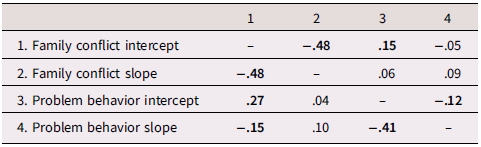
Correlations between growth parameters are shown in Table 3. Youth reporting greater family conflict at baseline also reporting a less steep decrease in family conflict and externalizing over time and were reported by parents as starting at higher levels of externalizing at baseline. Likewise, youth reported as higher in externalizing at baseline decreased these behaviors less steeply over time.
Correlations among growth parameters: bivariate latent growth curve model with structured residuals for family conflict and problem behavior

Note. Top diagonal contains correlations for the family conflict-internalizing model; bottom diagonal contains correlations for the family conflict-externalizing model. Correlations with p < .05 in bold. n = 11,844. Family Environment Scale – Conflict completed by parents. Child Behavior Checklist completed by youth.
Internalizing Behavior & Family Conflict
The model building process and fit indices for internalizing behavior and family conflict are shown in Table 2. Model fit degraded when the cross-lagged paths were freely estimated and thus the constrained cross-lagged paths models were retained. The final bivariate model is shown in Figure 5. Family conflict decreased over time, while parents report that youth internalizing behavior increased over time. All residual cross-construct, within-timepoint covariances were positive and significant. The cross-lagged paths predicting internalizing behavior from earlier family conflict were also positive and significant. However, the cross-lagged paths predicting family conflict from earlier youth internalizing behavior did not reach statistical significance. In other words, family conflict predicted later internalizing behavior, but not the other way around.
Bivariate latent growth curve model with structured residuals for family conflict and internalizing behavior over four years. Note. family conflict measured by youth report on the family environment scale – conflict. externalizing measured by parent report on the child behavior checklist – externalizing subscale. * p < .05. ** p < .01. *** p < .001. Solid lines represent statistically significant paths; dashed lines indicate the path did not reach statistical significance. n = 11,844. All paths are standardized.

Correlations between growth parameters are shown in Table 3. Youth reporting greater family conflict at baseline were reported by parents as starting at higher levels of internalizing at baseline. Youth starting high in internalizing behavior at baseline were reported as increasing over time at a less steep rate.
Discussion
The current study extends previous literature on family dynamics and children’s adjustment by examining bidirectional effects between family conflict and problem behaviors over four waves of data. First, we found that both youths’ perceptions of family conflict and parents’ reports of youth internalizing behaviors increased from ages 9–10 to ages 12–13 for our sample, and that youth starting at higher initial levels showed a shallower increase in these constructs over time. Externalizing behaviors, in contrast, decreased over this time span, which is consistent with prior literature examining trajectories of problem behavior over development (e.g., Nivard et al., Reference Nivard, Lubke, Dolan, Evans, St Pourcain, Munafò and Middeldorp2017). All patterns of change were linear (i.e., no quadratic effect was detected).
When we combined the univariate models to test the cross-lagged effects of one construct on the other over time, we found that, as expected, experiencing more family conflict than expected led to greater deviations in both internalizing and externalizing behaviors over four years. This supports both past literature and theoretical expectations that negative, hostile family environments are detrimental to youth adjustment. At any timepoint, living in a family that one perceives as conflictual led to youth later engaging in more problem behaviors at all future timepoints. Additionally, after controlling for prior levels of family conflict, family conflict was predicted by earlier levels of externalizing symptoms. In other words, living in a family experiencing higher than expected conflict leads youth to engage in more externalizing behavior later on. Further, families in which children are exhibiting greater than expected externalizing behavior became more conflictual over time. Contrary to predictions, family conflict was not bidirectionally associated with internalizing symptoms, in that greater deviation from expected levels of internalizing symptoms did not predict deviations from expected family conflict at subsequent time points.
The bidirectional relationship between family conflict and externalizing behaviors supports past literature, including recent findings by Morelli et al. (Reference Morelli, Hong, Elzie, Garcia, Evans, Duong and Villodas2022). Indeed, our findings expand Morelli’s by including a broader range of externalizing behaviors, including more than two repeated measures of family conflict, and continuing measurement past age 10. Together, these two sets of findings suggest that the reciprocal influences between conflicted home life and externalizing behavior may be beginning well before late childhood—as Morelli et al., found that age 6 delinquent and aggressive behavior predicted age 8 family conflict. While Morelli et al., did not report on growth trajectories of externalizing symptoms, we found that for the sample as a whole, externalizing behavior decreased over time (between-person effects); for families experiencing greater conflict than would be expected, however, externalizing behaviors decreased more slowly than would be expected (within-person effects).
Critically, our inclusion of youth-reported family conflict (rather than parent-reported conflict) highlights a potential discrepancy in how youth view family conflict versus their parents; indeed, previous literature suggests the agreement between parents and youth on measures of family functioning is low-to-moderate (De Los Reyes & Ohannessian, Reference De Los Reyes and Ohannessian2016), and that such discrepancies may be highest in early adolescence (De Los Reyes et al., Reference de Los Reyes, Ohannessian and Laird2016). It may be that youth who perceive their families as conflictual are those who are acting out (and in). Those who are engaging in more problem behaviors than would be expected from the group trajectory may experience their parents’ attempts to correct behavior as conflict, whereas the parent sees it as a normal give-and-take of the parent-child relationship. Perhaps parents view these corrections as normative and see early adolescence as a time to slowly start changing how they interact with their children, whereas youth may perceive their parents as implementing new rules and restrictions that are far too constricting.
The findings of youth-reported family conflict and internalizing behavior were slightly different. Family conflict residuals at each time point predicted internalizing residuals at the subsequent time point, but not the reverse. In other words, families with higher conflict than expected had children exhibiting more internalizing behavior than expected. Being higher or lower in internalizing behavior, though, did not predict deviations from expected family conflict. Taken with the bivariate externalizing model, we see that heightened family conflict at Times 1, 2, and/or 3 predicts greater than expected problem behavior at subsequent time points. However, family conflict only deviates from the expected trajectory when families are dealing with heightened externalizing, but not internalizing, behaviors. This suggests that children’s externalizing, “acting out” behaviors have a stronger effect on family conflict, and the larger family milieu, than their internalizing, “acting in” behaviors.
Strengths & limitations
The present study has several strengths, specifically the use of multiple informants, clear empirical separation of between- and within-person effects, and sampling from the ABCD study. By using youth reports of family conflict and parent reports of children’s problem behaviors, we eliminate the concern over informant bias (i.e., that parents reporting their children as engaging in problem behaviors view these behaviors as conflictual). Using data from the ABCD study gave us the unique opportunity to examine the research questions at hand in a large community-based sample, which allows for greater generalization of our findings (e.g., beyond just clinical populations). Finally, our use of bivariate LCMs-SR rather than traditional cross-lagged panel models allowed us to clearly elucidate between between-person effects (e.g., families high in conflict increase in conflict over emerging adolescence more slowly than low conflict families) and within-person effects (e.g., youth who exhibit greater externalizing behavior than their peers later perceive their families as more conflictual). While the present study was intentionally focused on emerging adolescence, it is possible that family conflict patterns may change meaningfully and dramatically after ages 12–13; if so, the current investigation’s focus on emerging adolescence may have missed a crucial point of change and disruption in family functioning. It may be that mid- to late adolescence is a more salient period for detection of increases in family conflict, especially as youth pull for greater autonomy and also are faced with increasingly adult-like responsibility (such as more intense schoolwork, part-time jobs, etc.). That the ABCD study only used parent-reports of problem behaviors in the first four waves of data collection is a further limitation, as parents from high conflict homes may be biased in their reporting of their children’s behavior. While this possibility is yet to be explicitly examined, parents in abusive homes do over-report their children’s conduct problems (Reid et al., Reference Reid, Kavanagh and Baldwin1987). This limitation is resolved in the sixth and subsequent waves of data collection in the ABCD study, which include youth-reported behaviors on the Youth Self-Report (YSR; Achenbach, Reference Achenbach1991; abcdstudy.org, 2023). The generalizability of the sample is also limited by the occurrence of the COVID-19 pandemic and subsequent lockdown procedures. Both family functioning and youths’ developing problem behaviors may have been impacted by this sudden and life-altering experience, which occurred between Times 2 and 4, depending on when families were assessed. Parents reporting greater amount of general and parenting stress during the pandemic had children who experienced greater psychopathology, and parents across the United States reported heightened stress across 2020 (Adams et al., Reference Adams, Smith, Caccavale and Bean2021). This experience may have been particularly difficult in families with pre-COVID psychopathology, both parent and child (Black et al., Reference Black, Evans, Aaron, Brabham and Kaplan2021). Several studies using the ABCD study data have examined the impact of COVID-19, but it remains a history graded effect which cannot be generalized to non-COVID times.
Finally, it must be noted that while the CBCL is a widely-used, highly standardized measure, the FES-Conflict may be considered less operationally sound. Dichotomous true/false response options and vague item descriptions (e.g., My family fights a lot) may lead to inclusion of “noise” in the data which may limit our ability to pick up on the intended “signal.” Use of colloquial phrases such as a lot in items may lead to variability in how youth respond, with influence possibly attributable to cultural norms, personal experience, implicit bias, etc. Further, the forced dichotomy of a true/false response option may not fully capture the true level of conflict in everyday family interactions, which may be best answered with a sometimes option. While the choice of measure and response options is beyond our ability as researchers accessing secondary datasets, we recognize that this is a clear limitation to the present study and one of which future researchers should be aware of when replicating the present study.
Future directions
The present findings set the stage for several potential research expansions. First, it is essential that we expand the developmental timeline of these findings, both earlier and later. We expected that beginning at ages 9–10 years old would be early enough for us to uncover the initiation of reciprocal effects between these constructs. In order to understand when family conflict and externalizing behaviors begin to influence one another, researchers should begin following families as youth are in middle childhood or earlier. Likewise, future research should utilize later waves of the ABCD study as it continues to follow families over the next several years, in order to see if this bidirectional pattern continues across development or if youth grow out of it. Beginning in Wave 6, youth in the ABCD study report on their own problem behavior on the Youth Self-Report (YSR; Achenbach, Reference Achenbach1991), which could be included in future research to better explore adjustment problems that are not known to the parent.
A final future consideration would be the examination of differences in both how youth report family conflict in the context of their sex as well as how parents may report problem behaviors differently for boys and girls. There is a robust literature on different patterns of problem behavior between sexes across time, though little is known about the how boys and girls may perceive conflict in their family in different ways. For example, Tezler & Fugilini (Reference Telzer and Fuligni2013) found, as expected, that girls reported more depressive symptoms than boys, but also reported both more positive and more negative family interactions. Further, it may even be that parents are reporting on their children’s behavior in ways specific to the sex of the parent; that is, that mothers report differently than do fathers. These questions are outside the scope of the present study and offer ripe opportunities for researchers to further investigate the nuanced interplay between child development and family dynamics.
Implications
The present study highlights the need for family-level support for youth who are beginning to engage in more externalizing behavior than is considered normative for their age. In the current studies, not only is heightened conflict a risk factor for developing problem behaviors, but these same problem behaviors are leading to greater conflict between family members. Rather than attempting to find the root cause of these problematic dynamics, clinicians may be better off focusing on interrupting the cyclical nature between youth maladjustment and heightened family conflict (Cowan & Cowan, Reference Cowan and Cowan2006).
Conclusion
The transition into adolescence is viewed in Western cultures as a coming-of-age period, in which youth begin to demand greater autonomy and are saddled with greater responsibility. But the adolescent is hardly isolated in these changes, as their growing independence also requires infusions of care, attention, and patience from their families. The present study showed that the majority of families of emerging adolescents were doing rather well, but that the changes experienced by emerging adolescents were felt by their family units and vice versa. These findings give us insight into ways in which clinicians and researchers alike can work to interrupt cycles of conflict and stress in families and suggest a whole-family approach when assessing both budding psychopathology and negative family dynamics.
Supplementary material
For supplementary material/s referred to in this article, please visit https://doi.org/10.1017/S0954579425100278
Data
The ABCD data repository grows and changes over time. The ABCD data used in this report came from [http://dx.doi.org/10.15154/1523041].
Acknowledgements
Data used in the preparation of this article were obtained from the Adolescent Brain Cognitive DevelopmentSM (ABCD) Study (https://abcdstudy.org), held in the NIMH Data Archive. This is a multisite, longitudinal study designed to recruit more than 10,000 children aged 9-10 and follow them over 10 years into early adulthood. The ABCD Study® is supported by the National Institutes of Health and additional federal partners under award numbers U01DA041048, U01DA050989, U01DA051016, U01DA041022, U01DA051018, U01DA051037, U01DA050987, U01DA041174, U01DA041106, U01DA041117, U01DA041028, U01DA041134, U01DA050988, U01DA051039, U01DA041156, U01DA041025, U01DA041120, U01DA051038, U01DA041148, U01DA041093, U01DA041089, U24DA041123, U24DA041147. A full list of supporters is available at https://abcdstudy.org/federal-partners.html. A listing of participating sites and a complete listing of the study investigators can be found at https://abcdstudy.org/consortium_members/. ABCD consortium investigators designed and implemented the study and/or provided data but did not necessarily participate in the analysis or writing of this report. This manuscript reflects the views of the authors and may not reflect the opinions or views of the NIH or ABCD consortium investigators.
Analyses for the present study was not pre-registered. Mplus code is available from OSF: https://osf.io/ny4kw/.
Funding statement
This research received no specific grant from any funding agency, commercial or not-for-profit sectors.
Competing interests
The authors declare none.





 Open access

