


Introduction
This paper examines how participatory processes enhance citizens’ legitimacy beliefs at the local level in South Korea (hereafter Korea). While representative democracy relies on elected officials to formulate and implement policies on behalf of the public, it faces persistent challenges in reconciling diverse societal demands and ensuring widespread legitimacy. The stability and effectiveness of democracy hinges on public support for government decisions and the perception that the decision-making process is legitimate, regardless of individual agreement with policy outcomes (Pharr and Putnam, Reference Pharr and Putnam2000; Dalton, Reference Dalton2004; Stoker, Reference Stoker2006; Norris, Reference Norris2011). However, dissatisfaction with government decisions and doubts about the legitimacy of the decision-making process pose fundamental threats to representative democracy.
To address these challenges, democratic theorists have increasingly emphasized public involvement in decision-making beyond elected representation and have viewed participatory processes as crucial to a well-functioning democracy (Pateman, Reference Pateman1970; Barber, Reference Barber1984; Warren, Reference Warren2017). Public participation complements representative democracy by enhancing citizens’ political knowledge, clarifying their common interests, and fostering cooperation, which ultimately reduces dissatisfaction with policy outcomes and strengthens democratic legitimacy (Gutmann and Thompson, Reference Gutmann and Thompson2004; Tyler, Reference Tyler2006; Hendriks et al., Reference Hendriks, Dryzek and Hunold2007; Dryzek, Reference Dryzek2009; Pateman, Reference Pateman2012; Jäske, Reference Jäske2019).
Within this theoretical framework, Korea presents a compelling case for examining whether participatory processes can enhance democratic legitimacy, particularly given its shifting democratic landscape and ongoing legitimacy concerns. Since its democratic transition in 1987, Korea has successfully institutionalized democratic governance. However, beginning in the 2000s, public support for democracy has gradually declined, as many Koreans perceive it as ineffective in addressing pressing socio-economic and political challenges (Cho, Reference Cho, JeongHun, Pacheco Pardo and Cho2023). Moreover, trust in core representative institutions, particularly the government and parliament, remains moderate to low, further contributing to the erosion of democratic legitimacy (Mauk, Reference Mauk2022). The simultaneous decline in democratic support and institutional trust has led to a steady weakening of democratic commitment among Korean citizens. Amid these challenges to democratic legitimacy, Korea has expanded opportunities for citizen participation in decision-making processes, particularly at the local level. Korea has been experiencing sustained mass mobilization since the 1987 democratic transition, with protests remaining relatively frequent though less intense than during early democratization (Mobrand, Reference Mobrand2019; Cho, Reference Cho, JeongHun, Pacheco Pardo and Cho2023; Cho and Hur, Reference Cho and Hur2025). Nonetheless, Korean citizens have been less willing to engage directly in policy-making. Given this tendency, it is crucial to examine whether public participation in decision-making at the local level strengthens legitimacy beliefs regarding political processes among Korean citizens.
By incorporating diverse national contexts and explicitly focusing on Korea, a relatively young democracy in Asia, our study broadens the scope of existing experimental research on how public participation in decision-making processes influences citizens’ legitimacy beliefs. Previous experimental studies have primarily focused on well-established Western democracies, where traditions of citizen engagement are strong, such as France, Germany, Switzerland, and the United Kingdom (Strebel et al., Reference Strebel, Kübler and Marcinkowski2019), Finland (Jäske, Reference Jäske2019), Norway (Arnesen, Reference Arnesen2017), Ireland (Germann et al., Reference Germann, Marien and Muradova2024), and Sweden (Esaiasson et al., Reference Esaiasson, Gilljam and Persson2012; Persson et al., Reference Persson, Esaiasson and Gilljam2013; Esaiasson et al., Reference Esaiasson, Persson, Gilljam and Lindholm2019; Werner and Marien, Reference Werner and Marien2022).Footnote 1
This raises the question of whether the legitimacy-enhancing effects of citizen participation also hold in young but institutionally consolidated democracies. Korea offers a particularly relevant case: participatory mechanisms are formalized and embedded in local governance, and citizens display strong anti-elite sentiments within a context of robust democratic institutions. Examining Korea allows us to assess whether findings from well-established Western democracies extend to young democracies that have achieved institutional consolidation. At the same time, if participatory processes enhance citizens’ legitimacy beliefs in Korea, the findings carry broader implications for other young democracies still struggling with consolidation after their transition.
Beyond examining general preferences for participation, we further investigate how anti-elite attitudes condition the effects of participatory processes on legitimacy beliefs in Korea. Korea has been characterized by strong anti-elite sentiments, with a widespread perception that political elites are self-serving, disconnected from ordinary citizens, and morally compromised. This sentiment has been reinforced through the current experience of mass movements such as the candlelight vigils and the national flag (Taegeukgi) movement in 2016–2017 (Lee, Reference Lee, Lee, Wu and Bandyopadhyay2021). As distrust toward elites persists, many Koreans believe that political decisions primarily serve the privileged rather than the general public (Han and Shim, Reference Han and Shim2021). Consequently, anti-elitism has emerged as a critical factor shaping both the impact of participatory processes and attitudes toward democratic legitimacy. Given this context, we argue that the effect of participatory processes on legitimacy beliefs is conditioned by citizens’ anti-elite attitudes in Korea. This perspective sheds light on the complex interplay between public participation and legitimacy beliefs in a society with deep-seated skepticism toward elites.
To assess the impact of public participation at the local level on perceived decision-making legitimacy, we conducted a survey experiment in Korea with 2083 adults. The survey included questions gauging pre-existing anti-elite attitudes. Respondents were then presented with a hypothetical scenario involving the decision-making processes for two local policy issues: (i) a budget increase to build a public park and (ii) the merging of local schools. Both issues are among the most contentious at the local level in Korea, as public park development often sparks conflicts over property rights and urban planning, while school mergers, driven by demographic shifts, frequently lead to disputes among parents and local communities over which facilities should be retained. For each policy, respondents were first asked how much they support or oppose the presented policy. Subsequently, we provided additional information about the decision-making process, randomly manipulating whether the local government organized deliberative citizen forums Footnote 2 to discuss the policy.
Our findings demonstrate that integrating participatory processes into local-level decision-making elevates citizens’ beliefs in the legitimacy of the political process, regardless of whether they are policy winners or losers. While some research suggests that citizens primarily assess political legitimacy based on outcome favorability rather than procedural considerations (Doherty and Wolak, Reference Doherty and Wolak2012; Arnesen, Reference Arnesen2017; Esaiasson et al., Reference Esaiasson, Persson, Gilljam and Lindholm2019), our results align with studies showing that public involvement enhances legitimacy beliefs even when participation does not directly shape policy outcomes or align with individual preferences (Esaiasson et al., Reference Esaiasson, Gilljam and Persson2012; Persson et al., Reference Persson, Esaiasson and Gilljam2013; Strebel et al., Reference Strebel, Kübler and Marcinkowski2019; Werner and Marien, Reference Werner and Marien2022; Germann et al., Reference Germann, Marien and Muradova2024). More importantly, our results reveal a critical moderating factor: citizens’ anti-elite attitudes condition the effect of public participation on legitimacy beliefs. Participatory processes generate significantly stronger legitimacy gains among respondents with high anti-elite attitudes, while producing minimal effects among those with low anti-elite attitudes. This finding suggests that participatory mechanisms may be particularly valuable for rebuilding democratic legitimacy among disaffected citizens who distrust political elites.
These findings highlight the critical role of participatory processes in addressing deficits in democratic legitimacy, particularly in contexts like Korea, where support for democracy has declined and trust in representative institutions is weakening. By providing alternative avenues for political engagement, such methods may help prevent further erosion of democratic norms and values, mitigating anti-democratic tendencies. This is especially relevant for young democracies, where building and maintaining democratic legitimacy remains an ongoing challenge.
Moreover, the finding that citizens with strong anti-elite attitudes perceive decision-making as more legitimate when participatory processes exist highlights a potential path for restoring confidence in democratic systems. If anti-elite sentiment remains unaddressed, it can fuel political disengagement, populist backlash, or support for non-democratic alternatives. However, by expanding participatory mechanisms in decision-making, representative democracies can offer skeptical citizens a greater sense of influence and legitimacy in the political process. In this sense, rather than undermining representative institutions, such participatory processes strengthen the foundations of representative democracy by ensuring that decision-making is perceived as legitimate.
Participatory processes and legitimacy beliefs
To discuss the relationship between participatory processes and legitimacy beliefs, we first clarify what we mean by legitimacy, as it is one of the most contested concepts in political science. Legitimacy is a multifaceted concept, so scholars have conceptualized it differently, emphasizing its dimensions (Beetham, Reference Beetham1991; Gilley, Reference Gilley2009; Gerschewski, Reference Gerschewski2018). We draw on a systematic review by Dellmuth et al. (Reference Dellmuth, Scholte, Tallberg and Verhaegen2022) that classified existing conceptual approaches to legitimacy into four categories. The first approach is a “justification approach” that defines legitimacy as a person’s perception that an authority or institution conforms to specific normative criteria. For example, Beetham (Reference Beetham1991) argues that the degree of legitimacy is determined by how far those subject to power regard it as rightful. The second approach is an “approval approach” that considers legitimacy a “deep-seated endorsement” (Dellmuth et al., Reference Dellmuth, Scholte, Tallberg and Verhaegen2022: 27) of a governing power. This conceptualization of legitimacy is closely related to diffuse support, which Easton (Reference Easton1965: 273) defined as “a reservoir of favorable attitudes or goodwill that helps members to accept or tolerate outputs to which they are opposed.” It is generally operationalized as confidence or trust in a specific authority or institution. The third approach is an “acceptance approach,” which conceptualizes legitimacy as a person’s willingness to defer to governing power. For instance, Tyler (Reference Tyler2006: 376) defines legitimacy as “a [psychological] property that, when it is possessed, leads people to defer voluntarily to decisions, rules, and social arrangements.” The fourth and final approach does not prioritize one conceptualization but incorporates all three aspects.
We draw on the justification approach to legitimacy, which emphasizes citizens’ normative evaluations of decision-making arrangements. While legitimacy can also be conceptualized through approval (trust/confidence in institutions) or acceptance (behavioral deference) approaches, these are less suitable for our experimental context. The approval approach typically measures diffuse support for institutions rather than evaluations of specific procedures, while the acceptance approach requires measuring behavioral compliance that is difficult to capture authentically in hypothetical scenarios. Our focus on citizens’ normative evaluations of specific decision-making processes aligns naturally with the justification approach. However, rather than imposing specific normative criteria, we intentionally allow respondents to evaluate legitimacy based on their own normative frameworks. By asking respondents to assess whether decision-making processes are “legitimate,” “fair,” and “appropriate,” we capture their holistic normative judgments according to their own democratic values and standards. This methodological choice captures authentic legitimacy beliefs as they naturally occur among citizens and aligns with established experimental research that similarly allows respondents to apply their own normative criteria when evaluating legitimacy (Esaiasson et al., Reference Esaiasson, Gilljam and Persson2012; Werner and Marien, Reference Werner and Marien2022).
A great deal of studies examine what determines citizens’ belief in the legitimacy of decision-making arrangements. Many scholars have emphasized the procedural dimension of legitimacy, arguing that procedural fairness or justice constitutes a defining feature of legitimacy (Beetham, Reference Beetham1991; Tyler, Reference Tyler2006). They say that the degree to which individuals subject to political decisions are engaged in the decision-making process leading to those decisions enhances their perceptions of the procedural fairness of the process. For example, Scharpf’s (Reference Scharpf1999) “input-oriented legitimacy,” which emphasizes “government by the people,” focuses on this aspect. Similarly, people view the decision-making process of democracy as more legitimate than the unilateral imposition of decisions by a small governing class or by specific individuals, since democracy allows people to voice their preferences and interests through voting in the democratic process (Dahl, Reference Dahl1989). Accordingly, allowing the opportunity for citizens to participate in decision making on matters that affect their lives is expected to enhance legitimacy belief in policy-making processes. At the same time, when people have opportunities to influence political decision making, they are more likely to accept the decisions that result from them (Pateman, Reference Pateman1970). This is why participatory forms of democracy, such as deliberative citizen forum, participatory budgeting, and referendum, are considered as potential remedies to address public disenchantment with representative democracy (Dalton, Reference Dalton2004; Bowler et al., Reference Bowler, Donovan and Karp2007; Bengtsson and Mattila, Reference Bengtsson and Mattila2009).
Many studies find supporting evidence for the importance of public participation in enhancing legitimacy beliefs for the decision-making process. A decision-making process that includes the possibility of participation is likely to be considered more legitimate than one without this possibility (Olken, Reference Olken2010; Beath et al., Reference Beath, Christia and Enikolopov2017; Strebel et al., Reference Strebel, Kübler and Marcinkowski2019; Werner and Marien, Reference Werner and Marien2022; Germann et al., Reference Germann, Marien and Muradova2024). In addition, personal involvement itself is believed to increase citizens’ legitimacy belief (Bengtsson and Mattila, Reference Bengtsson and Mattila2009; Esaiasson et al., Reference Esaiasson, Gilljam and Persson2012). For example, Esaiasson et al. (Reference Esaiasson, Gilljam and Persson2012) found that people are more likely to view decision-making arrangements as legitimate when they allow direct public participation – such as participatory constitution-making, direct majority voting, and consensual decision-making – compared to arrangements that rely on representatives and experts. Similarly, in their field experimental study on small-group decision making, Persson et al. (Reference Persson, Esaiasson and Gilljam2013) demonstrates that decision-making processes involving direct voting along with the opportunity for deliberation lead to a higher perception of decision legitimacy compared with scenarios without direct voting and deliberation.Footnote 3
However, other scholars question the significance of procedural assessment in legitimacy judgments. Emphasizing output-oriented legitimacy (Scharpf, Reference Scharpf1999), which is connected to the wellbeing of the people, these scholars argue that citizens care more about the substance of decisions than about the procedures leading to those decisions. They show that outcome favorability affects not only decision acceptance but also evaluations of political procedures (Doherty and Wolak, Reference Doherty and Wolak2012; Arnesen, Reference Arnesen2017; Esaiasson et al., Reference Esaiasson, Persson, Gilljam and Lindholm2019). People who have unfavorable feelings regarding the results of a decision-making process sometimes perceive the process itself as unjust, and the influence of citizens’ participation in decision making is generally not a crucial determinant of legitimacy beliefs.
Doherty and Wolak (Reference Doherty and Wolak2012), for example, provide a more nuanced finding. They show that individuals determine the fairness of a political process based on either principles of justice or their prior preferences. When confronted with clearly fair or unfair procedures, individuals tend to make impartial assessments of procedural justice. However, in situations of uncertain fairness, they often rely on their prior preferences, considering procedures yielding favorable policy outcomes as fair and those resulting in disliked outcomes as unfair. Similarly, Arnesen (Reference Arnesen2017) finds that outcome favorability increases legitimacy beliefs, while the effect of citizens’ participation in decision making remains limited. Esaiasson et al. (Reference Esaiasson, Persson, Gilljam and Lindholm2019) also show that, although objective procedural arrangements shape subjective perceptions of procedural fairness, outcome favorability remains the primary determinant of legitimacy across various contexts.
We acknowledge that both procedural arrangements and outcome favorability play important roles in shaping legitimacy beliefs about decision-making processes. Rather than viewing these as competing factors where one must dominate the other, we argue that participatory processes can enhance legitimacy perceptions independently of and alongside outcome considerations. As Werner and Marien (Reference Werner and Marien2022) demonstrate through their analysis of twelve experiments, participatory processes consistently generate higher fairness perceptions compared to non-participatory processes, even among those who disagree with the final decision. This suggests that while citizens naturally care about policy outcomes, the opportunity for participation provides an additional and independent boost to legitimacy beliefs that benefits both winners and losers of policy decisions. The fact that both groups experience enhanced legitimacy perceptions through participation, rather than viewing this as problematic, actually strengthens the case for incorporating participatory processes as a complement to representative democracy. These findings align with other recent research showing that participatory processes can increase legitimacy perceptions regardless of outcome favorability (Strebel et al., Reference Strebel, Kübler and Marcinkowski2019) and that, when both decision-making procedures and outcomes are varied, they enhance perceptions of fairness and appropriateness among both policy winners and losers (Grillos et al., Reference Grillos, Zarychta and Nelson Nuñez2021).
Accordingly, we expect the existence of participatory processes to generate higher legitimacy perceptions compared to purely representative processes without citizen participation. We further hypothesize that this positive effect will manifest for both winners and losers of policy decisions. This expectation stems from evidence that citizens can simultaneously care about both procedural fairness and outcomes, with participatory elements providing an independent boost to legitimacy beliefs even when controlling for outcome favorability.
H1: Political decision-making process that includes participatory procedures produces a higher legitimacy belief than decision-making without participatory procedures.
H1a: Both policy winners (those who agree with the decided policy) and policy losers (those who disagree with the decided policy) will perceive higher legitimacy when decision-making process includes participatory procedures than otherwise.
Before moving further, we should clarify what we are not arguing. We do not claim that there is a linear relationship where increased citizen participation automatically leads to higher perceived legitimacy of the decision-making process. Rather, our argument is more specific: citizens view decision-making processes that incorporate citizen participation as more legitimate than those that rely solely on elected representatives. For example, the adoption of deliberative citizen forums where everyday people are chosen at random to learn about and discuss can boost citizens’ belief in the legitimacy of the decision-making process. This does not necessarily imply that citizens want to make important political decisions themselves.
Next, we argue that the effect of a participatory process on legitimacy beliefs varies across individuals based on their pre-existing political attitudes. One important attitude we emphasize is citizens’ views towards elites. We argue that anti-elite attitudes will magnify the effect of a participatory policy-making process on belief in legitimacy. Anti-elitist attitudes reflect the beliefs that politicians are self-serving, disconnected from the concerns of average citizens, and morally compromised (Akkerman et al., Reference Akkerman, Mudde and Zaslove2014; Ackermann et al., Reference Ackermann, Braun, Fatke and Fawzi2023). Such views often include skepticism about politicians’ motivations and a fundamental distrust of their ability to represent the will of the people.
When citizens hold strong anti-elite attitudes, they do not want important political decisions to be made by elites. They are more likely to perceive as illegitimate decisions made only by elites and support policy-making processes bypassing the distrusted elites and giving more control to ordinary citizens. Similarly, when citizens are more frustrated with the establishment and incumbent elites, they are more likely to distrust the existing representative democracy (Dalton et al., Reference Dalton, Burklin and Drummond2001; Bowler et al., Reference Bowler, Donovan and Karp2007). Accordingly, citizens’ attitudes toward the elite can be an essential factor that conditions the legitimacy-enhancing effects of participatory processes. We expect that a participatory policy-making process is more likely to translate into greater legitimacy belief for citizens who hold a more assertive anti-elite attitude.Footnote 4
H2: The effect of a participatory policy-making process on legitimacy beliefs is higher among individuals with a stronger anti-elite attitude.
Why South Korea?
One of the best examples of a third-wave democracy is Korea, which adopted democracy in 1987 and has since solidified it. It has experienced eight presidential elections in a row, producing five government turnovers. The V-Dem Institute regards Korea as a liberal democracy, rating its liberal democracy score as 0.732, which ranks 27th in the world. Even amid growing concerns about democratic backsliding, many democracy reports, including the V-Dem’s report, consider Korea an example bouncing back from an episode of autocratization between 2008 and 2016 (Papada et al., Reference Papada, Altman, Angiolillo, Gastaldi, Köhler, Lundstedt, Natsika, Nord, Sato, Wiebrecht and Lindberg2023).
Both democratic support and institutional confidence among Korean citizens have slowly dwindled since the early 2000s, while citizen attitudes toward democracy play a key role for the stability of democracy. Using the five waves of the World Values Survey from 1996 to 2018, Cho (Reference Cho, JeongHun, Pacheco Pardo and Cho2023) shows that ordinary Koreans’ support for democracy has steadily eroded and their leaning towards non-democratic alternatives have increased. This downward trend indicates that more than 30 years of democratic practices are not sufficient enough for Koreans to be democrats who support democracy and reject its authoritarian alternatives. In addition, among the five East and Southeast Asian democracies (Indonesia, Japan, Mongolia, South Korea, and Taiwan), Koreans express the lowest levels of trust in parliament (Mauk, Reference Mauk2022). Parliament is most subject to political contention. Koreans have been frequently exposed to political conflicts between ruling and opposition parties on a daily basis. Political elites consider each other as adversaries rather than partners and frequently produce political stalemates.
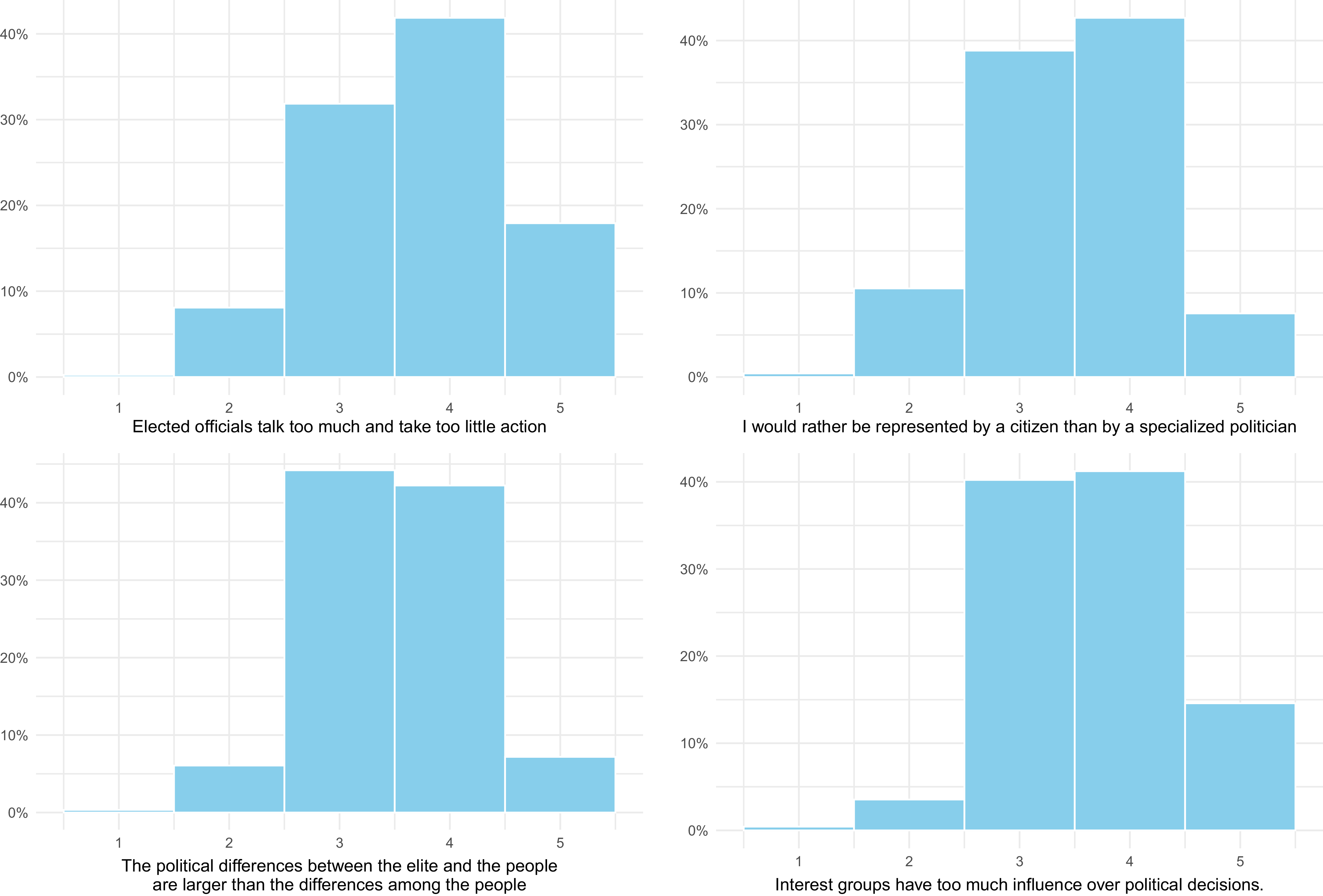
At the same time, anti-elite attitudes among Korean citizens have grown. Figure 1 displays survey results measuring anti-elite sentiments across four dimensions. The data show strong antielite attitudes among Korean respondents, with the highest levels of agreement (scores of 4 and 5) consistently appearing across all four statements. Around 40% of respondents strongly agree that elected officials talk too much without taking sufficient action. There is also strong agreement that citizens would make better representatives than professional politicians and that the political divide between elites and the general public exceeds differences among ordinary citizens. The distribution patterns reveal that very few respondents strongly disagree with these anti-elite statements (scores of 1 and 2), suggesting a widespread skepticism toward political elites.
Anti-elite attitudes among South Korean. 1 = Strongly disagree, 5 = Strongly agree. Each bar refers to the proportion of each answer. Data from Korean General Social Survey (2021).
One of the criticisms against the political system of Korea is its lack of citizens’ participation in decision-making processes. Footnote 5 Korea has been characterized by citizens’ active participation in mass mobilization. Mass movements have played a crucial role in achieving the democratic transition in 1987 and further democratic developments since the transition. In Korea, protests and demonstration activism have persisted at a relatively high frequency, albeit not reaching the heights seen during the early years of the democratization movement (Mobrand, Reference Mobrand2019; Cho, Reference Cho, JeongHun, Pacheco Pardo and Cho2023; Cho and Hur, Reference Cho and Hur2025). Nevertheless, citizens’ participation in policy-making processes has been low. For instance, Figure 2 shows the scores for different dimensions of democracy in Korea, obtained from the V-Dem data (Papada et al., Reference Papada, Altman, Angiolillo, Gastaldi, Köhler, Lundstedt, Natsika, Nord, Sato, Wiebrecht and Lindberg2023). Compared with other dimensions of democracy, the participatory democracy score is relatively much lower in 1992 and 2022. Among several subcomponents of the participatory democracy index, the civil society participation index score is low. The civil society participation index mainly measures the degree to which policymakers and people routinely consult major civil society organizations.
The V-dem’s five dimensions of democracy in Korea in 1992 and 2022. Data from the V-Dem version 13.

Public participation in local decision-making is a vital aspect of democracy (Uddin and Alam, Reference Uddin and Monwar Alam2021). It allows citizens to make their voices heard and influence decisions that are affecting their daily life. To deepen its democracy and address this drawback, Korea has worked on decentralization and citizens’ participation in the decision-making process at the local level. As public interest in civic engagement rose in the 2000s, the need for citizens’ participation in local government in Korea began to be raised gradually (Cho, Reference Cho2014). Korea has introduced several local governance institutions for citizens’ participation, including residents’ claim of proposition for the ordinance in 2000, audit demand of residents in 2000, residents’ lawsuit in 2006, and participatory budgeting in 2012 (Lee, Reference Lee2019). Korea has also implemented “Field Forum” in local governments to promote citizen participation in decision-making processes. The Field Forum is a civil forum where local citizens, local government officials, and related experts come together to discuss what policies are needed for the local community. While these institutions allow citizens to participate in the decision-making process for local policies and budgets, Korean citizens have not been actively engaging in the process. Therefore, it is crucial to explore the effect of participatory decision-making processes at the local level on citizens’ belief in the legitimacy of the political process in Korea. Citizens from young democracies often experience limited engagement with political parties and candidates, resulting in reduced involvement in decision-making processes. Although young democracies typically provide fewer opportunities for citizen participation in decision-making processes, we know relatively little about how citizens’ participation in the decision-making process at the local level affects their belief in the legitimacy of the process.
Experimental design
To assess how information about public participation in decision-making processes affects citizens’ belief in the legitimacy of such processes, we fielded an online survey experiment with a nationally representative sample of 2083 adults in March 2023. Footnote 6 A private polling company in Korea (Hankook Research) recruited the online sample, and the survey was conducted in Korean. Footnote 7 The characteristics of the respondents resemble a nationally representative sample concerning gender, education, and age. In Appendix Table A1, we present the summary statistics of the respondents’ socio-demographic attributes.
Our experiment presented all the respondents with hypothetical scenarios about two local policy issues in Korea: (1) if the local government should increase its budget to build a public park (hereafter, “park policy”) and (2) whether local schools should be merged in response to the decrease in students in some districts (hereafter, “school policy”). Public participations in decision-making process increase at the local level in Korea, making municipal government an ideal field to explore their consequences. Both public park development and school merge policies are the most contended issues among residents at the local level in Korea. First, the debate around public park development in Korea includes how to expand parks, how to make them more accessible, and how to ensure they are sustainable. Because the issue of public parks development is clearly divided between pros and cons at any given municipalities, it always attracts the attention of the residents (Park, Reference Park2023). Usually, those who support the public park development argue that neighborhood parks should be preserved by designating them as urban natural park zones on the premise of full compensation. However, others who oppose the development argue that designating urban natural park zones is unacceptable because it further infringes on private property rights. Second, due to the aging population and low birth rate, rapid school merge (or closure) in Korea becomes a salient issue both local and national levels. Usually in school merges, one school and its facilities are selected and the other abandoned. In many cases, the parents and local communities couldn’t reach an agreement on which of the two schools’ facilities to salvage. Some 193 schools closed between 2017 and 2022 (Kim and Chung, Reference Kim and Chung2023). In turn, both public park development and school merge policies are not valence issues but divisive issues among residents at the local level in Korea.
The order in which these policy issues were presented was randomized to eliminate potential ordering effects. After briefly describing the policy issue, we asked how much the respondent supported or opposed it to capture their pre-existing opinion on a 5-point scale. We then divided the respondents into two groups – “policy winners,” who support the policy and “policy losers,” who do not – to check if the treatment effects vary systematically between these two groups. Footnote 8 In Appendix Figures A1–A2, we show the distribution of each category of pre-existing attitudes.
Subsequently, we randomly assigned subjects to one of two conditions for each policy.Footnote 9 Following Werner and Marien (Reference Werner and Marien2022)’s methodology, we manipulate information regarding the formation and involvement of a deliberative citizen forum in the process to investigate whether and how the perceived legitimacy of the policy-making process increases when citizens are directly involved, as opposed to when they are not allowed to participate. Under the “no public participation’ condition, participants were informed that local authorities had decided to implement the policy without public participation in the decision-making process. On the other hand, in the “public participation” condition, we told the participants that the decision to implement the proposed policy resulted from consultation between the local authorities and a civil forum. We present detailed descriptions of the wording and content of each experimental condition in Appendix Section A2. In addition, we have provided English translations of the information presented.
Potential concerns exist that the “no public participation’ condition might be susceptible to experimenter effects or social desirability bias. The immediate presence of pro- and con- prompts before the manipulation vignette could have prompted respondents in this condition to infer researcher expectations. To address these issues, we tested whether exposure to the “no public participation” condition creates pressure to appear more favorable toward participation in subsequent questions. Specifically, we compared support for public participation in the second policy between respondents who had received “no public participation” versus “public participation” conditions in the first policy. If social desirability bias were operating, those initially exposed to the “no participation” condition might overcompensate by expressing higher support for participation when asked about the second policy. The results, presented in Appendix Section A5, show no significant difference (p = 0.45), suggesting respondents are not systematically adjusting their responses based on perceived researcher expectations.
In addition, we examined the responses by dividing them into the first and second exposed policies. If the concerns about experimenter effects or social desirability bias are severe, the treatment effects for the first exposed policy would differ from those for the second exposed policy. The results, presented in Appendix Figures A9–A10, reveal no major disparity in the effects of public participation between the first and second presented policies. These results indicate that the concerns about experimenter effects or social desirability bias may be of a limited extent.
To assess balance across experimental groups, we calculated standardized mean differences for key socio-demographic variables (gender, age, region, education, income) as well as our primary theoretical variables (anti-elite attitudes and policy preferences). The results, presented in Appendix Tables A2 and A5, show that standardized mean differences are at or below 0.1 for all attributes, including our key moderating variables, indicating successful randomization across both demographic and theoretically important characteristics.
After presenting either the “public participation” or “no public participation” conditions for a given policy issue, we asked respondents to indicate how legitimate, fair, and appropriate the policy-making process described was on three 5-point scales. As discussed above, we rely on the justification approach to legitimacy and define legitimacy as a person’s perceptions of how much an authority or institution conforms to specific normative criteria. Therefore, we ask respondents about their perceptions of the legitimacy of the decision-making process and indirectly ask them to evaluate its fairness and appropriateness. Appendix Section A2 presents the exact wordings of these questions asking the respondents’ legitimacy beliefs. Appendix Table A6 shows the means and standard deviations of the responses to these questions. The primary dependent variable is the average value of the answers to these three questions. We also use the identical models, but we use the responses to each question pertaining to legitimacy belief as dependent variables in order to guarantee the robustness of the results. The results, presented in Appendix Figures A4 and A5, are consistent with our main findings.
We also asked respondents to indicate their support on a 5-point scale (1 = Strongly oppose, 2 = Somewhat oppose, 3 = Neither support nor oppose, 4 = Somewhat support, 5 = Strongly support).
We then categorized respondents as follows: “policy winners” (scores 4–5), “policy losers” (scores 1–2), and “neutrals” (score 3). For the policy winner-loser subgroup analyses presented in the main text, neutrals were excluded to create clean comparison groups of supporters versus opponents. However, we analyzed neutrals separately as a robustness check (see Appendix Figure A7).
Before being exposed to the survey experiment, all respondents answered several questions about their attitudes toward elites. To measure attitudes toward elites, we asked respondents to indicate on a 5-point scale the extent to which they agreed or disagreed with the following four statements: (i) “The gap between the political perspectives of elites and citizens is greater than the perspective gap among citizens themselves”; (ii) “I want to be represented by the people, rather than politicians”; (iii) “Elected officials talk a lot but do not take action”; and (iv) “Interest groups exert too much influence on political decision making.” Previous studies have frequently used these four questions to measure anti-elitism (Schulz et al., Reference Schulz, Müller, Schemer, Wirz, Wettstein and Wirth2018; Ackermann et al., Reference Ackermann, Braun, Fatke and Fawzi2023; Çarkoglu and Elçi,˘ Reference Çarkoglu and Elçi2023). We coded the answers such that higher values reflect anti-elite attitudes and used the average responses to these four statements as an overall measure of anti-elite attitudes. Appendix Figure A3 shows the distribution of our measure of anti-elite sentiments.Footnote 10
Results
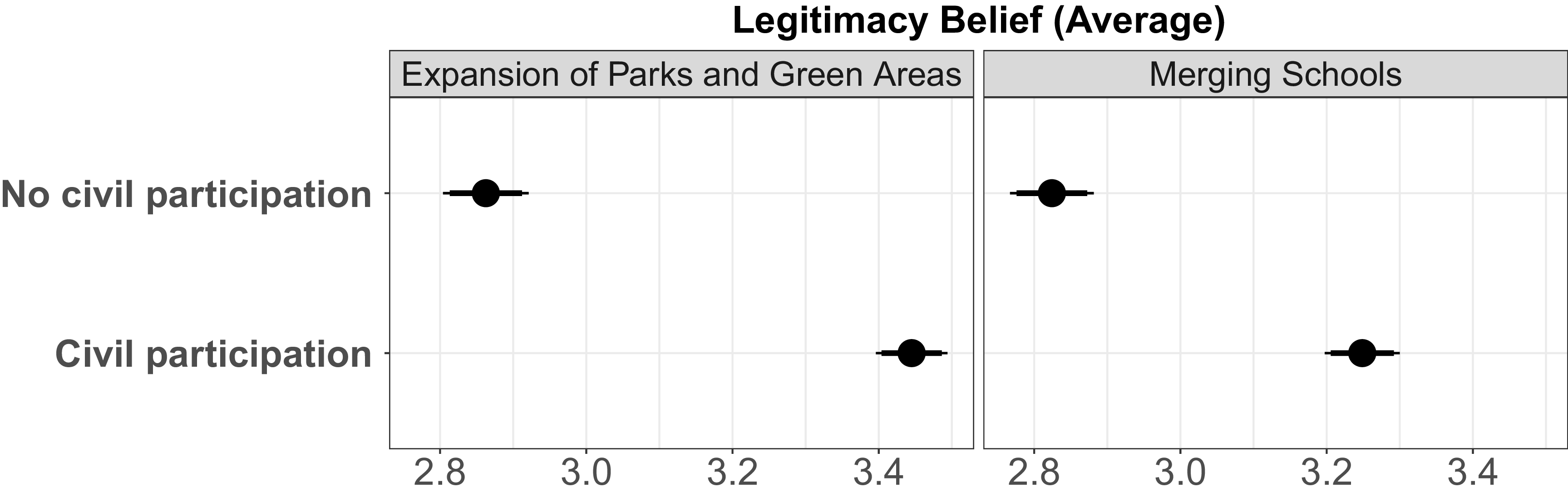
We start by looking at how a participatory decision-making process affects how legitimate a process is seen to be. Figure 3 depicts the predicted mean values of the average evaluation of legitimacy in each experimental arm – the “no public participation” condition and the “public participation” condition. The left and right panels show the results for the “park policy” and “school policy,” respectively. We discover evidence that a participatory process results in greater legitimacy belief in both policy issues. The averages of the responses to the three questions about legitimacy in the “public participation” groups are higher than those in the “no public participation” groups, with no overlaps between the confidence intervals of each group. Footnote 11 For both policy problems, the differences between the experimental groups are statistically significant at the 1% level.
The predicted mean values of legitimacy belief in each experimental group. 90% confidence intervals depicted by thicker lines and 95% confidence intervals by thinner lines.

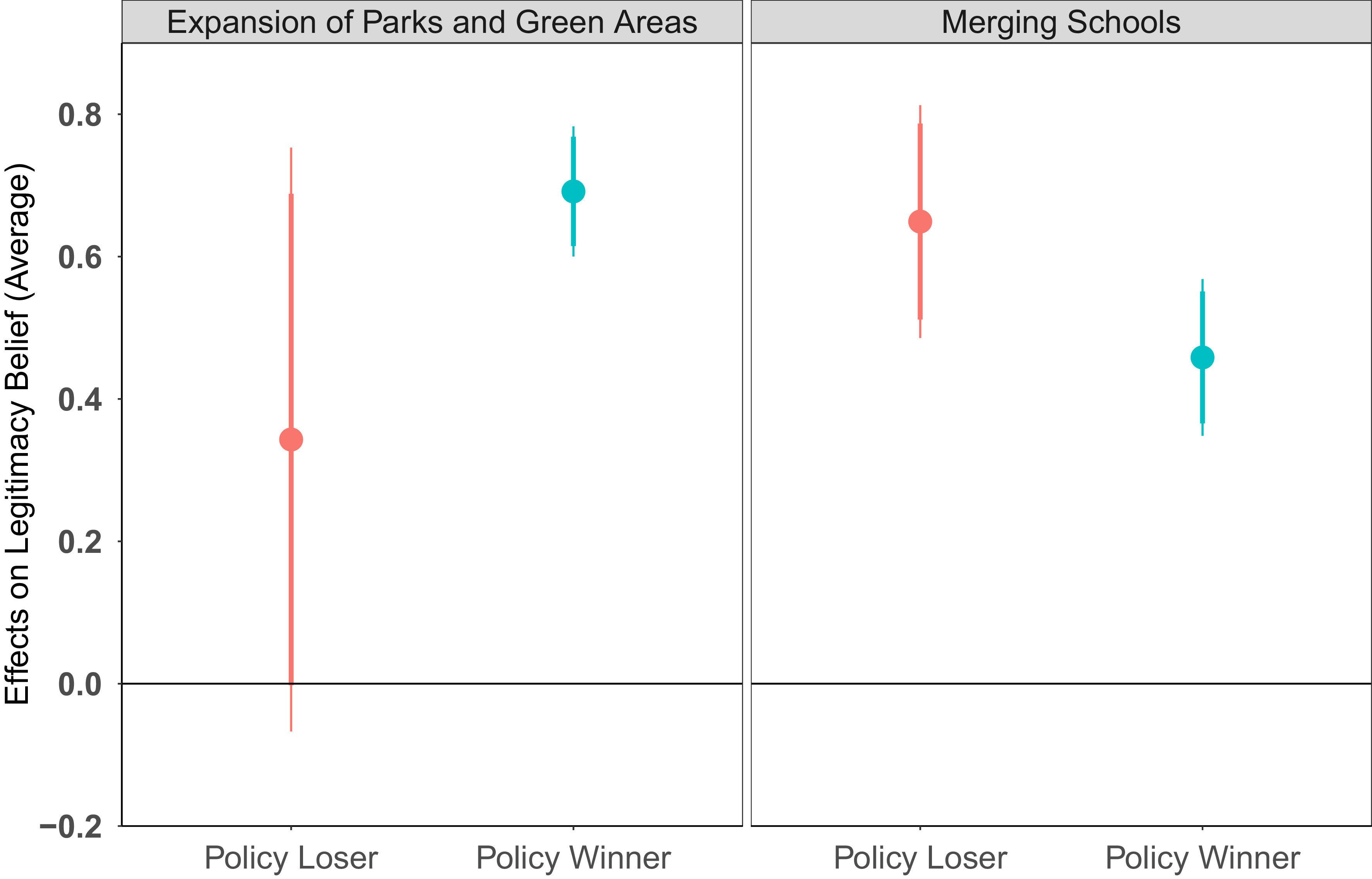
We also present the regression table for the estimations in Appendix Tables A9 and A10. Interestingly, we also find that the sign of the interaction term between Public participation and Policy winner is positive for the park policy and negative for the school policy. We speculate that their different natures drive this result: the school merger is a redistributive, zero-sum policy, while the park is positive-sum. For the redistributive school merger, participation has a stronger legitimizing effect on “losers” – who value the procedural justice it offers against a tangible loss – than on “winners,” whose support is already high (a ceiling effect). This explains the negative interaction. Conversely, for the park policy, participation is more crucial for “winners,” who need it to build a democratic mandate for a discretionary project, explaining the positive interaction. We stress, however, that this is a post-hoc interpretation of our results. We believe it is a plausible explanation, but future research is needed to delve more deeply into such heterogeneous interaction effects across different policy issues.
Hence, to address potential concerns about construct validity of our anti-elite measure, we also examined whether our moderation effects hold when using each individual anti-elite item separately (columns 5–8 in Appendix Tables A9 and A10). The results demonstrate strong robustness across different dimensions of anti-elite sentiment. For park policy, all four items show significant positive interactions: elite-people gap, citizen representation preference, elite inaction, and interest group influence. For school policy, three of four items show significant interactions, with effect sizes ranging from 0.115 to 0.187. This consistency across multiple anti-elite dimensions supports the robustness of our theoretical claims and suggests our findings are not driven by measurement circularity.
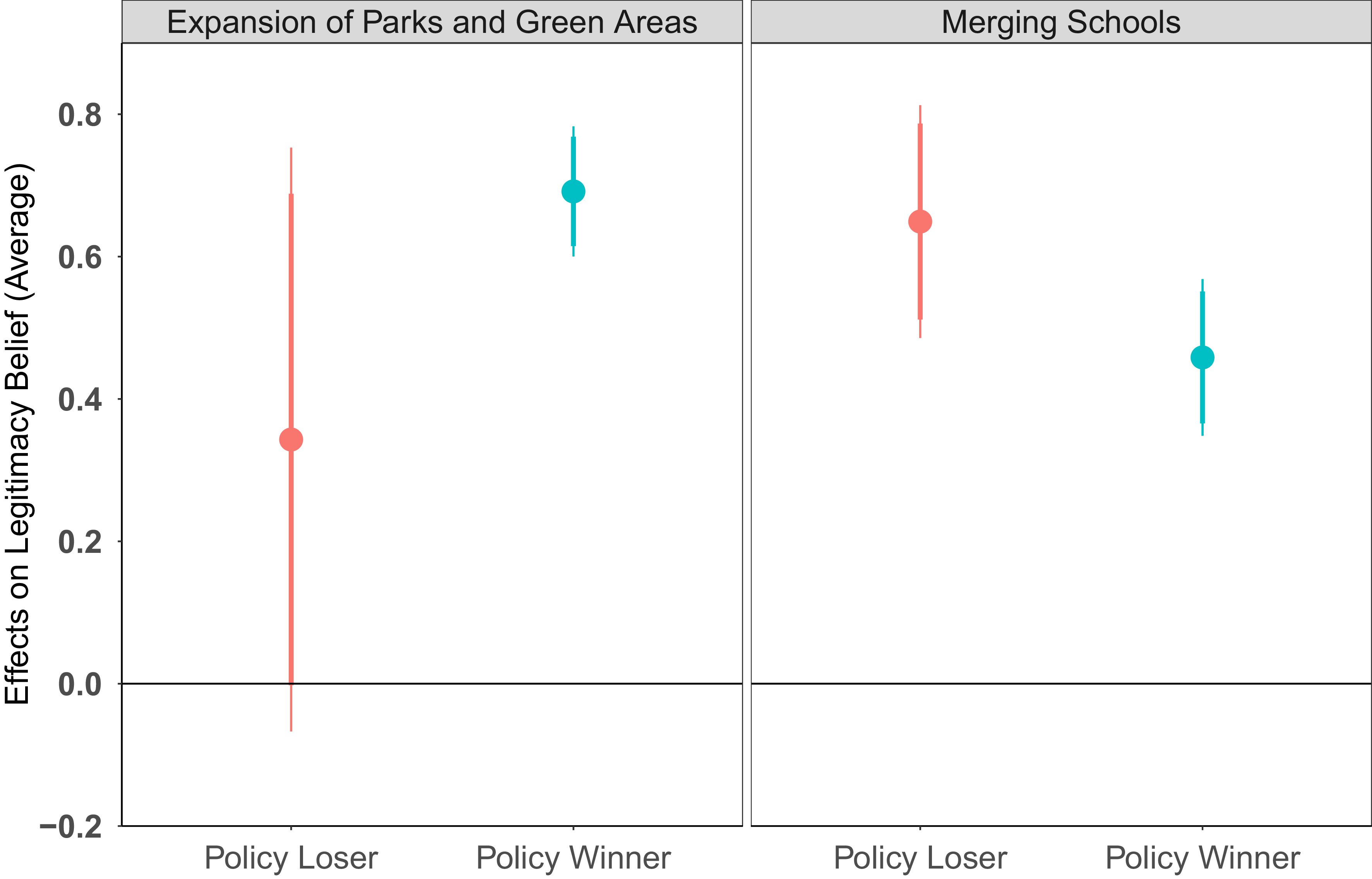
We split our samples as per respondents’ pre-existing opinions about each policy. Appendix Figure A6 presents the predicted mean values of legitimacy belief for respondents who support the policy (i.e., policy winners) and those who oppose it (i.e., policy losers). The results indicate that policy winners tend to, on average, hold higher levels of perceived legitimacy for the political process than policy losers. Regarding the consequences of the participatory process, however, we discover that regardless of how favorable the conclusion is, knowledge about citizen engagement raises the perceived legitimacy. Figure 4 presents the effect sizes of a participatory process for each group of respondents.Footnote 12 Both policy winners and losers perceive the decision-making process as more legitimate when they are informed that there was public participation. This is consistent with Werner and Marien (Reference Werner and Marien2022)’s finding that public participation enhances legitimacy regardless of outcome favorability.Footnote 13
The effects of public participation for policy winners and losers. The dots represent the effects of a participatory process treatment on legitimacy belief among the respective policy winners and losers for each local policy issue. 90% confidence intervals are denoted by thicker lines and 95% by thinner lines.
Legitimacy belief (average)
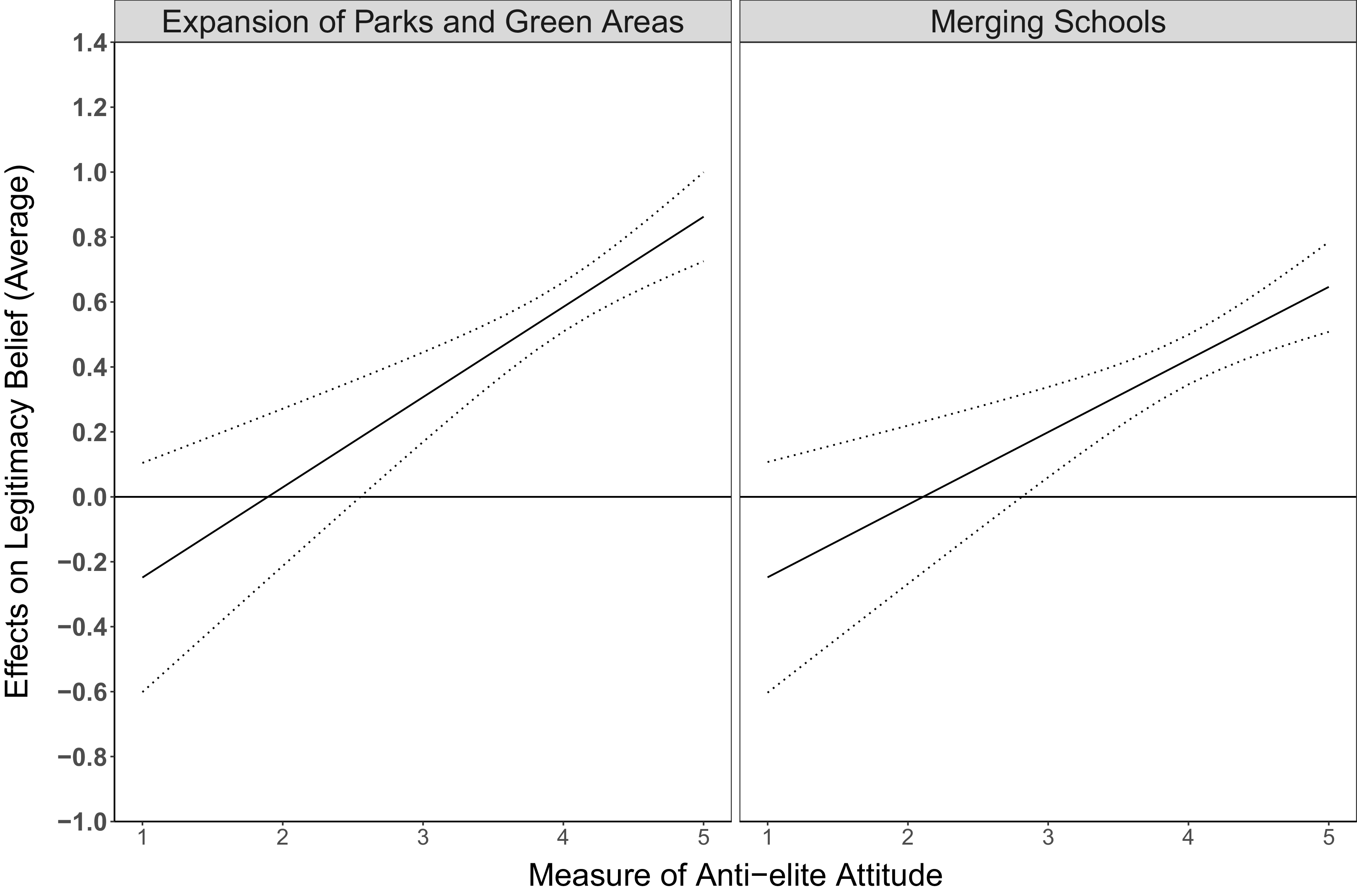
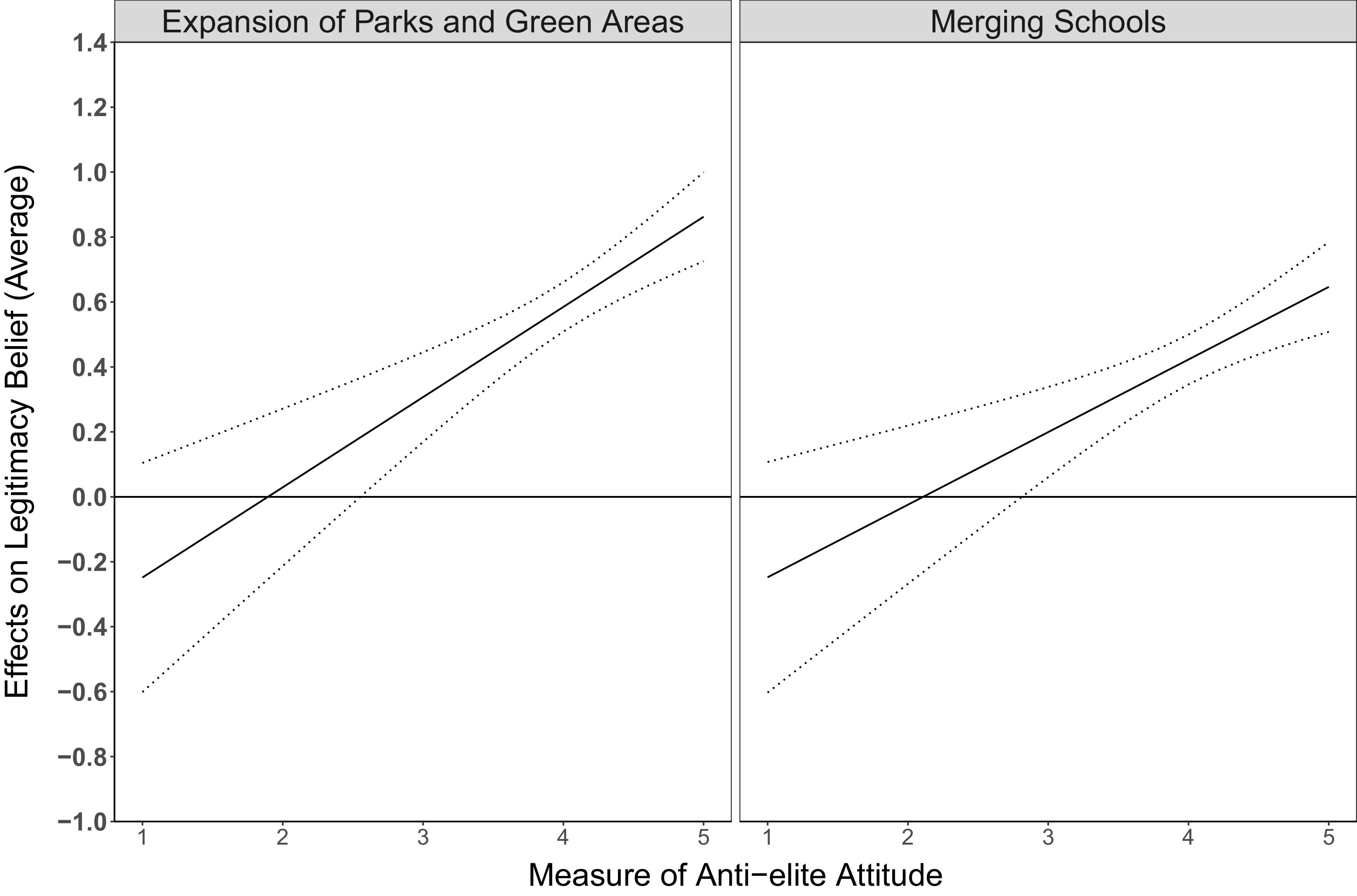
Having established the connection between public participation and legitimacy belief, we examine the heterogeneous effects of participatory processes across anti-elite attitudes. Firstly, Figure 5 depicts evidence supporting H2: the marginal effects of public participation are greater among respondents with stronger anti-elite attitudes. For lower values of the anti-elite measure, the point estimates of the marginal effects are negative, albeit statistically insignificant, indicating a limited impact among people who have relatively positive sentiments toward elites. The positive and statistically significant effects become more apparent for anti-elite attitude values of 3 (i.e., neither agree nor disagree with anti-elitism-related questions) and above.
Marginal effects of public participation across anti-elite attitudes. The lines show the marginal impacts of the participatory process treatment on the anti-elite attitude measure’s legitimacy belief across various values. The findings are based on linear models that include an interaction term between the anti-elite attitude measure and the participatory process treatment indicator. The dotted lines denote 95% confidence intervals.
While anti-elite sentiment is widespread in our sample (with <3% expressing pro-elite views), our non-linear analysis demonstrates that meaningful moderation effects occur throughout the observed distribution (Appendix Figure A8). The marginal effects of participation vary significantly across levels of elite skepticism, from moderate to strong anti-elite orientations. This indicates that gradations within anti-elite sentiment matter substantively, not just the difference between pro- and anti-elite extremes.
Additional results
In the pre-analysis plan, we also outlined that the effect of public participation on legitimacy beliefs may vary depending on political ideology. However, to focus on the implications of public participation’s effect on legitimacy beliefs in the context of recent democratic backsliding, ideological inclination was excluded from the primary analysis. Instead, trust and satisfaction with the existing democratic system were included alongside anti-elitism. Still, we conducted an analysis of how the effect of public participation on legitimacy beliefs varies by ideology, and as expected, this effect was stronger for those with more liberal political values. In Appendix Tables A11 and A12 report the results for the interaction between participation process and political ideology.
Also, since the anti-elite measure is on a continuous scale from 1 to 5, we estimate linear regression models with the interaction term between the indicator of the participatory process treatment and the anti-elite measure. The regression outputs are presented in column (3) in Appendix Tables A9 and A10. In addition, we conducted an analysis of how the effect of public participation on legitimacy beliefs varies by citizens’ levels of trust in political institutions and satisfaction with the existing democratic system. As expected, the effect of a participatory policy-making process on legitimacy belief is higher among individuals with lower levels of trust and satisfaction with existing democratic system. The regression outputs are presented in column (2) and (3) in Appendix Tables A11 and A12.
Discussion and conclusion
Do measures that encourage citizens to participate in a decision-making process make the process seem more legitimate at the local level in Korea? Our results indicate that decision-making that includes a participatory process leads to greater legitimacy beliefs than decision-making without a participatory process, regardless of whether respondents favor a given policy proposal or not. This finding holds across two different local policy issues in Korea. We also find that citizens’ pre-existing attitudes significantly modify the effect of a participatory process on their belief in the legitimacy of decision-making. The impact of policy making with a participatory process on legitimacy belief is greater among individuals harboring strong anti-elite attitudes.
Our findings have imperative implications for the role of participatory procedures in democracies. Direct civic engagement in decision-making at the local level can bolster the legitimacy beliefs in the democratic process. Deliberative citizen forums provide a platform where citizens can engage with both elected and unelected officials, voice their concerns, and influence policy decisions. By participating, people feel that policies are shaped by public interests rather than by elite-driven agendas. This not only enhances transparency and trust in governance but also ensures that decision-making is more inclusive and representative of diverse perspectives. Citizens’ legitimacy beliefs in the political process is essential for understanding challenges at reforming a mature democratic system. Lower levels of citizens’ legitimacy beliefs may threaten the democratic system. Our finding indicates that the legitimacy-generating effects of a participatory process at the local level can even be driven by citizens with stronger anti-elite attitudes. Increasing the perception that decision processes are legitimate is crucial for an existing democracy facing democratic backsliding since the public’s declining trust in the democratic systems and support for them is one aspect of the current democratic erosion (Foa and Mounk, Reference Foa and Mounk2016, Reference Foa and Mounk2017; Wike and Fetterolf, Reference Wike and Fetterolf2018; Claassen, Reference Claassen2020).
It is important to clarify what our findings do and do not demonstrate. Our experiment measures perceived legitimacy of decision-making processes, not policy support or acceptance. Respondents may view a participatory process as legitimate while still opposing the policy outcome. Furthermore, our scenarios involve hypothetical decisions in other localities, not policies directly affecting respondents. This distinction is crucial: viewing participatory processes as legitimate in abstract or distant contexts differs from accepting such decisions when they directly impact one’s own community. Future research should examine whether these legitimacy perceptions translate into policy acceptance when citizens face real consequences from the decisions.
Additionally, our findings do not necessarily contradict the stealth democracy hypothesis (Hibbing and Theiss-Morse, Reference Hibbing and Theiss-Morse2002). While respondents view decision-making involving ordinary citizens as more legitimate than elite-only processes, this does not mean they personally wish to participate. Citizens may simultaneously believe that (1) participatory processes are more legitimate, (2) ordinary citizens should have input opportunities, yet (3) prefer not to invest their own time in participation. Our results suggest that citizens value the availability of participatory channels and view their use by others as legitimacy-enhancing, regardless of their personal desire to engage. This aligns with stealth democracy’s core insight: citizens want responsive governance without bearing the costs of participation themselves.
This study demonstrates that participatory decision-making processes enhance perceived legitimacy among citizens in South Korea, regardless of whether they support the policy outcome. This finding is particularly significant for young democracies like Korea, where traditional representative institutions face growing skepticism. Our results reveal that the legitimacy-enhancing effects of participation are strongest among citizens with anti-elite attitudes, suggesting that participatory mechanisms may help rebuild trust among those most disaffected with current political systems. While we cannot claim that enhanced legitimacy perceptions automatically translate into policy compliance or citizen engagement, our findings indicate that expanding opportunities for citizen input can strengthen democratic governance. Importantly, participatory processes appear to signal that decision-making is open to voices beyond political elites – a message that resonates especially strongly in societies with limited participatory traditions and growing anti-elite sentiment.
Our findings should generalize to other democracies, as our theoretical framework does not depend on specific cultural contexts. The desire for fair, inclusive decision-making processes likely transcends particular democratic traditions. However, future research should test these relationships in diverse institutional contexts and, critically, examine whether legitimacy perceptions of distant, hypothetical decisions translate into acceptance of policies that directly affect citizens.
Future studies can further explore how citizens’ pre-existing attitudes condition the effect of participatory decision-making processes on their belief in legitimacy. Here we focus on respondents’ attitudes toward elites and show that these shape participants’ responses to the participatory decision-making process treatment. Examining how populist attitudes impact the link between participatory decision-making processes and legitimacy belief is a logical next step for this project. Populist attitudes include support for popular sovereignty, a Manichean outlook, and anti-elitism (Akkerman et al., Reference Akkerman, Mudde and Zaslove2014; Harris, Reference Harris2022). These core elements of populist attitudes could produce a stronger desire for a participatory form of democracy.
Furthermore, our study focuses on the local policy context for two key reasons: (1) Public participation in national policies is relatively uncommon in Korea, making local policy engagement a more realistic scenario for our research and (2) public participation at the local level is likely to elicit more thoughtful and engaged responses from participants, as it relates more directly to their immediate environment and daily lives. This approach allows respondents to consider public participation more tangibly and seriously. However, it is important to acknowledge that public perceptions of decision-making processes may differ between local and national policy contexts (Verschuere et al., Reference Verschuere, Roets, Steyvers, Wauters, Berkvens, Smedt, Goutry, Pittoors, Severen and Haesevoets2025). Consequently, future research should extend this investigation to examine the effects of public participation in national policy contexts as well.
Supplementary material
The supplementary material for this article can be found at https://doi.org/10.1017/S1755773926100411.
Data availability statement
The replication package is uploaded to the Harvard Dataverse.
Acknowledgements
All authors contributed equally to this article. Nam Kyu Kim was supported by a Korea University Grant (K2406811).
Financial support
This work was supported by the Ministry of Education of the Republic of Korea and the National Research Foundation of Korea (NRF-2020S1A3A2A02092791).
Competing interests
There are no competing interests.
Ethical standards
Institutional Review Board (IRB) at Sungkyunkwan University approved the survey experiment described in this article. We have also registered a pre-analysis plan (PAP) (can be accessed here: https://osf.io/r8gf2/).



 Open access

