

Introduction
The outcome of the Referendum on the United Kingdom's (UK) membership in the European Union (EU)Footnote 1 warrants a discussion of EU developments in social and gender policies with a view to the UK leaving the EU. It is feasible, at least in principle if not in practice, for domestic regulations to take a more socially progressive turn after the UK leaves the EU. Such prospects, however, are unlikely. As I will demonstrate, notwithstanding criticisms that could be made of the content, significance, and implementation of EU policies on social and gender issues, they also merit celebrating over some major achievements. At this point, a firmer sense of recent EU policy developments in the social domain from a gender equality perspective might be indicative of what the UK stands to lose if it fails to establish a progressive post-Brexit agenda. My objective is, thus, to illuminate the EU social dimension – sometimes referred to as EU social policy, social Europe, or the European social model – with attention to gender equality, briefly accounting for its emergence and focusing on efforts establishing the European Pillar of Social Rights (the Pillar/EPSR) and its new initiative on work-life balance for parents and carers. The question I address in this article is: Does the European Pillar of Social Rights represent a meaningful advancement on social progress and gender equality agenda?
The article is organised as follows. In the next section I provide an overview of the literature, in which I conceptualise social and gender policy at the EU level, followed by a cursory overview of studies assessing the social and gender dimensions of EU policy development. The review of the theoretical and empirical scholarship establishes the extent to which social and gender policies have been integral to the EU project. The key argument drawn from this assessment is that, while the EU has expanded social and gender policies substantially, it has done so in subordination to economic policy, treating the economic and the social as unequal, if related, spheres. This tendency to prioritise the economic above the social bears implications for the persistence of gendered inequalities, several patterns of which I expose in the following part. Persisting socioeconomic inequalities signal the need for a more effective policy approach in line with EU policy objectives. I then provide a note on the methodological approach to this article. In the subsequent section I engage with the main goal of this article and analyse recent policy developments in social and gender spheres, focusing on the new EPSR.
The analysis shows that through the proclamation of the Pillar the EU confronts the uneven status of economic and social policies. The effort to move social policy, including initiatives on gender, up the policy agenda is clear and the reforms are capable of reshaping the relationship between the social and the economic, and contribute to rearticulating EU economic policies. This potential, if realised, denotes a loss for social and gender policies in post-Brexit UK, which so far has benefitted from EU encouragements and requirements, as other articles in this issue demonstrate. At the same time, the EPSR is in its early stages of development and the embedding of social and gender justice principles in socioeconomic policies is far from achieved.
Social policy, gender equality and the EU: a credible proposition with mixed interpretations
Although social policy is typically understood within national borders through regulatory and institutional arrangements and specific areas of intervention constructed on the basis of shared norms and practices, modified criteria permit to speak of EU social policy. The EU and its institutions influence the welfare of people variously incorporated into, as well as barred from, citizenship. The social mandate of the EU is anchored in a complex regulatory framework (the social acquis) comprised of primary law (the Treaties and the Charter of Fundamental Rights), secondary law (including over fifty directives on social and workers’ rights, Social Summit 2017), the decisions of the Court of Justice of the EU (CJEU), and in non-legislative measures like recommendations, social programmes (e.g. PROGRESS), and some redistribution of funds (e.g. European Social Fund). These instruments are especially well established in policies concerning working conditions, social security deriving from employment, gender equality, and free movement. Policy innovations following the Amsterdam Treaty of 1997 expanded soft law via the Open Method of Coordination (OMC) to address a wider range of social issues in employment, public pensions, and social inclusion. Commitments to the social sphere have evolved from a ‘market economy’ (CEC, 1994) to a ‘social market economy’ entailing ‘full employment and social progress, and a high level of protection’ (TEU, Article 3, 2007). EU interventions cut across national social citizenship norms, for example through gender equality and workers’ rights, working time, and parental leave regulations. And so, while a construction of a social model was not a deliberate project when the EU was being established, an EU social dimension has evolved to a meaningful extent, even as it remains more regulatory than redistributive, and so drastically different from the social models of many member states.
The EU's social dimension is closely linked to the goal of gender equality. The objective is well grounded in its legislative framework as the EU has a Treaty obligation to pursue gender equality. The principle has been foundational to European social policy since the reference to equal pay for equal work in Article 119 of the 1957 Treaty of Rome (now Article 157 in the Treaty on the Functioning of the EU). The strengthening of the gender dimension of social policy was laid down in secondary law in the form of directives from the mid-1970s, and through a range of non-binding instruments, such as action programmes, recommendations, or guidelines. The expansion of the OMC was accompanied by the requirement to mainstream a gender perspective into all stages of policy making. EU approach to gender reflects three main conceptualisations of equality: equal treatment, granting legal equality in rights; equal opportunities, providing for differential status via positive action; and equal outcome, requiring attention to all aspects and processes involved in re/producing inequality and bringing about their transformation through, for example, mainstreaming (Rees, Reference Rees2005). These approaches, combined, can contribute towards the attainment of gender equality by overcoming the equality-difference dilemma (Lombardo, Reference Lombardo2003) and facilitating the transformation of unequal gender relations. Indeed, the EU presents itself as ‘the most progressive gender regime in the world’ (Abels and MacRae, Reference Abels and MacRae2016: 22), even while gender inequalities persist in all its member states.
Six decades of social and gender policymaking in the EU has earned a mixed assessment. The vast literature on the issue (inter alia Hantrais, Reference Hantrais2007; Kantola, Reference Kantola2010; Anderson, Reference Anderson2015; Jacquot, Reference Jacquot2015; MacRae and Weiner, Reference MacRae and Weiner2017) demonstrates that the Union's social and gender policies, rather than comprising a stand-alone goal, have been conceived in relation to the economic project of market integration. The pursuit of economic goals has taken precedence over social objectives, with various configurations constructing social and gender policy as an obstacle to, a corrective for, or a necessary partner to the economic. The literature assessing the social and gender policy development in the EU broadly agrees that economic and social domains have had an unequal status. But within this broad agreement, views oscillate between opposing conceptions of EU contributions acknowledging the positive difference the EU has made and viewing it negatively as a market-oriented neoliberal project, especially since the 2008 economic crisis.
On the one hand, EU institutions have developed powers beyond the intentions of EU founders and in practice engage in both market and social policymaking (Anderson, Reference Anderson2015). The CJEU has acted in the interest of the market as well as protecting the rights of workers and their families by embedding social content into the market (Caporaso and Tarrow, Reference Caporaso and Tarrow2009). Brexit negotiations lend support to the argument that the EU is committed to social issues. Deploying economic instrumentalism, the EU insisted on clarifying the rights of EU citizens in the UK when discussing post-Brexit trade arrangements, as well as demanded appropriate agreements for the Irish border with a view to community relations and peace, not just cross-border tradeFootnote 2 . Historically, the EU has significantly contributed to women's equality in social, economic, and political areas (Hoskyns, Reference Hoskyns1996; Mazey, Reference Mazey1998) by acting outside the pure market logic and encouraging a more egalitarian gender division of domestic labour (Walby, Reference Walby2004). The EU has been judged ‘one of the most progressive’ (Pollack and Hafner-Burton, Reference Pollack and Hafner-Burton2000: 452) and ‘in the vanguard’ (Rubery, Reference Rubery2015) in gender equality promotion (see also Fagan and Rubery, Reference Fagan and Rubery2017).
On the other hand, concerns have been raised regarding the co-optation of gender policies (Stratigaki, Reference Stratigaki2004) serving macroeconomic growth goals (Elomäki, Reference Elomäki2015). Lack of progress has been linked to the exaggeration of rhetoric against policy practice, as greater gender awareness goes hand in hand with diminishing equality-promoting activities (MacRae, Reference MacRae2010; Jacquot, Reference Jacquot2015; Jenson, Reference Jenson2015). To these critiques we must add institutional changes involving the move of the Commission's gender equality unit from Employment and Social Affairs DG to Justice in 2011, as it impacted the overarching approach to gender equality. The move of gender policy away from social and employment spheres has weakened its material base and connections to social and economic policies, in favour of human rights and legal foundations. While the extension of gender issues to broader policy areas should be interpreted positively, the shift away from substantive to formal equality represents a loss.
This mixed judgment on EU social and gender policies stems from their uneven development in scope, content, visibility and impact (Lewis, Reference Lewis2006; Kantola, Reference Kantola2010; Karamessini and Rubery, Reference Karamessini and Rubery2014). More optimistically, social and gender policies undergo innovation and survival (Daly, Reference Daly2008), deconstruction takes place with reconstruction (Rubery, Reference Rubery2011), and ‘regenerative capacity’ (Barnard, Reference Barnard2014: 237). Recent explicit and deliberate linking of economic and social objectives suggests that economic coordination has become more ‘socialised’ (Zeitlin and Vanhercke, Reference Zeitlin and Vanhercke2014) and economic policy has been extended to include social policy goals with real potential for the EU to pursue social progress (Šmejkal, Reference Šmejkal2015) or even develop a distinctive social model (Barnard, Reference Barnard2014; Bekker, Reference Bekker2015).
To what extent is the advancement of social and gender equality feasible? The most serious, indeed intractable, barrier to the development of a fully-fledged European social model has been identified in the constitutional asymmetry between economic and social policies, where ‘market-making’ has a constitutional priority over ‘market-correcting’ (Sharpf, Reference Sharpf2002: 649). This puts the interests of capital outside the area of contestation, unlike in the member states where the relationship between economic and social policy is subject to debate. The crux of the matter is the political feasibility (as well as the desire) to create a common social policy for Europe. To be achievable, the necessary condition would be for the social to have an equal legal status to the economic, something that in a diverse EU cannot be overcome (Scharpf, Reference Sharpf2002). As a result, the EU policy process privileges capital over labour and the economy over society. The second problem is that EU institutions have facilitated the emergence of a particular form of the market, prioritising market freedom rather than regulation. Therefore, not only is the economic sphere privileged procedurally, substantively an economic paradigm hostile to market regulation and social policy expansion has become hegemonic (Schmidt and Thatcher, Reference Schmidt and Thatcher2014). This second limit to social Europe entailing an economic paradigm emphasising market freedom, need not, however, dominate (Polanyi, Reference Polanyi1944). Alternative economic policies can both open the space for social policy development as well as prevent the need for market corrections, at least to some extent.
The alternative conceptualisation of the relationship between economic and social policies corresponds to feminist understandings of economic and social relations as interdependent. Both spheres are bearers of social relations and values, including gender, although these are not explicitly acknowledged and incorporated into policymaking (Elson and Cagatay, Reference Elson and Cagatay2000). Recognising that economic issues have been firmly anchored in EU governance while social issues have remained within the control of the member states, I would argue that it is nevertheless possible to pursue social and gender justice through two inter-related tracks. The first track requires an explicit engagement with the contradiction of rigidly separating economic and social policies since such a separation does not reflect the extent to which socioeconomic processes are intertwined. Numerous policies already span both spheres to the extent that employment comprises the core of EU social policy, while the concern with gender equality originated in support of macroeconomic objectives as well as developed through equal treatment, equal opportunities, and gender mainstreaming approaches capable of social transformation of gendered power hierarchies. Clearly the EU has incorporated the social, but has cast it in a supportive role to the economic. The EU's refusal to disregard the social could thus be built upon towards valuing the social in its own right. The second track requires replacing the hegemonic neoliberal economic model with one that is more just in its pursuit of prosperity and conducive to the development of socio-democratic institutions concerned with social and gender progress. Theoretical, technical and political proposals contributing towards a new economic order have been particularly visible throughout the post-crisis period. Socioeconomic renewal is needed across a whole range of areas in which inequalities persist, which I demonstrate in the following section.
Inequalities in contemporary EU: far from prosperity and justice
Does the aspiration of social Europe stand up to the empirical test of prosperity and social justice? While the EU social and gender policy repertoire has expanded through institutional, regulatory, and technical innovations, and the knowledge of the processes underlying inequalities is increasingly comprehensive, European societies continue being unequal. Several dimensions of inequality are captured in the EU Social Justice IndexFootnote 3 (Schraad-Tischler and Schiller, Reference Schraad-Tischler and Schiller2016) demonstrating that in 2016 the social situation in the EU, although improved over the worst post-crisis performance, has not recoveredFootnote 4 . Importantly, economic growth, while correlated with social outcomes, does not achieve social welfare independently of policies (Perrons and Plomien, Reference Perrons and Plomien2010), since several states with lower GDP per capita (e.g. Czech Republic, Estonia, Slovenia) score better than richer countries (e.g. Ireland) (Schraad-Tischler and Schiller, Reference Schraad-Tischler and Schiller2016). The Gender Equality Index, developed by feminist scholars and supported by the Commission, shows that gender equality, understood as equal distribution of time and resources and equal outcomes, has progressed very slowly (Plantenga et al., Reference Plantenga, Figueiredo, Remery and Smith2003; Humbert et al., Reference Humbert, Ivaškaitė-Tamošiūnė, Oetke and Paats2015). From the average score of 62.0 in 2005, rising to 66.2 by 2015Footnote 5 , and wide ranges between countries and domains (Humbert and Keelan, Reference Humbert and Keelan2017; Barbieri et al., Reference Barbieri, Franklin, Janeckova, Karu, Lelleri, Riobóo Lestón, Luminari, Madarova, Maxwell, Mollard, Osila, Paats, Reingardė and Salanauskaitė2017), the results signify the continued salience of national arrangements and different degrees of in/equality in different areas. Gender division of labour and unequal time spent on unpaid domestic work and care are among the most obstinate problems, whereas economic decision-making has improved, albeit from a low base and thus remains the least equal. Member states do not achieve consistently linear improvements. The UK, for example, has deteriorated and then rebounded, highlighting the instability of progress as well as interactions between domestic and supra-national frameworks. A Brexit scenario in which external requirements and resources for gender and social policy progress are removed will risk further deterioration in the UK (see also Guerrina and Masselot, Reference Guerrina and Masselot2018; and Fagan and Rubery, Reference Fagan and Rubery2017).
Many gender inequalities in access to resources, wellbeing and power concern the work-welfare relationship and the interdependencies between employment and social policy systems. Across the EU, labour force participation has risen in recent years, with women's employment reaching an all-time high of 65.5 per cent and men's 77.4 per cent in 2016, and the gender gap declining to 12 percentage points (EC, 2017d). This in itself does not signify convergence towards greater economic security as non-standard forms of work are more prevalent among women, who are more likely than men to be in temporary employment, as well as work on the basis of ‘zero hours’ contracts – 55 per cent of ‘zero hours’ workers in the UK are women (EC, 2017d). Relatedly, the bifurcated employment model (Mutari and Figart, Reference Mutari and Figart2001; Zbyszewska, Reference Zbyszewska2013) remains strong whereby only 8.2 per cent of employed men but 31.4 per cent of employed women work part-time (Eurostat, 2017a), effectively widening the gender employment gap to 18 percentage points in full time equivalents (EC, 2017d). Inequalities are complex and vary for different groups of women, for example 46.4 per cent of third-country migrant women, 45.7 per cent of women with disabilities, and 16 per cent of Roma women are employed (EC, 2017d) raising questions about multiple disadvantages and the relationship between non-employment and social security entitlements.
On the other side of the gender division of labour, unpaid domestic work and care, women are overwhelmingly more burdened. Employed women dedicate 22 hours per week to unpaid domestic work and care, while employed men dedicate under 10 hours (EC, 2017d). Parental leave up-take is unequal too, in 2010 of the three and a half million people on leave only 2.7 per cent were men (Eurostat, 2014). Inequalities in the gender division of labour and employment related differences, including sectoral segregation, women's overrepresentation in non-standard employment, men's wage premiums for long working hours, and discrimination (Blau and Kahn, Reference Blau and Kahn2017) all result in earnings inequalities over the lifecycle, including in pensions. In 2015 the overall gender pay gap in the EU was 16.3 per cent and in pensions nearly 38 per cent, both varying in magnitude across member states (EC, 2017d).
Poverty, a related concern, is reflected in the at risk of poverty or social exclusion (AROPE) category. Any improvements in the AROPE indicator prior to the crisis have stalled or reversed, with estimated 23.4 per cent of EU-28 population (22.4 per cent men and 24.3 per cent women) comprising this group in 2016 (Eurostat, 2017b). Since nearly a quarter of the EU's total population (one of the richest world regions) is at risk of poverty or social exclusion (Perrons, Reference Perrons2015), a status exacerbated by factors such as health (31 per cent women with disabilities versus 28.8 per cent of men) or lone parenthood (47.7 per cent) (EC, 2017d), the realisation of a social Europe is far from complete. These patterns must be interpreted within particular policies as various macroeconomic alternatives exist and can be redesigned towards redistributive economic policies and economically productive social policies (Perrons and Plomien, Reference Perrons, Plomien, Karamessini and Rubery2014; Perrons, Reference Perrons2015; Rubery, Reference Rubery2015).
The inequalities reviewed here confirm that prosperity and social justice remain a relevant goal for the EU and its member states. The limited progress, even deterioration, registered over the last decade is not simply a manifestation of EU's irrelevance. Rather, it is related to the broader problem of the separation of the social from the economic, including the uneven development of social and gender policies (Lewis, Reference Lewis2006; Rubery, Reference Rubery2008; Jacquot, Reference Jacquot2015), the rise of income inequalities since the 1970s (Bogliacino, Reference Bogliacino2009; OECD, 2011), and the severity of the recent economic crisis and the in/adequacy of the EU and member states’ responses to it (Karamessini and Rubery, Reference Karamessini and Rubery2014; Klatzer and Schlager, Reference Klatzer, Schlager, Evans, Hemmings, Henry, Johnstone, Madhok, Plomien and Wearing2014; Kantola and Lombardo, Reference Kantola and Lombardo2017). To achieve social and gender progress, therefore, the EU needs to deploy multiple strategies, including committing to the goals of social justice and gender equality in their own right and recognising the social content of economic policies. This necessitates more deliberate action on inequalities, including in employment and income, and in the sharing of unpaid work and care. With this in mind I examine in the rest of the article the EPSR renewed efforts to reconcile paid work with family responsibilities (unpaid work and care) as a means of encouraging equality between women and men in paid and unpaid labour.
Methodologically, two points are relevant. First, I have analysed documents produced by EU institutions – the Commission, the Parliament, the Council and relevant Committees – on the early developments of the EPSR until its proclamation in November 2017. These were analysed against the economic and social policy context in the post-crisis EU leading up to the launch of the Pillar, including changes to the European Semester (combining economic, fiscal, employment and social policies). Second, in analysing the Pillar, I have narrowed the discussion to its work-life balance aspect. I chose this focus for two related reasons. Firstly, because labour market and employment policies are among the most established conduits of EU social and gender policy. Originating in the settlements between capital and labour, the gendered work-welfare relationship is crucial to managing social security provision. From the beginning of the EU project, gender and health and safety regulations have accompanied the competiveness agenda, later to develop into concern with unemployment, then employment, and work-family balance initiatives. Even though EU social and gender policies go beyond employment and reconciliation of work and family life, this policy area is suitable for assessing social and gender progress. Politically and technically it is the most longstanding concern with gender, enabling an iterative process to attain policy objectives. Substantively, it has the potential to influence the nexus of paid and unpaid work and care and bring about their gender-equal distribution – a key feminist demand for the transformation of gender relations. Secondly, Europeanisation processes of work-family policy make the analysis highly relevant to Brexit, since social and gender equality policies in the UK have developed significantly in relation to the EU (see Fagan and Rubery, Reference Fagan and Rubery2017).
The European Pillar of Social Rights: a new vision for social and gender progress?
In these times of change, and aware of the concerns of our citizens, we commit to the Rome agenda, and pledge to work towards (. . .) a social Europe: a Union which, based on sustainable growth, promotes economic and social progress as well as cohesion and convergence, while upholding the integrity of the internal market; a Union which takes into account the diversity of national systems and the key role of social partners; a Union which promotes equality between women and men as well as rights and equal opportunities for all; a Union which fights unemployment, discrimination, social exclusion and poverty; a Union where young people receive the best education and training and can study and find jobs across the continent; a Union which preserves our cultural heritage and promotes cultural diversity. (The Rome Declaration, Reference Declaration2017)
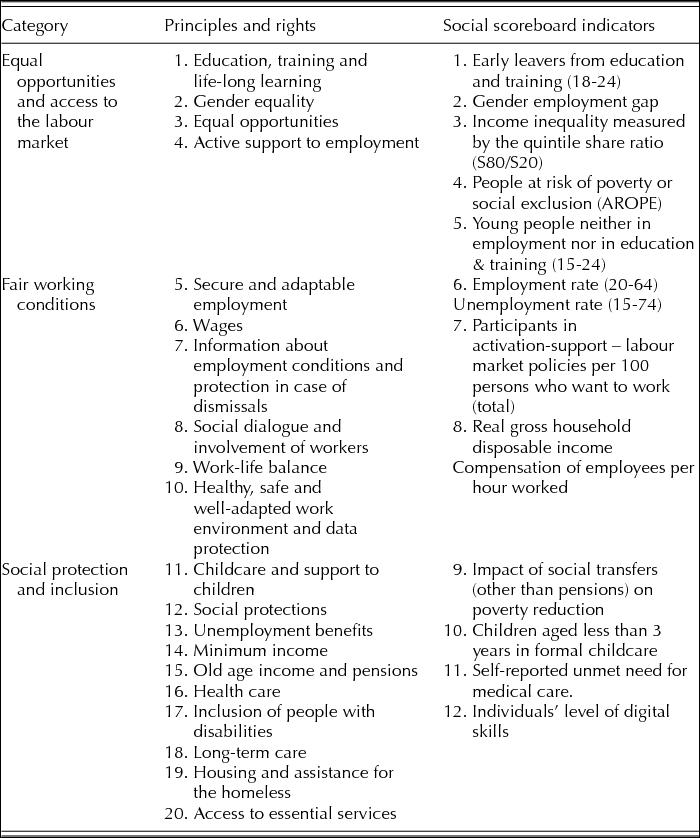
In April 2017, the European Commission presented its final proposal establishing the European Pillar of Social Rights, agreed unanimously by EU employment and social policy minsters in October, and proclaimed in Gothenburg in November at the Social Summit for Fair Jobs and Growth, the first such meeting since the 1997 Luxembourg extraordinary summit on employment. Following the announcement by Jean-Claude Juncker (President of the Commission) in his first State of the Union speech to the European Parliament, the Pillar's preliminary outline of March 2016 opened consultations with social partners, civil society and citizens. The EPSR consists of twenty principles and rights subsumed within three categories in employment and social policy (see Table 1) and four concrete legislative and non-legislative initiatives with respect to work-life balance, information for workers, access to social protection and working time (EC, 2017a, 2017b).
In a nutshell, the EPSR represents an explicit re-articulation of social objectives for fair labour markets and welfare systems and makes commitments to gender equality. It is to be delivered through a combination of hard and soft law, focusing on implementation, alignment with the European Semester, and utilising indicators. There are many aspects of the Pillar, however, which are ambiguous. One ambiguity is that the Pillar is a blend of old and new elements. Politically, the Commission expects it to renew and promote social convergence in the member states by reinforcing the screening of their economic and social performance and driving national level reforms. So, what is already seen as a well-developed social acquis requires better national level implementation. Some new processes support this, for example, through the development of a social scoreboard (EC, 2017c) to track trends concerning the Pillar and feed into the European Semester of macroeconomic surveillance and employment and social policy coordination. Eurostat's statistical database already contains a table based on the Pillar's indicators (Eurostat, 2017c). Alongside additional social indicatorsFootnote 6 that have become part of the European Semester, and by incorporating social policy recommendations to the already established macroeconomic recommendations, the basis for discussion of social renewal is at least more visible. To what extent heightened visibility will translate into social progress remains an empirical question, and will depend on the power of the EU vis-à-vis individual member states. Another uncertainty concerns the applicability of the EPSR. Most measures to deliver on the Pillar are in the hands of the member states; and in its current form, it is intended for Eurozone countries (currently 19Footnote 7 ). But, this is not applicable to all initiatives announced within the Pillar, as the work-life balance directive is intended for the whole EU. If some elements of the EPSR are considered for all member states, and others for the Eurozone core, then the linking of social with the economic appears inconsistent. The Commission either does not seem to have internalised the interdependence between social and economic policies, or has done so quite literally by linking economic and social spheres for the Eurozone separately from those in the wider EU.
Attention to gender equality seems to have improved through the proposal of the EPSR. As shown in Table 1 it has an explicit status in the list of principles and rights – already an improvement on the invisibility of gender in Europe 2020 strategy. The final proposal is also better than the preliminary outline, where it was contained in the fifth domain ‘gender equality and work life balance’. The revision raised its profile by (a) bringing up ‘gender equality’ to the second domain, and (b) separating ‘work life balance’ to chapter II on fair working conditions. This resulted in giving gender equality a more general and prominent place, and by including work life balance among the issues dealing with the working environment, the two related, but distinct, gender equality dimensions are not necessarily and always equivalent, opening up scope for development. Similarly, the domain of equal opportunities moved up from the sixth to the third place, which refers to a wide range of legislation prohibiting discrimination, including anti-racism (2000/42/EC) and employment equality framework (2000/78/EC), as well as the gender equality directive (2006/54/EC).
The Commission's new initiative to support work-life balance for working parents and carers (EC, 2017e) consists of legislative and non-legislative actions. The non-legislative measures focus on the provision of adequate care services and economic disincentives to employment of second earners pledging ‘to assist Member States in their national reforms and promote a change of mind-sets at organizational and societal level’ (p7). Monitoring leave design and take-up as part of the European Semester, better collection of data, developing pilot schemes, and sharing of best practice are examples of specific actions. Furthermore, the Commission offered to strengthen the application of the existing directive on maternity leave (without changing its content) and, via legislation, to introduce a directive on work-life balance (EC, 2017e). The project entails new developments and adjustments in paternity leave, parental leave, carers’ leave, and flexible working arrangements (see Table 2). In consultations, employers’ organisations found the current EU work-life balance legislative framework to be sufficient, while trade unions endorsed further action on strengthening leaves. These positions are not surprising, given the fate of recent attempts to revise maternity leave regulations. In 2008 the Commission proposed a directive on maternity leave, in which it aimed to extend the minimum period of fourteen weeks compensated at least at the level of sick pay to eighteen weeks and an allowance amounting to full salary. In 2010 the European Parliament sought to extend the paid maternity leave to twenty weeks and added two weeks of paternity leave under the same conditions as maternity. The amended proposal was then submitted to the Council of Ministers, where it was stuck due to lack of agreement on the replacement level of full pay (and opposition of business lobbies, especially from the UK). As a result after seven years of negotiations, the Commission withdrew its proposal in 2015, to then begin developing its new initiative on work-life balance as part of the EPSR.
Main features of the proposed directive on Work-Life Balance for Parents and Carers

Source: EC, 2017e
As outlined in Table 2, the proposed directive on Work-Life Balance for Parents and Carers brings in important advances, especially the entitlement to paternity leave for fathers and second carers, and by strengthening parental leave individual entitlements and flexibility. However, the contentious issue of extended maternity leave at full pay has been dropped from the previous unsuccessful reform attempts. This had a knock-on effect on paternity pay, which at the level of sick pay represents a significant loss of income if leave is availed of. Two points are noteworthy here. One is that the current legislation in member states on leave does not depart significantly from the originally proposed reforms: in twenty-one countries, maternity leave is already compensated at least at 70 per cent (at full replacement in fifteen) while for paternity leave the gap between the proposal and status quo is greater, with seven member states not having any provisions at all and only eleven meeting the two-week and full replacement criteria. Stronger EU framework would thus improve existing provisions in some member states and prevent any potential rollback. The second point relates to shifting gender relations. If, as the Commission is aware (EC, 2017e), change in the gender division of labour (underpinning labour market inequalities) requires particular policy and institutional framework to encourage a more equal distribution of care responsibilities between women and men, then the proposal is likely to disappoint. The necessary features include universal provision, individual entitlement, wage-related compensation, relatively long period of available leave and flexibility (Smith and Williams, Reference Smith and Williams2007; Haas and Rostgaard, Reference Haas and Rostgaard2011; OECD, 2016). The proposal is thus insufficiently ambitious. One reason is likely to be a cautious approach of the Commission wary of stalling of another bill. The 2008–15 negotiations of the maternity leave directive were conducted throughout the crisis and widespread austerity discourse at national and EU levels, which controverted social policy expansion in general, and maternity pay in particular. The withdrawal of the directive ‘which had no chance of being adopted’ led to the development of a ‘fresh approach’ for working parents and carers (EC, 2015a: 1). However, by the time of launching the EPSR the constraints of crisis and austerity have become less prominent, suggesting deeper reasons for the weakening of reconciliation reforms.
Arguably, a more fundamental reason for the specific content and format of the initiatives on work-life balance within the EPSR is the underlying conceptualisation and the representation of the problem this set of policies intends to address. The problem is understood to be women's underrepresentation in employment, caused by the unequal distribution of family responsibilities between women and men. Increase of women's employment and addressing gaps in labour market participation, pay, and pensions are thus sought, in line with EU's growth and jobs agenda (EC, 2015b, 2017e). The problem, to which this policy package responds, is also one of economic loss – the gender employment gap costs the EU economy 370 billion Euros per year (EC, 2017e). The other side of this equation, the ‘hidden economy’ (Himmelweit, Reference Himmelweit2002) and the goods and services produced therein, continue to reside in the blind spot of policy makers. But, setting the criticism of the instrumental use of gender policy aside, even the jobs and competiveness goal does not explain the scaling back of maternity and paternity leave proposals. An aggregate analysis (Akgunduz and Plantenga, Reference Akgunduz and Plantenga2012) of the impact of leave duration on employment rates, vertical segregation, and high-skill wages conducted within a macroeconomic framework of employment, working hours and wages, demonstrates that paid leave for women of about twenty weeks is linked to positive participation effects and minimal negative effects on high-skill wages and segregation, while for participation rates alone the optimal length is thirty weeks. The political complexity of the relations between the EU and its member states, and the difficulties of infusing EU gender policies with feminist conceptualisations of gender equality cannot be thus discounted.
Conclusion: EPSR adaptation towards transformation?
The European Pillar of Social Rights could be interpreted as a response to the multidimensional crisis affecting the EU in economic, political, and social terms demanding action to address the complex and persisting inequalities across the EU. The political elites have acted to prevent disintegration of the Union and the new Juncker Commission, recognising the mistakes of crisis management, took steps to keep market economies and the EU going by rearticulating the need to strengthen the EU's social dimension. Without a doubt, the European Pillar of Social Rights represents the most encompassing attempt to raise the profile of social policy in two decades, since the inclusion of the employment chapter in the Amsterdam Treaty and the formulation of the European Employment Strategy. It is a decisive improvement on the post-Lisbon and EU2020 agendas in content and process. As expressed by the co-hosts of the Gothenburg Summit, the Pillar was developed to ‘put people first for social Europe’ according to Stefan Löfven, the prime-minister of Sweden and provide a ‘framework for social policy in Europe’ by putting ‘social priorities where they belong: at the top of Europe's agenda’ in the words of Jean-Claude Juncker (Social Summit for Fair Jobs and Growth, 2017). This commitment, together with the Pillar's content and format, demonstrates advancement on the first track towards the attainment of social and gender progress. Legal analysis (Šmejkal, Reference Šmejkal2015) suggests that the pursuit of social progress in a social market economy is feasible through secondary law (e.g. social dialogue agreements converted into directives) and via amendments to the wording of Article 9 of the Lisbon Treaty making social rights equivalent to market freedom. However, the extent to which the social and the economic have been recognised as interdependent, and therefore social and economic policies reaching parity, remains limited. The partial dilution of the work-family balance package indicates that resistance to social policies by some member states hinders progress for all.
Relatedly, with respect to the second requirement, there is nothing inherent in the constitutional asymmetry (which privileges economic coordination over social harmonisation) that dictates what kind of economic policies should be pursued. That is, the contestation over power and resources is not only the domain of welfare state development and social policy; hegemonic ideas about the economy and macroeconomic policies – whether Keynesian, neoclassical, neoliberal, or otherwise – too are subject to political contestations and shifts (Hall, Reference Hall1993). By moving social issues up on the EU political agenda, the EPSR is not completely devoid of value for the development of better, socially just economic policies. Social and gender policies have become more closely aligned with economic decision making at the EU and member state levels, providing an opportunity for closer scrutiny and side by side assessment. While there is no guarantee that gender and social justice will be pursued in their own right, their subordination to market oriented initiatives has become more difficult to ignore. The mainstreaming of social and gender justice content into economic policy is currently the most important area of intervention for feminist scholarship and practice.
The debate on the extent to which the renewed socioeconomic coordination in the EU constrains or opens the space for a gender-just social Europe continues, partly because EU level policies keep evolving in relation to the member states. Brexit complicates the EU-wide equality project. On the one hand, questions about the UK's departure from the EU ask whether the Union will be able to proceed more swiftly and smoothly without one of its most reluctant members on expanding social rights. Conversely, UK's exit combined with signs of political instability in other member states poses significant challenges to EU institutions and member states set on strengthening social democracy across the continent. In any case Brexit is likely going to bring a slow-down, if not reversal, on social and gender issues in the UK. Through the Pillar, the EU demonstrates a determination to address the social problems afflicting Europe; a process in which post-Brexit UK will not take part.
Acknowledgements
I would like to thank the two anonymous reviewers as well as Diane Perrons and Linda Hantrais, for their comments on an earlier version of this article, as well as the editorial team of Social Policy and Society – Liam Foster, Majella Kilkey and Shona Kirk – for their suggestions and editorial help.



