




1. Introduction
Lateral consonants are known to vary considerably cross-linguistically, with their realization influenced by both linguistic factors, such as position within a word or syllable and phonetic context (e.g., Sproat & Fujimura Reference Sproat and Fujimura1993), and by social factors, including dialectal and sociolectal variation (e.g. Kirkham Reference Kirkham2017; Kirkham, Turton & Leemann Reference Kirkham, Turton and Leemann2020; Luttenberger, Weighs & Reinisch Reference Luttenberger, Weighs and Reinisch.2024). The current paper compares contextual allophonic variation in lateral consonants across four languages: Russian, English, Georgian, and Romanian, selected for the differences they exhibit in the realization of their laterals, between ‘dark’ and ‘light’. By analyzing the lateral /l/ in these four languages, the present study aims to contribute to a typology of /l/ realization from ‘light’ to ‘dark’, building on work by Recasens (Reference Recasens2012), a study which highlights the gradience of /l/ darkness cross-linguistically, by comparing data from 23 languages. Recasens proposes a classification based on formant frequency values for /l/, specifically the differences in formant values between positional allophones. He relates the results to the previously proposed distinction between ‘intrinsic’ and ‘extrinsic’ allophones, following Tatham (Reference Tatham1971), Ladefoged (Reference Ladefoged1965, Reference Ladefoged1967), and Wang & Filmore (Reference Wang and Fillmore1961). Positional allophones are ‘intrinsic’, attributed exclusively to the influence of the surrounding phonetic context, when the formant difference between them is small, below 200-300 Hz (Recasens Reference Recasens2012). When the difference is above this threshold, they are ‘extrinsic’ and are not directly attributable to processes like coarticulation or accommodation to neighboring sounds, but rather reflect language-specific phonological patterns.
Our study aims to contribute to this line of research. The novelty of our contribution is both empirical, through the inclusion of Georgian, a language that has been comparatively underexplored in the study of lateral consonant variation, and methodological, through the adoption of a dynamical analysis approach, which remains relatively uncommon in this same area of research.
Additionally, our study advances the understanding that the distinction between dark /l/ and light /l/ is not a binary phenomenon. Instead, /l/ darkness exists on a continuum, with the four languages examined displaying varying degrees of /l/ darkness or lightness, influenced by the specific characteristics of each language. Moreover, within a single language, the degree of /l/ darkness or lightness can vary depending on factors such as syllable position and phonetic context.
We begin by presenting the articulatory-acoustic characteristics of laterals in Section 1.1 followed by a review of previous descriptions of laterals in the four languages under consideration in Section 1.2. Section 1.3 presents the aims of the study. The remainder of the paper is structured as follows: Section 2 describes the experimental method, while Section 3 presents the static and dynamic acoustic comparison of lateral consonants in the four languages. Finally, Section 4 focuses on a discussion of the results and Section 5 concludes the study.
1.1. Articulatory-acoustic characteristics of laterals
Lateral consonants are complex segments typically involving a coronal constriction, although this is not always the case (see some West Guinea languages with velar constrictions: Ladefoged, Chochran & Disner Reference Ladefoged, Cochran and Disner1977). Their articulation involves air flowing along the side(s) of the tongue through lateral channels (Stevens Reference Stevens1998). One hypothesis about how lateral channels are formed is that they result from narrowing the front part of the tongue, which leads the sides of the tongue to retract away from the molars (Browman & Goldstein Reference Browman, Goldstein, Bell-Berti and Raphael1995). Another hypothesis, not incompatible with the first, suggests that lateralization can also occur by tilting the tongue toward one side of the mouth, as shown in recent EMA studies (Katz et al. Reference Katz, Mehta, Wood and Wang2017; Ying et al. Reference Ying, Shaw, Carignan, Proctor, Derrick and Best2021). In English, indirect evidence for the narrowing hypothesis comes from findings that laterals involve a gesture advancing the tongue tip toward the teeth, combined with a second gesture retracting the tongue dorsum (Sproat & Fujimura Reference Sproat and Fujimura1993; Browman & Goldstein Reference Browman, Goldstein, Bell-Berti and Raphael1995). These opposing gestures effectively lengthen the tongue, and due to the tongue’s incompressibility (Fujimura & Kakita Reference Fujimura, Kakita., Ohman and Lindblom1979), this elongation could causally contribute to narrowing (Browman & Goldstein Reference Browman, Goldstein, Bell-Berti and Raphael1995; Popescu et al. Reference Popescu, Goldstein, Llorens-Montéserin and Narayanan2022) or result from narrowing produced by other tongue muscles (Sproat & Fujimura Reference Sproat and Fujimura1993). Acoustically, the resulting lateral airflow can create spectral zeros and anti-resonances, which in turn result in raising F3 values – a characteristic feature of laterals (Stevens Reference Stevens1998). Additionally, F1 may also be affected by the presence of side channels, with wider lateral passages tending to increase F1 values (Fant Reference Fant1971).
Traditionally, if a coronal lateral approximant phoneme has been reported for a language, in many cases it has been described as falling somewhere along a continuum form dark to light /l/. When relatively stable within a language, /l/ can be typologically characterized according to its approximate position along this continuum as lighter or darker /l/. The articulatory and acoustic realization of the two variants has been well studied in English (Lehiste Reference Lehiste1964; Delattre, Reference Delattre1965; Bladon & Al-Bamerni Reference Bladon and Al-Bamerni1976; Giles & Moll Reference Giles and Moll1975; Hardcastle & Barry Reference Hardcastle and Barry1989; Sproat & Fujimura, Reference Sproat and Fujimura1993; Browman & Goldstein Reference Browman, Goldstein, Bell-Berti and Raphael1995; Narayanan, Alwan & Haker Reference Narayanan, Alwan and Haker1997; Proctor et al. Reference Proctor, Walker, Smith, Szalay, Goldstein and Narayanan2019; Kirkham et al. Reference Kirkham, Turton and Leemann2020; Ying et al. Reference Ying, Shaw, Carignan, Proctor, Derrick and Best2021). English /l/ is produced with a dual gesture involving different parts of the tongue: a tongue tip gesture and a tongue dorsum gesture. The latter gesture distinguishes between the two /l/ varieties. Light /l/ has been described as having an [i]-like tongue configuration – raised and fronted tongue body – whereas dark /l/ has been described as [u]-like, with grooving along the midsagittal line and, crucially, a post-dorsal retraction towards the velar/uvular region (Browman & Goldstein Reference Browman, Goldstein, Bell-Berti and Raphael1995; Narayanan et al.Reference Narayanan, Alwan and Haker1997; Recasens Reference Recasens2012).
Acoustically these articulatory differences are reflected in the formant structure of the two laterals. The main acoustic correlate determining lateral quality is F2 (Stevens Reference Stevens1998; Recasens Reference Recasens2012). Tongue dorsum retraction is highly correlated with F2 – the greater the retraction, the lower the values of F2 (Stevens, Reference Stevens1998; Fant, Reference Fant1971). While darker /l/ has lower F2, lighter /l/ has a higher F2 corresponding to a fronted/raised pre-dorsum. Furthermore, the grooving in the middle tongue body region (i.e., pre-dorsal lowering) triggers raising of F1 in dark /l/ compared to light /l/. The difference between light and dark /l/ is thus the relative distance between the first and second formants, with light /l/ having a larger distance (lower F1 and higher F2), and dark /l/ having a shorter distance (higher F1 and lower F2). Consequently, the F2-F1 difference has been commonly adopted as a quantitative measure of lateral darkness (Sproat & Fujimura Reference Sproat and Fujimura1993; Recasens Reference Recasens2012; Rodrigues et al. Reference Rodrigues, Martins, Silva and Jesus2019; Kochetov, Petersen & Arsenault Reference Kochetov, Petersen and Arsenault2020; Kirkham et al. Reference Kirkham, Turton and Leemann2020; Popescu & Chitoran Reference Popescu and Chitoran.2024). Languages differ in the relative degree of darkness or lightness of their lateral sounds. For example, the so-called Russian dark /l/ is considerably darker than the English dark /l/ in American English (Recasens Reference Recasens2004; Recasens Reference Recasens2012; Popescu & Chitoran Reference Popescu and Chitoran.2024). Likewise, at the lighter end of the continuum, Spanish /l/ realizations are lighter than those in German (Recasens, Reference Recasens2012).
The articulatory specificities of the two lateral varieties are also linked to their coarticulatory patterns. Several studies have found that darker /l/ is more resistant to coarticulation than lighter /l/ (Bladon & Al-Bamerni Reference Bladon and Al-Bamerni1976; Proctor Reference Proctor2009), indicating that lighter /l/s are more permissive in their articulatory configuration than darker /l/. This is in line with predictions of the degree of articulatory constraint (DAC) model (Recasens et al., Reference Recasens, Pallarès and Fontdevila1997), where coarticulation resistance increases with the degree of involvement of the tongue dorsum: the more precise the target for the tongue dorsum, the more resistant the segment is to coarticulation. This would imply that the target for the dorsal gesture is less specific for lighter /l/s and should allow more variation. One might even argue that the tongue dorsum is not actively involved in the production of /l/s at the light end of the continuum but is a by-product of the tongue tip raising. However, in an acoustic study, Recasens, Pallarès & Fontdevila (Reference Recasens, Pallarès and Fontdevila1998)show that German light /l/ exerts F2 displacement on adjacent vowels, which suggests that the tongue dorsum is actively being directed towards a target position. Coarticulation degree is hence a crucial parameter when investigating lateral consonants and can determine the difference between intrinsic and extrinsic allophones.
Additionally, laterals have been acoustically and articulatorily described in other languages, including broader cross-linguistic comparisons. Recasens (Reference Recasens2012) compares onset and coda /l/ in 23 languages, Gick et al. (Reference Gick, Campbell, Oh and Tamburri-Watt2006) provide articulatory descriptions of laterals in six languages, and Popescu & Chitoran (Reference Popescu and Chitoran.2024) compare the acoustics of coda /l/ in single and complex codas in four languages. Our goal is to contribute further to this typology by focusing on the positional variants that laterals exhibit. The next section provides a review of previous descriptions of laterals in the four languages we study here.
1.2. Laterals in Russian, English, Georgian and Romanian
Recasens and Espinosa (Reference Recasens and Espinosa2005) classify languages into three broad groups based on the darkness degree of their /l/ allophones: (a) languages with darker /l/ varieties in all phonological positions, (b) languages with positional allophones occupying different regions along the dark-light continuum and (c) languages with lighter /l/ in all positions. The present study selects Russian as a representative of group (a), English and Georgian as distinct representatives of group (b) and Romanian as a representative of group (c). We review below the descriptions from previous literature for each of the four languages.
Russian has two lateral phonemes: the non-palatalized /l/ and palatalized /lj/ which are contrastive in both word initial and word final context (e.g. onset: лук /luk/ ‘onion’ vs. люк /ljuk/ ‘hatch’; coda дал /dal/ ‘gave’ vs. далъ /dalj/ ‘expanse’) (Proctor Reference Proctor2009; Kochetov Reference Kochetov2005; Fant Reference Fant1971; Bolla Reference Bolla1981). In this study, we focus exclusively on the non-palatalized lateral /l/, characterized by a primary tongue tip dental constriction and tongue dorsum retraction towards the uvular-pharyngeal region (Bolla Reference Bolla1981; Fant Reference Fant1971; Proctor Reference Proctor2011). This articulation aligns with the description of darker /l/ variants. Acoustic formant measurements for /l/ further support this classification as closer to the darker end of the continuum, with low F2 values reported around 952Hz (Recasens Reference Recasens2012) and 850 Hz (Fant Reference Fant1971) and high F1 values around 304 Hz (Recasens Reference Recasens2012) and 350Hz (Fant Reference Fant1971).
English lateral allophony has traditionally been described as involving two lateral allophones which vary based on the syllable position: light /l/ in onsets and dark /l/ in codas (Sproat & Fujimura Reference Sproat and Fujimura1993; Browman & Goldstein Reference Browman, Goldstein, Bell-Berti and Raphael1995 for American English). Articulatorily, light /l/ is characterized by two roughly synchronous gestures: tongue tip fronting and tongue dorsum lowering. In contrast, dark /l/ involves tongue dorsum retraction occurring before the tongue tip gesture, aligning more closely to the vocalic nucleus (Sproat & Fujimura Reference Sproat and Fujimura1993; Browman & Goldstein Reference Browman, Goldstein, Bell-Berti and Raphael1995). However, Gick et al. (Reference Gick, Campbell, Oh and Tamburri-Watt2006) showed that this pattern may not apply to all English dialects, finding differences in West Canadian English compared to American English. Acoustically, Recasens (Reference Recasens2012) showed significant differences in F2 values between onset and coda /l/, with the distinction being more pronounced in /i/ contexts (onset /l/ ∼ 1272 Hz; coda /l/ ∼ 760Hz) than in /a/ contexts (onset /l/ ∼ 992; coda /l/ ∼ 858Hz), suggesting the presence of coarticulatory effects. More recent studies have highlighted considerable dialectal variation. For instance, some English dialects exhibit only dark /l/ in all positions (Kirkham Reference Kirkham2017) while others exhibit only light /l/ in all positions (Carter & Local Reference Carter and Local2007). A crowdsourcing study by Kirkham et al. (Reference Kirkham, Turton and Leemann2020), which analyzed twelve English dialects and included 95 speakers, revealed a range of patterns, including dialects with a clear onset/coda distinction and others with minimal or no distinction between positions.
Like English, Georgian features both light and dark varieties of lateral consonants. However, the allophonic distribution of these varieties differs between the two languages. While English lateral allophony depends on syllable position, Georgian lateral allophony is reported to be linked to vowel quality. In Georgian, alternation occurs between onsets with light /l/ appearing before front vowels (/i, e/) and onsets with dark /l/ appearing in all other contexts (Robins & Waterson Reference Robins and Waterson1952). Chigogidze (Reference Chigogidze2011) proposes the phonological rule in (1) to capture this alternation, with the underlying dark /l/ surfacing as light /l/ before front, non-rounded, non-low, tense vowels:
(1) Georgian lateral fronting rule: /ɫ/ → [l]/[-back, -round, -low, +tense]
To our knowledge there are only two studies of Georgian /l/, each based on data from a single speaker. The first is the well-known study by Robins & Waterson (Reference Robins and Waterson1952), reporting impressionistic descriptions of the speech of a single speaker, the second is an ultrasound study by Archangeli & Berry (Reference Archangeli and Berry2010). The ultrasound study shows that the timing of the two articulatory gestures involved in producing Georgian /l/ differs from the timing observed in English, indicating that the dark/light contrast in laterals can be achieved in multiple ways.
Popescu & Chitoran (Reference Popescu and Chitoran.2024) examined acoustic data from six speakers and focused on coda /l/ variants, where allophony is not reported. They found interspeaker variability, as well as evidence for a more general pattern of lighter varieties of /l/ occurring after front vowels, and darker varieties after back vowels. This suggests that the allophonic variation in Georgian, based on vowel context, holds for both codas and onsets.
Romanian features a single variety of lateral consonants, light /l/ in all positions, as demonstrated by the acoustic study of Recasens (Reference Recasens2012) and the articulatory study of Marin and Pouplier (Reference Marin and Pouplier2014). Articulatorily, the Romanian /l/ is reported to pattern with the German light /l/. Acoustically, Romanian exhibits high values of F2, averaging around 1412 Hz across vowel contexts and syllable positions (Recasens Reference Recasens2012), and low F1 values averaging around 343Hz (Recasens Reference Recasens2012). These values show slight shifts depending on the syllable position (lighter variants in onsets) and vocalic context, with higher F1 and lower F2 values in a back vowel context, such as /a/, and lower F1 and higher F2 in a front vowel context, such as /i/. For coda position, Popescu and Chitoran (Reference Popescu and Chitoran.2024) showed that the mean F2-F1 values are 1248 Hz, indicating lighter /l/ sounds in coda position.
1.3. The present study
The aim of this study is to delve deeper into the typology of lateral allophony, providing a comprehensive acoustic description of /l/ allophony in four languages, specifically chosen to represent the three categories of lateral consonant systems identified by Recasens & Espinosa (Reference Recasens and Espinosa2005). A particular emphasis is placed on Georgian, a language whose lateral allophony has been reported, but has not yet been systematically studied experimentally.
The study examines /l/ in both onset and coda position, investigating the influence of vowel type (front vs. back vowels) on the formant structure of the lateral. This analysis is conducted using both classic static measurements of F2-F1 at the midpoint of the lateral, and dynamic analyses of formant trajectories throughout the lateral-vowel onset and vowel-lateral coda sequences. The dynamic approach offers a richer perspective, capturing temporal patterns and transitions that static measurements may overlook. Furthermore, the study adopts Recasens’ (Reference Recasens2012) criteria of distinguishing between extrinsic and intrinsic allophones, defined by a threshold of 200/300Hz for the context dependent frequency difference (F2-F1). By integrating these methodologies, the paper aims to shed new light on acoustic, and indirectly articulatory, factors shaping lateral allophony and to expand our understanding of its variation both within and across languages.
2. Method
In this section, we describe the methods used to conduct the study, including details on the experimental procedure, the study design and the data analysis employed to assess the results.
2.1. Participants and procedure
A total of 26 native speaker participants were recorded for this study: 6 Russian (all F), 7 American English (4F, 3M), 6 Georgian (5F, 1M), and 7 Romanian (4F, 3M). Except for two Romanian participants (aged 59 and 60 respectively at the time of the recording) all participants were under 28 years old. Russian, American English and Georgian participants were recorded in Paris, in the sound-attenuated recording booth of the Université Paris Cité phonetics lab. The Romanian participants were recorded in Romania, in a soundproof room at the Romanian Academy in Bucharest. All recordings were made using the same equipment, a Zoom H4NPRO recorder. None of the participants reported a history of hearing or language impairment. All participants gave written informed consent for their participation in the study and for the subsequent use of their data for scientific purposes.
2.2. Experimental design and test words
Test words for Russian, English, and Romanian were all monosyllabic words containing lateral consonants in either word-initial or word-final position. Test words for Georgian were monosyllabic words, and disyllabic words with initial stress. Thus, onset /l/ was always word initial and in a stressed syllable, the same as for the other languages. Georgian word-final /l/ cannot surface as a singleton coda, since the morphology imposes inflectional markers following the stem-final /l/. We therefore recorded Georgian coda /l/ nouns and adjectives ending in lateral consonants in both their fully inflected forms with the genitive case marker ‘-s’, and as stems omitting any markers. Although these stem forms do not occur in spoken Georgian, participants were asked to read them as naturally as possible as citation forms, as part of the experiment. We thus recorded three times as many test words for Georgian than for any of the other languages. This provided more data for a more detailed analysis of the acoustic realization of Georgian /l/, which has been much less studied so far, compared to the other three languages. The expanded number of stimuli for Georgian was designed to address this gap and provide a more comprehensive analysis of its lateral consonants.
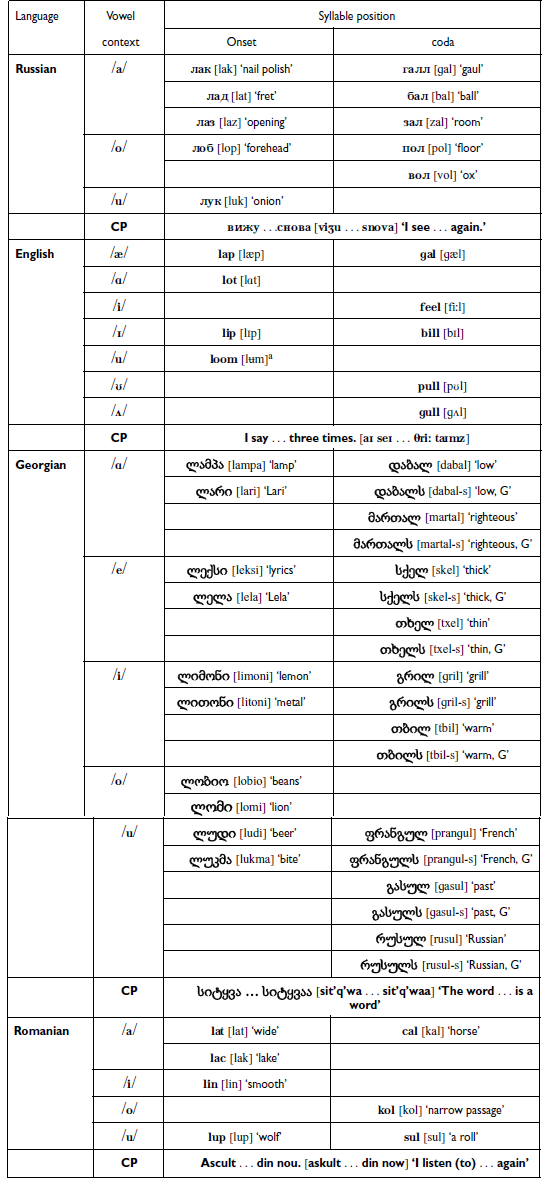
A total of 55 test words (10 Russian, 9 English, 28 Georgian and 8 Romanian) involving variable vowel contexts (both front and back vowels) were included in the study. The complete list of test words is given in Table 1. Each word was embedded in a 4-syllable carrier phrase (CP) and presented on a computer screen, written in the orthography of each language. Three repetitions of each phrase were elicited in three randomized blocks. Due to either errors or technical issues, 27 tokens were discarded (7 Russian, 9 English, 11 Georgian) resulting in a total of 1014 /l/ tokens that were analyzed.
Complete list of test words per Language, Syllable Position and Vowel context, with the carrier phrase in each language

a The transcription [lʉm] is used here to reflect the fronted quality of the vowel typically observed due to u-fronting. However, two speakers in the dataset produced a more backed variant, with F2 values around 1200Hz, indicating less fronting.
2.3. Data processing and analysis
All acoustic files were hand segmented in Praat (Boersma & Weenink Reference Boersma and Weenink2024) based on the waveforms and wide-band spectrograms. For onset laterals, the left boundary was identified at the beginning of the stable periodic cycle on the waveform, corresponding with the stable formant pattern on the spectrogram. The right boundary was marked at the point where the formant intensity of the subsequent vowel increased. In the case of coda laterals, the end of the visible formant structure on the spectrogram corresponded to the end of the postvocalic /l/. The boundary between the vowel and the coda lateral was more difficult to identify, particularly for darker /l/ sounds, and was determined by decreases and increases of amplitude profiles on the waveform. Figure 1 shows examples of these segmentation criteria for Russian onset dark /l/ in лук [luk] ‘onion’ and for Romanian coda light /l/ in cal [kal] ‘horse’.
Segmentation of Russian onset dark /l/ (лук [luk] ‘onion’) and Romanian coda light /l/ (cal [kal] ‘horse’). The boundary between the lateral and the vowel is marked in yellow.

Figure 1 Long description
The image contains two sets of graphs comparing the acoustic properties of Russian onset dark l and Romanian coda light l. Each set includes three graphs: a waveform, a spectrogram, and a segmentation. The waveform graphs display the amplitude of the sound over time, with the Russian onset dark l on the left and the Romanian coda light l on the right. The spectrograms show the frequency components of the sound over time, with the Russian onset dark l on the left and the Romanian coda light l on the right. The segmentation graphs indicate the boundary between the lateral consonant and the vowel, marked in yellow. The Russian onset dark l is represented by the word 'luk' (onion), and the Romanian coda light l is represented by the word 'cal' (horse). The graphs illustrate the differences in the acoustic properties of these lateral consonants in the two languages.
Given that laterals are complex segments with both vocalic and consonantal gestures, we moved beyond static segmental measures to a parametric approach, as advocated by Plug and Ogden (Reference Plug and Ogden.2003). We analyzed formant transitions in lateral-vowel (LV) and vowel-lateral (VL) sequences. This approach allows for a more comprehensive examination of formant transitions across the entire sequence and has been used in previous studies to analyze coda liquids (Plug & Ogden Reference Plug and Ogden.2003; Nance Reference Nance2014; Stuart-Smith et al. Reference Stuart-Smith, Lennon, Macdonald, Robertson, Sóskuthy, José and Evers2015; Nance et al. Reference Nance, Dewhurst, Fairclough, Forster, Kirkham, Nagamine, Turton and Wang.2023).
Formant tracking for the first two formants (F1 and F2) was conducted semi-automatically using FastTrack (Barreda Reference Barreda2021). The third formant (F3) is also a relevant parameter, as stated in Section 1.1. However, it was eventually excluded from the present analysis due to the unreliability of its automatic extraction for all 4 languages, and particularly for Georgian laterals, where most F3 measurements were incorrectly identified. Manual correction or extraction was also problematic. We thus focused on the first two formants. F1 and F2 measurements were taken every 2ms throughout the LV and VL sequences. Due to differences in duration between these sequences, we developed a custom Python script to downsample the data to obtain 20 equidistant measurement points per sequence. A total of 173 tokens (38 Russian, 17 American English, 103 Georgian and 15 Romanian) required manual correction of formant measures. Additionally, static measurements were extracted at the midpoint of the lateral.
Static measures were analyzed using linear mixed models (lme4 package, Bates et al. Reference Bates, Mächler, Bolker and Walker2015). Post-hoc comparisons were conducted using estimated marginal means from the emmeans package in R (Lenth & Piaskowski Reference Lenth and Piaskowski.2024). The model included a three-way interaction among Language, Syllable position and Vowel context, along with Gender as predictors. Random intercepts were Participant, Word and Repetition Block. This analysis specifically compared onset vs. coda patterns, allowing for direct examination of syllable position effects.
To assess differences in F2-F1 values we fitted General Additive Mixed Models (GAMMs) across the whole LV and VL sequences instead of focusing on the isolated lateral. GAMMs are a statistical approach that assesses both linear and non-linear effects. This approach has been increasingly adopted for analyzing speech production data, both acoustic (Wu Reference Wu2024; Stuart-Smith et al. Reference Stuart-Smith, Lennon, Macdonald, Robertson, Sóskuthy, José and Evers2015), and articulatory (Nance et al. Reference Nance, Dewhurst, Fairclough, Forster, Kirkham, Nagamine, Turton and Wang.2023; Popescu & Noiray Reference Popescu and Noiray2021; Gorman & Kirkham Reference Gorman and Kirkham2020; Carignan et al. Reference Carignan, Hoole, Kunay, Pouplier, Joseph, Voit, Frahm and Harrington2020). The model was fitted using the function bam from the mgcv package (Wood Reference Wood2011; Reference Wood2017) in R Statistical Software (v4.4.1, R Core Team 2024). The function gam.check was employed to assess the normality of the residuals’ distribution, to check for heteroscedasticity, and to evaluate the adequacy of the k parameter, which determines the maximum non-linearity of the fitted smooths. The main predictor was an ordered interaction variable (LSV.ord) between Language (Russian, English, Romanian, Georgian), Syllable Position (onset, coda) and Vowel Position (front, back). The random smooth structure included by-trajectory slope smooths per participant for Syllable Position, Vowel Position and Repetition Block (Block 1, 2 or 3). Tensor smooths for measurement point (measurementNb) and duration were added to account for differences in LV and VL duration. To account for autocorrelations in our data we used an AR1 model with rho estimated as the autocorrelation at lag 1. Due to the inherent differences in the temporal structure of the LV and the VL sequences, this dynamic analysis could not directly compare onset vs. coda syllable positions, instead focusing on the effect of vowel context. For modeling our data with GAMMs, we followed Sóskuthy (Reference Sóskuthy2017) and Wieling (Reference Wieling2018). Datasets and model scripts are provided in the supplementary material.
3. Results
Results will be presented in two stages. First, we present a descriptive analysis of the data, focusing on the static measures (formant values at the midpoint of the /l/). Second, we offer a dynamic analysis of formant trajectories in lateral-vowel and vowel-lateral sequences.
3.1. Static analysis
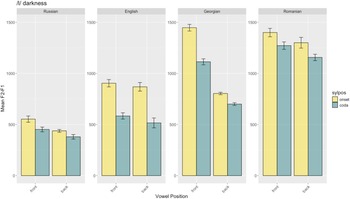
Figure 2 illustrates the mean F2-F1 over all speakers for each language as a function of syllable position and vowel context. A small F2-F1 difference indicates a dark /l/.
Mean F2-F1 values as a function of syllable position (onset vs. coda) and vowel context (front vs. back) for each of the languages (Russian, English, Georgian and Romanian). Error bars indicate −/+ one standard deviation (SD) around the mean F2-F1 value.
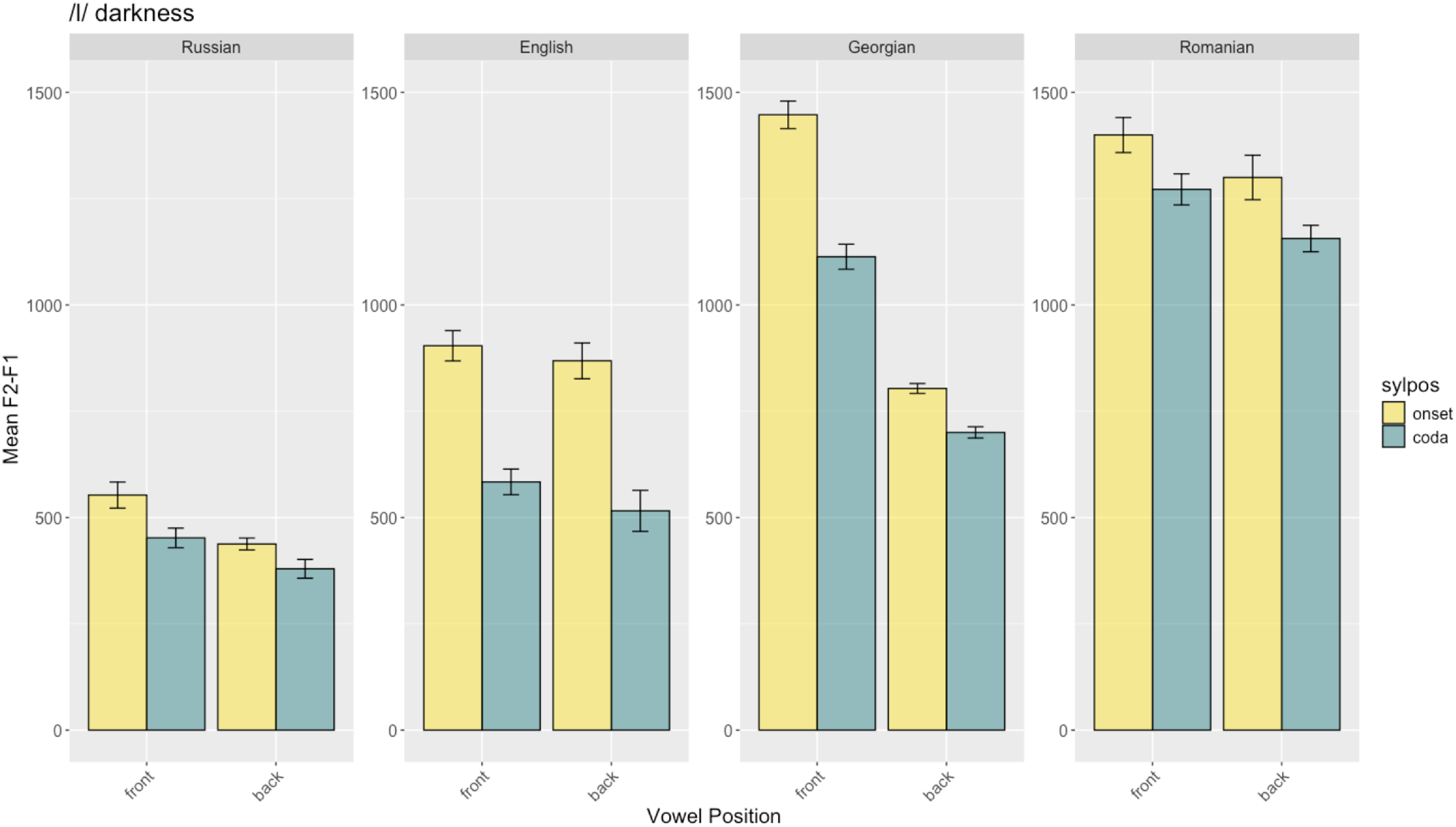
Figure 2 Long description
The bar graph compares mean F2-F1 values for the languages Russian, English, Georgian, and Romanian, showing variations by syllable position (onset vs. coda) and vowel context (front vs. back). The x-axis represents vowel position with categories front and back, while the y-axis represents mean F2-F1 values ranging from 0 to 1500. Each language is represented by two sets of bars, one for onset and one for coda positions, with yellow and blue colors respectively. Error bars indicate plus one standard deviation around the mean F2-F1 value. In Russian, the values are lower overall, with onset positions slightly higher than coda positions. In English, the values are higher, with front vowel positions showing greater differences between onset and coda. Georgian shows the highest values, particularly for front vowel positions in onset. Romanian displays intermediate values, with noticeable differences between onset and coda positions. All values are approximated.
First, some consistent patterns are observed across all four languages. In all languages, /l/ tends to be darker in coda position than in onset position—even in languages where no positional allophones are reported. Additionally, /l/ is never lighter in the context of a back V than adjacent to a front vowel. Focusing on the differences between languages, several patterns can be observed. First, /l/ darkness is gradient across the four languages. Russian exhibits the darkest laterals overall, regardless of syllable position, with mean F2-F1 values between 370 and 550Hz. Romanian has the lightest laterals, with values ranging from 1150 to 1400Hz. English has the second darkest laterals, with mean F2-F1 values of 500 to 900Hz. Georgian displays the most variable distribution of lateral allophones with values spanning from 700 to 1450Hz. Second, languages can be separated in two groups: Russian and Romanian, which exhibit lower variability based on syllable position and vowel context; and English and Georgian, where a positional and phonetic allophonic variation can be observed. English shows a clear difference between onset and coda /l/ in both vowel contexts. Georgian shows instead both an effect of vowel context and of syllable position. In Georgian, onset /l/ is lighter than coda /l/, but /l/ in a front vowel context is lighter than /l/ in a back vowel context, consistent with existing descriptions of the language (Robins & Waterson Reference Robins and Waterson1952).
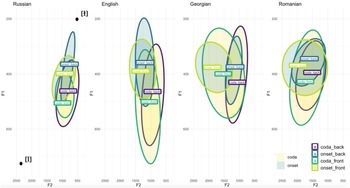
Figure 3 illustrates the distribution of onset and coda laterals across Russian, English, Georgian, and Romanian, as a function of vowel context (front vs. back). Hypothetical light/dark /l/ ([l]/[ɫ]) are shown in the first quadrant. The ellipses, representing 95% confidence intervals, highlight cross-linguistic differences in the F1-F2 space. A high degree of overlap indicates minimal allophonic variation, while distinct patterns reveal language-specific differences. First, coda /l/ shows more variation across all four languages, with larger ellipses (yellow-filled) indicating greater variation. Second, Russian and Romanian exhibit a higher degree of overlap compared to English and Georgian. The ellipses for Russian and Romanian are positioned differently: Russian ellipses are on the right of the F2-F1 space, while Romanian ellipses are on the left, reflecting the /l/ darkness contrast between the two languages. In contrast, English and Georgian show less overlap, and their patterns differ. For English, the main variation occurs along the syllable position dimension, with coda /l/ (yellow-filled ellipses) positioned lower than onset /l/ (blue-filled ellipses). In Georgian, the primary distinction is driven by vowel context, with a V-shaped pattern distinguishing front from back vowel contexts.
Ellipse plots of Onset (yellow) and Coda (blue) laterals for each language as a function of vowel (front vs. back) context. Ellipses show two standard deviations (95% confidence interval) around the mean of the Syllable position * Vowel Context interaction variable for each level (coda_back, onset_back, coda_front and onset_front). Hypothetical light/dark /l/ ([l]/ ) are shown in the first quadrant.
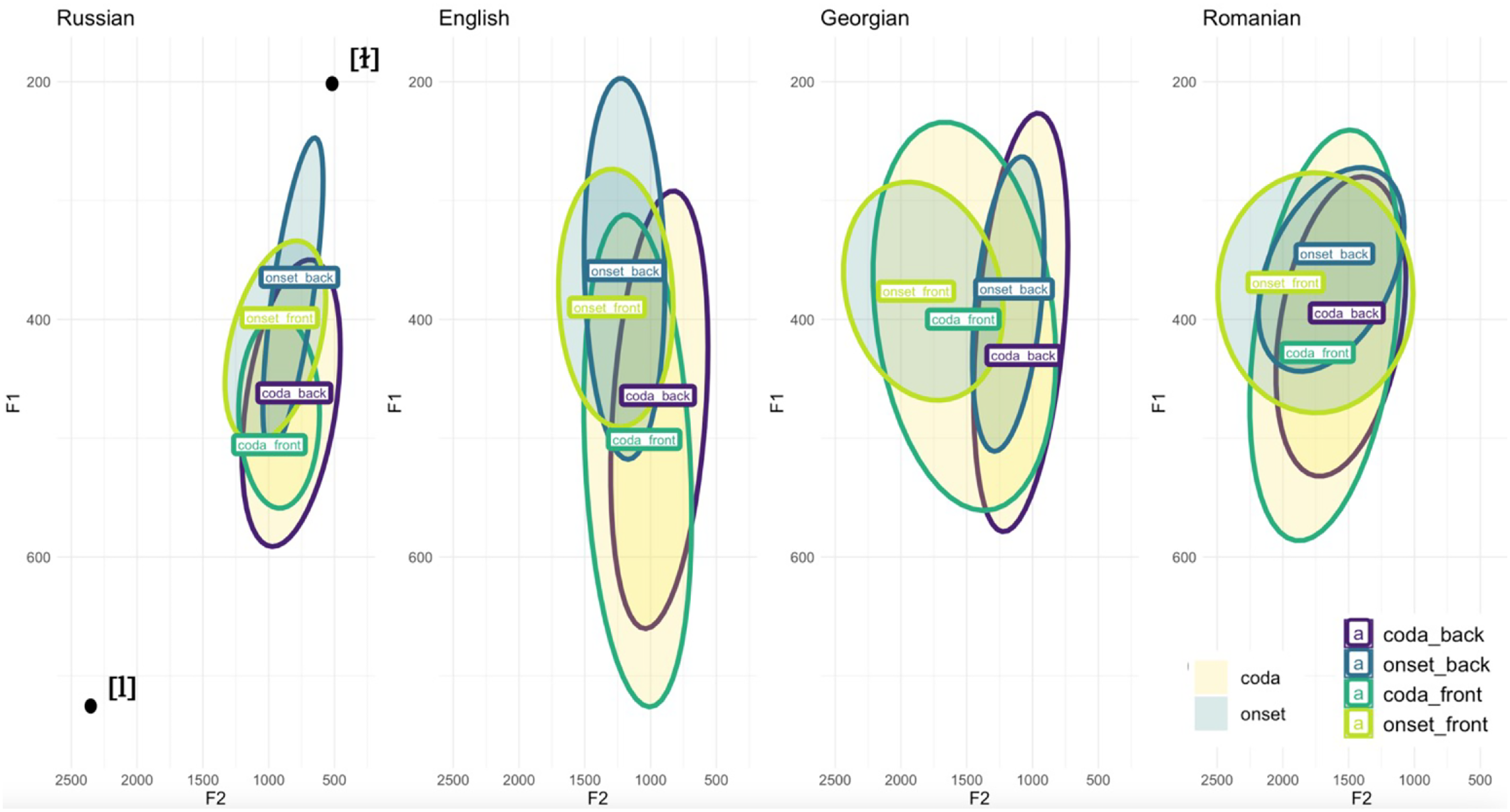
Figure 3 Long description
Four ellipse plots compare Onset and Coda laterals across Russian, English, Georgian, and Romanian languages. Each plot shows two standard deviations around the mean of the Syllable position * Vowel Context interaction variable for each level: coda_back, onset_back, coda_front, and onset_front. The ellipses are color-coded with yellow for Onset and blue for Coda. Hypothetical light and dark l sounds are depicted in the first quadrant. The plots illustrate how lateral consonants vary based on vowel context and syllable position across different languages.
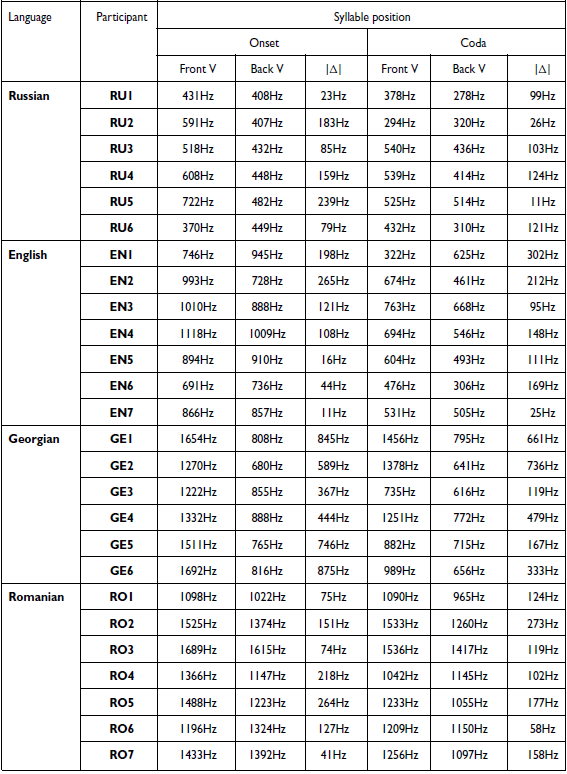
Table 2 gives a more detailed account of inter-speaker variability. For each speaker, mean F2-F1 values are presented per language, syllable position and vowel context. |Δ| values indicate the absolute difference between front and back vowel contexts in onset and coda position. Georgian |Δ| values include both mono- and disyllabic words. A t-test comparing the F2-F1 values of mono- vs. disyllabic words revealed no significant difference (t = −1.0641, df = 315.81, p-value = 0.2881). Consequently, the subsequent analysis will not differentiate between the two word length categories.
Mean F2-F1 values for each speaker, categorized by language, syllable position, and vowel context.
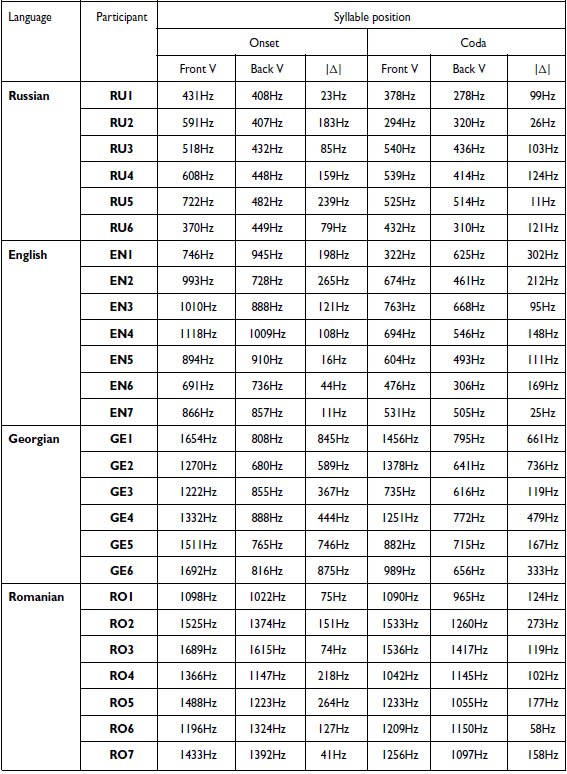
Table 2 Long description
A table with six columns and twenty rows. The columns are labeled Language, Participant, Syllable position, Onset, Coda, and Front V Back V. The table presents mean F2-F1 values for each speaker categorized by language, syllable position, and vowel context. The languages included are Russian, English, Georgian, and Romanian. Each language has multiple participants with their respective F2-F1 values listed for onset and coda positions in both front and back vowel contexts. Notable trends include significant variations in F2-F1 values across different languages and participants. For instance, Georgian shows the highest F2-F1 values in both onset and coda positions compared to other languages. The table also indicates that Georgian values include both mono- and disyllabic words, with no significant difference found between them.
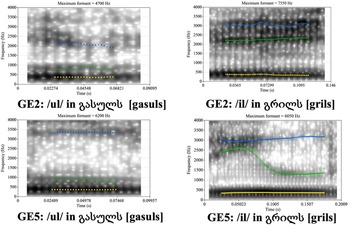
There is by-speaker variability for all languages. However, while inter-speaker variability follows the predicted patterns for Russian, English, and Romanian, distinct patterns can be observed for Georgian speakers. In both Russian and Romanian, the F2-F1 differences are below 200Hz across syllable position (onset vs. coda) and vowel type (front vs. back), suggesting that the observed variability in F2-F1 is due to intrinsic factors, and that the laterals in these two languages can be classified as intrinsic allophones. In English, the influence of vowel type in both onset and coda positions does not result in F2-F1 variations exceeding 300Hz, the threshold proposed by Recasens (Reference Recasens2012). This suggests that variation in English also arises from phonetic context rather than extrinsic allophony. However, the differences between onset and coda position in English surpass Recasens’ (Reference Recasens2012) 200/300Hz threshold, indicating that for our speakers, English exhibits extrinsic lateral allophones based on syllable position. As presented in Section 1.3, Georgian lateral allophony has been reported for onsets only, as a function of vowel context (Robins & Waterson Reference Robins and Waterson1952), based on one speaker. In our data, the allophony seems to occur in coda positions as well, but not for all speakers. While speakers GE3 and GE5 make no distinction in /l/ darkness between coda laterals in front vs. back vowel contexts, participants GE1, GE2 and GE4 produce clearly distinct allophones in coda position, with differences in mean F2-F1 measures of above 500 Hz. Figure 4 illustrates these patterns for speakers GE2 (light-dark distinction) and GE5 (only dark /l/ variants). The spectrograms in the figure, which represent the image winners of the FastTrack algorithm (Barreda Reference Barreda2021), highlight these distinctions.
Spectrograms (image winners generated by FastTrack – Barreda, Reference Barreda2021) of vowel-lateral sequences in two vowel contexts (/i/ and /u/) for two speakers. Speaker GE2 exhibits a clear allophonic distinction, while speaker GE5 does not.

Figure 4 Long description
Four spectrograms display vowel-lateral sequences in Georgian for two speakers, GE2 and GE5, in two vowel contexts, i and u. Each spectrogram shows frequency on the y-axis and time on the x-axis, with formant frequencies highlighted in different colors. Speaker GE2 exhibits a clear allophonic distinction between the sequences, visible through distinct formant patterns, while speaker GE5 does not show such a clear distinction. The spectrograms for GE2 in the context of the vowel u show three prominent formants, with the first formant around 300 Hz, the second around 1500 Hz, and the third around 2500 Hz. In the context of the vowel i, the formants are higher, with the first around 400 Hz, the second around 2000 Hz, and the third around 3000 Hz. For GE5, the formants in the context of the vowel u are similar to those of GE2, but the distinction is less clear. In the context of the vowel i, the formants are also higher, but the allophonic distinction is not as pronounced. The maximum formant frequencies differ slightly between the spectrograms, with GE2 showing a maximum of 4700 Hz and 7550 Hz, and GE5 showing a maximum of 6200 Hz and 6050 Hz. The spectrograms highlight the variation in lateral consonant realization influenced by linguistic and social factors.
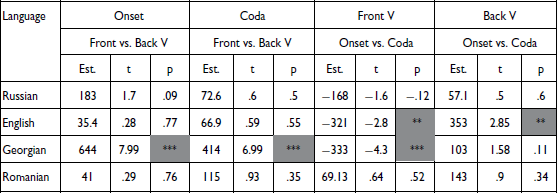
To statistically confirm the described patterns, we conducted a linear mixed model analysis on the same dataset (data and model are available in the supplementary material). The model has a marginal effect size of R2m = 64.3%, representing the variation explained by the fixed effects alone and a conditional effect size of R2c = 78.3%, which accounts for the combined influence of both fixed and random effects. Table 3 contains the results of the linear mixed model.
Results of the linear mixed model predicting F2-F1 values as a function of the interaction variable language*syllable position*vowel context. Significance codes: ‘***’ < 0.001 ‘**’ < 0.01 ‘*’ < 0.05

Table 3 Long description
A table displaying the results of a linear mixed model predicting F2-F1 values as a function of language, syllable position, and vowel context. The table includes data for Russian, English, Georgian, and Romanian, with columns for onset and coda positions, front and back vowels, and comparisons between them. Each cell contains estimated values, t-values, and p-values, indicating the significance of the results. Notable trends include significant differences in F2-F1 values for Georgian across all comparisons, while Russian and Romanian show fewer significant differences.
The results confirm the absence of positional and vowel context allophony for Russian and Romanian, and the presence of syllable position allophony for English with darker /l/ in coda position than in onset position in both front and back vowel contexts. The results show that Georgian lateral allophony is dependent on vowel context in both syllable positions, with laterals adjacent to front vowels being lighter than those adjacent to back vowels.
3.2. Dynamic account
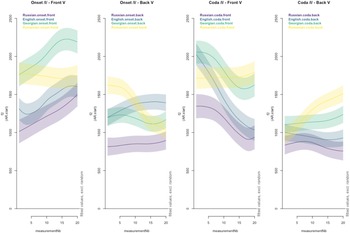
While formant measures taken at fixed points provide valuable insights into the allophonic variation of laterals, offering a snapshot of key articulatory and acoustic characteristics, the dynamic analysis provides a more holistic interpretation. We next report on dynamic measures of formant trajectories in lateral-vowel and vowel-lateral sequences. Figure 5 illustrates the F2-F1 LV and VL trajectory smooths for all four languages. The different panels correspond to the different syllable position and vowel position contexts.
F2-F1 trajectory smooths for each language. The different panels represent the different syllable position and vowel context comparisons.

Figure 5 Long description
The image contains four line graphs comparing F2-F1 trajectory smooths for lateral consonants in Russian, English, Georgian, and Romanian. Each graph represents different syllable positions and vowel contexts. The x-axis shows the measurement number, ranging from 0 to 20, while the y-axis indicates the F2-F1 values, ranging from 0 to 2500. The graphs are color-coded: Russian in blue, English in green, Georgian in yellow, and Romanian in purple. Each line represents the trajectory of lateral consonants in different contexts: onset front, onset back, coda front, and coda back. The trajectories show variations in formant frequency values, highlighting differences in the realization of lateral consonants across the four languages. The smooths illustrate how the lateral l varies from light to dark, contributing to a typology of l realization. The graphs indicate that the formant differences between positional allophones are influenced by both intrinsic and extrinsic factors, as proposed by Recasens (2012). The trajectories provide insights into the gradience of l darkness and the phonological patterns specific to each language. All values are approximated.
Several clear patterns emerge from the data. First, concerning vowel quality, there is greater variability in front vowels compared to back vowels across the four languages. In the front vowel panels (leftmost and second-to-right panels), the smooth trajectories exhibit a lower degree of overlap for the first (onset) and last (coda) measurement numbers. In contrast, back vowel contexts (second and rightmost panels) show more overlap indicating similar back vowel quality across the four languages.
Second, dynamic trajectories confirm gradual variation in /l/ darkness across languages. The smooths reveal a hierarchy in /l/ darkness, with Russian (purple) displaying the darkest laterals (lowest F2-F1 measures) across all conditions, followed by English (blue), Georgian (green) and Romanian (yellow). This pattern is particularly pronounced in the back vowel contexts, where the F2-F1 values for Romanian remain consistently higher than those of the other languages. Third, the Georgian vowel-context allophony is evident. In onset front vowel context (leftmost panel), Georgian laterals pattern closely with Romanian laterals, as evidenced by the overlap between the green and yellow curves. But in onset back vowel context (second panel), Georgian laterals align more closely with English laterals, as shown by the green-blue overlap. In coda front vowel contexts, we observe a yellow-green overlap towards the tail end of the trajectories, indicating that Georgian laterals pattern with Romanian ones (i.e., they are light). Finally, in coda back vowel contexts (rightmost panel), Georgian laterals occupy an intermediate position between Romanian and English. Overall, the figure highlights cross-linguistic differences in lateral articulation while demonstrating the influence of vowel context and syllabic position on /l/ production, particularly for Georgian.
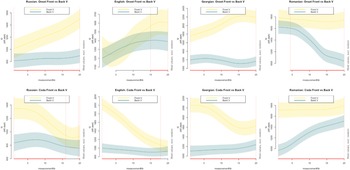
Figure 6 illustrates binary comparisons between front (yellow) and back (blue) vowel contexts in onset (top row) and coda (bottom row) for all four languages. Time windows of significant differences between the smooths are highlighted in red.
Model results – non-linear smooths for front- (yellow) and back-vowel (blue) F2-F1 trajectories (y-axis) for onset (top row) lateral-vowel and coda (bottom row) vowel-lateral sequences. Measurement number is indicated on the x-axis. Highlighted in red are normalized time windows of significant difference between front- and back-vowel smooths.

Figure 6 Long description
Eight line graphs compare front and back vowel F2-F1 trajectories for onset and coda sequences in Russian, English, Georgian, and Romanian. The top row shows onset lateral-vowel sequences, while the bottom row shows vowel-lateral sequences. The x-axis represents measurement numbers, and the y-axis represents F2-F1 trajectories. Front vowels are depicted in yellow, and back vowels are depicted in blue. Red highlighted areas indicate normalized time windows of significant differences between front and back vowel smooths. The graphs illustrate how F2-F1 trajectories vary across different languages and vowel positions.
In onset position (top row), Russian and Georgian are two languages that display significant differences between the front and back vowel trajectory smooths throughout the LV sequence, indicative of coarticulatory effects. While there is some overlap in Russian, the trajectories in Georgian are markedly distinct, suggesting not merely a coarticulatory effect, but also the presence of extrinsic allophones. In Romanian lateral-vowel sequences, F2-F1 values do not differ significantly between the front and back vowel contexts at the onset of the trajectories (i.e., the lateral portion). However, as the sequence progresses into the vowel, there is a clear and significant difference in trajectory smooths, as highlighted by the red time window. This suggests that the Romanian light /l/ is more resistant to coarticulation, achieving similar acoustic targets regardless of the following vowel.
English, in contrast, exhibits no significant difference between front and back vowel contexts throughout the entire lateral-vowel sequence. This finding may seem surprising, as it suggests no distinction between the vowels themselves. It could, however, be attributed to the use of the F2-F1 measure and to the fact that English stimuli involve more centralized vowels compared to the other three languages. More specifically, the inclusion of loom in our stimuli may have influenced results, given that /u/-fronting has been observed in most North American dialects (Labov, Ash & Boberg Reference Labov, Ash and Boberg2006; Havenhill Reference Havenhill2024). Nevertheless, we retained the word loom as a representative of the back vowel context, two of the speakers produced notably more backed variants with F2 values around 1200Hz, well below the range expected for front vowels.
In coda position (bottom row), only English shows no significant differences toward the tail end of the VL trajectories, suggesting that dark /l/ is resistant to coarticulatory effects, achieving consistent acoustic targets. In opposition to the onset stimuli, in coda there is a clear distinction between vowels contexts in English. In contrast, Russian, Georgian and Romanian exhibit differences across the entire VL sequence, pointing to coarticulatory influences of the vowel on the lateral. Georgian smooths are more separated that those in Russian and Romanian, albeit to a lesser extent that in onset position, hinting at some degree of extrinsic allophonic variation in coda /l/, in addition to the more pronounced one in onset /l/.
4. Discussion
The aim of this study was to provide a comprehensive cross-language comparison of lateral consonant allophony, focusing on Russian, English, Georgian and Romanian, selected for their varying degrees of /l/ darkness/lightness. The four languages represent the three broad categories of /l/ positional allophones, as described by Recasens and Espinosa (Reference Recasens and Espinosa2005). Russian consistently exhibits only dark /l/ in all syllable positions, while Romanian only light /l/. English and Georgian display both varieties, though their positional allophony differs. In English the allophony is determined by syllable position, with lighter /l/ occurring in onset and darker /l/ in codas. In Georgian, on the other hand, vowel-context allophony shows lighter /l/ appearing before and after front vowels, and darker /l/ before and after back vowels. To investigate these reported patterns, recordings were made of 26 native speakers, with 6 to 7 speakers per language, producing target words embedded in carrier phrases. The acoustic signal was analyzed using both traditional methods, such as static formant measures at the midpoint of the lateral, and dynamic methods, examining formant transitions throughout lateral-vowel and vowel-lateral sequences.
The findings of the study are multifold. First, we find, as previously stated in the literature, that /l/ darkness exists on a continuum. Across the four languages examined here, Russian exhibits the darkest laterals, followed by English, Georgian and Romanian, which has the lightest laterals. While our results align with previous studies in showing that the effect of syllable position does not reach statistical significance in Russian or Romanian, we also observe consistent directional trends across all four languages. Specifically, F2-F1 values tend to be higher in syllable onset than in coda position, and higher in front vowel contexts than in back vowel contexts. Although the magnitude of these effects varies, and often falls below statistical or phonetic thresholds for extrinsic allophony, their uniform direction across languages suggests underlying phonetic influences that shape lateral production more broadly. This reinforces evidence for a more gradient interpretation of lateral variation, rather than a binary classification of languages with or without positional allophony.
In Russian and Romanian, these directional effects appear to reflect intrinsic variation rather than categorical allophonic patterns: F2-F1 differences remain well below Recasens’ (Reference Recasens2012) proposed thresholds for extrinsic allophony (i.e., below 120Hz for Russian and 145Hz for Romanian), even when coarticulatory influences of vowel type are present. In contrast, in English syllable position influences lateral allophony, as evidenced by our participants, who were predominantly speakers of Midwestern American English. Specifically, onset /l/ tends to be significantly lighter than coda /l/ in this variety (Sproat & Fujimura Reference Sproat and Fujimura1993). For our data, the differences in F2-F1 values exceed the intrinsic/extrinsic thresholds in both front and back vowel contexts, supporting the presence of syllable position based lateral allophony.
Georgian emerges as the most novel result, as previous studies mention only onset lateral allophony based on vowel type. The study by Robins and Waterson (Reference Robins and Waterson1952), conducted through listening sessions with one West Georgian speaker living in London, indicated vowel-based allophony for onset position. However, our present study provides evidence of vowel type based allophony in both onset and coda positions. This result is however modulated by speaker-specificity: three out of six speakers exhibited lighter vs. darker /l/ variants in coda position, with F2-F1 differences exceeding 400Hz, suggesting that for these speakers, vowel-driven lateral allophony may be extrinsic in nature, independent of syllable position. This variation could be due to dialectal differences, but we did not collect dialectal information for our Georgian speakers. All speakers, however, were students under the age of 30, living in Paris at the time of the recording, who did not speak Russian. Further data collection is essential to fully understand the underlying patterns and mechanisms driving lateral allophony in Georgian.
Results indicate that static and dynamic measures provide slightly different perspectives. While overall patterns remain consistent – Russian and Romanian show no allophony, English exhibits syllable position allophony, and Georgian displays vowel-context allophony – differences emerge in coarticulation patterns. For instance, static measures did not detect coarticulatory differences in Russian and Romanian based on vowel context, but dynamic measures revealed subtle effects. In Russian, both onset and coda positions show a small influence of vowel quality, with lighter /l/ in front vowel contexts. For Romanian, onset /l/ was shown to be more resistant to coarticulation than coda /l/.
A limitation of the current study is that it relies exclusively on acoustic data. In future studies, dynamic effects of F3 should also be considered, and in order to comprehensively describe lateral allophony, data collection needs to incorporate articulatory data into the analysis. Ultrasound studies by Gick et al. (Reference Gick, Campbell, Oh and Tamburri-Watt2006) and Archangeli & Berry (Reference Archangeli and Berry2010) reveal that the gestural timing of the double articulation characteristic of laterals – comprising tongue-tip and tongue-body gestures – varies across languages. This difference in timing patterns could have an effect on allophonic and coarticulatory patterns. Collecting and analyzing articulatory data is therefore crucial to uncovering cross-linguistic patterns and the factors influencing them, providing a more complete understanding of lateral articulation and its phonological implications. In the meantime, the present dynamic acoustic results provide us with precise predictions to be tested articulatorily.
5. Conclusion
The present study provides a comprehensive acoustic investigation of lateral allophony across four languages, with a particular focus on the understudied Georgian laterals. By incorporating both classical F2-F1 measurements and dynamic analyses of formant trajectory, the study offers insights into the role of syllable position and vowel context in shaping lateral variation. The results highlight cross-linguistic differences in the production of laterals, as well as a previously unattested characterization of Georgian lateral allophony, expanding our understanding of how intrinsic and extrinsic factors interact in lateral consonant production. The findings contribute to the growing body of research on lateral allophony and underscore the importance of including more underrepresented languages as well as integrating dynamic methods.
Replication package
Supplementary_material.zip: df_static.csv, df_dynamic.csv, static_analysis.R, dynamic_analysis.R, gamm_hacks.r
Acknowledgements
The authors would like to thank audiences at ISSP 2024 in Autrans, France for their valuable feedback, Qianwen Guan for recording two of the Georgian participants, and the speakers who participated in the study.
Supplementary material
To view supplementary material for this article (including audio files to accompany the language examples), please visit https://doi.org/10.1017/S0025100325100868
Competing interest
The authors declare none.
Author contribution
AP designed the study, acquired and analyzed the data. AP and IC wrote the paper. All authors contributed to the article and approved of the final version.



 Open access

