Gestational diabetes mellitus (GDM) refers to any degree of glucose intolerance that occurs or is first discovered during pregnancy(Reference Buchanan, Xiang and Page1). As one of the common complications of perinatal women, GDM has serious impacts on maternal and infant health both in the short term and long term(Reference Alejandro, Mamerto and Chung2–Reference Vounzoulaki, Khunti and Abner6). Birth weight is one of the most common and important neonatal birth outcomes, especially for women with GDM. Evidence from epidemiological studies suggested that birth weight was strongly associated with the risk of obesity from childhood to early adulthood(Reference Hillier, Pedula and Schmidt7–Reference Yu, Han and Zhu9), age-related cognitive dysfunction(Reference Mosing, Lundholm and Cnattingius10), mental health problems in childhood, adolescence and adulthood(Reference Mathewson, Chow and Dobson11) and all-cause mortality in adulthood(Reference Risnes, Vatten and Baker12), among other events.
Maternal nutrition is an important factor influencing fetal growth, neonatal birth size(Reference Goldstein, Abell and Ranasinha13,Reference Li, Liu and Guo14) and the quality of life of the offspring(Reference Koletzko, Brands and Chourdakis15). Nutritional therapy is also the primary treatment for women with GDM to control their blood glucose(Reference Hernandez, Mande and Barbour16) and consequently neonatal birth weight(Reference Kgosidialwa, Egan and Carmody17). As a food with high nutrient density and bioavailability, milk and dairy products are rich in protein. Milk and dairy products are an important dietary source of nutrients such as Ca, P, iodine, vitamin B12, riboflavin, etc., which are very important in the physiological state of a woman’s pregnancy(Reference Haug, Høstmark and Harstad18,Reference Walther, Guggisberg and Badertscher19) . The way of dairy intake during pregnancy and the intake of dairy products have always been a concern of pregnant women. Furthermore, the conclusions of previous studies on the effect of milk and dairy products intake during pregnancy on neonatal birth weight were inconsistent(Reference Achón, Úbeda and García-González20–Reference Miyake, Tanaka and Okubo31). Some studies suggested that milk intake during pregnancy was positively associated with neonatal birth weight(Reference Achón, Úbeda and García-González20–Reference Sartorelli, Carvalho and da Silva Santos29), while Ludvigsson found that milk intake during pregnancy was not associated with neonatal birth weight(Reference Ludvigsson and Ludvigsson30). In addition, a study in Japan indicated that milk intake during pregnancy was negatively correlated with neonatal birth weight(Reference Miyake, Tanaka and Okubo31). Therefore, it is essential to further explore the relationship between milk and dairy products intake during pregnancy and neonatal birth weight.
To the best of our knowledge, there are no studies on the relationship between milk and dairy products intake during pregnancy and birth outcomes in women with GDM. So the aim of this prospective cohort study was to investigate the intake of milk and dairy products during pregnancy in women with GDM and to explore its effect on pregnancy outcomes.
Method
Study design and participants
This study was designed as a prospective cohort study and conducted in Fujian Maternal and Child Health Hospital and Fujian Obstetrics and Gynecology Hospital from January 2022 to June 2023. In this study, a questionnaire was administered by the researcher using a convenience sampling method to pregnant women who underwent antenatal check-ups at this hospital and were diagnosed with GDM. The diagnostic criteria of GDM were as follows(32): For women who were not previously diagnosed with diabetes, a 75 g oral glucose tolerance test was performed at 24–28 weeks of pregnancy. Plasma glucose levels were measured on an empty stomach, 1 h and 2 h after drinking sugar water. The plasma glucose thresholds were 92 mg/dl (5·1 mmol/l), 180 mg/dl (10·0 mmol/l) and 153 mg/dl (8·5 mmol/l) at fasting, 1 h and 2 h after drinking sugar water, respectively. When any of the three test results reaches or exceeds the above plasma glucose value, it could be diagnosed as GDM.
The inclusion criteria for participants were as follows: (1) first diagnosed as GDM, the diagnostic criteria according to the American Diabetes Association issued by the ‘Standards of Medical Care in Diabetes-2022’; (2) aged between 20 and 45 years old, no disturbance of consciousness, who could fill in the questionnaire; (3) regular routine prenatal examination and planned to give birth in the unit of this study; (4) their volunteering to participate in this study. Meanwhile, the exclusion criteria were also as follows: (1) with severe pregnancy complications or complications; (2) suffering from heart, liver, kidney and other important organ diseases; (3) women with GDM treated with hypoglycaemic drugs or insulin; (4) patients with incomplete blood glucose data and pregnancy outcome data during pregnancy.
Sample size estimation
The sample size in this study estimated was based on total caloric food intake of women with GDM with the formula N = (Z1−α/2 × σ)/δ2. Among that, σ is the overall sd, and δ is the allowable error. Our previous study clearly showed the detail of sample size calculation(Reference Chen, Zheng and Liao33). The sample size was calculated as 385 participants in total. And then considering a 10 % turnover rate, 424 participants should be included in the study.
Milk and dairy products intake assessment
All participants completed a questionnaire at 24–30 weeks of gestation that included general information and a FFQ. General information includes social demographic data, reproductive history, disease history, family history, diet and living habits, etc. The FFQ used in this study was designed based on the dietary habits of Chinese people, including 70 food items, involving more than 200 foods, which can well reflect the dietary status of pregnant women(Reference Zhang, Qiu and Zhong34). The investigators asked the subjects about their dietary intake in the past 3 months through face-to-face interviews. Initially, all investigators were trained by nutrition experts on how to use FFQ. We need to be proficient in guiding interpretation terms, data collection content and inquiry skills and adopt consistent investigation order and inquiry methods in the investigation process to ensure the reliability and consistency of the survey data. In the FFQ, milk and its products include whole milk, low-fat milk, milk powder, yogurt and cheese. Daily average food intake weight = (food intake frequency × single consumption weight)/consumption interval days.
When matching the food names in FFQ and the Chinese food composition table, the ‘representative value’ of the food is preferred(Reference Yang35). Therefore, the food name of the FFQ in this study corresponding to ordinary milk in the Chinese food composition table is ‘pure milk (representative value, full fat)’, low-fat milk corresponds to ‘pure milk (representative value, low fat)’, milk powder corresponds to ‘full-fat milk powder (representative value)’, yogurt corresponds to ‘yogurt (representative value, full fat)’ and cheese corresponds to ‘cheese [cheese]’. In order to make the calculated total milk and dairy products intake more accurate, we first evaluated the intake of milk and dairy products in women with GDM through FFQ and then converted dairy products into liquid milk according to the protein content of yogurt, milk powder and cheese in the ‘Chinese Food Composition Table Standard Edition’(Reference Yang35). Finally, the total intake of milk and dairy products was obtained. Among them, 100 g full-fat pure milk contains 3·3 g protein, 100 g milk powder contains 19·9 g protein, 100 g yogurt contains 2·8 g protein and 100 g cheese contains 25·7 g protein. Low-fat pure milk and full-fat pure milk are liquid milk, and the protein content is similar, so they are not converted(Reference Yang35).
Pregnancy outcomes
Pregnancy outcomes include neonatal birth weight, macrosomia, low birth weight (LBW), preterm birth and caesarean section. Newborns weighing less than 2500 g and more than 4000 g were classified as LBW infants and macrosomia, respectively(Reference Blencowe, Krasevec and de Onis36). In addition, newborns less than 37 weeks of gestation were classified as preterm infants.
Statistical analysis
Energy-corrected whole milk, low-fat milk, milk powder, yogurt and cheese were obtained using the residual method(Reference Willett, Howe and Kushi37). Meanwhile, according to the recommended amount of milk (300–500 g/d) in the Dietary Guidelines for Chinese Pregnant Women (2022)(38), the subjects were divided into two groups: insufficient intake of milk and dairy products group (< 300 g/d) and sufficient intake of milk and dairy products group (≥ 300 g/d). The study subjects were divided into two groups based on whether the total intake of milk and dairy products during pregnancy reached 300 g/d. After referring to relevant research, we used age, pre-pregnancy BMI, whether or not primiparous women, smoking history, education level, family per capita monthly income, neonatal sex, the weekly gestational age and total energy intake as confounding factors(Reference Heppe, van Dam and Willemsen22,Reference Hjertholm, Iversen and Holmboe-Ottesen23) . Among these factors, age, the weekly gestational age and total energy intake were used as continuous variables.
The quantitative data were described by mean ± standard deviation ( $\bar x\,$
± s), while the qualitative data were described by absolute value (number, N) and percentage (%). A χ
2 test was used to compare the differences in maternal and neonatal characteristics between groups with or without adequate total maternal milk and dairy intake. Multiple linear regression was used to investigate the relationship between total milk and dairy products consumption during pregnancy and infant size at birth in women with GDM. Binary logistic regression was used to analyse macrosomia, LBW, premature infant and caesarean section. The OR and 95 % CI were estimated for independent variables of regression analyses. A P value of 0·05 or less was considered statistically significant. All statistical analyses were done by SPSS 26.
$\bar x\,$
± s), while the qualitative data were described by absolute value (number, N) and percentage (%). A χ
2 test was used to compare the differences in maternal and neonatal characteristics between groups with or without adequate total maternal milk and dairy intake. Multiple linear regression was used to investigate the relationship between total milk and dairy products consumption during pregnancy and infant size at birth in women with GDM. Binary logistic regression was used to analyse macrosomia, LBW, premature infant and caesarean section. The OR and 95 % CI were estimated for independent variables of regression analyses. A P value of 0·05 or less was considered statistically significant. All statistical analyses were done by SPSS 26.
Result
Characteristics of participants
A total of 450 Chinese women with GDM were included in this prospective study and completed the questionnaire survey. However, fifty-one cases were excluded because they went to other hospitals to give birth and could not obtain pregnancy outcomes or data were incomplete. Additionally, thirteen cases refused to follow-up pregnancy outcomes. Finally, a total of 386 women with GDM were included. The characteristics of the participants are presented in Table 1.
Characteristics of 386 women with gestational diabetes mellitus according to the sufficiency of dairy products intake during pregnancy

OGTT, oral glucose tolerance test.
* Fisher’s exact test.
† Means ± standard errors are presented.
‡ Median (P25, P75) are presented.
t: the statistics of independent sample t test.
χ 2: the statistics of chi-square test.
Bold values indicate that the P value is less than 0·05, indicating statistical significance.
In terms of demographics, the average age of the 386 women with GDM included was 31·7 years old. Most of the pregnant women were Han nationality (96·4 %) and had jobs during pregnancy (74·9 %). About half of the women with GDM had a bachelor’s degree or above (51·6 %). Two-thirds of women with GDM had a monthly income of more than CNY 6000 (67·9 %) (CNY 1 = USD 0·1446). Three-quarters of them lived with their husbands during pregnancy (75·9 %). For personal health, 44·7 % of pregnant women had abnormal pre-pregnancy BMI (underweight/overweight/obesity). Three-quarters of pregnant women were in their first or second pregnancy (75·1 %), 60·6 % were primiparas and 16·3 % had a caesarean section. For the health of the fetus, almost all participants do not have the habit of smoking and drinking (0·5 %). Additionally, 8·29 % of pregnant women had been diagnosed with GDM in a previous pregnancy, 0·8 % of women with GDM had hypertension before pregnancy, and so on. For the oral glucose tolerance test results, 27·2 % of pregnant women with GDM had abnormal fasting plasma glucose, 64·0 and 63·5 % for abnormal blood glucose 1 h and 2 h, respectively. In terms of family disease history, 10·6 % of pregnant women had a family history of obesity, 32·9 % of them had a family history of diabetes and 27·7 % of them had a family history of hypertension. In terms of living habits during pregnancy, most of the pregnant women had exercised during pregnancy (74·9 %) and had extra meals during pregnancy (83·4 %). Besides, participants were only different in terms of education level, parity and caesarean section experience (Table 1). There were no differences in other demographics, personal health, family history and pregnancy habits (Table 1).
Milk and dairy products intakes in women with gestational diabetes mellitus
Among the 386 women with GDM who participated in the survey in the second trimester pregnancy, the total milk and dairy products intake was 317·8 ± 179·5 g/d, the total energy intake was 1635·4 ± 708·7 kcal/d, the total protein intake was 86·2 ± 36·9 g/d, the total fat intake was 44·5 ± 23·5 g/d and the total carbohydrate intake was 220·7 ± 111·3 g/d. In this study, the energy intake percentage of protein, fat and carbohydrate in women with GDM was 21·59, 24·96 and 53·80 %, respectively.
In total, in the second trimester pregnancy, 197 pregnant women (51·0%) had sufficient intake of milk and dairy products (≥ 300 g/d), and 189 pregnant women (48·9%) had insufficient intake of milk and dairy products (< 300 g/d). The average daily intake of milk and dairy products, total protein, total fat and total carbohydrate had a significant difference between sufficient and insufficient milk intake groups; however, the average daily energy intake had no significant difference between the two groups. Among that, the average daily intake of milk and dairy products in the sufficient group was 459·8 ± 117·7 g, while it was 169·8 ± 91·5 g in the insufficient group (Fig. 1). The average daily energy intake in the sufficient group was 1626·4 ± 653·8 kcal, and that reached 1644·8 ± 763·4 kcal in the insufficient group (Fig. 2). The average daily intake of protein, fat and carbohydrate in the sufficient group was 90·5 ± 2·6 g, 46·7 ± 1·4 g and 208·0 ± 6·9 g, respectively, while in the insufficient group, it was 81·8 ± 2·7 g, 42·3 ± 1·9 g and 234·0 ± 9·0 g, respectively. The energy intake percentages of protein, fat and carbohydrate in women with GDM with sufficient intake of milk and dairy products were 22·85, 26·68 and 50·70 %, respectively, while in women with GDM with insufficient milk and dairy intake, they were 20·28, 23·16 and 57·05 %, respectively (Table 1). All detail is presented in Table 1.
Total milk intake in sufficient and insufficient intake groups.

Total energy intake in sufficient and insufficient intake groups.

Pregnancy outcomes in women with gestational diabetes mellitus
Table 1 also shows all results for pregnancy outcomes. Among the newborns delivered by women with GDM included in this study, 56·5 % were boys, and 43·5 % were girls. The average birth weight of newborns was 3219·15 ± 462·11 g, of which 3·9 % were macrosomia, 4·9 % were LBW infants and 8·3 % were premature infants. Additionally, 45·6 % of pregnant women were caesarean section. Overall, the neonatal birth weight in the sufficient milk and dairy products intake group was lower than that in the insufficient milk and dairy products intake group (P = 0·02). The risk of macrosomia in the sufficient milk and dairy products intake group was lower than that in the insufficient milk and dairy products intake group (P = 0·01), while the risk of caesarean section in the insufficient milk and dairy products intake group was higher than that in the sufficient milk and dairy products intake group (P = 0·009). However, there was no difference in the incidence of weekly gestational age (P = 0·59), premature birth (P = 0·90) and LBW between the two groups (P = 0·59) (Table 1).
Maternal intake of milk and dairy products is inversely associated with birth weight in women with gestational diabetes mellitus
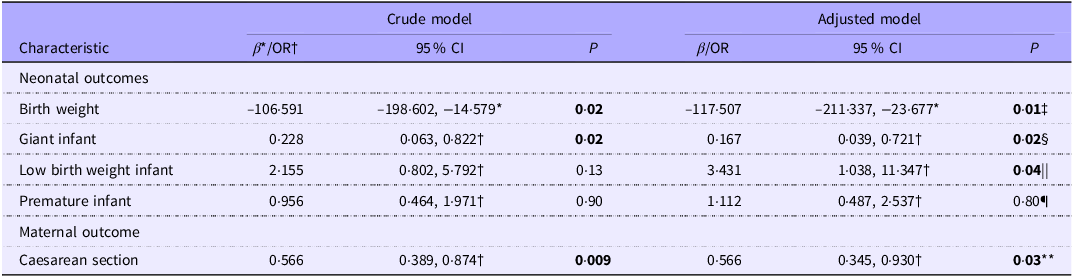
We further explored the relationship between sufficient intake of milk and dairy products during the second trimester pregnancy in women with GDM and neonatal birth weight via linear regression and used the β-coefficient to measure the effect of total intake of milk and dairy products on birth weight. The results of the initial model showed that in the second trimester pregnancy, the birth weight of infants born to women with GDM with sufficient daily milk and dairy products intake (≥ 300 g) was 106·6 g lower than that of women with GDM with insufficient milk and dairy products intake (95 % CI −198·602, −14·579; P = 0·02) (Table 2). In the calibration model, we adjusted for age, pre-pregnancy BMI, whether or not primiparous woman, smoking history, education level, family per capita monthly income, neonatal sex, the weekly gestational age and total energy intake during the second trimester pregnancy. We similarly found that in the second trimester pregnancy, women with GDM who consumed more than 300 g of milk and dairy products per d had an average reduction in birth weight of 93·1 g compared with women with GDM who consumed less than 300 g of milk (95 % CI −171·343, −14·927; P = 0·02) (Table 2).
The association between pregnancy outcome and the sufficiency of dairy products intake in gestational diabetes mellitus women

Bold values indicate that the p-value is less than 0.05, indicating statistical significance.
* β-coefficient and CI (95 % CI).
† OR and CI (95 % CI).
‡ Adjusted model: adjusted for age, BMI, ethnicity, education level, work during pregnancy, family per capita monthly income, family history of obesity, family history of diabetes, whether there is gestational diabetes mellitus (GDM) before pregnancy, whether exercise during pregnancy, whether to add meals during pregnancy, total energy intake and oral glucose tolerance test (OGTT) results.
§ Adjusted model: adjusted for age, BMI, education level, pregnancy work, family per capita monthly income, GDM before pregnancy, abnormal lipid metabolism before pregnancy, whether exercise during pregnancy, whether to eat during pregnancy, neonatal sex, total energy intake and OGTT results.
|| Adjusted model: adjusted for age, BMI, parity, nationality, education level, pregnancy work, family per capita monthly income, family history of obesity, GDM before pregnancy, thyroid metabolic disease, whether exercise during pregnancy, whether meals during pregnancy, neonatal sex, total energy intake and OGTT results.
¶ Adjusted model: adjusted for age, BMI, parity, education level, pregnancy work, family per capita monthly income, husband and wife living together, family history of obesity, family history of hypertension, GDM before pregnancy, history of hypertension before pregnancy, abnormal liver and kidney function before pregnancy, abnormal lipid metabolism before pregnancy, thyroid metabolic disease, whether exercise during pregnancy, whether to add meals during pregnancy, total energy intake and OGTT results.
** Adjusted model: adjusted for age, BMI, parity, caesarean section experience, education level, work during pregnancy, family per capita monthly income, GDM before pregnancy, history of hypertension before pregnancy, thalassaemia before pregnancy, thyroid metabolic disease, exercise during pregnancy, total energy intake and OGTT results.
Relationship between sufficient intake of milk and dairy products and pregnancy outcomes in women with gestational diabetes mellitus
We also explored the relationship between sufficient intake of milk and dairy products during the second trimester pregnancy and pregnancy outcomes in women with GDM via logistic regression. The results showed that in the second trimester pregnancy, the sufficient intake of milk and dairy products could reduce the risk of macrosomia in women with GDM, and the differences were statistically significant both in the crude model (OR 0·228; 95 % CI 0·063, 0·822; P = 0·02) and the adjusted model (OR 0·174; 95 % CI 0·043, 0·695; P = 0·01) (Table 2). This model was adjusted for age, pre-pregnancy BMI, whether or not primiparous woman, smoking history, education level, family per capita monthly income, neonatal sex, the weekly gestational age and total energy intake during the second trimester pregnancy. However, sufficient milk and dairy products intake during the second trimester pregnancy was not associated with the risks of LBW infants (P = 0·17) and preterm birth (P = 0·23) in women with GDM (Table 2).
In addition, sufficient milk and dairy products intake during the second trimester pregnancy could reduce the risk of caesarean section in women with GDM, and the difference was statistically significant both in the crude model (OR 0·583; 95 % CI 0·389, 0·874; P = 0·009) and the adjusted model (OR 0·601; 95 % CI 0·387, 0·933; P = 0·02) (Table 2).
Discussion
In this prospective study, we found that sufficient intake of milk and dairy products during the second trimester pregnancy in women with GDM was inversely associated with neonatal birth weight. The lower the birth weight of an infant born by a woman with GDM, the greater the intake of milk and dairy products (≥ 300 g/d) during the second trimester pregnancy. At the same time, women with GDM with sufficient milk and dairy products intake during the second trimester pregnancy have a lower risk of giving birth to macrosomia. In addition, the risk of caesarean section is also lower in the sufficient milk and dairy products intake group than that in the insufficient milk and dairy products intake group. However, sufficient dairy intake during the second trimester pregnancy was not associated with the risk of giving birth to LBW infants and preterm infants in women with GDM. These results were contrary to the results of most previous studies on the effect of milk and dairy intake on the birth weight of pregnant women in general.
It is well known that nutritional therapy is the first line of treatment for GDM(Reference Hernandez, Mande and Barbour16). Some studies have shown that the maternal dietary factors that most significantly affect birth weight are energy and protein intake(Reference Cucó, Arija and Iranzo39–Reference Mousa, Naqash and Lim41). Several studies have shown that total energy intake during pregnancy is positively associated with neonatal birth weight(Reference Mousa, Naqash and Lim41–Reference Reyes-López, González-Leyva and Rodríguez-Cano45). Appropriate energy intake during pregnancy in women with GDM is required to meet the physiological and metabolic needs of the pregnant woman herself and the fetus in order to maintain appropriate gestational weight gain and to achieve and maintain reasonable blood glucose levels. According to the Dietary Guidelines for Patients with Gestational Diabetes Mellitus, the recommended additional daily calorie intake for women with GDM in China is 0 kcal, 300 kcal and 450 kcal in the early, middle and late stages of pregnancy, respectively(46). However, 76·68% of women with GDM in this study did not meet the recommended total energy intake. Among them, 76·14 % of women with GDM in the sufficient milk and dairy products intake group had insufficient total energy intake, while 77·25 % of pregnant women in the insufficient milk and dairy products intake group had insufficient total energy intake. At the same time, the average daily energy intake of women with GDM with sufficient and insufficient milk and dairy products intake during the second trimester pregnancy was not significantly different, 1626·41 ± 653·75 kcal and 1644·84 ± 763·38 kcal, respectively. Three-quarters of the women with GDM in this study were in a state of insufficient total energy intake. Therefore, even if the intake of milk and dairy products is increased, the weight of the infant may not increase.
An observational study of Japanese women showed an inverted U-shaped relationship between protein intake and fetal growth(Reference Morisaki, Nagata and Yasuo47). Another observational study of the relationship between dietary protein intake and pregnancy outcomes in low-income urban women in the USA suggested that there was a quadratic relationship between maternal protein intake and birth weight, with smaller birth weights when protein intake exceeds 70 g/d(Reference Sloan, Lederman and Leighton48). This may be due to an increase in protein intake, leading to a decrease in total energy intake. Weigle et al. showed that increasing dietary protein intake from 15 to 30 % of energy at a constant carbohydrate intake leads to a continuous decrease in random calorie intake, which may be mediated by increased leptin sensitivity in the central nervous system(Reference Weigle, Breen and Matthys49).
Protein has a stronger sense of satiety than fat and carbohydrates(Reference Astrup50,Reference Dove, Hodgson and Puddey51) . One meta-analysis study suggested that under strictly limited conditions, higher protein preload could increase satiety more than lower protein preload(Reference Dhillon, Craig and Leidy52). Milk is recommended for pregnant women because of its high-quality protein. Whey protein is the most important protein in milk, which can provide satiety signals that affect the regulation of short-term and long-term food intake(Reference Luhovyy, Akhavan and Anderson53). Whey protein can affect satiety in the following ways: (1) Whey protein fractions. A study found that whey protein quickly passes through the stomach after ingestion and reaches the jejunum as a complete protein. Compared with other proteins, the hydrolysis rate of whey protein in the small intestine is slower, and its digestion and absorption require a longer intestine(Reference Boirie, Dangin and Gachon54). Therefore, the whey protein fractions are more satiety than other sources of protein(Reference Bendtsen, Lorenzen and Bendsen55). (2) Bioactive peptides. Bioactive peptides from protein digestion have a direct effect on food intake suppression via the gastrointestinal tract. It has been reported that oral preload containing whey protein 2 h before eating can reduce subsequent ad libitum food intake for subjects with normal weight. This effect is associated with an increase in satiety and in some anorexigenic gastrointestinal peptides, including glucose-dependent insulinotropic polypeptide, cholecystokinin, pancreatic polypeptide and glucagon-like peptide 1(Reference Chungchunlam, Moughan and Henare56,Reference Chungchunlam, Henare and Ganesh57) . (3) Amino acids released after digestion. Digestion of whey proteins into the gastrointestinal tract provokes rapid absorption of bioactive peptides and branched-chain amino acids, especially leucine. In the local gastrointestinal wall or systemic blood flow, they separately stimulate specific enteroendocrine cells to secrete anorexigenic gastrointestinal peptides and act at the hypothalamic level on neurones regulating energy intake or expenditure(Reference Jakubowicz and Froy58). Animal experiments have shown that these molecular and cellular effects can increase satiety, stimulate heat production and reduce food intake(Reference Luhovyy, Akhavan and Anderson53). (4) The combined effects of whey protein and/or peptides and/or amino acids with other milk components. The satiation and satiety produced by milk may be the result of the synergistic action of whey protein and casein. Whey protein provides early signals, and casein provides overlapping but later signals. Whey was found to reduce food intake more at 90 min, while casein had a stronger effect later (at 150 min)(Reference Luhovyy, Akhavan and Anderson53).
In addition, Godfrey’s study reported that maternal intake of dairy products and meat protein in the third trimester pregnancy was positively correlated with birth weight, but the effect of meat protein intake on neonatal birth weight was more significant(Reference Godfrey, Robinson and Barker21). There were also several studies that have shown that higher carbohydrate intake is associated with higher birth weight(Reference Moore, Davies and Willson59–Reference Sharma, Greenwood and Simpson61). However, women with GDM are required to control carbohydrate intake during nutritional therapy. So as the intake of milk and dairy products increases, the satiety of pregnant women increases, which may lead to a decrease in their intake of carbohydrates, fats and other sources of protein (especially meat protein) and a corresponding decrease in total energy intake. In this study, the intake of carbohydrates in women with GDM with sufficient intake of milk and dairy products was significantly lower than that in pregnant women with insufficient intake of milk and dairy products. The proportion of carbohydrate energy in women with GDM with insufficient intake of milk and dairy products was higher than that in the group with sufficient intake of milk and dairy products. Therefore, although women with GDM in the group with sufficient milk and dairy products intake consumed more high-quality milk protein, the total energy and carbohydrate intakes were less than that of pregnant women in the group with insufficient milk and dairy products intake, so the infant’s weight of this group decreased instead, and the risk of macrosomia decreased.
It is necessary to acknowledge the limitations of this work. First, the insufficient number of participants and the fact that only about half of the participants had adequate milk and dairy products intake may have biased the results to some extent. Second, the consumption of milk and dairy products is self-reported by participants and assessed through the FFQ, which may be subject to recall bias and measurement bias. Finally, even after controlling for many potential confounders, including socio-demographic, dietary, disease history and family history factors, we could not rule out the possibility of unobserved confounders.
Conclusion
In conclusion, the results of this study indicated that under the premise of insufficient total energy intake, sufficient intake of milk and dairy products during the second trimester pregnancy in women with GDM was associated with reduced neonatal birth weight and also associated with reduced risks of macrosomia and caesarean section. However, we could rule out unidentified confounding factors and the bias of a small sample size on the study results. In the future, we need to expand the sample size and conduct a more comprehensive study to further evaluate the relationship between the intake of milk and dairy products during pregnancy and the birth weight of women with GDM under the premise of sufficient total energy intake and to find the optimal intake of milk and dairy products for women with GDM during pregnancy.
Acknowledgements
The authors would like to thank all of the women with GDM participating in the study.
This study was funded by the Joint Funds for the Innovation of Science, Fujian Province (no. 2020Y9133), Fujian Maternity and Child Health Hospital (YCXH 22–02) and Startup Fund for scientific research at Fujian Medical University (no. 2023QH1186).
The authors’ contributions are as follows: C. X.: Conceptualization, Methodology, Writing- original draft, Formal analysis, Validation, Visualization, Writing- review & editing. Q. Z.: Conceptualization, Methodology, Project administration, Writing- review & editing. X. J.: Project administration, Supervision, Writing- review & editing. Y. L.: Methodology, Data curation, Investigation, Formal analysis. X. G.: Methodology, Data curation, Investigation, Formal analysis. Y. Z.: Data curation, Investigation, Formal analysis. J. L.: Data curation, Investigation, Formal analysis. R. L.: Data curation, Investigation, Formal analysis.
The authors have no financial or personal conflicts of interest to declare.
This study was conducted according to the guidelines laid down in the Declaration of Helsinki, and all procedures involving human subjects/patients were approved by the Ethics Committee of a tertiary maternal and child hospital in the Fujian Province (approval no. 2021KR041 and no. 2021KLRD645). Written informed consent was obtained from all participants.